

Editor’s Note: AirlineGeeks is proud to present our ‘Livery of the Week’ series. Every Friday, a team member will share an airline livery, which can be from the past, present, or even a special scheme. Some airline liveries are works of art. The complexity associated with painting around critical flight components and the added weight requires outside-the-box thinking from designers. The average airliner can cost upwards of $200,000 to repaint, creating a separate aircraft repainting industry as a result.
Have an idea for a livery that we should highlight? Drop us a line.
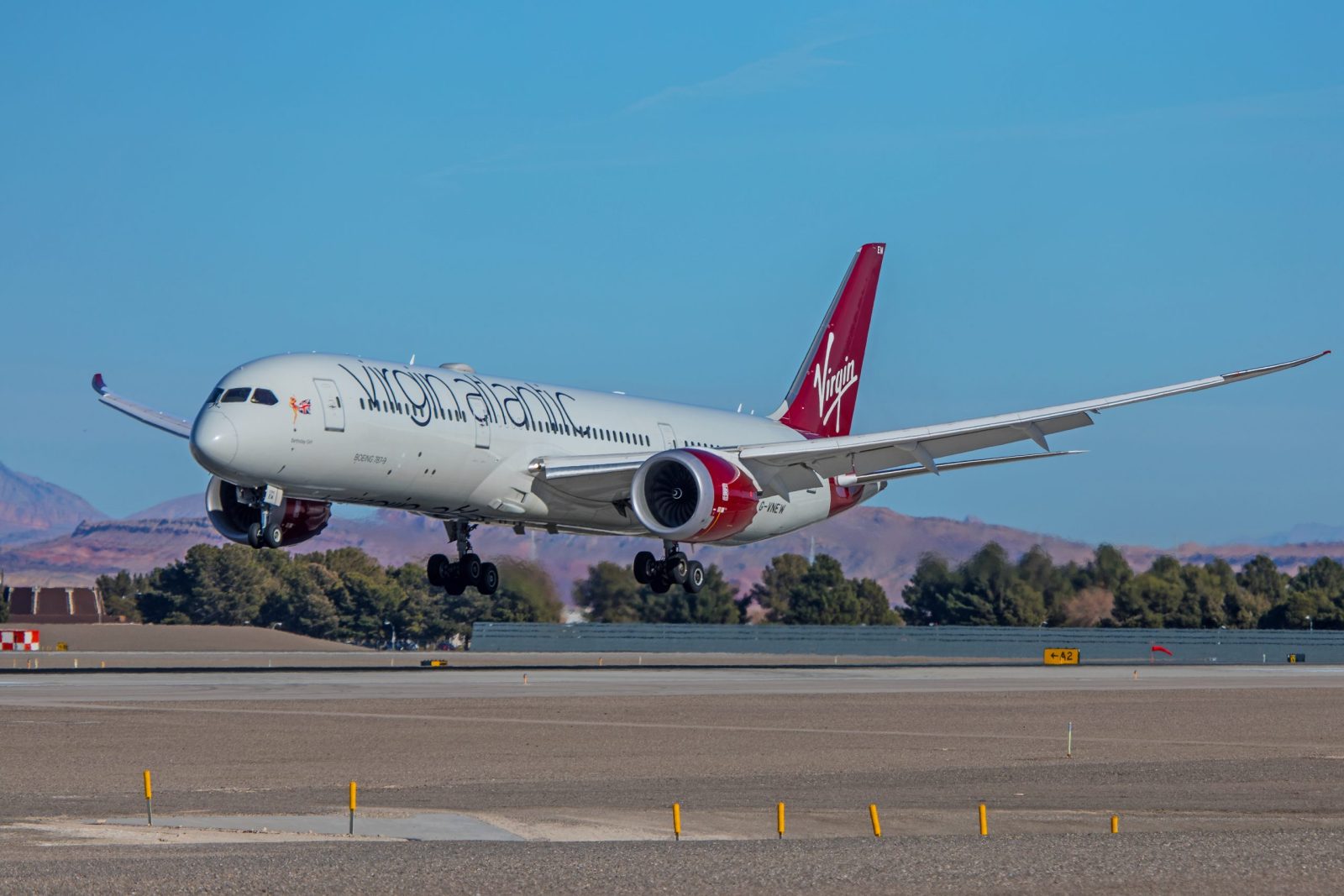
Virgin Atlantic’s standard livery is built around one color above all others: red. From its metallic red tail and engine nacelles to the smaller details found throughout the aircraft, the color has been a defining part of the British carrier’s identity since it began flying in 1984.
The current design pairs those red elements with a largely white fuselage and large “Virgin Atlantic” titles along the side of the aircraft. On the vertical stabilizer, the familiar handwritten-style Virgin logo appears against a metallic red background, providing the most prominent identifying feature when viewed from a distance.
Virgin Atlantic introduced the basic form of its current livery in 2010, replacing an earlier scheme that used a metallic silver fuselage. The redesign returned the airline to a predominantly white aircraft while introducing a more prominent version of the Virgin Atlantic wordmark and a deeper metallic finish on the tail and engines.
One of the smallest details is also among the most distinctive. For decades, Virgin Atlantic aircraft carried the “Flying Lady” near the nose, artwork inspired by the pin-up illustrations commonly associated with military aircraft. The figure became a longstanding part of the carrier’s visual identity and appeared in several variations as Virgin Atlantic introduced new aircraft.
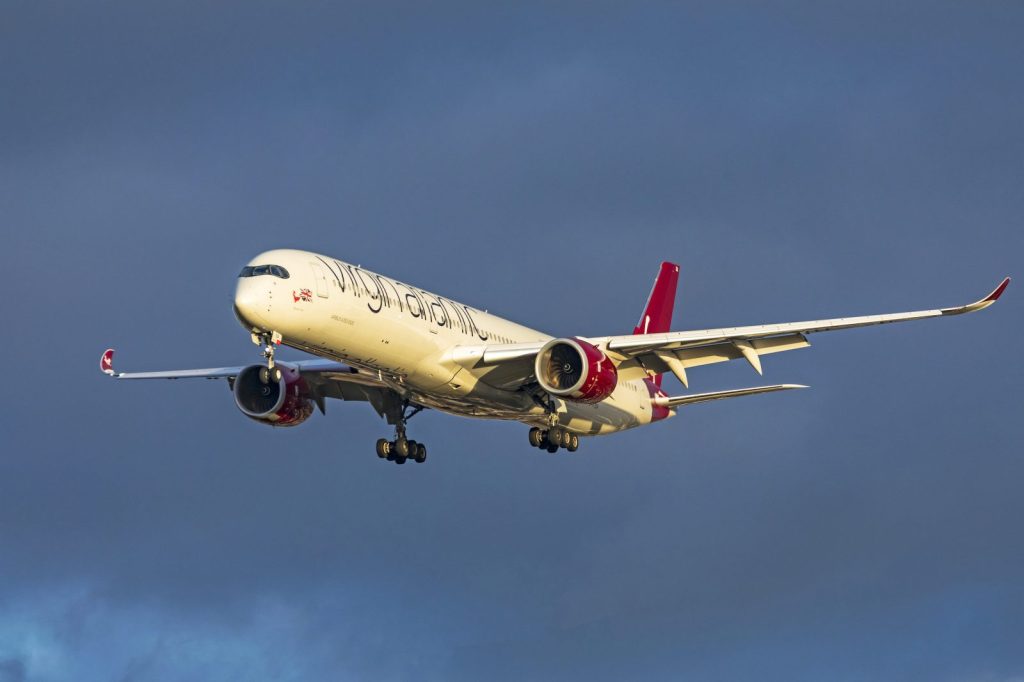
That tradition evolved again with the arrival of the Airbus A350-1000. In 2019, Virgin Atlantic began replacing the Flying Lady on new aircraft with a collection of “Flying Icons,” featuring a broader range of male and female characters. The airline said the change was intended to better represent modern Britain while preserving the tradition of displaying individual artwork near the nose.
Virgin has continued the concept on newer aircraft. Its A330neo named “Ruby Rebel,” for example, received a punk-inspired Flying Icon as part of the airline’s 40th anniversary celebrations in 2024.
Aircraft names provide another longstanding piece of the airline’s exterior identity. Virgin Atlantic has named its airplanes since its first Boeing 747, G-VIRG, was christened “Maiden Voyager.” The practice continues across the current fleet, with names including “Mamma Mia,” “Ruby Slipper,” “Queen of Hearts,” “Purple Rain,” and “Benny Jet.”
The standard livery now appears across an all-widebody fleet that includes Airbus A330s, A330neos, A350-1000s, and Boeing 787-9 Dreamliners. Although the proportions and placement of individual elements differ slightly between aircraft types, the white fuselage, metallic red tail and engines, and prominent Virgin branding remain consistent.
Those elements have survived several generations of Virgin Atlantic aircraft. Boeing 747s, Airbus A340s, and earlier A330s carried previous interpretations of the same basic identity before giving way to the carrier’s newer-generation fleet.
Looking for a new airplane model? Head over to our friends at the Midwest Model Store for a wide selection of airlines and liveries.