











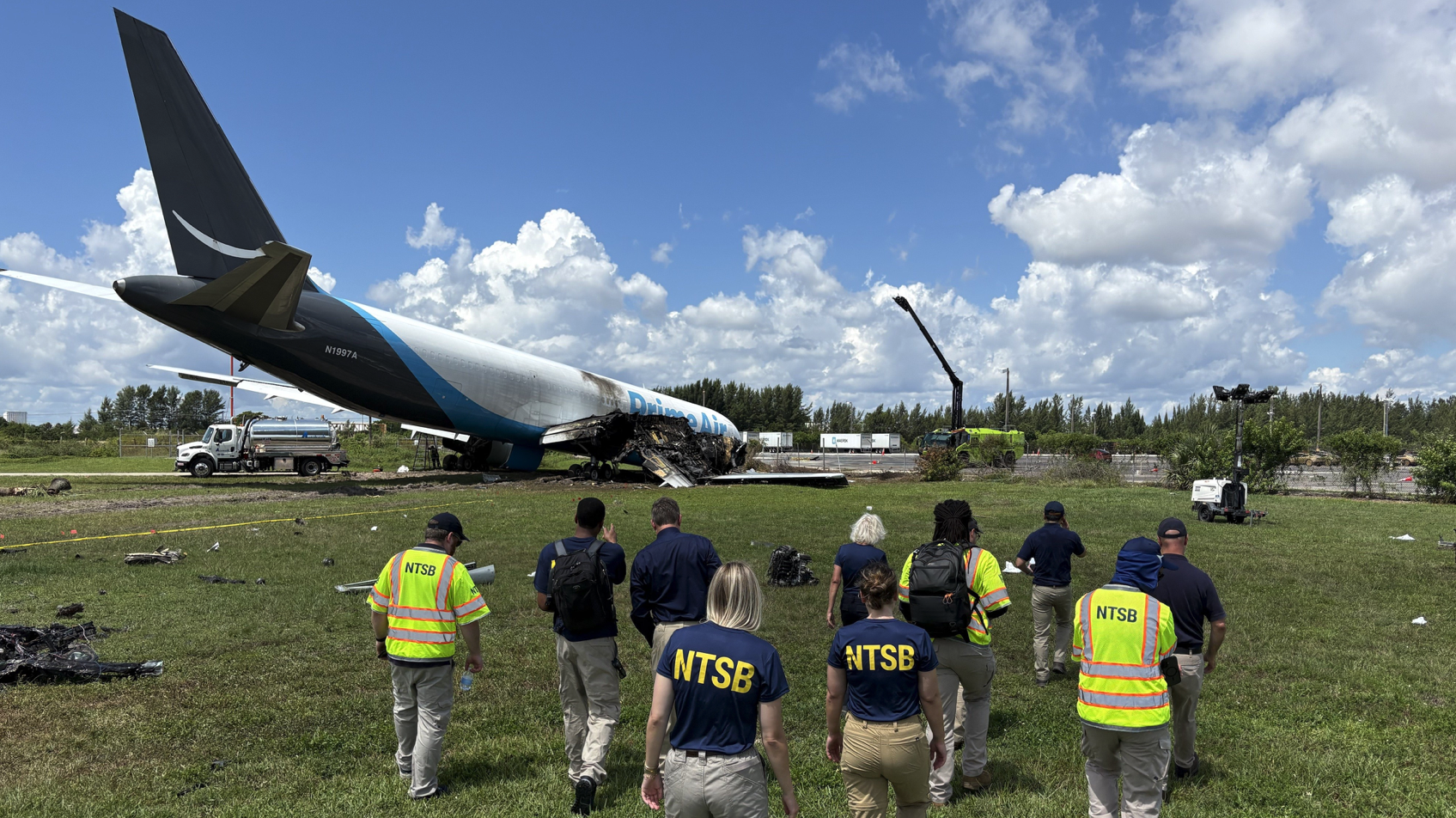


One of the pilots of an Amazon Prime Air cargo aircraft that overran a runway in Miami on Sunday warned multiple times that they were flying “too fast” in the minutes leading up to the botched touchdown, according to the NTSB.
The agency on Wednesday released a preliminary transcript of the Boeing 767’s cockpit voice recorder, which captured about two hours of good-quality audio from the accident flight. The transcript is not an exact reproduction of the pilots’ conversations, but a general description of their remarks with timestamps.
The NTSB said one pilot warned the other than they were coming in “too fast” about one minute and 42 seconds before the CVR recording ended. The pilot continued to comment on the aircraft’s “excessive speed” throughout the remainder of the recording, the agency said, but there was no “consistent verbal response” from the other pilot.
Also captured by the CVR were automated cockpit alerts, including “minimums,” “sink rate,” and “too low terrain.” The “too low” warning sounded four times, according to the transcript.
About 31 seconds before the recording ended, noises consistent with an aircraft touching down were heard. Sixteen seconds later, one of the pilots called for a go-around, but the jet “depart[ed] the paved surface” of the runway before it could lift off again.
The NTSB also shared data from the aircraft’s flight data recorder, which showed the 767 touched down with a ground speed of 134 knots. Seconds later, the brakes were released and throttles were increased “to a value consistent with go-around thrust.”
About 11 seconds before the FDR recording ended, throttles were reduced to idle power and the brakes were reapplied. The brakes remained engaged through the remainder of the recording, and the aircraft’s last recorded ground speed was 65 knots.
There was no indication that speed brakes or thrust reverses were deployed, the NTSB said.
Sunday’s crash at Miami International Airport killed five people and injured five others. All of the deceased were inside a van that was hit by the 767 as it barreled off the runway.
The two pilots were treated at an area hospital and released. Three other people, including two survivors from the van, remained hospitalized as of Thursday morning.
The NTSB, FAA, and authorities in Miami-Dade County are investigating the accident.