


Editor’s Note: AirlineGeeks is proud to present our ‘Livery of the Week’ series. Every Friday, a team member will share an airline livery, which can be from the past, present, or even a special scheme. Some airline liveries are works of art. The complexity associated with painting around critical flight components and the added weight requires outside-the-box thinking from designers. The average airliner can cost upwards of $200,000 to repaint, creating a separate aircraft repainting industry as a result.
Have an idea for a livery that we should highlight? Drop us a line.
Turkish Airlines’ standard livery is centered on a red tail featuring a stylized white bird, a design that has been part of the carrier’s identity since the early 1960s. Although the airline has updated its aircraft appearance several times, the emblem has remained a consistent feature as Turkish Airlines expanded its global network.
The bird is a wild goose, originally designed by Turkish graphic artist Mesut Manioğlu. In 1959, his design won a competition to create a new emblem for the airline, which officially adopted it in 1961.
The goose was selected partly because of its ability to fly long distances at high altitudes. Its shape also incorporates a less obvious detail: Viewed from different angles, the design resembles the letters T, H, and Y, representing Türk Hava Yolları, the airline’s name in Turkish.
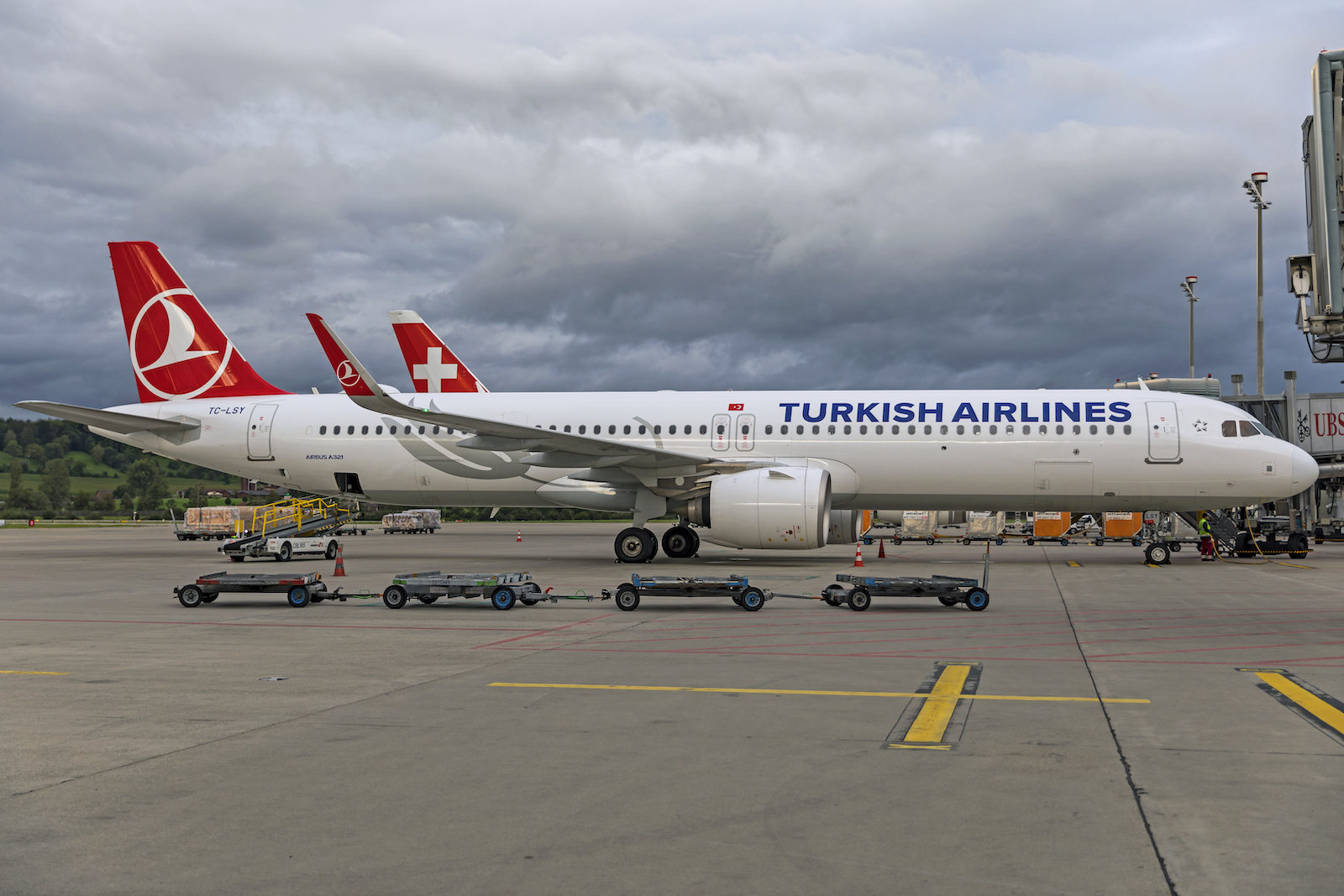
The current livery traces its origins to a redesign introduced in 2010. The scheme features a predominantly white fuselage with large dark-blue “TURKISH AIRLINES” titles along the forward section. A bright red vertical stabilizer carries the white goose emblem, enclosed within a circular outline.
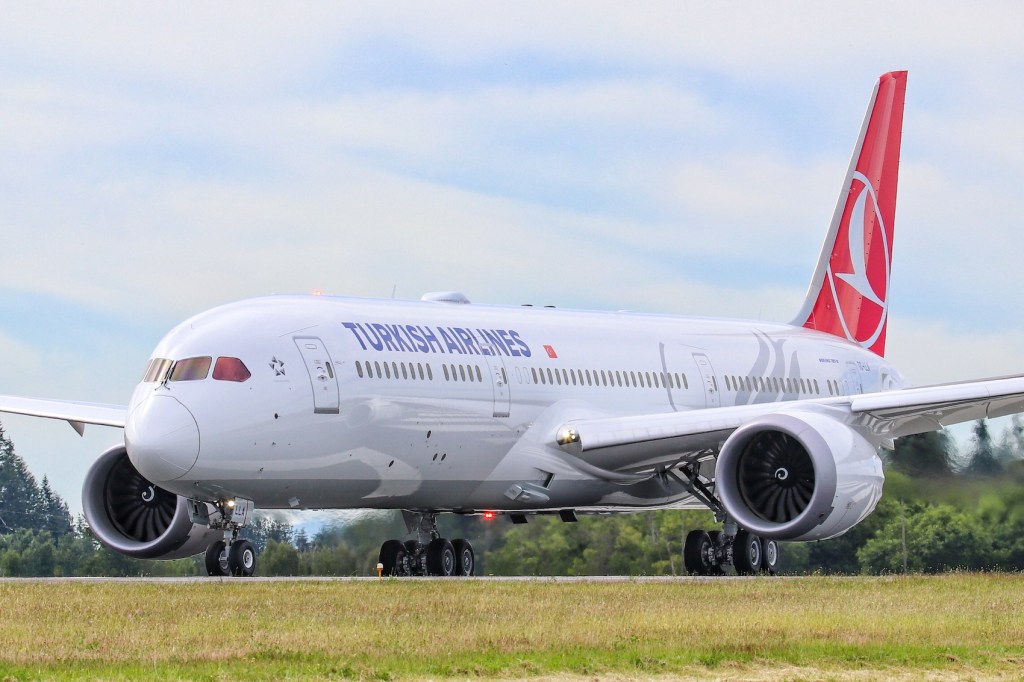
The aircraft’s lower fuselage is painted gray, providing a subtle contrast to the white upper section. Some aircraft also feature a gray tulip motif near the rear fuselage, a reference to a flower closely associated with Turkish culture and history.
Before the 2010 redesign, Turkish Airlines aircraft featured a similar red tail but used a different arrangement of fuselage titles. Earlier liveries included blue “Turkish” lettering with smaller gray “Airlines” text, along with variations of the tulip design introduced during the mid-2000s.
The current scheme has appeared on a wide variety of aircraft, including Boeing 737s, 777s, and 787 Dreamliners, along with Airbus A320-family jets, A330s and A350s. The same basic design is used across both narrowbody and widebody aircraft, with adjustments to accommodate differences in fuselage size.
Turkish Airlines has also introduced numerous special liveries over the years, including aircraft celebrating major sporting events, sponsorships and milestones in the carrier’s history. In 2026, the airline highlighted its 500th aircraft with a special design featuring photographs of thousands of employees and retirees.
Despite those variations, the red tail and white goose remain the most recognizable elements of Turkish Airlines’ aircraft. More than 65 years after Manioğlu created the original emblem, the design continues to represent the carrier on flights around the world.
Looking for a new airplane model? Head over to our friends at the Midwest Model Store for a wide selection of airlines and liveries.