









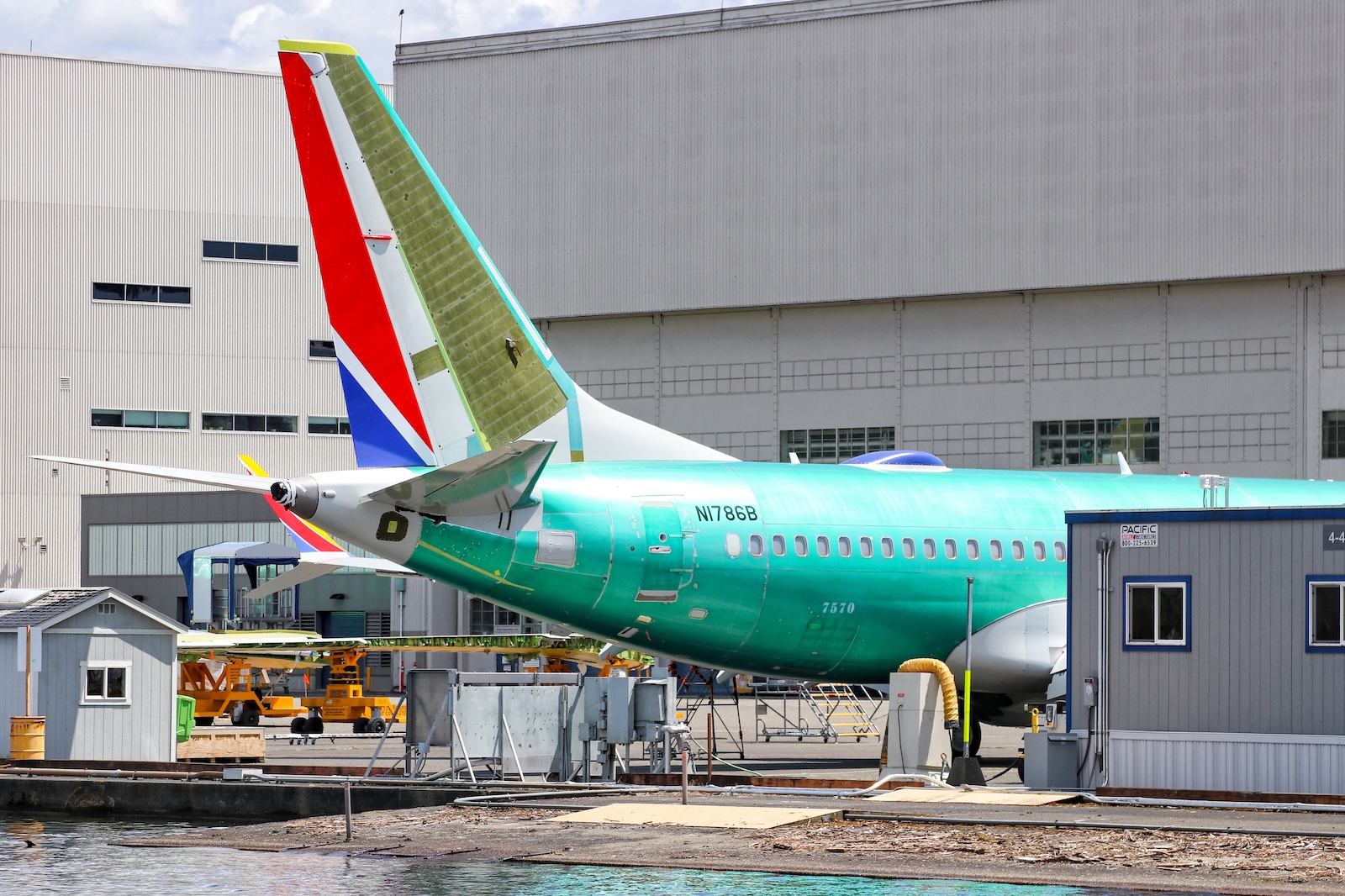

The Federal Aviation Administration (FAA) issued a safety alert to airlines Monday warning certain Boeing 737 rudders could become jammed or restricted.
In the FAA’s Safety Alert for Operators (SAFO) statement, the agency said that operators of Boeing 737 NG and 737 MAX jets equipped with Collins Aerospace SVO-730 RRGA should instruct flight crews that the rudder control system could become jammed or restricted in flight or during landing.
The FAA stated that this can occur due to moisture that could accumulate and freeze in the Rudder Rollout Guidance Actuator (RRGA).
“If the rudder restriction condition is encountered in flight, Boeing recommends flight crews follow the Jammed or Restricted Flight Controls Non-Normal Checklist (NNC),” the statement continued. “If this rudder restriction is encountered on the ground, use differential braking to maintain runway centerline. Avoid using nosewheel steering above 100 Knots Indicated Airspeed (KIAS) unless necessary for airplane control as a potential for overcontrol exists.”
The FAA also recommends that operators familiarize themselves with the information in Boeing’s Multi-Operator Message (MOM) 24-0142-02B. More on this is available in the full SAFO, which can be read here.
This safety alert comes after a rudder pedal anomaly occurred on a United 737 MAX 8 landing in Newark earlier this year. The National Transportation Safety Board (NTSB) investigating the incident issued urgent safety recommendations in September concerning the Collins Aerospace-supplied rudder control systems on Boeing 737 NG and 737 MAX aircraft.
NTSB Blasts FAA
A week later on September 30, NTSB Chairwoman Jennifer Homendy blasted the FAA in a letter for not taking the potential rudder jamming “more seriously.”
“Boeing’s August 23, 2024, Multi Operator Message stated that 353 affected actuator units were delivered to Boeing starting in February 2017,” Homendy stated in the letter, published on X/Twitter by CNN Correspondent Pete Muntean. “Of these 353 units, we understand that 73 have not yet been installed on airplanes. Another 271 affected actuators that may be installed on aircraft in service operated by at least 40 foreign air carriers; 16 may still be installed on US-registered aircraft. In addition to the 353 affected actuators Collins provided to Boeing, Collins sent 75 affected actuators directly to operators for aftermarket installation; some of these may be spares, while others may currently be on airplanes in service. Accordingly, it is essential that aftermarket installations of affected actuators also be clearly addressed.”
The letter went on to state NTSB’s concern that other airlines were unaware of the presence of these actuators on their 737 jets.
“Not making operators fully aware of the installed systems and equipment on the airplanes delivered to them is unacceptable and cannot continue to be tolerated,” the letter stated.
In a statement to The Hill following the safety alert, Boeing said that it “will continue to work under the oversight of regulators regarding the actuator on an optional autoland system on a subset of 737s.”
