










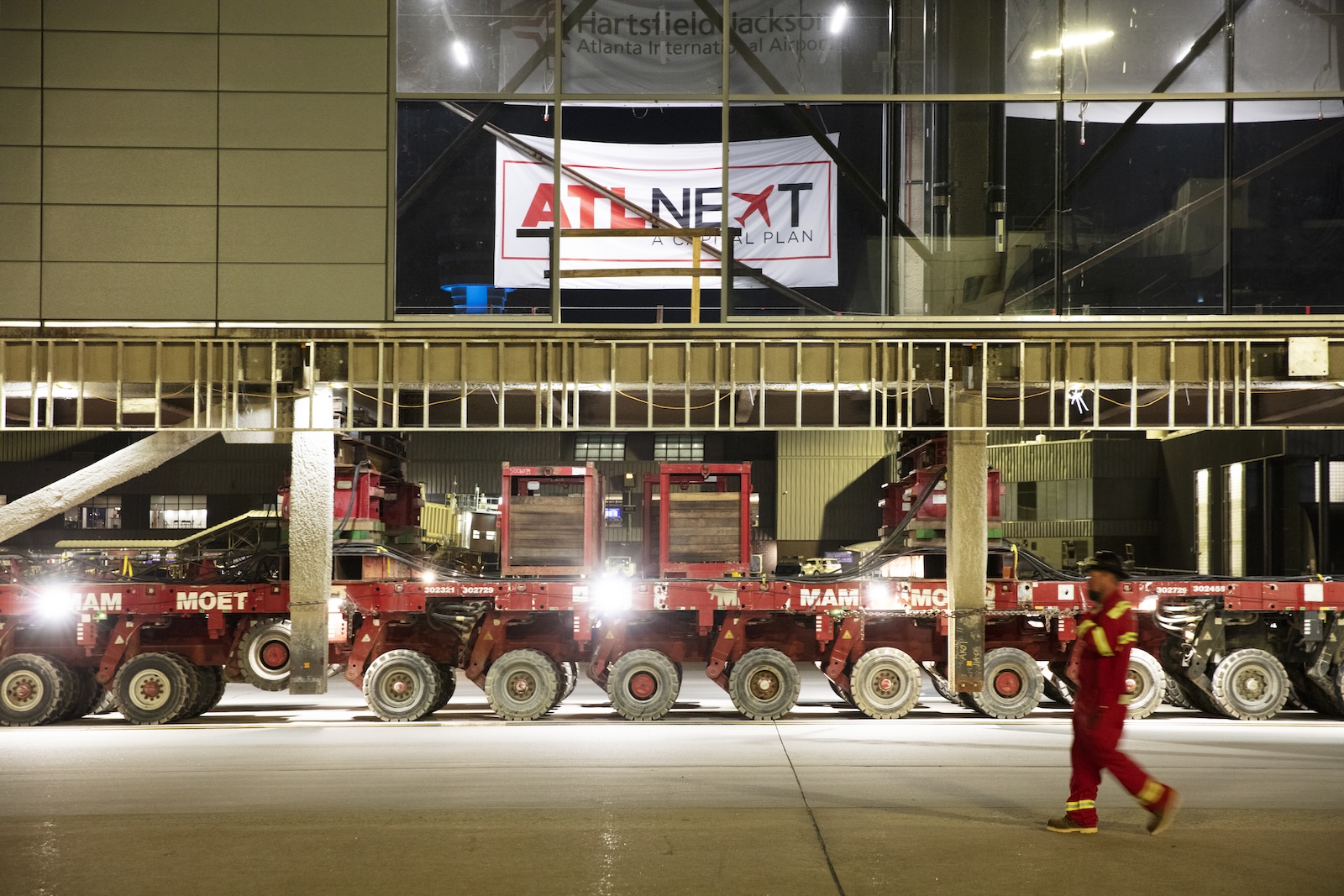

The busiest airport in the world is undergoing renovations with a unique construction method designed to keep airplanes – and travelers – moving.
In 2024, the Hartsfield-Jackson Atlanta International Airport had 62.7 million seats available, according to aviation analysts at OAG.
The airport plays a vital role to carriers like Delta, which plans to offer 1.1 million weekly seats from Atlanta for customers this summer.
Delta operates at all seven concourses in Atlanta, and it occupies 36 of the 40 gates at Concourse D. The airline had a clear interest in Concourse D’s long-needed renovation project – namely to keep flights moving while it happened.
So when the airport received $1.4 billion to begin widening Concourse D, architecture and design company Corgan was hired in partnership with Atlanta-based architecture firm Goode Van Slyke to help get the project done.
Most importantly to stakeholders, the concourse had to remain operational during renovations.
Creating a Solution
That would prove to be easier said than done.
Concourse D, built in the 1980s for small regional aircraft, was the narrowest of all ATL’s concourses, and Corgan was hired to expand the building size by nearly 60%.
At the behest of ATL’s Airport General Manager Balram Bheodari, and after gathering the input of carriers operating at the concourse, Corgan opted for a unique expansion method: modular construction.
This method, which would keep the airport fully operational while the concourse size was increased, had only been done at one other airport by another architectural company. While the option was more expensive to perform, the cost-benefit of keeping flights going for operators was worth it.
Modular construction allowed for Corgan to begin building giant modular sections near the airport grounds and move them as “building blocks” into new, expanded frames around the concourse.
Corgan used high-tech equipment and trailers called Self-Propelled Modular Transporters (SPMTs) to transport these 700-ton modular units after they were built. These moves have been carefully performed overnight while the ramp area is closed.
Construction started at the end of 2023. With a total of 19 modules and interior fit-outs planned, Corgan is aiming to complete the project by summer 2029.
Gopi Swaminathan, associate principal and project manager at Corgan, told AirlineGeeks in a virtual interview that this project has required a high degree of finesse due to the airport still operating.
“Modular construction is so much easier if they give us the whole conquest where we just go demo it, then we’ll put [the module units in],” Swaminathan said. “But the story with Atlanta is [that] keeping the gates live is the most important thing compared to what other airports are doing.”
“I don’t think DFW [the other airport that has opted for modular construction] had that kind of criteria in their program,” he continued. “… This has a lot more complexity, especially dealing with a building that is 45 years old.”
In January 2025, five 100×100 feet modules were installed at ATL, marking a major step forward for the project. Corgan stated on its website that once the project is completed, approximately 21,000 square feet of additional boarding space will be available in Concourse D.
