










Last week, ICAO Headquarters in Montréal hosted the Seventh Worldwide Air Transport Conference, where Member States and industry stakeholders gathered to set global policy priorities on aviation economic regulation, infrastructure financing, resilience, consumer protection and sustainable growth.
Over 1,500 delegates from 154 Member States and organizations attended the week-long event thirteen years after the Sixth Conference in 2013. They discussed high-level topics in commercial aviation: modernizing economic and legal frameworks, investing in infrastructure and skilled workforces, and ensuring that innovation keeps pace with rapidly changing technologies and global demands.
“Broad agreement was reached on the need for harmonized, risk-based, and proportionate economic regulation that facilitates the adoption of emerging technologies such as artificial intelligence, automation, sustainable aviation fuels, and advanced air mobility solutions,” ICAO said in a press release during the Conference.
Air transport development and sustainable growth
Participants agreed on the value of frameworks that support innovation and investment for economic development. They stressed this especially for smaller landlocked States, which depend heavily on air connectivity for growth.
The Conference supported modernizing air navigation infrastructure in line with ICAO’s Global Air Navigation Plan. It also supported liberalizing air services agreements without making liberalization conditional on infrastructure development, since new air links fostered by more liberal agreements are seen as key to economic growth.
However, all initiatives should be flexible enough to address local circumstances and should not burden developing States. ICAO’s statement continued: “The Conference also reaffirmed that international standards are key to building effective, market-enabling policies and avoiding fragmentation that could impede cross-border air services. Delegates pointed to ICAO’s Carbon Offsetting and Reduction Scheme for International Aviation (CORSIA) as a successful example of this approach.”
Consumer protection laws
Participants were asked to express their views on the documentation proposing various initiatives with regards to consumer protection legislations that have become an integral part of the legal framework for all air operators.
At the Sixth Worldwide Air Transport Conference in March 2013, ICAO was asked to develop Core Principles on consumer protection. The final document, adopted by the ICAO Council in 2015, contains provisions on:
- Informed purchasing and transparent information before travel;
- Information, assistance and accessibility during travel;
- Effective complaint handling after travel.
The report for the Seventh Conference invites States to modernize their consumer-protection frameworks, keeping them evidence-based, proportionate, accessible and responsive to the changing realities of commercial air transport. It also says legislation should establish clear responsibilities for carriers, intermediaries and other providers regarding information, complaints and disruption assistance.
ICAO is expected to review its Core Principles while preserving national and regional flexibility. It is also expected to assess whether existing policies adequately cover online intermediaries and other overlooked situations.
Many Member States cautioned against the ICAO Air Passenger Handbook proposed by IATA, because producing and maintaining a single repository covering many different national laws would be too costly.
Guidance on the use of AI
The Conference asked ICAO to “examine the need for harmonized, risk-based guidance on the use of AI in aviation, including common terminology and meaningful human oversight.”
The rapid development of AI and its unknown effects on aviation operations is a topic Member States will need to monitor. ICAO will coordinate and facilitate international exchange, while States will oversee implementation to ensure that the technologies adopted are secure, interoperable and consistent with cybersecurity and data-protection objectives.
ICAO will handle AI within its existing structure, as the proposal to create an ad hoc unit was not supported.
Four new ICAO Council members
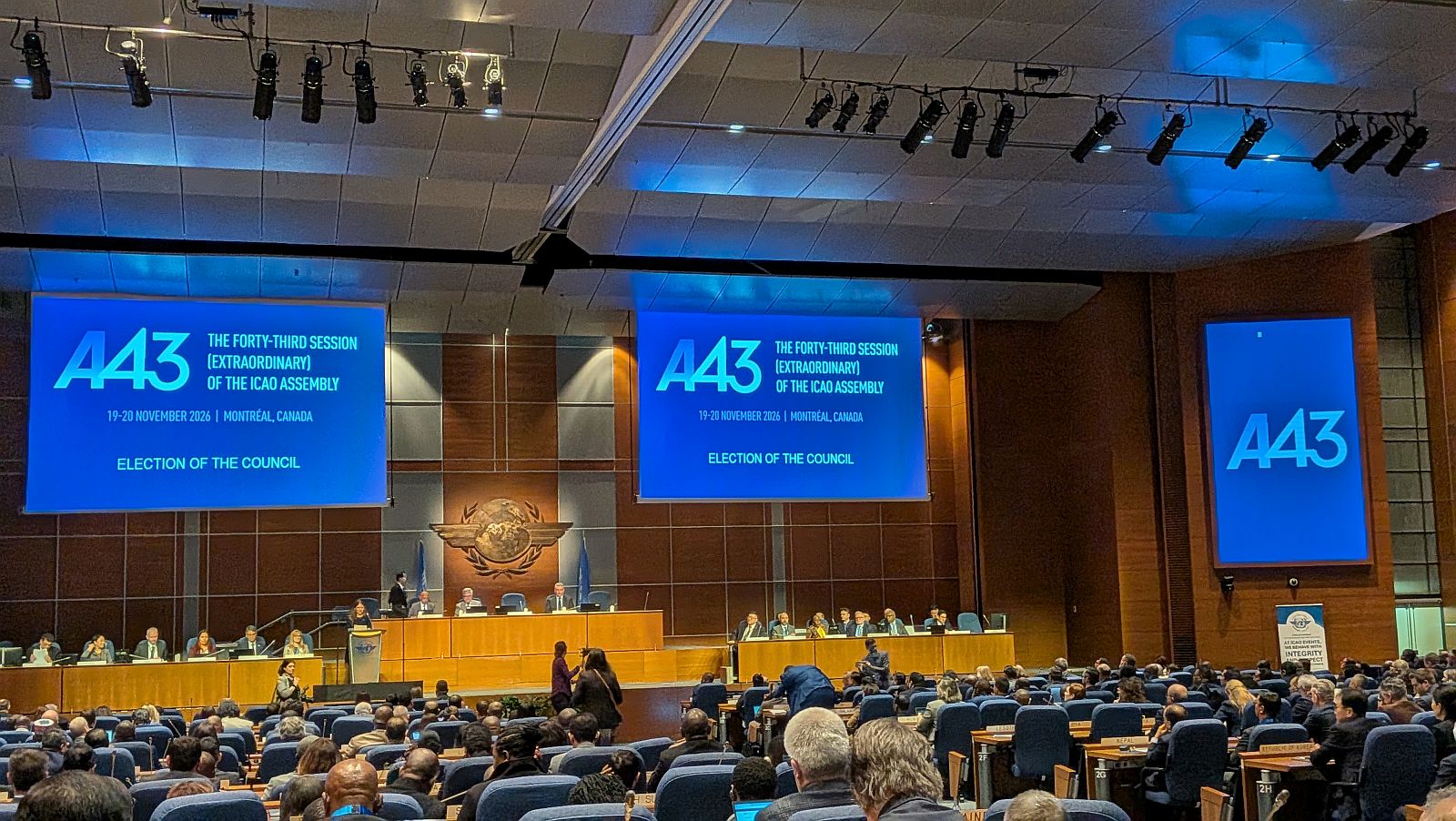
During the final two days of the Conference, ICAO held an Extraordinary Session of its Assembly to elect the four additional Council members required by the entry into force of the 2013 protocol amending the Convention on International Civil Aviation. The Council is the Organization’s permanent governing body, accountable to the Assembly and responsible for setting priorities and implementing its directions. Its membership increased from 36 to 40, and there are no permanent seats.
Six candidates competed for the four new seats: Ethiopia, Indonesia, Kazakhstan, Oman, Thailand and Türkiye. In the vote on the final day, Kazakhstan and Thailand were not elected, and the other four States won seats.
The Council now comprises Angola, Argentina, Australia, Belize, Brazil, Canada, China, Colombia, Cuba, Denmark, Ecuador, Egypt, Equatorial Guinea, Ethiopia, France, Germany, India, Indonesia, Italy, Japan, Malaysia, Mali, Mexico, Morocco, Nigeria, Oman, Poland, Qatar, the Republic of Korea, Saudi Arabia, Singapore, South Africa, Spain, Switzerland, Türkiye, Uganda, the United Arab Emirates, the United Kingdom, the United States and Uruguay.
The next elections will take place at the General Assembly in September 2028.