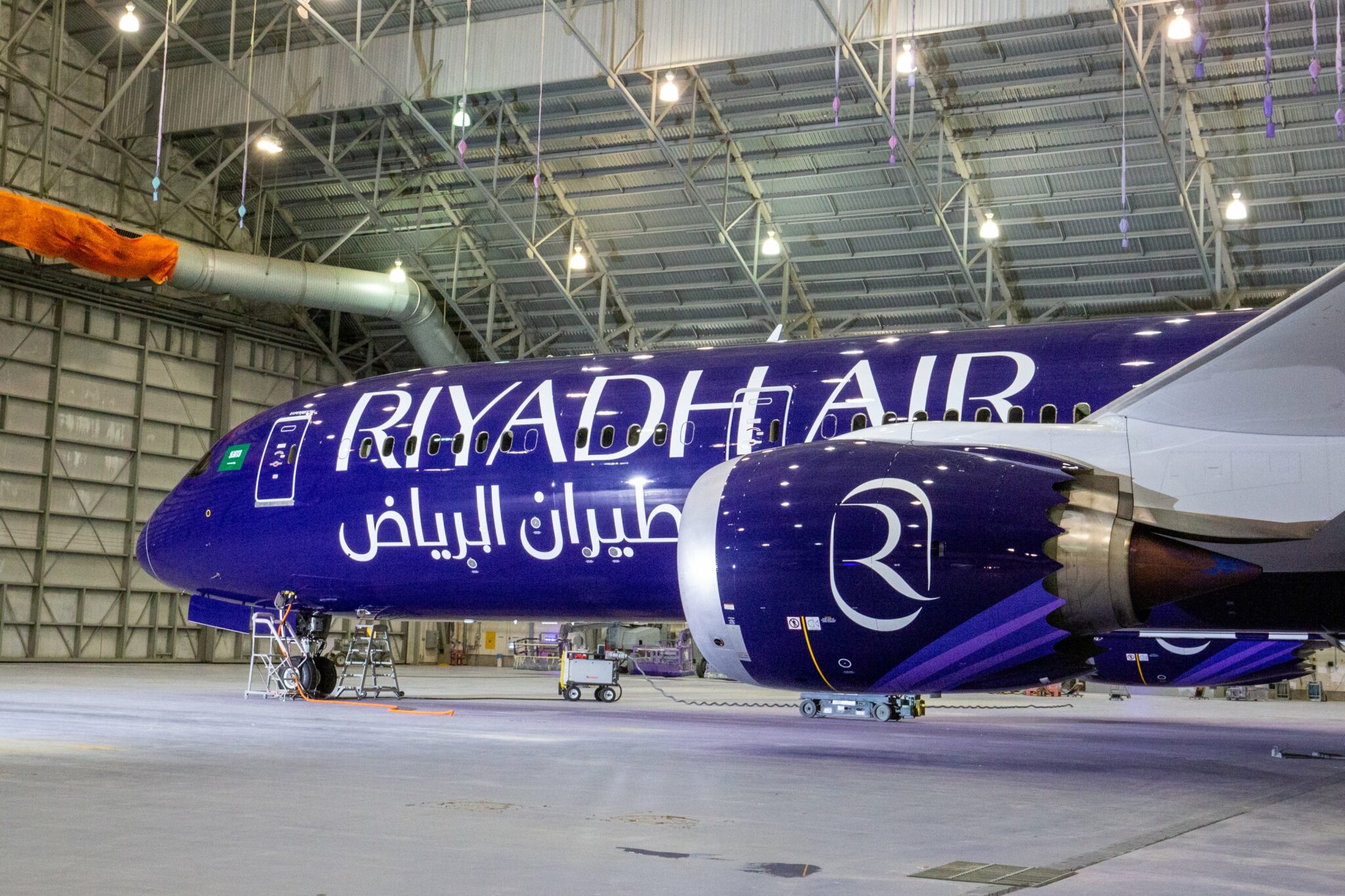
The fuselage of a Riyadh Air Boeing 787 Dreamliner. (Photo: Riyadh Air)
Saudi carriers Riyadh Air and Saudia this week launched the first phase of a strategic partnership intended to improve connectivity within the kingdom and beyond.
Riyadh Air’s code will now appear on six Saudia-operated routes to and from King Khalid International Airport in Riyadh, Riyadh Air’s main hub. The connections serve Abha, Al Qassim, Dammam, Jeddah, Medina, and Tabuk, all in Saudi Arabia.
With codesharing in place, passengers will be able to book a domestic flight to Riyadh on Saudia and an international flight on Riyadh Air with a single ticket, officials said. The same applies for passengers flying into Saudi Arabia via Riyadh Air, then traveling to one of the six included cities with Saudia.
“By placing its RX code on Saudia’s frequent daily flights between Riyadh and the six destinations covered by the codeshare, Riyadh Air will be able to ensure that its guests have the most convenient possible connecting option tailored to the arrival or departure time of their Riyadh Air flight at RUH,” Riyadh Air said in a news release. “With both carriers operating under one roof in the KKIA Terminal 1-4 complex, connecting guests will experience swift, single-ticket transits with luggage checked through to their final destination.”
Riyadh Air and Saudia both serve as flag carriers of Saudi Arabia, though Saudia is much older and more established. Riyadh Air was formed in 2023 and only launched full commercial operations this summer.
The two airlines signed a strategic cooperation agreement in 2023 laying the groundwork for future codesharing and coordination on routes.
Riyadh Air currently serves London Heathrow, Jeddah, Dubai, Cairo, Manchester, and Madrid.
Zach Vasile is a writer and editor covering news in all aspects of commercial aviation. He has reported for and contributed to the Manchester Journal Inquirer, the Hartford Business Journal, the Charlotte Observer, and the Washington Examiner, with his area of focus being the intersection of business and government policy.
American Sets Date for Return to Caracas
The carrier suspended service in June following two disastrous earthquakes.
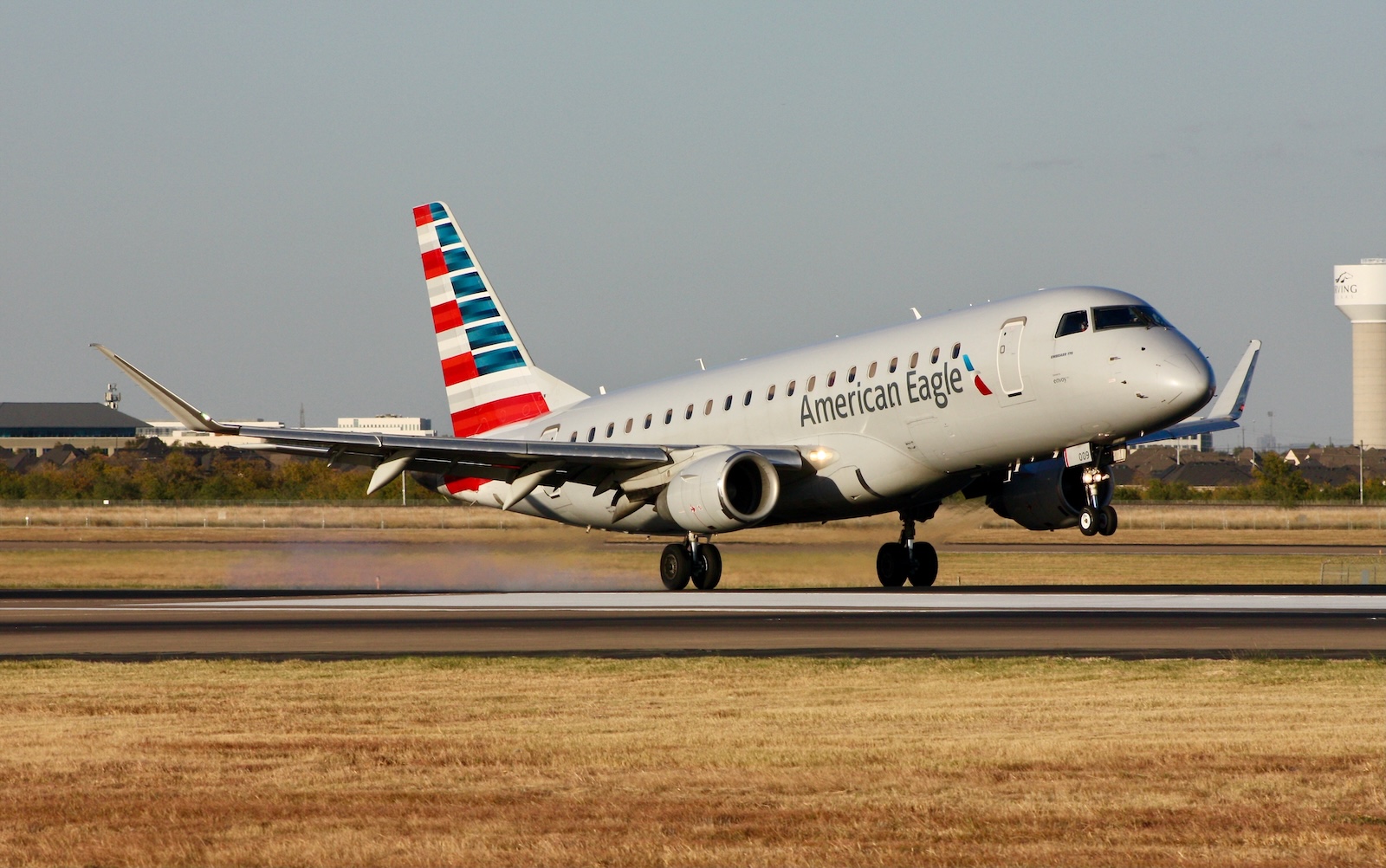
An American Eagle E175. (Photo: Shutterstock | Austin Deppe)
American Airlines will restart flights to and from Caracas next week, about two months after a pair of earthquakes killed thousands of people and badly damaged Venezuela’s main international airport.
The carrier confirmed to AirlineGeeks that service between Miami and Caracas will resume Sept. 3, provided Maiquetía International Airport is open and operating as normal. Flights will operate daily, as they did before the suspension of service on June 24.
American had only recently relaunched service to Venezuela when the earthquakes struck. It became the first U.S. carrier to return to the country on April 30, following the semi-normalization of relations between Washington and Caracas.
Prior to that, no U.S. passenger or cargo airline had served Venezuela since 2019 due to a federal ban.
American launched service to Maracaibo, Venezuela, on July 14, and has continued to operate that connection. It also flew humanitarian aid into Caracas on July 2.
No other U.S. passenger airline currently serves Venezuela. United had planned to revive its Houston-Caracas connection in August, but the route was put on hold after the earthquakes.
Zach Vasile is a writer and editor covering news in all aspects of commercial aviation. He has reported for and contributed to the Manchester Journal Inquirer, the Hartford Business Journal, the Charlotte Observer, and the Washington Examiner, with his area of focus being the intersection of business and government policy.
United Schedules First A321XLR Routes
The long-range narrowbody will fly to two California cities before entering transatlantic service.
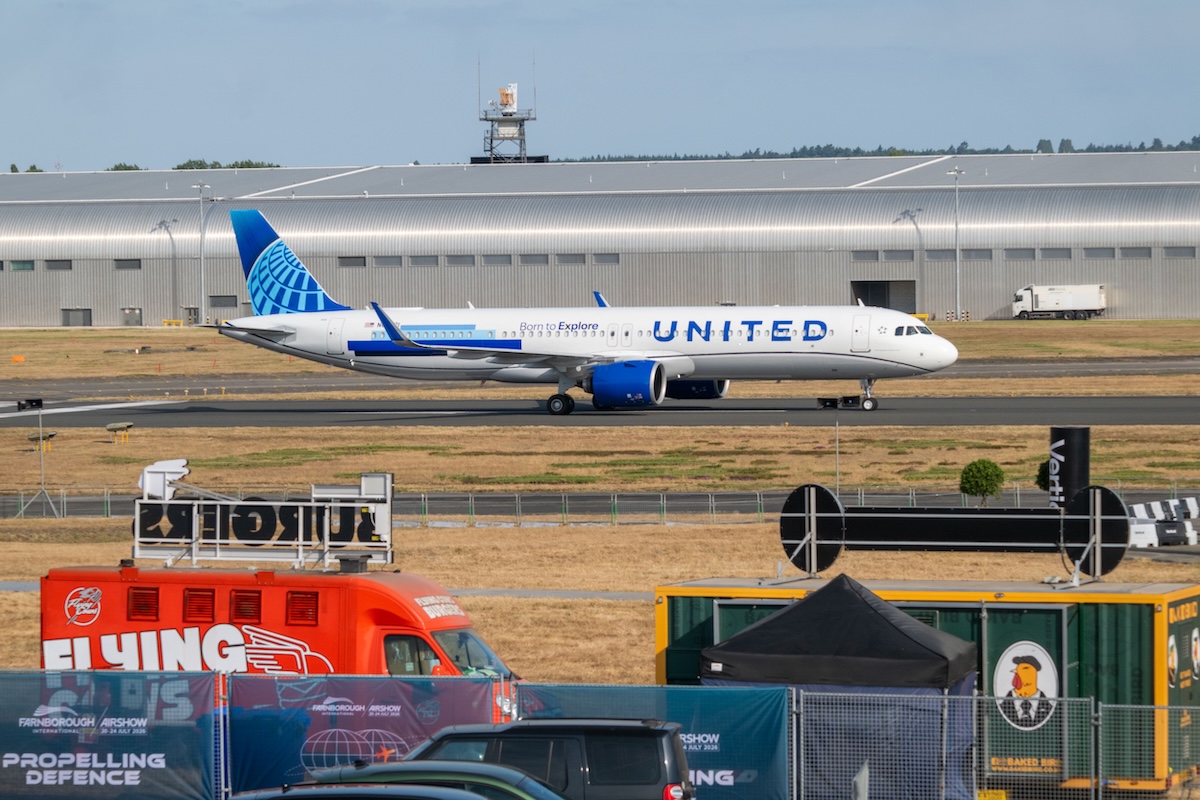
United has scheduled the first domestic routes for its new Airbus A321XLR ahead of the aircraft’s planned September debut.
Beginning Sept. 9, the A321XLR is slated to operate between Washington Dulles and San Diego. That assignment will continue through Nov. 30.
The aircraft will also operate between Dulles and Los Angeles from Oct. 1 through Nov. 30, according to a United spokesperson. Tickets for both routes are now on sale.
The A321XLR is scheduled to transition to transatlantic flying on Dec. 1, serving Amsterdam and Dublin from Dulles.
United took delivery of its first A321XLR in June. The carrier has 50 of the long-range aircraft on order, which will gradually replace its aging Boeing 757 fleet.
Ryan founded AirlineGeeks.com in February 2013 and has spent more than a decade covering the airline business. His work has been featured by CNN, WJLA, CNET, and Business Insider. His aviation experience spans airport operations, Part 135 regulatory compliance, and airline crew workforce planning, along with time behind the yoke of a Cessna 172 and interviews with airline executives. Ryan now serves as Group President of Firecrown Media’s Aviation Group. He holds a B.S. in Air Transportation Management and an MBA from Arizona State University and teaches Airline Management at Embry-Riddle Aeronautical University.
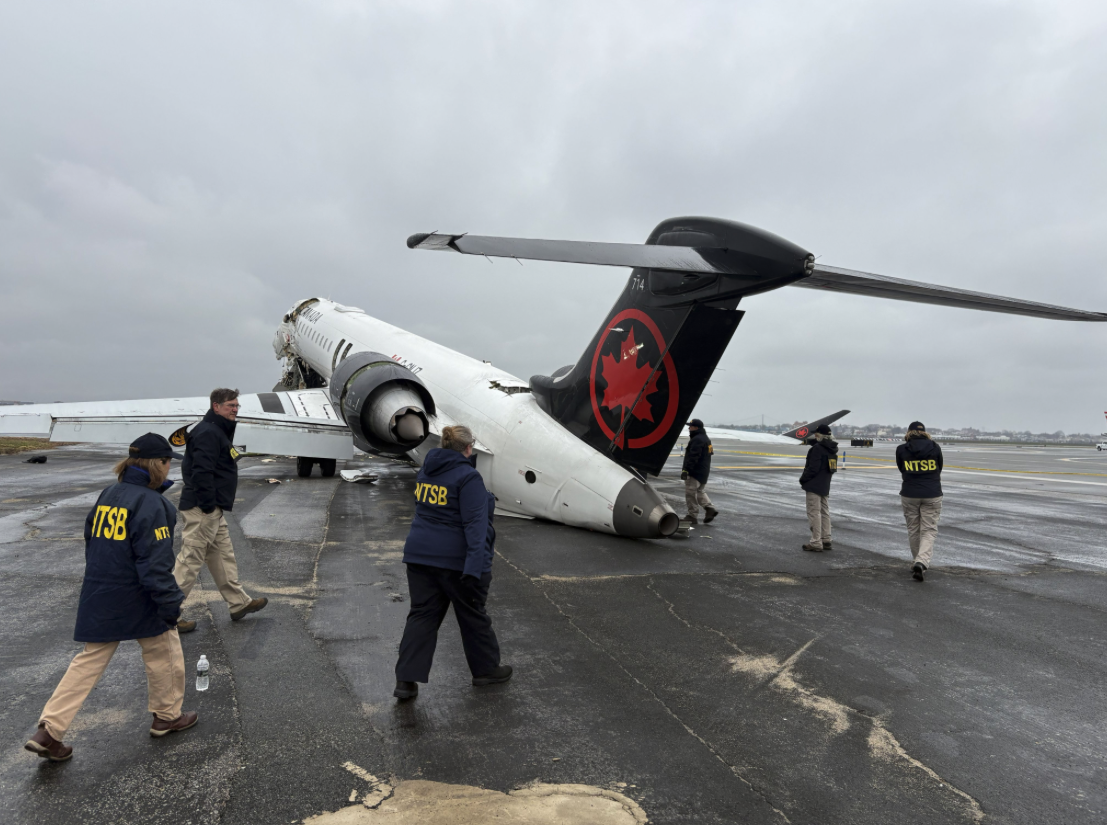
NTSB investigators walk the scene of the March 22 collision between an Air Canada Express plane and a firefighting vehicle on Runway 4 at LaGuardia Airport. (Photo: NTSB)
Citing sources familiar with the matter, the newspaper said the FAA is moving to fire the two controllers. They allegedly left their shifts about an hour early on March 22, leaving two remaining controllers with no backup on a busy night.
The Journal did not identify the controllers. Both are believed to be on leave.
“The FAA is committed to holding employees accountable, and we will not compromise the safety or efficiency of the National Airspace System,” the FAA said in a statement. “At the same time, we are strengthening our workforce at a record pace, with more than 2,000 controllers hired in 2026, the most in a single year and 20% more than in 2024.”
Air Canada Express Flight 8646 collided with an airport firefighting truck while landing at LaGuardia after a flight from Montreal. The crash destroyed the Bombardier CRJ900’s cockpit and killed the two pilots. Thirty-nine others, including passengers on the aircraft and the occupants of the fire truck, were injured.
The truck was heading for a United aircraft that had aborted a takeoff because of a strange smell on board. The vehicle was cleared to cross the runway where the Air Canada jet was landing.
Air traffic control recordings indicate a controller attempted to get the truck to stop, but the warning came too late to avert a collision.
Zach Vasile is a writer and editor covering news in all aspects of commercial aviation. He has reported for and contributed to the Manchester Journal Inquirer, the Hartford Business Journal, the Charlotte Observer, and the Washington Examiner, with his area of focus being the intersection of business and government policy.
Livery of the Week: Virgin Atlantic
The British carrier’s red tail, metallic accents, and distinctive nose art have evolved alongside the airline for more than four decades.
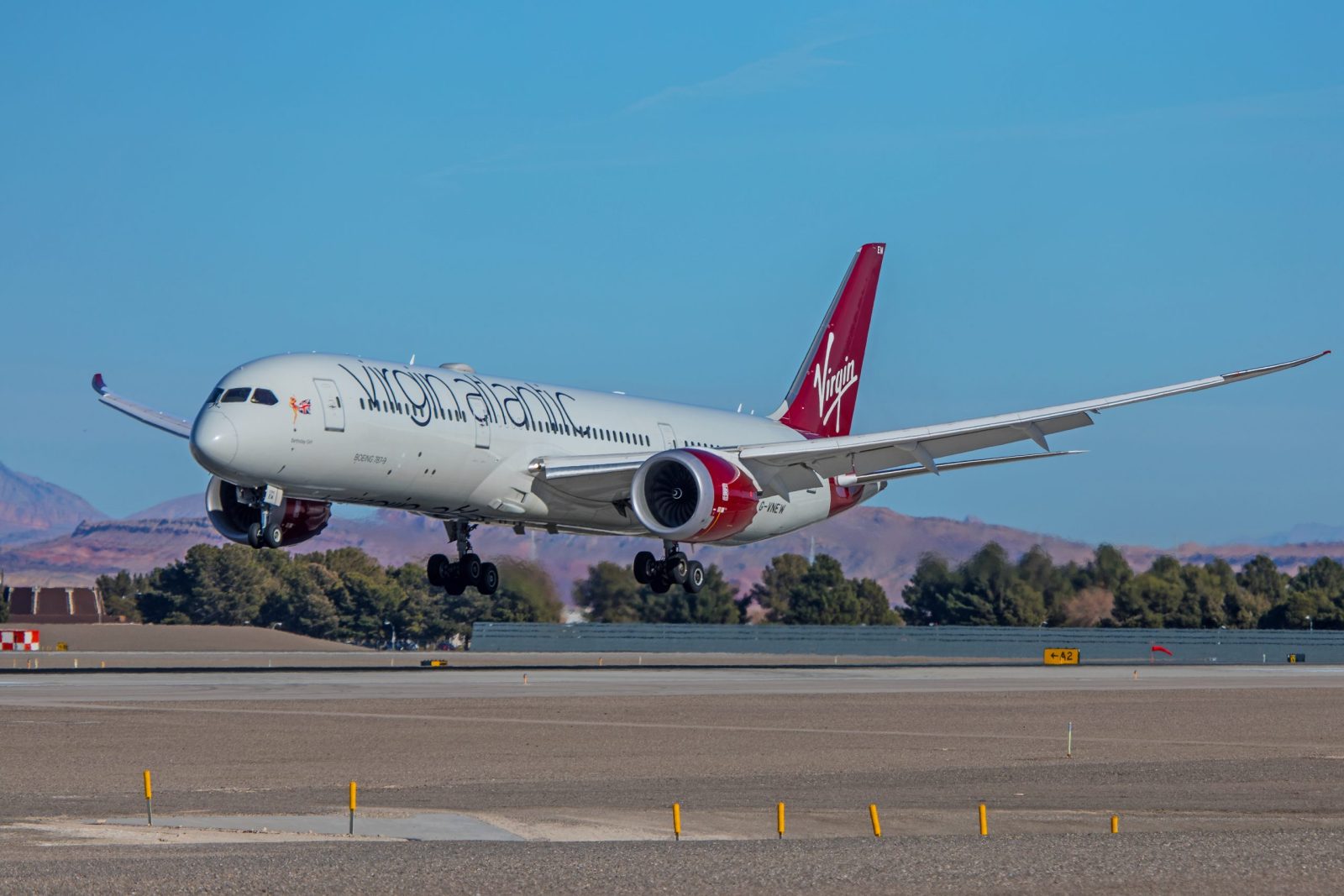
A Virgin Atlantic Boeing 787 Dreamliner seconds from touchdown in Las Vegas.
(Photo: AirlineGeeks | William Derrickson)
Editor’s Note: AirlineGeeks is proud to present our ‘Livery of the Week’ series. Every Friday, a team member will share an airline livery, which can be from the past, present, or even a special scheme. Some airline liveries are works of art. The complexity associated with painting around critical flight components and the added weight requires outside-the-box thinking from designers. The average airliner can cost upwards of $200,000 to repaint, creating a separate aircraft repainting industry as a result.
Have an idea for a livery that we should highlight? Drop us a line.
Virgin Atlantic’s standard livery is built around one color above all others: red. From its metallic red tail and engine nacelles to the smaller details found throughout the aircraft, the color has been a defining part of the British carrier’s identity since it began flying in 1984.
The current design pairs those red elements with a largely white fuselage and large “Virgin Atlantic” titles along the side of the aircraft. On the vertical stabilizer, the familiar handwritten-style Virgin logo appears against a metallic red background, providing the most prominent identifying feature when viewed from a distance.
Virgin Atlantic introduced the basic form of its current livery in 2010, replacing an earlier scheme that used a metallic silver fuselage. The redesign returned the airline to a predominantly white aircraft while introducing a more prominent version of the Virgin Atlantic wordmark and a deeper metallic finish on the tail and engines.
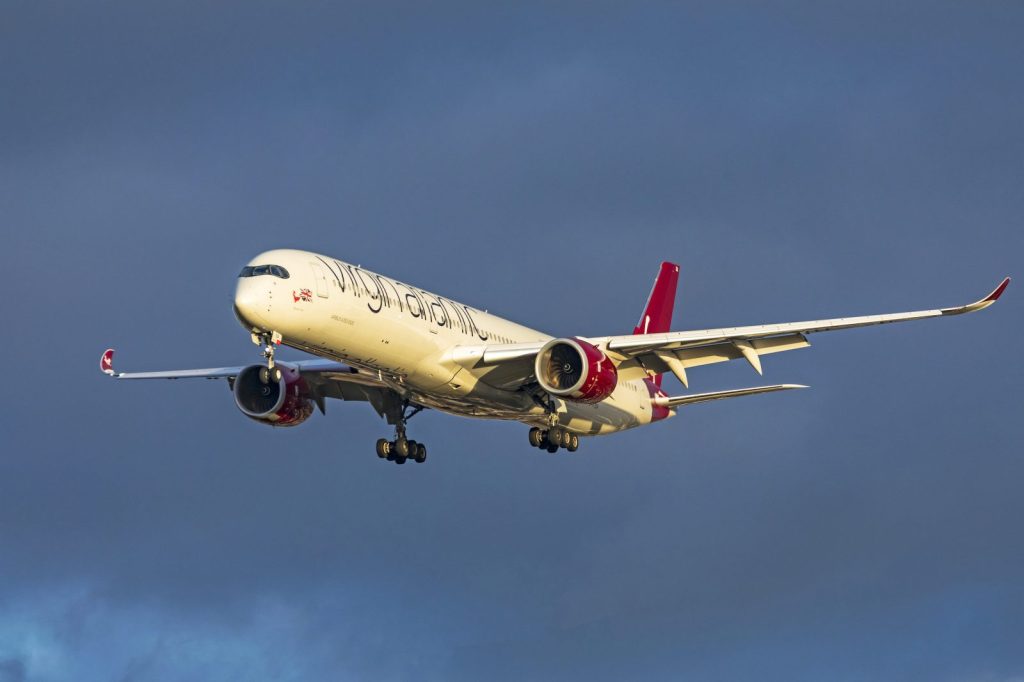
A Virgin Atlantic A350-1000. (Photo: AirlineGeeks | William Derrickson)
One of the smallest details is also among the most distinctive. For decades, Virgin Atlantic aircraft carried the “Flying Lady” near the nose, artwork inspired by the pin-up illustrations commonly associated with military aircraft. The figure became a longstanding part of the carrier’s visual identity and appeared in several variations as Virgin Atlantic introduced new aircraft.
That tradition evolved again with the arrival of the Airbus A350-1000. In 2019, Virgin Atlantic began replacing the Flying Lady on new aircraft with a collection of “Flying Icons,” featuring a broader range of male and female characters. The airline said the change was intended to better represent modern Britain while preserving the tradition of displaying individual artwork near the nose.
Virgin has continued the concept on newer aircraft. Its A330neo named “Ruby Rebel,” for example, received a punk-inspired Flying Icon as part of the airline’s 40th anniversary celebrations in 2024.
Aircraft names provide another longstanding piece of the airline’s exterior identity. Virgin Atlantic has named its airplanes since its first Boeing 747, G-VIRG, was christened “Maiden Voyager.” The practice continues across the current fleet, with names including “Mamma Mia,” “Ruby Slipper,” “Queen of Hearts,” “Purple Rain,” and “Benny Jet.”
The standard livery now appears across an all-widebody fleet that includes Airbus A330s, A330neos, A350-1000s, and Boeing 787-9 Dreamliners. Although the proportions and placement of individual elements differ slightly between aircraft types, the white fuselage, metallic red tail and engines, and prominent Virgin branding remain consistent.
Those elements have survived several generations of Virgin Atlantic aircraft. Boeing 747s, Airbus A340s, and earlier A330s carried previous interpretations of the same basic identity before giving way to the carrier’s newer-generation fleet.
Looking for a new airplane model? Head over to our friends at the Midwest Model Store for a wide selection of airlines and liveries.
Ryan founded AirlineGeeks.com in February 2013 and has spent more than a decade covering the airline business. His work has been featured by CNN, WJLA, CNET, and Business Insider. His aviation experience spans airport operations, Part 135 regulatory compliance, and airline crew workforce planning, along with time behind the yoke of a Cessna 172 and interviews with airline executives. Ryan now serves as Group President of Firecrown Media’s Aviation Group. He holds a B.S. in Air Transportation Management and an MBA from Arizona State University and teaches Airline Management at Embry-Riddle Aeronautical University.
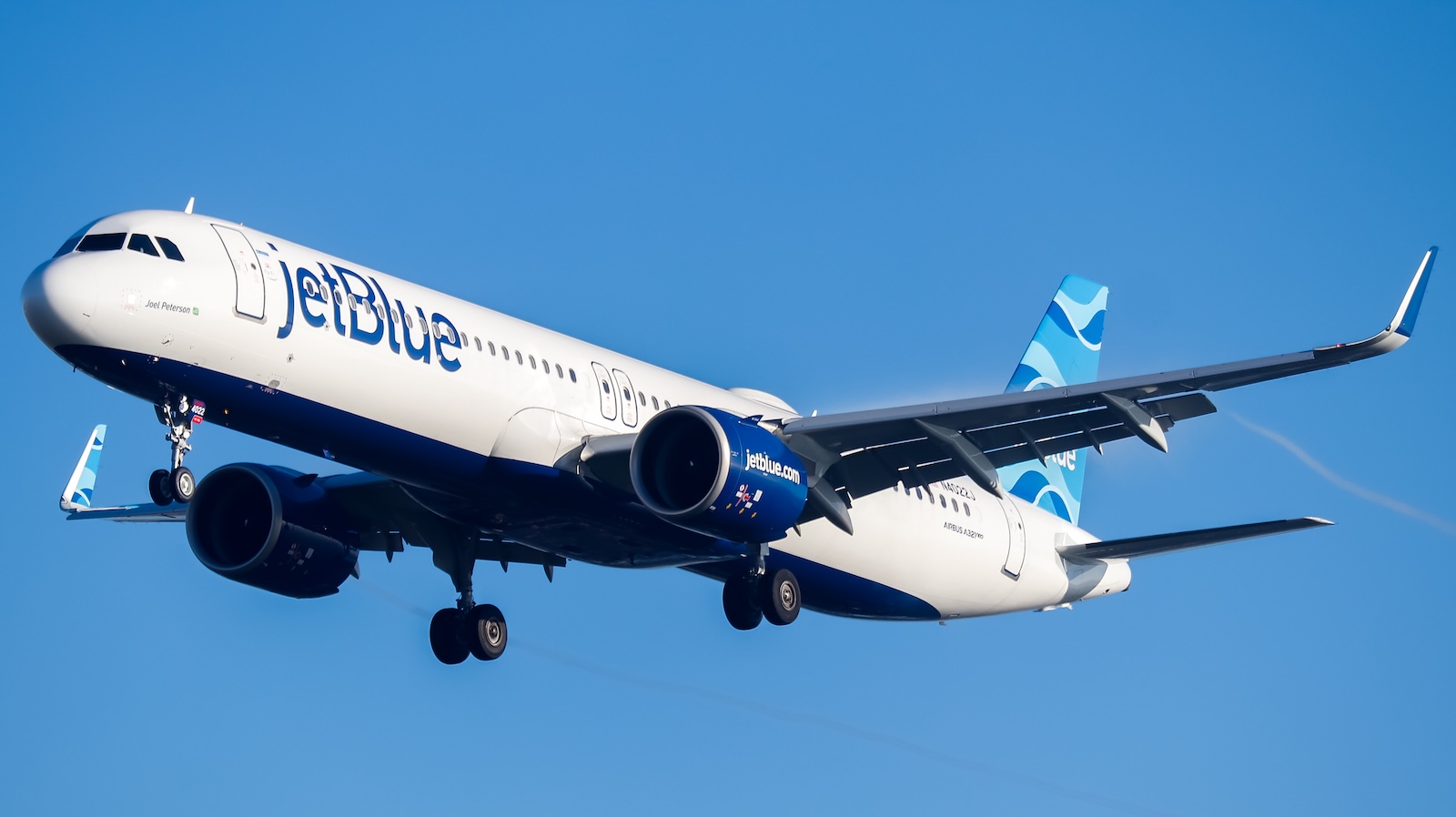
A JetBlue A321LR in London. (Photo: Shutterstock | Bradley Caslin)
Two representatives of businessman and investor Carl Icahn are departing JetBlue’s board of directors after his company, Icahn Enterprises, cut its investment in the airline.
JetBlue announced Thursday that Jesse Lynn and Steven Miller have stepped down “effective immediately.” The carrier said their resignations are in line with an agreement with Icahn Enterprises requiring “a minimum beneficial ownership of the company’s outstanding shares” to maintain representation on the board.
Icahn Enterprises once owned 10% of JetBlue, but that stake has been cut to around 3.3%, recent regulatory filings show. According to Reuters, Icahn notified the airline ahead of time that he was reducing his investment below the threshold needed to hold his board seats.
Lynn and Miller joined JetBlue’s board in 2024. Lynn is general counsel of Icahn Enterprises, and Miller is portfolio manager of Icahn Capital.
At the time, Icahn viewed JetBlue as potentially undervalued. He is well known for investing in companies and then pushing for changes to improve profitability.
Icahn Enterprises did not say why it has reduced its stake in JetBlue, but the airline’s recent struggles are well known. It has not posted a full-year net profit since 2019, and higher fuel prices stemming from the Iran war have bogged down turnaround efforts.
“We appreciate the constructive contributions of Jesse and Steven as we established and began to execute our JetForward strategy,” JetBlue CEO Joanna Geraghty said in a news release. “Two years into JetForward, we’re encouraged by the progress we’re making and the results we’re driving across the business, and we have demonstrated our confidence in our value creation opportunity through our 2028 EPS target.”
“We appreciate the constructive partnership with JetBlue over the years as they have reshaped the airline and we look forward to seeing them continue to successfully execute the JetForward strategy,” Icahn said in a statement.
With Lynn and Miller gone, JetBlue’s board will be reduced from 13 members to 11, JetBlue officials said.
Zach Vasile is a writer and editor covering news in all aspects of commercial aviation. He has reported for and contributed to the Manchester Journal Inquirer, the Hartford Business Journal, the Charlotte Observer, and the Washington Examiner, with his area of focus being the intersection of business and government policy.
Qantas Unveils New ‘Business Suites’ for A321XLR, 787
The airline is adding lie-flat seats to a narrowbody jet for the first time.
The first of 16 A321XLRs configured with the new Business Suites is scheduled to arrive in 2028.
Qantas offers Business Suites on its widebody aircraft, including the A380, A330, and Boeing 787, but it has never before adapted the product for a single-aisle aircraft.
In a statement, Qantas Group CEO Vanessa Hudson said the company is responding to increased demand for premium. Premium cabin revenue is growing at twice the rate of economy across Qantas’ international network, she said.
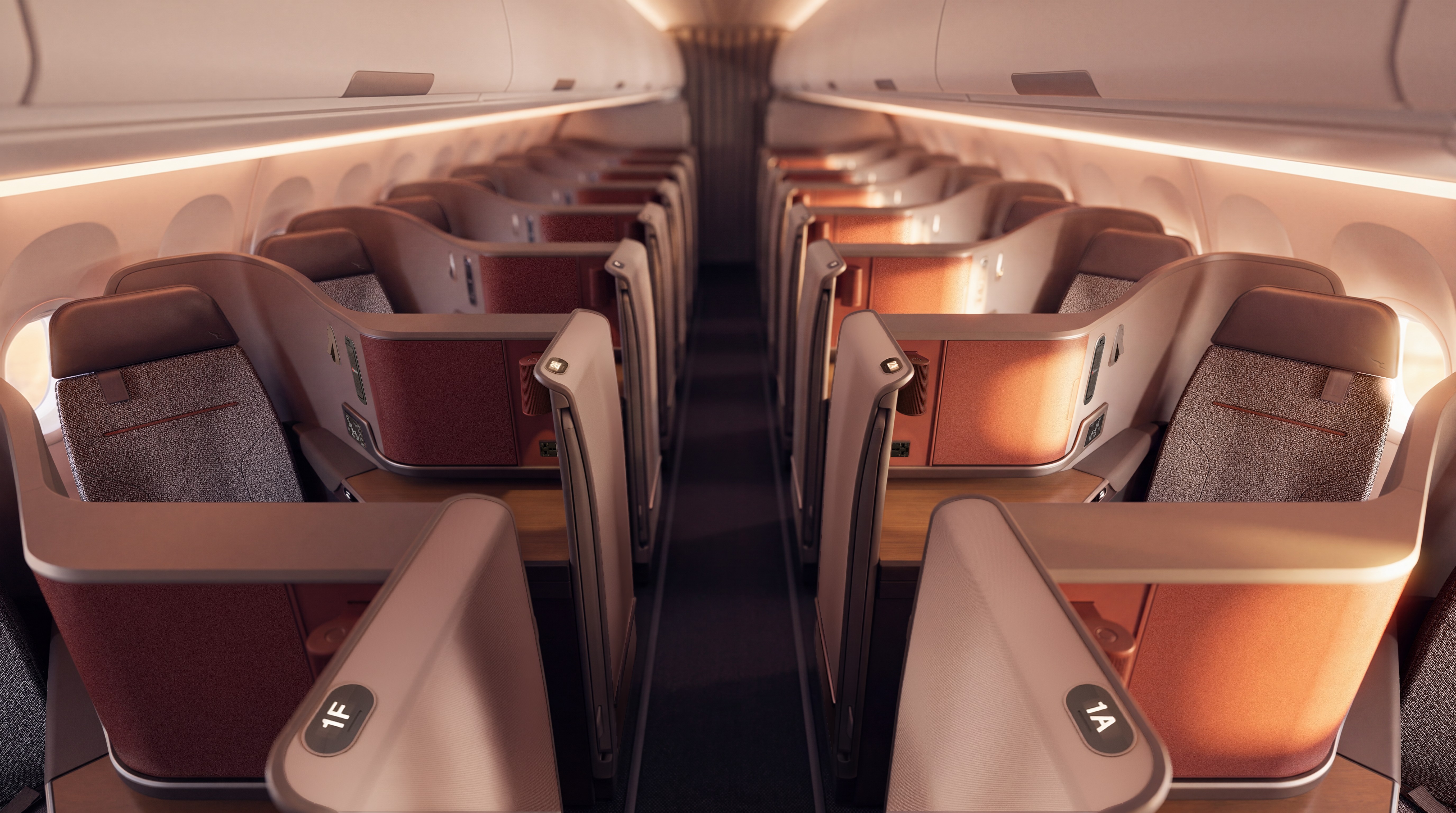
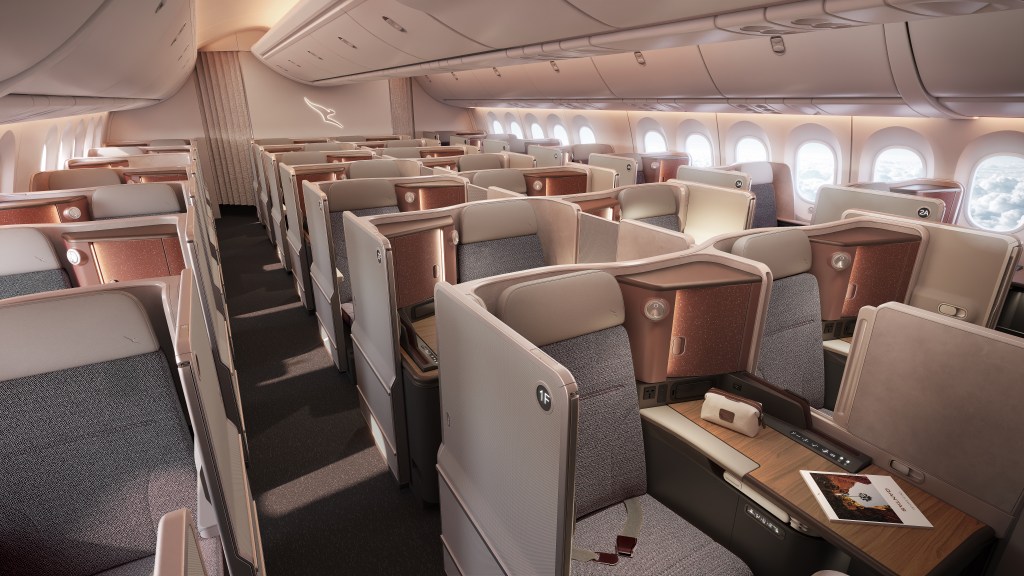
A rendering of the updated Business Suites on the 787. (Credit: Qantas)
Qantas also said it will introduce “evolved” Business Suites for new 787-9s. The upgraded seats will have sliding doors for the first time, the carrier said, as well as larger, 80-inch beds and a wider footwell.
Zach Vasile is a writer and editor covering news in all aspects of commercial aviation. He has reported for and contributed to the Manchester Journal Inquirer, the Hartford Business Journal, the Charlotte Observer, and the Washington Examiner, with his area of focus being the intersection of business and government policy.
Potential Strike Looms as Boeing Engineers, Technicians Reject Company’s Latest Offers
The manufacturer said it is putting its contingency plan in place.
A work group consisting of nearly 17,000 Boeing engineers, scientists, technicians, analysts, and other employees has rejected the aerospace manufacturer’s latest contract offers, setting the stage for a possible work stoppage in the fall.
Two subunits of the Society of Professional Engineering Employees in Aerospace (SPEEA) chapter at Boeing last Friday voted against the separate offers extended to them and in favor of authorizing a strike. The chapter’s Professional Unit, which includes mainly aerospace engineers and scientists, voted 64% against, while the Technical Unit, which consists of designers, analysts, technicians, and specialists, voted 71% against.
In a statement, SPEEA said members raised concerns about job security, salaries falling behind inflation and the market, and “quality and safety taking a backseat to schedule.”
“The next few weeks will be busy for the Negotiation Team, but we are committed to negotiating the best offer that reflects all our SPEEA members’ voices,” SPEEA said.
The workers’ current contract expires on Oct. 6, and the soonest a strike could occur is Oct. 7.
Boeing said that while no further discussions with SPEEA are planned, its “goal is to reach a resolution before the current contract expires.”
“We have a responsibility to the rest of our workforce and customers,” the company said in a statement. “We’re implementing our contingency planning to protect business continuity and keep delivering for our customers in the event of a strike.”
The business will “continue running” if a work stoppage occurs, Boeing added.
“We will leverage a wide range of qualified resources to ensure we’re doing what’s right for our customers with an emphasis on safety and quality,” the statement continued. “The specifics of the planning will be shared with managers and employees who will be directly involved.”
The strike threat comes as Boeing rebuilds much of the momentum it lost during the 737 MAX crisis, the COVID-19 pandemic, and years of supply chain disruptions. Production of the MAX and the 787 Dreamliner are ramping up, and just recently the company secured certification for the long-delayed MAX 7. It hopes to have the similarly delayed MAX 10 certified by the end of the year.
At the same time, labor relations have remained a sore point. In 2024, Boeing’s machinists went on strike for 53 days. The disruption cost the company around $5.5 billion.
The following year, Boeing Defense workers in and around St. Louis stayed off the job for over three months.
Zach Vasile is a writer and editor covering news in all aspects of commercial aviation. He has reported for and contributed to the Manchester Journal Inquirer, the Hartford Business Journal, the Charlotte Observer, and the Washington Examiner, with his area of focus being the intersection of business and government policy.
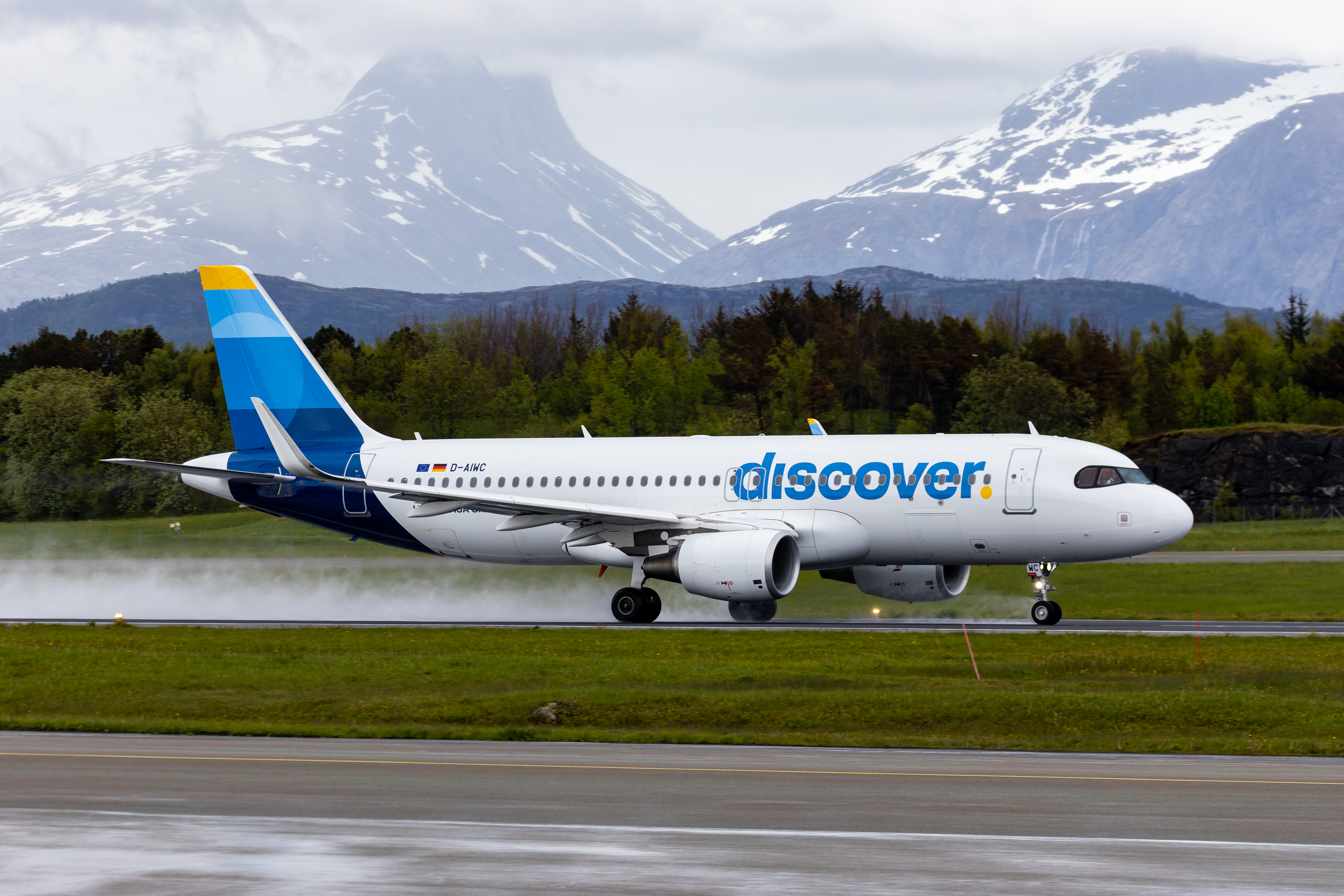
Service from Frankfurt to Glasgow will launch first, on March 29. Flights will operate up to six times per week. A second connection to Glasgow from Munich will come online May 16, running up to twice per week.
Twice weekly service between Frankfurt and Bristol will commence May 17. Service from Frankfurt to Inverness will start about one month later, on June 19, with one flight per week.
Discover will use Airbus A320s for all four connections.
“We see a clear trend toward nature, outdoor activities, and trips that combine culture and scenery – our three new destinations fit this trend perfectly,” Marco Götz, chief commercial officer of Discover, said in a news release. “They open up a wide variety of ways to discover Great Britain. We are all the more pleased that our guests will be able to reach these destinations this summer more easily than ever via our two hubs in Frankfurt and Munich.”
Discover mainly flies to warm-weather destinations in Southern Europe and North Africa; it also offers connections to East Africa, North America, the Caribbean, the Maldives, Scandinavia, and Iceland. In the U.S., the airline serves Philadelphia, Minneapolis, Las Vegas, Orlando, Tampa, and Fort Myers.
Zach Vasile is a writer and editor covering news in all aspects of commercial aviation. He has reported for and contributed to the Manchester Journal Inquirer, the Hartford Business Journal, the Charlotte Observer, and the Washington Examiner, with his area of focus being the intersection of business and government policy.
Qantas Moves Up Retirement of A380
The carrier originally planned to phase out the superjumbo starting in 2032.
In comments released alongside the airline’s fiscal year 2026 earnings report, Qantas Group CEO Vanessa Hudson said the current delivery pace for new A350s and Boeing 787 Dreamliners means the superjumbo can be retired starting in 2028, instead of 2032. The A350 and 787 can fly all of Qantas’ current A380 routes, Hudson said, and through their range and fuel efficiency will open up additional long-haul international connections.
While beloved by aviation enthusiasts and many passengers, the A380 is expensive to fuel, operate, and maintain compared to newer and more efficient aircraft. Airbus ended production of the type in 2021, creating additional barriers to repairs and overhaul work.
Qantas first announced in 2023 that it would retire the A380 from 2032. At the time, the airline said it would use the A350-1000 as a replacement.
Since then, Qantas and Airbus have also made significant progress in developing the A350-1000ULR, an ultra-long-range variant that will connect cities on the east coast of Australia with far-flung destinations such as New York and London. Deliveries of the -1000ULR are expected to begin in 2027.
Qantas currently operates 10 A380s. It did not say how long it will take to retire all of them.
Fewer than a dozen large airlines currently fly the A380. Emirates is by far the largest operator of the type, followed by Singapore Airlines, British Airways, Qantas, and Qatar Airways.
Several former operators, including Air France and China Southern Airlines, ditched the A380 over high fuel costs.
Zach Vasile is a writer and editor covering news in all aspects of commercial aviation. He has reported for and contributed to the Manchester Journal Inquirer, the Hartford Business Journal, the Charlotte Observer, and the Washington Examiner, with his area of focus being the intersection of business and government policy.
Sign-up for newsletters & special offers!
Get the latest stories & special offers delivered directly to your inbox