











Stories

Airlines Told to Disregard ‘X’ Mark on U.S. Passports

U.S. Customs and Border Protection said carriers should input an “M” or “F” into their passenger data systems.

A U.S. Customs and Border Protection vehicle in Nogales, Arizona.
A U.S. Customs and Border Protection vehicle in Nogales, Arizona. (Photo: Shutterstock | Matt Gush)

A new rule that will require airlines to disregard gender-neutral “X” marks on U.S. passports and input either an “M” or an “F” into their passenger data systems has come into effect.

U.S. Customs and Border Protection announced plans in July to abandon official recognition of the X mark, but airlines had a 90-day window to prepare for the new policy. That window closed late last week, meaning airline employees reviewing an X-marked passport holder’s booking will have to select either male or female as they submit information to the Advance Passenger Information System, or APIS, which Customs uses to screen for possible security threats.

“If the travel document presented by a traveler for an international flight to or from the United States has a sex indicator other than ‘M’ or ‘F’ or does not otherwise indicate the sex of the traveler, the carrier or the traveler should select either ‘M’ or ‘F,’” a Customs memorandum states. “Submitting ‘M’ or ‘F’ in the sex field, in place of the value reflected on the travel document, will not subject the carrier to penalty.”

The document does not suggest that citizens with the X mark are barred from flying internationally, only that airline employees will have to make an independent guess or judgement about customers with X-marked passports that likely contradicts their wishes and self-described identity.

The State Department issued the first X passport in 2021 following a federal anti-discrimination lawsuit and introduced the option for all U.S. citizens the following year. The Biden administration said the X mark was needed to properly recognize non-binary, intersex, and gender-nonconforming Americans.

But on the first day of his second term in office, President Donald Trump issued an executive order titled “Defending Women from Gender Ideology Extremism and Restoring Biological Truth to the Federal Government,” which withdrew federal recognition of transgender people and requires all federal agencies to use the male-female binary in their official documents.

A federal court in Massachusetts has blocked some aspects of the executive order from taking effect, including provisions that would do away with the X mark entirely. The court’s ruling also ensures that existing X-marked passports remain valid.

Zach Vasile

Zach Vasile is a writer and editor covering news in all aspects of commercial aviation. He has reported for and contributed to the Manchester Journal Inquirer, the Hartford Business Journal, the Charlotte Observer, and the Washington Examiner, with his area of focus being the intersection of business and government policy.

Hawaiian Brings Back Auckland Service

The carrier has served New Zealand’s largest city on a seasonal basis since 2013.

A Hawaiian Airlines Airbus A330-200
A Hawaiian A330 in Anchorage. (Photo: Ted Stevens Anchorage International Airport)

Hawaiian Airlines’ seasonal nonstop service to Auckland, New Zealand, is set to return next month.

Officials with Alaska Airlines, which is in the process of merging with Hawaiian, said flights between Honolulu and Auckland will start Nov. 16 and continue through April 20, 2026. The service will operate three times weekly using Airbus A330 aircraft.

“We know Kiwi travelers have long awaited the return of our seasonal service, and our crews are thrilled to welcome them onboard once again with the authentic hospitality and care for which Hawaiian Airlines is known,” said Andrew Stanbury, regional director for the South Pacific for Alaska and Hawaiian, in a news release. “Now, thanks to the strength of our combined global network, every guest flying from Hawaii, the U.S. mainland, and New Zealand will have more options than ever to explore the world.”

Hawaiian has offered seasonal service to Auckland since March 2013.

Alaska officials pointed out that the Honolulu-Auckland service will operate during the Southern Hemisphere summer, allowing residents of Hawaii and the continental U.S. to explore New Zealand at its warmest and most active.

Zach Vasile

Zach Vasile is a writer and editor covering news in all aspects of commercial aviation. He has reported for and contributed to the Manchester Journal Inquirer, the Hartford Business Journal, the Charlotte Observer, and the Washington Examiner, with his area of focus being the intersection of business and government policy.

Frontier Suspends Service to California Airport

The ultra-low-cost carrier cites “current market demand” for the cut.

Frontier A320neo
A Frontier A320neo aircraft. (Photo: Shutterstock | Omar F Martinez)

Frontier plans to halt service to an airport it has served for over a decade. The carrier confirmed the cut on Monday.

According to last weekend’s Cirium Diio schedule update, the airline will no longer serve Palm Springs, California, effective next month. A Frontier spokesperson later confirmed the market exit.

The airline’s flights between Palm Springs and San Francisco will end on Nov. 17, while service to its Denver hub is slated to be suspended starting on Nov. 29.

“We are pausing our service at PSP at the end of next month in response to current market demand, but will continue to monitor conditions for opportunities to resume service,” the spokesperson said in a statement. “We greatly appreciate our partnership with the airport and the greater Palm Springs community.”

Frontier began serving Palm Springs in 2011 with flights to Denver before a pandemic-era pause between 2021 and 2024. Service from Palm Springs to San Francisco was added last year.

Ryan Ewing

Ryan founded AirlineGeeks.com back in February 2013 and has amassed considerable experience in the aviation sector. His work has been featured in several publications and news outlets, including CNN, WJLA, CNET, and Business Insider. During his time in the industry, he's worked in roles pertaining to airport/airline operations while holding a B.S. in Air Transportation Management from Arizona State University along with an MBA. Ryan has experience in several facets of the industry from behind the yoke of a Cessna 172 to interviewing airline industry executives. Ryan works for AirlineGeeks' owner FLYING Media, spearheading coverage in the commercial aviation space.

British Airways Shifts U.S. A380 Service

The carrier will pull the superjumbo from one route while restoring service to another.

British Airways A380
A British Airways Airbus A380 (Photo: AirlineGeeks | William Derrickson)

British Airways is set to adjust its Airbus A380 operations to the United States next year, marking another shift in how the airline deploys its largest aircraft type across its transatlantic network.

According to Ishrion Aviation on X and Cirium Diio schedule data, the airline will end A380 service between London Heathrow and Washington Dulles on Nov. 7, 2025.

At the same time, the carrier plans to bring the aircraft back to its London–Dallas/Fort Worth route beginning on May 21 after a year-long pause.

In Washington, British Airways will continue to serve the market with a mix of A350-1000s, 787-9s, 787-10s, and 777s.

Double-Daily A380 Service

For Dallas/Fort Worth, the resumption of British Airways’ A380 service means the airport will see two daily superjumbo flights starting in June. Qantas also operates the A380 between Sydney and Dallas/Fort Worth.

Qantas A380 at DFW Airport
Qantas’ A380s return to Dallas/Fort Worth (Photo: Qantas)

The Texas airport last saw double-daily A380 flights in 2014 when both Emirates and Qantas used the type on their respective routes.

British Airways currently operates its 12-aircraft A380 fleet to several North American destinations, including Los Angeles, Miami, and San Francisco.

Ryan Ewing

Ryan founded AirlineGeeks.com back in February 2013 and has amassed considerable experience in the aviation sector. His work has been featured in several publications and news outlets, including CNN, WJLA, CNET, and Business Insider. During his time in the industry, he's worked in roles pertaining to airport/airline operations while holding a B.S. in Air Transportation Management from Arizona State University along with an MBA. Ryan has experience in several facets of the industry from behind the yoke of a Cessna 172 to interviewing airline industry executives. Ryan works for AirlineGeeks' owner FLYING Media, spearheading coverage in the commercial aviation space.

Two Killed After 747 Hits Airport Vehicle in Hong Kong

Officials said the aircraft made an unexpected turn right before touching down.

Air ACT flight Hong Kong
The damaged Air ACT aircraft at Hong Kong International Airport. (Photo: Airport Authority via RTHK)

Two workers at Hong Kong International Airport were killed early Monday after an Emirates cargo flight skidded off the runway and hit their patrol vehicle.

According to a report from Reuters, the Emirates 747 was arriving from Dubai around 4 a.m. local time when it veered off the runway, crashed through a perimeter fence, and hit the patrol vehicle, pushing it into the sea surrounding the airport. Both staff members inside the vehicle died, the airport’s operator said.

The Emirates aircraft also fell into the water and was partially submerged, but all four crew members escaped. The airline confirmed that the crew members were safe and no cargo was on board the flight.

The aircraft involved in the accident was leased from and operated by Turkish carrier Air ACT.

Authorities in Hong Kong are investigating the cause of the crash.

The runway where the accident occurred is closed, but two other runways are open and operating as normal. Several cargo flights scheduled to land at Hong Kong International Airport on Monday were canceled.

Steven Yiu, the airport’s executive director of operations, told the BBC that the 747 made an unexpected turn away from the runway and toward the sea while landing. He said the two airport workers were driving on a road outside the closed-off runway area and “definitely did not run out onto the runway.”

The flight’s crew did not send out a distress signal prior to or during the botched landing, Yiu added.

Authorities said they are still looking for the aircraft’s flight data recorder and cockpit voice recorder, which apparently fell into the water.

Zach Vasile

Zach Vasile is a writer and editor covering news in all aspects of commercial aviation. He has reported for and contributed to the Manchester Journal Inquirer, the Hartford Business Journal, the Charlotte Observer, and the Washington Examiner, with his area of focus being the intersection of business and government policy.

United 737 MAX Diverts After Windscreen Crack

The NTSB is investigating the incident.

United 737 MAX 8
A United 737 MAX 8. (Photo: AirlineGeeks | William Derrickson)

A United 737 MAX 8 flying from Denver to Los Angeles was forced to make an emergency landing after the cockpit’s windscreen cracked.

United Flight 1093 diverted to Salt Lake City and landed safely on Thursday after the cracked windscreen was reported at cruise altitude over Moab, Utah, the NTSB said in a statement. Investigators are gathering radar, weather, and flight recorder data, the agency said, and the damaged windscreen is being sent to a lab for examination.

“On Thursday, United flight 1093 landed safely in Salt Lake City to address damage to its multilayered windshield,” United said in a statement. “We arranged for another aircraft to take customers to Los Angeles later that day and our maintenance team is working to return the aircraft to service.”

The New York Post reported Sunday that one of the pilots was injured when an unidentified object struck the windscreen, and shared an image of a pilot’s bloodied arm that had been circulating on social media. Neither the NTSB nor United has confirmed those details.

Another photo, also unverified, appeared to show scorch marks on the aircraft’s exterior above the windscreen.

The marks, combined with the aircraft’s reported cruise altitude – far higher than most birds can fly – prompted some social media users to speculate that a small meteorite or piece of space debris may have caused the damage.

Zach Vasile

Zach Vasile is a writer and editor covering news in all aspects of commercial aviation. He has reported for and contributed to the Manchester Journal Inquirer, the Hartford Business Journal, the Charlotte Observer, and the Washington Examiner, with his area of focus being the intersection of business and government policy.

JetBlue Leaving International Airport

The route cut is slated for early next year.

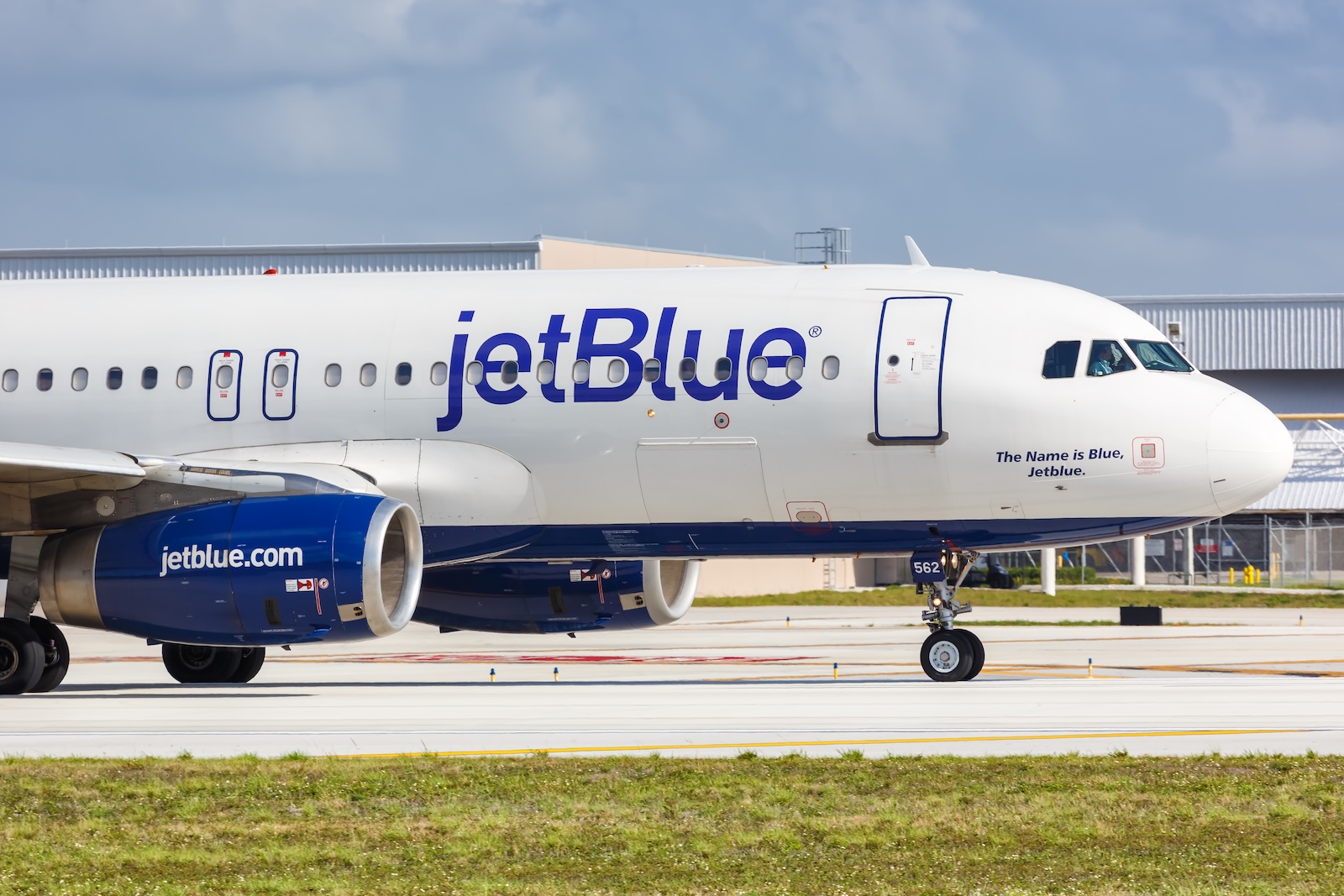
A JetBlue A320
A JetBlue A320. (Photo: Shutterstock | Markus Mainka)

JetBlue will end service on a route it began less than a year ago in 2026. With this cut, the New York-based airline will also completely exit this airport.

Early next year, the carrier will no longer serve the Dutch Caribbean island of Bonaire, according to this week’s Cirium Diio schedule update. Local media also reported the change.

JetBlue began twice-weekly flights between its New York-JFK hub and Bonaire in November 2024. Service will now end on Jan. 3, 2026, after being previously planned as a year-round route.

“At JetBlue, we’re always working to fine-tune our network to best align with customer demand and support our long-term success,” an airline spokesperson said in a statement to AirlineGeeks. “As part of this, JetBlue will end its once-weekly service between New York (JFK) and Bonaire (BON) after local authorities informed us they will be ending a multi-year revenue guarantee early. The last day of service will be January 3, 2026.”

As part of a cost-cutting effort, JetBlue completely halted service to Miami earlier this year. In addition, the airline’s service to Seattle will no longer operate on a year-round basis.

Editor’s Note: This story was updated on Monday, Oct. 20, 2025 at 5:09 p.m. ET to add comments from JetBlue.

Ryan Ewing

Ryan founded AirlineGeeks.com back in February 2013 and has amassed considerable experience in the aviation sector. His work has been featured in several publications and news outlets, including CNN, WJLA, CNET, and Business Insider. During his time in the industry, he's worked in roles pertaining to airport/airline operations while holding a B.S. in Air Transportation Management from Arizona State University along with an MBA. Ryan has experience in several facets of the industry from behind the yoke of a Cessna 172 to interviewing airline industry executives. Ryan works for AirlineGeeks' owner FLYING Media, spearheading coverage in the commercial aviation space.

Unanimous Support for CORSIA at ICAO General Assembly

All ICAO General Assembly's Member States endorsed a global framework for SAF and set collective emissions reduction targets.

ICAO Headquarters in Montreal
ICAO Headquarters in Montreal (Photo: Vanni Gibertini)

As red maple leaves started to color the Montreal skyline during the first week of October, the 42nd ICAO General Assembly drew to a close at the organization’s headquarters in the Canadian city. During this triannual event, delegates from the 193 Member states and invited observers discussed the hundreds of working papers and potential resolutions that will set the path for the next three years.

Net-Zero Emissions

The Assembly’s most prominent outcome was its solidification of ICAO’s commitment towards a sustainable future for air transport. For the first time since the beginning of aviation’s journey towards sustainability, Member States unanimously endorsed the ICAO Global Framework for Sustainable Aviation Fuels (SAF) and other cleaner energy initiatives.

The Framework sets a collective target for a 5% reduction in CO₂ emissions by 2030 and strengthens commitment to the Carbon Offsetting and Reduction Scheme for International Aviation (CORSIA) and the pursuit of net zero carbon emissions by 2050.

The Assembly also emphasized the importance of the full operationalization of the ICAO Finvest Hub, a fundamental tool to connect decarbonization projects with public and private investors to accelerate the launch of a fully functional emission credits market.

Raising the Pilot Retirement Age: More Data Needed

One of the hottest topics discussed during the first week of the Assembly was the proposal made by IATA to raise the pilot retirement age from 65 to 67, reflecting ongoing research and analysis into workforce needs, health, and safety trends. 

While currently some jurisdictions (such as Australia, Canada, Japan, and New Zealand) allow pilots to continue in their profession indefinitely until they can no longer satisfy the required medical standards, no pilots over 65 years of age are allowed to operate on international routes because this was established by ICAO Members in 2006.

For the time being, ICAO stated that “medical science is inconclusive on the effects of raising the age limit for pilots”, but there was clear consensus that ICAO should continue to consult with stakeholders, analyze evidence, and evaluate medical and operational impacts before issuing any regulatory change, ensuring that safety remains paramount.

Safety and Security Systems

The Assembly unanimously committed to the highest safety standards by endorsing the 2026-2028 Global Aviation Safety Plan, the eighth Global Air Navigation Plan (with a new six-year cycle for enhanced efficiency), and the Second Edition of the Global Aviation Security Plan, which introduced new global targets and a monitoring system.

Furthermore, the Assembly endorsed the ICAO Council’s determination that radio frequency interference (RFI) with Global Navigation Satellite Systems (GNSS) from North Korea and Russia violates the Chicago Convention (1944), and two resolutions were passed formally condemning both States and urging compliance with international obligations.

Finally, the Assembly tasked ICAO with taking the lead on establishing a framework for new challenges emerging in today’s commercial aviation, such the need to implements plans for cybersecurity at a national level, the creation of a new Task Force on Artificial Intelligence to shape safe applications and performance benchmarks for AI in aviation, and the modernization of the regulatory approaches for new entrants, notably remotely piloted aircraft systems (RPAS).

Next Stop: 2028

Member States will now have to incorporate the resolutions approved by the Assembly in their national legislations as soon as possible as with the support of ICAO’s “no country left behind” principle once again reaffirmed during the meetings in Montreal.

The delegates will return to Montreal in 2028 for the 43rd ICAO General Assembly.

Vanni Gibertini

Vanni fell in love with commercial aviation during his undergraduate studies in Statistics at the University of Bologna, when he prepared his thesis on the effects of deregulation on the U.S. and European aviation markets. Then he pursued his passion further by obtaining a Master’s Degree in Air Transport Management at Cranfield University in the U.K. followed by holding several management positions at various start-up carriers in Europe (Jet2, SkyEurope, Silverjet). After moving to Canada, he was Business Development Manager for IATA for nine years before turning to his other passion: sports writing.

Miami Leaders Seeking Nonstop Flights to East Asia, Middle East

County commissioners want routes to established and up-and-coming economic hubs.

Terminal in Miami
A terminal in Miami. (Photo: Shutterstock | Khairil Azhar Junos)

Officials in Miami are pushing for new routes connecting the city to destinations in East Asia, the Middle East, and South America.

The Miami-Dade County Board of Commissioners this week issued a resolution calling on Mayor Daniella Levine Cava to investigate the feasibility of nonstop passenger flights between Miami and Tokyo, Singapore, Riyadh, Saudi Arabia, and Asunción, Paraguay. Currently, none of the airlines at Miami International Airport offer nonstop service to those cities.

If possible, the resolution adds, the mayor should “undertake all appropriate efforts to solicit such flights from the appropriate carriers.”

Miami International Airport is owned and operated by the Miami-Dade Aviation Department, which is part of the county government.

The commissioners highlighted the potential economic benefits of establishing connections to the four cities. Tokyo and Singapore have some of the largest city economies in the world, they said, and both Riyadh and Asunción are growing fast and likely to achieve greater international prominence in the years ahead. Launching service to those locations would increase tourism and business travel and open up new commercial opportunities, the board said.

Miami is a major transit point between the continental U.S. and Latin America, but no airlines there fly nonstop to Paraguay.

Miami International Airport offers nonstop flights to Dubai and Doha, Qatar, in the Middle East, but the commissioners want to see service to Riyadh as well as it develops into a business and technology hub. Riyadh is the capital of and largest city in Saudi Arabia.

Zach Vasile

Zach Vasile is a writer and editor covering news in all aspects of commercial aviation. He has reported for and contributed to the Manchester Journal Inquirer, the Hartford Business Journal, the Charlotte Observer, and the Washington Examiner, with his area of focus being the intersection of business and government policy.

IndiGo Orders More Widebody Jets

The purchase will help support the carrier’s international expansion.

IndiGo A350 rendering
IndiGo A350 rendering (Photo: Airbus)

Indian airline IndiGo has ordered an additional 30 Airbus A350 aircraft.

The carrier said Friday that it converted options under a June memorandum of understanding with Airbus into a firm order, bringing its total A350 commitment to 60 jets. Airline leaders said the widebody aircraft will help IndiGo expand its long-haul international route network.

“The conversion of this MoU into a firm order for 30 additional A350-900s is a testament to our confidence in the future of Indian aviation and our strategic partnership with Airbus, further reinforced by the strong start of our long-haul operations,” IndiGo CEO Pieter Elbers said in a statement. “These aircraft, as they join our fleet in the years to come, will play a pivotal role in enabling IndiGo expand its reach, connect India with more destinations across the globe, and offer our customers new international travel opportunities.”

Financial details of the order were not disclosed.

IndiGo’s fleet consists almost entirely of Airbus aircraft, with A320-family jets supporting most domestic and short-haul international routes.

IndiGo A321neo landing
An IndiGo Airbus A321neo at Delhi Airport. (Photo: AirlineGeeks | Vihaan Kushwaha)

The carrier flies mostly within South Asia, but earlier this year it launched long-haul flights to Manchester in the U.K., Amsterdam, and Copenhagen. Later this month, it will add London to its route network, with Athens set to follow in 2026.

IndiGo also offers medium-haul flights to destinations such as Istanbul, Jakarta, Mauritius, Nairobi, and Hong Kong.

Zach Vasile

Zach Vasile is a writer and editor covering news in all aspects of commercial aviation. He has reported for and contributed to the Manchester Journal Inquirer, the Hartford Business Journal, the Charlotte Observer, and the Washington Examiner, with his area of focus being the intersection of business and government policy.
Sign-up for newsletters & special offers!

Get the latest stories & special offers delivered directly to your inbox

SUBSCRIBE

Uh-oh! It looks like you're using an ad blocker.

Our website relies on ads to provide free content and sustain our operations. By turning off your ad blocker, you help support us and ensure we can continue offering valuable content without any cost to you.

We truly appreciate your understanding and support. Thank you for considering disabling your ad blocker for this website