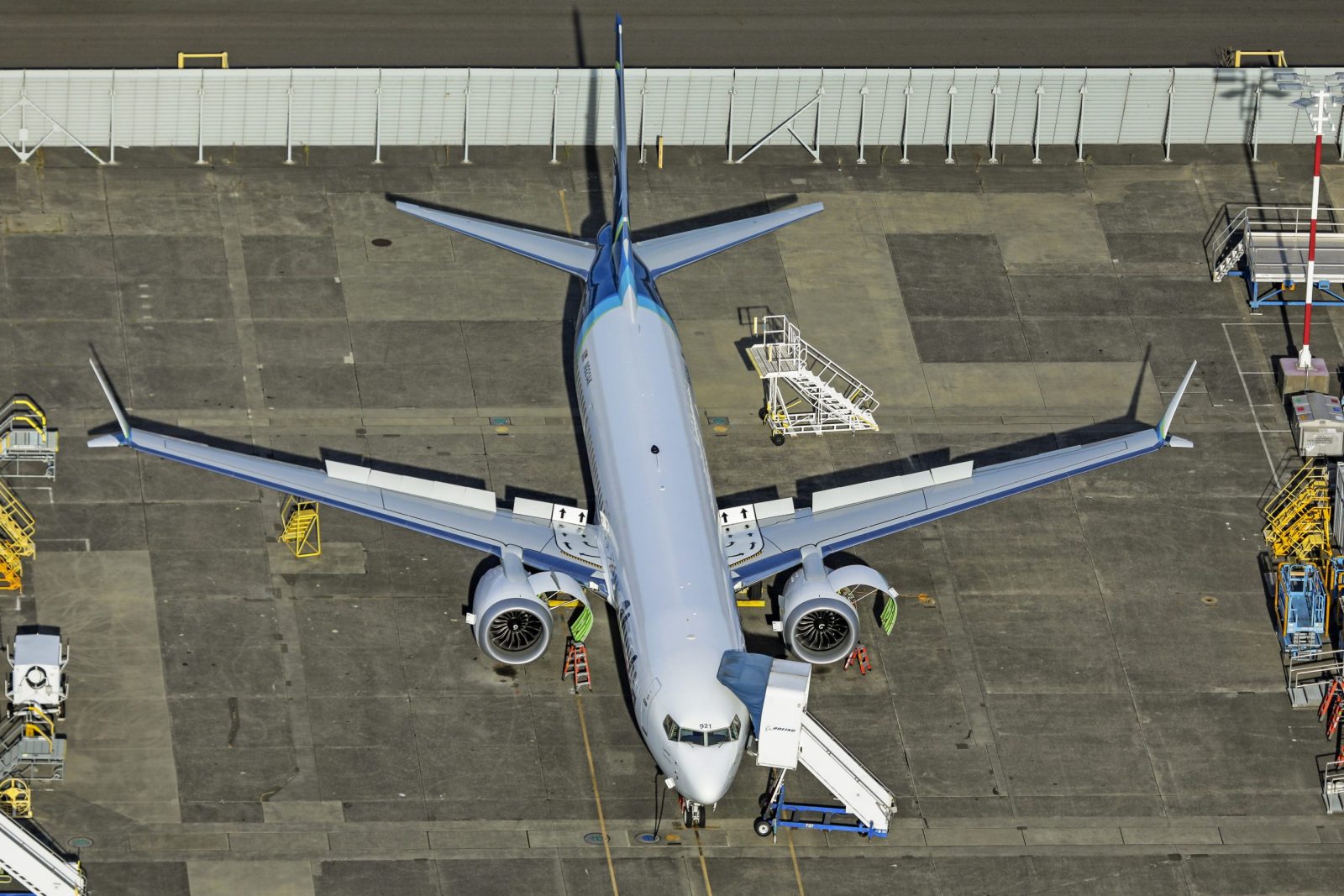
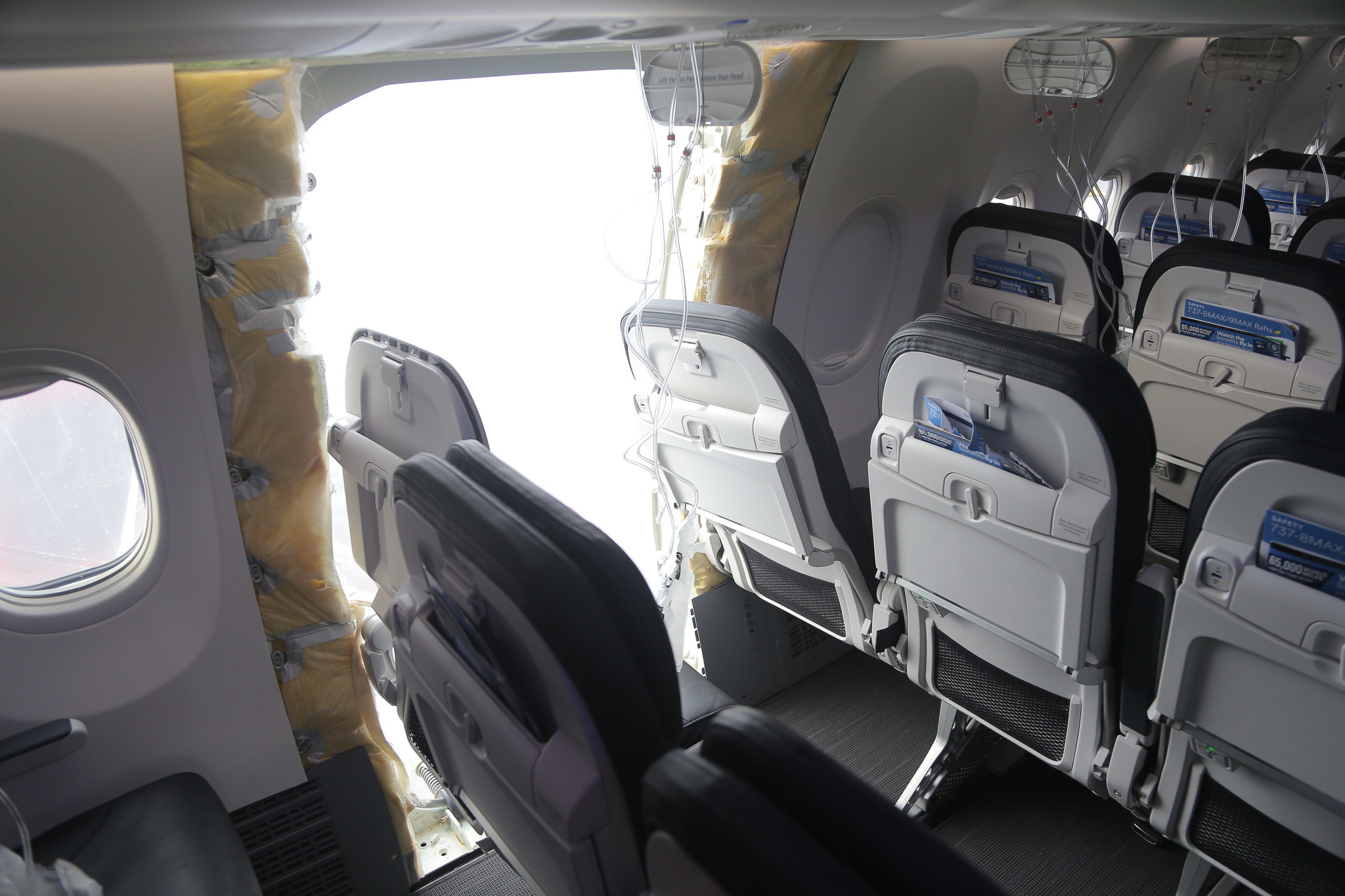
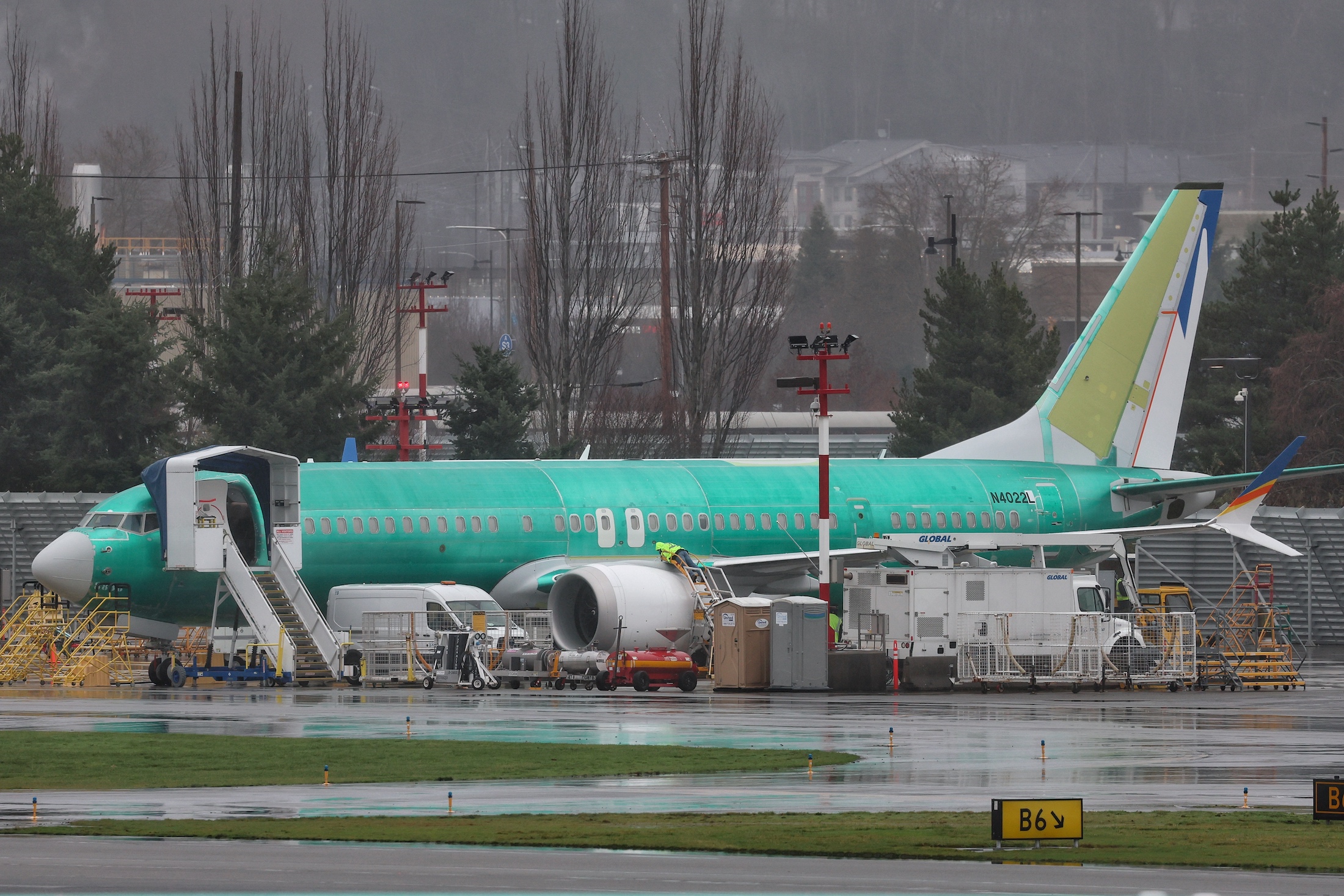
The 19-page report, released Tuesday by the NTSB, noted the four bolts that are supposed to hold the door plug in place were removed for maintenance at the factory before delivery of the jet but never reinstalled. The aircraft had flown 510 hours without having the door plug properly secured.
The Details
On January 5 shortly after takeoff from Portland International Airport (KPDX) in Oregon, Alaska Airlines Flight 1282 lost the mid-exit door (MED) plug as the aircraft climbed through 16,000 feet. The loss of the door plug resulted in violent decompression, but no serious injuries to the 177 persons on board. The flight crew declared an emergency and returned to Portland with a refrigerator-sized hole in the side of the aircraft.
“An event like this must not happen on an airplane that leaves our factory,” Calhoun said. “We simply must do better for our customers and their passengers. We are implementing a comprehensive plan to strengthen quality and the confidence of our stakeholders. It will take significant, demonstrated action and transparency at every turn—and that is where we are squarely focused.”
In a statement to the media, Boeing outlined immediate action items it is undertaking to strengthen quality.
“First and foremost, the company has implemented a control plan to ensure all 737-9 mid-exit door plugs are installed according to specifications by instituting new inspections of the door plug assembly and similar structures at our supplier’s factory and on Boeing’s production line, and adding signage and protocol to fully document when the door plug is opened or removed in our factory, ensuring it is reinstalled and inspected prior to delivery,” the statement said.
“Boeing is also taking steps to improve overall quality and stability across the 737 production system. These steps include layering additional inspections into the Boeing supply chain, more communication and collaboration with suppliers on production enhancements, performing more work on the aircraft at their assigned positions, setting aside multiple days for 737 teams to focus on implement quality improvements, adding independent assessment to bolster the quality management system at Boeing Commercial Airplanes by a highly experienced safety expert.
“In addition to these Boeing actions, we are opening our factory to 737 customers to conduct their own additional reviews and will fully and transparently support the FAA’s investigation, audit, and oversight actions.”
Said Calhoun: “This added scrutiny—from ourselves, from our regulator, and from our customers—will make us better. It’s that simple.”
The NTSB is continuing its investigation.
Editor’s Note: This story first appeared on FlyingMag.com.
AirlineGeeks.com was founded in February 2013 as a one-person blog in Washington D.C. Since then, we’ve grown to have 25+ active team members scattered across the globe. We are all here for the same reason: we love deep-diving into the fascinating realm of the airline industry.
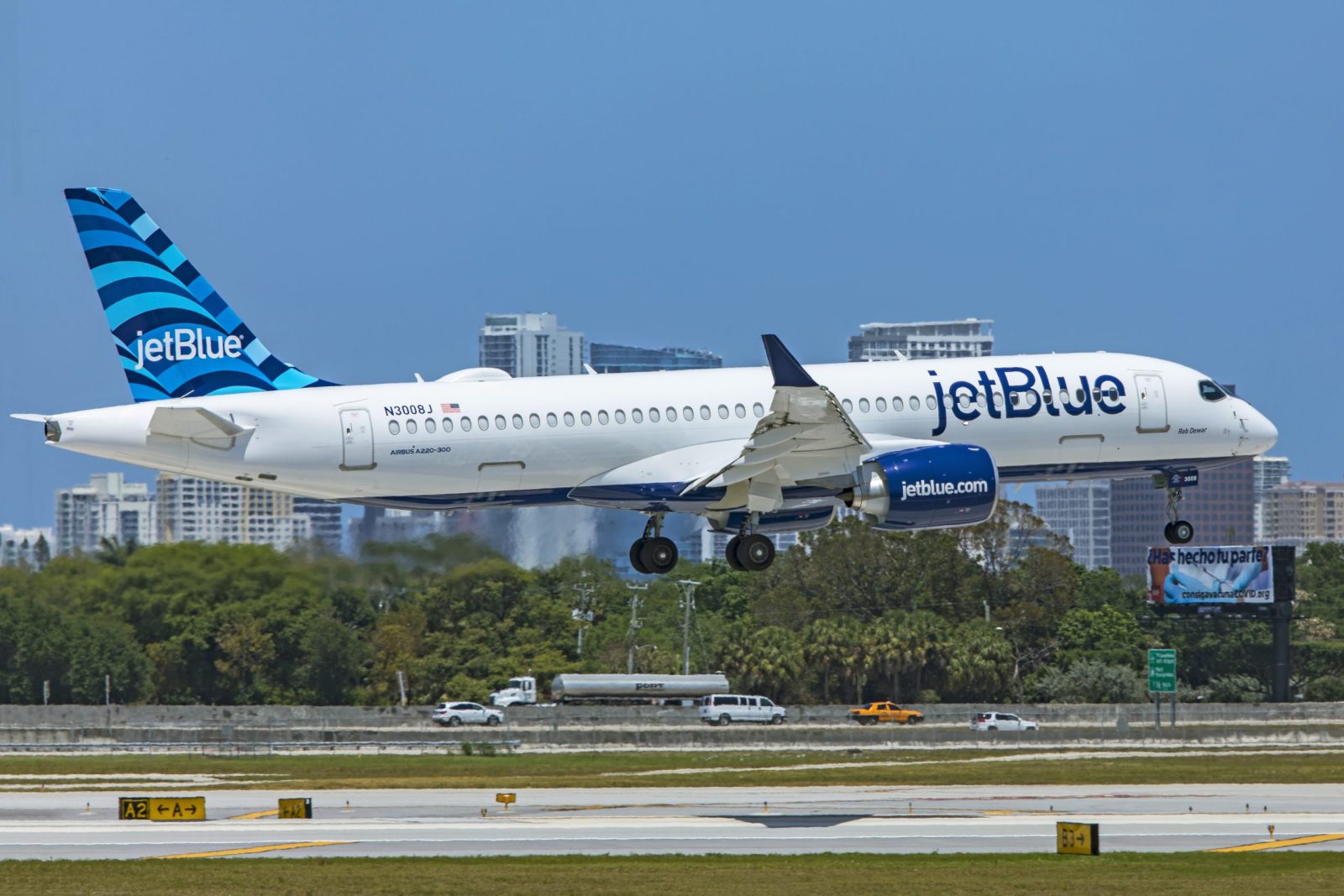
A JetBlue Airways Airbus A220 prepares for landing in Fort Lauderdale, Florida.
(Photo: AirlineGeeks | William Derrickson)
JetBlue announced on Wednesday the appointment of Marty St. George as the airline’s new president, starting on Feb. 26, 2024. St. George, a seasoned airline executive with over 30 years of experience, will report to Joanna Geraghty, JetBlue’s current president and incoming chief executive officer. The New York-based company’s current CEO Robin Hayes is slated to step down on February 12.
St. George Returns to JetBlue After Stint at LATAM
St. George rejoins JetBlue after serving as chief commercial officer for LATAM Airlines Group, the largest airline holding company in Latin America. Prior to LATAM, he led his own airline strategy consulting practice and held interim leadership roles at Norwegian Air Shuttle. St. George is a familiar face at JetBlue from his previous 13-year tenure with the company from 2006 to 2019.
As president, St. George will oversee a wide range of JetBlue’s operations, including marketing, loyalty programs, network planning, airline partnerships, sales, revenue management, customer support, enterprise and operational planning, and corporate communications. He will also manage JetBlue Travel Products (JTP) while its day-to-day operations remain under the leadership of president Andres Barry.
During his first stint at JetBlue, St. George held various leadership positions, including vice president of planning, senior vice president of marketing and commercial, and executive vice president and chief commercial officer. He was instrumental in developing the airline’s “focus city” strategy, establishing key partnerships, and crafting its distinctive brand and innovative product offerings, according to the company.
Joanna Geraghty, JetBlue’s incoming CEO, expressed her enthusiasm about St. George’s return in a press release: “With more than 30 years of experience in aviation and a passion for our industry like few others, Marty’s the right leader to bring onboard as we embark on our focused plan to get back to profitability,” Geraghty said. “I look forward to working with Marty to ensure that our crewmembers are set up for success in serving our customers and can deliver the reliability we know is critical to generating financial returns and powering long-term, sustainable growth.”
“I’m energized to be returning to JetBlue at this pivotal time in its history. JetBlue has incredibly passionate people and one of the best brands in the industry. I’m eager to get to work to help drive the business forward for the benefit of our crewmembers, customers, and owners alike,” added St. George
St. George holds a degree in civil engineering from the Massachusetts Institute of Technology (MIT). He joins JetBlue at a crucial time for the carrier as it navigates an antitrust battle for its proposed acquisition of Spirit. The airline lost $104 million in the fourth quarter of 2023.
Ryan founded AirlineGeeks.com in February 2013 and has spent more than a decade covering the airline business. His work has been featured by CNN, WJLA, CNET, and Business Insider. His aviation experience spans airport operations, Part 135 regulatory compliance, and airline crew workforce planning, along with time behind the yoke of a Cessna 172 and interviews with airline executives. Ryan now serves as Group President of Firecrown Media’s Aviation Group. He holds a B.S. in Air Transportation Management and an MBA from Arizona State University and teaches Airline Management at Embry-Riddle Aeronautical University.
The Avelo aircraft is seen during the Avelo Air aircraft shoot at Hollywood Burbank Airport on April 07, 2021 in Burbank, California. (Photo: Joe Scarnici/Getty Images for Avelo Air)
Ultra-low-cost carrier Avelo Airlines has unveiled four new routes from its base at Tweed-New Haven Regional Airport in Connecticut. Flights to the four southeastern United States destinations are scheduled to commence in May.
Details: Avelo’s New Routes from New Haven
Avelo will be starting flights to Hartsfield–Jackson Atlanta International Airport on May 2, 2024, with a weekly frequency of four flights on Mondays, Thursdays, Fridays, and Sundays. The airline will face competition at the world’s busiest airport from Delta Air Lines, which operates up to five daily flights between Atlanta and Bradley International Airport – located approximately 50 miles away from New Haven in Windsor Locks, Connecticut.
Charlotte, N.C.’s secondary airport – Concord-Padgett Regional Airport – will also be receiving new service from Avelo as of May 2, 2024. The carrier will start twice-weekly service between New Haven and Concord-Padgett, operating on Thursdays and Sundays. Avelo will be the airport’s second commercial air carrier, joining Allegiant Air.
Avelo’s third new route will be to McGhee Tyson Airport in Knoxville, Tenn. This route will be operated twice weekly on Thursdays and Sundays starting on May 9, 2024. As is the case for all four airports in Avelo’s latest announcement, Knoxville will be a new destination for the airline.
Farther south in Florida, Destin / Fort Walton Beach Airport will be seeing two flights weekly from Avelo. Service will commence on May 17, 2024 and be operated twice weekly on Thursdays and Sundays. The airport will be Avelo’s eighth destination in Florida.
“We are excited to offer Southern Connecticut residents even more travel options with the addition of Atlanta, Charlotte, Knoxville and Destin,” Avelo Chairman and Chief Executive Andrew Levy said as part of the announcement. “With 21 nonstop destinations, including eight Florida cities, flying from Tweed is easier and more affordable than ever. Additionally, when you consider our industry-leading reliability and caring Soul of Service, it is clear why almost 2 million people have flown Avelo at Tweed since 2021.”
Avelo’s Continued New Haven Investment
Since opening its New Haven base in 2021 with four routes, Avelo has continuously grown its presence at the southern Connecticut airport. As an ultra-low-cost carrier, the airline focuses on price-sensitive passengers traveling for leisure or to visit friends and family, as shown by its existing routes from New Haven to destinations like Orlando, Fort Lauderdale, and Myrtle Beach. The carrier is currently the only airline at Tweed-New Haven Regional Airport and offers the most nonstop destinations from the state of Connecticut.
“Launching these routes to Knoxville, Destin, Atlanta, and Charlotte is not just an operational milestone—it’s a celebration of progress and accessibility in air travel from Tweed-New Haven Airport,” Tweed New Haven Airport Executive Director Tom Rafter stated in a press release. “We are dedicated to offering services that are not only convenient and budget-friendly, but also underscore our pledge to superior customer experience, and this great news from Avelo is part of that continued work here at Tweed.”
Andrew is a lifelong lover of aviation and travel. He has flown all over the world and is fascinated by the workings of the air travel industry. As a private pilot and glider pilot who has worked with airlines, airports and other industry stakeholders, he is always excited to share his passion for aviation with others. In addition to being a writer, he also hosts Flying Smarter, an educational travel podcast that explores the complex world of air travel to help listeners become better-informed and savvier travelers.
Pilots Flying Amazon Cargo Say Employer Stalling Contract Talks
The chair of the pilots’ union at Air Transport International, the largest air carrier in Amazon’s delivery network, accused ATI management in an interview of dragging its feet on a new contract.
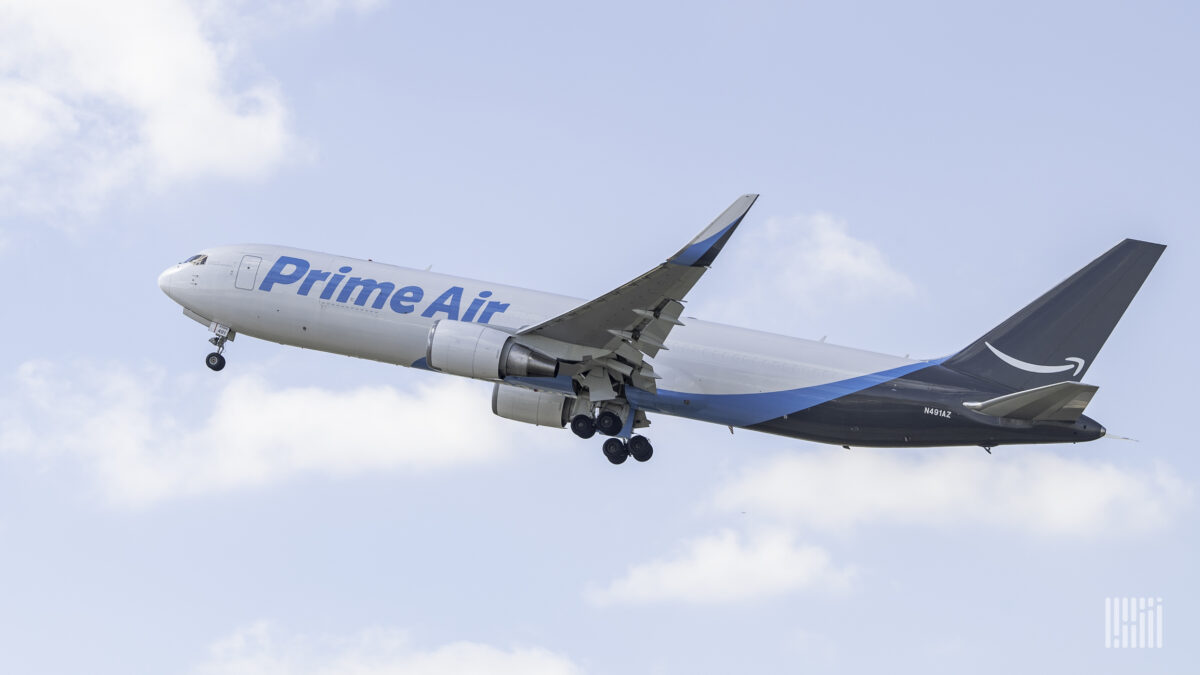
Air Transport International is the largest operator of Amazon-branded Boeing 767 freighters. (Photo: Jim Allen/FreightWaves)
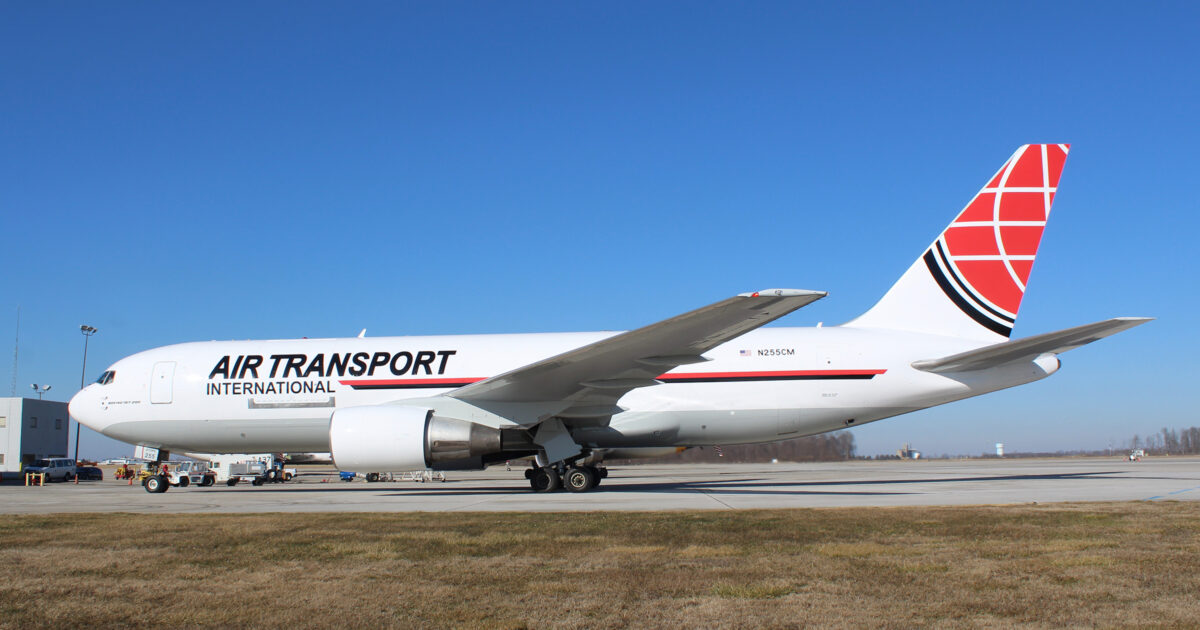
The chair of the pilots’ union at Air Transport International, the largest air carrier in Amazon’s delivery network, accused ATI management in an interview of dragging its feet on a new contract for hundreds of pilots until the existing transportation services agreement with the mega-retailer can be renewed in two years.
Amazon’s growing e-commerce business and how pilots are compensated at other airlines that provide outsourced airlift within the retailer’s rapid fulfillment network – not the soft market for general air cargo – should be the barometer for an improved labor contract, added Mike Sterling, chair of the ATI Master Executive Council and a Boeing 767 captain, in an interview.
ATI pilots, represented by the Air Line Pilots Association (ALPA), last week asked the National Mediation Board to declare an impasse in contract negotiations and move the process to binding arbitration. The request is designed to clear the way for a potential strike against the company in a heavily regulated bargaining process. Talks, which have been underway for more than three and a half years, have broken down over pay, retirement benefits and work rules.
The subsidiary of Air Transport Services Group (NASDAQ: ATSG) operates more than 40 Boeing 767 converted freighters, according to database Planespotters.net. About 90% of the airline’s work consists of shuttling e-commerce packages to and from airports near Amazon warehouses across the nation for express delivery to customers’ doorsteps. It also flies four Boeing 757-200 combi aircraft, which can carry up to 42 people and 10 pallets of cargo, and one freighter for the U.S. Department of Defense.
“Based on our experience in negotiations, it appears that ATSG is actively delaying our agreement in an attempt to synchronize with a new air transport services agreement. We find this delay completely unacceptable as our current contract was amendable in March 2021. To impose an artificial deadline for negotiations is creating a toxic environment of pilot attrition and attraction-related problems,” Sterling told FreightWaves on Wednesday.
Management said during an earnings presentation last summer it didn’t expect to reach a labor agreement in 2023.
“In our proffer for arbitration with the National Mediation Board we emphasized executive comments made by ATSG, which clearly point to a delay posture and an impasse between the parties,” Sterling said. “Our pilots’ dedication, professionalism and commitment to deliver a fantastic product to Amazon is being eroded by the ongoing refusal by ATSG to reach an agreement.”
The interview took place here during a symposium organized by ALPA to discuss issues unique to pilots who fly freighter aircraft.
When passenger airlines face higher labor costs they can raise ticket prices and recoup the increase. ATSG lacks the same leverage with Amazon, which owns 20% of the company and has a reputation for using its market clout to get favorable pricing from suppliers.
ATSG negotiates terms of service with Amazon and determines the cost relationship with ATI, primarily hourly flight rates and aircraft lease rates. ATI rents most of its fleet from ATSG’s aircraft-leasing subsidiary and also subleases planes provided by Amazon.
“ATSG is the underlying force to reach an agreement. Pilot costs eventually are passed through in our block hour rates to our customers,” said Sterling. “ATSG has a responsibility to negotiate a market-based agreement, even though we work for ATI.”
The union branch chief dismissed suggestions that the timing for a large pay raise is bad because of the cyclical downturn in heavy airfreight, which is dominated by large business-to-business shipments, since the pandemic. Sterling said Amazon’s air network is geared toward the robust e-commerce sector and express delivery of lightweight packages to consumers, noting that Amazon posted solid results in 2023.
A strong holiday shopping season helped increase Amazon’s fourth-quarter North American retail sales by 13% year over year to $105.5 billion. The company said customers bought a record 1 billion items on its marketplace during the holiday season. Full-year sales for North America grew 13% to $353 billion. The online retailer last week said Prime deliveries in 2023 were faster than ever. More than 4 billion units were delivered by same-day or next-day service, a 65% increase from the prior year.
Sterling said ATI experienced a ramp-up in flight operations for Amazon in mid-November for the peak shipping season, as it normally does each year.
Doug Herrington, CEO of worldwide Amazon stores, in a blog post attributed Amazon’s delivery speed to the implementation of a regional rather than national fulfillment model, which shortened delivery distances, improved inventory placement and expanded the number of same-day delivery stations.
Transporting orders from in-region warehouses to local service centers minimizes the stops per package and reduces the need for air transportation. But customer deliveries over longer distances depend on Amazon Air. The online superstore has slowed the expansion of its 8-year-old air network as it matures and e-commerce demand normalizes following the COVID boom, but it has not cut flights or parked aircraft as have many all-cargo carriers, including FedEx and UPS.
According to Insider Intelligence, U.S. e-commerce sales were projected to reach $1.1 trillion in 2023, with 16.4% of all retail sales conducted online. The compound annual growth rate for retail e-commerce in the U.S. through 2027 is 11.4%, according to Statista.
“The thing that disappoints me the most is that Amazon is caught in some of the undertow of our discussions with ATSG,” Sterling said, adding that pilots delivered record reliability during the holiday shipping season and annually help generate more than $500 million in revenue for the holding company.
Closing the pay gap
In November, union members authorized leaders of the Air Line Pilots Association to call a strike over stalled labor talks once such action becomes permissible under federal law.
The union says pilots are underpaid and overworked because of unfavorable crew scheduling, which resulted in 250 pilots leaving the airline last year. ATI has about 605 pilots, but maintaining that level has come at a high cost in recruiting and training.
“We’ve lost 18 of our pilots already this month. We’ve hired 15. So we’re at net minus three” for January, Sterling said.
ATSG contends it can’t afford top-scale compensation because margins in the all-cargo sector are much less than for passenger airlines and express delivery operators. The vertically integrated aviation firm has suffered from the sharp downturn in shipping demand that gripped the freighter industry for nearly 18 months, as airline customers cut back on flight requirements and others postponed taking new aircraft leases. Pilots benefit, the company adds, by being able to reach captain level — and the higher pay rate that comes with it — much faster at Air Transport International than at a major carrier.
Through three quarters of 2023, ATSG recorded adjusted earnings before accounting measures of nearly $432 million. The full-year adjusted profit was $631 million in 2022. No date for releasing fourth-quarter results has been announced.
Air Transport International pilots, including MEC Chairman Mike Sterling (center) picket outside the Nasdaq building in New York City during ATSG’s investor day on Sept. 29, 2023. (Photo: ALPA)
A Boeing 767-300 captain at ATI with 12 years of experience earns $281.87 per hour compared to $297.65 at Atlas Air, another Amazon partner. At Delta Air Lines and FedEx Express, 12-year 767 captains respectively make $349.50 and $326.51 per hour, according to ALPA data. A new labor deal last year at Amerijet, a midtier cargo airline based in Miami, significantly boosted hourly pay for pilots in the same category to $301.84.
First-year ATI pilots earn about $68,000 per year, compared to $88,000 at FedEx and $107,000 at Delta, which agreed to a new pilot contract in 2023.
Sterling said ATI pilots want a contract similar to one their counterparts at Hawaiian Airlines received last year. Hawaiian is a new entrant to the all-cargo sector after agreeing in late 2022 to operate 10 Airbus A330-330 widebody freighters for Amazon. It began operating a single cargo jet in October and Amazon is scheduled to provide eight more used aircraft this year once they have undergone a passenger-to-cargo conversion.
The four-year pilot contract at Hawaiian Airlines hikes pay nearly 33% on average, raises company retirement contributions and increases schedule flexibility, putting compensation within the ballpark of that at carriers such as FedEx, UPS and Delta.
Hawaiian likely wouldn’t have agreed to the new pay-and-benefits package if Amazon wasn’t comfortable with how that would impact the price of its service, Sterling said.
“They’re [Hawaiian executives] not going to negotiate a pilot contract that puts them substantially in the hole,” the union chief said. “The passenger operation is not in a position to subsidize cargo, so they’re looking at this as a profit center.”
Amerijet, Sterling added, also serves as a good benchmark for a contract. “Our proposals are significantly under FedEx and UPS. We just want to get halfway there.”
Management considers the union’s proposal as above the market basis.
“At the end of the day, you’ve got to have a contract that works for both sides. So if you’ve got the union side asking for FedEx or UPS wages or industry-leading, and that’s not in the cards from what we get from our customers, then that’s just not something we can agree to. So the key is finding a happy middle ground between their demands and our needs to keep things on the rails,” CEO Joe Hete said during an earnings call on Nov. 7.
Fight for vacation, less demanding schedules
One substantial sticking point involves vacation usage. Under current rules, aviators aren’t paid if approved vacation time falls on an off-duty day. Before the start of the year, pilots reserve two to four weeks of vacation, depending on seniority, which they can split in half. Pilots bid for flight hours in two-month increments. They could get a schedule that calls for working every other week, which means they will get one week of paid vacation and no money for the second week that was designated for normal rest.
“We see our pilot group lose 34% of their vacation to days off. It secures a day off, but it doesn’t come with pay as a benefit,” Sterling said.
A heavy workload is also diminishing quality of life, according to the union.
“ATI started using some more advanced crew optimization software a few years back and has packed our schedules tighter than ever. One of the reasons is that we don’t have enough pilots to have schedules that are a little bit more flexed out” while also guaranteeing minimum flight hours and complying with federal duty limitations, Sterling explained.
“You’ll continuously move yourself around the clock [with] day-night transitions. So you’re flying daytime one day and the next night you’re going out at 1 or 2 in the morning. And the next day you’re doing daytime flying again. The pilots at carriers like FedEx tend to be part of the daytime [package sortation] or part of the nighttime sort. They don’t tend to roll from one to the next.
“We have contract language that says they’ll minimize this to the extent practicable. Obviously, it’s not strong enough because they’re not minimizing it. And so, you have to start with the first part of the problem, which is staffing levels. Our staffing levels were reduced, partly for economics, to get the pilots on the property to do more than they had been previously. And then you deal with rampant attrition and a hard time attracting pilots. It kind of traps you in that loop. And it’s tough flying.”
Sterling estimated it would take a pilot cohort that was 10% larger to provide more consistent scheduling.
Air Transport International operates freighters with its own logo for Amazon as well as customers that charter flights. (Photo: ATSG)
With such a tight labor pool, ATI is hiring inexperienced pilots who can be awarded captain slots during initial training if there is an opening and they are on the seniority list, he told FreightWaves.
“And then, the overall flight time experience has gone to absolute minimum levels. We’re seeing single-engine, fixed-gear pilots coming to work and transitioning to a 767,” Sterling said. “That’s a big leap.”
A pilot graduating from a single-engine turboprop, like a Cessna, would normally first progress to a small regional jet.
“To go from a single-engine aircraft with no gear handle to a 767 [with retractable landing gear], and the sophistication of that operation is asking a lot of that pilot,” Sterling said. “They could have never been above 10,000 feet in their career. And the speed of operations is just dramatically higher.
“Our training failure rate has risen dramatically. They either wash out or need a lot more training. And our training review boards are up 400% over the last two years.”
The committees, which are standard at every airline, meet as needed to discuss the progression of pilots who are experiencing difficulty completing training and recommend any remedial training that may be necessary.
“That means the people we’re hiring are not moving through the training pipeline like we would have seen in the past,” the pilot leader said. “At ATI, if you do two training review boards in your process, they’re probably going to discontinue your employment. Just last week, probably five pilots went out the door that didn’t complete training from being hired in the fall. So, it’s very expensive. But when you’re hiring pilots that don’t have a proven background, then that’s going to be the result.
“Aviation looks like baseball to me,” Sterling continued. “You start playing single A ball and work your way up to double A and every once in a while a guy jumps right from high school to the majors. That person is really talented. It’s the same thing in aviation. I went through the stepping stones. That’s the normal progression. And they’re just skipping all the intermediate clubs, you know, going right to the big show.”
In a statement provided to FreightWaves, ATSG said it “looks forward to ATI and its pilots’ union reaching an agreement that allows ATI to deliver service while being competitive in the market. ATI continues to attract and hire candidates that exceed the standards set forth by federal regulations. The safety and reliability of ATI has remained consistent during more than 40 years of airline operations.”
Fewer tools to pressure airlines
Getting to the point where workers can exercise their right to strike remains an uphill climb.
Collective bargaining for airlines is governed under the Railway Labor Act, which is much more restrictive than general labor law.
Under federal rules designed to prevent work interruptions in critical interstate commerce, workers are prohibited from striking and companies from locking out workers until a lengthy series of bargaining steps, including federal mediation, are completed. The federal mediator has the power to hold the parties in mediation indefinitely. ATI and the pilots’ union have been working with a mediator, who reports to the board, since late March.
Before a strike can take place, the National Mediation Board must first decide that additional mediation efforts would not be productive and offer the parties an opportunity to arbitrate the dispute before a special panel. If either side declines the arbitration, both parties enter a 30-day “cooling off” period, after which the parties can engage in self-help — a strike by the union or a lockout by management.
Arbitration in the airline industry is rare because both sides must agree to it. And, the NMB historically has been very reluctant to open the door to potential strikes, which airlines often use to their advantage in negotiations.
There is one more catch: The law allows the president to create an emergency board to investigate a labor dispute and issue a report within 30 days if the parties reject binding arbitration. That is followed by another 30-day period to consider the board’s recommendations and reach an agreement. If no agreement is reached at the end of the second cooling-off period, the parties may take action.
ATSG last week announced the retirement of ATI President James O’Grady, who led the airline subsidiary since 2016 and held a variety of roles in the corporation over a 40-year career. His replacement is Chief Operating Officer Mike Betson. Prior to joining ATI in 2021, Betson was vice president of industrial engineering for UPS.
Editor’s Note: This story first appeared on FreightWaves.
AirlineGeeks.com was founded in February 2013 as a one-person blog in Washington D.C. Since then, we’ve grown to have 25+ active team members scattered across the globe. We are all here for the same reason: we love deep-diving into the fascinating realm of the airline industry.
Bolts Missing from Alaska 737 MAX 9’s Door Plug: NTSB
The NTSB has issued its preliminary report into the door plug failure on Alaska flight 1282 last month, which includes details on the door plug installation.
Missing door plug after a January incident involving Alaska flight 1282 (Photo: NTSB)
The National Transportation Safety Board (NTSB) has issued the preliminary report on Alaska Airlines flight 1282, the Boeing 737 MAX 9 that had a door plug blow out in early January. The report includes the basic information the NTSB has collected over the past few weeks, encompassing information from basic aircraft inspections, crew interviews, ADS-B data, and more.
Preliminary reports include the basic information that the NTSB has found regarding an accident. Such information includes a timeline of events and the key facts investigators have confirmed. They do not include what the agency determines to be the accident’s probable cause, nor do they include safety recommendations.
NTSB Report Details
This particular report is 19 pages long. It includes information such as the qualifications and experience of the pilots on board; the order of events as determined by crew interviews, and ATC audio; descriptions and diagrams of the plug door; descriptions of the cabin pressurization system; and photos of the cabin and plug door components.
There is also information on manufacturing records and human performance in the manufacturing process as well as the process for reporting manufacturing discrepancies at Boeing. The review concludes with the safety actions Alaska Airlines took to ensure the safety of its 737 MAX fleet.
Crucially notable, the NTSB has determined that the four bolts holding the plug door in place were completely missing at the time of the incident. While both Alaska and United found loose bolts on similar aircraft, this is the first confirmation that the bolts missing from the airframe in question.
The NTSB’s next step is a more thorough investigation of the incident. The NTSB must eliminate every potential explanation for this occurrence until they determine the accident’s most probable cause. While the investigation will focus greatly on Boeing’s final assembly of the aircraft, especially the Boeing mechanics who reinstalled the plug door in Renton, the NTSB will also pursue other potential explanations to make sure there are no other contributing factors that must be taken into account.
FAA Administrator Mike Whitaker will appear before the aviation subcommittee in the US House of Representatives, his first congressional testimony since being confirmed to the post a little more than three months ago, to describe the FAA’s actions to monitor Boeing more closely. The FAA told reporters it is developing a plan for “re-imagined oversight” of Boeing.
“Going forward, we will have more boots on the ground closely scrutinizing and monitoring production and manufacturing activities,” Whitaker will say in prepared remarks shared with CNN.
“Boeing employees are encouraged to use our FAA hotline to report any safety concerns,” Whitaker will tell lawmakers. “And we will consider the full extent of our enforcement authority to ensure Boeing is held accountable for any non-compliance.”
John McDermott is a commercial pilot pursuing a career in professional flight. His passion for aviation began in an Ann Arbor bookstore with a tale of enemy pilots during World War 2, and he hasn't looked back. Besides flying and writing for AirlineGeeks, John volunteers with Professional Pilots of Tomorrow and travels whenever he gets the chance.
Allegiant ‘Uncertain’ on First 737 MAX Deliveries
The ULCC is the latest airline to experience Boeing 737 MAX delivery woes as it looks to grow its aging all-Airbus fleet.
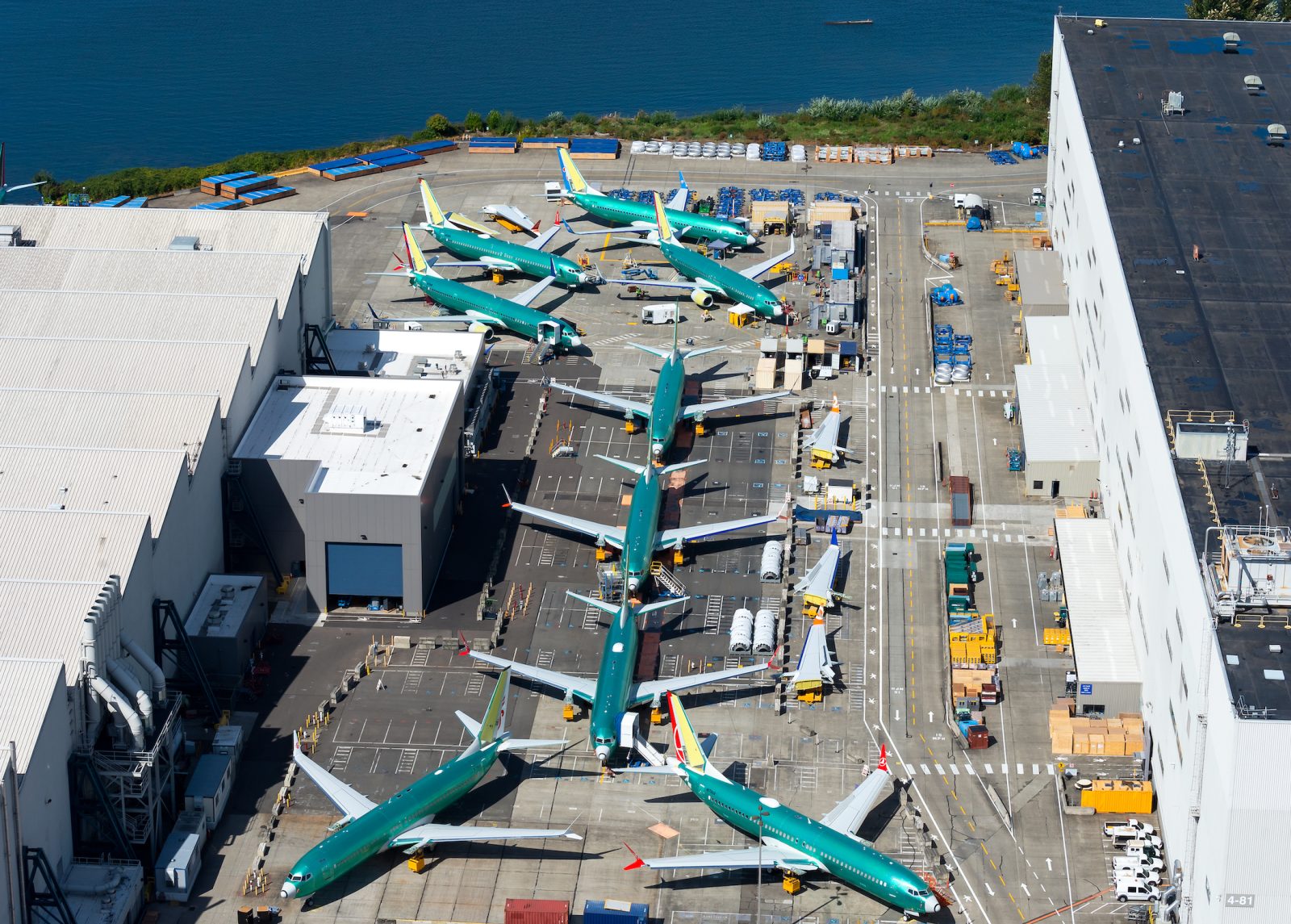
Allegiant's first 737 MAX on Boeing's Renton fligtline (Photo: AirlineGeeks | Katie Zera)
Ultra-low-cost carrier Allegiant now expects to take delivery of its first 737 MAX nearly four months late. In a Q4 2023 earnings call on Monday, the Las Vegas-based company said it initially expected to receive its first 737 MAX in the first week of 2024. With recent production and quality control woes at Boeing, Allegiant is eyeing a late March or early April delivery.
“As you might expect, we are actively discussing with Boeing changes to our 737 MAX delivery schedule for 2024. At the time of our last investor update, we were expecting to take delivery of our first MAX aircraft in the first week of 2024. As of now, we are estimating that deliveries will begin in late March or early April,” said Drew Wells, Allegiant’s Senior Vice President and Chief Revenue Officer, in prepared remarks during the earnings call.
“Our current estimates differ from contractual commitments,” Wells continued. The airline says it is “conservatively planning” to receive 12 737 MAX aircraft in 2024, placing into service 10.
Citing uncertainty around the 737 MAX deliveries, the airline stopped short of providing full-year 2024 financial guidance to analysts during the call. Although Allegiant says it remains confident in Boeing, it is being “flexible” in its 2024 capacity planning as a result of the delivery hiccups.
“While Boeing deliveries will be delayed based on recent news and comments, we are excited about our introduction of the MAX 8200 aircraft. It’s one of the most reliable airplanes in the world. Its performance profile as well will provide us enhanced economic benefits in the coming years,” Allegiant chief Maurice Gallagher added.
The airline plans to equip its 737 MAX jets with Allegiant Extra, which offers six inches of additional legroom along with a handful of other enhancements. Allegiant is concurrently configuring its Airbus aircraft with the new product offering.
Allegiant joins a growing list of airlines being more nimble in future capacity planning as a result of Boeing’s production woes. Last month, United said it removed the 737 MAX 10 – the aircraft type’s largest variant – from its future fleet plans.
Ryan founded AirlineGeeks.com in February 2013 and has spent more than a decade covering the airline business. His work has been featured by CNN, WJLA, CNET, and Business Insider. His aviation experience spans airport operations, Part 135 regulatory compliance, and airline crew workforce planning, along with time behind the yoke of a Cessna 172 and interviews with airline executives. Ryan now serves as Group President of Firecrown Media’s Aviation Group. He holds a B.S. in Air Transportation Management and an MBA from Arizona State University and teaches Airline Management at Embry-Riddle Aeronautical University.
An Air Mauritius Airbus A330-900 at the Paris Airshow 2019 (Photo: Airbus)
Air Mauritius unveiled plans on Monday to commence operating two weekly flights between Mauritius and Rome from Oct. 16, 2024 until April 30, 2025. The airline will deploy its Airbus A330-900neo aircraft configured with 28 seats in Business Class and 260 seats in Economy Class for this service, which will operate on Wednesdays and Sundays, connecting Sir Seewoosagur Ramgoolam International Airport in Mauritius to Rome’s Leonardo Da Vinci International Airport.
As outlined in the press release, flights departing from Mauritius will take off at 08:40 local time and land in Rome at 17:40 local time on both Wednesdays and Sundays. Return flights from Rome to Mauritius will depart at 19:25 local time, arriving in Mauritius at 08:05 local time the following day. The initial phase of operations spans from Oct. 16 to Oct. 26, 2024, after which, from Oct. 27, 2024 to March 29, 2025, the frequency and schedule will remain consistent.
“The introduction of these two non-stop flights to Rome is part of the consolidation of our European network. Rome, has a lot to offer. The year 2025 will be marked by the opening of a Holy Year. These flights to Rome represent an opportunity for many Mauritians who are looking forward to this moment to go on pilgrimage there and in other Italian cities during this jubilee period. Our Air Mauritius non-stop product is unique in the region, and we are delighted to make it available to both Mauritian passengers and connecting passengers from the region. The tourism industry in Mauritius will also benefit from these two non-stop flights which will attract more visitors from Italy and neighboring countries to Mauritius,” says Laurent Recoura, Officer in Charge of Air Mauritius in a press release.
The Airline’s Broader Growth Plan
This move aligns with Air Mauritius’ broader strategy to bolster its European network, tapping into the popularity of Rome as a destination and catering to both Mauritian and connecting passengers. Notably, currently, Neos, an Italian airline, is the sole operator of non-stop flights from Mauritius to Rome (Fiumicino) FCO, offering these flights once weekly with the Boeing 787 Dreamliner aircraft.
It’s noteworthy that in March last year, Air Mauritius announced the relocation of its London operations from Heathrow Airport to Gatwick Airport, commencing daily flights to Sir Seewoosagur Ramgoolam International Airport from Oct. 29, 2023, utilizing A350-900 and A330-900neo aircraft. The airline reported approximately 290,000 passengers traveling from London to Mauritius in 2022, marking a four percent increase from 2019 levels. Additionally, in November 2023, the airline commemorated 50 years of operating to London.
Victor Shalton's love for aviation can be traced to when he was 11-years-old. As a seasoned aviation writer, he takes pride in providing the best aviation coverage around the globe and is passionate about advancing his skills in the aviation space. In addition, he loves travelling, writing, arts and while his speaking engagements have taken him around the world, he is proud to call Nairobi home.
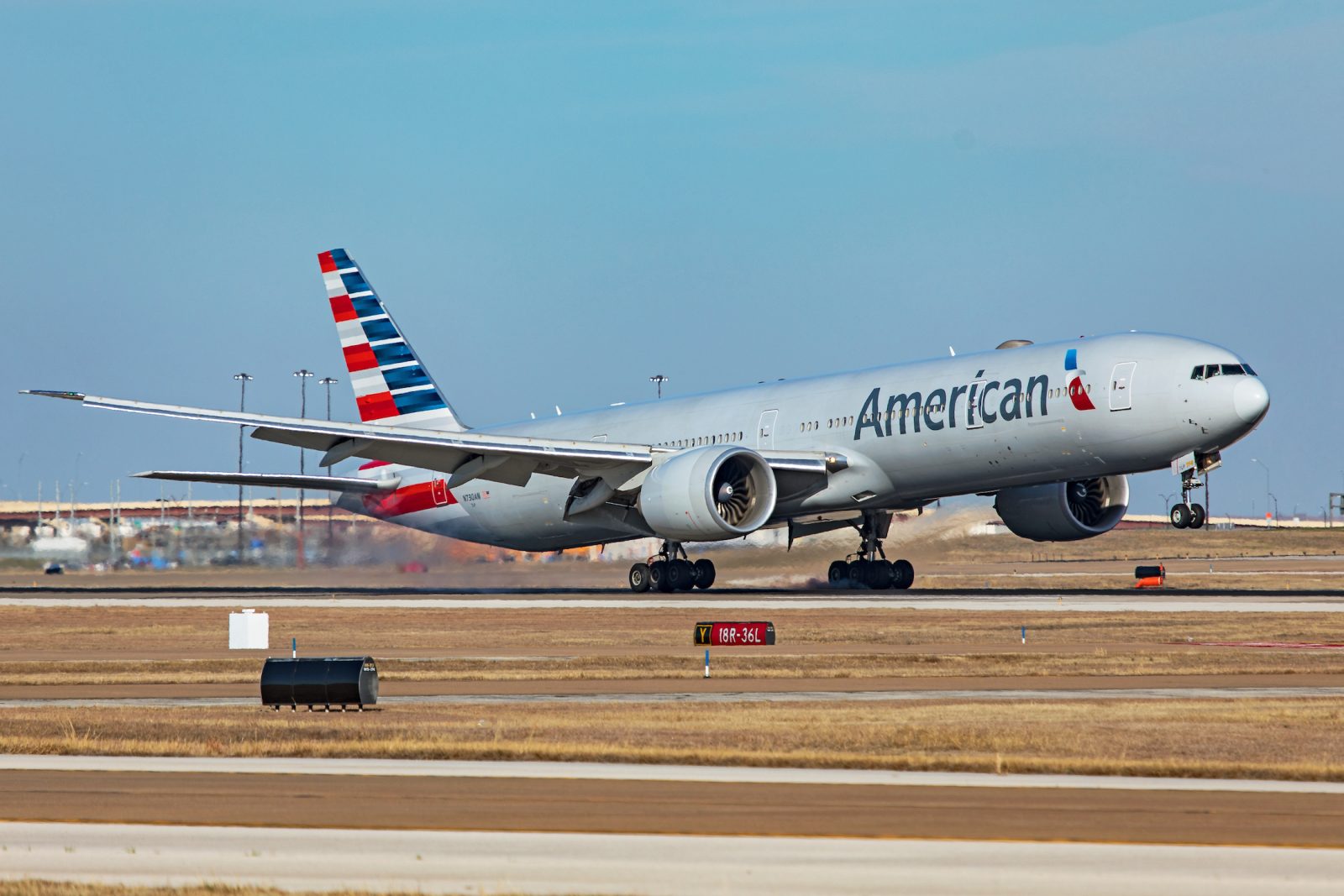
An American 777-300ER at DFW. (Photo: AirlineGeeks | William Derrickson)
American is bolstering its international network with some frequency and equipment changes on a handful of routes. Less than a week ago, on Feb. 1, 2024, American announced multiple new international routes out of its Dallas/Ft. Worth hub, including its new longest scheduled flight, which will operate from DFW to Brisbane, Australia. In addition to the airline’s new longest route, American also announced several routes from DFW to Latin America that begin in October 2024.
First announced by Ishrion Aviation on X, the airline will be expanding and adding frequencies or increasing the aircraft size on five international routes all of which go into effect on Oct. 27, 2024.
From Miami, the Fort Worth-based carrier will be increasing Sao Paulo service from 14 to 21 weekly flights, essentially adding a third daily flight every day of the week. They will also increase Buenos Aries service from 17 to 21 weekly flights, which means every day of the week will now have three flights.
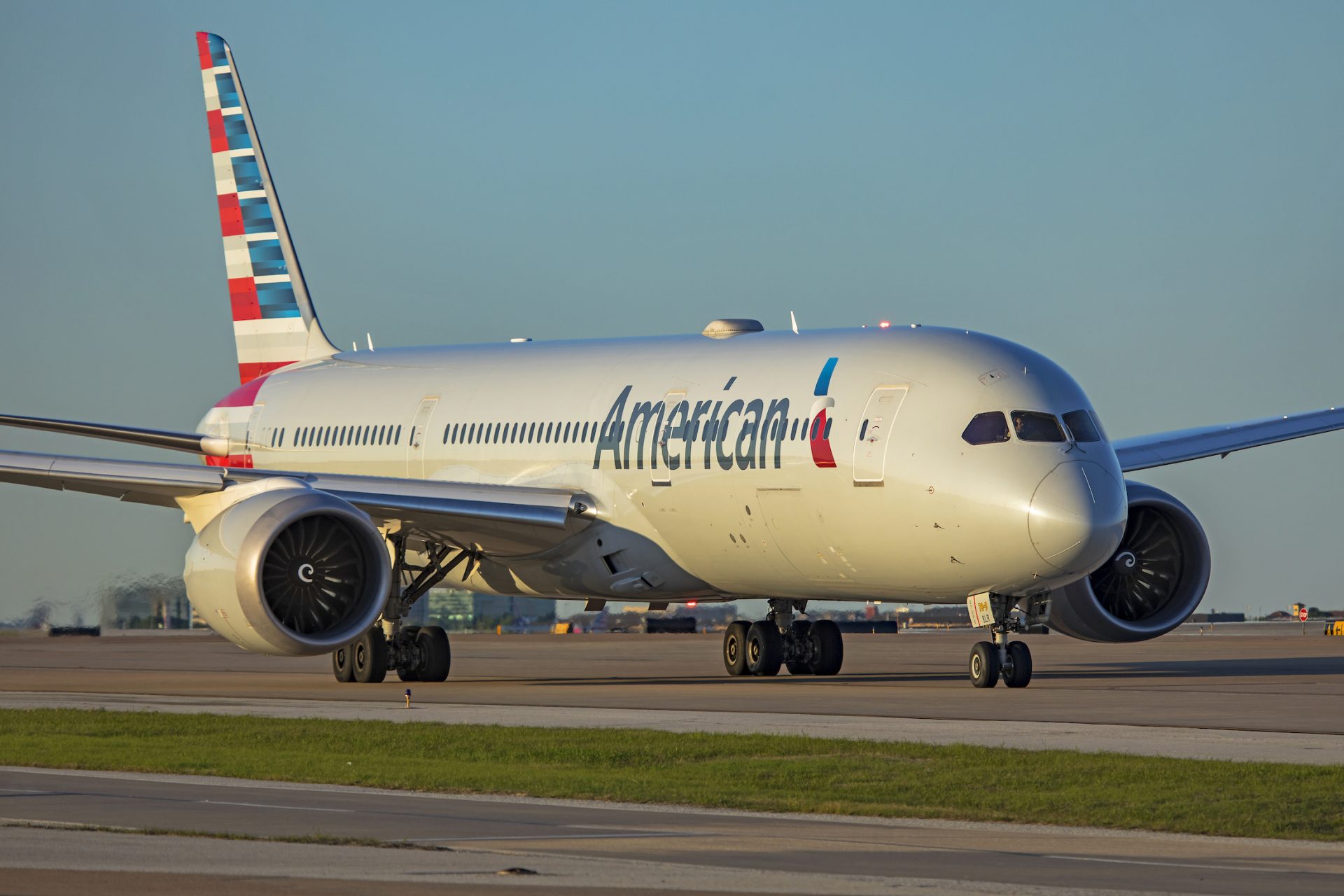
From American’s home at Dallas/Ft. Worth, the airline will be switching its Tokyo service to a larger aircraft, with Narita moving from a Boeing 787-8 to a Boeing 777-200, and Haneda moving from a Boeing 787-8 to a slightly larger 787-9.
An American 787-9 Dreamliner (Photo: AirlineGeeks | William Derrickson)
Upgrading Los Angeles Service
From Los Angeles, the carrier will be expanding Tokyo Haneda service by switching it from a 787-8 to a larger 787-9, similar to its Haneda service out of Dallas/Ft. Worth.
As mentioned previously, all of these service changes go into effect in October 2024, along with the other previously announced international additions and new frequencies. American, along with other airlines, tend to increase service to destinations in the Southern Hemisphere towards October and November as it is the start of springtime in that part of the world and the high season begins.
Joey has always been interested in planes for as long as he can remember. He grew up in Central New York during the early 2000s when US Airways Express turboprops ruled the skies. Being from a non-aviation family made it harder for him to be around planes and would only spend about three hours a month at the airport. He was so excited when he could drive by himself, the first thing he did with his driver's license was get ice cream and go plane spotting for the entire day. He graduated from Western Michigan University in 2022 with a B.S. in Aviation Management & Operations and a Minor in Business, and currently works for a major airline in his hometown.
Boeing Continues To Face Mounting Pressure From Airlines
Emirates has become the second major airline customer to put pressure on Boeing after last month’s 737 MAX 9 door plug blowout.
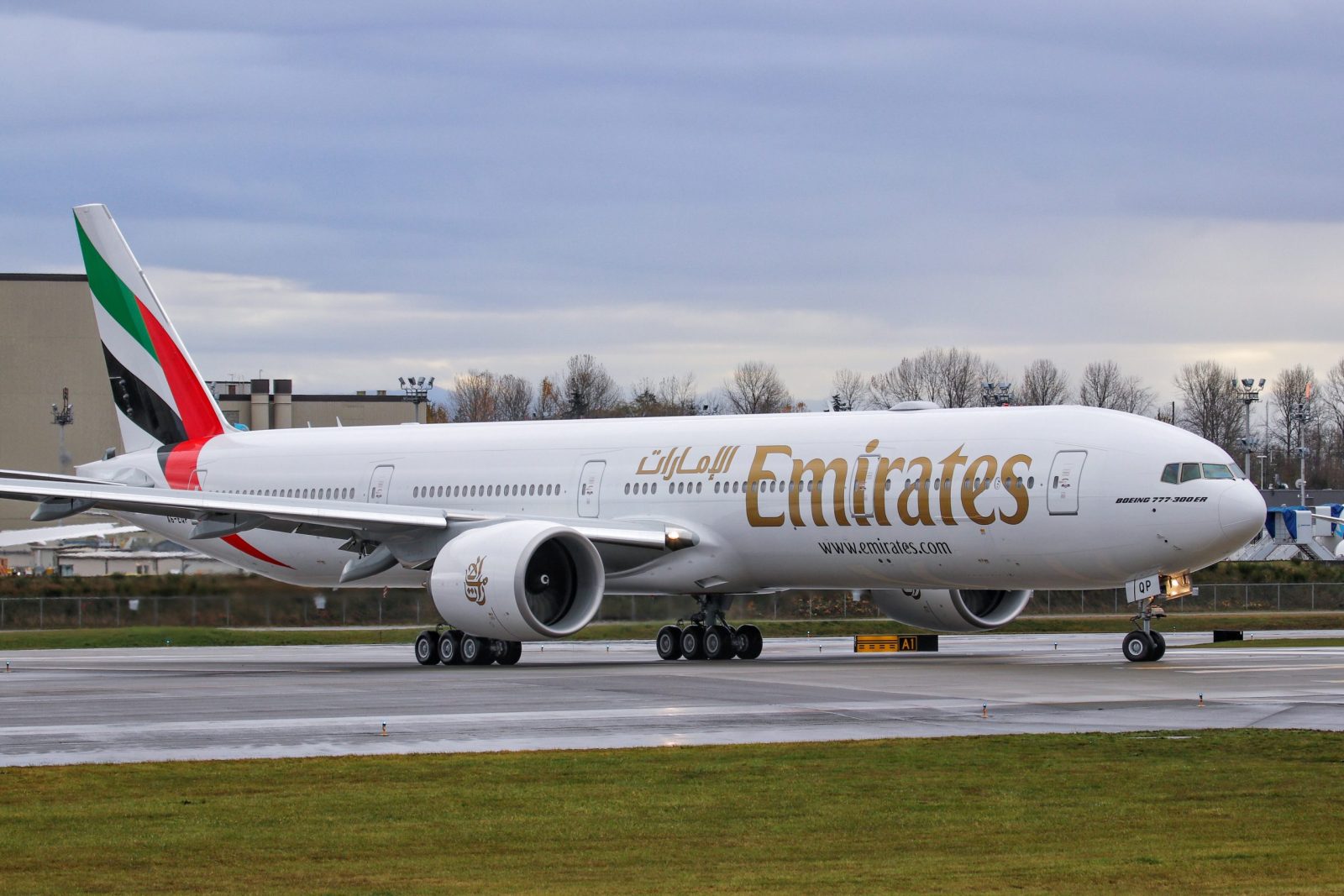
Emirates is the largest operator of Boeing 777-300ER aircraft with 134 jets in the fleet. (Photo: AirlineGeeks | Katie Zera)
Emirates has become the second major airline customer to put pressure on Boeing after last month’s 737 MAX 9 door plug blowout. Airline President Tim Clark says Boeing is in the “last chance saloon,” adding the company wants to see Boeing rectify issues that have damaged its reputation in recent years.
The 737 MAX 9 door plug blowout is the latest in a string of incidents that the Federal Aviation Administration says is due to poor quality control at Boeing, one of the largest airline manufacturers in the world. Emirates operates a substantial fleet of Boeing aircraft and is awaiting deliveries of 777X aircraft, whose first delivery is set to be in 2025, six years behind schedule.
Boeing’s relationship with Emirates is crucial. The airline already operates over 130 Boeing 777 widebodies, and it has orders for over 230 more, split between 777X and 787 Dreamliner aircraft. The airline has operated Boeing aircraft since 1985, and its cargo arm operated 747s until the late 2010s. Losing Emirates as a customer would be a critical blow for Boeing and a huge win for rival Airbus, with whom Emirates has 65 orders.
Emirates isn’t the first airline to put pressure on Boeing after the 737 MAX 9 incident and groundings. United Airlines CEO Scott Kirby publicly announced last month that United would reconsider the 737 MAX 10’s future in United’s fleet as that type is riddled with certification delays. Airbus offered United expedited deliveries of new A321neo aircraft, and Kirby visited Airbus in France soon after.
Like Emirates, United is a critical customer for Boeing. Losing business from United would be a major blow to Boeing’s bottom line, and equally a major win for Airbus.
Boeing is currently under federal investigation for its alleged shortcomings in quality in control. The FAA is limiting the number of 737 MAX aircraft that Boeing can produce while the investigation is ongoing, and additional third-party inspectors are present in Boeing’s factories to ensure any quality control issues are rectified.
Whether Emirates is in talks to expand its Airbus A350 order is unclear, though Airbus would likely be happy to take Emirates’ business. Getting timely delivery slots for A350 aircraft could be difficult, though, so Emirates may give Boeing some leniency to ensure a steady flow of aircraft to replace aging 777s.
Still, speaking publicly on Boeing’s shortcomings played well for United, who received almost immediate support from Airbus. It is not unfeasible, therefore, for Airbus to offer Emirates benefits should Emirates look for other options than the 777X.
Boeing has over 450 orders for its 777X and over 6,000 for the 737 MAX family at the time of writing.
John McDermott is a commercial pilot pursuing a career in professional flight. His passion for aviation began in an Ann Arbor bookstore with a tale of enemy pilots during World War 2, and he hasn't looked back. Besides flying and writing for AirlineGeeks, John volunteers with Professional Pilots of Tomorrow and travels whenever he gets the chance.
More Quality Control Issues With 737 MAX
Boeing announced Sunday it will need to do more work on 50 undelivered 737 MAX aircraft after Spirit AeroSystems, the contractor that builds 737 fuselages.
737 MAX aircraft in Renton. (Photo: Shutterstock | Thiago B Trevisan)
American aircraft manufacturer Boeing announced Sunday it will need to do more work on 50 undelivered 737 MAX aircraft after Spirit AeroSystems, the contractor that builds 737 fuselages, discovered two mis-drilled holes on some fuselages.
Boeing told Reuters that a problem with “edge margins,” or gaps between a fastener and the edge of the sheet metal, was found in holes drilled on a window frame on some jets. Boeing will devote several “factory days” at its Renton, Wash. plant to working on these misaligned holes this week, in addition to finishing other outstanding work.
“This past Thursday, a supplier notified us of a non-conformance in some 737 fuselages. I want to thank an employee at the supplier who flagged to his manager that two holes may not have been drilled exactly to our requirements,” Boeing Commercial Airplanes CEO Stan Deal said in a letter to staff.
“While this potential condition is not an immediate flight safety issue and all 737s can continue operating safely, we currently believe we will have to perform rework on about 50 undelivered airplanes,” Deal continued in the letter.
Spirit says they are “in close communication with Boeing on this matter.” The two companies have reportedly come to an agreement on how many mis-drilled holes must be addressed and how many problems are so minor that fuselages can be used as-is.
The quality defect in question has been found on 22 of the 47 fuselages inspected. It is possible that this problem is also present on airframes already in service.
Boeing says that delays stemming from this drilling problem will affect its production schedule but will improve overall quality and stability. The manufacturer has also asked a major supplier to halt all shipments until this new problem is rectified.
Points such as rivet holes can be among the most critical places on aircraft. Aircraft life cycles are largely defined by the number of times it is pressurized. This is because microcracks form around rivets and other welding points with each pressurization, and the airplane must be permanently removed from service if the cracks reach a certain severity.
Modern aircraft can withstand thousands of pressurization cycles, and the oldest commercial aircraft in service are decades old. Many especially old aircraft might even still be flying if it weren’t for new, more-efficient aircraft replacing them.
This is the latest blow to Boeing, who is under investigation for quality control issues stemming from the Alaska Airlines door plug blowout on a 737 MAX 9 jet last month. The FAA blamed Boeing, not Spirit AeroSystems, for leaving bolts holding the plug door in place too loose.
737 MAX production has been indefinitely capped at 38 aircraft per month while the FAA investigates. There are also more third-party investigators in Boeing plants to continually monitor safety.
John McDermott is a commercial pilot pursuing a career in professional flight. His passion for aviation began in an Ann Arbor bookstore with a tale of enemy pilots during World War 2, and he hasn't looked back. Besides flying and writing for AirlineGeeks, John volunteers with Professional Pilots of Tomorrow and travels whenever he gets the chance.
Sign-up for newsletters & special offers!
Get the latest stories & special offers delivered directly to your inbox