American Flies Gold Star Families to Orlando in Massive Airlift
The Fort Worth-based airline donated 11 aircraft and 700 tickets as part of its annual Snowball Express event in partnership with the Gary Sinise Foundation.
The Snowball Express program is more than just a vacation to the happiest place on earth. It’s an opportunity for families to connect with others who understand their loss and to create new memories during the holiday season.
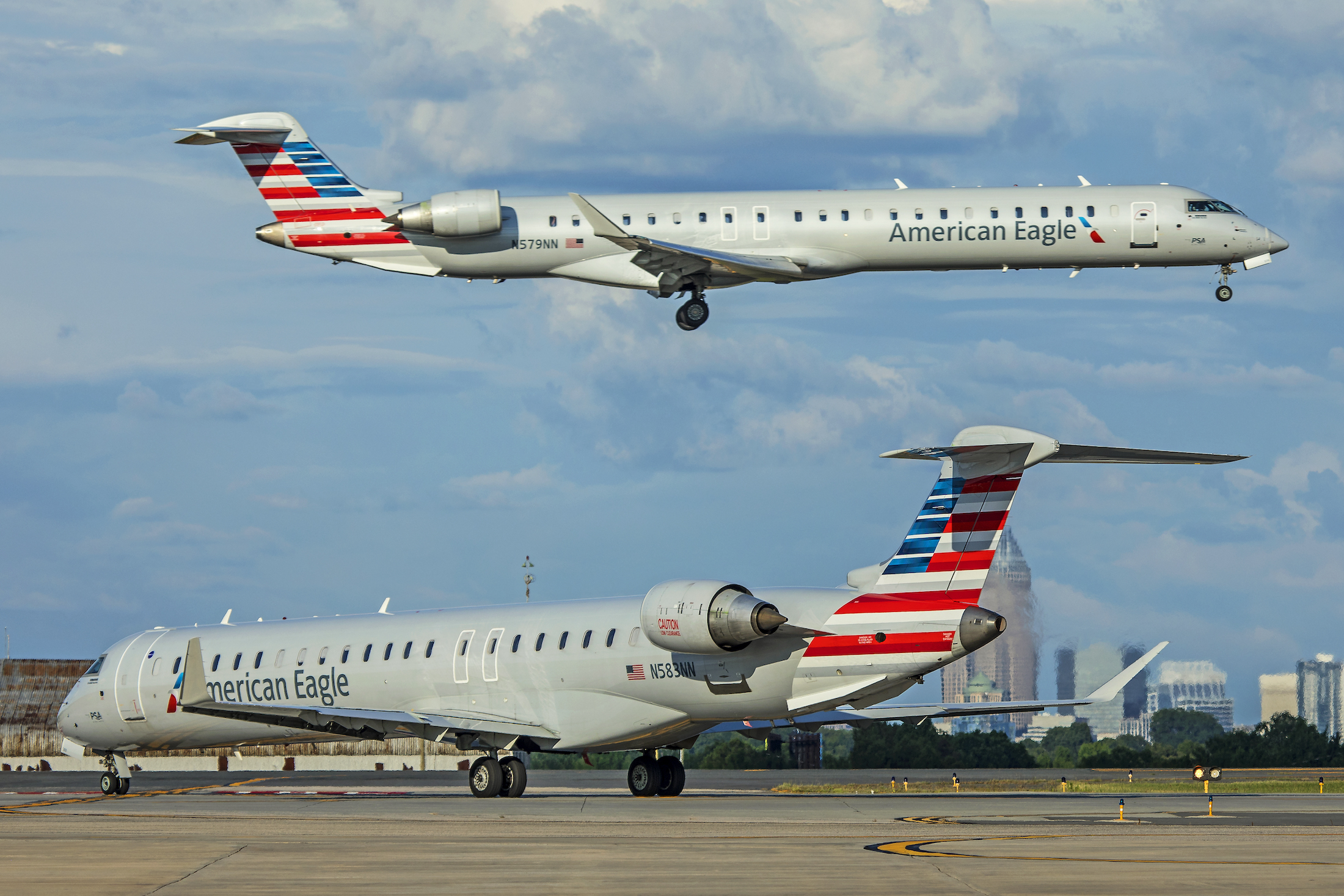
American donated 11 charter aircraft to the Snowball Express airlift in 2023. (Photo: Flightradar24)
This year, the Fort Worth-based airline donated 11 aircraft and over 700 tickets to ensure that family members from regions across the world would have the opportunity to participate in the event. Over 1,800 family members from 80 different locations participated in the airlift from as far away as Australia, Guam, and Europe.
“With the families of our fallen heroes for our Gary Sinise Foundation Snowball Express Annual event as they depart to the most magical place on Earth, Disney World. We’re taking over 1,800 family members, the children and surviving spouses,” actor Gary Sinise said on his Facebook page.
American includes aircraft as large as a Boeing 787-9 in the airlift. (Photo: AirlineGeels | Ryan Ewing)
“It’s always an honor to wrap my arms around them and remind them we do not forget their hero. Thank you to our presenting sponsor American Airlines for taking extra care of these special families, providing 11 chartered planes,” he added.
Gold Star family members receive a special send-off before each Snowball Express flight. (Photo: AirlineGeeks | Ryan Ewing)
Also donating their time are the crew members on each of the 11 charter aircraft along with teams on the ground supporting them. Both pilots and flight attendants have the opportunity to volunteer on Snowball Express flights every year.
During the send-off event at Dallas/Fort Worth International Airport (DFW), American Airlines COO David Seymour shared that the demand is so high for volunteers that not everyone is chosen. Being the airline’s largest hub, DFW typically has the biggest Snowball Express event.
Aircraft cabins are decorated in a holiday theme. (Photo: AirlineGeeks | Ryan Ewing)
From DFW, 284 people boarded a holiday-decorated Boeing 787-9 aircraft – the largest aircraft in the Snowball Express airlift. Before departure, the airline’s employees decorate each of the charter aircraft’s cabins with a holiday theme.
The DFW Snowball Express flight receives a water canon salute. (Photo: AirlineGeeks | Ryan Ewing)
American and the Gary Sinise Foundation operate the charter flights from some of the carrier’s hubs and also select military towns. Several cities from Seattle to Fayetteville, N.C. saw a Snowball Express flight pass through on Saturday, with some making stops to pick up more families en route to Orlando.
Ryan founded AirlineGeeks.com in February 2013 and has spent more than a decade covering the airline business. His work has been featured by CNN, WJLA, CNET, and Business Insider. His aviation experience spans airport operations, Part 135 regulatory compliance, and airline crew workforce planning, along with time behind the yoke of a Cessna 172 and interviews with airline executives. Ryan now serves as Group President of Firecrown Media’s Aviation Group. He holds a B.S. in Air Transportation Management and an MBA from Arizona State University and teaches Airline Management at Embry-Riddle Aeronautical University.
A Ukraine International Airlines Boeing 737-800 aircraft. (Photo: AirlineGeeks | William Derrickson)
Ukraine International Airlines, the flag carrier of Ukraine, has entered bankruptcy proceedings after being sued by Ukreximbank, a Ukrainian state-owned bank. The move comes about a month after the airline began selling off assets below market value to pay off its debts, which total $568 million.
The airline paused commercial passenger operations after Russia invaded Ukraine in February 2022. The airline has not operated regularly scheduled flights under its own name in nearly two years and thus has had near zero revenue.
Ukraine International Airlines has found ways to bring in some money. It leased some of its aircraft to airBaltic soon after Russia’s invasion began, but none of the aircraft operated after September 2022 in large part due to disputes between the two companies.
Some of Ukraine International’s aircraft have been fully transferred to airlines in other countries and de-registered to other carriers, domestic or otherwise. Leasing companies also recalled a number of aircraft to protect them from damage.
Flying around Ukraine has been a challenge since Russia invaded the country last year. Most countries barred their airlines from entering the country over concerns that aircraft would be damaged. One of Ukraine International’s aircraft was shot down over Iran in 2020, making it especially challenging for them to operate normally during wartime.
Russia Targeting Aviation Infrastructure
Russia has not been shy to target Ukraine’s aviation facilities, including the famed Antonov AN-225 soon after the war began. Air travel can be a vital air link to get critical wartime supplies into the country – and civilians out. Ukraine’s airports stopped operating for non-military flights after the invasion began.
Even without overt attacks, since so many Ukrainians left the country after the invasion began, and the country’s tourism is so decimated, that demand for air travel into and out of the country is near zero.
John McDermott is a commercial pilot pursuing a career in professional flight. His passion for aviation began in an Ann Arbor bookstore with a tale of enemy pilots during World War 2, and he hasn't looked back. Besides flying and writing for AirlineGeeks, John volunteers with Professional Pilots of Tomorrow and travels whenever he gets the chance.
Another Cubana Aircraft Returns Home
Cubana, the Havana-based flag carrier of Cuba - now in its 94th year - has just received another one of its aircraft back from maintenance.
A stored Cubana IL-96 in Havana, Cuba (Photo: AirlineGeeks)
Cubana, the Havana-based flag carrier of Cuba – now in its 94th year – has just received another one of its aircraft back from maintenance. Until recently, most of its fleet is parked except for a single ATR72 aircraft that flies domestically within the country.
Roughly three months ago, in September of 2023, a Tupolev TU204, which carriers the registration CU-T1702, returned to Cuba after being flown in from Ulyanovsk, Russia where it was undergoing heavy maintenance for over four years. The Tupolev in question flew domestically for a few months within Cuba, before being flown to Doha via Gander and Moscow on Nov. 30, 2023.
A Cubana Tupolev Tu204 parked in Havana (Photo: AirlineGeeks | Joey Gerardi)
Thanks to the carrier’s surprisingly active Facebook page, it is now known that the airline has received an Ilyushin IL-96-300 that carries the registration of CU-T1250 after it was flown back to Cuba from Russia after “regularly scheduled maintenance.” The aircraft was met with a water cannon salute upon arrival in Cuba on Dec. 3, 2023.
A Cubana Ilyushin IL-96-300 (Photo: Cubana de Aviación)
A Rare Aircraft
It is assumed that similar to the TU204, the IL96-300 will be placed on regularly scheduled routes within Cubana’s network in the near future. The airline has flown this aircraft on its main two international routes to Buenos Aries and Madrid, which have been flown on leased Airbus A340-300s from Spanish company PlusUltra since their IL96s have been in maintenance.
For AvGeeks who can visit Cuba and fly on the airline, this presents a rare and unique opportunity as the airline will have two aircraft that aren’t found anywhere in the world on passenger operations; the IL96, as Cubana is the sole commercial operator, and the Tu204, of which Cubana is one of two current operators with the second being Air Koryo in North Korea.
Joey has always been interested in planes for as long as he can remember. He grew up in Central New York during the early 2000s when US Airways Express turboprops ruled the skies. Being from a non-aviation family made it harder for him to be around planes and would only spend about three hours a month at the airport. He was so excited when he could drive by himself, the first thing he did with his driver's license was get ice cream and go plane spotting for the entire day. He graduated from Western Michigan University in 2022 with a B.S. in Aviation Management & Operations and a Minor in Business, and currently works for a major airline in his hometown.
Alaska Airlines to Acquire Hawaiian
Alaska Airlines and Hawaiian Airlines have announced a $1.9 billion deal that will see Alaska acquire Hawaiian, forming the fifth-largest U.S. airline.
Alaska Airlines and Hawaiian Airlines have announced a $1.9 billion deal that will see Alaska acquire Hawaiian. The transaction will see the two airlines combine into a single company, strengthening Alaska’s position as the fifth-largest airline in the United States.
Details of the Proposed Transaction
The transaction would see Alaska Air Group acquire Hawaiian Holdings for $18.00 per share in cash – a generous premium for Hawaiian shareholders who saw the company’s stock close at $4.86 per share on Friday. Inclusive of Hawaiian’s net debt of $0.9 billion, the total value of the transaction will be approximately $1.9 billion.
In a press release announcing the acquisition, the companies stated that the deal is expected to create approximately $235 million of synergies without having a long-term impact on balance sheet metrics or leverage levels. The transaction is expected to close within 12-14 months. Although the deal has received the green light from both boards, it is conditional on approval from regulators and Hawaiian shareholders.
“We are also pleased to deliver significant, immediate and compelling value to our shareholders through this all-cash transaction,” Hawaiian Airlines President and CEO Peter Ingram, states in the press release. “Together, Hawaiian Airlines and Alaska Airlines can bring our authentic brands of hospitality to more of the world while continuing to serve our valued local communities.”
Combining Complementary Networks
Serving the 49th and 50th states, the two airlines largely serve distinct markets. Alaska has a strong network throughout the U.S. West Coast, with additional routes to the eastern part of the country and to warmer southern destinations throughout Central America.
Alaska Airlines Boeing 737-900(ER) and B737-800 aircraft at LAX (Photo: AirlineGeeks | James Dinsdale)
Meanwhile, Hawaiian focuses on intra-island flights and transpacific flights connecting the Hawaiian islands to the continental U.S. Unlike Alaska, the carrier also has a long-haul fleet, flying from Hawaii to the U.S. mainland, Asia and Oceania.
As shown in a combined route map that accompanied Sunday’s announcement, the two airlines have largely complementary networks. The main overlapping area of competition is routes connecting the U.S. West Coast to Hawaii. Once the transaction is completed, the combined company is expected to serve over 130 destinations.
The combined airline is expected to serve 138 destinations, including 29 international markets (Photo: Alaska Airlines)
The merged entity will maintain Alaska’s oneworld membership, giving Hawaiian customers access to the alliance’s global network. Alaska customers will benefit from greater connectivity between the U.S. West Coast and the Asia-Pacific region through Hawaiian’s Honolulu hub.
One Company, Two Brands
Although the two airlines are combining to form one company, both airline brands will be maintained. Alaska and Hawaiian each have distinct brands with loyal customer bases, and it is evident that the companies recognize the strength of their existing brands.
With a fleet of 365 aircraft, the combined company will have a mixed fleet of Airbus and Boeing jets. Having recently returned to an all-Boeing fleet with the retirement of the remaining Virgin America aircraft, the Alaska Air Group will soon see the reintroduction of Airbus aircraft into its portfolio.
Alaska’s fleet currently consists exclusively of Boeing 737s – although its regional partners operate Embraer 175s under the company’s brand – while Hawaiian operates Boeing 717-200s, Airbus A321neos, and Airbus A330s. Hawaiian will also begin to receive Boeing 787-9 Dreamliners in the coming months.
Hawaiian Airlines aircraft in Honolulu (Photo: AirlineGeeks | Ian McMurtry)
“This combination is an exciting next step in our collective journey to provide a better travel experience for our guests and expand options for West Coast and Hawai‘i travelers,” said Ben Minicucci, Alaska Airlines CEO in a press release. “Our two airlines are powered by incredible employees, with 90+ year legacies and values grounded in caring for the special places and people that we serve. This is an exciting next step in our journey to elevate the travel experience and expand options for guests.”
Andrew is a lifelong lover of aviation and travel. He has flown all over the world and is fascinated by the workings of the air travel industry. As a private pilot and glider pilot who has worked with airlines, airports and other industry stakeholders, he is always excited to share his passion for aviation with others. In addition to being a writer, he also hosts Flying Smarter, an educational travel podcast that explores the complex world of air travel to help listeners become better-informed and savvier travelers.
Qantas' 787 Dreamliner which will be used on the Perth-London route (Photo: Qantas)
It has been a hack of a year for Perth and Western Australia so far, with many new connections to Europe and Asia either commenced or starting soon. With the most recent being Jetstar Australia and Vietnam Airlines, new services are seemingly announced on a weekly rate. In this article, we will provide a summary of all new services this year and upcoming.
Perth is unique positioned in Australia. Away from the cluster of metropolis on the East Coast, it is not the most populous region but is situated closer to South East Asia, Europe and Africa. Historically, Perth has had significant services to Asia and Africa, while Europe came into the picture with Qantas establishing direct connection to London Heathrow using a Boeing B787-9.
Existing Intercontinental Services
A Qantas Boeing 787-9 departing LAX (Photo: AirlineGeeks | James Dinsdale).
Qantas is currently the sole operator of flights to Europe, flying to London Heathrow daily and Rome on a seasonal basis. To the Gulf region, where travelers connect to get to Europe and beyond, Emirates and Qatar Airways each operate a daily flight on their A380s.
In East Asia, Singapore Airlines has traditionally been the primary carrier in providing connection for Western Australians. Its significant offering with 25 weekly flights provide over 2,000 seats per day between the city pair, allowing travelers to connect onto its network from Singapore Changi to Europe, North America, Asia and South Africa. The airline is also building a new SilverKris lounge at the airport.
Singapore Airlines’ low-cost subsidiary Scoot operates another 12 weekly flights on their Dreamliners. Qantas’ sole Asian destination from Perth is also Singapore, with a daily frequency on Airbus A330. Singapore-Perth sees 44 weekly flights in December 2023. (Source: flightrader24)
One of Singapore’s first 787-10, which is used for Perth flights (Photo: AirlineGeeks | Ryan Ewing)
Elsewhere in Asia, Cathay Pacific also flies five weekly flights to Hong Kong, a drop from pre-pandemic level. Its OneWorld partner Malaysia Airlines flies 12 weekly frequencies to Kuala Lumper. A number of airlines have introduced new services in 2023 and the details are in the next section.
To Africa, Air Mauritius runs a three weekly service, connecting passengers beyond its hub in Port Louis. Before the pandemic, both Qantas and South African Airways (SAA) flew the route and we could expect a return from either or both, as SAA reintroduced intercontinental services to its network earlier this year.
Recent Additions
The recent growth at Perth mainly comes from Asia, specifically South East Asia, where there is significant leisure and VFR (Visiting friends and relatives) demand coming out of COVID.
List of new services added or resumed in 2023:
Airline
Destination
Frequency
Aircraft
ANA
Tokyo Narita (NRT)
3
B787-9
AirAsia Indonesia
Jakarta (CGK)
4
A320
Batik Air
Jakarta (CGK)
7
A320
Batik Air Malaysia
Kuala Lumper (KUL)*
4
B737-8
Citilink
Denpasar (DPS)
7
A320
Citilink
Jakarta (CGK)
3
A320
Philippine Airlines
Manila (MNL)
3
A321neo
Vietjet
Ho Chi Minh City (SGN)
5
A321neo
*Batik KUL service continues onwards to Auckland on fifth freedom, bookable connection
Amongst them, it was the first time Philippine Airlines and Vietjet have landed in Perth, while ANA resumed its flights initially launched in 2019.
In addition, two familiar carriers, Singapore Airlines and Cathay Pacific, are ramping up their services. Singapore Airlines will add a fourth daily flight next year, increasing its weekly frequency from 25 to 28. Cathay upgraded Perth to 5 weekly and is currently using B777-300ER, its biggest aircraft, to serve the route.
This is expected to change as airlines recognize the demand from Perth and more carriers connect their hubs to Perth, giving more destination options to travelers. Singapore’s status could be challenged in the process as travelers opt for direct connections.
Upcoming Connections
A Vietnam Airlines Boeing 787 Dreamliner on approach into London’s Heathrow Airport. (Photo: AirlineGeeks | William Derrickson)
Vietnam Airlines will be another new addition to the skies of Perth, launching its first flight to Perth with its B787 Dreamliners. China Eastern will mark its return with a seasonal service during the Chinese New Year period from January 20th to February 18th. Qantas’ new French connection also responds to seasonal demand in time of the Olympics and the frequency will drop to three weekly after the Olympics.
List of upcoming flights:
Airline
Destination
Frequency
Aircraft
Start Date
China Eastern
Shanghai (PVG)
3
A330-200
20 Jan 2024
Vietnam Airlines
Ho Chi Minh City (SGN)
3
B787-9
7 Nov 2023
AirAsia Malaysia
Kuala Lumper (KUL)
7
A321neo
Mar 2024
Jetstar
Singapore (SIN)
TBD
A321LR
TBD 2024
Jetstar
Phuket (HKT)
TBD
A321LR
TBD 2024
Jetstar
Bangkok (BKK)
TBD
A321LR
TBD 2024
Qantas
Paris (CDG)
4/3
B787-9
12 Jul 2024
Jetstar’s new base at Perth will house four A321LR aircraft and will be leisure focused. Overall, Perth will see its network significantly strengthened to Asia and is making a case for its potential to be a transit hub to Europe and Africa.
Anthony is an aviation enthusiast who grew up around the world from St. Louis to Singapore, and now lives in Amsterdam. He loves long-haul flying and finds peace in the sound of engine cruising. He aspires to share his passion for the sky though writing and providing another angle on the stories.
Lufthansa Group Advances Sustainable Aviation With Green Fares On Long-Haul Flights
Lufthansa Group introduces Green Fares for long-haul. Lufthansa Group aims for CO2 neutrality by 2050, promoting sustainable air travel.
Lufhtansa aircraft at Munich Airport.
(Photo: AirlineGeeks | Fabian Behr)
The Lufthansa Group is taking a significant step towards environmental responsibility by extending its Green Fares to long-haul flights. Starting November 30, this initiative encompasses twelve selected flight routes, connecting Lufthansa Group hubs to various global destinations:
Zurich – Los Angeles (ZRH – LAX)
Frankfurt – Miami (FRA – MIA)
Sao Paulo – Zurich (GRU – ZRH)
Frankfurt – Bengaluru (FRA – BLR)
Munich- Seoul (MUC – ICN)
Brussels – Kinshasa (BRU – FIH)
Singapore – London (SIN – LHR/LCY)
Nairobi – Frankfurt (NBO – FRA)
Bangkok – Vienna (BKK – VIE)
Hong Kong – London (HKG – LHR/LCY)
London – Hong Kong (LHR/LCY – HKG)
Paris – Bangkok (CDG/ORY – BKK)
Global airlines are advocating for Sustainable Aviation Fuels (SAF) as an effective strategy to lower carbon emissions without major infrastructure modifications, as many commercial aircraft can operate with SAF. Some airlines have already started using SAF blended with traditional jet fuel.
The Green Fares program was launched for European and North African routes in February and has witnessed substantial customer endorsement. Since its inception, over half a million passengers have chosen Green Fares flights, underscoring the public’s growing commitment to eco-friendly travel. This initiative reflects the increasing public desire to travel sustainably, further providing insights for developing sustainable travel portfolios.
The hallmark of the Green Fares is its comprehensive approach to CO2 emission offsetting. It involves using Sustainable Aviation Fuel (SAF) to achieve a 10% reduction in CO2 emissions, with the remaining 90% offset through high-quality climate protection projects. SAF, a ‘drop-in’ fuel mixed with fossil fuel before airport transportation, is a critical component in the Lufthansa Group’s strategy for reducing its carbon footprint. This initiative is part of the group’s ambition to achieve CO2 neutrality by 2050, with an interim goal of halving its net CO2 emissions by 2030 compared to 2019.
The participating airlines in this test phase include Lufthansa, Austrian Airlines, Brussels Airlines, and SWISS, offering these routes via their booking sites. In addition to using SAF, this program focuses on fleet modernization, optimizing flight operations, and supporting global climate and weather research.
The Lufthansa Group’s extension of Green Fares to long-haul flights marks a significant stride in sustainable aviation. By blending SAF use with contributions to climate protection projects, the group advances its sustainability goals and caters to the growing global demand for environmentally responsible air travel.
Vincenzo graduated in 2019 in Mechanical Engineering with an aeronautical curriculum, focusing his thesis on Human Factors in aircraft maintenance. In 2022 he pursued his master's degree in Aerospace Engineering at the University of Palermo, Italy. He combines his journalistic activities with his work as a Reliability Engineer at Zetalab.
Canada’s Air Transat and Porter Announce JV Alliance
Air Transat and Porter have announced a Joint Venture (JV) alliance ‘integrating Porter's and Transat's highly complementary, non-overlapping networks...'
A Porter Airlines Embraer 195-E2. (Photo: Embraer)
Canadian airlines Air Transat and Porter Airlines have announced a Joint Venture (JV) alliance ‘integrating Porter’s and Transat’s highly complementary, non-overlapping networks at Toronto Pearson (YYZ) and Montreal Trudeau (YUL) airports.’ The airlines began a codeshare agreement a little over a year ago in October 2022 and the JV is being categorized as ‘an evolution’ of the arrangement. Air Transat credits the codeshare agreement with generating an additional 60,000 passengers for the 2023 fiscal year.
Annick Guérard, the President and Chief Executive Officer of Transat, said in a press release: “This historic agreement constitutes a significant step forward in executing Transat’s strategic plan and an important milestone in developing a more sustainable competitive network. We are delighted to further extend our collaboration with Porter, a partner that shares our customer-centric approach and values. Through this Alliance, we will accelerate the expansion of our transatlantic footprint by allowing us to leverage the domestic market served by Porter, while allowing for a more efficient use of our fleet.”
Air Transat has a leisure focus offering service to over 60 international destinations and Porter Airlines has a regional focus with expansion into the North American market. Subject to regulatory approval, the JV will enable coordination of route-planning and scheduling, and collaboration in fare structure.
Michael Deluce, President and CEO of Porter, said: “Porter is in the midst of disrupting the North American market through a significant continental expansion that will only be amplified by this Alliance. The flow of passengers on both carriers means that Porter will be able to develop a more robust network by increasing flight frequency on key domestic and transborder routes, and entering into new markets with less point-to-point traffic.”
Porter Adds to Fleet
This week Porter announced that the airline will be taking up the option of an additional 25 Embraer E195-E2 aircraft in addition to the 50 firm orders the carrier has with the manufacturer. 24 of those initial 50 aircraft are already in service for Porter Airlines allowing the airline to expand its U.S. destinations. “As we continue receiving deliveries of up to 100 new Embraer E195-E2 aircraft, our options for deploying this fleet are even greater based on this collaboration with Air Transat,” added Deluce. The airline expects delivery of the additional aircraft to commence in 2025 and still has the remaining option of a further 25 E195-E2s.
“At Porter, we entered a new era when we began operating the E195-E2 earlier this year,” said Deluce. “The jet is exceeding our expectations, especially in terms of fuel use, and delivering an incredible level of customer satisfaction to our passengers with a quiet, comfortable ride. These additional 25 orders enable us to continue extending our reach throughout North America, with more exciting new destinations.”
John has always had a passion for aviation and through a career with Air New Zealand has gained a strong understanding of aviation operations and the strategic nature of the industry. During his career with the airline, John held multiple leadership roles and was involved in projects such as the introduction of both the 777-200 and -300 type aircraft and the development of the IFE for the 777-300. He was also part of a small team who created and published the internal communications magazines for Air New Zealand’s pilots, cabin crew and ground staff balancing a mix of corporate and social content.
John is educated to postgraduate level achieving a masters degree with Distinction in Airline and Airport Management. John has held the positions of course director of an undergraduate commercial pilot training programme at a leading London university. In addition he is contracted as an external instructor for IATA (International Air Transport Association) and has been a member of the Heathrow Community Fund’s ‘Communities for Tomorrow’ panel.
JSX Adds New California Airport
This new airport for the carrier joins other Bay Area airports such as Oakland (OAK) and Concord (CCR) with service starting in February.
Inside the JSX hangar at Dallas Love Field. (Photo: Mateen Kontoravdis | AirlineGeeks)
Semi-private operator JSX is adding a new route starting in early 2024. Starting on February 1, the operator will add San Jose (SJC) to its route map, joining other Bay Area airports such as Oakland (OAK) and Concord (CCR). While JetSuiteX served the SJC-BUR market a few years back, this remains a new route for JSX in its current form.
The carrier’s new SJC station will start with a single flight to Burbank (BUR). According to the company’s website, the new route will be three times daily in both directions. Morning, midday, and evening departures are currently in the schedule.
Ryan founded AirlineGeeks.com in February 2013 and has spent more than a decade covering the airline business. His work has been featured by CNN, WJLA, CNET, and Business Insider. His aviation experience spans airport operations, Part 135 regulatory compliance, and airline crew workforce planning, along with time behind the yoke of a Cessna 172 and interviews with airline executives. Ryan now serves as Group President of Firecrown Media’s Aviation Group. He holds a B.S. in Air Transportation Management and an MBA from Arizona State University and teaches Airline Management at Embry-Riddle Aeronautical University.
Editor’s Note: AirlineGeeks is excited to launch our ‘Livery of the Week’ series. Every Friday, a team member will share an airline livery, which can be from the past, present, or even a special scheme. Some airline liveries are works of art. The complexity associated with painting around critical flight components and the added weight requires outside-the-box thinking from designers. The average airliner can cost upwards of $200,000 to repaint, creating a separate aircraft repainting industry as a result.
Have an idea for a livery that we should highlight? Drop us a line.
Air New Zealand took a bold step towards updating its 1990s-era predominantly white livery in 2012. The ‘Kiwi’ airline flipped a long-time trend of historically more bland liveries for something eye-catching and visually appealing.
Currently, the airline has 101 aircraft in service ranging from ATR 72s to Boeing 777-300ERs, according to planespotters.net. Air New Zealand serves its home country along with medium and long-haul international flights.
Historical Liveries
The Air New Zealand brand emerged in 1965. With it came the first iterations of teal and blue hues in the company’s branding, which were used until 2012. Representing the airline’s Oceanic roots, these hues would largely stick around on multiple versions of the livery.
An Air New Zealand 777-200 in Los Angeles (Photo: AirlineGeeks | William Derrickson)
Circa 1980s stripes along the length of the fuselage were replaced with stylized waves and bolder titles across the airline’s fleet, according to Norebbo. This livery remained until 2009 when the airline modified it again, removing the waves and keeping a white fuselage.
Jet-Black, Pun Intended
Fast forward to 2012 to the airline’s current livery, which was a major shift from the teal and blue colors. Air New Zealand’s overall brand pivoted where black became the primary color.
The airline’s current paint scheme features a sleek, jet-black exterior adorned with the iconic white fern emblem, symbolizing New Zealand’s national pride and sporting heritage. The design pays tribute to the country’s rugby team, which came to fruition out of a 2011 special livery.
Created by Designworks, the livery actually comes in two different versions. There is a white version with a black rear portion of the aircraft along with an all-black design. Only a few aircraft feature the all-black livery, including the Boeing 787-9 Dreamliner, the Airbus A321neo and the 777-300ER.
An Air New Zealand 787 Dreamliner at Paine Field. (Photo: AirlineGeeks | Katie Bailey)
The all-black version of the livery was first debuted in 2013 on a 787-9. In a 2013 Business Traveller article, the carrier said it conducted extensive customer testing, including focus groups, to gather feedback on the updated design.
An Air New Zealand 787 landing at Houston IAH (Photo: AirlineGeeks | Mateen Kontoravdis)
At the time, Christopher Luxon, Air New Zealand’s CEO, said: “The new-look livery is distinctive and iconic and we believe will inspire a sense of pride in New Zealanders.”
In August 2022, Air New Zealand turned heads again when it unveiled an all-black version of the Star Alliance livery on an A321neo, registered as ZK-OYB. The all-black livery can still be found on select Air New Zealand widebody and narrowbody aircraft.
Looking for a new airplane model? Head over to our friends at the Midwest Model Store for a wide selection of airlines and liveries.
Ryan founded AirlineGeeks.com in February 2013 and has spent more than a decade covering the airline business. His work has been featured by CNN, WJLA, CNET, and Business Insider. His aviation experience spans airport operations, Part 135 regulatory compliance, and airline crew workforce planning, along with time behind the yoke of a Cessna 172 and interviews with airline executives. Ryan now serves as Group President of Firecrown Media’s Aviation Group. He holds a B.S. in Air Transportation Management and an MBA from Arizona State University and teaches Airline Management at Embry-Riddle Aeronautical University.
Inside the carefully choreographed effort to keep Reagan National Airport's main runway open. The project is scheduled to take just over two years to complete.
Construction crews work late nights to keep a major artery to the Nation's Capital open. (Photo: MWAA)
Every year, over 20 million passengers traverse Ronald Reagan Washington National Airport’s (DCA) runways, making it a critical gateway to the Nation’s Capital. But just like any major artery, it requires regular maintenance and upkeep and, occasionally, an overhaul.
A relic of the airport’s 1940s birth, its airfield features three intersecting runways. At 6,869 feet in length, the main north-south runway – 1/19 – is the airport’s longest. In most cases, DCA is limited to single runway operations due to the airfield design.
An airfield design with perpendicular runways can be a bit constraining. For instance, take DCA’s nearby sister airport – Washington Dulles International (IAD). It has four runways, three of which are parallel. Closing one may hamper air traffic flow, but it won’t shut down the entire airfield.
DCA’s runway layout (Photo: United States Geological Survey (USGS), Public domain, via Wikimedia Commons)
So how does an airport like DCA repair its aging runways? A tactically choreographed runway rehabilitation effort has been taking place for seven months this year, which involves closing the airfield each night.
Nightly Rehabilitation
When it comes to shutting down the airfield each night, DCA already has very few aircraft operations between 10 p.m. and 6:59 a.m. due to the airport’s so-called Nighttime Noise Rule. Even though this rule was far more prevalent with louder airliners back in the day, Cirium Diio schedule data shows just a handful of arrivals after 11 p.m. prior to the start of construction.
Airlines have still been forced to rearrange their schedules, and construction crews work against the clock each night to reopen the airfield. Any delay in an originating morning flight from DCA could create ripples in the aircraft’s overall schedule.
Construction crews at DCA work to rehab the runways (Photo: MWAA)
“There is a lot of coordination…because of the project,” James Keogh – the project’s manager from Lagan Aviation and Infrastructure, which specializes in runway overhauls – told AirlineGeeks during an interview. “We have a fairly definitive timeline…generally 11 p.m. to 6 a.m. and the airlines are aware of this.”
Although Keogh and his crew near the edge of airlines’ schedules, he says that there have been no major disruptions so far. “It’s our biggest thing, making sure we’re off every morning. So far it’s been successful. There’s been no, sort of, disruption outside of the planned works and the planned impacts on the airfield,” he added.
Rehabilitating a runway is as much an art in construction as it is in time management.
Not like a Roadway
While most runways are made with asphalt or concrete, similar to a roadway, the process of overhauling them can be a bit more daunting. Beneath the top layer is a network of lights and electrical components to illuminate the runway at night and during poor weather.
Priyam Shah manages construction projects for the Metropolitan Washington Airports Authority (MWAA), which oversees operations at both Reagan National and Dulles airports. He shared some in-depth details on the overhaul.
“You don’t see that there is so much electrical work involved in a runway project, but there is a lot,” Shah said. “When the planes hit the center of the runway, these lights do take a lot of heavy impacts, and they are [a] very important part of a [instrument] landing system.”
As part of the runway restoration project, MWAA will replace the lighting system on most of the airfield.
“So we are also rehabbing that as part of this. And when I said rehabbing, we are completely replacing that entire system. It goes hand in hand with the paving work, so the sequence has to be exactly right. There are like five different steps to this light installation process and paving off the runway,” Shah added.
During the interview, James Keogh also provided some insight on why a runway construction project differs from, say, a typical roadway.
“One of the big differences is the polymer bitumens that we use in the mix to give it additional strength and performance at greater variances in temperature and things like that,” he shared. “The specific allocation and the tolerance on it is generally tighter than on a highway…[it’s] more stringent and the implications of not achieving that can be costly.”
Getting It Right
Safety is paramount when redoing any airside surface, but so is efficiency. Construction crews at DCA worked six nights per week, coordinating closely with stakeholders. The project is currently paused for the winter months, but is slated to resume again in the spring of 2024.
Costing an estimated $110 million, the project is scheduled to take just over two years to complete. The airport’s shorter runway – 15/33 – remained open for one phase of the project, which allowed smaller aircraft to operate. As for airliners, 15/33 is on the shorter end of the runway spectrum at only 5,204 feet, therefore limiting larger aircraft.
Most travelers don’t think about the pavement that their aircraft is traversing, and that’s a good thing. Commonly known as a pavement management system, behind-the-scenes airport professionals do regular inspections of airfield surfaces to ensure they are safe, stable, and free of debris as stipulated by FAA regulations.
Since Runway 1/19 sees the majority of the airport’s traffic, regular upkeep continues to be important in avoiding any operational disruptions. “So the runways are taken care of very well,” Shah said. “So to do that, we do very rigorous regular inspections on the runway and there are some engineering thresholds.”
At DCA, the last major runway rehabilitation project was in 2011-2012. The airport did a so-called 3.5-inch mill and pave. This time around crews will replace base materials up to eight inches deep, which MWAA hopes will help with the runway’s long-term durability.
“We don’t have too many examples, or probably not any example, of doing this kind of work in this kind of time frame, so everything had to be thought out ahead of time,” Shah concluded.
Ryan founded AirlineGeeks.com in February 2013 and has spent more than a decade covering the airline business. His work has been featured by CNN, WJLA, CNET, and Business Insider. His aviation experience spans airport operations, Part 135 regulatory compliance, and airline crew workforce planning, along with time behind the yoke of a Cessna 172 and interviews with airline executives. Ryan now serves as Group President of Firecrown Media’s Aviation Group. He holds a B.S. in Air Transportation Management and an MBA from Arizona State University and teaches Airline Management at Embry-Riddle Aeronautical University.