










Stories

Unique Connection Series Trip Report: Taos, New Mexico

Our aircraft on the ground in Carlsbad, Calif. (Photo: AirlineGeeks | Joey Gerardi)

If you have read my articles in the past, then you know I love out-of-the-way airports, airlines, and aircraft and would do almost anything to adventure to a new city or fly on a unique or rare aircraft type. So in this new series, which I will be calling the “Unique Connection Series” I will go over unique flight routings between two cities using a small or unusual airport as a stopover. The uniqueness of the connection might be referring to the small size of an airport, or a unique aircraft type, or both.

Overview

For this Unique Connection, I will be starting in Austin, Texas, and flying to Carlsbad, Calif. located roughly 35miles north of downtown San Diego using a connection in the small city of Taos, New Mexico. This was a special trip for me, as the first article I wrote for AirlineGeeks back in December 2019 was about the airline I will be flying in this trip report, so I was so excited to finally be trying it. The airline is Taos Air, but the flights are all operated by Hawthorne, Calif.-based Advanced Airlines using 30-seat Dornier328Jets which was another unique aspect of this flight.

At the time of writing this article, there are only 10 routes in the U.S. that are scheduled to operate on the Dornier328Jet. Taos Air/Advanced Air operates four of them, while Denver Air Connection flies the other six. The cities Taos Air operates from including its namesake of Taos, N.M., are Carlsbad and Hawthorne in California as well as Austin and Dallas Love Field in Texas.

Taos Air route map (Photo: Taos Air)

Other than flying directly to or from Taos to each of the four cities, which you can definitely do as it’s a popular ski destination, you can fly between Carlsbad and Austin or Dallas Love Field and Hawthorne in either direction using a connection in the city of Taos. Taos Air uses all FBO’s, or a small terminal in Carlsbad’s case, so there is no TSA, no hassle, and most importantly no lines, so depending on where you live or need to go the Taos connection may actually be the faster option for you, but that will be explained later.

Day of the flight

On the day of the flight, I woke up in Austin and headed to the airport for my 3:10 P.M. flight. Taos Air flights operate out of the Million Air FBO located on the south side of the Austin Airport roughly two miles from the South Terminal at Austin-Bergstrom. You don’t need to arrive more than 1-hour prior to the flight time, but I wanted to explore so I got there earlier than most.

Million Air FBO at Austin Intl. (Photo: AirlineGeeks | Joey Gerardi)

The FBO was very nice, clean, and had a lot of natural light coming in, with a wall of windows looking out onto the ramp so there are plenty of plane spotting opportunities from here.

Inside the Million Air FBO at Austin Intl. (Photo: AirlineGeeks | Joey Gerardi)

The person at the front counter instructed me that Taos Air passengers were to head upstairs for check-in, where I found a small table with a sign for Taos Air and a small scale for bags.

Taos Air Check-in at the Million Air FBO (Photo: AirlineGeeks | Joey Gerardi)

Each passenger is allowed two pieces of checked luggage up to 38lbs free of charge which includes snow sports items and helmet bags, anything above that is subject to costs and space availability on your flight. I was traveling with just a backpack, so it was weighed and I was given a Fiji water, boarding pass, and the freedom to explore and walk around until it was time to board.

The boarding pass for my flight (Photo: AirlineGeeks | Joey Gerardi)

The boarding pass was cardstock and was very nicely designed with Taos Air and the aircraft tail number on the front, and the words ‘Operated by Advanced Air’ on the back. I would like to point out that our aircraft ended up being N192T and not N192TS, but despite that very minor detail I was still impressed seeing a tail number on a boarding pass as well as the bright colorful design on it.

I headed downstairs for some exploring and found a self-serve soda machine, a Starbucks coffee machine, and a small bar inside the FBO all of which were nicely designed.

Starbucks coffee machine at the FBO (Photo: AirlineGeeks | Joey Gerardi)

Since I’m not a coffee drinker I was more impressed with the bar and even more impressed to find that everything was complimentary, provided you were flying out of the FBO.

The small bar located inside the FBO (Photo: AirlineGeeks | Joey Gerardi)

After grabbing a small drink I headed back upstairs to the lounge to find that more people had checked in for the flight, along with a pile of checked bags that were to be loaded onto our flight.

The upstairs lounge at the FBO (Photo: AirlineGeeks | Joey Gerardi)

The arrival of my aircraft was growing closer, so I grabbed a seat and enjoyed the amazingly comfortable chairs, the FBO was super comfortable and offered more than most airline lounges that I have seen. Before I could become bored, the star of the show had landed, so I headed outside to the open-air deck to watch the aircraft pull in.

The star of the show, a Dornier328Jet from the outdoor deck (Photo: AirlineGeeks | Joey Gerardi)

It was an interesting perspective, being able to see the top of the aircraft you are about to get on from such a close distance is not something passengers normally experience. My aircraft carried the tail number N192T and was originally delivered in early 2000 to Germany-based ‘Modern Air’. This aircraft even flew under the Delta Connection banner as N419FJ between 2001 and 2004, the detailed history of this specific aircraft can be found below.

The history of my aircraft (Screenshot from planespotters.net)

Even for the non-aviation enthusiasts, the arrival brought many individuals up to the window to see the aircraft in all its glory.

The tail of our aircraft, from inside the FBO (Photo: AirlineGeeks | Joey Gerardi)

Taos Air doesn’t have seat assignments and the seats are first come first serve, similar to other small airlines, so just after the aircraft’s arrival, I proceeded to head downstairs to make sure I could get on first. You can request a specific seat when you book the ticket, and while your request isn’t a guarantee they try to comply with all requests if they can. Roughly 20-minutes after arriving the flight attendant, whose name is Kimberly, came inside and took me and the other 17-passengers outside to the aircraft as well as collected our boarding passes

She also reminded us that masks are required while on the aircraft, as quite a few people didn’t have them on while inside. While the mask mandate is in place for all airport terminals, the FBO is technically private property so they weren’t required for people inside the FBO building itself as it doesn’t fall under the jurisdiction of the TSA. I did reach out to the specific FBO and they did inform me that masks were indeed optional for passengers inside the building, although the employees working there are required to wear them.

The flight attendant showing us to our aircraft (Photo: AirlineGeeks | Joey Gerardi)

As we walked out to the aircraft it became very loud as the APU, Auxillary Power Unit, was running. I highly recommend earplugs for the short walk out to the plane for those with sensitive hearing, but if your hearing isn’t sensitive you should be fine. The Taos Air/Advanced Air Dornier328Jet is laid out in a 1-2 configuration and seats 30 passengers.

Interior of the Dornier328Jet (Photo: AirlineGeeks | Joey Gerardi)

When the flight was booked I requested a window just behind the wing, and when I got on the aircraft the flight attendant already knew the request. She suggested either row 9 or 10, and I opted for seat 9A, a window/aisle seat on the left side of the plane. I was impressed that she knew exactly who made the request, although the camera was probably a big hint.

My seat on the first flight to Taos, N.M., 9A (Photo: AirlineGeeks | Joey Gerardi)

The flight then proceeded on as any other airline flight, the safety briefing followed by engine startup. The Dornier328Jet has a unique sounding startup and it was awesome listening to it. It was a short taxi out to the runway and we blasted off the runway from Austin only 13 minutes behind schedule.

Lined up for takeoff in Austin (Photo: AirlineGeeks | Joey Gerardi)

I love regional jets, and the Dornier328Jet has to be one of my favorites, the high wing offers views that are unmatched in the airline industry today. Most other high winged aircraft in commercial service today, such as the Cessna 208, are unpressurized so they can’t climb that far above the clouds.

Just after departing out of Austin (Photo: AirlineGeeks | Joey Gerardi)

Not long after departure, Kimberly came around with the snack basket and also get our drink orders. A majority of the snacks are made and produced right in Taos, N.M., or by other B Corporations as the airline love to show the commitment to the local communities that they serve as well as the environment. But if local snacks don’t suit your fancy they also had name-brand snacks such as Doritos or Lays chips.

The snack basket on Taos Air (Photo: AirlineGeeks | Joey Gerardi)

The airline also offers complimentary alcoholic beverages to those passengers over the age of 21, for those that aren’t they also offered a variety of juices and also water. Taos Air is also the world’s first carbon-neutral airline and has a 100% carbon offset program, and in that same spirit, the water is instead served in a large metal thermos which you can take with you and refill later, I still use mine. It is truly amazing the lengths the airline goes to in order to be more sustainable, even with the extra weight the metal bottles can add to an aircraft.

The refillable water bottle that is given out on the Taos Air flights (Photo: AirlineGeeks | Joey Gerardi)

By this time the flight was nearly half over and we had reached our cruising altitude of 30,000-feet. I decided to get up and talk with the other passengers around me to get their perspectives on this service. Almost everyone I talked to was either coming or going to see family and grandkids in the Taos, N.M. area. They all praised the service and were thankful that it existed as they no longer had to drive two hours to the next closest airport in Santa Fe, N.M. Those that weren’t going to see family or go home were going to the Taos Ski Resort. The airline offers free transportation to and from the airport and the Taos Ski Resort and also offers free ski/snowboard rentals to passengers coming in on Taos Air.

My view from 30,000 Feet (Photo: AirlineGeeks | Joey Gerardi)

One person I talked to even said this was the first time going to see her brother in over five years as he couldn’t drive long distances anymore and she didn’t have the money to rent a car and drive, and this service enabled her to see family she might not otherwise see. This is one of the reasons I fly to these small cities, to talk to people and get the stories most others wouldn’t hear, it isn’t just about the cool aircraft, it is who these planes can connect and bring closer together that wouldn’t travel otherwise had these types of services not exist.

The exit row seat, 9A, is by far the best seat on this plane and offers the most legroom. I’m not tall by any means at 5’4″, but remember this is still a regional jet so the legroom isn’t the best, but it still feels roomier than a 50-seat CRJ-200. There was also no Wifi on this aircraft or any of the airlines Dornier328Jets, but that shouldn’t be an issue as the views are more than enough to keep you occupied for the entirety of the flight.

My seat 9A (Photo: AirlineGeeks | Joey Gerardi)

By this point in the flight, we had begun our descent into Taos a while back. The city of Taos, N.M. was also visible out of the left side of the aircraft.

The city of Taos, N.M. coming into view (Photo: AirlineGeeks | Joey Gerardi)

We then passed over the Taos Regional Airport, I didn’t know it at the time, but this would be a rather long approach to the airport. The flight crew was practicing IFR, Instrument Flight Rated, procedures on this flight and we took the long way in passing the airport twice before actually landing. The crew is required to do this every six months or so in order to stay IFR current.

Our longer than average flight path into Taos, N.M. (Screenshot from FlightRadar24)

The approach into Taos was very windy and the plane did rock back and forth quite a bit as we got closer to the ground.

Approaching Taos, N.M. (Photo: AirlineGeeks | Joey Gerardi)

Despite the high winds in the area, the crew did a great job making a smooth landing on the runway only two minutes behind our scheduled arrival time at 4:12 P.M. which brought our total flight time for the first leg to 1-hour 49-minutes. Another thing I noticed once we landed, the Dornier328Jet doesn’t have thrust reversers, meaning the aircraft has to rely completely on wheel braking and speed brakes.
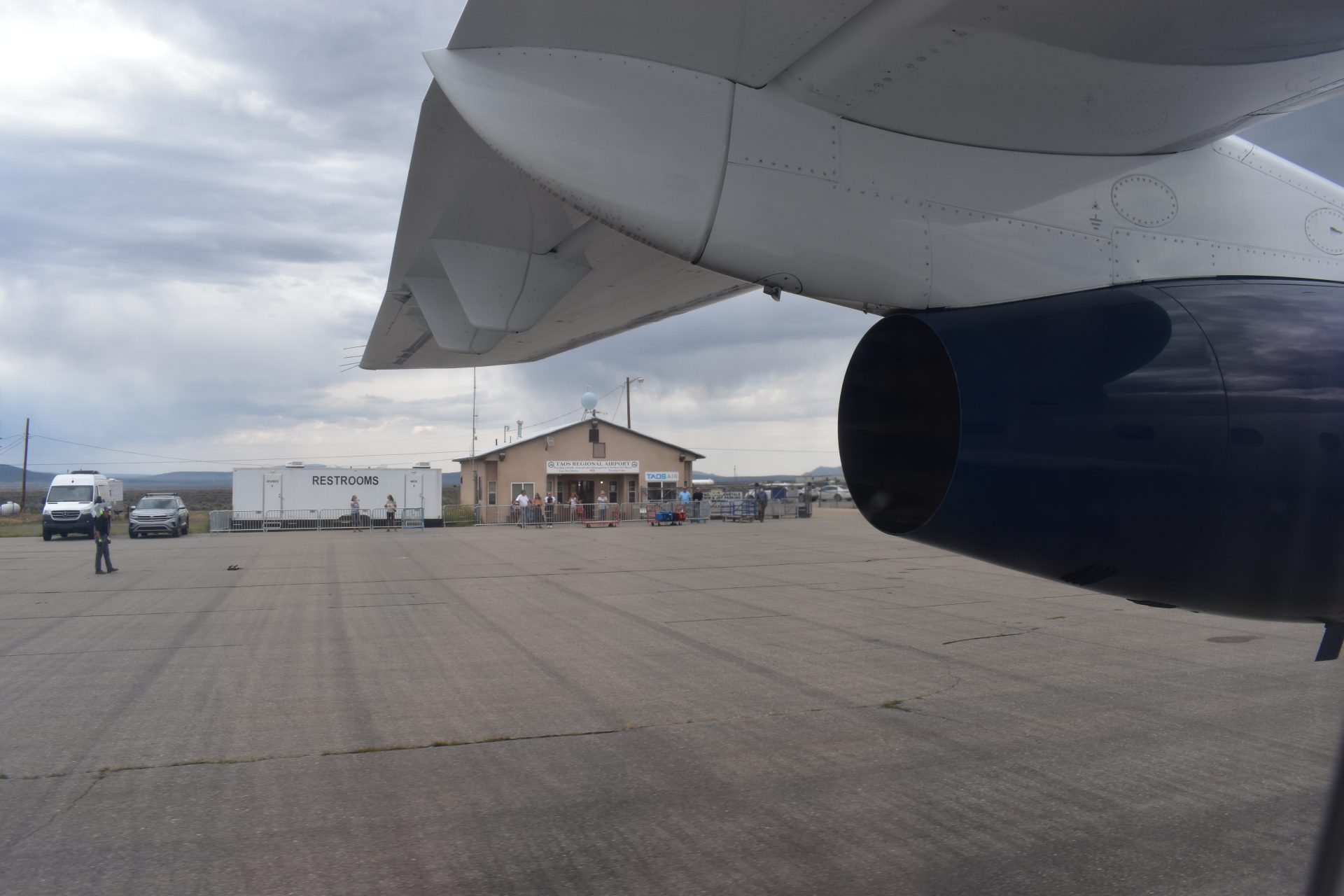
Pulling up to the terminal in Taos, N.M. (Photo: AirlineGeeks | Joey Gerardi)

I then caught my first glimpse of the small terminal with the small metal fence surrounding it, this was the terminal for the city of Taos, N.M.. It is always so fun seeing what the terminals look like in these small cities, they always add some sort of local flair.

After the engine shut off I was escorted off, as everyone had to get off for refueling for safety. Also, I was the only passenger that was continuing onto Carlsbad and I might have possibly been the first passenger to ever to fly from Austin all the way to California on Taos Air, as they seemed very shocked when I told them I would be getting back on.

Looking at the scenery from the airport (Photo: AirlineGeeks | Joey Gerardi)

As I got off and saw the mountains behind the airport, it reminded me of another reason why I connect in these small cities; I get to very briefly see places that I might not otherwise see, while still getting where I need to go. As an AvGeek, I was also obligated to get a picture of myself in front of the Dornier328Jet, which the ground crew was happy to take for me.

Me in front of the Dornier328Jet in Taos, N.M. (Photo: AirlineGeeks | Joey Gerardi)

The terminal in Taos was quite small, but again the airline only recommends you arrive for your flight one hour prior to departure so there isn’t much time for sitting in the terminal.

The outside of the terminal building (Photo: AirlineGeeks | Joey Gerardi)

Despite being a small terminal on the inside, there was plenty of outdoor space for passengers to walk around as long as they didn’t try to venture out close to the airplane.

The seating area inside the airport (Photo: AirlineGeeks | Joey Gerardi)

I then went up to the small podium and got checked in for my flight onto Carlsbad, Calif. they again weighed my bag and I also received a new boarding pass, this one did have the correct tail number on it, N192T.

The boarding pass for my flight to Carlsbad, Calif. (Photo: AirlineGeeks | Joey Gerardi)

IT wasn’t long before the pilot gathered everyone to take them out to the aircraft, he took our boarding passes and we got onto the aircraft bound for California. I decided to try out a non-exit seat for this flight, so I took a seat in 8A, just ahead of the exit row but still a window/aisle seat on the left side.

Sitting in 8A for the flight to Carlsbad, Calif. (Photo: AirlineGeeks | Joey Gerardi)

With Kimberly as the flight attendant for this flight as well, I settled in for the flight to Carlsbad which was scheduled to be just about the same flight time as the first leg. This leg only had 13 passengers total on it, but it did have noticeably more younger kids on it. Our total time on the ground in Taos was just under 1-hour making this an efficient and quick connection. Same as before, safety briefing and the startup of the two PW306B Turbofan engines. We blasted off out of Taos only 11 Minutes behind the original scheduled departure of 5 P.M. local time.

Turning onto the runway for takeoff in Taos, N.M. (Photo: AirlineGeeks | Joey Gerardi)

Again, the benefit of a high wing aircraft is being able to see the sights below and it definitely paid off on this flight. Just after takeoff, we flew over the Rio Grande River that is located inside of a canyon, and it was certainly a sight to see.

Passing over the Rio Grande River (Photo: AirlineGeeks | Joey Gerardi)

This flight progressed identically to the other, climbed up to cruising altitude which this time happened to be 28,000 Feet and the snack and beverage service began. For this flight, I decided to try out the snack selection and it didn’t disappoint.

My snack choice on the second leg (Photo: AirlineGeeks | Joey Gerardi)

Despite not knowing of either snack brand before the flight, it was an interesting choice of snack but they were certainly both tasty. By this time it was becoming late in the afternoon and the sun was now in front of our aircraft, I could clearly see the reflection of the aircraft on the jet, another plus of having a high wing aircraft.

The reflection of my aircraft on the Jet (Photo: AirlineGeeks | Joey Gerardi)

I tried to talk to passengers on this flight as well, but nobody really felt like talking and most of the passengers slept for this flight. I kept myself busy by taking pictures out of the window, and the views didn’t disappoint.

My view from 28,000 Feet (Photo: AirlineGeeks | Joey Gerardi)

As we got closer to our final destination we began to descend and in addition, a layer of smoke and haze began to fill the skies over southern California. We also passed the Salton Sea, which is located just north of Imperial, California, the place where I flew Mokulele Airlines just over a year before.

The Salton Sea, located in Southern California just north of Imperial, Calif. (Photo: AirlineGeeks | Joey Gerardi)

About 20-minutes outside of Carlsbad, the mountains, and hills slowly started coming into view as well as greener terrain.

The green hills of Southern California (Photo: AirlineGeeks | Joey Gerardi)

Carlsbad Airport has an interesting history. Taos Air is the first airline to successfully serve the airport since United Express left in 2015 due to the retirement of their Embraer E120 aircraft. The airport has had several unsuccessful attempts made by Caljet by Elite and most famously California Pacific Airlines, but the detailed history of the airport can be seen HERE.
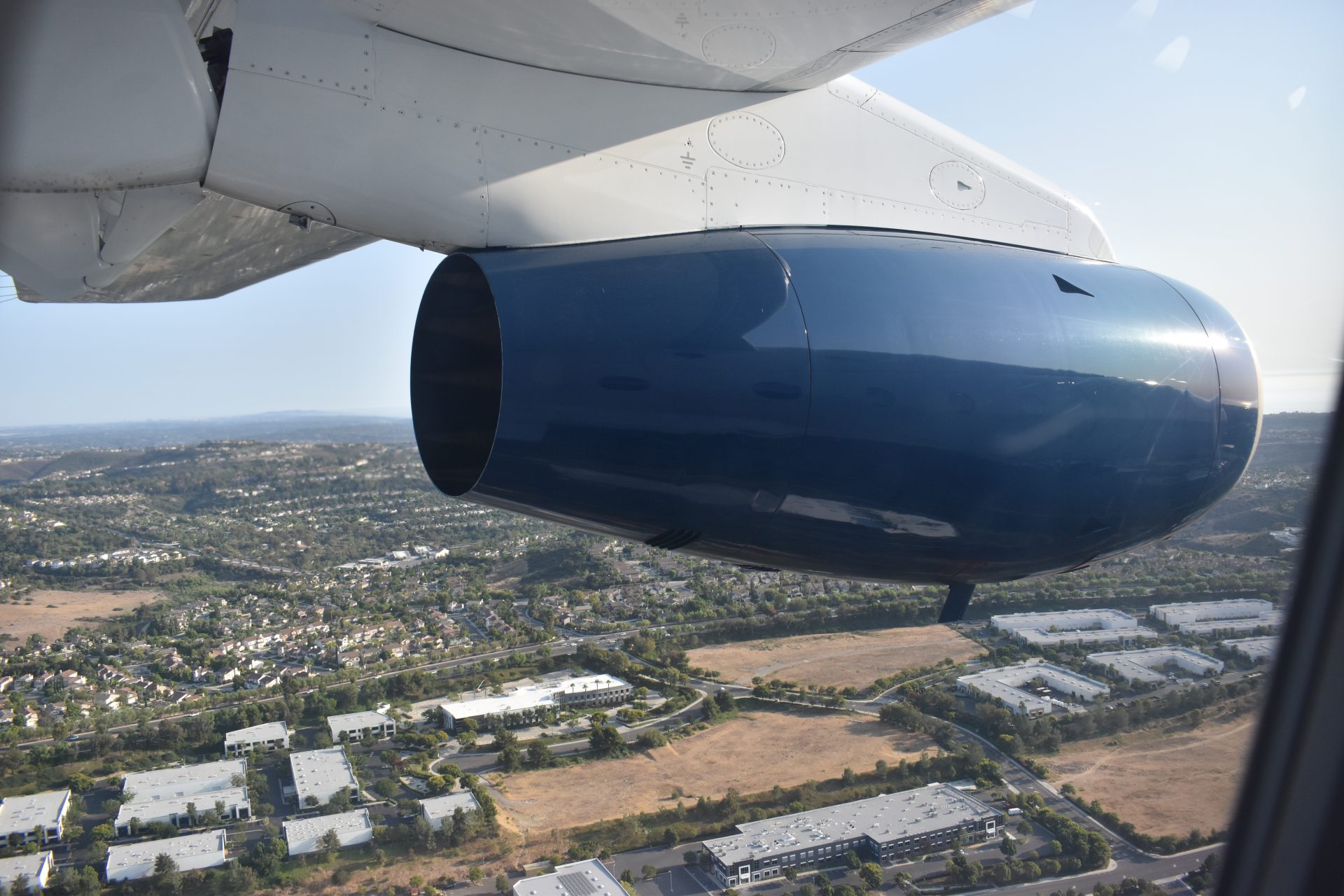
On final approach to Carlsbad, Calif. (Photo: AirlineGeeks | Joey Gerardi)

The approach was a lot less windy going into Carlsbad, and we proceeded to land at 6:01 P.M. local time, five minutes ahead of schedule, and had a total flight time for this leg of 1-hour and 50-minutes. The two flights on Taos Air were super fun and definitely make for a unique connection to any AvGeeks that are up to the task, in addition to the unique connection you’ll also get to ride on the Dornier328Jet, a dying breed in the United States for commercial airline service.

Our aircraft on the ground in Carlsbad, Calif. (Photo: AirlineGeeks | Joey Gerardi)

You can also do the unique Taos Air connection in the opposite direction as the flight times do work out. You can also make a connection in Taos, N.M. between Dallas Love Field and Hawthorne, Calif. in both directions. Hawthorne is located 4-miles southeast of LAX, so instead of going to the congested larger airport you can save a lot of time, and have more fun doing so.

Time for some math; from the time I arrived at the FBO in Austin until we landed in Carlsbad it was 5-hours and 45-minutes total including the connection in Taos. Flights from Austin to San Diego International Airport are scheduled at 3-hours and 10-minutes, and add in 2-hours for TSA in Austin and another hour to drive from the airport located in downtown San Diego to Carlsbad and that’s another hour, which leaves you at 6-hours and 10-minutes which is already more and still doesn’t including time to get your car. So depending on where in Southern California you are going or coming from, not only is this the more fun and unique option, but it just may be the fastest option as well. Plus, it’s on a DornierJet which is a super fun plane to fly on.

By no means is this service Emirates first class, but it is comparable if not better than short-haul domestic first-class flying within the United States. Plus Taos Air was definitely a fun and enjoyable experience for me and will make a great experience for any AvGeek that wants to make the trip and extra effort to fly on a unique aircraft and see a place they’ve never been to.

A video of the experience can be found below

Joey Gerardi

Joey has always been interested in planes for as long as he can remember. He grew up in Central New York during the early 2000s when US Airways Express turboprops ruled the skies. Being from a non-aviation family made it harder for him to be around planes and would only spend about three hours a month at the airport. He was so excited when he could drive by himself, the first thing he did with his driver's license was get ice cream and go plane spotting for the entire day. He graduated from Western Michigan University in 2022 with a B.S. in Aviation Management & Operations and a Minor in Business, and currently works for a major airline in his hometown.

The Emergence of Moving ‘Man’s Best Friend’

PuppySpot Saab 340 (Photo: PuppySpot)

When it comes to the transport of animals, cargo airlines have always been more than willing to provide to get animals from their starting point to their final destination. These moves can range from the Tex Sutton Equine Air Transport Boeing 727 for racehorse movements to one-off Panda flights by FedEx to return the species to their native lands in China. However, the demand for household animal transport has gained traction in the current marketplace, and two different airlines with different purposes have plans to get ‘man’s best friend’ across the country.

The first airline to make a move as a result of the pandemic was online pet provider PuppySpot. The dog service provides potential buyers and breeders a chance to communicate and access a client base across the country. PuppySpot is a USDA licensed distributor and oversees who they interact with, only selecting breeders that hold the same USDA standard they do and removing any deceptive breeders that might attempt to use puppy mills or scam tactics. The company runs health checks on dogs before delivery.

However, the pandemic left PuppySpot in a difficult situation in 2020, the company had previously relied on other airlines for transport of animals to their new homes. The drop of passenger traffic, the lack of cargo room and an increase in demand as people looking for a friend meant that PuppySpot needed a fix for their logistics problems.

PuppySpot would ultimately decide to do the work in-house via private aviation, selecting Castle Aviation of North Akron, Ohio and a few other private jet companies to do ‘dog-friendly travel to counter the lack of commercial aviation in 2020.

PuppySpot Chief Administrative Officer, Josh Kreinberg, noted, “Covid came in and handed us all kinds of complications because routes and flight schedules evaporated for the airlines.”

Kreinberg also comments that ground transportation was also considered but was too difficult because of different cross-border barriers that existed back in 2020.

Eventually, the deal would expand to more than just private aviation in 2021, when Castle Aviation took hold of a Saab 340 targeted specifically to be used by PuppySpot. The aircraft is USDA compliant for animal transport and comes with strapped-down dog cages for both small and large animals. The goal is that the aircraft being to make multiple stops and drop off dogs as close as possible to each family member.

These operations started in early 2021 and a second aircraft would be brought on board to add more capacity for the logistics side of the company in the summer.

The service ranges from $400 to $1400, depending on the depth of service and the location. Buyers can either pick up their new friend at the airport upon arrival or have a door delivery done by a chaperone that will specifically pay attention to their dog throughout the journey.

Currently, there are two Saab 340s that wear the PuppySpot colors. N346CJ, an ex-Colgan Air airframe that is currently 28 years old and was taken up by Castle Aviation in pet cargo hold configuration in February 2021 for PuppySpot. The other is a 31-year-old model previously used by Penair, the aircraft with registration N685PA was taken up by Castle in March 2021 and transitioned to PuppySpot four months later. Castle Aviation has four other Saab 340s that operate in cargo configuration from its Akron-Canton Regional Airport base.

The second and reemerging contender that serves a different purpose but operates similarly is Pet Airways. The Delray Beach, Florida-based airline had previous experience operating between 2009 and 2011 using Suburban Air Freight’s propeller freight aircraft. SubAir even went to the lengths of putting Pet Airways stickers on the side of one of its Beech 1900 aircraft to promote the service.

However, Pet’s initial strategy never really launched as intended. A mix of low demand the financial recession resulted in the pet inspired airline failing to turn a profit towards the back half of its operations and ultimately closed up shop after a difficult 2011.

Now, a revitalized Pet is looking to the skies once again. Previous owners Dan Wiesel and Alysa Binder are back in charge and plan to launch operations as soon as the COVID-19 pandemic eases restrictions. The airline had originally noted a summer 2021 launch window but has since let it slip to mid-2022.

Pet Airways falls under the notion that the existing passenger airlines fail to provide a positive travel experience to airlines operating dogs as cargo. They point out to cargo holds will leave animals exposed to temperature extremes and darkness while leaving the animal exposed to injuries. Pet believes that animals are not luggage and should be given a better flying experience.

The airline plans to revive its old business model of airport-to-airport luxuriousness for animals. Pet will check animals in and give them a ‘lounge’ to wait in till their flight departs. Onboard, these self-proclaimed ‘passengers’ are given their own carrier and checked on every 15 minutes into the flight to ensure their travel experience is going well. 2009 airfare for the airline was set to begin at $149 with service between 20 cities across the United States. There is no additional information about which cargo airline will be helping Pet 2.0, but those plans are expected to be revealed as the airline finally irons out a schedule and plans a schedule.

Ian McMurtry

Although Ian McMurtry was never originally an avgeek, he did enjoy watching US Airways aircraft across western Pennsylvania in the early 2000s. He lived along the Pennsylvania Railroad and took a liking to trains but a change of scenery in the mid-2000s saw him shift more of an interest into aviation. He would eventually express this passion by taking flying lessons in mid-Missouri and joining AirlineGeeks in 2013. Now living in Wichita, Kansas, Ian is in college majoring in aerospace engineering and minoring in business administration at Wichita State University.

Omicron Gives No Respite, New Restrictions and Canceled Flights

A United Airlines Boeing 737 lifts off from Denver International Airport. (Photo: AirlineGeeks | Parker Davis)

Close to the Christmas vacations, the Omicron variant forced United to cancel more than 100 flights. The airline itself said that many of its employees were infected due to the new variant of COVID-19. The cancellation is sure to have a major impact, given that it is Christmas Eve and many travelers will not be able to reach their chosen destination without having some discomfort. United, however, is committed to notifying passengers in time and rescheduling their flight.

Yesterday, Paul Burton, medical director of Moderna, said that the pharmaceutical company is working on the variant-specific booster effective against Omicron. Trials will begin in early 2022 and it will take at least 2 months to get initial results. However, the belief remains that at the moment it is not rushing to make the fourth dose, but rather waiting since still the predominant variant remains Delta. Even the National Institute of Allergy and Infectious Diseases Director Dr. Anthony Fauci himself said that it is still early to talk about a fourth dose and there is no need to rush.

The call to reduce the isolation period for airline workers to no more than 5 days

Leading members of the US airline industry including Nick Calio, president and CEO of Airlines for America and Delta CEO Ed Bastian require that the isolation period for workers in the sector be reduced from 10 to 5 days following the onset of symptoms, to reduce the logistical impact. The 10-day absence of an employee could significantly reduce the workforce and lead to a slowdown in operations and activities across the industry.

These requests also reflect the CDC statement that yesterday published the new guidelines for health professionals who test positive for COVID-19. They will be able to return to work after seven days if asymptomatic or test negative.

Problems not only in the US

According to a report published yesterday by the UK Health Safety Agency (UKHSA), the risk of being hospitalized for Covid-19 due to the Omicron variant appears to be lower than the risk due to Delta. This finding could be related to the high transmissibility of the new variant that would nevertheless cause a large number of hospital admissions.

Another report yesterday from the Italian Istituto Superiore di Sanità shows that the Omicron variant probably accounts for about a third of new cases. Following this release, the Italian government has also decided to introduce new restrictions valid until January 31, 2022, and an FFP2 mask will be mandatory to travel on public transport. From February 1, the period of validity of vaccination certificates will also be reduced, from nine to six months.

To combat the infection and new hospitalizations, on Tuesday, Israeli Prime Minister Naftali Bennett announced that the country would introduce a fourth dose for all healthcare workers, over-60s and frail people. 

Vincenzo Claudio Piscopo

Vincenzo graduated in 2019 in Mechanical Engineering with an aeronautical curriculum, focusing his thesis on Human Factors in aircraft maintenance. In 2022 he pursued his master's degree in Aerospace Engineering at the University of Palermo, Italy. He combines his journalistic activities with his work as a Reliability Engineer at Zetalab.

SAS A321LR Completes First Long-Range Flight

Scandinavian Airlines currently has three Airbus A321neoLRs on order. (Photo | SAS)

SAS’ brand-new Airbus A321LR completed its first-ever long-haul flight on Dec. 22, flying from Copenhagen to Washington. The journey takes place ahead of the type’s March 2022 launch on US routes.  The SE-DMR registered A321LR aircraft of Scandinavian Airlines took off from Copenhagen Airport (CPH) in Denmark at 13:20 local time and landed at Dulles International Airport (IAD) in Washington DC about 16:00 EST. The jet also rotated between Oslo and Copenhagen on Monday.

This is a test flight ahead of the plane’s commercial launch on March 27, 2022.

The A321LR is the longest-range version of the Airbus A320-family aircraft currently in service. The A321 has been around for a long time, largely on regional flights, but Airbus has continued to expand its range. Airbus first introduced the A321neo, followed by the A321LR, and in 2023, the A321XLR, which will offer an even longer range. The A321LR has proven to be popular for transatlantic flights, with carriers such as Aer Lingus, JetBlue, and TAP Air Portugal using it. SAS will be a part of that group in the near future.

SAS EVP and CCO Karl Sandlund announced the A321LR’s arrival to the fleet, “This is an entirely new aircraft type for SAS, which is incredibly well suited to the Scandinavian market and emerging travel patterns to and from the region. It gives SAS an opportunity to offer travelers more intercontinental routes, fewer stopovers, and shorter travel times to and from Scandinavia.”

Configuration & Details

The new aircraft, like the rest of SAS’ long-haul fleet, is fitted with a three-class service concept, increasing SAS’ flexibility to accommodate Scandinavian travel trends. The narrowbody had 157 seats in business, premium economy, and economy.

The economy class has 123 seats in a normal 3-3 configuration with a big IFE screen and USB power outlets. Passengers may expect to see a little bit more features than those in the typical A321s. The addition of a true premium economy class cabin to SAS’ A321LR is the most interesting feature. A broad, recliner-style seat is featured in each of the 12 seats, which are arranged in a 2-2 configuration. This is similar to configurations found in Virgin Atlantic’s widebody aircraft or domestic first class in the United States.

Finally, SAS has added a 22-seat lie-flat business class cabin. The seat layout in this cabin alternates between a 1-1 and a 2-2 configuration, which is gradually becoming the standard for A321LRs in Europe. The cabin features SAS’ darker color palette and appears to be spectacular in photographs. “The new aircraft is equipped with a service concept at par with the rest of SAS’ long-haul fleet, offering passengers all the benefits, level of comfort and choices of our traveling classes,” says Karl Sandlund, EVP & Chief Commercial Officer.

This single-aisled, narrow-body aircraft is designed to fly larger distances than a conventional A321neo. SAS will be able to fill the smaller aircraft on new routes, and it will be a welcome addition to the SAS long-haul fleet. The A321LR will allow SAS to respond more quickly to changes in demand for new routes and destinations.

Reducing Carbon Footprints

The A321LR is part of SAS’ ongoing fleet renewal and will reduce climate-impacting emissions as compared to previous generations of similar aircraft. The A321LR is part of the most recent generation of aircraft, and it is intended to reduce climate-impacting emissions by around the same amount as when SAS debuted the A320neo, which has a carbon footprint that is 15-18% lower than an equivalent-size aircraft from the previous generation.

“Reducing the carbon footprint in the airline industry is crucial and SAS aims to lead the way toward sustainable travel. We have set a target of reducing carbon dioxide emissions by 25 percent by 2030. The ongoing fleet renewal, including new long-haul aircraft, is an investment toward more sustainable aviation,” says Sandlund.

SAS’ new A321LR is scheduled to begin operation on March 27, 2022, and will run transatlantic flights from Copenhagen to Washington, Boston, and New York.

Kalai Raajan

Kalai has always wanted to work in the aviation industry, having been fascinated by its inner workings since he was a child. In pursuit of his dream, he obtained a diploma in aviation management and is currently interning with a low-cost airline, under in-flight policies. In his free time, he loves to engage in recreational activities, and watch sports. In the upcoming years, Kalai intends to pursue his degree at a business school before working as an executive for a global airline around the world.

Airbus Eyes Expanding Business in China

A China Eastern Airlines A350, the first to be delivered from the Chinese plant. (Photo: Airbus)

On Dec. 20, Airbus operated the first dual-test flight in China above its Tianjin plant. Two Airbus A320neos ordered by Juneyao Airlines and Spring Airlines conducted their test flights at the same time. The operation was supported by Beijing and Tianjin air traffic control centers.

Airbus Tianjin is expected to welcome more soon-to-be-delivered aircraft. A new delivery center for Airbus A330 and Airbus A350 XWBs opened in 2021, and capacity expansions on the Airbus A320 series production line.

China Southern A320neo MSN10239 | (Photo: Airbus)

Expanding Business

Airbus is advancing on multiple fronts to increase its presence in China. Last week, on Dec. 13, during the 8th China-France High-Level Economic and Financial Dialogue, leaders from both countries agreed to accelerate the certification of the ATR 72-600. The aircraft is manufactured by the joint venture of Airbus and Aeritalia, an Italian aircraft manufacturer. Eyeing China’s vest regional jet market, the ATR 72 is a competitor in the 70-seat-level market.

Last month, Airbus announced its Tianjin plant would expand and add Airbus A321 production capability. The expansion will complete during the third quarter of 2022. Orders for the A321neo comprise more than half of all orders for A320neo series aircraft.

Airbus Tianjin is the first Airbus aircraft assembly line outside of Europe, and it is also the first modern mainline aircraft assembly line in China. So far, the plant delivered over 500 aircraft to airlines based in the region.

In 2017, Airbus Tianjin constructed a new finishing center for A330s and A350s, and the finishing center expanded Airbus’s deliver-to-door service for Chinese customers into its wide-body aircraft portfolios.

The Chinese market is going to be one of the driving forces of growth in the coming decades. Boeing projects China will need 8,700 new aircraft in the next 20 years. Airbus offered a similar prediction of 7,400 new jets demands from China in the next 20 years. The majority of those jets will be single-aisle jets such as Boeing 737 MAX and Airbus A320neo.

Boeing on Its Heels

As Airbus swiftly makes its move to occupy more market shares in China, Boeing is also setting up its finishing facility in Zhoushan, China, delivering 737max to customers. However, since the opening of the Zhoushan delivery center, merely 2 jets were delivered to customers before the fatal crashes of the aircraft that led to the global grounding of 737max. Chinese regulators recently reissued airworthiness certification to Boeing 737max, laying the groundwork for the aircraft to take the sky again before Chinese New Year.

An Air China 737 MAX 8 (Photo: AirlineGeeks | Katie Bailey)

At the same time, the Boeing 787 Dreamliner is suffering from multiple issues with its engines, fuselage, and quality of some components. Boeing halted all deliveries of its Dreamliner until the second quarter of 2022.

Airbus is also eyeing the sizable wide-body aircraft markets in the Asia Pacific area. By leveraging its existing facilities to deliver A350s to customers’ doors, Airbus saves millions in logistics for its Chinese customers, who still hold a massive amount of orders of Airbus jets. before the pandemic, Airbus delivered multiple A330s in Tianjin Finishing Center, and the first Airbus A350 was delivered to China Eastern in July 2022.

Lei Yan

Lei is from Inner Mongolia, China, and now lives in Guangzhou. He grew up in an aviation family, where his passion began. During his time at Penn State University, he studied Industrial Engineering specializing in operations research, and he graduated with an honor’s thesis on airport gate assignment optimization. Now, he is a Purchasing Manager with Procter & Gamble. In his free time, he enjoys flying, reading, and wandering around the city.

Eurowings Optimistic for 2022 with Network Expansion, New Aircraft

A Eurowings A320 at Düsseldorf Airport. (Photo: AirlineGeeks | Fabian Behr)

Germany’s largest leisure carrier Eurowings has announced a summer 2022 schedule with more destinations than ever. The airline will operate to over 140 destinations with an estimated 2,500 weekly flights. In a clear sign of anticipated passenger demand in the new year, the airports servicing the German cities of Stuttgart, Düsseldorf, Cologne and Bonn will see the addition of several new destinations.

Stuttgart will have new services to a multitude of destinations in southern Europe including Porto, Portugal; Adana and Kütahya-Zafer, Turkey; Preveza, Greece; Tbilisi, Georgia; Tivat, Montenegro and Tunis, Tunisia. The new destinations for Düsseldorf include Volos, Greece and Belgrade, Serbia with a continuation of services to new winter additions Bergamo, Italy; Funchal, Portugal and Tromsø, Norway.

Cologne Bonn Airport will add Tenerife, Canary Islands and Alicante, Spain to an expanded summer schedule that will also see a return to the Turkish destinations of Izmir and Kayseri. Eurowings will have a significant focus on the Balearic Islands by flying up to 380 times a week to the Spanish island of Majorca from 20 airports.

The summer 2022 expansion announcement follows news that the airline that forms part of the Lufthansa Group will invest in new aircraft. The first of these aircraft will be a 180-seat Airbus A320neo that is scheduled to be delivered prior to the lucrative summer season in 2022. This will be the first of eight A320neo deliveries with seven scheduled to arrive by the end of 2022. The following year, the first of five 232-seat Airbus A321neo aircraft will enter the Eurowings fleet.

“With the neos, Eurowings is getting brand-new, highly efficient aircraft equipped with the best technology currently available. This milestone investment in our fleet is an important signal for all our customers, but also a vote of confidence by the Lufthansa Group in the future viability of Eurowings,” said Eurowings Chief Operating Officer Jens Ritter.

The Airbus aircraft will provide savings for the airline through 15% fuel efficiency and lower CO2 emissions. Further environmental benefits include a 50% noise reduction that Mr. Ritter further referenced.

“We are therewith not only getting a very competitive aircraft, but also a future-oriented aircraft with state-of-the-art technology, which strongly focuses on sustainability in our company and in the entire Lufthansa Group,” he said. “We are making rapid progress on our chosen path toward low-emission flying – through significantly lower fuel consumption, correspondingly lower emissions and significantly less noise. This results in high cost efficiency, so that the investments are accompanied by considerable savings in the long term. Nevertheless, we remain committed to continue our efforts in bringing Eurowings out of the crisis and into profitability.“

John Flett

John has always had a passion for aviation and through a career with Air New Zealand has gained a strong understanding of aviation operations and the strategic nature of the industry. During his career with the airline, John held multiple leadership roles and was involved in projects such as the introduction of both the 777-200 and -300 type aircraft and the development of the IFE for the 777-300. He was also part of a small team who created and published the internal communications magazines for Air New Zealand’s pilots, cabin crew and ground staff balancing a mix of corporate and social content. John is educated to postgraduate level achieving a masters degree with Distinction in Airline and Airport Management. John has held the positions of course director of an undergraduate commercial pilot training programme at a leading London university. In addition he is contracted as an external instructor for IATA (International Air Transport Association) and has been a member of the Heathrow Community Fund’s ‘Communities for Tomorrow’ panel.

Mexican LCC VivaAerobus Debuts New Flight Attendant Uniforms, ‘Non-Discriminatory’ Appearance Standards

Viva Aerobus A320 LAS William Derrickson
A Viva Aerobus A320 in Las Vegas. (Photo: AirlineGeeks | William Derrickson)

Mexico’s VivaAerobus will be rolling out new uniforms for all its flight attendants this coming week. The new uniform for the low-cost carrier also includes new appearance standards for its customer-facing employees like gate agents and flight attendants that allow for greater gender expression and personal style.

According to sources working for the airline, the new flight attendant uniforms will come onto the line on flights beginning this Tuesday. The new uniform renews the more formal black-white uniforms that have been synonymous with the Mexican low-cost carrier for many years since it was founded in 2006. Images of the renewed uniform line were first revealed on the airline’s Facebook page in late November to celebrate the airline’s 15th anniversary.

VivaAerobus’ new uniform line features bold color blocks in sharper contrast such as lime green and black, and black and white. (Photo: VivaAerobus)

In the framework of its 15th anniversary, VivaAerobus’s new uniform and appearance guidelines not only seek to launch a renewed image for the young and growing airline but also expresses the airline’s policy of non-prejudice in the skies. The airline in recent years has been promoting removing labels of gender expression and personal style.

The new uniform is less formal than the previous one. The uniform features bold color blocks in sharper contrast such as lime green and black, and black and white. There are also different look combinations, including silk scarves for women-identifying flight attendants and rolled-up sleeves for male-identifying flight attendants.

According to VivaAerobus the new uniform and appearance standards reflect the airline’s mission of security, authenticity and fun under the corporate philosophy of “VivaSerTú,” which translates to, “Live to be you.”

“(With the new uniform), the airline encourages the creation of positive experiences for passengers while leaving its mark as a young, fun airline with quality service,” a spokesperson from VivaAerobus said.

Following the likes of European low-cost carriers, VivaAerobus flight attendants will be wearing tennis shoes on the job. (Photo: VivaAerobus)
VivaAerobus’ new appearance policy for customer-facing staff in Mexico prioritizes freedom of expression, including tattoos and piercings. (Photo: VivaAerobus)

VivaAerobus’ new flight attendant uniforms prioritize efficiency over formal appearance. To spare flight attendants’ swollen legs from spending hours wearing heels, both male and female-identifying flight attendants can now trade their heels for tennis shoes. Following the likes of low-cost carriers in Europe, VivaAerobus has designed uniform white sneakers emblazoned with a lime green “V” for this purpose.

The airline is highlighting the use of tennis shoes, however female-identifying flight attendants will still have to option of wearing heels, but with a lower heel.

The new appearance standards for the low-cost carrier also give flight attendants more freedom of expression. The changes target different areas, including tattoos, makeup, piercings and nail polish. Regardless of gender, these personality features are all now allowed to be displayed prominently by customer-facing uniformed employees in Mexico.

Albert Kuan

Most people hate long flights or overnight layovers, but Albert loves them. The airport and flying parts of traveling are the biggest highlights of any trip for him – as this avgeek always gets a thrill from sampling different airline cabin products and checking out regional developments happening at local U.S. airports. He’s flown on almost every major carrier in the U.S. and Asia Pacific, and he hopes to try out the new A350s soon. Albert recently completed his undergraduate studies in Business Accounting at USC in Los Angeles and he is currently recruiting for a corporate analyst position at one of the U.S. legacy carriers. During his college years, he interned at LAX for Los Angeles World Airports working behind-the-scenes (and on the ramp) in public relations and accounting. Outside of writing for AirlineGeeks, he enjoys trekking the Hollywood hills, visiting new hotspots throughout SoCal, and doing the occasional weekender on Spirit Airlines.

JetBlue Extends Transatlantic Service to London Heathrow Through October 2022

JetBlue's first passenger-carrying Heathrow arrival (Photo: JetBlue)

JetBlue announced today the extension of its service from New York’s John F. Kennedy International Airport to London’s Heathrow Airport. As a result of the Covid-19 pandemic, many larger carriers dropped flights between the two destinations, allowing JetBlue to pick up temporary slots which began in August 2021. Finding success, JetBlue worked with local authorities to extend operations through October 2022. 

“The response on both sides of the Atlantic has been overwhelmingly positive, and it’s now widely recognized that losing JetBlue on this route would be a major setback for travelers who enjoy low fares and great service,” said JetBlue CEO Robin Hayes in a statement. “We are committed to collaborating with regulators as well as the U.S. and U.K. governments to identify a pathway to staying at Heathrow for the long-term. There’s so much more good we can do as we grow this route if we are allowed to stay and compete.”

Now well into its stint in the transatlantic market, JetBlue’s entrance into the premium-traffic-dominated segment introduced a new era of customer-focused, low-fare travel for leisure and business travelers.

“We’re delighted that JetBlue is extending its schedule at Heathrow through summer next year,” said Heathrow Airport CEO John Holland-Kaye. “JetBlue’s signature service and fuel-efficient aircraft, combined with the value for money Heathrow delivers customers, is the perfect combination to change the way people think about transatlantic travel. More competition and choice between airlines delivers even better value for passengers at Heathrow which is why we will continue to support JetBlue’s long-term future at the U.K.’s hub airport.”

Onboard Experience 

On the route, JetBlue utilizes its Airbus A321LR, an aircraft with the range capabilities similar to the typical wide-body aircraft utilized between the two destinations, but has the economics of a narrow-body aircraft. 

The A321LR features 114 economy seats, each at 18.4 inches wide with AC and USB-C power. There will be 24 seats of Even More Space seating that offers up to six inches more pitch. Passengers also have the option of upgrading into JetBlue Mint, a section of the cabin featuring 24 fully lie-flat private suites with sliding doors for more privacy, as well as two Mint Studios.

JetBlue currently operates daily service between New York and London. Flight 007 departs New York at 9:38 p.m. and arrives in London the following morning at 10:05 a.m. Flight 20, from London, departs at 2:00 p.m.and arrives in New York at 5:08 p.m. 

Chase Hagl

Chase Hagl grew up in Twin Falls, Idaho. His love and passion for Aviation landed him in Orem, Utah where he obtained a B.S. in Aviation Management with a minor in Business Management from Utah Valley University. Chase currently works as a flight attendant in Charleston, SC and is also the primary Inflight ASAP ERC representative for startup airline, Breeze Airways. His experience in the aviation industry spans back four years, working in areas including agriculture application, customer service, maintenance, and flight ops. In his free time, Chase enjoys road biking, astronomy, and flying.

A New Partnership: Delta Air Lines and ITA Airways

ITA Airways new livery rendered on an Airbus A330. (Photo: ITA Airways)

Having made its debut on Oct. 15, ITA Airways has been making significant progress in the last couple of months of this year — from becoming a member of IATA and SkyTeam while introducing its first aircraft in its own new livery.

With a total of 52 aircraft under its name, the newly rebranded national carrier has bigger ambitions to not only grow and remodel its fleet with new-generation aircraft but also to offer more connections from Italy to the rest of the world, with talks of possible codeshare agreements in the works with known international carriers such as Qantas.

A U.S. Partner

Even as talks have been going on, one partner has been confirmed as following in the footsteps of its predecessor, Alitalia. ITA Airways said it has signed a reciprocal codeshare agreement with Delta Air Lines that will become effective as of Dec. 22, allowing both airlines to offer more ways to get between Italy and the U.S. in addition to further flights throughout the airlines’ broader networks.

ITA Airways’ code will be placed on a grand total of 92 Delta destinations which includes flights between Rome and Atlanta, Boston, Detroit and New York, as well as selected routes across Delta’s domestic network and flights to Canada and Mexico.

In a similar fashion, Delta Air Lines will have its code placed on 33 ITA Airways’ destinations including flights from New York, Washington D.C., Boston, Los Angeles and Miami to Rome and a further 16 onward connections within Italy. The agreement also extends to passengers flying beyond Italy towards destinations such as Albania, Egypt, Greece, Israel, Malta, and Tunisia.

Although the agreement is reciprocal, but not every route mentioned will be available under the agreement as destinations such as Canada, Mexico, or Egypt are still subject to government approval. Nonetheless, this partnership will benefit massively in terms of choices with such an expansion of flight operations and will prove to be less of the usual connecting hassle as the codeshare will include single tickets paired with check-in bags to their final destination.

An Advantageous Pairing

Besides the fact that Delta Air Lines had previously partnered with Alitalia, there were other factors playing into this codeshare partnership – one being that both airlines are part of the SkyTeam alliance, and also because Italy has always been a popular destination for both business and leisure passengers of Delta.

“Italy is a top destination for Delta customers, and this codeshare – achieved just two months after ITA Airways’ launch – expands our reach and makes it easier for our customers to get out into the world,” said Perry Cantarutti, Delta’s Senior Vice President of Alliances in a press release. “We are grateful to the authorities in the U.S. and Europe for granting the codeshare approvals and will look to further enhance customer benefits with ITA in the months and years ahead.”

Whilst there have been no schedules posted by either airline yet, but it seems highly likely that the schedules will include numerous daily flight services to Italian cities such as Milan, Rome, and Venice – which could also be a sign of just how big Delta Air Lines summer schedule for 2022 could possibly be.

And as for ITA Airways, partnering with a major U.S. carrier is just one of the many headstarts the newcomer needs to advance commercially in such a competitive market.

“Through this codeshare agreement with Delta, we will continue our commercial strategy to further grow our partnerships with the world’s best airlines,” said Emiliana Limosani, Chief Commercial Officer of ITA Airways in the same press release. “Thanks to Delta’s network from New York, we are able to offer a huge choice of onward destinations to our customers, while also welcoming American visitors to Italy via our base at Rome Fiumicino.”

Charlotte Seet

Fascinated by aircraft from a very young age, Charlotte’s dream was to work alongside the big birds one day. Pursuing her dream, she went on to achieve her diploma in Aviation Management and is currently working on her degree in Aviation Business in Administration with a minor in Air Traffic Management. When she’s not busy with school assignments, you can find her aircraft spotting for long hours at the airport. In Charlotte’s heart, the Queen of the Skies will always be her favorite aircraft.

Bamboo Airways Reveals Flights To Australia

A Bamboo Airways A321neo aircraft (Photo: Tokimvuong [CC BY-SA 4.0 (https://creativecommons.org/licenses/by-sa/4.0)])

Bamboo Airways — the Vietnamese airline — is expecting to launch a direct service from Ho Chi Minh City, Vietnam to Melbourne, Australia on Apr. 1. The brand-new route is subject to regulatory approval.

The direct service will be operated by Boeing 787-9, and the flight time will be eight hours to arrive at the destination. In the early phase, Bamboo Airways will provide two times a week services and potential increase frequencies to four times a week later in the year.

“We expect the upcoming regular non-stop Vietnam – Australia route of Bamboo Airways will help maximize passenger’s benefits when traveling between two countries,” Executive Deputy General Director of Bamboo Airways, Nguyen Manh Quan said.

During the pandemic, Bamboo Airways hasn’t stopped expanding its business. Earlier this year, San Francisco Airport signed a Memorandum of Understanding (MOU) to launch flights between Vietnam and United States, following Bamboo Airways’ test flight had arrived in San Francisco. Bamboo Airways will become the first new foreign airline to serve Melbourne, Australia’s Tullamarine Airport since the pandemic began. In addition, the airline has chosen Melbourne to be its base in Australia, ignoring another city, such as Sydney.

The Airline’s New Base

Lorie Argus — Tullamarine Airport’s Chief of Aviation — acknowledged Bamboo Airways’ decision for choosing Melbourne to be its Australian base.

“Adding a new airline in the midst of a global pandemic is a testament to the strength of Melbourne’s tourism appeal, and our airport’s ability to handle passengers safely,” Argus added.

Vietnam was one of the tourist hotspots that were popular among Australians before the pandemic. Vietnam National Administration of Tourism revealed that over 383,000 Australian tourists to Vietnam in 2019. Meanwhile, Australia has the largest Vietnamese community in the world outside Vietnam, with more than 300,000 Vietnamese living in the country and 36% migrants living in Melbourne.

Argus expected the direct flight will be more popular in the future due to the Covid testing rules. According to the media, the demand of tickets is soaring even months away from launching the new route.

In the meantime, Tullamarine Airport is seeing a recovery ahead of Christmas. According to the airport, the airport recorded over 50,000 passengers on Dec. 17, the number of passengers is almost higher than an entire month’s capacity during the pandemic. Tullamarine Airport recorded 50,007 passengers in October, and only 12,400 were international travelers in response to the strict international travel restrictions. Compared to pre-covid, it handled 100,000 passengers per day.

While the airport has been suffering from Covid-19 for more than a year, Tullamarine Airport hasn’t stopped upgrading its facilities. Earlier, the airport has announced it would spend 30 million Australian dollars ($21.4 million) to enhance its Terminal Three, and the construction is expected to be completed by mid-next year. Tullamarine Airport expects the enhancement could welcome back more domestic passengers.

Sign-up for newsletters & special offers!

Get the latest stories & special offers delivered directly to your inbox

SUBSCRIBE