










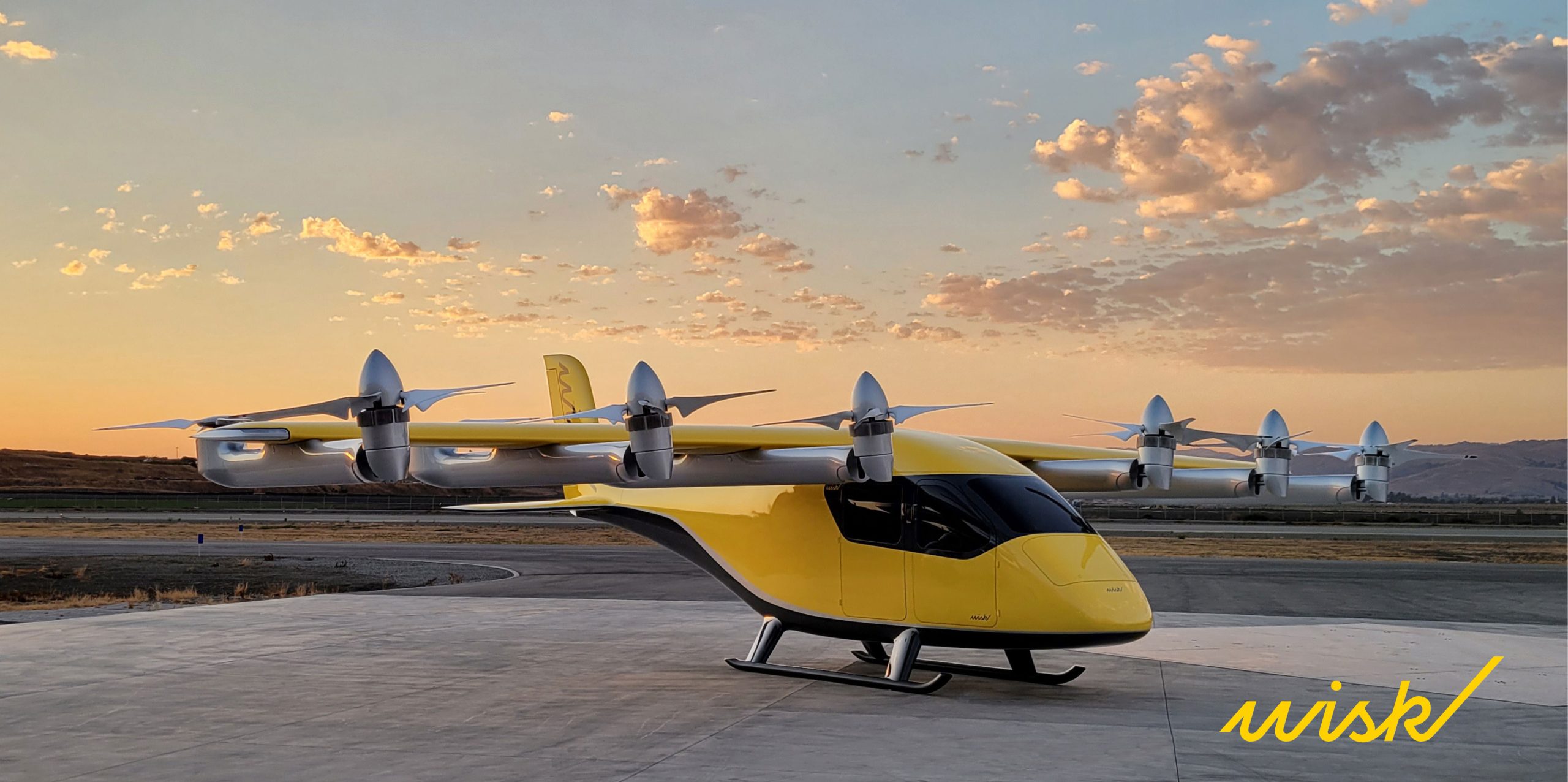

Wisk became the first electric vertical takeoff and landing (eVTOL) air taxi company to fly in the greater Los Angeles area with the launch of test flights at Long Beach Airport. The company produces fully autonomous vehicles that do require a pilot onboard.
The test flights allowed Wisk to conduct autonomous flight operations in a complex, real-world commercial airport environment alongside other passenger airline operations. While Long Beach Airport only sees 5% worth of Los Angeles International Airport’s passenger volume, its flight operation number is about 60% of its larger sibling, which is still very busy considering its much smaller footprint.
The company concluded its flight program at the Long Beach Airport with the first public demonstration of an eVTOL air taxi flight in the Los Angeles region during Long Beach’s Festival of Flight. The multi-transition flight was conducted using Wisk’s 5th Generation (Cora) autonomous eVTOL aircraft, demonstrating the safety and reality of autonomous passenger flight. The company also recently announced that its 6th generation prototype is under construction and is on track to fly in 2024.
The test was part of the developer’s and Long Beach Economic Partnership(LBEP) partnership established in February 2022.
In addition, the company also hosted the Mayor of Long Beach and local and state officials from the Los Angeles region, including Orange County and Boeing leadership, for a discussion regarding the future of Advanced Air Mobility(AAM) within the area.
Economic Impact of a New Industry: A Long Beach Case Study
Wisk Aero also sponsored a positive economic impact study based on the Southern California region. Long Beach Economic Partnership and California State University, Long Beach, conducted the study.
The report looked at the economic impact of an Urban Air Mobility network covering the city of Long Beach, California, and the greater Los Angeles-Orange County region. It looked at the possibility of constructing a six-vertiport system initially across this region, ultimately expanding to a ten and finally a twenty-vertiport system.
According to the study, constructing a twenty-vertiport network would generate “2,133 jobs, $174.0 million in labor income, and $423.6 million in economic output.”
Once it is operational, the vertiport network would annually: generate $173.3 million in expenditures, deliver $90.3 million in labor income, and create 943 jobs.
The AAM sector has gained a lot of momentum lately. In October, China issued the world’s first type certificate for an autonomous eVTOL aircraft, the Ehang EH216-S. A week ago, Archer Aviation also reached an agreement with the Abu Dhabi Investment Office to provide an all-electric air taxi service across the UAE. It’s apparent that governments worldwide are seeing the AAM’s potential and trying to move the industry forward.
