










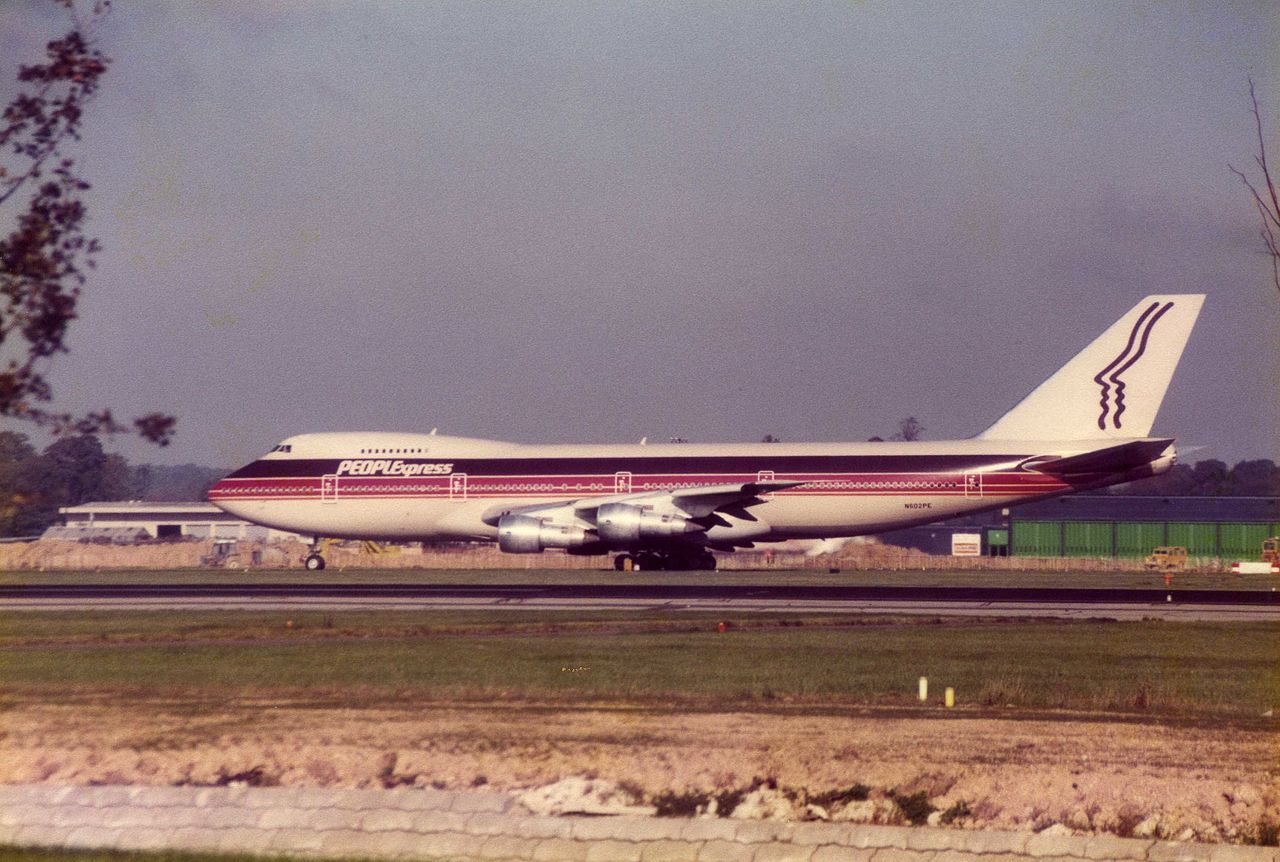


When People Express took off in April 1981 from Newark, it did so with a simple mission: offer ultra-low fares, no frills, and maximum efficiency. Founded by former Texas International executive Don Burr, the airline aimed to transform U.S. aviation with a model of lean operations and unbundled pricing.
The first flights used three Boeing 737-100s, and tickets were sold onboard in lieu of traditional ticket desks.
Rapid Growth and Bold Ambitions
People Express expanded fast. In just a few years, it scaled its network from a handful of Northeast routes to dozens of U.S. cities and even London. The airline added Boeing 727s and 737-200s, and later 747-100s to launch transatlantic service. At its peak around 1985–86, it was carrying over four million passengers annually.
People Express also experimented with human resources innovation. Employees were cross-trained to help in multiple roles — pilots might help with baggage, ticket agents assist with ground handling, etc. — a tactic intended to reduce overhead and increase flexibility.
Cracks in the Model
But the very traits that made People Express novel also sowed vulnerabilities. As route density and fleet types multiplied, the lean system’s strain became evident. The acquisition of Frontier in 1985 brought new debt, staff, and operational complexity.
Service quality and on-time performance began to suffer, and margins tightened under fierce competition. The airline’s signature low-fare approach left little room for absorbing negative shocks. In late 1984, People Express posted a roughly $14 million operating loss in one quarter, after months of profitability.

By 1986, the problems mounted: expensive debt, integration headaches, rising costs, and underperforming routes. The only viable path forward became a merger.
Merger and Aftermath
In 1986, the People Express brand was bought by Texas Air Corporation and later folded into Continental. The integration absorbed its routes, assets, and many of its employees, but People Express as a brand vanished.
In 2014, a new startup attempted to revive the name using 737-400s out of Newport News, Virginia, but the venture lasted only months before shutting down.
Though short-lived, the People Express model left a lasting imprint on the airline industry. It pushed legacy carriers to rethink pricing, schedule density, and service unbundling. The ideas of low base fares, ancillary charges, and high utilization endure in today’s ultra low-cost carriers.
Its tale also serves as caution: growth without structural resilience breeds instability. But for airline history, People Express remains a founding chapter in the democratization of air travel.