











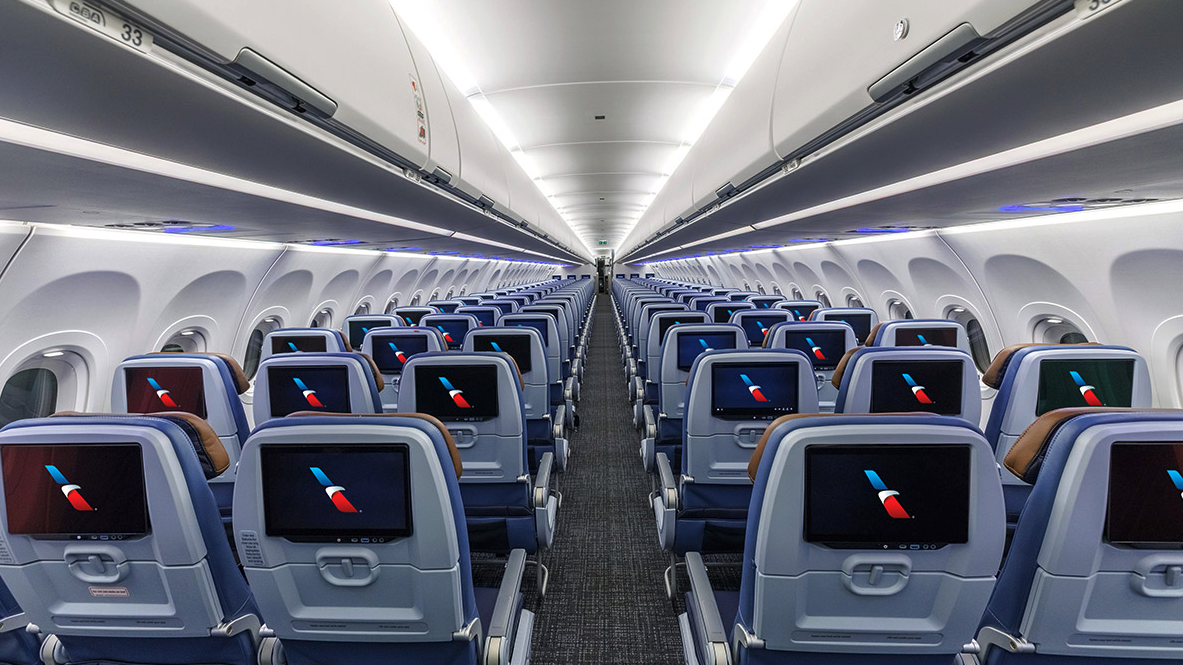


American Airlines announced Tuesday that it will install seatback entertainment screens across its entire narrowbody fleet, bringing its offering more in line with competitors United and Delta.
The airline said it will install the screens on every new Airbus and Boeing aircraft delivered starting in 2028, while also performing retrofits on older airplanes. The screens will be among the largest offered on any narrowbody aircraft, American said, with 4K technology, USB-C charging ports, Bluetooth audio connectivity, and access to a broad selection of movies, television shows, music, games, and content through the airline’s media partnerships.
More Premium Seats
The announcement came alongside news that American will add more premium seats on its narrowbody jets. The carrier will add an additional row of First Class seats on its Airbus A319s and A320s, install 24 First Class seats on its upcoming Boeing 737 MAX 10s, and add more Main Cabin Extra seats across all narrowbody types.
“We’re making one of the most significant investments in the onboard experience in our history,” American Chief Customer Officer Heather Garboden said in a news release. “From next-generation seatback entertainment at every seat to substantially more premium seating options, these enhancements will give our customers more ways to relax, stay connected and enjoy their journey.”
American signaled in March that it was considering re-adding seatback screens on its single-aisle aircraft. It began removing the devices from its narrowbody fleet in 2017, reasoning that customers would rather use their own phones, laptop computers, or tablets for entertainment. Foregoing screens also reduced the weight of the aircraft, which translated to savings over time.
United and Delta went in the opposite direction, investing in newer and larger screens, especially for their premium products. According to a report from CNBC, American felt pressure to bring the screens back in order to compete with its two main rivals.
The airline said it will install the screens as quickly as possible. Installation work should be completed by the early 2030s, it said.