










Stories

Alaska, Hawaiian Integrating Booking Systems

The changes will come into full effect in April 2026.

Hawaiian A330-200
A Hawaiian A330-200 in Seattle. (Photo: AirlineGeeks | Katie Zera)

Alaska Airlines is moving to standardize its booking system across its Alaska and Hawaiian brands as a final integration of the two carriers draws nearer.

In a statement released Thursday, Alaska said it will align cabin and seat names for Alaska and Hawaiian to “take the guesswork out of flying.”

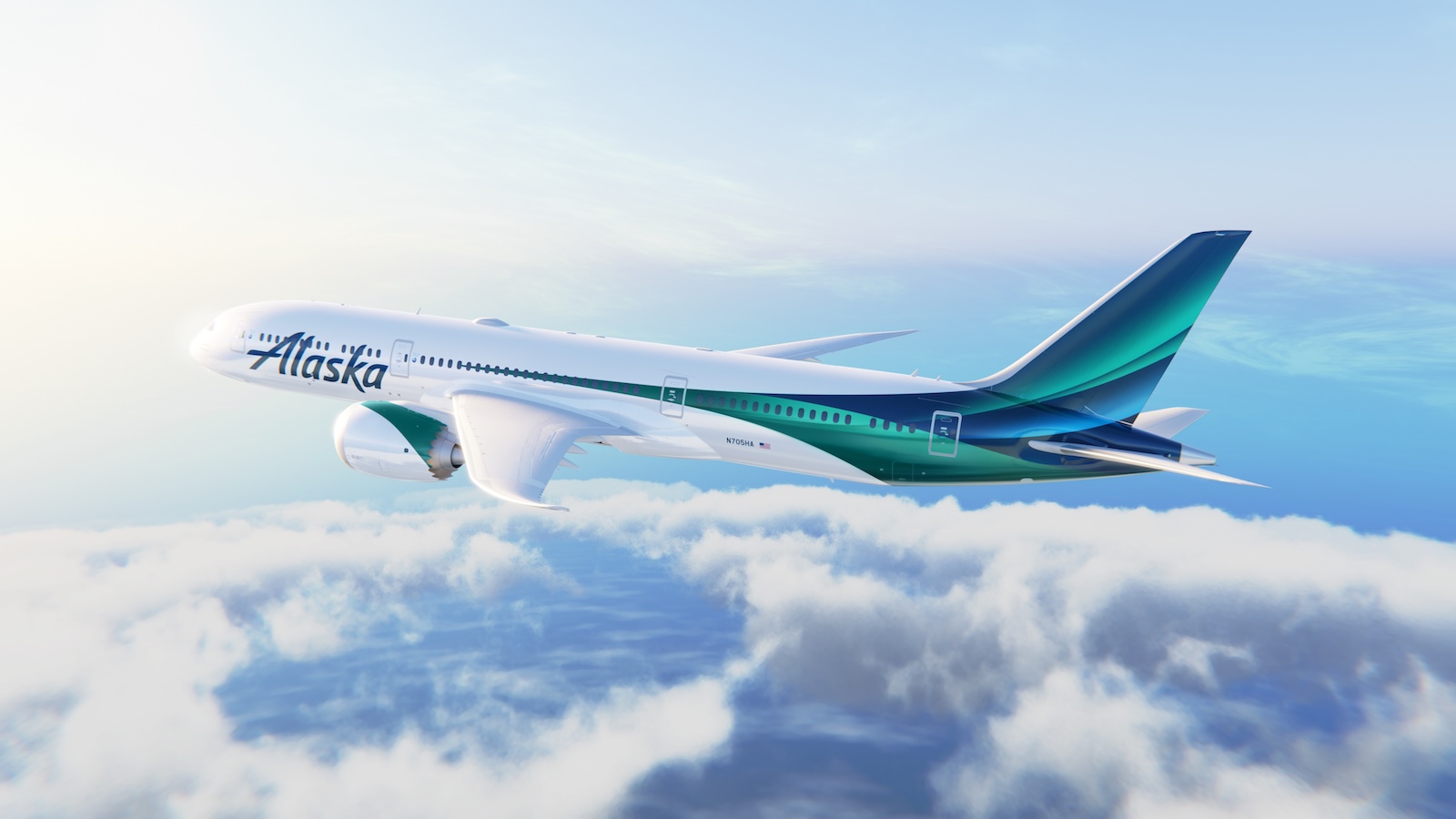
As of April 22, 2026, seating will be organized into First Class, Premium Class (which will include Hawaiian’s Extra Comfort seats), Main Cabin Preferred, Main Cabin, and Saver Fare. A lie-flat First and Business Class are available on flights operated using a Hawaiian Airlines Airbus A330 or an Alaska Airlines Boeing 787 Dreamliner.

First Class on the 787 comes with enclosed suites with direct aisle access, Alaska noted.

Lie-flat cabin passengers also have access to the network of Alaska Lounges, the Plumeria Lounge in Honolulu, and select partner locations through Alaska’s oneworld and global partners.

Premium Class gives customers four inches of extra legroom and some added perks, including complimentary cocktails, beer and wine. Alaska first introduced the Premium option in its own fleet in 2017.

Hawaiian’s Main Cabin Basic option will transition to Saver Fare next year.

The changes will be reflected in bookings starting Oct. 14 for flights departing on or after April 22, 2026.

Alaska and Hawaiian are working to obtain a single operating certificate from the FAA, which would allow the two airlines to complete their merger and consolidate operations. Later this month, Alaska plans to start renumbering Hawaiian flights under new Alaska-style ranges.

Zach Vasile

Zach Vasile is a writer and editor covering news in all aspects of commercial aviation. He has reported for and contributed to the Manchester Journal Inquirer, the Hartford Business Journal, the Charlotte Observer, and the Washington Examiner, with his area of focus being the intersection of business and government policy.

CEO: Delta Not Seeing Effects From Government Shutdown

But Ed Bastian said that could change if the current political deadlock drags on.

A Delta A330-300 aircraft.
A Delta A330-300 aircraft. (Photo: Shutterstock | Santi Rodriguez)

Delta is operating smoothly despite the federal government shutdown, CEO Ed Bastian said Thursday, but that could change if the congressional impasse blocking funding drags on much longer.

In an interview with CNBC, Bastian said Delta hasn’t seen “any real impact at all” from the shutdown. In the eight days since the shutdown started, he noted, the airline’s completion rate relative to its schedule was 99.99%.

Still, Bastian said he wants to see the federal government reopened as soon as possible, before the worsening lack of FAA air traffic controllers further destabilizes the U.S. air transportation system.

“I would say that if this doesn’t get resolved, say beyond another 10 days or so, you probably will start to see some impacts,” he said.

Passengers have faced delays at numerous major airports since Monday, when the U.S. Transportation Department noted a slight uptick in the number of air traffic controllers calling out sick. Controllers, along with TSA officers and other federal workers deemed essential, are expected to continue working during government shutdowns, even though their agencies have no money to pay them.

Air traffic control issues have been particularly acute at Denver International Airport and Newark Liberty International Airport in New Jersey, as well as at Hollywood Burbank Airport in the Los Angeles area, where no controllers were on duty for close to six hours Monday evening.

Zach Vasile

Zach Vasile is a writer and editor covering news in all aspects of commercial aviation. He has reported for and contributed to the Manchester Journal Inquirer, the Hartford Business Journal, the Charlotte Observer, and the Washington Examiner, with his area of focus being the intersection of business and government policy.

BermudAir Changes Course on Airport Suspension

The airline will now serve three airports in the New York region.

BermudAir E175
A BermudAir E175 (Photo: Orlando International Airport)

BermudAir is expanding its footprint in the New York area, adding new service from LaGuardia and Newark while retaining flights from Westchester County Airport in White Plains. The move, which the airline is branding as its “New York Triangle,” reverses earlier plans to suspend operations at White Plains as new routes came online.

With the launch of flights from LaGuardia and Newark, New Jersey, this month, BermudAir will connect Bermuda with three New York City–area airports.

The expansion brings the carrier’s U.S. network this winter to eight cities, including Boston, Baltimore/Washington, Raleigh-Durham, Richmond, and Orlando. BermudAir also serves Toronto, Montreal, and Halifax in Canada.

“Adding service to LaGuardia and Newark is a significant milestone for BermudAir,” said Adam Scott, the airline’s founder and CEO, in a news release. “At the same time, many of our most loyal and frequent travellers from Westchester and Fairfield counties spoke up—and we listened. With the launch of our ‘New York Triangle,’ we’re offering nonstop flights from three of the most convenient New York City–area airports, providing leisure and business travellers alike with more flexibility and convenient access to Bermuda.”

Flights from White Plains will continue three times weekly on Tuesdays, Thursdays, and Sundays, while new LaGuardia and Newark service will each operate twice weekly. All flights will use Embraer E175 and E190 aircraft.

Tickets for the expanded network are now available on the airline’s website.

Ryan Ewing

Ryan founded AirlineGeeks.com back in February 2013 and has amassed considerable experience in the aviation sector. His work has been featured in several publications and news outlets, including CNN, WJLA, CNET, and Business Insider. During his time in the industry, he's worked in roles pertaining to airport/airline operations while holding a B.S. in Air Transportation Management from Arizona State University along with an MBA. Ryan has experience in several facets of the industry from behind the yoke of a Cessna 172 to interviewing airline industry executives. Ryan works for AirlineGeeks' owner FLYING Media, spearheading coverage in the commercial aviation space.

Pan Am Begins Certification Process With FAA

Plans call for a revived Pan Am to operate a fleet of Airbus aircraft.

A Pan Am A300
A Pan Am A300 (Photo: Eduard Marmet, CC BY-SA 3.0 GFDL 1.2, via Wikimedia Commons)

Plans to revive the long-defunct Pan American World Airways are moving forward.

Aviation merchant bank and consulting firm AVi8 Air Capital announced Thursday that it has completed a comprehensive business plan for the potential relaunch of Pan Am, which went out of business in 1991. With that step completed, Avi8 and Pan American Global Holdings, which owns the rights to the Pan Am brand, have formally started the airline certification process with the FAA, which could reestablish Pan Am as a Part 121 scheduled carrier.

“Avi8 has assembled a world-class team to lead the certification effort and has received strong initial support from aircraft lessors and key vendors,” the company said in a statement.

Avi8 and Pan American Global Holdings have been working since June to evaluate Pan Am’s prospects for a comeback.

The partners said that, once certified, the new Pan Am plans to operate a fleet of Airbus aircraft. The company will be headquartered in Miami.

A Pan Am 707
A Pan Am 707. (Photo: Shutterstock | Peter Scharkowski)

Avi8 and Pan American Global Holdings did not specify which type of Airbus aircraft the revived Pan Am will fly, or what routes it will aim to operate.

Pan Am was at one time the largest international airline based in the U.S. Its fortunes turned after the oil shock of the 1970s, which hurt travel demand. Deregulation of the American airline industry under President Jimmy Carter exposed the carrier to new levels of competition, and it struggled to build a domestic network. After years of losses, it finally filed for bankruptcy.

Still, the Pan Am name remains synonymous with refined luxury travel in a bygone time, a fact Pan American Global Holdings has said could lure travelers back to the brand if it does successfully return to the skies.

Zach Vasile

Zach Vasile is a writer and editor covering news in all aspects of commercial aviation. He has reported for and contributed to the Manchester Journal Inquirer, the Hartford Business Journal, the Charlotte Observer, and the Washington Examiner, with his area of focus being the intersection of business and government policy.

Where Will Air Canada Fly the A321XLR?

The airline expects to have the aircraft in full commercial service by the summer of 2026.

An Air Canada A321
An Air Canada A321 (Photo: Shutterstock | Ross Howey Photo)

Air Canada is poised to grow its international route network next year after taking delivery of its first Airbus A321XLR aircraft.

In a statement, the carrier said it is considering potential new routes that would make sense for the A321XLR.

Alexandre Lefevre, vice president of network planning for North America and scheduling at Air Canada, said the airline expects to have the extended-range jet in full commercial service by the summer of 2026.

Air Canada A321XLR
Rendering of an Air Canada A321XLR (Photo: Air Canada)

“When you look at opening new routes, you need to look at the economics,” Lefevre said in a news release. “When you’ve got a tool like the A321XLR that’s completely different from the tools you’ve got in your toolbox today, that opens up new markets that today you cannot viably and profitably open.”

International Growth

“The A321XLR will be used to replace some older aircraft, but our strategy is to use it for growth, especially international growth,” he added.

Last month, Air Canada announced its first new route supported by the A321XLR – Montreal to Palma de Mallorca, Spain. The service will operate from June 17, 2026, to Oct. 24, 2026.

The airline also plans to use the A321XLR on existing routes to Toulouse, France; Dublin; and Edinburgh, Scotland.

Air Canada is also looking at using the aircraft on some longer domestic routes, which would give more customers access to its amenities, including lie-flat seating and larger overhead bins. Lefevre suggested the A321XLR could be used on service between Toronto and Montreal and the west coast of Canada.

Zach Vasile

Zach Vasile is a writer and editor covering news in all aspects of commercial aviation. He has reported for and contributed to the Manchester Journal Inquirer, the Hartford Business Journal, the Charlotte Observer, and the Washington Examiner, with his area of focus being the intersection of business and government policy.

Southwest’s Summer 2026 Schedule Plans Eight Routes

Anchorage officially joins the carrier’s system as service grows in several U.S. and international markets.

Southwest 737 MAX
A Southwest 737 MAX 8 in Las Vegas. (Photo: AirlineGeeks | William Derrickson)

Southwest has opened its summer 2026 schedule, unveiling a broad expansion of its route network that includes new service, added frequencies, and the airline’s first flights to Alaska.

Among the highlights, Southwest will begin its previously announced service to Anchorage on May 15, 2026, connecting the Alaska hub with Denver and Las Vegas. Anchorage will become the 122nd airport in the carrier’s network.

The airline also plans major growth across several airports. In Las Vegas, Southwest will add international service to Cancun beginning June 4, along with new flights to Los Cabos and Puerto Vallarta.

Frequencies to a number of domestic destinations — including Nashville, Tennessee; Burbank, California; Indianapolis; Kansas City, Missouri; Orlando, Florida; New Orleans; Reno, Nevada; and Tampa, Florida — will increase year over year.

Southwest 737 aircraft
Southwest Boeing 737 aircraft (Photo: Shutterstock | Robin Guess)

In Orlando, Southwest will bolster its position by adding more flights to 11 cities, including Austin, Texas; Baltimore, Maryland; Kansas City; Las Vegas; Nashville; Milwaukee, Wisconsin; New Orleans; Pittsburgh; Louisville, Kentucky; and San Juan, Puerto Rico.

West Coast Growth

In San Diego, the opening of the new Terminal 1 will enable the airline to operate a record high of 134 peak-day departures to 43 destinations, it said.

A new nonstop route between San Diego and Boston begins June 4, and San Diego–San Francisco flights will increase to eight daily frequencies on peak days.

In the LA Basin, the airline will boost Los Angeles service to Sacramento, San Francisco, and San Jose while restoring Burbank–San Francisco flights.

In Austin, Southwest will launch new daily service to Cincinnati and resume seasonal flights to Seattle. The carrier also plans to increase Austin–Indianapolis service to three daily frequencies and Austin–San Francisco to two weekday flights, going head-to-head with Delta in the Texas capital city.

Here’s a look at Southwest’s newly announced routes for its Summer 2026 schedule:

RouteStart Date
Anchorage – DenverMay 15, 2026
Anchorage – Las VegasMay 15, 2026
Las Vegas – CancúnJune 4, 2026
Las Vegas – Los CabosJune 4, 2026
Las Vegas – Puerto VallartaJune 4, 2026
San Diego – BostonJune 4, 2026
Austin – CincinnatiJune 4, 2026
Burbank – San FranciscoJune 4, 2026

Ryan Ewing

Ryan founded AirlineGeeks.com back in February 2013 and has amassed considerable experience in the aviation sector. His work has been featured in several publications and news outlets, including CNN, WJLA, CNET, and Business Insider. During his time in the industry, he's worked in roles pertaining to airport/airline operations while holding a B.S. in Air Transportation Management from Arizona State University along with an MBA. Ryan has experience in several facets of the industry from behind the yoke of a Cessna 172 to interviewing airline industry executives. Ryan works for AirlineGeeks' owner FLYING Media, spearheading coverage in the commercial aviation space.

United Adds Four New International Destinations

The carrier reveals a wide-ranging network update with seven routes.

United 767-300
A United Boeing 767-300 aircraft. (Photo: Shutterstock | Michael Derrer Fuchs)

United is expanding its international network next summer with another major transatlantic growth plan, adding new cities across Europe while increasing frequencies in several existing markets.

As part of the update, United will launch nonstop flights from its Newark, New Jersey, hub to Split, Croatia; Bari, Italy; Glasgow, Scotland; and Santiago de Compostela, Spain. The airline says it will be the only U.S. carrier to offer nonstop service to those destinations.

United also plans to add year-round service between Washington Dulles and Reykjavik, Iceland, while expanding its presence in Asia with a new Newark–Seoul route and an additional frequency to Tel Aviv.

United says the new flights will increase its summer 2026 transatlantic schedule to 46 cities — more than any other U.S. airline — and bring its total to nearly 3,000 weekly international roundtrips.

Route Details

Service to Split begins April 30 and operates three times per week using a Boeing 767-300ER. Bari launches May 1, followed by Glasgow on May 8 and Santiago de Compostela on May 22, with the latter two operated by Boeing 737 MAX 8 aircraft.

United last served Glasgow in 2019, also from Newark.

A United 737 MAX 8 (Photo: AirlineGeeks | Noah Escobar)

The carrier’s Reykjavik route from Washington Dulles is scheduled to begin May 21 and will operate daily year-round with Boeing 757-200 aircraft.

The Newark–Seoul flight starts Sept. 4 and will be operated by a Boeing 787 Dreamliner. United adds a third daily Newark–Tel Aviv roundtrip beginning March 28 using the 787-9.

RouteFrequencyStart DateAircraft Type
Newark – Split, Croatia3x weeklyApril 30, 2026Boeing 767-300ER
Newark – Bari, Italy4x weeklyMay 1, 2026Boeing 767-300ER
Newark – Glasgow, ScotlandDailyMay 8, 2026Boeing 737 MAX 8
Newark – Santiago de Compostela, Spain3x weeklyMay 22, 2026Boeing 737 MAX 8
Washington Dulles – Reykjavik, IcelandDaily (year-round)May 21, 2026Boeing 757-200
Newark – Seoul, South KoreaDailySeptember 4, 2026Boeing 787 Dreamliner
Newark – Tel Aviv, Israel3x daily (adds 1 new frequency)March 28, 2026Boeing 787-9

Returning Markets

United confirms it will also bring back all nine destinations introduced during its record Summer 2025 expansion, including Ulaanbaatar, Nuuk, Palermo, Bilbao, Madeira, Faro, Dakar, Kaohsiung, and Puerto Escondido.

Service to Nuuk will begin one week earlier than last year on June 6. Flights to Madeira will resume three weeks earlier on May 16.

Ryan Ewing

Ryan founded AirlineGeeks.com back in February 2013 and has amassed considerable experience in the aviation sector. His work has been featured in several publications and news outlets, including CNN, WJLA, CNET, and Business Insider. During his time in the industry, he's worked in roles pertaining to airport/airline operations while holding a B.S. in Air Transportation Management from Arizona State University along with an MBA. Ryan has experience in several facets of the industry from behind the yoke of a Cessna 172 to interviewing airline industry executives. Ryan works for AirlineGeeks' owner FLYING Media, spearheading coverage in the commercial aviation space.

flyCAA Bets on Converted Airbus A321 to Boost Congo’s Air Freight Capacity

Compagnie Africaine d’Aviation (flyCAA) has taken delivery of Africa’s first Airbus A321P2F.

321 Precision Conversions plans to start cutting cargo doors and making other modifications to A321 passenger jets so they can carry palletized cargo.
321 Precision Conversions plans to start cutting cargo doors and making other modifications to A321 passenger jets so they can carry palletized cargo. (Photo: 321 Precision Conversions)

Compagnie Africaine d’Aviation (flyCAA), a Kinshasa-based carrier in the Democratic Republic of the Congo (DRC), has taken delivery of Africa’s first Airbus A321P2F (Passenger-to-Freighter) aircraft.

The aircraft, a 1998-built Airbus A321 registered as 9S-PEB (MSN 808), was previously operated by Air Moldova before undergoing conversion by PEMCO Conversions in Tampa, Florida. PEMCO is a subsidiary of the U.S.-based Aircraft Transport Services Group (ATSG), while the aircraft itself is owned by another ATSG subsidiary, Cargo Aircraft Management (CAM).

Following conversion, the freighter was ferried to Kinshasa via Bridgetown, Barbados (BGI), and Bissau, Guinea-Bissau (OXB), arriving at N’djili International Airport (FIH) on September 28, 2025.

With this delivery, flyCAA joins a select group of global operators of the A321P2F. According to CH-Aviation data, few airlines currently operate the type — SmartLynx Airlines Malta, GlobalX, Raya Airways, Sichuan Airlines, Levu Air Cargo, Fly Mara Airlines, a Kenyan private carrier that began operating a leased A321P2F from Egypt’s Sky Vision Airlines in August 2025 for an initial six-month period and now flyCAA — bringing the total number of A321P2Fs in service to 13 since the program’s launch in 2021.

The addition of the A321P2F enhances flyCAA’s growing cargo capabilities. The airline already operates a Boeing 767-200F (MSN 23141), which joined the fleet in 2024, and has been actively strengthening its position in the domestic cargo market. The new freighter is expected to boost competitiveness against Serve Air Cargo, its primary rival, which operates a fleet of six Boeing 737-300Fs and three 737-800Fs.

Although traditionally a passenger carrier, flyCAA has been steadily diversifying its operations. Its current passenger fleet includes three Airbus A320ceo, one A330-200, one inactive A330-300, and one ATR72, also inactive. The airline operates around 14 domestic routes across the DRC and has plans to launch international services to Johannesburg, marking a new phase in its network expansion.

Founded in 1991, flyCAA merged with flyCongo in 2012, combining their resources to form one of the DRC’s leading passenger and cargo airlines. The carrier is owned by the Blattner family, whose business interests extend into construction, agroforestry, and finance.

Victor Shalton

Victor Shalton's love for aviation can be traced to when he was 11-years-old. As a seasoned aviation writer, he takes pride in providing the best aviation coverage around the globe and is passionate about advancing his skills in the aviation space. In addition, he loves travelling, writing, arts and while his speaking engagements have taken him around the world, he is proud to call Nairobi home.

Virgin Wins Trademark Dispute With Alaska

Alaska challenged an earlier decision that required it to pay $160 million in total.

A Virgin America aircraft A320
A Virgin America aircraft A320 (Photo: AirlineGeeks | William Derrickson)

A British court has settled a long-running trademark dispute between Alaska Airlines and Virgin Group, the owner of Virgin Atlantic.

In a ruling issued Oct. 3, a court in London said Alaska must pay Virgin Group for the right to use the Virgin name and branding, even though Alaska has not exercised that right in the years since its acquisition of Virgin America between 2016 and 2018.

“The effect of my conclusions is that Virgin is entitled to a monetary judgment in the amount of the [minimum royalty] in the period to 23 September 2022,” the judge wrote. “It follows that Virgin is entitled to judgment with interest, and that Alaska is refused permission to effect the disputed amendments.”

The “minimum royalty” amounts to just under $8 million per year.

The source of the dispute between the two airlines is an agreement that allowed Alaska to use Virgin’s brand name. After Alaska acquired Virgin America and fully integrated its operations in 2018, the carrier stopped using Virgin branding and argued that it should no longer be responsible for the minimum royalty.

Virgin Group argued that it was owed the minimum royalty each year between 2016 and 2039. Alaska countered that this arrangement was never explicitly spelled out by Virgin Group or Virgin America.

Virgin Atlantic 787
A Virgin Atlantic Boeing 787 Dreamliner seconds from touchdown in Las Vegas. (Photo: AirlineGeeks | William Derrickson)

Alaska also argued that Virgin Group violated parts of the licensing agreement by launching a loyalty program with Delta.

A London judge ruled in favor of Virgin Group in 2023, awarding it the full $160 million. The judge wrote that the minimum royalty is “a flat fee payable for the right to use the Virgin brand, whether or not that right is taken up.”

Zach Vasile

Zach Vasile is a writer and editor covering news in all aspects of commercial aviation. He has reported for and contributed to the Manchester Journal Inquirer, the Hartford Business Journal, the Charlotte Observer, and the Washington Examiner, with his area of focus being the intersection of business and government policy.

Essential Air Service Gets $41 Million Lifeline

DOT says it obtained millions in stopgap funding as shutdown continues.

United CRJ-200
A United Express CRJ-200 exiting the runway in Ogdensburg, N.Y. (Photo: AirlineGeeks | Joey Gerardi)

The U.S. Department of Transportation says it has obtained $41 million in additional funding to continue the Essential Air Service (EAS) program, temporarily averting a lapse in operations caused by the ongoing federal government shutdown.

Funding for the program was initially slated to run out by Sunday as the shutdown enters its second week.

Transportation Secretary Sean Duffy said Tuesday the funds will allow the department to sustain EAS subsidies through “early November.”

EAS provides federal payments to airlines serving markets that would otherwise be unprofitable, connecting rural airports and larger hubs. The program currently supports 169 communities across the U.S., including more than 40 in Alaska.

In a statement, Duffy said the additional funds would “keep critical federal services like EAS hanging on” until Congress restores full appropriations. The department previously warned EAS carriers and eligible communities on Monday of potential contract suspensions and reimbursement delays if funding lapsed.

The agency did not say where the additional $41 million originated.

Under those contingency plans, DOT said it would suspend air carrier obligations under EAS contracts and Alternate Essential Air Service grants until budget authority was reinstated.

The newly secured funds are expected to prevent those interruptions, at least temporarily.

Ryan Ewing

Ryan founded AirlineGeeks.com back in February 2013 and has amassed considerable experience in the aviation sector. His work has been featured in several publications and news outlets, including CNN, WJLA, CNET, and Business Insider. During his time in the industry, he's worked in roles pertaining to airport/airline operations while holding a B.S. in Air Transportation Management from Arizona State University along with an MBA. Ryan has experience in several facets of the industry from behind the yoke of a Cessna 172 to interviewing airline industry executives. Ryan works for AirlineGeeks' owner FLYING Media, spearheading coverage in the commercial aviation space.
Sign-up for newsletters & special offers!

Get the latest stories & special offers delivered directly to your inbox

SUBSCRIBE

Uh-oh! It looks like you're using an ad blocker.

Our website relies on ads to provide free content and sustain our operations. By turning off your ad blocker, you help support us and ensure we can continue offering valuable content without any cost to you.

We truly appreciate your understanding and support. Thank you for considering disabling your ad blocker for this website