









AirAsia has seen an upward trajectory during the second quarter of 2024 with a load factor of 90%, seeing an increase of 2% year-over-year. The group carried over 30 million passengers in the first half of the year and passenger numbers are close to pre-pandemic levels.
However, the group hasn’t utilized its entire fleet thus far. As of the end of June, AirAsia has reinstated 195 out of 218 jets.
In the wake of Malaysia and Thailand’s visa-free program being introduced to Indian and Chinese travelers, flight operations to India and China have been with a load factor of 91%. The group has experienced a holistic recovery across AirAsia Malaysia, Thailand, Indonesia, Philippines. But AirAsia Cambodia was left behind with a load factor of 38%.
In the meantime, the group has also seen an increase in ancillary revenue. Santan, the airline’s food and beverage provider, has sold more than 10 million units, an increase of 7% year-over-year. The growth was spread across both domestic and international flights. However, duty-free and merchandise sold declined by 17%
Asia Digital Engineering, the wholly-owned subsidiary, providing engineering services for AirAsia group and other commercial airlines in the region has surged 22% compared to the same time last year.
Bolster Subang Airport
In addition, the low-cost carrier got into gear and announced the expansion of its network in Kuala Lumpur’s Subang Airport. The airline will operate two domestic services to Kuching and Kota Kinabalu in August.
“The decision to operate at Subang Airport as our second home in Kuala Lumpur is driven by several compelling factors and opportunities. The airport’s location and proximity to the city centre and surrounding suburbs offer an optimal travel experience for guests in the vicinity,” Dato’ Captain Fareh Mazputra, Managing Director of AirAsia Malaysia, said.
In April 2021, Malaysia Airports Holding Bhd unveiled the regeneration plans for the former gateway to the country. Under Phase One of the project, the airport could handle eight million passengers by 2030.
Meanwhile, AirAsia X Malaysia, the group’s airline operating long-haul services, has announced that it carried a total of 880,625 passengers in the second quarter of 2024, surging 42% year-over-year. The passenger load factor was 83%, up by 7%. AirAsia X Thailand has also seen a load factor of 84%, compared to 76% during the same time last year.
AirAsia X has been experiencing a travel boom as Africa is on the airline’s radar, announcing that it will enhance its network by adding a Kuala Lumpur – Nairobi route in November.
Joining the route cuts from earlier this year, American plans to remove service from Austin to Las Vegas, New Orleans, Orlando, Palm Springs, and Reno in November 2024. All of these routes were added in 2021.
An airline spokesperson confirmed the market exits in a statement. “As part of the continuous evaluation of our network, American will reduce service from Austin (AUS) starting in October. American will continue to offer customers access to our comprehensive global network of more than 350 destinations with one-stop connections. We’re proactively reaching out to impacted customers and apologize for any inconvenience this may cause,” the carrier said.
The airline had planned to relaunch service from Austin to Reno in May 2025, but the route is now removed after being paused in August 2024. In addition, American is scaling back flights between Austin and Raleigh/Durham, removing the route from its schedule in January, February, and March. It is slated to resume in April 2025.
American’s December 2023 route map from Austin (Photo: Cirium Diio)
American’s December 2024 route map from Austin (Photo: Cirium Diio)
With these cuts, American will continue to serve Austin from most of its hubs in addition to Aspen, Nashville, Boston, Cancun, Cabo San Lucas, and Santa Ana/Orange County.
Allegiant Closes Base, Cuts Routes
Ultra-low-cost carrier (ULCC) Allegiant is also scaling back its operations in Austin, citing constraints around gate space. In June, the airline announced plans to close its nearly three-year-old crew base at the airport, which employed roughly 90 people with three Airbus A320 aircraft.
The base is slated to close in early 2025. However, starting in August 2024, the carrier will slash service on several routes from Austin. As first reported by KUT News, these markets include Bozeman, Eugene, Sioux Falls, Washington Dulles, Indianapolis, Omaha, Pittsburg, San Diego, Louisville, Orlando Sanford, and Santa Ana/Orange County.
Allegiant will continue to serve routes to its other bases, including Cincinnati, Anaheim, Des Moines, Provo, Asheville, and Sarasota.
The City of Austin — which operates Bergstrom International Airport — plans to close the South Terminal in 2026 to make room for a larger midfield concourse. Both Allegiant and Frontier operate from this three-gate terminal.
According to a statement from Allegiant last month, the city offered it space at the airport’s main terminal, which was not enough to sustain a base.
“We’re hoping to backfill some of those seats with other carriers and encourage Allegiant to fly to other Allegiant bases that they currently don’t fly to [from] Austin,” the airport’s business development director Jamy Kazanoff told KUT.
Ryan founded AirlineGeeks.com in February 2013 and has spent more than a decade covering the airline business. His work has been featured by CNN, WJLA, CNET, and Business Insider. His aviation experience spans airport operations, Part 135 regulatory compliance, and airline crew workforce planning, along with time behind the yoke of a Cessna 172 and interviews with airline executives. Ryan now serves as Group President of Firecrown Media’s Aviation Group. He holds a B.S. in Air Transportation Management and an MBA from Arizona State University and teaches Airline Management at Embry-Riddle Aeronautical University.
WestJet Group Announces ‘Expansive’ Schedule for Winter Season
Canadian consortium the WestJet Group has announced an ‘expansive’ schedule for the Winter 2024-25 season to capitalize on passengers seeking sunnier climates.
A WestJet Boeing 737 MAX 8 at Harry Reid International Airport in Las Vegas. (Photo: AirlineGeeks | William Derrickson)
Canadian consortium the WestJet Group has announced an ‘expansive’ schedule for the Winter 2024-25 season to capitalize on passengers seeking sunnier climates south of the border. The Calgary-based group comprised of leisure carrier Sunwing Airlines and WestJet will operate to 63 destinations in the U.S., Mexico, the Caribbean, and Central America this winter. Together the airlines will increase transborder capacity by five percent and capacity on Latin-Caribbean routes by three percent.
John Weatherill, WestJet Group’s Executive Vice-President and Chief Commercial Officer, said: “Our winter schedule is building on our ambitions to ensure Canadians benefit from a comprehensive network of affordable domestic air service, while providing seamless access to fulfill cold-weather escapes to the most popular sun destinations.”
The WestJet Group completed its acquisition of Sunwing Airlines in May 2023 and together with the WestJet brand is seeing significant growth in the Canadian market. In addition to the 63 destinations south of the border, the group will also operate to three transcontinental destinations (Tokyo, Paris, and London) and have 37 domestic airports on its network over the winter season. “As we bring more seats and affordable fares across our entire network, we are giving Canadians choice and flexibility this winter,” said Weatherill.
The group will also be leveraging its codeshare partner Delta Air Lines’ network via the U.S. carrier’s hubs including Atlanta and Minneapolis. Flights to Delta’s hubs will be increased over the winter by 42 percent on a year-by-year comparison. This will give passengers the opportunity for one-stop connections from Calgary, Edmonton, Regina, Saskatoon, Winnipeg, and Vancouver to more than 100 U.S. destinations on the Delta network.
WestJet’s domestic network will be able to offer ’71 unique domestic routes’ with a total of 323 daily domestic departures. According to the airline, this will give passengers the choice of ‘more unique routes between Eastern Canada and Western Canada than any other airline.’ The announced schedule increases will also give WestJet a 53 percent market share of domestic services operating within and between the Eastern provinces of British Columbia and the group’s home province Alberta.
Several airports will benefit from double-figure domestic capacity growth (vs. winter 2023). Winnipeg (44 percent), Regina (24 percent), Saskatoon (27 percent), Edmonton (32 percent), Kelowna (14 percent) and Vancouver (16 percent) lead the way. Calgary will have a six percent increase in domestic capacity year-on-year compared to last winter.
Kelowna in British Columbia will have the addition of a daily non-stop flight to Seattle beginning in January. “This route will provide guests in the Okanagan and across the Pacific Northwest regions with new convenient and affordable options to easily connect between both popular regions for business and leisure year-round,” said Weatherill.
John has always had a passion for aviation and through a career with Air New Zealand has gained a strong understanding of aviation operations and the strategic nature of the industry. During his career with the airline, John held multiple leadership roles and was involved in projects such as the introduction of both the 777-200 and -300 type aircraft and the development of the IFE for the 777-300. He was also part of a small team who created and published the internal communications magazines for Air New Zealand’s pilots, cabin crew and ground staff balancing a mix of corporate and social content.
John is educated to postgraduate level achieving a masters degree with Distinction in Airline and Airport Management. John has held the positions of course director of an undergraduate commercial pilot training programme at a leading London university. In addition he is contracted as an external instructor for IATA (International Air Transport Association) and has been a member of the Heathrow Community Fund’s ‘Communities for Tomorrow’ panel.
SkyWest ‘Very Optimistic’ on Charter Venture
With potential regulatory headwinds on the horizon, SkyWest still has high hopes for its charter subsidiary SkyWest Charter — or SWC.
A SkyWest Charter CRJ-200 aircraft (Photo: Shutterstock | Robin Guess)
With potential regulatory headwinds on the horizon, SkyWest still has high hopes for its charter subsidiary. SkyWest Charter — or SWC — launched in 2023 with just two CRJ-200s.
Instead of the usual 50 seats on the aircraft type, the carrier configured SWC jets with just 30 in order to operate certain charter flights. Currently, the aircraft are largely used to operate on-demand charter flights for sports teams and corporations.
Last month, the Federal Aviation Administration (FAA) announced plans to close the so-called “loophole” that allows these flights to operate. “If a company is effectively operating as a scheduled airline, the FAA needs to determine whether those operations should follow the same stringent rules as scheduled airlines,” said FAA Administrator Mike Whitaker in a press release.
Despite this move, SkyWest executives told investors on Thursday that the company remains bullish on its charter business.
“We continue to be very optimistic about charter,” said the carrier’s CEO Chip Childs on a recent earnings call. “We’re very committed to seeing through the commute authority…We’ve taken it to court, we’re going to go down that route. We’re also going to continue to work with the government because there [are] obviously some things they want to change with 135 operations. We think we not only meet but massively exceed everything that they’re talking about from a safety perspective.”
Childs added that SkyWest will “be patient” on the commuter authority front while continuing to focus efforts toward on-demand charters.
Nearly two years after the company applied, SkyWest Charter’s application for commuter authority is still pending approval from the Department of Transportation (DOT).
In an October statement to AIN, the company said, “SkyWest Charter (SWC) believes that the operation of Part 380 flights under the current FAA classification is essential for small community air service, today and well into the future. The FAA’s ‘notice of intent’ to review its classification of such Part 380 flights clears the path for DOT to approve SWC’s application for a commuter air carrier authorization, consistent with existing law and SWC’s undisputed fitness, since the non-fitness issues will be addressed by the FAA allowing DOT to focus on fitness. Additionally, SWC already exceeds current safety requirements and will transition to any additional requirements that may be adopted by the FAA as part of the rulemaking process.”
Ryan founded AirlineGeeks.com in February 2013 and has spent more than a decade covering the airline business. His work has been featured by CNN, WJLA, CNET, and Business Insider. His aviation experience spans airport operations, Part 135 regulatory compliance, and airline crew workforce planning, along with time behind the yoke of a Cessna 172 and interviews with airline executives. Ryan now serves as Group President of Firecrown Media’s Aviation Group. He holds a B.S. in Air Transportation Management and an MBA from Arizona State University and teaches Airline Management at Embry-Riddle Aeronautical University.
Copa's retro livery on a Boeing 737-800 (Photo: Copa Airlines)
Editor’s Note: AirlineGeeks is proud to present our ‘Livery of the Week’ series. Every Friday, a team member will share an airline livery, which can be from the past, present, or even a special scheme. Some airline liveries are works of art. The complexity associated with painting around critical flight components and the added weight requires outside-the-box thinking from designers. The average airliner can cost upwards of $200,000 to repaint, creating a separate aircraft repainting industry as a result.
Have an idea for a livery that we should highlight? Drop us a line.
In 2022, Panama’s Copa Airlines unveiled a nostalgic tribute to its history with the introduction of a retro livery on one of its Boeing 737 aircraft.
The airline, marking its 75th anniversary, has brought back a classic paint scheme that echoes the distinctive style of the 1980s and 1990s. At the time, the carrier was far smaller with only two Boeing 737-200 aircraft in its fleet.
The retro-liveried 737 is a visual treat for aviation enthusiasts and long-time passengers alike. The aircraft underwent an extensive 2,500-hour makeover at the Copa Airlines Maintenance Center, involving a dedicated team of over 30 professionals to meticulously recreate the iconic design.
“With this Boeing 737-800 NG painted in the colors our fleet wore in the early 1990s, we want to commemorate an important time in our history, when we started what would come to be called the Hub of the Americas,” said Pedro Heilbron, a director from the carrier. “It is a story of great commitment and achievement, but above all the great commitment of our people to overcome all the challenges we have encountered along the way and proudly carry the Panamanian flag in the skies of America for 75 years.”
The airline has not announced plans for additional retro-liveried aircraft but the current one has been deployed to various destinations across the Americas. The aircraft is registered as HP-1841CMP.
Looking for a new airplane model? Head over to our friends at the Midwest Model Store for a wide selection of airlines and liveries.
Ryan founded AirlineGeeks.com in February 2013 and has spent more than a decade covering the airline business. His work has been featured by CNN, WJLA, CNET, and Business Insider. His aviation experience spans airport operations, Part 135 regulatory compliance, and airline crew workforce planning, along with time behind the yoke of a Cessna 172 and interviews with airline executives. Ryan now serves as Group President of Firecrown Media’s Aviation Group. He holds a B.S. in Air Transportation Management and an MBA from Arizona State University and teaches Airline Management at Embry-Riddle Aeronautical University.
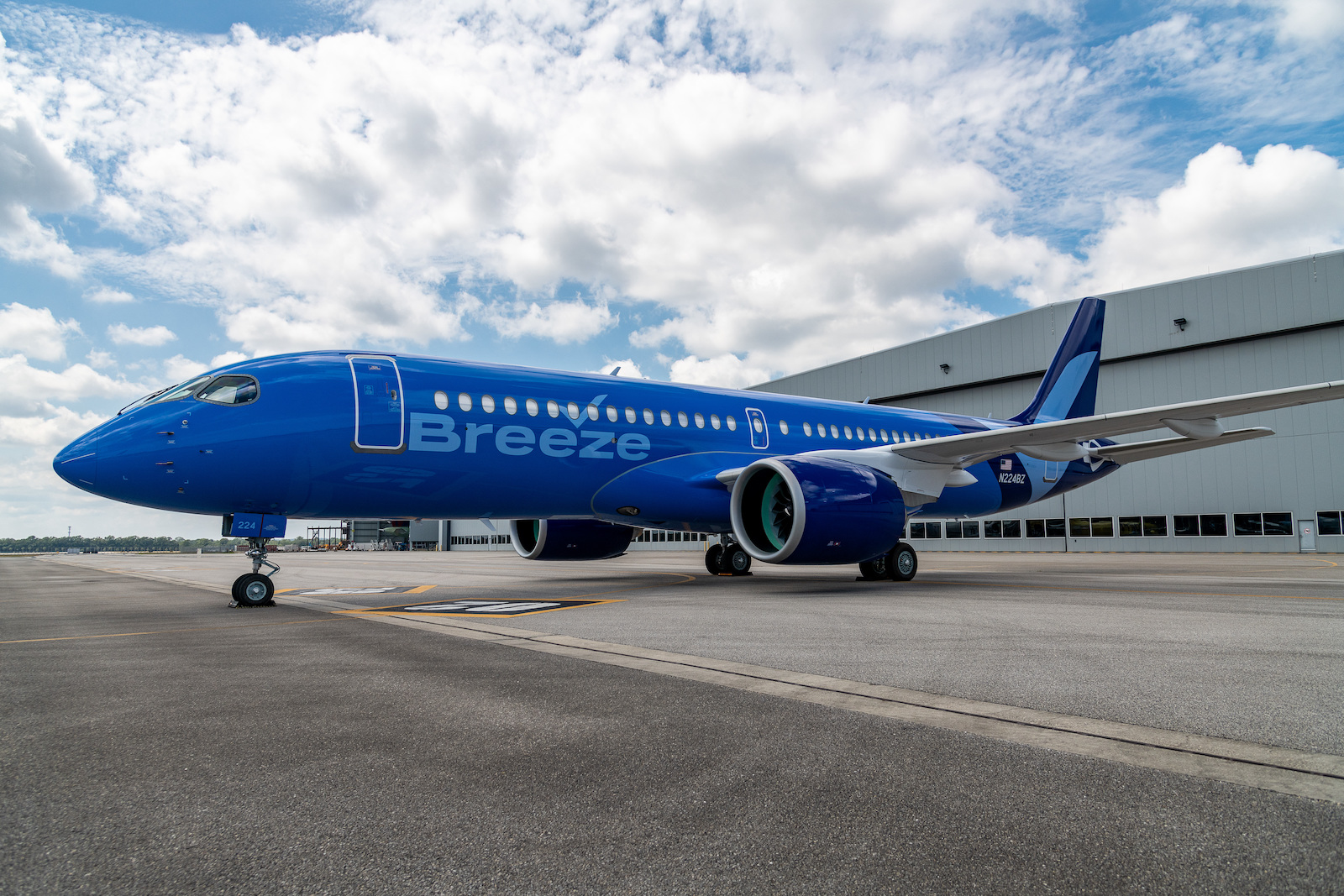
A Breeze A220 in Phoenix. [AirlineGeeks - William Derrickson]
The Essential Air Service (EAS) program is getting more interesting with the introduction of new airlines trying to snap up these EAS contracts like Breeze and JetBlue, the latter of which has won a contract. Plus, the recently passed FAA Reauthorization Act limits EAS flights in the lower 48 to 650 miles or less also threw a snag in some of the recent proposals, most notably Sun Country’s flights out of Eau Claire.
But, it is very rare to get so many proposals for a single city. There have been a few instances where five airlines have submitted proposals, but as far as we know, this is the first time a city has seen six, giving them many options.
According to Ishrion Aviation on Twitter/X, the airlines that have submitted proposals for Pueblo, Colo. include Advanced Air, Boutique Air, Breeze, Key Lime Air/Denver Air Connection, SkyWest, and the current operator at the airport Southern Airways Express.
Advanced Air
This airline is proposing flights using its nine-passenger King Air 350. Flights would operate to Albuquerque 17 times a week, and Phoenix Sky Harbor seven times a week, or the airline could do all 24-weekly flights just to Albuquerque.
Up until this point, the airline didn’t offer any interline or baggage agreements, but the proposal states it has “executed an interline agreement with Alaska Airlines which we expect to have fully implemented later this year.” That is positive news, although Alaska doesn’t have a hub at either city it plans on serving.
An Advanced Air King Air 350 at Phoenix Sky Harbor (Photo: AirlineGeeks | Joey Gerardi)
For a mix of Phoenix and Albuquerque, the subsidy would be between $7,247,990 and $8,879,099 depending on what year. For just Albuquerque service, the subsidy required would be between $6,468,470 and $7,924,154 depending on the year.
Boutique Air
Boutique Air is proposing either 24 or 28 weekly flights to Denver, all of which would be on its eight-seat Pilatus PC-12s. The subsidy would be between $4,388,664 and $5,538,342 depending on the year and how many frequencies to Denver.
A Boutique Air PC-12 in Merced, Calif. (Photo: AirlineGeeks | Joey Gerardi)
Boutique does offer interline with both American and United, the latter of which would be really helpful in Denver as it serves as a large hub for the airline.
Breeze Airways
This proposal is for flights to Phoenix Sky Harbor and also Las Vegas. Notably, Las Vegas does follow the new rule stating that no EAS route may go over 650 miles and sits at roughly 607 miles. Flights would on board the Airbus A220-300 which seats 137 passengers and is by far the largest aircraft offered in a proposal for this city.
Breeze does offer a small hub at both cities, but it does not offer many connecting flights in its system.
A Breeze A220 aircraft (Photo: AirlineGeeks | William Derrickson)
While the cities are the same, they do offer two options; Option 1 is six times weekly to both hubs, and Option 2 is four times weekly to Phoenix and three times weekly to Las Vegas. The subsidy per year for Option 1 is $11,907,343 while the subsidy for Option 2 per year is $8,908,474, both of which have a 4% increase per year.
Key Lime Air/Denver Air Connection
Their proposal also has all flights going to Denver, but the frequency and aircraft type can vary depending on which option the city wants.
Option 1 is a mix of 50-seat Embraer E145s and 30-seat Dornier 328Jets at a frequency of 12 flights per week, Option 2 is 24 weekly flights on board its nine-seat Fairchild Metroliner, and Option 3 is a mixture of six weekly flights on a jet aircraft (either E145 or J328) and 12 weekly flights on the Metroliner.
Denver Air Connection aircraft parked in Denver. (Photo: AirlineGeeks | Joey Gerardi)
Option 1 has a subsidy of $6,449,526 per year, Option 2 is $6,028,965, and Option 3 is $6,239,746. All three options carry an annual subsidy increase of 6% each year.
This airline has an interline with all three of the United States three major airlines: American, Delta, and United.
SkyWest
SkyWest is the airline that used to serve Pueblo before Southern Airways Express, but those keen EAS followers will remember that Pueblo is one of the over 30 communities that the airline wanted to terminate a couple of years ago due to the pilot shortage.
A United Express CRJ-200 (Photo: AirlineGeeks | Joey Gerardi)
If the community decides to take them back, then the service will return to nearly the same as what it was before with 12-weekly flights on board a 50-seat CRJ-200 under the United Express brand.
The subsidy will be between $6,047,937 and $6,924,283, and will only run for three years, where the other airlines submitting proposals are offering four-year contracts.
Southern Airways Express
The final airline submitting a proposal is the one that currently flies to the city, and if re-selected, not much will change other than the subsidy. Southern Airways Express is proposing 24-weekly flights on board its eight-seat Pilatus PC-12s to Denver.
It does offer the most interlines than the rest of the airlines, offering four, including Alaska, American, Hawaiian, and United. The subsidy per-year rate will be between $3,715,407 and $4,001,087, and it is offering either a four-year or two-year option.
Joey has always been interested in planes for as long as he can remember. He grew up in Central New York during the early 2000s when US Airways Express turboprops ruled the skies. Being from a non-aviation family made it harder for him to be around planes and would only spend about three hours a month at the airport. He was so excited when he could drive by himself, the first thing he did with his driver's license was get ice cream and go plane spotting for the entire day. He graduated from Western Michigan University in 2022 with a B.S. in Aviation Management & Operations and a Minor in Business, and currently works for a major airline in his hometown.
Farnborough Airshow Roundup: Days 4 and 5
As the airshow draws to a close, two major aircraft deals just managed to scrape the headlines in the aviation world on the final days of the show.
With the crowds waning later in the week, Thursday and Friday were much quieter in airshow news. This was combined with immense amounts of rain on Thursday. As the airshow draws to a close, two major aircraft deals just managed to scrape the headlines in the aviation world.
Flynas Inks Large Airbus Order
Saudi Arabia’s second-largest airline, Flynas, has placed a monumental order with Airbus. The carrier announced on Thursday that it would be purchasing an additional 75 Airbus A320neos, and 15 Airbus A330neos. The Airbus A330neos are likely to replace those being wet-leased from Indonesian low-cost carrier Lionair. These are currently used to operate on the same routes as the A320neos, but with larger capacities.
The Jeddah-based airline also operates a small fleet of aging A330-300s, which could also be replaced by the incoming aircraft. The new A330neos are meant to have around 400 seats in a two-class configuration, something typical for a low-cost carrier.
Flynas’ 75 new A320neos add to its already existing fleet of 53. The new aircraft are likely to be very similar to the existing ones unless Flynas decides to roll out a cabin upgrade throughout the fleet.
To the carrier, the benefits of this order were clear, with their CEO, Banda Almohanna, claiming that the A320neo “provides exceptional operational performance and environmental benefits, allowing us to offer unique, low-cost travel experiences. Additionally, the A330 will enhance our long-haul capabilities with its advanced technology and efficiency while supporting our growth plans and Saudi Arabia’s pilgrim program.”
Abra Group Begins Path to Ordering A350-900s
Avianca’s owner, Abra Group, has signed a Memorandum of Understanding to purchase five Airbus A350-900s. These are to allow Avianca to reach more international destinations, and increase the number of passengers which can fly with the airline.
At the moment, Avianca’s long-haul services are limited to Boeing 787-8s and a few leased Airbus A330ceos. This has resulted in Airbus A320neos, of which Avianca has plenty, often operating flights of lengths up to six hours. Therefore, the A350s should help to relieve the pressure on the high-demand routes, such as connecting Colombia to New York, Miami, and Los Angeles.
The MoU in the A350 essentially means that the buyer has expressed interest in an aircraft purchase, and is going to make a firm order soon. The difference between an MoU and a letter of intent (LoI) is that it is legally binding.
Abra Group is the owner of both Avianca and GOL, bringing them both under the same leadership. This allows for the group to become a South American superpower in the airline industry, and gives them a better chance against the giants such as LATAM and Azul.
Sam Jakobi is a young aviation journalist based in London, U.K. A lifelong Airbus fan, he has adored aviation for as long as he can remember. Sam writes articles and conducts interviews with members of the aviation community.
JetBlue Shakes Up Route Network Again
JetBlue announced an increase in its Winter season flying in the New England region, along with plans to add more flights from Boston.
A JetBlue Airways Airbus A220 prepares for landing in Fort Lauderdale, Florida.
(Photo: AirlineGeeks | William Derrickson)
In a press release earlier this week, JetBlue announced an increase in its Winter season flying in the New England region, along with other announcements.
The airline plans to add more flights from Boston, continuing its hold as the carrier with the most nonstop destinations in the market. Manchester, N.H. will also now see JetBlue service, becoming the tenth airport in New England served by the carrier. Flights from Manchester will begin on Jan. 23, 2025.
However, as reported on Aeroroutes, even with the announcement of Manchester, the airline plans to cut service to many cities.
Also included in the announcement, as previously reported, the airline confirmed the further retirement of the Embraer E190 fleet in favor of introducing the Airbus A220.
“[JetBlue has] already taken delivery of more than 30 A220s and replaced over 60 percent of [its] E190s,” said Marty St. George, current President of JetBlue. St. George continued by stating that the A220 “represents [JetBlue’s] commitment to providing the best onboard product.”
Service Additions and Cancellations
From Manchester, the airline initially plans to serve Fort Lauderdale and Fort Myers, with the former scheduled for four weekly flights and the latter for three weekly. JetBlue will also serve Orlando from Manchester with a daily flight. All three destinations will be served by the carrier’s Airbus A320 aircraft.
The airline will also add further flights to New England via a daily Fort Myers route to Providence, a thrice-weekly Orlando-Portland, Maine, flight, a daily Tampa-Providence flight, and a thrice-weekly West Palm Beach-Buffalo flight.
The airline plans to add more flights from Boston to winter destination spots such as Aruba, Cancún, Grand Cayman, Liberia, and different Florida cities, but also faces cancellations across the network.
The airline also plans to suspend its Boston to Amsterdam flight during the winter season, which began in September 2023. Furthermore, the carrier has announced cancellations for flights that were previously scheduled to resume, including Hartford to Miami and New York to Palm Springs.
Ever since he was a kid, Arya has been interested in aviation. With his entire family overseas, he has taken many family trips worldwide to places like the United Kingdom and India. He lives in Colorado but attends The University of Alabama, studying Computer Engineering with a minor in Computer Science. He hopes to obtain his PPL and eventually translate his engineering degree to working in operations at an airline.
La Compagnie Marks 10 Years of Operations
La Compagnie has two Airbus A321XLR aircraft on order and seems to be settling into the niche it has carved out for itself.
A La Compagnie Airbus A321neo (Photo: AirlineGeeks | William Derrickson)
Roughly 10 years ago, an interesting airline popped into existence and many were unsure about its business practices. It wasn’t clear if the airline’s business model made sense and how long the airline would be around. Well, that airline is La Compagnie, and it is celebrating its 10th anniversary this month.
The airline launched flights on July 21, 2014, out of Newark Liberty International Airport to Charles de Gaulle Airport in Paris using two Boeing 757 aircraft in an all-business class 2×2 configuration. The airline then went on to add a second route to London Luton from Newark.
At the time there was much concern about the viability of an all-business class airline offering 2×2 that was already an older product at the time. To add to the uncertainty, the airline offered relatively cheap fares that left many wondering if those fares would enable the airline to squeeze out a profit.
Somehow the airline still chugged along and relocated Paris operations to Orly from Charles de Gaulle. Further expansion came in 2018 when seasonal service started to Nice from Newark.
The COVID pandemic was a trying time for the airline. It completely suspended all commercial operations at the start of the pandemic for over a year. It wasn’t until June 2021 that the airline resumed service. Eventually, as demand returned, the airline began offering service between Paris Orly and Tel Aviv and between Newark and Milan.
It’s been a wild ride for the airline. I’m personally surprised that it has been around 10 years. I recall the launch and I was rather skeptical about the future of the airline. It has come a long way and could continue growing its boutique operations. La Compagnie has two Airbus A321XLR aircraft on order and seems to be settling into the niche it has carved out for itself.
The airline even reported its first-ever profit in 2022 of 1 million Euros. It’s operated over 9,000 flights and carried over 480,000 passengers since starting operations. The majority of passengers, 54 percent, are from the United States, 39 percent are from France, the remaining primarily coming from the rest of Europe. The airline is continuously focusing on strengthening the brand’s awareness across Europe to appeal to a broader audience. It would not be surprising to find that most people have not heard of the airline.
La Compagnie will continue chugging along doing its thing. New routes are going to be announced next year in January, and new aircraft will be joining the fleet in the Fall 2026.
Hemal took his first flight at four years old and has been an avgeek since then. When he isn't working as an analyst he's frequently found outside watching planes fly overhead or flying in them. His favorite plane is the 747-8i which Lufthansa thankfully flies to EWR allowing for some great spotting. He firmly believes that the best way to fly between JFK and BOS is via DFW and is always willing to go for that extra elite qualifying mile. Hemal's opinions are his own and do not reflect those of his employer.
Japanese Startup JCAS Airways Orders ATR 72-600 for Regional Flights
JCAS Airways, a new Japanese regional airline, will launch operations with an ATR 72-600 leased from Singapore-based Avation PLC.
The deal comes shortly after Avation placed an order for 10 ATR 72-600s in May 2024. \
Fuel Efficiency, Versatility Drive Choice for JCAS Airways
The ATR 72-600’s fuel efficiency, versatility, and ability to operate in challenging environments make it the ideal choice for expanding domestic and regional connectivity within Japan, the company notes. The aircraft is a preferred option for Japanese operators seeking to deliver a superior and low-emission travel experience to passengers, and for lessors and investors aiming to build an attractive portfolio with high residual value.
Seiji Shirane, Chief Executive Officer at JCAS Airways, stated, “Today’s achievement is a major milestone that moves us closer to launching operations. We are fortunate to have highly experienced partners by our side in leading lessor Avation and regional aircraft manufacturer ATR. Regional air links are crucial for Japanese communities as they connect people for healthcare, trade, business, and tourism. JCAS Airways is committed to revitalizing our country, boosting its economy, making cultural experiences accessible, and maintaining a vital lifeline for islanders.”
Regional Connectivity Emphasized
Jeff Chatfield, Executive Chairman of Avation PLC, commented, “We congratulate JCAS Airways on selecting the ATR 72-600 as their aircraft of choice for expanding regional air travel throughout Japan, and for choosing Avation PLC as their leasing partner. By investing in the latest generation, industry-leading low carbon footprint, Sustainable Aviation Fuel (SAF) compatible aircraft like the ATR 72, we are all investing in a more sustainable future for aviation, contributing to strengthening much-needed connectivity between regions and communities.”
“We are thrilled to witness Avation’s successful aircraft placement and welcome JCAS Airways to the ATR family,” said Alexis Vidal, ATR’s SVP Commercial. “This strategic partnership strengthens ATR’s presence in Japan and highlights the dynamic nature of our market and the undeniable appeal of the ATR 72-600. Its unmatched performance, fuel efficiency, and passenger comfort make it the optimal choice for operators aiming to unlock the full potential of regional connectivity. We will fully support JCAS Airways in their journey to provide reliable and affordable air transportation to passengers across the country.”
Regional Connectivity Vital for Japan
Japan is a vast archipelago encompassing 378,000 sq km and nearly 7,000 forest and mountain-covered islands, of which 420 are inhabited. Regional connectivity provided by the current 20 ATRs flying with five operators is essential for many, not just for trade and commerce but also for access to crucial services such as healthcare and education.
Tolga is a dedicated aviation enthusiast with years of experience in the industry. From an early age, his fascination with aviation went beyond a mere passion for travel, evolving into a deliberate exploration of the complex mechanics and engineering behind aircraft. As a writer, he aims to share insights , providing readers with a view into the complex inner workings of the aviation industry.
Sign-up for newsletters & special offers!
Get the latest stories & special offers delivered directly to your inbox