A Singapore Airlines A380 coming in to land in Los Angeles.
(Photo: AirlineGeeks | William Derrickson)
Singapore Airlines is on track for the recovery after the pandemic, posting highest half year and quarterly operating profit in history.
The airline has recorded a profit of $1.23 billion ($879 million) for the half year of the financial year of 2022-23 — which ended Sept. 30 — and $678 million for the quarterly operation profit. Singapore Airlines and Scoot, its low-cost subsidiary, served 11.4 million passengers during the first half of the financial year, 13 times to same time last year.
The relaxation of travel restrictions in April paved the way for the recovery, the travel demand has increased across all cabin classes and routes during the summer. The traffic of east Asia was left behind due to the travel restrictions in the region. However, the airline forecasted a rebound on East Asia travel.
Japan, Hong Kong and Taiwan have announced the relaxation of their travel restrictions in October. The airline expected the momentum could last up to Lunar New Year Holidays. Earlier, the airline announced that the flight frequencies to South Korea will be bolstered in response to the surging demand. But the pandemic is far from over, China, one of the most significant markets, has no sign of reopening its border thus far.
As of Sept. 30, Singapore Airlines’ fleet consisted of 131 passenger aircraft and seven freighters, and Scoot had 55 passenger aircraft.
Meanwhile, the airline sounded the alarm on the future, due to the prices of the fuel, geopolitical issues, inflation of the global supply chain and the risk of a global recession could be a challenge to the airline.
Singapore Airlines expected the profit from the passenger and the air fare could decline in 2023, due to its rival airlines bring back more aircraft and add capacity.
“We would not expect yields to stay at the same elevated levels we were at in 2022.” Lik-Hsin Lee, Executive Vice President Commercial of the airline said.
North America Market Rebounded
Also, Changi Airport, the gateway of the country, has revealed its passenger traffic to and from North America continued to trend above pre-pandemic levels. In wake of surging in demand, Singapore Airlines and United Airlines have enhanced their services to U.S. The airport recorded a strong recovery on Southeast Asia market as well.
“With more borders re-opening and as travel recovery picks up pace, we expect Changi Airport to handle 80% of pre-Covid flights by year end.” Ching-Kiat Lim, the Managing Director of the airport said. Also, the airport saw another sign of recovering, four terminals have restored to full operation in October, the first time since the pandemic. As at Oct. 1. Changi served 130 cities in 48 countries and territories.
A Wizz Air A321 aircraft in the airline's new livery. (Photo: Wizz Air)
Wizz Air is among the fastest-growing European airlines in 2022. It was also recently named Global Environmental Sustainability Airline Group of the Year at the inaugural Centre for Aviation Asia Aviation Summit and Sustainability Expo in Singapore and received the Europe, Middle East and Africa Environmental Sustainability Airline of the Year.
In 2021, CAPA, part of the Aviation Week Network, launched its first sustainability benchmarking report for airlines and airports to assess their carbon emissions. The awards were independently studied by CAPA and Envest Global analysts.
Wizz Air, is one of the most sustainable airlines in Europe, with the lowest carbon dioxide emissions per passenger kilometer, pledging to further reduce its carbon dioxide emissions by 25% by 2030 by renewing its fleet, adding new Airbus A321neo aircraft, currently becoming one of the youngest and most efficient fleets in the world, with an average age of five years.
As noted on Wizz Air’s website, the Hungarian airline is the largest operator of Airbus A321neo aircraft in Europe, with 153 aircraft in the Airbus A320 family — including the Airbus A320-200, Airbus A321ceo and Airbus A321neo. Wizz Air plans to reach more than 500 aircraft in its fleet by 2030, relying on the latest generation of Airbus aircraft, which will help the airline meet environmental sustainability goals set by the international community.
Wizz Air Closes Bases in Palermo, Chisinau
A few days ago, the Hungarian low-cost carrier decided to temporarily suspend operations at its base in Chisinau (established in 2016), the capital of Moldova, effective Dec. 1, 2022, following growing concerns about the safety of the country’s airspace due to the war in neighboring Ukraine.
On Oct. 10, the Moldovan defense minister announced that three Russian cruise missiles bound for Ukraine had crossed Moldovan airspace, endangering the country’s infrastructure and, in particular, civilian aircraft flying in its airspace.
Wizz air, therefore, modified its winter 2022-2023 schedule to Chisinau to minimize overall service disruptions in Moldova. However, as soon as there is stability and certainty again, the Hungarian airline said it will reopen the base. Until Nov. 30, Wizz will continue to operate flights from Chisinau to Austria, Belgium, Cyprus, Czechia, France, Germany, Hungary, the Netherlands, Spain, and the U.K.
As of Nov. 3, 2022, another Wizz Air base was closed in Palermo, southern Italy, relocating the two Airbus A321neo aircraft at the airport and bases in Rome Fiumicino and Milan Malpensa. With this expansion, Wizz Air said it will offer its customers “65 routes from Rome Fiumicino and 43 from Milan Malpensa, becoming the third largest airline in Italy.” As a result, the Rome Fiumicino base will grow to 7 aircraft while the Milan base will reach six aircraft.
The allocation of the two aircraft will enable the airline to increase traffic from the capital, opening seven new routes to Barcelona; Gothenburg, Sweden; Malaga, Spain; Paris; Porto, Portugal; Seville, Spain and Valencia, Spain, and increasing frequencies between Rome’s Fiumicino Airport and the cities of Eindhoven, Netherlands; Hurghada, Egypt; Paris; Yerevan, Armenia and Tel Aviv.
The additional aircraft in Milan, on the other hand, will add five new routes to Cardiff, U.K.; Jeddah, Saudi Arabia; Yerevan; Marsa Alam, Egypt and Riyadh and increase the frequency of routes to the cities of Tel Aviv; Catania, Italy and Athens.
The low-cost carrier will continue to fly to Palermo Airport by providing daily connections between Milan Malpensa Airport and Venice Airport. Routes from Palermo airport to Turin and Bologna airports will cease.
Vincenzo graduated in 2019 in Mechanical Engineering with an aeronautical curriculum, focusing his thesis on Human Factors in aircraft maintenance. In 2022 he pursued his master's degree in Aerospace Engineering at the University of Palermo, Italy. He combines his journalistic activities with his work as a Reliability Engineer at Zetalab.
Canada Jetlines Airbus A320. (Photo: Canada Jetlines)
Canada Jetlines has been granted “economic authority” by the U.S. Department of Transportation to provide service the U.S. The new Canadian leisure carrier expects the Federal Aviation Administration to give the required approvals by the end of the year for the carrier to start operating to the U.S.
“We are looking forward to expand our international network, as the U.S. is a top market for Canadian travelers,” Eddy Doyle, President and Chief Executive Officer of the airline said in a statement. “With the winter months fast approaching, we know sun destinations will be a priority for leisure travel and we intend to announce our first international destination later this month.”
Canada Jetlines began operations on Sept. 22 with an inaugural service from its hub at Toronto Pearson International Airport to Calgary International Airport. The first flight came exactly a month after the Canadian Transportation Agency issued the airline with licenses to operate “domestic, non-scheduled international and scheduled international service.”
The airline currently flies with a single Airbus A320 aircraft but recently signed a lease agreement for its second. The new A320-200 will be leased from CCB Leasing and is expected to join Canada Jetlines by the end of November.
“The Airbus A320 is a fuel-efficient, narrow-body framework that supports a high-density seat configuration,” said Mr. Doyle. Though this is only the carrier’s second A320, the airline is forecasting a fleet of 15 by 2025.
According to the announcement of the second A320 “the aircraft cabin will be configured with the new Recaro 3530 seats, in-seat USB power, and personal electronic device holder. The airline will also install the Flymingo Box system, which offers an enhanced passenger experience through its wireless inflight entertainment.”
Since its inaugural service in September, Canada Jetlines has been operating twice-a-week services between Toronto and Calgary. Starting in December, the airline will commence a twice-weekly service from Toronto to Vancouver International Airport. In terms of passenger traffic, this new service will link the two busiest airports in Canada.
“Following the launch of a successful first route out of Toronto, we look forward to expanding our services into Vancouver ahead of the upcoming holiday travel season. We seek to provide Canadian travelers with more convenient travel options and look forward to bringing the country’s newest leisure airline to [Vancouver International Airport],” Chief Commercial Officer Duncan Bureau said in a statement.
Canada Jetlines’ launch this year came after a prolonged postponement due to the pandemic and other issues. The carrier had hoped to commence services in August of this year from Toronto to the Canadian cities of Moncton and Winnipeg but these were delayed and eventually changed to the Toronto to Calgary inaugural as regulatory approval for the other services was not granted in time.
John has always had a passion for aviation and through a career with Air New Zealand has gained a strong understanding of aviation operations and the strategic nature of the industry. During his career with the airline, John held multiple leadership roles and was involved in projects such as the introduction of both the 777-200 and -300 type aircraft and the development of the IFE for the 777-300. He was also part of a small team who created and published the internal communications magazines for Air New Zealand’s pilots, cabin crew and ground staff balancing a mix of corporate and social content.
John is educated to postgraduate level achieving a masters degree with Distinction in Airline and Airport Management. John has held the positions of course director of an undergraduate commercial pilot training programme at a leading London university. In addition he is contracted as an external instructor for IATA (International Air Transport Association) and has been a member of the Heathrow Community Fund’s ‘Communities for Tomorrow’ panel.
Cathay Pacific Returns to Russian Airspace, Limiting Codeshares from Other Carriers
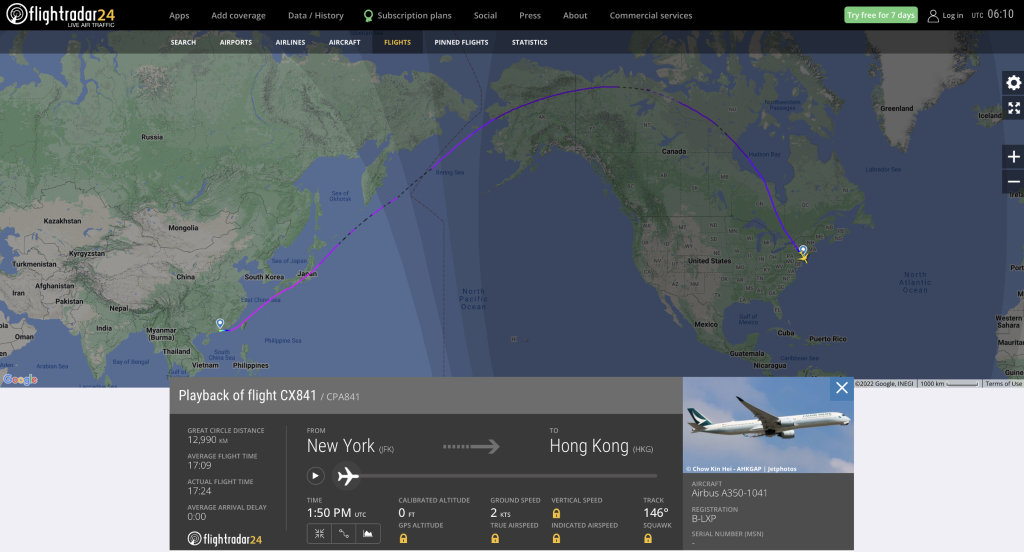
Cathay Pacific flight CX841 taking a route through Russian airspace. (Photo: FlightRadar24)
Since Nov. 1, Cathay Pacific Airways flight CX841 service from New York’s John F. Kennedy International Airport to Hong Kong returned to Russian airspace due to a strong high altitude headwind in the temperate zone. Previously, such weather has caused the flight to divert to Taipei to fuel up. Cathay Pacific had previously avoided Russian Airspace since the beginning of Russia’s Invasion of Ukraine.
As a result of CX841 flying over Russian airspace, American Airlines will no longer codeshare with Cathay Pacific on this route. Passengers previously booked on this flight with American Airlines will need to be rebooked.
Cathay Pacific used Airbus A350 XWBs to operate the flight from New York to Hong Kong. The flight is among the longest flights in the world. Normally the flight would take more than 15 hours runway-to-runway. However, with the strong headwind and the detour to avoid Russian airspace, the flight recently took an astonishing 17 hours to arrive. On Oct. 19, the flight confirmed its diversion to Taipei only a moment after it took off. The weather conditions were harsh enough to make the situation clear even at the beginning of the flight.
Due to the temperature difference between the tropical area and polar area of the earth, in addition to the rotation of the earth, there’s always a wind moving from west to east in the temperate zone, and it’s called the Westerlies. The wind is especially strong during winter time in the northern hemisphere. Such a strong headwind will prolong the flight time of westward long-haul international flights, making some flights unable to operate with the original plan.
To mitigate the situation created by the Westerlies that a route becomes inoperable for a type of aircraft, airlines may add a stop to fuel up, or, unload some passengers or cargo to reduce the fuel consumption rate. In this case, Cathay Pacific has a major operating hub in Taipei, and not many passengers would volunteer to delay their travel even with high-value vouchers.
As of this moment, Cathay Pacific’s CX841 is the only flight that flies through Russian airspace. Other long-haul international flights operated by Cathay Pacific are still taking the detour to avoid Russian airspace. Besides the flights connecting Hong Kong and the U.S. East Coast, other long-haul international flights operated by Cathay Pacific are generally within the range of Airbus’ A350 or Boeing’s 777 family aircraft.
Since the Russian invasion of Ukraine, many carriers have chosen to avoid Russian airspace. Russia, on the other hand, has also banned carriers from “hostile nations” to pass through Russian airspace. Such a situation has made flights between the Far East and the western hemisphere longer, and some even inoperable. Lufthansa, Air France, KLM and other major European carriers rerouted their flights to Asia via the Middle East and Central Asia. Such routing made the operating cost of Asian flights even higher under the global inflation situation.
As Russia’s invasion of Ukraine has no end in sight, a large portion of the world’s most crucial airspace will remain unusable for many carriers around the world. Such a situation is negative for the world’s recovering aviation market. Cathay Pacific was forced back to Russian airspace as the northern hemisphere is entering winter, but it’s unknown how many other airlines will or can choose to do the same.
Parker joined AirlineGeeks as a writer and photographer in 2016, combining his longtime love for aviation with a newfound passion for journalism. Since then, he’s worked as a Senior Writer before becoming Editor-in-Chief of the site in 2020. Originally from Dallas and an American frequent flyer, he left behind the city’s rich aviation history to attend college in North Carolina, where he’s studying economics.
A Boeing 737 MAX 9 undergoing test flights at Paine Field. (Photo: AirlineGeeks | Katie Zera)
Confidence is stepping onto an aircraft. Why else would anyone board one? Just knowing that it works, it’s safe, and that the pilots up front can fly the thing – it’s something an estimated 0.1% of humanity take for granted every day. But before that 737 even makes its way out the factory door, who decides that its worth trusting? More importantly, how are those decisions made?
This week, AirlineGeeks was given the chance to meet up with test pilot and founder of Daedalus Aerospace, David Kern. Daedalus — recognizing a gap in test flight education — delivers training for aviation professionals, specifically through on-demand courses in flight test planning, flight execution, risk management and data analytics. Flight Test 101 is Daedalus’ introductory course, and this course dives deep into the principles that dictate a successful flight test program. Having been given access, we were provided with a new perspective on aircraft and system development.
We wanted to find out more about Daedalus, and more specifically, how these principles are applied in the real world. As Kern answered our questions, we gained a new appreciation of proper, planned flight tests. As Kern said, “if you don’t flight test your system — your customers will.”
Daedalus – What’s In a Name?
For the historically inclined reader, the story of Icarus is a familiar one. Flying too high and falling to his peril, it’s a story synonymous with the proud, the inexperienced, and the reckless — all of whom face the disaster of going “too far.” There is, however, Daedalus, who famously warned Icarus of the fate that would await him if he over-stepped the line. It’s this character that Daedalus Aerospace is named after.
AG: Many people are familiar with the story of Icarus, yet Daedalus – another character of the story – gets little attention. What makes his role significant? Could you connect that to the work you do?
DK: While I am not a student of ancient history, the sources I’ve read portray Daedalus as a far more interesting character than his son Icarus. I actually chose the name Daedalus Aerospace in his honor, with the idea that we can all strive to “Be a Daedalus, not an Icarus”. In Ancient Greek mythology, Daedalus was an inventor, craftsman, and artist. His works made him synonymous with skill and excellence. He is portrayed as a symbol of wisdom, knowledge, and power.
The most famous of the Daedalus legends describe him as exiled or imprisoned on an island with his son. In order to escape, Daedalus crafted wings for himself and his son Icarus from feathers and wax. Before their flight to freedom, Daedalus warned Icarus not to fly too high, because the heat of the sun would melt the wax. Icarus famously disregarded this advice, and even as their flight of escape from the island was successful, Icarus was tempted by hubris and flew too close to the sun. Although the legend says Daedalus escaped, Icarus plunged to his death.
Daedalus should be our model, because he was a craftsman that both knew how to effectively build the means of flight, and also had the skills to identify hazards and manage risks. I like to say that aerospace development is a team sport. We must be like Daedalus, able to not only creatively solve the challenges of flight but also apply risk management that allows confident progress without risk aversion.
AG: You’ve put together some impressive courses. What role do you aim to play in the flight test sector?
DK: I have always been fascinated with flight. Since becoming a test pilot, I’ve been fortunate to be a team member contributing to the development of some world-changing technologies — for example, I was a project pilot for the F-16 Automatic Ground Collision Avoidance System between 2009-2011. Along the way, I’ve had some incredible experiences and been trusted to fly amazing prototype systems. However, as my career progressed, I think I’ve realized that it’s far more gratifying to multiply these experiences for others by teaching and enabling them to develop the future of flight.
Today, we are living in an aerospace renaissance, with exciting projects and developments worldwide, at a far greater rate than we have seen for a generation. I want to educate and enable the engineers that are staffing up these aerospace teams for projects like drone autonomy, urban air mobility, supersonic/hypersonic aircraft, and commercial space launch.
Flight Test 101 – Principles for Test Programs
As we progressed through Daedalus’ introductory course, Flight Test 101, we came to appreciate that despite the public perception of flight tests (think Top Gun Maverick), the truth is somewhat less chaotic. In reality, flight test involves risk management and a well-planned, methodical approach based on two foundational concepts – that model validation and the so-called “build-up” approach.
AG: The Flight Test 101 course you deliver outlines significant principles that guide a test program, such as risk management and the “build up” approach to flight tests. Could you please explain how these principles are applied?
DK: Flight Test 101 describes the principles and concepts that guide modern professional flight tests. The two foundational concepts for flight tests are model validation and the build-up approach. Model validation is related to the concept of digital engineering or a digital twin. The planned aerospace system is defined in terms of mechanical structure, aerodynamics, electrical, thermal, data systems, and so on. This model of the system may be as simple as first principles, derived on the back of an envelope and roughly calculated to few significant figures – or may include computational fluid dynamics. The model is exercised to predict how the system is expected to respond in the planned flight conditions. These calculations are often generated before the physical prototype is fully manufactured, in the course of engineering iterations and design decisions.
Model predictions should include uncertainty factors for the calculated responses, to account for desired performance margins but also to identify potential exceedances or divergent responses. Flight test uses the modeled performance of the system to target test resources to critical conditions as well as to identify safety considerations. These test results are used to confirm the accuracy of the model or, alternatively, to re-tune the model to match the test results. By spot-checking at inflection points and the edges of the envelope, the development process can be confidently and safely accelerated toward operational fielding. Interpolation is sometimes acceptable, but extrapolation is generally not. Model validation is often described by flight testers using the mantra, “predict – test – validate”. The model predicts system behavior, the test evaluates the predictions, and the resulting data is used to validate and refine the model.
When choosing conditions for flight tests to address model validation, it is important to prioritize and sequence test points using the build-up approach. The term “build-up approach” is a simple way to express that initial flight test conditions should be identified with lower risk and higher confidence in the model, in order to progressively work out to the edge of the envelope. This is not a one-dimensional tactic but requires a collaborative and multi-disciplinary team to consider how to intelligently move into areas of lower model confidence, higher safety risk, higher energy states, lower terrain clearance, or reduced engineering margin.
The build-up approach sequences pre-requisite tests that contribute certainty through model validation. By starting with test conditions that have lower model uncertainty and lower risk, the refined model predictions can be fed back into subsequent tests to increase safety and efficiency. Using the model validation method and build-up approach, a flight test team may safely, efficiently, and effectively prove the capability of an aerospace system.
Flight Test and Commercial Aviation
AG: Flight test is often perceived as being closely tied to defense. How large is the commercial aviation sector in flight tests?
DK: Many people associate flight tests with military and defense, probably because of the high profile and public interest in government spending. However, the civil/commercial aviation sector also has a very significant scope of flight test work. I don’t have precise numbers for each segment of the flight test industry, and there is a certain amount of overlap because people often work on multiple projects, but I estimate that military and civil/commercial flight test sectors have similar employment numbers and economic impacts. Just think about the value of all the new airliners, or new business jets, or emerging multi-copter and drone projects! There is a lot of work going on across all these sectors.
AG: In the course, you teach that the goal of flight tests is to answer questions. What questions do you think need answering for future commercial aviation?
DK: The goal of a flight test is always to answer questions, while also managing risk to an acceptable level. These questions can be quite straightforward, such as “how fast will it fly?”, or “what is the takeoff distance at the maximum weight on a standard day at sea level?”.
Those are simple questions, although answering them may require some risk management considerations. However, some of the more difficult and important questions that flight test answers are things like “is this aircraft design compliant with the applicable civil certification standards?”, or “does this weapon system fulfill the military specifications and operational utility requirements?” Those questions generally can’t be answered in a single flight, and usually require quite a bit of specialized technical documentation.
Future commercial aviation will have to answer all these types of questions but in different contexts. Important questions will include things like “how well does the fly-by-wire system for this multi-rotor air mobility system handle the urban wind jungle, and what limits should be documented to protect the operators/passengers?”, or “what combinations of supersonic Mach and altitude result in an acceptable noise signature for a flight over populated areas?”
Learning Lessons for the Future
In 2019, three letters changed the face of commercial aviation – MAX. Almost as if Boeing flew too high, the tragedy and fallout of the 737 MAX reminded the world that although a system might work well in theory, proper test flight would have taken much more into consideration. We asked Kern for his thoughts on the 737 MAX, as well as what lessons are needed as aviation experiences a new renaissance in the 21st century.
AG: I’d like to get your perspective on the Boeing 737 Max. While MCAS is not a unique technology (I can think of character augmentation systems used by Empires Test Pilot School, for example), do you think it received adequate testing? Is this a textbook lesson in poor planning?
DK: Much has been written about the Boeing 737 MAX, and I think the best reference is always the Joint Authorities Technical Review . The takeaways that I like to emphasize are 1) the necessity of thinking holistically about aerospace designs from a systems engineering perspective, and 2) recognizing the complex nature of human-machine interfaces. We need to design future aerospace systems (and really any safety-critical system) not just so that they CAN work correctly — but also to account for failure modes, human error/reaction time, and engineering margins.
AG: In the course, we learn that a successful test doesn’t necessarily mean we get the results we would like. How can we create a team environment where engineers and professionals can feel safe enough to speak up and re-examine models and test again?
DK: One of the most important concepts for aerospace development is that a successful test simply means that you set up and executed a controlled experiment that resulted in meaningful data. It doesn’t mean that your product functioned particularly well. You might actually be disappointed with the results from a business sense or product development perspective — a successful test might send you “back to the drawing board”, but the test is successful if you set it up to answer a meaningful question and got data that supports a decision.
This is why integrity and a safety culture are so important to engineering in general and flight test in particular. Sometimes, the person that knows the most about the design of the system under test, is the junior engineer (or even the intern!) in the back of the room. That person needs to be empowered to speak up to prevent unsafe outcomes, both for the test crew during development and also for the eventual customer. There are many ways to develop this safety culture, but all of them take ongoing effort at two-way communication between the engineering and test teams, plus management commitment to integrity and safety as the highest priorities.
AG: Computational fluid dynamics have improved over the years. Do you see an increasing reliance on CFDs and less on test pilots in the future?
DK: There are many areas of aerospace development where our tools have significantly improved, including CFD and finite element analysis (FEA). In a more broad sense, these tools are sometimes called digital engineering or using a digital twin. While those tools are certainly needed to create future designs and accelerate the engineering process, I know that flight tests will always be necessary to validate the models.
Remember that one of the fundamental principles of flight tests is Model Validation. Models are dependent on assumptions, which in a worst-case scenario leads to garbage in – garbage out… but can also have the undesirable effect of a point-condition optimized design. The only way to really prove an aerospace system is with an actual flight test.
Remember, if you don’t flight test your system — your customers will. You don’t want potential problems to be discovered “in the wild”, without any risk management processes in place or experienced flight testers to identify the issues before they escalate and become an incident/accident. From another perspective, an overreliance on digital tools can result in long, expensive delays with endless digital iteration and optimization. It’s easy to forget the effects of real-world manufacturing tolerances under operational flight conditions when you’re staring at a CAD drawing. Early flight test (with some risk-management controls in place) can be an engineering development accelerator, by gaining confidence in the reliable areas of the model and quickly showing where our assumptions were flawed.
From Start to Finish
Having gleaned much from Kern and Daedalus Aerospace, we were left with a deep appreciation for the entire lifecycle of an aircraft. Whether we are boarding a short, regional flight, or relying on emergency relief from above, flight test is the behind-the-scenes magic that ensures confidence in any flying machine.
From the very start and right through to the finish, the flight test provides the right answers to the right questions. Maybe that’s why the test pilot has the right stuff. And from what we gained from Daedalus, this is one ingredient that will never grow old.
Mike’s love affair with flight and mechanical objects in the sky began at an early age, fascinated by space documentaries and the vintage Flight Simulator ’95. He currently works as an instructor for UAVs and is training to receive his Private Pilot Licence with the goal of working in manned flight instruction. An avid reader of all things aviation and manned space flight, Mike stays close to developments in aerospace while reminiscing and sharing the rich history of flight with others. He loves writing, engineering and science.
A Southwest 737 landing at Chicago O'Hare. (Photo: AirlineGeeks | Joey Gerardi)
Last week, Southwest Airlines released its third-quarter results for 2023, reporting a net profit of $277 million. The $277 million set a record for the airline, making it the largest quarterly profit in the airline’s history — a direct result of the strong demand for air travel this summer season.
The Dallas-based carrier brought in a total of $6.2 billion in operating revenue, another quarterly record for the airline. The numbers reported by Southwest, as well as many other carriers this quarter make the assumption that the travel industry has made a full recovery from the pandemic, a fair one.
“We are pleased to report solid third quarter 2022 profits and record third quarter operating revenues,” Bob Jordan, Chief Executive Officer at Southwest, said.“We remain focused on maintaining our current momentum and expect to generate strong profits and margins in the fourth quarter of 2022, based on current trends and barring any significant unforeseen events.”
Southwest’s $6.2 billion in operating revenue is a 10.3 percent increase from 2019’s third-quarter results. Of the total revenue, $5.6 billion came from the carrying of passengers, $44 million from freight, and $563 million from other streams of revenue.
The quarter resulted in the carrying of 34.5 million passengers with a Revenue per Available Seat Mile (RASM) of ¢15.85, up 10.6 percent from the pre-pandemic ¢14.32 in 2019. These results can be attributed to the “surge in leisure demand,” which contributed to the airline’s 85.4 percent load factor.
Southwest continues to run a reliable operation. The airline achieved a 99 percent completion rate for the quarter.
Going Forward into 2023 and Beyond
Southwest Airlines looks to end the year on a high note. Despite lower demands when compared to the summer season, “Leisure and business demand remain strong, and we currently expect revenue trends to improve sequentially from third quarter to fourth quarter 2022,” Jordan said.
To begin 2023, Southwest plans to increase capacity by 10 percent from what was reported in the first quarter of 2022 and 14 percent in the second quarter. However, the airline plans to exercise caution with the capacity adjustments as there is uncertainty around Boeing’s expected delivery dates of their 737 Max aircraft. “We currently expect aircraft delivery delays to persist into 2024,” Jordan added.
In the ongoing attempt to drive economic benefits through cost savings from more fuel-efficient aircraft, the company expects to retire a total of 26 Boeing 737-700 aircraft in 2022, including 5 -7’s retirements in the fourth quarter. Previous guidance had plans to retire an additional three aircraft, however, are likely keeping them operational due to the delayed Max deliveries.
Thus far this year, Southwest has received a total of 40 Boeing 737-8 aircraft with an additional 31 737-800 aircraft expected to be delivered this quarter. Contractually, the carrier is scheduled to receive 114 MAX deliveries, however, due to Boeing’s delay, a portion of its deliveries are expected to shift out of 2022. By year’s end, the company is expected to have 768 aircraft.
Chase Hagl grew up in Twin Falls, Idaho. His love and passion for Aviation landed him in Orem, Utah where he obtained a B.S. in Aviation Management with a minor in Business Management from Utah Valley University. Chase currently works as a flight attendant in Charleston, SC and is also the primary Inflight ASAP ERC representative for startup airline, Breeze Airways. His experience in the aviation industry spans back four years, working in areas including agriculture application, customer service, maintenance, and flight ops. In his free time, Chase enjoys road biking, astronomy, and flying.
An Air Asia India Airbus A320 landing in Bengaluru Airport.
(Wikimedia Commons- Venkat Mangudi)
AirAsia Aviation Group Limited, the holding company of Capital A’s group of airlines, today confirmed the signing of an agreement to sell its remaining stake in AirAsia India to Air India, the country’s flag carrier owned by the Tata Group, the Indian industrial conglomerate founded by Jamsetji Tata.
The decision comes amid AirAsia’s growth in other markets, where it will now seek to strengthen its business. According to the company itself, during 2022 it has already operated a total of more than 171.000 commercial flights and carried more than twenty-three million passengers. The company, which follows a low-cost business model, is based in Malaysia, but operates subsidiaries in other Southeast Asian countries and India.
“Since 2014 when we first commenced operation in India, AirAsia has built a great business in India, which is one of the world’s biggest civil aviation markets in the world”, noted Bo Lingam, CEO of Air Asia Group. He also valued the experience of working with the Tata Group (which already held a majority stake) and said: “This is not the end of our relationship, but the beginning of a new one as we explore new and exciting opportunities to collaborate and enhance our synergies moving forward”.
A change in focus
“The pandemic has allowed us to re-examine our priorities, and we felt that it was best suited for AirAsia to develop a Southeast Asia-only business”, Lingam said. There, the company maintains four major brands that have a strong presence in Malaysia, Thailand, Indonesia, and the Philippines.
Lingam remarked that India will continue to be an important market for the company, which will continue to market scheduled air services through its various airlines. “We will use the experience and knowledge we have gained from operating in the Indian domestic market to grow the Southeast Asia-Indian market in logistics and passenger services to a far greater extent”.
In recent weeks, the transatlantic market in Venezuela has been steadily reactivated with the resumption of operations by multiple airlines. The country will offer 12,464 seats per week in December, representing a 95 percent recovery from pre-pandemic levels.
Almost all international carriers operating to the Atlantic have resumed operations, except for Air France which maintains its suspended services from Paris (CDG). Estelar has also maintained the suspension of its services to Europe.
Currently, the European and Asian countries authorized by the National Institute of Civil Aeronautics (INAC) are Spain, Portugal, Russia, Turkey, and Iran. All these nations have a non-stop connection with Venezuela.
Spain, Venezuela’s largest European market
On Sunday October 30, Iberia resumed operations between Madrid (MAD) and Caracas (CCS) with three weekly flights, increasing the number of airlines on this route to four as Plus Ultra, Air Europa and Conviasa also operate the route.
By the end of November, Plus Ultra is expected to return to seasonal service between the Venezuelan capital and Tenerife – Norte (TFN). This will be the only non-stop service between the Canary Islands and South America.
Currently, Spain is Venezuela’s main international market measured in seats per kilometers (ASK). According to data compiled by Aena Estadísticas 240,255 passengers and 2,971.9 tons of cargo and mail were mobilized in 2019 between Madrid (MAD) and Caracas (CCS). The Venezuelan capital ranked #14 of the busiest Latin American routes from Adolfo Suarez International Airport (MAD).
Major changes
As Venezuela gradually opens its borders to other countries, several airlines have increased their capacity compared to that offered prior to the pandemic. TAP Air Portugal changed equipment from Boeing 767-300ER to Airbus A330-900neo, this represents a 13.7 percent increase over 2019.
Turkish Airlines resumed daily flights to Venezuela on the Istanbul (IST) – Caracas (CCS) route, including four weekly non-stop flights and three operations a week via Havana (HAV). The company also replaced the Airbus A330-200s that previously operated the route with Boeing 787-9 Dreamliner, representing a 20% increase in seating capacity compared to pre-pandemic levels.
Beyond long-haul operations from the Venezuelan capital, Porlamar (PMV) is receiving international services from Moscow by leisure operator Nordwind Airlines on Boeing 777-200ERs every 15 days.
With the recent addition of Airbus A340-600s to its passenger fleet, Conviasa is offering transatlantic services to Moscow – Vnukovo (VKO) and Tehran (IKA) on a twice-a-month basis. The Venezuelan flag carrier also plans to operate several charter flights to Doha for the Qatar 2022 World Cup.
Two New Pacific Airways airplanes at Ontario. (Photo: New Pacific Airways)
AirlineGeeks had the opportunity to talk to the CEO of Northern Pacific Airways(NPA), Rob McKinney, after he completed the airline’s show-and-tell tour in Saipan and revealed the latest updates to the company’s terminal at Anchorage. The startup airline is planning on connecting the US and Asia via Anchorage in Spring 2023 on what the CEO describes as the ‘nicest passenger 757 in the world.’ The airline is putting the final touches on its four Boeing 757-200 airplanes at its maintenance base.
Rendering of the Boeing 757 ceiling reminiscing of the twinkly sky. (Photo: Northern Pacific Airways)
Route Network
Mr. McKinney discussed the startup’s latest strategy and route network aspirations. As it stands now, the startup is shelving plans for Mexico to give way for the partnership in the Northern Mariana Islands (CNMI). The move helps Northern Pacific to refocus on the Asia Pacific region.
Asia
A Northern Pacific Airways Boeing 757 getting ready to depart on the show-and-tell tour. (Photo: Northern Pacific Airways)
The airline is still planning on starting Japan and South Korea service next Spring. While the company has two airplanes that have already been retrofitted with new interiors, there are still pending registration changes to put them on the airline’s operation certificate. ‘We are expecting to put that(the route) application in December. That takes anywhere between 30-45 days. Then we can take a look at when we can start selling tickets.’
However, the Russian air space closure added headwinds to the Asia service, as the plane now needs to be ETOPS certified. When asked about the company’s plan for servicing the area, it appears the company’s not only taking Icelandair’s business model but also their planes. The company hopes to launch the service through wet-lease, and Icelandair is the top runner as the provider. ‘Our preference would be a partnership with Icelandair. They’ll be the ideal partner, but they create another level of complexity because now two different countries are trying to partner together. There are some restrictions that we are working through.’
CNMI
Northern Pacific Airways plans to start Service from Saipan to Sydney, Brisbane, and Manila under Northern Marianas Airways. (Photo: Northern Pacific Airways)
The company is also working on a potential joint venture with a company based in CNMI, which will initially provide service from Saipan to Sydney, Brisbane, and Manila. The company expects to file for regulatory approval in the near future. ‘we are probably a couple of months out from that. If Saipan comes to fruition, it’ll probably be in late March or early April.’ Anything more final would take a little more time.
Saipan is right on the route from Australia to Japan and South Korea, so AirlineGeeks also asked if the carrier’s planning on serving those destinations. Despite having a shorter distance than traveling to Australia, Japan and Korea services will require ETOPS. Therefore they are not an option at launch, but the airline considers those destinations as a second step when it has its ETOPS certification.
The service from Saipan will be on Northern Pacific airplanes operating under the company’s 7H code. However, the planes will wear a slightly different livery where ‘Northern Marianas’ will replace ‘Northern Pacific’ on the Fuselage.
North America
The company also planned on serving Mexico from California as a stop-gap measure before the Asia Service starts. However, the company has pulled back on the effort with the latest opportunity in CNMI. ‘We are still moving forward with regulatory approvals for Mexico, so that can always be an option for us. But at the moment, it’s a better business model for us to go to Saipan than Mexico.’
The Alaska-based carrier plans to fly from Anchorage to Los Angeles, San Francisco, New York, and Orlando from the mainland. Notably, the airline will serve the LA area via Ontario International Airport(OIA). ‘Our demographic study shows that there’s a more dense Asian population close to the Ontario airport than LAX.’ On top of that, OIA is actively seeking more international services and has cheaper fees compared to the mega hub LAX.
Future Growth
The CEO also expressed interest in serving several locations in China. However, that can only happen once China opens back up. The Alaskan government had worked on initiating routes from northeastern China even before the inception of Northern Pacific Airways, which would help provide leads should the country opens back up again.
There’s also interest in serving further south to places such as Taiwan. Although, that capability will largely depend on the evolution of the CNMI partnership. Alternatively, it could happen when the company scales up to flying Airbus jets or possibly widebodies.
First look at the new terminal
Entrance of the Navigators Club at Ted Stevens Anchorage International Airport. (Photo: Northern Pacific Airways)
Mr.McKinney also shared more details about the $6m renovating project at the airline’s future home in the North Terminal at Anchorage. The company’s renovation is almost done except for some cabinets and ceilings. Some highlights in the company’s leased area include its premium passenger lounge, the ‘Navigators Club’ and a small IMAX theater that will open to all passengers.
Food and drink area in the Navigators Club. (Photo: Northern Pacific Airways)Food and drink area in the Navigators Club. (Photo: Northern Pacific Airways)
The compass-shaped lounge logo with Northern Pacific’s bright blue color will greet passengers upon entering the lounge. The lounge features a glamouring bar area with large open spaces. When opened, it’ll provide hot and cold drinks as well as food services. It’ll also provide ample seating options for premium passengers.
A mini-IMAX theater in Northern Pacific Airways’ terminal area will play a promo video of Alaska. (Photo: Northern Pacific Airways)
The IMAX theater is a unique development aiming to attract passengers to spend a few more days on their next pass-through. The theater seats 50 people and will be playing an 8-10 minute movie on a looping basis to show people what the great state of Alaska has to offer.
Like Icelandair, the Alaska-based airline will also offer options for passengers to create a more extended layover to experience the last frontier. Since Ravn Alaska owns the startup airline, ‘It’ll be really easy for us to book the same reservation on the same code. If they(passengers) want to divert, stay here or hop on a dash 8 and see part of Alaska, it’ll be incredibly easy for them to do that.’
Final Thoughts
Like the other newly started airline, Breeze, NPA has to fight for its branding due to the recent BNSF lawsuit on the Northern Pacific name. The former changed its name from Moxee to Breeze due to an infringement with an incumbent Marriott brand. On the other hand, Mr.McKinney is optimistic that the company would prevail since the BNSF branding has not been used commercially for over 50 years.
Even though the airline suffered a few delays in inaugurating services, the delay is nothing out of the ordinary compared to almost all airlines that began services in the last two years, such as Breeze and Avelo. Securing airplanes and regulatory approvals have caused all these companies to postpone services. Nevertheless, Northern Pacific is inching closer to its first passenger flight with two completed planes and a near-finished terminal.
‘Just like any business, we have to pivot and there are bumps in the road, but we are making progress. In the grand scheme of things, I’m really pleased with the progress we’ve made to have two finished airplanes and the opportunities we have. It’s very exciting.’
Full Interview
AG: Since your latest visit was to Saipan, can you tell us what NPA’s plan for the region is?
NPA: ‘We are in talks with some folks down there, maybe creating a joint venture project. It would be headquartered in the CNMI. For flights initially to Sydney, Brisbane, and Manila. They are just talks and plans. Australia and Phillepeans are just like Korea and Japan. We couldn’t make those actual applications until we have the airplanes on our op specs, so we are probably a couple of months out from that. Anything more final would take a little more time. If Saipan comes to fruition, it’ll probably be in late March or early April.’
AG: Is the initial plan to serve only Australia and the Philippians and potentially expand to Japan and Korea in the future?
NPA: ‘Expanding to Japan and Korea would be like a second step. It requires ETOPS, so it means we have to have a partner to do those flights for us until we can acquire our own ETOPS certification.’
AG: There have been reports that Northern Marianas Airways would wet-lease airplanes from Northern Pacific Airways. Will there be more involvement beyond wet leasing?
NPA: ‘We’ll most likely be part owners of it. The actual flights will be on an airplane branded in Nothern Marianas, but they’ll look substantially alike. If you glance at them, they’ll look just like ours: same livery, just Marianas instead of Pacific on the side. It’ll be our code, it’ll still be 7H-coded tickets. Everything will be ours.’
AG: Speaking of branding, what effect does the recent BNSF lawsuit has on your branding?
NPA: ‘We are hopeful not. I can’t really talk too much yet as we are still in the initial phases. It’s a shame that it came to this. The railroad has not used that brand commercially for 52 years. And they are a freight company and we are a passenger airline. It seems unfortunate that it has come to this, but we are hopeful that we will prevail in the end.’
AG: The last question in the CNMI region, Saipan island was a fairly popular destination for Chinese tourists before the pandemic. Do you see the possibility of opening China routes if the country reopens?
NPA: ‘That depends more on China than us. We have our eyes on several places in China regardless of what transpires at CNMI. So we are just like everybody else and waiting to see when China decides to open back up.”
AG: Since your main focus is Asia connections through Anchorage, can you share some updates on that?
NPA: ‘Just like I was describing the application process, we need to have the airplanes on our certificate before we can finalize that complete application. We are expecting to put that application in December. That takes anywhere between 30-45 days. Then we can take a look at when we can start selling tickets and other things. We are still moving forward on that. It’s just that making this big of a jump is a lengthy and complicated process.’
AG: The Russian air space closure adds more headwind to that, right? How has that affected your plans?
NPA: ‘It adds complexity. Now we have to circumnavigate Russia, which requires ETOPS, so it means we have to have a partner to do those flights for us until we can acquire our own ETOP certification.”
AG:Are you working on ETOPS?
NPA: ‘yes, but you have to start flying to work on ETOPS. The request is already there, so the second we start flying the airplanes, then that’s credit towards ETOPS. But you have to be in operation before you start working on ETOPS.’
AG: You talked about needing a partner to operate those routes, so have you already identified potential partners to operate those routes?
NPA: ‘We do, we are in talks with a couple, but our preference would be a partnership with Icelandair. We have had a couple of discussions, and I’ve been to Reykjavik a couple of times. They’ll be the ideal partner, but they create another level of complexity because now two different countries are trying to partner together. There are some restrictions there as well that we are working through.’
AG: Are you still planning on launching the Mexico service in the interim?
NPA: ‘We kind of put a pause on that. We considered that before the opportunity arose from Saipan. We are still moving forward with regulatory approvals for Mexico, so that can always be an option for us. But at the moment, it’s a better business model for us to go to Saipan than Mexico.’
AG: Since your focus is still in Anchorage and you just unveiled some exciting features for your new terminal, how’s the construction going?
NPA: ‘It’s almost done. Some cabinets and ceilings are missing in the premium passenger lounge, but everything else is done. It came out really well.’
AG: How do you plan on using those spaces? How would you promote a stopover in Alaska?
NPA: ‘That is the whole point of the little IMAX theater we’ve installed. It will be for everyone, not just the premium class lounge. That’ll be playing an 8-10 minute movie on a looping basis to show people that if you are only making a connection, this is what you’ve missed. These are some of the cool things you could’ve done if you were to stay in Alaska. To attract them on the next pass-through to spend a few days.’
AG:Will passengers have any flexibility to make the change on the spot and extend their layover in Anchorage?
NPA: ‘Absolutely, especially since we are the same company as Ravn Alaska. It’ll be really easy for us to book the same reservation on the same code. If they want to divert, stay here or hop on a dash 8 and see part of Alaska, it’ll be incredibly easy for them to do that.’
AG: What US destinations do you plan on serving from Anchorage?
NPA: ‘Los Angeles, San Francisco, Las Vegas, New York and Orlando.’
AG: You’ll serve the LA Area from Ontario, why?
NPA: ‘Ontario airport has availability and they were actively seeking new international service. Our demographic study shows that there’s a more dense Asian population close to the Ontario airport than LAX. The airport cost is not even in the same league. So Ontario made a lot of sense for us.’
AG: Why is the airplane you took on the tour back in Ontario?
NPA: ‘Well Ontario airport is our maintenance base. There are always little things that can be tweaked. We still have to install the refreshed ceiling, it’ll be a dark ceiling with twinkle LED lights. I dare say we have the nicest passenger 757 in the world right now. Those are still left to go in. We are working through the FAA conformity process for the Ontario base. The other part is Ontario is a way better place to store an airplane than Alaska.’
AG: China Airlines runs a direct flight from Ontario to Taipei. Any chance you are looking to serve Taipei in the future?
NPA: ‘It depends on how Saipan goes because we can’t get to Taipei from Anchorage. We are not really looking to do Tech Stop routes because that’ll be a competitive disadvantage. Unless we connect out of a Saipan hub, probably not in the short-run until we step up to the widebodies.’
AG: Do you have any plans to upgauge to widebodies?
NPA: ‘I think that’s the natural evolution. Not right out of the gate, our five-year plan shows a scaling to 50 airplanes in seven years, but all narrowbodies.’
AG: How much life do you think you can get out of those airframes, and how do you plan on scaling to 50 airplanes?
NPA: ‘I think we have at least ten more years on these frames. Delta just announced they are extending their 757 fleets. But I’m not delusional to think that we can scale to that with the 757s, so at some, we’ll have to change over, most likely to Airbus. But as it stands right now, we want to stay in the narrowbody space, it’s better for the business model.’
AG: How many airplanes do you have now?
NPA: ‘We have four right now. Two of them are done with retrofitting except for the headliner I described. One is in C check right now and the other one is queued up to go through C check as soon as this one is done.’
Fangzhong grew up near an OEM airport in northeastern China, where he developed his enthusiasm for aviation. Taking upon his passion, he's now working as an aircraft interior design engineer. Besides working in the aerospace industry, Fangzhong enjoys trying out different types of airplanes and seeing how airplane interiors have evolved. So far, he's flown on over 80 types of aircraft. He also planespots in his spare time. His rarest catches included the 747 Shuttle Carrier Aircraft and AN-225.
All Nippon Airways Posts First Profit Since The Pandemic
An All Nippon Airways 777 in Los Angeles.
(Photo: AirlineGeeks | William Derrickson)
After three years of the pandemic, Japan’s aviation industry is seeing the light at the end of the tunnel. All Nippon Airways has posted its first profit since 2019.
The largest airline in the country has revealed a net profit of 19.54 billion yen ($132 million) for the first half of the financial year of 2022 (from April to September), compared to the same time last year, the airline posted a loss of 98.8 billion yen. The operating revenue has increased by 83.4% year-on-year and the operating expenses were limited to an increase of 38.8%.
“The perseverance and dedication of our employees is propelling ANA Group to overcome the challenging times and we look forward to seeing the continued increase as customers once again visit Japan.” Kimihiro Nakahori, Executive Vice President and Group Chief Financial Officer attributed its success to the employees.
Japan reopened its borders on Oct. 11. ANA looked forward with optimism and revised its forecast. A net profit of 40 billion yen is projected for the financial year of 2022 instead of the initial forecast of 21 billion yen. Also, the operating revenue is expected to be 1,700 billion yen. Japan is expected to be benefited from a weak yen, attracting more foreign travelers to visit the country.
“We were able to capitalize on the recovering trend.” Koji Shibata, CEO of the airline said.
In the first half of the financial year of 2022, the airline recorded five times increase year-on-year for international travel. The airline has increased its services to North America, Hawaii and Asia. However, flight services to Europe remained limited due to the invasion of Ukraine. In addition, the flight operation between Japan and China were limited because of the travel restrictions in China.
Domestic Travel Demand Surged
ANA currently operates 35% of the international travel of the pre-pandemic levels, forecasting to reach 60% of pre-covid levels by the end of the financial year of 2022. However, it could take a year longer to reach pre-pandemic levels.
Peach Aviation, All Nippon Airways’ low-cost carrier also posted the passenger volume by 2.4 times year-on-year. The no-frills airline has resumed flight operations to South Korea and Taiwan.
Japanese have started returning to the skies following the restrictions that were lifted in late March. The policy has paved the way for recovery. The airline saw a surge in travel demand for the Golden Week Holidays (From the end of April to the beginning of May) and summer holidays. The demand from business travelers was also on the rise.
By popular demand, the carrier operated additional flights during the weekends and holidays. The airline said domestic travel is expected to reach the pre-pandemic level by March, currently at 74% of 2019 levels.