Delta's new Airbus A321neo. (Photo: Delta Air Lines)
As airlines in North America are shrugging off the horrible months of the pandemic and balance sheets start looking rosier again, all the issues that had been put aside to survive the most devastating crisis commercial aviation has ever encountered are now resurfacing and calling for a solution.
On Oct. 31, the overwhelming majority of pilots at Delta Air Lines voted in favor of a strike. According to a statement from ALPA, the Air Line Pilots Association, 96 percent of pilots participated in the ballot and 99 percent of them voted to authorize a strike as a negotiation weapon in the talks about the new pay conditions for cockpit crew at the Atlanta-based carrier.
The current working conditions were negotiated in 2016 and discussions to renegotiate them were started in April 2019 before they were suspended due to the pandemic.
“Today, Delta’s nearly 15,000 pilots sent a clear message to management that we are willing to go the distance to secure a contract that reflects the value we bring to Delta Air Lines as frontline leaders and long-term stakeholders,” Capt. Jason Ambrosi, chair of the Delta Master Executive Council said. “Delta has rebounded from the pandemic and is poised to be stronger than ever, posting record revenues for the third quarter. Meanwhile, our negotiations have dragged on for too long. Our goal is to reach an agreement, not to strike. The ball is in management’s court. It’s time for the Company to get serious at the bargaining table and invest in the Delta pilots.”
Delta’s Profits Soar
A few weeks ago Delta released its quarterly report for Q3 2022 announcing a 3 percent increase in revenue over Q3 2019 for a total $12.8 billion in operating revenue. The operating income was confirmed at $1.5 billion for the quarter generating an operating margin of 11.6 percent. Net profit remains at $695 million though, considerably lower than the $1.5 billion recorded in 2019.
Forecasts for the final quarter of the year are even rosier, with operating margins expected to remain between 9 and 11 percent, but total revenue is expected to increase 5 to 9 percent over the corresponding period in 2019.
Operations will continue as normal for the time being, as rules impose the intervention of the National Mediation Board (NMB) when a strike vote is cast. Its role is to understand whether there is enough margin to reach an agreement between the parties or whether a strike is the only way forward. Furthermore, if any of the two parties reject arbitration, there needs to be a 30-day “cooling off” period before any of the parties can engage in any type of unilateral action.
Vanni fell in love with commercial aviation during his undergraduate studies in Statistics at the University of Bologna, when he prepared his thesis on the effects of deregulation on the U.S. and European aviation markets. Then he pursued his passion further by obtaining a Master’s Degree in Air Transport Management at Cranfield University in the U.K. followed by holding several management positions at various start-up carriers in Europe (Jet2, SkyEurope, Silverjet). After moving to Canada, he was Business Development Manager for IATA for nine years before turning to his other passion: sports writing.
AirBaltic and Air France Launch flights to Morocco
An airBaltic Airbus A220 on approach into Amsterdam. (Photo: AirlineGeeks | Fabian Behr)
AirBaltic now connects the Baltic countries with Africa — the world’s second-largest continent — through its first flight to Marrakesh, Morocco’s Menara Airport, operating on the morning of Oct. 31. The airline expects increased travel activity for leisure travelers between the Baltic states and Morocco with the new route now offering a great gateway to the Atlas Mountains and the Sahara Desert — which has plenty of places of interest.
Flights between Riga, Latvia and Marrakesh, Morocco will operate twice a week and will be operated by the carrier’s flagship aircraft the Airbus A220-300 aircraft. The new route marks the airline’s official entry into the African market, bringing the total number of destinations served by the Baltic carrier to 50 destinations.
The inaugural celebration was attended by the airline and airport executives. The airline hopes this will be the first of many routes it opens to the African continent, as it continues to expand its route network offering to leisure travelers ,who will have access to more exotic destinations.
The Chief Operation Officer of airBaltic, Pauls Cālītis, shared the company’s excitement for the new route and anticipation of steady demand for the route throughout the winter.
Cālītis said, “We are excited to launch our first-ever scheduled route to Africa. Marrakesh or the so-called Pearl of the South is both an exotic and warm destination and an important center of economics, also for Latvia. Moreover, it has plenty to offer for culture lovers as well. As the leading airline in the Baltics, we continue to build our network, adding more captivating leisure destinations also for the winter season.”
Passengers looking to travel between Riga, Latvia and Marrakech, Morocco can expect the flight to take 5 hours and 30 minutes. Additionally, it will be one of the longest operated on the Airbus A220-300 aircraft.
Air France Relaunches Flights to Morocco
Meanwhile, on Oct. 30, Air France relaunched a route between Paris’ Orly Airport and Casablanca, Morocco after eight years of absence between the two airports, in addition to its departures from Paris’ Charles De Gaulle Airport.
The French flag carrier will now offer a daily flight between its base in Paris’ Orly airport and Casablanca, Morroco’s Mohammed V airport. The flight is operated on an Airbus A320 that can accommodate 18 passengers in Business Class and 160 in Economy. Departures are scheduled at 15:00 to arrive at 18:05 and return flights leaving Morocco at 19:05 to land at 22:05.
Air France — which had offered this route until March 2014 — is in direct competition with Royal Air Maroc, its low-cost subsidiary Transavia France and TUI Fly Belgium.
At the moment, the SkyTeam alliance airline currently offers four daily flights between Paris’ Charles De Gaulle Airport and Casablanca, in addition to Transavia’s daily rotation. Air France also serves Marrakech, Morocco and Rabat, Morocco from Charles De Gaulle Airport.
Victor Shalton's love for aviation can be traced to when he was 11-years-old. As a seasoned aviation writer, he takes pride in providing the best aviation coverage around the globe and is passionate about advancing his skills in the aviation space. In addition, he loves travelling, writing, arts and while his speaking engagements have taken him around the world, he is proud to call Nairobi home.
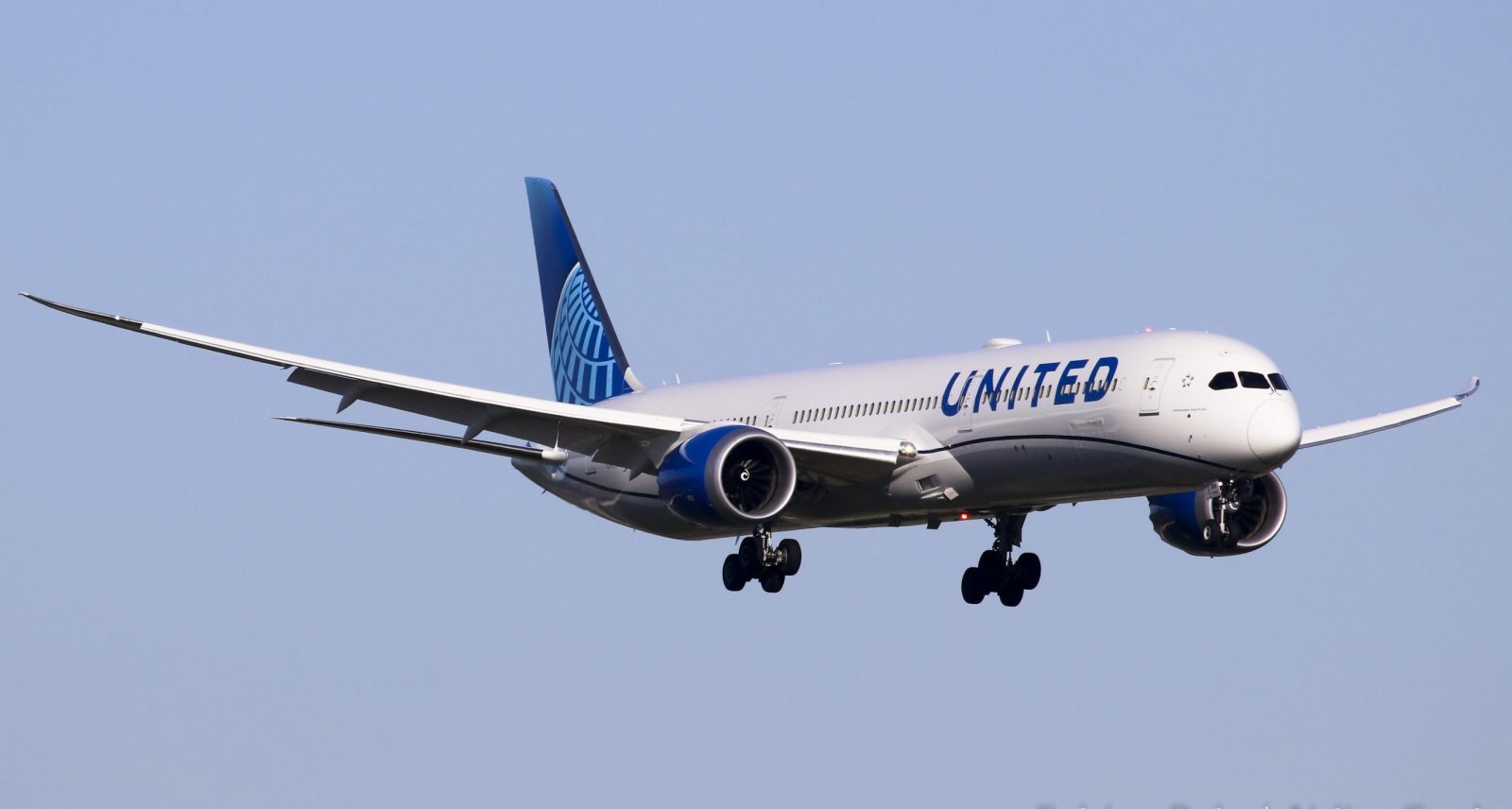
A United 787 Dreamliner descends into Amsterdam. (Photo: AirlineGeeks | Fabian Behr)
United is now the largest airline between North America and Asia-Pacific; as several countries in the region open their borders the U.S. carrier has added new destinations, resumed routes suspended in the wake of the pandemic and expanded existing services thanks to increased passenger demand.
The company has reestablished most of its operations in Australia, New Zealand, Singapore, and Taiwan and is resuming operations to Japan and South Korea due to the progressive reopening of its borders. Despite mainland China and Hong Kong services are still largely suspended or in a much-reduced operation, United has quickly added more capacity within the rest of the region.
Landing in Queensland
Last Friday (28), United landed in Brisbane (BNE) with a Boeing 787-9 Dreamliner-operated service, the carrier’s third destination in Australia and the second North American carrier to offer a nonstop route to Queensland.
Recently, United partnered with Virgin Australia which allows its passengers to make domestic connections on its Australian destinations and earn enhanced mileage redemption benefits in frequent flyer programs.
Flight Itinerary
San Francisco – Brisbane Flight UA 96 SFO 23:30 – BNE 06:30+2 Wednesday, Friday and Sunday.
Brisbane – San Francisco Flight UA 97 BNE 10:30 – SFO 06:40 Wednesday, Friday and Sunday.
Resumption of service in Australia
United resumes two services in Australia suspended due to the pandemic, both of which last operated in March 2020. For this northern winter season, the airline will offer up to three connections to Sydney (SYD) and two from Melbourne (MEL).
The carrier resumed its longest flight on the Houston (IAH) – Sydney (SYD) service, a 13,834 kilometers and 17 hours and 35 minutes route. It is operated on Boeing 787-9 Dreamliner aircraft and is the only non-stop airline connection between Texas and the South Pacific.
Flight Itinerary
Houston – Sydney Flight UA 101 IAH 21:15 – SYD 07:00+2 Wednesday, Friday and Sunday.
Sydney – Houston Flight UA 100 SYD 10:20 – IAH 10:00 Tuesday, Friday and Sunday.
From December 15 this service will increase to daily flights.
On addition to the Sydney route, the carrier has resumed operations between Los Angeles (LAX) – Melbourne (MEL), this service complements its daily service from San Francisco (SFO). Both routes are operated on Boeing 787-9 aircraft.
Flight Itinerary
Los Angeles – Melbourne Flight UA 98 LAX 22:35 – MEL 08:30+2 Monday, Wednesday and Friday.
Melbourne – Los Angeles Flight UA 99 MEL 10:30 – LAX 06:45 Wednesday, Friday and Sunday.
From December 15 this service will increase to daily flights.
More flights to New Zealand
On October 28, United also resumed daily flights between San Francisco (SFO) and Auckland (AKL), operated on Boeing 777-200ERs. This represents an 86.8% recovery of seat capacity from pre-pandemic levels.
Flight Itinerary
San Francisco – Auckland Flight UA 917 SFO 22:55 – AKL 08:10+2 daily flights.
Auckland – San Francisco Flight UA 916 AKL 14:50 – SFO 07:05 daily flights.
Back to normal in Singapore
The carrier resumed its second daily operation between San Francisco (SFO) and Singapore (SIN), fully restoring the seat capacity offered prior to the pandemic. United is the only U.S. carrier operating at Changi International Airport (SIN).
Flight Itinerary
San Francisco (SFO) – Singapore (SIN)
Flight UA 01 SFO 22:45 – SIN 07:00+2 daily flights.
Flight UA 29 SFO 11:40 – SIN 20:15+1 daily flights.
Singapore (SIN) – San Francisco (SFO)
Flight UA 02 SIN 10:15 – SFO 09:50 daily flights.
Flight UA 28 SIN 22:20 – SFO 22:20 daily flights.
All services are operated by Boeing 787-9 Dreamliner aircraft.
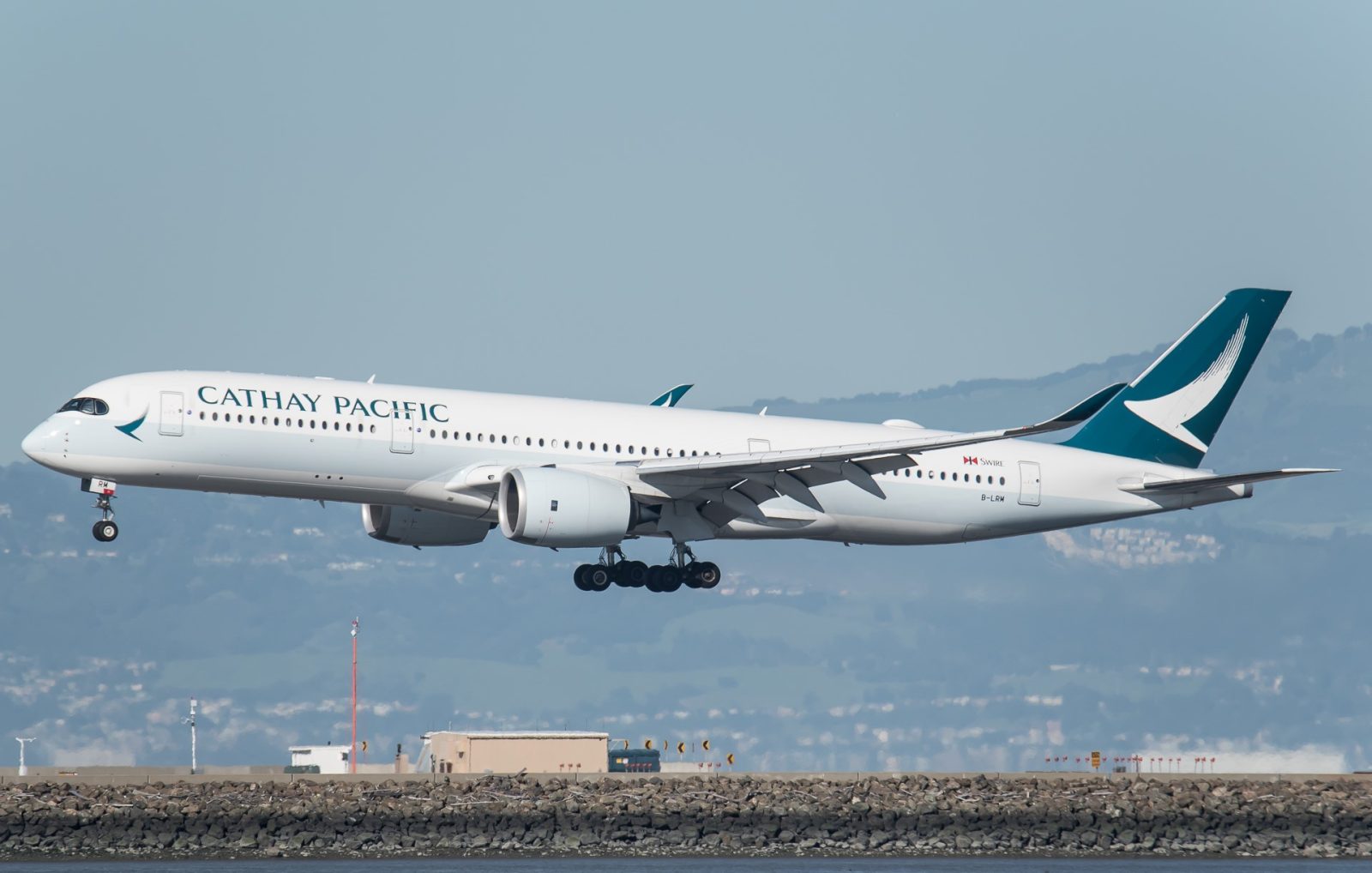
A Cathay Pacific A350. (Photo: AirlineGeeks | Ben Suskind)
Starting November 1, Hong Kong-based Cathay Pacific will reinstate some of its routes that involve overflying Russian airspace, as reported by Bloomberg.
In doing so, the airline will resume operations over polar regions for the first time since restrictions were imposed in February following Russia’s invasion of Ukraine and the subsequent restriction on foreign operators flying over the world’s largest country.
Initially, the measure affected European carriers. However, airlines from South Korea and Japan then decided to avoid the airspace for operational safety reasons.
The situation forced the rescheduling of regular flight routes and, in some cases, the suspension of services. The size and location of Russian airspace makes it a critical link, especially thanks to the time savings made possible by using routes close to the Arctic Circle. For this reason, the closure particularly complicated air operations between the Far East, Europe, and North America.
Operators from China, India, Turkey, and the Middle East, however, continued to fly over Russia without major impediments.
Polar routes: less flight time and more operational efficiency
Cathay Pacific will resume using the so-called polar routes from tomorrow. Initially, it will link Hong Kong (HKG) and New York (JFK) airports in an operation that will include overflying part of the eastern sector of Russian airspace. The company cited headwinds and problems carrying the desired payload as the main reason for restoring normal routes.
Cathay Pacific explained that the decision is aimed at achieving «a safer and more efficient operation» for both its staff and customers. The use of polar routes, which require considerably less flight time, optimizes the number of passengers and total cargo carried.
Last March, the airline announced plans to divert its regular route between New York and Hong Kong. The change would include overflying the North Atlantic and then entering European airspace over Britain. The route would then continue over Eastern Europe and Central Asia. This way, the airline would avoid the usual overflight of Greenland, the Arctic Ocean, Russia and Mongolia.
At the time, Cathay Pacific joined many other Asian and European carriers that had already taken similar steps.
A British Airways Airbus A319 on approach to London's Heathrow Airport.
(Photo: AirlineGeeks | William Derrickson)
The International Airlines Group (IAG) Anglo-Spanish multinational holding company formed on January 21, 2011, from the merger of the flag carriers of the United Kingdom and Spain, British Airways and Iberia, published its financial results for the third quarter of 2022 a few days ago. As of September 30, 2022, the Group had total liquidity of 13,488 million euros, including 9,260 million euros in interest-bearing deposits.
In the first nine months of 2022, IAG’s load factor reached 81.3%, increasing once again during the period, reaching 72.2% in the first quarter, 81.8% in the second quarter, and 87.0% in the third quarter, only 0.7 points lower than in the third quarter of 2019.
IAG has been successful in raising financing since the COVID-19 outbreak, having financed all aircraft deliveries in 2020 and 2021, and has continued to successfully finance aircraft in the following nine months through September 30, 2022, continuing to secure aircraft financing with long-term agreements.
Average commodity fuel prices in the nine months to September 30, 2022, were significantly higher than in the previous period, with jet fuel prices nearly doubling from the previous year.
The Group’s financial performance was affected by fluctuations in exchange rates, mainly of the U.S. dollar, euro, and pound sterling. The average exchange rate for the first nine months of 2022 saw the U.S. dollar strengthen by 10% against the euro, and 7% against the pound, compared with the average for the first nine months of 2021. The net impact of transactions and foreign exchange translation for the Group in the nine months was negative €316 million (negative €90 million in the first quarter, €106 million in the second quarter, and €120 million in the third quarter).
New aircraft ordered from Airbus and Boeing
On October 26, IAG shareholders approved the purchase of 50 Boeing 737 and 37 Airbus A320neo aircraft. These aircraft, scheduled for delivery between 2023 and 2028, will replace the current Airbus A320ceo family aircraft.
Boeing on its website announced that 50 Boeing 737-8-200s and 737-10s have been ordered, with options for a hundred more. The order had been firm since November 2021. The Boeing 737-10 is the largest model in the 737 family and can accommodate up to 230 passengers in a single-class configuration with a 3,300-mile range. The Boeing 737-8-200, on the other hand, can be configured to accommodate up to 200 passengers.
The next day, on Oct. 27, Airbus posted the news on its website that it had placed an order for 37 A320neo aircraft, following shareholder approval. The latest order follows previous agreements for 22 A320neo Families (17 A320neo, 5 A321neo) announced in March and June 2022, bringing the year’s total to 59 aircraft.
The two Boeing 737 and Airbus A320 families have the latest technologies. The 737 has the latest generation CFM International LEAP-1B engines offering the highest efficiency ever achieved on a Boeing 737. Airbus A320neo aircraft as well have next-generation engines and Sharklets on board, a solution that provides fuel savings of at least 20%. As stated by Airbus itself, with more than 8,500 orders from more than 130 customers, the A320neo Family is the world’s most popular aircraft.
Vincenzo graduated in 2019 in Mechanical Engineering with an aeronautical curriculum, focusing his thesis on Human Factors in aircraft maintenance. In 2022 he pursued his master's degree in Aerospace Engineering at the University of Palermo, Italy. He combines his journalistic activities with his work as a Reliability Engineer at Zetalab.
Kalamazoo/Battle Creek Intl. from above (Photo: AirlineGeeks | Joey Gerardi)
Houston, Texas-based Avelo Airlines has had quite a history, they were originally founded in 1987 as Casino Express Airlines, in 2005 as Xtra Airways, and finally in April of 2021 under its current name Avelo Airlines. Under the leadership of CEO Andrew Levy, they have expanded past their original route network along the west coast and have a substantial network in the eastern portion of the United States.
They opened a second base in New Haven, Conn., and the third base in Orlando, with a fourth, planned in Ft Meyers but has been postponed due to hurricane damage. With its newly opened Orlando base, the airline has expanded into many new destinations, one of which is Kalamazoo, Mich., the topic of this article.
Flights between Kalamazoo and Orlando Intl. will operate twice a week, Mondays and Fridays, with flights arriving at the small Michigan airport late in the evenings around 8 P.M. with a departure back to Florida occurring around 9 P.M. However, during the carrier’s first two weeks in Kalamazoo, the departures are scheduled to occur at 4 P.M., giving those on the inaugural some wonderful daylight scenery en route to Florida.
This Avelo Air flight to Kalamazoo is also Avelo’s first scheduled nonstop flight to anywhere in the state of Michigan, with Lansing, Mich. starting later the same day and having roughly the same schedule. These are also the first scheduled flights to Florida from Kalamazoo since 2012 when DirectAir went bankrupt, the carrier who previously operated this sector.
Days Prior
The week prior to the flight I got a reminder email from the airline, which isn’t unheard of in the industry, making sure passengers actually take their flight as some people forget especially if they book them many months prior. As Avelo is an Ultra Low-Cost Carrier or ‘ULCC’ for short, they also charge for items like seat selection, and carry-on bags, among other things. So in addition to the reminder, they also prompted me to add customization to my trip, as I was only traveling with a backpack and had already selected my seat I skipped this option.
My flight reminder one week before my Avelo flight (Screenshot: Joey Gerardi | AirlineGeeks)
The day before the flight I decided to check in online 24 hours prior to the flight and got a concerning message.
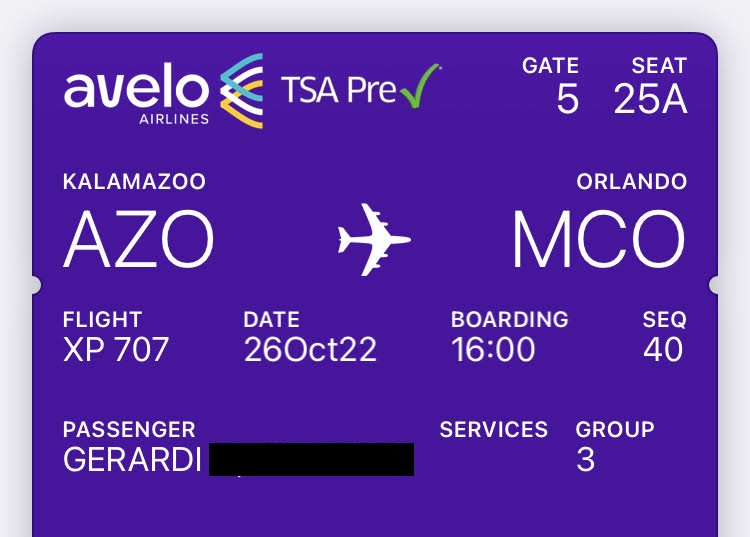
‘Please see an Avelo Airlines check-in agent’, I got worried as to what this could mean, but I tried to check in about 5-hours later and I managed to get a mobile boarding pass which I then put into my wallet on my phone. It must be a temporary glitch on the airline’s website preventing me from checking in, had I not tried to check-in again hours later or not been a seasoned traveler it might cause a bit of panic.
My message during my first check-in attempt (Screenshot: Joey Gerardi | AirlineGeeks)
During my second check-in attempt, I was able to add my TSA PreCheck number to my reservation, as Avelo has joined the PreCheck program since they started operations in April of 2021. While PreCheck won’t be a big deal at the smaller airport like Kalamazoo, it will surely help at the larger airports they fly to like Orlando.
My mobile boarding pass (Photo: AirlineGeeks | Joey Gerardi)
During check-in, they also gave you one last chance to add-on services such as carry-on bags, during the online check-in process they gave you the option to change to any seat you wanted to at no additional charge. That itself was an interesting feature given during booking, seats in the front and back of the cabin had a $47 price difference, but if you wait until check-in they are all free. I choose seat 25A, which cost $15 but I could’ve moved myself up to 1A, a $59 seat, at no additional cost, something to keep in mind when flying the carrier.
I decided to keep myself in 25A, that way I could get shots of the rear of the wing and the flaps. In addition, when flying south at sunset the sun will be on the right side of the plane, meaning I would save myself and my camera from being blinded by the excessive sunlight. Once the flight departure moves back to 9 P.M. the sun will already be down so either side is fine.
Day of the Flight
On the day of my flight, I got to the airport way earlier than I needed to so I could experience the first day of the airline to the fullest, arriving over three hours before the departure time.
Normally Avelo flights will come in and leave within the hour, but on the first day of operations the ground time for the aircraft was over 2.5-hours, this gave the ground crew and agents time to learn and train on the aircraft and the computer systems as well as time to work on any bugs the system might have at a new location. This was because the day of the inaugural was the first time most of them have ever worked for an actual live Avelo flight outside of some training, and they all did a good job of it working the system with no major issues.
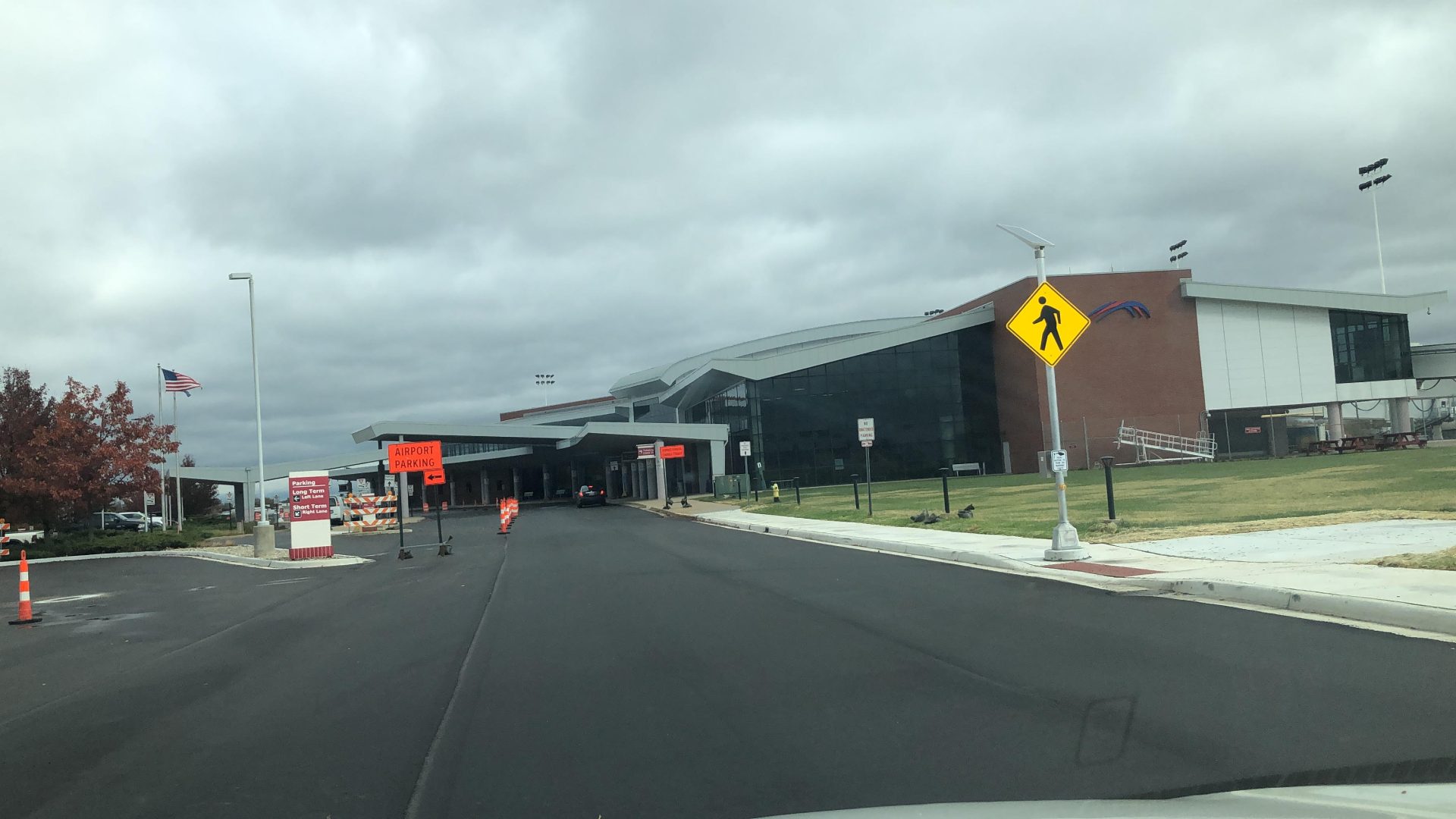
The Kalamazoo/Battle Creek Intl. Airport terminal (Photo: AirlineGeeks | Joey Gerardi)
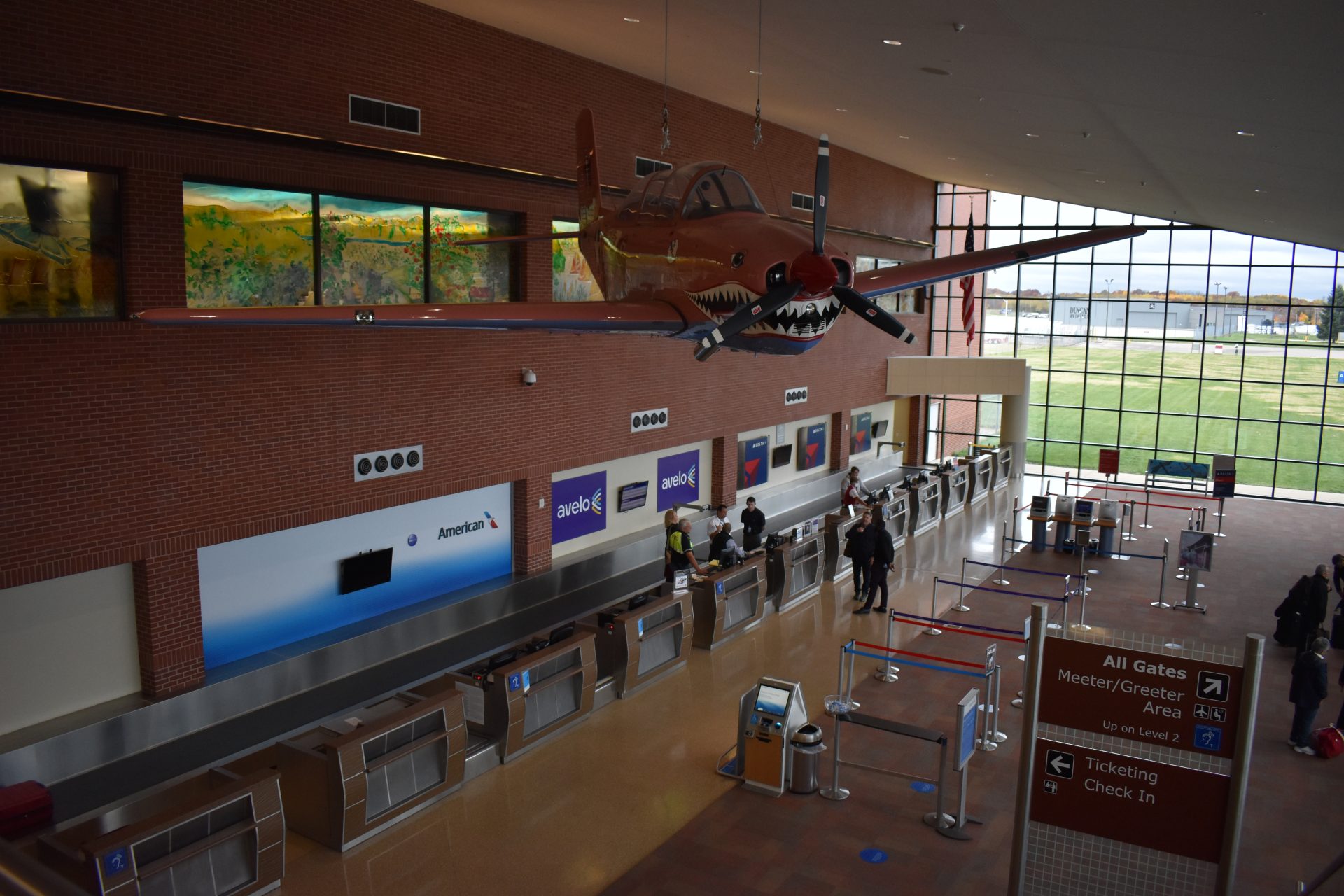
Once I walked in there was already a feeling of excitement from the airport and airline employees as preparations were underway for the party the airport was putting on. I went up to the Avelo desk which had a group of people around it, mostly employees of the airline or the company handling their ground handling in Kalamazoo. Boarding passes are free to print at the counter, but they wouldn’t do it until two hours before the flight so I had some time to walk around. The Avelo counter in Kalamazoo is located between American Airlines and Delta Air Lines, where United Airlines used to be located before they pulled out of Kalamazoo in January of 2022.
The check-in desks at the airport (Photo: AirlineGeeks | Joey Gerardi)
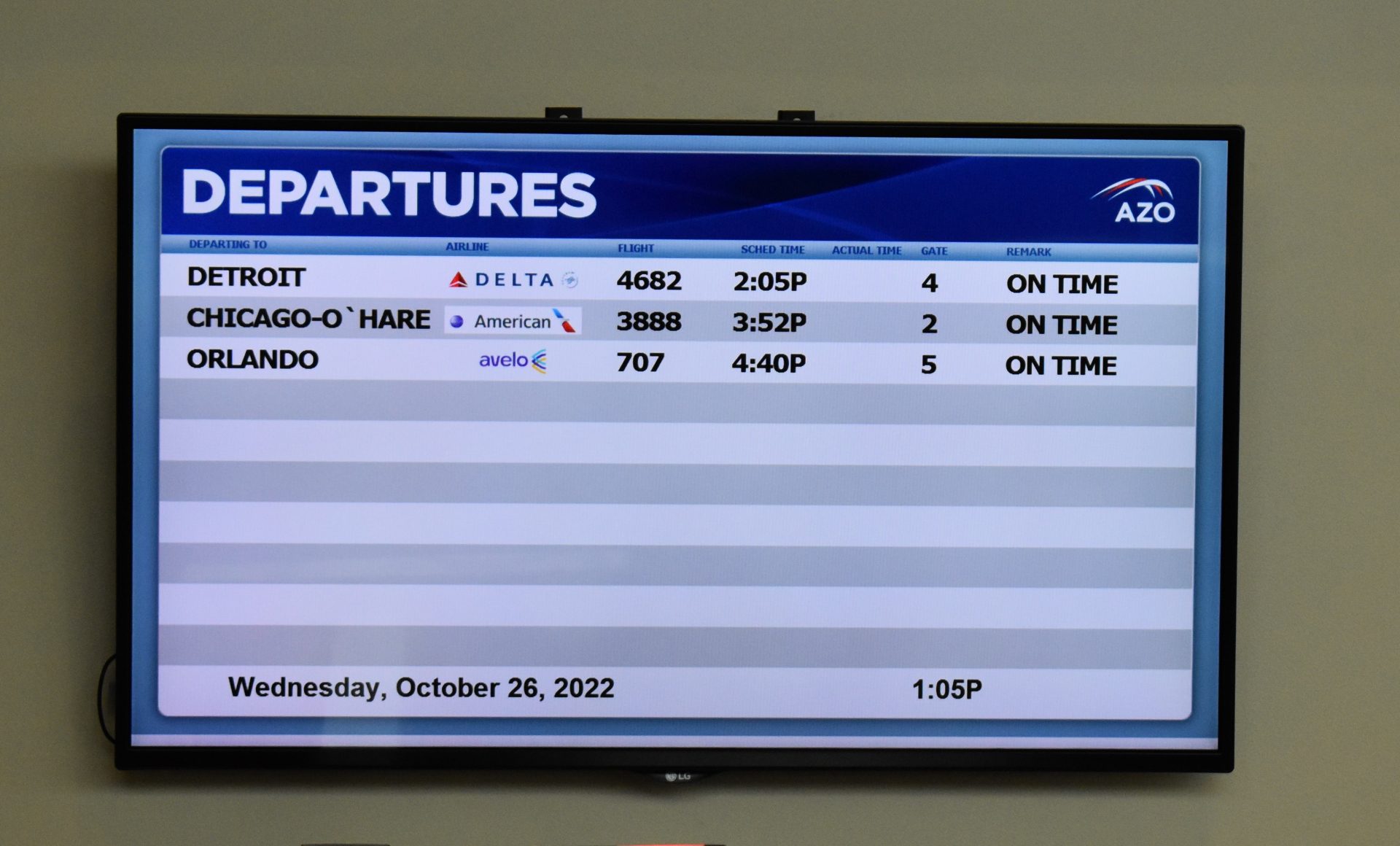
I then went up to look at the very lonely departure board at the airport, prior to the pandemic the airport saw at least 12-daily flights from three different airlines. Now, outside of Avelo’s twice weekly flights, the airport now only sees four flights a day on two airlines; two on Delta to Detroit, and two on American to Chicago O’Hare, each of which is on small 50-seat regional jets. Kalamazoo definitely fits Avelo’s target market, small underserved airports that have lost service.
The departure board at the airport (Photo: AirlineGeeks | Joey Gerardi)
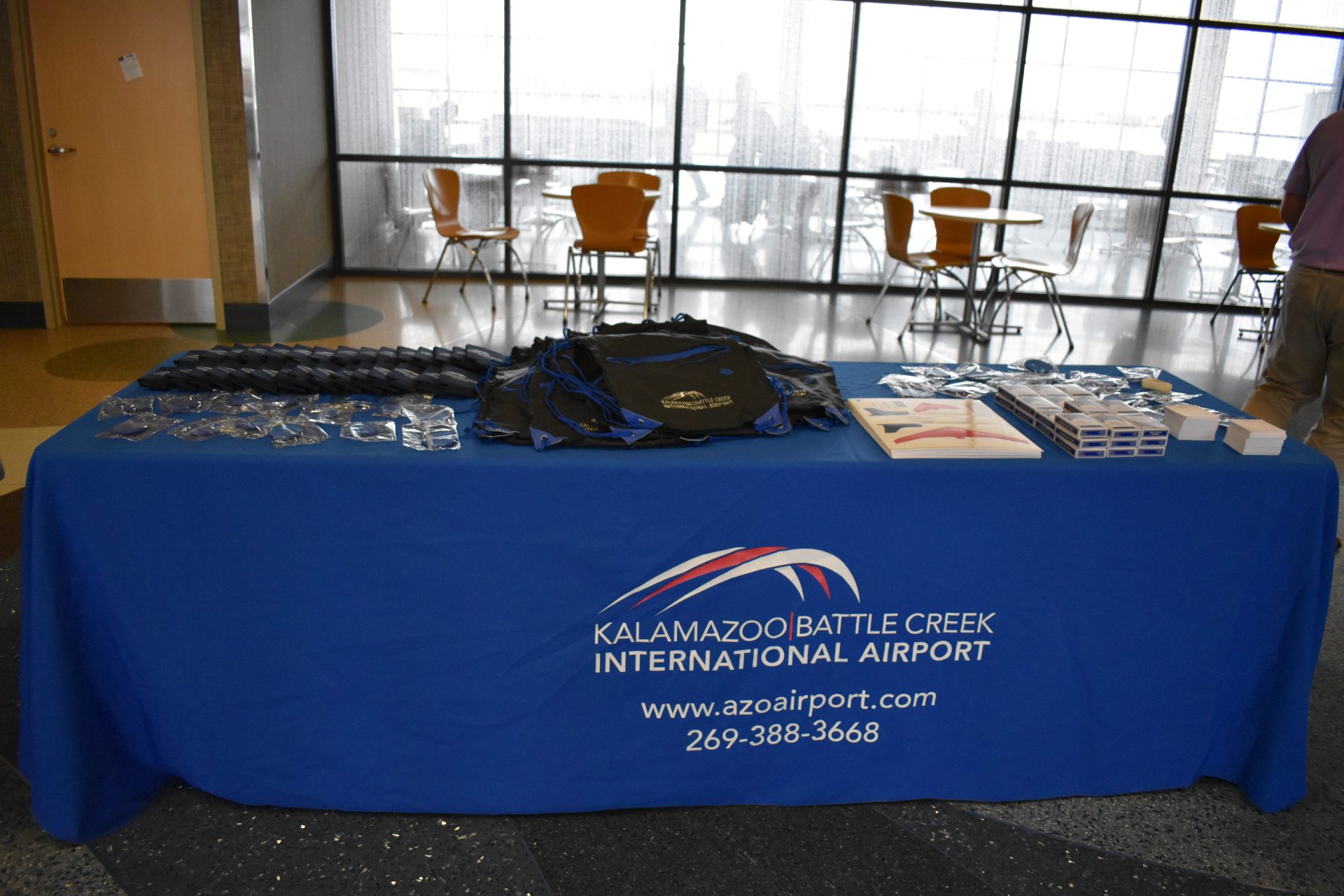
Upstairs near the security checkpoint, the party set up was underway with the airport director and his team setting up balloons, decorations, and putting goodies out for the passengers. Items ranged from playing cards to drawstring bags, all of which had the airport logo on them, and of course, being an AvGeek I helped myself to some of the items.
The goodie table at the inaugural party (Photo: AirlineGeeks | Joey Gerardi)
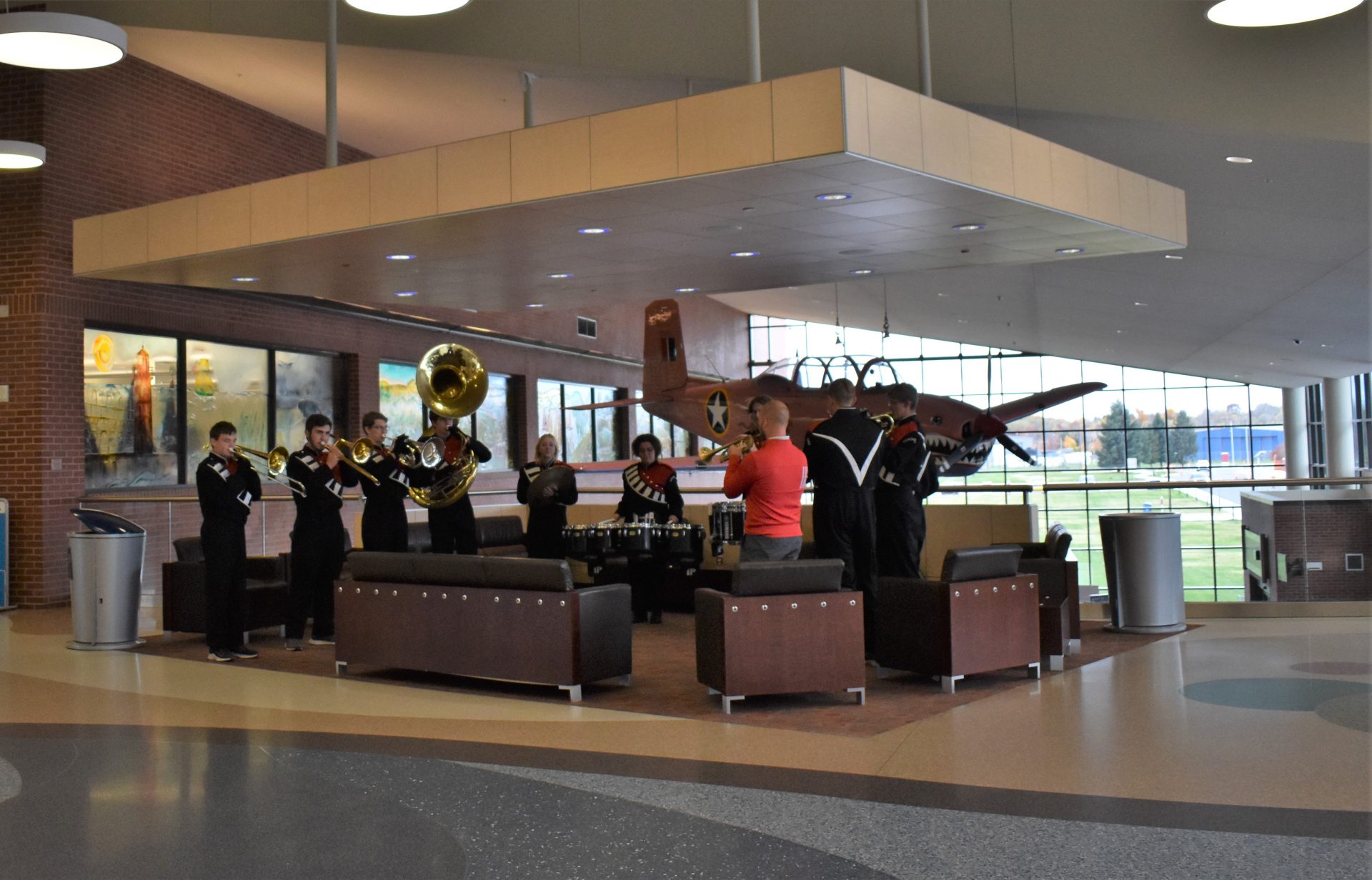
While set up was happening, around 12 people with instruments showed up who turned out to be members of the Vicksburg High School band. The airport invited them to come in and play for the inaugural party as well as when the first passengers were coming off the flight. It wasn’t long before band music filled the entirety of the small terminal, from the counters and rental car counters to the greeting area upstairs near security.
Vicksburg High School Band warming up for the inaugural party (Photo: AirlineGeeks | Joey Gerardi)
By this time, the inbound aircraft was about ten minutes out, so I went outside to the ramp with an airport employee to get pictures of the water cannon salute. When we got outside there was something interesting waiting on the taxiway, two Western Michigan University or ‘WMU’ Cirrus SR20’s sitting on the taxiway. WMU is a large university located in Kalamazoo that has a flight school, and it turned out that two of their aircraft would be leading in the first Avelo arrival.
Two Western Michigan University SR20’s waiting to lead in the first Avelo flight (Photo: AirlineGeeks | Joey Gerardi)
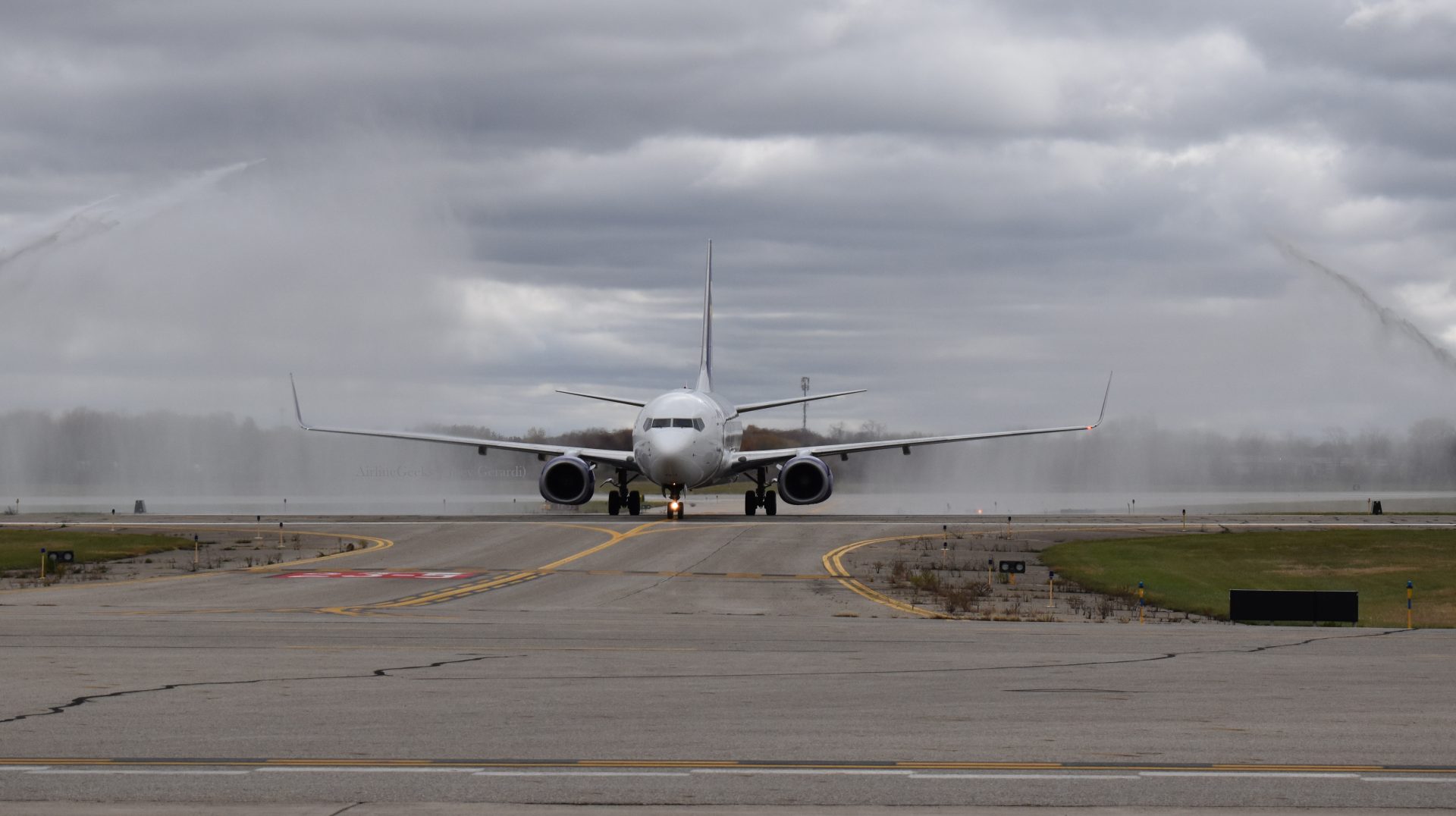
It wasn’t long before the plane landed, N7837A, 2003 built Boeing 737-700 that belonged to Aeromexico and Southwest before coming to Avelo in June of 2022. The aircraft got a traditional water cannon salute upon taxiing in, led by the two Cirrus SR20’s mentioned above.
Avelo Air’s first flight to Kalamazoo taxiing in (Photo: AirlineGeeks | Joey Gerardi)
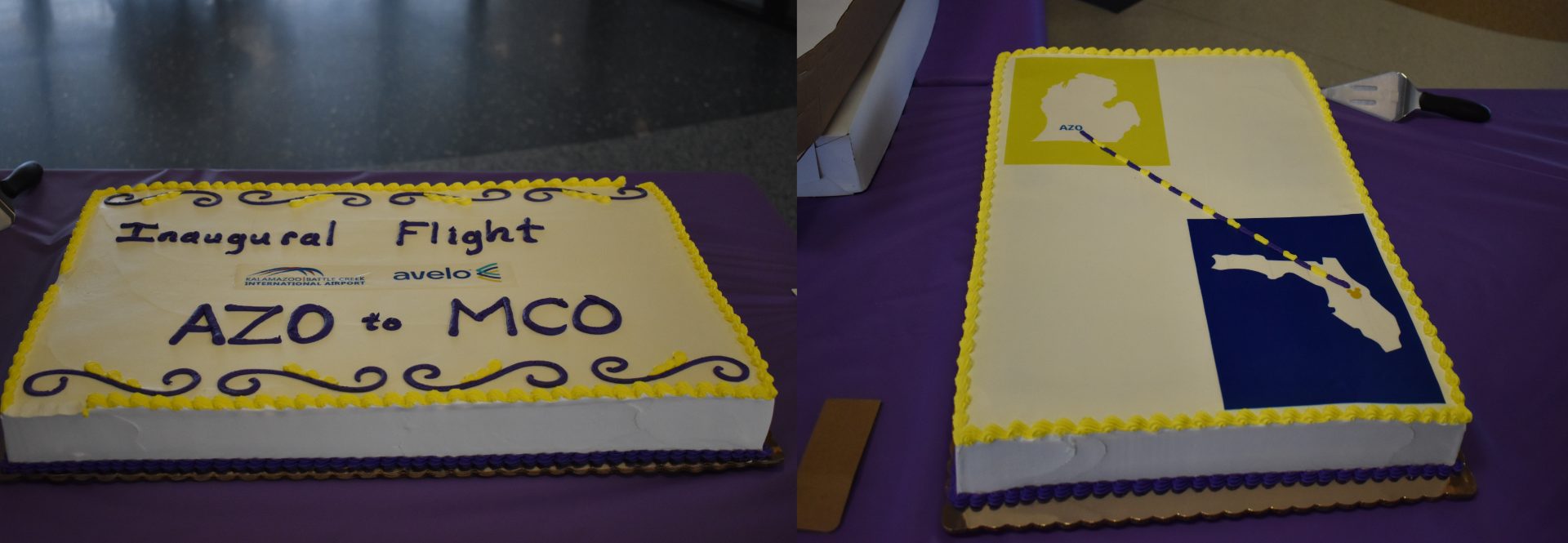
After the aircraft taxied in, I headed inside to see the festivities when the first passengers came off. Since I went outside, DiscoverKalamazoo had set up a table for the arriving passengers. They handed out magnets and Kazoos to people coming off of the Avelo flight. They had also cut the two large cakes that they got for the party, both of which were impressive and I managed to get a picture of them before they were cut.
The two cakes the airport got for the inaugural party (Photo: AirlineGeeks | Joey Gerardi)
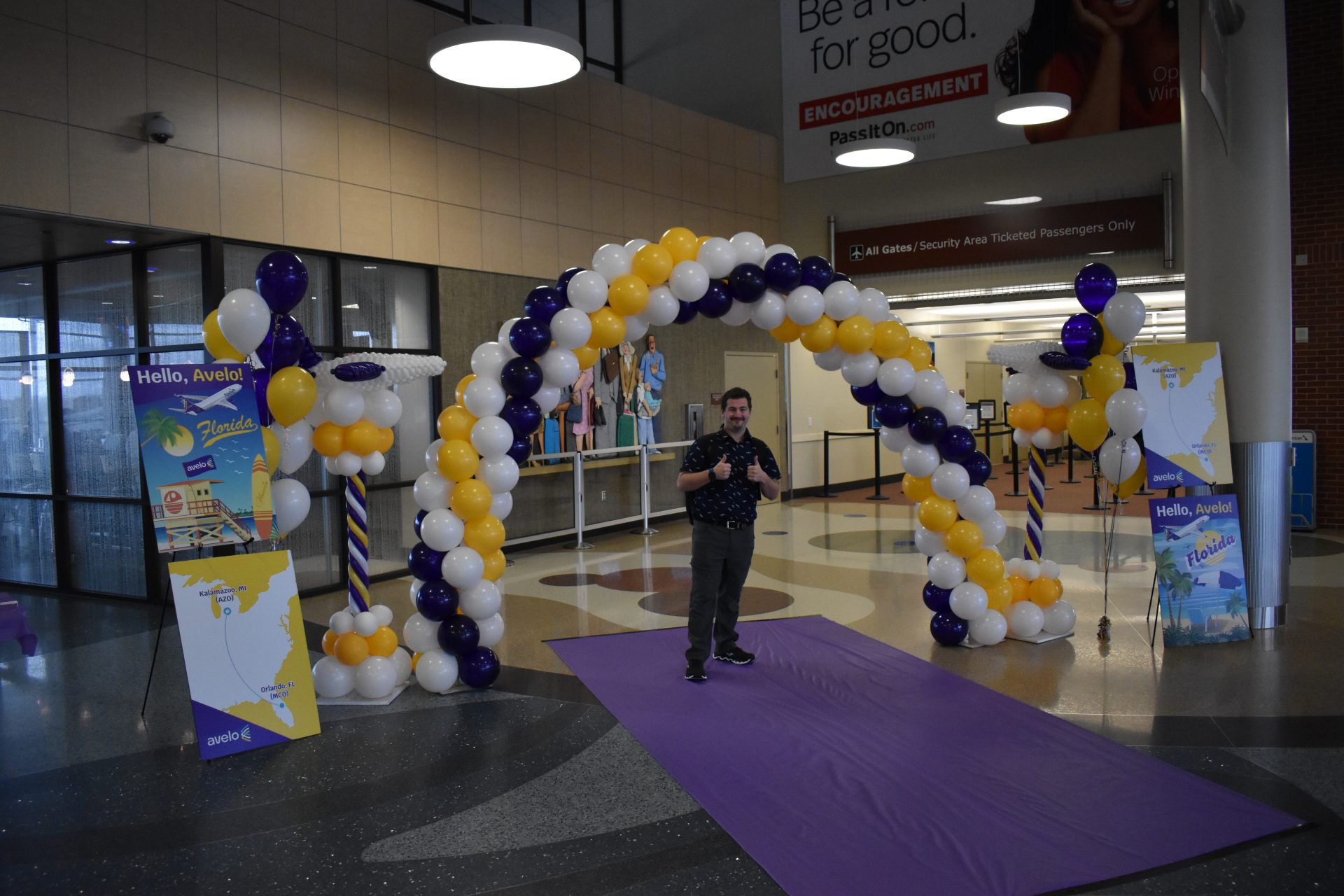
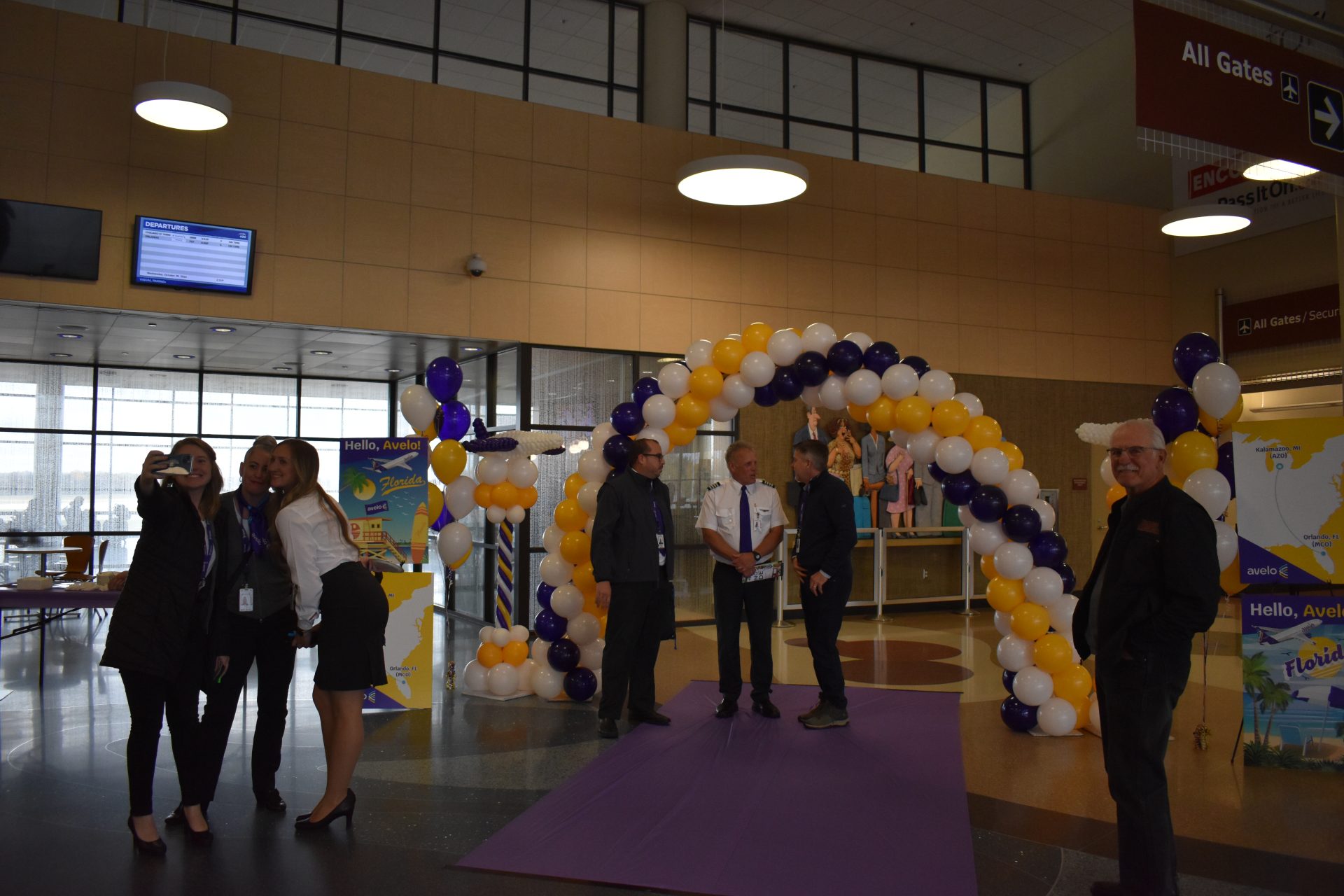
The first passengers off the Avelo flight came out and the band started playing and the party began. Everyone was talking with each other and hanging out, eating cake, getting pictures, or just sitting. This was a nice environment and probably one of the biggest inaugural celebrations that I have had the pleasure of partaking in. Of course, I got the AvGeeky photo in front of the balloons and signs which a fellow passenger was happy to take for me.
Me, in front of the balloons and signs at the Avelo inaugural (Photo: AirlineGeeks | Joey Gerardi)
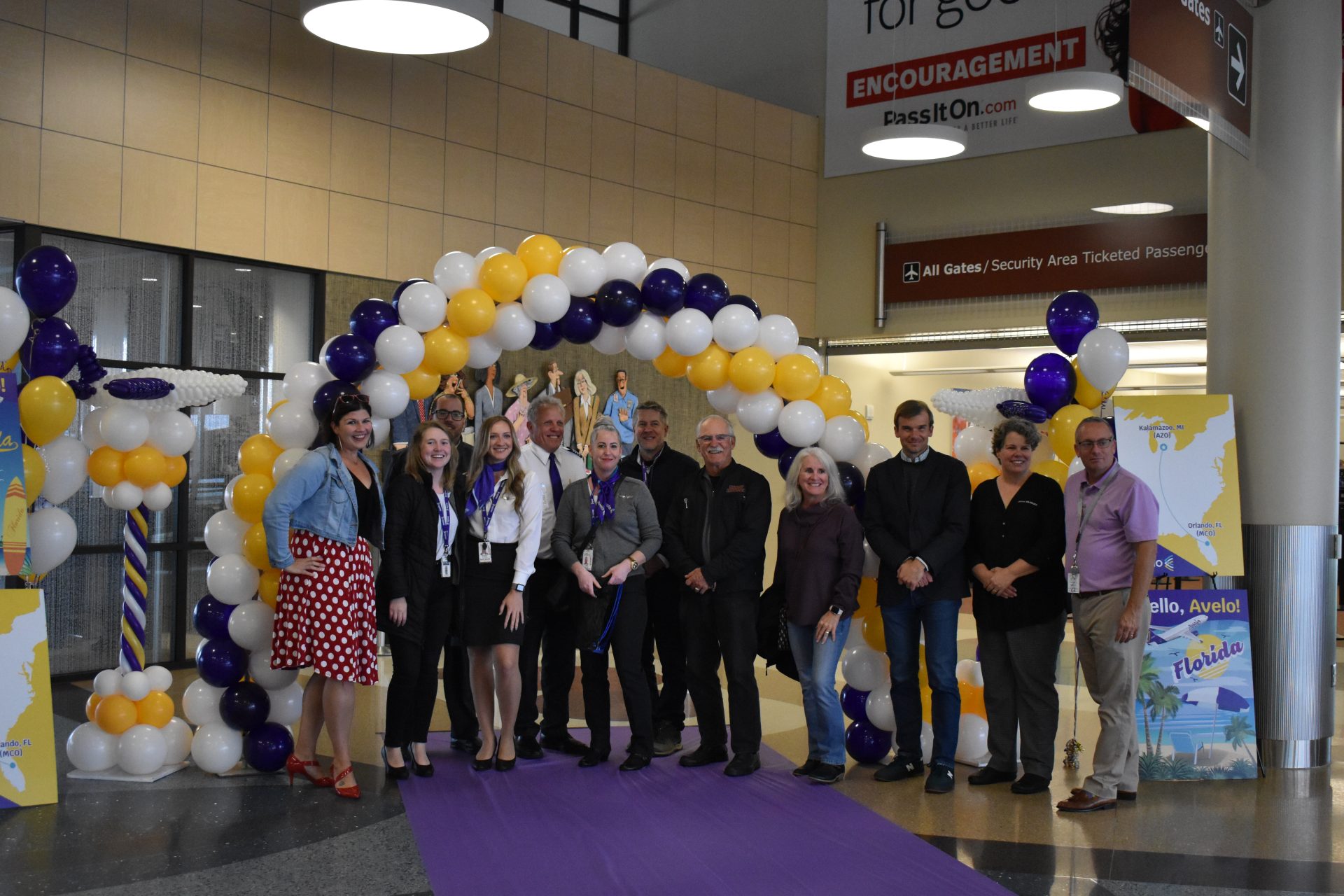
Shortly after that the crew off the Avelo flight came to join the party, they also got a photo in front of the decorations along with some of the airport staff members.
The Avelo Aircrew and members of airport staff at the inaugural party (Photo: AirlineGeeks | Joey Gerardi)
Once the band had stopped playing I headed downstairs to the check-in area to get my printed boarding pass, which looked similar to the mobile boarding pass except the paper pass was in black and white. The PreCheck logo was located at the top next to the airline logo.
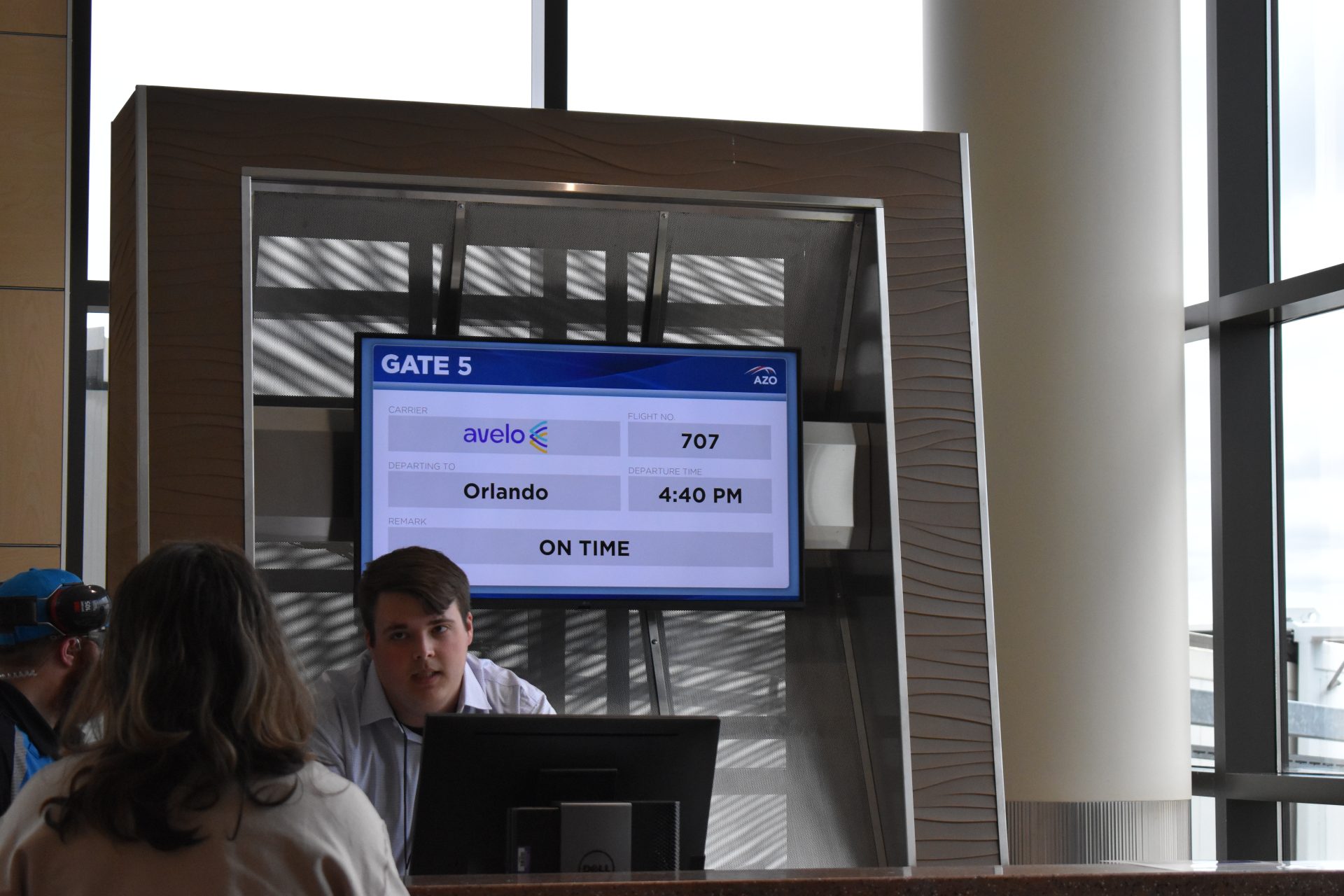
At this point, I decided to head through security which didn’t take more than five minutes, as it’s a small airport and I have TSA PreCheck. The gate they use in Kalamazoo is gate 5, the closest gate to the security checkpoint. The gate area isn’t the largest, but the seating area combined with nearby gate 4 has plenty of seats for passengers even if there is a full plane.
Gate 5 at the airport, Avelo’s gate (Photo: AirlineGeeks | Joey Gerardi)
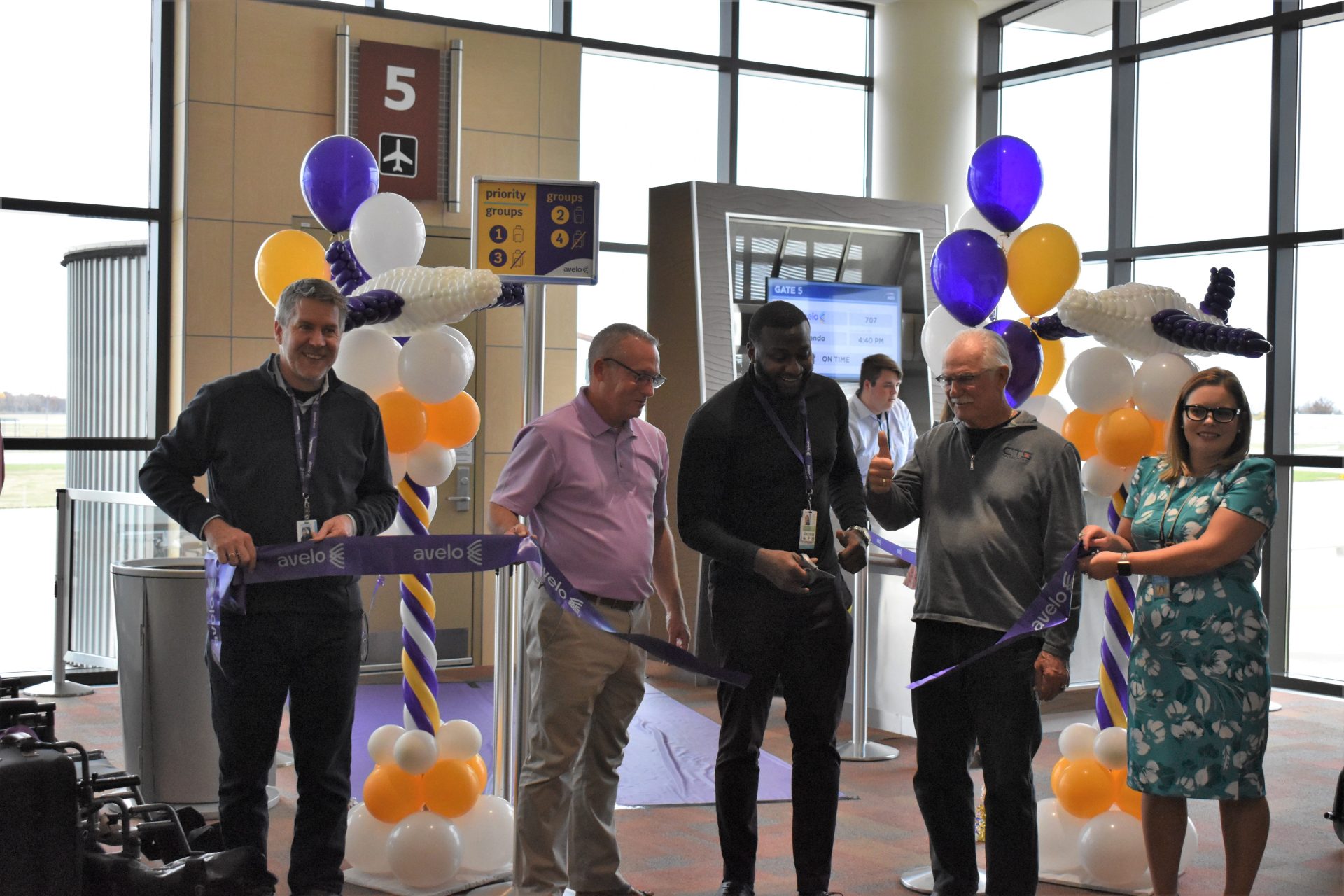
By this time they had moved all of the balloons and most of the decorations to the gate area and a couple of small speeches started. First by the airport director, followed by Avelo’s head of marketing, and finally, someone who sat on the Kalamazoo airport board. Right after that was a ribbon cutting, and luckily I was able to snag a part of the ribbon, which was a real treat.
Ribbon cutting for the Avelo inaugural in Kalamazoo (Photo: AirlineGeeks | Joey Gerardi)
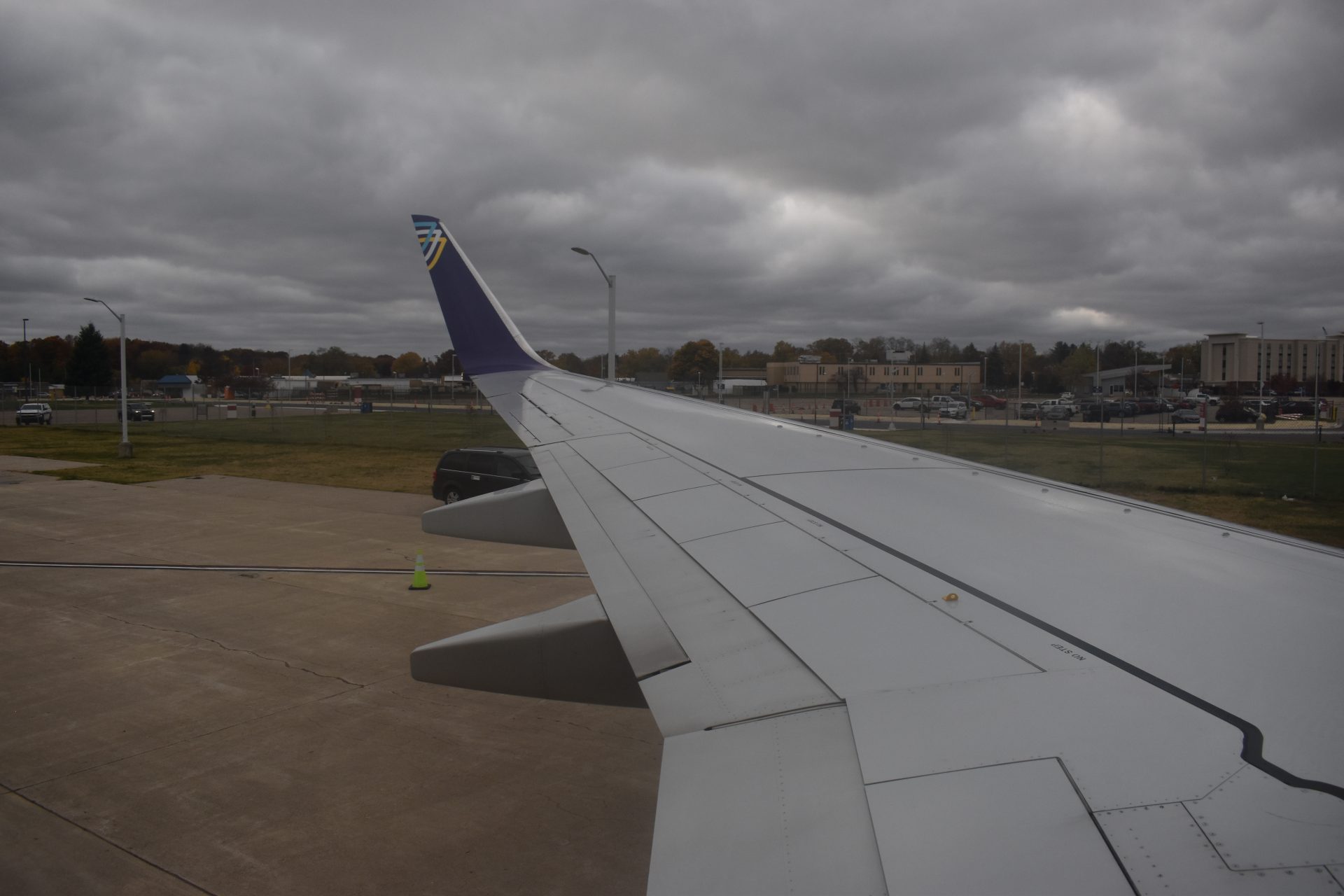
Boarding started 30-minutes before the departure time, and all 94 passengers got on, a good number considering its the first flight and its the middle of the week. The airport director mentioned that the second flight, which would occur two days later, was almost full. Another unique feature of these small airports, I could see my car in the parking lot from my seat on the plane while we were at the gate.
Looking towards the parking lot from my seat on the plane (Photo: AirlineGeeks | Joey Gerardi)
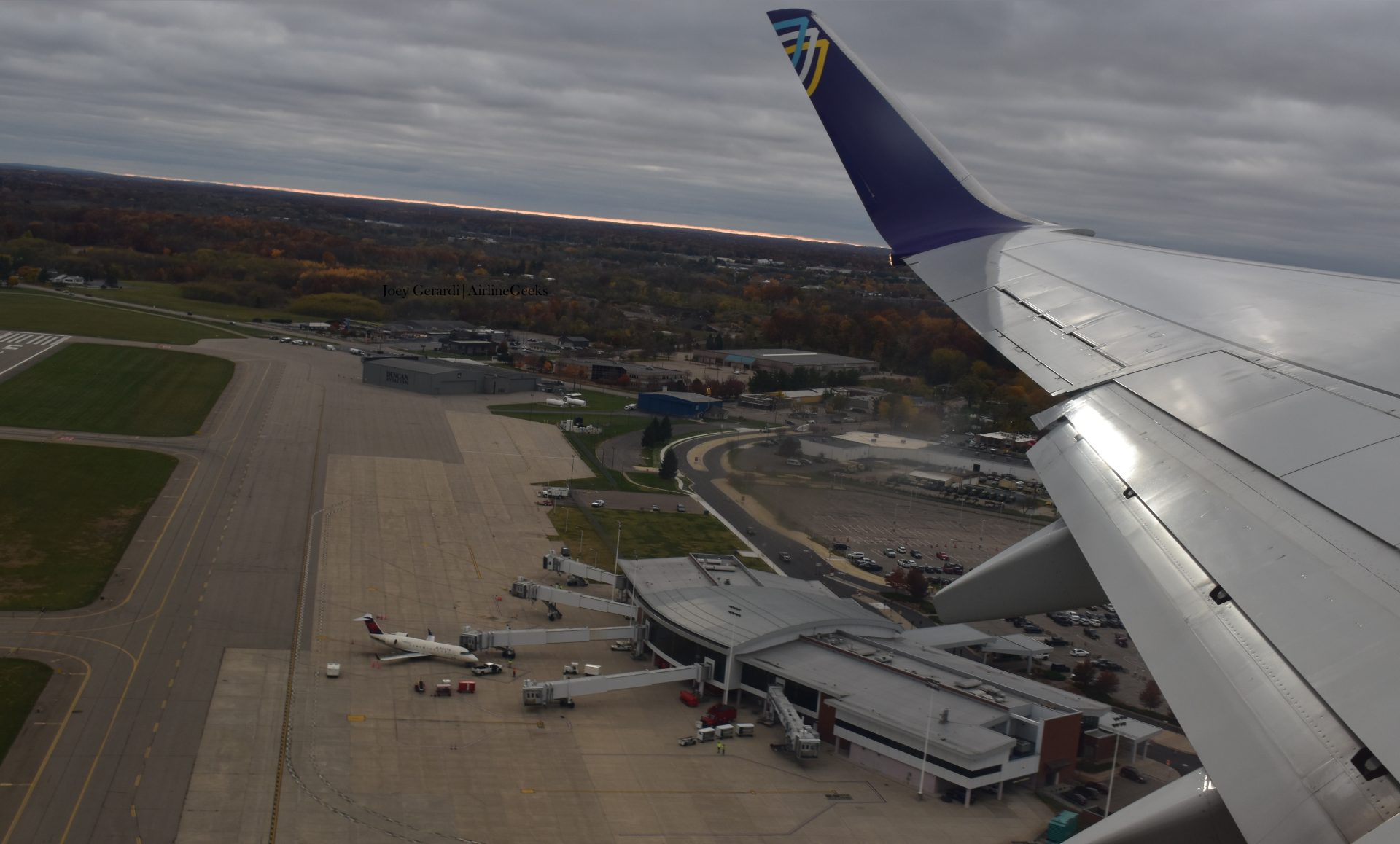
We then pushed back from the gate two minutes ahead of schedule at 4:38 P.M. My seat, 25A had two windows due to the alignment of the seats. Passengers on the left side of the plane got a perfect view of the terminal below as we took to the skies out of Kalamazoo.
Kalamazoo/Battle Creek Intl. from above (Photo: AirlineGeeks | Joey Gerardi)
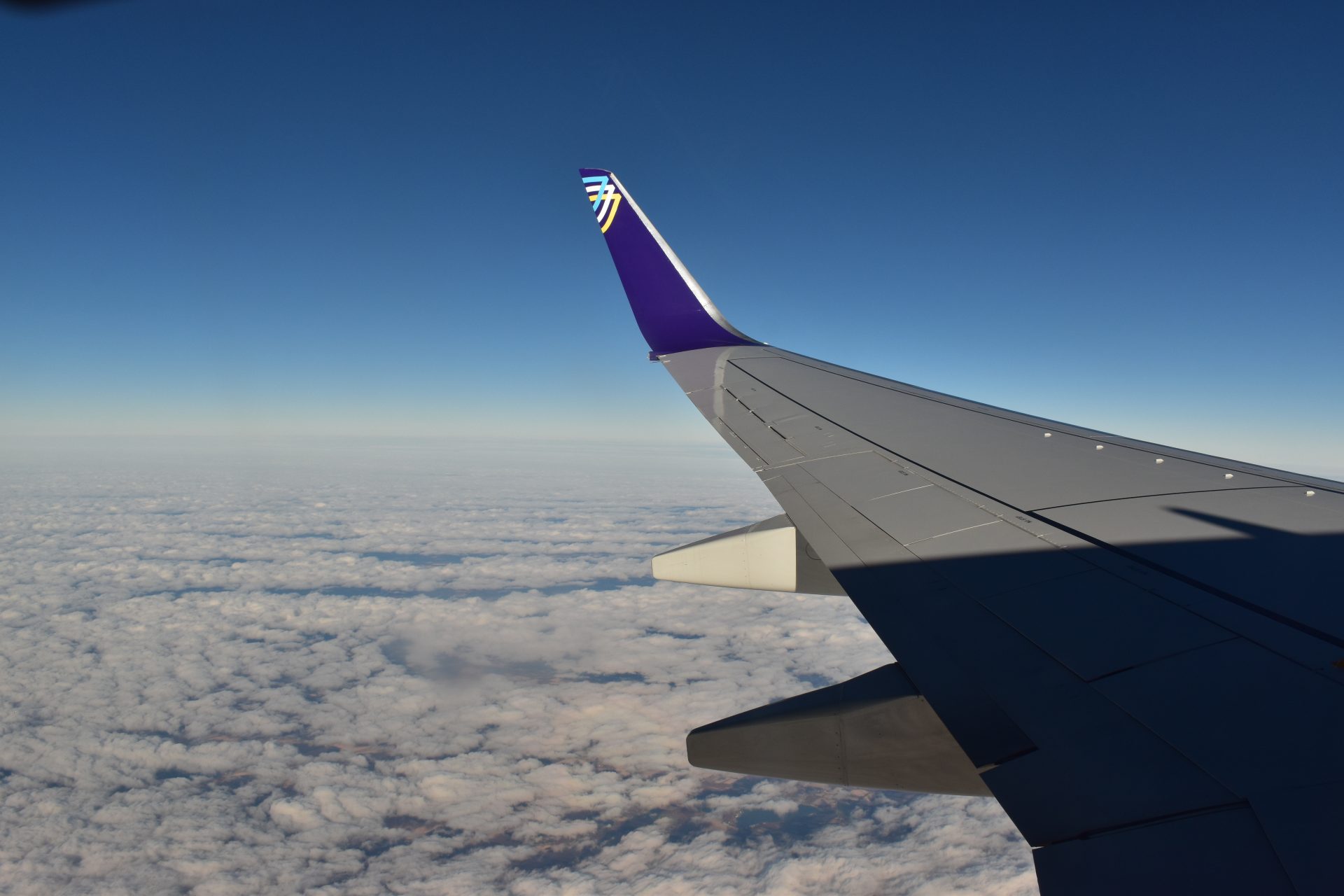
We quickly climbed up to our cruise altitude of 39,000 feet and began to make our way down to Orlando. As this is an Ultra Low-Cost Carrier or ULCC for short, you need to plan on bringing something to do for the over two-hour flight as there is no in-flight entertainment system, no WiFi, and once the flight departure switches to 9P.M., not even any daylight to see stuff out the window.
Climbing up to our cruising altitude (Photo: AirlineGeeks | Joey Gerardi)
I spent most of my time during the flight either looking out of the window or watching my seatmate play games on her phone. At one point during the flight, the person in the aisle and me were watching the person in the middle play games, it was pretty entertaining and she seemed to enjoy the audience.
At our cruising altitude of 39,000 feet (Photo: AirlineGeeks | Joey Gerardi)
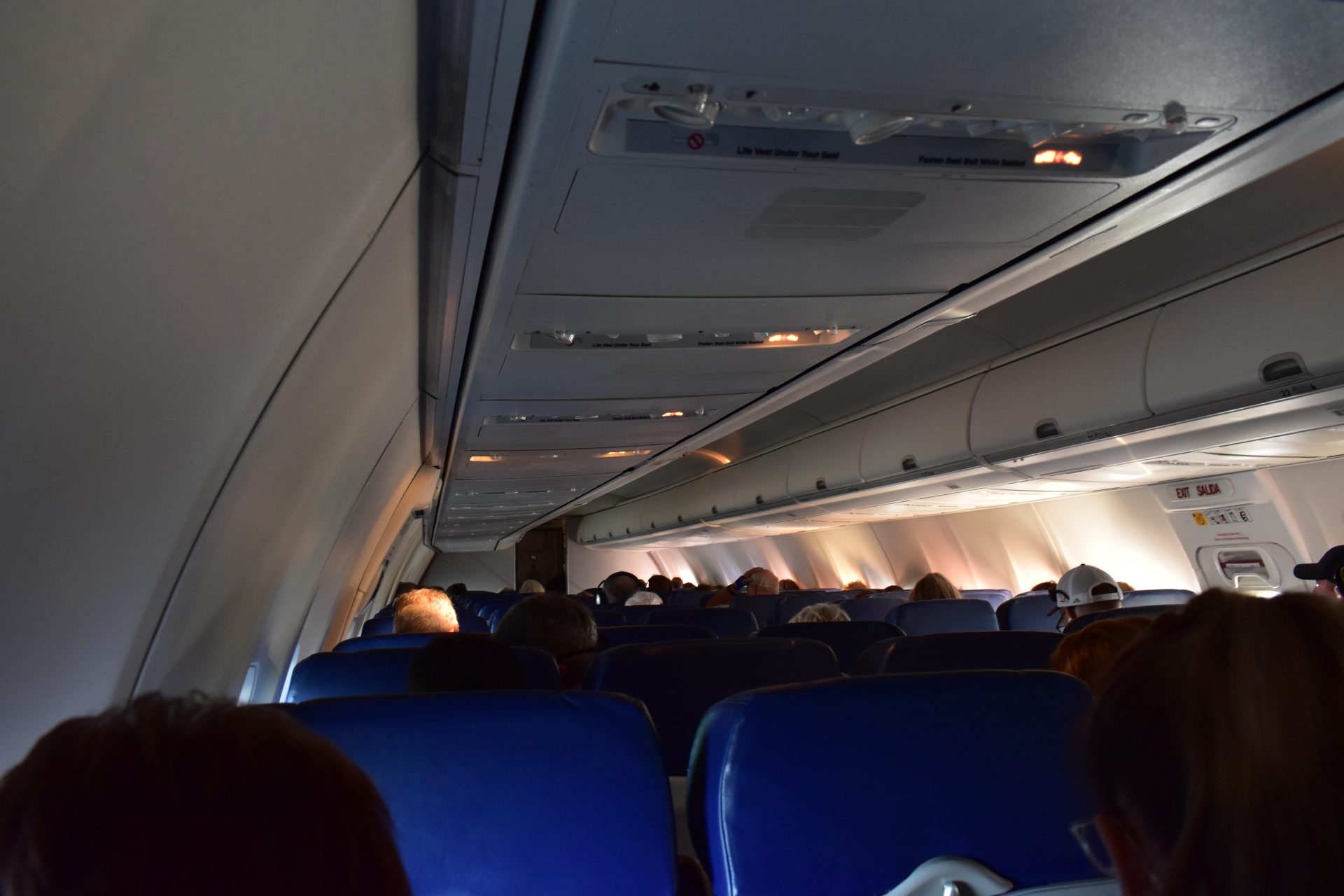
In terms of the seat, it was comfortable enough although I wouldn’t want to sit in it for more than a couple of hours. There was a button on the armrest for reclining but it was disabled on all of the seats. No outlets are expected, so if your device loses power quickly and you plan on using it the entire flight you’ll have to bring an external charger for it. Leg room was decent for a ULCC, and wasn’t much less than regular full-service airlines such as Delta, and this is even with a backpack at my feet.
Without the outlets, there was no bulky box under the seats which made more room for a slightly larger bag under the seat. The tray table was much larger than I expected and could fit a small laptop unlike the tables on other ULCC, which usually are only the size of a smartphone. The cabin was ‘Southwest-esq’, and the seat colors reminded me of a Southwest plane, although they probably added more seats since the plane now belongs to a ULCC.
The cabin of the plane from my seat (Photo: AirlineGeeks | Joey Gerardi)
As we went further south I realized something, they didn’t do service, at all for the entire flight. The same flight attendant walked to the front of the cabin and stayed there for around 30-minutes, then went to the back and stayed there for 30-minutes, and that pattern repeated throughout the entire flight. Being it’s a ULCC, I understand that they didn’t have snacks and drinks like a full-service airline, but I was surprised they didn’t try to sell passengers anything like similar ULCCs like Frontier or Allegiant. So it would also be a smart idea to have a refillable water bottle and some snacks packed in your bag if you think you’ll get hungry.
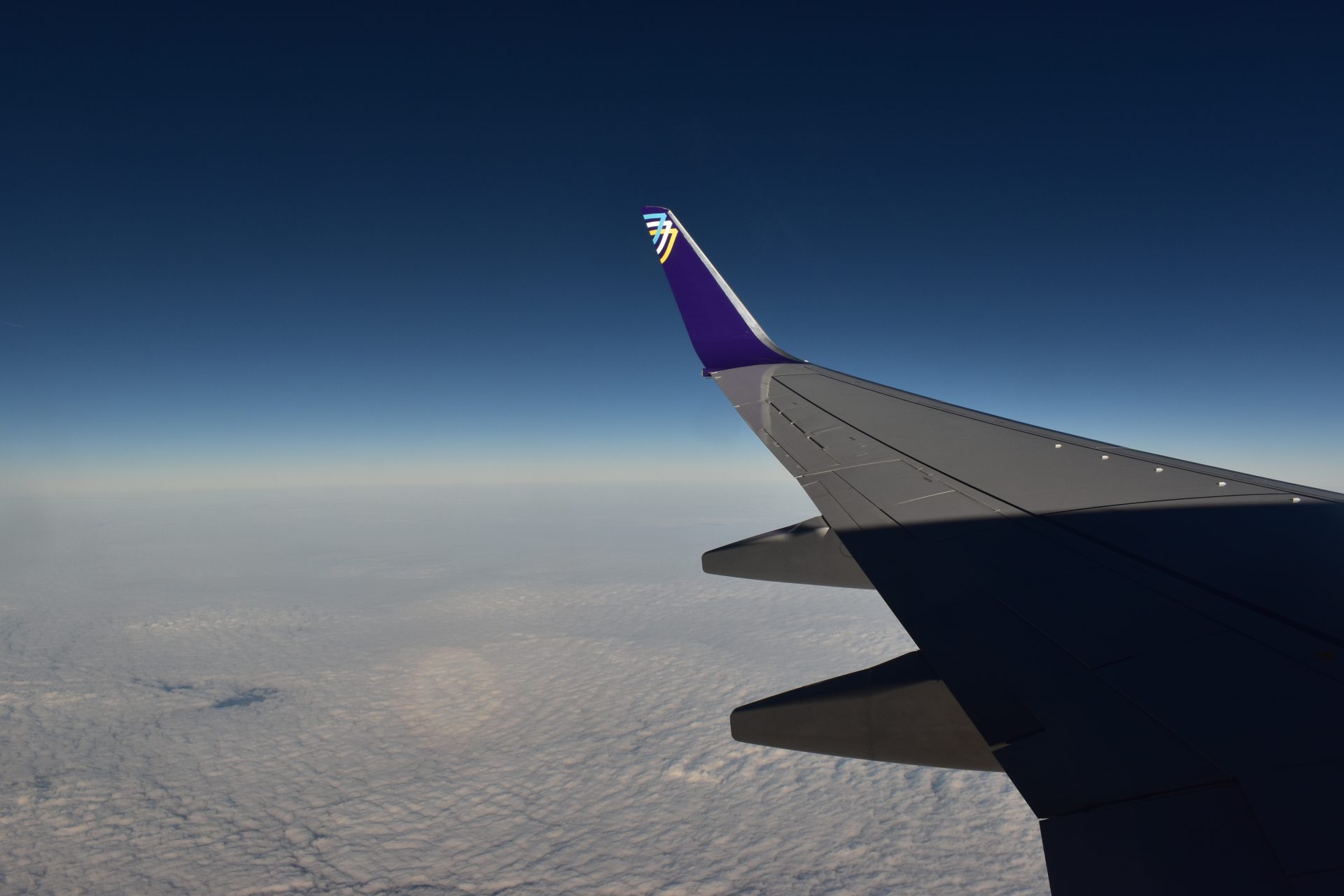
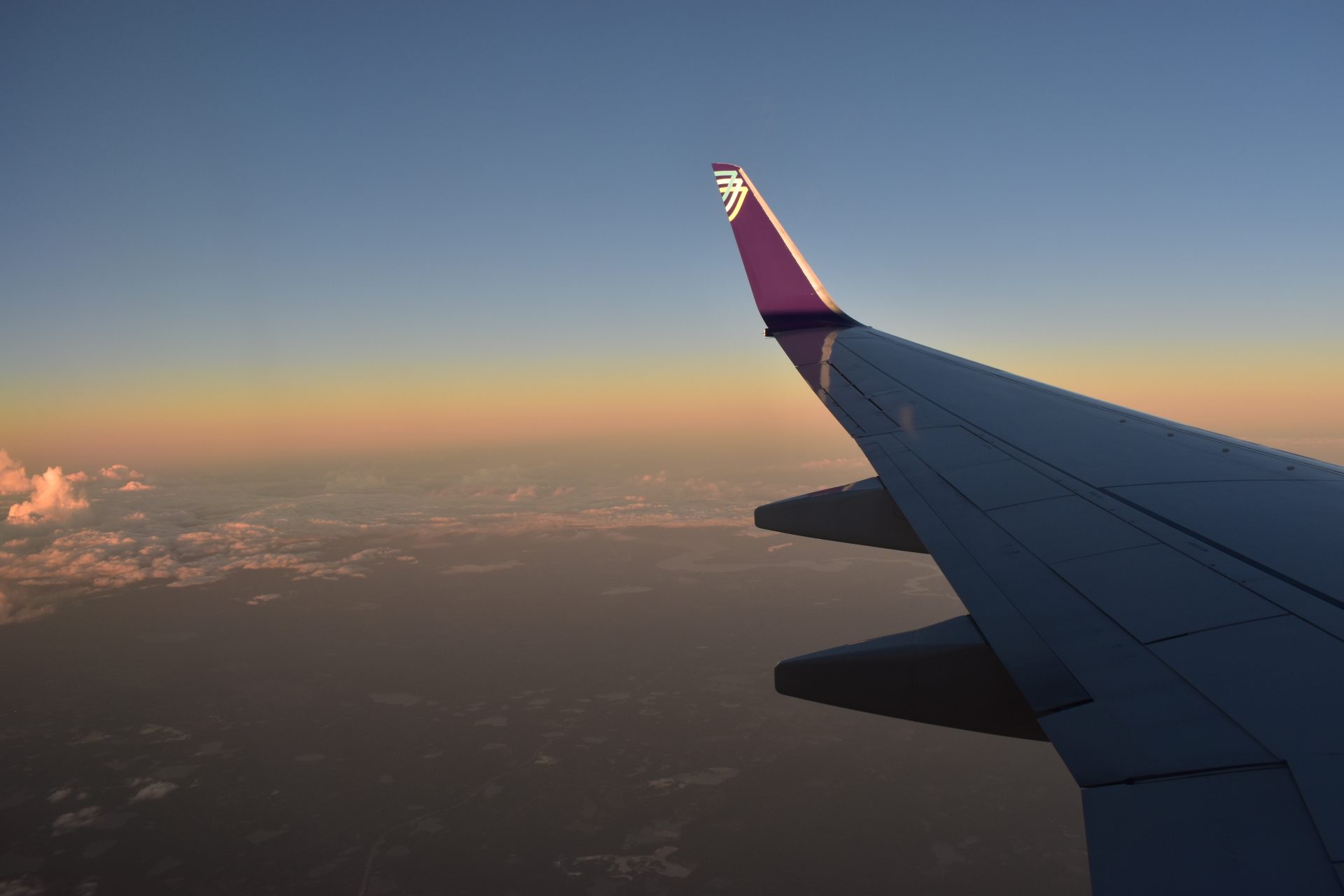
The closer we got to Florida, the further up the wing the shadow went meaning the sun was setting further. With this came some wonderfully colored skies, pink blues and yellows that made the sky look more like a painting than real life.
The sun setting en route to Florida (Photo: AirlineGeeks | Joey Gerardi)
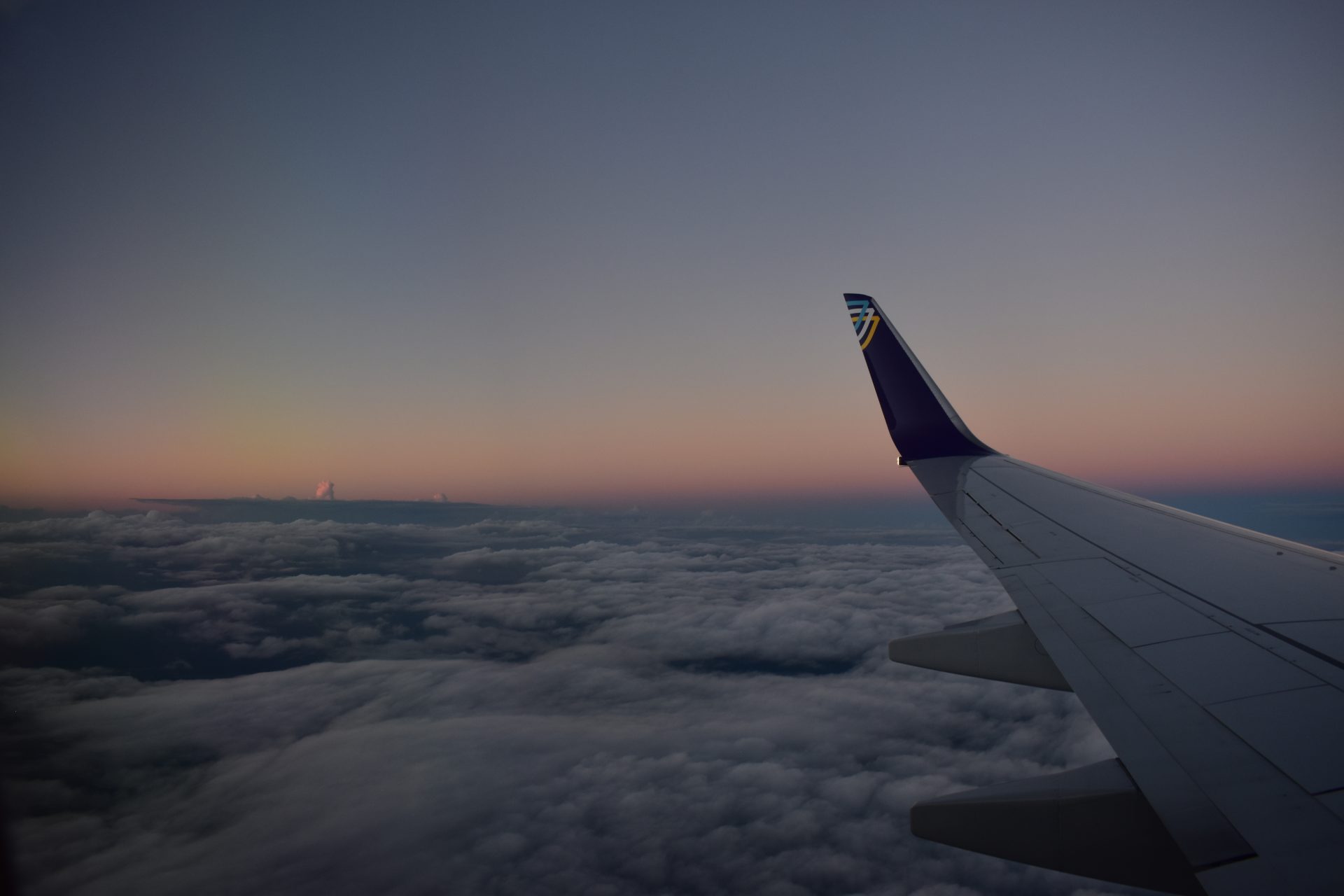
We then began our descent into Florida as the sun set further and the sky turned a dark purple. The pilots came on and told us about the weather in Orlando and the flight attendants came around to collect garbage.
The skies turned dark purple as we began our descent (Photo: AirlineGeeks | Joey Gerardi)
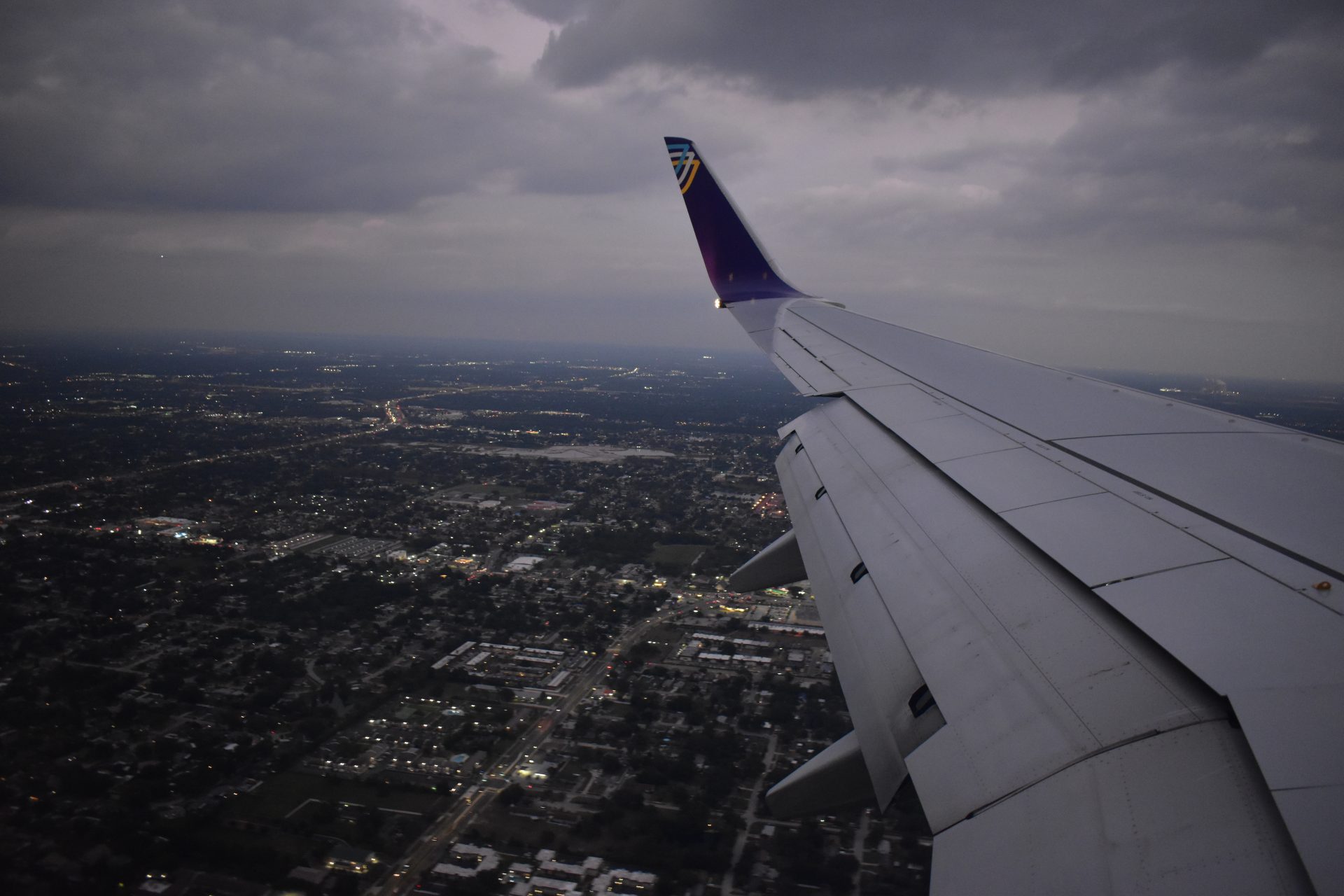
As we got closer to the ground the lights began to turn on as we went into nighttime, the purple winglet went nicely with the gray clouds and the setting sun.
On approach to Orlando Intl. (Photo: AirlineGeeks | Joey Gerardi)
We touched down at Orlando Intl. at exactly 7 P.M., after two hours and 11-minutes of flying time from Kalamazoo.
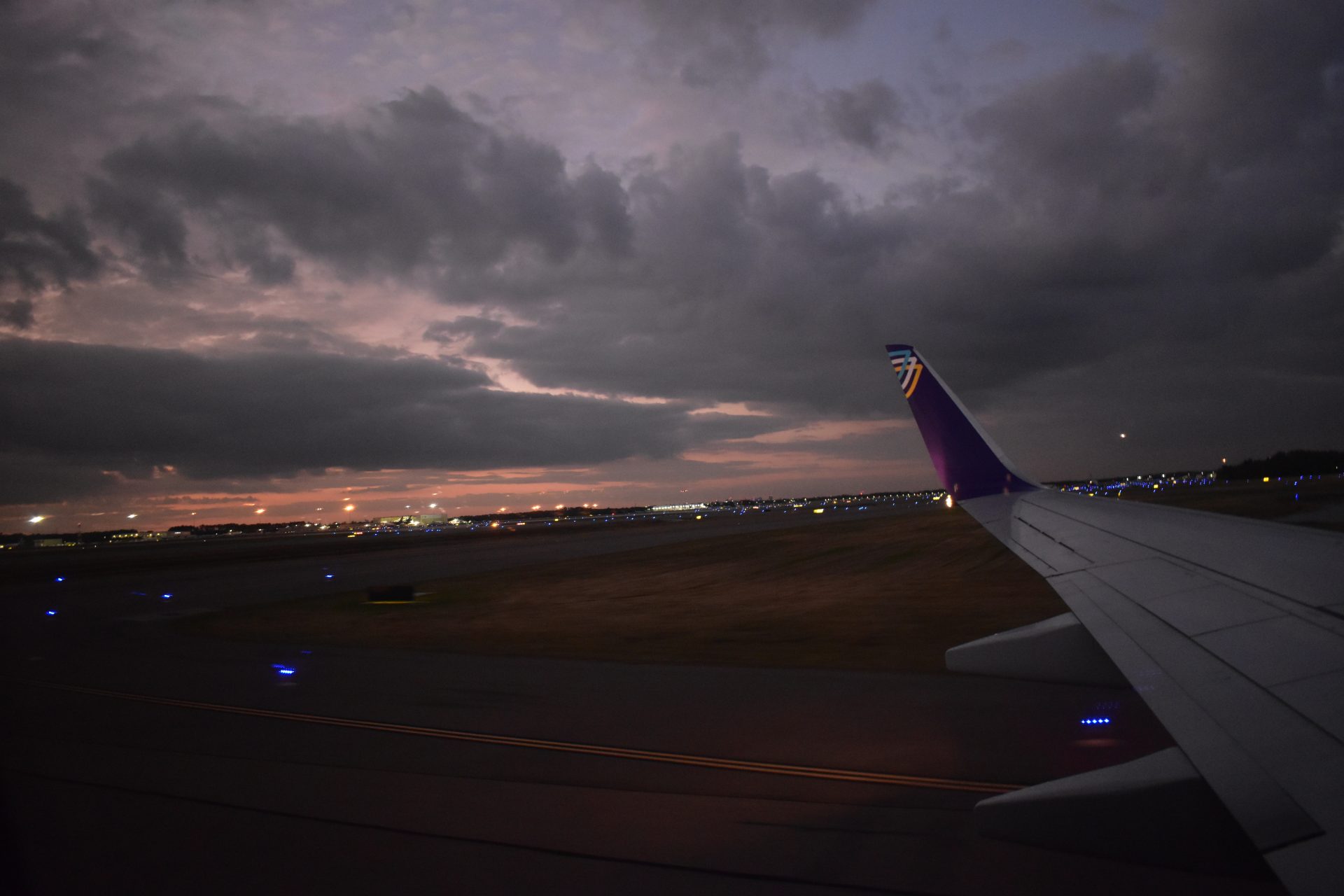
Just after arriving at Orlando Intl. (Photo: AirlineGeeks | Joey Gerardi)
After landing we then taxied to and parked at Southwest’s gate area, only fitting as the aircraft we were on was a former Southwest aircraft and has most likely been there in its past operator’s life.
Thoughts
The service was definitely convenient going from a small local airport to a major leisure destination like Orlando and it beats having to connect once or even twice at an intermediate hub for hours. Despite being a ULCC, I was surprised they didn’t have any service as I know people who have been on flights with the airline before and every person I’ve talked to said they gave out at least a small water bottle, especially on inaugural flights.
The inaugural party in Kalamazoo (Photo: AirlineGeeks | Joey Gerardi)
I am overjoyed with the massive celebration and party the Kalamazoo Airport put on before departure and for the arrival into Kalamazoo and they did a great job with its setup and execution. I am disappointed that the airline itself didn’t do anything on board as they have for past inaugural flights of theirs. Also, a little disappointed Orlando didn’t do anything for the first arrival, although for them it wasn’t a huge deal as it was just another city they served among the hundreds they already fly to. Everything celebration-wise in Kalamazoo was arranged and set up by the airport, nothing was the airline except for the short speech the marketing director gave before boarding and the short minute-long announcement the pilot made on board.
The lead-in by the two WMU Cirrus SR20’s was a unique touch as the university has such a huge influence in the Kalamazoo area. I’m glad the airline doesn’t charge for boarding pass printing as they are a nice memento for any AvGeek, especially anyone on an inaugural flight. Despite it being the first flight and the ground crew still training, everything went smoothly in Kalamazoo and the flight arrived early and departed on time.
Avelo Air was a new airline for me, and I would definitely fly on them again if I needed to as it was simple, easy, and it got me there. This was the second inaugural flight out of four that I will be on before the year is over, and I hope the others are as much fun as this one, and hopefully even more.
A video account of this trip report can be found below.
Joey has always been interested in planes for as long as he can remember. He grew up in Central New York during the early 2000s when US Airways Express turboprops ruled the skies. Being from a non-aviation family made it harder for him to be around planes and would only spend about three hours a month at the airport. He was so excited when he could drive by himself, the first thing he did with his driver's license was get ice cream and go plane spotting for the entire day. He graduated from Western Michigan University in 2022 with a B.S. in Aviation Management & Operations and a Minor in Business, and currently works for a major airline in his hometown.
A mock-up design of Starlux's A350 jets (Photo: Airbus)
At the Airbus headquarters in Toulouse, France, STARLUX Airlines (SJX) received its first A350-900 today. The delivery ceremony was presided over by STARLUX Airlines Chairman K.W. Chang and CEO Glenn Chai, who were both delighted to celebrate the new accomplishment. Chang traveled to Toulouse to take part in the delivery process and personally fly the brand-new A350-900 (B-58501 Callsign) back to Taiwan. On October 29 at 15:30 local time, the plane is expected to touch down at Taiwan Taoyuan International Airport.
“This delivery is a milestone for STARLUX Airlines. The A350-900 is our first large widebody aircraft, which will allow STARLUX to open markets for longer routes, and this also marks the next step in our partnership with Airbus, with 17 more A350s deliveries in the future. With the addition of the A350-900, the STARLUX fleet now can cover short, mid, and long-range flights, providing service to passengers outside Asia,” said STARLUX Chairman.
The B-58501 is the first of the 18 A350s that STARLUX has ordered, and it will be put into service in January 2023 following the necessary approvals and crew training. Another A350-900 will be added to the fleet this year. The A350-900 will begin operations to Los Angeles in April 2023 after initially serving major cities in the Asia-Pacific area.
Details on STARLUX’s A350s
The largest of Rolls-famed Royce’s Trent series and the most effective large aero engine currently in service, the Trent XWB engines are used to power the A350-900. The engine is uniquely developed and tuned for the Airbus A350 family, which helps the aircraft’s entire noise footprint be reduced and results in a 25% gain in fuel efficiency. The airline has strengthened its relationship with Rolls-Royce by signing a long-term TotalCare servicing deal for all A350 aircraft equipped with the jet engine manufacturer, similar to the agreement it already has for its fleet of A330neos.
STARLUX’s A350 is the first A350 to offer First Class around the world. The new A350-900 for STARLUX has a cabin that is 4 inches wider and 35 inches longer than other A350s currently in operation, providing extra space for passengers in all classes as well as larger galleys for the cabin crew. The aircraft also has the most recent electrically dimmable windows, blocking 99.99% of visible light and switching twice as quickly as the previous version.
STARLUX’s aircraft is the very first A350 to put these new windows into service. Moreover, STARLUX is also the first airline to install dynamic secant luminous panels on an A350. At two gateways and the very end of Business Class, there are three motion panels that display various ceramic shapes with leaves elongating to help passengers feel at home. The STARLUX cabins can be configured with ambient lighting depending on the stage of the flight because the A350-900 will fly long-distance routes.
Four seats are available in First Class, 26 in Business Class, 36 in Premium Economy Class, and 240 in Economy Class on the premium four-class aircraft.
The 60-inch door wall used in First Class suites allows for a private space for each guest on board. To store luggage, a personal wardrobe is available.
A 48-inch door and a warm lamp can be found on the Business Class seats. Both First and Business Class seats can be converted into fully lie-flat beds, and they also include a “zero gravity” feature to provide further comfort and relaxation.
A leg rest and footrest bar have been added to the specifically built Premium Economy Class seats. Each seat’s thickness has been decreased to prevent leg numbness in Economy Class, and it has been reconfigured with a distinctive S-shape to allow for additional legroom.
The onboard entertainment of the A350 has been enhanced. Each seat in First Class features a 32-inch 4K screen, while Business Class passengers may enjoy a 4K resolution on a 24-inch screen. With a 15.6-inch or a 13-inch screen, respectively, travelers in Premium Economy Class and Economy Class may also enjoy 4K resolution.
STARLUX collaborated with Airbus and a production crew to use Airbus test flights as an opportunity to capture an air-to-air video of all three models in flight in order to celebrate both the addition of the third Airbus flight model to its fleet and the delivery of the first A350-900 to STARLUX. In recent years, only STARLUX has completed a formation flight with all three of its Airbus models, the A321neo, A330neo, and A350.
Views by Top Aviation Executives
Christian Scherer, Airbus Chief Commercial Officer and Head of Airbus International said: “With an all-new generation, all-Airbus fleet, STARLUX is bringing new levels of comfort and efficiency to the premium market. As the flagship aircraft in this fleet, the A350-900 will carry the airline’s brand on its longest routes as it opens up to new markets. We wish the airline every success as it spreads its wings to more destinations across the world.”
Ewen McDonald, Chief Customer Officer, Rolls-Royce Civil Aerospace, said: “We would like to congratulate STARLUX on taking delivery of their first A350 passenger aircraft, which is powered by Rolls-Royce Trent XWB-84 engines. This delivery builds on our partnership with STARLUX who earlier this year took delivery of their first A330neo, which is also powered by our Trent 7000 engines. We look forward to further supporting STARLUX to maximize its fleet performance and achieve operational excellence. We thank STARLUX for their trust in Rolls-Royce, and we will continue our commitment to providing reliable power and world-class service to help STARLUX fly higher and further.”
STARLUX’s Future Plans
The Airbus A350-delivery 900’s has marked the beginning of a new phase for STARLUX. After tomorrow’s expected delivery of A321neo B58211, STARLUX will have eleven A321neos, four A330neos, and one A350-900. As STARLUX is ready to start service to markets outside of Asia, another delivery of two A321neos and an extra A350-900 will be made by the end of the year, increasing the company’s capacity. As more aircraft are prepared for delivery and the Taiwanese border reopens, STARLUX will be able to serve more passengers in style and expand its network with the highest effectiveness.
Kalai has always wanted to work in the aviation industry, having been fascinated by its inner workings since he was a child. In pursuit of his dream, he obtained a diploma in aviation management and is currently interning with a low-cost airline, under in-flight policies. In his free time, he loves to engage in recreational activities, and watch sports. In the upcoming years, Kalai intends to pursue his degree at a business school before working as an executive for a global airline around the world.
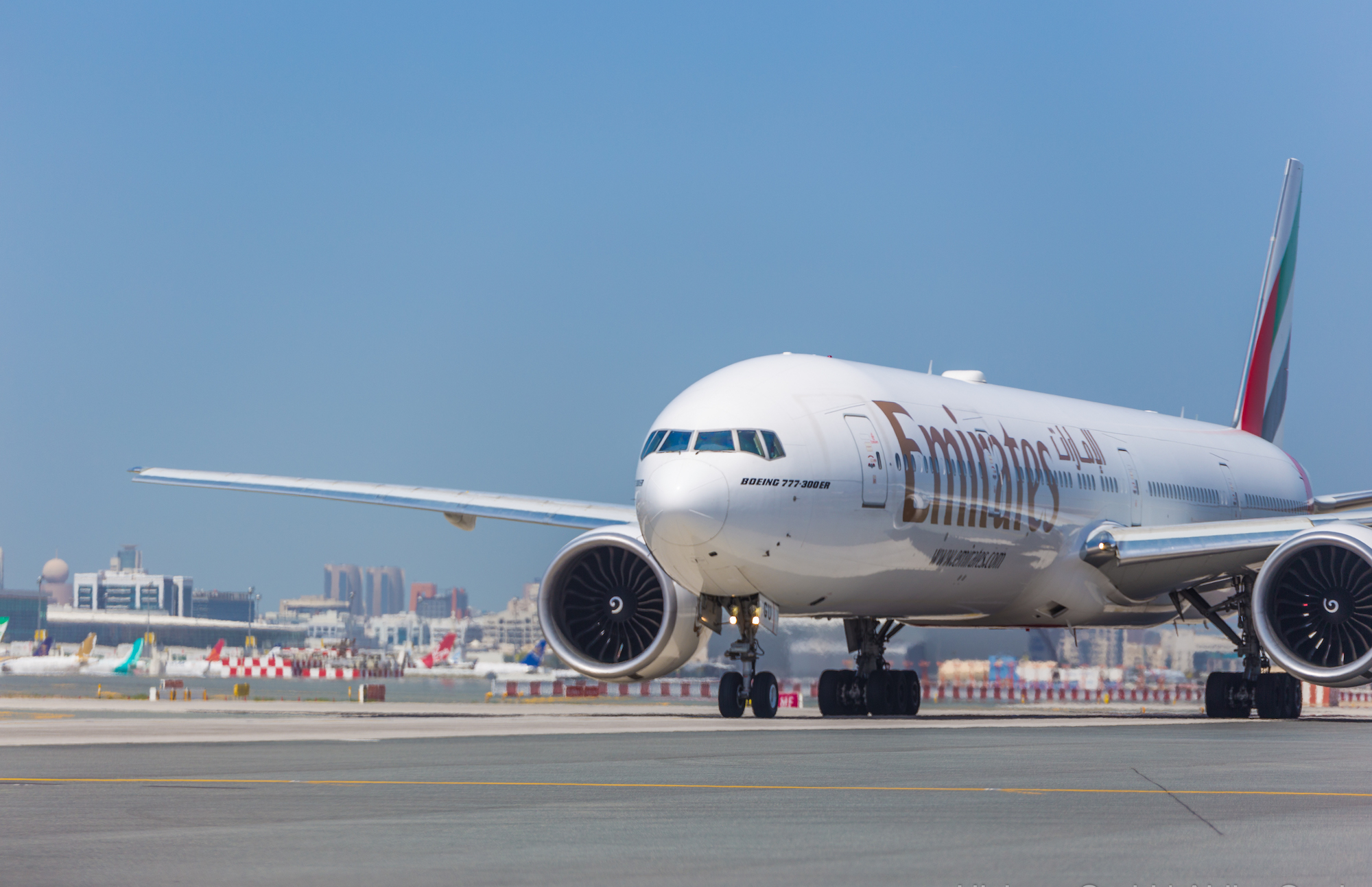
An Emirates 777-300ER in Dubai (Photo: AirlineGeeks | Hisham Qadri)
As we start a return to normalcy after lockdowns and travel restrictions due to COVID-19, travel isn’t what we expected. Business travel is still returning but leisure travel is returning in full force, often in greater numbers than before the pandemic.
Many leisure travelers are also becoming premium travelers resulting in unprecedented business and first-class loads across airlines are boosted by leisure travelers spending more for better travel experiences.
Emirates is seeing a lot of this across their global network and this is giving the airline reason to increase frequency or up-gauge the aircraft flying on certain routes. This is particularly true for flights to Asia.
Growth in Asia
Taiwan is reopening to the world soon following the termination of mandatory COVID-19 quarantine restrictions for arrivals. Emirates is planning daily service between Taipei and Dubai using Boeing 777 aircraft shortly after the restrictions are lifted, this is an increase in flights from the current four weekly flights. It’s expected that the end of the COVID restrictions will result in a significant increase in travel to Taipei and will also increase connectivity from Dubai for Emirates passengers.
Prior to COVID Emirates regularly flew an Airbus A380 in a two-class configuration to the Asian city. It’s likely that demand may be sufficient enough to start seeing the A380 heading to Taipei again from Dubai.
In addition to Taiwan reopening borders, Japan is set to remove daily arrival caps and mandatory COVID-19 testing and quarantine rules for arriving passengers.
Emirates has seen a significant spike in bookings for flights to Narita and Osaka from Dubai, this has resulted in an up-gauge of the aircraft used to service Japan’s Narita airport.
A380 on More Routes
The airline will reintroduce the A380 on their flights to Narita as a way to quickly provide more capacity to the high-demand location. Osaka will see daily service operated by Boeing 777 aircraft.
India is seeing some of the A380 love as well. Emirates flies to Bengaluru from Dubai three times a day using B777s. Starting on October 30, Emirates will replace one of those B777s with an A380. This will result in daily service with the A380 supplemented by two additional flights using B777 aircraft, an overall capacity increase.
This will make Bengaluru the first South Indian city to be served by an Emirates A380 and the second Indian destination for the Emirates A380 after Mumbai.
The airline has been accelerating the deployment of its flagship A380 aircraft across the world, currently the A380 flies to 30 destinations with more to be announced in the future. Emirates is planning on deploying the A380 to over 40 destinations by March 2023.
Cabin Refurbishments
During this expansion, Emirates is also planning on spending $2 billion to refresh airline cabins. AirlineGeeks recently had the opportunity to speak to Essa Sulaiman Ahmad, Emirates’ Divisional Vice President, USA and Canada about this refresh and what it means for the fleet.
Emirates will be retrofitting the interiors of 67 A380s and 53 B777s at a rate of one aircraft rolling out into service every 16 days.
The update will involve 5,092 A380 business class seats and 1,702 B777 business class seats along with their respective cabins. This goes from re-upholstered seats, new paneling, upgraded carpets, stairs, and flooring. All will be updated to reflect the new tones and design motives Emirates is prioritizing for this generation of seats.
Seven hundred and forty-eight first-class seats on the A380 and 272 first-class seats on the B777 are also due for upgrades. This means new leather, updated armrests, new paneling, flooring, and other design features. The fully enclosed suites found on a subset of aircraft will not be put on additional aircraft but many look and feel aspects of these seats will be incorporated in first-class cabins across the fleet as part of the retrofit program.
This retrofit will also extend the service life of some of Emirates’ existing aircraft according to Essa. This is an additional way the airline plans on coping with delays to the Boeing B777X program for which Emirates is a launch customer.
Menu Enhancements
Additionally, the airline is revamping menus in first class and offering unlimited portions of caviar for first-class passengers. It has also entered into an exclusive deal to serve Dom Perignon on flights, the reason behind Singapore Airlines dropping the champagne from their first-class offerings.
The airline is also investing millions of dollars into the development of vegan choices for passengers in all cabins. It has influences from Chinese, Indian, and Arabic cuisines and will be available for pre-order. New vegan offerings will also be expanded into Emirates lounges. A significant portion of these plant-based offerings will be sourced through Bustanica, the world’s largest hydroponic farm located just miles away from Emirates Flight Catering in Dubai.
Some of the example meals available:
Creamy Spinach & Avocado Mousseline with marinated tofu, blanched snow peas, radish, asparagus, pomegranate seeds, courgetti ribbon and sriracha oil
Multicolored Quinoa with caramelized pear and celeriac puree, roasted cauliflower, glazed carrots, sauteed kale and lovage pesto
Barley Risotto with Mushrooms served with sundried tomatoes, buttered chestnuts, blanched broccolini and toasted pumpkin seeds
Dark Chocolate Custard Cake with strawberries
Lemon Tart with coconut cream
Chocolate tofu cheesecake with strawberry compote
The menu items are imaginative and actually highlight vegetables instead of just using things like plant-based meat to duplicate meat-based dishes. Usually, vegan meals on flights are incredibly boring so it’s refreshing to see genuinely imaginative dishes available for people with dietary restrictions that are on the same level as normally catered dishes.
Emirates is putting its best foot forward as the world recovers from the COVID-19 lockdowns. From increased frequencies and larger aircraft to a completely refreshed fleet Emirates has big plans as it aims to go beyond where the airline was in 2019.
Hemal took his first flight at four years old and has been an avgeek since then. When he isn't working as an analyst he's frequently found outside watching planes fly overhead or flying in them. His favorite plane is the 747-8i which Lufthansa thankfully flies to EWR allowing for some great spotting. He firmly believes that the best way to fly between JFK and BOS is via DFW and is always willing to go for that extra elite qualifying mile. Hemal's opinions are his own and do not reflect those of his employer.
How Qatar Airways is Embracing the FIFA World Cup Onboard
Qatar Airways B777 in FIFA Livery (Photo: Qatar Airways)
Qatar Airways is in the process of fully incorporating and highlighting the 2022 FIFA World Cup into its in-flight services. The 2022 FIFA World Cup will be held in Qatar starting next month.
Passengers will see planes in a special FIFA livery and will be able to stream many of the games directly on their flights. In addition, there will be limited edition amenity kits, football jersey-styled loungewear and more for FIFA fans traveling on Qatar Airways.
Most importantly though, Qatar Airways is introduced special FIFA-themed menu items that feature a variety of meal and snack options including typical game day snacks like burgers and chicken wings along with the standard types of dishes offered on Qatar Airways.
AirlineGeeks had the opportunity to sample a few of these dishes and discuss the inspiration behind some of these dishes with Mary-Jane Bonnaud, Qatar Airways’ Culinary Development Manager.
Things started off with an amuse-bouche of lobster cocktail with poached prawn topped with caviar.
Poached Prawn Topped With Caviar (Photo: AirlineGeeks | Hemal Gosai)
This was followed by a wholesome soup, corn and jalapeno soup topped with Crème Fraiche.
Things got better when the sampler was brought out.
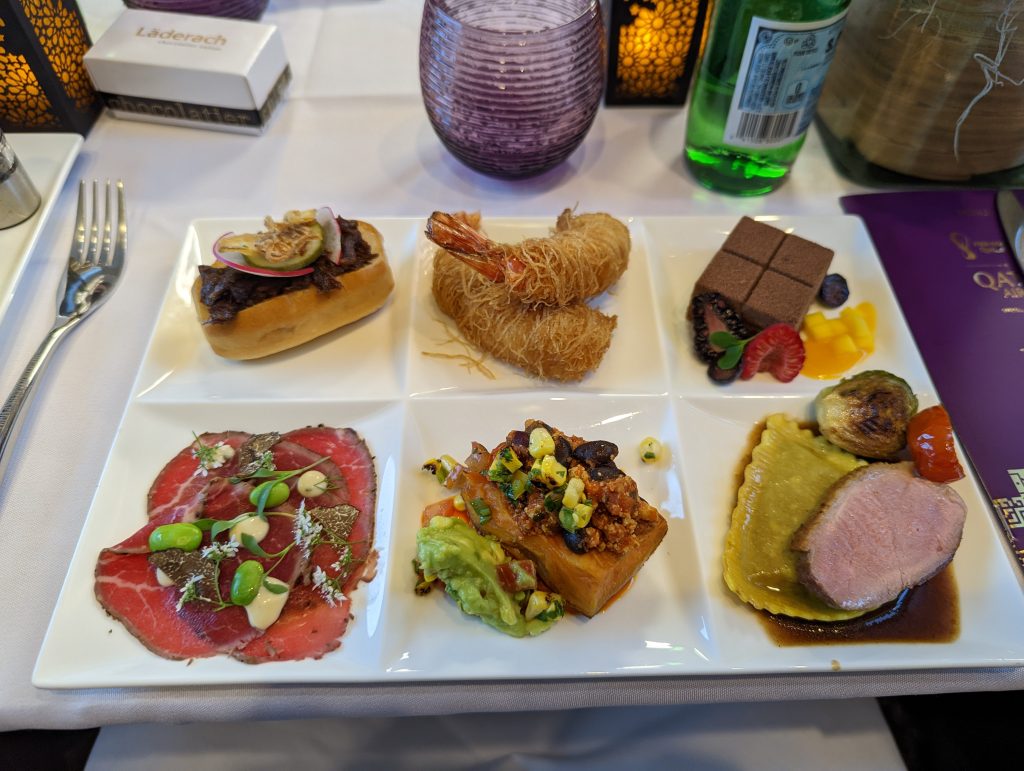
Qatar Airways Menu Sampler (Photo: AirlineGeeks | Hemal Gosai)
Top Row Left to Right:
A play on a hotdog with sliced beef with radish, fried onions, and pickles – part of the FIFA menu
Fried shrimp in vermicelli noodles -part of the FIFA menu
A chocolate mousse cake with berries and mango
Bottom Row Left to Right:
Beef carpaccio with black winter truffles
Roasted sweet potato with corn and smashed avocado
Duck ravioli with slice duck breast, roasted brussels sprouts, and tomato
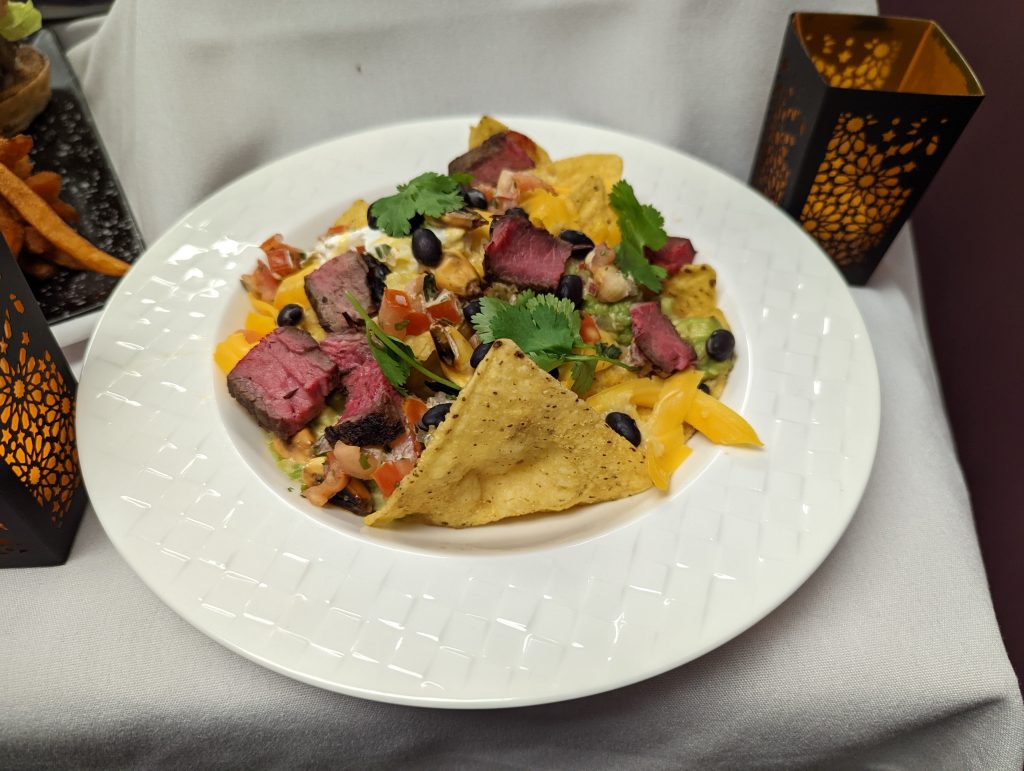
A lot of the FIFA menu items are specifically geared around snack foods that people would typically have while watching sporting events. Below is how the steak nachos would look if served on a Qatar Airways flight departing the U.S.
Qatar Airways FIFA Steak Nachos (Photo: AirlineGeeks | Hemal Gosai)
Things got fun with the burger. The exact type of burger will vary based on the route. On flights from the United States there will be a burger with the typical fixings of an American cheeseburger.
Flights from Australia, for example, will have uniquely Australian fixings like beetroot on their burgers.
Qatar Airways FIFA American Burger (Photo: AirlineGeeks | Hemal Gosai)
Catering Partners
Qatar Airways primarily uses Do&Co for catering in the United States where available, alternatively, Gate Gourmet and Sky Chefs are used. Do&Co has a reputation within the industry as being one of the better caterers, however, Qatar Airways’ culinary director has assured AirlineGeeks that the offerings will be consistent across all North American departures in terms of taste, appearance and quality.
Airline catering is something that’s frequently overlooked so it’s always refreshing to see airlines take a fun approach to cater flights. Airline catering kitchens clearly have the capability to make good food as evidenced by airlines like Qatar Airways and Turkish Airlines. It is just a matter of the airline caring enough to make the necessary investments to offer good food on flights for its passengers.
Hemal took his first flight at four years old and has been an avgeek since then. When he isn't working as an analyst he's frequently found outside watching planes fly overhead or flying in them. His favorite plane is the 747-8i which Lufthansa thankfully flies to EWR allowing for some great spotting. He firmly believes that the best way to fly between JFK and BOS is via DFW and is always willing to go for that extra elite qualifying mile. Hemal's opinions are his own and do not reflect those of his employer.
IAG Confirms Order for Boeing 737s and Options for Additional Aircraft
A British Airways 737 MAX in storage on the ramp.
(Photo: AirlineGeeks | Katie Bailey)
Shareholders of the International Airlines Group (IAG) have approved the consortium’s order for 50 Boeing 737 aircraft announced in May. Boeing has confirmed the order for the aircraft is now ‘firm’ and IAG will also have the option for 100 more. In IAG’s initial announcement which was given five months ago, it was noted that the order was for 25 Boeing 737-8-200 and 25 B737-10 aircraft with deliveries expected to begin in 2023.
Luis Gallego, IAG´s chief executive, said in May: “The addition of new Boeing 737s is an important part of IAG´s short-haul fleet renewal. These latest generation aircraft are more fuel efficient than those they will replace and in line with our commitment to achieving net zero carbon emissions by 2050.”
IAG comprises British Airways, Iberia, Vueling, Aer Lingus and LEVEL. The aircraft are expected to be utilized across all airlines for fleet replacement.
Boeing noted that IAG would be able to configure the B737-8 MAX 200 with up to 200 passengers, while the Boeing 737 MAX 10 could accommodate up to 230 passengers ‘in a single-class configuration and can fly up to 3,300 miles.’ Fuel efficiency for both aircraft is cited as ‘on average 14 percent more fuel-efficient than today’s most efficient Next-Generation 737s and 20 percent more efficient than the original Next-Generation 737s when they entered service.’
Ihssane Mounir, Boeing’s senior vice president of Commercial Sales and Marketing said, “We welcome today’s decision by IAG’s shareholders to approve a firm order for 50 737-8-200s and 737-10s, with options for 100 more, and we look forward to working with IAG on reintroducing the 737 into the Group’s fleets.”
The announcement comes a day after Boeing Chief Executive Dave Calhoun told CNBC he was confident that the company would get an extension to a deadline from the United States Congress on certifying the B737 MAX7 and B737 MAX 10 with the Federal Aviation Administration (FAA) under existing rules. Reuters reported that meeting the deadline or gaining an extension would be crucial for the aircraft manufacturer to avoid significant delays in delivery to airline customers.
Boeing is confident that the 737 MAX 7 would be certified by year’s end or in 2023 and that the 737 MAX 10 would begin FAA certification flight testing later this year or in 2023. If FAA certification was granted, Boeing would expect the 737 MAX 10 to enter into service in 2023 or 2024.
Failure to meet the December deadline or gain an extension would require Boeing to ensure that the aircraft ‘must have modern cockpit alerting systems to be certified by the FAA.’ The United States Congress adopted these certification reforms after the two fatal MAX aircraft crashes in 2018 and 2019 involving Lion Air of Indonesia and Ethiopian Airlines.
John has always had a passion for aviation and through a career with Air New Zealand has gained a strong understanding of aviation operations and the strategic nature of the industry. During his career with the airline, John held multiple leadership roles and was involved in projects such as the introduction of both the 777-200 and -300 type aircraft and the development of the IFE for the 777-300. He was also part of a small team who created and published the internal communications magazines for Air New Zealand’s pilots, cabin crew and ground staff balancing a mix of corporate and social content.
John is educated to postgraduate level achieving a masters degree with Distinction in Airline and Airport Management. John has held the positions of course director of an undergraduate commercial pilot training programme at a leading London university. In addition he is contracted as an external instructor for IATA (International Air Transport Association) and has been a member of the Heathrow Community Fund’s ‘Communities for Tomorrow’ panel.
Sign-up for newsletters & special offers!
Get the latest stories & special offers delivered directly to your inbox