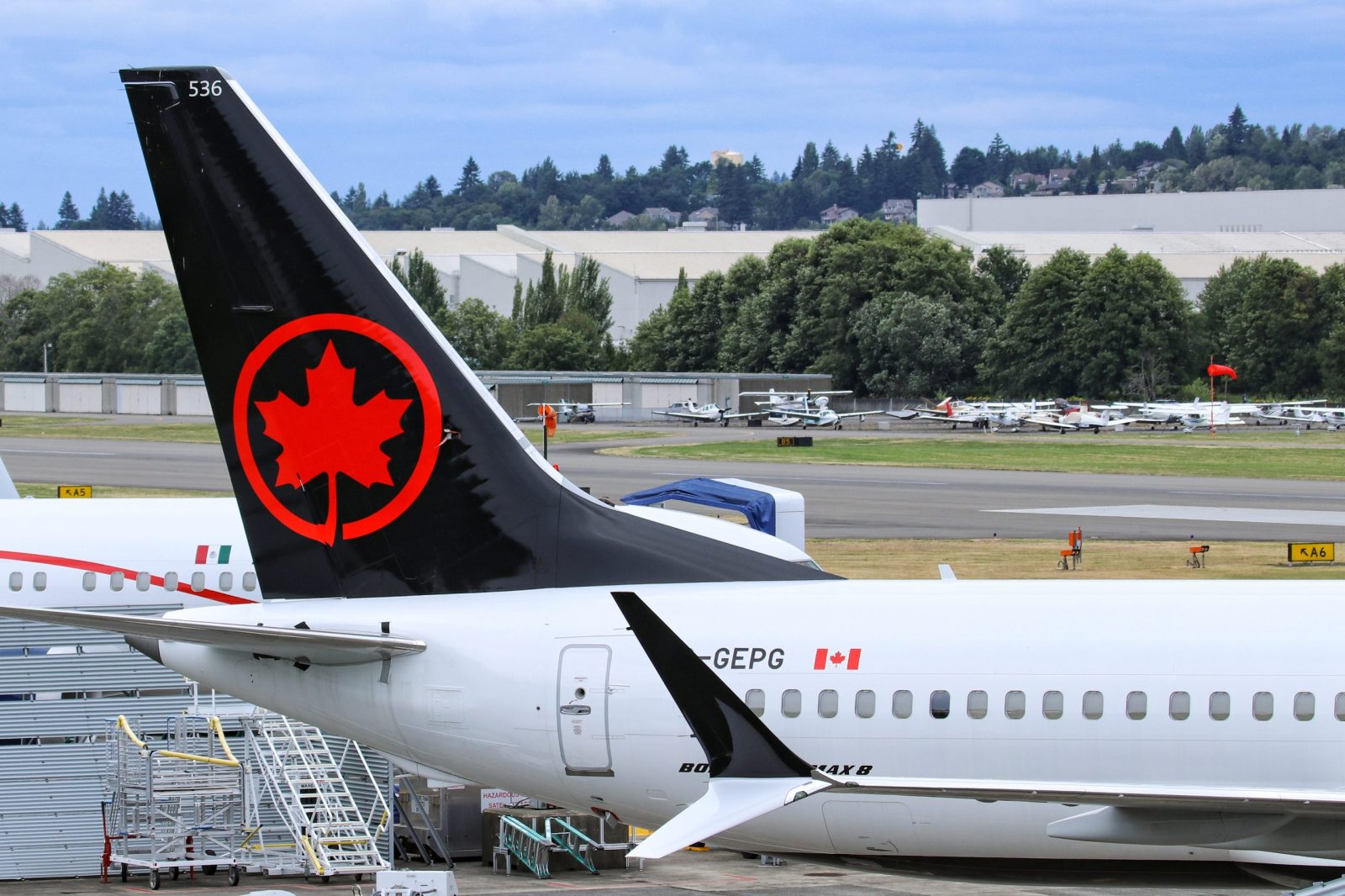
An Air Canada 737 MAX 8. (Photo: AirlineGeeks | Katie Zera)
Air Canada will resume operations between Toronto – Pearson (YYZ) and Panama City (PTY), after a two-and-a-half-year absence due to the pandemic. With the return of the Canadian airline, five North American carriers will offer service at Tocumen International Airport (PTY).
“The benefits of the return of Air Canada to Panama will be significant not only from the point of view of connectivity, but this important decision constitutes an additional means to promote tourism, trade, investment and cultural exchange between the two countries,” said Raffoul Arab, General Manager of Tocumen International Airport.
Flight Itinerary
Toronto – Panama City Flight AC 1874 YYZ 08:30 – PTY 14:05
Panama City – Toronto Flight AC 1875 PTY 15:05 – YYZ 20:35
Initially the route will offer two flights per week (Friday and Sunday); starting December 18, the company will increase its operations to three flights per week by adding an extra service on Wednesdays. This service will be operated by Air Canada Rouge in Airbus A319 aircraft with a capacity of 136 seats in two classes (12 Business Class/124 Economy).
According Tocumen Airport Statistics, 96,925 passengers were mobilized between Panama City (PTY) and Canada within January and September 2022.
Between January and September of this year, Tocumen International Airport has registered a traffic of 11.5 million passengers, through eighteen commercial airlines offering services to eighty-four destinations in the Americas and Europe.
For this winter season, Air Canada will serve Belize (BZE), San Jose, Costa Rica (SJO), Liberia/Guanacaste (LIR) and Panama (PTY). In addition, it is the only Canadian airline operating out of Tocumen Airport (PTY).
Brisbane grows to daily service
After three months of resuming services between Vancouver (YVR) and Brisbane (BNE), starting June 1, 2023, the carrier will increase this service from four times per week to daily flights. This represents a 16.9% increase in capacity over 2019 levels, completely surpassing the pre-pandemic offering.
“This means Air Canada’s capacity at Brisbane is higher than it was before Covid. This is a great sign of recovery and firmly positions Queensland as a destination of choice for the North American market in time for its summer period,” according to Gert-Jan de Graaff, chief executive officer of Brisbane Airport Corporation.
Flight Itinerary
Vancouver – Brisbane Flight AC 35 YVR 22:45 – BNE 06:40+2 daily flights.
Brisbane – Vancouver Flight AC 36 BNE 09:45 – YVR 06:20 daily flights.
The route will be operated by Boeing 787-9 Dreamliner aircraft with a capacity of 298 seats in three classes (30 Signature Class/21 Premium Economy/247 Economy).
“Air Canada has seen strong demand for the Vancouver – Brisbane service since its restart in July and is excited to add these additional frequencies with the support of the Queensland government to return our operations beyond their full pre-covid level with the start of these daily flights. from the northern summer of next year,” says Vic Naughton, Air Canada’s General Manager Australia and New Zealand.
For the 2023 summer season, Brisbane (BNE) will have three nonstop services to North America operated by Qantas to Los Angeles (LAX) and Air Canada to San Francisco (SFO) and Vancouver (YVR).
This article was originally published by Rainer Nieves Dolande on Aviacionline in syndication with AirlineGeeks
New Pacific's first Boeing 757-200 at an unveiling event in Southern California (Photo: AirlineGeeks | Katie Zera)
Northern Pacific Airways — an upcoming Anchorage, Alaska-based transpacific airline — is picking up speed in preparation for launching flight operations.
Sporting a distinctive livery design, the first of the fleet’s newly refurbished 757-200s took off from Ontario, Calif. on Oct. 18. The plane conducted a 4-city, multi-state demonstration tour from California to Hawaii, Northern Marianas Islands and finally to its new home in Anchorage, Alaska. The aircraft finished its tour on October 25 back in Ontario, Calif.
The aircraft stopped overnight in Maui, Hawaii, before continuing to Saipan in the Nothern Marianas Island. During the stop, the airline met with customers, tourism and airline partners, aviation community guests, and members of the press. It also revealed a potential wet-lease partnership with the newly founded Northern Marianas Air to fly from Oceania to US and Asia.
While no paying passengers were onboard the aircraft, this is still significant for the upcoming airline. “This first flight is a major milestone for Northern Pacific Airways as it heads toward service launch,” Rob McKinney, CEO of Northern Pacific Airways, said. “Northern Pacific Airways will bring the world closer to the Alaskan traditions of freedom, friendship, and exploration with a cost-effective option.”
Anchorage Airport’s North Terminal
The ongoing $6 million revitalization project from Northern Pacific Airways strives to restore the state’s position as a leader in international air servicing. The project situates Alaska as a hub for international, long-haul travel. The upcoming Anchorage-based trans-Pacific airline has nearly completed upgrading its leased areas of the North Terminal in Anchorage, Alaska’s Ted Stevens Anchorage International Airport.
The airport is matching the effort by further investing to improve and modernize public spaces of the terminal. “It’s really exciting to watch the progress we’re making in bringing Alaska to the forefront of international travel once again,” said Rob McKinney, CEO of Northern Pacific Airways. “Anchorage used to bustle as an international hub with travelers connecting from Asia, Russia, and the Lower 48 alike. We’re proud to say that Alaska’s North Terminal now looks the best it ever has. Visitors will be inspired to stay and explore Alaska, and Alaskans will have easier access to international travel than ever before.”
Monday’s preview event greeted attendees with a transformed North Terminal featuring a 50-seat mini-IMAX theater, as well as a 2,800-square-foot lounge and bar area. The event also provided Alaskans a first look at Northern Pacific Airways’ fleet, showcasing the detailed work of one of their improved Boeing 757-200s in Anchorage.
Future Services
Northern Pacific Airways will begin service with a fleet of Boeing 757-200 aircraft. The single-aisle plane is less costly to fly than its wide-bodied counterparts, yet it has a range greater than other aircraft of similar size. The aircraft is well-suited for point-to-point, long-haul flights and has enough space to accommodate each passenger’s carry-on luggage.
AirlineGeeks provided coverage for the company’s reveal event back in January. The entirety of Northern Pacific’s fleet will remain stored in California until the airline is prepared to launch in the spring of 2023, connecting service between Asia Pacific destinations and major U.S. cities. The 757-only airline will initially serve Japan and South Korea.
Previously, the startup airline reported plans to serve Mexico from Ontario before launching its Asia service. However, as the new year draws close, the company has yet to release any further updates. In addition to serving Mexico from California, the company has the approval to fly between Texas, New York and Mexico under the open sky agreement.
Fangzhong grew up near an OEM airport in northeastern China, where he developed his enthusiasm for aviation. Taking upon his passion, he's now working as an aircraft interior design engineer. Besides working in the aerospace industry, Fangzhong enjoys trying out different types of airplanes and seeing how airplane interiors have evolved. So far, he's flown on over 80 types of aircraft. He also planespots in his spare time. His rarest catches included the 747 Shuttle Carrier Aircraft and AN-225.
Air Canada Doubles Down on the Airbus A220 and Orders Fifteen Additional Aircraft
Air Canada Airbus A220-300 at Montreal Trudeau Airport (Photo: Air Canada)
Air Canada will add another 15 Airbus A220s, bringing the total number of Airbus A220 aircraft it will complete in its fleet over the next few years to sixty.
“The A220 has become an important component in Air Canada’s fleet modernization and a key part of our narrowbody fleet, thanks to its performance and passenger comfort,” said Mark Galardo, Air Canada’s Senior Vice President, Network Planning and Revenue Management.
“The A220 is the perfect aircraft for our North American network thanks to its economics, and its fuel efficiency also supports Air Canada’s commitment to reduce emissions on the path to its goal of zero net emissions from all global operations by 2050,” he added.
Christian Scherer, Airbus Chief Commercial Officer and Head of International, said, “With more than thirty aircraft in service with the airline, the A220 has established itself as an efficient route opener as well as a backbone workhorse, strengthening the airline’s continental network while meeting Air Canada’s ambitious decarbonization goals. We thank Air Canada for its continued confidence in Airbus.”
Air Canada’s Airbus fleet consists of 78 A320 family aircraft, 16 A330s and 31 A220-300s. It also has 10 A321XLRs on order.
Globally, the A220 has accumulated orders for nearly 800 aircraft, of which 220 are already in operation with sixteen airlines on more than 800 routes linking 325 cities.
737 MAX airplanes stored during the worldwide MAX grounding.
(Photo: AirlineGeeks | Katie Zera)
Another earnings presentation, another negative result for Boeing. In recent years, the U.S. manufacturer found no way to escape this sequence, and Q3 2022 was no exception.
Although a deeper analysis shows a change in trend and some signs of recovery in the medium term, Boeing’s position remains complex.
In this quarter, Boeing presented a net negative result of $3.3 billion on total revenue just under $16 billion. A disastrous result across the board and, in one of those rare cases, a direct consequence of the problems that the division that kept the manufacturer afloat during the peak of the 737 MAX crisis is carrying silently. The goose that laid the golden egg is now a liability that triggers alerts on all fronts.
Boeing Defense and the fixed-price contract trap
For years, the Defense division proved to be a safe harbor for Boeing shareholders: long, expensive contracts with a production volume that guaranteed continuity. Of course, to win those contracts some concessions had to be made, which in part were born out by the contractors’ sustained abuse of the finances of the forces buying the products.
It took several things to happen on several programs that suffered delays, cost overruns, contracted packages that did not meet the operator’s expectations, and price increases before the USAF decided to put its foot down and not subsidize the supplier’s inefficiency: fixed-price contracts were born.
Perhaps the paradigmatic case is the KC-46: the multipurpose refueler that won by force a contract from the Airbus A330 MRTT was rushed out in bid-we-can’t-reject mode. Eleven years after winning the contract it still has not resolved basic issues with its remote vision system for refueling and only this year made progress with the approval of air-to-air refueling operations.
In 2011 it signed a fixed-price contract for 179 aircraft. Eleven years later, it delivered 62. With more than 100 aircraft to go, the KC-46 is a burden that will never recoup its development costs. And it is not the only one.
The T-7A Red Hawk has not been an easy – or cheap – project either, and the MQ-25 preferred not to feel alone and joined the club that also includes the new Air Force One, the VC-25B.
In this quarter Boeing Defense took responsibility for $2.8 billion of the $3.3 billion loss, on those four programs and a smaller expenditure on the NASA Commercial Crew program. An atrocious result for the division, which posted a -52 percent operating margin.
“While our cash generation was strong, our revenue and earnings were significantly impacted by losses on fixed-price development programs in our defense business, driven by higher estimated manufacturing and supply chain costs, as well as technical challenges,” Dave Calhoun said in a communication to employees.
“We are focused on maturing these programs, mitigating risks and delivering for our customers and their important missions,” he added
Boeing Commercial: Bad, but not that bad.
While unable to escape the red, Boeing’s commercial aviation division is showing some improvements that suggest the future doesn’t look as bad as it did in 2020 or 2021. With a loss of 643 million and an operating margin of -10.3 percent, it cannot be said that this is a good result – in fact, in millions of losses it is a little worse than last year, while revenue was considerably higher-, but much of this balance is attributable to problems that are already reducing their impact.
With 737 MAX deliveries in full swing and 787 deliveries gaining pace after returning in August, expect revenues to grow and charges for past delays and cancellations to impact less and less.
The 737-7 and -10 certification issues still hang over the division’s head and resolution of that conflict is absolutely key to the entire MAX project, but a favorable decision would solidify a must-have financial relief for the manufacturer at its flagship division’s worst historical moment.
“We continue to take important steps in our turnaround effort as we drive stability and focus on performance. That said, we remain in a challenging environment and have more work ahead of us to ensure we deliver on our commitments and restore the strength of our company” Calhoun also shared in his message.
“As we begin to reach key operational milestones, we were able to generate $2.9 billion of free cash flow in the quarter. This puts us on a very solid path to achieve positive free cash flow by 2022, which has been our key financial metric for the year,” he concluded.
And that is Boeing’s goal: to deliver a cash-flow positive year. After years of navigating troubled waters – in 2021 cash flow was -507 million – and with serious challenges ahead, Boeing has yet to resolve profoundly significant questions about its immediate future. But it seems that a little beyond the storm there is some sunshine.
Flair Airlines Boeing 737 MAX 8 in Halifax, Nova Scotia, Canada (Photo: AirlineGeeks | Vanni Gibertini)
Despite being the second largest country in the world with a very sparse population and vast distances among its main cities, air transport in Canada has not evolved as it has in most of the other G8 countries. The market is mainly controlled by two large carriers, Air Canada and WestJet, and fares are quite high if compared to those available to travelers in Europe and the U.S.
During the past few years, a small number of start-up carriers adopting the typical business models of ultra-low-cost carriers have commenced operations to try and break the oligopoly in Canada and bring its 38 million inhabitants the lower fare enjoyed by their counterparts South of the Border or across the Atlantic.
One of these carriers is Flair Airlines, a carrier officially launched in 2005 as a cargo airline but rebranded in 2019 to adhere to the low-cost airline model and recently expanded to include 22 aircraft (plus 8 due for deliveries by 2023) connecting 38 destinations in Canada, the United States and Mexico.
During the month of September, they launched a promotional sale offering thousands of seats at 49 Canadian dollars one-way ($36), so we took this opportunity to experience their product firsthand with a short trip from Montreal to Halifax.
Taxes, Taxes, Taxes
During the booking process, it was easy to spot one of the reasons why low-cost carriers have always had a really hard time in Canada. To a net round-trip fare of C$0.99, these fees and taxes were added:
35 Canadian dollars for “Airport Improvement Fee” Montreal
35 Canadian dollars for “Airport Improvement Fee” Halifax
14.24 Canadian dollars for ATC fees
12.79 Canadian dollars for sales taxes, which is 14.975% for Montreal and 15% for Halifax
Therefore a 0.99 Canadian dollar net-fare would result in a 98.01 Canadian dollar all-in fare.
This fare only includes a personal item to carry onboard and store under the seat in front, however during both flights we were able to store our personal items in the overhead bins using the space available.
Expensive Bags
The maximum allowed size for the personal item is 6 x 13 x 17 inches, which is quite standard across the industry, and its weight is limited to 15.5 pounds. During our flights, this rule was not enforced very strictly, as most passengers had considerably bigger and heavier personal items.
Full size carry-ons (21.5 x 15.5 x 9 inches, or 55 x 40 x 23 cm) were offered for 33.34 Canadian dollars with checked bags costing 56.34 Canadian dollars for the first two items (49 Canadian dollars + taxes) and 90.38 Canadian dollars for the subsequent items (79 Canadian dollars + taxes).
Prices for extra items on Flair Airlines (Photo: AirlineGeeks | Vanni Gibertini)
During the booking procedure, some bundles are offered to reduce the price of extra items, but they are capacity controlled because on some flights the price of the bundle is simply the sum of the individual items.
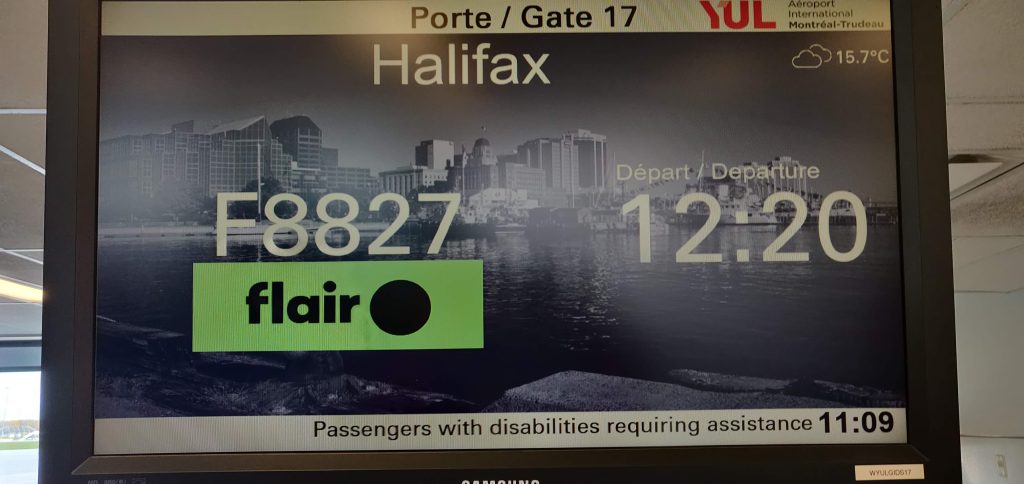
The outbound leg was flight F8 827 from Montreal YUL to Halifax YHZ on Wednesday, October 19 at 12:20 p.m., and it was operated by one of the three Boeing 737-800 aircraft still operating for the airline. All the other 19 aircraft are new generation Boeing 737 MAX 8 aircraft. Flight time was approximately 1 hour 35 minutes.
Flair Airlines – gate departure screen at Montreal Trudeau Airport (Photo: AirlineGeeks | Vanni Gibertini)
Airport Check-In Is a Luxury
The airline strongly encourages passengers to check in online via the website or the smartphone app, as having the boarding pass printed at the airport triggers a 25 Canadian dollars. On the outbound sector, online check-in was quite smooth, while on the return sector it took several hours and more than a dozen attempts to complete the procedure. It seems a recurring issue with the carrier, since when calling their customer service number, a recorded voice says that in case of problems with online check-in the charge will be waived.
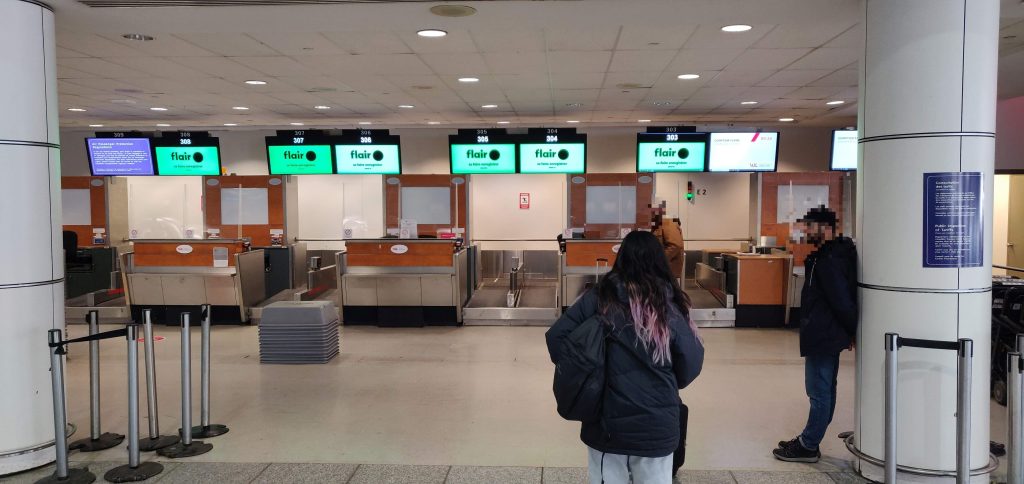
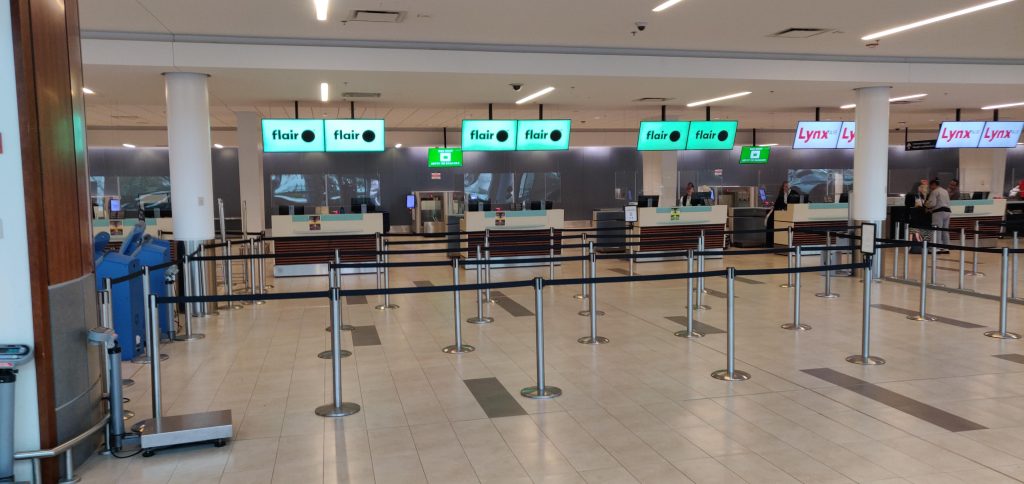
Flair Airlines – Check-in area at Montreal Trudeau Airport (Photo: AirlineGeeks | Vanni Gibertini)
Passengers with bags to check-in can avail of a quite large check-in area in the main terminal, considering there is rarely more than one flight open for check-in at the same time (check-in opens 3 hours before departure).
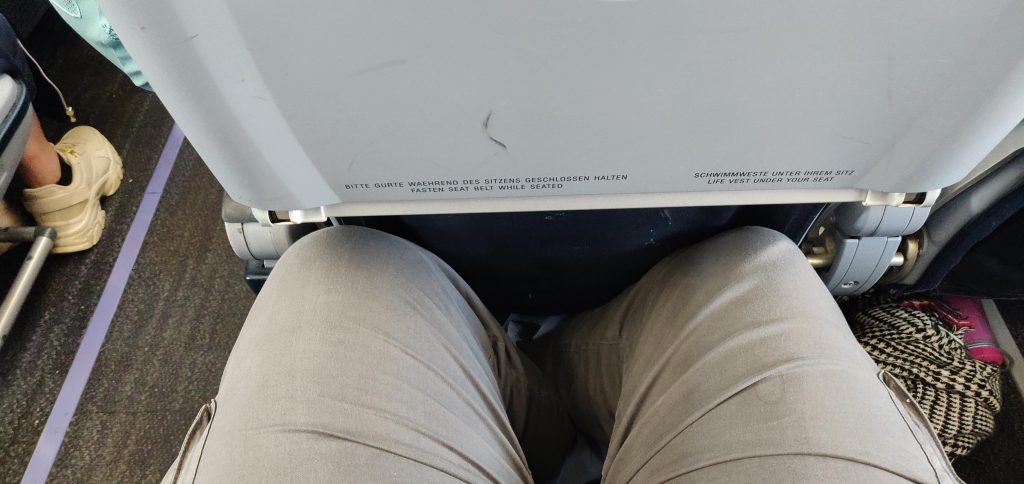
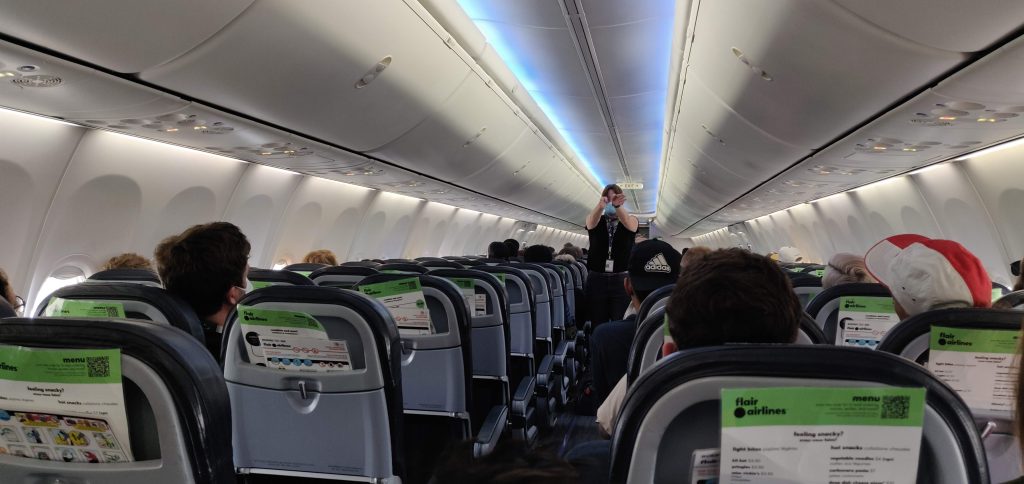
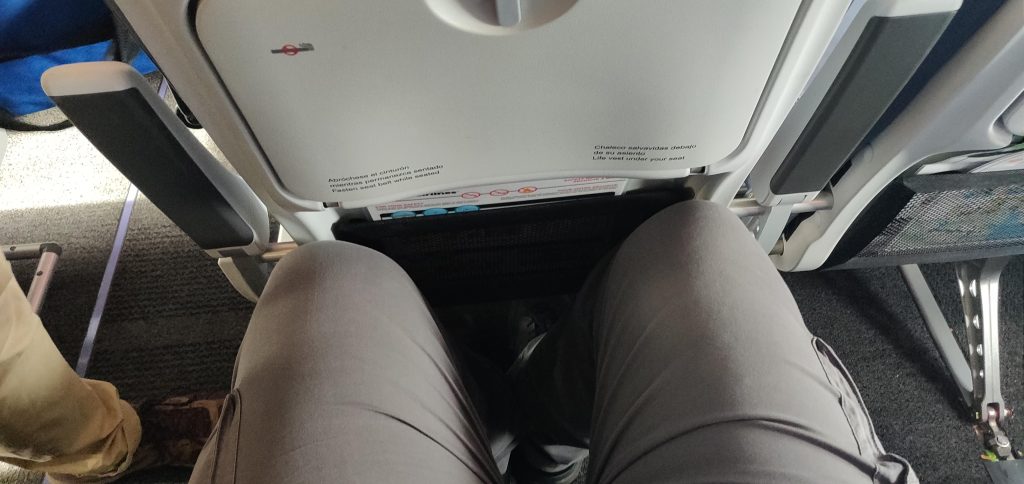
Boarding took place from gate 17 in one of the remote islands: only the Flair Airlines flight was departing from there at that moment and it was organized in three groups. The seats are fairly dated, after all this is one of the oldest aircraft in the fleet, and the thicker old-fashion seats make the 30-31 inch seat pitch particularly uncomfortable for tall passengers.
Seat pitch on Flair Airlines Boeing 737-800 (Photo: AirlineGeeks | Vanni Gibertini)
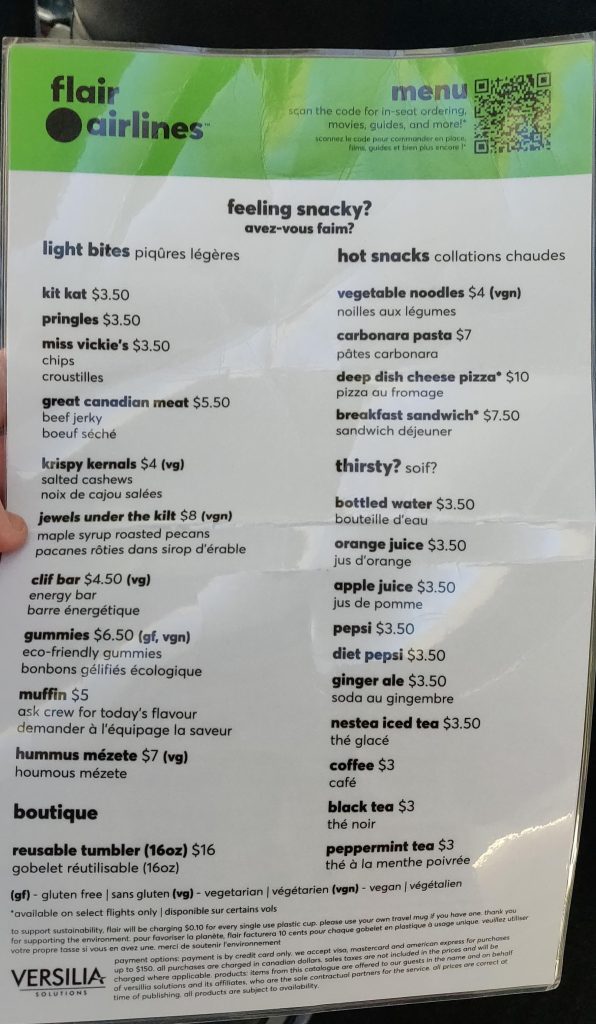
In the back-seat pockets, there are two laminated sheets: one for the safety instructions and the other for purchasing refreshments. There is no trolley service: all refreshments are purchased on-demand and payment is exclusively by credit card: no cash is used onboard.
Flair Airlines interior of Boeing 737-800 (Photo: AirlineGeeks | Vanni Gibertini)
Flair Airlines onboard menu (Photo: AirlineGeeks | Vanni Gibertini)
Departure was delayed by approximately 20 minutes since the headcount had to be repeated several times: some passengers were repeatedly called through the public announcement system, as they had probably checked a bag but did not show up at the gate.
Unlike what happens with U.S. and especially European low-cost carriers, there doesn’t seem to be any emphasis on shortening the turnaround times. This may be explained partly by a difference in culture and partly by the fact that Flair’s network structure includes a large number of longer routes which limits the possibility of cramming extra sectors into the day if turnaround times are optimized.
The return leg was flight F8 828, scheduled to depart Halifax on Friday, October 21 at 11:20 a.m. The flight was operated with a Boeing 737 MAX 8 aircraft with a newer configuration, and three fewer seats (186 versus 189). The thinner seats made the perception of the seat pitch much more comfortable.
Flair Airlines – Check-in area at Halifax Stanfield Airport (Photo: AirlineGeeks | Vanni Gibertini)
The overhead lockers are the wider Space Bins, which are supposed to store up to 50% more carry-ons provided they are arranged lying on the smaller side. This would require passengers to know how to put their suitcases in the bins, to read the instructions or to be assisted by cabin crew in performing the operation correctly, none of which actually happened on our flight.
The Boeing 737 MAX 8 is supposed to be equipped with WiFi and free inflight entertainment to be streamed to the passengers’ individual screens, but on our flight, the system was not operative.
Seat pitch on Flair Airlines Boeing 737 MAX 8 (Photo: AirlineGeeks | Vanni Gibertini)
The flight was at first delayed by approximately 30 minutes by the late arrival of the aircraft, but actual departure took place almost an hour late due to another quite slow boarding procedure. Flight time was a quick 1 hour 15 minutes.
On both flights announcements and the safety briefing were made in both Canada’s official languages. The order of the two languages appeared quite casual, while on other carriers it is usually English first and then French, except for when the aircraft is departing or arriving in Quebec when languages are switched and French is first due to local Quebec language laws.
The general impression is of a very young airline that still needs to iron out and standardize its procedures: for example, there appear to be strict checks for fastened seat belts whenever the signal is on, but before take-off and landing heavy objects like laptops are tolerated in the seat-back pockets and, while a flight attendant insisted for a personal item to be completely under the seat in front of the passenger, it was completely overlooked that jacket and purse of the same passenger were casually thrown on an empty seat next to them, when they should have been securely stored for take-off.
An Uphill Battle
While Flair’s effort to bring lower fares to Canada needs to be appreciated and supported, their baggage policy appears to be quite punishing: once we include all the charges for the items that would be included in a basic ticket in a full-service carrier, prices tend to become quite similar. For example, unless a specific seat is purchased during the booking or even at check-in, it is impossible to ensure that all the members of the same party will sit together. If no seat is being paid for, the system automatically assigns a seat without the possibility of choosing it or changing it.
Incumbent carriers can avail of large amounts of data to respond to lower fares launched by ultra-low-cost carriers: since they usually have a much higher number of frequencies on routes where they are under attack by budget competitors, they can just reduce the price of one of their flights of the day, usually the worst performing, in order to remain competitive without diluting too much of their revenue. This makes it difficult for new entrants like Flair but also like Jetlines and Lynx Air to compete effectively against Air Canada and WestJet.
Canada is also a difficult market to put in place the usual strategies adopted by low-cost carriers: airports tend to be quite expensive, and there are very few secondary airports that could provide better deals, so low-cost airlines are stuck paying the same high prices charged to their full-service counterparts. Flair Airlines has started services to some of the secondary airports serving popular destinations in the United States, such as Orlando Sanford (SFB), Phoenix-Mesa (AZA) and Los Angeles Burbank (BUR), on top of obtaining incentives from underserved communities in Canada like Kitchener-Waterloo, Ontario, Lethbridge, Alberta and Prince George, British Columbia.
Vanni fell in love with commercial aviation during his undergraduate studies in Statistics at the University of Bologna, when he prepared his thesis on the effects of deregulation on the U.S. and European aviation markets. Then he pursued his passion further by obtaining a Master’s Degree in Air Transport Management at Cranfield University in the U.K. followed by holding several management positions at various start-up carriers in Europe (Jet2, SkyEurope, Silverjet). After moving to Canada, he was Business Development Manager for IATA for nine years before turning to his other passion: sports writing.
An Air New Zealand 777-200 in Los Angeles (Photo: AirlineGeeks | William Derrickson)
In response to a speedy recovery, New Zealand’s Auckland Airport has revised its forecast for the financial year 2023.
Auckland Airport, the largest international gateway to the country, has seen a strong demand in domestic and international travel, in particular on North and South America, South Pacific and Trans-Tasman routes. The airport sees the recovery as universal, with travel demand to the U.K. and Europe on the rise as well.
The airport expects international passenger numbers will be between 60% and 70% of pre-Covid-19 levels and domestic passenger numbers could reach 85-90% of those figures, with a profit after tax between 100 million New Zealand Dollars ($57.9 million) and 130 million New Zealand Dollars for the financial year of 2023. That represents an uplift on guidance provided in August of between 50 million New Zealand Dollars to 100 million New Zealand Dollars.
The airport handled 5.6 million passengers in the financial year of 2022 (which ended in June), recording a net underlying loss after tax of 11.6 million New Zealand Dollars.
In addition, the airport agrees with IATA, that the global industry will recover to pre-pandemic levels by the end of 2024.
The airport’s latest announcement expressed concern over the North Asia market. China, one of the largest tourism markets pre-pandemic for New Zealand, has no sign of relaxing its travel restriction thus far. The other countries in North Asia have reopened their border gradually, Japan has followed in South Korea’s footsteps to welcome travelers in October.
Following the lifting of travel restrictions in Japan, Air New Zealand has seen a strong uptick in interest and bookings. Air New Zealand operates three times-a-week services between Auckland and Tokyo as a result. Japan was New Zealand’s fifth-largest international visitor market with 100,000 visitors arriving in 2019.
After the pandemic, North America has been identified as one of the priority markets for Kiwis. United Airlines and American Airlines return to New Zealand in October, Auckland becomes the most connected Australasian city to North America. Five carriers will provide eight destinations, offering up to 60 flights per week.
Competing with Its Neighbors
On the other hand, Auckland Airport has mentioned that it will compete with other countries, such as Australia, to entice more airlines and visitors to return to New Zealand. Australia has invested heavily in encouraging airlines to come back to Australia.
Despite the challenges aviation and aviation-adjacent industries are facing — such as the availability of crew, ground staff and resourcing associated with bringing fleets out of hibernation — the airport remains optimistic.
“We are increasingly confident that aviation is returning to normal, with the structure of the market becoming more balanced across inbound and outbound travel, and ‘business’, ‘friends and family’ and ‘leisure’ travel categories,” Carrie Hurihanganui, the chief executive of the airport, said in a statement.
Meanwhile, the airport has been focusing on the expansion of the terminal. The domestic terminal will end its services after six decades. Auckland Airport is going to combine its domestic and international terminals. According to the airport, the airlines currently pay some of the lowest domestic charges in Australasia to operate at the airport due to the age of the domestic terminal. The new terminal airport is expected to be completed in five years after construction is started.
An Etihad Airways Boeing 787-10 Dreamliner. (Photo: AirlineGeeks)
After its ownership was transferred to Abu Dhabi Wealth fund ADQ, UAE flag carrier Etihad Airways appointed Antonoaldo Neves — the former chief of TAP Air Portugal — as the new group CEO, succeeding Tony Douglas, who took on a new role to head Saudi Arabia’s new $30 billion national carrier, RIA, Arabian Business reported.
Douglas, who led Etihad’s operations since January 2018, will leave the Abu Dhabi-based carrier and will serve during his transition period as an advisor to the Board of ADQ Aviation and Aerospace Services Company.
Etihad’s New Boss
Incoming chief Neves was CEO and a board member at TAP Air Portugal, the National Airline of Portugal, where he successfully led a major turnaround to create a more valuable company, which significantly contributed to tourism development in Portugal.
Before TAP, Antonoaldo was the President of Azul Airlines in Brazil, where he successfully led the company to an initial public offering in the U.S. Antonoaldo was also a partner at McKinsey and Company, where he developed the long-term plan for the aviation sector development in Brazil.
Mohammed Ali Al Shorafa, Chairman of Etihad Aviation Group, said, “Tony has led Etihad through some of its most challenging times and has successfully turned the airline into a profitable and sustainable business over the past five years as part of its initial transformation program. As we’re entering our next phase of sustainable growth, we are confident that Antonoaldo will build on Tony’s legacy. We thank Tony for all the hard work he has delivered. Etihad will continue to serve Abu Dhabi as the national airline of the UAE, delivering world-class services and exceeding global benchmarks shortly.”
Neves on his part commented, “Etihad Airways is a globally well-known brand in the industry. I’m excited to embark on this new role and build on the solid foundation left by Tony and the management team. I am confident that Etihad will prosper into new heights and continue its journey of sustainable growth.”
The outgoing chief Tony Douglas also said, “I am proud to have served as Etihad’s chief executive officer over the past five years. The unprecedented challenges stemming from macroeconomic conditions faced by the industry were successfully navigated through prudent measures undertaken to position Etihad on a sustainable path for the future. I am appreciative of all the support provided by my Etihad colleagues and looking forward to further supporting the evolution of the wider Abu Dhabi aviation ecosystem.”
A New Flag Carrier
Saudi Arabia’s new airline, RIA, is scheduled to launch operations in the last quarter of 2022 and is forecasted to bring fierce competition to the Middle East’s commercial aviation landscape by rivaling the market’s leading carriers including Emirates Airline, Etihad Airways and Qatar Airways.
According to Arabian Business, other senior Etihad executives are expected to follow in Douglas’ footsteps and join the airline in the upcoming months.
The airline, which is fully funded by Saudi Arabia’s Public Investment Fund, is a key pillar in the kingdom’s $100 billion investment in aviation planned over the coming eight years, as part of the Vision 2030 program objectives to diversify the country’s economic portfolio and reduce its reliance on oil exports.
According to industry sources, RIA’s initial operations will be primarily regional, with a fleet of Boeing 737 MAX and Airbus A320 aircraft.
Victor Shalton's love for aviation can be traced to when he was 11-years-old. As a seasoned aviation writer, he takes pride in providing the best aviation coverage around the globe and is passionate about advancing his skills in the aviation space. In addition, he loves travelling, writing, arts and while his speaking engagements have taken him around the world, he is proud to call Nairobi home.
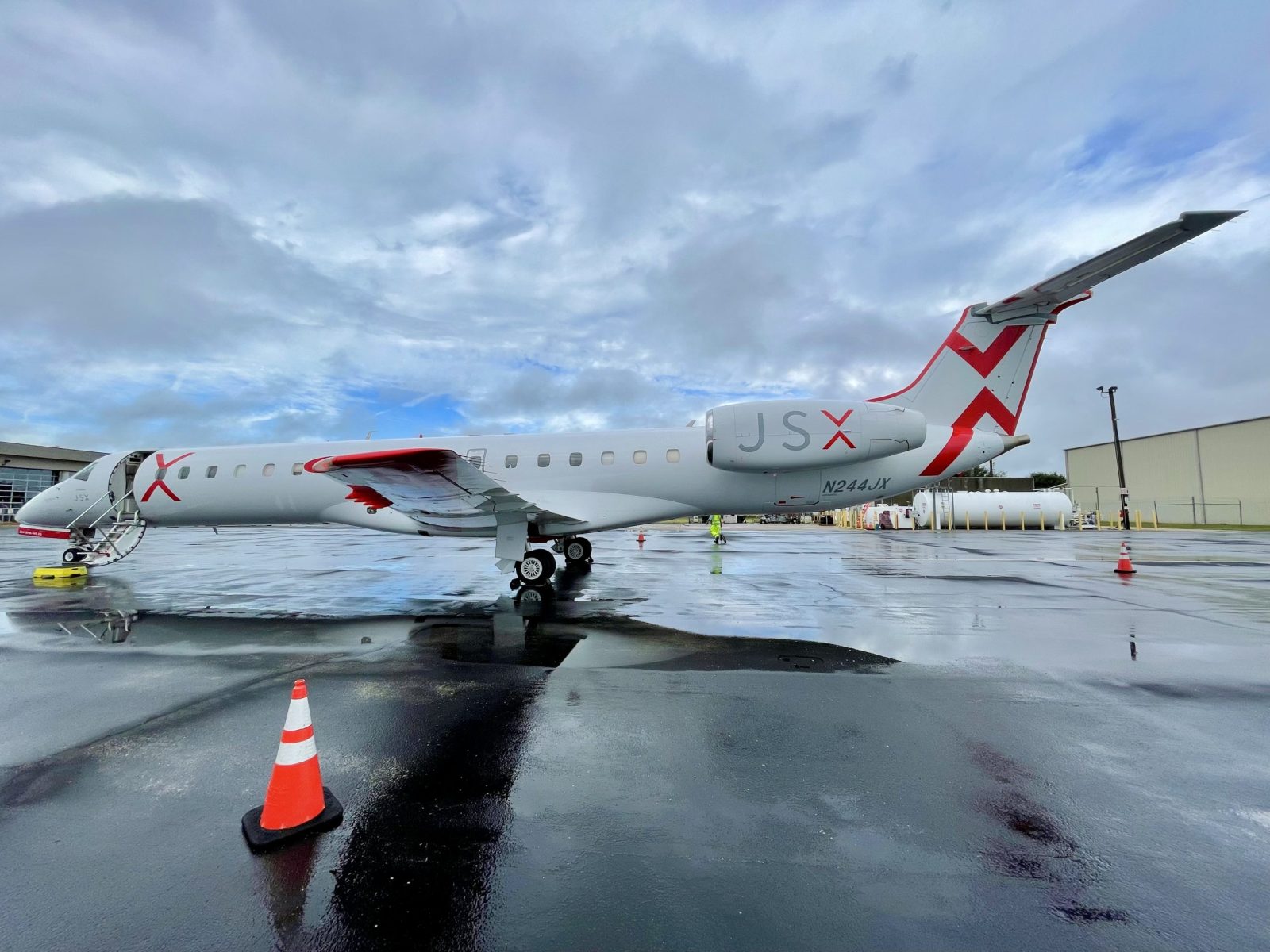
A JSX Embraer E-145 on the FBO ramp at Austin-Bergstrom International Airport. (Photo: AirlineGeeks | Mateen Kontoravdis)
Dallas-based JSX has announced the addition of two more destinations to its route map. This comes just a month after its last new destination announcement last month when it announced Gunnison/Crested Butte in Colorado. The two destinations they have announced are Orlando, via the Orlando Intl. Airport, and Rifle which is located in Colorado. Each new destination will have two nonstop destinations, adding another four to the airline’s ever-growing route map
Orlando flights will start on Dec. 15, 2022, operating to Dallas Love Field on a once-daily basis. Other flights will operate from Westchester County in New York beginning on Dec.22, 2022, and will also operate on a daily basis from Orlando. Orlando will be the third destination the airline serves in the state of Florida, the other two being Destin-Executive, which they serve during the summer months, and Miami Intl. which sees year-round service from Westchester, Winter seasonal service to Dallas Love Field, and Summer seasonal flights to Destin-Executive.
The second city they have announced is Rifle, Colorado, a community that from the looks of it has never seen airline service and JSX will be the first airline to operate here. Adding another airport to the airline system in the United States. From here they will start flights on Dec. 16, 2022, and operate to Dallas Love Field two-to-three times a week. In addition, they will also start nonstop flights to Burbank, Calif. on Jan. 12, 2023, which will also operate on a two-to-three time-a-week basis. Service to Rile will be winter seasonal, but the airline has yet to announce when the flights will end in the springtime and continue as far out as the airline is booking flights, the end of March 2023.
JSX current route network as of Oct.24, 2022 (Photo: JSX)
Rifle, also appears on the airlines’ website as Rifle/Aspen/Vail, the latter two of which are popular ski towns in the area. It is also odd that they are showing as both are at least an hour’s drive from Rifle during good weather when snow isn’t affecting the driving time and the highways aren’t a complete mess. Aspen is 1 hour and 15-minutes, and Vail is 1 hour and 30-minutes, again, this driving time is an estimate during good weather. Grand Junction, Colo. is another bigger city that is located only an hour’s drive from Rifle, closer than either Vail or Aspen yet it isn’t listed anywhere on the carrier’s site as an alternative for that city.
As the flights were just announced and are still months out, they have not yet announced where they will be departing from at either airport but are expected to be either an FBO or a private terminal. All flights are scheduled to operate on the carriers Embraer E135 or E145 both of which have 30-seat.
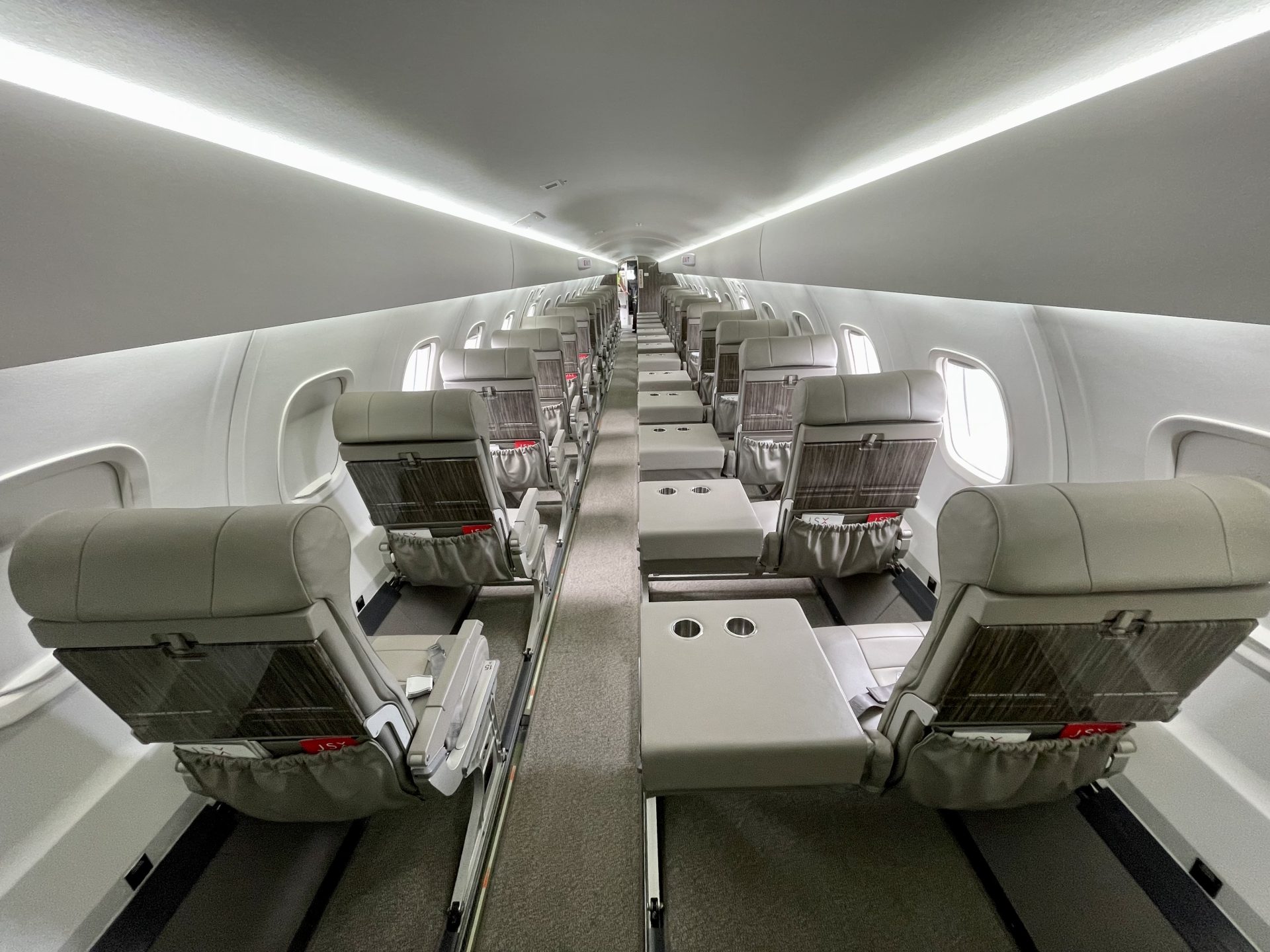
Onboard the recently refurbished JSX E-145. (Photo: AirlineGeeks: Mateen Kontoravdis)
Joey has always been interested in planes for as long as he can remember. He grew up in Central New York during the early 2000s when US Airways Express turboprops ruled the skies. Being from a non-aviation family made it harder for him to be around planes and would only spend about three hours a month at the airport. He was so excited when he could drive by himself, the first thing he did with his driver's license was get ice cream and go plane spotting for the entire day. He graduated from Western Michigan University in 2022 with a B.S. in Aviation Management & Operations and a Minor in Business, and currently works for a major airline in his hometown.
Air France-KLM Move to Support Electric Aircraft with Ampaire
Air France Industries KLM Maintenance & Engineering is moving to support electric aviation. Photo: Air France Industries KLM Maintenance & Engineering
Aircraft support provider Air France Industries KLM Engineering and Maintenance (AFI KLM E&M) has taken steps to support electric aircraft, signing a memorandum of understanding with US electric aviation pioneer Ampaire. The move, announced on October 19, means the maintenance, repair and overhaul (MRO) giant will accelerate its familiarity with the electric aviation field with the guidance and assistance of Ampaire.
With the new MoU, both companies will aim to develop training for ground engineers as part of a global network, install upgrades for modified aircraft, as well as further collaborate for extended support of a 19-seat aircraft. According to KLM E&M Executive Vice President Ton Dortmans, Ampaire was selected due to its approach being “visionary and also extremely methodical and practical, which means these beneficial technologies can be already introduced in the very near future.”
As part of AFI KLM M&E’s future plans, the company aims to set itself up as the preferred electric training partner, contemplating the benefits of using augmented and virtual reality technology in the process.
Ampaire, having already tested its hybrid-electric aircraft on airline routes, intends to reach the goal of fully electric aircraft with modified hybrid aircraft as a stepping stone. In a statement, Ampaire CEO Kevin Noertker said that “AFI KLM E&M’s powerful global network and strong expertise will give operators everywhere high technical confidence in new propulsion systems.”
More MoU’s Signed for Electric Aviation
In addition to the Ampaire memorandum of understanding, Air France Industries KLM Maintenance & Engineering is showing further interest in electric aviation, having also signed an MoU with French hybrid-VTOL start-up Ascendance Flight Technologies. The MoU allows for the potential to collaborate line maintenance, component repair, mechanics training and airworthiness management.
Despite Ascendance ‘start-up’ status, Air France Industries Executive Vice President Géry Mortreux stated: “we are very interested in electric and hydride electric propulsion technologies, which are set to be future business drivers over the next decade.” He further added that “this type of cooperation is in the general interest (of aviation) and is a further illustration of the general mobilization of our industry to decarbonize aviation – a collective effort in which AFI KLM E&M is of course fully involved.”
In return, Ascendance CEO Jean-Christophe Lambert said “in parallel with our efforts to develop a new type of aircraft, it is very important for us to prepare the future of its operations today, in conjunction with the best experts in our industry. Maintenance is obviously at the center of our customers’ concerns and this collaboration with AFI KLM E&M is a major step towards providing them reliable solutions.”
Ascendance is currently developing its ‘Atea’ VTOL aircraft, a five-seat alternative to helicopters, with the goal of readying the vehicle for operations by 2024. According to Ascendance, Atea will have “a range of 400 km, a reduction in carbon emissions of up to 80% and a fourfold reduction in noise emissions, it is suitable for urban and regional use.
Mike’s love affair with flight and mechanical objects in the sky began at an early age, fascinated by space documentaries and the vintage Flight Simulator ’95. He currently works as an instructor for UAVs and is training to receive his Private Pilot Licence with the goal of working in manned flight instruction. An avid reader of all things aviation and manned space flight, Mike stays close to developments in aerospace while reminiscing and sharing the rich history of flight with others. He loves writing, engineering and science.
An Amazon Prime Air 767 touching down in Miami. (Photo: AirlineGeeks | William Derrickson)
Amazon Air, the cargo airline of Amazon.com, Inc. which operates exclusively for Amazon’s parcel transportation business, has signed a lease agreement for ten converted to freighters (P2Fs) Airbus A330-300. The new aircraft will be added to the fleet that currently consists only of ATR and Boeing aircraft. In total, Amazon Air has a fleet of 88 aircraft, 55 Boeing 767-300ER, 28 Boeing 737-800 BCF (Boeing Converted Freighter) versions and 5 ATR 72-500F.
The airline, founded in 2015, is headquartered in Hebron, Kentucky. In 2017, it changed its name from Amazon Prime Air to Amazon Air to differentiate itself from its namesake service of autonomous package delivery to customers via drones, which is currently under development. Until January 2021, the airline had relied on wet leasing its aircraft to other operators, but in late 2020 it purchased four Boeing 767-300s, previously flying for Qantas and then WestJet. The airline however will continue to lease aircraft from its fleet using external crew, maintenance and insurance.
Amazon’s airline last week decided to expand its fleet, signing an agreement to lease ten A330-300P2Fs from Altavair, a global leader in aviation financing. The aircraft will be operated for Amazon by Hawaiian Airlines, the flag carrier of the U.S. state of Hawaii, as well as the 10th largest commercial airline in the United States, and a deep connoisseur of Airbus A330-200s with a total in its fleet of twenty-four.
Although both the A330-200 and A330-300 are suitable for conversion, the longer fuselage A330-300P2F is particularly suited for cargo transport due to its high volumetric payload capacity with low-density cargo.
The ten aircraft will be converted from passenger to cargo by the company Elbe Flugzeugwerke GmbH (EFW), a joint venture between ST Aerospace and Airbus, whose A330P2F (passenger-to-freighter) conversion program began in 2012. EFW is a Dresden-based company currently a center for Airbus P2F aircraft conversion with associated maintenance.
Philippe Karam, Director of Amazon Global Air Fleet & Sourcing said the new A330-300s will be both the first Airbuses in the fleet, but will also be the newest and largest aircraft for Amazon Air, enabling the logistics company to deliver more packages to its customers on every flight, faster, more efficiently and over longer distances. The first A330-300P2F aircraft is expected to join Amazon Air’s fleet in late 2023.
Airbus A330s possess advanced technology, including fly-by-wire flight controls, and an extremely capable platform for cargo conversion, due precisely to the number of aircraft converted over time. Since the Airbus A330 entered service in 1994, more than 1,700 aircraft have been ordered and more than 1,500 have been delivered, providing ample knowledge for Passenger-to-Freighter conversions for many years.
Vincenzo graduated in 2019 in Mechanical Engineering with an aeronautical curriculum, focusing his thesis on Human Factors in aircraft maintenance. In 2022 he pursued his master's degree in Aerospace Engineering at the University of Palermo, Italy. He combines his journalistic activities with his work as a Reliability Engineer at Zetalab.