This week, Emirates Airline confirmed that it will hire new first officers «who meet the airline’s standards in safety, technical prowess and customer experience», it said in a statement.
The new pilots will be based in Dubai, United Arab Emirates, the airline’s main hub. Emirates stressed that the new first officers will be able to aspire to operate the fleet of new wide-body aircraft that the company will incorporate in the coming years.
The Middle East’s largest airline has firm orders for Airbus A350-900, Boeing 787-8, 787-9 (scheduled for delivery from 2023) and 777X (scheduled for delivery from 2025) aircraft.
Shortlisted applicants will complete their training and qualification programs at the company’s facilities. Currently, Emirates has ten Full Motion Flight Simulators (FFS) to provide training on the two aircraft types that make up its fleet, the Airbus A380 and the Boeing 777.
Candidates must have experience as a first officer on multi-engine aircraft, hold a valid airline transport pilot license and have at least 2.000 hours of flight experience on aircraft with a maximum take-off weight (MTOW) of more than 20 tonnes or 3.000 hours on aircraft with an MTOW of between 10 to 20 tonnes.
In addition, they must have flown a minimum of 150 hours during the twelve months prior to joining the company in aircraft with an MTOW of more than 10 tonnes and must hold an ICAO Level 4 English language proficiency or higher. Those wishing to apply can find more information on the Emirates careers portal.
This month, the company will hold three information session days in the United Kingdom on the recruitment process and working conditions.
This story was originally published by Agustin MIguens of Aviacionline in syndication with AirlineGeeks.
Ryan founded AirlineGeeks.com in February 2013 and has spent more than a decade covering the airline business. His work has been featured by CNN, WJLA, CNET, and Business Insider. His aviation experience spans airport operations, Part 135 regulatory compliance, and airline crew workforce planning, along with time behind the yoke of a Cessna 172 and interviews with airline executives. Ryan now serves as Group President of Firecrown Media’s Aviation Group. He holds a B.S. in Air Transportation Management and an MBA from Arizona State University and teaches Airline Management at Embry-Riddle Aeronautical University.
A Virgin Atlantic 787-9 departing London Heathrow. (Photo: AirlineGeeks | William Derrickson)
The International Air Transportation Association (IATA) has released the passenger data for June showing an unsurprising rise in passenger demand. Using the industry metric of Revenue Passenger Kilometres (RPKs) to indicate total passenger traffic IATA’s figures indicate a 76.2% increase over 2021. As a comparison passenger traffic was at approximately 71% of pre-pandemic levels.
With domestic markets holding strong with an increase of 5% over June 2021 levels international travel soared with a rise of 229.5%. IATA’s Director General Willie Walsh said: “Demand for air travel remains strong. After two years of lockdowns and border restrictions people are taking advantage of the freedom to travel wherever they can.”
From a regional perspective, the ‘Within Europe’ market saw levels of passenger traffic exceed pre-pandemic levels by 7 percent. International RPKs for airlines based in Europe increased 234.4 percent year on year and sit around 80 percent of 2019 levels. However, this trend may be under threat from the recent issues affecting European airports and airlines in July.
Within the data release, Mr. Walsh commented on the recent capping of passenger numbers at London Heathrow and other airports. “By capping passenger numbers, airports are preventing airlines from benefitting from the strong demand. Heathrow Airport has tried to blame airlines for the disruption. However, Service Level Performance data for the first six months of this year show that they have failed miserably to provide basic services and missed their Passenger Security service target by a massive 14.3 points. Data for June has not yet been published but is expected to show the lowest level of service by the airport since records began.”
In North America airlines experienced the highest load factor of any region with an increase of 24.1 percentage points to 87.7 percent. Asia-Pacific airlines benefitted from the easing of travel restrictions in some countries with a 492 percent rise in traffic. Matching the surge in RPKs the load factor of airlines in the region increased significantly by 45.8 percentage points to 76.7. By comparison, African airlines are operating at close to 2019 capacity levels the region experienced the lowest load factor of 74.2 percent.
Mr. Walsh indicated that further challenges remain for the airline industry even with the increases in passenger demand, particularly in the Northern Hemisphere. He said it would be “premature” if the European Commission followed through on the intent to return to the 80-20 slot use rule which IATA states ‘requires airlines to operate at least 80% of every planned slot sequence.’
Calling for the continuation of flexibility in regard to the slot rules Mr. Walsh stated: “Just look at the issues that airlines and their passengers at some hub airports are being confronted with. These airports are unable to support their declared capacity even with the current 64% slot threshold and have extended recent passenger caps until the end of October. Flexibility is still essential in support of a successful recovery.”
John has always had a passion for aviation and through a career with Air New Zealand has gained a strong understanding of aviation operations and the strategic nature of the industry. During his career with the airline, John held multiple leadership roles and was involved in projects such as the introduction of both the 777-200 and -300 type aircraft and the development of the IFE for the 777-300. He was also part of a small team who created and published the internal communications magazines for Air New Zealand’s pilots, cabin crew and ground staff balancing a mix of corporate and social content.
John is educated to postgraduate level achieving a masters degree with Distinction in Airline and Airport Management. John has held the positions of course director of an undergraduate commercial pilot training programme at a leading London university. In addition he is contracted as an external instructor for IATA (International Air Transport Association) and has been a member of the Heathrow Community Fund’s ‘Communities for Tomorrow’ panel.
Airbus Cancels Remainder of Qatar A350 Order as Dispute Continues
A Qatar Airways A350-1000 at the gate at Houston Bush Intercontinental Airport. (Photo: AirlineGeeks | Mateen Kontoravdis)
French aircraft manufacturer Airbus has canceled the remainder of Qatar Airways A350 orders following a dispute over what Qatari regulators claim is premature surface damage.
Qatari regulators grounded nearly half of Qatar’s A350 fleet consisting of both the -900 and -1000 variants. The airline was the first to fly the type in 2015 and the first to fly the -1000 variant in 2018. Airbus and Qatar Airways seemingly had a strong relationship with the carrier operating nearly every Airbus type on the market and committing large amounts towards further orders.
Airbus has continued to say that the aircraft are safe though other A350 operators have reported issues like Qatar Airways leaving many wondering the cause. Qatar Airways is suing Airbus for a minimum $1.4 billion which is no small number and likely accounts for maintenance and lost revenue due to the type’s grounding.
Airbus seems to have little interest in dealing with the airline and has instead opted to flat out cancel the rest of the scheduled deliveries. Airbus also canceled an order Qatar had for 50 A321neo aircraft earlier in the year opting to resell the airplanes to other interested carriers which bothered Qatar Airways as they made an effort to stop Airbus from doing so.
This isn’t a confined issue
Airbus has acknowledged issues with production quality on the A350 though they don’t buy Qatar’s claims that the premature surface damage was caused by Airbus. Qatar isn’t the only carrier to have raised concerns with the A350. Reuters reported in November of 2021 that quite a few other airlines had seen issues in the exterior of the aircraft.
Finnair as far back as 2016 reported paint damage. Cathay Pacific, Lufthansa Air Caraibes and French Bee all reported paint deterioration as well. Cathay Pacific said there was no threat posed to the safety of the aircraft. No other airline had grounded the type over safety concerns until Qatar.
Airbus has investigated the issue and their choice to cancel the remainder of the order hints at the manufacturer having little interest in facing continued paint issues that it says have no effect on the aircraft’s performance or safety. Some similarities have been found on Boeing’s 787 aircraft as well and it should be noted that the 787 is also composed of carbon fiber.
Capacity is in demand
Airbus, by canceling the order themselves, are also making it clear that they have plenty of options when it comes to finding new homes for these aircraft. It is no secret that airlines are in dire need of capacity at the moment and many airlines are looking for any chance to expand.
Ezra Gollan is a student, photographer and aviation enthusiast based in New York, New York. He has spent over half a decade around New York City’s airports as a photographer.
The new Flair Airlines livery seen on one of the airline's 737-400s. (Photo: Flair Airlines)
On Wednesday, Canadian low-cost carrier, Flair Airlines announced a new non-stop service to Cancun from Toronto, further strengthening its presence in Mexico.
Flair will initially operate the route twice-weekly, with service beginning November 3. Airfare for the particular route starts at $109 CAD.
“We’re delighted to add an additional route to our network in Mexico. We know that Canadians will be looking to beat the winter blues by escaping to the Sandy beaches of Cancun, and we’ve added additional service to the airport to allow people to chase the sun affordably,” stated Stephen Jones, Flair Airlines Chief Executive Officer in a press release. “As we continue our growth in the Mexican market, we look forward to increasing frequencies on our routes and adding new destinations.”
Accompanied by the Mexico announcement, Flair revealed plans to change the airport served on their California routes. Previously serving the Hollywood-Burbank, CA airport (BUR), the carrier will now fly into Los Angeles’ LAX airport. The company will have nonstop flights from Canada’s Edmonton and Vancouver airports.
Edmonton to Los Angeles will begin October 31 with three weekly flights, and Vancouver to Los Angeles begins the following day, November 1. LAX to Vancouver will operate four times weekly.
From both Vancouver and Edmonton, fares will begin at $99 CAD.
The airline has found success serving the Mexican market, as Toronto to Cancun becomes the carrier’s eighth route between the two countries. The route joins the already served Cancun to Kitchener-Waterloo and Cancun to Ottawa.
Flair customers can also fly direct from Abbotsford, Edmonton, and Vancouver to the popular Los Cabos destination. Currently served twice-weekly, the low-cost carrier will up this service to three times weekly.
Additionally, the newly served Puerto Vallarta to Edmonton and Vancouver will increase service to 4x weekly, up from the previous 1x per week.
The aircraft serving these routes are the Boeing 737 -800 and the 737 MAX 8 in a 189 3×3 seat configuration. The seat offers passengers 30 inches of pitch, 17 inches of width, and 2 inches of recline.
The ULCC is the subsidiary of 777 Partners and offers both scheduled passenger and charter services.
Within the United States, Flair operates to destinations covering all corners of the continent including Denver, Fort Lauderdale, Los Angeles, Las Vegas, Nashville, New York, Orlando, Palm Springs, Tucson, Phoenix, and San Francisco with plans to add more in the near future.
Chase Hagl grew up in Twin Falls, Idaho. His love and passion for Aviation landed him in Orem, Utah where he obtained a B.S. in Aviation Management with a minor in Business Management from Utah Valley University. Chase currently works as a flight attendant in Charleston, SC and is also the primary Inflight ASAP ERC representative for startup airline, Breeze Airways. His experience in the aviation industry spans back four years, working in areas including agriculture application, customer service, maintenance, and flight ops. In his free time, Chase enjoys road biking, astronomy, and flying.
United Announces New Nonstop Flights to South Africa
A United Airlines Boeing 787 at San Francisco.
(Photo: AirlineGeeks | William Derrickson)
Earlier this week, United announced new direct flights between Washington, DC’s Dulles Airport and Cape Town, South Africa —becoming the first airline to provide nonstop round-trip service from the United States’ capital to one of South Africa’s main gateways.
The U.S. Department of Transportation granted the airline three weekly direct flights,, which will commence on November 17, 2022 (subject to approval by the South Africa Government). Tickets are currently available for sale.
United started seasonal service from Newark, NJ to Cape Town, South Africa in 2019 and expanded to year-round service this year. The carrier has more flights to South Africa than any other North American airline.
Patrick Quayle, United’s Senior Vice President of Global Network Planning and Alliances said, “We are thrilled to further expand our Africa offering with this first-ever direct link between Washington DC and Cape Town,”
With this addition, United will offer a total of 19 weekly flights to Africa. In addition to these new flights to Cape Town, the airline launched nonstop flights from Newark, NJ to Johannesburg and Washington, D.C. to Accra, Ghana and Lagos, Nigeria in 2021.
“These new flights build upon our existing year-round New York/Newark to Cape Town service – together they’ll provide a near-daily pattern from the U.S. to Cape Town along with connectivity to the broader region through our Airlink partnership,” he added.
United’s new flights also connect Cape Town to 55 U.S. cities, representing more than 92% of the U.S. travel demand. The new flights will also allow customers to connect in Cape Town to other points in South Africa, and other countries in the southern region of the African continent with United’s South African-based partner Airlink and their Cape Town hub.
United Airlines will utilise Boeing 787-9 Dreamliner aircraft on this new route, which features 48 lie-flat, United Polaris® business class seats, 21 United Premium Plus® seats and 188 economy seats.
A United Airlines 787-8 departing Washington Dulles (Photo: AirlineGeeks | Joey Gerardi)
Battle for Cape Town Market
Over recent years, the US – Africa Atlantic corridor, including flights between the United States and South Africa have been subject to the attention and rivalry of two US airlines – Delta and United.
The two carriers have battled it out throwing legal blows to oppose the other from gaining the upper hand with more frequencies from their US hubs to SA’s Johannesburg and Cape Town.
According to a bilateral agreement between the United States and South Africa, US airlines are limited to 21 air service frequencies to South Africa per week.
before the pandemic, Delta held a larger market share of routes to South Africa, for the good part of two decades. Its only competition was South African Airways. United on the other hand had only launched its inaugural flight to Cape Town in 2019.
However, United’s flights to Cape Town gained traction and momentum. In August 2022, United is projected to have a 58% seat share between the US and South Africa, compared with Delta’s share of approximately 42%, according to a data report from CAPA and OAG.
Before United received approval from the U.S. Department of Transportation (DOT) for its three weekly services from Washington to Cape Town, the frequency share between US Airlines for services to South Africa was split as follows:
United Airlines offers a total of 10 weekly flights from Newark, NJ to Cape Town, South Africa and Johannesburg.
Meanwhile, Delta Airline offers 7 weekly flights from Atlanta to Johannesburg.
In February and March 2022, Delta and United applied to the DOT for rights to operate three weekly services to Cape Town from their hubs in Atlanta and Washington-Dulles respectively.
For United, this would provide a near-daily pattern to Cape Town. However, only four frequencies of the 21 allowed frequencies remained. Hence, Delta was vying to deny United from gaining a majority of the seat market share on flights to South Africa.
Victor Shalton's love for aviation can be traced to when he was 11-years-old. As a seasoned aviation writer, he takes pride in providing the best aviation coverage around the globe and is passionate about advancing his skills in the aviation space. In addition, he loves travelling, writing, arts and while his speaking engagements have taken him around the world, he is proud to call Nairobi home.
Inside the Jewel at Singapore Changi Airport looking at the famous Rain Vortex. (Photo: AirlineGeeks | Mateen Kontoravdis)
Singapore’s aviation sector is like no other in Asia, and its Changi Airport has seen the sign of rebounding after two years of the pandemic. The Asian vibrant hub announced that it had handled 7.33 million passengers in the second quarter (from April to June) of 2022. It comes after Singapore Airlines revealed its big surge in passenger numbers in the first quarter of 2022-23.
The latest figures for the second quarter of the year have shown 43.6% of 2019 and a traffic 14 times higher than the same time last year. The performance of the American market was remarkably good during the second quarter, the passenger traffic to and from American cities has exceeded pre-pandemic levels by 7.13%. This is attributed to the additional flights to Canada since last December. Other markets such as Europe, Oceania, and South Asia also have seen a recovery, reaching over 60% of 2019 traffic levels.
However, airfreight movements have reached 469,000 tonnes, dropping by 1.4% on a year-on-year basis.
“We are encouraged by the steady increase in passenger traffic as it is a sign that we are getting back on the trajectory of growth toward pre-pandemic levels.” Ching-Kiat Lim, Changi Airport Group’s Managing Director for Air Hub Development said.
Changi revealed it had handled 2.93 million passengers in June, posting 50.3% of pre-pandemic levels. Comparing this figure to those reported by neighboring airports, we can see that Kuala Lumpur recorded traffic at 30% of 2019 levels, and Bangkok Suvarnabhumi Airport at 35%.
Singaporean government’s policies have been paving the way for its rebound, the aviation sector has seen a gradual recovery since 2022. Since the country reopened its border on Apr. 1 Changi has welcomed three new airlines, including Thailand’s Thai Vietjet, Vietnam’s Bamboo Airways, and South Korea’s low-cost carrier T’way. According to Changi, 85 airlines operate over 4,400 weekly scheduled flights as of Jul. 1.
Terminal Four Reopens
After reopening Terminal Two, as a result of the surge in travel demand, Changi has announced its Terminal Four will resume its operation on Sep. 13 after two years hiatus. The airport forecasts Terminal Four can meet the increasing demand and support airlines to launch more flights. Changi announced some airlines will move to Terminal Four: Cathay Pacific and Korean Air will move on Sep.13, becoming the first two airlines to move to the newly-reopened terminal. However, the airport’s new terminal scheme is not for everyone.
According to local media, Jetstar Asia, the no-frills carrier, has “no intention of moving” to Terminal Four due to its code-sharing arrangement with other carriers. Jetstar is currently operating at Terminal One which provides better connectivity and the carrier believes the relocation will impact on its passengers, staff and operations. Changi said the Jetstar is scheduled to move on Oct. 25.
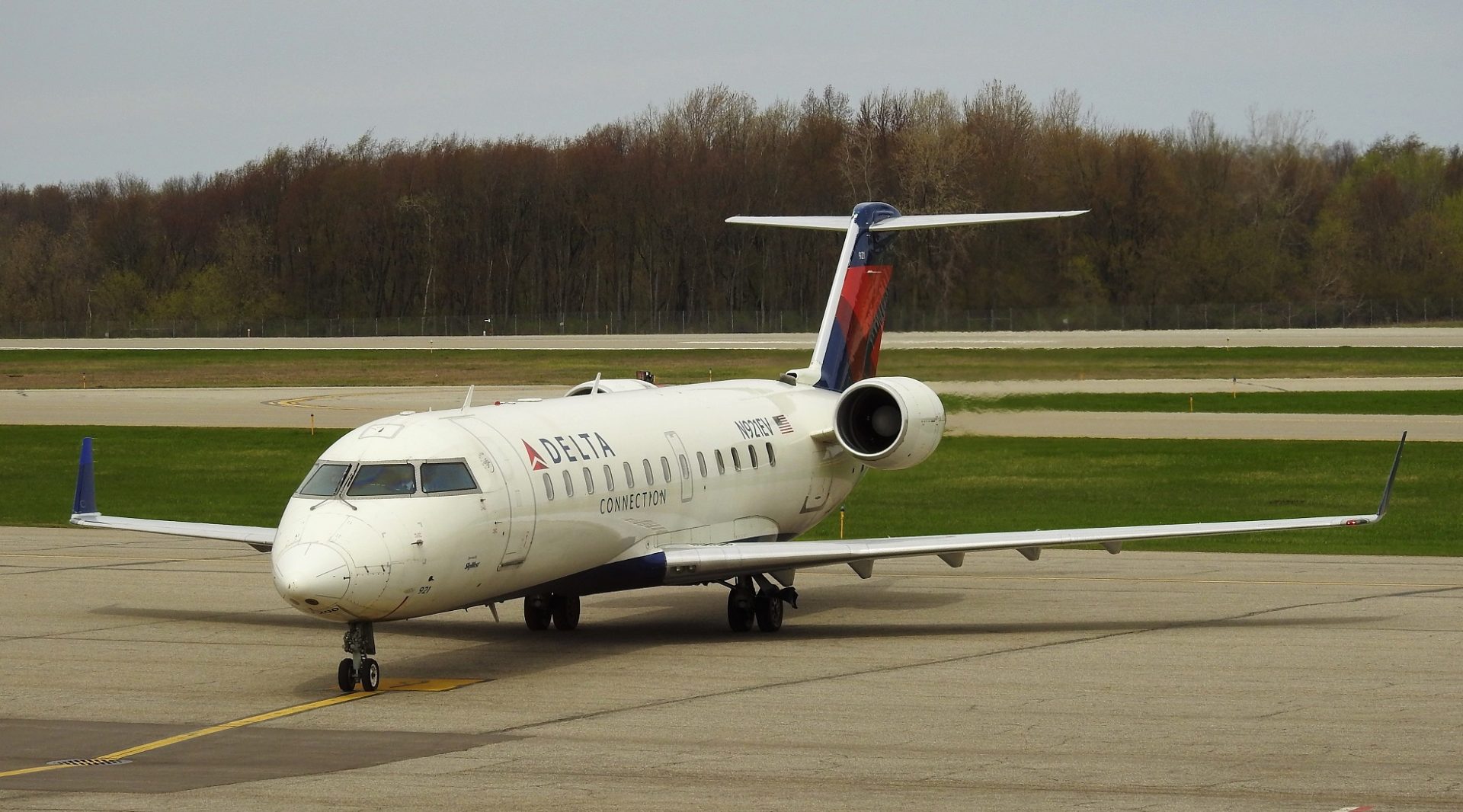
A Delta Connection CRJ-200 in Minneapolis/St. Paul (Photo: AirlineGeeks | Joey Gerardi)
Atlanta-based Delta Air Lines has made it through the pandemic without starting a single tag route. Other airlines such as United, American, Alaska, and others combined destinations into a single flight to save costs during the pandemic due to severely light passenger loads. SkyWest under the United Express banner combined many smaller EAS communities into a single flight routing this past spring when the airline began to struggle with the pilot shortage. A tag flight is when an aircraft makes a stop in the first city and continues to the next.
For example; United added a tag routing that started in Chicago O’Hare and went to Clarksburg, W.V. then Johnstown, Penn. and finally going onto Washington Dulles. This would use a single plane and crew from start to finish instead of using two different crews and aircraft going to Johnstown and Clarksburg separately. Up until this point, these tag flights with SkyWest have been entirely on the United Express side and Delta Connection has managed to avoid using them, but that will change come September.
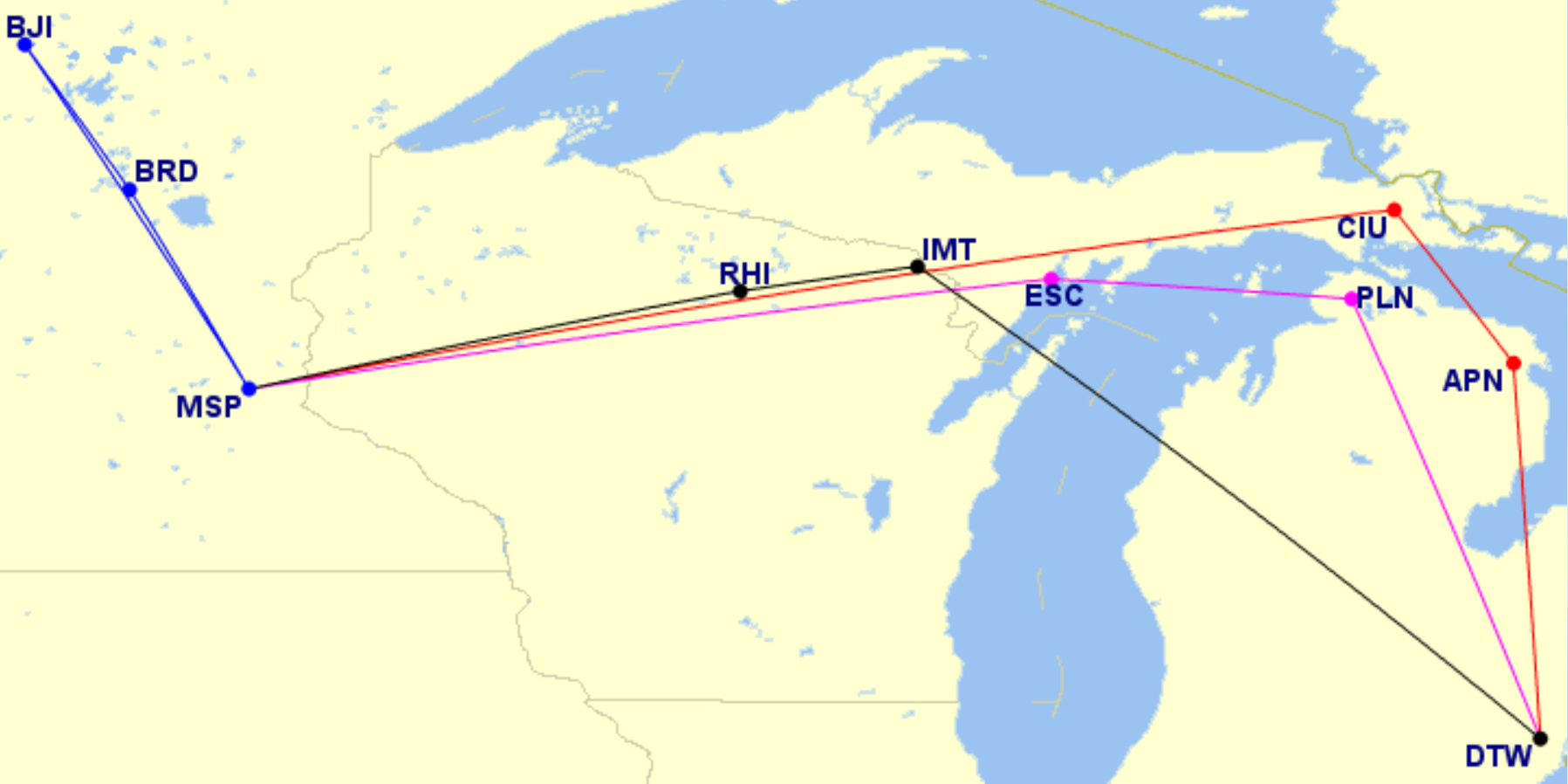
The new Delta tag flights will occur in the Midwest from either the carriers Detroit Metro or Minneapolis/St. Paul hub. Cities that will be affected include Pellston (PLN), Alpena (APN), Sault Ste. Marie (CIU), Iron Mountain (IMT), and Escanaba (ESC) all of which are in Michigan; Brainerd (BRD) and Bemidji (BJI) located in Minnesota, and Rhinelander (RHI) in Wisconsin. All of the non-hub destinations that are being affected also happen to be Essential Air Service cities.
A Delta Connection CRJ-200 (Photo: AirlineGeeks | Joey Gerardi)
An interesting fact is that due to these all being EAS communities, the carrier that holds the contract and operates these flights, SkyWest, is supposed to file a proposal to alter air service with the Department of Transportation and then they have to approve it. This proposal has yet to be seen on regulations.gov which is the public website to which all of the EAS documents are posted, despite these new tag flights being scheduled to begin in just over a month.
Current Service Communities Receive
Until the change occurs in September, these are the current service offerings for the communities that will eventually be affected:
Alpena and Pellston both receive two daily nonstop flights to Detroit Metro on most days of the week.
Sault Ste. Marie receives one daily nonstop from Detroit which arrives around 11 P.M. and departs in the early morning, as well as one daily nonstop to Minneapolis/St. Paul that occurs in the late afternoon around 4 P.M.
Escanaba receives one daily nonstop from each Detroit and Minneapolis. Detroit departure is early morning and the Minneapolis departure is around 4 P.M. you can connect through this community going west from Detroit to Minneapolis on the same aircraft
Iron Mountain also receives one daily flight from both Detroit and Minneapolis. The Detroit departure is around 5:30 P.M. and the Minneapolis departure is around 11 A.M. due to the timing of the flight, you can connect in this community in either direction between Detroit and Minneapolis. This community you may recognize as I did connect here last fall, the trip report of which can be found HERE.
Rhinelander, Wis. Brainerd, Minn., and Bemidji, Minn. all receive two daily nonstop flights to Minneapolis.
The current service to the eight EAS communities (Screenshot: GreatCircleMapper)
The Service Changes
Each of the eight EAS communities listed will either be losing or gaining something as far as service goes, whether it’s a frequency or destination. All of the following changes will occur starting September 12, 2022, have no end date specified, and are operated onboard SkyWest CRJ-200s.
Brainerd and Bemidji, Minnesota
Brainerd will be the only city that has no obvious effect from these changes, they will still receive two daily nonstop flights to Minneapolis on most days of the week. The only change is the first flight of the day will now depart just over an hour later, leaving at 7:15 A.M. instead of 6:10 A.M.
Bemidji will be losing one of their nonstop flights going down to just a single nonstop in the evenings. They will have a second flight in the early morning, but it will depart two hours earlier than it currently occurs at, and will occur at 6 A.M., and will have an intermediate stop in Brainerd on the way to Minneapolis, this also means the late night arrival into Bemidji will stop at Brainerd first. If someone wishes to they can book a flight solely between Bemidji and Brainerd in the mornings, but the late flight between the two small communities isn’t bookable.
The bookable flight on Delta.com between Bemidji and Brainerd (Screenshot: AirlineGeeks | Joey Gerardi)
Rhinelander, Wisconsin and Iron Mountain, Michigan
This is where it gets interesting, Rhinelander will still have one daily nonstop from Minneapolis but they will also be gaining one-stop same plane service to the Detroit hub with an intermediate stop in Iron Mountain. This does come at the disadvantage of Iron Mountain as it will be losing the one daily nonstop flight to Minneapolis, which will now make an intermediate stop in Rhinelander first.
Here is the flight schedule for the two communities.
Rhinelander and Iron Mountain (AirlineGeeks | Joey Gerardi)
Another interesting point to note is that the flight between Rhinelander and Iron Mountain will become the shortest flight in Delta’s entire network, coming in a 67-miles. This will overtake the current record holder Lansing to Detroit, which sits at 74-miles. Unlike the two communities in Minnesota, you can book a flight in either direction between the two communities if you want to fly on the airlines shortest flight.
Alpena and Sault Ste. Marie, Michigan
Another case of one wins and one looses, Alpena will loose one of its daily nonstop flights to Detroit but they will gain one-stop same plane service to Minneapolis with an intermediate stop through Sault Ste. Marie which is located in Michigan’s Upper Peninsula. Meanwhile Sault Ste. Marie already has one nonstop a day to each Detroit and Minneapolis, but the Detroit flight will now be converted into a one-stop flight through Alpena.
Alpena and Sault Ste. Marie (AirlineGeeks | Joey Gerardi)
Just like the previous two, you can book the short hop between the two EAS communities in either direction
The bookable flight on Delta.com between Alpena and Sault Ste. Marie (Screenshot: AirlineGeeks | Joey Gerardi)
Escanaba and Pellston, Michigan
The final two cities have a very similar flight schedule and path as Alpena/Sault Ste. Marie with planes for both tag routes in the air at the same time. As was the same case with the previous two, one of these communities is located in Michigan’s lower peninsula and one is in the Upper Peninsula. Pellston will be losing one of its nonstop flights to Detroit, but in exchange, it will be gaining one-stop same-plane service to Minneapolis with a stop in Escanaba. Escanaba, however, will be losing its nonstop link to Detroit and the plane will now be making a stop in Pellston, but will retain its one nonstop flight to Minneapolis.
Escanaba and Pellston (AirlineGeeks | Joey Gerardi)
And just like all of the other tags with the exception of Brainerd/Bemidji, you can book the flight just between Pellston and Escanaba on the carrier’s website.
Conclusion
As mentioned earlier. all flights will be flown on CRJ-200s that are operated by SkyWest. All schedules and flights mentioned in this article are subject to change especially since the carrier has yet to file a proposal to have alternate service offerings with all of the communities mentioned being in the EAS program. These eight cities are the only ones appearing to have tag flights so far on the airline’s schedule, but this article will be updated if more to pop up for the Sept. 12 start date with Delta Connection.
While flights between the communities is definitely a fun trip, another AvGeek aspect of this could be the desire to fly between the two Delta hubs connecting in two communities along the way.
The service changes come Sept. 12, 2022 (Screenshot: GreatCircleMapper)
Joey has always been interested in planes for as long as he can remember. He grew up in Central New York during the early 2000s when US Airways Express turboprops ruled the skies. Being from a non-aviation family made it harder for him to be around planes and would only spend about three hours a month at the airport. He was so excited when he could drive by himself, the first thing he did with his driver's license was get ice cream and go plane spotting for the entire day. He graduated from Western Michigan University in 2022 with a B.S. in Aviation Management & Operations and a Minor in Business, and currently works for a major airline in his hometown.
Dash Air Shuttle's Cessna 402's in Port Angeles, Wash. (Photo: Dash Air Shuttle)
Dash Air Shuttle announced on July 27, 2022, that the company would be delaying the launch of flights due to a DOT complaint filed by Kenmore Air. The company announced its inaugural date less than a month ago from the latest delay.
The Tukwila, Wash-based company has suspended ticket sales and would refund all previously-purchased tickets. In the meantime, the airline is urging community members to comment on DOT’s website. So far, the docket has received more than 200 overwhelmingly supportive comments in Dash’s favor.
The complaint
Kenmore Air’s complaint is mainly around two points.
Financial Fitness
The first is that the newly founded airline is not fit for providing commuter air services under DOT regulations. While Dash likely achieved all necessary safety certificates from FAA for starting service, Kenmore is focusing on financial fitness. The complaint suggests that the company lacks economy fitness approval from the Office of the Secretary of Transportation.
The fitness in question seems to be Commuter Air Carrier authority according to 49 USC 41102 and 14 CFR 201. The regulation dictates that an operator operates “small aircraft” and carries passengers on at least five round-trip flights per week on at least one route to acquire a Certificate of Public Convenience and Necessity or a Commuter Air Carrier Authorization. The startup airline’s proposed service uses a 9-seat Cessna airplane and includes 25 round-trip flights per week.
Kenmore Air’s Commuter Authority. (Photo: DOT)
A brief search on regulation.gov did not return a commuter air carrier authority for either Dash Air Shuttle or its operational partner, Backcountry Aviation. While the investigation was not comprehensive and did not mean the parties failed to meet the regulation, it was easy to return Kenmore Air’s application for said authority in contrast.
Interstate Operation
The second issue cited by the Kenmore, Wash-based airline is the nature of the new air service. The airline cited Dash’s interview stating the service’s benefits in connecting to interstate and international services. In its view, Dash’s announcements constitute false advertising because it cannot provide interline agreement on interstate routes.
On a more confusing note, although the latest regional airline will only fly between Seattle and Port Angeles, Wash, which is intrastate, Kenmore argues the operation is interstate because Dash markets it on the internet. The complaint further added that selling tickets to out-of-state residents also violate the interstate rule.
The competition
A Kenmore Air airplane in front of the Space Needle. (Photo: AirlineGeeks | Fangzhong Guo)
The main reason Kenmore Air lodges this complaint is that the airline believes Dash Air’s business practice will bear competitive harm to itself.
The float-plane-focused airline pulled out from Port Angeles in 2014 and has previously turned down the city’s request to restart service. Therefore there is no direct competition between the two regional airlines.
There are, however, still a few potential reasons for Kenmore Air to view Dash Air Shuttle as a competitor. Kenmore Air offers charter service in the Pacific Northwest and may potentially lose the lucrative charter flight opportunity between the peninsula and Seattle. Secondly, Port Angeles is the gateway to Olympic National Park, one of Seattle’s top weekend getaway destinations. Kenmore Air’s route network centers around the San Juan Islands, another of Seattle’s top short getaway destinations. The new service can potentially divert passengers.
What now?
While a complaint doesn’t usually necessitate flight cancellations, the startup airline decided to do so to protect its customers. However, this may also protect the company from disciplinary measures by the DOT should the department side with the complainant.
The young airline is preparing responses to the DOT. In the meantime, travelers will need to remain patient. Even though most people want to bring service back to this community, it might be months before it takes off.
Fangzhong grew up near an OEM airport in northeastern China, where he developed his enthusiasm for aviation. Taking upon his passion, he's now working as an aircraft interior design engineer. Besides working in the aerospace industry, Fangzhong enjoys trying out different types of airplanes and seeing how airplane interiors have evolved. So far, he's flown on over 80 types of aircraft. He also planespots in his spare time. His rarest catches included the 747 Shuttle Carrier Aircraft and AN-225.
Air France-KLM Sees Strong Second Quarter Despite Operational Challenges
An Air France 787-9 begins its takeoff roll at Paine Field. (Photo: AirlineGeeks | Katie Zera)
Operational difficulties arose in Europe and the United States, mainly due to labor shortages at airports, lots of flight cancellations and understaffed airports grappling with mountains of lost luggage. According to Business Insider over the past seven years, 2022 had the highest percentage of delayed flights (19 percent) and the highest percentage of canceled flights (4 percent), excluding 2020.
Despite these problems, however, according to American Express, 74% of respondents are willing to book a trip for 2022 even if they might have to cancel or modify it later and 62% of respondents agree that they plan on taking 2-4 trips in 2022. Due to these very positive results on tourism, many airlines and airports have recorded higher profits than in pre-pandemic periods. This is the case of Air France – KLM French-Dutch holding company based in Tremblay-en-France, which released last July 29 its results for the second quarter of 2022 with excellent results.
Air France and KLM are among the most active airlines to accommodate the travel recovery, with a second-quarter capacity for network passenger activity at an index of 82%. The yield environment should remain high for the rest of 2022 (significantly positive in the third quarter), for the first time since 2019, with a strong summer demand resulting in yield levels above 2019.
According to the Air France – KLM report, in response to rising fuel prices and other external costs, the group made several fare increases during the first half of the year on all long-haul flights, depending on destination and class of travel. In addition, increased travel demand, the strong performance of premium services, and a solid recovery in corporate traffic led to performance above the 2019 level in the second quarter.
During the second quarter, Air France added three Airbus A350-900s and two Airbus A220-300s while KLM phased in three Embraer 195 E2s. One 777-200, one Airbus A320, three Airbus A319s, two Embraer 170s, and five Canadair Jet 1000s were phased out. The Group will continue to introduce new generation aircraft into its fleet to improve its economic and environmental performance.
As of June 30, 2022, the Group has a strong 11.9 billion euros of liquidity and credit lines at its disposal. Net income amounted to 324 million euros in the Second quarter of 2022, an increase of 1.8 billion euros compared to 2021. The capacity in Available Seat Kilometers (ASK) was 69.4% higher than last year.
Very peculiar to note how Cargo capacity, compared to the pre-COVID 2019 year, in the second quarter was still 8% lower than in 2019. However, thanks to high demand, total revenues in the second quarter of 2022 were 76 percent higher than in 2019.
As for Transavia, an airline of the Air France – KLM group, it is evident that seasonal tourist traffic is increasing sharply but the Operating result was slightly negative at -18 million euros, although improved by 80 million euros compared to the Second quarter of 2021. The fleet of Transavia is approaching 100 aircraft, to further capture the strong demand of leisure traffic in Europe.
Vincenzo graduated in 2019 in Mechanical Engineering with an aeronautical curriculum, focusing his thesis on Human Factors in aircraft maintenance. In 2022 he pursued his master's degree in Aerospace Engineering at the University of Palermo, Italy. He combines his journalistic activities with his work as a Reliability Engineer at Zetalab.
A Lufthansa A350 taxis in Munich. (Photo: AirlineGeeks | Fabian Behr)
After a week of operational chaos for the Lufthansa Group due to a ground crew strike that on 27 July led to the cancelation of over 1,000 flights affecting over 130,000 passengers all around Europe, more trouble may be on the horizon for the German company.
A consultation among all the pilots associated with the Vereinigung Cockpit (VC) Union on Sunday revealed that an overwhelming majority of members are in favor of industrial action to obtain “a modern and fair, internationally competitive remuneration structure” said the VC’s negotiator Marcel Groels in an email to BNN Bloomberg.
Walkouts have not been immediately planned, but they could start as early as next week while Lufthansa and all other European airlines are fighting labor shortages at the biggest airports in the Continent and holiday travel is in full swing as passenger numbers continue to rebound strongly after two years of low demand due to the COVID-19 pandemic.
Labour Issues Piling on Operational Chaos
Endless security lines snarling outside airport terminals, piles of undelivered bags clogging arrival areas and mass cancelation to cope with lower-than-expected staffing rates in ground handling departments and at security checkpoints are just some of the problems plaguing airports in Europe and around the world as passenger demands recovered stronger than expected for the 2022 summer season.
Lufthansa has already cut more than 7,000 flights during this current season to cope with these difficult operational circumstances and could be bracing for more disruption as labor negotiations heat up. Pilot’s union VC is demanding a 5.5% pay raise this year for its members and an automatic inflation compensation thereafter, the Globe and Mail reports. Its requests also include a uniform pay structure including all the divisions of the Lufthansa Group, including also its budget carrier Eurowings and the recently created long-haul leisure carrier Eurowings Discover.
Salaries and wages are usually the biggest cost item for airlines and one of the most common strategies to keep it under control is to create separate divisions where younger crewmembers with lower salaries and benefits are hired to operate the flights for the group’s budget carriers. This could lead to colleagues working side by side performing a similar role with significantly different salary schemes and seniority privileges, which can be a significant source of internal tension.
Another airline of the Lufthansa Group, Swiss International Air Lines, has seen its pilots overwhelmingly reject a contract renewal proposal to a labor contract that expired in April, adding another labor front that will require the management’s attention during this already tumultuous period. “If management continues not to recognize the signs of the times and does not immediately offer adequate solutions, then the pilots must show the management even more clearly how dissatisfied they are,” the Swiss labor union Aeropers said on Sunday to the Globe and Mail.
Vanni fell in love with commercial aviation during his undergraduate studies in Statistics at the University of Bologna, when he prepared his thesis on the effects of deregulation on the U.S. and European aviation markets. Then he pursued his passion further by obtaining a Master’s Degree in Air Transport Management at Cranfield University in the U.K. followed by holding several management positions at various start-up carriers in Europe (Jet2, SkyEurope, Silverjet). After moving to Canada, he was Business Development Manager for IATA for nine years before turning to his other passion: sports writing.
Sign-up for newsletters & special offers!
Get the latest stories & special offers delivered directly to your inbox