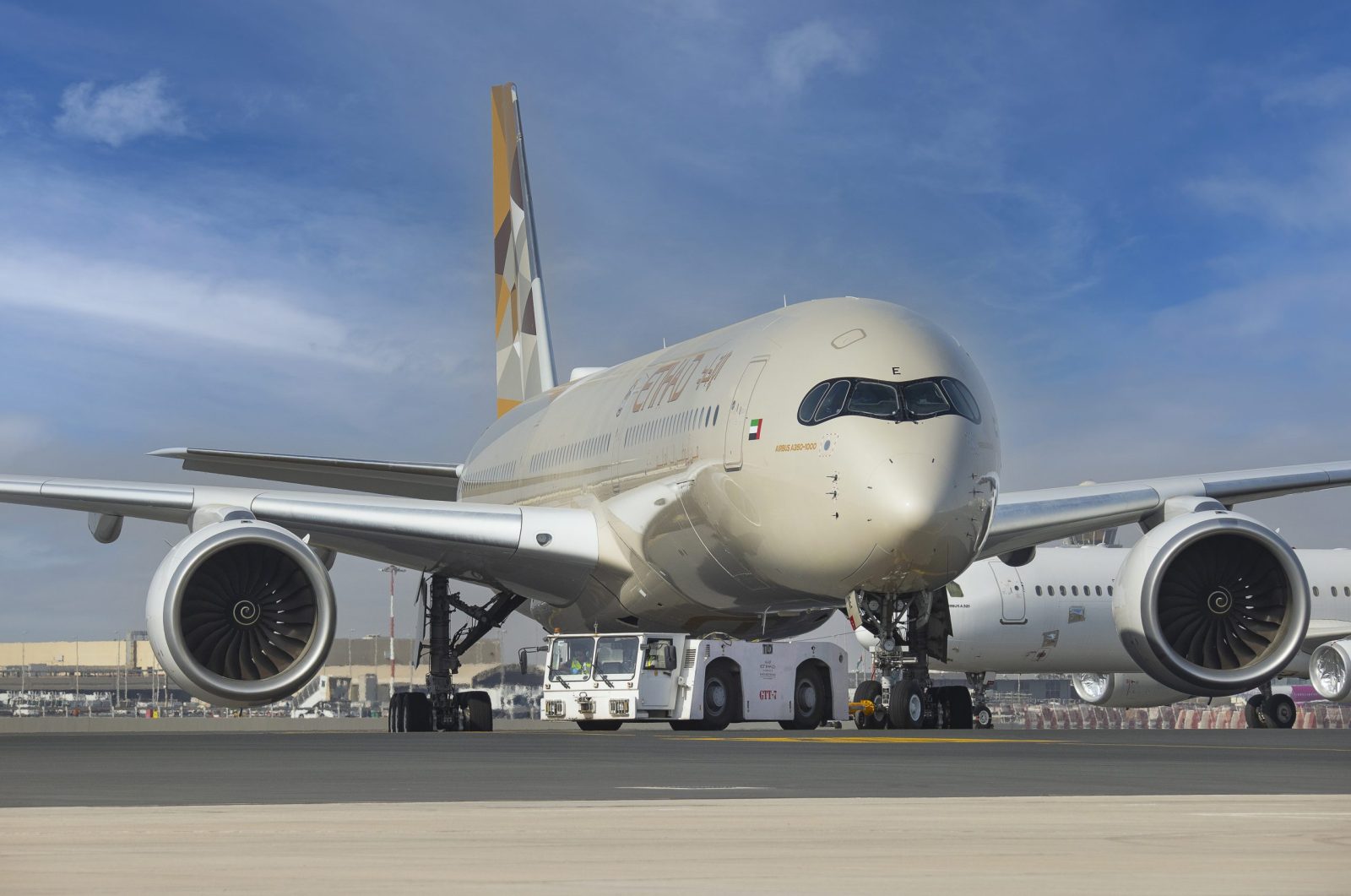
Etihad Airways' new A350-1000 aircraft. (Photo: Etihad Airways)
On 30 June 2022, Etihad Airways celebrated the arrival of its new Airbus A350-1000 (one of five new Airbus A350s to join Etihad’s fleet this year) in the United States, with 371 passengers, following the inaugural commercial flight from Abu Dhabi International Airport (AUH) to New York’s John F. Kennedy International Airport (JFK).
The Airbus A350 XWB is a twin-engine, low-wing airliner made by the European multinational Airbus. Intended for long-haul routes, it features a wide-body configuration, and it is one of the most efficient aircraft types in the world, with a 25 percent reduction in fuel consumption and CO2 emissions compared to previous generation twin-aisle aircraft. Developed from the A330 and A340 families, it was then redesigned with a wider fuselage (hence the name “XWB,” eXtra Wide Body) to meet customer demands.
The Airbus A350 is an aircraft of great interest in commercial and cargo aviation because of its sustainability features. Many airlines have chosen it recently, including Etihad, which, in 2021, formed a partnership with Airbus and Rolls Royce called “the Sustainable50 program”, will use Etihad’s A350s as a flying testbed for new initiatives, procedures and technologies to reduce carbon emissions.
From July 1, all Etihad flights servicing New York and Chicago O’Hare International Airport will be operated by the A350s.
The Airbus A350 aircraft features Etihad’s newest cabin interior, inspired by the shadows cast by Abu Dhabi’s palm trees and is more efficient and sustainable in design. The cabin lighting emulates natural ambient light and is designed to enhance the guest experience, provide an optimum environment for sleeping and reduce the effects of jetlag. Mobile and Wi-Fi connectivity is also available throughout the aircraft.
The aircraft has a two-class configuration, Business and Economy. The Business class is home to 44 Business seats with sliding doors that provide a high level of privacy to each suite and a width of over 20”. Each seat converts into a fully-flat bed of 79” in length and faces forward directly aisle access. Etihad’s spacious Economy cabin is configured with 327 smart seats in a 3-3-3 arrangement, of which 45 ‘Economy Space’ seats have been enhanced with an additional 4 inches of legroom. Guests receive blankets and pillows for additional comfort and amenity kits on longer flights.
Etihad Airways’ new Business offering. (Photo: Etihad Airways)
Etihad passengers traveling to the US have access to Etihad’s US pre-clearance, the only United States Customs and Border Protection facility in the Middle East. This allows passengers bound for the United States to process all immigration, customs and agriculture inspections in Abu Dhabi before they board their flight, avoiding immigration and queues on arrival in the US.
Etihad continues its partnership with Airbus aircraft and confirms its interest in the Airbus A350. Back in February at the Singapore Airshow, Etihad had already become the newest customer for the Airbus A350F (seven A350F freighters ordered), focusing on the future of the widebody freighter market.
Vincenzo graduated in 2019 in Mechanical Engineering with an aeronautical curriculum, focusing his thesis on Human Factors in aircraft maintenance. In 2022 he pursued his master's degree in Aerospace Engineering at the University of Palermo, Italy. He combines his journalistic activities with his work as a Reliability Engineer at Zetalab.
Those that have read my stories and interviews know that I love out-of-the-way or unique airlines, especially the smaller ones that still fly propeller-driven aircraft. So, I was very excited to hear that there would be another airline and brand that I could fly and use a relatively new aircraft type, the Italian-made Tecnam P2012.
Marianas Southern Airways will have a route network within the Commonwealth of the North Mariana Islands, or CNMI for short, and will fly four routes using a new aircraft type for the airline. AirlineGeeks once again had the pleasure of talking to Keith Sisson, the Chief Marketing Officer of Southern Airways Express, about their newest brand and the continual expansion of the Southern Airways name.
AirlineGeeks (AG): You will be the first major commuter airline to serve most of these routes since Cape Air ended its ATR service back in 2018. What led SAE to announce service to these destinations and start a new base so far away from current operations?
Keith Sisson (KS): The only airline providing service throughout The Marianas abruptly ceased operations for a brief time in December of last year. This caused a great deal of panic and concern throughout the island chain. As a result, a group of local business and community leaders started looking for alternative solutions. One of the business leaders has been developing a plan to bring 757 passenger services to Saipan from large Asian and Pacific markets. His group pivoted from those plans in hopes of first finding a solution to the inter-island air service problem. They wanted a partner that had the resources to start immediately, as well as a partner with experience operating within island communities. They noticed what we were doing with our Mokulele brand in Hawaii and reached out. Upon hearing their pitch and then visiting the region, we felt this was a natural fit for our operation.
The route map for Marianas Southern Airways (Map: Southern Airways)
(AG): Why did you select the Tecnam P2012 for these new operations?
(KS): We looked at several aircraft types, including the Cessna Grand Caravan which operates an overwhelming majority of our routes. Ultimately, however, we decided that the Tecnam P2012 Traveller is the best fit for this particular mission due to its ability to efficiently operate on very short routes. Also, we felt very strongly that it was important to operate the flights in this region on new aircraft, and Tecnam had several new Travellers available for immediate purchase.
(AG): Tinian is a route that was never flown by Cape Air, how do you plan on accommodating this island/destination in a way that Cape Air couldn’t?
(KS): We see this as being very similar to our Molokai market in Hawaii. Quite a few airlines have tried and failed to operate service from Molokai in the last 10-12 years, most recently, Ohana by Hawaiian. The driving factor is gauge. There are simply not enough people, and there is not enough demand, to run large aircraft in these markets. Cape’s ATR service was simply too much lift for Tinian. Operating 9-seat aircraft allows us the flexibility to scale-up service during peak travel times and pull back service when there is little demand. This is the key to being successful in the CNMI, we will get high load factors by adjusting frequency on an as-needed basis.
(AG): A lot of those routes will be used by locals commuting throughout the islands, will you be starting a frequent flyer program for these individuals?
(KS): We will extend our “21st Century e-Ticket book” concept to this market that we have deployed in New England and Hawaii. This allows for frequent travelers to pay in advance and receive a discount based on the amount they place on deposit. Members who participate in this program also receive other benefits like free change fees and free bags.
(AG): What will be the daily frequency for each route?
(KS): Initially, we will be offering 66 weekly departures [within the Marianas Islands], with at least double-daily service on most routes. Some routes will start with three or four departures. Ultimately, we intend to grow to over 120 weekly departures, based on demand, of course.
(AG): Being so far from your other current destinations you’ll have to open a new base, where will this be located?
(KS): Our local headquarters for the region will be in Saipan, while dispatch will be based at our Regional Operations Center in Kona, and crew/aircraft scheduling at our Global Operations Center in Palm Beach.
(AG): Will flights here be sterile (TSA) or non-sterile (no TSA)?
(KS): All flights will be operated non-sterile, just like in Hawaii.
Mokulele’s non-sterile terminal in Honolulu (Photo: AirlineGeeks | Joey Gerardi)
(AG): You currently are partners with United Airlines and they operate a hub in Guam, will you offer UA interline/codeshares on routes throughout the commonwealth?
(KS): This is very exciting…Yes! This is a very big deal for locals and visitors alike. Currently, when you fly into Guam, you must stay overnight before you can continue to the CNMI. The same-day connections will be very popular!
As a side note, since this interview took place, United Airlines announced they would begin flights from Tokyo-Narita to Saipan on Sept. 2, 2022. This means passengers heading to/from Tinian can now get to Asia with just a single stop in Saipan on a single itinerary between the two airlines.
(AG): So, this brand will be part of the Southern Airways Express family?
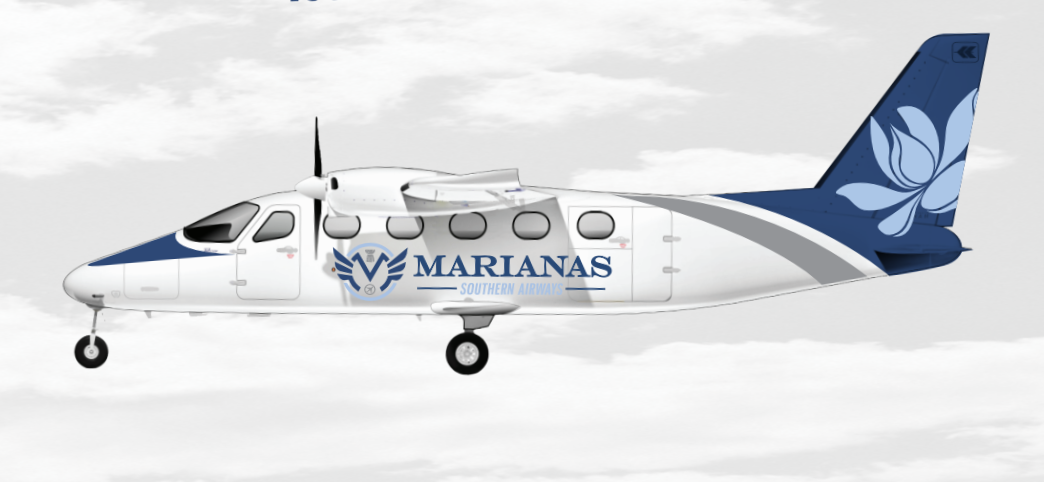
(KS): Yes, we are unveiling a new brand for this region. Very much like Mokulele is a unique brand under the Southern umbrella in Hawaii, the brand in this region will be ‘Marianas Southern Airways’. We felt it very important to include the local name and local icons in the branding. The colors and tail logo will be similar to Southern/Mokulele.
The new brand for the CNMI flights (Photo: Southern Airways)
(AG): So, with operations in the Marianas Islands, Hawaii, and every time zone on the mainland United States, this means the sun will never set on Southern Airways operations (i.e. 24hrs a day). Will this pose any challenges operationally or logistically?
(KS): You bring up a great point! The CNMI is located on the other side of the international dateline. This means that the first departure each day from American soil will begin with Sothern’s Marianas-branded departure from Saipan AND that the very last flight landing each day on American soil may very well be Southern’s Mokulele-branded flight, which will land just before midnight Hawaii Standard Time. America’s flight day will begin and end with Southern Airways!
As far as operational challenges, our customer service center is already a 24-hour operation. We have dispatch offices, maintenance hotline responders, and company leadership in both the Eastern and Hawaii time zones. Because of this, we are already a round-the-clock operation. By the time I am going to sleep in Kona, Hawaii, Stan Little, Southern’s CEO, is waking up in Palm Beach!
(AG): When will flights on each route begin?
(KS): We haven’t announced an official start date yet, but it will be in the month of July.
(AG): The Tecnam isn’t a large aircraft made for long-haul flights, how will you be getting the aircraft out to Guam and the Commonwealth?
(KS): The Tecnams will be flying a world tour! They will leave Italy already painted with our livery and cross the Atlantic, eventually arriving at our Lancaster, Pennsylvania maintenance facility to undergo FAA conformity. Then, the aircraft will travel across the country to our LAX hub, ferry to Hawaii, and then on to Saipan.
Since the time of this interview was conducted, the first Tecnam P2012 Traveller wearing the Marianas Southern Airways livery was ferried across the Atlantic Ocean between June 20 and 23, 2022. The route it took was Aberdeen (ABZ) to Reykjavik (RKV) to Narsarsuaq (UAK) to Goose Bay (YYR) to Bangor (BGR) and finally to Lancaster (LNS). The aircraft carries the registration of N503SA.
Marianas Southern Airways first aircraft (Photo: Southern Airways)
(AG): Your expansion into the Rockies and now this, what will this bring your total number of Southern Airways operated destinations and daily flights up to?
(KS): Including our acquisition of Air Choice One, our new EAS contract in Jackson, Tennessee, our new EAS contract in Show Low, Arizona, and this new expansion to the Commonwealth of the Northern Mariana Islands, we will be serving 48 cities with over 250 peak-day departures.
With this newest expansion, they will become the largest commuter airline in the United States, surpassing Cape Air in both number of daily departures and number of destinations served. In addition, with the expansion across the international dateline, this means the sun will never set on Southern Airways operations, another thing no commuter airline has accomplished since Cape Air served the CNMI back in 2018.
I would once again like to thank Keith Sisson for talking with me about their newest airline brand, and I am sure we will have another interview in the future.
Joey has always been interested in planes for as long as he can remember. He grew up in Central New York during the early 2000s when US Airways Express turboprops ruled the skies. Being from a non-aviation family made it harder for him to be around planes and would only spend about three hours a month at the airport. He was so excited when he could drive by himself, the first thing he did with his driver's license was get ice cream and go plane spotting for the entire day. He graduated from Western Michigan University in 2022 with a B.S. in Aviation Management & Operations and a Minor in Business, and currently works for a major airline in his hometown.
Lufthansa Group Cites ‘Operational Challenges’ As More Flights Suspended
A Swiss Airbus A220 in Frankfurt.
(Photo: AirlineGeeks | Fabian Behr)
The European summer season ramps up further next week with the beginning of school holidays in a number of countries. It has been well documented that aviation has been facing significant challenges in recommencing services with operational pressures on staff numbers and the continuation of degrees of travel restrictions in some countries.
The Lufthansa Group acknowledged these challenges to its customers this week with an email from the Executive Board. The statement read: “As the Northern Hemisphere summer begins and with global travel restrictions now almost all lifted, everyone involved in aviation worldwide is reaching almost daily the limits of the resources that are currently available. And the ramp-up of the complex air transport system from almost zero to now almost 90 percent is clearly not proceeding with the reliability, the robustness and the punctuality that we would like to offer you again.”
As a result, German-based Lufthansa is removing about 2200 flights from its schedule and fellow Lufthansa Group airline SWISS is removing a further 674 flights between August and October. The Local Swiss news site reports that the latest flight suspensions are in addition to those removed from schedules on 08 June. The airline is cited as saying: “Further cuts, unfortunately, cannot be avoided due to resource constraints and operational challenges across the airline industry.”
Lufthansa Group advised passengers that “too many employees and resources are still unavailable, not only at our infrastructure partners but in some of our own areas, too. Almost every company in our industry is currently recruiting new personnel, with several thousand planned in Europe alone. However, this increase in capacity will only have its desired stabilizing effect by the time winter comes.”
The apology to customers by the Executive Board mentioned that the war in Ukraine was also contributing to the issues that airlines are experiencing and that “the situation is unlikely to improve in the short term.” SWISS also added: “We very much regret the further flight plan adjustments that have become necessary and expressly apologize to the passengers affected and our partners for the inconvenience caused as a result.”
The recently announced cuts for SWISS account for approximately two percent of the total scheduled flights. A mix of short-haul and long-haul services is expected to be affected with flights to Dubai and Johannesburg cut. The Local also reports that some U.S. flights will also be affected through the destinations were not immediately confirmed.
The Lufthansa Group Executive Board concluded the communication to customers by stating: “We are doing our utmost to again offer you the quality, the punctuality and the reliability that you can rightly expect from your Lufthansa Group airlines as soon as we possibly can.”
John has always had a passion for aviation and through a career with Air New Zealand has gained a strong understanding of aviation operations and the strategic nature of the industry. During his career with the airline, John held multiple leadership roles and was involved in projects such as the introduction of both the 777-200 and -300 type aircraft and the development of the IFE for the 777-300. He was also part of a small team who created and published the internal communications magazines for Air New Zealand’s pilots, cabin crew and ground staff balancing a mix of corporate and social content.
John is educated to postgraduate level achieving a masters degree with Distinction in Airline and Airport Management. John has held the positions of course director of an undergraduate commercial pilot training programme at a leading London university. In addition he is contracted as an external instructor for IATA (International Air Transport Association) and has been a member of the Heathrow Community Fund’s ‘Communities for Tomorrow’ panel.
A KLM 737-800 aircraft
(Photo: AirlineGeeks | Fabian Behr)
KLM Royal Dutch Airlines completed the repayment of the last part of the loan it had agreed with the Dutch State and private banks in 2020. With the repayment of 277 million euros, the Netherlands’ largest airline finally returned the amount received as part of the aid package to cope with the complications unleashed by the pandemic.
Like many other airlines, KLM relied on financial support from public sources to sustain its capacity during downturns.
Of the 3.4 billion euro credit line, the company drew down a total of 942 million euros. By the beginning of the year, it had completed two repayments. Increased demand for air travel, the cessation of mobility restrictions and greater efficiency in its cost structure made the repayment possible, KLM said.
The company repaid the full 665 million euros from banks in three stages. It paid 311 million euros on May 3 and a further 354 million on June 3. All that remained was to complete the repayment of 277 million euros to the Dutch State.
In an official statement, the company said it is “very grateful to the Dutch government and the banks for their support.” The text adds that “with this step, KLM demonstrates that it takes its responsibility and keeps its promises to financiers, government and society.”
Pieter Elbers, CEO of KLM, highlighted the work of all KLM employees during 2020 and 2021: “I would like to thank all KLM colleagues for this», he said. Furthermore, he assured that «the current operational situation at Schiphol is also tough and, again, demands a lot from our people and our customers.”
Prospects
While the airline industry has been showing definite signs of recovery for months now, KLM has decided to maintain its credit line for the foreseeable future. Rising inflation levels, increasing fuel costs and other input prices, along with geopolitical uncertainties surrounding the Russian invasion of Ukraine, maintain a veil of uncertainty over the state of the airline business in the coming months.
After completing the repayment of the money used, the company will continue to have a credit line of 2.4 billion euros (723 million from the government and 1.735 billion from Dutch banks). Despite this, current forecasts are positive in terms of available financial resources for the coming years.
This story was originally published by Agustin Miguens of Aviacionline in syndication with AirlineGeeks.
AirlineGeeks.com was founded in February 2013 as a one-person blog in Washington D.C. Since then, we’ve grown to have 25+ active team members scattered across the globe. We are all here for the same reason: we love deep-diving into the fascinating realm of the airline industry.
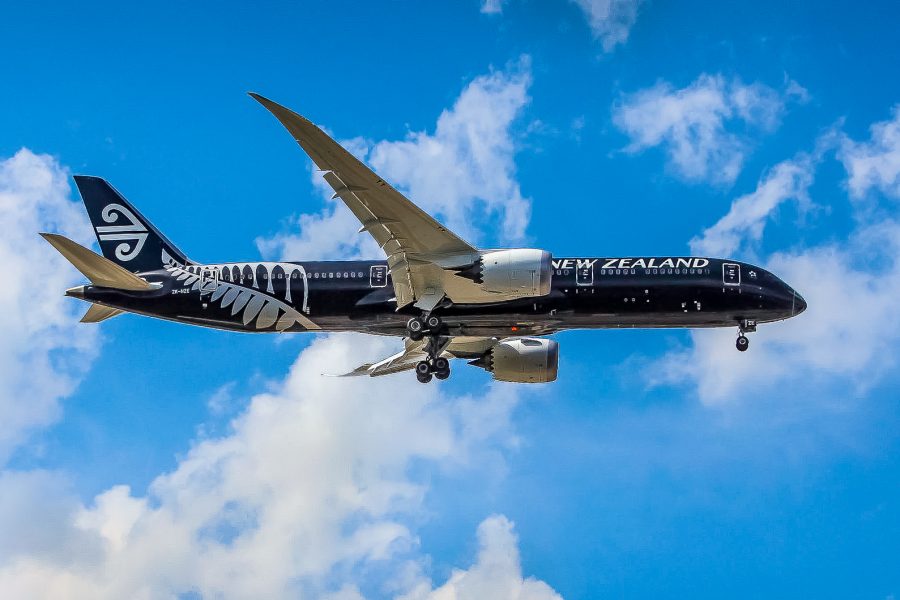
An Air New Zealand Boeing 787 Dreamliner landing in Houston. (Photo: AirlineGeeks | William Derrickson)
Air New Zealand unveiled its plan on Wednesday for completely redesigned cabins on its Boeing 787-9 Dreamliners, creating a much more comfortable experience for passengers on the carrier’s long-haul flights.
The announcement comes as a response to the airline’s “overwhelming amount of customer feedback on the importance of sleep and comfortability during its flights.”
The carrier states that the cabin, “will give customers more choice than any airline in the world, providing the best sleep in the sky regardless of the cabin customers choose to fly in.” The revamped cabins are set to enter service as early as 2024.
The geographical location of New Zealand creates an opportunity for the airline to operate many ultra-long-haul routes. Due to the length of some of these routes, a majority of the customers’ first day is spent onboard.
“We have zeroed in on sleep, comfort, and wellness because we know how important it is for our customers to arrive well-rested. Whether they are heading straight into a meeting, or to their first holiday hotspot – they want to hit the ground running” stated Air New Zealand Chief Executive Officer Greg Foran in a press release. “Research shows us the first night away from home is the hardest to get a good night’s sleep so everything we do on board is to help create a sense of calm.”
Air New Zealand will introduce many new options for travelers choosing to fly with the carrier. One feature that stands out is the self-proclaimed, “Skynest,” a sleep pod in the sky. The aircraft will feature six of these pods and will be an add-on for passengers seated in economy class, allowing them to reserve by the hour.
Air New Zealand’s ‘Skynest’ (Photo: Air New Zealand)
“We wanted to offer our Economy customers a lie-flat option and that’s how Skynest was born. It’s going to be a real game-changer for the economy travel experience,” stated Foran.
The carrier’s Dreamliners will retain its already established and successful “Skycouch” going forward. First introduced in 2019, the Skycouch is a reservation for an entire row of three, in which one can convert to a lie-flat bed. Additionally, one is provided with extra cushions, blankets, a special seatbelt enabling a comfortable sleep, and a mini mattress to lay flat on the seats for extra comfort.
Premium Economy will also enjoy a nice upgrade, allowing for more privacy, as well as the ability to recline further without interrupting the passenger behind them.
Air New Zealand’s Business Class passengers can choose from Business Premier or Business Premier Luxe. Business Premier includes a private pod, not only giving passengers more privacy but more comfortability allowing for a better night’s sleep. The seats include a retracting middle divider for passengers traveling with a companion.
Business Premier Luxe gives passengers the ultimate experience, offering the most space and privacy. Everything included in Business Premier is included in the Luxe package, with an added fully closing the door as well as space for two to dine throughout the flight.
The configuration of the cabins will include either four or eight Business Premier Luxe seats, 22 or 42 Business Premier seats, 33 or 52 Premium Economy seats, 125 or 213 Economy seats and six Skynest sleep pods on some ultra-long-haul aircraft.
Chase Hagl grew up in Twin Falls, Idaho. His love and passion for Aviation landed him in Orem, Utah where he obtained a B.S. in Aviation Management with a minor in Business Management from Utah Valley University. Chase currently works as a flight attendant in Charleston, SC and is also the primary Inflight ASAP ERC representative for startup airline, Breeze Airways. His experience in the aviation industry spans back four years, working in areas including agriculture application, customer service, maintenance, and flight ops. In his free time, Chase enjoys road biking, astronomy, and flying.
SKY Express Announces New Partnership with Emirates
A Sky Express A320neo parked in Larnaca. (Photo: Sky Express)
Greek airline SKY Express announced its new strategic partnership with Emirates. Under the agreement, customers of both airlines will have access to a wider network of destinations available through a single booking. The partnership joins others with Air France, KLM, Delta, Qatar Airways, American Airlines, Cyprus Airways, Condor, El Al, Middle East Airlines and Transavia.
Passengers travelling with Emirates from Dubai (DXB) and New York (JFK) to Athens Eleftherios Venizelos International Airport (ATH) will be able to connect to any of the 34 destinations served by SKY Express in Greece.
According to the Greek airline, the agreement will further boost the country’s already valued tourism market. The United Arab Emirates airline’s extensive network of destinations globally will help connect travellers from markets such as Australia, India, North America and Southeast Asia.
“The collaboration with Emirates proves to us in the best way that the systematic effort to establish SKY express in the international market as a reliable partner is effective,” commented Giannis Lidakis, the company’s Commercial Director. “We will continue to work in this direction by offering to more and more visitors from around the world the right conditions to enjoy the experience of our country’s unique destinations,” he added.
Recently, the company positioned itself as one of the leading operators in the Greek airline market. It has a fleet of ATR 42-500, 72-500, 72-600 and Airbus A320neo aircraft. It serves an important network of domestic destinations, mainly in the Mediterranean and the Aegean. In the rest of Europe, it offers scheduled services to Larnaca, Rome, Paris, Brussels and London.
This story was originally published by Agustin Miguens on Aviacionline in syndication with AirlineGeeks.
AirlineGeeks.com was founded in February 2013 as a one-person blog in Washington D.C. Since then, we’ve grown to have 25+ active team members scattered across the globe. We are all here for the same reason: we love deep-diving into the fascinating realm of the airline industry.
A Qantas Boeing 787 departing LAX. (AirlineGeeks | James Dinsdale)
Qantas — Australia’s national carrier — will begin flying between Perth, Australia and Johannesburg on Nov. 1 — fulfilling its long-harbored ambition to take on the 11-hour trek.
The flights will run three days a week on an Airbus A330 with 27 business suites and 224 economy seats, with the following schedule:
QF65 departs Perth at 3 p.m., to reach Johannesburg at 8:15 p.m. the same day.
Return flight QF66 from Johannesburg leaves at 10:00 p.m., arriving in Perth at 1:15 p.m. the following day.
The route was previously exclusive to South African Airways, although the beleaguered carrier stopped flying to Perth in early 2020, as the pandemic began.
Qantas cites the large South African community in Perth, as fueling demand for people visiting family and friends as well as business and leisure travelers. In addition, with its flights from Perth to London and Rome, Qantas also expects travelers from many other Australian cities to travel to Perth for their trip.
The airline’s existing Sydney-Johannesburg Boeing 787 Dreamliner service will not only remain but will also see a boost from four flights per week to daily as of Oct. 30.
It’s expected that Perth flights will depart from the same international wing of its Perth T3 terminal as used by non-stop services to London and Rome.
Qantas initially hoped to challenge South African Airways on the Perth, Australia-Johannesburg route in late 2018, with four direct Airbus A330 flights a week, running on a seasonal basis from November-March.
Meanwhile, the Flying Kangaroo also re-introduced flights from Perth to Jakarta, Indonesia for the first time, since borders closed in March 2020. From Nov. 30, the airline will begin with three flights per week on its Boeing 737 aircraft.
It is the first time that Qantas has operated the route, which will support the growing trade and tourism links between Australia and Indonesia.
The route is also expected to be popular with travelers connecting to other major, leisure cities such as Surabaya, Indonesia and Medan, Indonesia.
“Western Australia has become an increasingly important part of our international network and we’re excited to be launching two more routes from Perth,” Joyce said. “International travel demand continues to rebound as people make up for two years of closed borders. Our direct flights from Perth to London and Rome are solely strength, which gives us the confidence to add new routes from our western hub.
Speaking in Perth with Western Australian Premier Mark McGowan and Perth Airport CEO Kevin Brown, Qantas Group CEO Alan Joyce said the new routes marked a major expansion of the airline’s international network from Perth.
“Indonesia is a rapidly growing economy that’s home to more than 270 million people and these new flights will open up more trade and investment opportunities and a new gateway for travelers looking to explore Indonesia,” Joyce added. “There’s a big South African population that lives in Western Australia, and this will be great for people traveling in both directions to see family and friends. It will also help support the economic ties between Australia and South Africa.”
The addition of Johannesburg and Jakarta will mean Qantas will operate international flights from Perth to five destinations including London, Rome and Singapore.
Victor Shalton's love for aviation can be traced to when he was 11-years-old. As a seasoned aviation writer, he takes pride in providing the best aviation coverage around the globe and is passionate about advancing his skills in the aviation space. In addition, he loves travelling, writing, arts and while his speaking engagements have taken him around the world, he is proud to call Nairobi home.
Cathay Pacific's A350-1000 enters the gate at Dulles (Photo: AirlineGeeks | Ben Suskind)
Hong Kong-based airline Cathay Pacific is considering a possible renewal of its fleet, especially to strengthen its short and medium-haul services, Bloomberg reported. A new dispute between Airbus and Boeing could thus be triggered. “We are constantly looking at the fleet requirements,” assured Augustus Tang, the company’s CEO.
“We have not come up with a decision as to when we will be going to the market, but this is a topic we are looking at very closely,” he added. While no details were released on the possible number of aircraft to be ordered, he referred to the renewal as “crucial.”
Any possible order would have to take into account the airline’s expansion plans, in a context of recovery after having gone through the worst moments of the COVID-19 pandemic. The company’s projections are aligned with the expansion of Hong Kong International Airport (HKG), its main base of operations, which will add a third runway in 2024 and thus increase its operational capacity.
Cathay Pacific currently has a fleet of 234 aircraft serving its passenger and cargo divisions. In the widebody segment, Airbus aircraft account for 60% of the units operating regional and long-haul flights.
Airbus A330-300s and Boeing 777-300s provide much of the company’s capacity in the Australian, Indian and Southeast Asian markets. The average age of the fleet is starting to be a factor being analyzed by the company’s management and modernization is becoming a consideration.
A fleet renewal plan could include orders for aircraft such as the A330neo, A350 or 787 Dreamliner. In this regard, Tang said that “it will most likely be an Airbus or Boeing variant, or a combination of both.” On the other hand, he said that they are also considering the 737 MAX as an alternative.
The latest variant of the U.S. manufacturer’s popular model is an attractive option to complement the current Airbus A321neo fleet operated by Cathay Pacific. This is the first narrow-body aircraft operated by the company. Both aircraft offer lower operating costs and optimized efficiency for short and medium-range routes.
This story was originally published by Agustin Miguens on Aviacionline in syndication with AirlineGeeks.
AirlineGeeks.com was founded in February 2013 as a one-person blog in Washington D.C. Since then, we’ve grown to have 25+ active team members scattered across the globe. We are all here for the same reason: we love deep-diving into the fascinating realm of the airline industry.
A Lufthansa A380 parked after diverting to Austin. (Photo: AirlineGeeks | Mateen Kontoravdis)
When the COVID-19 pandemic struck the aviation industry in March of 2020, many carriers scrambled to send as many aircraft as they could to storage sites around the world in an effort to cut costs. Airlines looked first to the aircraft that they felt provided little value to them in times when passenger demand was at an all-time low.
This meant that many of the world’s Airbus A380s made their way over to Tarbes in France, Teruel in Spain and a newly constructed storage facility in Alice Springs, Australia to name a few. Only China Southern, Korean Air, and Emirates kept some of their A380 fleets operational.
Qantas A380s parked in storage at ComAv’s facility. (Photo: AirlineGeeks | William Derrickson)
This was until airlines saw demand for travel skyrocket. Airlines around the world are currently facing staffing, aircraft and high fuel costs as they try to meet demand that would be considered high in pre-pandemic years. The A380, when it was full to capacity, provided airlines with a way to transport around 525 passengers at once. Now, some airlines are bringing back the superjumbo with hopes it will help meet demand.
The Return of the Superjumbo
Qantas, who parked all 12 of its A380s in the California desert, said when the pandemic began that it wouldn’t need any of them for at least three years and now, just over two years later, the carrier says it will begin to return to service.
British Airways has already begun to fly the A380 again and plans to ramp up service over the coming months.
Asiana Airlines announced it would bring back its A380s within a month and Lufthansa announced on Monday that its A380s would make a return to service in 2023.
Executive Board Members of Deutsche Lufthansa AG told customers in a letter that: “In the summer of 2023, we not only expect to have a much more reliable air transport system worldwide. We will be welcoming you back on board our Airbus A380s, too. We decided today to put the A380, which continues to enjoy great popularity, back into service at Lufthansa in summer 2023. In addition to this, we are further strengthening and modernizing our fleets with some 50 new Airbus A350, Boeing 787 and Boeing 777-9 long-haul aircraft and more than 60 new Airbus A320/321s in the next three years alone.”
Lufthansa knows that demand for travel is only going to get stronger but that doesn’t mean it did not come as a surprise when the airline decided to bring back the A380. Many thought they were likely gone for good.
Air France retired its fleet of A380s saying costs to refurbish the aircraft would exceed 400 million euros.
Ezra Gollan is a student, photographer and aviation enthusiast based in New York, New York. He has spent over half a decade around New York City’s airports as a photographer.
Iberojet Inaugurates Flights Between Barcelona and Cancún
An Iberojet A350 (Photo: Bene Riobó, CC BY-SA 4.0 , via Wikimedia Commons)
At 10:08 p.m. local time on Sunday, the inaugural Iberojet flight arrived in Cancún from Barcelona. The first operation was carried out in an Airbus A330-300 belonging to Wamos, another Spanish company.
Iberojet will fly twice a week between Barcelona and Cancún during the summer season. With this schedule, the airline will offer 3,492 monthly seats per leg.
Barcelona is Iberojet’s second destination from Cancun.
Schedule between Barcelona and Cancún – Iberojet
Flight
From
ETD
To
ETA
E9 845
Barcelona (BCN)
3:20 p.m.
Cancún (CUN)
7:50 p.m.
E9 846
Cancún (CUN)
9:50 p.m.
Barcelona (BCN)
3:15 p.m. +1
Flight
Mon
Tue
Wed
Thu
Fri
Sat
Sun
E9 845
X
X
E9 846
X
X
As these are seasonal services, Iberojet will stop flying between the two cities in mid-September.
Iberojet in Mexico
Barcelona
Cancún (CUN): Airbus A330-300
Madrid
Cancún (CUN): Airbus A330-300 and Airbus A350-900
San José del Cabo (SJD): Airbus A350-900 – starts in mid-July
This story was originally published on Aviacionline by Sebastian Polito in syndication with AirlineGeeks.
AirlineGeeks.com was founded in February 2013 as a one-person blog in Washington D.C. Since then, we’ve grown to have 25+ active team members scattered across the globe. We are all here for the same reason: we love deep-diving into the fascinating realm of the airline industry.