Rome "Leonardo Da Vinci" Airport (Photo: Aeroporti Di Roma - ADR)
Rome-Fiumicino International Airport located about 30 km west of the city center of Rome, the Italian capital, has been awarded the ACI Europe Best Airport Awards 2022, the fourth time in the past five years.
The “Airport Council International” (ACI) is a nonprofit association of civil airport operators formed in 1991 with headquarters in Montréal, Canada, and today represents 575 members operating in 179 countries. The association’s main objective is to represent its members at the International Civil Aviation Organization (ICAO) and discuss global standards for civil air transportation. This association also independently surveys passenger satisfaction at the world’s major airports with a panel consisting of representatives from the European Commission, EUROCONTROL, SESAR Joint Undertaking, International Transport Forum and European Civil Aviation Conference (ECAC). The evaluation was based on how airports have responded to the crisis, the innovation implemented, and sustainability and decarbonization goals.
Fiumicino airport stood out for implementing the Innovation hub dedicated to start-ups and developing Urban Air Mobility services with the launch of the first electric vertical take-off aircraft connections between the airport and Rome in 2024. Particularly appreciated was the commitment to achieving the goal of becoming Net Zero Emission in 2030, twenty years ahead of what has been set at the European airport sector level, in intermodality with the development of integrated train+airplane products, and in the diffusion of SAF (Sustainable Aviation Fuel), a biofuel capable of reducing CO2 emissions by 60-90%.
Qantas inaugurates new direct flights from Italy to Australia
Qantas began services from Sydney to Rome in 1948 as part of the seven-stop Kangaroo Route to London, and from the early 1990s, it flew the Boeing 747 twice a week until 2003, when direct services were suspended during the SARS pandemic.
After another pandemic, almost 20 years later, Qantas’ new non-stop flight from Perth to Rome landed today, operated by a Boeing 787/900 Dreamliner, with three weekly connections. The flight is the only direct flight between mainland Europe and Australia. According to Qantas Group CEO Alan Joyce, there is substantial demand for international travel as more and more countries loosen restrictions. Qantas will operate these three weekly flights from Rome to Sydney (via Perth) from now until October 6.
To celebrate the launch of the new route to Rome Fiumicino, Qantas has introduced an array of Italian-inspired menus in its lounges and on board. In addition, it has added a remarkable collection of iconic Italian films to its in-flight entertainment offerings on all international flights to give travelers the first taste of Italian-ness already during their journey.
Vincenzo graduated in 2019 in Mechanical Engineering with an aeronautical curriculum, focusing his thesis on Human Factors in aircraft maintenance. In 2022 he pursued his master's degree in Aerospace Engineering at the University of Palermo, Italy. He combines his journalistic activities with his work as a Reliability Engineer at Zetalab.
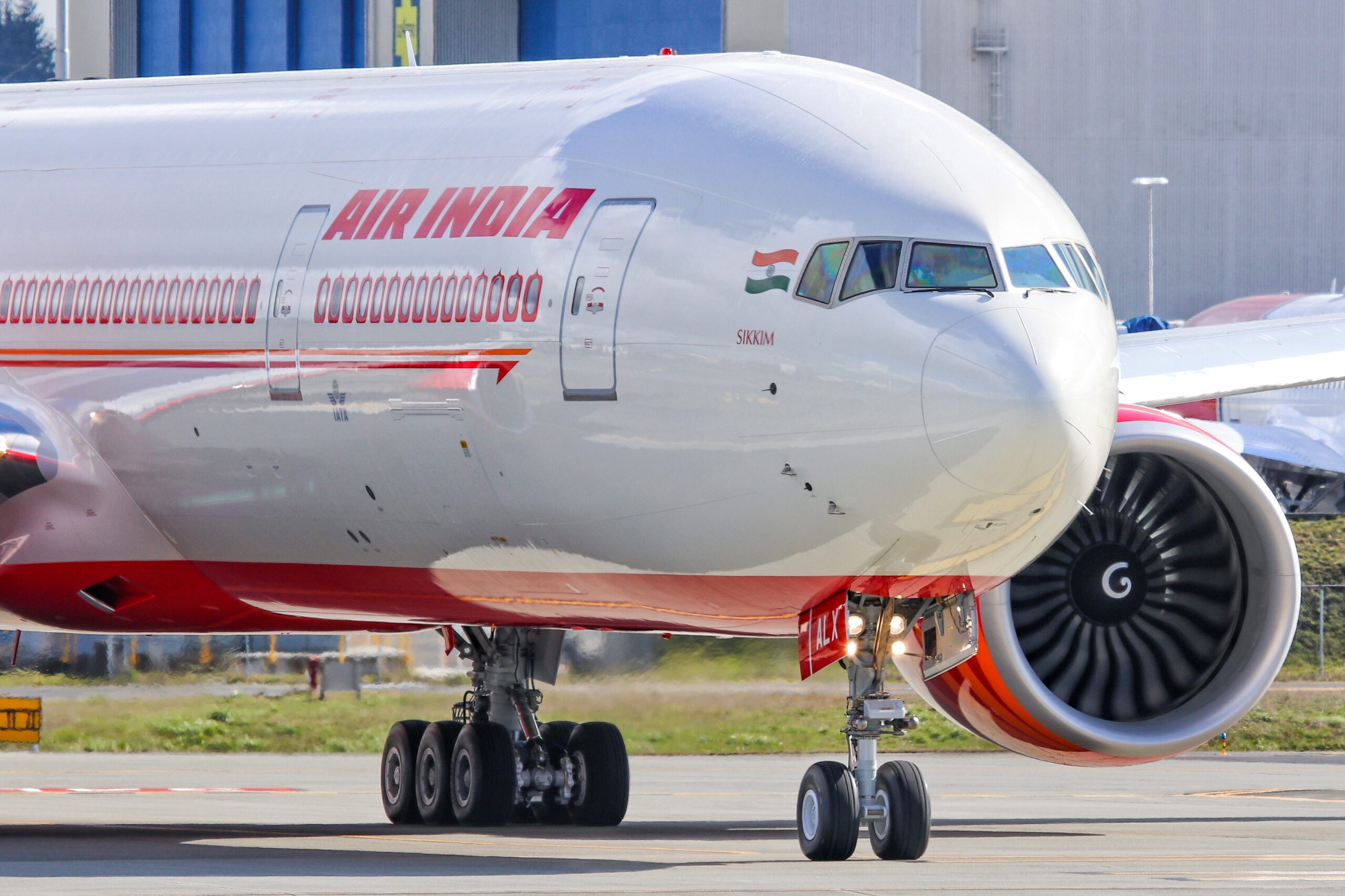
An Air India 777-300ER (Photo: AirlineGeeks | Katie Bailey)
As the Tata Group works on their reorganization of Air India, one important part of that is fleet planning. The current Air India fleet is a mixed bag of poorly maintained aircraft in various stages of disrepair. Years of mismanagement have left the airline’s fleet in a state of serious improvement. It’s not that the airline has old planes, the airline did start flying Boeing B787 aircraft a while back but those fell apart pretty quickly. The airline cannibalized some of their new planes for parts for older aircraft along with general poor maintenance. All in all, a fleet refresh has been a long time coming and may finally happen.
Rumors of A350 Order
While not official, there was reportedly a memo sent out to Air India pilots inquiring if there is any interest to be trained on the Airbus A350. This has sparked speculation that the Tata Group is currently in talks to acquire A350 aircraft. Tata Group chairman Natarajan Chandrasekaran was also said to have recently gone over to Airbus headquarters in Toulouse.
On top of this Airbus has a good number of A350s ready for delivery. There are a number of undelivered A350s in Airbus’ inventory due to Aeroflot not taking deliveries due to sanctions and Qatar refusing delivery due to quality issues. This presents a prime opportunity for the Tata Group to quickly buy up the A350s and begin integrating the aircraft into the Air India fleet as early as 2023. Rumor has it that the airline is looking to buy around 20 A350s, other rumors say up to 50 A350s and 100 or more A321-neos.
Airbus’ chief commercial officer, Christian Scherer, also had some choice words to share about Air India during the IATA general meeting in Doha. Scherer stated that “Air India is clearly reorganizing itself under the very able stewardship of the Tatas and as such, it is very natural that they contemplate an investment in new fleets, new airplanes if only to regain more sovereignty, more market share, for an Indian carrier in the international market”. He did however decline to comment on any talks that may have happened over purchasing aircraft.
There also is a possibility the Tata Group is talking to Boeing for aircraft as well, but it’s unlikely Boeing will be able to provide aircraft as quickly as Airbus can. Boeing currently owes Vistara, another Tata airline, two B787s that haven’t been delivered due to quality issues plaguing Boeing. The Tatas may place an order with Boeing for B787s that would be delivered at a future time.
If Air India does proceed with this order from Airbus, it would give the European manufacturer entry into the widebody market in India. Currently, no Indian airline operates widebody Airbus aircraft. Air India’s and Vistara’s widebody fleets are comprised of Boeing aircraft. Jet Airways when it previously flew did operate Airbus A330 and A340 aircraft along with Boeing B777s.
Regardless of the type of aircraft ordered, a fleet refresh is a welcome move by the Tatas. The new aircraft will be a great step forward for the airline. However, the Tatas shouldn’t discount the existing fleet. If the airline pulled a Delta Air Lines and maintained planes and interiors well, Air India can pull out quite some more time with their existing fleet.
Hemal took his first flight at four years old and has been an avgeek since then. When he isn't working as an analyst he's frequently found outside watching planes fly overhead or flying in them. His favorite plane is the 747-8i which Lufthansa thankfully flies to EWR allowing for some great spotting. He firmly believes that the best way to fly between JFK and BOS is via DFW and is always willing to go for that extra elite qualifying mile. Hemal's opinions are his own and do not reflect those of his employer.
A Jet Airways 777-300 landing at London Heathrow. (Photo: AirlineGeeks | William Derrickson)
The Jet Airways entity is slowly rising up from the dead with the help of the Jalan Kalrock Consortium, the new owner of the airline and CEO Sanjiv Kapoor, an airline industry veteran who has worked at Northwest Airlines, SpiceJet, and Vistara before taking the CEO position at Jet Airways.
The team has been hard at work for months working to revive the airline. In May the airline conducted its first proving flights with B737 aircraft in anticipation of receiving its air operator’s permit which was granted on May 19. It is still unknown how many flights the carrier will initially operate and to where it is expected that there will be a mix of widebody and narrowbody aircraft.
Seeking Flight Attendants and Pilots
One major part of getting back into the skies is hiring staff. The airline has steadily been corporate staff to get the administrative parts of running an airline sorted out. Two-thirds of the current 200 staff are former Jet Airways staff.
Jet Airways is ramping up on its hiring and is giving preference to former Jet Airways when all else is equal. This past week the airline posted on Twitter that they are beginning hiring for cabin crew with a preference for former Jet Airways crew. Kapoor later posted that 700 job applications were submitted in the first 5 hours of the posting.
The airline is soon going to start hiring pilots and engineers while senior positions are steadily rolling out. It is likely that the airline will face many of the same pilot staffing challenges that airlines around the world are currently facing.
Currently, the Jet Airways fleet consists of nine aircraft, four Boeing 737s and five 777s. It is expected that as the airline continues to get up and running a lease or order for additional B737 aircraft may materialize. Officially it’s expected that fleet plans will be announced relatively soon, Kapoor cheekily mentioned that they are waiting for Twitter poll results and advice from all armchair CEOs before finalizing their decisions.
Return to Flying
The airline is expected to start operations in Q3’22. There are high expectations for the return of Jet Airways to the skies. The airline is remembered fondly by many around the world as a top-tier Indian airline with stellar service. The bankruptcy in 2019 was a downer for many who thought that there may never be an airline like Jet Airways again but now there is hope. There is a highly experienced team leading the charge with a proven track record of success. It’s very likely we’ll see an even better version of Jet Airways in the future.
Hemal took his first flight at four years old and has been an avgeek since then. When he isn't working as an analyst he's frequently found outside watching planes fly overhead or flying in them. His favorite plane is the 747-8i which Lufthansa thankfully flies to EWR allowing for some great spotting. He firmly believes that the best way to fly between JFK and BOS is via DFW and is always willing to go for that extra elite qualifying mile. Hemal's opinions are his own and do not reflect those of his employer.
Flying over Moloka'i (Photo: AirlineGeeks | Joey Gerardi)
Flying within the Hawaiian Islands is one of the easiest and cheapest flights you’ll ever take due to the heavy competition. With many airlines competing on only a handful of routes, flights are usually very frequent and can be above 30-a-day between destinations.
Hawaiian Airlines, Mokulele Airlines, and most recently Southwest Airlines are the three airlines with the most passenger inter-island flights, although a few other smaller companies do exist. Between the three airlines, they operate almost 30-daily nonstops in each direction, 21 of which are on Hawaiian Airlines.
A couple of weeks ago we went over one of those options with Mokulele in a “Unique Connection Series” trip report, this time we will take the more conventional, and the most known option; Hawaiian Airlines. The route does see each aircraft type in their fleet; the Boeing 717, Airbus A321, and occasionally the Airbus A330, but it usually tends to be the workhorse of their fleet, the Boeing 717.
Day of the flight
I chose a morning flight option, with the departing flight leaving Kahului at 9:05 A.M. I knew security wouldn’t be terrible as most of the early morning flights had already left, plus I have TSA PreCheck which is always great. I arrived at the airport just an hour before the flight at 8 A.M. and made it through security with no problem.
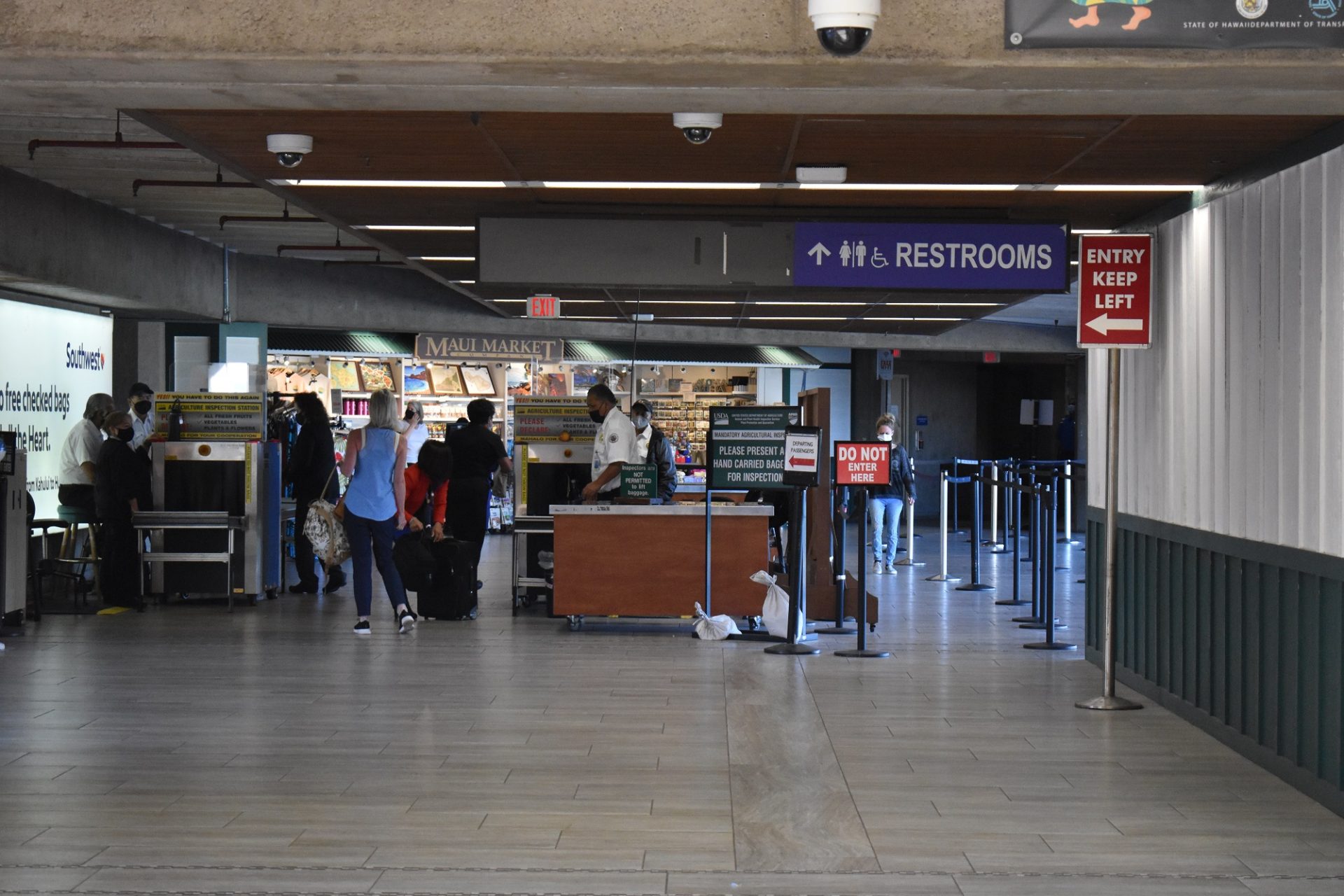
The airline has a few special gates set aside for their inter-island operations. They have agriculture inspection areas set up in the terminal if you are headed towards any gates besides Hawaiian Airlines’ inter-island ones. Due to this, unfortunately, there weren’t many places to walk around, but this wasn’t that bad as the flight was only an hour away.
Baggage inspection for a flight bound to Mainland United States (Photo: AirlineGeeks | Joey Gerardi)
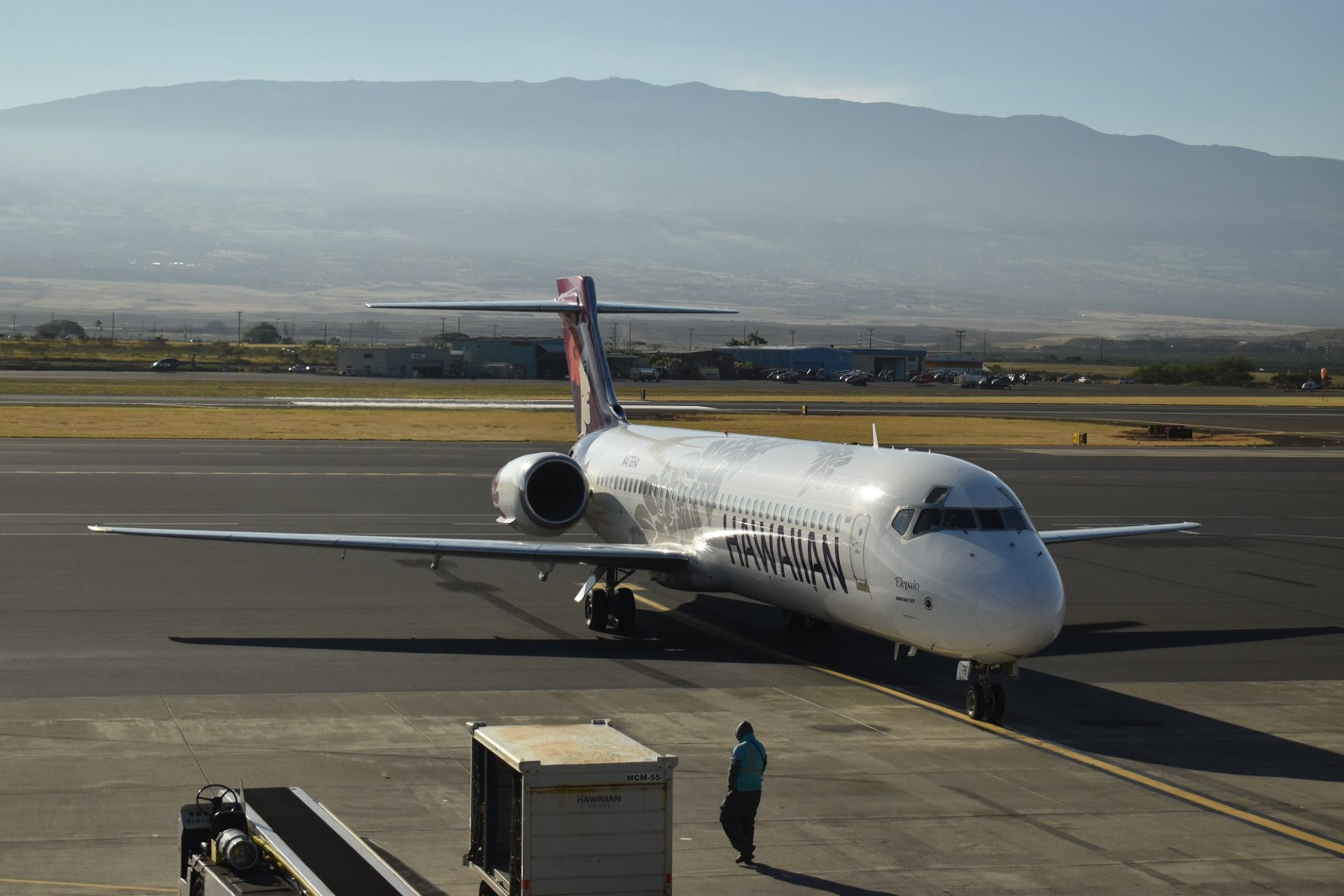
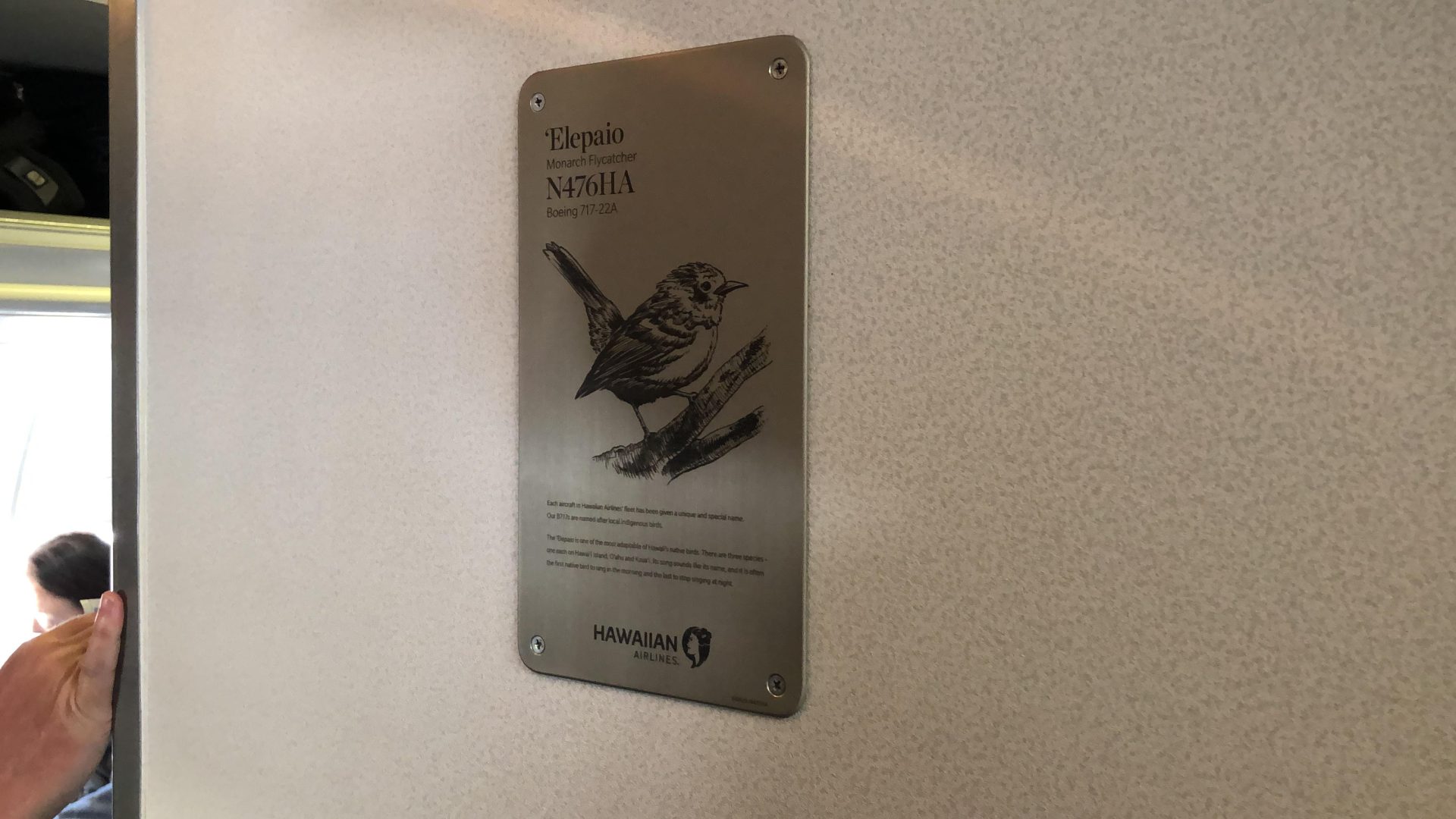
It wasn’t long before my aircraft arrived, N476HA, one of the many Boeing 717’s the carrier possesses. This aircraft was named “Elepaio” after a bird species that is only found in the state of Hawaii.
My plane pulled into the gate at Kahului Intl. (Photo: AirlineGeeks | Joey Gerardi)
These inter-island operations are very efficient and run like a well-oiled machine. As soon as the last person stepped off the inbound aircraft they began loading my flight.
The plaque in the passenger cabin (Photo: AirlineGeeks | Joey Gerardi)
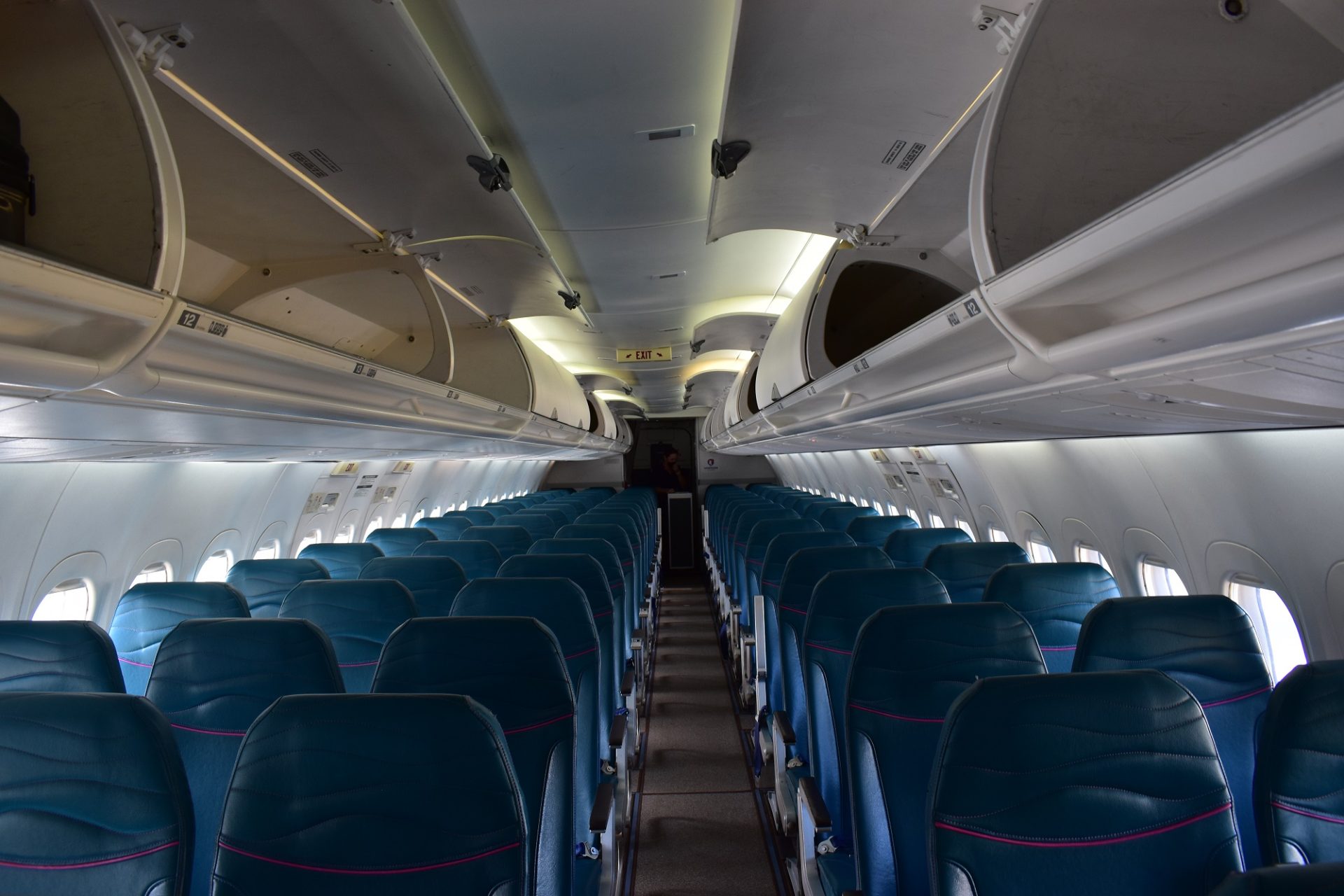
The interior of this aircraft was simple, but for the short flights they use these aircraft it is perfect. The seats are bright and give off a warm Hawaiian vibe.
The passenger cabin of Hawaiian Airlines’ Boeing 717 (Photo: AirlineGeeks | Joey Gerardi)
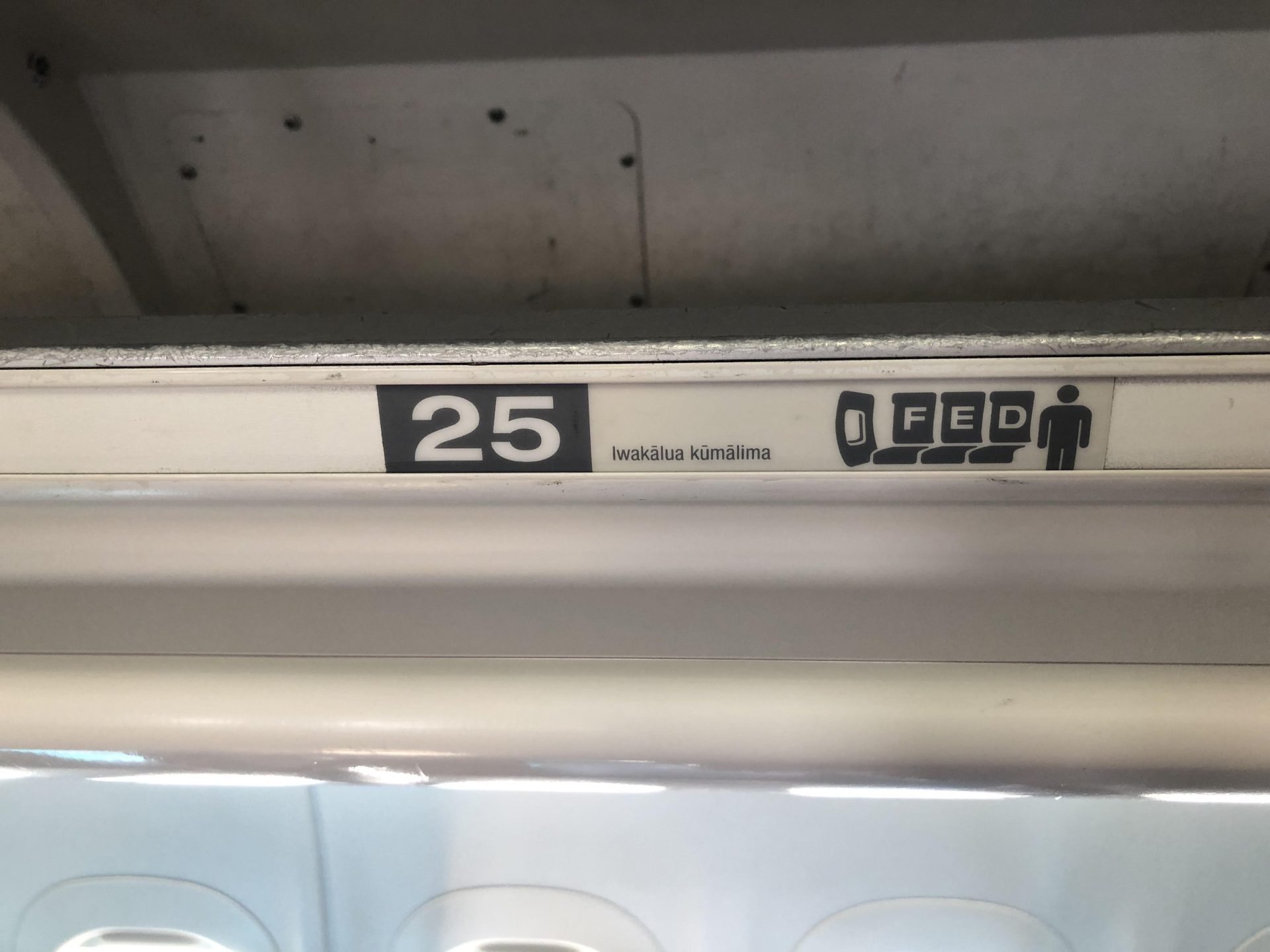
Another interesting aspect of the flight is the labels, every sign on the aircraft had the words written in Hawaiian under the English words.
Most sign on the interior are written in Hawaiian, as well as English (Photo: AirlineGeeks | Joey Gerardi)
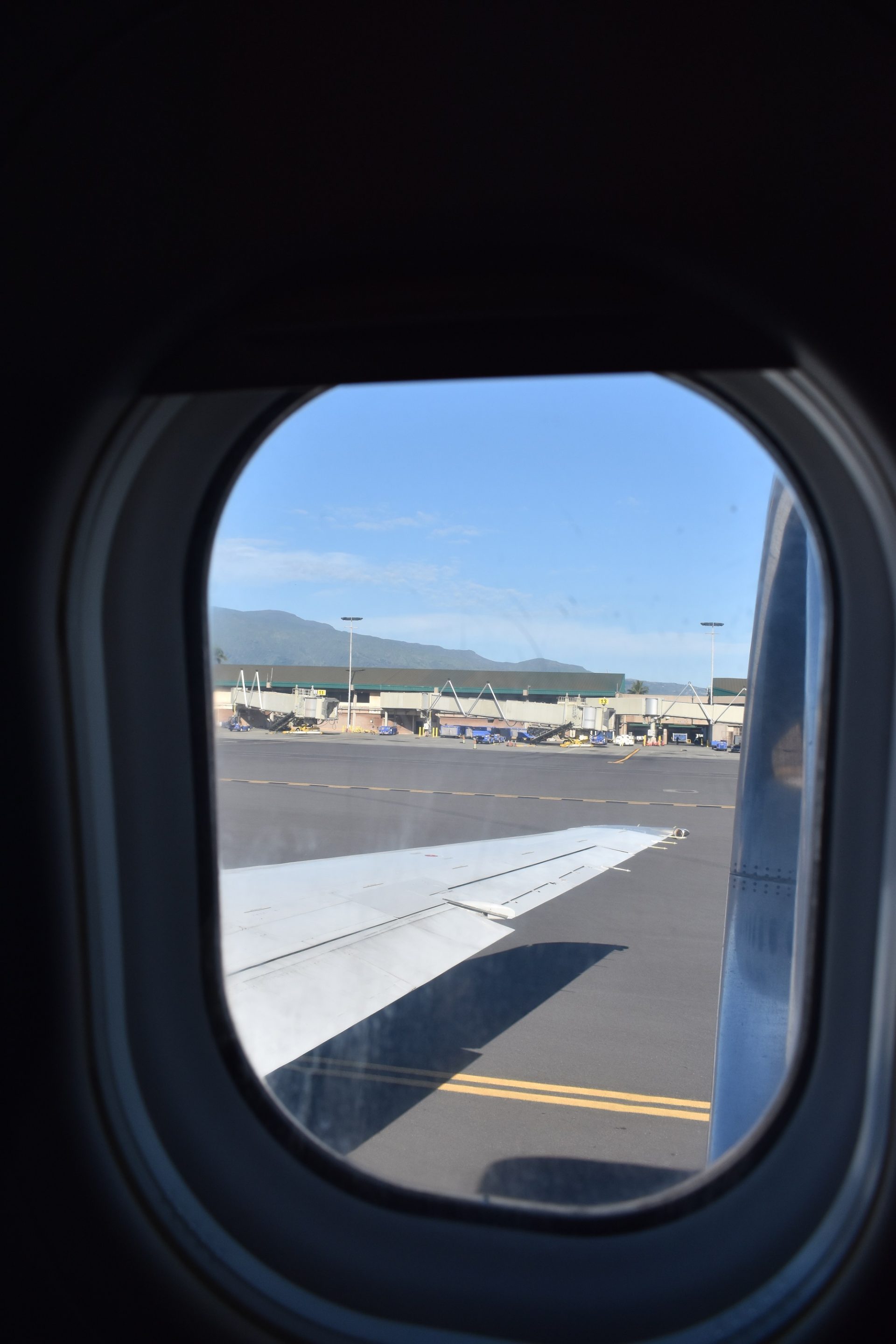
I chose seat 25F for this flight, this would be one of the instances where I should’ve looked at a seat map website before selecting this seat. The row was so far back my view was almost completely obstructed by the engine, and unfortunately, there weren’t any window seats left on my flight so I couldn’t move around.
My view from 25F (Photo: AirlineGeeks | Joey Gerardi)
As I was the last person on, the door was quickly shut and before I had time to even think about it we had begun pushback from the gate. It was a short taxi to the runway and we blasted off for the short flight to Honolulu.
Taking off out of Kahului Intl. (Photo: AirlineGeeks | Joey Gerardi)
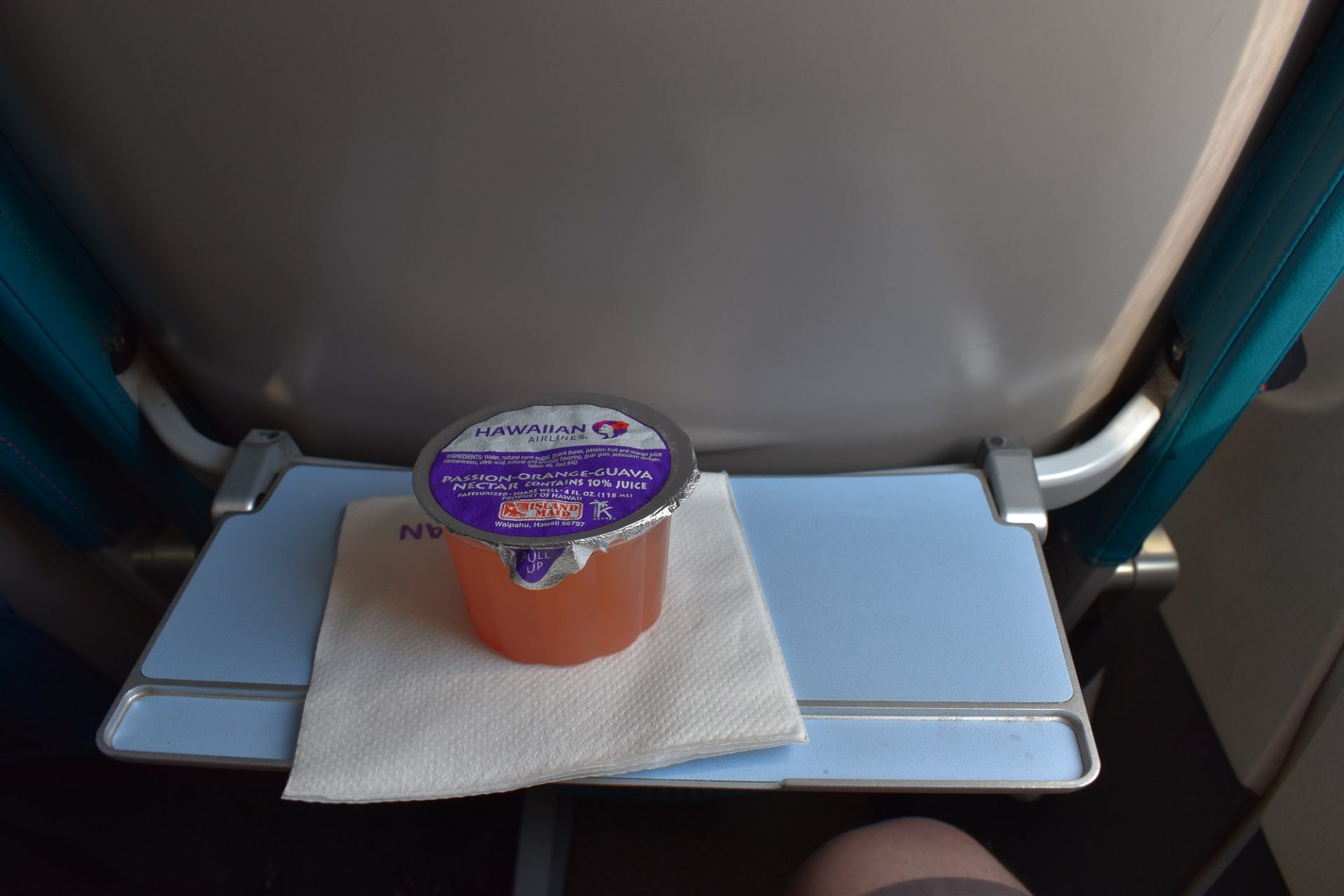
As one might imagine, there was no fancy meal or snack for a short flight like this. Passengers had the option of coffee, water, or juice, the third of which is made right in the Hawaiian Islands.
The juice service on the flight interisland (Photo: AirlineGeeks | Joey Gerardi)
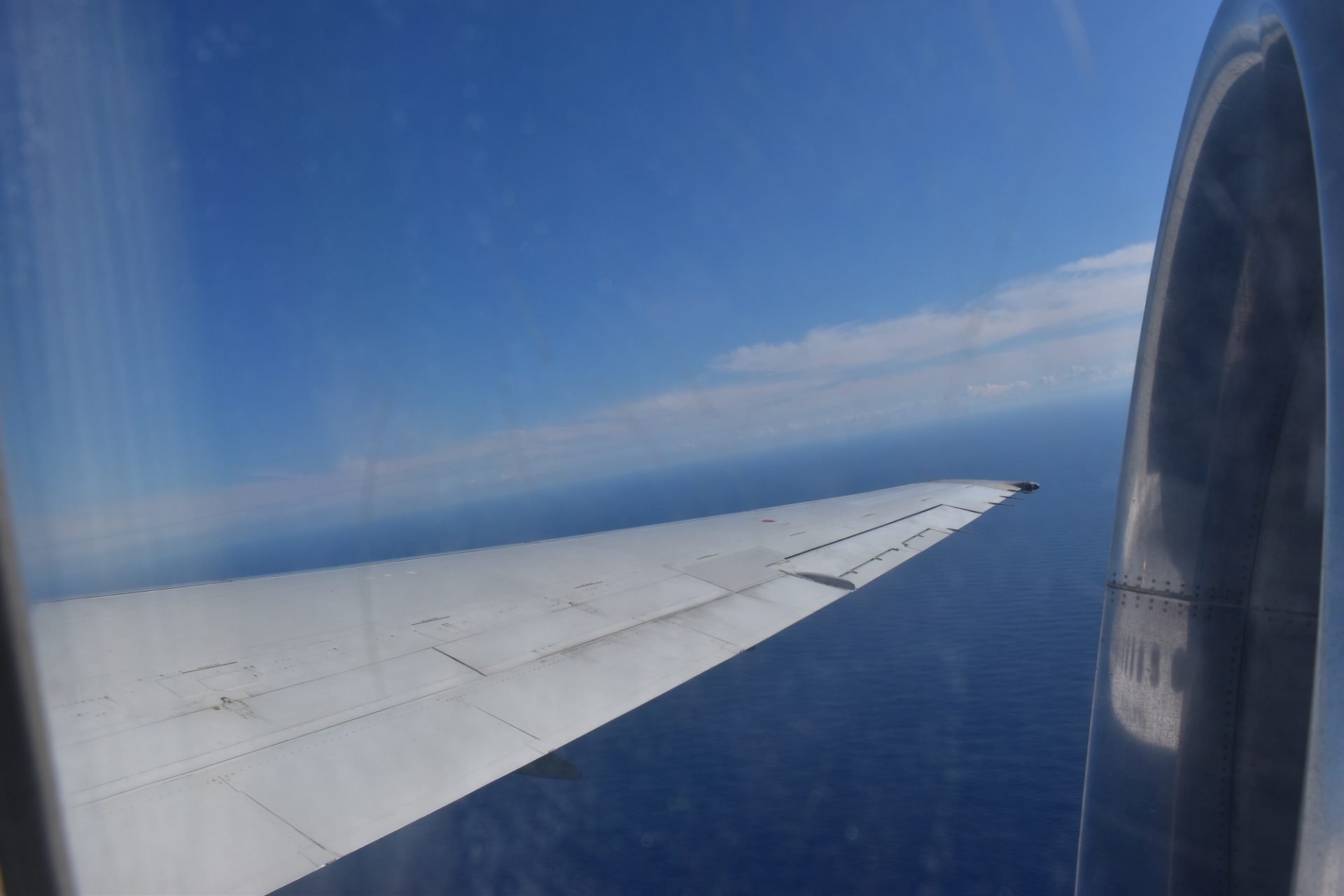
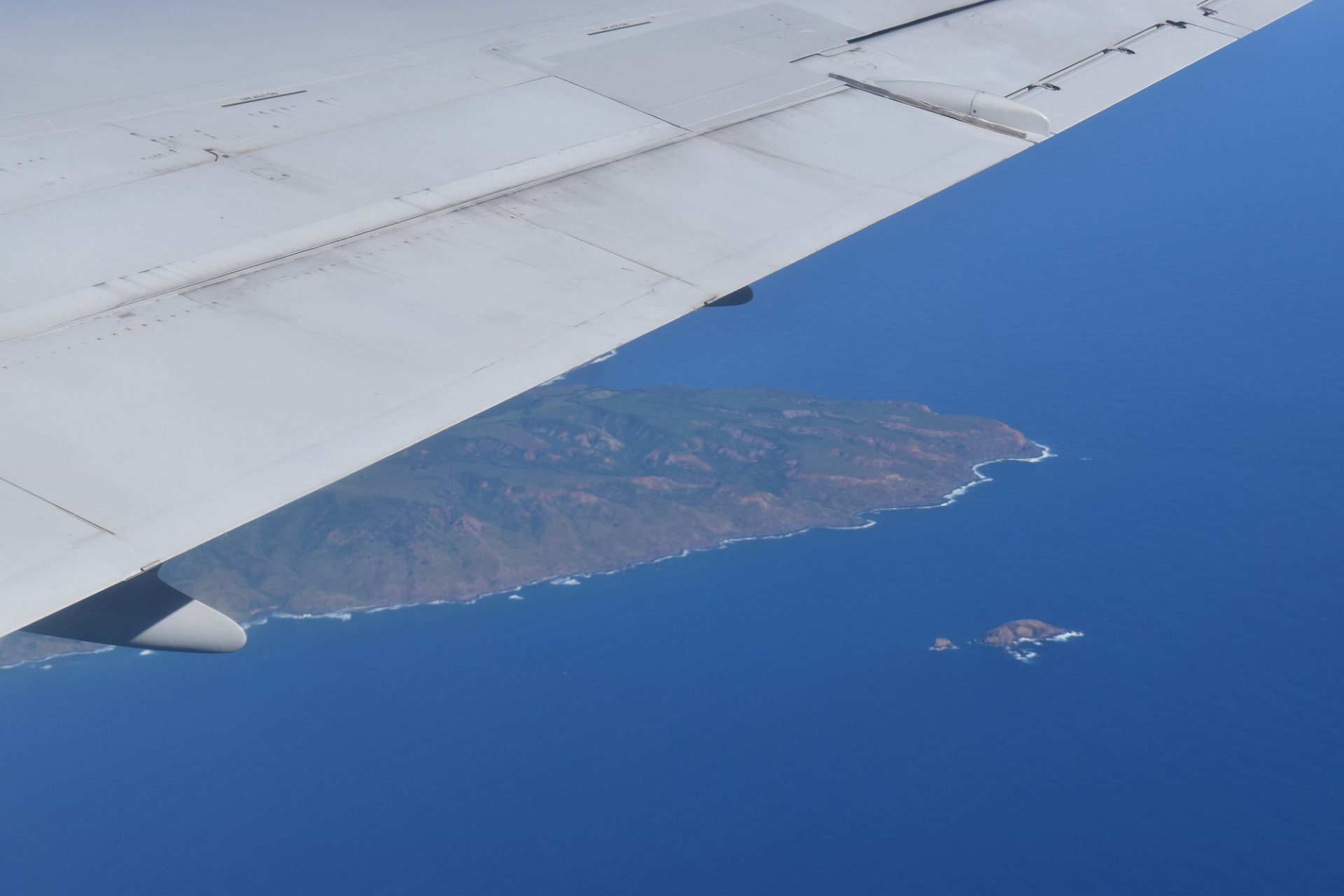
Having an almost completely covered window, the views I experienced weren’t the easiest to obtain but I still had some stuff to see out of the window. We passed by the island of Moloka’i, where I had completed my unique connection series just days before.
passing by the island of Moloka’i (Photo: AirlineGeeks | Joey Gerardi)
Before I had even realized it, we began our descent into Honolulu. It was not a very long flight, and I spent the remaining time looking out at the view I did have.
Flying over Moloka’i (Photo: AirlineGeeks | Joey Gerardi)
As we got closer to O’ahu, Honolulu came into view and so did more wonderful scenery. As you can tell I mention the scenery a lot, and for a good reason, as the scenery is one of the biggest draws for those visiting the islands and I didn’t want to miss a single second of it.
For this same reason, there is no inflight entertainment on the airlines Boeing 717’s, and why would there be when you can spend the time looking out at the ocean and the islands. Even if you don’t get a window, the longest interisland flight they operate has just over 40-minutes of total flight time so you won’t have much time to be bored.
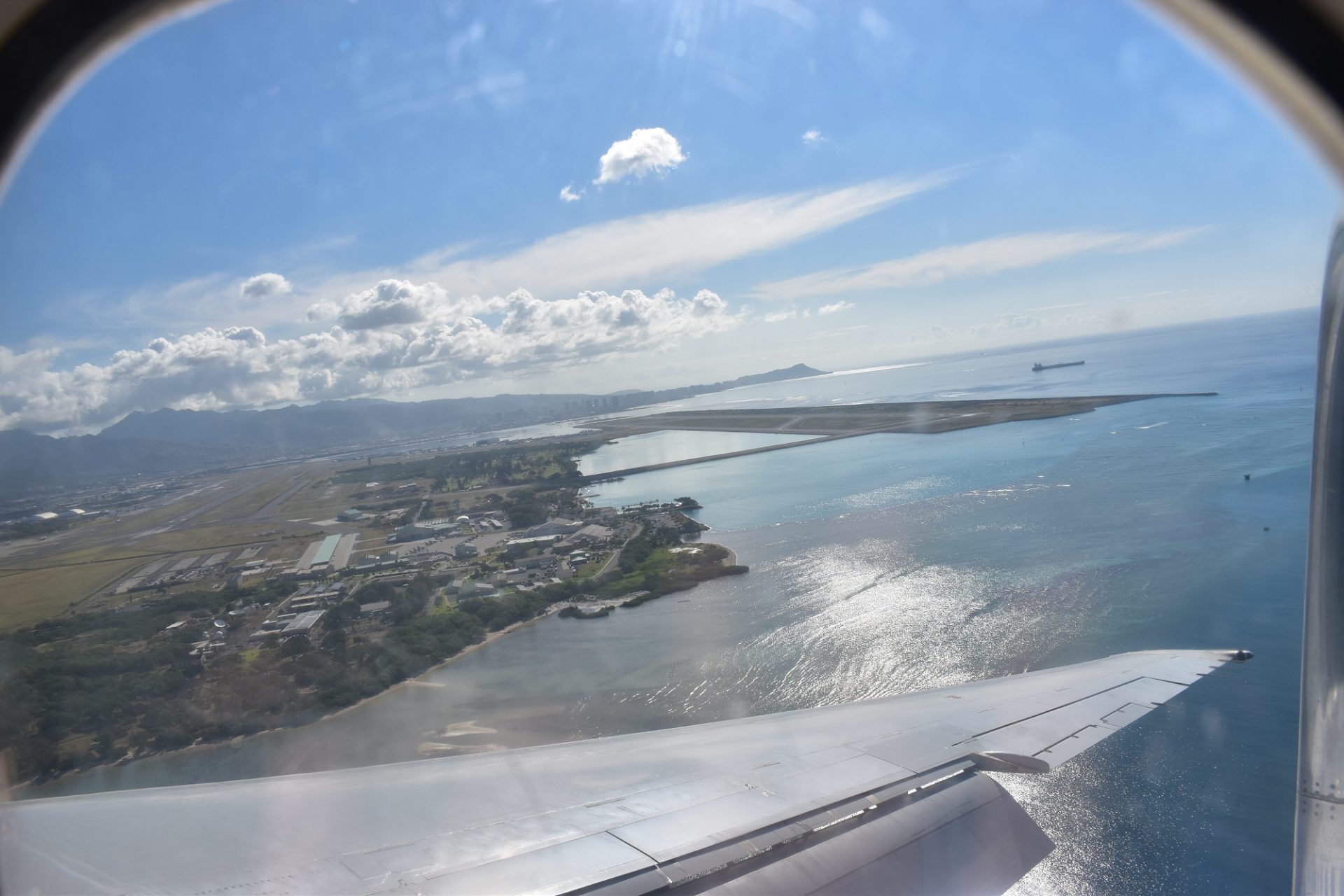
we approached the airport from the southwest and made a hard right bank on approach. This is something I don’t experience often, but I have been told that this is a common occurrence for flights into Honolulu, especially the interisland ones.
Turning to land at Honolulu Intl. (Photo: AirlineGeeks | Joey Gerardi)
We landed at Hawaii’s busiest airport making the total flight time only 22 minutes. A very short flight, making the total flight time just about the same time as it took to board the aircraft. I can only imagine that boarding the Airbus A321s and A330s for this route can take as much as double or three times the actual flight time just to board the aircraft.
While the flight isn’t long, it certainly was fun getting to experience the interisland transportation system and the staple of Hawaiian’s interisland operations, the Boeing 717, and just how efficient it truly is.
Joey has always been interested in planes for as long as he can remember. He grew up in Central New York during the early 2000s when US Airways Express turboprops ruled the skies. Being from a non-aviation family made it harder for him to be around planes and would only spend about three hours a month at the airport. He was so excited when he could drive by himself, the first thing he did with his driver's license was get ice cream and go plane spotting for the entire day. He graduated from Western Michigan University in 2022 with a B.S. in Aviation Management & Operations and a Minor in Business, and currently works for a major airline in his hometown.
Regional Express To Grow With New Travel Agent Deals
Rex’s first Boeing 737-800 passenger flight, between Melbourne and Sydney, on 1 March 2021. Photo: Regional Express
SYDNEY, Australia – Australian regional airline Regional Express announced on Friday, June 24, that it has signed new agreements with major travel agency groups, with the agreements to commence on July 1, 2022. The arrangement, which coincides with its competitor Qantas’ regional expansion, will see expected revenues double in the next financial year.
Rex, as the airline is better known, has ensured it remains a popular choice for domestic travel by signing deals with Flight Centre, Helloworld, Webjet, Consolidated Travel, and Corporate Travel Management. The agreement with Flight Centre, one of Australia’s largest travel agencies, will ensure Rex remains its airline of choice for 10 years – the deal labeled “landmark” by Rex.
The airline, with its fleet of 60 Saab 340 and six Boeing 737-800NG aircraft, aims to double its domestic jet revenue without any increase in fleet size. The reasons can be attributed in part to the expansion of its more popular services due to freed up resources from its recent service closures. Rex, increasing these services, will see up to 67% increases in weekly return flights to major regional centers.
Rex Rated Australia’s Most Reliable Airline
According to the Australian Government’s official data, May 2022 saw Rex as the most reliable airline with the fewest cancellations. The Bureau of Infrastructure and Transport Research Economics monthly report took note of on-time departure and arrival performance, as well as flight cancellations of all major Australian airlines.
As the only airline to perform above the 70% mark in reliability, Rex scored 78.5% for on-time departures and 75.5% for arrivals, with a cancellation rate of 1.4%. Virgin Australia rated second, with its reliability scoring 64.4% departures, 65.7% arrivals, and a cancellation rate of 5.0%. As for Qantas, its reliability rate for on-time departures and arrivals scored 61.5% and 60.7% respectively, with the highest cancellation of any Australian airline at 7.1%.
With tongue in cheek, Rex Deputy Chairman, the Hon John Sharp AM, said: “Rex treats its customers with respect and decency; we don’t cancel flights en mass and we don’t lose truckloads of our passengers’ luggage… nor do we leave our customers on the phone for days at a time waiting to get through.” Sharp’s comments, referencing some of the more negative Qantas experiences of late, highlight the growing competition – and resentment – between the two airlines.
‘Hypocrisy’ In Australia’s Airline Industry
In step with other industry pay rises, Rex has faced what it calls “a double standard” from the pilots’ union, with the airline’s latest pay rise offer being rejected. The offer, a 5.1% increase compared to QantasLink’s 2% pay rise last year, was received negatively by the Australian Federation of Air Pilots (AFAP) despite praising the QantasLink deal as ‘pragmatic’, according to a media statement.
In a recent statement, Sharp commented: “Just last September, the AFAP agreed to a 2% pay rise in 2021 and 2022 for QantasLink pilots saying, ‘we are pleased to have arrived at a pragmatic outcome for the QantasLink pilot group’. Rex on the other hand has offered its SAAB pilots a 5.1% pay rise from 1 July 2022, plus significant catch-up payments worth another 8% once the business is profitable again.”
He further added: “The AFAP’s double standard clearly demonstrates that it is not really interested in protecting its members’ interest but rather in pursuing its own agenda.” The airline noted that during the COVID pandemic, which resulted in a mass exodus of airline pilots due to nationwide lockdowns, it was the only airline to support its crews and not retrench any of its pilots.
Mike’s love affair with flight and mechanical objects in the sky began at an early age, fascinated by space documentaries and the vintage Flight Simulator ’95. He currently works as an instructor for UAVs and is training to receive his Private Pilot Licence with the goal of working in manned flight instruction. An avid reader of all things aviation and manned space flight, Mike stays close to developments in aerospace while reminiscing and sharing the rich history of flight with others. He loves writing, engineering and science.
An Air New Zealand 787 landing at Houston IAH (Photo: AirlineGeeks | Mateen Kontoravdis)
Air New Zealand has announced the recommencement of 14 international routes over a 16-day period in July. According to the New Zealand Herald, the airline will relaunch services from Auckland to destinations such as Tahiti, Honolulu and Houston that have not seen service for just over 800 days.
“Come July, we will double our services across the Tasman and restart popular direct services like the Sunshine Coast, Hobart and Adelaide,” Air New Zealand chief executive Greg Foran said, referencing the airline’s significant travel market in Australia. “By July 9 we will be back to all nine Australian ports which is an important milestone for us.”
New Zealand initially had a zero Covid policy and was one of the most ‘locked-down’ countries to visitors and their own citizens for over two years. Those within the country were subjected to limited lockdowns compared to other countries, but residents were disconnected from the world and return from international travel was subject to limited hotel quarantine spaces. ‘Travel bubbles’ with Australia were attempted at different times but withdrawn when Covid cases began to rise.
Radio New Zealand reported that Air New Zealand’s domestic routes would be back to 100 percent pre-Covid-19 capacity; through the Tasman and the Pacific Islands, around 75 percent of pre-Covid-19 levels; the rest of the international routes at about 50 percent of pre-Covid-19.
Foran predicts that “By the time we get to the end of the year, domestic, we would expect to be completely back to pre-Covid so maybe even a little bit better than 100 percent and the rest of the world sitting at around 75 percent.”
The airline will return a number of Boeing 777-300 aircraft back into service, in response to this significant increase in international capacity. The aircraft began service for the airline in 2011 and were originally due to be phased out by 2027 as the airline utilizes more Boeing 787-10 Dreamliner aircraft.
Foran acknowledged some of the challenges the airline was facing by increasing capacity with fuel costs being of concern. “Over the last few months, we’ve seen effectively a doubling in price and I’ve referred to the fact that getting to Los Angeles, it used to cost us just over US$40,000 to fill up a Dreamliner and now it’s about US$96,000, so that’s seen the price of tickets on the average increase around 20 plus percent,” he told Radio New Zealand.
The airline is also actively recruiting more airport staff to match the operational increases after over 4000 workers were removed from the workforce due to the Covid pandemic.
Radio New Zealand cited an internal Air New Zealand communication to staff offering the following incentives: “Refer a friend or family member and once they’re successfully onboard, you will both receive 400 New Zealand Dollars ($250) gross. As an additional thank you, once the employee you recommended completes 12 months within Airports, a further 1000 New Zealand Dollars will be paid to you both.”
Foran added, “Getting aircraft out of storage, people back in, opening ports, and working with new travel requirements, there’s a lot to consider, and the Air New Zealand team are doing their very best to make it happen as quickly as possible.”
John has always had a passion for aviation and through a career with Air New Zealand has gained a strong understanding of aviation operations and the strategic nature of the industry. During his career with the airline, John held multiple leadership roles and was involved in projects such as the introduction of both the 777-200 and -300 type aircraft and the development of the IFE for the 777-300. He was also part of a small team who created and published the internal communications magazines for Air New Zealand’s pilots, cabin crew and ground staff balancing a mix of corporate and social content.
John is educated to postgraduate level achieving a masters degree with Distinction in Airline and Airport Management. John has held the positions of course director of an undergraduate commercial pilot training programme at a leading London university. In addition he is contracted as an external instructor for IATA (International Air Transport Association) and has been a member of the Heathrow Community Fund’s ‘Communities for Tomorrow’ panel.
Trip Report: Norse Atlantic Airways’ Inaugural Flight from New York in Premium Class
Norse Atlantic Airways — the ultra-low-cost transatlantic carrier — recently launched its operations from the U.S. As passengers look for cheaper fares in a summer travel market that is expected to exceed pre-pandemic levels, CEO Bjørn Tore Larson’s all Boeing 787 Dreamliner airline looks to offer an alternative option to passengers who would ordinarily be faced with legacy carriers.
The carrier’s ultra-low fares are being offered on a twice-weekly basis from Oslo, Norway’s Gardermoen Airport to New York’s John F. Kennedy in a two-class configuration. With fares as low as $114 each way, Norse is far and away from the cheapest option over the Atlantic offering passengers a gateway to Europe once in Oslo, Norway.
AirlineGeeks was onboard the inaugural flight from New York to Oslo in Premium and had an up-close look at Norse’s brand new operation.
Check-in Experience
Norse departs from Terminal 1 at JFK Airport. Terminal 1 is home to many international carriers at the airport and serves only international destinations. Air France and Lufthansa have the biggest presence at the terminal offering their own lounges given that they operate multiple long-haul flights per day. Norse, however, had not communicated the terminal very well to passengers leaving many confused and worried about the status of their flight.
JFK Airport placed a label on the airline directory heading into the terminals by car, but there was no mention of a terminal on the AirTrain. This has since been added, and there is a level of leeway that needs to be given when an airline is operating at an airport for the first time let alone its first and second-ever flights.
I was seated in Norse’s Premium Cabin and once I located check-in, I was able to collect my paper boarding pass. Norse’s electronic boarding passes faced hiccups too, with no mention of a terminal or gate. This was also the case in Oslo.
After collecting my boarding pass, I was directed to the Fast Track security lane, which is a great benefit to have when flying long haul often removing the stress of long lines when running smoothly. In Oslo, Norse does not yet offer a priority security benefit, though I was told by a representative that they are awaiting approval from Avinor, who operates the airport in Oslo.
Airport Experience in New York and Oslo
Norse does not offer lounge access — something Norwegian provided for its premium passengers through contract lounges up until 2019. It is unclear if Norse will add this to its Premium travel benefits but for the time being your airport experience is entirely dependent on your location and since Norse does not operate on a spoke and hub model this will vary greatly. JFK’s Terminal 1 offers few options for dining and is very clearly in dire need of a refresh.
There are enough choices for passengers to buy a variety of very expensive bottles of water and pre-made sandwiches should you wish to do so. Oslo Gardermoen offers a far superior experience when it comes to dining, shopping and great places to sit and rest.
If you happen to carry status with another airline or credit card, there may be lounge access available to you as both JFK’s Terminal 1 and Oslo have a few lounges. It is worth noting that lounges at Oslo Gardermoen are located before passport control, meaning that you must be willing to take your chances on the wildly unpredictable queues.
Post passport control, there is a great bar/cafe with outlets at every seat along with a convenience store selling sandwiches and salads and a duty-free shop. Prices are very reasonable, and the cleanliness and quiet of the F gates are fantastic.
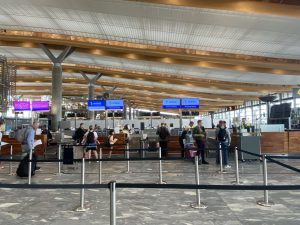
Check-in at Oslo Gardermoen. (Photo: Airline Geeks | Ezra Gollan)
Once the arrival flight had deplaned the pace began to pick up as Norse Atlantic CEO Bjørn Tore Larsen spoke to reporters by the gate. When asked about the experience so far, Larsen said, “It is fantastic to experience the spirit of the people in this company.” added, “I am truly honored to be part of a team but this is not about me it’s about the rest of the team particularly I would say the crew onboard the aircraft.” Larsen stressed how much the onboard experience matters and how important the team onboard the aircraft are saying, “Running an airline from an office desk is, in theory, very easy but in practice, you can’t do it. You do everything onboard.”
Larsen, who before Norse had spent decades in the shipping industry may be new to airlines but it’s clear he values the people who are on the front lines of an airline. This is obviously promising to hear from a new CEO and having had the chance to speak with multiple Norse employees, they all mentioned how much he believes in the team.
Our aircraft arrived at JFK as Norse flight 01 landed at 10:44, after a delay due to issues with bookings for Ukrainian refugees. Nearly 100 were on Norse’s first-ever flight and if there is ever a time when a delay is perfectly acceptable, this was it. Our aircraft had also brought in 20 tons of Norwegian seafood, cargo that CEO Bjørn Tore Larsen told reporters was critical to the carrier’s success.
The aircraft rolled into the gate drawing a considerable crowd of enthusiasts and journalists alike all hoping to get a peek of the Boeing 787-9 Dreamliner that would be taking us over the Atlantic. LN-FNB, a 2-year-old jet once bound for Norwegian stood out in a crisp multi-toned blue livery.
Getting Onboard
The inbound delays and paperwork that needed to be done for the inaugural meant that we didn’t get to board the aircraft until just after midnight. It was clear by around 11:30 pm that the chances of us getting off the ground in a timely fashion were slim to none.
Norse Atlantic boards by groups with Premium passengers in group 1 and then those in standard economy boarding in no real order. Passengers were instructed to form a line in order to board the aircraft. Whether or not this is the world’s most efficient boarding process is for another day but considering that this was only the second-ever boarding of a Norse flight, crowds were relatively well controlled by the gate agents.
In Oslo, many flights operating from the F gates use a boarding system that involves “pre-boarding” passengers over 2 hours before the scheduled departure time. Gate agents scan boarding passes and solve any issues at a checkpoint before a departure area so that when the aircraft is ready passengers can simply just head to the aircraft.
Unfortunately, this seems to create increased stress and many passengers could be seen rushing to the gate after reading “boarding” on the departure board despite the fact that the actual boarding of the aircraft would not take place for another hour and a half to two hours. When boarding commenced there was little distinction between premium passengers and those traveling in Economy Class with many rushing for the jetbridge.
Back in New York, we boarded the aircraft and were greeted by a friendly crew who seemed happy to be there. I was shown to 4A, my seat for the 6 and a half-hour ride to Oslo. The new aircraft smell and buzz in the air for an inaugural meant many of us were too excited to be worried about delays.
Norse’s Premium Seats
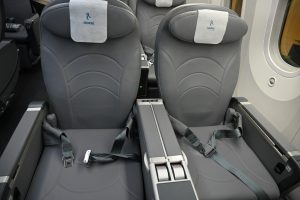
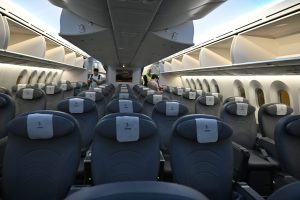
Onboard Norse’s Boeing 787-9 Dreamliners are 56 Premium seats arranged in a 2-3-2 configuration with 8 rows. If the look of the seats and configuration seems eerily similar to that of the Norwegian 787s, well that’s because they are nearly identical. An interior refresh in terms of different colored mood lighting was added along with images in each cabin of a national park somewhere in the world where Norse longships are named after. This adds a nice touch of personality and branding but aside from those additions, it is very similar.
This is not to say though that this is not an incredibly comfortable and spacious premium product. The seats feature lots of legroom, footrests, adjustable headrests and excellent recline among other things. The seat is roomy, and both the tray table and IFE monitor slide upwards from under the armrests on both sides of the seat.
The reclining function can be accessed by pulling back on the labeled switch as well as the padded footrest that comes out from below the seat. The padded footrest combined with the fully reclined seat makes for a fantastic sleeping chair.
While not fully lie-flat, when it comes to pure comfort, these are some of the best premium economy seats that many will be thrilled are back in the sky. The seat itself is far and away better than what is offered on most US legacy carriers and international airlines operating transatlantic routes. Each seat has a coat hook, reading light and air vent. The reading light can be switched on and off from the IFE monitor.
Each Premium seat is equipped with a 13.5-inch touch screen IFE monitor. The screen, as expected for a brand new one, is very responsive. Also to be expected with a brand new airline, a fairly limited selection of movies and TV shows with enough to keep one occupied over the course of a 7-8 hour flight. It probably would not have enough options to the point where passengers can find their favorite show or movie. For those whose favorite TV show is titled “3D map” starring a rendering of the aircraft you are flying giving you a 360-degree view of the world, you will be disappointed to find that Norse’s flight information screen is fairly basic.
All the essentials one would like to know over the course of the flight are there, but if your favorite activity throughout a long-haul flight is to watch the aircraft icon move, you may have to wait a little while longer. It is for certain that over the coming months and years, Norse’s inflight entertainment offerings will expand.
The airline says 5G wifi is coming to all aircraft which will be the best in its class when it rolls out aboard the 787s. Norse says they anticipate wifi installation in the summer of 2023. Once again, these are all to be expected with a new airline and what is on offer at the moment is solid.
Inside the premium cabin aboard Norse’s Boeing 787 Dreamliner. (Photo: Airline Geeks | Ezra Gollan)
In-Flight Dining Experience
For those seated in Premium, Norse offers a standard meal service with your fare along with 1 alcoholic or nonalcoholic beverage of your choice. Since we didn’t get off the ground in New York until 1:56 am local time, the crew was eager to begin what was a very late night dinner service. Despite the delays, the crew remained professional and calm.
The in-flight meals onboard Norse are what would be considered standard economy class meals. All meals include a main dish, a dessert and a warm bread roll with butter.
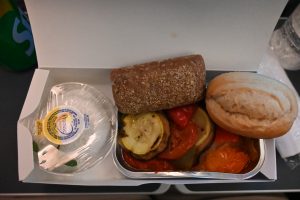
On the flight departing JFK I decided to try the vegan option, which was some vegetables stewed in tomato sauce which was pretty good and a coconut pineapple pudding that was fairly bland but not bad. Before landing in Oslo a light breakfast was served. Muffins and yogurt along with tea and coffee were included.
Norse’s catering out of Oslo was impressive. On the departure with much more normal dinner service at around 8:30 pm local time I opted for the salmon with mashed potatoes, dill sauce and sautéed greens. This was where I felt that Norse’s in-flight experience shined once again. The fish was flavorful for an airplane, and it wasn’t too overcooked. My meal also came with a chocolate ganache for dessert which was also excellent. The crew was once again friendly and attentive.
Dinner onboard the flight. (Photo: Airline Geeks | Ezra Gollan)
Buy On Board
Norse is an ultra-low-cost carrier, which means that for those not seated in premium and for those in premium looking for food throughout the flight, you are presented with a menu featuring a wide variety of snacks, sandwiches and pasta along with a broad selection of alcoholic and non-alcoholic drinks. I ordered some fusilli arrabbiata towards the end of the return to New York and it made for a good, inexpensive snack. If onboard shopping is your thing there are watches, stuffed animals and earrings plus other accessories for purchase.
A Very Fitting European Airport Arrival
After flying through the night back to the US and all morning in Norway, we touched down at Oslo Gardermoen at 2:38 pm local time. Upon parking, at the gate, the cabin crew asked us to let those with connections disembark first. I had a flight later that night on Ethiopian to Stockholm, but since I had 5 hours till departure even with my delay, I figured I would take my time.
What awaited me when I turned the corner into the customs hall was a line and a crowd of people as far as the eye could see. I had read about European airports being pushed past their capacity and it was evident here. I was lucky only waited an hour and a half compared to others who waited up to 2 and a half hours. This of course is out of Norse’s control but from a passenger standpoint, be prepared when traveling to Europe this summer as airports are simply unable to handle the demand.
Final Thoughts
The emergence of Norse into the transatlantic market is something every traveler, or “explorer” as Norse calls its passengers, should be excited about. Whether in economy or premium, they are offering a product that rivals many legacy carriers for a fraction of the cost. The premium seats make for a fantastic option for those looking to cross the Atlantic in comfort and a level of affordability that simply did not exist beforehand.
While there certainly are areas for improvement especially when it comes to the ground experience, with a brand new airline you just have to give it time. The airline recently launched its Oslo to Fort Lauderdale, F.L. route and plans to launch services from Oslo to Berlin on Aug. 17, with Oslo to Los Angeles operations beginning Aug. 19.
Ezra Gollan is a student, photographer and aviation enthusiast based in New York, New York. He has spent over half a decade around New York City’s airports as a photographer.
Allegiant Becomes Official Airline for the Detroit Pistons
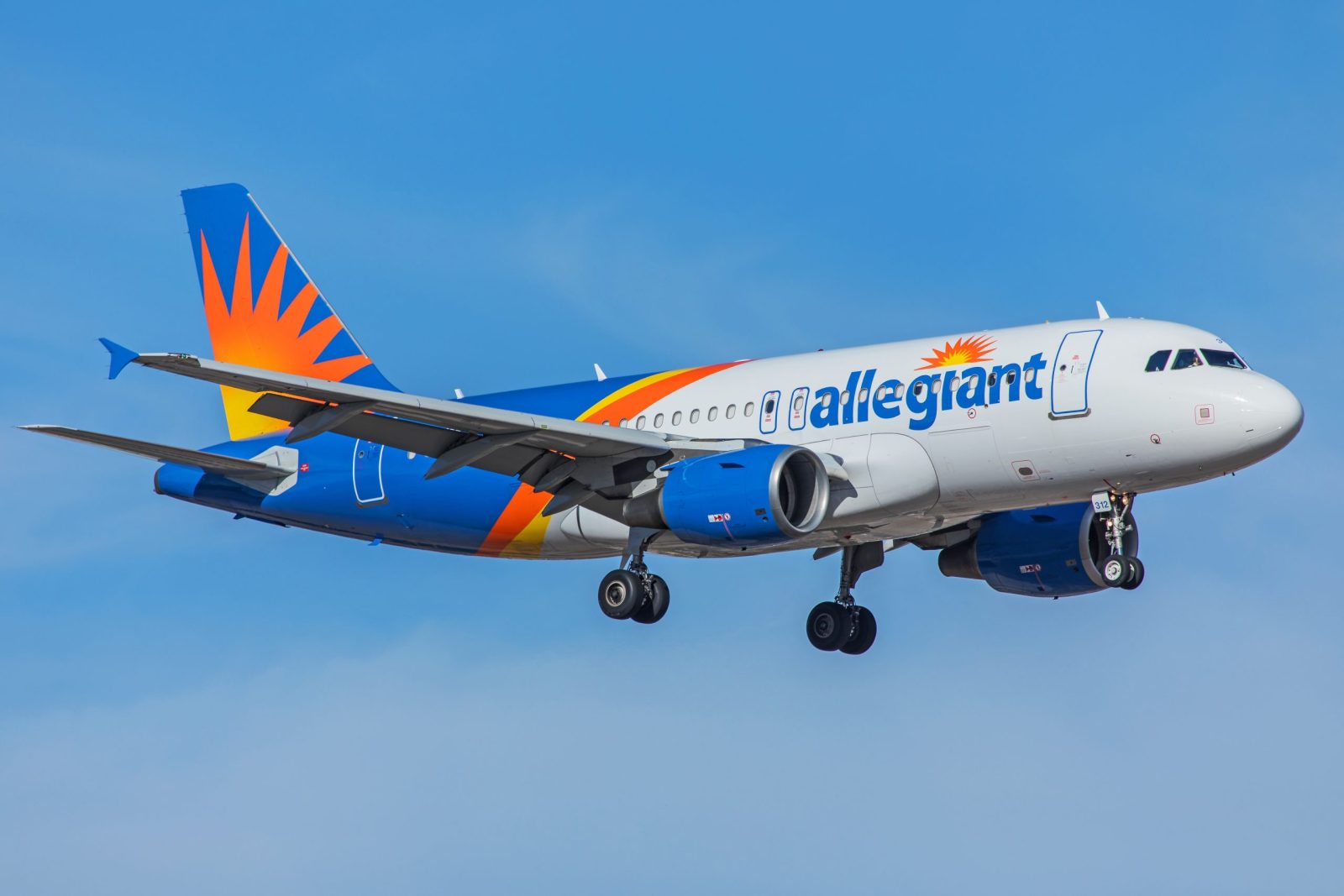
An Allegiant A319 in Las Vegas. (Photo: AirlineGeeks | William Derrickson)
Allegiant Air recently announced in a press release that it will be partnering with the NBA team, the Detroit Pistons. The partnership will coin Allegiant, the “Official Airline of the Detroit Pistons.”
The partnership with the Pistons will officially take effect next month on July 1.
The airline — headquartered in Las Vegas — currently acts as one of the state’s larger operators with bases in both Flint and Grand Rapids, Mich. As stated in the press release, the partnership supports the airline’s ongoing commitment to serving the local communities in which the airline’s employees work and live.
Allegiant initially marked the state as a key component of its operation in 2009 when the airline began service to Gerald R. Ford International Airport in Grand Rapids. Since then, the carrier has expanded rapidly, connecting the state of Michigan to the rest of the United States at lower costs than existing carriers. The airline has added service to Traverse City, Mich.’s Cherry Capital Airport and Flint, Mich.’s Bishop International Airport. The airline has grown to operate 29 routes from the three cities.
Allegiant invested over $117 million into the Grand Rapids and Flint bases — permanently stationing nearly 200 employees in the state.
In addition to already having a presence in the community, the two companies share similar values, making for a strong partnership. One example of an element the companies share is their stance on achieving equality. Allegiant will serve as the presenting sponsor of the Pistons Pride Night, an annual event recognizing the efforts of the lesbian, gay, bisexual and transgender community.
“Sports have the universal power to break down social barriers and bring people together to celebrate their teams and communities,” Scott DeAngelo, Allegiant’s executive vice president and chief marketing officer, said “We believe the same can be said about air travel. The Pistons are an ideal partner for us because of our shared core values, especially our commitment to diversity and inclusion.”
The ultra-low-cost airline intends to also engage basketball fans throughout Michigan through the organization of sweepstakes and company-sponsored events.
During the NBA season between October and June, Allegiant will allow fans to participate in specially designed sweepstakes that will connect them to largely anticipated matchups, giving fans unforgettable game-day experiences.
“We are excited to welcome Allegiant as the official airline of the Detroit Pistons,” said Brenden Mallette, Senior Vice President of Corporate Partnerships & Engagement for the Detroit Pistons. “Both Allegiant and the Pistons organization share a core value of commitment and service to Michigan and our communities.”
Allegiant Air is no stranger to the United States sports industry. A few notable partnerships include the Oakland Raiders NFL team, Vegas Golden Knights NHL team, FC Cincinnati MLS team, Indianapolis Colts NFL team, and are also the Official Airline of Minor League Baseball. Additionally, Allegiant is also the main sponsor with GMS Racing in the NASCAR Xfinity Series and the NASCAR Gander Outdoors Truck Series.
Chase Hagl grew up in Twin Falls, Idaho. His love and passion for Aviation landed him in Orem, Utah where he obtained a B.S. in Aviation Management with a minor in Business Management from Utah Valley University. Chase currently works as a flight attendant in Charleston, SC and is also the primary Inflight ASAP ERC representative for startup airline, Breeze Airways. His experience in the aviation industry spans back four years, working in areas including agriculture application, customer service, maintenance, and flight ops. In his free time, Chase enjoys road biking, astronomy, and flying.
Kenya Airways Introduces Travel Platform for Enhanced Customer Service
A Kenya Airways 787-8. The airline has decided to lay off half of its pilots. (Photo: AirlineGeeks | William Derrickson)
Kenya Airways recently launched a New Distribution Capabilities system (NDC), which will modernize the way air products are retailed to travel agents, corporations and travelers.
The web-based distribution solution seeks to encourage travel agencies and travelers to sell and access more content and ancillaries like extra baggage and preferred seats. In addition, this system will subsequently ensure they get tailored offers that match their preferences and travel history.
Julius Thairu, Chief Commercial and Customer Officer at Kenya Airways said the new solution will provide an offering that has more data and gives them a chance to interact directly with the airline without an intermediary.
“We’re proud to be the first African carrier to integrate with NDC at scale as part of our commitment to customer centricity that upholds innovation, insights, and interconnectivity for improved customer experiences. Our mandate as the pride of Africa is to understand our customers’ needs and align our products and services to address their end-to-end experience throughout their customer journey,” Thairu said.
What is an NDC?
NDC is a communications protocol created by IATA in 2012, aimed at streamlining the airline distribution process. An Extensible Markup Language (XML) standard has been adopted since this is the technology that underpins most online marketing from e-commerce transactions to podcast distribution to powering search engine optimization to graphical presentations. This technology will improve the connection between airlines and third parties, such as online travel agencies (OTA) and global distribution systems (GDS),
Travel advisors around the globe will enjoy accessing the content thanks to the partnership with the Verteil Technologies platform offering agents more personalized shopping experiences and access to customer information.
“Our new agreement with Verteil is an exciting addition to the NDC solution, creating greater opportunities for all partners in the travel ecosystem. In addition, the agreement ensures access to KQ content is the same as any content an agency or other seller would get from any other intermediary or aggregator,” Thairu added.
Jerrin Jos, Founder, and Chief Executive Officer, of Verteil Technologies, said the partnership is a testament to the critical role Verteil is playing when it comes to the development and promotion of NDC content distribution worldwide.
“We believe that KQ will be able to benefit from the superior direct booking capability, allowing the airline to work directly with Travel Agencies worldwide without constraints from legacy distribution channels. Africa is a focus market for Verteil, and we are quite excited to be facilitating the adoption of NDC technology significantly in this region,” Jos said
European Expansion
As the Kenyan flag carrier opts for digital integration to power up its processes, the airline is set to increase its European flight offering as the SkyTeam Alliance airline earlier this month increased its service offering on its Nairobi to London’s Heathrow Airport route, by adding an 8th weekly flight scheduled to operate on Sundays from Nairobi.
The 8th weekly flight is scheduled between June 5 and July 25 except for 03-04 July 2022. Boeing 787-8 Dreamliners will be used on this route.
Other European service adjustments for the summer 2022 season include Nairobi –Amsterdam which increases from 4 times a week to 5 times-weekly effective July 7, while flights to Paris will operate 6 times weekly up from 5 times weekly effective July 19 to September 1.
Victor Shalton's love for aviation can be traced to when he was 11-years-old. As a seasoned aviation writer, he takes pride in providing the best aviation coverage around the globe and is passionate about advancing his skills in the aviation space. In addition, he loves travelling, writing, arts and while his speaking engagements have taken him around the world, he is proud to call Nairobi home.
At the Aircraft Interiors Expo (AIX) in Hamburg, seat manufacturer Recaro announced that KLM Royal Dutch Airlines and Transavia will equip new Airbus A320neo and A321neo aircraft with BL3710 and SL3710 seats, designed for economy classes.
Deliveries to Transavia, which is owned by Air France-KLM, are scheduled to begin in September 2023. On the other hand, deliveries to its subsidiary in France would begin in October of the same year.
As reported by Recaro, KLM will opt for a hybrid layout: the BL3710 model will be installed at the front of the cabins and the SL3710 at the rear. Transavia Airlines and Transavia France will equip their aircraft with SL3710 seats.
New seating on KLM/Transavia (Photo: Recaro)
Both seats will be customized with additional features. They will include BYOD support (only for KLM) and a high-power USB-C power outlet in the seatback. In addition, the seatbacks of both models were redesigned. Thanks to the improvements, they will offer greater comfort and reduce the weight of the aircraft, according to the seat manufacturer.
“The right combination of comfort, reliability, weight, sustainability, carbon footprint reduction and economics led to the decision to work again with Recaro,” said Boet Kreiken, EVP Customer Experience at KLM in a press release.
This story was originally published by Agustin Miguens of Aviacionline in syndication with AirlineGeeks.
AirlineGeeks.com was founded in February 2013 as a one-person blog in Washington D.C. Since then, we’ve grown to have 25+ active team members scattered across the globe. We are all here for the same reason: we love deep-diving into the fascinating realm of the airline industry.