Stories

Malaysia Airlines Evaluating Options for Fleet Modernization

A Malaysia Airlines A350 prpares for testing in Toulouse (Photo: Airbus)

Malaysia Airlines is moving a step closer to modernizing its 21 Airbus A330s — replacing them with more fuel-efficient aircraft. The new flights are expected to lower carbon emissions. The airline owns 15 Airbus A330-300s and six Airbus A330-220s among its fleet of 87 aircraft.

“We are in a late stage of the process. We are looking for a one-to-one replacement on our A330 fleet,” Izham Ismail, the Chief Executive Officer of the carrier, said. Ismail hasn’t provided more details on the acquisition of the new aircraft.

Malaysia Airlines is seeing the light at the end of the tunnel. The airline recorded a growth of more than 100% in ticket sales and an 80 percent load factor on most flights since the country had reopened its border in April. After two deadly incidents in 2014, the struggling airline has experienced the worst to report positive cash flow since October. The airline is looking forward to turning in the black in 2023.

Since the Malaysian carrier has started returning to the skies, the customers have been suffering from the long waiting time of the airline’s call center. Malaysia Airlines has committed to providing a better service to its customers, promising to waive the offline booking fees for customers who experience a waiting time of more than 10 minutes. In addition, the airline is determined to take measures to meet the growing consumer demands and work closely with the airports around the country. The flag carrier has set a goal of reaching 76% of its capacity by the end of the year.

Airlines around the globe have been facing the same problems in the post-pandemic: The shortage of staff. According to the airline, it was “fortunate” that the carrier didn’t lay off its employees during the pandemic and expected the aviation industry needs six months to return to normal.

“What we did was we reduced senior executive salaries to support the lower incomes,” Ismail added.

Some airlines have grounded their aircraft in long term as a result of the pandemic. While the travel restrictions were lifted around the globe, the carrier couldn’t bring the aircraft on time, as the planes normally need 30-90 days to return to service. Ismail explained what the aviation sector has been facing.

Malaysia Aviation Group (MAG), the parent company of Malaysia Airlines, determined to restructure the airline last year, cutting debt by more than half as part of the plan agreed with the creditors.

In response to the airline restructuring, MAG announced to sell the airline’s six Airbus A380 aircraft and components last July. However, Malaysia Airlines did not sign a deal after discussing it with some potential buyers. Ismail hasn’t revealed further information on the jumbo flights. In the meantime, six A380s are currently being grounded.

Transpacific Low-Cost Flights Arrive in San Jose with ZIPAIR

A ZIPAIR 787-8 (Photo: Masakatsu Ukon, CC BY-SA 2.0 , via Wikimedia Commons)

ZIPAIR Tokyo, the low-cost subsidiary of Japan Airlines, continues to expand its long-haul network with a new destination announced on Monday at a press conference at Narita International Airport. Beginning in December, the airline plans new nonstop service between Tokyo Narita and San Jose, Calif.

Bookings for this new route are expected to open by the fall of this year; fares and schedules will be available from the company’s website. These flights are subject to government approvals.

The company will also debut a new livery across its entire Boeing 787-8 Dreamliner fleet to mark a new era for ZIPAIR. This revamped livery is expected to be unveiled on the first aircraft by December of this year and by Spring 2023, all units will have the new design.

ZIPAIR’s new livery (Photo: ZIPAIR)

“We are thrilled with today’s announcement that ZIPAIR plans to join the San Jose Mineta International Airport family later this year,” said John Aitken, SJC Director of Aviation in a press release.

“ZIPAIR represents a new kind of airline that leverages technology to deliver an efficient and more accessible travel experience, which is a perfect fit for San Jose and Silicon Valley. We look forward to working with the ZIPAIR team as plans for this new nonstop service between SJC and Tokyo-Narita are developed,” added Aitken.

ZIPAIR will be the only low-cost carrier providing non-stop service between Japan and the San Francisco metropolitan area, a market heavily dominated by legacy carriers, and will also reconnect Narita Airport (NRT) to San Jose (SJC), competing in this market with All Nippon Airways which offers flights from Tokyo Haneda (HND).

According to data obtained by Aviacionline through the U.S. Department of Transportation (DOT), in 2019, between the Japanese capital and San Jose, 92,518 passengers were carried.

The low-cost subsidiary of Japan Airlines will have three destinations in the United States by the end of 2022: currently, the company offers flights to Los Angeles (LAX) and Honolulu (HNL), with the opening of tourism in Japan, ZIPAIR increased its flights on both routes. The company also expects to end this year with a fleet of six Boeing 787-8 Dreamliner.

This story was originally published by Rainer Nieves Dolande of Aviacionline in syndication with AirlineGeeks. 

AirlineGeeks.com Staff

AirlineGeeks.com was founded in February 2013 as a one-person blog in Washington D.C. Since then, we’ve grown to have 25+ active team members scattered across the globe. We are all here for the same reason: we love deep-diving into the fascinating realm of the airline industry.

The 78th IATA Annual General Meeting (AGM) Begins in Doha

IATA Director General Willie Walsh at the International Air Transport Association's 77th Annual General Meeting. (Photo: IATA)

The Annual General Meeting (AGM) is an event, organized by the International Air Transport Association (IATA), that provides an opportunity for IATA members, as well as major players in the international civil aviation industry, to meet, network, and discuss emerging issues in civil aviation.

Two years ago the event was held entirely online (due to the pandemic) and lasted only one day, last year it was held in Boston, Mass., while this year the event will last two days, from June 19, until June 21, and is held in the Qatari capital, Doha. The national flag carrier Qatar Airways will be the host airline of the Meeting, and the top sponsors are Airbus, Boeing, General Electric and Shell Aviation.

This is not the first time the AGM has been held in Qatar, because back in 2014, it was hosted in Doha as well. The year 2014 was a special year because it was the 100th anniversary of the first flight of an airline, which occurred on Jan. 1, 1914, when a “flying boat” took off from St. Petersburg, Florida, and landed in Tampa, Florida, about 17 miles (27 kilometers) away.

The AGM is an event of great historical significance as well. It is one of the earliest civil aviation events, started in Montreal, Canada in 1945, and at that time, there were only 57 members from 31 countries. Today, IATA represents about 290 members from around the world.

Qatar Airways Group Chief Executive Officer, His Excellency Akbar Al Baker, said, that “coming together face-to-face provides us with the opportunity to discuss lessons learnt from our recent years during the pandemic, global issues affecting us all in the here and now, and to plan the best way forward for the industry.”

Monday kicks off the World Air Transport Summit (WATS), which will include the third annual Diversity and Inclusion Awards, sponsored by Qatar Airways. These awards recognize organizations and individuals who strive to make the aviation industry more gender-balanced. Immediately following will be the “CEO Insights Panel,” moderated by CNN’s Richard Quest, featuring Adrian Neuhauser, CEO of Avianca; Pieter Elbers, CEO of KLM; Akbar Al Baker, Group Chief Executive of Qatar Airways; and Jayne Hrdlicka, CEO of Virgin Australia.

On the last day of the event on June 21, there will be a sustainability focus, sponsored by the Air Lease Corporation, on reducing Single-Use Plastics (SUP) and sustainable aviation fuels. Finally, there will be a focus on regulatory and financial challenges, regarding global guidelines for airport slots and advances in lithium battery safety, sponsored by Cirium. Among the main topics to be addressed will be the war in Ukraine and its implications for the globalized world.

Vincenzo Claudio Piscopo

Vincenzo graduated in 2019 in Mechanical Engineering with an aeronautical curriculum, focusing his thesis on Human Factors in aircraft maintenance. In 2022 he pursued his master's degree in Aerospace Engineering at the University of Palermo, Italy. He combines his journalistic activities with his work as a Reliability Engineer at Zetalab.

Qantas, Airbus Join Forces to Develop SAFs in Australia

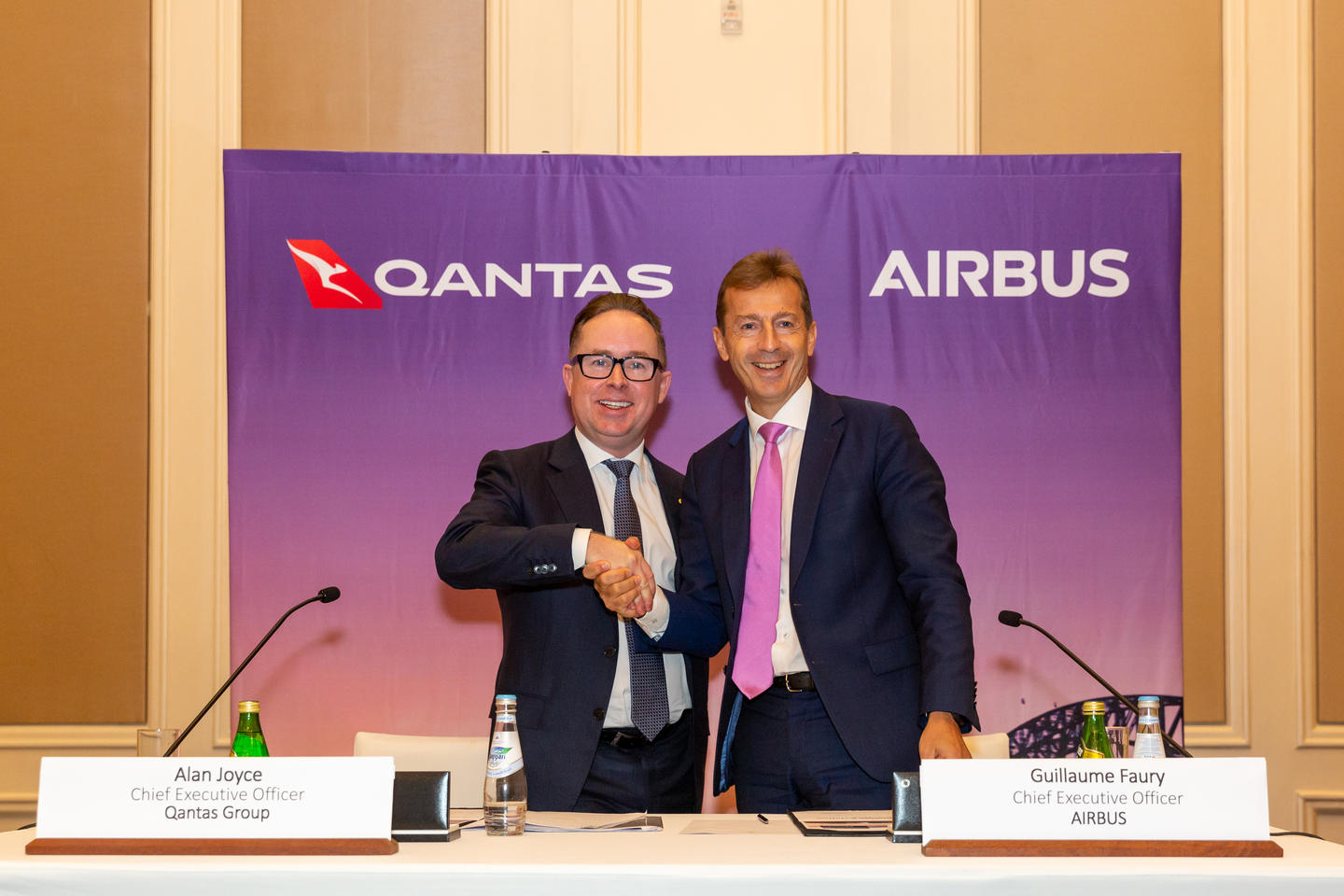
Quantas CEO Alan Joyce and Airbus CEO Guillaume Faury at the 2022 IATA AGM in Doha (photo: Airbus)

The global aviation industry is converging on Doha, Qatar for the 78th IATA Annual General Meeting, held in person for the first time, since the 2019 meeting took place in Seoul. Airbus and Qantas have made an announcement of cooperation that will see the Australian flag carrier invest $200 million “to accelerate the establishment of a sustainable aviation fuel (SAF) industry in Australia,” Airbus said, in a statement.

SAFs are seen as the most effective way for the airline industry to achieve its ambitious target to achieve net-zero emissions by 2050. In this context, Qantas has committed to using 10% of SAF in all its fuel mix by 2030. Still, due to the lack of facilities to produce SAF in Australia, it is forced to source them from overseas, making the process inefficient and expensive.

“The use of SAF is increasing globally as governments and industry work together to find ways to decarbonize the aviation sector,” Qantas Chief Executive Officer Alan Joyce said at a joint press conference. “Without swift action, Australia is at risk of getting left behind.”

Pratt&Whitney — the engine manufacturer that will power the A220 and A320neo aircraft on order by Qantas — have announced they will invest in the project as well, as part of their commitment to “support greater use of cleaner, alternative fuels including SAF, while continually advancing the efficiency of aircraft propulsion technology.”

Airbus CEO Guillaume Faury said, “The agreement we are signing with Qantas today reflects the new level of partnership between our two companies and are firmly shared commitment to act as catalysts of change to ensure a bright future for our industry.”

Qantas and Airbus will provide funding for locally developed and produced SAF and feedstock initiatives that will be evaluated based on their commercial viability and environmental sustainability.

Airbus and Qantas Build Closer Ties

The two companies are also partners in two other projects that aim to set new standards in aviation. “Project Sunrise” is intending to launch the first non-stop flights from the Australian East Coast city of Sydney to London and New York, thus performing the longest commercial flight in the world with a scheduled duration of over 20 hours. After a long evaluation process, Qantas decided to select the Airbus A350-1000 aircraft to operate this flight when it is launched in 2025. This aircraft was preferred to Boeing’s existing 787-9 aircraft or the still-under-development Boeing 777X.

Furthermore, Qantas has chosen Airbus also for its “Project Winton” which is leading a modernization of its fleet for the domestic market. An order for 20 A220-300 and 20 A321 XLR aircraft is intended to progressively replace the current fleet of Boeing 717 and Boeing 737 aircraft to fulfill its domestic needs, with deliveries to take place starting in 2023. The order also includes options for 94 further aircraft to be delivered until 2034.

Traffic levels Rebound

During the press conference, Qantas CEO Alan Joyce expressed satisfaction at how traffic is recovering after the many months of minimal passenger flows due to restrictions related to the COVID-19 pandemic. According to Joyce, corporate traffic is back to 90 percent of 2019 levels, and leisure traffic is experiencing a 120 percent surge compared to pre-pandemic levels.  International passenger numbers are expected to be completely recovered by the end of 2023.

Vanni Gibertini

Vanni fell in love with commercial aviation during his undergraduate studies in Statistics at the University of Bologna, when he prepared his thesis on the effects of deregulation on the U.S. and European aviation markets. Then he pursued his passion further by obtaining a Master’s Degree in Air Transport Management at Cranfield University in the U.K. followed by holding several management positions at various start-up carriers in Europe (Jet2, SkyEurope, Silverjet). After moving to Canada, he was Business Development Manager for IATA for nine years before turning to his other passion: sports writing.

Learning to Fly: Inside Sydney’s Premier Flying College

A Mokulele Cessna 208 on approach to Kahului Intl. (Photo: AirlineGeeks | Joey Gerardi)

The avenue to an aviation career is a road well-traveled, and for many, the destination is a dream fulfilled. Yet, if one was asked just how that dream can be made a reality, the road can suddenly seem anything but a yellow-brick road to the land of Oz.

AirlineGeeks visited one of Sydney’s – and Australia’s – most successful commercial flying schools, Sydney Flight College, to learn about the path, and how the school keeps itself up to date in a new era of flight.

50 Years of Sydney Flying College

Sydney Flight College, SFC as it is more commonly known, has a rich history in Australian aviation. Established in 1969, the not-for-profit college has been playing its part in expanding the aviation industry through the joy of flight, and its clubhouse and training facilities give evidence of that. AirlineGeeks started with a visit to these facilities and, specifically, the simulator.

After receiving a brief introduction, it fell to this writer to try some circuits over Sydney in the school’s Boeing 737-800 simulator. No stranger to the joys – and fatigue – of circuits, it was of great surprise to learn that rudder input was not required for a coordinated turn. More surprising yet, this writer managed to land the 737 without incident – credit is necessary for SFC 737 Simulator Manager Khalie Jensen, a former Cathay Pacific and Virgin Australia second officer.

Of course, a modern flight school is not a school at all unless its fleet is, well, modern. SFC impresses further in this field. Although the college owns an array of steam-gauge Piper Warriors and Archers, jaws drop and drool over the new Piper Archer TXs, Cessna 182T Skylane and the Diamond DA42.

Industry training is typically governed by principles that ensure the training is current and relevant to industry, and this fleet ensures SFC is keeping up to date with the industry. SFC’s Archer TX features a full glass cockpit and air conditioning (try flying in an Aussie summer without it) and is a delightfully stable trainer. The school’s DA42, apart from feeling like one is seated in an F-18 Hornet with its control stick centered between the pilot’s legs (calm down, Maverick), also offers a full glass cockpit, satisfying the current and relevant training principles.

The Road to Success

While one avenue to becoming a career pilot is through the small funnel of airline cadetships, one would be seriously mistaken to write-off the importance of general aviation in the airline sector. SFC’s CMO Raymond Toutounji took AirlineGeeks on a tour of the commercial career journey, starting with general aviation (GA).

Just as training wheels are a first step in learning to ride a bicycle, GA is the foundation on which all commercial aviation is built. SFC understands this fundamental truth well, using their flying club history and experience in their students’ favor to build a community that builds and encourages the prospective pilot.

For the pilot who so desires, SFC delivers full-time training, a journey composed of several elements. The first 12 months are comprised of 165 flying hours of training, culminating in a Commercial Pilot Licence (CPL) – the minimum requirement to fly commercially in Australia – opening the door to a career in flying.

The next element involves another four months of training, during which 38 flying hours and further study lead to a Multi-Engine Instrument Rating, or MECIR. This rating builds a platform from which a student can leap into either charter pilot work or a Flight Instructor Rating, both of which allow a build-up of more hours – all the while being paid (well, the instructor after receiving the rating) – so as to reach the requirements needed to begin work in the airline industry.

As the college moves with the times, it was pleasing to see how seriously SFC views the success of all their students – particularly female pilots and indigenous groups – by providing both scholarships and support groups to inspire and assist students. Worldwide, female pilots make up approximately five percent of all pilots, a statistic the school aims to increase drastically. It was admirable to see just how intent SFC is on removing as many barriers as possible for as much success as possible.

Expanding Out West

As Australia’s aviation sector grows into the future, SFC will adapt to meet new needs. For the reader acquainted with aviation’s pilot deficiency, it is of no surprise that one of the greatest challenges will be to fill that void. It is this void that SFC will continue to address as it plans on expanding beyond the Sydney region into regional New South Wales.

Utilizing the vacated premises of older schools, SFC will be expanding operations to the regional New South Wales city of Tamworth – affectionately known as the Country Music Capital of Australia. The expansion, expected sometime in 2023, will play a key role in supporting international growth in aviation as the school also aims to take on international students, taking advantage of Tamworth’s low-density airspace.

SFC’s expansion plans appear well-timed, as Sydney’s newest airport will affect changes in the city’s training areas. In a bitter-sweet move, the new Western Sydney Airport brings both new opportunities for the aviation sector while wiping out a large swathe of the popular training area.

Currently, Sydney’s airspace can loosely be divided into three zones of class C, D, and G from east to west respectively. With the opening of Western Sydney planned for 2026, this class G will transition to C – far from the idyllic G airspace where the student pilot’s mistakes can be more easily forgiven.

As the future slowly reveals its uncertain hand, SFC’s Tamworth location will provide a secure location, free from the effects of Sydney’s changing aviation landscape, as well as provide a genuine Australian experience for the student who dares travel to the land down under.

A Community, Club and College

Make no mistake – the journey to a successful career in aviation has its obstacles – but success is a real possibility. As an instructor, this writer can appreciate that a student requires more than just a ‘teacher.’ The learner needs, and deserves, a proverbial ‘yellow-brick road’ of support and friendship from which success is attained.

AirlineGeeks’ visit to Sydney Flying College revealed much about this journey; if it takes a village to raise a child, it takes a club to make a pilot. With an atmosphere of warmth and scenery of smiles, SFC is playing a key role in shaping, supporting, and building Australia’s – and the world’s – pilots.


Mike Mangano

Mike’s love affair with flight and mechanical objects in the sky began at an early age, fascinated by space documentaries and the vintage Flight Simulator ’95. He currently works as an instructor for UAVs and is training to receive his Private Pilot Licence with the goal of working in manned flight instruction. An avid reader of all things aviation and manned space flight, Mike stays close to developments in aerospace while reminiscing and sharing the rich history of flight with others. He loves writing, engineering and science.

Denver Opens New Commuter Gates

The new home of Denver's EAS airlines (Photo: Denver International Airport)

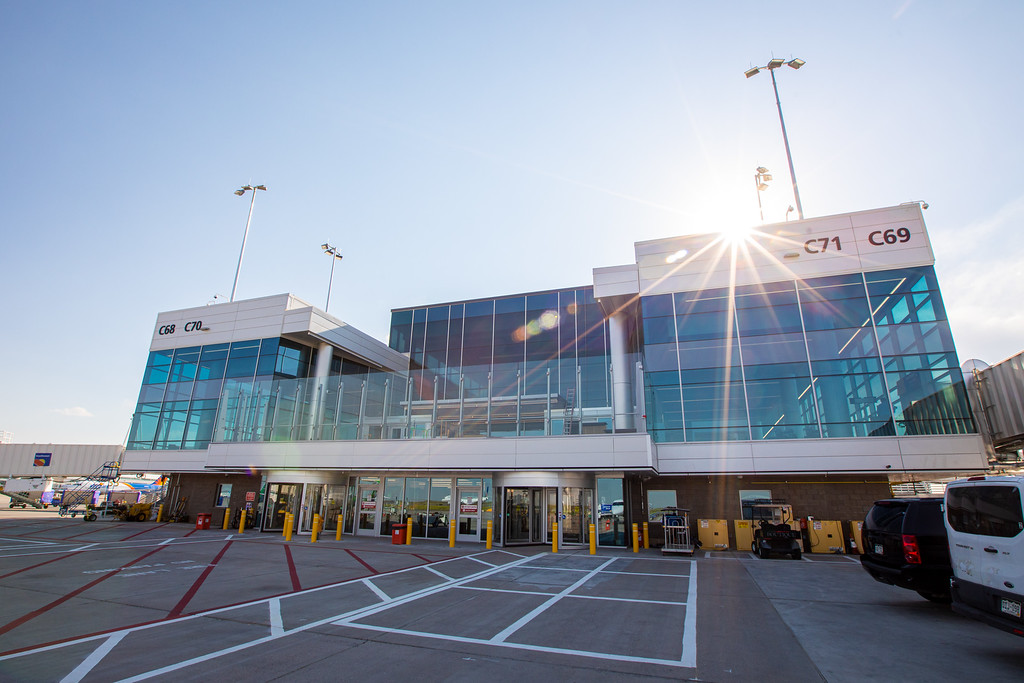
Denver International Airport is in the middle of a big expansion project adding tons of new gates to its existing concourses, and one such improvement is the new commuter airline gates. The new ground-level gates at the end of the C concourse will replace the current ground-level gates in terminal A.

The hallway leading to the old commuter gates in Terminal A (Photo: AirlineGeeks | Joey Gerardi)

As most know, a lot of the trip reports and articles I do are of flights to small Essential Air Service communities. You might even recognize the above picture from past trip reports like Boutique Air to Phoenix, Denver Air Connection’s famous Metroliner, and most recently my flight from Chicago to Denver on Denver Air Connection. These two airlines along with Southern Airways Express will be the three airlines that will utilize the new commuter gates in the C terminal.

The new commuter section is a breath of fresh air for those that travel on the three small carriers, and won’t be banished to the end of terminal A. Before the opening of these gates on June 7, 2022, those traveling on Boutique Air, Denver Air Connection, and Southern Airways Express had to walk down a long and relatively empty hallway to the very end of the A terminal. This hallway used to be where all of the Great Lakes Airlines flights departed before the airline ceased operations in 2018, but since then this part of the terminal has sat completely empty except for the very end where the commuter airlines operated from before July 7.

The former home of SAE, BTQ, and DAC (Photo: AirlineGeeks | Joey Gerardi)

The new gate assignments are as follows: Boutique Air will be at C 69, Southern Airways Express at C71, and Denver Air Connection will be at both C68 and C70. Although they are only at four gates, the three airlines will split the eight common-use aircraft parking spots. They will also have six parking spots for aircraft remaining in Denver overnight.
The new commuter airline gates at Denver Airport (Photo: Denver Airport)

The term ‘common use’ means that no airline is assigned to a specific spot, and they use whichever spots are available and even interchange them throughout the day. Passengers will then walk out from the preassigned terminal gate doors to whichever parking spot in which they will be departing. The new gates will also feature revolving doors which is a very unique feature, as well as automatic doors.

The automatic and revolving doors leading outside (Photo: Denver International Airport)

These gates will be directly under the new Terminal C expansion, so passengers will have much better access to charging ports, food, pet relief area, and shops than in their previous home in Terminal A.

The new home of Denver’s commuter airlines (Photo: Denver International Airport)

The below video is a walk-through of the old commuter airline gates in Terminal A:

Joey Gerardi

Joey has always been interested in planes for as long as he can remember. He grew up in Central New York during the early 2000s when US Airways Express turboprops ruled the skies. Being from a non-aviation family made it harder for him to be around planes and would only spend about three hours a month at the airport. He was so excited when he could drive by himself, the first thing he did with his driver's license was get ice cream and go plane spotting for the entire day. He graduated from Western Michigan University in 2022 with a B.S. in Aviation Management & Operations and a Minor in Business, and currently works for a major airline in his hometown.

LATAM Brazil Receives First Post-Pandemic Aircraft Delivery

LATAM
A LATAM Brasil A320 taxies in São Paulo/Guarulhos. (Photo: AirlineGeeks | João Machado)

In the last week of June, LATAM Brazil will receive its first Airbus A320neo (registration PR-XBI) since the start of the Covid-19 pandemic.

This will be the seventh aircraft of this model in the LATAM fleet in Brazil and the 14th in the LATAM group. It is important to remember that Airbus delivered the last new aircraft from the factory to the company in December 2019.

In a press release, the airline stated that LATAM Brazil’s new plane will leave the Airbus factory in Toulouse, France and should land in Fortaleza, Brazil at the end of this month. This is one of the 70 units of the A320neo family ordered by LATAM group from the manufacturer to modernize and increase its fleet efficiency.

It should be noted that, within the Chapter 11 process framework, the LATAM group presented an agreement with Airbus for the court’s approval for the purchase of 28 new aircraft. These incorporations will be added to the 42 narrowbody aircraft already agreed upon, as part of its fleet modernization and efficiency plan for the coming years.

This order, which adds up to 70 aircraft, maintains the LATAM group’s fleet as the largest in Latin America, with greater range and capacity. The A320neo aircraft features more efficient engines, aerodynamic improvements and technology that provides 20% more fuel efficiency.

They also generate less CO2 emissions, in addition to a 50% reductions in nitrogen oxide emissions and a 50% reduction in noise pollution. Currently, the LATAM group has a fleet of 299 Boeing aircraft (767, 777 and 787 models) and Airbus aircraft (A321, A320, A320neo and A319 models).

In addition, LATAM Cargo Chile, LATAM Cargo Colombia and LATAM Cargo Brazil also have a combined fleet of 14 cargo aircraft, which will gradually expand to a total of 21 cargo aircraft by 2023.

LATAM Projects Operation of 74% for June

LATAM Airlines Group projects a passenger operation of up to 74% for June (measured in Available Seat Kilometers – ASK) compared to the same month in 2019. The group will also begin operations between Puerto Maldonado and Cusco, in Peru, and will resume 3 routes from Belém (Brazil) to Macapá, Fortaleza, and Manaus.

The company plans to operate approximately 1,123 daily domestic and international flights during June, connecting 133 destinations in 21 countries. The group’s cargo business has scheduled more than 1,220 flights on cargo freighters. These projections are subject to the evolution of the pandemic in the countries where the group operates.

In May 2022, passenger traffic was 69.6% in relation to the same period in 2019, based on an operation of 73.1% compared to May 2019. As a result, the load factor decreased 4.0%, reaching 79.6%. The load factor of cargo operations was 58.0%, which corresponds to an increase of 1.6 percentage points in relation to May 2019.

Juan Pedro Sanchez Zamudio

The three things Juan Pedro loves most about aviation are aircraft, airports, and traveling thousands of miles in just a few hours. What he enjoys the most about aviation is that it is easier and cheaper to travel around the world and this gives you the opportunity to visit places you thought were too far away. He has traveled to different destinations in North, Central, South America and Asia. Born, raised and still living in Perú, Juan is a lawyer, soccer lover, foodie, passionate traveler, dog lover, millennial and curious by nature.

Crystal Cabin Awards 2022 Winners Announced

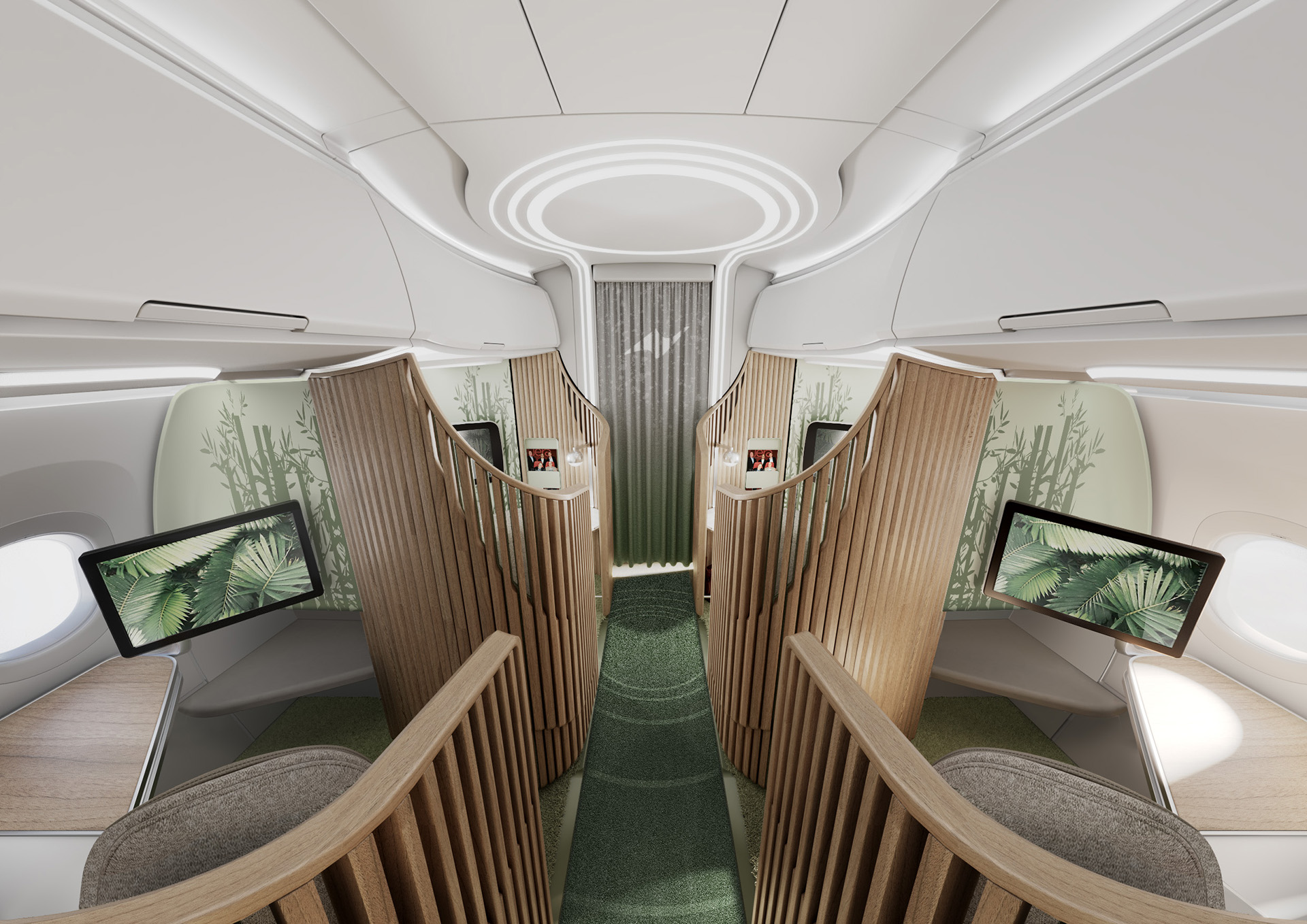
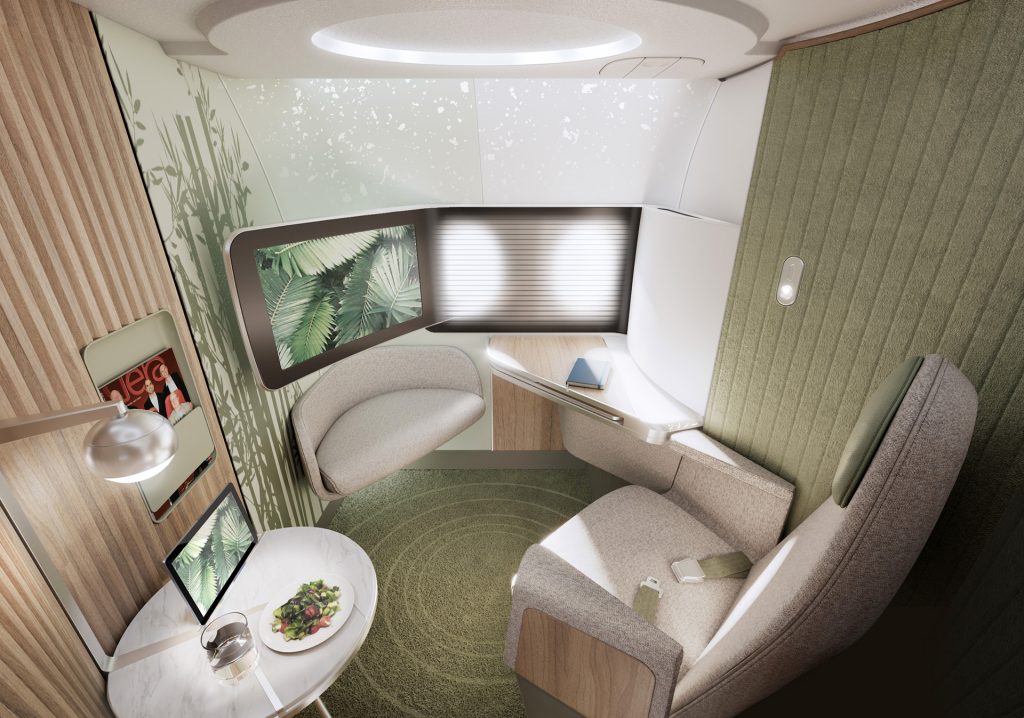
"Elevate" Cabin Concept from TEAGUE (Photo: TEAGUE)

The Crystal Cabin Award (CCA) is THE international prize for innovation in the aircraft cabin. A panel of renowned industry experts judges innovative cabin concepts and products each year at the Aircraft Interior Expo since 2007. 

There are eight categories in the award; “Cabin Concepts”; “Cabin Systems”; “Health and Safety”; “Passenger Comfort”; “IFEC & Digital Devices”; “Material & Components”; “Sustainable Cabin” and “University.” The winners were announced on June 14, 2022. 

Winner Cabin Concepts: Teague and NORDAM “Elevate”

TEAGUE’s “Elevate” concept uses floating furniture (Photo: TEAGUE)

Elevate uses floating furniture attached to give a free, more organic and more immersive feel than comparable premium accommodation concepts for narrowbody aircraft. Apart from the visually appealing design, the idea promotes more open space and lighter structure in each suite. 

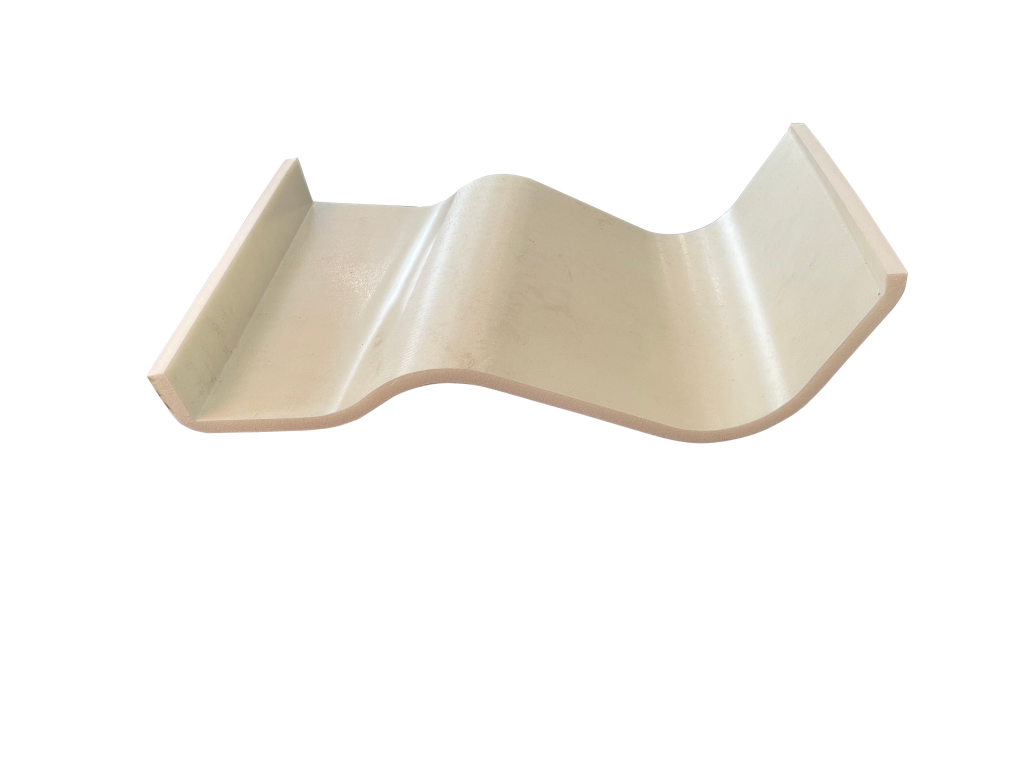
Teague achieved these through NORDAM’s patent-pending Nbrace wall brace. The U-shaped composite structure enables furniture attachment to the sidewall, which provides more possibility for areas like the footwell and under-seat storage previously constrained by the seat-track attachment.

Winner Cabin Systems: Caeli Nova “Cordillera”

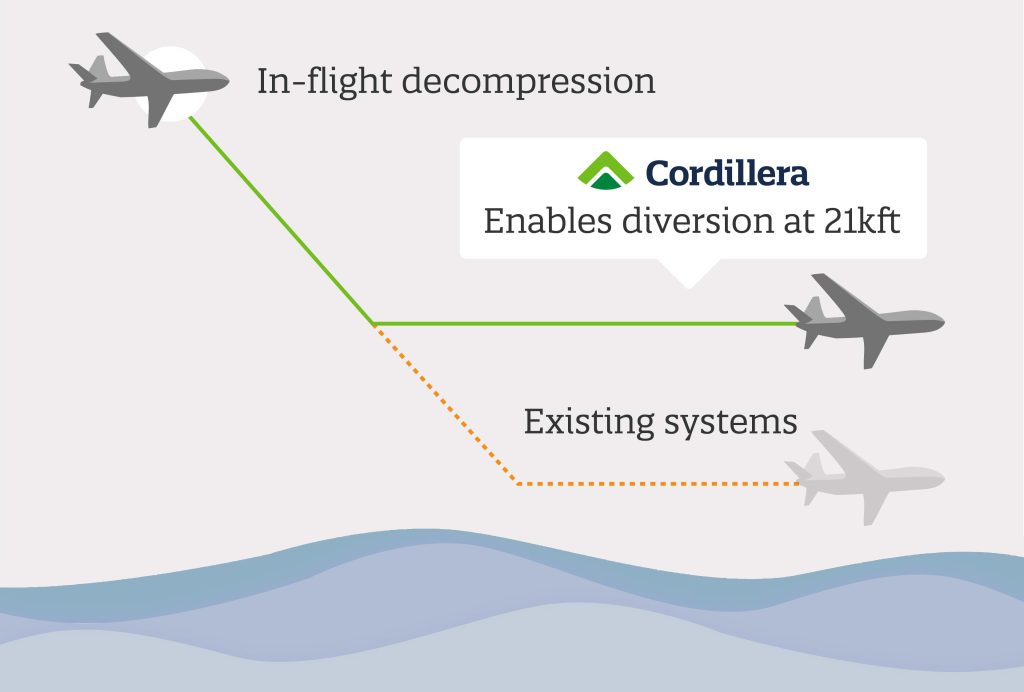
“Cordillera” provides more options for operating over high terrains. (Photo: Caeli Nova)

As the name Cordillera – “mountain ranges” indicates, the company’s mission is to disrupt established processes and protocols in operations over mountain ranges. According to their patent, this system may be mixing oxygen with extracted components from exhaled air so that oxygen supply time can be extended without increasing oxygen reserve. 

This system is a potential game-changer for airlines that enables direct routes over high terrains such as the Himalayas, Rockies or Andes. In time, the company anticipated annual savings for airlines of $500m and 1.2 million tonnes of CO₂.

Winner Health and Safety: Safran Cabin “Fire Resistant Cargo Container”

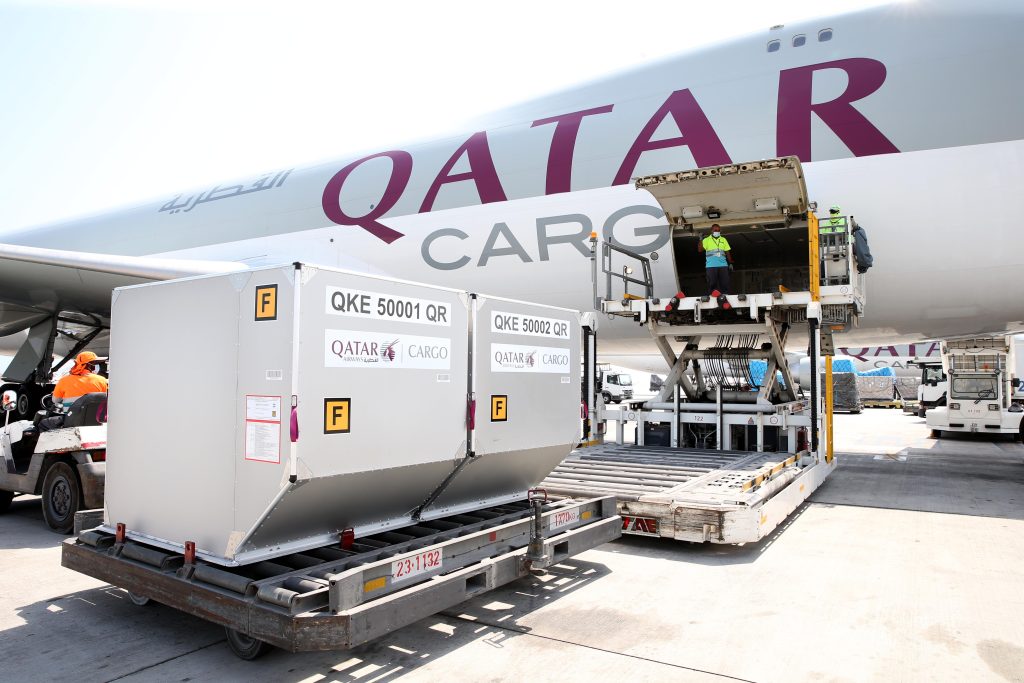
Safran’s fire-resistant cargo container waiting to be loaded. (Photo: Safran)

Safran Cabin’s Fire Resistant Cargo Container offers fire containment for Class D fires for up to 6 hours. Therefore giving passengers, crew and operators an additional level of protection from a threat that has the potential for catastrophic consequences during flight.

Fire is one of the biggest enemies of inflight safety. More digital devices containing lithium-ion batteries are traveling in air cargo. Therefore, the chance of a more violent fire incident becomes higher. FAA recorded 354 incidents involving lithium-ion batteries between January 2006 and February 2022. One of the most extreme accidents caused the total loss of a UPS DC-8, where lithium-ion batteries made the fire uncontrollable.

Winner Passenger Comfort: Collins Aerospace “SpaceChiller”

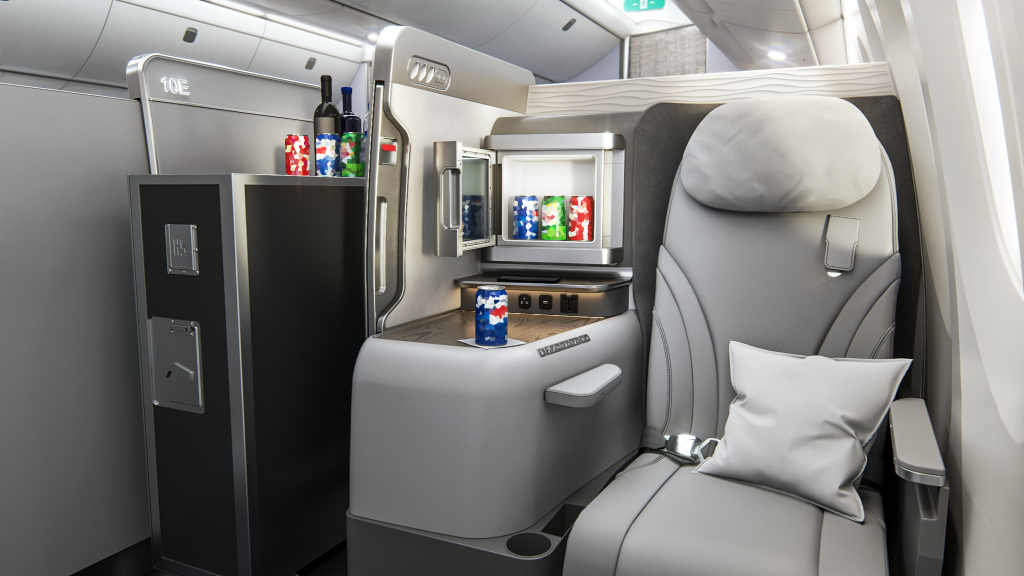
The “SpaceChiller” provides customizable cooling solutions. (Photo: Collins Aerospace)

From the press release

Innovations in this category seek to give all passengers a feeling of exclusivity and luxury, regardless of whether they’re sitting in first or economy. The winner this year in the Passenger Comfort category was SpaceChiller by Collins Aerospace. This personal refrigeration unit for individual passengers or larger aircraft cabin areas eschews traditional air-cooling technologies. Offering customers cooled snacks and drinks within arm’s reach was long considered difficult to implement.

SpaceChiller requires half the power of traditional designs. Its modular architecture offers a premium passenger experience and gives airlines added flexibility for services and crew workspace. Conceived primarily for premium seat classes, SpaceChiller can be scaled in size as required, another factor that impressed the jury. This enables airlines to provide self-service catering areas for passengers without encroaching on flight attendant workspaces or passengers’ personal space.

The core technology behind SpaceChiller is a heatsink developed for DARPA. The quiet thermoelectric cooling system operates at higher efficiency and offers better performance in a small space than previously possible, without the use of environmentally unfriendly refrigerants.

Winner IFEC & Digital Services: Anuvu coop. Southwest Airlines “Dedicated Space”

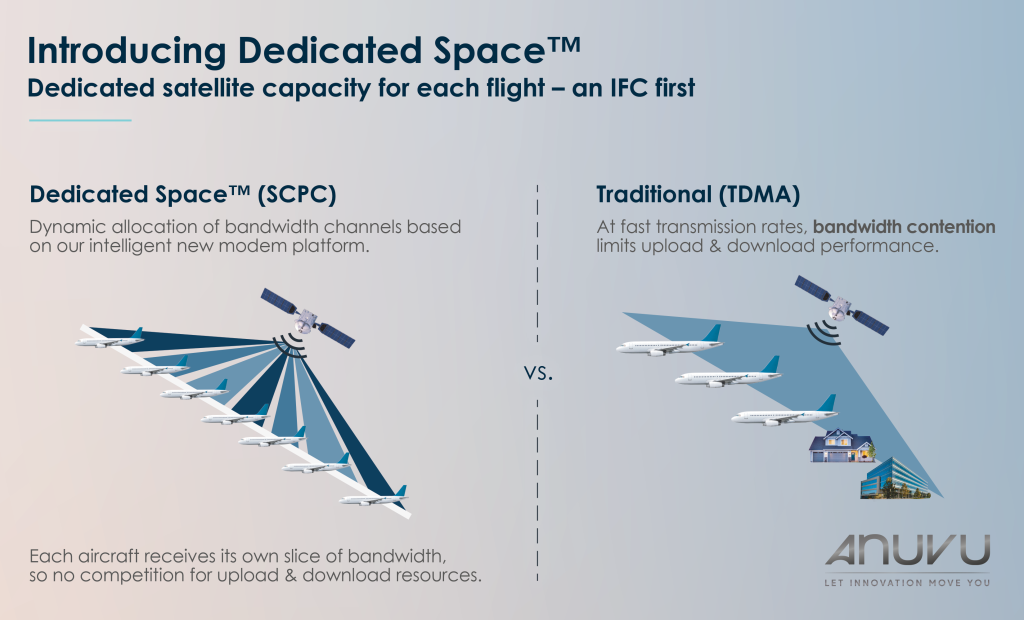
“Dedicated Space” dynamically allocates bandwidth to improve efficiency. (Photo: Anuvu)

Dedicated Space uses proprietary technology that combines aircraft hardware and intelligent software in a different approach to using satellite bandwidth onboard an aircraft. The software analyses bandwidth demand and dynamically assigns traffic based on individual aircraft requirements. Thereby promises a five-fold increase in available personal bandwidth, a dramatic latency reduction and better stability.
This system is one of the few finalists that is a certified product. According to a report by Runway Girl Network, Southwest was planning to install the system on 50 aircraft by the end of May. Despite confirming the installation, the Dallas-based airline later selected ViaSat as its line-fit internet supplier.

Winner Material & Components: Thales Avionics “Pulse”

“Pulse” reduces the footprint of the power supply for personal device charging. (Photo: Thales Avionics)

Like Dedicated Space, Pulse also employs patented technology that dynamically allocates resources to individual outlets. The system provides USB-A, USB-C and wireless charging options. The charging solution’s patented power management technology reduces the power supply weight by 30%. On top of its functionality, the visual quality of its material was also a contributing factor for it to win in this category.

Winner Sustainable Cabin: Diab “100% Recyclable Panels for Cabin Interiors”

Diab’s recycled thermoplastic. (Photo: Diab)

Swedish manufacturer Diab won this category with its partnership with AkzoNobel, Rescoll and Roctool. The group has pioneered a thermoplastics manufacturing process to produce 100% recyclable panels for cabin interiors. In addition, the thermoplastic sheets are welded directly to the foam core, offering improved acoustic insulation for the finished material. 

One can usually improve sustainability in aviation in two ways, weight reduction or waste reduction. This product achieved both aspects, boasting zero waste and an 8% to 10% weight reduction.

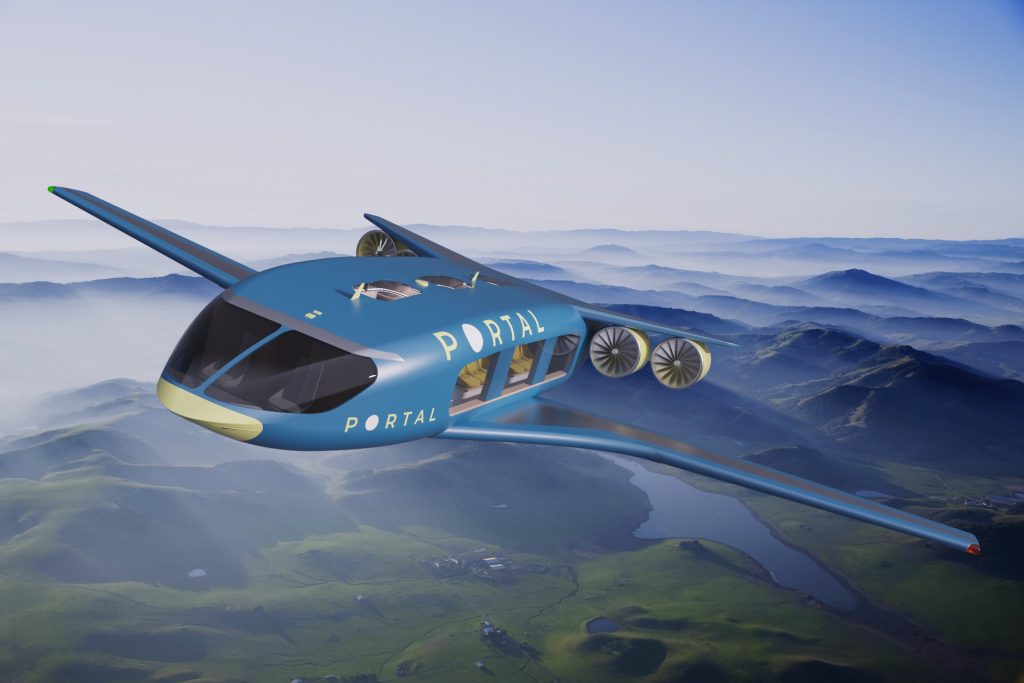
Winner University: Ken Kirtland “Portal”

“Portal” uses electric airplanes to provide travel between local hubs. (Photo: Ken Kirtland)

The University category is usually home to some of the wildest ideas. Ken Kirtland from the Georgia Institute of Technology won this category in 2022. 

Portal envisages a new type of zero-emission electric-powered aircraft to ferry passengers which also looks much like a ferry boat. The concept utilizes underused regional airports for air travel between local hubs. This concept provides an enticing vision for the future of regional flight.

Conclusion

One of the commonalities these winners show is sustainability. All these products in some way reduce emissions and decrease consumption while providing better passenger experiences. 

CCA usually showcases some of the most innovative ideas in the industry. While not all the ideas turn into reality, the winners will undoubtedly provide a glimpse of the future. 

Fangzhong Guo

Fangzhong grew up near an OEM airport in northeastern China, where he developed his enthusiasm for aviation. Taking upon his passion, he's now working as an aircraft interior design engineer. Besides working in the aerospace industry, Fangzhong enjoys trying out different types of airplanes and seeing how airplane interiors have evolved. So far, he's flown on over 80 types of aircraft. He also planespots in his spare time. His rarest catches included the 747 Shuttle Carrier Aircraft and AN-225.

American Express Shows Off New Delta 747-Themed Credit Card

Delta's 747-themed credit card (Photo: Delta)

Ever wanted an aviation-themed credit card outside of the normal airline co-branded ones? Well, on Wednesday Delta Air Lines and American Express are making this possible with a brand new lineup of credit cards with a touch of Delta aviation history.

Made with a retired Delta 747 aircraft, this credit card is the first of its kind. The card will be available exclusively for Delta SkyMiles® Reserve and Reserve Business Card Members from June 16 through Aug.  3, 2022. The cards are made from 25% of the same metal that made up Delta ship 6307, an aircraft that over its decades in service conducted many notable missions. Ship 6307 evacuated people from Florida during Hurricane Irma in 2017 and united orphans with their new families.

A Delta 747 in Atlanta (Photo: AirlineGeeks | Hisham Qadri)

Delta Air Lines SVP of Customer Engagement Dwight James said in a press release: “The idea of making a metal credit card out of actual airplane metal began years ago, and the creativity and innovation that was required to achieve this is incredibly meaningful.”

The card is obviously a must-have for any Delta frequent flier or aviation enthusiast looking to carry a piece of aviation history with them.

The card features a stylish black coating with facts about Delta ship 6307. Customers will also have access to an exclusive Augmented Reality kit in the welcome box that goes through the history of ship 6307 and the process Delta and American Express went through to make the one-of-a-kind credit card.

Ezra Gollan

Ezra Gollan is a student, photographer and aviation enthusiast based in New York, New York. He has spent over half a decade around New York City’s airports as a photographer.

Canada Suspends Vaccination Mandate For Air Passengers

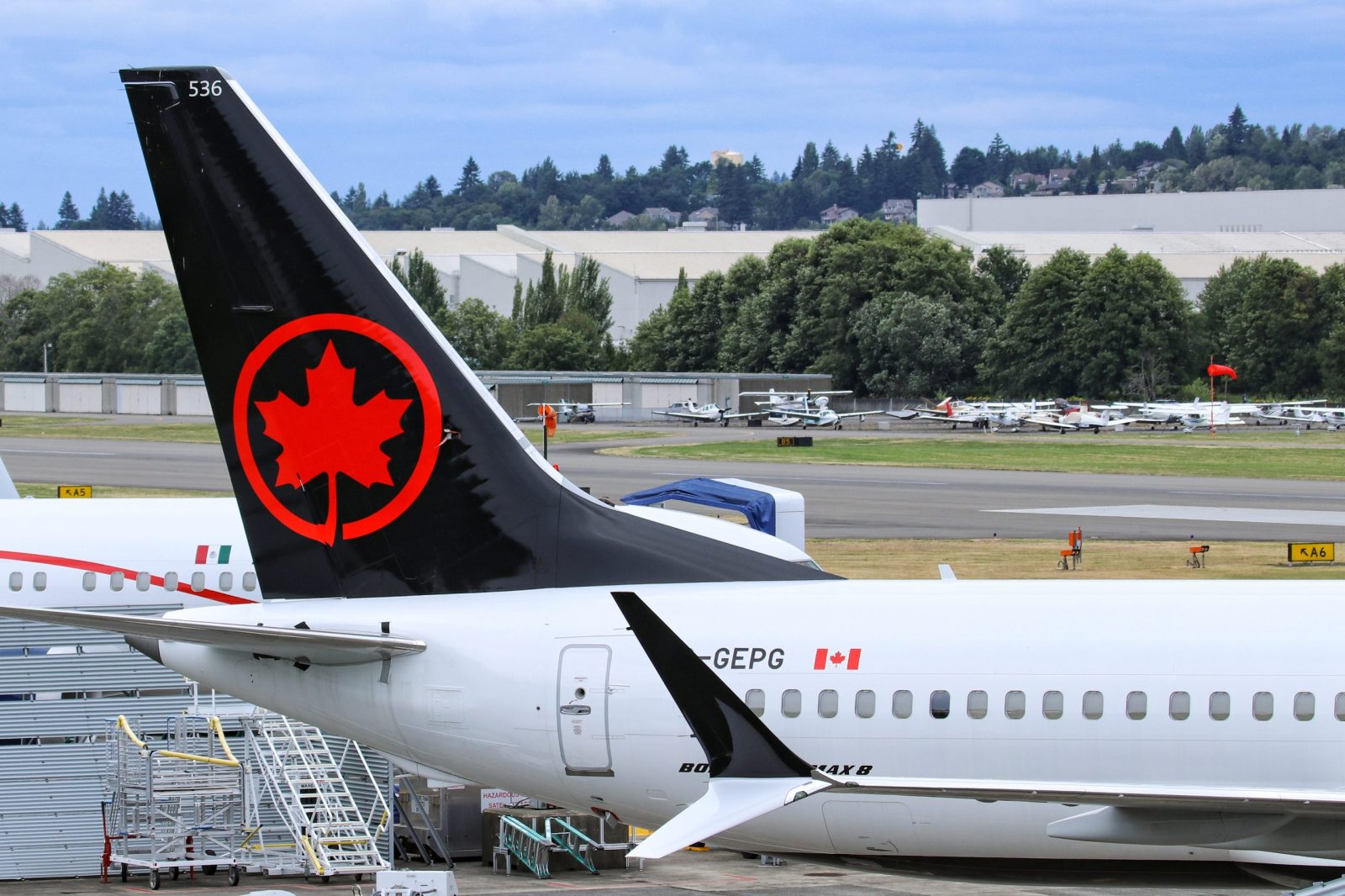
Air Canada 737 MAX 8
An Air Canada 737 MAX 8. (Photo: AirlineGeeks | Katie Zera)

As the travel industry attempts to return to a semblance of normality after months of restrictions due to the COVID pandemic, each country tried to find its own way to deal with the situation balancing the need to protect its population in a rapidly changing health environment and the need to restart business and leisure air traffic to support the economy.

From the very beginning, Canada adopted a very prudent approach, enforcing a mandatory 14-day quarantine for all individuals entering the country lasting from February to July 2021, quickly coupled with a mandate to prevent anyone who was not fully vaccinated to board any plane, train or long-distance bus in the country.

The very controversial mandate has been in force since May 2021, and it was only a few days ago that the Canadian authorities decided to suspend the requirement as of June 20, together with the requirement that all federally regulated employees be vaccinated to perform their duties. In Canada, all employees in the transportation, telecommunication, and banking sectors are regulated at a federal level.

This move will allow non-vaccinated people to board a domestic plane and leave the country if they choose to do so, but “because vaccination rates and virus control in other countries varies significantly, current vaccination requirements at the border will remain in effect”, said Transport Canada in an official note.

Masks will still be mandatory for all people traveling by plane or by train, while it has been dropped for long-distance buses. Vaccination will still be required for passengers and crews on cruise ships due to “the fact that passengers are in close contact with each other for extended periods of time.”

International Travel Restrictions Remain

While domestic travel will become much easier for non-vaccinated individuals, their ability to cross borders will still be significantly restricted: people eligible to return to Canada will be able to enter the country but they will still need to provide a negative test before boarding a plane to Canada, undertake another test on their arrival and be prepared to spend up to 14 days in quarantine should they be requested to do so by border agents, as well as take another test on Day 8 after their arrival in the country.

This decision from the Government follows the one announced a week earlier to suspend the practice of random-testing passengers arriving from international flights at airports in Canada. The suspension will last six weeks and during this time the process will be taken off-airport as expanding crowds are making it extremely difficult to keep this process in structures that were never designed for these activities

However, no change has been made to the policy regarding foreign individuals wishing to travel to Canada: only fully vaccinated foreign visitors will be admitted into Canada.

Vanni Gibertini

Vanni fell in love with commercial aviation during his undergraduate studies in Statistics at the University of Bologna, when he prepared his thesis on the effects of deregulation on the U.S. and European aviation markets. Then he pursued his passion further by obtaining a Master’s Degree in Air Transport Management at Cranfield University in the U.K. followed by holding several management positions at various start-up carriers in Europe (Jet2, SkyEurope, Silverjet). After moving to Canada, he was Business Development Manager for IATA for nine years before turning to his other passion: sports writing.
Sign-up for newsletters & special offers!

Get the latest stories & special offers delivered directly to your inbox

SUBSCRIBE

Uh-oh! It looks like you're using an ad blocker.

Our website relies on ads to provide free content and sustain our operations. By turning off your ad blocker, you help support us and ensure we can continue offering valuable content without any cost to you.

We truly appreciate your understanding and support. Thank you for considering disabling your ad blocker for this website