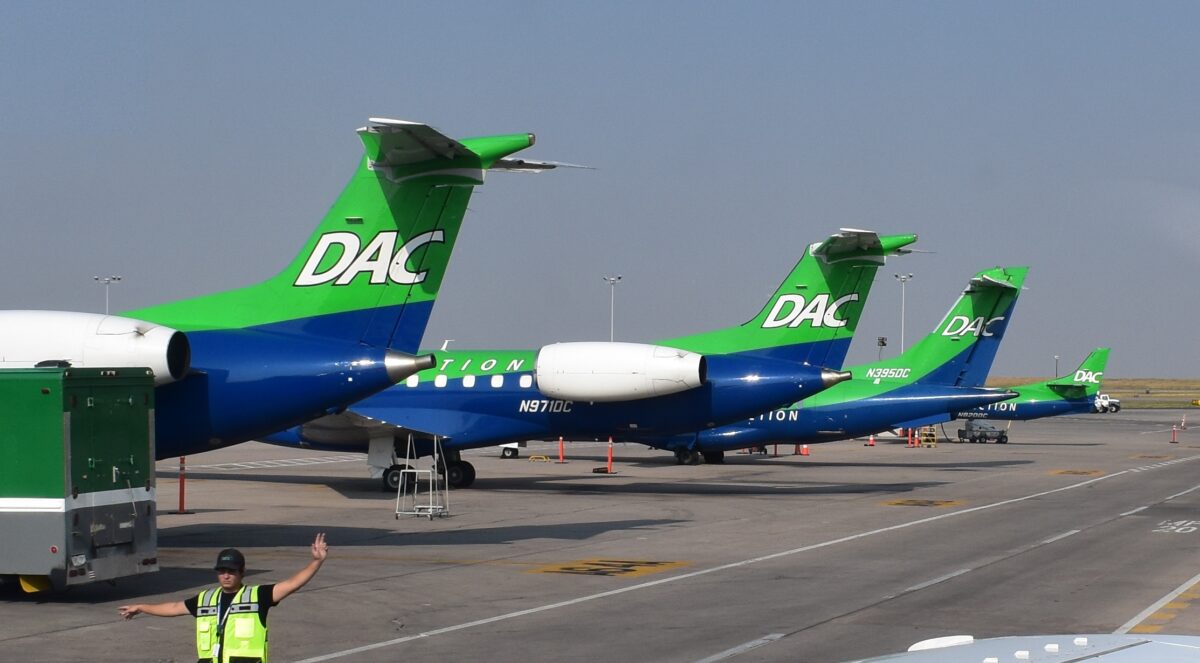
Denver Air Connection airplanes lined up in Denver. (Photo: AirlineGeeks | Joey Gerardi)
Denver Air Connection — more commonly known as DAC — is a Colorado-based airline that has pushed a rapid expansion over the past two years and is showing no signs of slowing down. The carrier has announced two new destinations, both of which are located in the carrier’s home state and are part of the Essential Air Service program: Alamosa and Cortez, Colo.
Alamosa was part of the mass community termination request by SkyWest back in March 2022 and was already in the midst of the EAS bidding process, so they hurried that city along within the process, and the decision took place on May 13. As of then, the Department of Transportation is giving the carrier less than a month to get stuff ready for a planned start date of June 8.
Alamosa will be served with 12 weekly flights to Denver International Airport using either a 30-seat Dornier 328Jet or a 50-seat Embraer E145. Which aircraft serves the community will depend on demand, regular maintenance schedules and other factors.
A Denver Air Connection Dornier 328Jet at Denver Intl. (Photo: AirlineGeeks | Joey Gerardi)
The contract will begin on June 8 and will run for just over two years until June 30, 2024, at an annual subsidy rate of $5,242,836. They will be taking the contract from SkyWest which runs the flights under the United Express branding.
Cortez, Colo. will begin a little bit later, on Oct. 1, and will have the contract run for two years until Sept. 30, 2024. This contract will be flown using the nine-seat Fairchild Swearingen Metroliner to both Denver and Phoenix Sky Harbor International Airport. DAC will be taking the Cortez contract from San Francisco-based Boutique Air.
A Denver Air Connection Fairchild Swearingen Metroliner in Alliance, Neb. (Photo: AirlineGeeks | Joey Gerardi)
A once dying breed for passenger flights in the U.S. just two years ago, the Metroliner will now have a third and fourth route it will operate on. This will also bring the Metroliner to its second major airport, Sky Harbor. Those in Phoenix will now see the Metroliner on an almost daily basis come the fall of 2022.
While Phoenix is not new for Denver Air Connection, it will now become a year-round destination as before it was only served during the winter months from Telluride, Colo. Cortez will see 24 weekly flights with DAC, having 12 flights to both Denver and Phoenix. The subsidy rate will be $6,410,791 for the first year and $6,603,115 for the second year.
DAC’s Current Route Map (Photo: Denver Air Connection)
DAC’s route map is looking similar to another frequent EAS carrier. Nine of the 15 destinations the airline serves are part of the EAS program, and seven of them used to belong to Boutique Air. Alliance, Neb; McCook, Neb.; Ironwood, Mich.; Thief River Falls, Minn.; Clovis, N.M.; Cortez, Colo. and Alamosa, Colo. are all former Boutique Air EAS contracts. The Alamosa contract briefly belonged to SkyWest for a year and a half after Boutique Air, but the rest of them Denver Air Connection has taken directly from the San Francisco-based airline.
One of Boutique Air’s Pilatus PC-12’s in Alamosa, Colo. (Photo: AirlineGeeks | Joey Gerardi)
Passengers will be able to enjoy interline and baggage agreements with both United and American, so depending on what direction Cortez passengers are heading, they can choose the airline they connect with.
Joey has always been interested in planes for as long as he can remember. He grew up in Central New York during the early 2000s when US Airways Express turboprops ruled the skies. Being from a non-aviation family made it harder for him to be around planes and would only spend about three hours a month at the airport. He was so excited when he could drive by himself, the first thing he did with his driver's license was get ice cream and go plane spotting for the entire day. He graduated from Western Michigan University in 2022 with a B.S. in Aviation Management & Operations and a Minor in Business, and currently works for a major airline in his hometown.
Artist’s conception shows the seaplane and logos envisioned for the new seaplane to service Tacoma, run in partnership by the Puyallup Tribe of Indians and Kenmore Air.(Photo: The News Tribune | Puyallup Tribe of Indians)
Earlier this month, Harbour Air resumed its seaplane service between downtown Vancouver, Canada and downtown Seattle. The route has been on hiatus since the transborder closed in 2020. The Vancouver-based carrier attempted to restart flying between the pair in June 2021. However, the uptick in Covid cases and tight entrance requirements kept the plan from materialization until this month.
The service started as a joint venture between Harbour Air and Kenmore Air in April 2018, with each airline operating half of the flights. The flight offers considerable time savings with quick passport control and proximity to city centers. Its first operating season saw over 3100 passengers flying, exceeding the airlines’ expectations.
The tech companies in the area drove the strong demand. The city of Vancouver, Canada even featured this service in its bid to become Amazon HQ2. Therefore, both sides of the border have shown strong interest in bringing the service back.
The relaunched route’s frequency matches its pre-pandemic level with two roundtrips on weekdays and a daily roundtrip during weekends. However, the Vancouver-based carrier is the sole operator at the restart, while its Seattle-based counterpart codeshares the flights. This change introduced a modified routing compared to its original launch.
The new service excludes the leg between downtown Seattle and Kenmore Air’s base in Lake Washington. The Canadian carrier’s move to restart the service by itself shows its interest in capturing the business traveling demands between the metropolitan areas. It’s unclear if the operation will return to its original arrangement.
The revised schedule also significantly changes the time on the ground of a same-day return trip. Time in Vancouver, Canada is reduced from 8 hours and 30 minutes to 4 hours, while time in Seattle is increased from 5 hours and 40 minutes to 7 hours. The change will likely create positive impacts. It provides more time for passengers who originate in Canada to conduct business in Seattle while only having minimal effect on the demand for traffic originating in the U.S.
Travelers who originate in Seattle can hardly make same-day return trips, because the U.S. still requires all travelers entering the country by air to show proof of a negative COVID-19 test. The route’s return follows Kenmore Air’s service resumption to Victoria, Canada in April 2022. It signifies travel across the U.S.-Canada border is one step closer to normality.
Kenmore Air, Tribal Casinos Partnership
While its Canadian partner relaunches, Seattle-based Kenmore Air and the Puyallup Tribe announced a planned seaplane dock and seaplane service out of Tacoma, Wash. The partnership is aimed at expanding tourism and attracting Canadian casino-goers.
The tribe plans to build a new terminal on land it recently bought for this operation. The pair expects to launch the service in late 2023. The Seattle-based carrier will operate one plane in the newly constructed port with flights to Victoria, Canada and the San Juan Islands, Wash. Both destinations are popular vacation spots and are only accessible by ferry or air.
The new service will reduce travel times for travelers heading out of the city from 4-5 hours to 1.5 hours. Similarly, it will make the tribe’s latest casino the closest casino to both locations, reducing travel time by half. The family-owned airline will also provide sightseeing flights in the nearby area.
It’s a common tactic for casinos to lure gamblers with transportation assistance. Most incentives include free water shuttles, ground shuttles or game coupons. In the past, casinos in Mississippi subsidized AirTran flights to grow their gambling business.
Despite not disclosing any details on the project’s cost, the tribe said it would invest a substantial amount, hinting its primary goal is to attract high-rolling players. It remains to be seen how the Tribe will promote the floatplane operation.
In addition to boosting foot traffic at the tribe’s casino, the tribe also hopes to engage young people from the Tribe in the aviation sector. The seaplane operator will operate the new terminal and provide support, as the tribe looks to hire workers for it.
AirlineGeeks.com was founded in February 2013 as a one-person blog in Washington D.C. Since then, we’ve grown to have 25+ active team members scattered across the globe. We are all here for the same reason: we love deep-diving into the fascinating realm of the airline industry.
A Sky Express A320neo parked in Larnaca. (Photo: Sky Express)
Delta and Sky Express announced that they will offer more options for both American and Greek passengers to connect between North America and Greece through their new interline agreement. Flights between the pair will originate out of Delta’s East Coast hubs of Atlanta, Boston, and New York.
The new routes accompany Delta and Sky Express destinations available through existing agreements with Air France and KLM via Paris-Charles de Gaulle and Amsterdam’s Schiphol Airport.
Customers of the airlines can already take advantage of the partnership, as it went into effect on May 19. They will have the option to travel to Athens on one of Delta’s daily nonstop services to then proceed to any of the 34 destinations across Greece and Cyprus operated by Sky Express.
Some of the more popular destinations customers can choose from are the islands of Mykonos, Kefalonia, and Santorini; Crete and Corfu; and Larnaca in Cyprus.
The announcement comes just in time for the summer season, as travel demand begins to surge.
This year alone, it is estimated that half a million tourists will be visiting Greece from the United States.
“With one of the youngest fleets and an unrivaled network, this arrangement with Delta will allow customers across the U.S. to connect to the magical charm of the Greek islands,” stated Yiannis Lidakis, Sky Express’ Commercial Director.
The influx of passengers will hit record highs this year.
“We have never had 500,000 travelers directly from the U.S. to Athens [in one year],” stated Vassilis Kikilia, Greece’s Tourism Minister, “and there is now a direct service on all three major American companies.”
The country welcomes the large number of guests coming from America, as tourism is a major driver of the Greek economy
Sky Express is currently the fastest-growing airline in Greece — and has been in operation since 2005. The carrier operates the largest network of destinations in Greece, totaling 34 locations.
The young company’s current fleet consists of eight Airbus A320s, with seven of those being neos. They utilize two configurations — 186 seats and 174 seats.
The airline also operates 12 ATR 42/72 turboprop aircraft with an average age of 11.9 years.
Sky Express currently has interline agreements with airlines worldwide such as Air France, KLM, Qatar Airways, American Airlines, Middle East Airlines, Cyprus Airways, Condor, El Al, Transavia, Air Transat, Royal Jordanian, and easyJet.
Chase Hagl grew up in Twin Falls, Idaho. His love and passion for Aviation landed him in Orem, Utah where he obtained a B.S. in Aviation Management with a minor in Business Management from Utah Valley University. Chase currently works as a flight attendant in Charleston, SC and is also the primary Inflight ASAP ERC representative for startup airline, Breeze Airways. His experience in the aviation industry spans back four years, working in areas including agriculture application, customer service, maintenance, and flight ops. In his free time, Chase enjoys road biking, astronomy, and flying.
Virgin Atlantic Announces Return of Flights to Cape Town
A Virgin Atlantic 787-9 departing London Heathrow. (Photo: AirlineGeeks | William Derrickson)
Virgin Atlantic is resuming its seasonal service to Cape Town, seven years after axing the South African city from its network.
The U.K. carrier will operate daily Boeing 787-9 flights between London Heathrow and Cape Town from November 5 until March 24, 2023, complementing its existing daily service to Johannesburg.
Virgin founder Sir Richard Branson visited Cape Town to announce the resumption of Virgin Atlantic’s seasonal nonstop flights to the city as he drove the streets of Cape Town in an open-top bus waving the South African flag.
“Who wouldn’t want to come to Cape Town? It’s the most special place in the world,” Branson said. “The challenge for us now is to try and get it so we can come 12 months of the year.”
The route which adds more than 80,000 seats between Cape Town and London is a major boost to the South African tourism industry which represented 9% of the South African GDP, pre-pandemic, with the U.K. contributing immensely as the market for tourism in Cape Town.
This service will make it easier for travelers going for business and leisure between South Africa and the United Kingdom, by providing seamless connections via Heathrow to Europe and North America.
Juha Jarvinen, Chief Commercial Officer at Virgin Atlantic commented: “We’re incredibly excited to return to the fabulous city of Cape Town with daily services from November. Although a little later than we’d have liked due to the Covid-19 pandemic, the move reflects the fact that travel is recovering and global demand for holidays to sunny, premium destinations is returning at pace.”
“We’re expecting a high proportion of leisure travelers on this route who will rightly be taking advantage of the winter sun, exploring the world-renowned wine regions, and soaking up the rich culture this incredible country has to offer,” Jarvinen added.
The service will also create additional cargo capacity for the route, transporting essential goods between South Africa and the U.K.
Virgin Atlantic’s head of Africa, the Middle East, and India, Liezl Gericke,noted that the decision to resume direct flights was due to the sustained growth in tourism in Cape Town and “a lot of work in terms of are-rationalizing our fleet.”
“We now have one of the youngest fleets in the sky. The average age of our aircraft is only five and a half years, so we’re flying very economical aircraft. Much more so than we did previously when we previously served the route. And Johannesburg is a good benchmark of how successful South Africa can be,” Gericke said.
According to Gericke, passenger numbers on Virgin’s London to Johannesburg route are back to pre-pandemic levels, and it’s the second-best performing route on Virgin Atlantic’s network.
Virgin Atlantic announced in September 2014 that it was withdrawing Cape Town from its network to focus more heavily on transatlantic routes.
Victor Shalton's love for aviation can be traced to when he was 11-years-old. As a seasoned aviation writer, he takes pride in providing the best aviation coverage around the globe and is passionate about advancing his skills in the aviation space. In addition, he loves travelling, writing, arts and while his speaking engagements have taken him around the world, he is proud to call Nairobi home.
Inside the Jewel at Singapore Changi Airport looking at the famous Rain Vortex. (Photo: AirlineGeeks | Mateen Kontoravdis)
Singapore’s Changi Airport Terminal Two will resume its operations on May 29 after a two years hiatus. In the wake of the pandemic, airport officials closed Terminal Two in May 2020, so they could enhance its facilities. The terminal was initially expected to be closed for 18 months, but the low travel demand deferred the reopening. The phased reopening will meet the surge in travel demand during the upcoming summer holidays.
The upgraded terminal will have a larger arrival immigration hall with automated immigration lanes, hosting mainly peak-hour arrival flights of airlines operating in Terminal Three as well. The entire terminal expansion will be completed by 2024. The terminal is expected to increase the passenger capacity by five million passengers to 28 million annually.
“CAG (Changi Airport Group) is encouraged to see the strong pickup in travel demand and has worked closely with our partners to bring forward the progressive reopening of T2 ahead of the June travel peak to meet this demand,” Tan Lye Teck, CAG’s Executive Vice President of Airport Management, said.
In addition, Singapore Changi Airport’s Terminal Five project will be resumed after suspending for two years due to the pandemic. The government will remobilize the new terminal’s design and engineering consultants progressively. S. Iswaran, Transport Minister of Singapore, believed the construction will be commenced in two to three years and the new terminal could meet the future demand,
Paving The Way For Post-Pandemic Era
The Terminal Five portion — part of the “Changi East” project — has been suspended due to the pandemic.
According to airport officials, “Changi East” will be the most significant expansion project. The project will consist of equivalent to 667 soccer fields, which includes Terminal Five, a three-runway system, the construction of tunnels, other underground systems, landside and aviation facilities and the Changi East Industrial Zone.
Terminal Five was scheduled to be completed around 2030. It can handle up to 50 million passengers annually in the early phase. Also, the existing military runway will be modified for joint military-civilian use, consisting of an extension from 2.75 to four kilometers. Under the three-runway system, almost 40 kilometers of new taxiways will be built to connect the runway with the rest of the airport.
The government has aimed the passenger volume of Changi could reach 50 percent of pre-pandemic levels by the end of the year. However, April’s passenger volume has already reached 40% of pre-pandemic levels. It came after the country had reopened its border on April 1, and fully vaccinated travelers could arrive in Singapore without quarantine. The airport has revealed its passenger traffic was only 20% of 2019 in March.
In response to the latest travel boom, the airport and its stakeholders started hiring 6,600 employees to meet the demand surge.
A United Express CRJ-200 (Photo: AirlineGeeks | Joey Gerardi)
SkyWest recently requested the termination of 31 Essential Air Service (EAS) contracts, and the process of refilling those contracts has reached the stage airlines submit proposals to the Department of Transportation, and community and industry members can comment on them. The proposals were originally due on April 11i, but the due date was extended to May 11, 2022. Houghton/Hancock, Mich. had its proposal deadlines extended another week.
The subsidies airlines are currently asking for are generally higher than in recent years, a result of the current price of fuel, the pilot shortage, and other economic factors.
Most of the communities have at least one airline that has proposed service to the communities, although a couple still have not been posted on the public website where they are found.
Here are the 31 communities and what airlines have proposed services to them:
Alamosa, Colo. (ALS)
This community had completed its EAS bidding process as it was already in the midst of the process when SkyWest announced the mass termination.
They will be receiving Denver Air Connection with flights to Denver starting on June 8 and running through June 30, 2024. The subsidy rate will be $5,242,836 per year and will be served using the 30-seat Dornier328Jet or the 50-seat Embraer E145.
Cape Girardeau, Mo. (CGI)
Boutique Air is proposing 28-weekly flights to Nashville using the 8-seat Pilatus PC12 with an annual proposed subsidy of $5,136,776 for the first year and $5,239,511 for the second year.
Contour Air is proposing 12-weekly flights to Nashville using its 30-seat Embraer E135 jet. This contract would be for four years, at a subsidy rate of $5,485,832.88 for year one, $5,869,841.18 for year two $6,280,730.06 for year three, and $6,720,381.17 for year four.
Southern Airways Express’s proposal is a bit more complicated. They have two options, the first is 24-weekly flights to either St. Louis or Nashville, and the second is 23-weekly flights to St. Louis or Nashville and seven flights to Chicago O’Hare. All flights would be on an 8-seat Cessna 208 except for Chicago which would be on an 8-seat Pilatus PC12. The subsidy would be between $2,954,416 and $4,483,314 per year depending on the route and frequency.
Proposed routes from Cape Girardeau (Photo: GreatCircleMapper)
Clarksburg, West Virginia (CKB)
Boutique Air is proposing 28-weekly flights to either Baltimore-Washington or Washington Dulles using the 8-seat Pilatus PC12s. The annual proposed subsidy of $5,179,703 for the first year and $5,283,297 for the second year if they chose the Baltimore option, or $5,184,953 for the first year and $5,288,652 for the second year if they choose the Washington Dulles option.
Contour Air is proposing 12-weekly flights to Charlotte using its 30-seat Embraer E135 jet. This contract would be for four years, at a subsidy rate of $5,511,849.46 for year one, $5,897,678.92 for year two $6,310,516.44 for year three, and $6,752,252.59 for year four.
This next one is weird, the company is “Cool Air” by the Team Tundra Group. There is no information on them online and they only just applied for their operating certificate. Cool stands for “Coalition Operating Organized Logistical Airline System”.
There isn’t even an aircraft type named on their proposal but they did say that they will “Continue EAS as outlined in the current contractual obligation with 50 seat planes”. There is also no subsidy cost on their proposal. The route network is also odd with a routing of Philadelphia-Johnstown, Penn.-Pittsburgh-Clarksburg-Washington Dulles-Philadelphia.
Southern Airways Express’s proposal is again complicated with many different options. They have three options, the first is 24-weekly flights to Pittsburgh, the second is 18-weekly to Washington Dulles and 12-weekly to Pittsburgh, and the third is 18-weekly to both Pittsburgh and Dulles. The Cessna 208 would be used in all cases and the subsidy would be between $2,499,60 and $3,638,267 per year depending on the route and frequency.
Proposed routes from Clarksburg (Photo: GreatCircleMapper)
Decatur, Illinois (DEC)
This community only has one airline proposing service; Southern Airways Express. They propose two options, 18-weekly to Chicago O’Hare and 24 weekly to St. Louis, or 12-weekly to both Chicago and St. Louis. With subsidy costs between $2,499,60 and $3,638,267 per year depending on the route and frequency and all flights would be on the 8-seat Cessna 208.
Proposed routes from Decatur (Photo: GreatCircleMapper)
Devils Lake, North Dakota (DVL)
This community currently has no airlines proposing service, and if no airline proposes service SkyWest will be required to remain in this community until a new airline can be found.
Dodge City, Kansas (DDC)
Boutique Air is proposing 21-weekly flights to Denver using the 8-seat Pilatus PC12 with an annual proposed subsidy of $5,884,734 for the first year and $6,002,428 for the second year.
Southern Airways Express is proposing 18 or 24 weekly flights to Denver. Flights will be on either the Pilatus PC12 or King Air 200 both of which have 8-seats. The subsidy will be between $3,636,871 and $4,831,701 per year depending on the route and frequency.
Eau Claire, Wisconsin (EAU)
Boutique Air is proposing 24-weekly flights to Minneapolis/St. Paul using their 8-seat Pilatus PC12 with an annual proposed subsidy of $4,395,741 for the first year and $4,483,655 for the second year.
Southern Airways Express did have three options, with a mix of proposed services to Chicago O’Hare and Minneapolis/St. Paul. However, after having the proposal up for about a week, the airline withdrew its proposal for an unknown reason. So Chicago O’Hare isn’t one of the options anymore as Southern was the only airline to offer a Chicago O’Hare option.
The third airline was a huge shock to me as I have never seen a proposal with an aircraft this large in the lower 48-seats, Sun Country has proposed EAS service using a 186-seat Boeing 737-800. EAS flights onboard a Boeing 737 are uncommon here in the lower-48 states, but in the state of Alaska, they are used between multiple EAS cities along the famous Milk Run route as well as Adak. This will also be the largest aircraft to visit any EAS community regularly, as the EAS communities Alaska Airlines serves are all operated on the -700 version of the aircraft.
Sun Country is proposing a year-round twice-weekly service to Minneapolis/St. Paul with 186 departures annually. They are also proposing seasonal service at less than daily flights to Ft. Myers, Orlando, and Las Vegas. Ft. Meyers will operate from November until April with 110 departures a year, Orlando will operate from May to August with 52 departures a year, and Las Vegas will operate from October to November with 52 departures a year.
They are also proposing a landline bus service to Minneapolis on the days the flight doesn’t occur, and the bus service is not included in the proposal subsidy costs. If selected the annual subsidy will be $6,293,357.
If selected, Eau Claire to Las Vegas will become the longest EAS flight in the entire country, overtaking the current longest of Anchorage to Adak, Alaska by almost 200-miles.
Proposed routes from Eau Claire (Photo: GreatCircleMapper)
Fort Dodge, Iowa (FOD)
Boutique Air is proposing 28-weekly flights to Minneapolis/St. Paul using an 8-seat Pilatus PC12 with an annual proposed subsidy of $4,384,883 for the first year and $4,472,580 for the second year.
Southern Airways Express is proposing a four-year contract here for 24 weekly flights to Minneapolis/St. Paul and flights will be on an 8-seat Cessna 208. The subsidy will be $3,344,300 for the first year, $3,427,908 for the second year, $3,513,605 for the third year, and $3,601,445 for the fourth year.
Proposed routes from Fort Dodge (Photo: GreatCircleMapper)
Fort Leonard Wood (TBN)
Contour Air is proposing 12-weekly flights to Nashville using its 30-seat Embraer E135 jet. This contract would be for four years, at a subsidy rate of $4,449,693.60 for year one, $4,761,172.15 for year two $5,094,454.20 for year three, and $5,451,066.00 for year four.
Southern Airways Express is proposing two options, either 36 weekly flights to just St. Louis, or 18-weekly to St. Louis and 12-weekly to Nashville. All flights will be on an 8-seat Cessna 208 and the annual subsidy will be between $3,164,419 and $3,994,552 depending on the route and frequency chosen.
Proposed routes from Fort Leonard Wood (Photo: GreatCircleMapper)
Hattiesburg, Mississippi (PIB)
This is another fun city to look at where each airline is offering a different destination and will come down to where the citizens of the community want to go the most.
Boutique Air is proposing 24-weekly flights to New Orleans using an 8-seat Pilatus PC12 with an annual proposed subsidy of $4,380,948 for the first year and $3,468,566 for the second year.
Contour Air is proposing 12-weekly flights to Nashville using its 30-seat Embraer E135 jet. This contract would be for four years, at a subsidy rate of $5,502,932.88 for year one, $5,888,138.18 for year two $6,300,307.85 for year three, and $6,741,329.40 for the fourth year.
Southern Airways Express is proposing three options, all of which go to Atlanta. they are proposing either 24, 30, or 36 weekly flights using an 8-seat Cessna 208. The annual subsidy will be between $3,550,749 and $5,196,615 depending frequency that is selected.
Proposed routes from Hattiesburg (Photo: GreatCircleMapper)
Hays, Kansas (HYS)
This community only had one airline submit a proposal; Boutique Air. The carrier is proposing 21-weekly flights to Denver using an 8-seat Pilatus PC12. The annual subsidy would be $5,630,189 for the first year and $5,742,792 for the second year.
Proposed routes from Hays (Photo: GreatCircleMapper)
Houghton/Hancock, Michigan (CMX)
This community currently has no airlines proposing service. The deadline has been extended another week, but if no airline proposes service here then SkyWest will be required to remain in this community until a new airline can be found.
Jamestown, North Dakota (JMS)
Boutique Air is proposing 24-weekly flights to Minneapolis/St. Paul using an 8-seat Pilatus PC12 with an annual proposed subsidy of $5,531,029 for the first year and $5,641,649 for the second year.
Southern Airways Express is proposing 24-weekly flights to Minneapolis/St. Paul using an 8-seat Cessna 208. The subsidy will be $4,574,029 for the first year, $4,688,380 for the second year, $4,805,589 for the third year, and $4,925,729 for the fourth year.
Proposed routes from Jamestown, N.D. (Photo: GreatCircleMapper)
Johnstown, Pennsylvania (JST)
Boutique Air is proposing 28-weekly flights to either Baltimore-Washington or Washington Dulles using the 8-seat Pilatus PC12s. The annual proposed subsidy of $5,140,521 for the first year and $5,243,331 for the second year if they chose the Baltimore option, or $5,145,424 for the first year and $5,248,332 for the second year if they choose the Washington Dulles option.
Contour Air is proposing 12-weekly flights to Charlotte using its 30-seat Embraer E135 jet. This contract would be for four years, at a subsidy rate of $5,580,903.60 for year one, $5,971,566.85 for year two $6,389,576.53 for year three, and $6,836,846.89 for the fourth year.
The unknown carrier “Cool Air” is also proposing service to this community. There isn’t even an aircraft type named on their proposal but they did say that they will “Continue EAS as outlined in the current contractual obligation with 50 seat planes”. There is also no subsidy cost on their proposal. The route network is also odd with a routing of Philadelphia-Johnstown, Penn.-Pittsburgh-Clarksburg-Washington Dulles-Philadelphia.
Southern Airways Express’s proposal is again complicated with many different options. They have three options, the first is 12-weekly flights to both Pittsburgh and Washington Dulles, the second is 18-weekly to Washington Dulles and 12-weekly to Pittsburgh, and the third is 18-weekly to both Pittsburgh and Dulles. The 8-seat Cessna 208 would be used in all cases and the subsidy would be between $2,739,624 and $3,621,788 per year depending on the route and frequency.
Proposed routes from Johnstown (Photo: GreatCircleMapper)
Joplin, Missouri (JLN)
This community only has one airline proposing service; Southern Airways Express. They propose two options, 12-weekly to Dallas Ft. Worth and 18 weekly to St. Louis, or 24-weekly to Dallas Ft. Worth and 18-weekly to St. Louis. With subsidy costs between $4,598,644 and $5,143,008 per year depending on the frequency chosen and all flights would be on the 8-seat Cessna 208.
Proposed routes from Joplin (Photo: GreatCircleMapper)
Kearney, Nebraska (EAR)
Boutique Air is proposing 21-weekly flights to Denver using the 8-seat Pilatus PC12s. The annual proposed subsidy of $7,809,517 for the first year and $7,965,707 for the second year.
Denver Air Connection is proposing 2-weekly flights to Denver using either the 30-seat Dornier328Jet or the 50-seat Embraer E145. The subsidy rate would be $7,475,114 per year.
This next proposal is one of my favorite in the running and is from Ravn Alaska, which is a subsidiary of new airline Northern Pacific Airways. They are proposing 14-weekly flights to Denver using their 50-seat Dash-8~300. The midday flight would be nonstop, to Denver but the morning kickoff flight would have a stop in North Platte on its way to Denver. The subsidy rate would be $3,957,499 per year, which is less than half the price of both Denver Air Connection and Boutique Air.
Proposed routes from Kearney (Photo: GreatCircleMapper)
Lewisburg, West Virginia (LWB)
Boutique Air is proposing 30-weekly flights to either Baltimore-Washington or Washington Dulles using the 8-seat Pilatus PC12s. The annual proposed subsidy of $5,541,881 for the first year and $5,652,718 for the second year if they chose the Baltimore option, or $5,544,086 for the first year and $5,654,967 for the second year if they choose the Washington Dulles option.
Contour Air is proposing 12-weekly flights to Charlotte using its 30-seat Embraer E135 jet. This contract would be for four years, at a subsidy rate of $5,971,352.88 for year one, $6,389,347.58 for year two $6,836,601.91 for year three, and $7,315,164.05 for the fourth year.
The unknown carrier “Cool Air” is proposing service to this community as well. There isn’t even an aircraft type named on their proposal but they did say that they will “Continue EAS as outlined in the current contractual obligation with 50 seat planes”. There is also no subsidy cost on their proposal. The route network is also odd with a routing of Philadelphia-Washington Dulles-Shenandoah-Lewisburg-Philadelphia.
Southern Airways Express is proposing three options, all of which go to Washington Dulles. they are proposing either 24, 30, or 36 weekly flights using the 8-seat Cessna 208. The annual subsidy will be between $3,029,059 and $4,213,593 depending frequency that is selected.
Proposed routes from Lewisburg (Photo: GreatCircleMapper)
Liberal, Kansas (LBL)
This community currently has no airlines proposing service. If no airline proposes service here then SkyWest will be required to remain in this community until a new airline can be found.
Mason City, Iowa (MCW)
Boutique Air is proposing 24-weekly flights to Minneapolis/St. Paul using an 8-seat Pilatus PC12 with an annual proposed subsidy of $4,378,082 for the first year and $4,465,643 for the second year.
Southern Airways Express is proposing 17-weekly flights to Minneapolis/St. Paul and seven-weekly flights to Chicago O’Hare using an 8-seat Cessna 208. The subsidy will be $3,378,416 for the first year, $3,462,876for the second year, $3,549,448 for the third year, and $3,638,184 for the fourth year.
Proposed routes from Mason City(Photo: GreatCircleMapper)
Meridian, Mississippi (MEI)
Boutique Air is proposing 30-weekly flights to New Orleans using an 8-seat Pilatus PC12 with an annual proposed subsidy of $5,210,711 for the first year and $5,314,925 for the second year.
Southern Airways Express is proposing three options, all of which go to Atlanta. they are proposing either 24, 30, or 36 weekly flights using the 8-seat Cessna 208. The annual subsidy will be between $3,214,568 and $4,459,386 depending frequency that is selected.
Proposed routes from Meridian (Photo: GreatCircleMapper)
Muskegon, Michigan (MKG)
This community only had one airline submi8-seat a proposal; Southern Airways Express. They are proposing either 30 or 36 weekly flights to Chicago O’Hare onboard an 8-seat Cessna 208. The annual subsidy will be between $3,487,860 and $4,220,226 depending on the frequency chosen.
Proposed routes from Muskegon (Photo: GreatCircleMapper)
North Platte, Nebraska (LBF)
Boutique Air is proposing 21-weekly flights to Denver using an 8-seat Pilatus PC12 with an annual proposed subsidy of $5,752,595 for the first year and $5,867,646 for the second year.
Ravn Alaska subsidiary under Northern Pacific Airways will also be bidding for this community. They are proposing 14-weekly flights to Denver using the 50-seat Dash-8~300. The midday flight to Denver will be nonstop, and either the morning kickoff or the late-night arrival will first go through the fellow Nebraskan city, Kearney.
Southern Airways Express is proposing 24-weekly flights to Denver using the 8-seat Cessna 208. The subsidy will be $3,499,318 for the first year, $3,586,801 for the second year, $3,676,471 for the third year, and $3,768,383 for the fourth year.
Proposed routes from North Platte (Photo: GreatCircleMapper)
Ogdensburg, New York (OGS)
This community has already completed its EAS bidding process as it was one of the first two cities that announced termination back in January, happening almost two months before the remaining 29 communities.
They will be receiving Contour Air with flights to Philadelphia starting on July 1, 2022, until June 30, 2024. The city will be served using the 30-seat Embraer E135.
Paducah, Kentucky (PAH)
Boutique Air is proposing 30-weekly flights to Nashville using an 8-seat Pilatus PC12 with an annual proposed subsidy of $5,537,875 for the first year and $5,648,632 for the second year.
Contour Air is proposing 12-weekly flights to Charlotte using its 30-seat Embraer E135 jet. This contract would be for four years, at a subsidy rate of $5,554,653.60 for year one, $5,943,479.35 for year two $6,359,522.91 for year three, and $6,804,689.51 for the fourth year.
Southern Airways Express is proposing two different options for this community. the first one is 36-weekly flights to either St. Louis or Nashville, and the second is 24 weekly flights to St. Louis and 12-weekly flights to either Nashville or Chicago O’Hare. Flights to St. Louis and Nashville would be on the 8-seat Cessna 208, and Chicago flights would be on the 8-seat Pilatus PC12. The subsidy cost would be between $3,816,904 and $5,152,930 per year depending on the route and frequency chosen.
Proposed routes from Paducah (Photo: GreatCircleMapper)
Plattsburgh, New York (PBG)
This community has also completed its EAS process, Contour air was selected for flights to Philadelphia onboard their 30-seat Embraer E135s. This community was one of the first two that ended the process when SkyWest announced its intention to terminate back in January of 2022 along, with fellow upstate New York community of Ogdensburg.
Pueblo, Colorado (PUB)
Boutique Air is proposing 28-weekly flights to Denver using an 8-seat Pilatus PC12 with an annual proposed subsidy of $5,060,722 for the first year and $5,161,937 for the second year.
Southern Airways Express is proposing 24 or 30-weekly flights to Denver using either the King air 200 or Cessna 208 both of which have 8-seats. The subsidy will be between $2,739,426 and $3,326,616 depending on the frequency and aircraft chosen to fly the route.
Proposed routes from Pueblo(Photo: GreatCircleMapper)
Salina, Kansas (SLN)
This community only has one applicant; Denver Air Connection. They are proposing 12-weekly flights with two options; just Denver, or Chicago O’Hare and Denver with six flights to each. The annual subsidy would be $8,457,935 if they choose only Denver, and $9,475,006 if they choose the Denver and Chicago O’hare option.
Proposed routes from Salina (Photo: GreatCircleMapper)
Scottsbluff, Nebraska (BFF)
Boutique Air is proposing 28-weekly flights to Denver using an 8-seat Pilatus PC12 with an annual proposed subsidy of $5,162,315 for the first year and $5,265,561 for the second year.
Southern Airways Express is proposing 24, 30, or 36-weekly flights to Denver using their 8-seat Cessna 208. The subsidy will be between $2,995,243 and $4,129,134 depending on the frequency chosen.
Proposed routes from Scottsbluff (Photo: GreatCircleMapper)
Shenandoah, Virginia (SHD)
Boutique Air is proposing 28-weekly flights to either Baltimore-Washington or Washington Dulles using the 8-seat Pilatus PC12s. The annual proposed subsidy of $5,176,218 for the first year and $5,279,742 for the second year if they chose the Baltimore option, or $5,181,279 for the first year and $5,284,904 for the second year if they choose the Washington Dulles option.
Contour Air is proposing 12-weekly flights to Charlotte using its 30-seat Embraer E135 jet. This contract would be for four years, at a subsidy rate of $5,415,032.88 for year one, $5,794,085.18 for year two $6,199,671.14 for year three, and $6,633,648.12 for the fourth year.
The unknown carrier “Cool Air” is proposing service to this community as well. There isn’t even an aircraft type named on their proposal but they did say that they will “Continue EAS as outlined in the current contractual obligation with 50 seat planes”. There is also no subsidy cost on their proposal. The route network is also odd with a routing of Philadelphia-Washington Dulles-Shenandoah-Lewisburg-Philadelphia.
Southern Airways Express’s proposal is again complicated with many different options. They have three options, the first is 23-weekly flights to Washington Dulles and seven to Pittsburgh, the second is 24-weekly to Washington Dulles and 12-weekly to Pittsburgh, and the third is 24-weekly flights to only Washington Dulles. The 8-seat Cessna 208 would be used in all cases and the subsidy would be between $2,634,903 and $3,740,699 per year depending on the route and frequency.
Proposed routes from Shenandoah (Photo: GreatCircleMapper)
Sioux City, Iowa (SUX)
Boutique Air is proposing 28-weekly flights to Minneapolis/St. Paul using an 8-seat Pilatus PC12 with an annual proposed subsidy of $5,183,034for the first year and $5,286,694 for the second year.
Proposed routes from Sioux City (Photo: GreatCircleMapper)
Victoria, Texas (VCT)
Boutique Air is proposing one option for this community, 25-weekly flights to Houston-Bush and three-weekly flights to Dallas Ft. Worth using an 8-seat Pilatus PC12 with an annual proposed subsidy of $5,135,321for the first year and $5,238,027 for the second year.
Southern Airways Express is proposing 18-weekly flights to Dallas Ft. Worth using its 8-seat Cessna 208. the subsidy will be $2,723,267 for the first year, $2,791,349 for the second year, $2,861,133 for the third year, and $3,932,661 for the fourth year.
Proposed routes from Victoria (Photo: GreatCircleMapper)
Conclusion
That concludes all of the proposals airlines have submitted for the 31 communities SkyWest is requesting to terminate. It doesn’t include any other decisions of the communities in regards to these proposals and is simply a list of what routes airlines are proposing to serve each community.
While these are the options the communities have with new carriers, another option is to keep SkyWest as their carrier. SkyWest has said that they are willing to stay and work with the communities if they are allowed to reduce flights down to only seven-weekly flights as they work through the pilot shortage. Some communities have already talked about taking that option as they feel once daily on SkyWest is better than any option the proposals have given them.
United Airlines CRJ200 operated by SkyWest at Muskegon-County Airport (Photo: AirlineGeeks | Joey Gerardi)
SkyWest is also required to stay in the communities that have no airline proposals at the currently agreed and contracted upon service unless the community submits a document wishing them to change it.
The general public can now make comments regarding the proposals and email them to the DOT. If you would like to comment on a particular city contact your respective community officials as they have the contact information for the DOT. All public comments must be submitted to the DOT no later than June 10, 2022.
Joey has always been interested in planes for as long as he can remember. He grew up in Central New York during the early 2000s when US Airways Express turboprops ruled the skies. Being from a non-aviation family made it harder for him to be around planes and would only spend about three hours a month at the airport. He was so excited when he could drive by himself, the first thing he did with his driver's license was get ice cream and go plane spotting for the entire day. He graduated from Western Michigan University in 2022 with a B.S. in Aviation Management & Operations and a Minor in Business, and currently works for a major airline in his hometown.
ITA Airways Continues Upward Passenger Trend As It Prepares for Summer
An ITA Airways Airbus A350-900 at Rome Fiumicino Airport. (Photo: ITA Airways)
ITA Airways shared that on May 20 the fledging airline carried 30,000 passengers on a single day for the first time since the start of its operations last Oct. 15, 2021. The airline still sits a long way from the approximately 80,000 passengers per day that the former Italian flag carrier — Alitalia — carried on average during the last few months before bankruptcy officially occurred in October 2021.
However, the new Italian flag carrier is confident and is looking forward to strong growth in the upcoming 2022 summer season, with a positive trend in bookings now steady for more than two months. According to the airline, the most popular destinations for customers booking travel are those in South and North America such as Los Angeles, São Paulo and Buenos Aires, in addition to some Japan as well as the Mediterranean. The airline recently added flights to the Italian, Greek, Spanish and Croatian islands. In more detail, there will be seasonal flights with connections between Rome and Milan to Lampedusa and Pantelleria in Italy, Corfu, Heraklion and Rhodes in Greece and Ibiza, Menorca and Majorca in Spain.
Toward Japan, there is also a lot of interest for the summer on the airline’s Rome to Tokyo route, which will be operated with Airbus A350-900s starting June 1. The route will presumably be operated with five flights per week on Mondays, Wednesdays, Fridays, Saturdays and Sundays and starting in August, probably on a daily basis.
ITA Airways also stands out for other excellent results. According to FlightStats data from Cirium, ITA Airways is the top airline in Europe for punctuality with 90.8% of flights landing on time.
Another A350 Joins the Fleet
Also noteworthy is the arrival yesterday in the fleet of the airline’s second Airbus A350-900 dedicated to Marcello Lippi, the coach of the Italian national soccer team that won the 2006 World Cup. Clearly, at this time, the flag carrier has yet to carry out the cycle of qualification and type qualification activities for pilots on this type of long-range aircraft just added to the fleet.
The aircraft registered EI-IFB has been prepared to begin flight activities alongside the first Airbus A350-900, dedicated to MotoGP champion Valentino Rossi, with registration EI-IFA, which arrived a week and a half ago. These aircraft, will be crucial for long-haul intercontinental routes and the certification activities will take several more days until the Italian flag carrier completes them.
The addition of this type of aircraft to the fleet will enable ITA Airways to contribute to the goal of reducing CO2 emissions by 750 thousand tons over the four-year period (2021-2025), as the Airbus A350-900 enables a 25 percent reduction in fuel consumption.
Vincenzo graduated in 2019 in Mechanical Engineering with an aeronautical curriculum, focusing his thesis on Human Factors in aircraft maintenance. In 2022 he pursued his master's degree in Aerospace Engineering at the University of Palermo, Italy. He combines his journalistic activities with his work as a Reliability Engineer at Zetalab.
An Air Fasr Boeing 737-200. (Photo: Wikimedia Commons)
Lately, aviation enthusiasts have rarely seen Boeing 737-200 aircraft — easy to notice with a distinctive engine shape — crossing the Indonesian archipelago. The reason is that many national airlines have stopped operating these aircraft, among them Sriwijaya Air.
The airline, owned by Chandra Lie, was recorded to have operated 10 Boeing 737-200s. Its last unit ended its final flight in August 2013. There are still other airlines that operate it, such as Xpress Air, but there are only a few of the aircraft operating relatively infrequently.
The 737-200 is one of the aircraft that has driven the aviation business in Indonesia for decades. Previously, the government banned private airlines from using jet aircraft. The ban was meant to protect the business of government-owned airlines, namely Garuda Indonesia and Merpati Nusantara, which have been using jet aircraft since 1975. It was only in the 1990s that, at the insistence of airlines, the government opened the jet age for the airline’s fleet.
Capt Kusmintardjo, a senior pilot for the Boeing 737-200, recalls this.
“It was around the 1990s, I was still working at Bouraq Airlines. I operated this aircraft for the first time,”
According to him, this plane has a different aura. With its booming sound compared to the propeller planes that were commonly used at the time of the introduction, people in the area quickly became fascinated by the aircraft. Many people in the area were amazed and finally wanted to try boarding a plane.
Because it is capable of landing on an 1800-meter-long (6,000-foot) runway, this aircraft was widely used to open routes to less trafficked areas within Indonesia.
Sharpening The Pilot’s Feelings
Boeing makes three civilian variants for the 737-200, namely the 737-200, the Boeing 737-200C and the Boeing 737-200 Advanced.
The first 737-200 aircraft was introduced to the public for the first time on June 29, 1967, and then flew for the first time on Aug. 8, 1967. Two years before its introduction, Boeing had already received an order for this aircraft from United Airlines. Until the last production unit rolled off the line in 1988, Boeing had produced as many as 1,095 aircraft of this type in various variants.
The last aircraft of the type delivered to buyer Xiamen Airlines on Aug. 8, 1988, were the 737-200 and 737-200 Advanced variants. Then Boeing replaced its production with the Boeing 737 Classic — including the -300, -400 and -500 — and NG — the -600, -700, -800, -900).
It was competition with European manufacturer Airbus that forced Boeing to start updating its highly-selling product.
“The panels in the cockpit are a transition between manual and computerized. The shape is still round glass like the panels on a car,” said Kusmintardjo.
According to him, these panels make a pilot feel like a real pilot because he doesn’t depend on sophisticated computers.
“We still have to set it up manually ourselves. And when we fly, we can still rely on feeling. We can be operators as well as managers on the plane,” he continued. The navigation system used is also still conventional with Rodeta. Unlike the classic 737 and NG variants that already use the Flight Management System (FMS). With all these systems, Kusmintradjo stated the 737-200 as a very, very easy to handle aircraft.
This senior pilot gave an example when he brought a 737-200 to land at Palermo Airport, Italy, where it is known to be very difficult to land. It was 1997’s, he was working at Tunis Air. Moments after takeoff, air traffic control (ATC) warned that in Palermo the visibility was very good but the winds were very strong.
“The ATC officer advised the pilot to abort the landing in Palermo. For pilots from Europe, it is already something difficult. But the copilot and I were confident and finally managed to land it well. My feeling is that the situation is the same as in other regions in Indonesia. I am also sure, because I already know this type of aircraft,” he said.
An Achilles Heel
Another distinctive feature is the shape of the engines, which are slimmer and elongated. This aircraft engine has both advantages and disadvantages.
The advantage, according to Kusmintardjo, is that the aircraft’s drag is smaller, making it more agile. However, this type of engine also caused this aircraft to end its work. The long engine does not have a good sound suppression system like the round engine which is currently widely used in commercial aircraft.
As a result, the sound produced by the 737-200 is also louder. The very loud sound was complained of being a very large noise pollution by the people around the airport.
In addition, with a longer engine, the resulting jet blast is also getting closer to the runway. When the plane’s turns upward during takeoff or landing, the plane’s jet blast will easily damage the tarmac of the runway. This is unfavorable for airport managers because they have to repair the runway more often. Finally, with economic considerations, many airlines abandoned this plane and replaced it with newer, more fuel efficient aircraft.
Indeed, the ban on the use of the 737-200 in many European and American countries in the 1990s turned out to be a blessing in the Indonesian aviation world.
“The price of this plane is cheaper because many are not operational. Even though Indonesian airlines need a lot of planes. So we import the plane,” said Sriwijaya Air Commercial Director Toto Nursatyo. For Indonesian airlines, this aircraft was used as a bridge to a new era, one that continues to this day as the nation’s aviation market flourishes.
Putu Deny Wijaya was always an aviation enthusiast by heart, growing up in Indonesia where air transport is very vital. His first love is The Queen of The Skies, serving the trunk routes between Jakarta and Denpasar. He brought along this passion with him throughout college by conducting his bachelor study abroad in the Netherlands for the purpose of experiencing a nonstop 14-hour long-haul flight. For Putu the sky's the limit when talking about aviation. He hopes that he would be able to combine his passion for aviation and knowledge of finance at the same time.
Airbus A319 first flight in new livery. Photo: Glenn Jacobson
For a land literally meaning ‘southern’, Australia isn’t all that far south. Gaining its name from the mythical Terra Australis, it was the last southern frontier in a world nearly complete in its exploration, or so it seemed. Officially, it was in 1820 when another land beyond was discovered – Antarctica – perhaps the true Terra Australis. Today, 200 years later, the two southern continents are linked together by more than just their shared hemisphere – they are inseparably connected by the well-oiled logistical machine of Australia’s Antarctic flights.
As Airline Geeks discovered, there’s much more to flying south than one might imagine. We had an exclusive interview with the Australian Antarctic Division on what makes Antarctic aerial operations so challenging, and how those challenges are met. The discussion revealed that aircraft carriers are not the only runways that are in continual motion.
Wilkins Aerodrome – Australia’s Antarctic Airport
Situated at an elevation of 2,300 feet above sea level, Wilkins Aerodrome is a summer-only facility about 44 miles southeast of Australia’s Casey Station, an Australian Government-funded research facility located 2410 miles south of the Australian city of Perth. The airport’s elevation is no coincidence, it was selected to minimize the effects of warm summers which can melt the runway and the surrounding areas.
We asked an AAD spokesperson a few questions about their flight operations to this unique destination.
[AG] How long has Australia been flying its aircraft to Antarctica?
The first direct flight between Australia and Antarctica took place in 1964. Demonstration flights to Wilkins Aerodrome occurred during the austral summer of 2006–07 and regular passenger flights commenced during the 2007–08 season. Wilkins Aerodrome is approximately 70 kilometers away from Casey’s research station.
[AG] Has the runway moved since the first flights?
The runway has remained at Wilkins, although its exact position varies year to year. The ice runway is on a glacier that shifts towards the coast at a rate of approximately 12 meters per year, as such it is realigned and repositioned during the construction/commissioning phase annually.
Aircraft and Ground Operations
Despite the Australian Antarctic Program (AAP) being a primary government operation, we were surprised to learn that there is a private operator flying an Airbus A319 regularly to Antarctica, as well as a private company responsible for aircraft maintenance on the icy continent.
[AG] Who operates the Airbus A319?
The A319 is operated by Skytraders.
[AG] How are the aircraft stationed in Antarctica maintained?
Jet aircraft utilized by the AAP (A319 and C17 aircraft) conduct return flights from Australia during appropriate weather windows and remain on the ground for around 1-4 hours to facilitate passenger/ cargo offload and reload. These aircraft do not remain in Antarctica overnight or undergo maintenance there.
Kenn Borek crews maintain their fleet of Twin Otters and Baslers contracted by the Australian Antarctic Program.
[AG] How are the aircraft parts imported?
Minimal parts are kept in the unlikely event maintenance is required. Cargo to Antarctica is typically transported by ship or C17.
[AG] We noticed there have been Royal Australian Air Force Globemaster drop-offs requiring in-flight refueling. Could you explain the logistics and organization of such an operation, such as where the tanker came from and what leg of the flight required refueling?
Air-to-air refueling is typically not required for flights from Hobart to Wilkins. Missions covering longer distances or with higher payloads – such as airdrop to Mawson Station – are something the Australian Defence Force has the capacity for.
The first Mawson airdrop took place in September 2017, and another airdrop was conducted in August 2021. A C-17A Globemaster departed Perth and was refueled over the Southern Ocean by a KC-30A Multi-Role Tanker Transport. The aircraft were connected for 22 minutes during the refueling. In all, the C-17A traveled 11,000 kilometers, over 15 hours.
[AG] What is the turn-around time for aircraft to return to Hobart?
Flights from Hobart International Airport to Wilkins Aerodrome take approximately 4.5 hours each way, with planes spending between 1-4 hours on the ground at Wilkins before departing.
Blue Ice Runway
As a private pilot in training, this writer has landed on both sealed and grassy airstrips. Wilkins Aerodrome has neither, instead of operating with a ‘blue ice’ runway.
[AG] What exactly is blue ice?
The Wilkins site is approximately 70% exposed ice and 30% snow cover that is less than one meter deep.
[AG] Sealed runways are maintained with construction materials such as concrete, etc. How are blue ice runways maintained?
The foundation of the runway is natural glacial ice, rolled with proof rollers to ensure that the surface ice has suitable bearing strength and integrity to support the aircraft. The runway surface is tillered by a snow-groomer to manufacture higher friction levels prior to each flight of a wheeled aircraft.
[AG] How regularly is action required to maintain the runway?
During the summer operational period runway maintenance is ongoing. Winter snow accumulation is dispersed using heavy machinery. Maintenance is undertaken before each flight lands at Wilkins depending on conditions this can range from several hours to several days to achieve.
[AG] Being an ice runway, naturally, there are mid-summer pauses due to increased temperature impact on the ice. How is this challenge met in the case of emergency flights and logistical issues?
The Australian Antarctic Program (AAP) uses ships and icebreakers throughout summer to resupply stations and changeover expeditioners. In the case of emergency flights, the AAP has a number of contingencies in place including the assistance of other Antarctic nations under quid pro quo arrangements.
International Relations
Since Airline Geeks’ readers are from all over this great big world, this writer thought it only appropriate to talk about how the Australian program supports international Antarctic operations.
[AG] Are international scientists transported on Australian aircraft?
Yes. The Australian Antarctic Program does assist other nations. Over 2021/21 operational summer, the AAP helped transport French and Italian expeditioners to Concordia station. Similarly, the French vessel L’Astrolabe has transported Australian personnel to sub-Antarctic Macquarie Island.
Supporting an Army of Researchers
As the saying goes, “tactics is for amateurs; logistics is for experts”. For the army of researchers and support personnel in the true Terra Australis, the same is true. As Australia’s Antarctic Territory encompasses an area of 3.7 million square miles – approximately 42% of the ice continent – it is obvious the logistical requirements will demand much.
While ships appear to remain an essential part of Antarctic logistics, as they were when the first explorers took their slippery steps on the alien world, Australian flights to the continent deliver a capability the former could only have prayed for. In a matter of four hours, a silver-winged angel (well, a big metal plane) can deliver all the comforts of home to the desolate landscape of Antarctica, and retrieve the sick for a rapid return to the care of civilization.
Thanks to the well-oiled machined of Australia’s Antarctic flights, all this and more means the discoveries from 1820 continue, revealing new truths about this icy land – truths that tell much about the past – and just maybe, the future as well.
Mike’s love affair with flight and mechanical objects in the sky began at an early age, fascinated by space documentaries and the vintage Flight Simulator ’95. He currently works as an instructor for UAVs and is training to receive his Private Pilot Licence with the goal of working in manned flight instruction. An avid reader of all things aviation and manned space flight, Mike stays close to developments in aerospace while reminiscing and sharing the rich history of flight with others. He loves writing, engineering and science.
A British Airways 737 MAX in storage on the ramp.
(Photo: AirlineGeeks | Katie Bailey)
International Airlines Group (IAG) has announced on Thursday that they have reached an agreement with Boeing to order 25 737-8200 and 25 737-10 aircraft. The announcement also advises that the parent group of British Airways, Iberia, Vueling, Aer Lingus and LEVEL have the option for a further 100 aircraft in the future subject to shareholder approval. Reuters reported that the total deal could be worth $6.25 billion at Boeing’s official list prices though an order of this size would certainly be subject to a discount.
Luis Gallego IAG’s chief executive said: “The addition of new Boeing 737s is an important part of IAG´s short-haul fleet renewal. These latest-generation aircraft are more fuel-efficient than those they will replace and in line with our commitment to achieving net-zero carbon emissions by 2050.”
IAG had previously placed an order for 200 Boeing 737 MAX aircraft in 2019 but that order had lapsed as a result of the coronavirus pandemic. The aircraft ordered this week are expected to be delivered between 2023 and 2027 for use across any of IAG’s airlines though the larger 737-10 variant has yet to receive certification.
According to Boeing ‘the 737-8-200 will enable IAG to configure the airplane with up to 200 seats, increasing revenue potential and reducing fuel consumption.’ The manufacturer adds that the ‘737-10 seats up to 230 passengers in a single-class configuration and can fly up to 3,300 miles. The fuel-efficient jet can cover 99 percent of single-aisle routes, including routes served by 757s.’ The Financial Times (FT) cited industry sources as saying the aircraft ‘is most suited to operations at London’s Gatwick airport that do not require containers for cargo.’
This week Ryanair Group chief executive Michael O’Leary criticized Boeing for delays in aircraft deliveries and certifications. The FT reported that Mr. O’Leary suggested that Boeing seek to replace management in the commercial aviation division to overcome the problems. The FT also reported industry sources as saying that IAG ‘continues to negotiate with Airbus for an order of roughly the same size.’ However, Lufthansa chief executive Carsten Spohr came to Boeing’s defense at a meeting in Washington on Thursday stating that “Boeing as a symbol of America will get back to its feet” and adding that “it’s a good time to negotiate prices with Boeing right now.”
The deal with IAG has been lauded by the American manufacturer with Stan Deal president and chief executive of Boeing Commercial Airplanes saying that: “Today’s agreement for up to 150 airplanes, including 100 options, is a welcome addition of the 737 to IAG´s short-haul fleets and reflects our commitment to support the Group’s continued network recovery and future growth with Boeing’s unrivaled family of airplanes.”
Mr. Deal also added that: “With the selection of the 737-8-200 and larger 737-10, IAG has invested in a sustainable and profitable future, as both variants will significantly lower operating costs and CO₂ emissions.”
John has always had a passion for aviation and through a career with Air New Zealand has gained a strong understanding of aviation operations and the strategic nature of the industry. During his career with the airline, John held multiple leadership roles and was involved in projects such as the introduction of both the 777-200 and -300 type aircraft and the development of the IFE for the 777-300. He was also part of a small team who created and published the internal communications magazines for Air New Zealand’s pilots, cabin crew and ground staff balancing a mix of corporate and social content.
John is educated to postgraduate level achieving a masters degree with Distinction in Airline and Airport Management. John has held the positions of course director of an undergraduate commercial pilot training programme at a leading London university. In addition he is contracted as an external instructor for IATA (International Air Transport Association) and has been a member of the Heathrow Community Fund’s ‘Communities for Tomorrow’ panel.
Sign-up for newsletters & special offers!
Get the latest stories & special offers delivered directly to your inbox