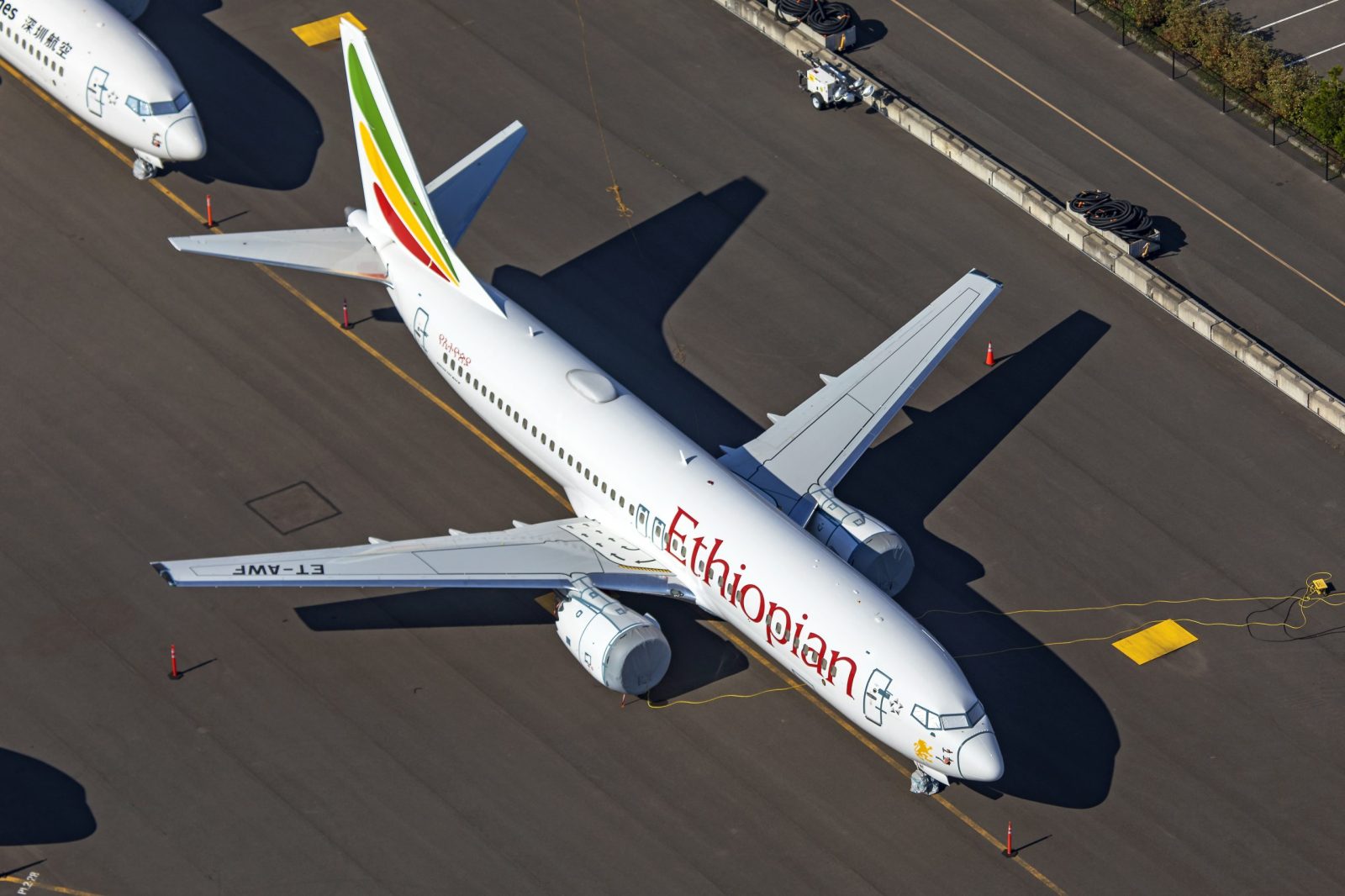
An Ethiopian Airlines 737 MAX 8. (Photo: AirlineGeeks | William Derrickson)
On July 2, Ethiopian Airlines will commence twice-weekly flight operations to Chennai, India — which will join the vast Ethiopian network as the fourth destination in India after New Delhi, Mumbai, and Bengaluru, India.
Ethiopian started its service to India with a debut flight to New Delhi in 1966 — just 20 years after the airline was founded. Ethiopian pioneered the air transport linkage between Africa and India.
Recently, Ethiopia marked its 50th anniversary of uninterrupted service to Mumbai — the commercial capital of India.
Flights to Chennai will fly a Boeing 737-800 aircraft on the Addis Ababa-Chennai, India route.
Ethiopian Airlines Group CEO Mesfin Tasew said, “I am excited that we are getting closer to our customers with our signature service and global connectivity options. We have been connecting Asia and Africa for 55 years now facilitating trade between the two continents. The addition of Chennai as a fourth passenger destination in India is a testimony of our resilience and unwavering commitment to serving our customers in India and the continent at large. We will continue to serve India with enhanced frequency and more destinations in the future. “
Chennai, India is a modern cosmopolitan city and the most prominent cultural, economic and educational center of South India. Ethiopia has been serving India without any interruption even during the pandemic, cementing the longstanding bilateral relationship between the two countries.
In addition to the opening of a new route, Ethiopian Airlines’ flight frequency to the cities of Mumbai and New Delhi will increase to double daily and ten weekly flights, respectively, from July 2022.
India is one of Ethiopian Airlines’ key destinations in the Asian continent and Ethiopian currently flies to three passenger and five cargo destinations with its enhanced services and modern fleet.
The Airline’s Cargo Market
Boeing and Ethiopian Airlines last week announced that the East African carrier is expanding its all-Boeing freighter fleet with an order for five 777 Freighters as the airline eyes opportunities in a buoyant cargo market.
The order was previously an unidentified order on Boeing’s orders and deliveries sheet.
Disclosing the order on Wednesday, Group CEO Mesfin Tasew said that “The addition of these five B777 Freighters into our cargo fleet will enable us to meet the growing demand in our cargo operation. While cementing our partnership with the Boeing Company with new orders, the growth of our freighter fleet takes the capacity and efficiency of our shipping service to the next level. We always strive to serve our customers with the latest technology aircraft the aviation industry could offer. Our Africa’s largest cargo terminal coupled with fuel-efficient freighters and well-trained cargo handling professionals will enable our customers to get the best quality shipment service. Customers can rely on Ethiopian for wide-ranging cargo services across five continents.”
The airline operates a fleet of nine 777 Freighters, utilizing the model’s range of 4,970 nautical miles or 9,200 km and a maximum structural payload of 107 tonnes or 235,900 lbs to connect Africa with 66 dedicated cargo centers throughout Asia, Europe, the Middle East and the Americas.
“We value the trust that Ethiopian Airlines places in the 777 Freighter to support their cargo ambitions which will provide them with increased capability and flexibility to their operations,” Ihssane Mounir, Boeing’s senior vice president of Commercial Sales and Marketing, said. “Additional 777 Freighters will enable Ethiopian to capitalize on near-term cargo demand while positioning the airline for further expansion in the future.”
In early March 2022, Boeing and Ethiopian Airlines announced a Memorandum of Understanding (MOU) for the carrier’s intent to purchase five 777-8 Freighters. The carrier also operates three 737-800 converted freighters, as well as a combined passenger fleet of more than 80 jets, including Boeing 737s, Boeing 767s, Boeing 777s and Boeing 787 Dreamliners.
Victor Shalton's love for aviation can be traced to when he was 11-years-old. As a seasoned aviation writer, he takes pride in providing the best aviation coverage around the globe and is passionate about advancing his skills in the aviation space. In addition, he loves travelling, writing, arts and while his speaking engagements have taken him around the world, he is proud to call Nairobi home.
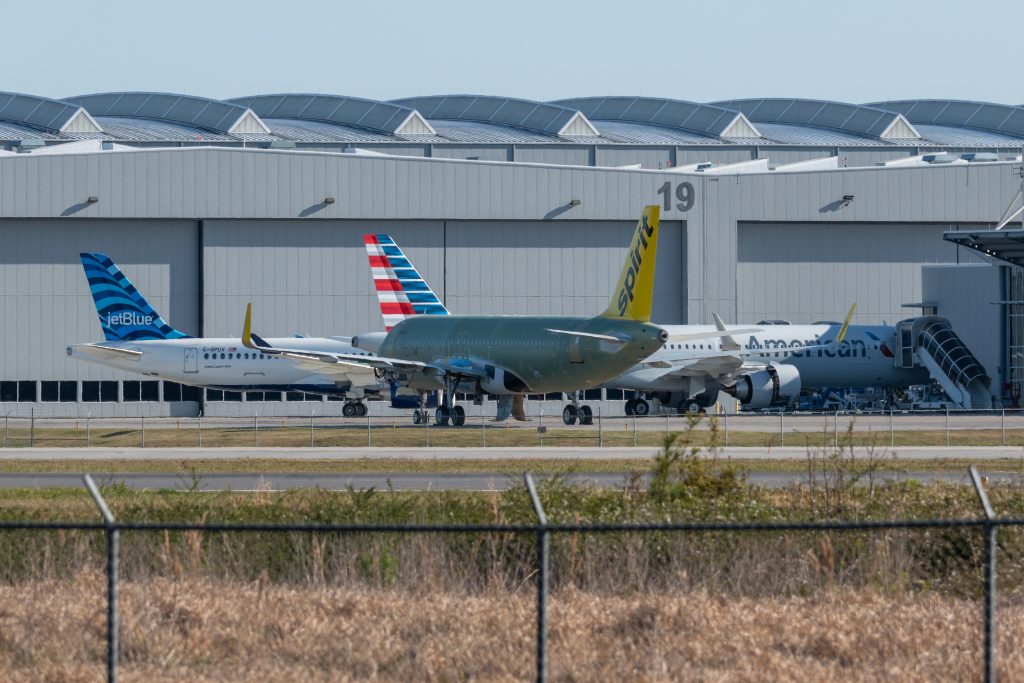
Some aircraft on the line in Mobile (Photo: Airbus)
It’s the dream of any aviation geek to visit OEM factories for a behind-the-scenes look into the makings of the flying machines. Airbus’s factory tour in Mobile, Alabama is the latest addition to this amazing collection of experiences.
I finally got my chance to partake in the tour in March 2022. This report is a summary of what I found interesting while visiting. Due to the company’s no photo policy, I do not have any pictures from inside the factory.
Background
Airbus has a long history in Mobile, Ala. The company opened an MRO center for military aircraft here back in 2009 before adding its commercial operations to the area in 2015. It started with a single Final Assembly Line for the Airbus A320 family. After Bombardier’s C Series program acquisition, the company added a new assembly line for the renamed Airbus A220 family in 2019. In May 2022, the European manufacturer announced plans to add a second A320 assembly line on its Alabama campus.
Flight Works Alabama (FWA) — a cooperative effort between the Airbus Foundation and the State of Alabama, conducts the touring operation. The organization started offering factory tours in November 2020.
Airbus produces A320 and A220 airplanes in Mobile Aeroplex at Brookley. (Photo: AirlineGeeks | Fangzhong Guo)
Booking
At the moment, FWA offers tours about once a month. The company usually announces dates a few months in advance. The tours are generally on Saturdays and have a few starts from the morning to early afternoon. Since the tours do not operate on a set schedule, you need to check tour dates on FWA’s social media platforms and website. The operator did not explicitly request advanced reservations for visiting the factory. However, most slots will sell out, so you should book your ticket before your visit.
Tour ticket costs $23.50 each, which also includes admission to the exhibition. Visitors must be at least ten years old and wear closed-toe shoes on the day of the visit. FWA also requires a government-issued I.D. for anyone over the age of eighteen.
Getting there
The plane manufacturer’s facility locates at Mobile International Airport – formerly known as Mobile Downtown Airport. Mobile Regional Airport is the closest commercial airport – about 30 minutes away from the visitor center. However, its flight options are very limited, and I could not find a connection to make a day trip work. Therefore I flew to New Orleans early in the morning and took a two-hour drive for the tour.
It’s worth noting that this is set to change. While Frontier Airlines has briefly served the Mobile Downtown Airport, no commercial passenger flight is available currently. However, Mobile County has announced its plans to build a new terminal at Mobile International Airport and move all commercial operations there. The new terminal could make visiting Airbus Mobile and the city of Mobile easier with its proximity to the Interstate highway. The county expects the transition to happen in late 2024.
The tour starts at a dedicated visitor center located at the north end of the Mobile Aeroplex at Brookley. Although there is a bus stop right outside the visitor center, the bus runs on a very thin schedule, so driving is the best option for attending the tour.
Entrance of Flight Works Alabama. (Photo: AirlineGeeks | Fangzhong Guo)
The exhibition
The entrance hall features a mural showing the city of Mobile and a Sharklets display across from the check-in desk. You will enter what FWA calls an aviation experience center once you pass the check-in counter. The exhibition there certainly lives up to its name.
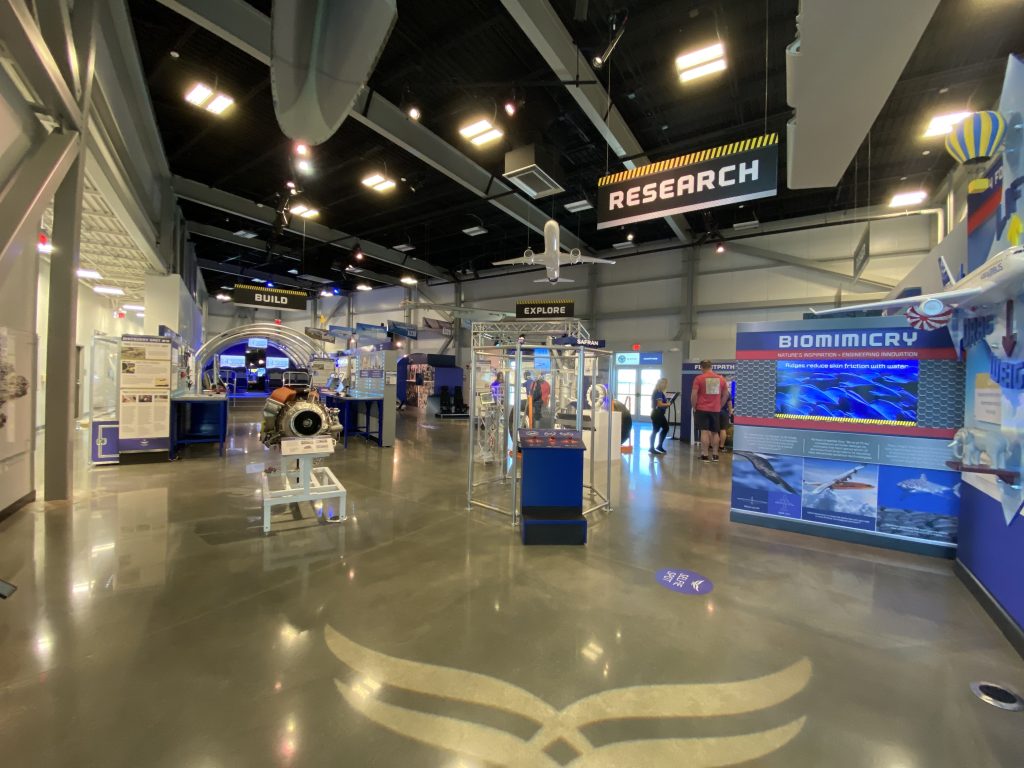
Experience Center at Flight Works Alabama. (Photo: AirlineGeeks | Fangzhong Guo)
FWA did an excellent job in creating the interactive experience. In addition to the typical flight simulators, an outdoor drone area and several games demonstrate the logistics of Airbus’ operations. The center fared well in enlightening visitors about the fundamentals of flying. I found many people waiting in line to try the aerodynamic test simulator. The way one can grab a physical design and see the simulated results appears to be a great touch on engaging people.
Apart from introducing the science behind flying, the exhibition also highlights the manufacturing processes of an airplane. It showcased them through hands-on workstations, which demonstrated each procedure with real tools. Some highlights include wiring assembly troubleshooting, proper torque application, etc. They also have a fastener display section so good that I’d want to have one at home and use it as a catalog.
Interactive displays at Flight Works Alabama. (Photo: AirlineGeeks | Fangzhong Guo)
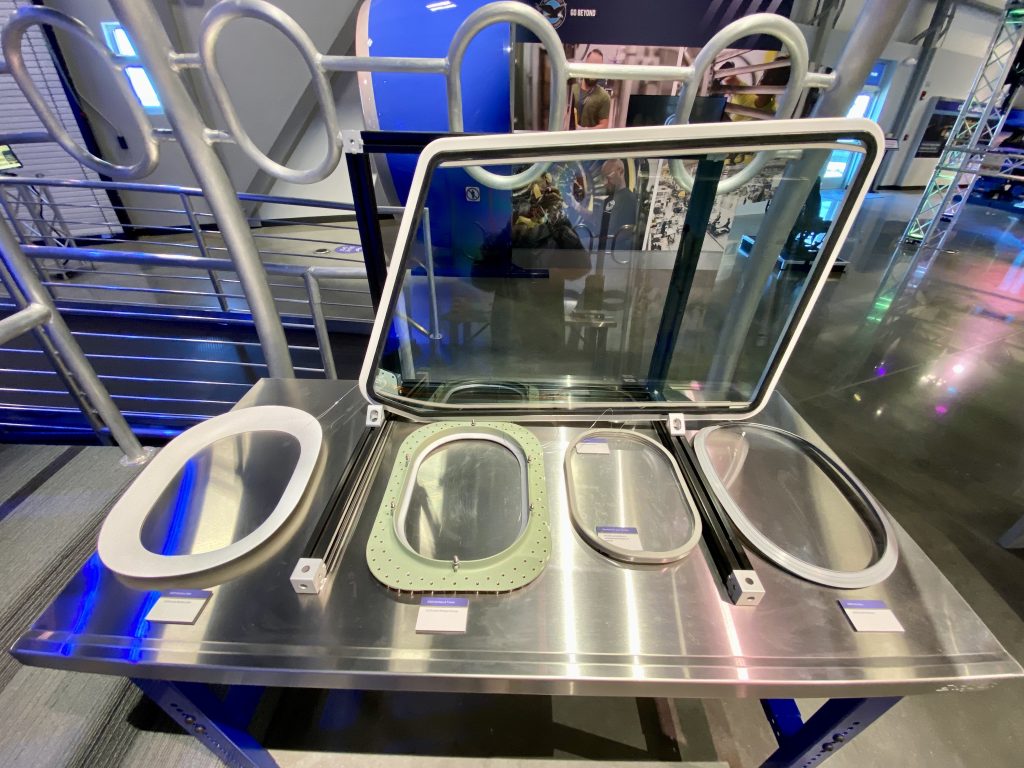
The experience center is also home to many actual aircraft parts you can get up close and even pick up. Beyond winglets and landing gears that you might find in other exhibitions, there is also a nicely prepped A320 bulkhead to show the behind-the-scenes construction of an aircraft. The display reminds me of the Boeing 747 in the Delta Flight Museum exhibit. Still, I think this one is better prepared to show the granular details closely tied to manufacturing exhibitions. Besides that, I found the window assembly display to be one of the most interesting because you can move all the parts and understand the build-up of an A320 window.
Build-it-yourself A320 window on display at Flight Works Alabama. (Photo: AirlineGeeks | Fangzhong Guo)
The only complaint I have against the space was that its gift shop is too small. I would not mind having a more extensive selection of Airbus swags. The few airplane models in the shop were also very fairly priced.
The Tour
The tour is mainly similar to experiences offered at other aircraft manufacturing plants. A bus will take a group of people to the building, and there is also the no photography allowed rule.
Even though the facility is home to both A320 and A220 FALs, the A320 building is the only stop on this tour. Once the bus arrives at the production building, visitors need to walk up four flights to reach the viewing area.
Unlike Boeing’s famous moving production line, there are four discrete stages in the building. The first two stations are for structure joints, whereas the first joins the fwd and aft fuselage, while the second station joins the wing to the fuselage. The fourth station sees system integration for the aircraft then the aircraft gets its interior at the last station before rolling out of the factory. The stations travel unidirectionally, which is different from when I visited their Hamburg, Germany, factory in 2015.
Except for being stationary, the production line shares a lot of resemblance to its main competitor. While both companies have small office areas on the platforms and multiple rigs around the airplanes, the European company’s floor design looks cleaner and more simplified than its U.S. rival.
Since the touring operation is still fresh, the tour guides are not the most knowledgeable. Luckily, there are always enough aviation people in the group to answer questions raised by other visitors. Nonetheless, You’ll still learn a lot of interesting statistics and techniques about their production from the narration.
The entire tour is about one hour, including about 20 minutes to travel from and to the visitor center. On our way back, the tour guide mentioned they had received a lot of interest in A220 production line tours, and they were trying to work out a plan to provide that. However, there is no solid timeline for when that might be available.
Planespotting
One of the fun activities you can do around the factory is to see the special purpose vehicles that deliver the parts and spot the brand new airplanes.
As the name indicates, the FALs here are only responsible for assembling aircraft. The A320 fuselages arrive in the U.S. by ship, and the A220 fuselages come from Canada. You might be able to spot the Airbus Mobile Express cargo ship in the nearby Mobile bay. The vessel transports A320 components to the port once a month.
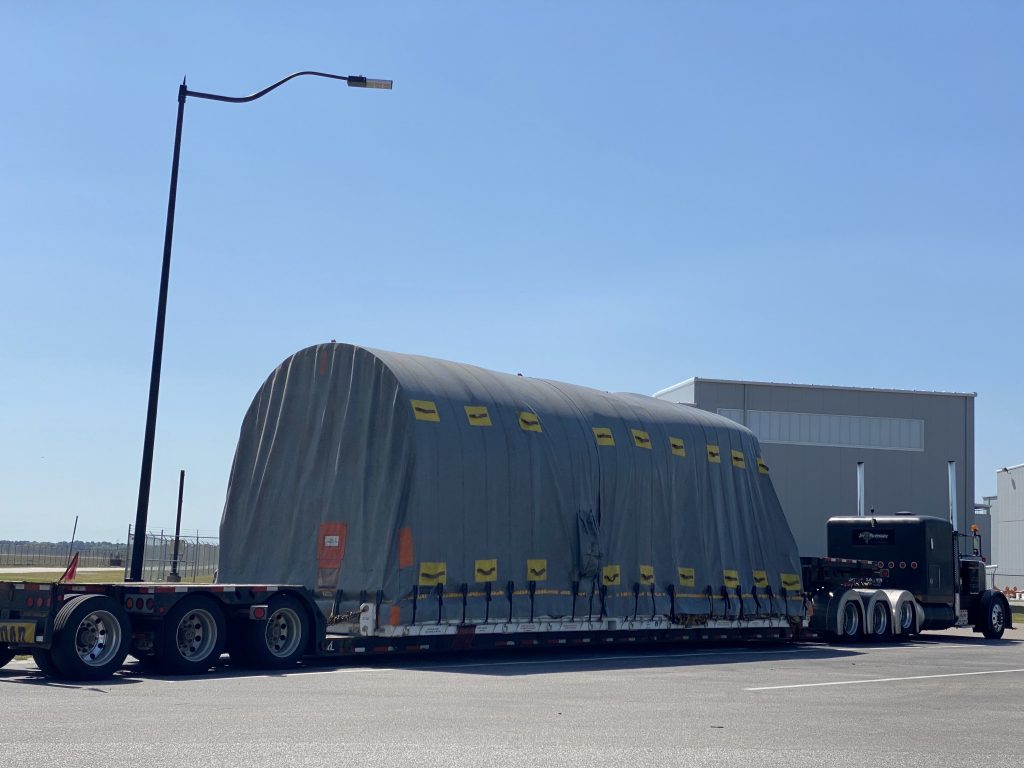
Eventually, parts for both types arrive at the factory by truck, which is mundane compared to Boeing’s Dreamlifter, Airbus’ Beluga, or even the train that carries Boeing 737 fuselages. Our guide did share one interesting fact to distinguish between the A320 and the A220 fuselages during the tour. A220 fuselages have covers over them while the A320s are exposed. You’ll be able to recognize the trucks next time you are in the area.
A truck carrying A220 Fuselage at Airbus Mobile. (Photo: AirlineGeeks | Fangzhong Guo)
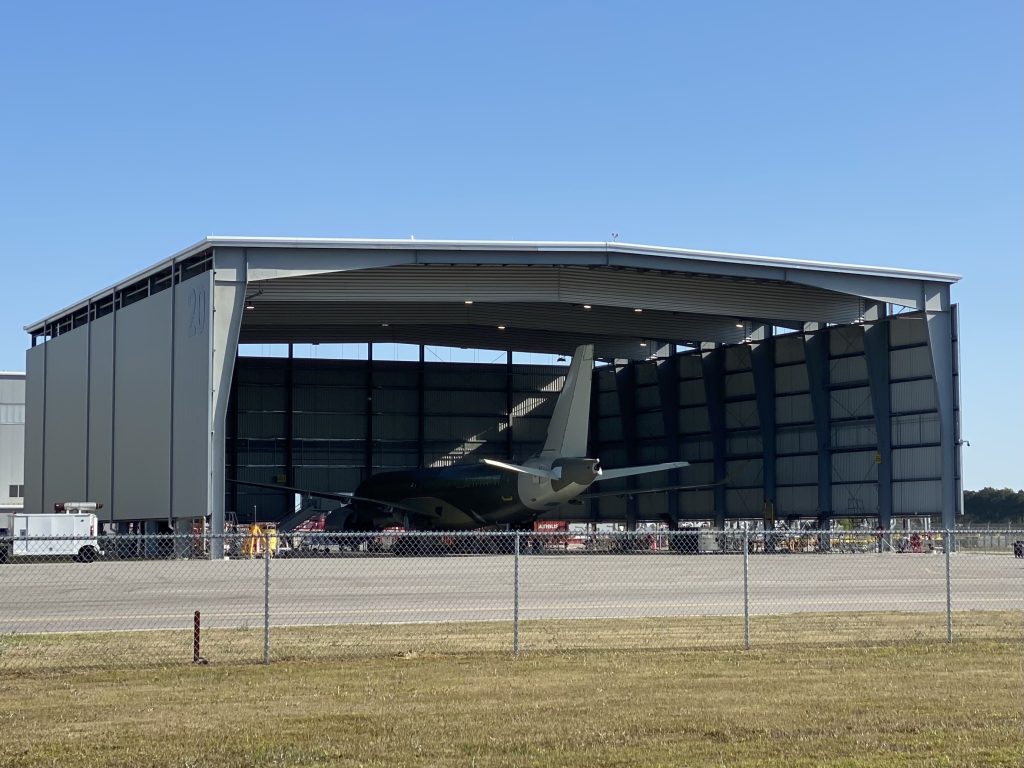
The area surrounding the factory is very accessible for planespotting. Planes are visible through the fences at a few parking lots along Aerospace Dr. During my visit, I saw a few Breeze Airway’s A220s on the flight line and an unpainted A220 in one of the open-air hangars nearby.
An unpainted A220 in a hangar at Mobile International Airport. (Photo: AirlineGeeks | Fangzhong Guo)
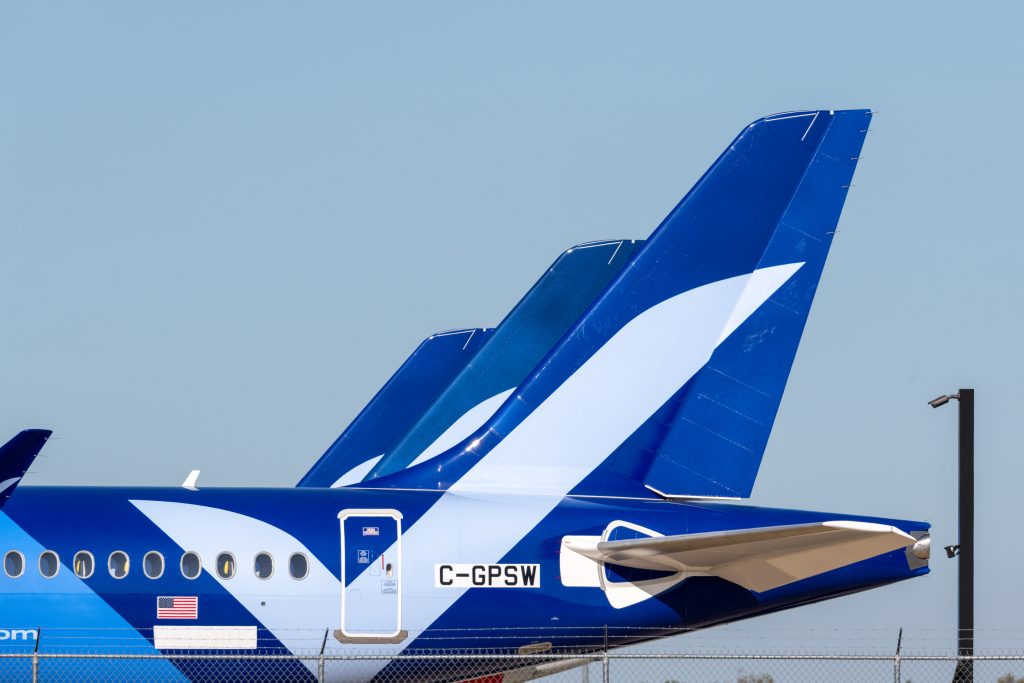
If you have time, check out Doyle Park on the west side of the complex. You might be able to spot a few test flights if you are lucky. The unique thing about Mobile’s operation is the aircraft carry foreign registries. The airplane normally uses temporary registration from the producing country in the manufacturer’s other FALs. For instance, Hamburg, Germany’s A320s start with D-, while Tianjin, China’s A320s begin with B-. However, all A320s produced in Mobile carry French registrations that start with F-, while all A220s have Canadian registrations that begin with C-.
A fleet of Breeze Airways A220s with Canadian registration on the flight line at Airbus Mobile (Photo: AirlineGeeks | Fangzhong Guo)
Comparison to other tours
I have toured Boeing’s Everett, Wash, and Renton, Wash factories, as well as Airbus’ Hamburg factory. Each tour has its highlights, and here’s a short comparison of them.
Content
The Boeing Evertt tour undoubtedly has the most variety among these tours, with Boeing 747, 767, 777 and 787 on display. The Airbus Hamburg tour packs the second most content showing A320 FAL and production for Airbus A320, A330 and A350 components. They used to include A380 as part of the tour. However, it was not part of my tour when I visited Hamburg. It could have resulted from me taking the English version and not the German version, but that shows some inconsistency between the tour offerings.
Boeing Renton and Airbus Mobile tours are comparable, except the U.S.-based manufacturer have a much larger space and a moving line. However, the moving line looks still because it was moving at a very slow speed.
Form
With the exception of Airbus Hamburg, all the tours took place on a balcony. When I visited the European manufacturer’s German factory in 2015, we walked on the production floor, which made the airplanes all the more impressive. Boeing has offered floor tours at the Everett factory through events or organizations in the past. They are not-to-be-missed events.
Outreach Programs
FWA places a heavy emphasis on its educational outreach programs. Their offerings range from camps to certificates and career training programs.
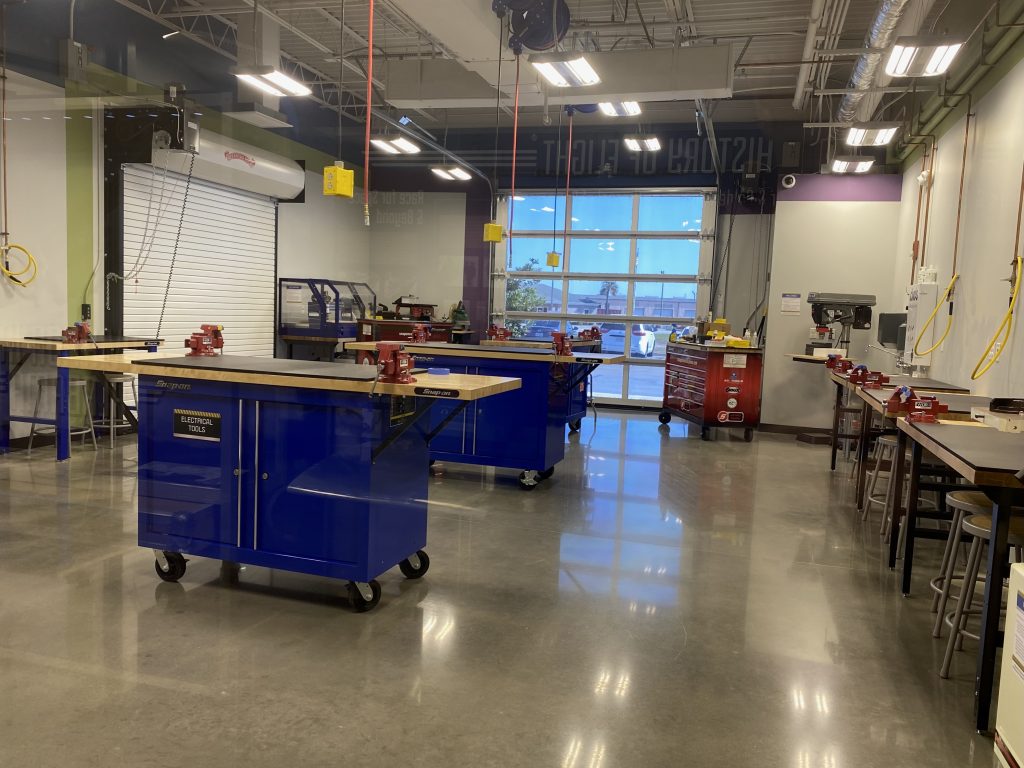
A few workshop areas in the building offer equipment such as basic CNC machines and 3D printers. They also make outreach events a priority. I asked why there was no scheduled tour for the month of April when I visited and learned that they did not schedule tours to make room for camps at the center.
Workshop area at Flight Works Alabama. (Photo: AirlineGeeks | Fangzhong Guo)
Their highlight program is FlightPath9. It provides a direct path to an apprenticeship at Airbus upon finishing the program. During my tour, there was even a FlightPath9 alumnus that landed a full-time job after completing his training. More information is available from FWA’s website.
Conclusion
Airbus and its partners created an overall awe-inspiring and engaging experience despite having a short and somewhat underwhelming tour. It is worth visiting if you are in the area, and I will come back if they make the A220 tour a reality.
Fangzhong grew up near an OEM airport in northeastern China, where he developed his enthusiasm for aviation. Taking upon his passion, he's now working as an aircraft interior design engineer. Besides working in the aerospace industry, Fangzhong enjoys trying out different types of airplanes and seeing how airplane interiors have evolved. So far, he's flown on over 80 types of aircraft. He also planespots in his spare time. His rarest catches included the 747 Shuttle Carrier Aircraft and AN-225.
Auckland Airport Sees More Flights from North America
An American 787-8 Dreamliner in Philadelphia (Photo: AirlineGeeks | Ryan Ewing)
Auckland, New Zealand’s Airport continues to receive more flights and services from North America after the pandemic. American Airlines — in partnership with Qantas — will return to New Zealand after two years of suspension. The Dallas/Ft. Worth-based airline will operate a daily seasonal service between Dallas and Auckland, New Zealand, starting on Oct. 29 until Mar. 25.
“We are thrilled to relaunch service to New Zealand in October, connecting Auckland with our Dallas/Fort Worth hub and offering our customers an unmatched network in the U.S. and beyond.” Jose Freig, American Airlines Vice President for International Operations, said.
The original plan of flights between Dallas and Auckland, New Zealand was expected to be launched in October 2020, but the pandemic resulted in the postponement. The airline will operate the Boeing 787 Dreamliner on the route. Before the pandemic, American Airlines operated the seasonal services between Los Angeles and Auckland, New Zealand.
“We’re really pleased to once again have American Airlines touching down at Auckland Airport,” Scott Tasker, Auckland Airport’s General Manager of Aeronautical Commercial, said.
Tusker believed every single Boeing 787 Dreamliner touching down daily on average contributes 157 million New Zealand Dollars ($103 million) in tourist spending and carries 500 million New Zealand Dollars worth of freight over a 12-month period.
According to the airport, five carriers will provide operations between Auckland, New Zealand and eight destinations in North America during the summer of 2022 and 2023, including Dallas, Los Angeles, San Francisco, Houston, Chicago, New York, Honolulu and Vancouver, Canada.
Increased Connectivity Between New Zealand and The U.S.
Auckland, New Zealand Airport expects the U.S. to become the second-largest tourism market this year, instead of China. This circumstance will last until 2026. North America has been identified as a priority market by Tourism New Zealand and Air New Zealand before the pandemic. Earlier, the flag carrier of the country has announced that flight operations to Honolulu, Houston and New York would be launched.
After the pandemic, Kiwis welcomed American travelers with open arms. Auckland Airport has partnered with Tataki Auckland Unlimited and Destination Queenstown to introduce New Zealand to the U.S. The trio has signed a memorandum of understanding (MOU) to develop a compelling proposition for North American customers.
In the meantime, Auckland Airport hasn’t stopped enhancing its facilities after the pandemic, following the reopening of its border, the airport has announced its new chapter of infrastructure investment, a World-class Transport Hub project and a 300 million New Zealand Dollar plus construction will start in June. In addition, the airport will spend 185 million New Zealand Dollars for its combined domestic and international terminal. Also, the airport introduced its smart baggage system.
After the transportation hub project is completed, the airport will create a seamless travel and transit experience for travelers.
Speaking at the Embraer Media Day 2022 event in Sao José dos Campos, the Brazilian company’s CEO, Francisco Gomes Neto, said that the non-conclusion of the agreement with Boeing caused “suffering,” given that Embraer had prepared for it.
“We started to reintegrate Embraer Commercial. It was a painful and expensive process but we are now ready in all aspects,” he added.
Despite this, and along with the crisis caused by the pandemic, he assured that the company recovered quickly and sought business continuity, with a focus on ensuring cash flow.
“In 2020 we knew that the crisis was going to end sometime. We created a 5-year strategic plan to follow a path of sustainable growth,” said Gomes Neto.
Last year the picture changed, and the manufacturer moved towards recovery, having achieved a positive financial result, with an EBIT of USD 260 million, and a strong focus on sales that made possible a backlog of USD 17 billion. 2022, like 2021, remains a year of recovery, but not free of challenges, such as inflation, which he said affects the entire industry and for which they are looking for tools to mitigate it.
He also added that difficulties in supply chains make it difficult to reduce the footprint, but that they will make progress in this regard. On the other hand, the 2023-2026 period will be the period of return to growth.
This will be possible based on five pillars, said Gomes Neto: increasing the sales portfolio; achieving more efficiency in the company through aspects such as higher inventory turns, production cycle reduction, cost of goods sold reduction, focus on productivity, footprint optimization and strong cash generation; achieving strategic partnerships, where he gave Eve as an example, a company that also had good results in 2021; innovation, which he referred to as the main driver of growth and which was responsible for 40% of revenue in the last five years; ESG initiatives as generators of good opportunities; and safety and quality above all else, both for its employees and for customers.
Aviacionline is participating in Embraer Media Day 2022. You can follow this week’s coverage from Sao José dos Campos, Brazil, both on the website and on our social networks.
This story was originally published by Pablo Diaz on Aviacionline in syndication with AirlineGeeks.com.
Since a little kid, Pablo set his passions in order: aviation, soccer, and everything else. He has traveled to various destinations throughout South America, Asia, and Europe.
Technology and systems expert, occasional spotter, not-so-dynamic midfielder, blogger, husband, father of three cats; he believes that Latin America's aviation industry past, present, and future offer a lot of stories to be told.
Trip Report: Flying Out of Shanghai After the Covid-19 Lockdown
Shanghai's Pudong Airports after lockdown (Photo: AirlineGeeks | Lei Yan)
As the lockdown-induced Covid-19 outbreak starts to relax, I took my first trip out of Shanghai in the past two and half months. I flew out on a Juneyao Airlines flight HO1015 from Shanghai’s Pudong International Airport to Hohhot, China’s Baita International Airport, my hometown airport. The route is nothing special during normal times, even a bit mundane. However, the lockdown made the trip from an ordinary flight into a convoluted journey.
Dragging Lockdown
For the past two months, Shanghai has been in lockdown amid a new Covid-19 outbreak. The city has been through a rough time with broken supply chains and isolations. Even the supply of food ran into bottlenecks to reach everyone. The city once had two airports that counted themselves among the largest in the world — Shanghai’s Hongqiao International Airport and Pudong International Airport. Both airports served over 130 million passengers in 2019, and they are crucial nodes for the city to stay connected to the rest of China, and to the world during this time of uncertainty.
During the past two months of lockdown, Shanghai only sees a handful of cargo flights and international flights out of the city. Starting the week of May 22, a couple of domestic flights started to resume, and more are planned to resume starting June 1. I was lucky enough to buy a ticket home before it sold out.
Preparing to Fly
As required by the government of Shanghai, passengers need a negative PCR test within 48 hours of the flight, and a negative Antigen self-test within 24 hours of the flight. After getting those test results, passengers will need to book their transport from the city to airports and train stations, as the public transportation is still not fully resumed. The hotline to book a taxi is always jammed. Lucky. for me again, I managed to find a taxi on the night before my trip.
On the day of the trip, I planned to depart for the airport five hours before my flight. On normal days, I would only reserve at most two hours before my trip to leave my apartment, as there are maglev services from downtown Shanghai to Pudong International Airport. It can get you there in only 8 minutes.
Lonely Trip
The streets of Shanghai look scarily quiet. We did not encounter any cars, let alone any traffic, on my way to the airport. The scene is unimaginable during normal times in Shanghai.
Shanghai’s Pudong Airports after lockdown (Photo: AirlineGeeks | Lei Yan)
After arriving at the airport, you need to register your identity, show the PCR test and Antigen test results, and show the agent at the entrance your ticket before making a step further into the terminal. Inside the terminal, the airport looked nothing like one that once served 76 million passengers. Closed concessions, closed check-in counters, and only a handful of passengers. The gigantic terminal has never been lonelier.
Shanghai’s Pudong Airports after lockdown (Photo: AirlineGeeks | Lei Yan)Shanghai’s Pudong Airports after lockdown (Photo: AirlineGeeks | Lei Yan)
The plane of the day was a seven-year-old Airbus A321. Tickets were all sold out for the flights. In-Flight services were minimal, and the passengers were too tired to care about any services, as most of us were up since 4 a.m.
After landing at Hohhot’s Baita International Airport, we were transported to a corner of the airport to claim our baggage, and all passengers took another PCR test. Before the results came out, we waited in a quarantine hotel. Finally, at 11 p.m. of the night, I was able to go home on a government vehicle and commenced my 7-day home quarantine.
The year 2022 reminded me of the time when Covid-19 was surging at the beginning of 2020. After that wave of lockdown, the traveling took a hard turn to the upside almost immediately. I hope this will be the case for this wave of Covid-19, and we can soon get our normal, even a bit mundane travel experience back.
Lei is from Inner Mongolia, China, and now lives in Guangzhou. He grew up in an aviation family, where his passion began. During his time at Penn State University, he studied Industrial Engineering specializing in operations research, and he graduated with an honor’s thesis on airport gate assignment optimization. Now, he is a Purchasing Manager with Procter & Gamble. In his free time, he enjoys flying, reading, and wandering around the city.
Bulgarian Drone Company Becomes First UAS Airline to Obtain EU Operational License
The Black Swan at the unveiling event in Sofia. (Photo: DRONAMICS)
DRONAMICS, founded in 2014 by the Rangelov brothers — Svilen, an economist, and Konstantin, an aerospace engineer — is an operator of small, low-cost, medium-range cargo drones. The company, which is based in Bulgaria in Sofia, Bulgaria and operates another hub London, says its main goal is to democratize air freight and accelerate e-commerce in emerging markets.
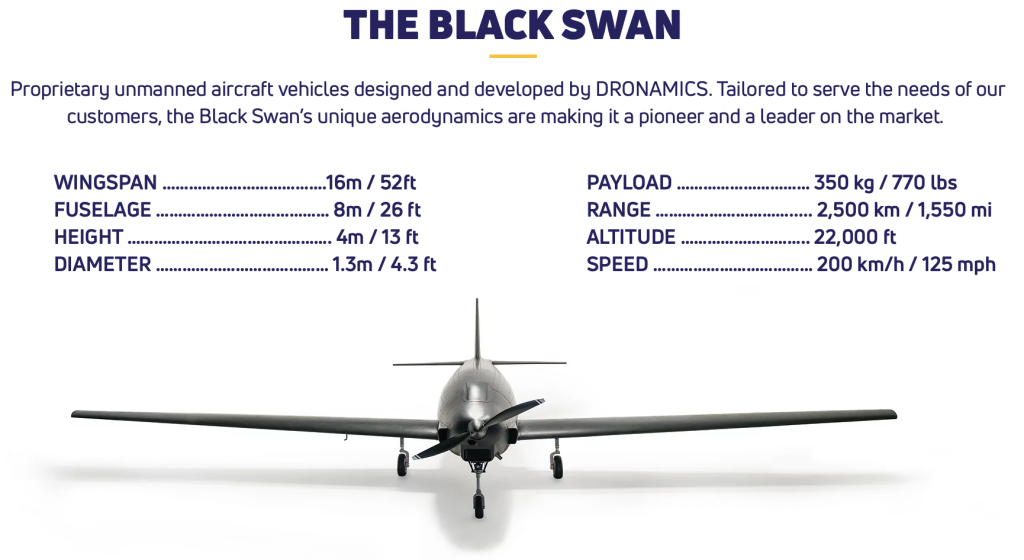
Over the years, DRONAMICS has developed a leading cargo UAV called “The Black Swan,” a fixed-wing unmanned aircraft that can carry 350 kilograms at a distance of 2,500 kilometers, with the distinction of doing so at a fraction of the cost of traditional air cargo and much less polluting.
Among DRONAMICS’ achievements in recent years, in 2018 it became IATA’s first strategic drone partner worldwide, and the award in the category for “Sustainable Drone Technology Company of the Year 2022″ in the Freightweek Sustainability Awards (FSA). The company has also set the goal to become Carbon-neutral by 2023 and Carbon-negative by 2027.
Black Swan Specifications. (Photo: DRONAMICS)
DRONAMICS, however, is not just building its drones but is also organizing the world’s first cargo drone network through partnerships with airports and establishing a European network of droneports. Specifically, five airports in Europe — located in Belgium (Liege Airport), Croatia (Osijek Airport), Finland (Seinäjoki Airport), Italy (Brescia Airport) and Sweden (Skövde Airport) — have signed agreements with the Bulgarian company.
DRONAMICS has also signed agreements with private airports and airport groups operating in more than 35 airports in 11 European countries and will aim to connect 300 million people with a low-cost same-day cargo service in the world of pharmaceuticals, e-commerce, and urgent shipments.
The Rangelov brothers’ company was of considerable interest during the Covid-19 pandemic. As a result of border closures and the stop of global supply chains, freight transport was almost at a standstill. However, with unmanned drones such as those of DRONAMICS, freight (especially urgent freight) in the European network would not suffer those kinds of problems, as well as costs and emissions up to 80% lower than traditional air cargo.
DRONAMICS’ New Certification
All this would have remained a dream if the Rangelov brothers’ efforts had not gone all the way. On May 25, DRONAMICS obtained the air license for drones — or Light UAS Operator Certificate (LUC) — recognized in all EU member states, granted by the Transport Malta Civil Aviation Directorate (TM – CAD), the nation’s civil aviation authority.
This one was a key step for the Bulgarian company because now, everything that has been conceived, designed and then implemented can truly come to life.
DRONAMICS made history since is the first cargo drone company to have obtained this kind of license. This license allows it to authorize its Black Swan drone flight operations in all EU countries, including operations beyond the visual line of sight.
Vincenzo graduated in 2019 in Mechanical Engineering with an aeronautical curriculum, focusing his thesis on Human Factors in aircraft maintenance. In 2022 he pursued his master's degree in Aerospace Engineering at the University of Palermo, Italy. He combines his journalistic activities with his work as a Reliability Engineer at Zetalab.
Australian regional airline Regional Express this week announced it will cease multiple flights as it encounters increased costs and competition. The Sydney-Canberra and Melbourne-Albury services will be ceasing on May 30, with others to follow starting June 30.
Rex, as Regional Express is better known, has been facing challenges of increased costs and competition from both Sydney Airport and airline giant Qantas, respectively.
The Sydney-Canberra route was added to Rex’s expanding operations last year, having commenced April 2021. Despite the year-long service adding increased competition to the route, the airline says its operations between Australia’s largest city and its capital are no longer practical.
Speaking of the route, Rex Deputy Chairman, the Honorable John Sharp AM, said: ““Unfortunately with the entrance of an additional operator and the very high charges imposed by Sydney Airport from 1 June 2022 mean that the route is no longer viable for Rex. The resources will be diverted to other routes which will provide a better return.”
Qantas Acting ‘Illegally’
The cessation of operations between Melbourne-Albury, as well as services from regional centres Bathurst, Grafton, Lismore, Kangaroo Island and Ballina, appears to based on more than increased costs alone, with the airline pinning much of the blame on Qantas. In a statement, Sharp said, “This route is the casualty of Qantas’ illegal predatory behavior to drive out competition in a war of attrition, knowing that its competitors do not have the balance sheet to lose money indefinitely.”
Cancellation of flights to these regional centres will commence on June 30, with Ballina to terminate on July 2, coinciding with the end of the Australian government’s Regional Airline Network Support.
The support program, an initiative taken by Federal Government in response to the COVID-19 pandemic in 2020, has been providing basic support to airlines for their continued operation by offsetting losses attributed to the pandemic.
Elaborating on Qantas’ actions, Sharp stated, “Pre-Covid, 22,000 passengers a year flew between Albury and Melbourne, hardly enough passengers for one carrier let alone two,” adding that during the Covid pandemic Qantas entered the route, “dumping an additional 31,000 seats annually into the market.”
The move, according to the airline, is another brick in what Rex sees as an anti-competitive wall. Having operated the route for 39 years, Sharp said: “Sadly for the community, we will soon see Qantas providing only a token service once it sees that it has achieved its objectives”, an opinion shared by many after the recent shortcomings of Qantas.
Last year, Rex commenced legal action against Qantas after Rex raised complaints about “Qantas’ willingness to enter loss-making routes in competition with Rex in an effort to intimidate Rex into not commencing domestic operations.”
Sharp, speaking on the cessation of routes, said, “It is unfortunate that these regional communities are the collateral damage of Qantas’ bullying and heartless behaviour. This behaviour is all the more unconscionable after receiving over $2 billion in Federal bailouts over the past 2 years.”
Rex Partners with Delta Air Lines
Despite the cessation of the two routes, Rex has recently expanded some of its operations, including internationally. The regional airline announced on May 2, 2022, that it had signed a letter of intent to partner with the US carrier Delta Air Lines. The move, which will see a reciprocal ticketing and baggage service between Rex and Delta, is slated to commence in the third quarter of this year.
Rex, which currently offers over 60 Australian routes, will provide a seamless connection for its passengers bound to the US. From December 18 this year, Delta will increase its flights to a frequency of 10 per week between Sydney and Los Angeles, from which Rex passengers can then seamlessly fly to nearly 50 cities in the US.
The partnership between Rex and Delta will give Rex the edge it needs to compete with what appears to be an increasingly monopolized Australian airline sector. According to Delta’s Vice-President – Alliance Partner Development, Jeff Arinder, Delta Airlines “look forward to welcoming more customers to our flights from Sydney to the U.S. and providing a world-class customer experience in the air and on the ground.”
Editor’s Note: This story was updated on Monday, May 30 with a news release from Rex.
Mike’s love affair with flight and mechanical objects in the sky began at an early age, fascinated by space documentaries and the vintage Flight Simulator ’95. He currently works as an instructor for UAVs and is training to receive his Private Pilot Licence with the goal of working in manned flight instruction. An avid reader of all things aviation and manned space flight, Mike stays close to developments in aerospace while reminiscing and sharing the rich history of flight with others. He loves writing, engineering and science.
A Garuda Indonesia Airbus A330-200 (Photo: byeangel from Tsingtao, China (Garuda Indonesia Airlines Airbus A330-243 PK-GPI) [CC BY-SA 2.0 (https://creativecommons.org/licenses/by-sa/2.0)], via Wikimedia Commons)
Indonesian airlines have had a long history. Various airlines have graced the skies of Indonesia, although not all of them survived to flap their wings in the sky of the archipelago.
On December 28, 1949, the NV Garuda Indonesia Airways (GIA) aircraft became the aircraft of the national airline which flew the first from Kemayoran to Yogyakarta. At that time, the plane was flown to pick up President Soekarno who had moved to the new capital city in Jakarta.
At that time, GIA had 26 aircraft ready to operate, consisting of 11 Douglas DC-3s, 12 cargo planes, and three Catalina seaplanes for pioneer flights.
GIA is a continuation of Indonesia Airways formed by the Governments of Indonesia and the Netherlands, as a result of the agreement of the Round Table Conference in The Hague, in November 1949.
According to the paper “Nationalization of Garuda Indonesia 1950-1958” (Dwi Adi Wicaksono, 2016), when it first started operating, GIA already had a large number of company assets. A large number of assets cannot be separated from the joint venture with the Dutch airline KLM-IB, which has been operating in the Dutch East Indies since 1928.
A year later, the civil aviation market in Indonesia is growing rapidly. The enthusiasm of GIA passengers exploded. In the first two years of operation, GIA managed to carry 288,331 passengers. The passenger occupancy rate is relatively high with an average of 76 percent. In 1951-1953, the number of GIA passengers increased 6.7 percent to 307,757 passengers, while cargo and airmail transported reached 540 tons.
Within the aviation market in Indonesia at that time, apart from its position as an aviation pioneer, GIA also maximized old and new aircraft to increase flight frequency. GIA also streamlines routes that have developed since the colonial era, and promotes through newspapers, and tries to increase the number of ticketing booking agents.
After 12 years of operation, GIA is finally off the air on its own. On September 6, 1962, the State Company Merpati Nusantara Airlines (MNA) was established. The airline with the slogan “Indonesian Air Bridge” relies on six aircraft to connect remote places in Kalimantan, including 2 DC-3 Dakota and 4 DHC-3 Otter.
In 1990 MNA grew, marked by the ownership of 100 aircraft to serve domestic and international routes. The successful MNA finally stopped its operations in 2014 due to financial problems with creditors.
Apart from flag carriers, private airlines also used to fly during that period, such as Sempati Air. There are also Pelita Air and Mandala Air which both stopped at the same time as MNA, in 2014.
While Bouraq Airlines was founded in 1970 with an initial capital of three DC-3 Dakota. In the 1990s, this airline won the title of the private airline with the best punctuality for domestic flights. However, post-monetary crisis, Bouraq continued to fade and eventually went out of business in 2005.
New Airline Incoming
According to history, the milestone in Indonesian civil aviation actually started 70 years ago, on January 26, 1949, when the DC-3 Dakota aircraft “Indonesian Airways” registered RI-001, departed from Calcutta, India, to Rangoon, Burma (now Myanmar). This charter flight is to help the Burmese Government overcome its domestic political problems. The plane was purchased from the donations of the people of Aceh.
The 1990s became a milestone for many new airlines in Indonesia. This cannot be separated from the birth of Law No. 15/1992 on Aviation and Government Regulation No. 40/1995 on Air Transportation. These two regulations are one of the deregulation factors that allow the establishment of commercial air transportation businesses in Indonesia by more people, both from state-owned enterprises (BUMN) and private companies.
The forerunner of major airlines that still survive today comes from this period. For example, Lion Air was founded on November 15, 1999, by Rusdi Kirana. Initially only relying on two Boeing 737-200 aircraft, the airline now has hundreds of aircraft of various types with a passenger volume of more than 33 million people (2018). Lion Air is the first airline in Indonesia.
Apart from Lion Air, there is also Citilink Indonesia, which was established on July 16, 2001. This state-owned airline is a business strategy unit of PT GIA. Initially operating, Citilink only served the Surabaya-Balikpapan-Tarakan route using two Fokker F28 Fellowship aircraft. The low-cost airline (LCC) segment and the big-name Garuda Indonesia make Citilink one of the most sought-after. In 2018, it was recorded that there were 15 million passengers that Citilink had successfully transported and this figure was ranked third.
There is also Susi Air which has been operating since December 27, 2004, to coincide with the earthquake on the west coast of Sumatra. Relying on two Cessna Grand Caravan aircraft, Susi Air participated in the distribution of aid to disaster areas. Since then, the pilot airline Susi Pudjiastuti has received charter flight services. It was only in 2006 that scheduled commercial flights began to be developed, based in Medan. Until 2015 the airline had 32 commercial routes, and in 2018 it managed to carry 41.6 thousand people.
Lion Air, Citilink, and Susi Air, are only some of the airlines that survived. The Ministry of Transportation noted that until 2018 there were at least 16 scheduled commercial airlines that were still operating in Indonesia. A total of 14 of them came from airlines born in the period 1990 and above. These include Trigana Air Service, which was established in 1991, Indonesia Airasia (1999), Sriwijaya Air (2003), Wings Abadi Airlines (2003), XpressAir (2003), Cardig Air (2004), Transnusa Aviantion Mandiri (2005), Batik Air (2013 ), Nam Air (2013), and Indonesia Airasia Extra (2013).
Meanwhile, for those who stop operating, this is not only due to the company’s financial problems, but also related to safety factors. For example, Adam Air whose flight operator license was revoked by the Ministry of Transportation, in 2008. The revocation of this license was carried out because the airline was deemed to have neglected safety in the crash of the Adam Air Boeing 737 numbered in Majene waters on January 1, 2007. The disaster killed all passengers and cabin crew, 102 persons.
Defensive strategy
It is not easy for air transportation service actors to survive in the midst of intense competition in the aviation business in Indonesia. There are at least three factors that have a positive effect on the competitive advantage of airlines, including flight routes, service quality, and promotions. Each airline has a different strategy to apply these three factors.
For example, even though others serve LCC flights, in 2018 Lion Air was superior to Citilink in carrying the number of passengers. The success of Lion Air is also influenced by a large number of destination cities and the frequency of flights. According to data, throughout April 2019, Lion Air served more than 51 destination cities with an average of 400-420 flight frequencies per day. Meanwhile, in July 2018, Citilink only served 35 destination cities with an average of around 274 flight frequencies per day.
The variety of flight routes has also made a number of pioneer airlines stay afloat. For example, the Medan, North Sumatra-Meulaboh, Aceh route, which is only served by Wings Air. Likewise, the Jayapura-Tanahmerah route in Papua is only served by Trigana Air.
Promotional factors by airlines can be in the form of low prices long before departure, ticket discounts, baggage promos, and marketing through advertisements. For example, a 70 percent discount from AirAsia for a number of their flight routes for the period October 7–October 13, 2019. This promo ticket booking is for flights one year ahead. Likewise, Sriwijaya Air, once provided a 10 percent discount for BPJS Employment owners in 2018.
The long history of Indonesian airlines and the number of passengers carried show that this mode of transportation has become the main means of connecting Indonesia. Indonesia’s geographical condition as an archipelagic country makes airplanes the most effective and efficient means of connecting. However, it cannot be denied that airline operations have very high risks.
Putu Deny Wijaya was always an aviation enthusiast by heart, growing up in Indonesia where air transport is very vital. His first love is The Queen of The Skies, serving the trunk routes between Jakarta and Denpasar. He brought along this passion with him throughout college by conducting his bachelor study abroad in the Netherlands for the purpose of experiencing a nonstop 14-hour long-haul flight. For Putu the sky's the limit when talking about aviation. He hopes that he would be able to combine his passion for aviation and knowledge of finance at the same time.
Qatar Airways Announces World Cup ‘Tie Up’ With Gulf Carriers
Qatar Airways A350 aircraft in flight (Photo: Airbus)
The 2022 FIFA World Cup football tournament in Qatar is less than six months away and airlines in the region have announced increased services to accommodate the demand for the event. This is the first time that the World Cup has been held in the Middle East and it is forecast that over 200,000 fans per day will be arriving into the nation of just under 3 million.
Qatar Airways as the official carrier of the tournament announced a ‘tie up’ with fellow Gulf carriers flydubai, Kuwait Airways, Oman Air and Saudia on Thursday. The collaboration will see the availability of ‘Match Day Shuttles’ to games with rotating frequencies from Dubai, Jeddah, Kuwait City, Muscat and Riyadh. The statement advises that Match Day Shuttles are ‘designed with the purpose of connecting fans seamlessly to Qatar so they can attend their respective matches, capture the sights and sounds of the host country, before departing Doha on the same day.’
Qatar Airways Group Chief Executive, His Excellency Mr. Akbar Al Baker, said, “The landscape of this tournament gives us the opportunity to spread the business with various regional airlines. Our combined bandwidth with flydubai, Kuwait Airways, Oman Air and Saudia will create travel flexibility that will bridge cultures and give fans the chance to explore multiple places in the Middle East.”
The event is expected to attract a total of 1.4 million visitors to the State of Qatar during the tournament run from 21 November – 17 December. The scheduling of the Match Day Shuttles is seen as a way of alleviating pressure on accommodation within the State of Qatar during the World Cup period allowing fans to see more than one game per day.
Mr. Al Baker who is also Qatar’s tourism minister said, “Connecting fans and shared love for football are at the heart of this game-changing partnership. We are immensely privileged to have the opportunity to unite fans from all walks of life to enjoy the beautiful game at its best, while introducing them to our hospitable culture and traditions. The FIFA World Cup Qatar 2022™ will be the first in the Middle East and Arab world, and we have always believed that a win for Qatar is a win for the region.”
The number of services offered to Doha will vary between the different Gulf states with fans arriving in Qatar in the morning, departing in the evening and with a strict no check-in baggage policy. There are scheduled to be 30 daily flights from Dubai; 24 from Muscat; 20 from Riyadh and Jeddah; and 10 daily services from Kuwait City. To be able to travel to Qatar football fans must have a ticket to a game and apply for a special ‘Haya’ pass.
To facilitate travel to the tournament the State of Qatar will be limiting inbound visitors only to those who qualify for the Haya pass. The Al-Monitor news site states that ‘Qataris and legal residents will also be able to enter but authorities have yet to announce how business people will be processed.’ It is also expected that Qatar Airways may reduce flights over the tournament period from countries that have not qualified.
Mr. Ghaith Al Ghaith, Chief Executive Officer at flydubai, said, “We are very pleased to be part of this game-changing partnership with Qatar Airways and the other partner GCC (Gulf Cooperation Council) national carriers. This will allow us to welcome more football fans and visitors from all over the world to experience the warm hospitality and rich culture of our region.”
John has always had a passion for aviation and through a career with Air New Zealand has gained a strong understanding of aviation operations and the strategic nature of the industry. During his career with the airline, John held multiple leadership roles and was involved in projects such as the introduction of both the 777-200 and -300 type aircraft and the development of the IFE for the 777-300. He was also part of a small team who created and published the internal communications magazines for Air New Zealand’s pilots, cabin crew and ground staff balancing a mix of corporate and social content.
John is educated to postgraduate level achieving a masters degree with Distinction in Airline and Airport Management. John has held the positions of course director of an undergraduate commercial pilot training programme at a leading London university. In addition he is contracted as an external instructor for IATA (International Air Transport Association) and has been a member of the Heathrow Community Fund’s ‘Communities for Tomorrow’ panel.
Alaska Airlines Points to Staffing Shortages As Carrier Pares Back Summer Schedule
An Alaska Airlines Boeing 737-800 in Los Angeles. (Photo: William Derrickson)
Alaska Airlines’ summer scheduling woes continued as the airline was forced to cancel additional flights due to poor planning and staffing shortages.
“Of the 1,200 flights that we operate every day, we’ve been canceling about 50 of them, roughly 4%,” Alaska Airlines CEO Ben Miniucci wrote in a message to employees May 12. “This is coming at a time when flights are already full, so rebooking options are limited and many of our guests have experienced extraordinarily long hold times.”
Miniucci added that he expects normal operations to resume in June and into the summer but the cancellations as of the past few months have been deeply troubling for Alaska.
Miniucci pointed to the airline needing 63 more pilots in order to fill schedules. Airline pilot shortages among staffing shortages as a whole have been what Alaska Airlines and many other airlines say is the cause of their cancellations.
Alaska Airlines customers weren’t shy to voice their opinions either with many taking to Twitter and other social media sites to call out the airline. Customers reported wait times as long as 10 hours for service.
More Potential Problems
The Alaska Airlines pilot shortage comes as no surprise given the recent demands from the Alaska Airlines pilot union which represents the company’s 3,100 members. The union recently authorized a strike due to a lack of progress made between the two sides. The airline and union are currently under federal mediation with the National Mediation Board and both sides would need to be released from mediation in order for a strike to take effect. Many believe this strike would come during the peak summer season should it happen.
“Alaska Airlines pilots are not on strike,” Alaska Airlines said in a statement on Wednesday. “As ALPA said this morning, a strike can only occur after a specific, multi-step process involving the federal government and National Mediation Board. Our guests and operation are not impacted by this vote. We remain committed to reaching a deal to provide an updated contract that is good for Alaska’s pilots.”
It is likely in Alaska Airlines’ best interest to work with the pilots union ahead of the summer season. Miniucci’s promises of the carrier getting “back on track” could go unfulfilled as a pilot strike during peak season could impact the airline for months and cause cancellations far beyond what the company has dealt with so far.
Airlines in the U.S. may have been too ambitious when it came to their summer planning for 2022. Operating a 2019 pre-coronavirus schedule in a post pandemic world where shortages can be found everywhere from agriculture products to staffing is just not feasible.
United Airlines was recently able to breathe a sigh of relief when many of its 777-200s were authorized to fly just last week. Despite that , it is likely that passengers will continue to see cancellations as airlines scale back their operations heading into the summer.
Ezra Gollan is a student, photographer and aviation enthusiast based in New York, New York. He has spent over half a decade around New York City’s airports as a photographer.
Sign-up for newsletters & special offers!
Get the latest stories & special offers delivered directly to your inbox