Pelita Air Service (PAS) has brought in two Airbus A320 aircraft to ensure that it is ready to grow its business and expand its services to the regular flight segment. On Monday, April 11, 2022, at Soekarno Hatta Airport in Tangerang, Banten, the two aircraft unveiled a new livery. The “Ribbon” livery will be seen on planes traveling from Montpellier Airport in France (MPL) to Sharjah International Airport in the United Arab Emirates (SHJ).
The “Ribbon” livery is named after the ribbon-like pattern that covers the tail and a portion of the fuselage in three colors: red, blue, and green, which can be understood as diversity and freedom of expression. The three colors on the livery also represent Pertamina’s identity as Pelita Air’s parent firm.
President Director of PT Pelita Air Service, Acting Daily Tasks (PTH) Pelita Air’s Airbus A320 aircraft arriving today, according to Muhammad S Fauzani, is a historic event as well as a new milestone for the firm, which previously specialized in charter flight services.
The introduction of these two aircraft also demonstrates Pelita Air’s readiness to expand its flight services to include scheduled commercial flights. “Currently, Pelita Air is still certifying the Airbus 320 aircraft, which is ongoing in order to launch scheduled flights, and we hope to be able to operate in the near future,” stated Muhammad S. Fauzani on Tuesday, December 4, 2022. Muhammad S. Fauzani also expressed his gratitude for the exceptional collaboration and coordination support he received from regulators, airport administrators, air traffic controllers, on-duty crew, and other parties who enabled the jet to arrive smoothly and on schedule.
Fajriyah Usman, Vice President of Corporate Communications at PT Pertamina (Persero), said that as a shareholder, Pertamina encourages Pelita Air Service to improve its performance through various business steps in order to develop air transportation through regular services that will support connectivity between Indonesian regions. “Pertamina supports Pelita Air Service’s corporate activity so that it can continue to expand at its best,” Fajriyah stated. Pelita Air’s new chapter is expected to make a significant contribution to the Indonesian aviation industry and give the Indonesian aviation ecosystem a new hue.
Dony Oskaria, President Director of PT Aviasi Wisata Indonesia (Persero), has promised that the Pelita Air carrier will launch in 2022. “In 2022, we will establish airlines in the medium service, namely Pelita Air Service,” Dony stated in a previous statement. Pelita Air is intended to fill the hole in the number of airlines or planes needed to improve connectivity in Indonesia following the ‘turbulent’ Covid-19 pandemic. “We hope that Pelita Air Service’s presence does not impede the quantity of traffic that will later fill in for mobility,” Dony remarked.
Apart from Pelita Air, Dony said the government is currently redesigning the airport, primarily for the aviation sector. Specifically, airports utilized by G20 Presidency guests. “A modification process will be carried out, especially for Ngurah Rai International Airport in Bali, to welcome the G20 Summit by further accentuating the impression of Indonesia,” Dony added. Pelita Air is a main effort of the BUMN firm and is known to be part of one of the sub-clusters. This is part of the InJourney strategy plan for the years 2022-2024.
Putu Deny Wijaya was always an aviation enthusiast by heart, growing up in Indonesia where air transport is very vital. His first love is The Queen of The Skies, serving the trunk routes between Jakarta and Denpasar. He brought along this passion with him throughout college by conducting his bachelor study abroad in the Netherlands for the purpose of experiencing a nonstop 14-hour long-haul flight. For Putu the sky's the limit when talking about aviation. He hopes that he would be able to combine his passion for aviation and knowledge of finance at the same time.
Norse Atlantic Announces First Ultra Low Fare Routes to the United States
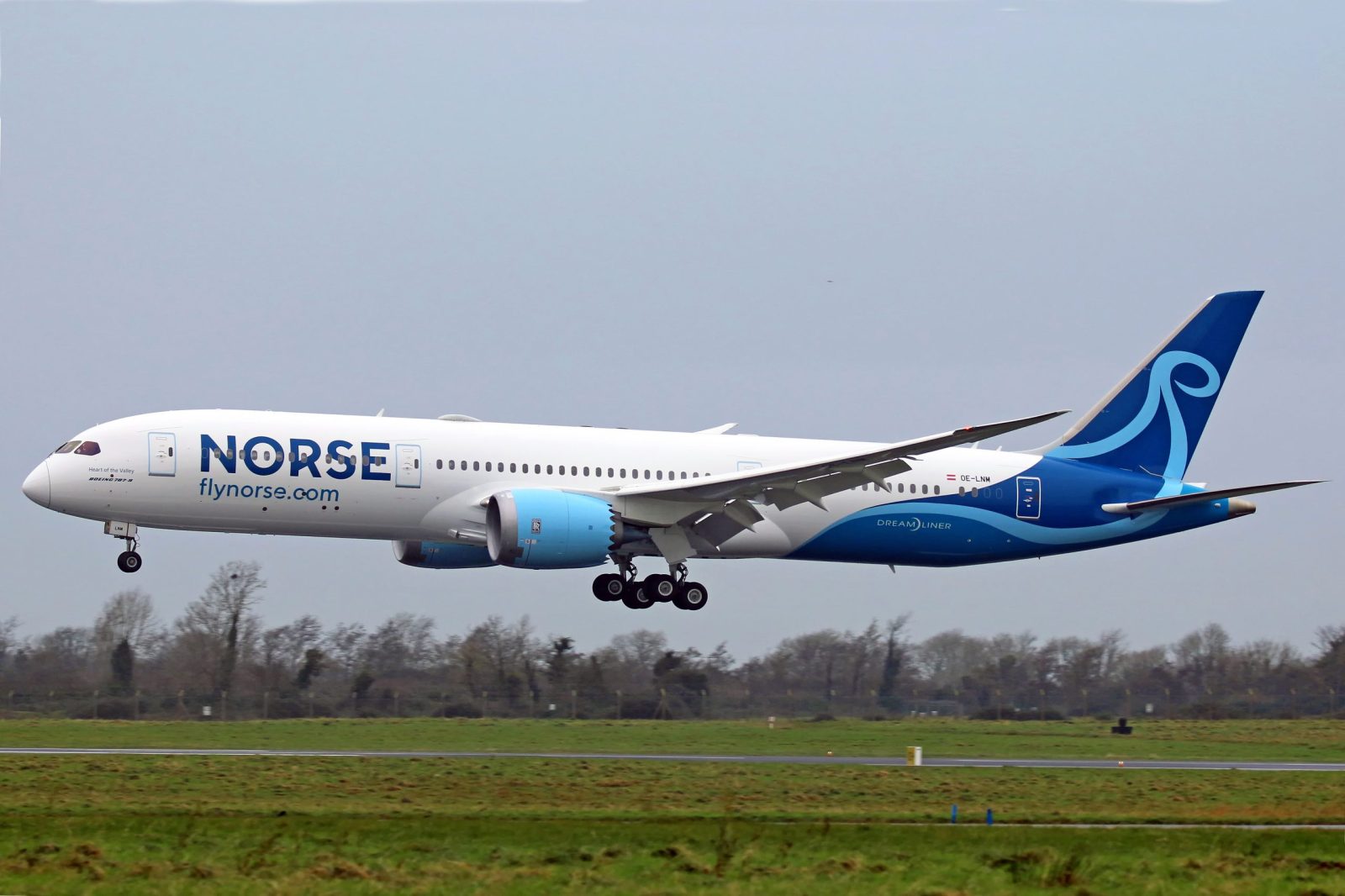
Norwegian startup Norse Atlantic has revealed its first 4 transatlantic routes to be launched later this year. The airline plans to serve New York, Los Angeles, Fort Lauderdale and Orlando with its Boeing 787 aircraft. Beginning June 14, 2022, Norse flight 01 will depart Oslo Gardermoen Airport for New York’s John F. Kennedy Airport at 7:50 pm local time arriving in New York just over 8 hours later at 10 pm local time.
Norse flight 02 is scheduled to depart JFK at 11:55 pm local time and arrive in Oslo the next day at 1:30 pm local time after roughly 7 and a half hours in the air. The Oslo-New York sector will operate on a twice-weekly basis until July 4 when it will pick up to once daily to meet forecasted summer demand. Norse will begin serving Fort Lauderdale on June 18th with twice-weekly service for the initial week followed by 3 times weekly. Service to Orlando will begin on July 5 and is scheduled to make the trip 3 times a week with no changes planned.
Norse’s service to Los Angeles is just the tip of the iceberg for the abnormal operation plans that the airline has publicized. Departing Oslo at 6:30 in the morning, the flight arrives in Los Angeles just after 8:30 am local time with a flight time of just over 11 hours. The aircraft will then remain on the ground at LAX until 1:30 pm the following day at which point it will depart back to Oslo to arrive at Gardermoen Airport at 9 am local time.
Norse’s CEO Bjorn Tore Larson said in a press release: “The introduction of affordable Norse Atlantic Airways point-to-point flights between Europe and the United States, will benefit both local tourism and businesses. Not only are we directly investing in the countries that we operate by employing local staff we are also supporting job creation across the wider tourism and service industry” With some fares as low as $114 USD one way, Norse is also launching these routes to the US from Oslo at rates that haven’t been seen in years. Prices for the upcoming summer season are higher than ever and Norse could prove to be an excellent option for those looking to reach Oslo and the rest of Europe very inexpensively.
The airports that Norse plans to operate those flights to, however, are surprising given the carrier’s ultra-low fares over the Atlantic. The few, now no longer ultra-low-cost transatlantic routes often operated from secondary airports in order to keep prices to a minimum. Norwegian Air Shuttle’s New York City to Bergen, Norway route flew out of Stewart Airport some 70 or so miles north of New York City. When Norse originally applied to serve the United States, it requested permission to fly to Ontario, California, Fort Lauderdale, Florida and Newburgh, New York. These are all secondary cities just outside of larger primary cities, in this case, Los Angeles, Miami and New York City. Norse opted not to use these secondary airports with the exception of Fort Lauderdale and instead chose to fly from LAX and JFK. It is likely that Norse can make its presence more well-known here as opposed to secondary hubs far from most passengers’ destinations.
The airline has also said it has plans to announce routes from London and Paris to the United States soon along with new US destinations.
Ezra Gollan is a student, photographer and aviation enthusiast based in New York, New York. He has spent over half a decade around New York City’s airports as a photographer.
Cape Air Requests Cancellation of Service to Small Communities
A Cape Air Tecnam P2012 Traveller (Photo: AirlineGeeks | Joey Gerardi)
The Essential Air Service – or EAS – communities have been taking a major hit over the past eight months. First Boutique Air requested to terminate Jackson, Tenn. followed by Show Low, Ariz. Altoona, Penn., and Pendleton, Oregon, although the latter three were just so the carrier could get a higher subsidy and is in the process, they are planning to leave Jackson in the next month or so. Boutique cited the termination due to rising costs and pilot staffing issues.
A Boutique Air Pilatus PC-12 at Atlanta Hartsfield-Jackson (Photo: AirlineGeeks | Joey Gerardi)
This was then followed by SkyWest’s massive announcement of the request to terminate 31 EAS communities across the country from Plattsburgh, N.Y. in the east to Alamosa in the Rocky Mountains. These negotiations and the EAS process are still going on, and EAS bids for 29 of the communities are due on May 11, 2022. SkyWest cited the reason for the termination request as pilot and staffing shortages.
A United Express CRJ-200 exiting the runway in Ogdensburg, N.Y. (Photo: AirlineGeeks | Joey Gerardi)
Cape Air is now the third airline that has requested to terminate EAS cities due to pilot staffing concerns. They have requested to terminate the EAS communities of Quincy, Ill. and Burlington, Iowa. The latter of which the carrier has only stated service to just three months ago, on Feb. 1, 2022.
Cape Air’s hub at Boston Logan (Photo: AirlineGeeks | Joey Gerardi)
Staffing and more specifically pilot staffing has been a big concern and the root cause of hundreds of flight cancellations, not only for carriers in these EAS communities but flights to larger cities as well. There is one EAS-focused airline however that has said they face no issues with pilots shortages at all, and are continuing to grow; Southern Airways Express.
“At Southern Airways and Mokulele, we create pilots. We train the first officers and help them build hours until they are qualified to become captains for us. Then, we pass them along to SkyWest, our regional airline partner. When a young pilot starts with us, they have a fast pathway to the major airlines, so we have hundreds of pilots applying every month to join our team. Southern and Mokulele are uniquely positioned to survive and thrive during the worldwide pilot shortage—our passengers can book with confidence that they will have a plane and crew ready to go when they are!”
For the time being, Cape Air is required to stay in both communities and continue operating flights as they are contracted to do. From here, what will usually happen is the DOT will deny the request until a replacement carrier can be found, at which point the EAS bidding process will begin and other airlines will submit bids for the community.
One thing is for sure, with the bids for 29 EAS communities due in less than a week, and a third airline requesting to terminate multiple EAS contracts, there has never been a more confusing time for people that live in these communities.
Joey has always been interested in planes for as long as he can remember. He grew up in Central New York during the early 2000s when US Airways Express turboprops ruled the skies. Being from a non-aviation family made it harder for him to be around planes and would only spend about three hours a month at the airport. He was so excited when he could drive by himself, the first thing he did with his driver's license was get ice cream and go plane spotting for the entire day. He graduated from Western Michigan University in 2022 with a B.S. in Aviation Management & Operations and a Minor in Business, and currently works for a major airline in his hometown.
French Bee Begins LAX – ORLY Service — Onboard Experience
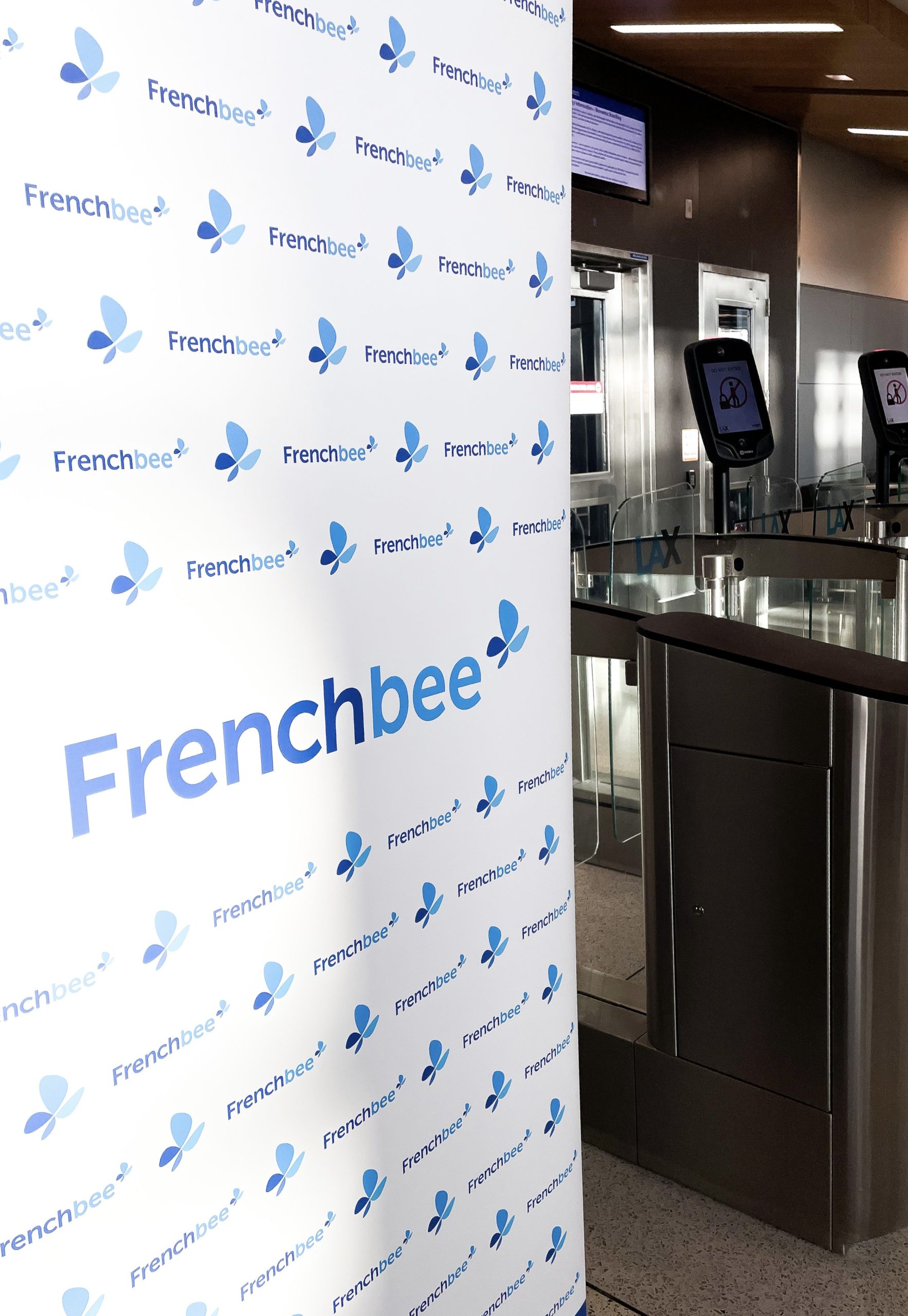
Banner set up at boarding gate 203 at LAX for French Bee's inaugural flight from LAX-ORY (Photo: Chase Hagl)
On Saturday, April 30, Paris-based carrier, French Bee, held its inaugural flight from Los Angeles (LAX) to Paris-Orly (ORY), a historic event for the carrier, marking its third destination in the United States, along with San Francisco (SFO) and New York (EWR).
By year-end, the carrier looks to add Miami to the list of U.S. cities.
“We continue to grow the tools to be quite efficient in the U.S. market for our product, we are not in the position to only serve one or two points, and with that, we are continuously building up our capabilities in these markets. We have decided to go very strongly on New York, San Francisco, now Los Angeles, and by the end of the year Miami” stated French Bee CEO Marc Rochet in an interview with AirlineGeeks. “We want to connect enough cities to support our commercial efforts.”
The low-cost carrier looks to serve the LAX-ORY route three times weekly on Monday, Thursday, and Saturday, with the possibility of increasing this to five times weekly by June. Fares start as low as $321 one-way for Basic Economy or $679 one-way for Premium Economy. The 5,652-mile flight runs at 10 hours and 50 minutes, with the outbound leg departing LAX at 7:45 p.m., with a scheduled arrival in Paris the following day at 3:35 p.m. The return flight to the states departs ORY at 2:50 p.m.and arrives in Los Angeles at 5:15 p.m.
Guests looking to book with French Bee can expect an A-la-Carte experience, allowing guests flexibility when flying with the airline. Thus making it a great option when strictly looking to get from point A to point B without the added expenses.
Customers have the option between three fare classes: Basic, Smart, and Premium. Basic fare, the least expensive, includes one carry-on bag (26 lbs) plus one accessory and a ticket that is changeable without fee up until the time of departure. Smart Fare includes those two options, plus one checked bag (50 lbs) and one meal included. Both of these fares have a non-refundable ticket. The Premium fare, the most expensive with the most options, includes all of the previous options but adds on an additional checked bag, snack, champagne and wine, and the ticket is refundable with a $65 fee.
French Bee’s Fare Packages
Onboard, guests are given packages to choose from for the purchase of inflight WiFi provided through iZiWifi. The four packages are labeled as Hello, Social, Geek, and Addicted. Hello, allows guests 25 MB for $4, Social 50 MB for $9, Geek 120 MB for $17, and Addicted 250 MB for $29.
Utilizing a business model that offers low fares while enhancing comfortability proves to be beneficial for many travelers. The U.S. market as a whole and the LAX-ORY market, in particular, look to be a catalyst for the airline and a popular option for both American and French citizens. When asked where the main point of sale for the market is, Rochet responded, “It has been changing. When we began to sell the U.S. market to Europe, the U.S. market was stronger at 60 percent and only 40 on the French side, a result of the 2021 US economy being stronger, mechanically speaking. The U.S.’s strong relaunch and demand on the market supported this” stated Rochet. “Now the French Market is coming back and there is strong demand on the French side as people are looking to travel again to the U.S. to visit friends or family. Today we are a bit more 52, 53 percent European French and the U.S. a bit less. All of this combined when projected to the summer is doing about 80 percent load factor, so we are quite happy.”
Airline Geeks was fortunate enough to be on board the maiden flight, getting the full inflight experience, from gate to gate.
Check-in and Boarding
The journey for French Bee’s guests begins at LAX’s Tom Bradley International Terminal. Upon walking into terminal B, screens displaying the prominent French Bee logo appeared above the seven check-in counters utilized by the carrier.
French Bee’s check-in counters at LAX (Photo: Chase Hagl)
Located at check-in area C, guests were separated into two lines, Premium Economy and Economy. Lucky for me, I was flying Premium-Economy and got to avoid a large number of guests already queued to check in on the Economy side. The process commenced at 4 pm, three hours and 45 minutes prior to departure.
Here, passengers presented both their Passport and vaccination cards to the agents, as well as checked their luggage. Following the check-in process, passengers were given a French Bee branded metal water bottle as a token of appreciation.
Security wait times were anywhere from 20 to 45 minutes for guests on today’s flight. A point to note, passengers should expect to spend a little extra time going through security when traveling with French Bee, as the carrier does not participate in TSA PreCheck.
Once through security, passengers began the ten-minute trek to gate 203, where they were greeted by the simple, yet sleek livery of the French Bee A350. Here, the carrier had set up banners, to show the significance of the event. Gate 203, located amidst gates 201-210 is all located in a very spacious area with plenty of seating, however, there were not many food and drink options available as the majority of shops that were present were closed.
A couple of hours prior to departure, the three pilots and ten flight attendants arrived at the gate, where they participated in a crew picture and crew briefing prior to boarding the aircraft.
The flight crew poses for a picture prior to the inaugural flight (Photo: Chase Hagl)
Guests began boarding the aircraft 45 minutes prior to departure, starting with Premium Economy and families needing a little extra time and/or assistance. However, the airline did not wait long, as the rest of the guests were quick to follow, creating a free-for-all and very hectic feel to the boarding process. It was here where individuals began getting turned away until they were wearing the appropriate “surgical face mask”, a cloth mask was not sufficient. An unfortunate byproduct of a mask mandate that continues to linger and the lifting of the restriction is long overdue.
Fortunate for those passengers, other guests saved the day by offering some of their extra masks, with bids beginning at $10. The low fare may be offset by the auctioning off of your additional masks prior to your next French Bee flight (noted). What did surprise me, was the fact that the carrier did not have extra masks for individuals that did not have the correct type of mask, especially in a country where the mask mandate has been lifted altogether.
Past the ticket counter, guests were greeted with a large selection of Macaroons, a French staple. I overheard the guest next to me state, “oh how pretty, I love the different colors.” I must have missed this detail, a hapless consequence of being color blind because I’m sure they were indeed, very pretty.
Onboard
The aircraft utilized for BF Flight 731 was the Airbus A350-941, registered F-HREY, a two-year-old aircraft and the aircraft of choice for the French carrier. The aircraft is one of French Bee’s five aircraft in its fleet, which includes four Airbus A350-900s and one A350-1000.
“In 2014-2015 we began to think about future goals, what will be a good place in the market, and we were considering building a low-cost long-haul French airline. Many people were not convinced. Many people would say low-cost and long-haul don’t fit very well” Rochet stated. “We thought about that, we continued to think about that, but we started. We decided to build the company from scratch” in regards to separating from their sister carrier, Air Caraibes.
The idea to start the airline from scratch was very important as it allowed them to start “perfectly clean”. “Our goal was to build the best organization entering into the long-haul market, and that is our reason behind the choice of the Airbus A350, which is probably one of the best aircraft in the market today.”
French Bee’s A350-900 consist of 411 seats, with a “Premiumblue” cabin consisting of five rows in a 2-3-2 configuration and an “Ecoblue” cabin which utilizes a tighter 3-4-3 configuration.
French Bee’s “Premiumblue” seats (Photo: Chase Hagl)
My first impression of seat 7A and the remainder of the 34 premium economy seats was a pleasing one. For a “lower”-cost carrier, comfortability and the ample amount of legroom offered came as a bit of a surprise. Seats in the premium economy provided passengers with a 36-inch pitch and width of 18 inches. Located at each seat is a 12-inch touch screen display along with power outlets and a USB port for each passenger.
Premium seats had the ability to recline a sizable seven inches, a nice tease to what a completely lie-flat seat might feel like. This was a pleasant feature for those looking to get a little bit of shut-eye over the Atlantic.
Passengers seated in the remaining 376 economy seats have 32 inches of pitch and a width of 16 inches. These passengers also have access to in-seat power as well as a ten-inch touch screen display.
The inflight entertainment consisted of 82 movies, 23 TV shows, 10 games, 141 albums, food and beverage options, duty-free shopping selections and an AirlineGeeks favorite option of external cameras, including the tail view, forward view, and non-functional down view.
One complaint I do have is the inability to control one’s temperature, as there are no individual air vents at each seat, a concern for those who run a little bit hot.
Within minutes onboard the aircraft, passengers in the premium economy were greeted by flight attendants offering a complimentary glass of champagne. For those who declined the offer, guests were offered an alternative soda, coffee, or tea.
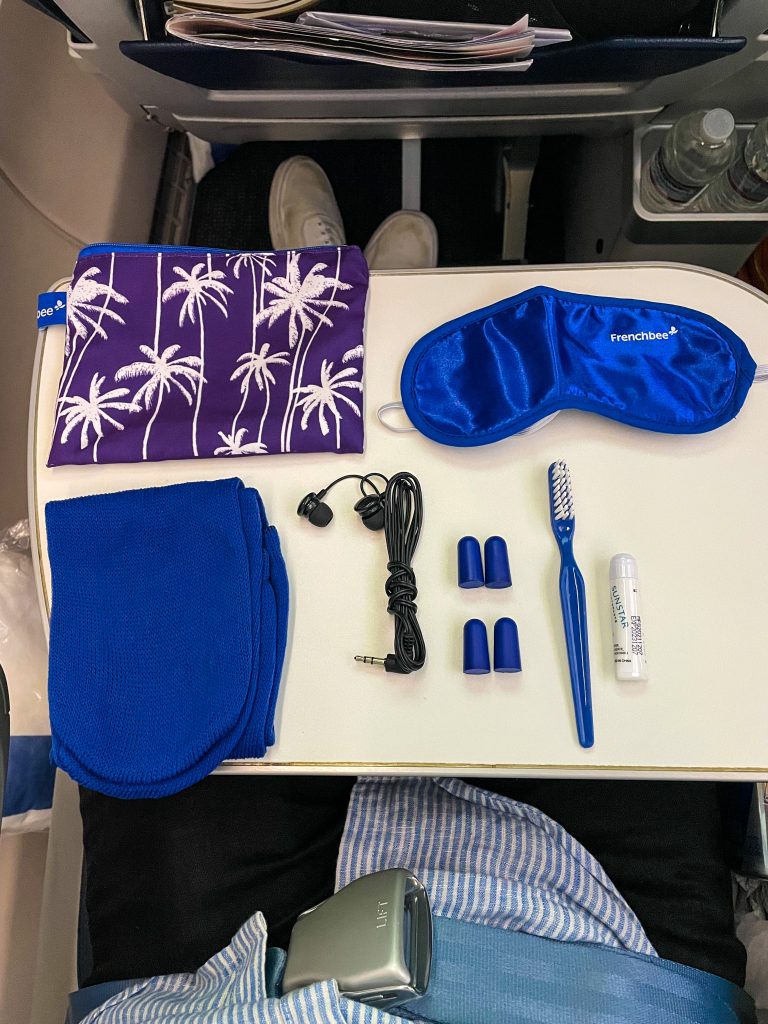
At each seat was a French Bee head pillow and blanket, along with a complimentary bottle of water. The cabin crew also handed out complimentary travel kits to premium economy guests that included socks, headphones, two pairs of earplugs, a toothbrush and toothpaste, and an eye mask.
Boarding doors were punctually closed at the scheduled departure time of 7:45 and the aircraft was pushed back with no delay six minutes later. By 8:07, just before sunset, the aircraft was wheels up, commencing the 10-hour red-eye journey to the city of lights.
Once through 10,000 ft and out of the sterile cockpit, flight attendants offered guests a tablet with a pre-loaded selection of newspapers, magazines, and books.
Tablets containing choices of magazines, newspapers, and books. (Photo: Chase Hagl)
Just prior to the dinner service, approximately 20 minutes into the flight, the cabin crew handed out hot (extremely hot), moist towelettes for guests to wash their hands and/or face with.
Forty minutes into the flight, service commenced with the offering of two main courses. Passengers had the choice between beef with mac and cheese or lemon butter shrimp linguine. Each meal came with two California sushi rolls, only appropriate for the route (California), red grapes, a chocolate brownie, a Ghirardelli chocolate square, and a triangle-shaped cheese. A recommendation for future flyers, you are in for a rude awakening when you think the cheese is a piece of cake.
On this flight, I got the beef with Mac and cheese and was pleasantly surprised with the taste and quality of the meal.
Beef and Mac and cheese dinner (Photo: Chase Hagl)
Following the first meal, the cabin crew went through the cabin with a cart containing Duty-Free items for sale. This included a wide assortment of name-brand products like cologne, perfumes, cosmetics, sunglasses, jewelry, headphones, etc., just about everything I look to buy when getting on a plane.
Cruise flight up until the “Brunch” service was uneventful, a term that is preferred when flying at speeds upwards of 500 knots in a metal tube, or in this case, a composite one.
For brunch, one hour and thirty minutes prior to landing, passengers were given the choice between a French toast with mixed berry and cartelized pineapple or scrambled eggs with peppers, roasted potato wedges, and chicken sausage. Both were served with blueberry Chobani yogurt, bread roll, and a raisin swirl danish, accompanied by your choice of beverage.
My decision was a bit flawed, as I thought one couldn’t go wrong with either choice, especially following the two solid choices for dinner. I was wrong. Possibly a result of the lack of sleep I got due to the two rounds of coffee I consumed, however, I did not order but received it due to my lack of French? Simply put, I did not particularly enjoy the French toast, however again, I do respect the brilliant play on food name choice on the particular route (FRENCH toast).
French toast breakfast meal served an hour and a half prior to landing (Photo: Chase Hagl)
Arrival
Following a 9-hour and 59-minute flight, BF731 touched down at 3:05 local time on Orly’s runway 06. By 3:19 we parked at gate B51 with the seat belt sign-off. Disembarking the aircraft was quick and easy due to the location in the aircraft we were situated in. The walk to passport control and baggage claim went fairly quick, and the longest part of the journey was waiting for our bags, however, who was I to complain, I was in Paris.
First Impressions
My first impressions of French Bee are quite good and I respect the business model. The carrier makes it clear that you will not be receiving the same experience as you would traveling with a larger, more well-known carrier, but that is the point. They are offering a product that is not offered by those carriers, a significantly reduced airfare, with the option of additional purchases along the way. This allows each passenger to tailor their experience to their own liking. It also gives individuals who prefer to pay the bare minimum, like me, the opportunity to simply get from point A to point B without the added costs that I likely wouldn’t use anyways. This may not be the ideal way of travel for some, but it opens the door to a much larger market.
I am also impressed by the carrier’s aircraft choice. One would expect a low-cost carrier to use older aircraft which utilize obviously older technology. That is not the case here. The use of the A350 offers passengers a smooth and quiet ride while benefiting passengers through the use of technology like mood-lighting which mimics sunrises and sunsets, resulting in improved sleep quality and reduction of jet lag. The comfortability of the seats along with the good selection of food makes for a bearable 10-hour journey. To top it off, the crew was extremely respectful and enjoyable on both outbound and return flights home.
The trip of course had some hiccups like boarding situation, lack of air vents, not providing appropriate masks, and lack of accommodation to the color-blind, but with as seemingly young as the carrier is, these are almost to be expected and I give them the benefit of the doubt.
In short, I thoroughly enjoyed the experience and product that French Bee had to offer!
Chase pictured with French Bee CEO Marc Rochet at their headquarters (Photo: Chase Hagl)
Chase Hagl grew up in Twin Falls, Idaho. His love and passion for Aviation landed him in Orem, Utah where he obtained a B.S. in Aviation Management with a minor in Business Management from Utah Valley University. Chase currently works as a flight attendant in Charleston, SC and is also the primary Inflight ASAP ERC representative for startup airline, Breeze Airways. His experience in the aviation industry spans back four years, working in areas including agriculture application, customer service, maintenance, and flight ops. In his free time, Chase enjoys road biking, astronomy, and flying.
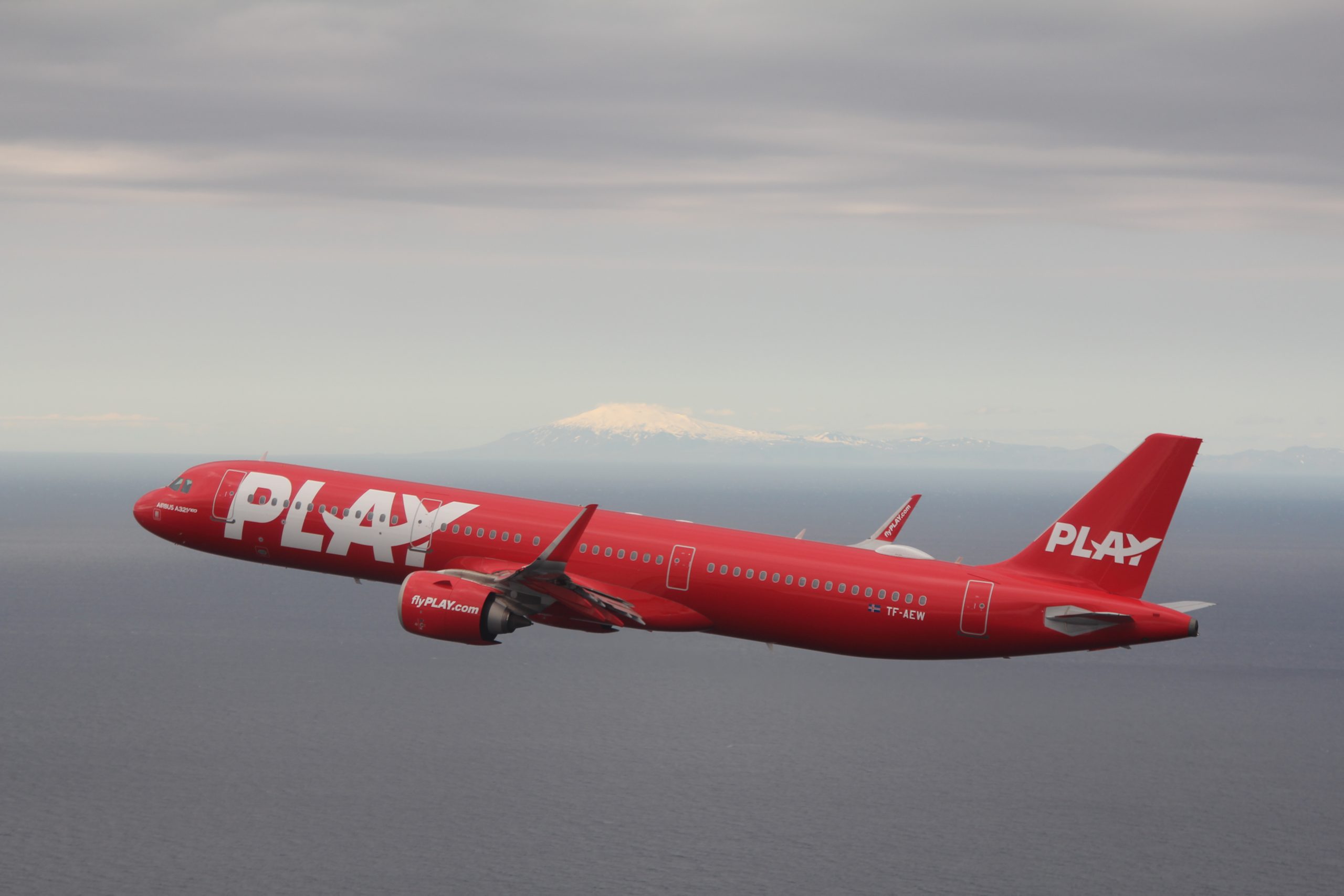
Icelandic Airline PLAY Grows with Second US Flight
New Icelandic airline PLAY has announced further growth with its second U.S. flight coming next May 11. Departing from Boston Logan International Airport, PLAY will establish its first Northeast service, opening up 22 European destinations via its home in Reykjavik, Iceland. It’s the second phase of PLAY’s wider strategy to capitalise on the year ahead which expects major growth in the travel industry.
As part of that strategy, the low-cost airline aims to continue its growth and influence with more flights this year from New York Stewart International Airport and Orlando International Airport, planned June 9 and September 30 respectively. With its “pay less, play more” slogan, PLAY will offer an additional competitive edge for international low-cost airlines, setting the goal of flying more than 1 million passengers from D.C., Boston and New York.
To celebrate the inaugural flight, PLAY will host a party and ceremony at the gate, with boarding passengers to be welcomed by PLAY CEO Birgir Jónsson and local officials. According to PLAY, the boarding will begin at 6 p.m., offering passengers the chance to experience what it calls “95% on-time reliability.”
Growth During Global Pandemic
Established in 2019, PLAY has grown significantly despite the tourism slump that came with the global COVID-19 pandemic. Commencing operations between Iceland and mainland Europe, the airline has seemingly defied the odds by adding North America to its list of routes, having commenced its first U.S. flight from Baltimore on April 20, 2022.
Although its load factors were only 41.7% in July last year, passenger loads in March this year increased to 66.9%. The positive growth has justified the expansion of its staff and fleet, complementing its 2021 fleet of three Airbus A321neo aircraft with two A320neo and one A3211neo LR aircraft. With this fleet of six aircraft, the airline predicts a fivefold-increase of seat capacity from 196,000 in 2021 to 1.04 million in 2022, aiming to still add another four Airbus A320/A321neo aircraft to its fleet by spring 2023.
The increase in seat capacity, in part from seating modifications, will see the airline deliver additional savings for passengers and added environmental benefits as the global aviation industry aims to lower carbon production. The costs, being lowered by 7% , mean sustainable low-cost flights as it adds additional holiday routes to Geneva, Switzerland in 2023.
Speaking on PLAY’s low-cost services, Jónsson stated, “We are a no-frills airline, but with our reliable and affordable flights, PLAY’s passengers can spend their hard-earned money in their holiday destination, rather than on getting there.”
PLAY’s Positive Outlook
In step with PLAY’s record of growth during the pandemic, the airline shows little sign of concern as the world faces its next crisis of increasing oil prices fuelled by the conflict in Ukraine. Although the airline anticipates increased fuel prices will cost it around $10 million, it sees strong pent-up customer activity due to the travel limitations imposed from the previously mentioned pandemic.
According to its annual CEO Update and Outlook, PLAY “uses one of the most fuel efficient aircraft available on the market,” adding “our network and schedule are structured in the most economical manner possible”. The airline’s financial situation is such that it has no plans to raise additional capital “unless the world and market situation deteriorates significantly from the current situation.”
Mike’s love affair with flight and mechanical objects in the sky began at an early age, fascinated by space documentaries and the vintage Flight Simulator ’95. He currently works as an instructor for UAVs and is training to receive his Private Pilot Licence with the goal of working in manned flight instruction. An avid reader of all things aviation and manned space flight, Mike stays close to developments in aerospace while reminiscing and sharing the rich history of flight with others. He loves writing, engineering and science.
Canadian and British Passports (Photo: AirlineGeeks | John Flett)
The lifting of coronavirus travel restrictions in North America and across Europe has created a sharp increase in the demand for air travel. Though the lifting of restrictions had been foreseen as a positive for an aviation industry hit hard by the pandemic the reality has been something else entirely. Flight cancellations, staff shortages and long lines for security and immigration have become daily headlines in both regions.
The cancellation of flights inconveniences passengers and intangibly damages the brand image of the airline particularly if done on the day of travel. However, in the U.K. and the European Union (EU), airlines also face financial penalties as customers are due compensation under EU regulation 261/2004. Though the UK has now left the European Union the regulation was adopted by the UK after Brexit.
According to Money Savings Expert, a UK consumer website, “if the passengers are on a flight leaving the UK/EU or returning to it (then it must also be an EU/UK airline), and the flight is canceled within 14 days of departure resulting in a two or more hour delay, then – providing the reason for the cancellation is the airline’s fault – you are also likely entitled to fixed cash (not vouchers) compensation of between £105 ($130) to £505 ($625) per person depending on the flight.”
Passenger compensation varies depending on the time period prior to the departure of the flight and the airline’s reason for cancellation. With some airlines struggling to ramp up staff numbers to meet the advertised capacity strategic flight cancellations have been occurring on a regular basis. In the past week, British Airways strategically canceled a number of flights up until the end of June to avoid possible cancellations within the 14-day compensation period.
Additionally, passengers on both sides of the Atlantic are facing additional concerns with regard to the issuance of passports. The delay in passport issuance in the U.K. has been a topic of discussion in parliament as a reported 5 million Brits have applied for new passports in anticipation of the summer holidays. The passport office has extended its issuing time from an average of 3-4 weeks up to 10 weeks.
According to The Independent, a British newspaper publication, citizens in the U.K. are advised that they have ‘10 days left to renew passports for the summer holidays.
The Daily Record reported that one of the UK’s largest travel firms, TUI Airways issued an email warning to customers to ensure they had a compliant passport prior to travel. With the pandemic having affected the last two summers and the UK now out of the EU since the last time, a majority of passengers may have flown TUI Airways issued a reminder for prospective passengers to ensure they could travel.
U.K. passport holders now need to have a minimum of three months validity to enter some EU countries, and their passport must not have an expiry date greater than 10 years.
CTV News in Canada is also reporting that Canadians face a long time in acquiring renewed or new passports. The report states that “Because Canadians were advised to avoid all non-essential travel during the COVID-19 pandemic people were not looking at their passports as often as they had been previously and unknowingly let the documentation expire.”
John has always had a passion for aviation and through a career with Air New Zealand has gained a strong understanding of aviation operations and the strategic nature of the industry. During his career with the airline, John held multiple leadership roles and was involved in projects such as the introduction of both the 777-200 and -300 type aircraft and the development of the IFE for the 777-300. He was also part of a small team who created and published the internal communications magazines for Air New Zealand’s pilots, cabin crew and ground staff balancing a mix of corporate and social content.
John is educated to postgraduate level achieving a masters degree with Distinction in Airline and Airport Management. John has held the positions of course director of an undergraduate commercial pilot training programme at a leading London university. In addition he is contracted as an external instructor for IATA (International Air Transport Association) and has been a member of the Heathrow Community Fund’s ‘Communities for Tomorrow’ panel.
Alaska Adds ‘Galaxy’s Edge’ to Disneyland Family of Special Liveries
Alaska Airlines and the Disneyland Resort in Anaheim, California celebrated “Star Wars Day” with an unveiling on the latest Disneyland promotional jet for the Seattle-based airline. The Boeing 737-800, wearing registration N538AS, now dons a black space theme and has been given the title of “Star Wars Transport to the Disneyland Resort” in long withstanding continued collaboration with the resort.
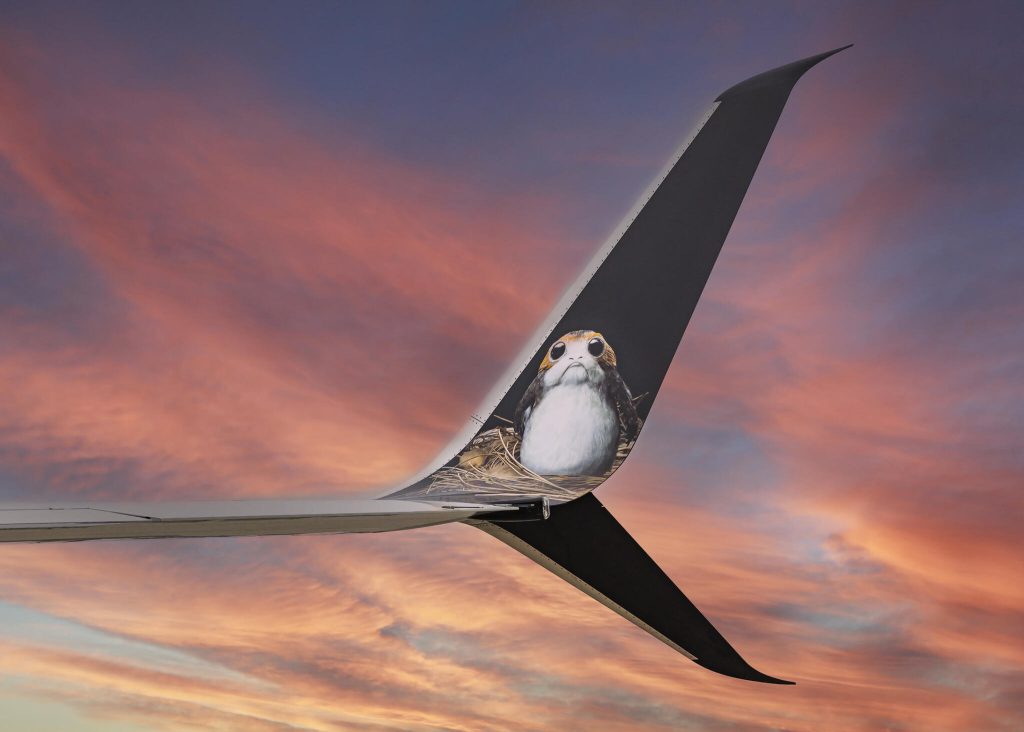
The jet is themed around the movie series Star Wars and the theme park’s dedicated section to the series titled “Star Wars: Galaxy’s Edge”. The California park’s version of the space universe opened to the public in May 2019, with Florida’s Walt Disney World’s Hollywood Studios getting a similar part in the following August. Similar to Galaxy’s Edge, the centerpiece of the design is focused on the Millennium Falcon, which for the Alaska livery takes up the tail and rear fuselage. The livery also focuses on enemy TIE fighters covering the fuselage giving chase to the Millennium Falcon. The Boeing 737 also has unique winglets, with creatures from the latest trilogy called Porgs appearing on the inside of the winglets looking back at passengers on the voyage.
The airline has special winglets featuring the porg, a creature from Luke Skywalker’s island in the most recent trilogy (Photo: Alaska Airlines)
The aircraft replaced the last Alaska aircraft wearing the “Hawaiian Lei” on the 1990s icicles livery. The aircraft would take 228 gallons of paint and 23 base colors to complete the space fantasy theme. Overall, 27 days would be devoted to turning a standard Alaska plane into the next iteration of the Disneyland family of planes in the Seattle carrier’s fleet.
For Alaska, the launch of “Star Wars Transport to the Disneyland Resort” marks the seventh aircraft to wear Disneyland sponsorship. Other planes in the past have worn legacy characters like Tinker Belle and Mickey Mouse, while more recent Disneyland special liveries promote new sections of the park, such as Carsland, Pixar Pier and now Star Wars: Galaxy’s Edge.
Star Wars has been a common special livery for various airlines over the past decade. United had a Boeing 737-800 in a similar space themed livery for the launch of the third trilogy’s finale “Star Wars: The Rise of Skywalker” in 2020. All Nippon Airways of Japan had a trio of Boeing widebodies themed around the droids of the story, with a Boeing 777-200 and a Boeing 787-9 Dreamliner still active themed around C-3P0 and R2-D2, respectively. The Boeing 777-300ER themed to the droid BB-8 was retired in early 2022 as the aircraft reached the end of its service life with ANA. A Boeing 777-300ER still exists in Star Wars colors through LATAM Airlines, who promotes the Florida version of Star Wars: Galaxy’s Edge with the aircraft wearing the color scheme of the Storm Trooper, an soldier from the series.
Alaska went all in on promoting the new scheme, offering passengers with Star Wars attire priority boarding on May 4 to celebrate the event. The airline also offered a fourth ticket free when booking three tickets on May 4 with an origin or destination being Hollywood Burbank Airport or Orange County Airport between May 5 and June 26.
Although Ian McMurtry was never originally an avgeek, he did enjoy watching US Airways aircraft across western Pennsylvania in the early 2000s. He lived along the Pennsylvania Railroad and took a liking to trains but a change of scenery in the mid-2000s saw him shift more of an interest into aviation. He would eventually express this passion by taking flying lessons in mid-Missouri and joining AirlineGeeks in 2013. Now living in Wichita, Kansas, Ian is in college majoring in aerospace engineering and minoring in business administration at Wichita State University.
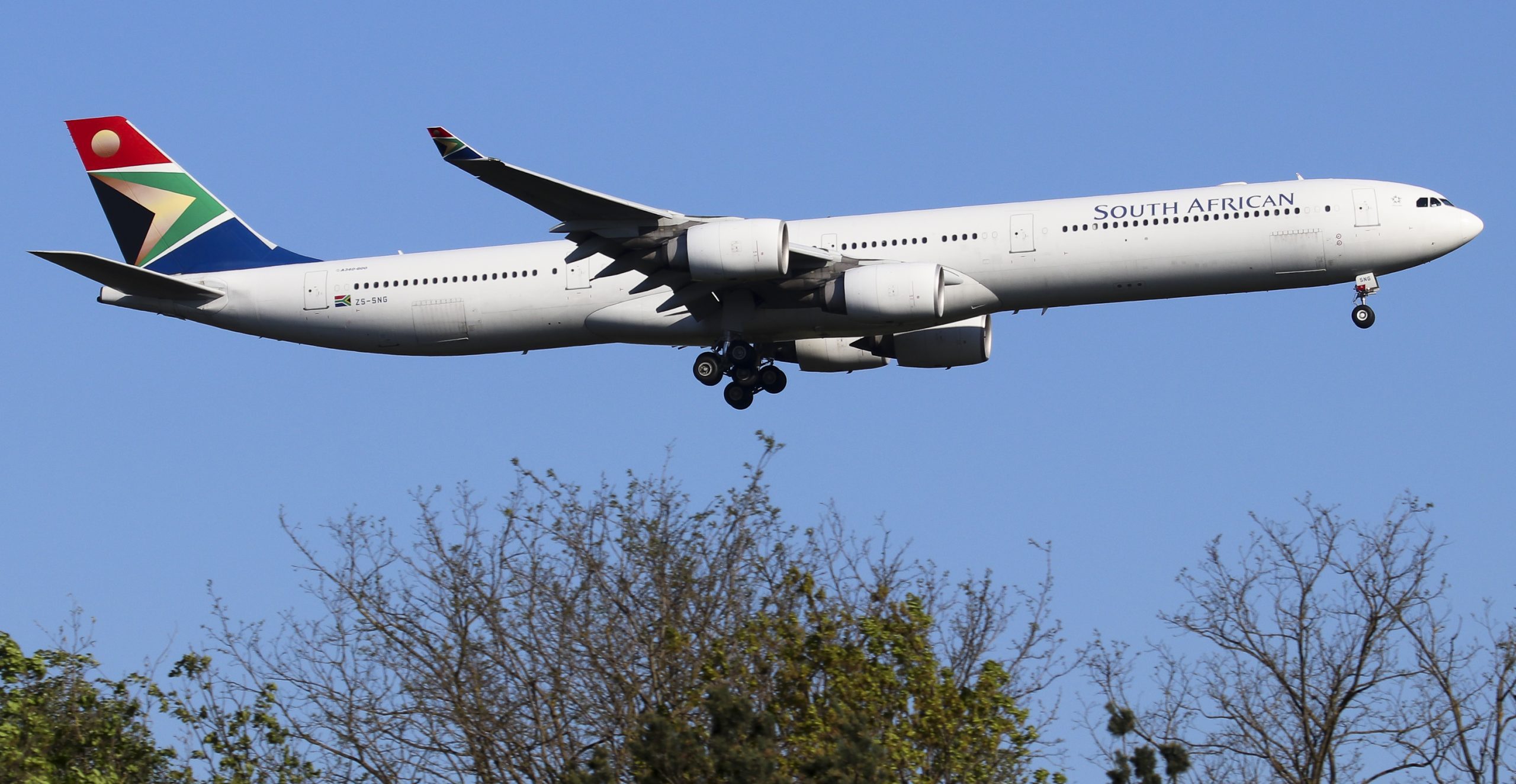
A South African Airways A340-600 on approach to Frankfurt. (Photo: AirlineGeeks | Fabian Behr)
Last week, South African Airways announced changes to its leadership structure. The carrier’s interim CEO Thomas Kgokolo — who has led the airline for a year now — has stepped down from the position, with the role subsequently being assumed on a more permanent basis.
John Lamola will replace Kgokolo, who has been serving as non-executive chairman of the interim board even as the airline seeks to rebuild after coming out of the business rescue process, in addition to pandemic induced travel downturn.
Kgokolo took office on April 13, 2021, and oversaw the re-entry of South African Airways into operation after exiting business rescue on April 30, 2021.
Lamola will assume office as the new Executive Chairman and Chief Executive Officer beginning on May 1. This is the latest in a wave of leadership changes at one of the continent’s big carriers, and the new executives are tasked with driving their recovery from the Covid pandemic. Mesfin Tasew Bekele took on the role of Ethiopian Airlines’ CEO on March 23.
SAA Lead Independent Non-Executive director, Ms. Bembe Zwane said, “Thomas took the job of CEO as leader of a cohort of a Transition Management Team. He was generous enough to offer his professional services under a short-term contract which we have eagerly extended on numerous occasions. Thomas has requested that his contract not be renewed. We appreciate the time he has given to SAA and look forward to the leadership of the executive team by John Lamola”
According to the airline’s statement, Lamola said, “The business strategy of SAA remains intact and on course as the Board and the Ministry of Public Enterprises are steadfastly pursuing their goal of a sustainable SAA for the good of the entire South African economy.”
Since taking office, Kgokolo faced the steep challenge of overseeing SAA’s re-entry into operation from administration at a time when the airline was restructuring to reduce debt and its workforce. This entailed working on re-building trust with the airline’s largest pilots’ union, the South African Airways Pilots Association (SAAPA) while navigating the uncertainties of the COVID-19 Pandemic.
“Since exiting business rescue in April 2021, SAA has made significant strides in improving revenue and reopening services both locally and regionally and is now fully focused on its transition to control by its envisaged majority shareholder, Takatso Consortium, which will take a 51% stake in SAA later in the year,” the airline said in a statement.
While in the realm of the country’s flag carrier, Lamola plans to have a smooth transition of the carrier as is set to be sold by the government to the Takatso Consortium.
The consortium is expected to take on a 51% share in the airline later this year and it reportedly plans to invest about 3 billion Rand ($195.34 million) in the carrier.
The government selected the Takatso Consortium, comprising infrastructure investor Harith General Partners and aviation group Global Aviation, as SAA’s preferred strategic equity partner.
The deal brings an end to years of speculation over the future of the troubled airline, which has been blighted by debt. The airline has received billions of South African Rands in government bailouts but has not turned a profit since 2011. As a result, this lead to a fierce debate in which some politicians advocated its permanent closure while others support full or partial privatization.
Victor Shalton's love for aviation can be traced to when he was 11-years-old. As a seasoned aviation writer, he takes pride in providing the best aviation coverage around the globe and is passionate about advancing his skills in the aviation space. In addition, he loves travelling, writing, arts and while his speaking engagements have taken him around the world, he is proud to call Nairobi home.
An Air New Zealand 777-300ER in Los Angeles (Photo: AirlineGeeks | William Derrickson)
New Zealand has gradually reopened its border to international travelers. After lifting the travel restrictions for Australian citizens three weeks ago, the nation welcomed citizens coming from almost 60 visa-waiver countries, including the U.S., Canada, the U.K. and Japan. Fully vaccinated travelers need to take a Covid test before boarding the flight and upon arrival.
Auckland, New Zealand’s Airport handled 9,000 passengers with 43 international flights on the first day of the reopening of the border. The gateway to the country has enhanced its services by adding 40 staff to handle the increasing travel demand.
“It’s been a pleasure to be here, and the fact we can play a role in welcome people back to Aotearoa is fantastic.” Carrie Hurihanganui, Auckland Airport’s Chief Executive said.
The government said New Zealand is not yet quite back to normal, but the reopening of the border was another step towards it.
Greg Foran, the airline’s Chief Executive said the reopening is “a big day for us.”
According to the airline, the travel demand after easing the restrictions has exceeded expectations with many of its services filling up. Also, the airline is seeing a surge in demand for Fiji and Honolulu during the winter holidays. The flag carrier has rehired 800 staff for the travelers returning to the skies.
Recently, Air New Zealand revealed it will relocate its head office to Auckland, New Zealand’s Airport in 2024, following the government’s announcement of the reopening of the border.
The new headquarters will centralize its 5,500 employees in one location and reduce the property cost. In addition, a new engineering facility will be built this year. It will be the largest single-span timber arch aircraft hangar in the Southern Hemisphere.
“We’re confident that our long-haul operation will return so investing now in a new hangar that will be large enough to house a Boeing 787 Dreamliner and two Airbus A320s side by side in one space makes complete sense,” Foran described while introducing the new hangar.
The existing hangars were built in the 1960s and 1980s, and Air New Zealand needed a modern structure for the new fleet that takes sustainability into account.
Route Network in North America
The notable Star Alliance carrier has its sights on its route network in North America after the pandemic. Air New Zealand will resume flight operations between Auckland, New Zealand and San Francisco, Los Angeles and Vancouver, Canada. Flights to Honolulu and Houston will resume on Jul. 4 and Jul. 7 respectively.
Earlier, the carrier revealed its ambitious flagship route, three-times-a-week services between Auckland and New York’s John F. Kennedy Airport will be launched in September. The airline will operate its Boeing 787 Dreamliner on this long-haul route. The flight is expected to be over 16 hours northbound and 17 and a half hours southbound.
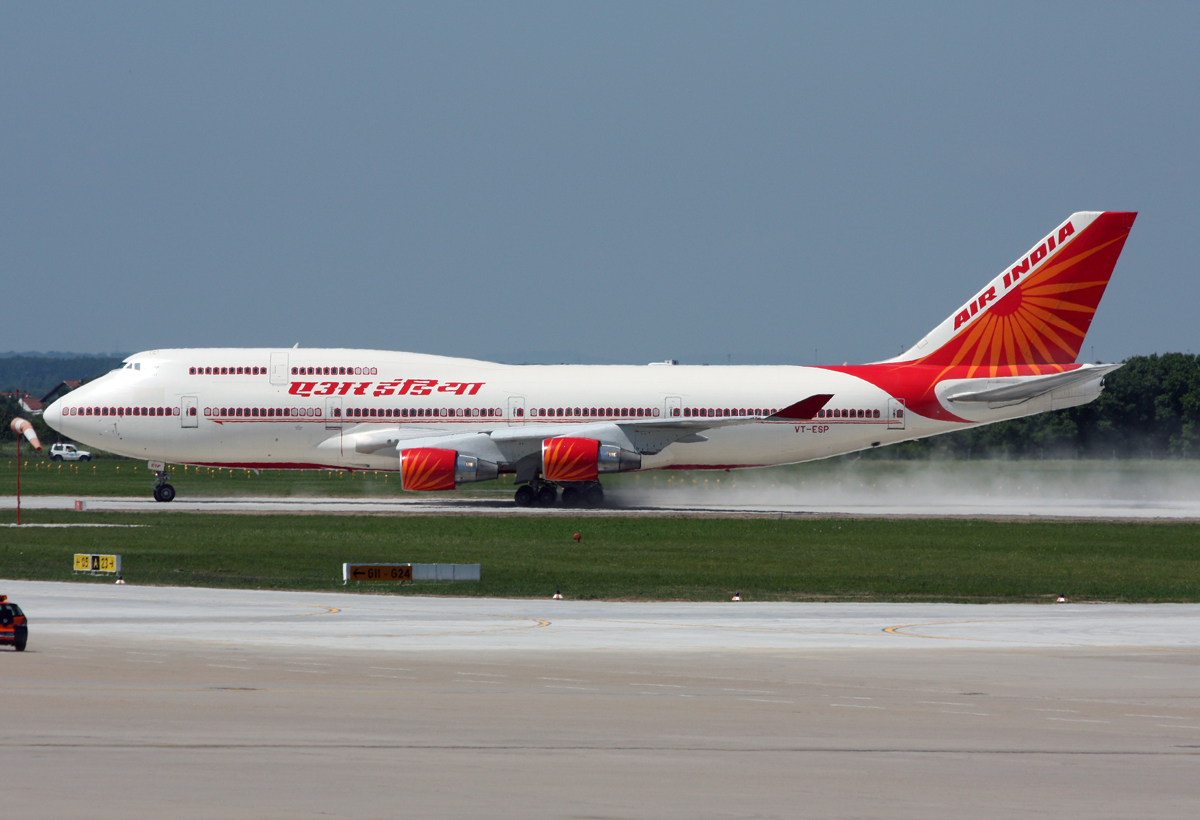
An Air India 747-400 aircraft (Photo: Mulag, CC BY-SA 3.0 , via Wikimedia Commons)
Last week, India’s Directorate General of Civil Aviation (DGCA) deregistered the last four Boeing 747-400s still listed as assets in the fleet of Air India, the national airline recently sold to the Tata Sons Group. With this, one of the last passenger jumbo jet operators in the world is saying goodbye to the model.
According to Aeroin, the aircraft had not been used on the Indian carrier’s scheduled flights for some years. Instead, they were employed on charter flights for religious events and served as a VIP transport platform for the local government. However, with the recent acquisition of a presidential Boeing 777, the jumbo has lost even more relevance.
An Air India 747-400 (Photo: parfaits, CC BY-SA 3.0 GFDL 1.2, via Wikimedia Commons)
The decision to remove the planes from the fleet was obvious. It is not yet known what the future of the aircraft, which were already reaching an average age of 27 years, will be.
The phasing out of four-engine jumbo jets worldwide is a trend, especially with the entry into service of reliable and much more economical twin-engine aircraft. Currently, most Boeing 747 jumbo jets operate on cargo flights. Only a handful of airlines still use them for passenger flights, such as Lufthansa (Germany), Mahan Air (Iran), and Rossiya (Russia), among a few others.
AirlineGeeks.com was founded in February 2013 as a one-person blog in Washington D.C. Since then, we’ve grown to have 25+ active team members scattered across the globe. We are all here for the same reason: we love deep-diving into the fascinating realm of the airline industry.