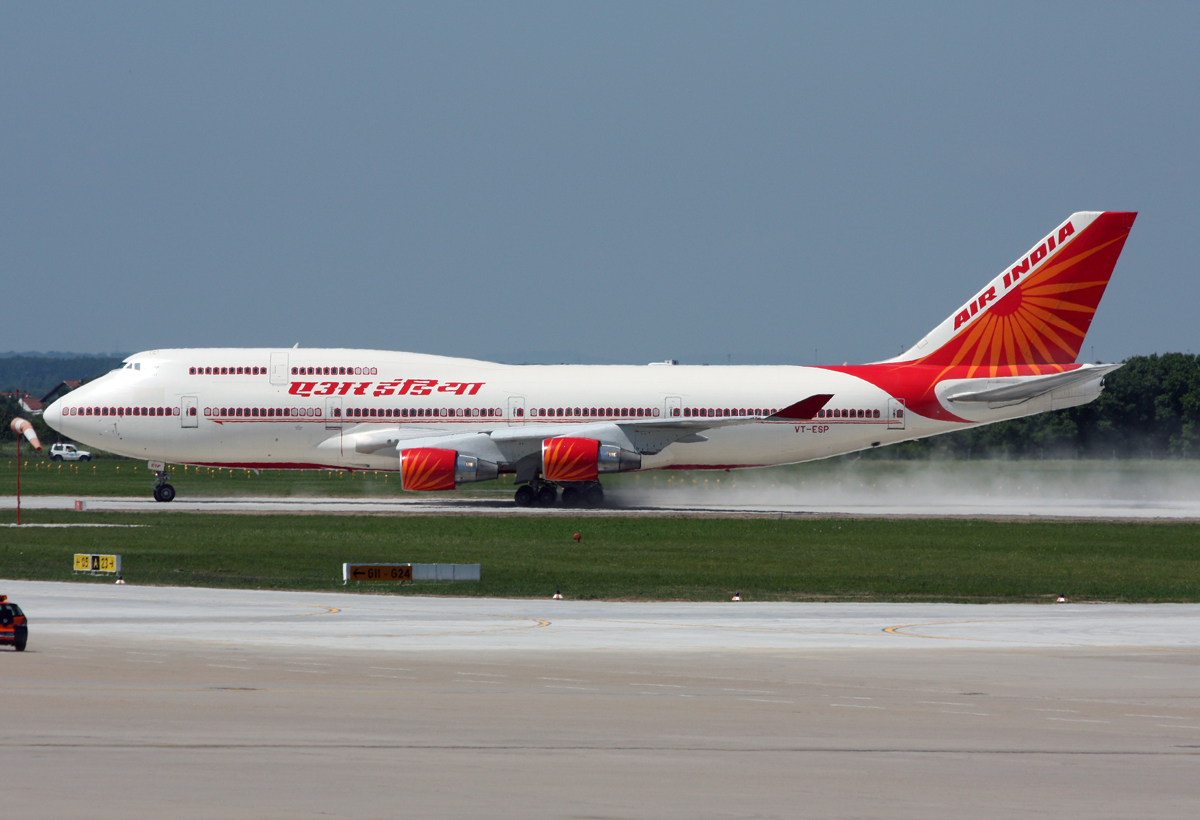
An Air India 747-400 aircraft (Photo: Mulag, CC BY-SA 3.0 , via Wikimedia Commons)
Last week, India’s Directorate General of Civil Aviation (DGCA) deregistered the last four Boeing 747-400s still listed as assets in the fleet of Air India, the national airline recently sold to the Tata Sons Group. With this, one of the last passenger jumbo jet operators in the world is saying goodbye to the model.
According to Aeroin, the aircraft had not been used on the Indian carrier’s scheduled flights for some years. Instead, they were employed on charter flights for religious events and served as a VIP transport platform for the local government. However, with the recent acquisition of a presidential Boeing 777, the jumbo has lost even more relevance.
An Air India 747-400 (Photo: parfaits, CC BY-SA 3.0 GFDL 1.2, via Wikimedia Commons)
The decision to remove the planes from the fleet was obvious. It is not yet known what the future of the aircraft, which were already reaching an average age of 27 years, will be.
The phasing out of four-engine jumbo jets worldwide is a trend, especially with the entry into service of reliable and much more economical twin-engine aircraft. Currently, most Boeing 747 jumbo jets operate on cargo flights. Only a handful of airlines still use them for passenger flights, such as Lufthansa (Germany), Mahan Air (Iran), and Rossiya (Russia), among a few others.
AirlineGeeks.com was founded in February 2013 as a one-person blog in Washington D.C. Since then, we’ve grown to have 25+ active team members scattered across the globe. We are all here for the same reason: we love deep-diving into the fascinating realm of the airline industry.
A rendering of Qantas' new Airbus A350-1000, A321XLR and A220-300. (Photo: Qantas)
Australian flag carrier Qantas today announced a set of aircraft orders aimed at expanding both its international and domestic route networks. The Australian airline committed to ordering a minimum of 52 Airbus aircraft — 12 A350s, 20 A320XLRs and 20 A220s – as it plans new non-stop flights from Australia to cities like London and New York, as well as improving domestic flight capabilities.
The major plans, named Project Sunrise and Project Winton on the international and domestic sides, respectively, will implement changes as early as 2023 for domestic flights and 2025 for its long-range, non-stop routes.
Riding Into the Sunrise
The airline’s plan, codenamed Project Sunrise, will include non-stop flights to the four corners of the globe. According to the media release, travelers from Australian airports will be able to access cities such as London, Paris, Cape Town, Rio de Janeiro and New York with direct flights to start from Sydney in 2025, although it plans to expand this service to both Brisbane and Melbourne at a later date.
The key to Qantas’s success in this feat will be its fleet of 12 Airbus A350-1000s, which will be equipped with an extra fuel tank, giving it a range of 8,700 nautical miles — approximately 10,000 miles.
As Qantas looks forward to the sunrise, it is also looking to utilize so-called sustainable fuels. The aircraft will operate with Rolls-Royce Trent XWB-97 turbofans which can operate on sustainable aviation fuels (SAFs), and offer 15% increased fuel efficiency compared to first generation Trent engines as well as reduced noise.
“New types of aircraft make new things possible,” Qantas CEO Alan Joyce said in a statement on the new fleet. That’s what makes today’s announcement so significant for the national carrier and for a country like Australia where air travel is crucial.”
He added, “Throughout our history, the aircraft we’ve flown have defined the era we’re in. The 707 introduced the jet age, the 747 democratised travel and the A380 brought a completely new level of comfort. The A350 and Project Sunrise will make any city just one flight away from Australia. It’s the last frontier and the final fix for the tyranny of distance. As you’d expect, the cabin is being specially designed for maximum comfort in all classes for long-haul flying.”
Qantas released a comprehensive rendering of its A350-1000, revealing greater space by removing excess seats – its aircraft will have to lowest seat count of any A350-1000 currently in service. This arrangement will provide 140 economy seats with a 33” seat pitch, 40 premium economy seats with a 40” seat pitch, a buffering ‘Wellbeing Zone’ between the two for comfort on the 20 hour flights, 52 business suites with a self-service bar (say goodbye to the A380 bars), and six first-class enclosed suites with separate recliner chairs and ergonomic beds — a total of 238 seats.
Qantas A350-1000 First Class (Photo: Qantas)Qantas A350-1000 First Class. (Photo: Qantas)Qantas A350-1000 Wellbeing Zone, where passengers in all classes can stretch during the long flights. (Photo: Qantas)Qantas A350-1000 Wellbeing Zone (Photo: Qantas)
Although prices have not yet been mentioned, there is little reason to doubt that the prices will be significantly more expensive than multi-leg flights.
Addressing Domestic Duties
Qantas plans to improve its domestic capabilities with its Project Winton, ordering 20 Airbus A321XLRs and 20 A220-300s to stagger the replacement of its retiring Boeing 737 and 717 aircraft. The initial deliveries of its new aircraft will start in late 2023, with the arrival of its first A220, and joined later by the A321XLR the following year.
The new aircraft will offer improvements in both passenger capacity and range, with Qantas saying the new A321XLR will have an additional 1,629 nautical miles and room for 200 passengers — an increase of 15% without compromising any legroom — compared to its existing Boeing 737 fleet. The A220-300 will have capacity for 137 passengers — a 25% increase — while nearly doubling the range of the Boeing 717 to over 3,200 nautical miles, meaning it will be able to travel non-stop to any city in Australia.
Both new aircraft will open further opportunities for Qantas in the Asia-Pacific market, adding to the existing order of 109 A320s from low-cost subsidiary Jetstar. All in all, it adds up to what Joyce called “the largest aircraft order in Australian aviation,” adding that it “is a clear vote of confidence in the future of the Qantas Group.”
That confidence, however, has been put to the test in recent weeks as the airline has faced backlash from unions, passengers and Australian customer advocacy group Choice. During this year’s Easter holiday period, entire Qantas flights took off without any baggage, with passengers waiting days for luggage.
Mike’s love affair with flight and mechanical objects in the sky began at an early age, fascinated by space documentaries and the vintage Flight Simulator ’95. He currently works as an instructor for UAVs and is training to receive his Private Pilot Licence with the goal of working in manned flight instruction. An avid reader of all things aviation and manned space flight, Mike stays close to developments in aerospace while reminiscing and sharing the rich history of flight with others. He loves writing, engineering and science.
After a board meeting at the Florida-based ultra-low-cost carrier, Spirit Airlines issued a press release stating that “the unsolicited proposal received from JetBlue Airways does not constitute a ‘Superior Proposal’ as defined in Spirit’s merger agreement with Frontier Group Holdings, Inc., parent company of Frontier Airlines, Inc., because it has determined that the proposed transaction is not reasonably capable of being consummated.”
Spirit Airlines, therefore, believes the proposed takeover by JetBlue Airways would not be able to clear the necessary regulatory hurdles and it would require significant divestments by the combined carrier in order to obtain the green light from the Antitrust authorities.
The “unacceptable level of closing risk” highlighted by Spirit Airlines is also linked to the regulatory scrutiny currently faced by the ‘Northeast Alliance’ pursued by JetBlue Airways and American Airlines. In fact, the U.S. Government has sued to stop this alliance that would see the two carriers coordinate their schedules and offering at lucrative airports in the Northeast of the United States, including Boston Logan, New York-JFK, and New York LaGuardia.
JetBlue’s Remedy Package Ineffective
On the same day, JetBlue Airways unveiled a “remedy package to address regulatory concerns” pertaining to the Northeast Alliance and to facilitate the takeover of Spirit. This package included the divestment of assets in Boston and New York, as well as some gates and assets at other airports including Fort Lauderdale, where Spirit Airlines has its main base, FlightGlobal reports.
JetBlue had also agreed to pay a $200 million “breakup fee” in case the acquisition could not be completed because of the opposition by the regulators, but even this “insurance policy” was not enough to tip the scale in favor of JetBlue Airways’ takeover bid.
While the merger proposed between Spirit Airlines and Frontier Airlines is intending to combine two airlines with similar business models, small overall market share and limited route overlap, the takeover by JetBlue would see an ultra-low-cost carrier like Spirit become part of a carrier that has evolved towards a hybrid model and is now shaping its structure and offering in a way much more befitting a legacy carrier like its Northeast Alliance partner American Airlines.
Spirit Airlines is certainly more attractive to JetBlue as a provider of certain assets like slots and gates at certain constrained airports rather than a carrier as a whole, therefore it is not difficult to foresee a reallocation of those slots to the carrier that would extract the highest value in case the takeover had gone through.
On the contrary, the airline originating from the merger between Spirit and Frontier would represent by far the largest ultra-low-cost carrier in North America and one of the largest in the world, enabling this new entity to achieve considerable economies of scope and scale and drive the development of budget flying for the next decades.
Vanni fell in love with commercial aviation during his undergraduate studies in Statistics at the University of Bologna, when he prepared his thesis on the effects of deregulation on the U.S. and European aviation markets. Then he pursued his passion further by obtaining a Master’s Degree in Air Transport Management at Cranfield University in the U.K. followed by holding several management positions at various start-up carriers in Europe (Jet2, SkyEurope, Silverjet). After moving to Canada, he was Business Development Manager for IATA for nine years before turning to his other passion: sports writing.
CityAirbus NextGen with ITA Airways livery rendering. (Photo: Airbus)
ITA Airways has become the first Italian company to join the ENAC project to help people with autism familiarize with air travel in all its stages, from arrival at the airport, to check-in, to staying on the plane and up to the arrival stopover. This ENAC project, started in 2015, has already been implemented in about 20 airports with the collaboration of Assaeroporti — the association of 29 Italian airport management companies operating at 37 Italian civil airports — and with the involvement of Associations to help autistic people and their families.
The Italian national airline will make its simulators available in its training center so that autistic passengers can realistically experience the sensation of flying and, at the same time, be supported by qualified instructors. In this way they will be able to become familiar with air travel, which could be a difficult moment to live.
Four days ago, ITA Airways signed a Memorandum of Understanding with Airbus to develop vertical take-off and landing Urban Air Mobility (UAM) in Italy with the aim of exploring UAM services tailored to the Italian market. The focus will be on the CityAirbus NextGen all-electric eVTOL prototype aircraft unveiled in September 2021. This eVTOL will have fixed wings, a V-tail, an eight-propeller propulsion system and a cabin with four seats — for the pilot and three passengers — to ensure easy boarding. The CityAirbus NextGen’s range will be 80 kilometers with a cruise speed of 120 kilometers per hour.
Airbus is committed to ensuring that CityAirbus NextGen fits seamlessly into urban environments, minimizing noise pollution as much as possible and more easily gaining public acceptance. The ultimate goal is to stay below 65 decibels — abbreviated dB(A) — during overflight and below 70 dB(A) during landing. Note that these values, which come from the Airbus website, are in dB(A), so the measurement is weighted and adjusted to take into account the different sensitivity of the human ear to different frequencies of sound.
An ITA Airways Airbus A320 with the new livery at Leonardo Da Vinci International Airport. (Photo: ITA Airways)
ITA Airways has consolidated its partnership with Airbus which, after the purchase of 28 aircraft from Airbus, likely will continue for a long time as the airline as expressed a desire for fleet simplicity.
The Italian national airline’s strategy is to focus strongly on digital transformation to provide an increasingly better experience for its customers. The latest agreement signed two days ago with the Amadeus IT Group is for the use of their Amadeus Airline platform. Amadeus IT Group is a Spanish multinational company that deals with the process of research, price calculation, booking and issuing of tickets, and departure control systems and offers its services to more than 200 airlines. The migration process to this platform will be completed by early 2023.
Vincenzo graduated in 2019 in Mechanical Engineering with an aeronautical curriculum, focusing his thesis on Human Factors in aircraft maintenance. In 2022 he pursued his master's degree in Aerospace Engineering at the University of Palermo, Italy. He combines his journalistic activities with his work as a Reliability Engineer at Zetalab.
An Avianca A321 prepares for its next flight at LAX. (Photo: AirlineGeeks | William Derrickson)
On the night of April 28, several rumors began to gain momentum regarding a decision that will revolutionize the Latin American airline market in general, and the Colombian market in particular: Avianca reached an agreement to acquire Viva, a domestic competitor with international projection.
According to the testimony of sources consulted by Aviacionline, we can confirm that Viva accepted the offer, and that its president informed employees of the company’s next steps in a virtual conference.
Following the various administrative processes and the necessary governmental approval, an interim board of directors will be established to work on the areas of interest of the transaction.
According to these sources, the approvals and due diligence of the deal are expected to take approximately twelve months. After that period, the companies will maintain their brands and some operational independence.
According to sources, the transaction seeks to establish an alliance, rather than a full merger. Viva’s management stresses that Avianca’s interest is a validation of the work done and a recognition that a consolidation strategy will allow it to gain strength to gain a foothold in a market as competitive as the Colombian one.
It is speculated that at midnight Colombian time, official announcements from both Avianca and Viva confirming the agreement will be made.
From two key players to a mega player
In 2021, according to information compiled by Aviacionline through Aerocivil, Avianca captured 36.1% of the domestic market in Colombia, being the market leader. Viva ranked third, with 21.8%.
This article was written by Pablo Diaz for Aviacoionline.
Inside Lima's airport terminal. (Photo: VasenkaPhotography - https://www.flickr.com/photos/vasenka/8722356428/, CC BY 2.0, https://commons.wikimedia.org/w/index.php?curid=26698429)
Aeropuertos del Perú (AdP), a concessionaire of 12 airports in Peru, announced the beginning of works at Piura airport and revealed the work progress at the Chiclayo airport.
Piura’s Airport Project
AdP signed the contract for the Technical File preparation of the project ” Capitán FAP Guillermo Concha Iberico Airport’s Passenger Terminal Construction and Aircraft Platform Expansion”. This project will cost to the Peruvian Government around $36 million investment.
In a press release, AdP’s CEO, Evans Avendaño, pointed out that “the technical file for this investment will contemplate the detailed engineering of the passenger terminal expansion with the aim of being able to increase the passengers flow, the aircraft capacity attention during peak hours, as well as improving service levels for users in general and strengthening airport security standards, within the current Concession areas”.
“This will contribute to improving Piura’s connectivity for the entire Region, by promoting tourism, trade, and business,” he concluded.
These improvements will allow Piura to host between 18 and 20 daily flights, mobilizing around one and a half million people a year. The studies also include the Environmental Management Instrument elaboration, which establishes the recommendations and mitigation measures to address the environmental impacts that may originate in the execution of the work.
This infrastructure expansion will increase passenger capacity and the number of air operations, which will increase the commercial flow in this area of the country, as well as the number of national and international tourists. It is important to remember that Piura’s airport currently has 2.5 kilometers long by 45 meters wide runway and a parking platform for aircraft measuring 140 meters by 80 meters for 2 PEA – Class C aircraft.
Chiclayo Airport Works Progress Positively
The works to improve the José Abelardo Quiñones Gonzales International Airport’s runway system and perimeter fence have been advancing positively. In a press release, the Peruvian government indicated that these works will benefit 700,000 people. These will favor passengers, merchants, operators, and other people who use the airport’s infrastructure.
The Ministry of Transport and Communications (MTC), through the concessionaire Aeropuertos del Perú (AdP), has invested more than $43 million so far in the works. The objective is to expand and improve the airport’s operational capacity, with high-quality service standards, which will allow connectivity and decentralization promotion of air transport in Peru. Among the works in the execution stage is the runway’s reconstruction along its 112,500 square meters.
In addition to this, the aircraft parking platform is being rebuilt in an approximate area of 18,668 square meters. Likewise, the rehabilitation and expansion of the perimeter fence with a length of 8,513 meters are being carried out. Added to this, more than 96 thousand square meters of taxiways are being improved, as well as the drainage and sewage system, the lighting aid system, provisional signage, and definitive signage in the Peruvian Air Force area.
The work contributes to the Peruvian economy promotion since its execution has meant the generation of 600 direct jobs and 2,400 indirect jobs. Currently, the accumulated progress of this work is at 38%.
The three things Juan Pedro loves most about aviation are aircraft, airports, and traveling thousands of miles in just a few hours. What he enjoys the most about aviation is that it is easier and cheaper to travel around the world and this gives you the opportunity to visit places you thought were too far away. He has traveled to different destinations in North, Central, South America and Asia. Born, raised and still living in Perú, Juan is a lawyer, soccer lover, foodie, passionate traveler, dog lover, millennial and curious by nature.
Allegiant's "Winter The Dolphin" livery departing for a flight (Photo: AirlineGeeks | Joey Gerardi)
On Tuesday, ultra-low-cost carrier Allegiant Air announced plans to open a new four-aircraft base at Provo Municipal Airport (PVU) in Utah County, Utah. Possible through an investment of $95 million, the airline is set to begin base operations on November 16th later this year, and is expected to create upwards of 157 high-wage jobs for the community.
The $95 million investment will go towards the necessary equipment, infrastructure, employees and supplies that will be needed to establish its base operations.
The base announcement comes at a time of rapid expansion and growth for the Las Vegas-based airline. Earlier this year, the carrier announced an order of 50 Boeing 737 aircraft comprising a mix of 737-7 and 737-8-200 models—with the option for a further 50 aircraft.
Allegiant Air, a subsidiary of Allegiant Travel Co., focuses on linking travelers in small to medium-sized cities to leisure destinations, thus making Provo the perfect fit.
“Unlike most airlines which operate on a hub-and-spoke system, we fly an ‘out and back’ network where crews originate at a base, do their day of flying and return to base every night. This is also a benefit for our crew members, who get to sleep in their own beds at night, see their families and truly live in their base communities,” according to Allegiant leaders.
Allegiant is no stranger to the Utah County area. Beginning operations at Provo in 2013, the carrier remains the only commercial airline operating out of the airport, currently offering eight non-stop routes – Austin and Houston, Texas; St. Pete-Clearwater, Florida; Phoenix and Mesa, Arizona; and Palm Springs, Los Angeles and Orange County, California. Since operations began, Allegiant has flown more than 700,000 passengers through Provo.
“Allegiant Air has found a following with their unique brand of travel focused on low-cost, nonstop flights to popular destinations without the hassle of layovers and connections,” said Brian Torgersen, interim Provo Airport manager. “We are pleased to launch a new era of travel at the Provo Airport, with Allegiant’s base operations expansion being key to our future success.”
Allegiant’s announcement comes just weeks before Provo is set to open its doors to its newest terminal. Breaking ground in November of 2019, the new terminal features four gates with the possibility to expand to 10 gates in the future. At a price tag of $55 million, the goal of the additional 70,000 sq ft of new terminal space is to attract some explosive growth in commercial air service.
City officials, pleased by Tuesday’s announcement, as they say Provo Airport has moved up to being the state’s second busiest airport as it grows.
“We’re delighted to grow alongside Provo, a market with phenomenal growth and convenient access to some of Utah’s most treasured destinations,” said Keith Hansen, Allegiant’s vice president of government affairs. “Allegiant understands the value of Provo Airport. Building on the success of eight existing routes at PVU, our investment means having locally-based aircraft and crews, opening the door for future new destination opportunities for residents.”
Chase Hagl grew up in Twin Falls, Idaho. His love and passion for Aviation landed him in Orem, Utah where he obtained a B.S. in Aviation Management with a minor in Business Management from Utah Valley University. Chase currently works as a flight attendant in Charleston, SC and is also the primary Inflight ASAP ERC representative for startup airline, Breeze Airways. His experience in the aviation industry spans back four years, working in areas including agriculture application, customer service, maintenance, and flight ops. In his free time, Chase enjoys road biking, astronomy, and flying.
Schiphol Airport Asks Airlines to Cancel Flights Due to Staff Shortages
A KLM A330-300 touching down in Amsterdam (Photo: AirlineGeeks | Fabian Behr)
One of Europe’s busiest airports is set to have further disruption this weekend after an unannounced baggage handlers strike caused chaos last weekend. According to Reuters Amsterdam’s Schiphol airport is seeking to prevent repeat scenes at the airport similar to those experienced on 23 April by asking airlines to manage aircraft movements.
Reuters reports that due to staff shortages Schiphol has “asked airlines to reduce the number of locally departing passengers this weekend by cancelling bookings, and not accepting new bookings from Schiphol in the period from 2 to 8 May.” This period coincides with the early May holiday period in many countries within Europe.
In an email to the news agency, Schiphol stated, “This is an annoying but necessary measure to reduce the number of passengers.” Dutch airline KLM has its hub at the Amsterdam airport and is expected to cancel some flights on Friday. Further information on future cancellations from KLM and other airlines was not immediately forthcoming and passengers were advised to contact their airlines.
The hub nature of KLM’s operation at Schiphol means that there is potential for significant disruptions to passenger journeys. It would be assumed that cancellations will be done strategically leveraging the codeshare and alliance agreements with other carriers operating to and from Schiphol to minimize passenger disruption.
As previously reported in Airline Geeks dozens of flights were cancelled at Schiphol on 23 April when baggage handlers staged the unannounced strike. Saturday’s disruption coincided with the first day of the school holidays and overwhelmed the airport. At midday, on Saturday the airport authorities issued a statement that read: “The terminal is too full at the moment … Schiphol is calling on travellers not to come to the airport anymore.”
Delays around the airport meant that police had to close highway exits to the airport for a brief time according to Reuters. The KLM ground handlers did return to work on Saturday afternoon and though the airport did lift the temporary call for travellers not to head to the airport three hours later, passengers were still subjected to lengthy delays.
In a statement following Saturday’s disruption, KLM said, “The discussions between the management board and the employees concerned addressed topics including staff shortages, mounting work pressure and job retention in the long term. These discussions will of course continue in the coming period.”
Staff shortages resulting in flight cancellations have been a feature of the aviation industry’s post-pandemic restart around the world. Airlines, airports and associated industries have been struggling to recruit to match the upsurge in traveller demand as governments eased or removed travel restrictions with minimal notice.
John has always had a passion for aviation and through a career with Air New Zealand has gained a strong understanding of aviation operations and the strategic nature of the industry. During his career with the airline, John held multiple leadership roles and was involved in projects such as the introduction of both the 777-200 and -300 type aircraft and the development of the IFE for the 777-300. He was also part of a small team who created and published the internal communications magazines for Air New Zealand’s pilots, cabin crew and ground staff balancing a mix of corporate and social content.
John is educated to postgraduate level achieving a masters degree with Distinction in Airline and Airport Management. John has held the positions of course director of an undergraduate commercial pilot training programme at a leading London university. In addition he is contracted as an external instructor for IATA (International Air Transport Association) and has been a member of the Heathrow Community Fund’s ‘Communities for Tomorrow’ panel.
Australia is set to host its biggest air show in history after Pacific Airshow announced it will head down next year. The announcement, made on a rather rainy Wednesday, April 27, stated that the massive event will take place over the sandy beaches of Surfers Paradise, Queensland in August 2023. It is the start of an initial five-year commitment that will bring an unprecedented experience from California’s Huntington Beach to Australia’s iconic Gold Coast.
Pacific Airshow, which launched six years ago at Huntington Beach in Southern California, has featured performances from display teams such as the US Navy Blue Angels, USAF Thunderbirds, and the RAF Red Arrows. A media release stated, “Pacific Airshow is all about maximizing the adrenalin rush as the world’s best aviators push to the edge of what’s possible.” The event has received wide acclaim having been the only air show in North America to host three military aerobatic jet teams from three different countries.
The unique event, which draws 3 million visitors to California each year, is welcome news for the recently resuscitated Australian tourism industry. According to analysts, Pacific Airshow injected an overall $105 million into the Huntington Beach economy in 2019 alone, a result that is expected to be similar for Pacific Airshow Gold Coast.
A Different Airshow
Binding the ties between Australia and the United States, Pacific Airshow will be the largest air show in Australian history. While Australia hosts many air shows each year, Pacific Airshow is unique. The largest air shows in Australia are often true to their definition – an event targeting an audience comprised almost exclusively of aviation enthusiasts. By contrast, Pacific Airshow aims to entertain a much broader audience that caters to entire families, capitalizing on the holiday hotspot of the Gold Coast.
Speaking to Airline Geeks, CEO of event organizer Code Four and Pacific Airshow Director Kevin Elliot stated, “this is not your grandparents’ dusty old air show,” adding that the show will include some surprises. Saying that he couldn’t elaborate on too much yet, he explained “Pacific Airshow has invited participation from all allied nations,” including the previously mentioned Blue Angels, Thunderbirds, and the United Arab Emirates Al Fursan display teams to name a few.
Pacific Airshow promises a vast range of demonstrations that will be of great interest to all in attendance, with less focus on static displays and more on the action up above. This will include the latest fighter jets, such as the Lockheed Martin F-35, the latest in manned and unmanned drone technology, and what could very well be a demonstration of Urban Air Mobility technology. All this will be in addition to civilian displays and, hinted to Airline Geeks, the possibility of jet-packs. In 2019, Pacific Airshow held the first jet-pack race at Huntington Beach.
Additionally, the show will feature Australian Air Race champion and former Royal Australian Air Force fighter pilot Matt Hall, who has been signed as the event’s first ambassador.
A Family-Friendly Event
Over its history, Pacific Airshow has garnered a family-friendly reputation. Director Kevin Elliot revealed a surprising statistic: during that history “not a single arrest has been made,” adding, “crime goes down when we look up.” Comparing Pacific Airshow to other events in Huntington Beach, he stated that not only was the event free of crime but that the location was left cleaner than at the start.
In addition to a display of aerobatics overhead, the three-day lifestyle festival will incorporate a vast entertainment and hospitality program, A-lister parties and exclusive VIP meet and greet events. “This will be an annual event that will feature the finest aerobatic teams and performers from around the globe as well as inspiring educational STEM activities, music, entertainment and much more,” Kevin Elliot added.
While the show has a reputation as the number one recruiting show for defense, it broadens its audience for all the family by increasing commercial involvement, meaning an enhanced experience that air shows of a more voluntary nature are unable to deliver.
Pacific Airshow is expected to draw attendees from around the world, with specific dates to be released in August 2022.
Mike’s love affair with flight and mechanical objects in the sky began at an early age, fascinated by space documentaries and the vintage Flight Simulator ’95. He currently works as an instructor for UAVs and is training to receive his Private Pilot Licence with the goal of working in manned flight instruction. An avid reader of all things aviation and manned space flight, Mike stays close to developments in aerospace while reminiscing and sharing the rich history of flight with others. He loves writing, engineering and science.
China Eastern's flagship Boeing 777-300ER at Shanghai's Pudong Airport (Photo: AirlineGeeks | Albert Kuan)
Since April, China’s Aviation Market has been maneuvering at historical low traffic, levels the country hasn’t seen since 2003. Daily flights currently number between 1,000 and 2,000, which is not even the level of traffic during 2021 for Guangzhou’s Baiyun Airport alone.
The traffic level is comparable to that of the country’s aviation market in 2003 as it continued to recover from a SARS outbreak. The widespread Covid-19 Omicron variant and the fear brought about by the crash of China Easter MU5735 have discouraged the public from traveling in recent weeks. And as a result, several airlines are struggling to maintain their cash flow, meaning 2022 could turn out to be a worse year for China’s aviation market than 2020.
Historic Low
The nation’s aviation market has been running low since the end of March. At that time, Shanghai went into a full lockdown, driven by the spread of Covid-19. The city is the largest aviation hub in China, with two mega airports, Hongqiao International Airport and Pudong International Airport. Both airports are among the largest in the world and contribute a substantial amount of traffic to the country’s national totals.
In April, other major cities in China — including Guangzhou, Beijing, and Chengdu — have all spotted minor spread of Covid-19. Travel restrictions against the residents of those cities further decreased the confidence of the traveling public.
A China Southern Airlines Boeing 777-300ER departing from Los Angeles airport (Photo: AirlineGeeks | James Dinsdale)
International flights have been running at an extremely low level since the beginning of the pandemic, with less than 5% of traffic operating compared to the same period in 2019. China’s harsh quarantine requirement for international travelers and a limited number of flights would not be a positive force to help lift the market. Regional flights between mainland China and Hong Kong, Macau, and Taiwan were running low as well, especially after a major Covid-19 outbreak in Hong Kong in February.
A Trying Time
The carriers are experiencing extreme difficulties running their business. So far, the Chinese government has not issued any subsidy for carriers affected by the pandemic. And in addition, fuel charges, a cost that continues fluctuating alongside large swings in international oil prices, have been lifted a number of times, trending upward from $3 to up to around $20 per seat operated. Considering the extremely low traffic right now, the increase in oil fees has been marginal for troubled carriers compared to other fixed costs.
The employees of airlines and airports are also feeling the chill of the market. Multiple airlines have reportedly given to notice their employees that their salaries in April will be delayed. Additionally, many employees’ salaries are directly linked to the performance of the airline or airport they work for.
Measures are being taken by the authority to relieve the stress on carriers and airports. The government is chartering flights to transport the medical workers to assist with Covid-19 hotspots. According to internal sources, large, state-owned carriers like Air China, China Southern and China Eastern are preparing to deliver extra funds to subsidiaries that are struggling more than others. As this round of Covid-19 outbreak trends down, airlines are also hoping travelers are getting ready to get back on a plane again.
Lei is from Inner Mongolia, China, and now lives in Guangzhou. He grew up in an aviation family, where his passion began. During his time at Penn State University, he studied Industrial Engineering specializing in operations research, and he graduated with an honor’s thesis on airport gate assignment optimization. Now, he is a Purchasing Manager with Procter & Gamble. In his free time, he enjoys flying, reading, and wandering around the city.
Sign-up for newsletters & special offers!
Get the latest stories & special offers delivered directly to your inbox