The Seoul Bankruptcy Court has given a green light to Sung Jung, a South Korean property developer, to acquire Eastar Jet — a struggling low-cost airline. The developer is trying to acquire an 80% stake in Eastar Jet for 108.7 billion South Korean wons ($97 million).
Eastar Jet is expected to receive an air operator certificate (AOC) from the transport ministry by January. The original AOC has been ineffective since May 2020.
Earlier, an airline’s spokesman said, “It will focus on putting business back on track as soon as possible.” The airline is forecasted to resume its services in February, around the Lunar New Year holidays in South Korea.
The court demanded the airline to pay the unpaid salaries and retirement allowances to the current and former employees first, which cost about 70 billion South Korean wons. In response to the pandemic, Eastar Jet has sacked 700 staff. The airline owned a team of 1,600 employees before the pandemic.
Eastar Jet had difficulty finding an investor since Jeju Air gave up its acquisition of the carrier during the pandemic. Jeju Air initially acquired 51% of Eastar Jet for 69.5 billion South Korean wons in December 2019. In the wake of the pandemic, Jeju Air made a U-turn on the acquisition of Eastar Jet, putting the low-cost airline at risk.
Meanwhile, Jeju Air has reported an 83.03 billion South Korean wons loss in the third quarter of the year. “Air passenger traffic declined as the country applied stricter distancing rules following the fourth wave of the pandemic. High oil prices and a weak won also weighed on the bottom line,” an airline’s spokesman said. Jeju Air is the largest budget carrier in the country.
A Recovery On The Horizon
Although Jeju Air was in the red in the last quarter, the South Korean aviation industry is experiencing a slow recovery. Following the successful vaccine program in the country, Jeju Air has started operating a weekly flight between Seoul and Chiang Mai, Thailand for golf tourists. The Thai government has announced a new program named “Test & go”, allowing the fully vaccinated travelers to be exempted from quarantining.
In the meantime, as a result of the strong cargo demand, Korean Air— the country’s flag carrier — reported a 438.6 billion South Korean wons in operating profit for the third quarter of 2021. The airline also forecasts a strong cargo demand in the fourth quarter of the year.
Korean Air has resumed its three flights a week to Honolulu in November. According to local media, the aviation industry is seeing an uptick in travel demand to Hawaii. Meanwhile, the acquisition of Asiana Airlines is in the cards to be completed this year.
Earlier, T’way Air — another budget carrier in the country — leased three A330-300s, and the airline’s instructors have finished a training course at Airbus Training Center in France. T’way is expected to introduce new routes, such as Sydney, Honolulu and Singapore.
A Corsair 747 performs a final flyover at Paris Orly Airport (Photo: Paris Orly Airport / Facebook)
Last August, Corsair and Air Austral — two French airlines — announced they had started talks for a possible joint venture between the two companies in a move to improve the financial viability of both their operations. At the same time, both carriers looked to reinforce the connectivity not only between Metropolitan France and the French Overseas Department of La Réunion, where Air Austral is based but also with all the other destinations served by the two airlines in Canada, the Caribbean, Africa and other airports in the Indian Ocean.
The process to start the joint venture has met its first hurdle when last Sunday a group of over 100 people from the trade unions represented within Air Austral gathered in front of city hall to protest the “forced marriage” between the two carriers, as they fear employment levels will be affected.
“Air Austral is an important economic force at La Réunion, with over 400 million Euros ($456 million) of turnover and almost 900 direct employees, supporting over 3000 jobs in the island. [The purpose] of our action is to request a meeting with the Prefecture in order to obtain guarantees that the plan of the Government to combine the operations of the two airlines takes into account the social aspects of Air Austral’s role in the life of people in La Réunion” said Vivien Rousseau, President of the Air Austral Pilots Association to the local news site Linfo.re.
Air Austral
Air Austral is an airline based at Saint-Denis — the capital city of La Réunion — which is a French Overseas Department located in the Indian Ocean west of Madagascar. Due to this status, the island is defined as an “ultra-peripheral” territory of the European Union, meaning it is located outside the European continent, but it is to all extent and purposes part of the E.U. The flight from Paris’ Charles De Gaulle Airport and Saint-Denis lasts over 11 hours, making it one of the longest domestic flights in the world.
The carrier connects Paris and other French cities within the European continent with the remote island, using a fleet of ten aircraft, three Boeing 777-300ERs, two Boeing 787 Dreamliners, two Boeing 737-800s and three recently-delivered Airbus A220-300s. Other countries served by the airline include India, Thailand, China, South Africa as well as other neighboring destinations in the Indian Ocean such as Mauritius, Seychelle and The Comores.
Corsair
Corsair — based at Paris-Orly airport — employs 970 people mainly in metropolitan France and connects French communities in the Indian Ocean to other cities in France and beyond to the French Caribbean islands of Guadaloupe and Martinique, Ivory Coast in Africa and Montreal in Canada. It has a fleet of 8 aircraft comprising both old and new generation Airbus A330s.
The joint venture will allow Air Austral and Corsair to develop an offer that will naturally be advantageous to customers: better flight schedules, increased choices due to access to different airports with flights to both Paris’ Charles De Gaulle Airport and Paris’ Orly Airport, more choices of departure and arrival times, more destinations and connections due to the combination of the two networks. In addition, there potentially would be better fares both for passengers and for freight since cargo services are equally important for this remote location, Air Journal reports.
The project is intended to “preserve the identity and the independence” of the two airlines and make them more resistant to the competition that is extremely intense on the connection between Paris and La Réunion. There are in fact two more carriers providing services to the route, in addition to Air Austral and Corsair: flag carrier Air France is obviously catering for this market with its specially-configured 777-300ERs with 468 seats in a three-class configuration. Low-cost carrier French Bee also flies with its flagship Airbus A350-900 and is also code-sharing with Air Caraibes.
Vanni fell in love with commercial aviation during his undergraduate studies in Statistics at the University of Bologna, when he prepared his thesis on the effects of deregulation on the U.S. and European aviation markets. Then he pursued his passion further by obtaining a Master’s Degree in Air Transport Management at Cranfield University in the U.K. followed by holding several management positions at various start-up carriers in Europe (Jet2, SkyEurope, Silverjet). After moving to Canada, he was Business Development Manager for IATA for nine years before turning to his other passion: sports writing.
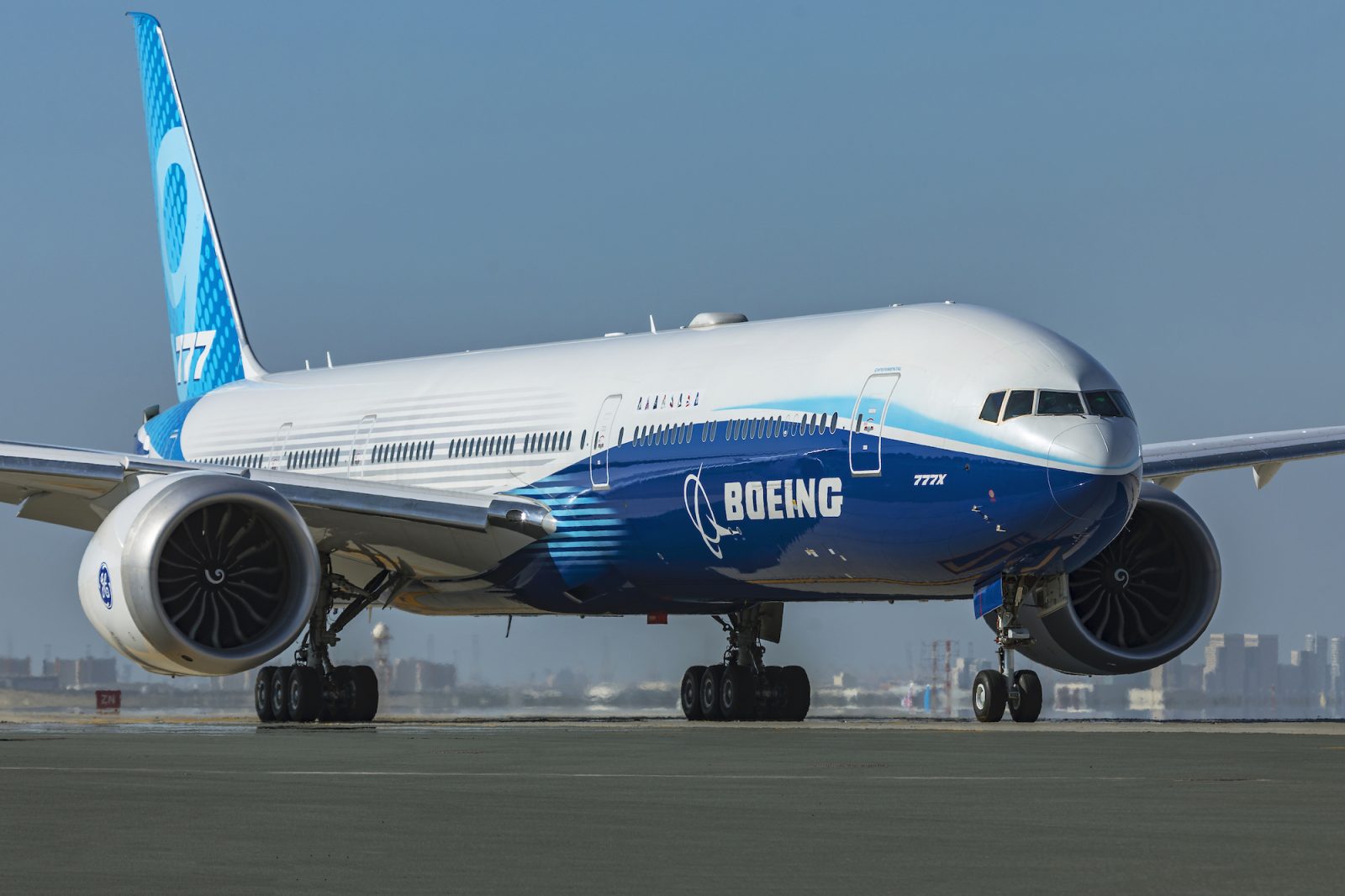
A Boeing 777X at the Dubai Airshow. (Photo: AirlineGeeks | William Derrickson)
The Dubai Airshow this week is bringing the aviation community back together in a way not seen since before the Covid-19 pandemic took hold of the world in early 2020. Industry leaders in aircraft manufacturing, airline and aircraft servicers, commercial airlines, and business aviation companies are all making appearances as look to show new products, court customers, and reintroduce themselves to the world after an almost 20-month hiatus.
Day 1: Sunday, Nov. 14
Sunday was relatively light on news as, after much anticipation and fanfare, the airshow got underway. The big exception, however, was Airbus, which announced it had inked a massive deal with Indigo Partners, an American private equity firm that has its hands in hundreds of markets worldwide through its portfolio of airlines.
The company — which controls Denver-based Frontier Airlines and Chilean low-cost carrier JetSmart and also is a partial owner of European low-cost carrier Wizz Air and Mexico’s Volaris — said it would acquire 255 Airbus A321neo aircraft for its airlines.
According to a joint release, Frontier will see 91 Airbus A321neos added to its fleet. Wizz Air will receive 75 A321neos and 27 A321XLRs, Airbus’s abbreviation for “extra-long range.” JetSmart will take delivery of 21 A321neos and two A321XLRs, and Volaris will add 39 A321neos.
The first day of the airshow also put Emirati airlines in the spotlight, as flag carriers Emirates and Etihad brought aircraft adorned in special liveries for flybys and static demonstrations, alike.
FlyDubai, a subsidiary of Emirates, and Sharjah, United Arab Emirates-based Air Arabia also made appearances with aircraft from their fleets, exclusively comprised of narrow-body aircraft.
Finally, Boeing’s 777X performed a flying demonstration over Al Maktoum International Airport, better known as Dubai World Central. Boeing is hoping to see more success with the aircraft this week even as the program has seen delays in recent weeks.
The manufacturer did manage to seal an order on the airshow’s first day, announcing in the afternoon that Icelease, an Icelandic aircraft lessor, had placed a firm order for 11 Boeing 737-800 Boeing Converted Freighters (BCF), passenger aircraft that have been converted for cargo operations.
Along with that announcement, Boeing said it would open a conversion line for the aircraft at Gatwick Airport in the U.K., setting Icelease as the launch customer for the new line.
Aircraft also began to roll in both for static displays and in anticipation of showcases moving into the rest of the week.
Dubai Airshow in Photos
Day 2: Monday, Nov. 15
Monday began with Boeing’s second aircraft order of the week, also in the category, as the American behemoth announced German shipping company DHL would take on nine more Boeing 767-300BCFs in the coming years. The company already owns seven of the type.
Also in the freighter category, Boeing said hometown carrier Emirates would order two additional Boeing 777F aircraft.
An Emirates Boeing 777F departing Los Angeles. (Photo: AirlineGeeks | William Derrickson)
Despite those two victories for Boeing, Airbus seemed to have won the day again, as the Toulouse, France-based manufacturer announced another massive order, this time with American aircraft lessor Air Lease Corporation (ALC).
ALC’s order ran the gamut of Airbus aircraft, with the company saying it would add 25 Airbus A220-300s, 55 A321neos, 20 A321XLRs, four Airbus A330neos and seven Airbus A350 freighters to its fleet. ALC Executive Chairman Steven Udvar-Hazy said the deal was reflective of the anticipated recovery of the industry in the years ahead.
“ALC was the launch customer for the very popular A321LR and XLR versions,” Udvar-Hazy said in a statement. “Now, we become the launch lessor for the A350F and by far the largest lessor customer for the A220. We had the vision to be first adopters of the A321 and are convinced we have made the right choice again on the A220 and A350F, responding to what we see the market will need in the period of recovery ahead.”
Airbus Chief Executive Officer Guillaume Faury said at the show that the A350F has the potential to become the first aircraft to be flown by a single pilot in the years ahead.
Abu Dhabi, United Arab Emirates-based carrier Etihad Airways also showed off a new business class product as other airlines and manufacturers from around the world showed off their aircraft, interiors and new offerings.
All photos by AirlineGeeks photographer William Derrickson.
Parker joined AirlineGeeks as a writer and photographer in 2016, combining his longtime love for aviation with a newfound passion for journalism. Since then, he’s worked as a Senior Writer before becoming Editor-in-Chief of the site in 2020. Originally from Dallas and an American frequent flyer, he left behind the city’s rich aviation history to attend college in North Carolina, where he’s studying economics.
On board my 737-700 in Cordova, Alaska (Photo: AirlineGeeks | Joey Gerardi)
The Alaska Airlines Milk Run: A must on any avgeek’s bucket list.
The route consists of many different variations from the same nine cities. My previous day had me on flight AS65 in a total of five different cities within six hours: Seattle, Wash. in addition to Ketchikan, Wrangell, Petersburg and Juneau, Alaska, the trip report for which can be found here. From Juneau, the aircraft and flight AS65 continued onto Anchorage without me.
On this second day, I would take flight AS61, which would have me in four cities all of which are located within the state of Alaska: Juneau, Yakutat, Cordova and finally Anchorage. My aircraft and the flight number began the day in Seattle and flew nonstop to Juneau, where it then picked me up and brought me to two small communities on its way up to its final destination of Anchorage.
The Day of the Flight
After a very restful night in Juneau and some plane spotting, it was time to head back to the airport for my flight. The flight had a scheduled departure time of 10:45 a.m. local time, although not knowing how busy it would be, I arrived 2 hours prior, which turned out to be way too early.
The Juneau International Airport (Photo: AirlineGeeks | Joey Gerardi)
I arrived in a virtually empty terminal and check-in area and opted to use one of the kiosks to check in for my flight. Just like the previous day, it had my final destination, Anchorage, as my final destination and the stopover cities in much smaller print underneath it.
My boarding pass for the second and final day of the Milk Run (photo: AirlineGeeks | Joey Gerardi)
I saw a couple of people at the ticket counters with multiple huge boxes and other assorted items and wondered how people afford to fly items this large in and out of these smaller communities so often. It turns out that Alaska Airlines offers a special club that is part of the Alaska Airlines Mileage Program, its called “Club49” because Alaska is the 49th state.
Alaska Airlines “Club 49” banner on the carrier’s website (Photo: Alaska Airlines)
This special program is only available to residents of Alaska and offers special benefits that are very useful to the residents of the state who use the flights to get much-needed supplies back home and who also use the flights to get around the state. Every member gets two completely free checked bags when traveling to/from or within Alaska, 30% off one-way travel within the state, and also $49 cargo shipping within the state of Alaska. There are many other benefits to the program, but you’d have to live in Alaska to learn about them.
I then proceeded up through security which even offered a TSA-PreCheck line, and although I was almost the only passenger in line it helped not taking out all of my camera gear. The security experience was a lot different than at Seattle-Tacoma the day before.
The security line at Juneau (Photo: AirlineGeeks | Joey Gerardi)
Once through security, I entered a very empty gate area, and as it turns out this was the first departure of the day out of Juneau for Alaska Airlines. As a matter of fact, it was the only departure in the morning at all, as the next departure wouldn’t be until 2:00 p.m. that afternoon.
Same as in Seattle, the boarding screen at the gate showed the destination as well as the cities the flight number would continue onto.
My gate at the Juneau Airport (Photo: AirlineGeeks | Joey Gerardi)
At this point I had a lot of time to relax before the flight, but as more passengers started to come into the gate area most recognized each other and started talking and laughing together. This flight is how people come into the larger cities to get supplies and items not available in the small cities they live in.
I had a very nice conversation with a group of passengers about their experiences living along the Milk Run, and even non-aviation industry folks that lived in the cities referred to the routes as “The 62 Milk Run” or “The 65 Milk Run” and so on. Most of the people living in the cities have even memorized all the Milk Run routes and to which flight numbers they belong. I talked with them about how they have shipped furniture, chicken feed, groceries, housing materials, and other items on this flight. And also the fact that a lot of the people from these communities make the trip on a nearly monthly basis.
The view out of the terminal window (Photo: AirlineGeeks | Joey Gerardi)
One of the couples I met even run a surfing shop in Yakutat called “Icy Waves” which was featured on CBS many years ago and now hosts surfers from around the world. It was very interesting listening to them talk about how locals essentially plan their daily lives around this flight, from something as simple as when the mail might arrive to more complicated tasks like making a flight to have medical procedures done in the larger hub cities. I even met someone who was traveling from Sitka, Alaska to Kodiak, Alaska to see a family member they haven’t seen since Covid began, but because of the nature of the route, they had to make five flights to get there.
Just as the stories started to get more interesting, the aircraft landed and the sound of thrust reversers echoed around the mountains surrounding the airport. The aircraft for today’s journey would be N622AS, another one of Alaska Airlines Boeing 737-700’s.
My aircraft arriving in Juneau, N622AS (Photo: AirlineGeeks | Joey Gerardi)
The aircraft pulled into the gate and the passengers got off as normal. As we got ready to board the gate agents informed us that there would be no service for any of the three flights of the journey up to Anchorage. Boarding began with the normal pre-boarding for people requiring extra time, followed by an announcement of “Boarding Group A”, after nobody made a move to the gate they then announced, “If anyone wants to go to Yakutat your welcome to come aboard”.
Our aircraft at the gate in Juneau (Photo: AirlineGeeks | Joey Gerardi)
I enjoyed the casual nature of these flights, and some of the passengers even recognized the gate agents and began having conversations with them. Everyone knows someone along these types of flights, they give off such a welcoming and bright atmosphere despite not being able to see facial expressions.
Just like the previous day, I took my seat in seat 10F, and by this time it had begun raining which is a common occurrence in the mornings according to the Juneau locals.
Seated in 10F for my flight to Yakutat (Photo: AirlineGeeks | Joey Gerardi)
For this first flight to Yakutat, there are only a mere 37 passengers, but I was told that the flights do become full during the height of the Alaskan fishing season. For this flight, I did have a seatmate on the aisle but we were allowed to spread out once everyone had boarded and they chose to sit elsewhere.
The process from gate to takeoff was the same as every other Alaska Airlines flight, safety demonstration proceeded by a short taxi to the runway. Being the only aircraft moving on the airfield we were immediately cleared for takeoff, and following a short takeoff roll, we rocketed into the skies for our rather short flight to Yakutat.
Just after takeoff from Juneau, Alaska (Photo: AirlineGeeks | Joey Gerardi)
Today is another example of had the weather been clear, the views would have been stunning as we fly along the Alaska Gulf Coastline for this entire day. But for this trip, a thick cloud layer covered the skies and that was all passengers were able to see.
At cruise altitude en route to Yakutat (Photo: AirlineGeeks | Joey Gerardi)
Once we got up to cruising altitude, I went to the forward cabin to inquire to the flight attendants about getting some pictures on the ramp at each of the stops and was responded to with an immediate, “Absolutely not,” and told me that if I stepped one foot outside the plane I wouldn’t be allowed back on. I did tell them about what had happened the previous day, but the answer was still no. This is one of the examples of me not getting so lucky with the flight crew. Technically speaking we aren’t allowed on the ramp anyways, but there is no harm in asking.
We then began descending into Yakutat and the rest of the flight was normal, flight attendants went around to collect garbage and they took their seats for landing. Due to the clouds in the area, I couldn’t see anything until we had almost reached the ground.
My first sight of the ground going into Yakutat (Photo: AirlineGeeks | Joey Gerardi)
Yakutat was another Essential Air Service, or EAS, community and just like the other two EAS cities the previous day I wouldn’t have any cellular service here either. It was interesting being so connected to the world on the airplane, yet so disconnected with no contact with the outside world on my phone.
The landing was smooth after the short 41-minute flight, and we backtracked on the runway to the terminal building. As we pulled into Yakutat I could already see an entire forklift of fish from the Yakutat Seafood company ready to be loaded onto the aircraft.
Food from the Yakutat Seafood Company ready to be loaded onto our aircraft (Photo: AirlineGeeks | Joey Gerardi)
After pulling into the gate the passengers disembarking got up and walked off the plane, and with them, I saw multiple individuals carrying fishing poles. I was told that even during the off-season, at least one person is carrying a fishing pole off the plane in Yakutat.
Once everyone had gotten off I headed up to the front of the aircraft to inquire if I may be able to get off, despite the “no” from the flight attendant, I figured there would be no harm in asking one of the ramp crew. After flagging one of them down and talking to them, they said I couldn’t get off but I could go as far as the top of the mobile airstairs, it wasn’t far but it was better than nothing.
The ‘terminal’ building in Yakutat (Photo: AirlineGeeks | Joey Gerardi)
Just like in Petersburg and Wrangell the previous day, Alaska Airlines owns this terminal building versus renting space from the airport. The building was also at least twice the size of the buildings the previous day, but still on the small side, and they also had a blue appearance instead of white and green like in Wrangell and Petersburg. After getting a few pictures I was ushered back inside by the flight attendant and I headed to the back galley to talk with those flight attendants.
My aircraft in Yakutat during the layover (Photo: AirlineGeeks | Joey Gerardi)
After a very nice conversation with the aft galley flight attendants, it was time to head to my seat for the flight onto Cordova as all the passengers had already boarded. For this second flight up to Cordova, there would only be 33-passengers on board. Safety demonstration, engine start, and quick taxi to the runway for the second to last flight of my trip.
A very gloomy and grey day in Yakutat, Alaska (Photo: AirlineGeeks | Joey Gerardi)
By this time, more clouds had begun to roll in and it had started raining again. I can’t emphasize this enough — do the trip during the summer months, and your weather is a lot more likely to be clear skies. Once again with so few people on this 737-700, we quickly took into the skies for this leg of the trip quickly making it up to our cruising altitude of 30,000 feet.
Taking off into the cloudy skies over Yakutat (Photo: AirlineGeeks | Joey Gerardi)
The ground below was completely covered by clouds at cruising altitude, but along the route, the tallest mountains did pop out which was certainly nice to see, especially with nothing else but clouds around.
The tallest of the mountains popping out of the clouds (Photo: AirlineGeeks | Joey Gerardi)
As we approached Cordova, the clouds began to disperse, which was exciting as this did happen the previous way in Wrangell and led to some stunning photographs. The ground quickly came into view, and I could see snow still covering the ground below us, also coming into view was the Copper River Highway, which is the single road that runs through Cordova connecting the people of these communities. Despite the word “highway” in the name, the road doesn’t lead to the outside world, connect to the main road system of Alaska, or is even paved as most of the road is dirt or rocks.
The Copper River Highway crossing the rivers below us (Photo: AirlineGeeks | Joey Gerardi)
There is even a section of this road that was washed out by erosion back in 2018, was never fixed and has plans to remain closed indefinitely as there are little to no plans to have it fixed. The highway isn’t even plowed or maintained past mile point 13 in the winter and snowy months, meaning people living beyond that could be stranded for months at a time if they don’t prepare properly.
It is eye-opening seeing how people in these small communities live and how something as basic as road plowing is sometimes overlooked if there isn’t enough need for it. As we got closer the clouds didn’t completely clear, but enough so that I was able to see some scenery.
Mountains and a glacier in the distance as we approach Cordova (Photo: AirlineGeeks | Joey Gerardi)
Despite the low cloud layer, it was still cool seeing glaciers and the mountains, I can only imagine the views one might have seen on a completely clear day. Once we landed in Cordova we turned around in the middle of the runway, just like at every stop, and we backtracked to the terminal.
turning around on the runway in Cordova (Photo: AirlineGeeks | Joey Gerardi)
Once parked, I noticed that Cordova was almost identical to Yakutat — same blue terminal building and no cell service. Alaska Airlines owns the building, and Cordova is also an EAS city. The only difference from an airport standpoint was that the words Cordova were on the building.
The blue terminal building in Cordova (Photo: AirlineGeeks | Joey Gerardi)
Same as in Yakutat, in Cordova I stood on the top step of the stairs, which is better than nothing. From what I could see, the scenery was very similar between Yakutat and Cordova, although there was more cloud cover in Yakutat so it is hard to know for sure.
After a nice chat with the flight attendants, I headed back to my seat for the final time on this journey. Instead of seafood like in Yakutat, here in Cordova, I saw roughly eight to 10 animals crates with what looked like huskies in them get loaded onto the aircraft.
A Huskie being loaded onto our aircraft in Cordova (Photo: AirlineGeeks | Joey Gerardi)
For this final leg of the journey up to Anchorage, there would be 48 passengers. By this time, the rain had finally stopped and we started our engines for the final leg to Alaska’s biggest city. It was a quick taxi out to the runway, as we took off I could see the river and single road into town getting smaller and smaller before it finally disappeared.
Taking off out of Cordova, Alaska for my final flight to Anchorage (Photo: AirlineGeeks | Joey Gerardi)
We proceeded to climb to cruising altitude, and the flight went on as normal minus the in-flight service as the flight would end up being just under 40-minutes. The clouds were again covering the sky for most of the flight but started to clear once we approached Anchorage.
Clouds en route to Anchorage on my final leg (Photo: AirlineGeeks | Joey Gerardi)
As we grew closer to Anchorage I began thinking about how my trip went. Despite the cloudy weather at most of the stops, it was a fun and exciting trip, of course, clearer weather would’ve been better but it was still a great trip nonetheless and I plan on making it again someday but during the summer months. I talked with a lot of nice and interesting people from the crew members of the flights to the people living in the communities, although I will never know exactly what it feels like living here, it was interesting getting a glimpse into their daily lives living along the Milk Run and how vital it is to the survival of the communities.
After coming out of the clouds I could see the airport off to the right side of the aircraft, we continued past it and made a right turn to approach from the west, and landed at Alaska’s largest airport of Anchorage.
Flying past Anchorage Intl. Airport (Photo: AirlineGeeks | Joey Gerardi)
After landing we taxied to Gate C1 and the engines shut off for the final time on my whirlwind trip along the Alaskan Southeast and Gulf Coast. After getting off the aircraft I noticed a sign for an observation area, I followed the sign and received a wonderful above view of the aircraft I had just gotten off and watched all of the cargo get offloaded for destinations around the country as well as within the state of Alaska.
My aircraft in Anchorage getting the Milk Run cargo off-loaded (Photo: AirlineGeeks | Joey Gerardi)
While us AvGeeks ride on the Milk Run for enjoyment and adventure, this route is just a fact of life for the people living in these small communities and doesn’t feel any more special to them than a city bus does to us.
To see a video account of the northern section of the Milk Run, the trip report can be found below.
Joey has always been interested in planes for as long as he can remember. He grew up in Central New York during the early 2000s when US Airways Express turboprops ruled the skies. Being from a non-aviation family made it harder for him to be around planes and would only spend about three hours a month at the airport. He was so excited when he could drive by himself, the first thing he did with his driver's license was get ice cream and go plane spotting for the entire day. He graduated from Western Michigan University in 2022 with a B.S. in Aviation Management & Operations and a Minor in Business, and currently works for a major airline in his hometown.
A LATAM 767 on short final in Miami.
(Photo: AirlineGeeks | William Derrickson)
LATAM Airlines Group’s operational passenger projection for November 2021 is estimated to reach 62% compared to the same month in 2019, as measured in available seat kilometers.
According to a press release, for this month, solid results from October have been maintained in the countries where the group operates, with significant increases in the estimate of the general supply in Brazil, Colombia and Peru.
LATAM plans to operate approximately 1,091 daily domestic and international flights during November, connecting 125 destinations in 16 countries. The cargo business has 1,100 flights scheduled on cargo planes with a level of utilization 19% higher on average than the same period in 2019.
All these projections are subject to the evolution of the pandemic as well as to travel restrictions in the countries where LATAM operates.
During Oct. 2021, passenger traffic (measured in Rented Passenger Kilometers – RPK) was 55.6% in relation to the same period of 2019, based on an operation measured in ASK of 57, 5% compared to Oct. 2019. This implied that the load factor decreased 2.7%, reaching 79.8%.
In cargo operations, the load factor was 60.7%, which corresponds to an increase of 6.1% in relation to Oct. 2019.
Country
Operation projected
Domestic Operations
International Operations
Notes
Brazil
64%
89% (47 destinations – 541 daily flights)
32% (16 destinations)
São Paulo/Guarulhos – Barcelona route resumption
Chile
56%
83% (16 destinations – 152 daily flights)
41% (20 destinations)
Santiago – Córdoba, Santiago Buenos Aires/Aeroparque, Santiago – Rio de Janeiro/Galeão routes resumption
Colombia
88%
119% (16 destinations – 145 daily flights)
47% (4 destinations)
Bogotá – Yopal domestic new route
Peru
62%
83% (19 destinations – 160 daily flights)
54% (19 destinations)
Lima – Córdoba route resumption
Ecuador
34%
109% (7 destinations – 32 daily flights)
13% (2 destinations)
Cargo
84%
75% lower deck transportation
52% lower deck transportation
122% freighter operations
LATAM Increases Revenues and Expects Recovery
Within the framework of the delivery of the results of the third quarter of the year, LATAM Airlines Group reported that it has registered a continuous improvement in its income during the period, reaching $1.3 billion, which represents an increase of 47.8% compared to second quarter of 2021 and 156.1% compared to 2020.
Despite this better performance, the group’s revenues for the third quarter are 50.7% below 2019 because of the effects of the still ongoing pandemic.
For its part, LATAM Cargo’s revenues registered an increase of 43.6% compared to 2019, reaching $361.4 million.
LATAM Airlines Group showed significant progress in its operation in the third quarter, reaching 49.7% of the 2019 levels (measured in available seat kilometers ASK), driven by a strong recovery in its domestic operations, and a 75% inquartcrease in capacity compared to the second quarter of 2021.
The group expects to close the year operating on 65% of consolidated capacity (measured in ASK) versus 2019 levels.
Total costs reached up to $1.8 billion at the end of the period, representing a 25.2% drop compared to the third quarter of 2019.
The unit cost (cost per ASK without considering the fuel variable) decreased 18.3% versus the second quarter of this year, despite higher maintenance costs and a slower recovery of the international operation.
The above result reflects the efficiencies achieved by the group in recent months, which will translate into savings of more than $900 million per year.
Operating income recorded losses of $479.2 million in the third quarter of the year, while the net loss was $691.9 million, impacted by the effects of maintenance costs, restructuring expenses and other non-recurring expenses.
The three things Juan Pedro loves most about aviation are aircraft, airports, and traveling thousands of miles in just a few hours. What he enjoys the most about aviation is that it is easier and cheaper to travel around the world and this gives you the opportunity to visit places you thought were too far away. He has traveled to different destinations in North, Central, South America and Asia. Born, raised and still living in Perú, Juan is a lawyer, soccer lover, foodie, passionate traveler, dog lover, millennial and curious by nature.
Cash-Strapped AirAsia Still Needs to Support Affiliates
AirAsia Group has announced a planned financial restructuring of its Thai businesses, which would include a capital infusion and a reorganization of its 45%-owned Thai AirAsia Co Ltd’s holdings (TAA). The move is hardly surprising, given AirAsia had previously said that its affiliates will seek financial assistance from the nations in which they operate.
In a nutshell, the Thai reorganization aims to generate 6.3 billion baht ($190 million) in new capital, out of a total of 14 billion baht declared. TAA’s effective stake in AirAsia will be reduced from 45% to 40.7%. As of now, subsidiaries in Thailand, Malaysia and India are all undergoing some type of reform. Indonesia AirAsia and AirAsia Philippines could be next in line.
This also begs the question of how much cash AirAsia will require when each of these affiliates goes through their recapitalization and restructuring processes. Analysts believe that the scenario for Indonesia AirAsia and AirAsia Philippines is more difficult. Thailand is a larger, more profitable market, whereas India possessed the necessary resources.
“While [its largest shareholder] Tata Group supports AirAsia India, nobody supports the Philippines and Indonesia except Malaysia (AirAsia Group),” one analyst told Mint.
The Nitty Gritty of the Restructuring Plan
Asia Aviation PCL (AAV), a Thai-listed company, is infusing 3.9 billion baht into TAA through a bank loan as part of the reorganization. For the increased funds injected into the airline, AAV will be granted new shares. TAA will settle 3.9 billion baht in obligations to AirAsia, which will sell its whole remaining ownership in TAA to AAV for 3.8 billion baht, thereby creating TAA a wholly-owned subsidiary of AAV.
AirAsia will then subscribe to AAV’s planned private placement and rights issue, with a 9.5 billion baht stake, giving AAV a 40.7% stake in AirAsia. The reorganization will assist in raising the required funds for TAA’s working capital as well as to revive operations “in a market heavily tourism-dependent and gradually reopening to tourists,” a statement from the group laid out.
It did, however, point out that AirAsia’s involvement in AAV’s private placement exercise would result in TAA’s unrecognized losses crystallizing immediately, “knocking out 20 cents from AirAsia’s net profits and net asset per share,” according to the release. If AirAsia uses all of the revenues from TAA for the fundraising, AirAsia’s share of the new capital infusion into the Thailand company comes to 181.06 million rupiah. Thai AirAsia and Thai AirAsia X were both reported to be among seven airlines requesting 5 billion baht in soft loans from the Thai government.
The Thai operation now has 57 aircraft, 13 of which are in service, according to planespotters.net. In comparison, AirAsia owns a 40% share in AirAsia Philippines (PAA), which operates a fleet of 24 planes, five of which are operational. AirAsia also owns a little more than 49% of PT AirAsia Indonesia TBK (AAID), which operates 25 planes, six of which are operational.
AirAsia has discussed raising up to 2.5 billion rupiah via cash calls and loans in the last year in order to withstand the epidemic. According to one expert, the funds would be used mostly to sustain the Malaysian business, which operated 98 planes at the end of June.
“Restart prices are significant, and gasoline expenses are also considerable,” the analyst said. “They may need RM2.5 billion to restart, but every other plane added to the working fleet will add a lot more to the costs.”
Putu Deny Wijaya was always an aviation enthusiast by heart, growing up in Indonesia where air transport is very vital. His first love is The Queen of The Skies, serving the trunk routes between Jakarta and Denpasar. He brought along this passion with him throughout college by conducting his bachelor study abroad in the Netherlands for the purpose of experiencing a nonstop 14-hour long-haul flight. For Putu the sky's the limit when talking about aviation. He hopes that he would be able to combine his passion for aviation and knowledge of finance at the same time.
Belavia Clamps Down on Yemeni, Syrian, Iraqi Passengers After Threats From EU
A Belavia Boeing 737-800 (Photo: Nikolaiko27 via Wikicommons)
Coming off a summer of heavy sanctions, Belarusian flag carrier Belavia is back under the European Union’s microscope after noting that the airline is allowing passengers from war-ravaged areas of the Middle East to travel on its aircraft and escalating a dangerous situation on the Polish border.
The consistent flight of these migrants has created a humanitarian crisis at the border of Belarus and Poland as Poland and the European Union have blocked these voyages from crossing into Polish territory. European Union nations and the United Kingdom have sent troops to the border to prevent people from scaling the fence and crossing illegally into the country. Belarus has noted that this could lead to an escalated military conflict but has also noted that it has offered 10 tons worth of humanitarian aid to those stranded at the border.
However, the pressure from the European Union has grown to a full-blown attempt to stop the influx of migrants into Belarus. This pressure has extended to leasing companies, most notably Irish leasing companies being asked to review how their aircraft are being used in Belavia.
Given this large amount of pressure, Belavia and the Turkish government both caved and blocked Iraqi, Syrian and Yemeni from traveling between the nations of Turkey and Belarus.
On the airline’s website, the airline noted, “According to the decision of the competent authorities of Turkey please note that starting from 12th November 2021 the citizens of Iraq, Syria, Yemen will be denied boarding the flights from Turkey to Belarus. Belavia passengers, affected by this restriction, can make a full refund without penalty at the place of tickets issuance.”
Belavia has already been banned from flying to European Union nations since May, following the events of Ryanair Flight 4978 and the political discourse after Belarusian activist Roman Protasevich was arrested upon landing. The airline parked some of its aircraft as a result of the cut route map, awaiting future news that they could return to its western destinations.
Belavia’s current route map sits at 22 destinations to 11 different nations. Only one of these routes is currently to the hybrid European-Asian nation of Turkey, with flights to Istanbul being the lone destination. The airline has a fleet mixed between 14 Boeing 737 models and 15 Embraer E-Jets.
Turkey, on the other hand, has denied wrongdoing and pointed the flaws at the Belarusian operator and nation for welcoming these passengers on board. They noted that Turkey has not seen the same traveling clientele that Belavia does and that the foreign airlines are to blame for the humanitarian issue between Poland and Belarus.
Although Ian McMurtry was never originally an avgeek, he did enjoy watching US Airways aircraft across western Pennsylvania in the early 2000s. He lived along the Pennsylvania Railroad and took a liking to trains but a change of scenery in the mid-2000s saw him shift more of an interest into aviation. He would eventually express this passion by taking flying lessons in mid-Missouri and joining AirlineGeeks in 2013. Now living in Wichita, Kansas, Ian is in college majoring in aerospace engineering and minoring in business administration at Wichita State University.
An Aeromexico Boeing 787 Dreamliner flares for landing. (Photo: AirlineGeeks | William Derrickson)
A CEIV trade lane is a general classification of any transport-related activities between two defined countries.
CEIV Pharma ensures that facilities, equipment, operations, and staff comply with all applicable standards, regulations and guidelines expected from pharmaceutical manufacturers.
According to a press release, Aeroméxico announced its recently joined the select group of companies that have the CEIV Pharma certification (Center of Excellence for Independent Validators in Pharmaceutical Logistics), awarded by the International Air Transport Association (IATA).
This certificate is the result of the procedures, infrastructure, equipment, operations, and qualified personnel, which guarantees compliance with the highest standards for the transport of products temperature-controlled pharmaceuticals.
To obtain the CEIV Pharma Certification, Aeroméxico went under a demanding documentary and on-site audit, in aircraft, warehouses and platform, among other aspects, to verify adherence to the requirements defined by the IATA and the pharmaceutical industry.
“The COVID-19 pandemic brought us many lessons and I can proudly say that Aeroméxico’s infrastructure and talent, allowed us to respond in a very prominent way to the demand in the transfer of vaccines and medical supplies in Mexico and in more than 15 countries on 3 continents”, declared Alñejandro Méndez González, Aeroméxico Cargo’s Senior Vice President.
“The certification is a symbol of the guarantee that each medicine and product that saves lives, is handled, transported and delivered in optimal conditions”, he finished.
Thanks to this certification, the Mexican carrier will increase its connectivity in the transport of pharmaceutical products, highlighting 10 international hubs from Asia, Europe, and South America:
• Asia: South Korea and Japan.
• Europe: Spain, Netherlands, France, and England.
• South America: Argentina, Brazil, Chile, and Colombia.
Since the COVID-19 pandemic began, Aeromexico has carried out nearly 400 charter flights to 15 countries, transporting almost 7 thousand tons of health supplies, and more than 80 tons of active substance for the manufacture of COVID-19 vaccines.
Pharmaceutical Cargo Transportation
The pharmaceutical industry relies on air transport for its speed, reliability, and efficiency in delivering high-value, time-sensitive, temperature-controlled cargo. Air carriers, freight forwarders, ground handlers and airports provide quality services, but there are still many challenges.
Pharmaceutical cargo transportation represents an important and lucrative sector for air cargo, contributing approximately $1.4 billion to total airline cargo revenue.
It is important to mention, that this data does not include the dramatic shifts that have (or will continue) occur due to the impact of COVID-19.
Assuming global COVID-19 vaccine coverage of 10 billion doses, it is expected vaccine distribution will require around 200,000 movements by pallet on 15,000 flights.
Given the current infrastructure, the feasibility to distribute COVID-19 vaccines within destination countries will greatly vary depending on the level of cold storage required.
Due to this pandemic, the pharmaceutical transport by air has shown stronger growth than the regular air cargo market.
The three things Juan Pedro loves most about aviation are aircraft, airports, and traveling thousands of miles in just a few hours. What he enjoys the most about aviation is that it is easier and cheaper to travel around the world and this gives you the opportunity to visit places you thought were too far away. He has traveled to different destinations in North, Central, South America and Asia. Born, raised and still living in Perú, Juan is a lawyer, soccer lover, foodie, passionate traveler, dog lover, millennial and curious by nature.
Japanese Low-Cost Carrier ZIPAIR Launches Flights to Los Angeles
A ZIPAIR Tokyo Boeing 787-8 Dreamliner. (Photo: ZIPAIR Tokyo)
One of Japan’s newest low-cost carriers, ZIPAIR, announced its first flight to the United States, Los Angeles. The subsidiary carrier for Japan Airlines will grow to a total of five destinations, operating three-weekly flights from Tokyo Narita on its Boeing 787-8 Dreamliner.
New West Coast Flights
Its’ flights will depart as ZIPAIR Flight 24 from Tokyo’s Narita Airport at 2:45 P.M. and arrive in Los Angeles at 7:40 A.M. On the return flight, ZIPAIR Flight 23 departs Los Angeles at 9:40 A.M. and arrives in Tokyo-Narita at 2:25 P.M. the next day. Due to the start of daylight savings time in March, the flight into Los Angeles arrives at 8:40 A.M. and departs at 10:40 A.M.
These flights are scheduled through March 26, 2022, with the possibility of increased frequencies on the Tokyo Narita to Los Angeles or the opening of new transpacific routes to the West Coast afterward, per Kyodo Japan.
On Tuesdays, Thursdays and Saturdays, ZIPAIR will fly its Boeing 787-8 Dreamliner from Tokyo-Narita to Los Angeles. Its’ cabin features 290 seats, including 18 business class reverse herringbone seats in a 1-2-1 configuration and 272 economy seats in a 3-3-3 configuration. In addition, the airline offers complimentary WiFi, but no in-flight entertainment system.
On the flight, ZIPAIR will utilize the VeriFLY Digital Health Passport app to process COVID-19 vaccination information, similarly to its parent company Japan Airlines’ U.S. to Japan services.
In a statement, Shingo Nishida, President of ZIPAIR Tokyo, said: “Ever since the introduction of ZIPAIR, one of our key goals was to establish a flight across the Pacific and I could not be prouder to stand here today to announce the launch of our Los Angeles route. Our mission is to define a new standard in the air travel industry by offering a unique low-cost business model on long-haul international routes. ZIPAIR features a NEW BASIC travel experience by offering personalized services during the flight, which will essentially shorten the sense of time. We are eager to welcome travelers in the U.S. to personally experience this truly new concept in air travel.”
ZIPAIR will provide the only long-haul low-cost carrier option from Los Angeles to Japan. For example, on the flight from Tokyo-Narita to Los Angeles, ZIPAIR will face competition from its parent company Japan Airlines, All Nippon Airways – ANA, Singapore Airlines and United Airlines. All carriers except United Airlines operate a Boeing 777-300ER on the route; United Airlines operates a Boeing 787-9 Dreamliner.
What Is ZIPAIR?
The move marks ZIPAIR’s second destination in the United States and the Tokyo-based airline’s fifth destination. The low-cost carrier launched its first flights to Honolulu in December 2020 once a week, now operating up to five weekly flights this winter. In addition to Honolulu, ZIPAIR operates flights to Bangkok, Singapore and Seoul.
To operate to these destinations, ZIPAIR leases two Boeing 787-8 Dreamliners from its parent Japan Airlines and is currently in the process of adding a third to its fleet. By 2024, the carrier plans to have 10 Boeing 787s.
ZIPAIR was launched in 2018 as Japan Airlines’ attempt at a low-cost long-haul subsidiary to defend against low-cost carriers like AirAsiaX launching new long-haul services from Japan. At the time, AirAsiaX operated a flight from Osaka, Japan to Honolulu, Hawaii using its A330-300. Initially, the Tokyo-based low-cost carrier aimed to launch services in the middle of 2020 to Bangkok and Seoul, but these plans were delayed due to the COVID-19 pandemic. Instead, ZIPAIR operated cargo flights to both destinations from April 2020 until October 2020, when the low-cost carrier launched its first passenger flights to Seoul.
ZIPAIR is not Japan Airlines’ only low-cost venture as it seeks to turn Tokyo-Narita into its’ premier low-cost hub. In April 2021, Japan Airlines acquired a majority stake in Spring Airlines Japan – the Japanese subsidiary of Chinese low-cost carrier Spring Airlines – to expand its low-cost network from Tokyo-Narita to China. The subsidiary of Japan Airlines is eyeing pent-up traffic between China and Japan at the end of the pandemic and potential expansion.
Additionally, Japan Airlines owns Jetstar Japan, which primarily focuses on domestic low-cost operations. With all three of these carriers, Japan Airlines hopes to utilize ZIPAIR to “grow by attracting new customers that JAL, the conventional full-service carrier, has not been able to reach.”
Ever since Winston was a toddler, he has always had a fascination for airplanes. From watching widebodies land at Washington Dulles to traveling the world, Winston has always had his eyes towards the skies. Winston began aviation photography in 2018 and now posts his photos occasionally on his Instagram account. He previously wrote for a blog. In his free time, Winston loves to play chess, do recreational activities, and watch sports. Looking into the future, Winston plans to service the aviation industry.
Scoot Expands Europe Network to London, Singapore Airlines Group on Path to Recovery
A Scoot 787 Dreamliner out for delivery at Paine Field.
(Photo: AirlineGeeks | Katie Bailey)
Just over a month ago when the news of the Vaccinated Travel Lanes was announced, the low-cost subsidiary of Singapore Airlines, Scoot, had increased and resumed quite a fair bit of flight services, with news of its approval to operate VTL flights to South Korea still pending.
It would seem that the wait is over as Scoot will begin operating one-time-weekly non-stop flight services between Singapore and Seoul, South Korea, allowing for passengers to enjoy quarantine-free travel during this holiday season. Scheduled to commence in just a matter of days on November 15, TR840 will depart for Seoul and the returning flight of TR841 will depart for Singapore. The route will utilize the low-cost carrier’s flagship Boeing 787 Dreamliner and will operate only on Mondays.
Bound For London
Scoot is about to progress even further as the low-cost carrier further expands its European network, by announcing a new flight service between Singapore and London’s Gatwick Airport via Bangkok Suvarnabhumi Airport.
Currently, Scoot operates daily flights between Singapore and Bangkok, which means the new service will also complement the existing non-stop services operated between Singapore and London’s Heathrow Airport by Scoot’s bigger sister, Singapore Airlines. Besides being the only low-cost carrier to operate non-stop flights between Bangkok and London, the new service will also mark Scoot’s first-ever entry into the United Kingdom because as of currently, its European network consists of only Germany and Greece.
Flights will commence from December 16 using the Dreamliner and will be followed by a three-times-weekly seasonal scheduled service from March 2022, with a possibility that the frequency could be increased based on demand and regulatory approval. Expressing utmost delight to the new route addition, Mr. Campbell Wilson, Chief Executive Officer of Scoot, said: “The progressive relaxation of international borders presents new opportunities for airlines and travelers alike. With the ability to now travel quarantine-free between the United Kingdom and Thailand, Scoot is excited to introduce the only low-cost option between Bangkok and London offering our unique combination of great value and great experience with a touch of Scootitude.”
He also added that Scoot was very “excited to now introduce the World’s Best Long-Haul Low-Cost Airline to London.”
With the addition of London, the low-cost carrier will serve over 30 destinations in December 2021 as it progressively builds back to its pre-COVID coverage of 68 cities.
Positive Climb
With Singapore Airlines and Scoot taking to the skies more frequently, the Singapore Airlines Group was able to post a remarkable improvement in its latest half-yearly results, indicating improved market conditions. Although the Group still posted a S$427.6 million net loss, it can still be considered a rather positive climb rate from the S$2.34 billion net loss posted the year before.
This was mainly due to an increase in cargo revenue being up to 51 percent when compared to last year’s levels, allowing for the Group to review that monthly operating cashflows were near breakeven levels and that passenger capacity is expected to reach 43 percent of pre-Covid levels by December, serving half of its previous destinations. It would certainly be a strikingly positive contrast when compared to September, whereby passenger capacity had only reached around 32 percent of pre-Covid levels, which on average filled only about 20 percent of the aircraft seats.
And now with the VTL flights gaining more traction for the Group, the likelihood of actual passenger capacity surpassing the expected 43 percent is quite high, especially with the recent addition of Malaysia to the VTL list that is set to start from November 29. Prior to the pandemic, the Singapore-Kuala Lumpur route was considered as one of the world’s busiest international routes, and the suspension of travel between Singapore and Malaysia has definitely caused a massive pent-up in anticipation for many Malaysians working in Singapore, as many are eager to return home to reunite with their families.
Whilst the Group is still seeing red, but it is most likely flying out of this prolonged drought and is headed for a definite recovery.
Fascinated by aircraft from a very young age, Charlotte’s dream was to work alongside the big birds one day. Pursuing her dream, she went on to achieve her diploma in Aviation Management and is currently working on her degree in Aviation Business in Administration with a minor in Air Traffic Management. When she’s not busy with school assignments, you can find her aircraft spotting for long hours at the airport. In Charlotte’s heart, the Queen of the Skies will always be her favorite aircraft.
Sign-up for newsletters & special offers!
Get the latest stories & special offers delivered directly to your inbox