Stories

New Airline Akasa Air Orders 72 Boeing 737 MAX Aircraft

Akasa CEO Vinay Dube and Boeing Commercial Airplanes president and CEO Stan Deal at the signing ceremony in Dubai (Photo: Boeing)

On Nov. 16, India’s Akasa Air made an order for 72 Boeing 737 MAX jets worth over $9 billion at list prices, a transaction that will continue to help the manufacturer reclaim lost ground in one of the world’s most promising markets.

According to the announcement by Boeing, Akasa Air has purchased two variants of the 737 MAX family, the 737-8 and the high-capacity 737-8-200. The Mumbai-based carrier would begin receiving the jets in mid-2022. The Akasa Air directive came months after the Directorate General of Civil Aviation (DGCA) cleared airlines to fly the MAX plane, putting an end to almost two and a half years of regulatory grounding following two tragic crashes in five months that killed 346 people.

Akasa Air, which is owned by billionaire investor Rakesh Jhunjhunwala, dubbed “India’s Warren Buffett,” has joined forces with former chief executives of IndiGo, the country’s largest carrier, and Jet Airways to capitalize on domestic air travel demand, which is approaching pre-pandemic levels as the country recovers from a devastating outbreak earlier this year.

The civil aviation ministry gave the low-cost airline preliminary approval to begin operations in October, and it is anticipated to begin flying next year.

Long Term Engine Deal

Just a day after its purchase with Boeing, the carrrier also struck a deal with CFM International for its LEAP-1B engines, worth approximately $4.5 billion at list price, to power the 737 MAX planes it had recently purchased.

The agreement also includes spare engines and long-term servicing, according to a joint statement from the companies. The LEAP-1B engine entered service on the Boeing 737 MAX in 2017, and the firms said that over 2.5 million engine flight hours have been documented.

Both Views

“We are honored that Akasa Air has placed its trust in the 737 families to drive affordable passenger service in one of the world’s fastest-growing aviation regions,” Stan Deal, president and chief executive officer (CEO) of Boeing Commercial Airplanes, said in a statement.

“We are delighted to partner with Boeing for our first airplane order and thank them for their trust and confidence in Akasa Air’s business plan and leadership team,” Akasa Air CEO Vinay Dube said at the Dubai airshow, where the order was announced. He believes that the company is witnessing a strong recovery in air travel, and sees decades of growth ahead of them.

Boeing dominates India’s wide-body market, which has 51 planes, but ticket wars and high costs have resulted in casualties among full-service carriers, like Kingfisher Airlines in 2012 and Jet Airways in 2019, allowing low-cost carriers and Airbus to become even more prominent.

Boeing’s proportion of India’s 570 narrow-body planes plummeted to 18 percent from 35 percent following Jet’s demise in 2018, according to consultant CAPA India. SpiceJet is the country’s sole customer for the MAX jets at the moment. Thus, Akasa’s entry into the market with MAX planes is unquestionably a significant triumph for Boeing.

According to a statement issued by Akasa Air, the airline intends to begin offering flights across India in the summer of 2022, with the goal of being “the nation’s most trustworthy, cheapest, and greenest airline.”

Kalai Raajan

Kalai has always wanted to work in the aviation industry, having been fascinated by its inner workings since he was a child. In pursuit of his dream, he obtained a diploma in aviation management and is currently interning with a low-cost airline, under in-flight policies. In his free time, he loves to engage in recreational activities, and watch sports. In the upcoming years, Kalai intends to pursue his degree at a business school before working as an executive for a global airline around the world.

Trip Report: Flying Through China’s Newest Mega Airport

Departure Hall of Qingdao Jiaodong Airport (Photo: AirlineGeeks | Lei Yan)

Qingdao, China’s Jiaodong International Airport is the newest mega Airport in the country. In August, the airport started its operations and replaced Liuting Airport — its predecessor — which served the city for over 30 years. The airport is designed to be a flagship of modern airports, with a smooth passenger experience enabled by the latest technology.

Jiaodong Airport adopted the popular starfish layout. This configuration can maximize the number of gates in a given space while keeping a short walking distance between landside and airside. A similar configuration is adopted by Beijing’s Daxing International Airport, Chengdu, China’s Tianfu Airport, both of which are highly anticipated new mega airports of China. Jiaodong airport is designed to serve 35 million passengers a year, which is 3 times larger than its predecessor.

Arrival walkway at Qingdao, China’s Jiaodong Airport. (Photo: AirlineGeeks | Lei Yan)

Trip To Qingdao, China

I chose to fly in on a morning flight and fly out in the evening. This is a typical way for me to experience a new airport, as well as get a glance at the beautiful coastal city in the northern part of China.

After landing at the airport, a short, two-minute taxi got us to the gate. As the airport is less than four-month-old, the facilities there are very new and clean. The airport is also visibility green for its design. On the sides of the terminal, all-glass walls reduce energy during the day, and openings on the roof also allow sunlight to provide the necessary light for other parts of the terminal.

The airport was not crowded. Since the Covid-19 case count is dialing up in China, many flights were canceled throughout the country. China still holds a zero-tolerance policy towards Covid-19, and such policy requires people from Covid-19 hot spots to test multiple times, following with a possibility for a mandatory quarantine. Under this situation, people would likely choose to avoid any travel during this uncertain time.

Need a Ride to Downtown?

Transportation between Jiaodong Airport and Qingdao city still has room for improvement. The airport is 56 kilometers (35 miles) away from downtown Qingdao. The distance is almost double what it used to be with Liuting Airport.

The fastest way to get from Jiaodong Airport to downtown is via high-speed rail. However, only three trains run from the airport to downtown each day, making it very difficult for travelers to catch. The metro will take an hour and a half to arrive downtown and taking a bus to downtown will take an hour as well, but three times more expensive than the metro.

Since the operating cost of high-speed rail is extremely high, and the traffic is still weak, it’s likely the airport will need more time to ramp up the demands so that starting a more frequent high-speed rail service would make sense.

Departure

The departure experience is smooth. Boarding passes are rarely used at Jiaodong Airport, and even ID cards are obsolete. Jiaodong Airport is equipped with face recognition technology at security and gates, so a simple glimpse is good to go. The technology is also enabling a touchless travel experience, reducing the odds of Covid-19 transmission around the airport.

Departure Hall of Qingdao, China’s Jiaodong Airport (Photo: AirlineGeeks | Lei Yan)

New Facilities in China

As the Chinese airlines are struggling to survive through this trying time, airports are capitalizing on the window of slow travel season to accelerate renovations and new constructions. Besides the newly opened Jiaodong Airport, Tianfu Airport of Chengdu, China opened in late June 2021.

Guiyang, China’s Longdongbao Airport is expecting a third terminal by December 2021, and Haikou, China’s Meilan Airport is expecting a second terminal at the same time. Shenzhen’s Bao’an Airport, serving the tech capital of China, is expecting a new satellite concourse opening at the end of 2021. The expansion will increase the capacity of the airport by 50% to 67 million passengers annually.

Jiaodong Airport was designed to be a gateway between China and East Asia. As the pandemic fading away, and most of the countries are relaxing travel restrictions, the airport will be a new growth engine for the city of Qingdao, China.

Lei Yan

Lei is from Inner Mongolia, China, and now lives in Guangzhou. He grew up in an aviation family, where his passion began. During his time at Penn State University, he studied Industrial Engineering specializing in operations research, and he graduated with an honor’s thesis on airport gate assignment optimization. Now, he is a Purchasing Manager with Procter & Gamble. In his free time, he enjoys flying, reading, and wandering around the city.

Avianca Ecuador Inaugurates Aircraft with New ‘Plus’, ‘Economy’ Seats

An Avianca 787 preparing for its first flight at Paine Field. (Photo: AirlineGeeks | Katie Zera)

Avianca has long anticipated the entrance of its new cabin configuration in its subsidiaries, bringing a new setup with the three new seats types: Premium, Plus and Economy

The Colombian carrier estimated that the first aircraft with the complete design would be ready during the second quarter of 2022 and that the total and final configuration of the A320 fleet will be completed by the end of 2022. Despite this, Avianca Ecuador has already announced its first aircraft with the new Avianca cabin configuration.

It is an Airbus A320 that has two of the three new seats — “Plus” and “Economy.” Thanks to the new design of the passenger cabin, the Colombian carrier will offer 20% more seats, which will generate an efficiency that will be reflected at lower prices coming soon.

The “Plus” seat is the one for those who prefer to be closer to the door when overflowing. Between rows four and 14, the design of this seat is light and comfortable, it has an independent headrest with six movements for greater rest, independent support for personal electronic devices, USB ports and recline.

At the “Economy” seat, with a simpler layout of rows 15 to 32, the customer will have access to a better price, which will allow them to purchase other additional services and adapt their travel experience. This chair features a pre-recline, a personal electronic device holder built into the table, and USB ports.

By February 2022, Avianca Ecuador will have at least three reconfigured aircraft out of the seven they have in operation in the South American country.

This week its first reconfigured aircraft begins operations on domestic routes in Ecuador. As announced, the new seats that Avianca’s short and medium-range aircraft will have are: “Premium,” “Plus” and “Economy”.

The new seats, designed by Recaro Aircraft Seating, show the new type of carrier that Avianca has become: low cost. The design of the seats, defined by Recaro, reduces the weight per passenger by more than 30% in each plane and decreases on average more than 13% in CO2 emissions for each passenger transported.

The new aircraft interior design also includes Airbus’ SpaceFlex, a module that optimizes space at the rear of the aircraft, combining galleys and restrooms, and which allows Avianca to increase seating capacity.

More than 100 Avianca experts have been working for more than a year on the redesign project, which has had the participation of great strategic allies.

Among these allies are Recaro, who is manufacturing all the new seats, one of them exclusive for Avianca, and Airbus, with whom they are making much more use of the space behind the planes thanks to SpaceFlex and who have directly accompanied the reconfiguration process.

Juan Pedro Sanchez Zamudio

The three things Juan Pedro loves most about aviation are aircraft, airports, and traveling thousands of miles in just a few hours. What he enjoys the most about aviation is that it is easier and cheaper to travel around the world and this gives you the opportunity to visit places you thought were too far away. He has traveled to different destinations in North, Central, South America and Asia. Born, raised and still living in Perú, Juan is a lawyer, soccer lover, foodie, passionate traveler, dog lover, millennial and curious by nature.

Wagga Wagga: Home to Regional Express and the Royal Australian Air Force

Rex S340
VH-PBS Preserved outside the Australian Airline Pilot Academy, Wagga Wagga. (Photo: AirlineGeeks | Mark Evans)

Wagga Wagga may be a small regional city in New South Wales, Australia, but it has a much bigger role to play in Australian aviation. The airport itself is only ranked 33rd busiest in Australia with just over 200,000 passengers, according to 2018-2019 statistics. However, the airfield is home to a flying training school and aircraft maintenance school which sees several hundred trainees pass through the airport each year.

The airfield was developed by the Royal Australian Air Force ( RAAF ) in 1940 as a flying school, and is still owned today by the RAAF. The city leases part of the airfield for civilian operations. The city is located almost exactly halfway between Australia’s two largest cities, Sydney and Melbourne.

Regional Express, otherwise known as Rex, has a large presence at the airport. Rex arose from the collapse of Ansett Airlines in 2001. Ansett was the parent company of Kendell Airlines and Hazelton Airlines. The assets of the two airlines were purchased by investors and used to form Rex. It started operations in August 2002 with its inaugural flight taking place from Wagga Wagga to Sydney. 

Australia’s largest independent regional airline has a large maintenance base at Wagga Wagga for its Saab 340s. The airport is also home to the Australian Airline Pilot Academy (AAPA) which is operated by Rex. The 28 million Australian dollar ($20.4 million) facility was officially opened in 2010 and is responsible for training around 200 cadets per year. Its former Saab 340, VH-PBS sits proudly outside the school.

Rex operates 60 Saab 340s and last year decided to expand operations with the acquisition of six Boeing 737-800s. This Monday saw the B737s return to the skies after being parked for several months due to domestic border closures. They will predominantly be used on the Golden Triangle route between Sydney, Melbourne and Canberra, competing with Qantas and Virgin Australia.

N333FA Metro
N333FA Metroliner inside the RAAF technical training college. (Photo: AirlineGeeks | Mark Evans)
VH-EEQ Metro
VH-EEQ outside the RAAF technical training college with its wings clipped. (Photo: AirlineGeeks | Mark Evans)

Some other former aircraft also live on at the airport. Rex’s cargo subsidiary Pel-Air previously operated Swearingen Metroliners. Prior to being owned by Rex, Pel-Air retired three of them at Wagga Wagga.

They were sold to the RAAF by 1999 and have been used as technical training aircraft since. The aircraft are VH-EEQ, VH-EER and N333FA. They are still in their former color schemes with VH-EER in full Australian Air Express livery.

The base is now used for The Royal Australian Air Force School of Technical Training (RAAFSTT). It provides a theoretical and practical learning environment to develop aviation technical trainees to support Army, Navy and Air Force aviation maintenance capability.

It delivers initial employment training to aircraft, avionics, aeronautical life support, and aircraft structures trades. There are approximately 400 trainees and students from across the three services undertaking training at any one time with course durations varying from six to 15 months.

 Trainees are eligible for the attainment of qualifications including a Certificate IV in Aviation Maintenance for avionics, aircraft and structural trades. Graduates will also become eligible for the attainment of a Military Aviation Maintenance License issued under the Defence Aviation Safety Regulations.

As well as the Metro’s the school operates six Pacific Aerospace CT-4B aircraft which are used for flightline activities, including live taxi and ground handling activities. There are also five Pacific Aerospace CT4-A and eight Aermacchi MB-326 aircraft used in the simulated maintenance environment where trainees undertake generic removal and installation tasks.

VH-EER metro
VH-EER still in Australian Air Express colors more than 20 years since being retired. (Photo: AirlineGeeks | Mark Evans)

The Metroliners are used in support of propeller removal and installation training, while two Bell UH-1H Iroquois helicopters support rotary wing aspects.

Six Pilatus PC-9/A trainers are now in the process of being integrated into the maintenance training program to improve and modernise the training aids used at RAAFSTT. 

Meteor
The Meteor saw active service during the Korean War and now sits outside the Aviation Heritage Centre. (Photo: AirlineGeeks | Mark Evans)

The base also has an Aviation Heritage Centre which is open to the public. It maintains five static aircraft at the front gate that saw action in various wars.

Mark Evans

Mark has been interested in aviation since the age of eight when he first went plane spotting at Manchester Airport, England. Trips around various European airports in the following years and then to the USA as a teenager furthered his desire. This led to Mark wanting to work in the industry and at the age of twenty one was accepted to train as an Air Traffic Controller. After training and working for several years in England, Mark moved to Bahrain in the Middle East where he worked for six years. He then moved to Sydney, Australia where he resides today after twenty years in the profession. Mark's pursuit to see planes has seen him visit over 140 countries and territories, including places, like North Korea, Sudan and Iran. He has flown over 1,100 times, visited over 700 airports and can always be found researching his next trip.

TAAG Angola Airlines Receives First of Six Dash 8-400s

The new TAAG Dash 8-400. (Photo: De Havilland of Canada)

TAAG Angola Airlines, the national flag carrier for Angola yesterday received its first of six Dash 8-400 aircraft from De Havilland Aircraft of Canada Limited. This introduction of Dash 8-400 is expected to support the growth of TAAG’s network.

“We selected the Dash 8-400 aircraft to support our development of a stronger domestic network and also to support our regional and international network,” said Rui Carreira, Chairman and Chief Executive Officer, TAAG Angola Airlines.

“With our acceptance of our first Dash 8-400 aircraft, we are continuing to implement our restructuring strategy and enhancing our service to smaller communities. The Dash 8-400 aircraft is well known for its comfortable amenities, operational versatility and outstanding economics, which will be critical for TAAG’s operations where large aircraft are not economical. We look forward to its introduction to our fleet and to the diligent, ongoing support of De Havilland’s teams as we build our network,” continued Mr. Carreira.

The order was first announced by Bombardier Commercial Aircraft on March 29, 2019 as an order from an unidentified customer. The disclosure of the previously unidentified customer was done in a press conference at the 53rd international Paris Air Show, which followed the completion of transition of Bombardier’s Dash 8/Q series aircraft program from Bombardier to De Havilland Canada.

The event at the Paris Air Show was attended by Ricardo Viegas D’Abreu, minister for transportation, Angola, David Curtis, chairman, Longview Aviation Capital and Todd Young, Chief Operating Officer, De Havilland Canada.

“We are delighted to announce that TAAG has taken delivery of its first Dash 8-400 aircraft which was completed through a delegated delivery process,” said Mr. Young

“Amidst the current health restrictions facing many countries and the need for efficient regional aircraft to restart air services, we have developed a remote delivery process to support our customer’s recovery efforts. Regional aircraft are proving to be the most important tools to support market recovery and De Havilland Canada’s teams are standing ready to provide ongoing service solutions to support TAAG’s success.”

“The Dash 8-400 aircraft has proven its reliability and flexibility in Africa’s most challenging environments, including the hot and sandy regions in North Africa and the Ethiopian Highlands. The aircraft’s hot and high operational capability, along with its jet-like speed and comfort – while retaining turboprop economics – are well suited for Africa and contribute to the aircraft’s diverse customer base,” added Mr. Young

COVID-19 outbreak has changed the aviation dynamics and no one really knows when passenger demand for flights will surely recover meaning governments will have to spend more significant amount of money to prevent their carriers from collapsing.

Even as TAAG intends to face this crisis head-on, the demise of other unsupported carriers would surely create some hole in connectivity, given the bilateral restrictions on flight operations between states and therefore, it will take some time before other airlines within the region to increase connectivity.

Victor Shalton

Victor Shalton's love for aviation can be traced to when he was 11-years-old. As a seasoned aviation writer, he takes pride in providing the best aviation coverage around the globe and is passionate about advancing his skills in the aviation space. In addition, he loves travelling, writing, arts and while his speaking engagements have taken him around the world, he is proud to call Nairobi home.

Part 2: DFW’s EVP of Global Strategy and Development Discusses Post-Covid Growth

Terminal D at DFW Airport. (Photo: DFW Airport)

The role of airports is greatly underestimated, as the airline industry goes forward after a pandemic that caused devasting effects.

During the World Routes 2021 event in Milan, however, airports made clear that they want to be an active player in the recovery, and Dallas-Fort Worth was not an exception.

AirlineGeeks had the chance to sit down with the airport’s Executive Vice President of Global Strategy and Development, John Ackerman. The half-hour talk was divided into two parts. Here’s the second part of our discussion.

Read the first part by clicking here.

AG: And what are the national limitations on incentives [from airports towards airlines]?

JA: The U.S. Federal Aviation Administration will not allow incentives in the United States. You can only pay incentives for two years, and that’s the main limitation. Then they will also look at the amount of the incentive. So if you tried to pay too much the FAA would step in and stop it.

But we carefully design our incentive program and we make sure our lawyers review it – legal experts, review it to make sure that it’s, that it’s a good program

AG: Going forward, do you think that Dallas is the best-prepared airport [for a post-COVID world]?

JA: Obviously I’m a senior executive for Dallas-Fort Worth International Airport so I’m pretty proud of my team, but I would say there are many amazing airports around the world. and I think we went into the pandemic very strongly. We came out even stronger on a relative basis. We’re second in the world right now, for a number of operations. We are third in departures.

So we’re a very, very big airport right now, but there are many good airports. So we think all airports have their own strengths for carriers that are interested in the US market. We think we’re among the best choices for the US market. You know, we think we’re the best destination in the US but it [all] depends on the airlines’ network. I mean, different airlines have different strategies.

But for an airline that is interested in it,  the United States aviation market is still the biggest aviation market in the world and it will be for some time. I mean, obviously with the growth of China, eventually China will pass the US, but right now, the US is still a very important market, it’s still a very rich market. It did very, very well during the pandemic. So for airlines that want to serve the US, we think we’re an excellent choice for them. Our Texas economy is incredibly strong – if Texas were its own country, we would be the ninth-largest economy in the world.

We’d actually be just behind Italy where we’re sitting right now. So we would be the next country after Italy, whereas the DFW Metro area by itself would be one of the top 30 countries in the world. So it’s a very big market. It’s growing very quickly. It has a very diverse economy, a diverse industrial base. So we think it’s a really attractive market for many airlines,

AG: Which route are we missing right now – if you chose one or two right now, which one [would it be]? 

JA: Barcelona is one of our largest unserved markets and in Europe, that’s a market that we’ve long had, our eye on.

We think that for American, they’re going to continue to expand in Mexico, so we think there’s room to grow in Mexico. South America has tremendous potential for us, American has long been very strong in South America. So we think that there are several South American cities that, that will, that will come over time.

But yeah, we have our target list, you know, like everybody else. And I would say we just added Istanbul two weeks ago from Turkish Airlines, we’ve been talking to Turkish for a long time, so even during the pandemic, Turkish realized how strong the DFW market was and they introduced service; and also American is going to launch the first-ever service from Texas to Israel; we’ll have Tel Aviv service coming in January. So even in the pandemic, you know, American, but other carriers are making bets on DFW because they believe in DFW

AG: What does it mean for you to be back in the presence?

JA: We think it’s really important. I mean, we learned that we can do things virtually, we can use Zoom and we can use Teams. And those are great tools, but I really believe there’s no substitute for being able to sit down, face-to-face. We’ve seen many people already today that we haven’t seen in two years. We’ve talked to them many times on the telephone and seeing their face on the screen, but I think humans in general, you know, humans like to be around other humans.

There’s a longing to connect with other humans. There’s a longing to explore other cultures. And I could have Zoom calls every day with a colleague in Italy, but coming to Milan and being on the ground and looking at the people and smelling the air — it’s just different. You can’t experience a culture via Teams and Zoom. I don’t believe that you can really truly understand people via the screen. I think there’s no substitute for that human contact. And I think a lot of people feel that way, and that’s why air travel continues to grow as fast as it does.

As people’s incomes rise and as the lower and moderate-income countries raise their standard of living, people want to travel, right? I mean, look, people want to go, they want to meet other people. They want to see things. They want to experience things and eat the food and see the sites.

And you can’t do that via Zoom. You just can’t. So long term we are very, very bullish on air travel; in short, it’s going to be choppy. It’s going to be rough and it’s going to be choppy and rough for the industry. And it will be choppy for us as well. You know, we’ve had a very steady recovery, but we’ve had a couple of little dips in there as well that caused us to hold our breath for a month or so. And then things kept recovering.

AG: Do you see life corporate travel being as important as it was before?

JA: Oh, I think corporate travel will always be very important, but that is, I was going to say, the million-dollar question.

That’s the trillion-dollar question maybe, what’s going to happen with corporate travel, and again, on corporate travel, we are still very bullish on corporate travel just because, again, the world is [all about] connections. 20 years ago [it was] said that teleconference is going to put air travel out of business, and then [that] video conferences would put air travel out of business, and then [that] Zoom would put air travel out of business.

But it hasn’t, right. And are there some trips that are being not taken and done on Zoom? Absolutely. But the overall business market is growing so rapidly because again, as the world gets more connected, you may make your first connection via zoom, but you’re going to eventually want to meet with these people in person.

So overall we’re still very bullish even on corporate travel. Although we do believe that there will be some corporate travel that used to be done that probably won’t be done in the future, I don’t think we’re unique in our view on this, that the company travel, you know, 10 of us from offices around the world, around the country meeting up for a couple of days for a sales meeting that might be done via Zoom – some of that may be done via Zoom. But we think the majority of corporate meetings, you know, will, still. We think a majority of the corporate travel will come back, but there will be some percentage that probably switches to a virtual setting.

But again, corporate travel is just growing so fast that we don’t think you’ll really see that, you know, five years from now, that we think that’ll be very hard to see in the data. The corporate market will be bigger. It’ll just be a little bit different as far as that was close to.

AG: When do you see the [track] numbers back to where they were before?

JA: We think to get to really, really where they were before, sometimes in kind of the middle of [20]23 to get fully back to where we were. We’ll start to get towards the end of next year, you know, maybe a year from now — we’ll start to see our numbers about where they were in 19, but to get an entire year of that, that’ll be just towards the end of the year.

You know, right now we’re still a little bit, 10 or 20% down — we think that’ll clear up about even with 2019 by later on, late next year, call it September of October, maybe, of 22, we think we’ll be back. And then it’ll come.

AG: What do you expect to accomplish at this conference?

JA: Look, in this conference, as I said, there’s many people we haven’t seen for a long time, we have, some airlines that requested to see us that are keen to start making some decisions [and] that wanted some additional data and they wanted to speak with us.

So we have no announcements to make here, everybody would love to make a big splashy announcement; we won’t have any announcements to make here, but we’re hopeful that some of the conversations here start to get things closer to announcements, but we have no new announcements.

AG: Are there any new airlines that you’ve been talking to?

JA: Yeah, we’re talking to several new airlines. We hope to announce some new airlines, but yeah, we’re talking to a few.

AG: And where do you see Dallas-Fort Worth Airport in five years time?

JA: Well, in five years time, I think we’ll be fully recovered from COVID.

[In] five years time we’ll have opened new gates. We’ll have five terminals we’ve updated and renovated all of our terminals are updated except for one in five years — that will be done as well. So we think we’ll have a gorgeous airport with an amazing customer experience. In five years our traffic will be fully recovered and it will have grown significantly. I believe we’ll have several new airlines in five years.

And again, something that’s not talked about a lot in this conference is our cargo business is growing very rapidly as well. And I think in five years the entire world will understand what an important cargo airport DFW is as well.


João Machado

João has loved aviation since he was six-years-old when he started visiting his home airport in Porto Alegre, southern Brazil. As he always loved writing, in 2011, at age 10 he started his very own aviation blog. Many things have happened since then, and now he is putting all his efforts into being an airline executive in the future. João currently lives in Siena, Italy, where he studies Economics and Management at Unisi.

Etihad Airways Partners with Industry Leaders, Strengthens Sustainability Program 

Etihad's 787 Greenliner sitting on the ramp prior to the 2021 Dubai Airshow (Photo: Etihad)

Etihad Airways — The United Arab Emirates’ flag carrier — signed multiple partnerships and collaboration agreements during one of the world’s most popular gatherings of aviation industry leaders, the 2021 Dubai Airshow. These agreements include manufacturers, suppliers and stakeholders all looking to help strengthen Etihad’s sustainability program by reducing Co2 emissions, making it a multi-organizational partnership in the industry.

The Abu Dhabi-based airline is expanding on its existing program and will include partnerships with well-known companies such as Boeing, Airbus, General Electric and Rolls Royce. A primary focus of this expansion is to enhance navigation and flight operations efficiency, airframe technologies and sustainable practices to reduce fuel use and emissions. In addition, the airline also combined forces with Lufthansa Technik, Satavia, and Tadweer or Abu Dhabi Waste Management. 

The partnership will help the carrier move closer to its existing sustainability goals. Some of these objectives include a 20 percent reduction in emissions intensity in its passenger fleet by 2025, a reduction of its 2019 emissions by 50 percent by 2035 and reaching the industry’s goal of net-zero emissions by 2050. Tony Douglas, Chief Executive Officer of the Etihad Aviation Group said, “There’s no silver bullet for this one, no obvious single act that will provide a solution. It’s going to require the combination and the sum of many different organizations and governments working together for small, incremental improvements,” in regards to the partnership in a speech at the 2021 Dubai Airshow.

Executives within these major companies commented on the importance that these partnerships harbor, as it fosters innovation and development of many technologies. 

Boeing Commercial Airplanes President and Chief Executive Officer, Stan Deal said, “Partnership is critically important to decarbonize our industry, and we are honoured to work side-by-side with Etihad to advance sustainable aviation.” 

John Slattery, President and Chief Executive Officer of GE Aviation — who has a focus on propulsion ad exploring new opportunities — to test new technologies and lower emissions said, “Decarbonization is a challenge that the entire aviation industry faces. The only way that we can address it is with agreements like this MOU with Etihad. Through this agreement, GE will be able to test innovative technologies that can help reduce emissions as well as enhance the time on wing of our GEnx engine, which may benefit Etihad and all our airline customers.”

Chris Cholerton, President of Rolls-Royce Civil Aerospace, the provider of Etihad’s XWB engines powering their future A350 fleet said: “Our commitment to net zero emissions by 2050 can only be achieved by working collaboratively with our valued customers and stakeholders. Our long-standing relationship with Etihad Airways provides an excellent foundation to build innovative solutions that can meet the needs of new trends in aviation as we embark on the same journey towards an increasingly sustainable industry.”

Existing Focus On Sustainability

The primary focus of Etihad’s sustainability program encompasses the carrier’s fleet of Boeing 787 aircraft powered by GE’s GEnx engines in their “Greenliner” program. This program tests new green technologies, including the use of sustainable alternative fuels (SAFs) and eco-friendly in-flight products on their Dreamliner fleet. 

The airline will now complement the existing “Greenliner” program by incorporating a similar one based around their new Airbus A350’s utilizing Rolls Royce XWB engines. At the Dubai Airshow, Etihad launched its first A350, carrying a “UAE50” livery to recognize the anniversary of the federation of the UAE and the commitment to net-zero carbon emissions by 2050. 

The partnerships made at the Dubai Airshow are a strong reflection of Etihad’s commitment to sustainability as a company within this industry. By engaging in new partnerships throughout all sectors of the aviation supply chain, it will provide access to technology development and maturation projects leading to a greener future.

Chase Hagl

Chase Hagl grew up in Twin Falls, Idaho. His love and passion for Aviation landed him in Orem, Utah where he obtained a B.S. in Aviation Management with a minor in Business Management from Utah Valley University. Chase currently works as a flight attendant in Charleston, SC and is also the primary Inflight ASAP ERC representative for startup airline, Breeze Airways. His experience in the aviation industry spans back four years, working in areas including agriculture application, customer service, maintenance, and flight ops. In his free time, Chase enjoys road biking, astronomy, and flying.

Singapore Airlines Anticipates Return Of Boeing 737 MAX

A Singapore Airlines Boeing 737 MAX. (Photo: Singapore Airlines)

Following two deadly crashes that sounded safety concerns, the rather promising Boeing 737 MAX aircraft fleet was quickly grounded worldwide and until today, not many airlines have returned the aircraft type back to service.

Even as regulators in various countries approve of its return to the skies, several airlines remain slightly more cautious in jumping the gun, especially in the Asia-Pacific region.

Specifically in Singapore, as it was only back in September when the Civil Aviation Authority of Singapore (CAAS) — Singapore’s national aviation regulator — approved the return to service of the 737 MAX. When the news was announced then, the national carrier Singapore Airlines did not release details on its 737 MAX operations.

The Return

After more than two years of grounding, the wait might finally be ending as Singapore Airlines will potentially bring back the 737 MAX to the skies before the end of this year, signifying a positive sign for the return of the aircraft in the region.

Singapore Airlines Executive Vice President Commercial Lee Lik Hsin, said, “We certainly ourselves are satisfied with everything that we have done, in accordance with what the regulators have asked for, that it is a safe aircraft,” in regards to consumer confidence in the aircraft type.

However, the green light is still pending as the airline requires approvals from other countries to fly the 737 MAX in their airspace and for landing. Currently, Australia, India, Japan and Malaysia, are among other Asian countries that have approved the plane’s return to service, while China and Indonesia are among those that have not.

With a fleet of six aircraft from the now-folded Silkair, the Star Alliance member is hoping that the 737 MAX will progressively serve short-to-medium haul flights that will include Brunei, Cambodia, Indonesia, Malaysia, Maldives, Nepal and Thailand.

“We certainly hope it will be as soon as possible,” Lee said. “We definitely expect that it will be before this year is out.”

Brand New Look

Singapore Airlines will definitely be ready to showcase to its passengers a brand-new look on its six 737 MAX aircraft, once the anticipated resumption happens.

After a hefty S$230 million investment in the development, design and installation, the national carrier is proud to launch new industry-leading cabin products aimed at elevating the passenger experience, allowing for a similar feel to a wide-body aircraft.

“The 737-8 cabin has been designed with a special focus on ergonomics, helping to ensure that everything is within easy reach for customers,” the airline said in a press release.

All of Singapore Airlines’ 737 MAX aircraft will have 154 seats in two classes, 10 in Business Class and 144 in Economy Class. The airline plans to include its new cabin products featuring lie-flat Business Class seats and sleek, slim-line seats for Economy Class.

The aircraft will also feature Panasonic’s X-Series seat-back in-flight entertainment, allowing all customers to enjoy the latest KrisWorld entertainment content with Panasonic’s in-flight Wi-Fi service, as well as mobile data connectivity services.

Once the remaining 31 737 MAX aircraft have been delivered to the airline, the state-of-the-art cabin enhancements will be gradually rolled out to those as well.

After more than two years of being grounded, it would be quite breathtaking to see the once regarded “game-changer” aircraft back in the skies for the Asia-Pacific region, with hopefully more airlines and countries soon to follow.

Charlotte Seet

Fascinated by aircraft from a very young age, Charlotte’s dream was to work alongside the big birds one day. Pursuing her dream, she went on to achieve her diploma in Aviation Management and is currently working on her degree in Aviation Business in Administration with a minor in Air Traffic Management. When she’s not busy with school assignments, you can find her aircraft spotting for long hours at the airport. In Charlotte’s heart, the Queen of the Skies will always be her favorite aircraft.

Dubai Airshow Recap: Day 3

Onboard an Emirates A380 at the Dubai Airshow (Photo: AirlineGeeks | William Derrickson)

Boeing came away from a day at the Dubai Airshow with the headline news for the first time on Tuesday as the American aircraft manufacturer inked a deal with Indian startup Akasa Air for 72 Boeing 737 MAX aircraft.

Valued at nearly $9 billion at list prices, the bill is likely to go to Inidan billionaire Rakesh Jhunjhunwala, who is helping to provide funding for the new airline run by a former chief executive of Indian low-cost carrier IndiGo and former chief executive of Jet Airways, the long-beleaguered Mumbai-based carrier.

“We are already witnessing a strong recovery in air travel, and we see decades of growth ahead of us,” Chief Executive Officer Vinay Dube said at the Dubai Airshow.

Inside the Boeing 777X prototype at the Dubai Airshow (Photo: AirlineGeeks | William Derrickson)

Airbus also landed a pair of headline orders on Tuesday, with the first coming from the Kuwaiti carrier Jazeera Airlines. The company was founded in 2004 and, according to planespotters.net, operates a fleet exclusively of Airbus A320 aircraft, including both the A320neo, short for new engine option, and the traditional variant.

The order confirmed on Tuesday includes 28 A320neo aircraft, affirming the airline’s commitment to a single type as it expands its route network beyond its current slate of regional and European destinations. 

Another relative market newcomer, Uyo, Nigeria-based Ibom Air said it had firmed up an agreement to purchase 10 Airbus A220 aircraft from the European manufacturer.

The airline currently has two of the type in service, which it took over from Air Sinai after it folded, according to planespotters.net. That is in addition to five Bombardier CRJ900s that currently operate throughout the airline’s all-Nigerian route network.

The order for the A220 will be added to the end of an already massive backlog Airbus is currently looking at for the aircraft type, which it took control of from Canadian manufacturer Bombardier in mid-2018. Still officially a joint partnership with the government of the Canadian province of Quebec, with over 600 orders currently on the books, the investment looks slated to yield a solid return for the French conglomerate.

Another African carrier to place orders on Tuesday was Air Tanzania. The flag carrier of the East African nation said it would add one Boeing 787-8 Dreamliner, one Boeing 767-300 freighter and two 737 MAX aircraft to its fleet. According to the airline, this will supplement its current fleet of four Bombardier Dash 8-Q400s, two A220s and two 787-8s.

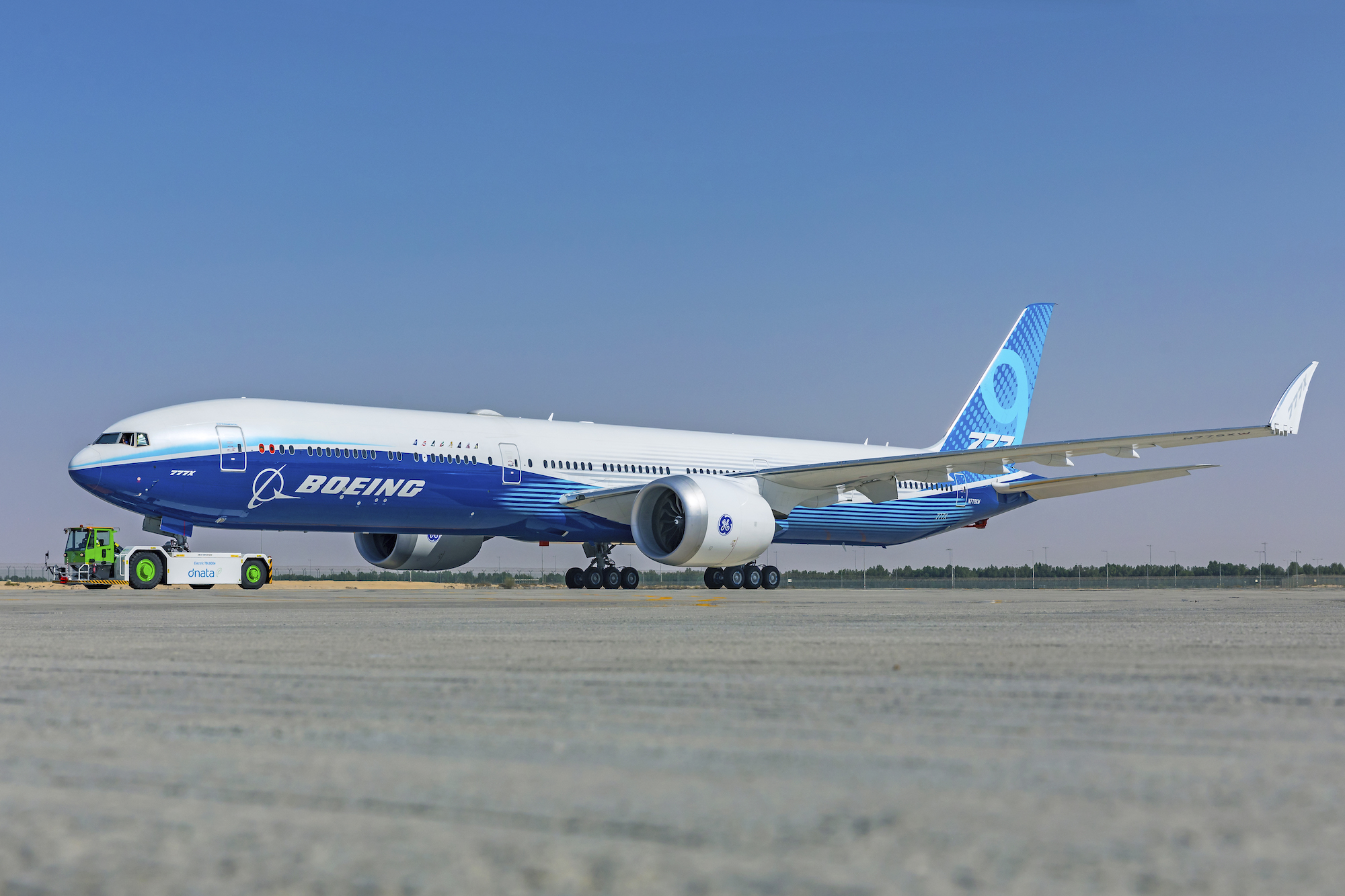
Boeing’s 777X on display at the Dubai Airshow (Photo: AirlineGeeks | William Derrickson)

Fresh Looks

Away from new orders, there was also a set of cabin interior announcements Tuesday, as Singapore Airlines unveiled lie-flat seats for its Boeing 737 MAX first class cabins and Emirates Airline said it would bring its Premium Economy class to over 100 aircraft for its nearly 200-strong fleet

Finally, the flying and static demonstrations continued for companies from across the industry as each looked to leave the week with a heavier order book than when they arrived.

Parker Davis

Parker joined AirlineGeeks as a writer and photographer in 2016, combining his longtime love for aviation with a newfound passion for journalism. Since then, he’s worked as a Senior Writer before becoming Editor-in-Chief of the site in 2020. Originally from Dallas and an American frequent flyer, he left behind the city’s rich aviation history to attend college in North Carolina, where he’s studying economics.

Ethiopian Airlines, Boeing Formulate 787 Landing Gear Exchange Program

An Ethiopian Airlines Boeing 787-8 Dreamliner. (Photo: Wikimedia Commons)

Boeing recently signed a memorandum of understanding with Ethiopian Airlines that enables the airline to bring cost-saving measures to its maintenance operations with Boeing’s 787 Dreamliner landing gear exchange program.

The new agreement — signed at the ongoing Dubai Air Show — guarantees the availability of 29 landing gear shipsets wherever and whenever they are needed to support Ethiopian’s 787 Dreamliner fleet, enabling more efficient and cost-effective maintenance operations for the carrier.

“As the fastest growing airline in Africa, much of our success depends on our ability to seek out new ways to drive operational efficiency in our processes,” Tewolde GebreMariam, Group Chief Executive Officer, Ethiopian Airlines, said.

The Boeing 787 landing gear exchange program greatly simplifies the contracting, scheduling and management of the landing gear overhaul process.

“As the commercial airline market continues to recover, we believe these services offered by Boeing provide a reliable way to realize more stability and predictability in managing our overall maintenance operations and costs across our fleet,” Gebremariam added.

Through this program, air carriers can quickly exchange landing gears that need to be repaired or overhauled with a replacement set of certified landing gear from a dedicated resource pool which Boeing maintains.

“We value our long-standing relationship with Ethiopian Airlines, and are pleased to be able to provide these reliable and cost-effective services to help drive efficiency in maintenance and flight operations for their fleet,” Anbessie Yitbarek, Vice President of Commercial Services Sales and Marketing, Boeing, said

By managing all parts, engineering and technical aspects of the program, Ethiopian Airlines will have the flexible exchange solution they need to repair and replace landing gear while lowering inventory costs. Boeing will also provide access to loaner Landing Gear shipsets and parts during unexpected AOG situations.

737 MAX Settlement

Boeing acknowledged liability for compensatory damages in lawsuits filed by families of the 157 people killed in the 2019 Ethiopian Airlines 737 MAX crash.

The American aircraft manufacturer said last week that it is “committed to ensuring that all families who lost loved ones in the accidents are fully and fairly compensated for their loss,” as reported by Reuters.

Lawyers for the victims noted in a statement last week that Boeing admitted under the agreement “that the 737 MAX had an unsafe condition, and that it will not attempt to blame anyone else” for the crash.

Under the agreement with Boeing, the victims’ families also agreed to dismiss claims against Rosemount Aerospace — a company that made sensors for the 737 MAX — and Raytheon Technologies Corp’s Rockwell Collins, the parent of Rosemount and a key supplier for the MAX.

Victor Shalton

Victor Shalton's love for aviation can be traced to when he was 11-years-old. As a seasoned aviation writer, he takes pride in providing the best aviation coverage around the globe and is passionate about advancing his skills in the aviation space. In addition, he loves travelling, writing, arts and while his speaking engagements have taken him around the world, he is proud to call Nairobi home.
Sign-up for newsletters & special offers!

Get the latest stories & special offers delivered directly to your inbox

SUBSCRIBE