










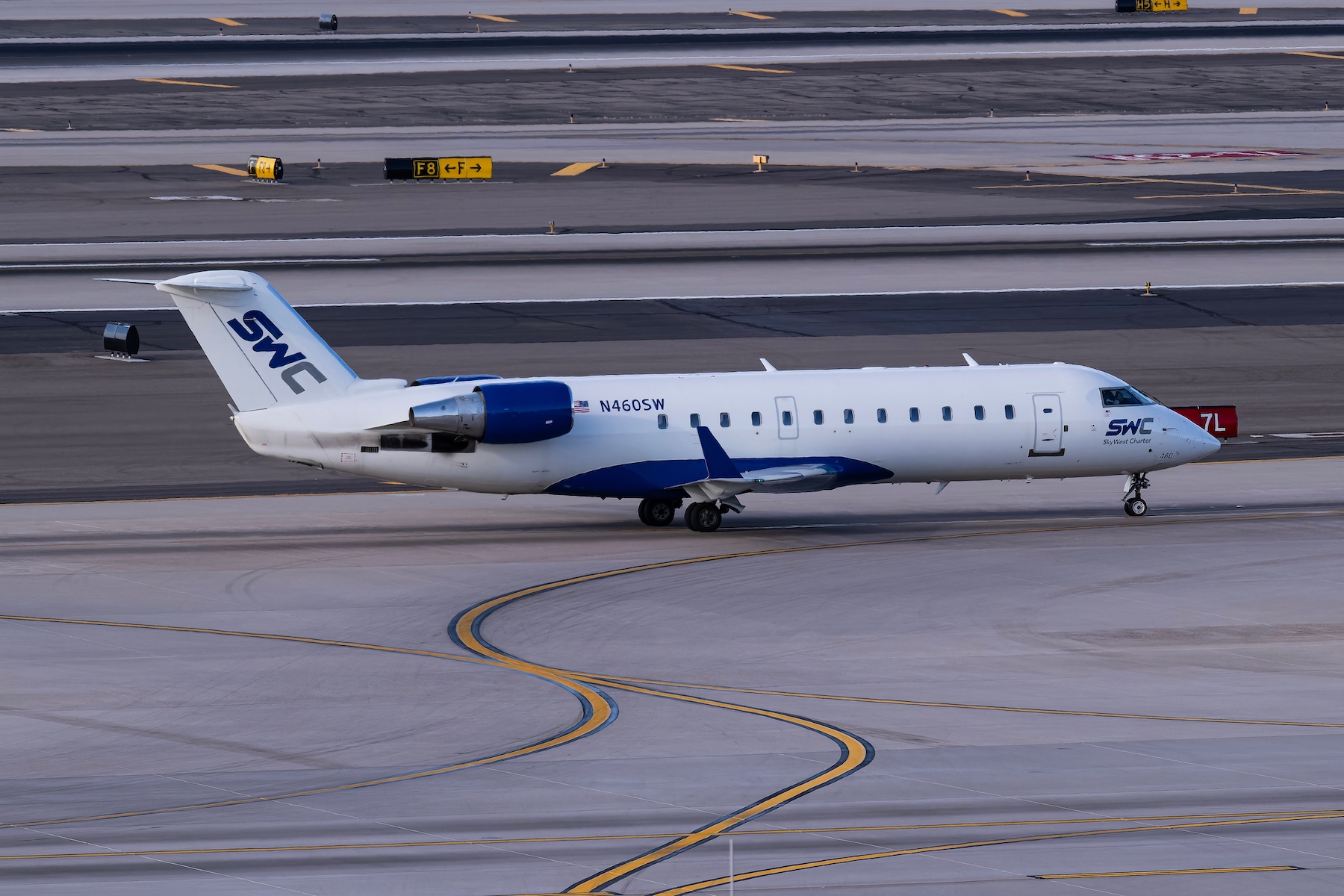

The U.S. Department of Transportation has granted SkyWest Charter authorization to operate as a commuter air carrier, clearing the way for the carrier to expand its charter services using 30-seat aircraft.
The agency’s decision finalizes a tentative finding issued in February.
SWC, a wholly owned affiliate of SkyWest Airlines, was launched in 2022 to provide charter flights under Part 135 regulations. The carrier currently operates on-demand flights through agreements with various organizations and institutions.
Based in St. George, Utah, SWC was created in part to provide alternatives for communities that lost regional airline service as pilot shortages and economic pressures reduced the viability of 50-seat regional jets in scheduled service.
The new commuter authorization allows the carrier to go beyond air taxi limitations, which restricted it to fewer than five weekly flights per route. SWC plans to use 30-seat Bombardier CRJ-200 aircraft for its expanded operations.
The approval followed extensive debate. Several labor organizations, including the Air Line Pilots Association (ALPA), the Association of Flight Attendants-CWA (AFA), the International Association of Machinists and Aerospace Workers (IAM), and the Professional Aviation Safety Specialists (PASS), raised objections. Concerns focused on safety standards, regulatory oversight, and potential impacts on Essential Air Service (EAS) communities. Members of Congress Nicholas A. Langworthy and Marc A. Veasey also urged the DOT to delay a final decision until the FAA completed its review of charter regulations.
In its final order, the DOT emphasized that FAA safety regulations currently permit operations of 30-seat or fewer aircraft under Part 135 and noted that the FAA’s Allegheny Flight Standards District Office has established a dedicated oversight team for SWC. The agency also confirmed that no empirical evidence was presented showing SWC’s operations would be unsafe.
As part of its authorization, SWC must submit a first-year progress report within 45 days after its initial year of commuter operations. This report will include details of its operations, financial status, and implementation of voluntary safety measures.
The DOT’s decision allows SWC to bid for EAS contracts, though approval of commuter status does not guarantee selection in EAS bids.