














Hitting its stride in the late 1970s and early ‘80s, Air Florida embodied the heady and sometimes reckless atmosphere brought on by the deregulation of the U.S. airline industry. From its home base in Miami, it rolled out new routes across the Americas and Europe at a blinding rate, while relying on low prices, quirky promotions, and operational flexibility.
But Air Florida could not maintain its breakneck momentum for long. A disastrous crash, coupled with a downturn in the airline sector, brought the carrier’s run to an end after only 12 years of operations.
Intrastate Early Years
In the 1960s and ‘70s, Florida was booming. Northerners were increasingly moving south to escape the cold and high taxes, while immigrants from the Caribbean and South America brought new cultures and entrepreneurial dynamism. This influx supercharged the growth of cities like Miami and Fort Lauderdale, once sleepy beach towns that seemed to grow into prosperous cities almost overnight.
To capitalize on that growth, a group of investors headed by Miami businessman Eli Timoner founded Air Florida in 1971.
While difficult to imagine today, the regulatory environment of the time made it easier to launch an intrastate airline, which operated within a single U.S. state, than a new nationwide carrier. Following in the footsteps of companies like Pacific Southwest Airlines (California) and Southwest (which initially only served Texas), Air Florida linked its home base in Miami with in-state destinations like Orlando and St. Petersburg, using a fleet of Boeing 707s and later Lockheed L-188 Electras.
While Air Florida gradually expanded its network and established a presence in new cities like Gainesville and Tallahassee, it was unprofitable for most of the ‘70s under the intrastate model. The airline did not have enough cash on hand to meaningfully improve operations or acquire new jet aircraft. Passengers voted with their feet, booking with larger and more modern airlines that were quickly muscling into South Florida.
Turnaround
Air Florida might have folded in the late 1970s had it not been for the intervention of an investor group led by former Braniff Airways executive Ed Acker. Funds put up by the group allowed Air Florida to acquire DC-9 jets, and later, as business picked up, Boeing 737s. To emphasize its shift away from turboprop flying, the carrier adopted a new slogan: “All jet. All the time.”

Acker took over as CEO and president of Air Florida in 1977. Energetic and ambitious, he retooled the airline’s business model and product, often with a tongue-in-cheek flair. Air Florida’s brand colors were changed, and passengers were greeted on board with orange juice-champagne mixtures called “Sunshine Sparklers.” A promotion from the period promised a free ticket on new routes for customers who approached and kissed a designated “Kiss Miss” gate employee.
On the business side, off-peak prices were dropped to help capture more of the budget market. Bookings picked up, and in 1979 the airline made a solid profit. By 1980, earnings were five times what they had been two years before. After a relatively short time at the helm, Acker was hailed as the “turnaround king,” and Air Florida as “the little airline that could.”
Acker’s arrival coincided with the deregulation of the U.S. airline industry, which allowed Air Florida to add destinations beyond its home state. The new CEO was an aggressive advocate for expansion, and between 1978 and 1981 the carrier launched dozens of new routes across the U.S., specifically to the Northeast, as well as to the Caribbean and Latin America. Outside Florida, some of its most important new markets were New York, Boston, Washington, D.C., White Plains, New York, Jamaica, and The Bahamas.
The delivery of longer-range aircraft, including the DC-10, extended Air Florida’s reach to London and Brussels, destinations that were unthinkable just a few years before.
Much of this expansion was financed through debt. While little noted at the time, Air Florida’s debt load would become a millstone around its neck as the aviation sector faced new financial pressures in the mid-1980s.
Acker departed the airline on a high note in 1981 to lead the struggling Pan Am, a position he saw as a worthy challenge.
1982 Crash, Decline, and Collapse
On Jan. 13, 1982, Air Florida Flight 90 crashed into the 14th Street Bridge over the Potomac River in Washington, D.C., just after takeoff from Washington National Airport (now Ronald Reagan Washington National Airport). The Boeing 737 hit several occupied vehicles and tore away a part of the bridge’s guardrail before hitting the river and smashing through its iced-over surface.
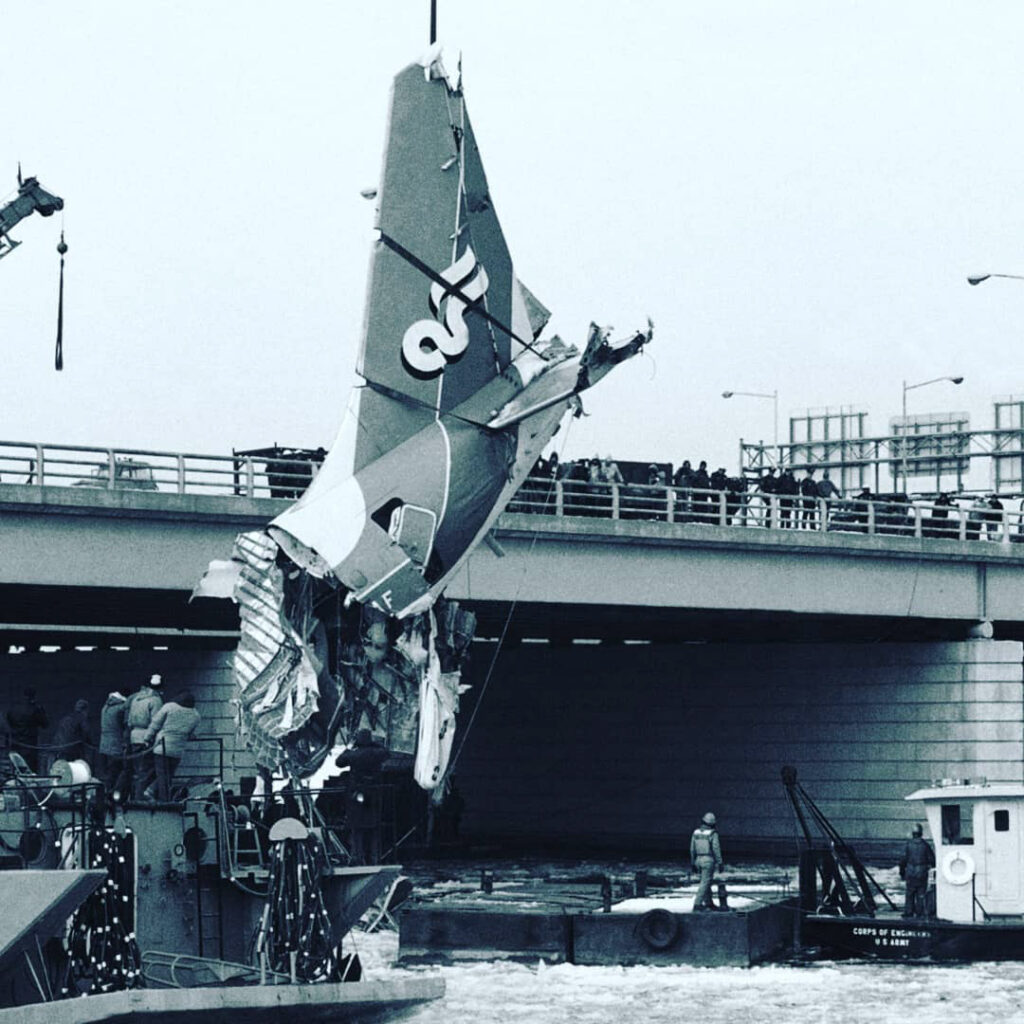
The crash killed 78 people in total, and only five people on the airplane, four passengers and a flight attendant, survived. The location of the crash site, immediately south of downtown Washington, D.C., ensured heavy media coverage, and news crews filmed as rescuers pulled those still alive from the freezing cold river.
After an investigation, the NTSB attributed the crash to pilot error, severely damaging Air Florida’s reputation. Bookings plunged, and the airline once again found itself in dire financial straits.
Over the following two years, Air Florida’s leadership cut expenses by selling off aircraft and shrinking the fleet. Inexplicably, however, the carrier did not do much to simplify its network, and money-losing service to the Northeast and Europe continued despite intense competition. The airline hemorrhaged money quarter after quarter and finally declared bankruptcy in July 1984.
Air Florida had a brief second life operating flights under contract for Chicago’s Midway Airlines, using the name “Midway Express.” This run came to an end in 1985, when Midway officially acquired Air Florida and rebranded Midway Express. Midway itself would declare bankruptcy and cease operations in 1991.
Today, Air Florida is remembered as one of the quintessential cautionary tales of the immediate post-deregulation years. A corporate obituary published in The Washington Post remarked that the airline outgrew its management, and paid a steep price.