












Grounded is AirlineGeeks.com’s look back at airlines that once shaped the industry but no longer take to the skies. Each story revisits a carrier that influenced routes, fleets, or fares—and explores what ultimately led to its final descent.
Known across the U.S. for its “smiling” aircraft liveries and low prices, Pacific Southwest Airlines was arguably the first true discount carrier.
Confined to California for decades due to the Civil Aeronautics Board’s tight regulations, the airline established itself as the Golden State’s unofficial “flag carrier,” embodying West Coast leisure and hospitality. At the same time, it influenced intrastate airlines in other regions, including Southwest Airlines, which emerged from Texas to become a national name.
But Pacific Southwest struggled to adapt to a post-deregulation marketplace, and it could not replicate its earlier success on a national scale. It was acquired by US Airways in 1987, and merged out of existence the following year.
Beginnings
Pacific Southwest Airlines was formed in 1949 as an offshoot of Kenny Friedkin’s flight training school in San Diego. Using a leased Douglas DC-3, the carrier flew first to Oakland, then to other major cities in California.
In the frenzied years following World War II, no less than eight separate passenger airlines cropped up in California, and because federal laws made it extremely difficult for new carriers to fly nationally, all eight ended up competing for market share inside the Golden State. Pacific Southwest emerged as the winner, outlasting all of its competitors while strengthening its hold in cities such as Los Angeles, Burbank, and San Francisco.
By the late 1950s and early ‘60s, PSA was still small but completely dominant in California, and its brand identity began to coalesce. It dubbed itself “The World’s Friendliest Airline,” and outfitted its flight attendants in colorful, daring uniforms. Management encouraged a friendly, bon vivant attitude on board, looking to mirror the “California lifestyle” that was contemporaneously shaping popular culture. Frequent passengers baked cookies and other treats for the crew, and they were often rewarded with free drinks.
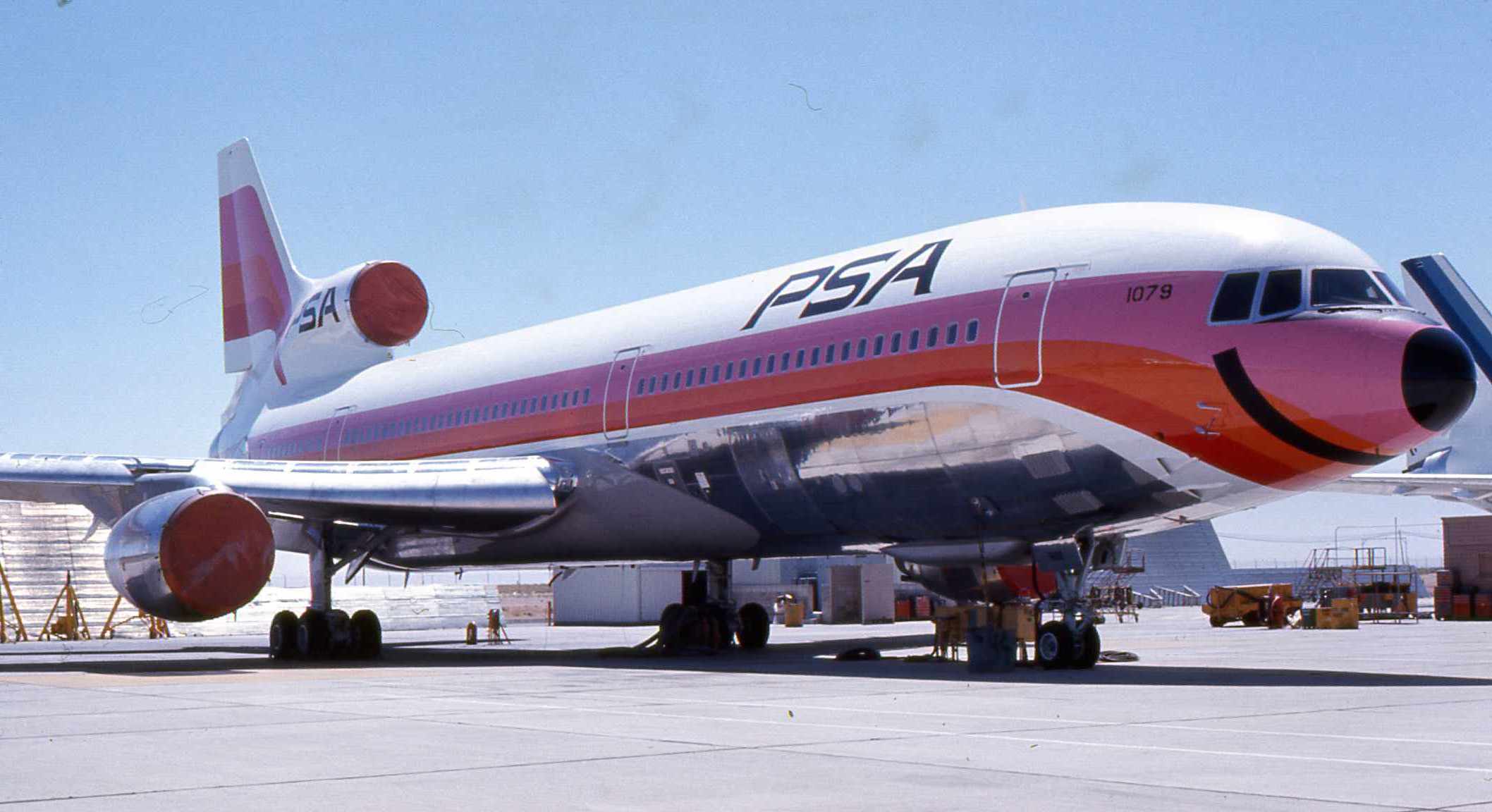
Around 1970, the airline introduced its famous smiling livery, applying the design to its new Boeing and Lockheed aircraft. The “smile,” really just a curved line under the nose of the jet, became a marketing hit, and reinforced the carrier’s friendly reputation.
A big part of PSA’s success came from its consistently low prices. A one-way flight between Burbank and San Francisco, for instance, cost $13.50, with tax, in coach. U.S. Navy personnel in San Diego, carrier’s main hub, affectionately nicknamed PSA the “Poor Sailor’s Airline.”
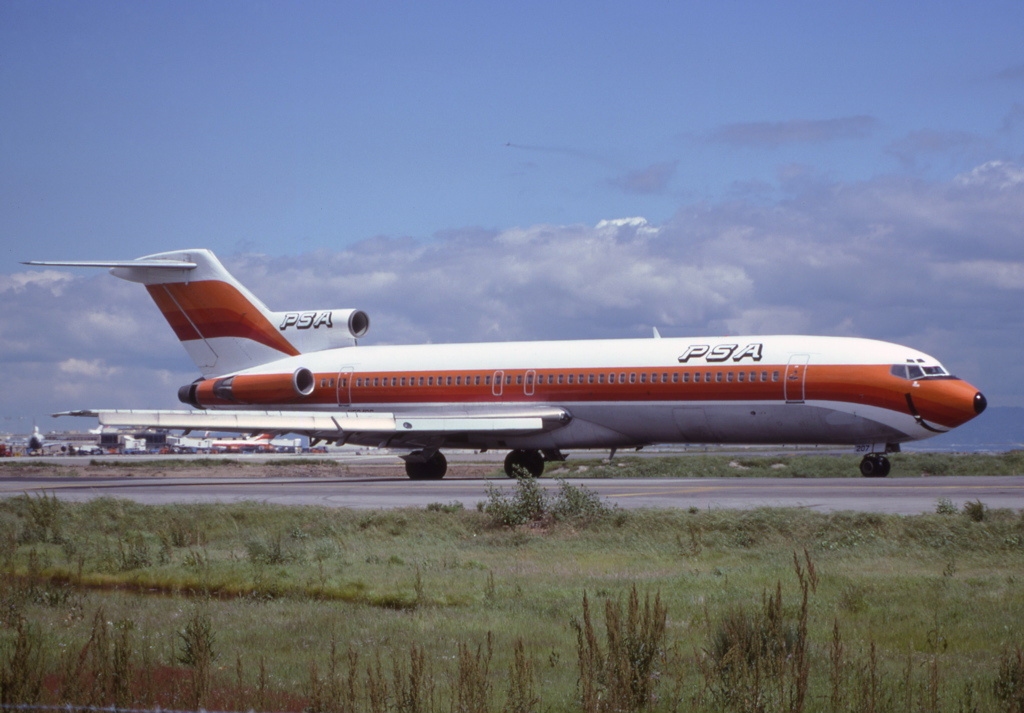
PSA operated a mix of aircraft in the 1960s and ‘70s, including the Boeing 727-100, 727-200, and 737-200, the Lockheed Electra and L-1011 (used briefly), and the Douglas DC-9. The carrier eventually settled on the 727-200, and the type became the backbone of PSA’s fleet through the 1970s.
Influence on Southwest
It would not be inaccurate to say that Southwest stole PSA’s playbook.
Founder Rollin King acknowledged that Southwest looked to PSA for inspiration, and Southwest president Lamar Muse said he didn’t mind being called a “copycat” of PSA’s operation. According to Muse, PSA officials actually handed him a copy of the airline’s operating manuals at a meeting in 1971; the documents were adapted for use by Southwest.
At the time, there was no risk of PSA aiding a competitor, since Southwest was limited to Texas. That would change, however, with the deregulation of the airline sector in 1978.
New Era and Decline
With the old federal limits on routes gone, PSA looked to expand outside of California. Its first destination outside its home state was Reno, followed by Las Vegas, Salt Lake City, and Phoenix. In the mid-1980s it would make inroads into the Pacific Northwest.
The carrier also had its eyes set on Texas, and in 1982 it struck a unique deal with Dallas/Fort Worth-based Braniff to begin service there. Under the agreement, Braniff would operate PSA-branded flights from Texas, using its own aircraft and personnel. PSA saw the alliance as a low-cost way to enter a new market, but Braniff pilots refused to fly at PSA’s lower rates, or to accept seniority below PSA pilots in the event of a merger. The deal collapsed in 1983.
Initially, PSA’s management expected that the airline would thrive with deregulation, but performance actually deteriorated. Larger rivals consolidated and moved west, while PSA struggled to upgrade its fleet from the 727 to the BAe 146-200. Executives also had their attention diverted away from the airline by numerous side projects and subsidiaries, including a rental car company, an energy outfit, and four radio stations.
By the middle of the decade, PSA was struggling. It cut wages and reshuffled its network, but to no avail. In 1986, the airline agreed to a $400 million takeover by US Airways, giving the larger carrier a significant presence in California for the first time. The deal closed in 1987, and PSA was officially absorbed by US Airways in 1988.
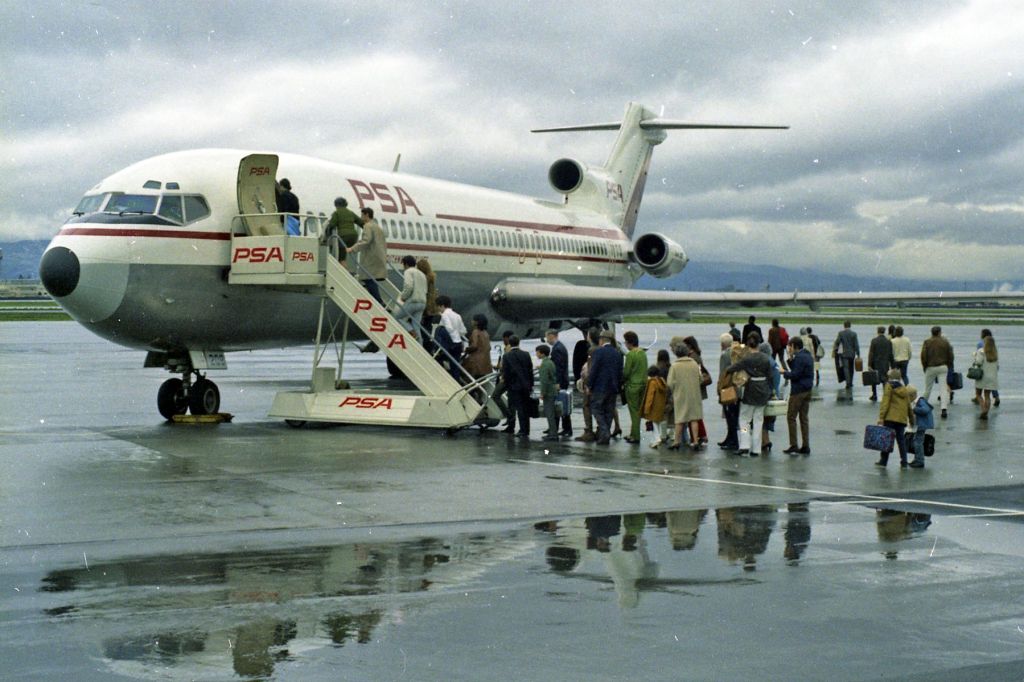
In an ironic twist, US Airways was forced to give up much of its West Coast network in the early 1990s due to fare wars with PSA’s protégé carrier, Southwest.
US Airways kept the PSA name alive by using it for its regional subsidiary, formerly known as Jetstream International. The brand remained intact after American Airlines acquired US Airways in 2013, and PSA became a subsidiary of American Airlines Group.
While probably little remembered, Pacific Southwest Airlines helped establish the low-cost market as we know it today. It played a key role in the development of Southwest, and Southwest’s success has spurred the creation of budget carriers around the world.