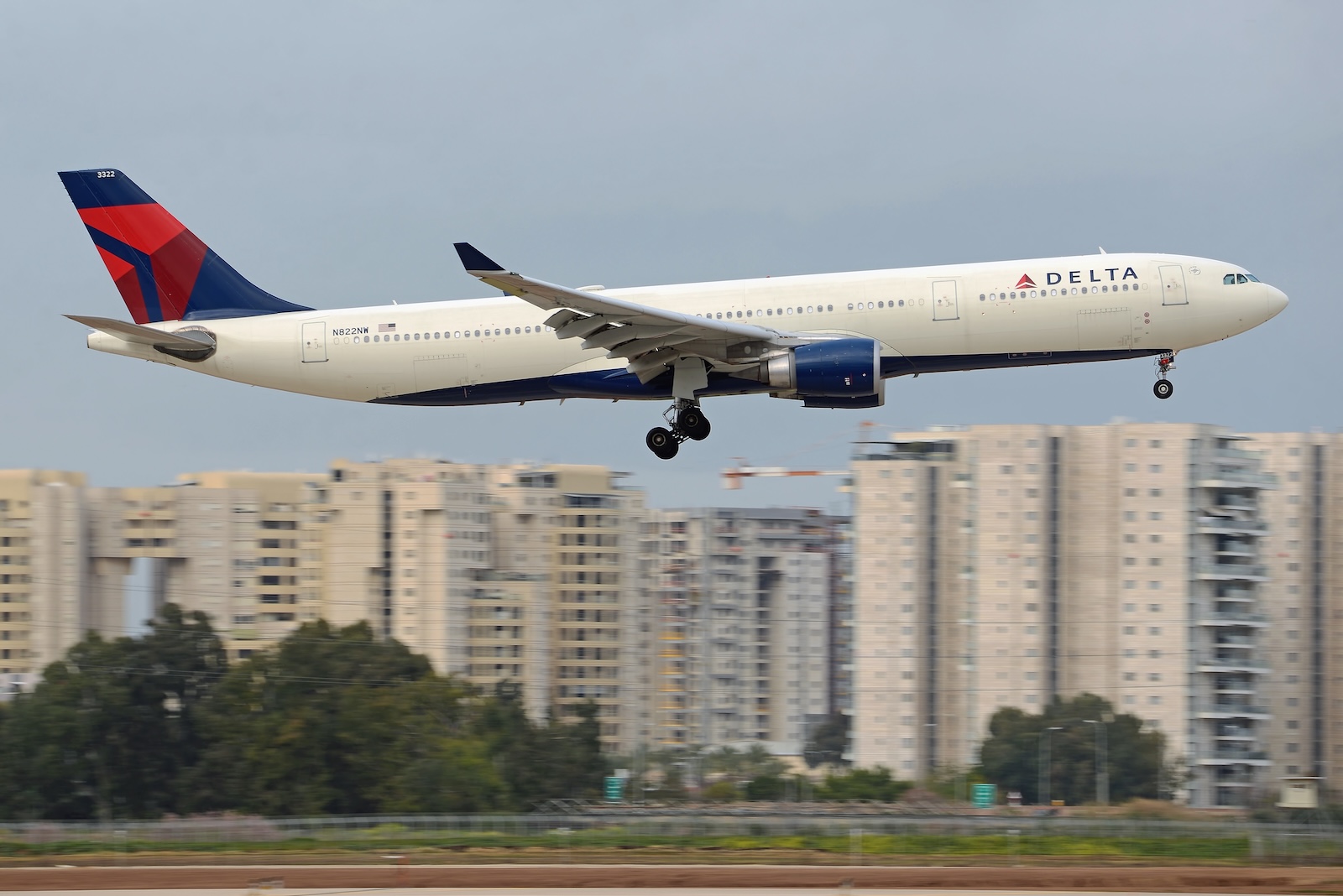
A Delta 737-800 in Los Angeles.
(Photo: AirlineGeeks | William Derrickson)
Delta is slated to bolster its network early next year with the addition of more routes.
According to Cirium Diio schedule data, the airline will resume flights between New York-JFK and Grand Cayman, along with Detroit and Liberia, Costa Rica. These routes will begin in December and January, respectively.
Service from New York to Grand Cayman will start on Dec. 3, operating once per week on Saturdays. The airline will deploy a Boeing 737-800 in this market.
Starting on Jan. 10, Delta will link Detroit and Liberia with once-weekly flights on Saturdays. This service will be operated by a Boeing 737-900ER.
The airline last served the New York-to-Grand Cayman route in 2016. Detroit to Liberia was last flown by the airline in 2002, per Enilria.
Ryan founded AirlineGeeks.com back in February 2013 and has amassed considerable experience in the aviation sector. His work has been featured in several publications and news outlets, including CNN, WJLA, CNET, and Business Insider. During his time in the industry, he's worked in roles pertaining to airport/airline operations while holding a B.S. in Air Transportation Management from Arizona State University along with an MBA. Ryan has experience in several facets of the industry from behind the yoke of a Cessna 172 to interviewing airline industry executives. Ryan works for AirlineGeeks' owner FLYING Media, spearheading coverage in the commercial aviation space.
An American 737-800 aircraft in Charlotte (Photo: AirlineGeeks | William Derrickson)
Roughly 15,000 pilots at American Airlines may be one step closer to new union representation. Currently, the group is represented by the Allied Pilots Association (APA), though a majority of members voted earlier this year to explore a merger with the larger Air Line Pilots Association (ALPA).
ALPA represents nearly 80,000 pilots at several major carriers, including Delta and United.
Last week, the APA’s board of directors signed off on plans to form a negotiating committee between the APA and APLA. This comes after 58% of pilots recently polled at the Fort Worth, Texas-based carrier say they “strongly” or “somewhat favor” a committee to explore a merger.
The union will hold a special board meeting in late June to elect members for the merger committee. About 25% of APA-represented pilots polled said they were “firmly opposed to an ALPA merger, don’t want a committee or want to fund a committee …”
This push for a tie-up between the two labor groups is nothing new. Last year, a group called AA Pilots for ALPA told Forbes it collected 8,219 cards in support of the merger, roughly half of the airline’s total pilot group.
Ryan founded AirlineGeeks.com back in February 2013 and has amassed considerable experience in the aviation sector. His work has been featured in several publications and news outlets, including CNN, WJLA, CNET, and Business Insider. During his time in the industry, he's worked in roles pertaining to airport/airline operations while holding a B.S. in Air Transportation Management from Arizona State University along with an MBA. Ryan has experience in several facets of the industry from behind the yoke of a Cessna 172 to interviewing airline industry executives. Ryan works for AirlineGeeks' owner FLYING Media, spearheading coverage in the commercial aviation space.
New special livery recognizes JetBlue's long-standing partnership with Dunkin'. (Photo: JetBlue)
JetBlue has unveiled a new special livery on one of its Airbus A320 aircraft, celebrating its nearly two-decade partnership with Dunkin’. The aircraft, named “Brewing Altitude,” features Dunkin’s signature pink and orange colors, adorned with playful doughnut and coffee motifs. The livery was revealed at a celebration in Boston, a city significant to both brands.
The collaboration between JetBlue and Dunkin’ began in 2006, with JetBlue serving Dunkin’s Original Blend coffee on board. In 2011, Dunkin’ became the airline’s exclusive onboard coffee provider. The new livery marks a continuation of this partnership, the airline shared.
“Dunkin’ has been part of the JetBlue journey for nearly two decades, and we’re proud to showcase this partnership with a livery that’s as fun and bold as the brands behind it,” said Marty St. George, president of JetBlue, in a news release. “With our shared Boston heritage and focus on delighting loyal customers, this collaboration brings together two fan-favorite brands in a way only JetBlue and Dunkin’ can.”
JetBlue special livery in partnership with Dunkin’ (Photo: JetBlue)
To commemorate the launch, JetBlue and Dunkin’ are offering a promotion titled “Monday Pick-Me-Up.” May 19 through Sept. 1, customers flying on the Brewing Altitude aircraft on Mondays will receive special rewards.
JetBlue’s TrueBlue members will attain Mosaic 1 status, while Dunkin’ Rewards members will earn Boosted status for three months. Existing Mosaic members will receive 20 bonus tiles, and current Boosted Status members will earn double points on qualifying purchases during this period.
JetBlue’s newest special livery on an Airbus A320 (Photo: JetBlue)
Ryan founded AirlineGeeks.com back in February 2013 and has amassed considerable experience in the aviation sector. His work has been featured in several publications and news outlets, including CNN, WJLA, CNET, and Business Insider. During his time in the industry, he's worked in roles pertaining to airport/airline operations while holding a B.S. in Air Transportation Management from Arizona State University along with an MBA. Ryan has experience in several facets of the industry from behind the yoke of a Cessna 172 to interviewing airline industry executives. Ryan works for AirlineGeeks' owner FLYING Media, spearheading coverage in the commercial aviation space.
A Royal Air Maroc Dreamliner 787-9 at Mohammed V International Airport in Casablanca, Morocco. (Photo: Shutterstock | B1anconer0)
Morocco is seeking contractors in an effort to construct a new terminal at Casablanca’s Mohammed V International Airport.
The Moroccan National Airports Office (ONDA) last month formally launched an international tender for the project, which it said marks a milestone for its “Airports 2030” strategy, a long-term vision to transform Morocco’s aviation infrastructure and establish it as a regional and global hub.
With a planned investment of approximately $1.6 billion, the terminal is set to triple the airport’s annual capacity to 20 million passengers by 2029. Designed in the shape of an “H,” it draws architectural inspiration from the Atlantic Ocean’s waves and incorporates Moroccan cultural elements, such as terracotta zellige tiles and shaded “oasis” spaces intended to elevate the passenger experience.
ONDA described the project as “a real technical feat and an architectural masterpiece.”
One key element will be the terminal’s integration with the country’s expanding high-speed rail network. The facility will link directly to the Kenitra–Marrakech line, enabling travel to major cities including Casablanca, Rabat, and Marrakech. The connectivity is expected to boost tourism and economic growth as Morocco prepares to co-host the 2030 FIFA World Cup with Spain and Portugal.
New Vision
To kick off the project, ONDA issued an initial tender for earthworks, with the main construction contract offered under a “design-build” model. Bids are due by May 16, 2025 at 4 p.m. Interest from both domestic and international firms is strong, with companies such as TGCC, SGTM, Jet Contractors, Bouygues, VINCI, and TAV reportedly considering participation.
The expansion effort is a response to a surge in air travel demand. In 2023, Mohammed V Airport handled 9.8 million passengers, a 28% increase from the previous year.
Once the new terminal is completed, the airport will rank among Africa’s largest.
For context, Cairo International Airport, currently the continent’s busiest, handled 27.7 million passengers in 2024, with plans to boost capacity to 30 million by 2030. Johannesburg’s O.R. Tambo International Airport, designed to handle 28 million annually, processed 17.85 million passengers during the 2023–24 fiscal year.
The planned new terminal in Casablanca is part of a broader national push under the “Airports 2030” strategy, centered on three pillars: infrastructure development, reimagined passenger experience, and structural modernization. Other airports earmarked for upgrades include Marrakech, Agadir, Tangier, and Fez. Marrakech Airport will see its capacity increase from 9 to 11.5 million passengers, Tangier from 1 to 3.2 million, and Agadir from 3 to 4.4 million.
Victor Shalton's love for aviation can be traced to when he was 11-years-old. As a seasoned aviation writer, he takes pride in providing the best aviation coverage around the globe and is passionate about advancing his skills in the aviation space. In addition, he loves travelling, writing, arts and while his speaking engagements have taken him around the world, he is proud to call Nairobi home.
‘Action Slip’ Caused British Airways 777 Rejected Takeoff
The U.K.’s Air Accidents Investigation Branch (AAIB) has released its final report on a “serious incident” involving a British Airways Boeing 777-200 aircraft.
A British Airways 777-200 (Photo: Shutterstock | Markus Mainka)
The U.K.’s Air Accidents Investigation Branch (AAIB) has released its final report on a “serious incident” involving a British Airways Boeing 777-200 aircraft that performed a rejected takeoff at London Gatwick Airport on June 28, 2024.
Investigators determined the incident occurred when the first officer inadvertently began reducing the throttles at the V1 decision speed instead of removing his hand from them as required by procedure.
“The co-pilot began retarding the thrust levers at airspeed V1, instead of removing his hand from them. After momentarily advancing them again, he initiated the rejected takeoff procedure around 2 KIAS later,” the AAIB report stated.
Incident Timeline
The incident occurred as the flight to Vancouver, Canada, was departing from Runway 26L at London Gatwick Airport with 334 passengers and 13 crew members on board. According to the investigation, when the aircraft reached V1 speed (160 knots), the first officer, who was the pilot flying, inadvertently pulled back the thrust levers instead of following standard procedure to remove his hand.
After recognizing the error, the co-pilot momentarily advanced the thrust levers again before deciding to commit to a rejected takeoff at approximately 162 knots. The aircraft reached a maximum speed of about 167 knots before coming to a stop well before the end of the runway.
A British Airways Boeing 777 at London Heathrow. (Photo: AirlineGeeks | William Derrickson)
Airport firefighters responded to the scene to extinguish a fire that developed on the right-side main wheel brakes due to the heavy braking action. No injuries were reported among passengers or crew.
The AAIB classified the event as a serious incident resulting from what human factors specialists term an “action slip” – an unintended action that occurs during routine or highly learned motor sequences.
The first officer, who had 6,156 total flying hours with 2,700 hours on the aircraft type, was returning from annual leave, having last flown on June 14, 2024. Investigators noted that he “expressed surprise in himself over the inadvertent thrust reduction and could not identify a reason for it.”
Weather conditions at the time were favorable with an 11-knot headwind and a dry runway surface. The aircraft was operating approximately 20 metric tons below its maximum takeoff weight.
“The incident emphasizes the complex nature of the takeoff roll,” the report stated. “Pilots perform a series of motor actions during a normal takeoff, while also mentally preparing themselves to decide upon and enact different action sequences for an RTO.”
Preventive Measures
The investigation revealed that the operator had already identified the risk of action slips in flight operations. Just four days before the incident, the airline had released an Operational Safety Notice addressing control movement errors, recommending that pilots “pause before execution, and cognitively consider what the required action is, methodically execute the action, confirm correct execution.”
In its report, the agency noted that British Airways “has included the wider issue of ‘focus’ in its recurrent simulator training” and has been cautious about publicizing specific incidents to avoid inadvertently priming crews to make similar errors.
“Pilots can improve their individual performance by mentally rehearsing what might seem like routine parts of an operation, especially after time away from flying,” the report concluded.
Ryan founded AirlineGeeks.com back in February 2013 and has amassed considerable experience in the aviation sector. His work has been featured in several publications and news outlets, including CNN, WJLA, CNET, and Business Insider. During his time in the industry, he's worked in roles pertaining to airport/airline operations while holding a B.S. in Air Transportation Management from Arizona State University along with an MBA. Ryan has experience in several facets of the industry from behind the yoke of a Cessna 172 to interviewing airline industry executives. Ryan works for AirlineGeeks' owner FLYING Media, spearheading coverage in the commercial aviation space.
An Air India 787 in London (Photo: AirlineGeeks | William Derrickson)
Airlines are canceling some flights to and from India and Pakistan and rerouting others to avoid the region as fighting between the neighboring countries escalates.
According to WFAA, American canceled a non-stop flight from Delhi to New York City on Wednesday as India began fighting against Pakistan. The carrier said it flew its aircraft out of Delhi with only its crew onboard.
Separately, Reuters reported that United canceled its non-stop Newark-Delhi flight on Wednesday.
Both carriers’ websites show those flights have resumed.
India’s civil aviation authority has closed 27 airports in the country’s west and northwest, forcing carriers like Air India, IndiGo, and SpiceJet to suspend dozens of flights, most of them domestic. Air India has said it will not fly to cities including Amritsar, Chandigarh, Jammu, and Jamnagar until at least Saturday.
Indonesia’s Batik Air, Taiwan-based China Airlines, Korean Air, Malaysian Airlines, Thai Airways, and Vietnam Airlines have all canceled or rerouted flights to avoid the region, and Air France, Dutch airline KLM, and Singapore Airlines have said they will no longer fly through Pakistan’s airspace. Lufthansa is reportedly continuing its Delhi-Frankfurt route by navigating over the Arabian Sea rather than the Indian-Pakistani border area.
FlightAware currently shows a large number of flights to and from India traveling south over the Persian Gulf, the United Arab Emirates, and Oman to bypass Pakistan.
India launched missiles into Pakistan this week in retaliation for the massacre of civilians at a popular tourist destination in the Indian-administered section of Kashmir last month. The Indian government holds Pakistan partially responsible because the militant group behind the attack operates from inside the Pakistani-controlled section of Kashmir.
Pakistan has retaliated by firing artillery and launching missiles at Indian towns near the border.
The U.S. State Department has issued a “Do Not Travel” warning for Indian Kashmir, citing the high risk of terrorism and civil unrest.
Zach Vasile is a writer and editor covering news in all aspects of commercial aviation. He has reported for and contributed to the Manchester Journal Inquirer, the Hartford Business Journal, the Charlotte Observer, and the Washington Examiner, with his area of focus being the intersection of business and government policy.
Horizon Mechanics Get 20% Pay Bump in New Contract
Horizon and the Aircraft Mechanics Fraternal Association have agreed on a contract that increases total compensation by 20%, along with other benefits.
An Alaska Airlines E-175 operated by Horizon Air at Paine Field. (Photo: AirlineGeeks | Katie Zera)
Horizon Air and the labor union representing its aircraft mechanics have agreed on a contract that includes a 20% boost in compensation.
Horizon and the Aircraft Mechanics Fraternal Association announced the agreement Wednesday after 74% of the union’s membership voted to ratify it.
The mechanics service and maintain the carrier’s fleet of 45 Embraer E175s.
According to union officials, the new deal raises its members’ total compensation by 20% over its four-year duration, increases the number of overtime hours eligible for double-time pay, and provides a “substantial” ratification bonus.
The contract also establishes paid rest when members travel away from their workplace for certain assignments and expands vacation time.
“We are proud of this agreement, which provides competitive wage increases and work rules that recognize the expertise and dedication of our members,” said AMFA National President Bret Oestreich in a news release. “With these improvements, Horizon reestablishes itself as a leader among regional carriers, better positioned to attract and retain the next generation of AMTs and related skilled professionals for years to come.”
Horizon is a regional subsidiary of Alaska Air Group, which also owns Alaska Airlines and Hawaiian Airlines. It has bases in Alaska, Idaho, Oregon, and Washington, and serves over 55 cities in North America.
Zach Vasile is a writer and editor covering news in all aspects of commercial aviation. He has reported for and contributed to the Manchester Journal Inquirer, the Hartford Business Journal, the Charlotte Observer, and the Washington Examiner, with his area of focus being the intersection of business and government policy.
Newark Radar Goes Down Again
The latest communications outage marks the second time this month that technology failures have occurred at the facility.
A United Express CRJ aircraft in Newark. (Photo: Shutterstock - Bui Le Manh Hung)
A radar display responsible for guiding aircraft in and out of Newark Liberty International Airport airspace briefly went offline on Friday.
The Federal Aviation Administration announced on social media that the outage occurred at 3:55 a.m. local time on Friday morning. The outage impacted communications and radar display at Philadelphia’s TRACON Area C and lasted approximately 90 seconds.
The outage comes shortly after Newark experienced over a week of disruptions due to ongoing issues with air traffic controller staffing, equipment failures and ongoing runway construction.
The blip in radar communications marks the second instance this month that technology troubles have impacted Newark air traffic control.
United CEO Scott Kirby claimed in a letter to employees last Friday that “over 20% of the FAA controllers for EWR walked off the job” recently.
The National Air Traffic Controllers Association union stated on Monday that controllers did not walk off the job, but took an absence under the Federal Employees Compensation Act after temporarily losing radar communications with aircraft under their control.
During an announcement from Department of Transportation Secretary Sean Duffy to upgrade U.S. air traffic control systems on Thursday, Delta CEO Ed Bastian cited ongoing issues at Newark as one recent example of outdated systems bogging down American aviation.
“It’s hard to believe and, frankly, unacceptable that many of the systems our air traffic rely on today are more than 60 years old,” he said at the announcement, flanked by four other major airline CEOs. “It’s past time that we change that. So it’s an honor to be here today among so many of our industry partners while getting a first look at what the secretary has put forward.”
AirlineGeeks.com was founded in February 2013 as a one-person blog in Washington D.C. Since then, we’ve grown to have 25+ active team members scattered across the globe. We are all here for the same reason: we love deep-diving into the fascinating realm of the airline industry.
An Air Canada Airbus A320 aircraft (Photo: Shutterstock | Joel Serre)
More airlines are cutting service to Mexico’s Tulum International Airport. Soon after its opening in December 2023, several airlines from the U.S., Canada, and Latin America flocked to the airport with an influx in capacity.
But now, many are pulling back. After less than a year, American cut its service between Charlotte, North Carolina, and Tulum in February.
United also planned to link Denver and the Mexican city starting on Dec. 19, 2024, but those plans were also scrapped. The airport is roughly 80 miles south of Cancun.
More Cuts
According to a recent Cirium Diio schedule update, United will no longer link its Chicago O’Hare hub and Tulum. The carrier is scheduled to continue serving Tulum from Newark, New Jersey, and Houston year-round.
Further north, Air Canada is also pulling back in the market. Per Aeroroutes, the Canadian airline has removed plans to resume seasonal service from Ottawa and Quebec City.
“I think it’s no secret that the industry in general put a lot of incremental capacity into Tulum; you’re seeing some carriers rationalize a bit,” Air Canada’s chief commercial officer, Mark Galardo, said during an earnings call on Friday.
Tulum Airport’s air traffic control tower (Photo: Mara Lezama / Quintana Roo government)
These routes were slated to resume this winter. The carrier will continue to serve Tulum from Toronto and Montreal.
Commenting on Air Canada’s shake-ups in Tulum, Galardo added, “We ourselves in Tulum are going to pare back a little bit of our service there and really kinda double down on Cancun, which performs quite well for us.”
Scheduled capacity in Tulum will be down by around 23% in December 2025 compared to the same month in 2024, according to Cirium.
Editor’s Note: Data referenced in this article was provided by aviation analytics company Cirium.
Ryan founded AirlineGeeks.com back in February 2013 and has amassed considerable experience in the aviation sector. His work has been featured in several publications and news outlets, including CNN, WJLA, CNET, and Business Insider. During his time in the industry, he's worked in roles pertaining to airport/airline operations while holding a B.S. in Air Transportation Management from Arizona State University along with an MBA. Ryan has experience in several facets of the industry from behind the yoke of a Cessna 172 to interviewing airline industry executives. Ryan works for AirlineGeeks' owner FLYING Media, spearheading coverage in the commercial aviation space.
Sen. Rick Scott announced Friday the introduction of legislation that would require airlines to provide passengers with status updates on delayed flights.
JetBlue and Delta aircraft in Los Angeles. (Photo: Shutterstock | Markus Mainka)
Florida Republican Sen. Rick Scott announced Friday the introduction of legislation that would require airlines to provide passengers with status updates on delayed flights every 15 minutes until departure.
The Frequent Logistics Information for Grounded and Held Travelers (FLIGHT) Act aims to enhance transparency for airline passengers experiencing delays, he said. Under the bill, carriers would be required to notify passengers when flights are delayed by 15 minutes or more, with subsequent updates provided every 15 minutes until the flight is ready for takeoff.
The notifications would be delivered via email or text message and would have to include updated estimated departure and arrival times. The bill also stipulates that passengers be given the option to opt out of receiving the notifications.
“No American I know has been spared from the inconvenience of a delayed flight,” said Scott in a news release. “While sometimes unavoidable and completely understandable, these delays cause frustration and ruined plans that can be costly for passengers who made their plans around times provided by the airlines and are often left in the dark amid endless delays.”
The bill would amend Title 49 of the United States Code to implement the new requirements, specifically targeting “covered air carriers” as defined in existing statutes.
Ryan founded AirlineGeeks.com back in February 2013 and has amassed considerable experience in the aviation sector. His work has been featured in several publications and news outlets, including CNN, WJLA, CNET, and Business Insider. During his time in the industry, he's worked in roles pertaining to airport/airline operations while holding a B.S. in Air Transportation Management from Arizona State University along with an MBA. Ryan has experience in several facets of the industry from behind the yoke of a Cessna 172 to interviewing airline industry executives. Ryan works for AirlineGeeks' owner FLYING Media, spearheading coverage in the commercial aviation space.