Stories

Latest: Delta CRJ-900 Crashes While Landing in Toronto

Delta flight 4819 is involved. The CRJ-900, which was operated by Delta regional subsidiary Endeavor Air, was flying from Minneapolis to Toronto.

An Endeavor Air CRJ-900 aircraft (Photo: AirlineGeeks | William Derrickson)

A Delta Connection flight has crashed in Toronto, with multiple injuries reported so far.

Delta flight 4819 is involved. The CRJ-900, which was operated by Delta regional subsidiary Endeavor Air, was flying from Minneapolis to Toronto.

Photos on X show the aircraft upside down in the snow. In another post, the airport confirmed that all passengers and crew members were “accounted for.” 

“Delta Connection flight 4819, operated by Endeavor Air using a CRJ900 aircraft, was involved in a single-aircraft accident at Toronto Pearson International Airport (YYZ) around 3:30p ET on Monday. The flight originated from Minneapolis-St. Paul International Airport (MSP),” the airline said in a statement.

18 passengers with injuries were transported to local hospitals, Delta added. Four crew members and 76 passengers were on board.

The Federal Aviation Administration confirmed all 80 people evacuated the CRJ.

“Delta Air Lines Flight 4819, operated by Endeavor Air, crashed while landing at Toronto Pearson International Airport in Canada around 2:45 p.m. local time on Monday, February 17,” an agency spokesperson said in a statement. “All 80 people on board were evacuated. The CRJ-900 departed Minneapolis/St. Paul International Airport. The Transportation Safety Board of Canada will be in charge of the investigation and will provide any updates.”

According to CTV News, at least three people are critically injured.

ATC Audio at the time that EDV4819 was on approach and flipped over. CYYZ Tower
byu/Aiden_Dijakovic inaviation

This is a developing story.

Ryan Ewing

Ryan founded AirlineGeeks.com back in February 2013 and has amassed considerable experience in the aviation sector. His work has been featured in several publications and news outlets, including CNN, WJLA, CNET, and Business Insider. During his time in the industry, he's worked in roles pertaining to airport/airline operations while holding a B.S. in Air Transportation Management from Arizona State University along with an MBA. Ryan has experience in several facets of the industry from behind the yoke of a Cessna 172 to interviewing airline industry executives. Ryan works for AirlineGeeks' owner FLYING Media, spearheading coverage in the commercial aviation space.

Scores of FAA Employees Fired as SpaceX Plans Facility Visit

The Federal Aviation Administration has laid off hundreds of probationary employees as the agency planned a visit from Elon Musk’s employees.

ATC tower
Air traffic control tower in St. Louis. (Photo: Shutterstock | ArtByArthur)

The Federal Aviation Administration has laid off hundreds of probationary employees as the agency planned a visit from Elon Musk’s employees on Monday.

U.S. Secretary of Transportation Sean Duffy stated in a Sunday post on X that members of the SpaceX team would be visiting the Air Traffic Control System Command Center in New Baltimore, Virginia, on Monday to make improvements to the federal air traffic control system.

“America deserves safe, state-of-the-art air travel, and President Trump has ordered that I deliver a new, world-class air traffic control system that will be the envy of the world,” Duffy said in the post. “To do that, I need advice from the brightest minds in America. I’m asking for help from any high-tech American developer or company that is willing to give back to our country.”

On Saturday, the Professional Aviation Safety Specialists (PASS) union issued a statement denouncing the termination of “several hundred” of its probationary employees at the FAA.

PASS stated that these employees were sent messages from a non-governmental email address late Friday night. The union said it was possible that other employees will be notified over the weekend or barred from entering FAA buildings on Tuesday following Monday’s federal holiday.

“We are troubled and disappointed by the administration’s decision to fire FAA probationary employees PASS represents without cause nor based on performance or conduct,” said David Spero, National President of PASS, in the statement.

“These are not nameless, faceless bureaucrats,” he continued. “They are our family, friends and neighbors. They contribute to our communities. Many military veterans are among them. It is shameful to toss aside dedicated public servants who have chosen to work on behalf of their fellow Americans.”

Spero concluded his statement by saying the decision to fire these employees was “hastily made,”  “did not focus on mission-critical needs and was harmful to employees.

Early reports indicate the layoffs will impact around 300 PASS-represented employees.

Positions affected, according to PASS, include maintenance staff, aeronautical information specialists, environmental protection specialists, aviation safety assistants, and administrative personnel.

Former Secretary of Transportation Pete Buttigieg posted on X Monday saying the flying public “needs answers” regarding how many FAA personnel were fired, what specific positions were affected, and why they were let go.

AirlineGeeks reached out to the FAA for comment.

AirlineGeeks.com Staff

AirlineGeeks.com was founded in February 2013 as a one-person blog in Washington D.C. Since then, we’ve grown to have 25+ active team members scattered across the globe. We are all here for the same reason: we love deep-diving into the fascinating realm of the airline industry.

Southwest Becomes IATA Member

Southwest added that its IATA membership will benefit the carrier in several ways, including partnerships and a broader voice within the travel industry.

Southwest 737
A Southwest 737. (Photo: AirlineGeeks | William Derrickson)

Southwest has officially joined the International Air Transport Association. The Dallas-based carrier was welcomed into the global airline trade group last week.

IATA is made up of around 340 airlines from around the world and was established 80 years ago. Thirty-six new airlines – including Southwest – have joined the association in 2024 and 2025.

“The membership gives Southwest a voice in shaping the policies and procedures that govern our industry, and more access to resources that help level the playing field with more capabilities for us to be competitive,” the company stated in an internal memo.

In November, Southwest CEO Bob Jordan said the airline was looking at joining the group, but no decisions had been made. IATA Director General Willie Walsh also said during Skift’s Aviation Forum that he would welcome Southwest.

Southwest added that its IATA membership will benefit the carrier in several ways, including partnerships and a broader voice within the travel industry. The airline just recently formalized a partnership with Icelandair.

An airline spokesperson confirmed to AirlineGeeks that Southwest joined IATA last week.

Last month, Southwest completed IATA’s Operational Safety Audit (IOSA). “IOSA represents the highest global standard for airline operational safety that is respected by regulators worldwide and well-established as a cornerstone for airline partnerships,” said Nick Careen, IATA’s senior vice president operations, safety, and security, in a January news release.

Ryan Ewing

Ryan founded AirlineGeeks.com back in February 2013 and has amassed considerable experience in the aviation sector. His work has been featured in several publications and news outlets, including CNN, WJLA, CNET, and Business Insider. During his time in the industry, he's worked in roles pertaining to airport/airline operations while holding a B.S. in Air Transportation Management from Arizona State University along with an MBA. Ryan has experience in several facets of the industry from behind the yoke of a Cessna 172 to interviewing airline industry executives. Ryan works for AirlineGeeks' owner FLYING Media, spearheading coverage in the commercial aviation space.

FlyDubai Looks to GoFirst for Indian Market Entry

UAE-based low-cost carrier FlyDubai has been looking at the acquisition of Indian airline GoFirst, reports Business Standard.

A flydubai 737 MAX 8 performing a test flight at Paine Field
A flydubai 737 MAX 8 performing a test flight at Paine Field. (Photo: AirlineGeeks | Katie Zera)

UAE-based low-cost carrier FlyDubai has been looking at the acquisition of Indian airline GoFirst, reports Business Standard.

The move would be collaborative with Busy Bee Airways, in order to revive the brand. The company has claimed to have no interest in purchasing physical assets, such as aircraft or GoFirst’s large plot of land near Mumbai, but rather the branding and airport slots.

GoFirst, which filed for Bankruptcy in 2023, has faced offers from Busy Bee before. They originally offered to purchase the airline in March 2024, however withdrew their proposal, before citing that it could still be on offer. Now, the move looks more possible in a joint effort with FlyDubai.

GoFirst was originally founded in 2005, competing in the domestic market with airlines such as SpiceJet and Air India Express. It was the first airline to voluntarily seek bankruptcy in India and blamed American engine manufacturer Pratt and Whitney for its downfall.

The offer currently stands at 10 Billion Rupees ($115 Million) for the complete purchase. Currently, according to the Indian government’s regulations, while 100% foreign investments in the Indian aviation industry are legal, any offer over 49% is subject to government approval and intense scrutiny.

This means that Busy Bee is currently waiting for approval from the NCLAT (National Company Law Appellate Tribunal) in order for the deal to go ahead.


Sam Jakobi

Sam Jakobi is a young aviation journalist based in London, U.K. A lifelong Airbus fan, he has adored aviation for as long as he can remember. Sam writes articles and conducts interviews with members of the aviation community.

SkyWest Charter Gets DOT Nod

Starting under the Biden administration, the FAA began reviewing regulations governing public charter operators, with potential impacts for carriers like JSX.

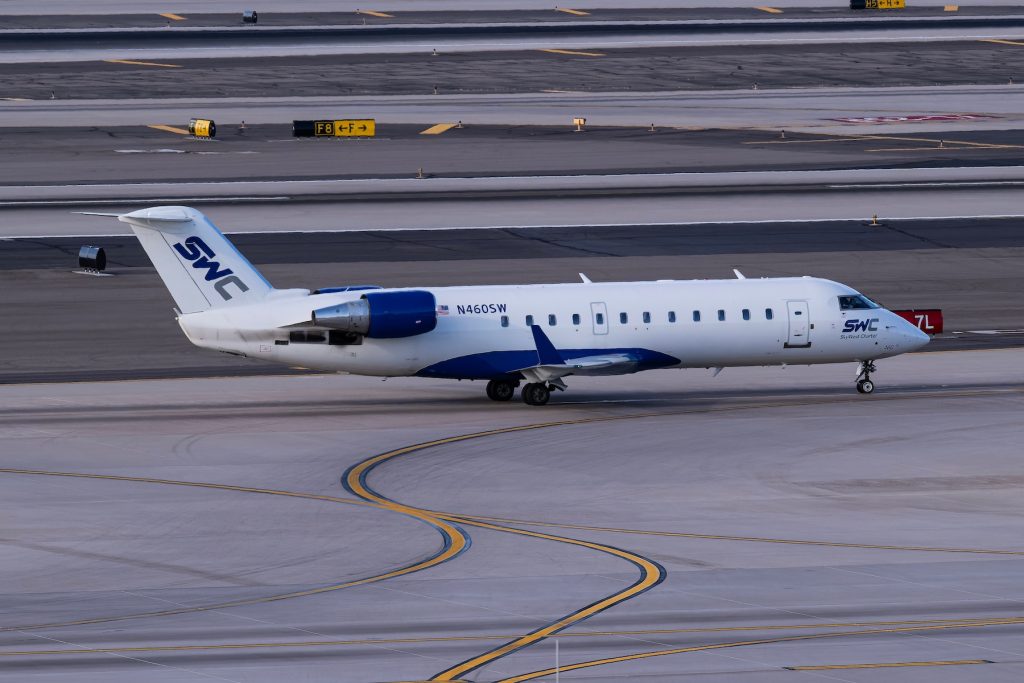
A SkyWest Charter CRJ-200 aircraft (Photo: Shutterstock | Robin Guess)

The U.S. Department of Transportation (DOT) has tentatively approved SkyWest Charter’s application to operate as a commuter air carrier, subject to certain conditions. This decision comes after nearly three years of regulatory challenges for the SkyWest subsidiary.

SkyWest Charter (SWC) plans to operate public charter flights using 30-seat CRJ-200 aircraft under Part 135 regulations. The carrier aims to serve small communities that have seen reductions in air service, potentially including Essential Air Service (EAS) markets.

In addition, the carrier currently offers on-demand charter services. It operates 18 aircraft and plans to serve 25 markets within the first year.

The DOT’s decision comes despite objections from the Air Line Pilots Association and other groups that argued that SWC’s proposed operations could undermine safety standards. However, the DOT noted that current FAA regulations allow public charter operations using aircraft with 30 or fewer seats under Part 135 rules.

In its filings, the carrier said it would exceed basic requirements for Part 135 operators. This includes operating with two ATP-rated captains, implementing safety management systems, and following Part 117 rest rules. The carrier also plans to only operate from airports with TSA checkpoints.

Continued Optimism

SkyWest CEO Chip Childs expressed optimism regarding the venture, stating the company is “reengaging” with the FAA on this “incredibly important strategic opportunity” to better serve communities.

Interested parties have 14 days to file objections to the DOT’s tentative findings. If no substantive objections are received, the agency will issue a final order, subject to SWC meeting all requirements.

Starting under the Biden administration, the FAA began reviewing regulations governing public charter operators, with potential changes that could impact carriers like SWC and JSX. It remains to be seen whether this push for regulatory change continues under Trump.

Ryan Ewing

Ryan founded AirlineGeeks.com back in February 2013 and has amassed considerable experience in the aviation sector. His work has been featured in several publications and news outlets, including CNN, WJLA, CNET, and Business Insider. During his time in the industry, he's worked in roles pertaining to airport/airline operations while holding a B.S. in Air Transportation Management from Arizona State University along with an MBA. Ryan has experience in several facets of the industry from behind the yoke of a Cessna 172 to interviewing airline industry executives. Ryan works for AirlineGeeks' owner FLYING Media, spearheading coverage in the commercial aviation space.

Saudia Will Add Over 10 New Destinations This Year

The Saudi Arabian national airline is growing its network at a significant pace. The new additions in 2025 are concentrated in Europe and the Middle East.

Airbus A321neo of Saudia, registered as HZ-ASAG (Photo: AirlineGeeks | Filip Kopec)

The national airline of the Kingdom of Saudi Arabia, Saudia, will inaugurate more than 10 new routes in 2025.

The Double Hub Model

The airline is adding to an already large international network of more than 100 destinations. Most of the network is served from Jeddah, Saudi Arabia’s cultural capital. Still, some of the routes are being added to the carrier’s secondary hub, Riyadh. The latter is the country’s political capital and the future hub of the new airline in the making, Riyadhair.

Once the second Saudi national airline begins operations, a split in the business will most likely follow. The legacy Saudi airline will continue operations in Jeddah as the premium carrier serving cultural and religious inbound tourism and the growing local population opening up to the world. The newly established Riyadhair will concentrate on connecting the capital to the world, facilitating political and commercial connections.

Saudia network in 2025 (Photo: flightconnections.com)

The Magic Number

Following the successful marketing campaign of its local rival, Etihad Airways, Saudia engaged with its customers launching more than 10 routes in 2025.

The airline will add a significant number of short-haul routes including Larnaca (Cyprus), Heraklion (Greece), Antalya (Turkey), El Alamein (Egypt), Salalah (Oman), and Athens (Greece). All were added to the Jeddah hub, with Athens being added to Riyadh as well.

The Riyadh hub additions to Saudia’s network are concentrated in Europe. Five medium-haul routes launched from Riyadh include Malaga (Spain), Venice (Italy), Nice (France), and Vienna (Austria) with the latest being added to both hubs.

A cherry on top is the Denpasar route (Indonesia). The destination is growing in popularity, especially among Middle Eastern carriers. Indonesia is the largest Muslim country in the world though, so the connection makes sense from both ends.

10+ routes added by Saudia in 2025 (Photo: Great Circle Mapper @ gcmap.com)

Saudia quotes 16% of passengers carried growth in 2024, a record-breaking year for the carrier. The airline is gearing up for another impactful year and that seems to be just the beginning. Saudia’s planned delivery of 118 new aircraft during the upcoming years will further increase the capability for growth. What remains to be seen is if any of the delivery slots are going to be transferred to Riyadhair.

Engr. Ibrahim Al-Omar, director general of Saudia Group, said: “Following last year’s operational success, we’ve implemented a strategic plan for 2025 to ensure continued excellence and meet rising international travel demand. Our destination selection is based on comprehensive feasibility studies and guest preferences. We are committed to providing our international guests with exceptional travel experiences that combine comfort, efficiency, and authentic Saudi hospitality.”

Filip Kopeć

A passionate aviation enthusiast that started off his career as an aerospace engineer, but found his true calling on the commercial side of the airline business. Now as a finance guy among avgeeks and an avgeek among finance guys, he has experience working in the Revenue Divisions of three airlines. In his spare time he enjoys traveling, but admittedly sometimes is more about the journey than the destination.

Delta Expands in Raleigh

The addition comes as the airline's regional subsidiary, Endeavor Air, said it would open a crew base in the North Carolina city.

Multiple aircraft
Regional aircraft at New York LaGuardia Airport. (Photo: AirlineGeeks | William Derrickson)

Delta is growing in Raleigh/Durham with a new route. The addition comes as the airline’s regional subsidiary, Endeavor Air, said it would open a crew base in the North Carolina city.

Brand-new daily service to Kansas City, Missouri, will begin on May 7, per this week’s Cirium Diio schedule update. Flights will operate daily with a 76-seat Endeavor CRJ-900 aircraft.

The airline will compete with Southwest, which flies between Raleigh and Kansas City twice per week. The schedule for Delta’s new service is as follows:

Orig. Dest. Dep. Time Arr. Time
MCI RDU 6:55 p.m. 10:19 p.m.
RDU MCI 7:55 a.m. 9:41 a.m.

Raleigh/Durham is set to become Endeavor’s seventh crew domicile, opening in the second quarter of this year. The regional airline operates a fleet of CRJ-700 and CRJ-900 aircraft.

Ryan Ewing

Ryan founded AirlineGeeks.com back in February 2013 and has amassed considerable experience in the aviation sector. His work has been featured in several publications and news outlets, including CNN, WJLA, CNET, and Business Insider. During his time in the industry, he's worked in roles pertaining to airport/airline operations while holding a B.S. in Air Transportation Management from Arizona State University along with an MBA. Ryan has experience in several facets of the industry from behind the yoke of a Cessna 172 to interviewing airline industry executives. Ryan works for AirlineGeeks' owner FLYING Media, spearheading coverage in the commercial aviation space.

NTSB Notes Altitude ‘Discrepancy’ in Midair Collision

The agency's chair says it is seeing "conflicting information in the data" regarding the helicopter’s altitude before the collision.

A crane removes airplane wreckage from the Potomac River (Photo: ROBERTO SCHMIDT/AFP via Getty Images)

The National Transportation Safety Board (NTSB) said there may have been an altitude discrepancy between both aircraft involved in a fatal collision over the Potomac River during a press conference in Washington, D.C., on Friday afternoon.

The press briefing comes just over two weeks after a midair collision occurred between a PSA CRJ-700 and U.S. Army Black Hawk helicopter near Ronald Reagan Washington National Airport on Jan. 29.

NTSB Chair Jennifer Homendy detailed several key factors in the collision during Friday’s briefing.

Altitude Discrepancy

Homendy said that the crew aboard the Black Hawk helicopter were on an Army “check ride,” which utilized night vision goggles. She said that NTSB believed the crew was all wearing these night vision goggles.

During the check ride, the helicopter was operated by a pilot and instructor. Homendy said that at 8:43 p.m. ET, five minutes before the collision, the Black Hawk’s pilot indicated the helicopter was at 300 feet, while the instructor pilot said they were at 400 feet.

“Neither pilot made a comment discussing an altitude discrepancy,” she added. “At this time, we don’t know why there was a discrepancy between the two. That’s something that the investigative team is analyzing.”

The radio altitude of the Black Hawk was 278 feet, though Homendy cautioned that this is not what the crew may have seen on their instruments.

In addition, the helicopter was equipped with ADS-B Out capabilities, but investigators do not know why it wasn’t transmitting.

Investigators examine wreckage from the CRJ-700. (Photo: NTSB)

Transmission Trouble

Homendy said at 8:46 p.m., a radio transmission from the air traffic control tower was audible on the CRJ’s cockpit voice recorder (CVR) informing the Black Hawk that traffic just south of the Wilson Bridge was a CRJ at 1,200 feet “circling” to Runway 33.

“CVR data from the Black Hawk indicated that the portion of the transmission stating the CRJ was ‘circling’ may not have been received by the Black Hawk crew,” she said. “We hear the word ‘circling’ in ATC communications, but we do not hear the word ‘circling’ on the CVR of the Black Hawk. The recorders group is evaluating this right now.”

At 8:47 p.m., 17 seconds before impact, the Black Hawk was directed by air traffic control to “pass behind” the CRJ. Homendy said that this radio transmission was audible on both CVRs.

“CVR data from the Black Hawk indicated that the portion of the transmission that stated ‘pass behind the’ may not have been received by the Black Hawk crew,” she said. “Transmission was stepped on by a 0.8-second mic key from the Black Hawk. The Black Hawk was keying the mic to communicate with [air traffic control].”

Homendy added that the NTSB is seeing “conflicting information in the data,” which is why the agency isn’t releasing altitude for the Black Hawk’s entire route.

Last week, the remains of all 67 victims from both aircraft were recovered and identified. Recovery efforts by Unified Command in the Potomac River were completed earlier this week, and all airport runways were reopened as of Monday.

Ryan Ewing

Ryan founded AirlineGeeks.com back in February 2013 and has amassed considerable experience in the aviation sector. His work has been featured in several publications and news outlets, including CNN, WJLA, CNET, and Business Insider. During his time in the industry, he's worked in roles pertaining to airport/airline operations while holding a B.S. in Air Transportation Management from Arizona State University along with an MBA. Ryan has experience in several facets of the industry from behind the yoke of a Cessna 172 to interviewing airline industry executives. Ryan works for AirlineGeeks' owner FLYING Media, spearheading coverage in the commercial aviation space.

‘Alitalia’ Brand Returns to the Skies

The long-troubled Italian flag carrier can now start looking at the future and plan to strategically utilize all of its assets.

ITA Airways' Airbus A350-900 EI-IFA "inspired by Alitalia" (Photo: ITA Airways)

Editor’s Note: AirlineGeeks is proud to present our ‘Livery of the Week’ series. Every Friday, a team member will share an airline livery, which can be from the past, present, or even a special scheme. Some airline liveries are works of art. The complexity associated with painting around critical flight components and the added weight requires outside-the-box thinking from designers. The average airliner can cost upwards of $200,000 to repaint, creating a separate aircraft repainting industry as a result. 

Have an idea for a livery that we should highlight? Drop us a line

With ITA Airways now officially part of the Lufthansa Group following the E.U.-approved purchase of 41% of the shares last November, the long-troubled Italian flag carrier can now start looking at the future and plan to strategically utilize all of its assets.

One of the remnants of the past is the Alitalia brand, which ITA Airways chose to maintain during the liquidation process of the former flag carrier. For a “bargain” price of 90m Euros (over $100m at the time), ITA Airways retained the right to use the IATA two-letter code for its flight numbers (AZ) and the IATA accounting code (055) for its ticket stock as well as the use of the iconic red, white and green stylized “A” that had been the symbol of Alitalia for almost half a century.

And while the codes were transferred almost seamlessly from Alitalia to ITA Airways for continued operational use, the Alitalia logo is only now making a return to the skies. After several weeks of unconfirmed rumors following a vague announcement last September, on Valentine’s Day (Feb. 14), the Italian company confirmed in a press release the introduction of an “inspired by Alitalia” sticker on three new generation aircraft of its fleet.

Honoring Italian Aviation History

The first aircraft to showcase this phrase on its livery will be the Airbus A350-900 aircraft “Valentino Rossi,” registered as EI-IFA, on its flight between Rome Fiumicino and Tokyo Haneda.

ITA Airways Airbus A350-900 EI-IFA “inspired by Alitalia” (Photo: ITA Airways)

In Summer 2025, the “Inspired by Alitalia” sticker will appear on an Airbus A321neo aircraft, usually deployed on medium-range routes, as well as an Airbus A220-100 aircraft, primarily operated on short-haul flights.

ITA Airways Airbus A350-900 EI-IFA “inspired by Alitalia” (Photo: ITA Airways)

“In this way, ITA Airways continues to work towards being the airline of choice for those not only wishing to fly to Italy but also carrying Italy in their hearts. The Alitalia brand, a key asset owned by ITA Airways, honors the history of aviation and the country with its pioneering excellence in air transport. Through this concrete and ambitious project, ITA Airways aims to associate the Alitalia brand with its own distinctive ‘ITA Airways’ logo, reinforcing its values of excellence in air transport that are universally recognized worldwide”, says the press release.

Looking for a new airplane model? Head over to our friends at the Midwest Model Store for a wide selection of airlines and liveries.

Vanni Gibertini

Vanni fell in love with commercial aviation during his undergraduate studies in Statistics at the University of Bologna, when he prepared his thesis on the effects of deregulation on the U.S. and European aviation markets. Then he pursued his passion further by obtaining a Master’s Degree in Air Transport Management at Cranfield University in the U.K. followed by holding several management positions at various start-up carriers in Europe (Jet2, SkyEurope, Silverjet). After moving to Canada, he was Business Development Manager for IATA for nine years before turning to his other passion: sports writing.

CommuteAir Starts Using VR Headsets for Pilot Training

Regional airline CommuteAir has begun using virtual reality headsets for its Advanced Qualification Program pilot training curriculum.

Virtual reality headsets being used for pilot training (Photo: CommuteAir)

CommuteAir has begun using virtual reality headsets for its Advanced Qualification Program (AQP) pilot training curriculum.

By implementing Visionary Training Resources’ (VTR) FlightDeckToGoTM advanced pilot training systems, the regional airline says it will remain at the forefront of pilot education.

In a Feb. 6 news release from VTR, the virtual reality software company stated its program was designed for use with the Meta Quest 3 headset to provide pilots with an “unmatched training experience.”

FlightDeckToGoTM gives pilots the ability to practice ground-based flows with eye-tracking in real-time, anytime.

“The use of VR is relatively new to the commercial aviation industry; however, it has been used in heavy industry, medical, and the military with good results,” said Lance Lau, director of training at CommuteAir, in the release. “We believe that through the use of virtual reality in pilot training, we will be able to greatly enhance the technical proficiency of our pilots.”

CommuteAir, a United Express partner airline, partnered with VTR and the Federal Aviation Administration to detail the training program’s usage and expected outcomes.

A CommuteAir Embraer E145 aircraft (Photo: CommuteAir)

Once the program is approved, CommuteAir will be one of the few airlines on the planet to incorporate VR training with FAA acknowledgment.

“This groundbreaking virtual reality training device along with our partnership with VTR has enabled us to revolutionize how we prepare new pilots for their transition to the ERJ145 flight deck,” said CommuteAir CEO Rick Hoefling, in the release. “This technology allows for safe, effective, hands-on learning that is paving the way for a future where training isn’t just effective, but transformative.”

The release stated the program will grant CommuteAir pilots a unique opportunity to continuously refine their skills in a VR Embraer 145 flight deck with a near identical aspect ratio.

“Many of our trainees have grown up with this technology and its use is almost second nature with them,” Lau said. “Our plan is to supplement normal procedures by using VR and establish the proof of concept in an effort to certify this as a training device. Upon certification, we expect to greatly increase its use in a variety of procedures.”

AirlineGeeks.com Staff

AirlineGeeks.com was founded in February 2013 as a one-person blog in Washington D.C. Since then, we’ve grown to have 25+ active team members scattered across the globe. We are all here for the same reason: we love deep-diving into the fascinating realm of the airline industry.
Sign-up for newsletters & special offers!

Get the latest stories & special offers delivered directly to your inbox

SUBSCRIBE

Uh-oh! It looks like you're using an ad blocker.

Our website relies on ads to provide free content and sustain our operations. By turning off your ad blocker, you help support us and ensure we can continue offering valuable content without any cost to you.

We truly appreciate your understanding and support. Thank you for considering disabling your ad blocker for this website