









A Sun Country 737 in Los Angeles (Photo: AirlineGeeks | Katie Zera)
Minneapolis-based ultra-low-cost carrier Sun Country has announced two new routes from its Minneapolis/St.Paul hub. The carrier will offer routes from Minneapolis to Monterey and Manchester-Boston Regional Airport.
Flights to each destination will launch in August. Flights to Monterey will operate twice weekly, while flights to Manchester will operate once weekly. Neither flight will face direct competition, though JetBlue will indirectly compete in the Boston market with its flight to Boston’s Logan International Airport.
Each flight plays an important role in the Minneapolis market. Monterey is the latest warm, sunny destination for midwesterners seeking a getaway. Meanwhile, Sun Country believes its flight to Manchester will capture a key market: passengers traveling between the two cities to visit family and friends.
“Sun Country’s route to MSP is a highly requested route and is an easy nonstop flight for Granite Staters to reach the natural beauty that can be found in the Twin Cities. Coupled with our convenient and easy-to-access airport and the simplicity of Sun Country’s terminal in MSP, this creates a perfect combination for residents of New Hampshire flying to Minneapolis and beyond and for visitors ready to explore our beautiful state,” said Manchester-Boston Regional Airport Director Ted Kitchens.
“We are grateful for this incredibly exciting addition to our airport and look forward to a long and successful partnership with Sun Country Airlines,” Kitchens continued.
“Minnesotans will be eager to visit New Hampshire for the American history it offers and the beautiful fall colors of New England,” Grant Whitney, Sun Country Senior Vice President and Chief Revenue Officer, said, about the Manchester route.
“Sun Country and our Minneapolis/St. Paul community will warmly welcome visitors from New Hampshire to Minnesota, where you’ll experience great fall weather, scenic lakes throughout the city, outdoor activity, and a terrific entertainment and restaurant scene,” Whitney added.
Monterey, meanwhile, hosts a notable aquarium in addition to multiple golf courses. It is also a relatively short drive from the Bay Area.
Airline’s Diversified Business Model
Both new routes align closely with Sun Country’s charter business. The carrier often strives to closely match scheduled and chartered routes to improve operational efficiency. In particular, Sun Country can use its limited scheduled service as a way to profit off of flights used to reposition aircraft already flying to pick up charter passengers.
“Our unique ability to integrate our scheduled service and charter business is a differentiator that allows us to meet our customers’ needs while maximizing efficiency,” Whitney said. “Sun Country is proud of our diversified business model of scheduled service, charter, and cargo.”
This model will also allow Sun Country to add flights to Atlanta, Ga. and Austin, Texas starting next month. Toronto and Montreal, as well as destinations in Montana, Idaho, and New Mexico, have recently been added.
Sun Country says that the 100+ destinations it serves give “customers and community an unparalleled breadth of destinations for a leisure airline.”
John McDermott is a commercial pilot pursuing a career in professional flight. His passion for aviation began in an Ann Arbor bookstore with a tale of enemy pilots during World War 2, and he hasn't looked back. Besides flying and writing for AirlineGeeks, John volunteers with Professional Pilots of Tomorrow and travels whenever he gets the chance.
Trip Report: Icelandair Saga Premium from Copenhagen to Iceland
Icelandair serves many destinations in North America, and even more in Europe. We flew in Saga Premium on a European hop from Copenhagen to Reykjavik/Keflavik.
The Rolls Royce engines on the Boeing 757 (Photo: AirlineGeeks | Joey Gerardi)
Icelandair serves many destinations in North America, and even more in Europe. The airline offers an extensive stopover program that allows people the chance to fly from Europe to North America (or vice versa) on board Icelandair with a stop in their home country.
These stopovers can last anywhere from a couple of hours or as much as a week at no extra cost. Given that I was in Europe and needed to get to Minneapolis, I decided to test out just how easy a short connection in their home country would be.
Day of the Trip
My flight was scheduled to leave Copenhagen, Denmark’s main airport just after 2 p.m., but given it was an international flight I decided to get to the airport three hours ahead of the scheduled departure time which proved to be way too much time.
The lobby of Copenhagen Kastrup (Photo: AirlineGeeks | Joey Gerardi)
I made it through security in no time, with my ticket being in Icelandair’s forward cabin called ‘Saga Premium’, which came with lounge access. Given my short connection in Reykjavik/Keflavik, I was not able to stop at the lounge in Iceland which is too bad as I have seen pictures and it does look amazing. However, I was able to use the SAS Lounge in Copenhagen, which is the partner lounge at this airport for Icelandair passengers.
The SAS lounge in Copenhagen that Icelandair premium passengers get access to (Photo: AirlineGeeks | Joey Gerardi)
I knew that there would be food on the plane, so I ate light and got some bread with cheese, along with some tomatoes. I spent about an hour in the lounge charging up my phone and relaxing before heading to the gate for my flight.
The food in the SAS lounge in Copenhagen (Photo: AirlineGeeks | Joey Gerardi)
It wasn’t long before my aircraft pulled into the gate, a Boeing 757-200 that was delivered directly to Icelandair in 2001 and carried the registration of TF-FIV. The aircraft is named Katla, which is an active volcano located in southern Iceland.
My aircraft ‘Katla’ for the flight up to Iceland (Photo: AirlineGeeks | Joey Gerardi)
My seat was 5A in the previously mentioned Saga Premium cabin, despite this plane being over 20 years old, the cabin looked new and recently updated and the seats and cabin are nearly identical to their newer Boeing 737 MAX. waiting at my seat was a pillow and Icelandic water, there were also headphones for us to borrow.
My seat 5A in ‘Saga Premium’ (Photo: AirlineGeeks | Joey Gerardi)
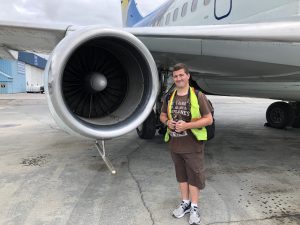
Once the jetbridge pulled back, it gave way to a beautiful view of the mighty Rolls Royce engines on this 757.
The wonderful engine view from my seat (Photo: AirlineGeeks | Joey Gerardi)
It was a quick taxi out to the runway and we rocketed into the skies out of Copenhagen. Given this aircraft can make flights up to seven hours, this three-hour hop up to Iceland was no problem. The video of the takeoff can be found at the bottom of this article.
Taking off out of Copenhagen onboard Icelandair (Photo: AirlineGeeks | Joey Gerardi)
The entire cabin screams Iceland, from the water bottles and even the sick bags which have cool facts about Iceland on the back of them. The seats have plugs in between them that can handle not only the European type C plug but also the North American plug among others.
They then passed out the menus for the meal, and we could choose from a hot or a cold meal option, along with the other pre-lunch snacks listed as well as the drink options.
The first thing to come out was just 30 minutes after takeoff, a small bowl of cheese bread along with a drink of choice which for me was sparkling apple cider.
The Cheese bread they served us before the main meal (Photo: AirlineGeeks | Joey Gerardi)
The Boeing 757 has really good performance, especially on shorter flights like this, making the climb up to our 38,000 feet (11,582.40 meters) cruising altitude quick and painless.
About an hour after takeoff lunch was served, and I chose the cold meal option. The meal consisted of Morrocan chicken with pickles red onion and wasabi dressing, bread with whipped butter and Icelandic sea salt as a side, and basque-style San Sebastian cheesecake as dessert.
The lunch served on my Copenhagen to Iceland flight (Photo: AirlineGeeks | Joey Gerardi)
I settled in to watch a quick movie, as by this point in the flight it wasn’t long enough for a full two-hour movie. The views going up to Iceland consisted mostly of water and clouds as it was only the ocean below us.
At our cruising altitude over the ocean (Photo: AirlineGeeks | Joey Gerardi)
About 30 minutes after the food came out and I was deep into my movie, they brought out a small tray of chocolate, with each one having the name of an Icelandair aircraft and Icelandic landmark with its silhouette on the wrapper.
The tray of Chocolate they brought out with Icelandic landmarks on them (Photo: AirlineGeeks | Joey Gerardi)
Even though it was only open ocean, I still looked outside every 20 minutes or so, as that is the best part about being by the window… the views out the world below.
Roughly an hour before landing they came around with more, but a different, kind of chocolate. It was in a very cool-looking blue box, and it kinda was designed to look like waves and icecaps and was artisanal.
The Artisanal chocolate they brought around closer to landing (Photo: AirlineGeeks | Joey Gerardi)
Not long after that, we passed over Katla, the landmark this aircraft was named after. Due to clouds, we couldn’t see the peak of it, but we were able to see the base which was still pretty cool as it’s not often I fly over an aircraft namesake.
The base of Katla, the volcano this aircraft is named after (Photo: AirlineGeeks | Joey Gerardi)
By this point in the flight we had already begun to descend into Reykjavik. The scenery going into Iceland was beautiful despite the clouds that surrounded the island and the mountains. We made a straight-in approach from the east and didn’t make any sharp turns going into Reykjavik/Keflavik.
On approach to Reykjavik/Keflavik (Photo: AirlineGeeks | Joey Gerardi)
The landing was nice and smooth and the local time was just about 3:30 p.m., after just over three hours of flight time from Copenhagen. Given the way Icelandair’s arrival and departure banks are set up, they have a flight coming in from every European destination they serve at virtually the same time and then an hour and a half later they all leave again to North America.
Reykjavik/Keflavik’s international terminal is not big enough to park every single flight at a gate when they all arrive at nearly the same time, meaning there is a large number of remote parking spaces that have busses to come to the terminal.
Deplaning onto the ramp at Reykjavik/Keflavik Intl. (Photo: AirlineGeeks | Joey Gerardi)
With us deplaning onto the ramp, that gave passengers an up close and personal encounter with the Roll Royce engines which glimmer yellow under the sunlight.
It was a wonderful flight from Denmark and the crew was fantastic. The meal was also really good and very well put together, and I loved all of the chocolate they served along the way too.
From here I had just over an hour and a half before my flight to Minneapolis/St. Paul in the United States. Despite going from one country to another country, and transiting to a third country, my connection time was more than enough and almost too much. This main international airport in Iceland is set up so well for transiting customers, even when Icelandair has all of their European flights landing at virtually the same time, it doesn’t take more than 15 minutes or so to get to customs.
Taking off from Reykjavik/Keflavik bound for Minneapolis/St. Paul (Photo: AirlineGeeks | Joey Gerardi)
My next Icelandair flight to Minneapolis will be in a different article and video that will be posted at a later date. A video of this flight from Copenhagen to Reykjavik/Keflavik can be found below.
Editor’s Note: Icelandair provided AirlineGeeks with a seat on this flight, but this trip report is an objective portrayal of the events and is in no way swayed by that aspect.
Joey has always been interested in planes for as long as he can remember. He grew up in Central New York during the early 2000s when US Airways Express turboprops ruled the skies. Being from a non-aviation family made it harder for him to be around planes and would only spend about three hours a month at the airport. He was so excited when he could drive by himself, the first thing he did with his driver's license was get ice cream and go plane spotting for the entire day. He graduated from Western Michigan University in 2022 with a B.S. in Aviation Management & Operations and a Minor in Business, and currently works for a major airline in his hometown.
Livery of the Week: Sun Country Goes From Bland to Bold
Sun Country Airlines, the Minneapolis-based budget carrier, boasts a colorful history reflected in its ever-evolving aircraft livery designs.
A Sun Country 737 lifts off.
(Photo: AirlineGeeks | William Derrickson)
Editor’s Note: AirlineGeeks is excited to launch our ‘Livery of the Week’ series. Every Friday, a team member will share an airline livery, which can be from the past, present, or even a special scheme. Some airline liveries are works of art. The complexity associated with painting around critical flight components and the added weight requires outside-the-box thinking from designers. The average airliner can cost upwards of $200,000 to repaint, creating a separate aircraft repainting industry as a result.
Have an idea for a livery that we should highlight? Drop us a line.
Sun Country Airlines, the Minneapolis-based budget carrier synonymous with leisure destinations, boasts a colorful history reflected in its ever-evolving aircraft livery designs. From bold beginnings to employee-driven contemporary hues, each livery tells a story of an evolving brand identity.
Early Designs
Sun Country’s inaugural flight in 1983 took off with a striking orange, red, and white scheme, featuring an abstract sun and chunky lettering. This eye-catching, if not somewhat unconventional design gave way to a more streamlined iteration later.
A Sun Country 727 (Photo: JetPix (GFDL 1.2 <http://www.gnu.org/licenses/old-licenses/fdl-1.2.html> or GFDL 1.2 <http://www.gnu.org/licenses/old-licenses/fdl-1.2.html>), via Wikimedia Commons)
Seeking a more sophisticated image, Sun Country shifted to a revised livery in 1996. Much of the same color scheme remained, but the stripes along the fuselage intercepted the text. The airline’s new logo – representing a sundial – was also placed on the tail.
Bold and Blue
While rolling out its new 737 fleet, Sun Country unveiled a bold new livery in 2001. The colorful design featured watermark-like text along the fuselage with dark blue hues. Although the new livery was a major shift from previous designs, the orange stripe still remained along the fuselage.
A Son Country Boeing 737-800 in Las Vegas (Photo: AirlineGeeks | William Derrickson)
A Low-Cost Pivot
In 2018, as the carrier was transitioning to a low-cost carrier model, Sun Country embarked on a rather unique approach, seeking employee input to choose their next livery. The winning design features a vibrant blue base accented by orange stripes and a stylized sun logo. The tail section incorporates contours inspired by Minnesota’s Lake Minnetonka, a nod to the airline’s hub.
Sun Country Boeing 737s sitting at its main base in Minneapolis/St. Paul (Photo: AirlineGeeks | Joey Gerardi)
Dubbed the ‘Tide Pod’ livery, the design adorns most aircraft in the carrier’s all-Boeing 737 fleet.
Looking for a new airplane model? Head over to our friends at the Midwest Model Store for a wide selection of airlines and liveries.
Ryan founded AirlineGeeks.com in February 2013 and has spent more than a decade covering the airline business. His work has been featured by CNN, WJLA, CNET, and Business Insider. His aviation experience spans airport operations, Part 135 regulatory compliance, and airline crew workforce planning, along with time behind the yoke of a Cessna 172 and interviews with airline executives. Ryan now serves as Group President of Firecrown Media’s Aviation Group. He holds a B.S. in Air Transportation Management and an MBA from Arizona State University and teaches Airline Management at Embry-Riddle Aeronautical University.
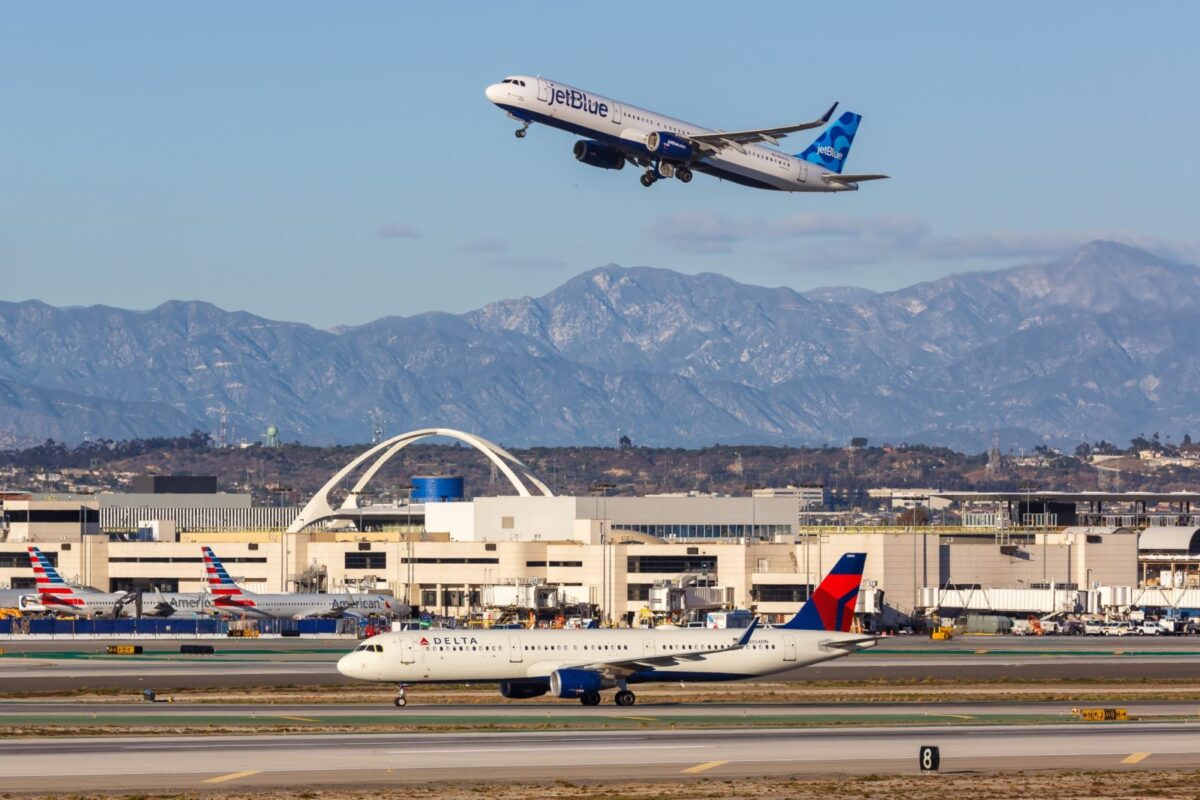
A Delta A350-900XWB in Los Angeles. (Photo: AirlineGeeks | Ryan Ewing)
On Friday, Delta announced the launch of a new seasonal route between Los Angeles and Brisbane (BNE) in Australia. The service is scheduled to begin on Dec. 4, 2024, and operate three times per week until March 28, 2025.
The Atlanta-based airline plans to operate an Airbus A350-900 on the new route. Currently, Delta serves Sydney, Auckland, and Tahiti in the Oceania region.
“With this addition of Brisbane, Delta’s upcoming winter schedule will offer our customers up to 17 weekly flights between the U.S. and Australia,” said Joe Esposito, Delta’s Senior Vice President of Network Planning, said in a press release. “This marks our most extensive schedule to the South Pacific to date, and as we build our presence in the region, we know our customers will enjoy the enhanced experience consistently provided by Delta.”
Brisbane is set to see booming U.S. airline traffic this year with American, Delta, and United now serving the capital city of Queensland. Earlier this month, American announced its longest-ever flight from Dallas/Fort Worth to Brisbane while United already serves the city from its San Francisco and Los Angeles hubs.
Ryan founded AirlineGeeks.com in February 2013 and has spent more than a decade covering the airline business. His work has been featured by CNN, WJLA, CNET, and Business Insider. His aviation experience spans airport operations, Part 135 regulatory compliance, and airline crew workforce planning, along with time behind the yoke of a Cessna 172 and interviews with airline executives. Ryan now serves as Group President of Firecrown Media’s Aviation Group. He holds a B.S. in Air Transportation Management and an MBA from Arizona State University and teaches Airline Management at Embry-Riddle Aeronautical University.
A United 737-800 in San Francisco. (Photo: AirlineGeeks | Ben Suskind)
United plans to launch daily nonstop flights between Guam and Tokyo Haneda starting on May 1, 2024. This new route joins the carrier’s current 32 flights per week from Guam to Tokyo Narita.
The service will be operated by a 737-800 aircraft with 166 seats. Currently, the flight is scheduled to depart Guam at 7 p.m. local time and arrive at Haneda at 10 p.m. on the same day. On the return segment, the flight will depart Haneda at 11:55 p.m. and arrive in Guam at 4:45 a.m. the following day.
With more than 87 weekly flights to 14 destinations, United is the largest carrier operating in Guam. The airline currently serves Osaka, Fukuoka, and Nagoya from Guam along with islands in the Federated States of Micronesia, Marshall Islands, and Palau among other routes.
“As we grow our global network, we’re always looking for opportunities to give our customers more choice and strengthen links between countries. This route – connecting Tokyo’s most convenient airport with our unique Guam hub – accomplishes just that. I appreciate the support of the Department of Transportation in recognizing the importance of this route to our customers and stakeholders,” said Patrick Quayle, United’s Senior Vice President of Global Network Planning and Alliances, in a press release on Friday.
The new flights are scheduled to operate year-round and are subject to government approval.
Ryan founded AirlineGeeks.com in February 2013 and has spent more than a decade covering the airline business. His work has been featured by CNN, WJLA, CNET, and Business Insider. His aviation experience spans airport operations, Part 135 regulatory compliance, and airline crew workforce planning, along with time behind the yoke of a Cessna 172 and interviews with airline executives. Ryan now serves as Group President of Firecrown Media’s Aviation Group. He holds a B.S. in Air Transportation Management and an MBA from Arizona State University and teaches Airline Management at Embry-Riddle Aeronautical University.
Another one bites the dust. Calgary-based airline Lynx Air communicated on Thursday night that it has sought and obtained an initial order for creditor protection from the Court of King’s Bench of Alberta. The carrier will continue to operate all its flights regularly until 12.01 a.m. MST on Monday before shutting down its operations permanently.
“Over the past year, Lynx Air, has faced a number of significant headwinds including rising operating costs, high fuel prices, exchange rates, increasing airport charges and a difficult economic and regulatory environment,” the airline said in a press release.
“Tremendous work was put into the growth and expansion of Lynx Air over the past two years, offering Canadians a low-cost, seamless travel experience for Canadians”, says Lynx Air on its website. “However, the compounding financial pressures associated with inflation, fuel costs, exchange rates, cost of capital, regulatory costs and competitive tension in the Canadian market have ultimately proven too steep a mountain for our organization to overcome. It is with a heavy heart we leave the skies. We hope in our absence that our vision to Inspire More Canadians to Fly leaves its mark on our passengers.”
Thank you for your support, it's been a pleasure to offer our affordable fares and great flying experience.
The airline had launched in 2022 focusing around Calgary and Vancouver in Western Canada, and it subsequently expanded to include the main cross-country routes to Toronto and Montreal, with services reaching as far as Halifax and St. John’s in Atlantic Canada.
At the same time, Lynx Air started services to the United States serving destinations popular with Canadian tourists and snow-birds such as Los Angeles, Las Vegas, Phoenix as well as various destinations in Florida. On Feb. 15, 2024, Lynx Air had added a third country to its network commencing a six-weekly service between Toronto Pearson and Cancun, Mexico.
The airline was operating a fleet of nine Boeing 737 MAX 8 aircraft with 189 seats in an all-economy configuration.
Lynx Air has advised all passengers holding reservations for flights after Feb. 26 to contact their credit card companies to obtain a refund on the amounts paid. Those passengers who have been caught in the middle of their trip by this announcement have been encouraged to change their reservations to one of the flights that are still operating.
During the past few weeks there had been a few rumors suggesting a possible merger between Lynx Air and Flair Airlines, the other Canadian start-up airline based in Western Canada that operates 20 Boeing 737 MAX-8 and adopts a similar business model.
Canada is proving to be a harsh environment for smaller independent carriers wishing to take the benefits of low-fare airlines to the North. A lack of lower-cost airports, high aviation taxes, a large country with a low population density and a strong stranglehold of the incumbent carriers Air Canada, Porter Airlines and WestJet on lucrative trunk routes, especially in Eastern Canada, are leaving new start-up grasping at straws looking for profitable markets to grow.
Canadian airports are among the most expensive in the world as they are responsible for repaying their own capital costs as they are not considered strategic assets to support the country’s operating system. This is reflected on some of the highest airport taxes applied on airline tickets, making it extremely difficult to stimulate markets with low fares, which is central to the business model of low-cost airlines.
Vanni fell in love with commercial aviation during his undergraduate studies in Statistics at the University of Bologna, when he prepared his thesis on the effects of deregulation on the U.S. and European aviation markets. Then he pursued his passion further by obtaining a Master’s Degree in Air Transport Management at Cranfield University in the U.K. followed by holding several management positions at various start-up carriers in Europe (Jet2, SkyEurope, Silverjet). After moving to Canada, he was Business Development Manager for IATA for nine years before turning to his other passion: sports writing.
United Announces Expansion To Flight Training Center
United Airlines has opened a significant expansion to the carrier's already large Flight Training Center in Denver, Colo.
A United Boeing 737 rotating out of Washington Dulles.
(Photo: AirlineGeeks | Peter Weiland)
Major carriers across the country have been hiring pilots at a record number since the recovery from the pandemic. Retirements are forecasted to continue with force through the end of the decade as well, begging the question of how carriers are planning to keep up with the pace. United alone says it plans to hire 10,000 new pilots this decade.
To achieve this, the carrier announced a significant expansion to the already large Flight Training Center in Denver. The expansion is a part of the carrier’s United Next Plan to incorporate an additional building to the training complex and create room for 12 additional flight simulators.
World’s Largest Flight Training Center
The Chicago-based carrier currently has the largest Flight Training Center in the world in Denver, holding all training events for the over 16,000 pilots flying for the global airline. With the addition of the new building, the complex spans 700,000 square feet of training space in eight buildings, housing 46 full-motion flight simulators. These high-tech simulators provide an environment for the carrier to train pilots on specific aircraft who have been hired and to keep current pilots current and proficient.
United’s new building at their Flight Training Center in Denver. (Photo: United Airlines)
While the new building has six simulators installed currently, the carrier has the ability to install an additional six, bringing the future total to 52 full-motion flight sims. The facility trains pilots 24 hours a day, 362 days a year. The carrier conducts over 32,000 training events each year and can now train 860 pilots a day.
The new $145 million facility is the latest part in strengthening United’s foundation in Denver, having invested $370 million in the Flight Training Center since 2016. The carrier is a significant part of the local economy in the Colorado capital, spending over $44 million last year on hotel rooms alone for the pilot group and is currently estimating a bill in excess of $64 million this year.
Into The Future
Two months into the new year, the major carrier has already hired 300 pilots after hiring 2,300 last year. This complements the airline’s plans to add 800 new narrowbody and widebody aircraft over the next decade, requiring a significant demand for qualified, professional pilots.
While the new facility will increase training capacity for the carrier, United does not believe it will be enough for the thousands of pilots the airline plans to hire and keep proficient. The major airline bought 2 parcels of land near Denver International Airport last year, intending to build a second training center, since the current facility has run out of room to expand. The second site is slated to begin training crews in 2028.
Zach’s love for aviation began when he was in elementary school with a flight sim and model planes. This passion for being in the air only intensified throughout high school when he earned his Private Pilot Certificate. He then attended Embry-Riddle Aeronautical University, earning his certificates and ratings to later flight instruct and share his passion for aviation with others. He now resides in the North East living out his dream as an airline pilot.
JetBlue Makes First Ever Bid for Essential Air Service Contract
JetBlue could be mere months away from flying to an Essential Air Service community with a first-of-its-kind proposal filed on Thursday.
Presque Isle, Maine has always been a unique Essential Air Service contract as it is farther away from its closest hub than a lot of EAS communities making it one of the more expensive contracts in the lower 48 states, Presque Isle also had the longest EAS route in the lower 48 for a short period of time when United offered a route to Wahington Dulles before switching it to Newark. It was also the first EAS city in the lower 48 states to see scheduled service with aircraft that featured a first-class section, and for many years, it was the only one.
There are four airlines proposing service to the community, whose current contract ends on May 31, 2024: Boutique Air, JetBlue, American, and the current provider at the airport United. Each contract is as follows, and includes links to the official documents.
United Airlines
The current operator at the airport is proposing something nearly identical to what it currently offers; 12-weekly flights on a 50-seat CRJ-550 to its Newark hub 515 miles away, which equates to twice daily service on most days except on the weekends. The CRJ-550 also features the ‘premium’ first-class section. The airline is stating that the “subsidy per passenger will decrease [in this contract] versus our 2022 bid.” Even with it going down, the subsidy requested per year is still a lot at $13,121,304.
United’s CRJ-550 (Photo: AirlineGeeks)
The proposal does not say how many years the contract would last, and only says, “We look forward to serving PQI [Presque Isle] for many years to come”. If selected passengers can connect to United and their partners just like any United flight departing from somewhere else.”
Boutique Air
The San Francisco-based carrier is proposing service to Boston, which is the closest hub to Presque Isle at 333 miles of direct routing. The proposal would be using its eight-seat Pilatus PC-12 or a Piaggio P180 Avanti, at a frequency of 42 flights a week equating to six flights every day. Although all flights are going to Boston and that is what the subsidy is calculated for, the company does mention that it “would like to reserve the ability to move up to 12 of the 42 weekly flights to a New York area airport.”
A Boutique Air Pilatus PC-12 in Chadron, Neb. (Photo: AirlineGeeks | Joey Gerardi)
The proposal is for a four-year contract; with the yearly subsidy rate of Pilatus PC-12 flights starting at $11,973,684 for the first year and increasing every year until the fourth year subsidy of $13,861,036. The subsidy rate for the Piaggio P180 Avanti is between $8 and $15 more expensive per year. Boutique offers interline and codeshare with United, and interline alone for American which does have a large base in Boston. This carrier hasn’t won any EAS contracts in a while, and it is currently down to just two, one of which is from Boston.
American Airlines
American is proposing EAS service to Philadelphia, which would be flown using single-class 50-seat Embraer E145s. The route would be 594 miles long and is the longest flight that is being proposed by any airline in this round of bidding for Presque Isle. Just like United, American would offer 12 weekly flights equating to two daily flights almost every day, with two days only having a single flight. The airline’s contract would run for two years and is by far the most expensive option, coming in at a subsidy rate of $17,303,949 per year.
An American Eagle Embraer E145 departing (Photo: AirlineGeeks | Joey Gerardi)
The airline currently only holds three EAS contracts, one of which operates from Philadephia and is located in northern New York state.
JetBlue Airways
Perhaps the most interesting proposal for this city is JetBlue, which has decided to throw its hat into the EAS ring for the very first time. The airline is proposing service to its Boston hub 333 miles away onboard the 100-seat Embraer E190s and did mention it would switch to the 140-seat Airbus A220 once the E190 is retired in 2025.
Service would only be offered once a day, but it is on a much larger aircraft, and flights are timed to line up with the airline’s arrival and departure banks out of the hub. The flights would leave Presque Isle at 6 a.m. and arrive in Boston at 7:40 a.m., with the flight back leaving Boston just before 8 p.m. and arriving in Presque Isle at 9:40 p.m.
Presque Isle would become JetBlue’s first year-round city in Maine, as the airline does already serve Portland, but only during the summer tourist season. This wouldn’t even be the airline’s shortest route out of Boston, as the heavily trafficked Boston to New York City sector is 187 miles. JetBlue is the newcomer to the EAS game, but it does have a solid chance of getting awarded the contract as it is also the cheapest option with the requested subsidy only being $10,400,000 for the first year and $11,200,000 for the second year.
A jetBlue Embraer E190 departs from Boston Logan Airport (Photo: Greg Linton)
JetBlue’s first-year subsidy is over a million less than the next cheapest overall option which is Boutique at $11,973,684 for year one. And, they are just under three million less than the next cheapest jet service option which is United sitting at $13,121,304, making JetBlue’s option relatively low considering the size of the jet.
If selected, Presque Isle would become the first EAS community in the lower 48 with a daily connection to an airline hub onboard a mainline-sized aircraft. Sun Country does serve Eau Claire from its Minneapolis hub with Boeing 737-800s but that service only operates twice a week.
As the proposals were just posted on Feb. 22, 2024, now they are in the comment period for some time. The current contract expires in May 2024.
Joey has always been interested in planes for as long as he can remember. He grew up in Central New York during the early 2000s when US Airways Express turboprops ruled the skies. Being from a non-aviation family made it harder for him to be around planes and would only spend about three hours a month at the airport. He was so excited when he could drive by himself, the first thing he did with his driver's license was get ice cream and go plane spotting for the entire day. He graduated from Western Michigan University in 2022 with a B.S. in Aviation Management & Operations and a Minor in Business, and currently works for a major airline in his hometown.
VietJet Inks First Widebody Deal at Singapore Airshow
VietJet Air, Vietnam's budget carrier, signed a memorandum of understanding (MoU) at the Singapore Airshow to acquire 20 Airbus A330neos.
VietJet Air, Vietnam’s budget carrier, signed a memorandum of understanding (MoU) at the Singapore Airshow on Wednesday to acquire 20 Airbus A330-900neo aircraft. When finalized, this will be Vietjet’s first-ever widebody order. This strategic move signifies a significant leap forward for the airline, modernizing its fleet, expanding its long-haul network, and driving its commitment to sustainability.
The new widebody jets will replace VietJet’s existing fleet of seven leased A330-300s, with deliveries commencing in 2026. According to Airbus, the A330-900s boast enhanced technology and deliver 25% better fuel efficiency, aligning with VietJet’s growing focus on environmental responsibility.
“We are excited to work with VietJet on the next phase of the carrier’s expansion,” said Airbus CEO Christian Scherer in a press release. “The A330neo will enable the airline to achieve the lowest possible operating costs per seat and to continue to offer its customers the best possible value wherever they fly. It will also be the perfect complement to the A321XLRs already on order with the airline, as it spreads its wings to more far-flung destinations.”
Upgrading the Game
The new A330-900s are expected to be deployed on key long-haul routes, enhancing VietJet’s reach beyond its current regional focus. The airline currently operates its A330-300s on routes connecting its hubs in Hanoi and Ho Chi Minh City to destinations like Delhi, Melbourne, and Sydney. Expanding its long-haul network aligns with VietJet’s ambitious growth plans, targeting new markets and catering to a growing demand for affordable long-distance travel.
The official order for the A330-900s is expected to be confirmed by the end of March. This deal marks a significant investment for VietJet, estimated at around $6.1 billion based on list prices.
Powered by Rolls-Royce Trent 7000 engines, the A330-900 boasts a 7,200 nautical mile (13,300 kilometers) range, allowing for non-stop journeys across vast distances. As of January 2024, the A330 Family has garnered 1,771 firm orders from over 130 customers worldwide.
Tolga is a dedicated aviation enthusiast with years of experience in the industry. From an early age, his fascination with aviation went beyond a mere passion for travel, evolving into a deliberate exploration of the complex mechanics and engineering behind aircraft. As a writer, he aims to share insights , providing readers with a view into the complex inner workings of the aviation industry.
Air Canada Launches Regional Bus Connections
Air Canada is joining the trend of airlines offering regional bus service, with a newly announced partnership with coach operator Landline.
Air Canada launched bus service last year (Photo: Air Canada)
Air Canada is joining the trend of airlines offering regional bus service, with a newly announced partnership with coach operator Landline. The airline will start offering service between Toronto Pearson International Airport and two smaller airports nearby starting in May.
Air Canada and Landline’s New Bus Connections
The new bus service will connect Toronto Pearson with John C. Munro Hamilton International Airport and Region of Waterloo International Airport. Hamilton is situated just outside the Greater Toronto Area and the airport serves both the city itself and the surrounding region. Meanwhile, Region of Waterloo International Airport serves the Kitchener–Waterloo region, a metropolitan area in southern Ontario.
Both airports are approximately fifty miles away from Toronto Pearson, which translates to a driving time of under one hour without traffic. The bus service will only be offered as a connection to or from a flight at Toronto Pearson, meaning that travelers will not be able to book the bus trips as an individual segment.
Travelers departing from Hamilton or Kitchener–Waterloo can check in online or at new Air Canada check-in counters at the two airports. Bags can be checked at Hamiton or Kitchener–Waterloo and the bus will depart from the curb outside the check-in area. However, passengers connecting onto the buses after a flight arriving at Toronto Pearson will have to pick up their luggage at the baggage claim before proceeding to their bus.
The buses will be operated by Landline, an American company that specializes in air-to-ground connections. The Canadian-made coaches will have 36 reclining leather seats in a 2-1 configuration. Travelers will have in-seat power, a tray table, free Wi-Fi, and access to an onboard lavatory.
Air Canada’s new multimodal service will begin as a pilot project in May of 2024. There will initially be six daily round trips between each of the smaller airports and Toronto Pearson.
Motor coach company Landline will operate Air Canada’s new regional bus connections using Canadian-made Prevost buses (Photo: Air Canada)
Regional Connectivity and Competition
Although Landline buses have been used to replace aircraft on some regional routes in the United States, Air Canada currently does not have service to either Hamilton or Kitchener–Waterloo. Air Canada previously operated flights between Hamilton and Montreal but axed the route in 2019 due to low sales.
Air Canada will therefore be entering markets that are currently occupied by some of its smaller competitors. Flair Airlines has a strong presence in Kitchener–Waterloo, while Sunwing and WestJet – and previously Swoop – also serve both airports. Hamilton is also served by Air Transat and Icelandic low-cost carrier PLAY, which operates up to seven flights per week to Reykjavík.
It is already common for residents across southern Ontario to fly out of Toronto Pearson. However, the newfound convenience of the bus connections could stimulate new demand among potential travelers. Air Canada’s new connecting service to these two airports is also set to tap into the pool of travelers who would otherwise choose to fly out of their regional airports with a competing airline.
“Every day, thousands of customers face a stressful, time consuming journey from Hamilton and Waterloo Region to Toronto Pearson airport,” said Nick Johnson, Vice President, Commercial for Landline in a press release. “Customers will love letting Landline and Air Canada do the driving for them, enjoying a connected experience while relaxing on one of our luxury motorcoaches.”
Canadian airports have not been immune to these challenges as well. Passenger traffic at John C. Munro Hamilton International Airport was growing rapidly before the pandemic, rising from 312,839 passengers in 2016 to 955,373 passengers in 2019. The airport saw 645,789 passengers in 2022 and 2023 figures are expected to be higher when they are released.
Meanwhile, Region of Waterloo International Airport had its busiest year ever in 2023, soaring well above pre-pandemic figures. 445,312 passengers traveled through the airport in 2023, compared to 76,943 in 2019 and 127,824 in 2016. This post-pandemic growth has largely been fueled by Flair Airlines, which began service at the airport in 2021. Flair now serves over a dozen domestic and international destinations from the airport.
“Air Canada is focused on improving regional services and through this innovative partnership with The Landline Company, we are connecting communities and extending our network by offering customers a convenient, stress-free multimodal option,” Air Canada’s Vice President of Network Planning, North America, and Scheduling, Alexandre Lefevre, said in a press release.
Landline’s Steady and Ambitious Growth
Since it began its first airline partnership with Sun Country Airlines in 2019, Landline has grown steadily over the coming years. The Colorado-based company now operates regional bus connections for United Airlines out of Denver and Newark, and for American Airlines out of Philadelphia. Air Canada will be its first international partner.
Landline’s largest partnership is with American Airlines (Photo: Landline)
The company has thrived in the post-pandemic world where airlines are seeking to balance connectivity with their staffing and regional capacity constraints. In 2023, Landline was also approved for airside-to-airside operations at certain airports in the United States, improving the connecting experience.
Andrew is a lifelong lover of aviation and travel. He has flown all over the world and is fascinated by the workings of the air travel industry. As a private pilot and glider pilot who has worked with airlines, airports and other industry stakeholders, he is always excited to share his passion for aviation with others. In addition to being a writer, he also hosts Flying Smarter, an educational travel podcast that explores the complex world of air travel to help listeners become better-informed and savvier travelers.