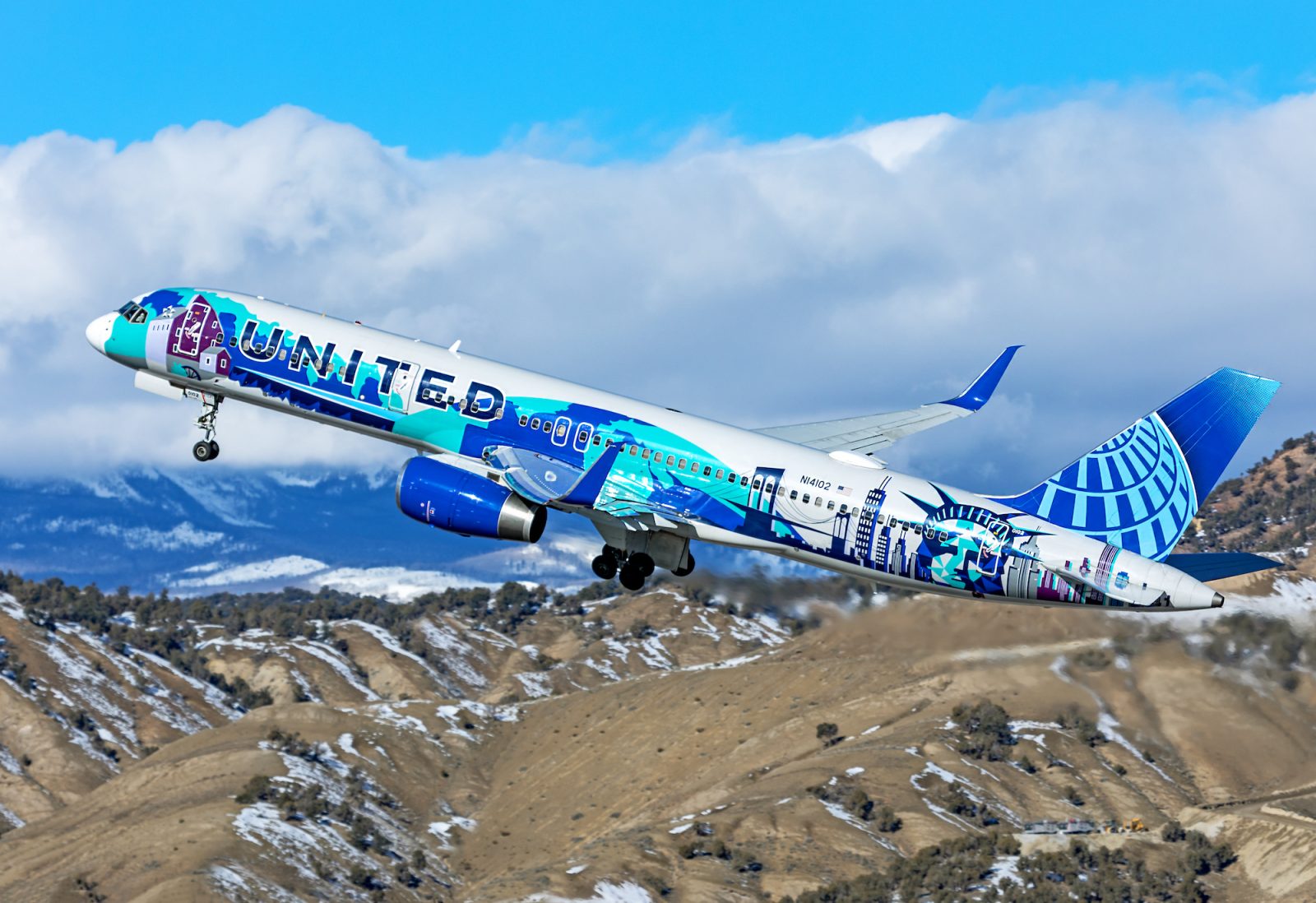
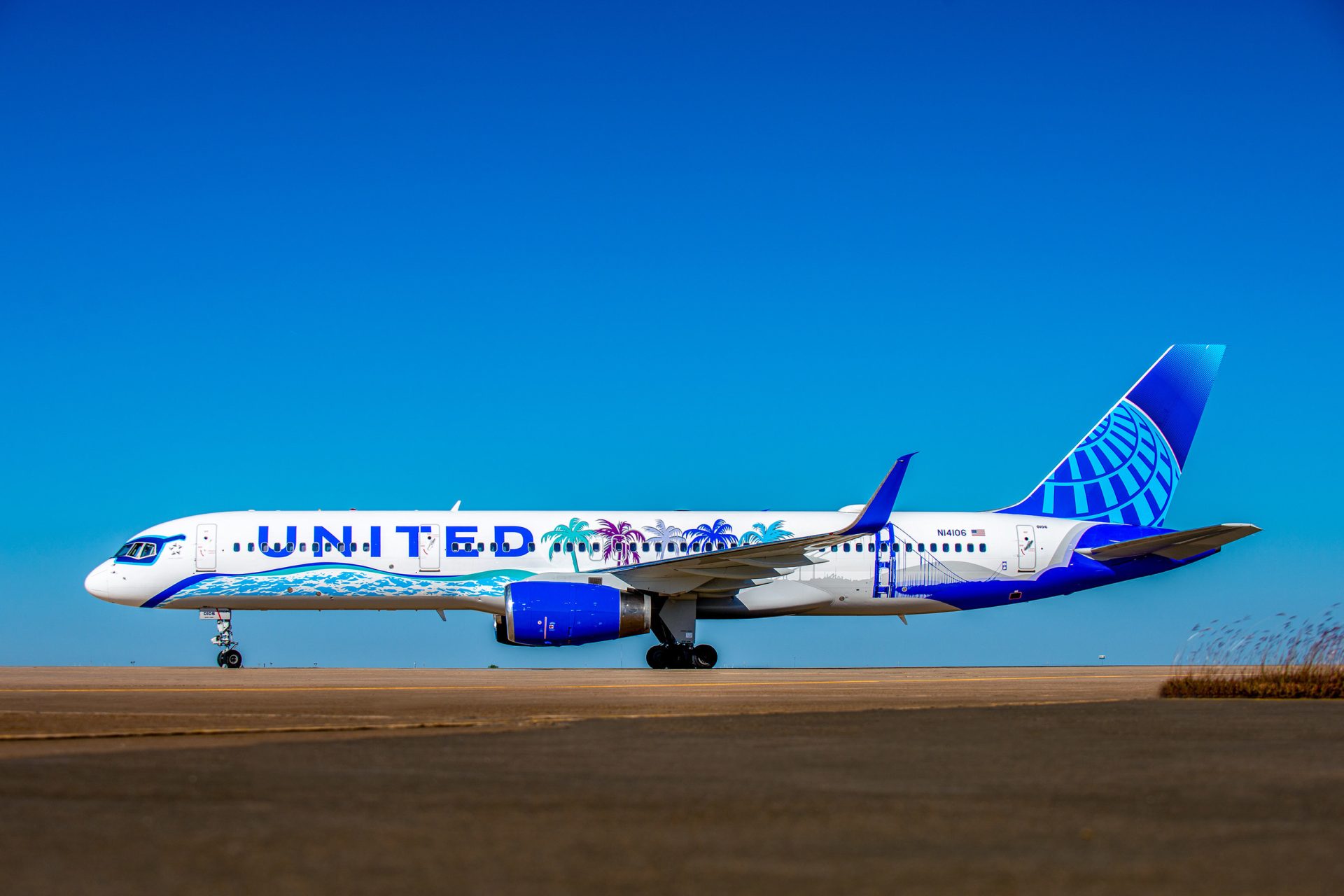
A United 757-200 adorned with a 'Her Art Here' special livery. (Photo: AirlineGeeks | William Derrickson)
Editor’s Note: AirlineGeeks is excited to launch our ‘Livery of the Week’ series. Every Friday, a team member will share an airline livery, which can be from the past, present, or even a special scheme. Some airline liveries are works of art. The complexity associated with painting around critical flight components and the added weight requires outside-the-box thinking from designers. The average airliner can cost upwards of $200,000 to repaint, creating a separate aircraft repainting industry as a result.
Have an idea for a livery that we should highlight? Drop us a line.
In 2019, United launched the “Her Art Here” program to celebrate women artists. The initiative invited female artists residing in the United States to design a special livery for a Boeing 757-200 aircraft. Two winning designs would be chosen and displayed on the aircraft, transforming them into flying works of art.
The competition received submissions from a variety of talented artists. The winners, Corinne Antonelli and Tsungwei Moo, were selected for their creative visions.
Antonelli, a New Jersey native, used her design to showcase the New York region’s iconic landmarks, including the Manhattan skyline and Statue of Liberty. Moo, based in California, brought the Golden State’s vibrancy to life with her artwork. Passengers flying on these aircraft are treated to a visual journey across the United States.
“Winning the Her Art Here contest means the world to me. When I was a young girl I had many artists I looked up to and felt inspired by and now I have the opportunity to become a role model for other young girls looking to pursue a career in the arts. It feels amazing being selected as the winner from the New York and New Jersey region – I’ve lived in New Jersey my entire life and have fallen in love with the state,” Antonelli said in a press release.
United’s ‘Her Art Here’ 757 aircraft (Photo: United)
Both liveries were then applied to the Boeing 757-200s, creating a unique look that celebrated artistic expression. The program aimed to raise awareness of the significant contributions women make in the arts.
Both aircraft continue to operate in United’s fleet. The New York/New Jersey adorns N14102 while the California design is on N14106.
Looking for a new airplane model? Head over to our friends at the Midwest Model Store for a wide selection of airlines and liveries.
Ryan founded AirlineGeeks.com in February 2013 and has spent more than a decade covering the airline business. His work has been featured by CNN, WJLA, CNET, and Business Insider. His aviation experience spans airport operations, Part 135 regulatory compliance, and airline crew workforce planning, along with time behind the yoke of a Cessna 172 and interviews with airline executives. Ryan now serves as Group President of Firecrown Media’s Aviation Group. He holds a B.S. in Air Transportation Management and an MBA from Arizona State University and teaches Airline Management at Embry-Riddle Aeronautical University.
A Wizz Air A321 aircraft in the airline's new livery. (Photo: Wizz Air)
Hungarian ultra-low-cost carrier Wizz Air and U.K. biofuel company Firefly have announced a partnership that aims to power 10% of flights operated by the carrier with sustainable aviation fuels (SAF) produced out of human waste by the year 2030.
The Firefly plant located in Harwich, Essex, will be converted to convert human feces into SAF of which they are planning to deliver up to 525,000 tonnes over 15 years starting in 2028.
This initiative is part of Wizz Air’s effort to reduce its carbon emission per passenger/km by 25% by 2030. The aviation industry as a whole has set itself a very ambitious target to be carbon neutral by the year 2050, and according to IATA (International Air Transport Association), 80% of the reduction in emissions will be achieved through the use of SAF.
In February 2023 Wizz Air announced a similar agreement with Finnish group Neste for the supply of up to 36,000 tons of SAF over the period of three years starting from 2025. Neste MY SAF is produced from renewable waste and residues such as used cooking oil and animal fat waste.
The importance of lifecycle carbon-emissions neutrality
Currently, the main issue with the sustainability targets pursued by the aviation industry is the lack of large-scale availability of SAF and the supply chain that is supposed to deliver it where it is needed at airports around the world. SAF is intended to work with the existing technology as far as engines and aircraft are concerned and can deliver a reduction of up to 80% in greenhouse gas emissions due to the oxygen-positive and CO2-negative effects during the production phase of its lifecycle.
When burned to power jet engines, SAF generates similar amounts of greenhouse gases as traditional oil-based fuels, but since they absorb those gases during their production phase, the net result of their impact on the environment is significantly lower.
In addition to that, SAFs are generated from renewable resources, unlike oil-based fuels: “There are enough biosolids in the U.K. to satisfy half of the mandated SAF demand in 2030” said Paul Hilditch, Firefly‘s chief operating officer. A utility company has committed to providing the biosolid needed by Firefly during the initial pilot phase, the BBC reports. The biosolids are a product of the waste water treatment process.
The challenge ahead
Yvonne Moynihan, corporate and ESG officer at Wizz Air, said: “Wizz Air celebrates two decades of transformation this year, transitioning from a small airline into a global leader of sustainable aviation and affordable travel. Alongside fleet renewal and operational efficiency, sustainable aviation fuel (SAF) plays a crucial role in reducing carbon emissions from aviation. Our investment in Firefly, which has the potential to reduce our lifecycle emissions by 100,000 tonnes CO2-eq per year, underscores our commitment to mainstream the use of SAF in our operations by 2030.”
“However, achieving our aspiration requires a significant ramp-up of SAF production and deployment. Therefore, we call on policymakers to address barriers to SAF deployment at scale by incentivizing production, providing price support, and embracing additional sustainable feedstocks for biofuel production.”
Vanni fell in love with commercial aviation during his undergraduate studies in Statistics at the University of Bologna, when he prepared his thesis on the effects of deregulation on the U.S. and European aviation markets. Then he pursued his passion further by obtaining a Master’s Degree in Air Transport Management at Cranfield University in the U.K. followed by holding several management positions at various start-up carriers in Europe (Jet2, SkyEurope, Silverjet). After moving to Canada, he was Business Development Manager for IATA for nine years before turning to his other passion: sports writing.
SAS Sets Next Steps for SkyTeam Cutover
In one of the biggest airline alliance stories of 2023, SAS, acquired by Air France-KLM, set out on a path to move from the Star Alliance to SkyTeam.
An SAS A320 in Oslo.
(Photo: AirlineGeeks | William Derrickson)
Following the initial report about Scandinavian SAS being nearly taken over by Air France-KLM, the subsequent implication was that the former would change alliances from Star Alliance to Sky Team.
The Transition
Early this week, SAS Scandinavian Airlines released an announcement about the final date for the partnership switch. The switch will take place with the last day of SAS in Star Alliance being on Aug. 31, 2024 and the first day in the ranks of SkyTeam as Sept. 1, 2024. Not even a year after the deal was reached and announced on Oct. 3, 2023.
The transition is a synergies-driven decision to align the SAS operations with Air France-KLM, which will hold a 20% stake in the Scandinavian airline. The French-Dutch airline group will benefit from SAS providing its customers with more options, as well as feeding hubs in Amsterdam Schiphol and Charles de-Gaulle airports. It surely was part of the business case all along.
Frequent Travelers Impacted
An important point to note is that the same date will apply for the EuroBonus benefits within the Star Alliance. It will remain SAS’ loyalty program even after the transition and the carrier is promising to guide its customers along.
This switch may negatively impact many European frequent travelers as EuroBonus is one of the most generous mileage programs for those flying extensively with Star Alliance members. Many have used it to obtain the EuroBonus Gold which offers a significant upside over the Frequent Traveler, possible to obtain with Lufthansa Group.
Those located in Central Europe will need to make a decision, whether they want to still pursue the lifetime EuroBonus Gold, which was given out after 10 years of continuous participation, or do they switch to another Star Alliance membership program. It will be interesting to see whether those membership conditions will change after the alliance transition of SAS.
SAS Scandinavian Airlines’ network (Source: flightconnections.com)
SkyTeam Benefiting
SAS Scandinavian Airlines is one of the founding members of Star Alliance. It is truly remarkable seeing it join SkyTeam, with this special kind of invitation from its founding member, Air France.
Up until recently, SkyTeam was at a disadvantage in the transatlantic battle with Air France-KLM being the main provider of European connectivity. Now with the new joiner SAS, it will increase the transatlantic capacity and European connectivity at the same time. It will also tackle the Northern European market, which has a very limited penetration outside of the biggest airports.
The SAS addition will especially come as crucial if ITA Airways follows along SAS’ path and changes its alliance in an exactly opposite direction if or when the takeover by Lufthansa Group takes place.
A passionate aviation enthusiast that started off his career as an aerospace engineer, but found his true calling on the commercial side of the airline business. Now as a finance guy among avgeeks and an avgeek among finance guys, he has experience working in the Revenue Divisions of three airlines. In his spare time he enjoys traveling, but admittedly sometimes is more about the journey than the destination.
American Introduces Flights to Provo
American Airlines has announced that it is launching two new routes to Provo, Utah. The airline will fly to Provo from its hubs in Dallas and Phoenix.
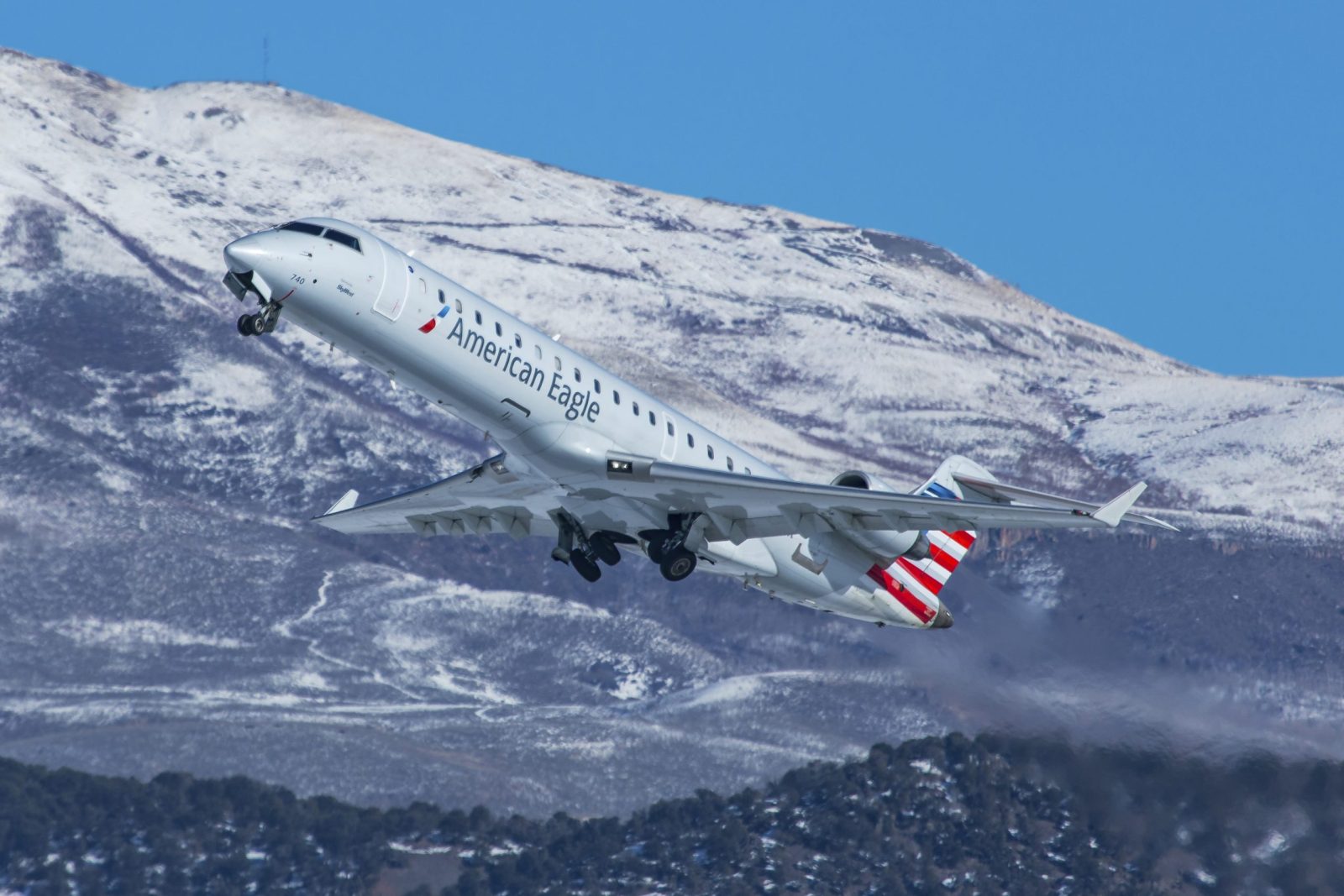
An American Eagle Bombardier CRJ-700 operated by SkyWest Airlines. (Photo: AirlineGeeks | William Derrickson)
American Airlines has announced that it is launching two new routes to Provo, Utah. The airline will fly to Provo from its hubs in Dallas/Fort Worth and Phoenix.
Details: American’s New Routes to Provo
The new routes to Provo Municipal Airport will start on Oct. 7, 2024. American will operate two daily flights between Provo and Dallas/Fort Worth International Airport and one daily flight between Provo and Phoenix Sky Harbor International Airport. According to the airline, tickets will be on sale as of April 22, 2024.
American’s flights to Utah’s second-largest metropolitan areas will be operated under the American Eagle regional brand. The airline will use 65-seat Bombardier CRJ-700 aircraft on both routes.
A New Destination for American
These two new routes will mark American’s entry to the Provo market. Two other airlines currently serve Provo Municipal Airport: Allegiant Air and Breeze Airways. American will be competing directly with both airlines, with Allegiant and Breeze both flying between Provo and Phoenix Sky Harbor and Breeze starting flights to Dallas/Fort Worth in July.
Provo is located approximately 45 miles south of Salt Lake City and is home to Brigham Young University and the Church of Jesus Christ of Latter-day Saints’ Missionary Training Center. The city’s airport opened a new terminal in 2022, which features 70,000 square feet of new terminal space and four passenger gates.
Provo Municipal Airport opened a new terminal in 2022 (Photo: City of Provo)
“American Airlines is proud to offer service for the first time to Provo, connecting residents year-round to our expansive network,” said American Executive Vice President Corporate Affairs and Chief Government Affairs Officer Nate Gatten in a press release. “With local connectivity to major metropolitan areas, residents will be able to unlock our vast domestic and global networks to discover new destinations and enjoy all that the American network has to offer.”
Andrew is a lifelong lover of aviation and travel. He has flown all over the world and is fascinated by the workings of the air travel industry. As a private pilot and glider pilot who has worked with airlines, airports and other industry stakeholders, he is always excited to share his passion for aviation with others. In addition to being a writer, he also hosts Flying Smarter, an educational travel podcast that explores the complex world of air travel to help listeners become better-informed and savvier travelers.
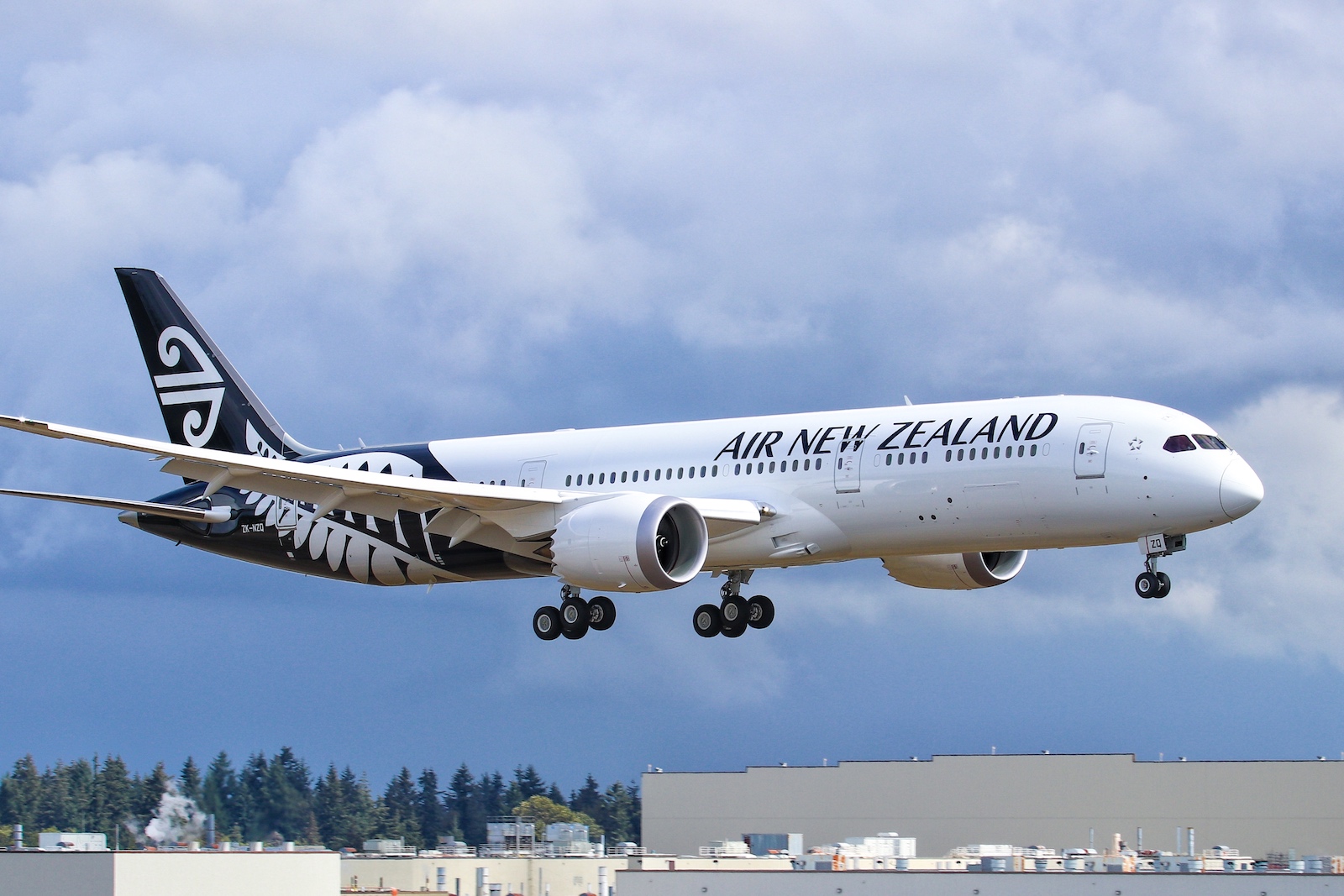
An Air New Zealand Boeing 787-9 Dreamliner. (Photo: AirlineGeeks | Katie Zera)
Air New Zealand has introduced a brand new menu that will be served in business class on long-haul flights. This new menu highlights local contemporary cuisine that aims to introduce unique New Zealand flavors to the world, according to the airline.
The new dishes will be featured as ‘A Taste of Aotearoa,’ a reference to the indigenous name for New Zealand, on premium cabin menus departing the country.
Some of these dishes include:
Confit potato with onion crème fraîche whip and chives
Mānuka smoked rye sourdough
Smoked kahawai rillette with celery, caper, parsley salsa and citrus
Crayfish bisque with chive crème fraîche and sourdough croutons
Slow-cooked wild Fiordland Venison with pancetta, parmesan polenta and balsamic
roasted red onions
Seared New Zealand snapper with escabeche vegetables, smoked mussels, white
beans and fresh dill
Ambrosia ice cream
The new menu showcasing the country’s cultural identity comes at a time when the airline is seeking to refresh its image.
New Business Class
Later this year, passengers will see Air New Zealand’s brand new business class called Business Premier on Boeing 787 aircraft. The new seats will replace the 20-year-old existing herringbone seats. The airline is also installing four larger seats at the front of the business class cabin.
Air New Zealand is calling these seats Business Premier Luxe suites, continuing the business plus trend we’re seeing more airlines introduce. A seat with more space in the existing business class cabin for a slightly higher price. Passengers in these Business Premier Luxe seats will also be able to sit across from each other for meals, a feature often found in first class cabins.
Operational Challenges
These new seats will be retrofitted onto the existing Boeing 787 fleet since new Dreamliner aircraft deliveries have been delayed. The airline was expected to receive two new 787 aircraft sometime in late 2023 but the aircraft have been delayed. The carrier now expects these aircraft to arrive halfway through 2025. The delivery dates for the remaining six aircraft are uncertain.
Air New Zealand is also facing issues with the Pratt & Whitney engines on its narrowbody fleet similar to many other airlines. The carrier expects that the additional engine maintenance required by Pratt & Whitney will ground up to five of the airline’s newest A320 family aircraft at a time across the next year and a half.
Hemal took his first flight at four years old and has been an avgeek since then. When he isn't working as an analyst he's frequently found outside watching planes fly overhead or flying in them. His favorite plane is the 747-8i which Lufthansa thankfully flies to EWR allowing for some great spotting. He firmly believes that the best way to fly between JFK and BOS is via DFW and is always willing to go for that extra elite qualifying mile. Hemal's opinions are his own and do not reflect those of his employer.
Spirit To Close Atlantic City Crew Base
Spirit Airlines is closing its Atlantic City crew base by Sept. 1, 2024 following a recent announcement that it will furlough pilots.
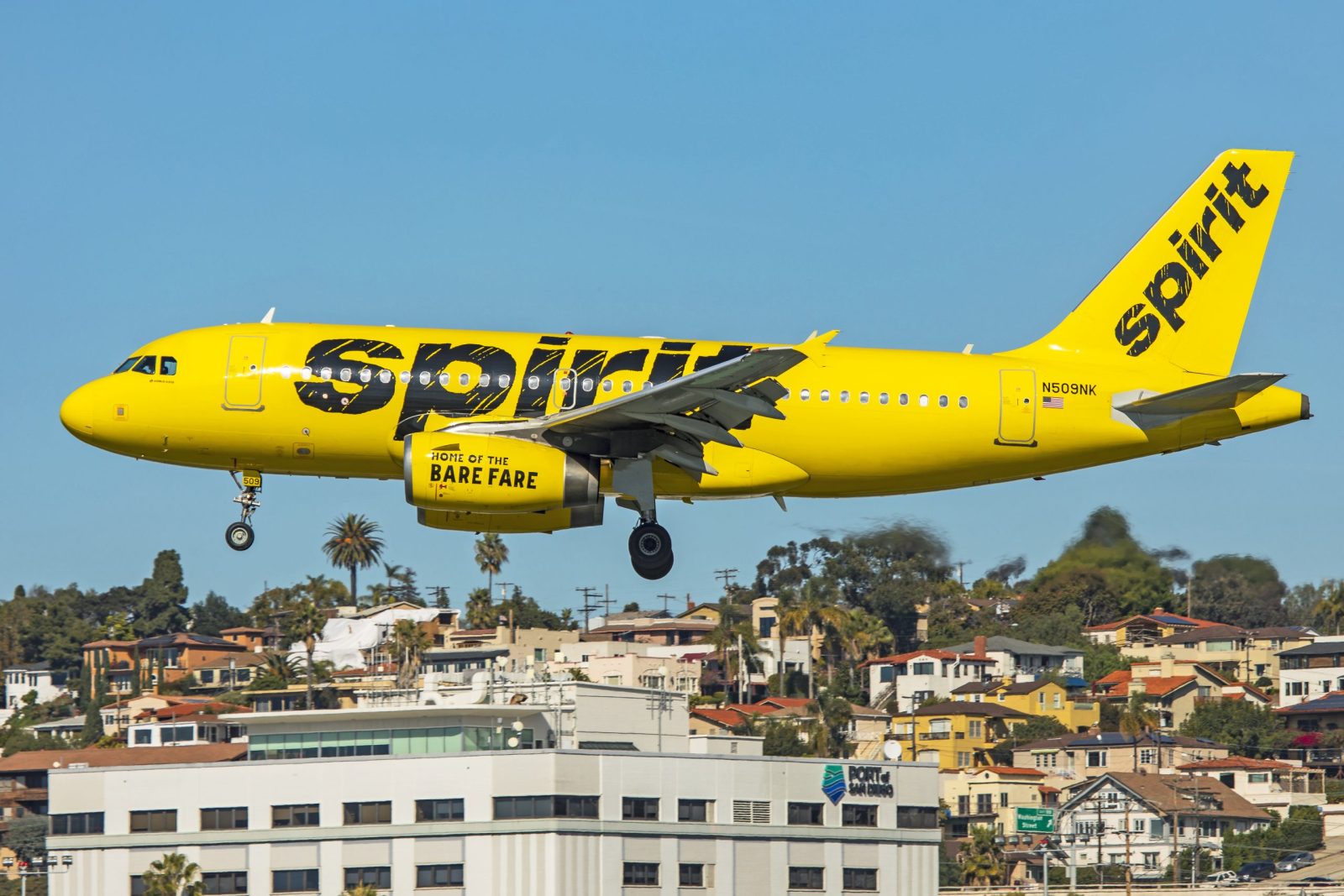
A Spirit Airlines Airbus A319 prepares for landing. (Photo: AirlineGeeks | William Derrickson)
In a not-so-surprising news, Spirit Airlines has announced that it will be closing its crew base at the Atlantic City airport in New Jersey later this year. The airline cites a decrease in daily departures and ongoing aircraft availability challenges. Many Spirit aircraft remain grounded due to Pratt & Whitney engine challenges.
Scheduled flights will continue as planned to and from Atlantic City, but this city will no longer serve as a base for over 150 pilots and flight attendants effective Sept. 1 of this year. Currently, the airline serves destinations in Florida with an average of eight to 10 daily departures from the airport, depending on the season.
Atlantic City International Airport
Spirit had bet on Atlantic City service being appealing to South Jersey residents and, to some extent, people from the Philadelphia area looking for a deal. It currently is the only carrier operating regularly scheduled air service to the airport.
American Airlines offers its bus service to and from Philadelphia’s main airport several times a day. The airport also sees regular charter operations booked by the casinos flying people in from across the region to stay and gamble at the various local casinos in Atlantic City.
The airport is also home to military operations. The Atlantic City National Guard and Coast Guard Air Station Atlantic City all call this airport home. It is also home to the 177th Fighter Wing of the New Jersey National Guard. Passengers going through the airport may be able to see the occasional F-16 Fighting Falcon.
Challenges For Spirit
This comes at a time when Spirit is looking to cut costs and survive after the blocked merger with JetBlue. The airline is going to start furloughing pilots in the third quarter of this year in addition to delaying deliveries of Airbus aircraft.
The airline is pushing deliveries until 2030 and 2031 in a move to improve its liquidity. This along with a large compensation payment from Pratt & Whitney over operational issues should help the airline weather the short-term challenges it faces.
However, the airline won’t be out of the woods yet as it needs to reevaluate its business and make adjustments based on changing market conditions.
On the flip side, the bad news for Spirit could be of benefit to other airlines and Airbus. The order book for Airbus A320 family aircraft is fully booked for years to come. Airlines that want to grow are having trouble finding aircraft that would be available relatively soon, and it’s complicating expansion plans.
Boeing had some manufacturing capacity available but given the significant quality failures the manufacturer is battling, it’s unlikely many airlines will be looking at Boeing favorably to fill the gap.
It was recently reported that United is in the market for some narrowbody aircraft, and Airbus is moving mountains to find space in its order books for the airline. There is speculation that the aircraft manufacturer is working with airlines to delay deliveries to be able to accommodate a potential United order.
It’s highly possible that we will see the aircraft deliveries originally allocated to Spirit be snapped up very quickly by other airlines.
Hemal took his first flight at four years old and has been an avgeek since then. When he isn't working as an analyst he's frequently found outside watching planes fly overhead or flying in them. His favorite plane is the 747-8i which Lufthansa thankfully flies to EWR allowing for some great spotting. He firmly believes that the best way to fly between JFK and BOS is via DFW and is always willing to go for that extra elite qualifying mile. Hemal's opinions are his own and do not reflect those of his employer.
Breeze Reports First Profitable Month, Cites Strong Demand and Network Growth
Breeze Airways, the self-styled "Nice Low-Cost Carrier" (NLCC), announced a major milestone this week: its first operating profit in March 2024.
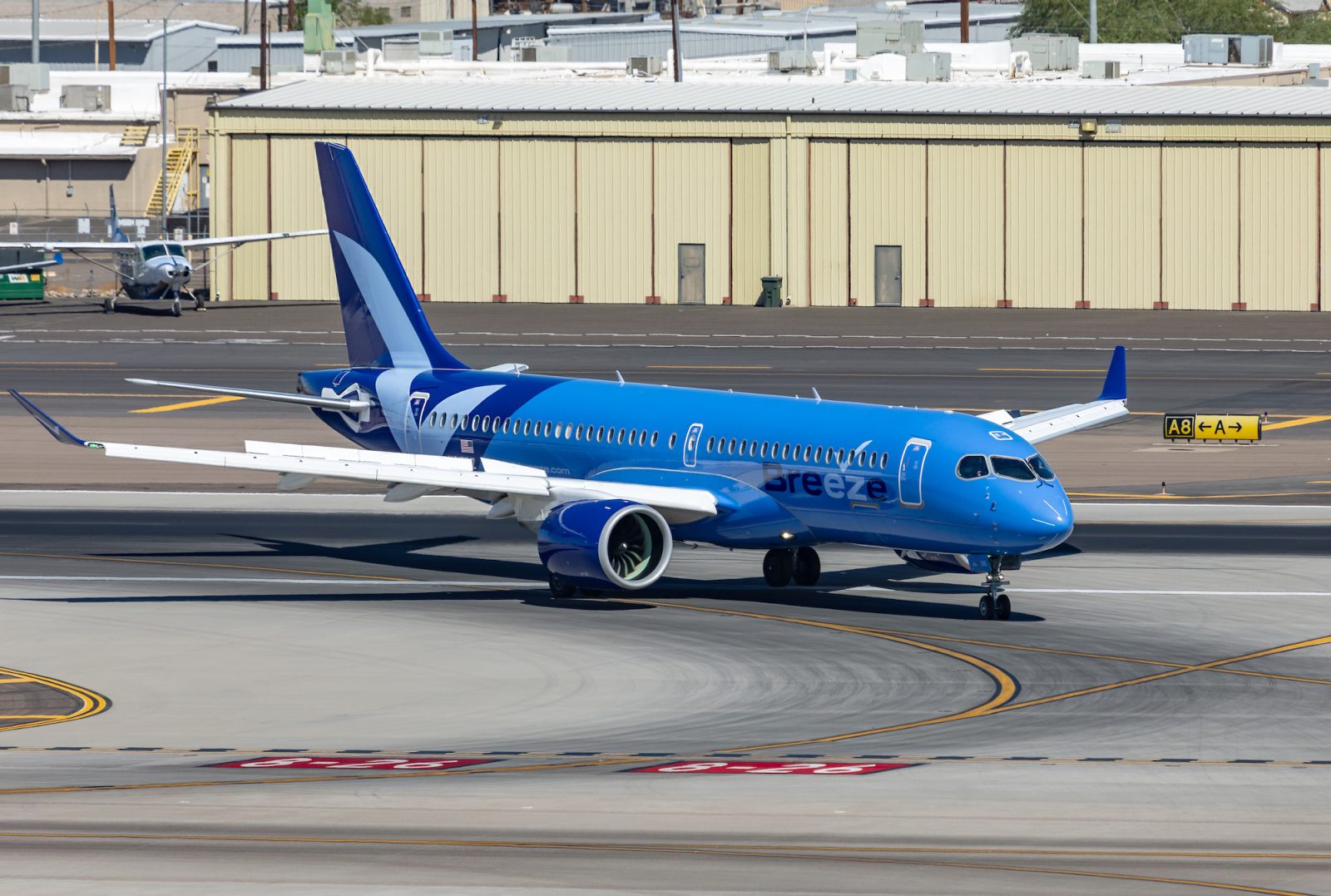
A Breeze A220 in Phoenix. (AirlineGeeks - William Derrickson)
Breeze Airways, the self-styled “Nice Low-Cost Carrier” (NLCC), announced a major milestone this week: its first operating profit in March 2024.
The airline attributed its success to high demand for its “premium leisure” offerings and a maturing network in key markets. It credits this with setting the stage for continued profitability throughout 2024.
Strong Revenue Growth
Breeze reported a unit revenue increase of over 30% year-over-year in the first quarter of 2024. The carrier also generated more scheduled service revenue in March 2024 than in the entire first quarter of 2023.
Founded in 2019, Breeze began service in 2021. Now, the airline serves 56 cities across 29 states, offering over 170 nonstop routes. The airline credits itself with stimulating competition and lowering fares in underserved markets.
“This milestone is a testament to the hard work, dedication, and pure grit of the more than 1,800 Team Members who, despite a multitude of challenges and setbacks, persevered to build something truly impactful,” said Breeze founder and CEO David Neeleman in a press release. “Starting an airline is not for the faint of heart but we have remained true to our purpose – to give millions of travelers in underserved markets access to efficient and affordable air travel.”
Breeze plans continued growth, aiming to nearly quadruple its capacity since its first year of operation. Looking ahead, Breeze is optimistic about the future, citing the popularity of their “premium leisure” product and the potential for further network expansion.
Ryan founded AirlineGeeks.com in February 2013 and has spent more than a decade covering the airline business. His work has been featured by CNN, WJLA, CNET, and Business Insider. His aviation experience spans airport operations, Part 135 regulatory compliance, and airline crew workforce planning, along with time behind the yoke of a Cessna 172 and interviews with airline executives. Ryan now serves as Group President of Firecrown Media’s Aviation Group. He holds a B.S. in Air Transportation Management and an MBA from Arizona State University and teaches Airline Management at Embry-Riddle Aeronautical University.
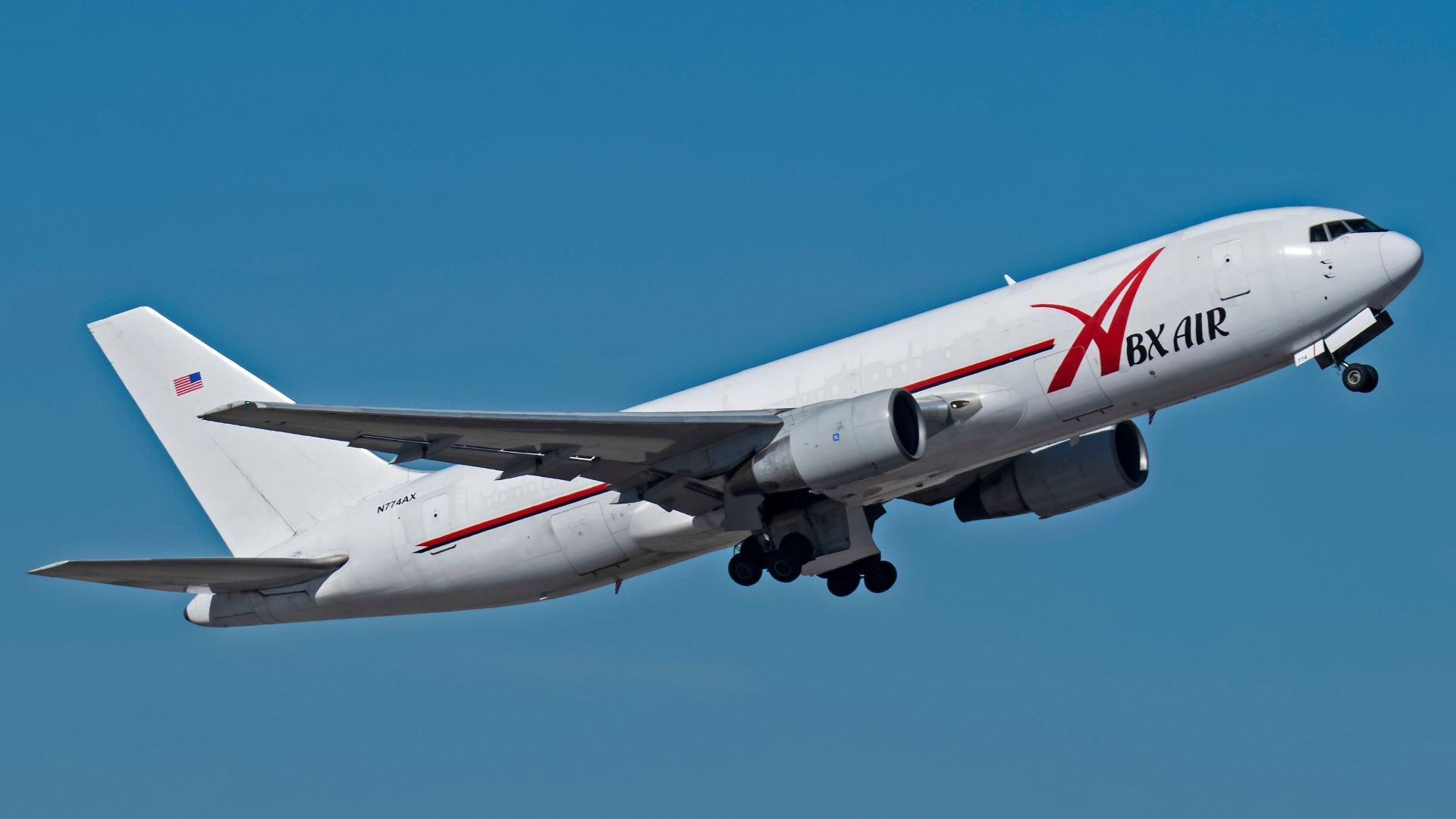
ABX Air operates about 25 Boeing 767 converted freighters. This 767-200 variant, seen taking off from Phoenix Sky Harbor Airport in Arizona on Jan. 7, 2023, is 40 years old. (Photo: Shutterstock/Robin Guess)
The exhibit hall at the Omni Hotel here was filled in mid-February with booths representing airlines, logistics providers, airports, truck delivery companies and technology vendors marketing their capabilities to industry peers attending the AirCargo 2024 conference. The stall with a handful of ABX Air pilots from the Airline Professionals Association stood out.
Pilots never attend air logistics conferences, let alone rent space for a display. Why would they? They don’t have anything to sell. They fly the planes. But here was the pilots union selling a precious commodity: good will.
Friction is common between unionized labor and employers. That’s especially true in the airline industry, where contract negotiations with pilots take years and unions often raise the prospect of going on strike for better pay. The rise in tensions is currently playing out with pilots at FedEx Express and Air Transport International. Both groups have authorized leaders to call a strike if they ever exhaust strict bargaining procedures under U.S. law.
The pilots at cargo airline ABX Air are trying to break the cycle of adversarial relations in the airline industry and lay the groundwork for a favorable contract by drumming up business for the company.
“We feel that if we present a positive image with our customers at these events it will garner some recognition for our commitment to their service,” said Andrew Whobrey, a Boeing 767 freighter captain and leader in the Airline Professionals Association, in an interview. “We’re pledging that there will be no delays and we’ll do everything we can to serve the customer to the utmost of our ability.”
ABX Air operates 24 aircraft — a mix of Boeing 767-200 and 767-300 converted freighters — and has about 300 pilots. The bulk of the fleet supports DHL Express, with about four aircraft providing dedicated transport for Amazon’s air network.
ABX and Air Transport International are owned by the same company — Air Transport Services Group — but the ATI pilots are represented by the Air Line Pilots Association.
Building a cooperative relationship with management is an approach rarely seen in the airline industry. The company’s perspective is to save money and boost shareholder returns. Pilots account for a large share of labor costs at airlines. Unions want to get as much compensation for their workers as the market will support.
Ken Jacobs, co-chair of the University of California-Berkeley’s Center for Labor Research and Education, said there’s a long history of unions promoting good union employers. Hotel workers’ union Unite Here!, for example, lists good union employers on its local websites. “They want to drive people to employers that do right by their workers,” he said.
That level of collegiality is not frequently seen in the airline industry, Jacobs acknowledged.
Capt. Andrew Whobrey, a member of the ABX Executive Council, second from right. (Photo: Airforwarders Ass.)
The ABX pilots have internalized the English proverb that you catch more flies with honey than vinegar. The philosophy that there is a better chance of winning over management to their contract expectations by playing nice is born from the repercussions of a work stoppage nearly eight years ago.
Pilots walked off the job days before the Black Friday shopping weekend in November 2016, forcing dozens of flights to be canceled. But a judge ordered them back to work one day later after determining the strike would cause severe economic harm.
He also rejected the union’s claim that ATSG had violated the collective bargaining agreement by not allowing pilots compensatory time or to take earned vacation after asking them to work overtime for two years.
Airlines fall under restrictive labor rules designed to prevent damage to interstate commerce that could have a widespread economic impact. Any impasse in collective bargaining has to go through a lengthy process, including mediation and arbitration, before either side can take unilateral action.
The short-lived strike raised concerns at DHL and Amazon about ABX Air’s reliability. It took several years before the express carriers requested additional flying from ABX.
Six years after the prior contract was eligible for amendment in 2014, the ABX pilots finally ratified a six-year contract on Dec. 30, 2020.
The bruises from that battle have motivated the pilots to act as brand ambassadors for ABX and ATSG.
“It was a long road to a collective bargaining agreement. It was a very lean time,” Whobrey said. “If we can help ABX grow and get business, that’s good for the pilots. Because a rising tide raises all boats.”
In addition to AirCargo 2024, the Airline Professionals Association has attended symposiums for freighter operators and manufacturers held in San Diego and Amsterdam since last summer.
The number of freighters ABX flies for Amazon has recently declined with lease expirations on 767-200s that have reached the end of their life cycle. Whobrey expressed hope that Amazon will eventually lease newer 767-300s from ATSG and place the aircraft on ABX’s operating certificate.
The collective bargaining agreement with ABX and ATSG is eligible to be updated at the start of 2026. The union pilots would look for improvements based on market conditions and for parity with peer airlines, but aren’t seeking pay scales like those at United Airlines or UPS.
“We don’t feel like we have to be the highest paid, but we don’t want to be the lowest paid,” Whobrey said.
Whobrey said it makes sense for ATSG to wait and see what happens with the Amazon contract because they have to know what their potential revenue is going to be before giving pilots an increase.
He predicted other airline unions will follow the Airline Professionals Association’s path if ABX grows and economic benefits flow to the pilots.
“We want to be part of the solution, not part of the problem.”
Editor’s Note: This story first appeared on FreightWaves.
AirlineGeeks.com was founded in February 2013 as a one-person blog in Washington D.C. Since then, we’ve grown to have 25+ active team members scattered across the globe. We are all here for the same reason: we love deep-diving into the fascinating realm of the airline industry.
Eight new airlines - seven of which are international carriers - have recently been added to the program. One of which is an oddball given its current state.
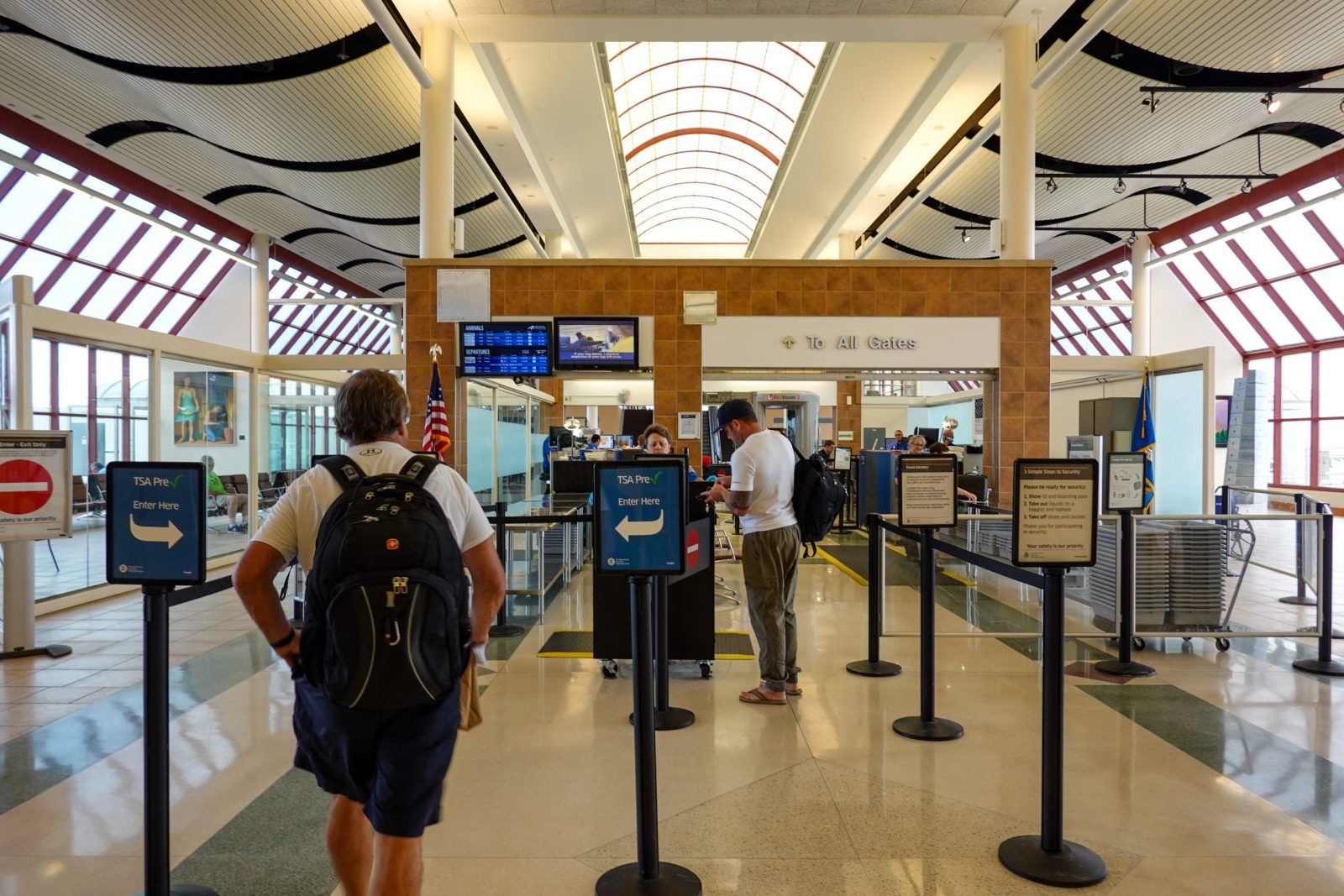
TSA PreCheck is a blessing for any traveler wishing to cut down on time spent at the security checkpoint, as it speeds up not only the time one spends in line but also the entire process as a whole. Eight new airlines – seven of which are international carriers – have recently been added to the program.
Air Premia
This is South Korea’s first ‘hybrid’ airline and operates a fleet of exclusively Boeing 787-9 aircraft. The airline only has five total routes in its network, all of which leave from its hub at Seoul-Incheon. Three of the airlines’ routes touch the United States; Los Angeles, San Francisco, and Newark, all of which are busy international hubs.
Air Tahiti Nui
This Tahiti-based airline has been flying to the United States for a long time, and it is a welcomed sight to the list of TSA PreCheck airlines as it flies out of two very busy airports in the country on four routes. The airline flies to Seattle-Tacoma and Los Angeles, and routes from both destinations include Papeete Faa’a Intl. which is the country’s main international airport, and also Charles de Gaulle in Paris, France. Flights are on board Boeing 787s.
Air Transat
This is the only Canadian airline being added this time around to the PreCheck program, this airline operates flights to five destinations in the United States; Orlando, Miami, Fort Lauderdale, Los Angeles, and San Francisco, many of which see multiple flights a day to four destinations in Canada.
Bahamasair
Another airline that has been operating to the United States for a long time is now finally in the program. Its flights to the U.S. mostly operate on Boeing 737s, but some routes into South Florida are on the ATR aircraft. The routes from the Bahamas to the U.S. include Miami, Fort Lauderdale, West Palm Beach, Orlando, and most recently Raleigh.
BermudAir
This Bermuda-based airline hasn’t been operating flights for an entire year with their first flights being in May of 2023. Although it does plan on serving Canada in the near future, all of the routes it currently serves are to the United States, with flights to White Plains, N.Y., Fort Lauderdale, Orlando, Baltimore-Washington, and Boston. Flights are on board Embraer E175 aircraft.
Iberia
Out of the eight airlines being added this time around, this is the busiest airline among them as it sees a couple of thousand daily passengers out of the United States on its over 10 routes from the country. Iberia operatse Airbus A330s and A350s from eight U.S. airports to multiple destinations in Spain; Boston, New York-JFK, Washington-Dulles, Miami, Chicago O’Hare, Dallas/Ft. Worth, Los Angeles, and San Francisco.
La Compagnie
This airline operates all business class configured Airbus A321s to three destinations in Europe, all of which are out of Newark. This PreCheck addition will be a welcome addition for the passengers to simplify their experience at Newark and add to the ‘premium experience’ the airline offers.
New Pacific Airlines
The final airline being added is the only U.S.-based airline being added this time around, but is a bit of an odd one given the timing. This airline discontinued its only route the same week it was added to the PreCheck program. It did operate Boeing 757s from Ontario, Calif. to Nashville, as well as Ontario to Reno, with the latter route being discontinued a couple of weeks prior to the only other route being canceled.
The carrier does operate flights under the Ravn banner and logo in the state of Alaska to 10 destinations out of Anchorage.
Joey has always been interested in planes for as long as he can remember. He grew up in Central New York during the early 2000s when US Airways Express turboprops ruled the skies. Being from a non-aviation family made it harder for him to be around planes and would only spend about three hours a month at the airport. He was so excited when he could drive by himself, the first thing he did with his driver's license was get ice cream and go plane spotting for the entire day. He graduated from Western Michigan University in 2022 with a B.S. in Aviation Management & Operations and a Minor in Business, and currently works for a major airline in his hometown.
Uganda Airlines to Boost Capacity to Johannesburg
Uganda Airlines is gearing up to expand its medium-haul fleet with the addition of an Airbus A320neo through wet-leasing.
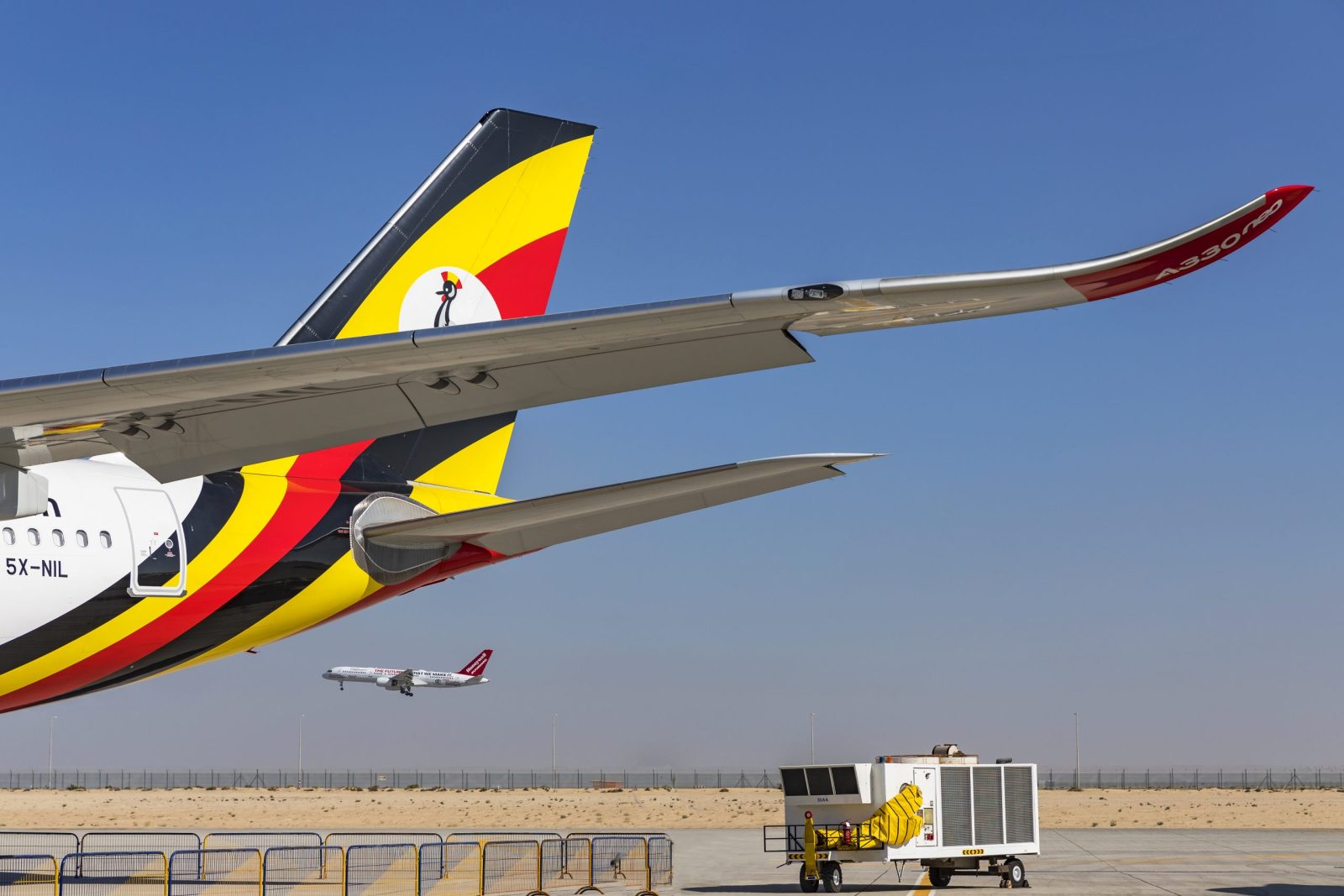
A Uganda Airlines Airbus A330neo.
(Photo: AirlineGeeks | William Derrickson)
Uganda Airlines is gearing up to expand its fleet with the addition of an A320neo through wet-leasing.
CEO Jennifer Bamuturaki, in an interview with national broadcaster UBC on March 27, revealed that this move is seen as a temporary solution due to the prolonged lead times associated with purchasing narrowbody aircraft. “We haven’t committed to an order for purchase yet; the soonest we could expect delivery is in 2029 or 2030.”
According to the airline boss, this aircraft will primarily serve the Entebbe to Johannesburg O.R. Tambo route, bridging the medium-haul gap within the current fleet. Bamuturaki explained this by stating, “We intend to deploy this aircraft on routes where our CRJ usage faces challenges in volume and weight. We anticipate a boost in our performance metrics, particularly on routes like Johannesburg, where baggage restrictions have been a limiting factor.”
A spokesperson from the airline, as reported by aeronautical data company CH-Aviation also confirmed that “The aircraft in question is an A320, and we are scheduled to take delivery later this month.” Details of the lessor were, however, not disclosed.
The wet-lease agreement enables Uganda Airlines to leverage the entire aircraft, including crew, maintenance, and insurance, while the carrier plans for a permanent acquisition.
By introducing the wet-leased A320neo, Uganda Airlines aims to overcome capacity constraints present in its current fleet of four CRJ900LRs and two A330-800neo widebodies. This move is expected to enhance operational flexibility, particularly on routes where the existing Bombardier regional jets fall short.
Bamuturaki further announced that Uganda Airlines has secured foreign operator permits for several new destinations, including Jeddah International and Riyadh in Saudi Arabia, Lusaka in Zambia, and Harare in Zimbabwe.
“We are not only focused on expanding our route network but also on establishing Entebbe as a hub where passengers can seamlessly connect to other flights or explore Uganda’s tourism offerings,” she emphasized.
Despite being operational since 2019, Uganda Airlines has faced scrutiny over its continual need for capitalization, despite reporting significant losses over the past three years.
This is after the Parliamentary Budget Committee, led by Hon. Tony Awany, disclosed earlier this year on Jan. 16, 2024, that the government plans to inject an additional UGShs34.9 billion ($9.2 million USD) into Uganda National Airlines, bringing the total budget allocation to UGShs120.9 billion ($31.8 million USD).
The Budget Committee members have raised concerns about the airline’s profitability and operational efficiency, seeking clarification on the government’s ongoing investment in Uganda National Airlines.
Victor Shalton's love for aviation can be traced to when he was 11-years-old. As a seasoned aviation writer, he takes pride in providing the best aviation coverage around the globe and is passionate about advancing his skills in the aviation space. In addition, he loves travelling, writing, arts and while his speaking engagements have taken him around the world, he is proud to call Nairobi home.