










The most immediate change, and perhaps the most surprising, is the deactivation of regional subsidiary Lufthansa CityLine. As of Saturday, all of the carrier’s 27 operational aircraft will be permanently removed from Lufthansa Group’s flight program, “in order to reduce further losses of the loss-making airline.”
CityLine, which is based in Munich, was previously set to wind down in 2027.
Lufthansa Group left some ambiguity about when exactly the subsidiary will be permanently closed but said it has already offered employees work at other divisions within the company.
At the end of summer, Lufthansa’s last four remaining Airbus A340-600s will be retired, and two Boeing 747-400s will be grounded. Officials said the removal of the six long-haul aircraft will help conserve fuel.
Lufthansa plans to permanently retire the 747-400 next year.
During the winter of 2026-27, five aircraft will be temporarily removed from Lufthansa’s mainline short- and medium-haul operations. Lufthansa Group did not say which aircraft types will be affected.
“The package for accelerated implementation of fleet and capacity measures is unavoidable in light of the sharply increased kerosene costs and geopolitical instability,” Lufthansa Group CFO Till Streichert said in a statement. “The goal is to focus our short- and medium-haul platforms more clearly and make them more competitive.”
Streichert also noted the accelerated shutdown of Lufthansa CityLine and called the decision “painful.”
In an added measure, Lufthansa Group said it has implemented new savings targets for staff recruitment, internal events, and external consulting services. The targets will help the company meet a previously announced goal of eliminating 4,000 administrative positions group-wide by 2030, officials said.
Zach Vasile is a writer and editor covering news in all aspects of commercial aviation. He has reported for and contributed to the Manchester Journal Inquirer, the Hartford Business Journal, the Charlotte Observer, and the Washington Examiner, with his area of focus being the intersection of business and government policy.
American to Roll Out Electronic Boarding Gates
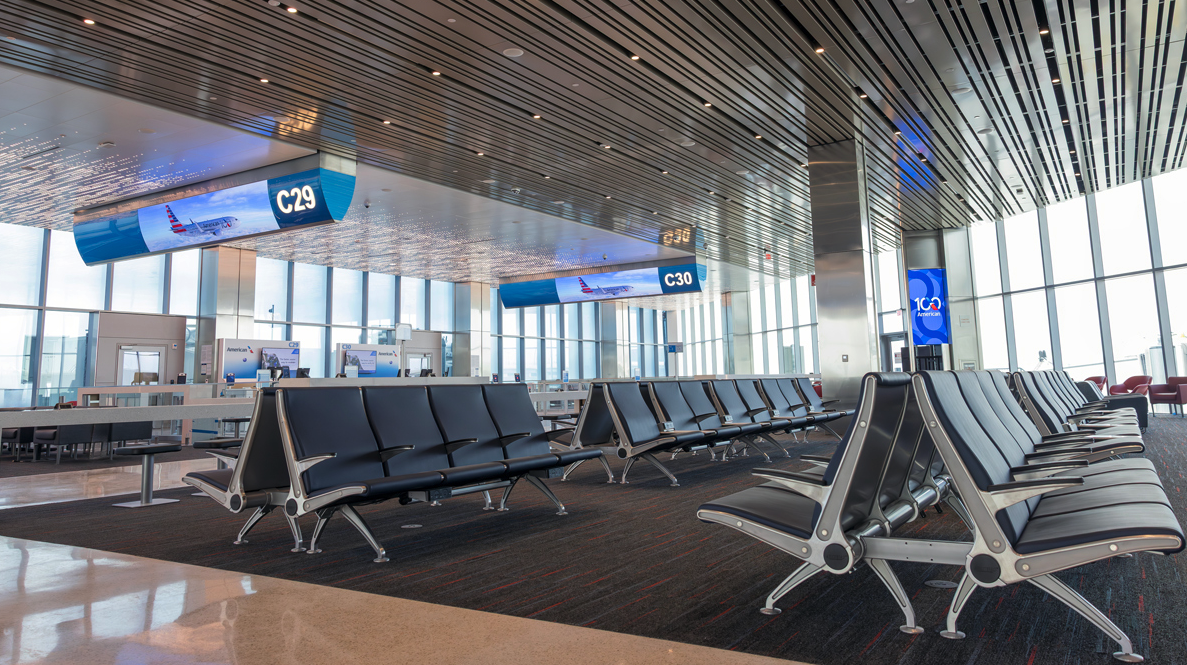
The e-gates will be installed at Dallas/Fort Worth this summer.
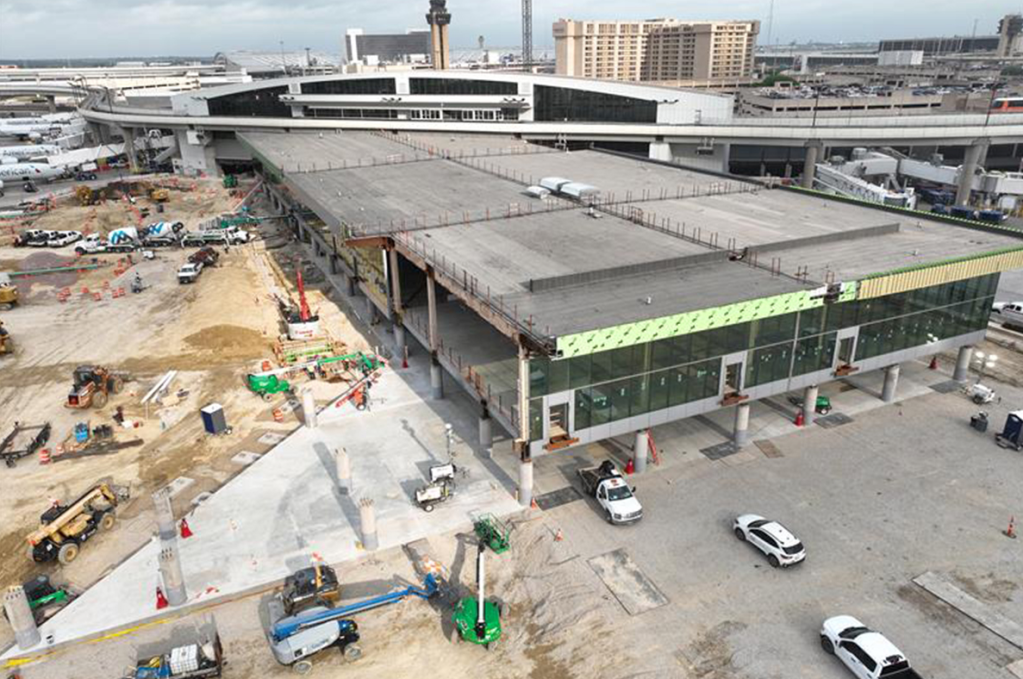
The carrier said this week that it will install the gates at the Terminal C Pier Expansion to start.
The gates are made by Swiss security company dormakaba. When customers scan their boarding pass, the machine validates it, and the gates swing open.
Officials said the gates will help regulate the pace of boarding to reduce congestion, and streamline tasks for American employees, who will be able to spend more time directly assisting travelers.
An illustration of the boarding gates. (Credit: American Airlines)
“Boarding plays a key role in how customers experience the final moments before their flight, and electronic boarding gates will further elevate that experience, creating a more seamless and consistent process,” American Chief Customer Officer Heather Garboden said in a news release.
American trialed the technology in November, and it received strongly positive feedback from users, the carrier added.
Zach Vasile is a writer and editor covering news in all aspects of commercial aviation. He has reported for and contributed to the Manchester Journal Inquirer, the Hartford Business Journal, the Charlotte Observer, and the Washington Examiner, with his area of focus being the intersection of business and government policy.
Report: Spirit at Risk of Liquidation
The carrier was on track to emerge from bankruptcy protection this spring or summer.
A Spirit Airbus A320. (Photo: Shutterstock | Jomica8)
Budget airline Spirit could be on the brink of liquidation, sources told multiple media outlets this week.
The financially troubled carrier has been restructuring its operations and initially expected to exit Chapter 11 bankruptcy some time this spring or summer, with a smaller, more economical fleet and a new pilot contract meant to contain labor costs. But the rising price of jet fuel has complicated that picture, the sources said, and discussions with the airline’s creditors now include the possibility of liquidation.
Bloomberg was first to report the development, with CNBC later reporting that Spirit could liquidate as soon as this week. The business news channel also cited unnamed people with knowledge of the matter.
In a statement, Spirit said it would not comment on “market rumors and speculation.”
Climbing fuel prices have affected airlines of every size and market level, but they could prove particularly damaging to ultra-low-cost carriers such as Spirit, who must carefully manage every expense to stay in the black. According to the International Air Transport Association, aviation fuel prices have doubled globally since the start of the conflict in Iran.
Spirit filed for bankruptcy protection in August 2025 in the face of climbing costs and ballooning debt, some of which was carried over from its prior stint in Chapter 11 protection. It has laid off corporate staff, furloughed pilots and flight attendants, canceled routes, pulled out of certain markets, and sold off aircraft in an effort to reduce spending.
Despite frequent media reports that the carrier was on the verge of collapse, Spirit appeared to be on the upswing in recent months. It canceled and reversed some employee furloughs, and negotiated a new contract with its pilots’ union that implemented temporary pay cuts and put off raises until 2028.
Zach Vasile is a writer and editor covering news in all aspects of commercial aviation. He has reported for and contributed to the Manchester Journal Inquirer, the Hartford Business Journal, the Charlotte Observer, and the Washington Examiner, with his area of focus being the intersection of business and government policy.
Allegiant, Sun Country Secure Final Regulatory Approval for Merger
But the deal is still subject to customary closing conditions and approval by shareholders, who will vote early next month.
The partners announced Wednesday that the U.S. Department of Transportation has granted a joint interim exemption application that will allow both carriers to continue operating as separate entities under common ownership after the closing date.
The authorization “marks a significant step” toward completing Allegiant’s acquisition of Sun Country, officials said.
“This approval underscores the strength of our shared vision and the thoughtful approach both teams have taken throughout this process,” Allegiant CEO Gregory C. Anderson said in a statement. “We remain focused on bringing these organizations together in a way that builds on their strengths, while positioning the combined company for long-term growth and resilience.”
Under the terms of the DOT’s approval, Allegiant and Sun Country will continue to operate independently after the merger closes, maintaining their own business models, route networks, and products, as they worked toward a single operating certificate. Leaders of both airlines said this structure will help ensure operational continuity during the merger process.
According to Allegiant, the DOT’s recent ruling “satisfies the last remaining regulatory approval-related condition” for the planned linkup. Now, the deal will go before Allegiant and Sun Country’s shareholders. Both airlines have scheduled shareholder meetings for May 8.
If investors approve the merger, it could close as soon as May 13, officials said.
Allegiant is set to acquire Sun Country in a cash-and-stock deal valuing Sun Country at $18.89 per share. The combined airline would serve about 22 million customers annually and operate in nearly 175 cities.
Zach Vasile is a writer and editor covering news in all aspects of commercial aviation. He has reported for and contributed to the Manchester Journal Inquirer, the Hartford Business Journal, the Charlotte Observer, and the Washington Examiner, with his area of focus being the intersection of business and government policy.
Asian Carriers Suspend Routes, Reduce Service Over Fuel Prices
Airlines are scrambling to adjust their summer schedules to stay ahead of price volatility.
A Vietnam Airlines A350-900. (Photo: Shutterstock | Thanhliemnguyen)
A number of airlines in Asia are temporarily suspending routes and scaling back frequencies on others in an effort to contain costs and conserve jet fuel.
Fuel is a major expense for carriers generally, and any fluctuation in the price can affect the economics of their route networks. Some airlines have also responded with new surcharges and fees.
Fuel prices have shot up as a result of the conflict in the Middle East, and the volatility is being felt acutely in East Asia, where China and Thailand, two of the region’s largest aviation fuel suppliers, have halted exports to protect their own reserves. This is forcing fuel importers, including in Singapore, Vietnam, the Philippines, and Cambodia, to compete with larger buyers for limited supplies.
Hong Kong
Cathay Pacific will halt some flights from the middle of May until the end of June.
The airline said it will cancel almost 2% of its scheduled passenger flights from May 16 to June 30.
Cathay Pacific has also levied a 34% surcharge on all passenger flights from April 1.
Budget carrier HK Express will cut around 6% of flights from May 11.
Thai Lion Air will halt flights between Don Mueang and Seoul Incheon from May 9 to Sept. 30.
Nok Air has suspended its Chiang Mai-Udon Thani route through April.
Thai AirAsia has halted several routes, including Suvarnabhumi-Narathiwat, Don Mueang-Xi’an, Hong Kong-Okinawa, Phuket-Chennai, and Phuket-Kochi.
Thai AirAsia X is also temporarily suspending flights between Don Mueang and Shanghai and Don Mueang and Riyadh.
Thai Airways imposed a 10% fuel surcharge in early April.
Vietnam
Vietnam Airlines and low-cost carrier VietJet have also been impacted by rising fuel costs. Both carriers have suspended a number of domestic and regional flights.
Lorne is a South Africa-based aviation journalist. He was captivated and fascinated by flying from the day he took his first airline flight. With a passion for aviation in his blood, he has flown to destinations in all corners of the globe. Lorne has traveled extensively and lived in various countries. Drawing on his travels and passion for aviation, Lorne enjoys writing about airlines, routes, networks, and new developments.
Caribbean Airlines Gets New Oversight
The government of Trinidad is looking to stabilize the carrier as it faces pressure from rising jet fuel prices.
A Caribbean Airlines Boeing 737 MAX. (Photo: Shutterstock | Kevin Porter)
Management of Caribbean Airlines has been transferred from Trinidad and Tobago’s Finance Ministry to its Transportation Ministry, government officials announced this week.
The airline, which serves as the flag carrier of both Trinidad and Tobago and Jamaica, is reportedly facing severe financial headwinds, made worse by the recent surge in global jet fuel prices. Earlier this month, it denied a report that it was on the brink of collapse.
Transportation Minister Eli Zakour will now oversee Caribbean Airlines. In a statement, Zakour said he will prioritize improving efficiency and addressing the carrier’s “financial challenges.”
According to the Trinidad and Tobago Guardian, the airline has not produced a properly audited financial statement in years, despite spending millions of dollars on an outside financial review. It reportedly incurred considerable losses from its past ownership of Air Jamaica, which ceased operations in 2015.
Caribbean Airlines, often abbreviated as CAL, serves destinations throughout the Caribbean and helps link the region to the U.S., with regularly scheduled flights to and from Miami, Fort Lauderdale, and Orlando in Florida and New York-JFK.
The airline is owned by the governments of Trinidad and Tobago and Jamaica, with Trinidad and Tobago holding the majority of the company.
Zach Vasile is a writer and editor covering news in all aspects of commercial aviation. He has reported for and contributed to the Manchester Journal Inquirer, the Hartford Business Journal, the Charlotte Observer, and the Washington Examiner, with his area of focus being the intersection of business and government policy.
Qantas Gives Update on ‘Project Sunrise’ A350-1000ULR
The first of the ultra-long-range variant is expected to be delivered at the end of the year.
In a post on social media, the Australian flag carrier said engines were recently installed on the first production -1000ULR. The airline also shared pictures of the aircraft, now sporting a temporary livery that reads “Our Spirit flies further” and “Project Sunrise.”
“The first Airbus A350-1000ULR rolled out of the hangar in Toulouse this week, with its Rolls Royce Trent XWB engines fitted and ready to start final ground checks and a two-month flight testing campaign,” the post’s caption read.
Qantas’ Project Sunrise, which the -1000ULR was developed for, aims to connect the east coast of Australia with far-flung destinations around the world with a single flight. The first commercial Project Sunrise flights will link Sydney with New York and London, routes which currently require one or more stops along the way.
The ultra-long-range A350 will be able to fly for 22 continuous hours, made possible by an additional 20,000-liter fuel tank and enhanced operating systems.
The first -1000ULR, possibly the one that got its engines this week, is expected to be delivered to Qantas at the end of this year after completing testing.
Zach Vasile is a writer and editor covering news in all aspects of commercial aviation. He has reported for and contributed to the Manchester Journal Inquirer, the Hartford Business Journal, the Charlotte Observer, and the Washington Examiner, with his area of focus being the intersection of business and government policy.
Air New Zealand Unveils Economy Bunk Bed ‘Pods’
The beds will be available on select flights between New York and Auckland.
An Air New Zealand Boeing 787-9 Dreamliner. (Photo: AirlineGeeks | Katie Zera)
After years of designing and planning, Air New Zealand is ready to roll out its “Economy Skynest” concept – bunk beds that passengers can book for four-hour sessions to catch some shut-eye on exceptionally long flights.
The carrier said it is installing Skynest sections on its new Boeing 787-9 Dreamliners, between the Economy and Premium Economy cabins. Each consists of six lie-flat beds in a bunk-style configuration.
Individual beds come with a full-length mattress, bedding, ventilation, a reading light, a privacy curtain, and USB-A and USB-C ports. Customers will also get an amenities kit with an eye mask, ear plugs, socks, and skincare products.
For a starting price of 495 NZD, or about $292, Economy and Premium Economy passengers can book a four-hour session in a bed. The sessions will be planned outside of meal service times.
The airline plans to offer two sessions per flight to start, and all bedding will be changed between the two bookings, officials said.
Skynest is available to travelers 15 and up. Air New Zealand advised that passengers will need to be able to climb to reach the second and third tier of beds, which are elevated.
Air New Zealand’s Economy Skynest. (Photo: Air New Zealand)
“For a country as remote as New Zealand, the journey matters,” Air New Zealand CEO Nikhil Ravishankar said in a news release. “Tourism is a 46 billion NZD industry, but growth depends on travelers’ willingness to spend long hours in the air to get here. Skynest is designed to help make that easier… By giving more people the chance to properly rest on ultra long-haul flights, it helps make travel to and from New Zealand more manageable.”
The beds will be available on select flights between New York and Auckland. Bookings will start on May 18, for travel starting in November.
Zach Vasile is a writer and editor covering news in all aspects of commercial aviation. He has reported for and contributed to the Manchester Journal Inquirer, the Hartford Business Journal, the Charlotte Observer, and the Washington Examiner, with his area of focus being the intersection of business and government policy.
El Al to Resume Service on Nine Routes
The restart follows the recent ceasefire between the U.S. and Iran.
An El Al Boeing 777-200 aircraft. (Photo: AirlineGeeks | William Derrickson)
Israel’s flag carrier will restart service to nine destinations this week.
As a result of the ceasefire agreement between the U.S. and Iran, El Al said it will recommence flights to Boston; London Luton; Tivat, Montenegro; Krakow; Marseille; Sofia; Paphos, Cyprus; Rhodes; and Thessaloniki before the end of the week.
Many flights to and from Israel have been suspended since conflict began in the Middle East on Feb. 28.
But with the ceasefire in place, several airlines are set to restart service to Israel’s primary hub, Ben Gurion Airport, in Tel Aviv.
The Jewish Chronicle reported that Bluebird Airways, ALK Airlines, TUS Airways, Smartwings, Georgian Airways, FlyOne, Ethiopian Airlines, Etihad Airways, and Hainan Airlines are expected to restart service shortly.
However, other carriers do not intend to return to Israel until later this year.
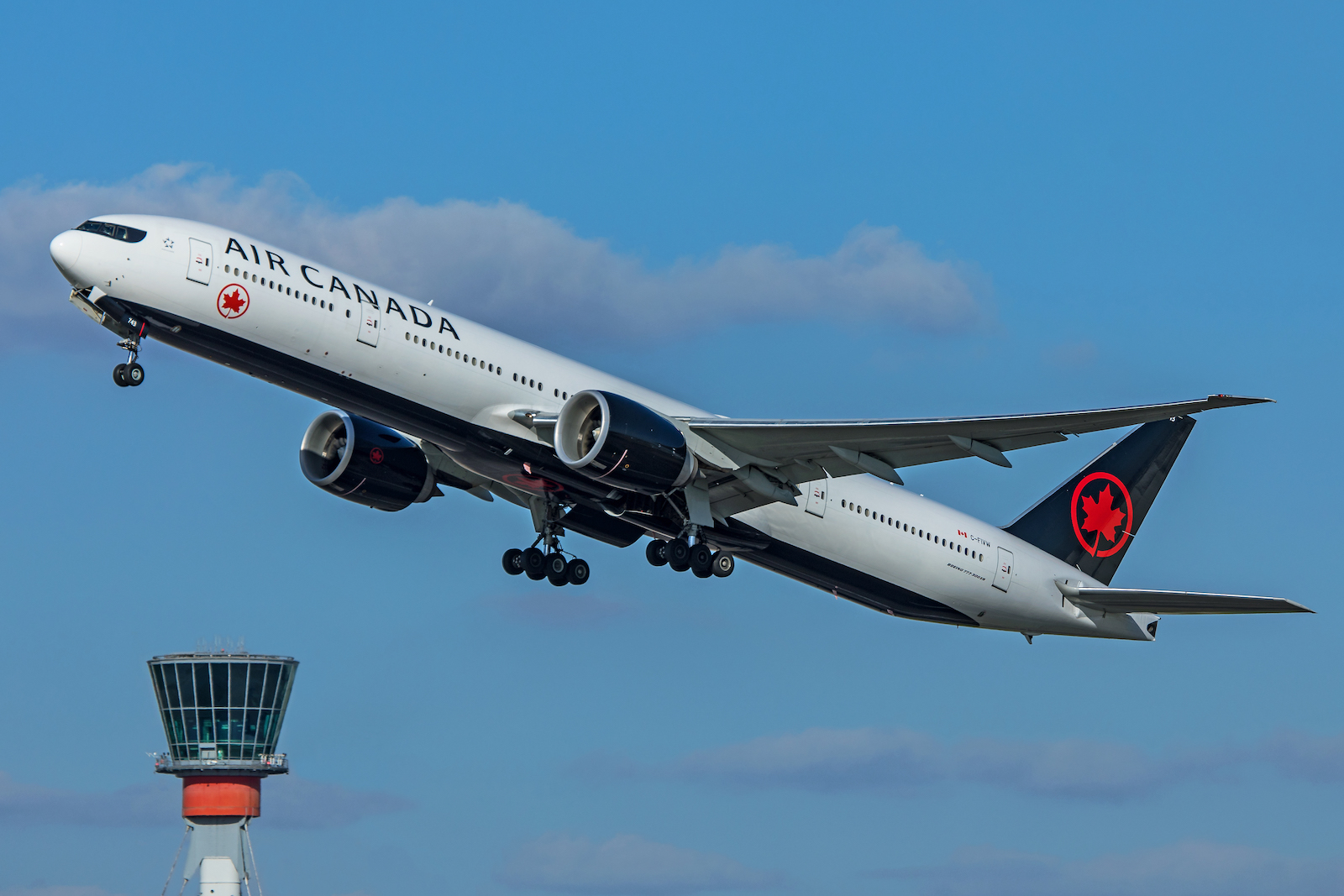
British Airways has suspended its Israel service until July 1. United and Air Canada will not return to Israel until September.
Lorne is a South Africa-based aviation journalist. He was captivated and fascinated by flying from the day he took his first airline flight. With a passion for aviation in his blood, he has flown to destinations in all corners of the globe. Lorne has traveled extensively and lived in various countries. Drawing on his travels and passion for aviation, Lorne enjoys writing about airlines, routes, networks, and new developments.
What Would a United-American Merger Look Like?
A potential deal could transform the U.S. airline industry, but only if approved by regulators.
An American Boeing 787-8 Dreamliner. (Photo: AirlineGeeks | William Derrickson)
A merger involving United and American Airlines would create the undisputed largest airline in the world and shake up the U.S. air travel market, but industry experts believe such a deal would face incredibly long odds, even under the mainly deal-friendly Trump administration.
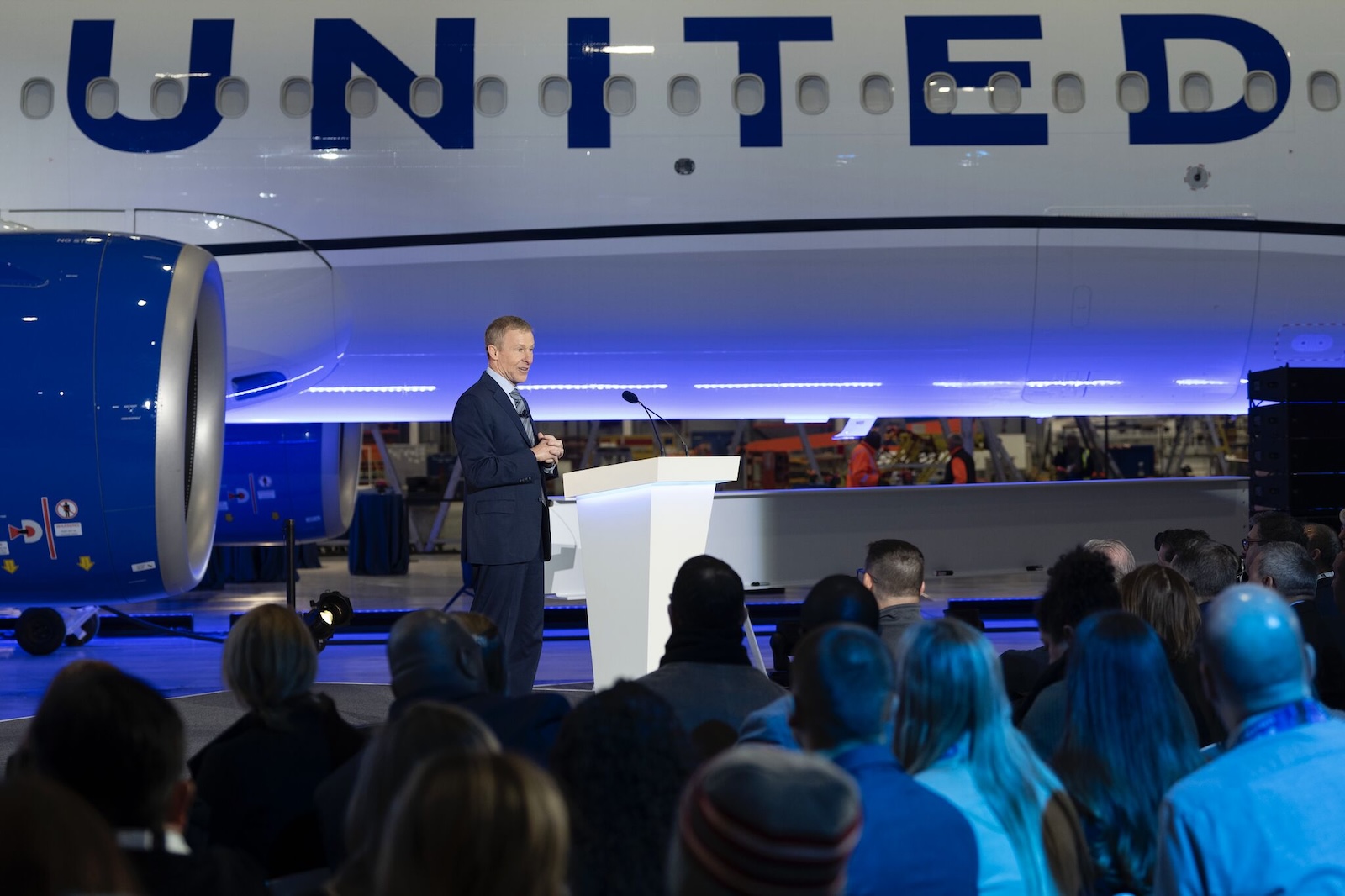
Bloomberg reported late Monday that United CEO Scott Kirby floated the idea of a linkup with American to President Donald Trump in February. He reportedly argued that the resulting airline would be more competitive in international markets.
Neither United nor American have commented on the story, and the White House has not weighed in. But the news has caused considerable speculation throughout the airline industry, mainly because United and American are already two of the largest airlines in the world, and a potential linkup could be the biggest ever for the sector.
According to figures from the Bureau of Transportation Statistics, United controls about 16.7% of the U.S. air travel market, while American holds 17.4%. A linkup would give the combined company a market share of just over 34%, a level of dominance not seen by any U.S. airline in years.
A post-merger carrier would have to rationalize its network and fleet, making it difficult to estimate its potential earnings per year or total number of aircraft. But executives would likely retain and capitalize on the strengths of each business – for United, its international long-haul routes, loyalty programs, and premium products, and for American, its comparatively younger fleet and dominance in the Caribbean and Latin America.
A merger would permanently end United and American’s battle for access at Chicago O’Hare. American is pursuing legal action over the allocation of gates at O’Hare, and both carriers are planning to ramp up operations there this summer in a bid to capture valuable market share.
In February, the FAA announced it would step in and order flight reductions to keep O’Hare from exceeding its capacity.
Officials would also have to hash out a new headquarters. United is famously based in Chicago, while American has its central office in Fort Worth, Texas.
A United Boeing 787 at Washington Dulles. (Photo: Shutterstock | Andrew Mauro)
There could also be an indirect impact on a third airline, JetBlue. United and JetBlue announced their Blue Sky partnership last year, and the carriers are gradually integrating some aspects of their rewards programs and booking platforms. Critics of the alliance, including Spirit, argued to regulators that United is engaged in a de facto acquisition of JetBlue that could hurt competition and raise prices in the long term.
Many experts believe a proposed United-American linkup would almost certainly be blocked by the U.S. Justice Department’s Antitrust Division, since regulators have intervened to stop much smaller linkups in the recent past, such as JetBlue’s failed acquisition of Spirit in 2024.
The federal government is usually most concerned with prices paid by consumers, which could rise as the industry becomes more concentrated and the incentive to compete with lower fares fades.
“This would be the biggest of all time,” George Hay, a law professor at Cornell University, told CNBC on Tuesday. “I can’t even see the slightest chance that a court would allow it.”
The president “loves to see big deals happen,” Duffy told CNBC’s Phil LeBeau.
But the secretary also noted that any merger would have to be evaluated for its potential effects on fares and competitiveness.
In a note, investment bank and financial services firm Jefferies said regulators would likely make United and American divest certain assets and rework their labor contracts before a deal could be approved.
Zach Vasile is a writer and editor covering news in all aspects of commercial aviation. He has reported for and contributed to the Manchester Journal Inquirer, the Hartford Business Journal, the Charlotte Observer, and the Washington Examiner, with his area of focus being the intersection of business and government policy.
Sign-up for newsletters & special offers!
Get the latest stories & special offers delivered directly to your inbox