Cayman Airways has recently announced some network news, which includes the expansion of one of it’s current routes and an expansion to a new destination.
The airline will be expanding its Los Angeles route, which is currently the longest in its network, will go from once-a-week flights to twice weekly. Currently, the carrier offers departures from the Cayman Islands to Los Angeles on Saturdays with the return trip to the islands on Sundays.
With the new expansion, it will now also offer a departure from the Cayman Islands to LAX on Wednesdays, with the return trip operating on Thursdays. This expanded second weekly flight will begin on Nov. 8, 2023.
Adding a New Route
The new route that the airline will be offering is to Bridgetown located in Barbados, making this the third country it serves in the Caribbean outside of its home country, along with Cuba and Jamaica. The new route to Bridgetown will initially operate once a week, on Wednesdays, beginning on Oct. 18, 2023. with the departure and return trip happening on the same day.
It will increase the Barbados route to twice a week on Nov. 7, 2023, with departures from the Cayman Islands on Tuesdays and Thursdays, and the departure from Barbados occurring on Wednesdays and Fridays.
Not only are these routes and service expansions good for people wanting to visit the Cayman Islands, but also for people connecting to onward destinations due to the timing of the new flights; on Tuesdays, passengers from Kingston, Havana, Miami, and Cayman Brac can connect onward to Barbados. On Wednesdays, Barbados passengers can connect in the Cayman Islands onto either JFK in New York City, LAX, and Cayman Brac.
On Thursdays, the exact opposite can happen with JFK, LAX and Cayman Brac passengers being able to connect onward going to Barbados. And finally, on Fridays, passengers from Barbados can connect onward to La Ceiba, Kingston, Miami, and Cayman Brac.
A Cayman Airways 737-300 in Grand Cayman (Photo: AirlineGeeks | Justin Sinanan)
Given that all routes are scheduled to start relatively soon, they have already been posted for booking, and all new routes and frequencies are scheduled to operate on the airline’s Boeing 737 MAX.
Joey has always been interested in planes for as long as he can remember. He grew up in Central New York during the early 2000s when US Airways Express turboprops ruled the skies. Being from a non-aviation family made it harder for him to be around planes and would only spend about three hours a month at the airport. He was so excited when he could drive by himself, the first thing he did with his driver's license was get ice cream and go plane spotting for the entire day. He graduated from Western Michigan University in 2022 with a B.S. in Aviation Management & Operations and a Minor in Business, and currently works for a major airline in his hometown.
Vertical Aerospace Update On VX4 Program After Incident
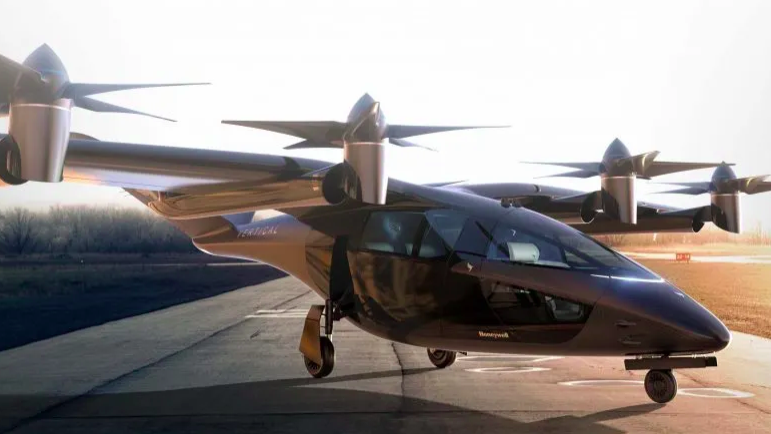
The Vertical Aerospace VA-X4. (Photo: Vertical Aerospace)
Vertical Aerospace, a British eVTOL aircraft manufacturer, updated on its VX4 program, announcing a significant milestone by successfully concluding its remote thrust-borne flight test campaign. The first full-scale VX4 prototype achieved its target speed of 40 knots (74 km/h), surpassing performance expectations by 10-30% during various flight phases.
According to the statement, the VX4 demonstrated exceptional stability and control, particularly in sustained hover, a challenging feat for VTOL aircraft. However, the journey hasn’t been without its hiccups. On August 9, 2023, the eVTOL experimental prototype, registered as G-EVTL, suffered a crash during an uncrewed test at Cotswold Airport (GBA) in the United Kingdom after reaching an altitude of approximately 20 feet (six meters).
One of the aircraft’s Electrical Propulsion Units (EPU) was intentionally disabled, and this led to the unexpected release of one of the front propellers connected to a separate EPU, resulting in an excessive imbalance that caused a supporting pylon structure to fail. The aircraft entered a stable descent, sustaining damage upon impact with the ground.
High-voltage systems and batteries demonstrated resilience during the incident, with voltage, current, and power levels remaining within acceptable limits and average cell temperatures. The investigation into the incident revealed a bonding issue within the propeller blade, which had already undergone a redesign and a different manufacturing process before the incident occurred. It’s worth noting that the aircraft involved in the incident will not be repaired to an airworthy standard but will be utilized for further ground tests.
As explained and addressed in the announcement, it is worth mentioning that it was a “forward-looking statement neither promises nor guarantees.” The market for eVTOL aircraft is in a relatively early stage, so Vertical Aerospace has a potential inability to produce, certify, or launch aircraft in the volumes or timelines projected.
Despite the setback, Vertical Aerospace maintains its certification timelines, with plans for an advanced full-scale VX4 prototype set to take flight early in 2024, backed by key industry partners like Honeywell, GKN Aerospace, Hanwha, Solvay, Leonardo, and Molicel.
The British company has secured funding through the second half of 2024, ensuring continued progress in its ambitious endeavors. In June 2021, American Airlines announced a pre-order of up to 250 aircraft with an option for an additional 100, while in 2022, it confirmed delivery slots for 50 VX4 eVTOL aircraft to collaborate on a framework for exploration of the future of advanced air mobility and potential markets for eVTOL operations in the United States.
As of 2022, Vertical has a market-leading pre-order book by value for 1,400 aircraft from global customers. Customers include American Airlines, Virgin Atlantic, Avolon, Bristow, Marubeni, Iberojet and FLYINGGROUP, Japan Airlines (JAL), Gol, Air Greenland, Gozen Holding and AirAsia.
Vincenzo graduated in 2019 in Mechanical Engineering with an aeronautical curriculum, focusing his thesis on Human Factors in aircraft maintenance. In 2022 he pursued his master's degree in Aerospace Engineering at the University of Palermo, Italy. He combines his journalistic activities with his work as a Reliability Engineer at Zetalab.
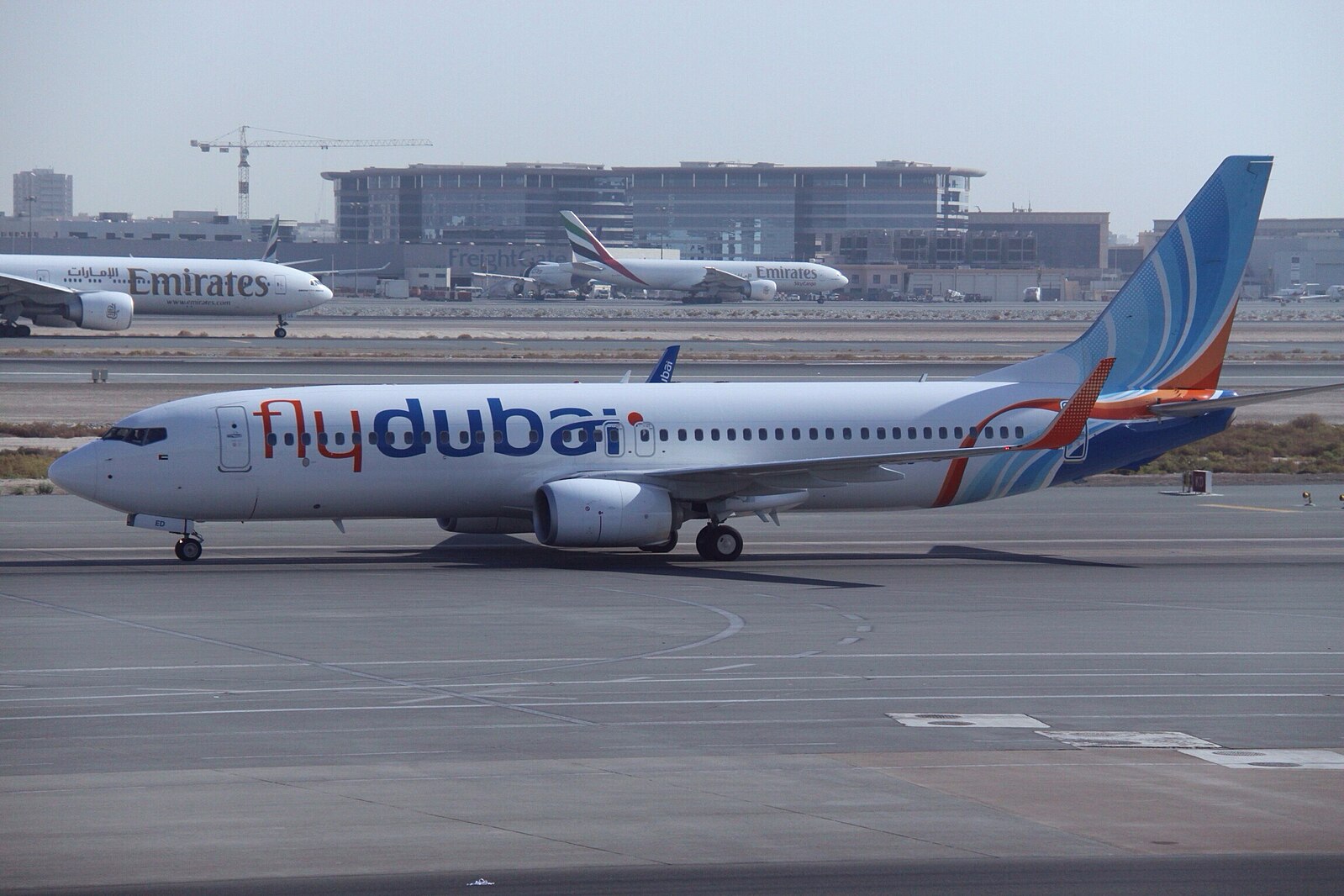
Flydubai Boeing 737-800 at Dubai International Airport. (Photo: aeroprints.com, CC BY-SA 3.0 https://creativecommons.org/licenses/by-sa/3.0/deed.en)
Flydubai is to Emirates like a younger, less favored sibling. A low-cost airline with a singletype fleet consisting of only Boeing 737s, next to a big brother, with an enormous fleet that consists of exclusively Airbus A380s and Boeing 777s. This negative connotation cannot be further from the truth. In the fierce business of commercial aviation, Flydubai is actually to Emirates like a second breath. Cooperation and partnership that had yet not been replicated in the Gulf area. One that gives Emirates the narrow-body component and product flexibility that other airlines from the region need to achieve on their own.
A Blessing, Not a Curse
From a purely internal perspective, Flydubai gives Emirates an edge in regard to network planning and scheduling. It is possible to either open destinations that wouldn’t be able to support even the smaller of the two families operated by Emirates, the 777, or add more frequencies that enhance the product. It is also a way to offer a lower price point to the passengers without sacrificing the Emirates brand.
The decision between the two so-called siblings arose in front of me recently. The schedule was a driving factor when choosing the trip plan. To set off my journey I picked to fly from Dubai International Airport to Warsaw-Chopin on a morning segment with Emirates. It fit me best to fly back the overnight segment with Flydubai. This is a great way to compare the two carriers operating in parallel on the same route. What interested me the most during this endeavor was pure comfort. I wanted to waste the least amount of energy on travel as my trip was short and tight.
A Seat is a Seat?
On flights longer than two hours the seat can make a difference. Flights between Dubai and Warsaw are three times that long. It’s because of that, that I was able to notice the difference. My flights were operated by Boeing 777-300ER and Boeing 737-8MAX respectively. Both with two class configuration – economy plus business class. According to seatguru the first of the two offers 33-34″ of pitch, while the other only 30″. This is a metric easy to quantify and verify, but from my observation, there was another one. Flydubai seat is definitely not reclining as much as the Emirates seat. I’m assuming that the lower pitch is partially the reason, but it’s a second issue nonetheless. When choosing between the two carriers on the website I couldn’t notice any difference in price. For this reason, each shortcoming I found felt a little bit like betrayal.
Is Emirates Food More of the Same?
Even though the flight time is very similar, while Flydubai passengers can count on one meal service during the flight, flying on Emirates gets you two. On my segment, the first meal was only a snack, and since it was a morning flight, the options were an egg sandwich or a fruit pastry. The second meal was the main course. It was an early lunch with two options – chicken or beef. Overall I really enjoyed it, and admittedly it was a lot of food. I could save the piece of cheese, the crackers and the oatbar for an even later snack during this flight.
Emirates main Economy meal service (Photo: AirlineGeeks | Filip Kopec)
Flydubai offers only one meal serving per flight, with two options to choose from – one of them veggetarian this time. The portion of the meal is rather smaller than the one offered by Emirates. To be fair though, I would not say that with blinds on my eyes I could tell the difference between Emirates and Flydubai food. It is worth noting that not all Flydubai passengers receive the meal service. If you booked the cheapest type of ticket called “Lite” , you are not eligible for this small luxury. Having bought the Emirates flight operated by Flydubai, there wasn’t such an option though at least with this part of the service.
Flydubai meal service (Photo: AirlineGeeks | Filip Kopec)
Entertainment
Emirates offers one of the world’s best In-Flight Entertainment systems. It is possible to have a peek at their current portfolio through the magazine available on the website. Next to some interesting new releases or the evergreen classics, we can also count on some seasonal offers, like the current Penelope Cruz cooperation. While flying on my second segment with Flydubai, I was hoping to see the same selection of movies and TV series. To my surprise, a dreadful orange box showed up on the right top corner of my IFE – “PURCHASE AED 40 ($11)”. This disappointment was incredibly amplified when after having a look at the digital offering I decided to go to sleep and asked the cabin crew for a blanket. I was politely informed that I could purchase one for myself for 100 AED ($27).
Flydubai IFE screen (Photo: AirlineGeeks | Filip Kopec)
Is It Worth It?
Comparing Emirates to Flydubai on one route might be comparing apples to apples, but such a comparison is definitely not fair to the latter. Flydubai will never play in the same league as Emirates. Having the possibility to book Flydubai flights with a different schedule is already an upgrade over just browsing through the Emirates offer. That being said, we sacrifice a lot for such perk, and I would very much prefer that Emirates clients were in fact treated like full service passengers when given a full service price to pay.
A passionate aviation enthusiast that started off his career as an aerospace engineer, but found his true calling on the commercial side of the airline business. Now as a finance guy among avgeeks and an avgeek among finance guys, he has experience working in the Revenue Divisions of three airlines. In his spare time he enjoys traveling, but admittedly sometimes is more about the journey than the destination.
BermudAir will operate Embraer 175 aircraft. (Photo: BermudAir)
Recently, BermudAir launched operations with flights from Bermuda to Boston and Westchester, New York. The self-proclaimed all-aisle cabin class airline will operate Embraer 175 aircraft on routes from Bermuda to the United States. Catering to tourism and business markets alike, the carrier will offer a new way to access Bermuda from the East Coast.
Routes
The brand new carrier is looking to break into the premium market, much like La Compagnie has done in the transatlantic market, and will offer a fully premium product on the initially three routes set to be operated. BermudAir launched service between Bermuda’s L. F. Wade International Airport and Boston’s Logan International Airport along with Westchester County Airport on Aug. 31.
The carrier will inaugurate its third service to Fort Lauderdale-Hollywood International Airport on Sept. 22. Flights to Boston and Westchester will operate 6 times weekly, with the exception of not operating on Tuesdays. However, beginning Sept. 15, the carrier will operate to Westchester twice daily on Monday and Thursday through Sunday, with Tuesday and Wednesday being operated once daily.
The Bermuda-based carrier will operate head-to-head with JetBlue operating to and from Boston. While BermudAir is the only carrier operating between Westchester and Bermuda, the airport is in close proximity to the New York City area and will be looking to attract travelers from the city. All three major carriers, along with JetBlue, offer flights to Bermuda from New York’s John F. Kennedy International Airport, New York’s LaGuardia Airport and Newark.
Aircraft
The carrier acquired two Embraer 175 aircraft, VQ-BLW and VQ-BLU, both of which were initially delivered to the now-defunct FlyBe. The current configuration both aircraft have is a 44-seat all-aisle cabin. However, the carrier has promised to roll out a new premium product to be offered on flights beginning November 1st of this year.
The new cabin will offer 30 pod-like seats allowing direct aisle access, a workspace and dining area along with substantial overhead bin space. The Bermuda-based carrier also released that onboard complimentary Wi-Fi and entertainment are available to passengers. To complement the onboard hard product, the carrier offers complimentary food and beverages throughout the flight.
BermudAir’s Aisle-Class pods, set to be onboard November 1st. (Photo: BermudAir)
BermudAir believes there is market share to be gained by the carrier. In a press release, the carrier noted that 85% of travelers arriving in Bermuda access the island through the United States. The other 25% of travelers originate from other countries, with some of that percentage entering via British Airways’ daily service from London Heathrow.
Over one-third of all travelers arriving in Bermuda come from one of the New York airports. BermudAir is looking to take advantage of this high percentage with the launch of their twice-daily operation to Westchester beginning mid-September.
Zach’s love for aviation began when he was in elementary school with a flight sim and model planes. This passion for being in the air only intensified throughout high school when he earned his Private Pilot Certificate. He then attended Embry-Riddle Aeronautical University, earning his certificates and ratings to later flight instruct and share his passion for aviation with others. He now resides in the North East living out his dream as an airline pilot.
1,000 Flights Per Week to Be Cut at Mexico City International Airport
An Aeromexico Boeing 787 Dreamliner flares for landing. (Photo: AirlineGeeks | William Derrickson)
The reduction of over 1,000 flights per week at Mexico City International Airport (MEX) is expected to take effect from the beginning of the Northern Winter schedule at the end of October, according to Reuters. News of the Mexican government-imposed reductions this week taking flight numbers down from 52 to 43 per hour has been met with criticism from airlines and airline advocacy group IATA (International Air Transport Association) given the changes are required with less than 2 months’ notice.
Peter Cerda, IATA Regional Vice President, said: “This decision by the government does not take into account the interests of consumers, nor does it respect the necessary consultative process with operators and users, especially at the country’s main airport.” Ironically, IATA held its Wings of Change Americas conference in Mexico in June and stated during the closing remarks that they were looking forward ‘to working with the Mexican Government to create a joint agenda to further utilize aviation to create jobs and economic opportunities for the country and its people.’
Crowded skies
The Mexican government cites the need to reduce capacity in the Mexican capital’s airspace as one of the reasons for the cuts. The ability to accommodate more flights at Felipe Angeles International Airport (NLU) is also behind the rationale. Mexican President Andres Manuel Lopez Obrador said on Thursday: “Since we have the (NLU), which does have the capacity, that’s how we’re going to resolve this.”
NLU opened in March 2022 and major Mexican carriers Aeroméxico, Volaris and Viva Aerobús operate from the airport in addition to MEX. However, all three airlines were critical of Thursday’s announcement by the president and the fact that no criteria have so far been given on how the cuts will affect all airlines, not just the Mexican carriers.
In a statement reported by Reuters, Viva Aerobus said: “The short notice of this decision will have a negative impact on the travel plans of thousands of passengers, especially given how soon the high season of winter is.” Most airlines will already have flights for sale for the Northern Winter period and a number will be selling for most of next year’s summer period.
Volaris is reported as questioning the need for a robust methodology to any process in determining how the cuts are allocated “to guarantee equity and avoid any form of discrimination in the implementation of these measures.” Aeromexico cites the ‘effect on workers and the ability to attract new investments’ which the airline says is dependent on “legal certainty and adequate air connectivity.” NLU is north of the city and currently relies on road transport to link it to the city center after a rail link opening was delayed to 2024.
John has always had a passion for aviation and through a career with Air New Zealand has gained a strong understanding of aviation operations and the strategic nature of the industry. During his career with the airline, John held multiple leadership roles and was involved in projects such as the introduction of both the 777-200 and -300 type aircraft and the development of the IFE for the 777-300. He was also part of a small team who created and published the internal communications magazines for Air New Zealand’s pilots, cabin crew and ground staff balancing a mix of corporate and social content.
John is educated to postgraduate level achieving a masters degree with Distinction in Airline and Airport Management. John has held the positions of course director of an undergraduate commercial pilot training programme at a leading London university. In addition he is contracted as an external instructor for IATA (International Air Transport Association) and has been a member of the Heathrow Community Fund’s ‘Communities for Tomorrow’ panel.
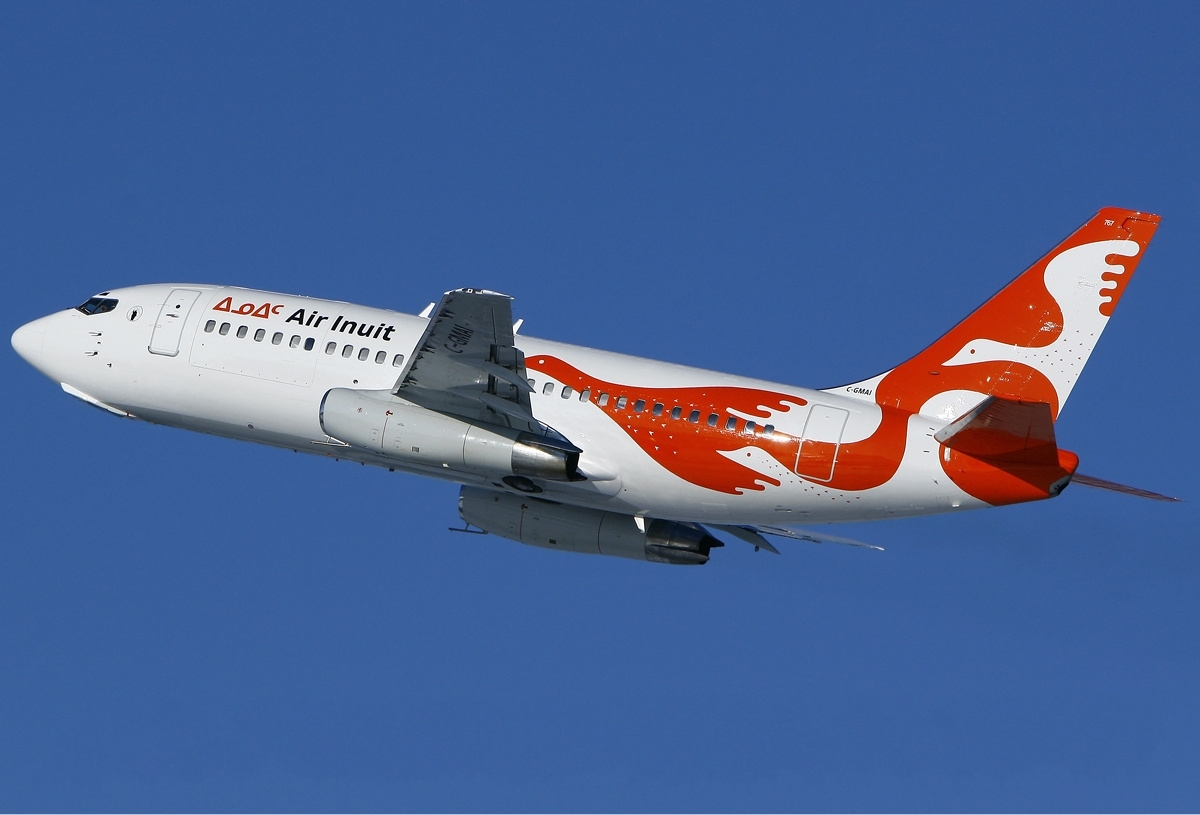
An Air Inuit Boeing 737-200 (Photo: Gilbert Hechema (GFDL 1.2), via Wikimedia Commons)
The Boeing 737 has played a central role in the development of the global aviation industry for decades. Since the first aircraft entered service in 1968, the twin-engine narrowbody jet has been the backbone of air travel around the world. For many years, it was the highest-selling commercial aircraft of all time – until it was surpassed by the Airbus A320 family in 2019 – and remains the record-holder for the highest number of deliveries.
The first generation of Boeing 737s – also known as the 737 Original – consists of the Boeing 737-100 and 737-200. While only a small number of Boeing 737-100s were delivered, over 1,000 of the -200 variant were put into service. Despite the subsequent introduction of the 737 Classic, 737 Next Generation and 737 MAX, there are still a few dozen Boeing 737-200s in active service around the world in 2023.
The Boeing 737 Original: Start of an Era
The introduction of the Boeing 737-100 in February of 1965 signalled the launch of an aircraft family that would bring The Boeing Company massive commercial success for decades. The Boeing 737-100 entered service with Lufthansa in 1968 but only saw 30 orders and deliveries. However, the higher-capacity Boeing 737-200 was the version of the aircraft that brought the 737 to the world.
Like the Boeing 737-100, the 737-200 also launched in 1965 and entered service in 1968. What it set it apart from the -100 was its longer fuselage. While the initial 135 Boeing 737-200s were essentially 737-100s with extended fuselages, subsequent aircraft were produced to a new standard known as the 737-200 Advanced. These aircraft had improvements including automatic braking, more powerful engines and higher fuel capacity. Boeing also offered a military variant, as well as two flexible cargo operations. The Boeing 737-200C (Combi) allowed for a mixed passenger and cargo configuration and the Boeing 737-200QC (Quick Change) allowed operators to convert the entire aircraft between passenger and cargo use.
The next generation of Boeing 737s – the 737 Classic – entered service in 1984 with the delivery of the first Boeing 737-300. The final Boeing 737-200 was delivered a few years later in 1988. With the introduction of subsequent generations of Boeing 737s in the years since, the 737 Originals started to be retired. In the United States, the last airline operating the Boeing 737-200 on scheduled passenger flights was Aloha Airlines, which retired the aircraft in 2008. Alaska Airlines retired their Boeing 737-200 Combi aircraft the following year.
The Boeing 737-200 Today
Although the newest Boeing 737-200 ever produced is 35 years old, the aircraft type continues to populate the skies today. In 2023, around 30 operators around the world still have a combined total of approximately 50 Boeing 737-200s in service. The aircraft is immediately distinguishable from newer generations of the Boeing 737 due to its long narrow engines.
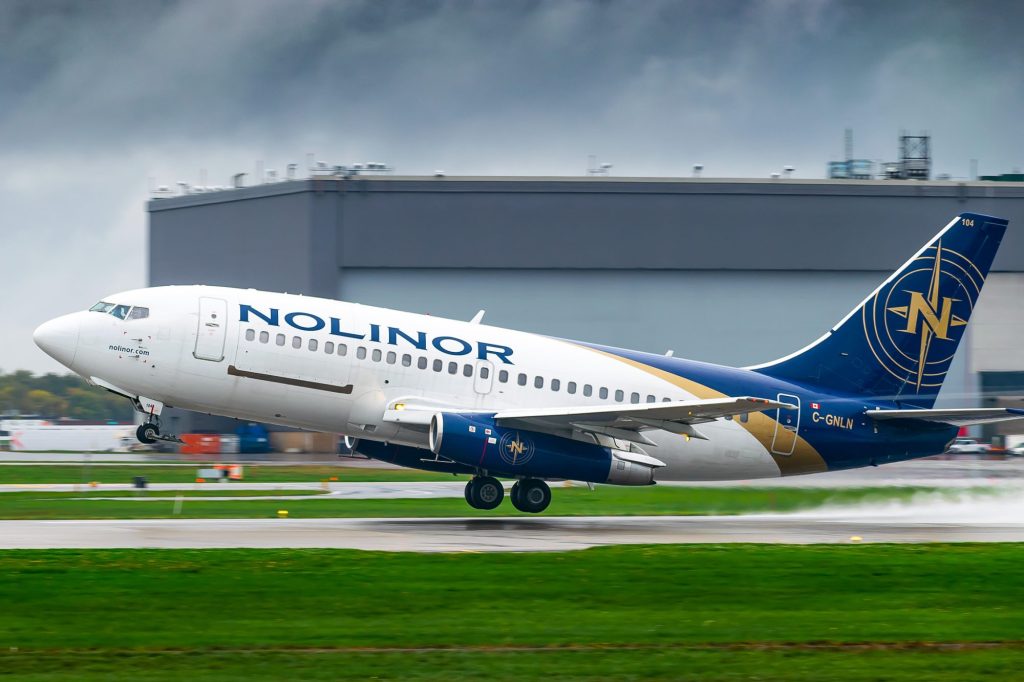
The three airlines with the greatest number of Boeing 737-200s are all located in Canada. The aircraft has been popular among Canadian carriers operating in the northern parts of the country as it can be fitted with a gravel kit for operations at remote unpaved runways. The gravel kit prevents foreign object debris from damaging the aircraft by adding a gravel deflector on the nose wheel and vortex dissipators in front of the engines.
A Nolinor Boeing 737-200 Combi with a gravel kit installed (Photo: Nolinor Aviation)
According to data from Planespotters.net, Nolinor Aviation has seven active Boeing 737-200s with an additional two parked aircraft. Nolinor is a Montreal-based charter operator that offers passenger and cargo charters throughout North America. Air Inuit is also based in Montreal and flies scheduled and charter passenger and cargo flights throughout Quebec and the northern Canadian territory of Nunavut. The airline operates four 737-200 Combi jets. Chrono Aviation is another Canadian charter airline and is the newest 737-200 operator, having received its three used airframes in 2018 and 2019. Canadian North retired their last Boeing 737-200 earlier this year.
Various other airlines around the world also operate small numbers of the 737-200. For example, Venezuelan carrier Avior Airlines has four of the type in service and Hawaii-based cargo and charter operator Transair has four 737-200Cs. Several militaries still operate the aircraft as well, including the Indian Air Force, the Peruvian Air Force and the Indonesian Air Force. A single highly-modified T-43 aircraft – the US military variant of the Boeing 737-200 – remains in service with the United States Air Force Materiel Command.
Andrew is a lifelong lover of aviation and travel. He has flown all over the world and is fascinated by the workings of the air travel industry. As a private pilot and glider pilot who has worked with airlines, airports and other industry stakeholders, he is always excited to share his passion for aviation with others. In addition to being a writer, he also hosts Flying Smarter, an educational travel podcast that explores the complex world of air travel to help listeners become better-informed and savvier travelers.
A DJI drone. The United States government is preparing to ban all drones made in China, including those made by DJI, a Chinese company.
(Photo: ekai used under CC BY-NC-SA 2.0)
Drones have reached the consumer market over the last decade or so, but they’ve actually existed for far longer than this. When most of us hear the term, we think of small drones that hobbyists use to film landscapes or take photos from above.
On the contrary, drones are quite generalised. A “drone” is simply defined as an unmanned aircraft. There are no pilots on board, no crew or passengers. The drone is typically piloted by someone on the ground, with cameras attached to help navigate the flight. It is believed that the first recognised drone was invented way back in 1917, which shows just how long this technology has been around.
Primarily, drone technology was used by armies and government defence agencies as a way of providing aerial coverage without keeping pilots in the air for hours on end. Militaries weaponised drones and used them to commit air strikes as well, though the main use remained the same: to provide coverage from above.
As technology developed and advanced, people realised there was room for this in everyday life. So, we saw the birth of small drones entering the scene. This includes products like the DJI Drone, which gave individuals a tiny aircraft they could launch into the sky. It was capable of soaring to pretty extreme heights and delivered some of the surveillance features we saw in much larger drones.
Nowadays, it feels like everyone you know has a drone, but how far can this technology develop? More specifically, what do drones mean for the future of aviation? If we look at some of the growing tech trends throughout society and apply them to drones, there are definitely a few ways in which the flying sector could be changed forever.
Pilotless Flights
Tiny drones will never carry passengers, but what about larger ones? Some of the drones used by the military are big enough to potentially carry people inside. Is it possible to create a drone that can transport passengers without the need for pilots or a crew?
With the rise in autonomous technology already taking the world by storm – see the influx of car manufacturers trying to create self-driving vehicles – could we see a similar approach in aviation? If so, drones certainly seem like the obvious starting point. The main issue will be trying to develop an aircraft that’s suitable for people while also still being able to be controlled from below. There’s also the problem of visibility and maintaining a connection to the grounded pilot.
In truth, nobody knows for sure if this will happen – and the odds of full commercial flights being made by drones are very slim. But, it could open opportunities for smaller passenger jets that may reduce the cost of private jet flights in the future.
More Affordable Shipping
Companies around the world rely on the aviation industry for shipping. You have logistics companies like DHL who provide aviation services for their clients. This means they load up thousands of packages onto cargo jets before taking off and landing in a different country. It’s an essential service that allows the global e-commerce market to thrive. Consumers can purchase goods from across the world and receive them in just a few days thanks to aviation shipping.
Keeping that in mind, could drones have a positive impact on this part of the industry?
The idea of pilotless commercial flights might seem crazy, but pilotless shipping isn’t that strange. After all, smaller drones are already being used by companies like Amazon to deliver goods across cities. This is a similar concept but on a larger scale. You get bigger drones that are equipped to store cargo and transport it from one destination to another.
Why could this be beneficial? In theory, you could create a much smaller aircraft for transport. Smaller aircraft need less fuel, so each flight would be cheaper – and potentially result in fewer carbon emissions. Similarly, cargo flights currently still need crew aboard. This usually consists of two people in the cockpit with one or two cabin crew to deal with any potential emergencies. These people all cost money to employ, while a drone would be completely manless.
There is of course the worry of drones losing contact with operators on the ground, as expressed when talking about pilotless flights. The difference here – and why it makes this seem more possible – is that no human lives are at risk. Sure, there’s a risk of losing cargo in flight, but that’s nowhere near as substantial or impactful. Drone crashes are also fairly rare, so who’s to say if this would be as big of a problem as suspected?
A British Airways 747-400 lands in Las Vegas (Photo: AirlineGeeks | William Derrickson)
Medical Aviation Drones
There’s a high possibility that drones allow a new branch in the aviation industry: medical services.
We can theorise about a handful of possibilities here, so let’s start with the simplest and most likely. Medical shipping or supply runs are already being used by military drones while countries like Italy are experimenting with blood transportation. Here, two different types of drones can be used. The smaller ones can help transport things by air across cities or built-up areas, decreasing transportation times in emergencies. Looking at the Italy example, there might be an emergency surgery that needs a blood transfusion and the only available blood type is at another hospital. With drones, blood can be transported quickly to potentially save a life.
Smaller drones have also been used to carry medical supplies to the front line in warzones – and there’s no reason larger drones can’t be equipped to do a similar thing.
Moving on to another possible use for medical aviation drones, what about passenger transportation? In some extreme cases, hospitals have helicopters that are sent out to airlift or pick up patients in serious emergencies. Could drones be used for the same thing? They need to be big enough for medical professionals and the patient to fit inside, but they’re piloted by someone in a different location. It frees up space and could mean an extra pair of hands are there to monitor the patient during transit. Not needing to navigate through traffic can also speed up hospital transfers and save lives.
Aerial Refuelling
The concept of aerial refuelling is an interesting one. It’s widely used in military settings where small jets and planes are refuelled in the air to extend their range. However, we don’t see it in commercial settings at all. In fact, airlines are strictly against the idea of aerial refuelling for a number of reasons.
For one, there’s the worry of bringing two aircraft close to one another when hundreds of passengers are on board. It’s not a huge issue for military aircraft as the planes are usually much smaller and don’t carry anywhere near as many passengers.
Aside from the danger element, there’s the cost of refuelling in the air. Airlines would need to pay for this extra plane, which massively increases the cost of flights for passengers.
So, could drones impact the idea of aerial refuelling for commercial airlines? In theory, you could get much smaller drones that only carry fuel and nothing else. This would make them cheaper, keeping the costs lower. It also deals with the safety issue as there’s a lower risk because you don’t have a massive commercial jet next to another one.
How likely is this to happen? In all honesty, pretty low! It’s more of an interesting theory than anything else. There are other reasons commercial airlines don’t like in-flight refuelling, plenty of which are related to logistics. Some passengers book long-haul flights specifically to get off when the plane stops for refuelling, so they can transfer to another flight or visit the layover location. There’s a worry that – if long-haul flights were completely uninterrupted – fewer people would buy tickets.
Will Drones Have A Positive Impact On Aviation?
After looking through the ideas above, it’s fair to say that drones can have a big impact on aviation. It’s funny how this technology started in the aviation industry and then moved towards a consumer space. Now, because smaller drones are so popular and versatile, we’re starting to see ideas that go back to the main aviation industry.
Overall, the future of drone technology can have a very positive impact on this sector. Most of the ideas revolve around reducing risks, saving money and speeding things up. Does this mean we’ll 100% see some of the ideas listed above? No! Who knows what stands in the way of drone technology and advancing even further? Money is always an issue, but other roadblocks may mean that we’ve hit our limit.
In all honesty, we don’t think this is the case! Modern technology is so brilliant that it seems highly unlikely drones will remain with the same capabilities they have now. Of all the different things in the aviation sector, the development of future drones is easily the most exciting. It definitely all builds towards the final end goal of possibly seeing pilotless flights for the first time.
AirlineGeeks.com was founded in February 2013 as a one-person blog in Washington D.C. Since then, we’ve grown to have 25+ active team members scattered across the globe. We are all here for the same reason: we love deep-diving into the fascinating realm of the airline industry.
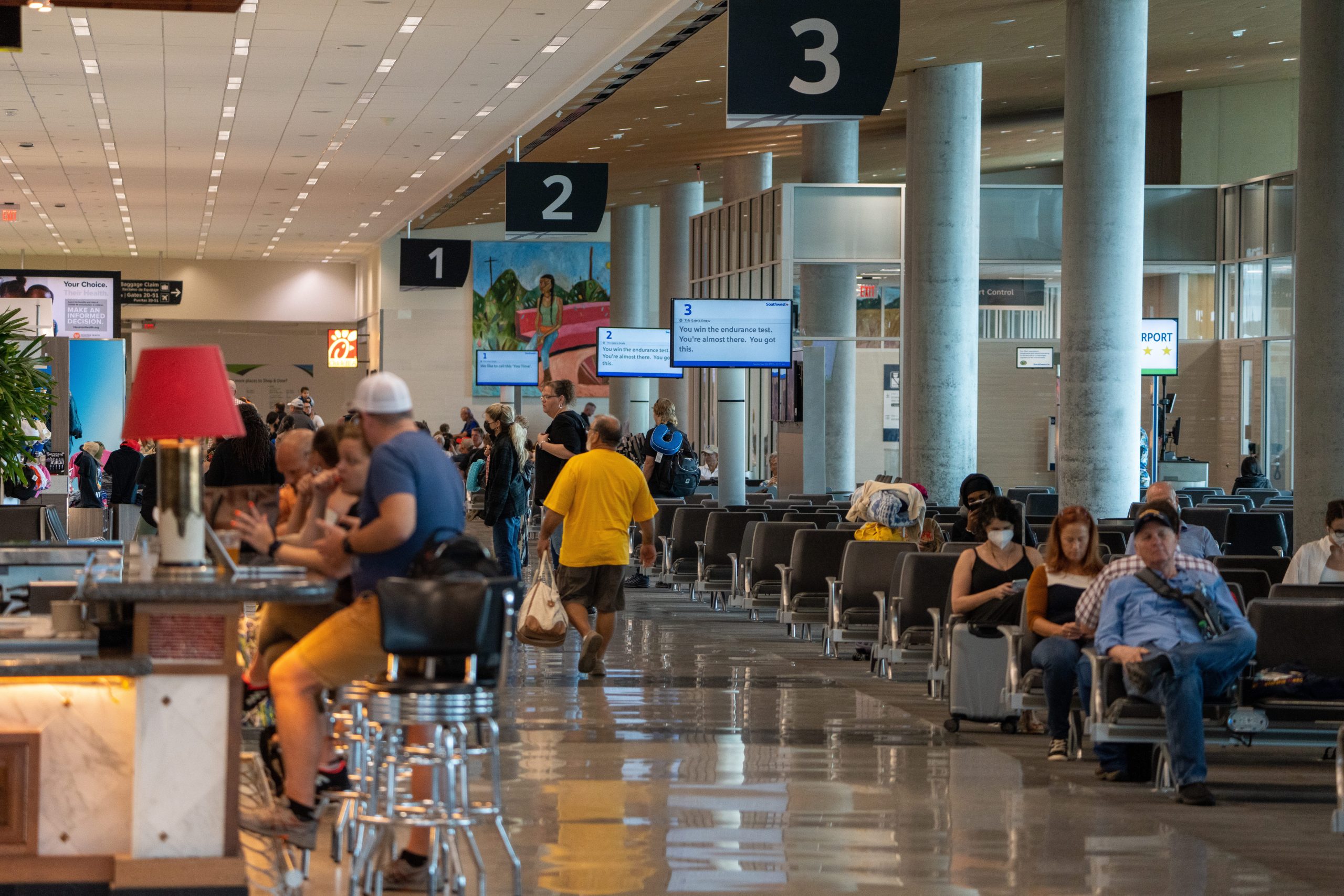
Crowds at Hobby Airport. (Photo: Houston Airports)
Houston’s City Council just unanimously approved a large appropriation of $250 million for William P. Hobby Airport to build more gates in the West Concourse and modernize the baggage experience for passengers as demand at the airport continues to soar.
This comes after an initial $20 million that was made available to the airport in March 2022 to develop plans for the expansion project in anticipation of increased demand from the airport’s main operator, Southwest Airlines.
The $250 million in funding will allow the airport to move forward with these expansion plans. It is expected construction will begin in early 2024 and it will take approximately two years to complete the expansion.
New additions to the airport include:
Seven additional gates that can accommodate domestic and international flights
Expanded and renovated baggage handling system
Updates to the baggage claim area
Overhead canopy along the departures curb which will protect against weather and serve as a connection between the Red Garage and the main terminal
The remaining $200 million in funding will be made available to the airport within the next 12 to 15 months to complete construction.
Airport’s Continued Growth
The airport has seen significant growth over the years. Just last year in 2022, the airport served over 13 million passengers, 12.2 million domestic passengers and 913,000 international passengers. These numbers are expected to continue to grow as Houston continues to be a destination for passengers across the world.
The local government considers regular investments in the airport as a way to strengthen the value proposition of the city and surrounding metro areas. This airport is located 10 miles away from downtown Houston.
The expansion of the West Concourse comes less than a decade after the last expansion when the concourse was first opened for use. The West Concourse opened in 2015 with five gates for international and domestic flights, a ticketing hall, a Federal Inspection Services facility and an expanded TSA security checkpoint. The opening of the new concourse also marked the return of international air service to the airport, after a 46-year hiatus with Southwest Airlines launching service to Mexico, Central America and South America.
When finished, the West Concourse will have more than double the number of gates available giving the airport’s largest operator Southwest Airlines six of the seven new gates.
While Southwest Airlines does control over 90 percent of the passengers flowing through the airport, other carriers such as Allegiant, American Airlines, Delta Air Lines and Frontier all offer flights to the airport.
Notably, JSX operates at the airport as well with its “hop-on jet service” offering convenient flights to Dallas Love Field year-round and Destin, Florida’s Executive Airport on a seasonal basis.
Hemal took his first flight at four years old and has been an avgeek since then. When he isn't working as an analyst he's frequently found outside watching planes fly overhead or flying in them. His favorite plane is the 747-8i which Lufthansa thankfully flies to EWR allowing for some great spotting. He firmly believes that the best way to fly between JFK and BOS is via DFW and is always willing to go for that extra elite qualifying mile. Hemal's opinions are his own and do not reflect those of his employer.
An In-Depth Analysis of China Eastern Airlines’ Fleet in 2023
A China Eastern 777-300ER in Los Angeles (Photo: AirlineGeeks | William Derrickson)
China Eastern Airlines, a leading global airline, operates an extensive network from its primary hubs at Shanghai’s Hongqiao (SHA) and Pudong (PVG) airports, as well as numerous secondary bases across China. With a fleet size that ranks among the world’s largest, the airline boasts 639 aircraft, according to data from ch-aviation.com. This article provides a comprehensive overview of the various aircraft types that make up China Eastern Airlines’ fleet.
Widebody Aircraft
China Eastern Airlines has a strong affinity for Airbus widebody aircraft, particularly the A330 series. The airline currently operates 55 A330s, divided between 30 A330-200s and 25 A330-300s. These aircraft have average ages of 10.4 and 8.9 years, respectively.
In addition to the A330s, the airline also operates 18 next-generation A350-900 models, which have an impressively low average age of 2.8 years. Furthermore, the airline has placed orders for two additional A350-900s, signaling its commitment to modernizing its fleet.
On the Boeing front, China Eastern Airlines operates aircraft from two widebody families. The airline has 20 Boeing 777-300ERs with an average age of 7.6 years. Additionally, it operates three Boeing 787-9s, averaging 3.8 years in age, and has seven more on order.
Narrowbody Aircraft
The Airbus A320 family constitutes a substantial portion of China Eastern’s narrowbody fleet, making up nearly 60% of the total fleet. The airline operates 35 A319-100s, 166 A320-200s, 104 A320neos, and 77 A321-200s. With pending orders for 38 more A320neos and 68 A321neos, this segment is poised for growth.
The Boeing 737 family plays a significant role in China Eastern Airlines’ narrowbody fleet. Despite grounding its 737-800s last year due to a fatal accident, the airline has successfully reactivated all 102 units, which have an average age of 8.2 years. The airline also operates 37 Boeing 737-700s with an average age of 11.9 years and has recently incorporated the next-generation Boeing 737 MAX 8, with three units in service and seven more on order.
Domestic Aircraft
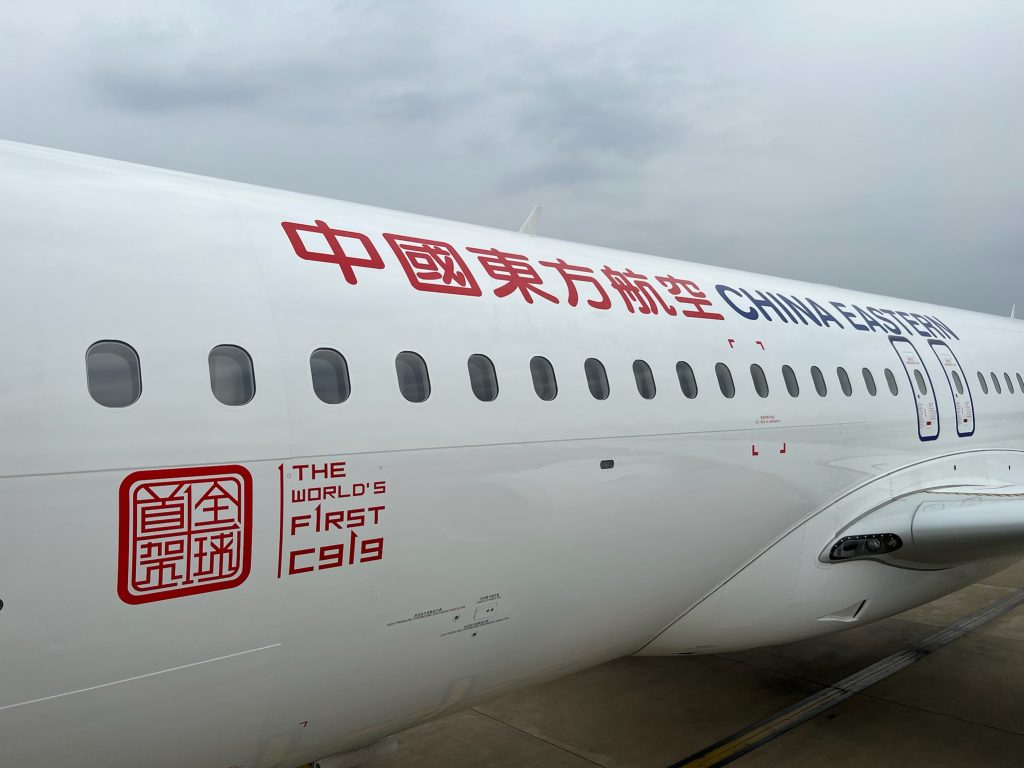
China Eastern Airlines also operates a selection of domestically produced aircraft. The airline has 17 COMAC ARJ21-700s, which are relatively new, with an average age of 1.5 years. These aircraft are operated by OTT Airlines, a subsidiary of China Eastern. Additionally, the airline has recently begun incorporating COMAC C919s into its fleet, with three more units on order.
World’s First C919 logo on China Eastern C919 (Photo: Lei Yan)
Conclusion
China Eastern Airlines’ diverse and extensive fleet is a testament to its strategic planning and commitment to offering a wide range of services. With a balanced mix of widebody and narrowbody aircraft from both Airbus and Boeing, as well as a growing number of domestically-produced aircraft, the airline is well-positioned for future growth and expansion.
The airline’s focus on modernizing its fleet, especially with the next-generation Airbus and Boeing models, is a prudent move that will likely yield operational efficiencies and enhance passenger experience in the long run.
Parth Jain is a dedicated aviation enthusiast with a rich background in general and commercial aviation. Over the years, Parth has consistently demonstrated a deep fascination with the aviation industry, his interests spanning from the workings of small general aviation aircraft to the complexities of large commercial jets. Parth's interest in aviation sparked at a young age when he first set foot in an airplane. Since then, he has dedicated much of his time to gaining first hand experience, achieving his private pilot license and currently working towards his instrument rating. Parth's education and experience are a testament to his dedication and commitment to this field. As a private pilot, he has navigated complex airspace, developed an understanding of the intricate details of aircraft operations, and consistently demonstrated safe and proficient flying skills.
Embraer has been gaining momentum in Asia this week. The Embraer E195-E2, the largest member of the E-Jet family, has been granted its Type Certificate by the Civil Aviation Administration of China (CAAC). This follows the certification of the E190-E2, which was received from CAAC in November last year during the Zhuhai Air Show.
“We’re excited to now have both the E190-E2 and E195-E2 certified by CAAC, paving the way for sales in the Chinese market,” said Arjan Meijer, President and CEO of Embraer Commercial Aviation. “Our team in China is actively working with potential customers and making good progress.”
The planemaker’s CEO is also in Asia, visiting China’s neighbor, India, where he expressed interest in setting up assembly lines in China or India.
Embraer’s History in China
Embraer has a long, but small, presence in China. It first entered the Chinese market in 2000, when Sichuan Airlines acquired 5 Embraer ERJ145s. Its larger aircraft and predecessor of the E2 jets, THE Embraer E190, first flew in China commercially in 2008. According to planespotters.net data, 64 older E-Jets are in service in China — 44 E190s and 20 E195s — and another 20 E-Jets are parked. In comparison, the country has over 7000 aircraft in commercial service.
In addition to the two commercial families of jets, the Brazilian manufacturer’s executive jet, the Embraer Phenom 300, was also used in scheduled services in China. Three aircraft flew commercial service in the years before the pandemic.
An Embraer Phenom used for scheduled service by Ordos General Aviation. (Photo: AirlineGeeks | Fangzhong Guo)
New Embraer Final Assembly Line?
The company has hinted that large orders from Chinese customers could help underpin the development of a final assembly line in the country since March of 2023. The company had previously partnered with AVIC, producing 41 ERJ-145s and some Legacy 650 business jets assembled in Harbin from 2003-2017.
The two world’s leading aircraft producers, Boeing and Airbus, both set up final assembly or completion centers in China following huge orders from local customers. It would not be a surprise if the Brazillian company joined the cohort should there be an order to warrant it.
While China has been the fastest-growing aviation market for several years, India has been catching up rapidly. During the Paris Air Show this year, India’s biggest airlines ordered nearly 1,000 airplanes with Airbus and Boeing combined. Reports also suggested the government of India was nudging the duo to set up shops in the country. Unsurprisingly, the world’s third-largest airplane manufacturer wants a piece of the action. The Brazilian planemaker’s CEO stated last week that the company is discussing with potential partners to assemble the E2 jets and the KC-390 military freighter in the country during his visit to India.
Outlook
Even though the CAAC recently granted type certification for the E2 jets, it likely won’t translate into sales anytime soon. Tianjian Airlines and GX Airlines operate most of the Embraer jets in the country, with their fleets nearing renewal. However, both belong to the troubled Hainan Airlines Group, whose financial health will limit their growth. With the country’s demographic preferencing larger planes, it’ll take a lot of work for the world’s largest regional jet producer to convert its certification success to sales momentum.
On the other hand, the Indian market shows many demands. The country’s infrastructure push will also help attract more airlines to transition from turboprops to jets. However, it remains to be seen if the E2 will be big enough for the world’s most populous country.
Fangzhong grew up near an OEM airport in northeastern China, where he developed his enthusiasm for aviation. Taking upon his passion, he's now working as an aircraft interior design engineer. Besides working in the aerospace industry, Fangzhong enjoys trying out different types of airplanes and seeing how airplane interiors have evolved. So far, he's flown on over 80 types of aircraft. He also planespots in his spare time. His rarest catches included the 747 Shuttle Carrier Aircraft and AN-225.
Sign-up for newsletters & special offers!
Get the latest stories & special offers delivered directly to your inbox