Asiana will be sending its A350-900 XWB to New York starting Oct. 28, 2018. (Photo: AirlineGeeks | Ben Suskind)
As the airlines around the globe recorded a profit after the pandemic, South Korea’s Asiana Airlines wasn’t left behind and posted a net profit of 1.8 billion won ($1.36 million) in the second quarter of 2023.
The sales reached 1.57 trillion won in the second quarter, but operating profit still dropped 48.5% year-on-year due to rising cost and foreign exchange loss. After lifting the travel restrictions, the sales of the airline recorded a 112% increase year-on-year from passenger travel. The cash-strapped airline recorded a loss of 54.36 billion in the first quarter of the year.
It came days after Korean Air’s second quarter finance result. The flag carrier posted an operating profit of 468 billion won. Korean Air is optimistic about the third quarter of the year and enhances its services by increasing flight operations to meet the travel demand.
Merger With Korean Air
Korean Air and Korea Development Bank (KDB), the main creditor of Asiana, are working to acquire Asiana Airlines. However, Korean Air slowed its stride after submitting its request to the US and EU.
“We will do our best to win the final approvals after finishing negotiations with the antitrust authorities,” Korean Air said.
The acquisition is by no means a done deal. Earlier, Korean Air requested the EU extend the deadline to October, trying to offer more remedies to get the approval. The EU originally decided to deny the merger in early August and raised concerns over the competition. The merger has continued to undergo scrutiny by the bloc.
In addition, US is concerned that a merger with Korean Air could have a monopoly on cargo transportation services. The decision potentially could affect the stability of the supply chain, such as with semiconductors. The two Korean airlines currently have a combined market share of 95%.
In response to the concerns about the monopoly, KDB says it will consider offloading Asiana’s cargo section to boost the acquisition. The potential buyer could be T’way Air, a budget carrier in the country. The no-frills carrier currently operates without cargo services. Asiana Cargo owns a wide variety of aircraft, ranging from Airbus A320 to Boeing B747-400SF.
“There have been talks, but nothing has been decided,” T’way Air said after a meeting.
But KDB is reluctant to sell the cargo section and believes the valuation of Asiana will drop. Asiana could maximize synergy with the cargo section. Meanwhile, KDB denied the rumor of selling Asiana to a third party.
After nearly three years of announcing the merger, Korean Air got 11 green lights from competitors’ authorities, including the UK, Australia and Singapore. The acquisition needs three more approvals from the US, EU, and Japan to be done.
An Azman Air 737 (Photo: Anna Zvereva from Tallinn, Estonia, CC BY-SA 2.0 , via Wikimedia Commons)
A month after resuming scheduled operations, the Nigerian airline Azman Air has once again halted its flights. Known for its domestic services and Hajj charters, the Nigerian carrier temporarily halted all operations due to ongoing aircraft maintenance issues. The carrier’s troubles have led to the grounding of its fleet, leaving it unable to continue its services. This suspension comes after a series of setbacks, with significant implications for the airline and its employees.
Ch-aviation writes that Azman Air suspended its operations, including domestic flights and Hajj charters to Saudi Arabia, based on ADS-B data. The airline’s A340-600, which had been operating Hajj charters for the National Hajj Commission of Nigeria (NAHCON), conducted its last flight in July. Subsequently, Azman Air’s domestic schedules were suspended in June, with the last recorded flight occurring between Abuja and Kano.
Reports suggest that the airline’s maintenance issues have led to an unexpected delay, forcing them to send the majority of their staff on unpaid leave on August 1. A memo from the Human Resources Manager explained that the decision was due to extended maintenance timelines. It also stated that only eight senior staff members are exempt from unpaid leave. The memo stated that Azman Air’s domestic operations were on hold due to the necessary aircraft C-checks, with completion dates pushed back.
This is not the first time Azman Air has faced operational challenges. In March 2021, the airline suspended all of its flight services to review safety and regulatory compliance. The Nigerian Civil Aviation Authority’s (NCAA) involvement aimed to identify the causes of previous incidents and recommend solutions.
These aircraft are currently undergoing C-checks at various Maintenance, Repair, and Overhaul (MRO) facilities. The process has taken longer than initially anticipated, causing the airline to take the drastic step of putting most of its staff on unpaid leave.
Despite the setbacks, the airline remains optimistic about its future. The circular issued by management assured employees that they would be recalled to duty once everything was resolved. Azman Air’s Public Relations Officer, Nurudeen Allyu, indicated that the aircraft would return to service in October.
Azman Air was founded in 2010. The airline operated domestic routes and flew charter flights to Saudi Arabia during the Hajj season. The fleet consists of four Boeing 737-500s, two 737-300s, and one Airbus A340-600.
Victor Shalton's love for aviation can be traced to when he was 11-years-old. As a seasoned aviation writer, he takes pride in providing the best aviation coverage around the globe and is passionate about advancing his skills in the aviation space. In addition, he loves travelling, writing, arts and while his speaking engagements have taken him around the world, he is proud to call Nairobi home.
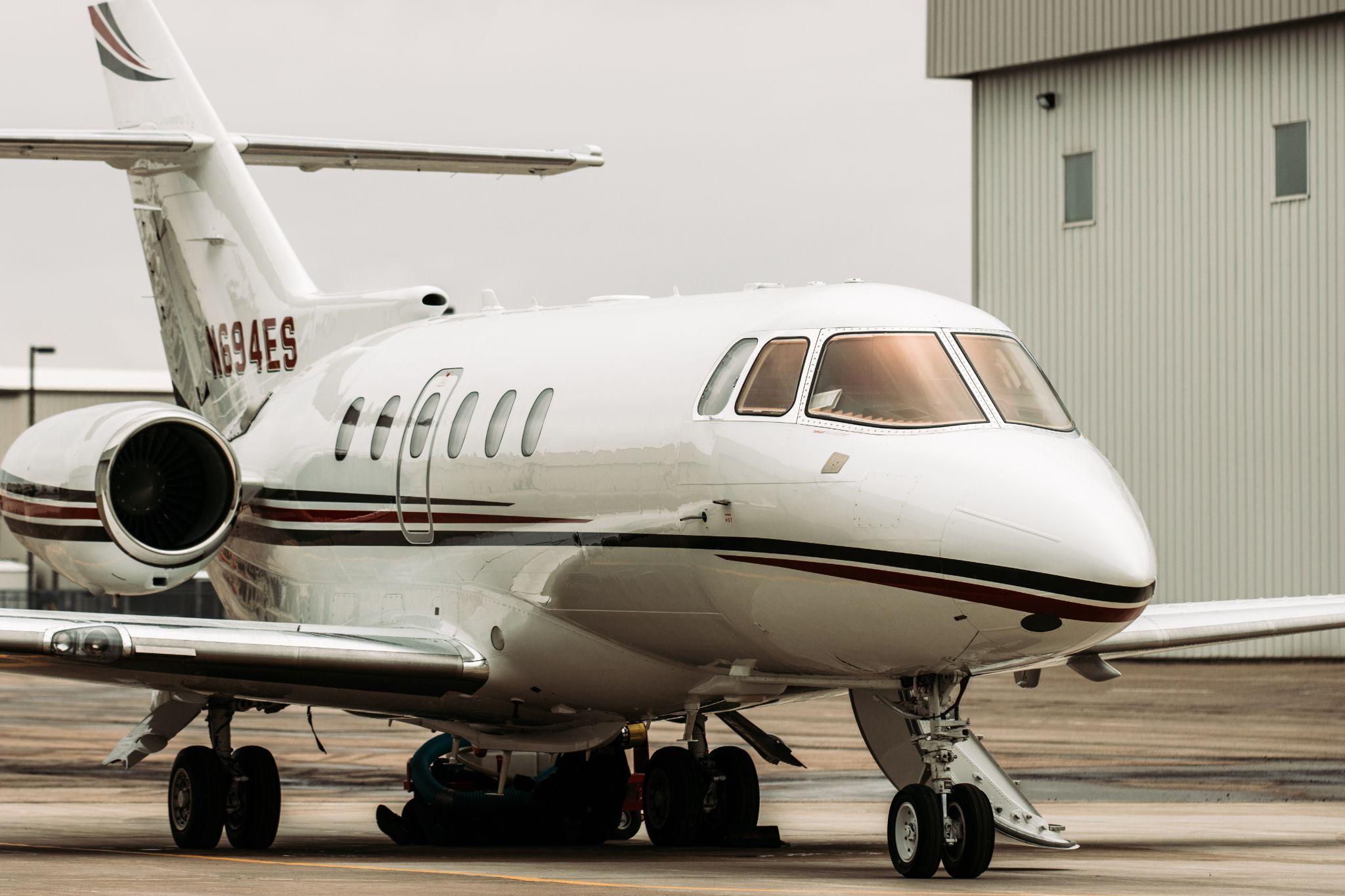
A private jet aircraft (Photo: https://unsplash.com/photos/kZfdHrUoB3U
)
Private jet flights have seen a massive increase in popularity over the past few years. It has left the realm of being reserved only for the rich and famous, with “regular” people now choosing to fly private when they need to travel. Here are a few reasons why.
Fast & Efficient
The entire process of flying private is fast and far more efficient than flying commercially. Not only are you in an aircraft that can get you anywhere, but traveling by private jet has multiple benefits before you even get on the plane.
You can park at the private terminal or right next to the aircraft, passport control takes seconds, you don’t have to wait in the baggage lines when you land, and the experience — in general — is substantially faster.
Work Efficiency
A private jet charter has also become the best way to travel for business people because some jets are designed for work and productivity. All private jets are quiet, but some have a few extras that create an office in the sky.
Some are fitted with phones, monitors, and the internet, with the bigger aircraft having mini board rooms. This creates a space that is ideal for work or hosting clients.
Comfort
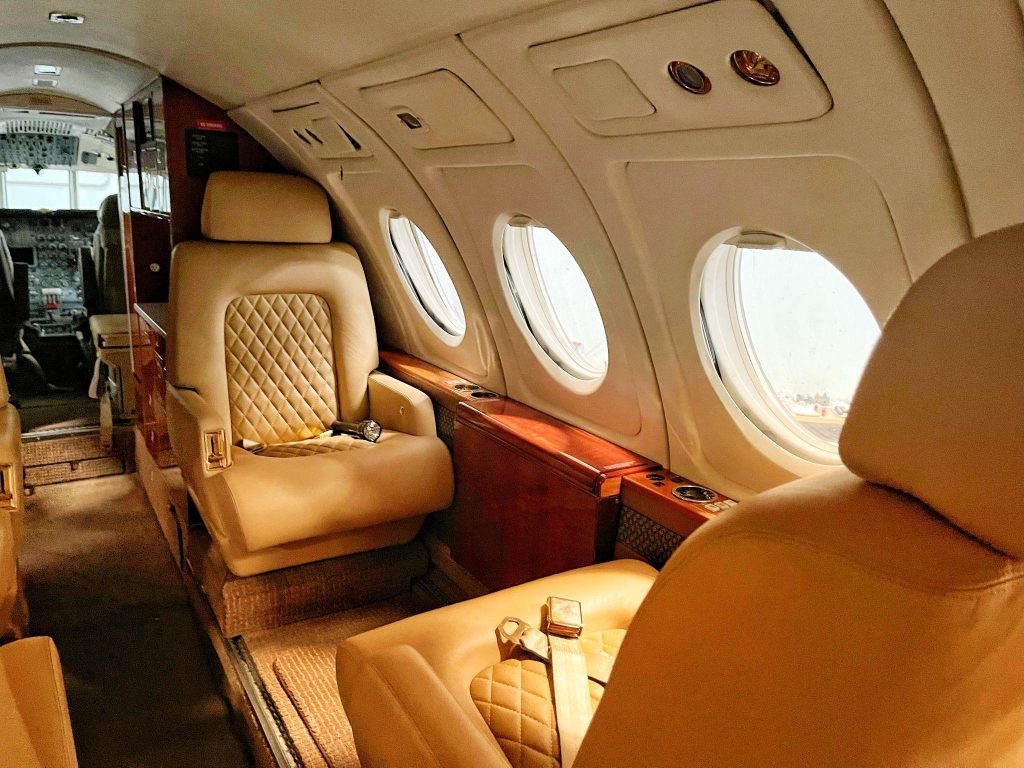
There is no question that a private jet is far more comfortable and luxurious when compared to a commercial aircraft. For example, those luxurious “apartments” on Qatar Airways flights will look quite basic and underwhelming compared to what some private jets can offer.
Some private jets will also have incredible extras like bedrooms, fully fitted kitchens, and bathrooms that look like they were plucked out of a 5-star hotel.
One of the most significant advantages of flying private is the amount of flexibility it offers you. You can get a flight almost whenever you want and fly almost anywhere, as private jets don’t require the same level of infrastructure as commercial airliners.
Destination Choice
Speaking of being able to fly anywhere, this is another big part of why private flying has become so popular. As mentioned, commercial aircraft need airports and airport infrastructure, while private jets just need a well-paved landing strip.
While the world has countless airports, there are still several remote destinations that you can’t get close to by flying commercially. However, a private jet will get you to places that a commercial flight can’t.
Fewer Baggage Restrictions
While there is a bit of a myth that you can take whatever and however much luggage onto a private jet, you will have fewer baggage restrictions when compared to a commercial flight. The most significant sticking point is that private jets don’t have that much luggage storage space.
However, if you are flying with your partner or in a small group, you can still bring several bags just for yourself, as long as they can all fit in the hold.
Affordability
Another significant factor driving private jet charter popularity is how relatively affordable it has become. While it is by no means exceptionally inexpensive, many are surprised by how little it can cost to choose affordable options.
Travel With Friends or Family
If you want to travel privately for a family event, birthday party, or a family holiday with your friends, splitting the cost of a charter can drastically reduce it. Depending on the type of aircraft you choose and how many people there are, there is a good chance your private jet seat will cost less than a commercial ticket.
Empty Legs
Private jets also have something called “empty legs,” which you can take advantage of. Since these jets have a home base, they don’t wait at the airport or landing strip and will fly back relatively quickly.
However, if the passengers they brought don’t fly back with them, they will have an empty aircraft and typically offer “empty leg” rates. These are lower rates that are used as a way to recoup some money and can be shockingly inexpensive.
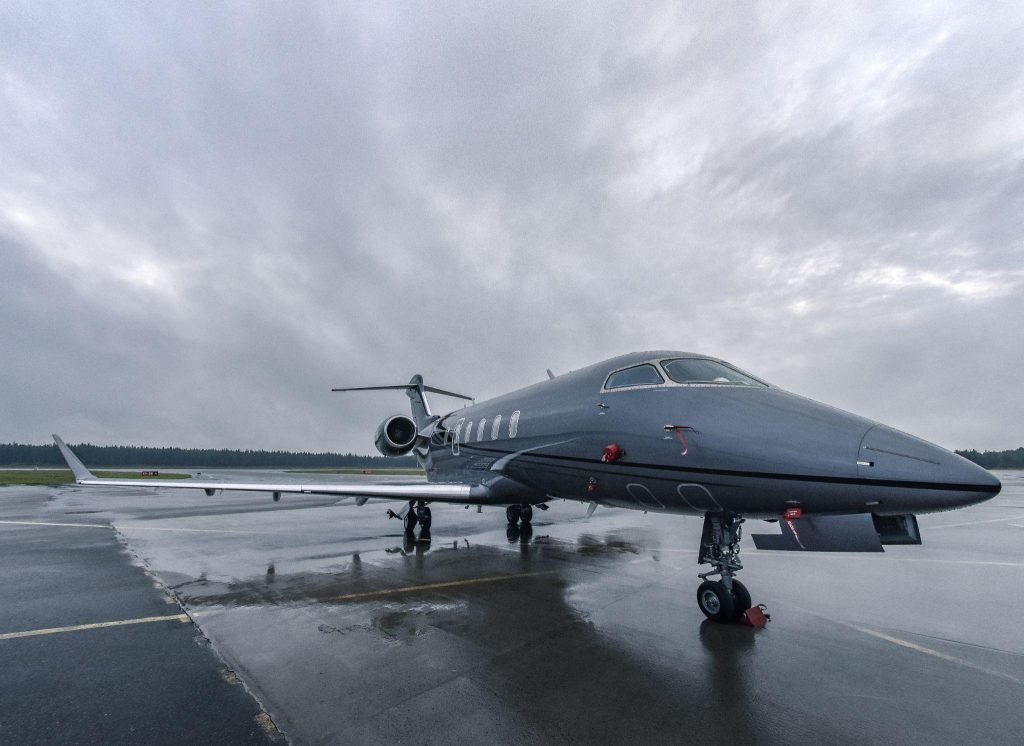
A private jet aircraft (Photo: https://unsplash.com/photos/n7pLpkhwXFk )
Jet Options
Finally, another driving factor behind private jet popularity is the number of options, especially for interiors and optional extras. Nowadays, you can choose anything from a jet with twelve comfy seats to one that looks more like a penthouse apartment than a private jet.
Bedrooms aren’t the only thing that changes either; private jets have varying kitchens, bathrooms, entertainment options, and almost everything in between. There is arguably no better way to travel, especially for long-haul journies.
Conclusion
As you can see, while private jets are still one of the best ways to display luxury and opulence, they are no longer reserved for the ultra-wealthy. Private jets have become something for everyone and are now one of the most popular ways for people to travel.
AirlineGeeks.com was founded in February 2013 as a one-person blog in Washington D.C. Since then, we’ve grown to have 25+ active team members scattered across the globe. We are all here for the same reason: we love deep-diving into the fascinating realm of the airline industry.
An Air France A320 in Munich (Photo: AirlineGeeks | Fabian Behr)
The French government has announced plans to raise airline taxes to fund railways. The tax will apply to first-class and business-class tickets. The new taxes are part of France’s efforts to promote train travel to meet its environmental goals.
The increase will be included in France’s 2024 finance bill and would bring in roughly €100 million ($110 million) by 2027. French transport minister Clément Beaune said that the taxes will apply to first and business-class tickets because the passengers that fly these classes are not as sensitive to price increases as passengers in economy class.
The French aviation industry is concerned that this new tax will be anti-competitive because the industry already sends substantial investments into environmental initiatives. The industry is also advocating for a new tax for the advancement of the aviation sector.
France has been in the spotlight for years for putting remarkable restrictions on its aviation industry. It recently banned short-haul domestic flights that are under 2.5 hours where a comparable rail service exists, except for those that are required for international connections. Though the move only impacted a select few flights, it was one of the most aggressive actions a European nation has taken to date to limit aviation because of its environmental impact.
In October 2022, France imposed additional restrictions on private jets by increasing taxes on aviation fuel, bringing the taxes in line with those imposed on cars.
Aviation’s Environmental Impact
Aviation has long been at the center of debates over how to regulate its impact on the environment. Aviation is not the most-polluting form of transportation, as the volume of cars on the road means that they emit more greenhouse gasses than the aviation industry. While commercial aircraft do burn a lot of gas at face value, fully loaded aircraft achieve hundreds of gallons per seat mile, making them three to four times more efficient per person than even the most efficient hybrid cars.
Private jets are often cited as bigger pollutants per person because they burn similar amounts of fuel but carry significantly fewer people; while a domestic narrowbody aircraft operated by a mainline airline can carry between 150 and 180 people, private jets usually carry up to a dozen.
An Air France 777-300ER at LAX (Photo: AirlineGeeks | William Derrickson)
The question arises, then, as to whether France’s focus on limiting commercial aviation is somewhat misguided and whether a true effort to decrease aviation’s carbon footprint necessitates that greater focus should be placed first on private aviation.
This question additionally arises when it is considered that the most recent taxes will be placed on, as France itself has said, passengers who will not notice a small price increase for taxes.
Will This Tax Really Work?
If France was to crack down on aviation to prioritize rail, they need to convince the people that fly in first and business class that taking the train is more worth their time and money than flying. If there is no change in prices in first and business classes, the taxes that France brings in will likely be lower than the income they could make by selling more train tickets.
France is trying to play a careful game: take action to solve a prominent problem that is critical to its administration without annoying wealthy political donors. However, this will inevitably prove to be another situation where an easily-implemented ideal situation is avoided because of concern over donations.
The fact of the matter is that small taxes that will generate an extra €100 million over four years, when considering how many people fly first and business class even domestically, will not disincentive the wealthy travelers and billion-dollar-corporations who can pay for premium classes from buying them; as mentioned, these travelers won’t even notice the increase.
It is true that first class and business class are worse for the environment than economy class due to the reduced passenger density – the same amount of gas to carry fewer people – and the added waste from more drinks, snacks, meals, and amenities. But change will not be exacted if the people who create this waste, namely the wealthy people and corporations who purchase business class, are not forced to change.
An Air France A380 on final approach at LAX. (Photo: AirlineGeeks | William Derrickson)
For that change to happen, either France needs to make flying in First and Business class significantly less attractive – more taxes and restrictions – or it needs to make trains significantly more attractive by adding more services and more destinations and adding more amenities.
This might be tricky, since France would need to find a way to stimulate demand on train services to small communities to be able to compete with the regional airliners that can easily find a niche in small cities. It’s one thing to fly a 50-seat Embraer E145 or Bombardier Dash 8 to a small runway once or twice a day; it’s a different feat entirely to build tracks and stations and to relegate expensive engines, large train cars, and train workers to that same city.
Still, airlines around the world have proven it’s possible to fly relatively-large aircraft into small destinations. Airlines like Ryanair, easyJet, and flyDubai have stimulated demand to small cities not because these small cities have significant appeal but because the airlines offered cheap flights to those towns in the first place.
Thus, perhaps we can take a middle ground here. Though France should increase restrictions on aviation if it really wants to make a stand against climate change, if it does not want to unilaterally crack down on flying, perhaps it can use the extra taxes it generates from aviation to expand services to smaller destinations and towns that would rather take the train but fly out of necessity. Or they could spend the money to improve onboard amenities to outpace airlines and make taking the train a more attractive option than flying.
A 787-9 Dreamliner destined for Air France during its checks at Paine Field. (Photo: AirlineGeeks | Katie Bailey)
France could also improve connections between rail and aviation. In Germany, for example, it is not uncommon for travelers coming from far-flung international destinations to be able to book an onward itinerary on a train instead of on another plane. While there are still airplane options that compete with the train connections, having railway options easily accessible to passengers who would otherwise fly will naturally increase rail ridership by forcing people to consider taking the train and offering more scheduled connection times that might be more appealing than the aviation options alone.
We’ve focused a bit on premium travelers in this article because those classes will be affected by France’s most recent push. But how about leisure travelers? Passengers who fly in on economy may consider trains if the trains are for some reason more appealing.
The addition of economy class to airplanes made flying cheaper across the board, and that trend has continued as more ultra-low-cost carriers have forced legacy airlines to cram more seats into planes to compete. Perhaps it is worth following this business model on trains. Making seats an inch or two closer together could make room for more seats onboard trains. More seats mean you can carry more passengers in the same railcars without needing to lengthen platforms and redesign track changes or signaling as you would by making trains longer. Could a proliferation in train classes – essentially adding “economy basic” class to trains – drive down the cost of train tickets enough to convince leisure travelers on a budget to take the train more instead of flying?
Aviation Restrictions Around the World
Even if France’s restrictions are useful, their method is not applicable around the world. In countries like the United States, Russia, and Australia, which are geographically huge and diverse, building infrastructure that could support widespread car and train usage is highly impractical. Airplanes can fly over these wide, diverse geographical areas much more easily and efficiently than other vehicles, which might expend extra energy traversing tall mountains and scorching deserts.
Countries like Canada have very remote areas that are not accessible by road or rail. Where it is impractical for slower boats to bring in critical supplies like food and medical materials, airplanes must be used to quickly and affordably access the area. And in South America, where deforestation is rampant and geography is just as diverse as in the United States, destroying additional natural reserves to build rail infrastructure and roads may prove unpopular.
John McDermott is a commercial pilot pursuing a career in professional flight. His passion for aviation began in an Ann Arbor bookstore with a tale of enemy pilots during World War 2, and he hasn't looked back. Besides flying and writing for AirlineGeeks, John volunteers with Professional Pilots of Tomorrow and travels whenever he gets the chance.
Delta Adds Two Non-Hub Routes from White Plains, N.Y.
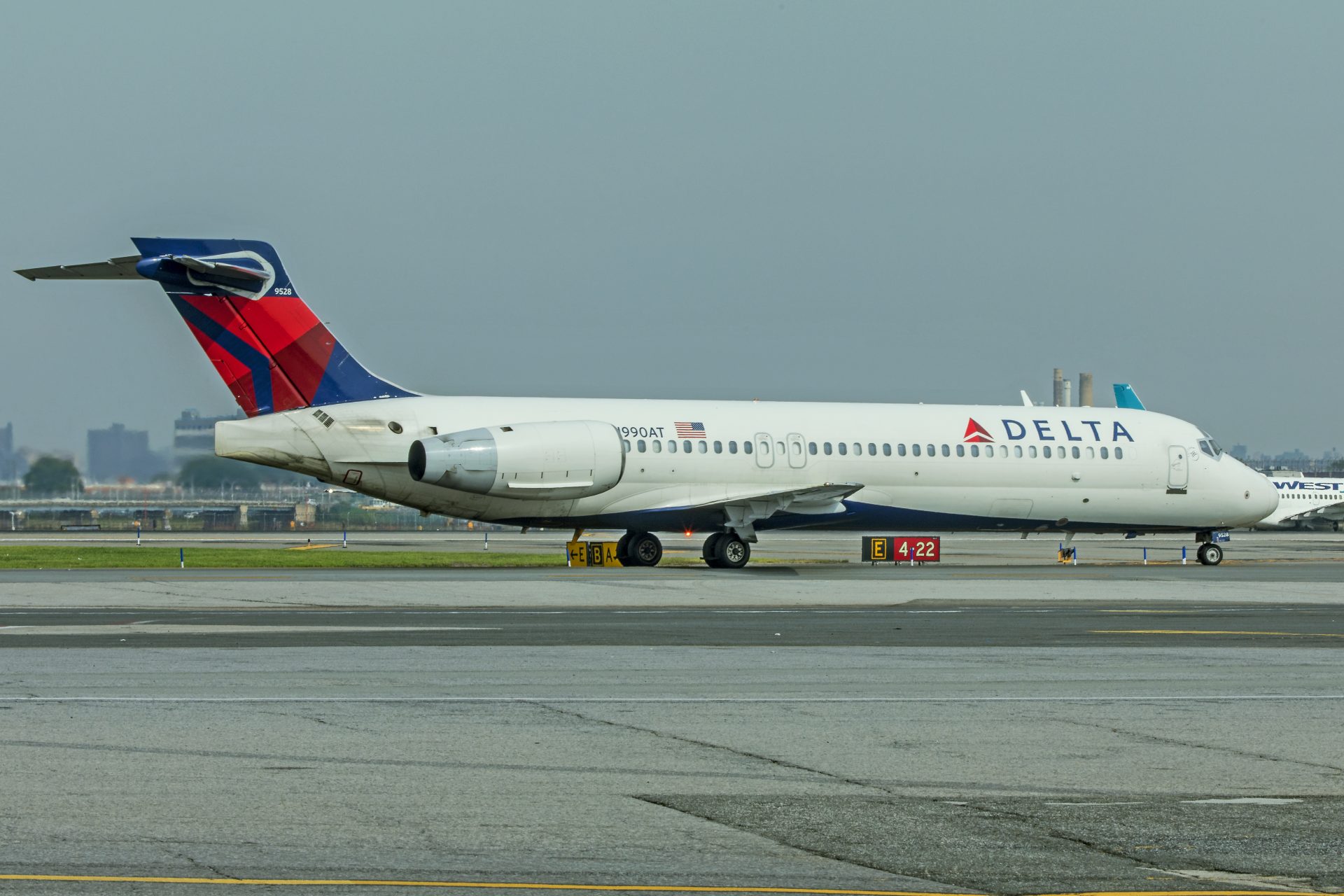
A Delta 717 at ATL (Photo: AirlineGeeks | Ryan Ewing)
Delta Air Lines has loaded two new routes into their booking site, but they don’t touch any of the carrier’s hubs. United Airlines, and especially American Airlines, have histories of adding routes between two non-hub cities, especially when there are major sporting events happening. But it is rare to see this from Delta, as they tend to stick more towards the traditional hub-and-spoke model with very few exceptions in their network, except for a few routes out of the nation’s capital airport of Washington Reagan to other state capitals.
The two new routes, both of which are now for sale on the carrier’s website, are from White Plains, N.Y. to both Orlando and West Palm Beach, Fla. The flights will start November 10th and will both operate on a once-daily basis. As of yet, the airline has not made an official route announcement about the routes, which is odd given these routes start less than three months away. Both of the new routes from White Plains will be served on board the carrier’s 110-seat Boeing 717.
A Delta Airlines Boeing 717 (Photo: AirlineGeeks | William Derrickson)
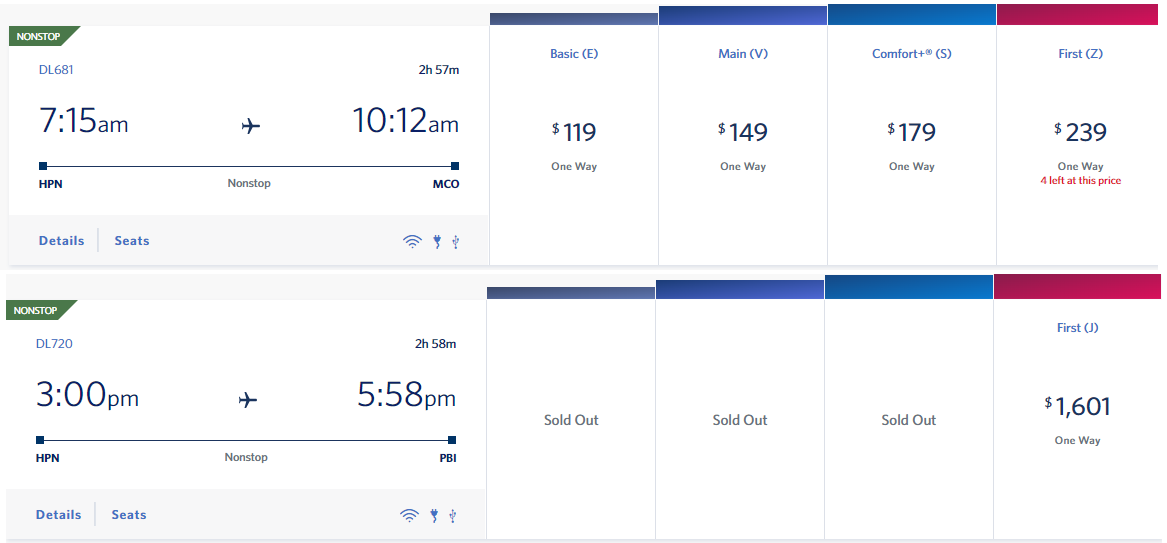
Looking at the timing of the flights, it appears that the same tail number can, and probably will, fly both routes on the same day. This is how the flight schedule currently stands for the new routes:
The plane will leave White Plains at 7:15 A.M., getting to Orlando just before 10:15 in the morning, with the return leaving Orlando at 11:30 A.M. and getting back to White Plains just after 2 P.M.. The plane leaves White Plains again at 3 P.M., this time going to West Palm Beach, where it will arrive just before 6 P.M., with the return trip leaving West Palm at 7 P.M. and getting back to White Plains just before 10 P.M.
The flights have both already been put on sale, although the flights to West Palm Beach are already showing sold out in all cabins, except for First Class, which is selling at a really high price. This is most likely a glitch, as it’s almost impossible they have sold out a plane this quickly for that route, and the fare is so much higher than the first-class seat to Orlando from White Plains.
Screenshots from Delta.com of the new routes (Screenshot: Delta.com)
These will be the third and fourth nonstop routes that the airline offers from White Plains, as they already serve their Detroit and Atlanta hubs from here. They do currently serve Boston as well, but those flights will be ending on August 31, 2023.
This is a very odd route for the airline, given none of the cities they will be touching along these new routes are a hub, and it’s not an underserved route either. Currently, JetBlue already operates flights from White Plains three times a day to both Orlando and West Palm Beach. This makes Delta the fourth daily operator on both routes, giving them a lot of competition on a route they don’t have a history of serving. Most people flying these routes might have loyalty with JetBlue already.
All routes and schedules are subject to change, and all information prices, and flight schedules talked about in this article were obtained from Delta.com
Joey has always been interested in planes for as long as he can remember. He grew up in Central New York during the early 2000s when US Airways Express turboprops ruled the skies. Being from a non-aviation family made it harder for him to be around planes and would only spend about three hours a month at the airport. He was so excited when he could drive by himself, the first thing he did with his driver's license was get ice cream and go plane spotting for the entire day. He graduated from Western Michigan University in 2022 with a B.S. in Aviation Management & Operations and a Minor in Business, and currently works for a major airline in his hometown.
Emirates Premium Economy Product Shines in First Year
An Emirates Airbus A380-800 in the airline's new livery (Photo: Emirates)
Emirates’ premium economy has achieved tremendous success in its inaugural year, owing to the dedication and efforts of the cabin crew team, which has now expanded to an impressive 20,000 members.
Since its introduction in August 2022, over 160,000 customers have traded to fly in Emirates’ premium economy. The product is currently available on flights to 11 cities, with the list set to expand to 13 cities by the year’s end as more retrofitted aircraft with refreshed cabins are added to scheduled service.
Dubai’s unique location enables Emirates to operate flights to over 130 destinations, with A380s featuring the latest premium economy cabins flying to London Heathrow, Sydney, Melbourne, Auckland, Christchurch, Singapore, Los Angeles, New York JFK, Houston, San Francisco, and Dubai. Flights regularly reach total capacity in premium economy.
The airline will offer premium economy on flights to/from Mumbai and Bengaluru starting October 29. Additional cities will be announced soon. Emirates has retrofitted 14 of its 20 premium economy aircraft in-house in Dubai over the past nine months. The airline’s multi-billion-dollar retrofit program includes the installation of over 4,000 premium economy seats, 700 first-class suites, and the refurbishing of 5,000 business class seats with the latest interiors. This program will upgrade 67 Emirates and 53 Boeing 777 cabins.
Since August 2022, the airline has operated nearly 4,500 premium economy flights. Last year, over 60% of premium economy bookings came from loyal Emirates Skywards members and regular customers.
Emirates, one of two flag carriers of the United Arab Emirates, is a subsidiary of The Emirates Group, owned by the government of Dubai’s Investment Corporation of Dubai. It has an extensive network covering 800 cities and 5,250 additional sectors. Over 50,000 travelers connect to their destinations through codeshare or interline flights operated by Emirates’ partners. Emirates has a transport ecosystem of 29 codeshare, 117 interline, and 11 intermodal rail partners across 100 countries.
20,000 Cabin Crew Members
Emirates’ cabin crew team has reached a new milestone of 20,000 members. Since 2022, the airline has held recruitment events in 340 cities across six continents. It now has an incredibly diverse team comprising more than 140 nationalities and the ability to speak 130 different languages.
Among Emirates’ cabin crew members, 4,000 have served between 5 and 9 years, nearly 3,000 have served between 10 and 14 years, over 1,500 have served between 15 and 19 years, and approximately 400 have over 20 years of service on their resumes. In addition, three crew members have been with the airline for over 30 years.
The airline’s longest-serving cabin crew is a male Emirati purser who joined in 1987 called Moosa Mubarak. He has flown as Emirates’ cabin crew for 36 years on over 3,500 flights. Today the airline has over 1,100 pursers.
The airline will host global recruitment events covering hundreds of cities all year round, still expanding in the coming months. All new cabin crew will undergo an intense eight weeks of training in hospitality, safety, and service delivery standards in Emirates’ state-of-the-art facility in Dubai.
Vincenzo graduated in 2019 in Mechanical Engineering with an aeronautical curriculum, focusing his thesis on Human Factors in aircraft maintenance. In 2022 he pursued his master's degree in Aerospace Engineering at the University of Palermo, Italy. He combines his journalistic activities with his work as a Reliability Engineer at Zetalab.
An artist's rendering of an Air Transat A321LR (Photo: Air Transat)
Canadian leisure carrier Air Transat recently announced further network expansion into South America during the upcoming northern winter schedule. Subject to government approvals the airline will fly to Lima, Peru twice weekly from Toronto and once a week from Montreal. Air Transat is part of the Transat A.T. Inc. tourism consortium operating to ‘some 60 destinations in more than 25 countries in the Americas and Europe.’
The Toronto-Lima route will commence on 20 December and is scheduled to run until April 24, 2024. Montreal-Lima is scheduled to be operated between Dec. 22 through April 26 of next year, with both routes appealing to the lucrative market of Canadian travelers escaping winter weather.
Michèle Barre, Transat’s Chief Revenue Officer, said, “We are proud to add Lima to our portfolio of destinations on three continents. This strategic expansion allows us to diversify our long-haul offering by maximizing the use of our A321LR aircraft, and to capitalize on the sustained growth of tourism in South America.” Air Transat operates the Airbus A321LR aircraft in a two-class configuration with 12 Club Class seats with a 38-inch pitch and 187 economy seats.
In addition to Lima, Peru being added to Air Transat’s network the airline also advised the recommencement of service between Montreal and Cozumel, Mexico. “We are consolidating our presence in the Mexican market – a key destination of our Caribbean winter program – by restarting our operations in Cozumel,” said Barre. Flights from Montreal to Cozumel will be a weekly service commencing on Dec. 15 and operating until April 26, 2024.
The post-pandemic travel period has been positive for Air Transat and its parent corporation with its offering of flights and holiday packages. In June the company reported a continued momentum of higher revenues leading into the northern summer period. “For the second quarter of 2023, Transat reported a solid performance, with an adjusted operating income of $56.1 million, nearly 40 percent higher than in the same quarter of 2019,” Annick Guérard, President and Chief Executive Officer of Transat said at the time. “At mid-year, and based on current booking trends, we are raising the target for the adjusted operating income margin from the initially set range of 4 percent to 6 percent to a target of 5.5 percent to 7 percent for the fiscal year.”
Air Transat is operating a schedule at 89 percent of 2019 levels over the summer period with 80 percent of the capacity aimed at the lucrative European market. A strategy of fleet optimization enabled the airline to maintain 2019 capacity levels over the Winter 2023 schedule by having 20 fewer aircraft in service. Guérard also credited “better price management, thanks to improved practices and new tools” with the airline’s ability “to maximize revenues and seize market opportunities.”
John has always had a passion for aviation and through a career with Air New Zealand has gained a strong understanding of aviation operations and the strategic nature of the industry. During his career with the airline, John held multiple leadership roles and was involved in projects such as the introduction of both the 777-200 and -300 type aircraft and the development of the IFE for the 777-300. He was also part of a small team who created and published the internal communications magazines for Air New Zealand’s pilots, cabin crew and ground staff balancing a mix of corporate and social content.
John is educated to postgraduate level achieving a masters degree with Distinction in Airline and Airport Management. John has held the positions of course director of an undergraduate commercial pilot training programme at a leading London university. In addition he is contracted as an external instructor for IATA (International Air Transport Association) and has been a member of the Heathrow Community Fund’s ‘Communities for Tomorrow’ panel.
Turkish Airlines Profiting from Increased International Travel
Turkish reports strong results as the industry continues to recover.
A Turkish Airlines 787-9 at Paine Field. (Photo: AirlineGeeks | Katie Bailey)
As the world moves past the COVID-19 pandemic, airlines are back to making money again. Passengers are returning to the skies across the world eager to make up for lost time.
One such airline that has benefited from this pent-up demand is Turkish Airlines. The airline finished the second quarter of 2023 and has reported strong financials.
Growth in 2023
The airline saw total revenue reaching $5.1 billion, up 13.5 percent from the same time last year. Turkish Airlines also increased capacity to account for this increased demand and was flying with 28 percent higher capacity than in 2019 by growing the fleet by 10 percent. Overall, the airline surpassed its 2019 international capacity by 29 percent. Turkish Airlines currently operates a fleet of over 424 aircraft.
Loads appear healthy as well with a 81.5 percent domestic load factor and 81.8% international load factor in the second quarter. Looking at January to July, the total load factor was 82.3 percent, an increase of nearly 5% from the same period last year. This was further broken up with an international load factor of 82.2 percent and a domestic load factor of 83.2 percent.
From January to July of this year the airline carried 47.3 million passengers, a massive 22 percent jump from the same period of 2022.
A Turkish Airlines Boeing 777-300. (Photo: AirlineGeeks | William Derrickson)
Notable given that global airline capacity in the second quarter of this year is still 12 percent below what it was in 2019. Not all airlines have benefited equally from the return of passengers to the skies.
Cargo revenues did decrease significantly, 44 percent decrease year over year to $600 million. The airline attributes this to a slowing in global trade overall and the deadly earthquake earlier this year across Turkey and Syria. It is estimated that nearly 60,000 people perished and over 121,000 were injured. The earthquake caused massive damage to an area that accounts for over 9 percent of Türkiye’s global exports.
From January to July of this year cargo decreased nearly 8 percent to 890.3 thousand tons from 965.2 thousand tons the year prior.
Yields were acceptable as well with Turkish Airlines ending the quarter with a net profit of $635 million.
Turkish Airlines while doing well domestically is primarily seeing growth from the international side of operations. This makes sense given that the airline has the largest flight network of any airline in the world. The airline flies to hundreds of destinations in over one hundred different countries. Year to date the airline has seen a whopping 36 percent increase in international to international passengers, shuttling 16.7 million passengers across the world on its aircraft.
The airline will continue to grow as it seeks to expand further into markets and develop close partnerships with other airlines such as IndiGo.
Hemal took his first flight at four years old and has been an avgeek since then. When he isn't working as an analyst he's frequently found outside watching planes fly overhead or flying in them. His favorite plane is the 747-8i which Lufthansa thankfully flies to EWR allowing for some great spotting. He firmly believes that the best way to fly between JFK and BOS is via DFW and is always willing to go for that extra elite qualifying mile. Hemal's opinions are his own and do not reflect those of his employer.
Air India Finally Takes Off with Refreshed Livery and Brand Identity
A refreshed brand identity for Air India has landed.
Since the Tata Group took over the airline, there had been much speculation about its rebranding, which came to an end. Mr. N. Chandrasekharan, the Chairman of Tata Group, revealed the logo and livery on Thursday in New Delhi. This significant step marks a massive milestone for Air India in its transformation plan called ‘Vihaan.ai’.
The Indian flag carrier now has an all-new logo, a refreshed livery and revamped cabin interiors. Tata Group hired FutureBrand, a London-based brand design company, to transform Air India from scratch, which they delivered.
‘The Vista’ Logo
‘The Vista’ logo (Photo: Air India)
Historically, the Indian window frame design called ‘jharokha’ has been used by Air India on all its aircraft since 1971. This design has now been used to create the new logo, ‘The Vista’. As described by Mr. Chandrasekaran, this new logo symbolizes a ‘window of limitless possibilities’, signifying the airline’s future vision and its roots in India’s rich history and culture.
A bold, modern-looking, and yet Indian culture-resembling font called ‘Air India Sans’ has been used in red for the words’ Air India’. These are adorned by the peak of the golden window on the top right.
Air India’s iconic mascot, ‘The Maharaja,’ is here to stay. Now, he has an all-new look, wearing his uniform in new colors.
The New Livery
Boeing 787-9 in the new Air India livery (Photo: Air India)
Air India’s fresh livery retains the bright red letterings on the aircraft but in a new typeface and a larger scale, covering the front half of the fuselage. Just like its sister airline Vistara, this new livery has Air India written on the underbelly on a red patch, along with a golden frame inspired by the logo.
The tail of the aircraft will feature the logo frames in red, gold, and a dash of purple with an intricate design. The tip of the same pattern will be replicated on the aircraft’s wingtips. The engines will be painted red and wrapped around by a thin golden band towards the front.
The majority of the aircraft’s surface will be painted white along with these changes. Airlines that have undergone a rebranding recently, such as Gulf Air, Lufthansa, and Brussels Airlines, tend to keep their new liveries minimal, reducing maintenance costs and damage to the aircraft by direct sunlight.
The first aircraft expected to be painted in the new livery is an Airbus A350-900, which will enter the fleet in December 2023.
Future Ready Cabins
Air India’s CEO, Mr. Campbell Wilson, introduced new seating for the fleet’s ‘legacy’ long-haul aircraft. These older aircraft in the fleet include 13 Boeing 777-300ERs and 27 Boeing 787-8 Dreamliners.
In the short video unveiled on Thursday, we see what these aircraft will be refurbished to in the next few years, starting from mid-2024. The aircraft sported four classes onboard that were completely redesigned in collaboration with London-based companies JPA Design and Trendworks.
First Class will have a golden-brown color scheme with four fully private, lie-flat seats and a ton of additional features, and the aubergine-colored Business Class suites feature privacy doors too. Towards the rear of the aircraft, newer, more ergonomic, highly dense premium economy and economy seats will be available.
Keeping in mind that these new cabins will only feature on the refurbished aircraft, the airline did not comment on the cabin interior of the newer long-haul aircraft such as the Airbus A350-900, which are due to be received during the end of the year with ex-Aeroflot cabins.
Besides these cabins, Mr. Campbell also talked about the new inflight entertainment, featuring tons of movies and TV shows from India and worldwide.
What Does the Future Hold?
This week’s reveal marked a massive transformational milestone for Air India. The airline will subsequently update its website, app, and social media with the new brand identity.
As the airline prepares to induct its first Airbus A350-900 in late 2023, several Boeing 777s have been leased to increase its capacity in the short term. Five of these are ex-Delta Boeing 777-200LRs, which the airline has already received. Air India has yet to receive three former Singapore Airlines and five former Etihad Airways 777-300ERs.
This transformational project is the first of its kind to happen in Indian aviation.
It all started at the age of five when Vihaan got a Qantas 747 model from Sydney Airport. Since then, he has been an AvGeek, collecting aircraft models, safety cards, and even magazines! He has flown over 120 flights to more than 25 countries worldwide.
Vihaan shares his passion for photography and aviation by spotting at New Delhi's Indira Gandhi International Airport and wherever flights take him. Apart from being an AvGeek, Vihaan is currently an undergraduate business management student and aims to pursue a career in aviation consulting and analysis. You can check out some of his spotting work at @aviation.del on Instagram.
Rising Above Turbulence: Pakistan’s Pioneering Aviation Overhaul for the Future
Is a new renaissance on the horizon for Pakistani aviation?
A PIA A320 aircraft (Photo: Aasif Azaan / CC BY-SA (https://creativecommons.org/licenses/by-sa/4.0))
Amidst the evolving global aviation landscape, Pakistan is boldly setting its sights on rejuvenating its most cherished aviation jewel: Pakistan International Airlines (PIA). This audacious stride towards privatization manifests the nation’s proactive agenda to transform key sectors of its vast infrastructure. Notably, this endeavor resonates deeply with an ambitious $3 billion deal inked with the International Monetary Fund (IMF) to outsource its aviation operations.
Embracing the New Dawn of Privatization
In the face of changing global dynamics, the Cabinet Committee of Privatization, steered by Finance Minister Ishaq Dar, unveiled its blueprint for the imminent privatization of Pakistan International Airlines Co. Ltd.
Facilitated by a timely legislative amendment, this decision integrates PIA seamlessly into the nation’s expansive privatization narrative. This commitment, far from being just symbolic, encapsulates the government’s unyielding determination to redress the financial hiccups of the carrier and infuse new life into the aviation realm of Pakistan.
In parallel with the PIA narrative, the committee’s visionary move to enlist a seasoned financial strategist for the meticulous transition of the Roosevelt Hotel, a paramount asset under PIA Investment Limited, unfolds a multi-pronged approach. This approach is crafted to revamp the airline’s operations. Through this integrative vision, the government aspires to carve an aviation environment that’s both agile and competitive, setting the stage for exponential growth in both domestic and international travel corridors.
Such setbacks accentuated the airline’s need for exhaustive and systemic reforms. Further complicating the narrative was PIA’s financial deadlock with Pakistan’s Federal Board of Revenue, leading to multiple instances of asset freezes. This tumultuous chapter was underlined by disputes over the exact quantum of tax liability, with even the specter of legal action against the airline’s top brass looming large. In terms of its fleet prowess, PIA takes pride in its ensemble of 33 aircraft, although a portion remains dormant, as data from ch-aviation elucidates.
Broadening the Privatization Canvas in Pakistani Aviation
PIA’s metamorphosis is but a fragment of the larger tapestry of transformation within Pakistan’s aviation sector. A recent disclosure by Reuters highlighted a robust plan to privatize Islamabad International Airport, post an extensive dialogue phase with the International Finance Corporation.
Seen within the macrocosm of national economic revival, this step is meticulously orchestrated to fortify Pakistan’s foreign exchange coffers. Energizing this venture are preliminary dialogues with Qatar, envisioning collaborative stewardship of key terminals spanning cities like Islamabad, Karachi, and Lahore. With a potential financial infusion of up to $3 billion from the Qatar Investment Authority on the horizon, Pakistan’s aviation industry is poised for a renaissance. It will be interesting to see how this process unfolds for PIA, and the greater effect it will have on the Pakistani Aviation Industry.
This story was written by AirlineGeeks writer Parth Jain.
AirlineGeeks.com was founded in February 2013 as a one-person blog in Washington D.C. Since then, we’ve grown to have 25+ active team members scattered across the globe. We are all here for the same reason: we love deep-diving into the fascinating realm of the airline industry.