Stories

Opinion: Accessibility Is Coming To Aviation. It’s About Time.

IMG_0338
A Delta Air Lines A319 holds short as an American Airlines A321 departs Los Angeles. (Photo: AirlineGeeks | James Dinsdale)

Over the summer, two major developments in disability accessibility were announced by American carriers. In early June, Delta Air Lines announced that one of its subsidiaries is developing a seat that would allow passengers to stay in their power wheelchairs during a flight. At the end of July, United Airlines announced it would become the first U.S. airline to add braille to aircraft interiors, including to mark rows, seat numbers, and the inside and outside of lavatories.

Neither of these changes will be immediate. It will take at least 18 months for Delta’s seat to enter service assuming it passes testing on time, while United won’t be able to retrofit all of its aircraft until 2026. Still, these moves represent a major step forward for disabled passengers in the United States.

The United States Department of Transportation reported that 27 million passengers with disabilities traveled in 2019. The U.S. Government Accountability Office has reported that large airport spread, TSA screening passengers, and improper handling of accommodation by airlines pose significant challenges to travelers with disabilities. Notably for this article, US airlines together mishandled, lost, damaged, delayed, or lost 11,389 wheelchairs and scooters in 2022, or about 1.54 per 100 that were loaded onto aircraft, per the Washington Post, the highest number since the Department of Transportation first reported the data in 2018.

Federal Accessibility Legislation

Delta’s and American’s moves come amid a greater push for aviation accessibility in the United States government. In spring 2023, Senators Tammy Duckworth and John Thune announced the Mobility Aids on Board Improve Lives and Empower All Act, otherwise known as the MOBILE Act, which would require the Department of Transportation to publicly report the type of damage that occurs to wheelchairs and mobility aids. It would also require airlines to provide sufficient information to passengers to make sure mobility aids can fit on an aircraft before boarding.

Disability advocates have called for more airline accountability and accessibility to be included in the next FAA reauthorization act, which is currently being developed.

“For passengers who use wheelchairs, traveling can oftentimes be difficult and frustrating,” Thune said. “I’m proud to join Senator Duckworth in introducing this common-sense legislation that would improve safety and accessibility for individuals who use mobility aids to help ensure their travel experience is as smooth and hassle-free as possible.”

United Airlines, with its “fortress hub” in Houston, makes it difficult to consider other loyalty options (Photo: AirlineGeeks | Hisham Qadri)

Duckworth pointed out that it is often a medical risk for people to be moved into and out of wheelchairs. Being able to board a flight in your own wheelchair not only makes sure the chair isn’t lost or damaged, but it also reduces at least two points of risk when passengers are moved from their wheelchair into a plane seat, if not also transferred from their own chair to a chair owned by an airline or airport.

“This isn’t just a customer service issue; this is actually a safety issue,” Duckworth said. “If people don’t have access to their devices or a safe way to board the plane, then they’re subjecting themselves to injury.”

Practical Uses of Airlines’ Developments

It is expected that Delta will make its convertible seat accessible to other airlines for use. Since the chair can be used on the same seat tracks airlines already used on their aircraft, transferring the new seats in will be a relatively cheap job.

It has yet to be seen whether airlines will take up Delta’s offer. But it is common for airlines to pick up the practices other airlines have already adopted once the new practices are proven safe and cost-effective, especially when under pressure from customers and advocacy groups.

A 2021 report found that removing two rows of seats would allow for the installation of in-cabin wheelchair securement systems with no issue, though more studies on safety and feasibility. With these seats taking up extra room on the aircraft, airlines wouldn’t be able to fly as many passengers on one aircraft; charging extra for a wheelchair seat may not stand in a court challenge on discrimination grounds, so the installation of these chairs may end up being a price all passengers end up paying for.

A Delta A321 landing (Photo: AirlineGeeks | Craig Fischer)

Though widebody aircraft are required to have accessible restrooms, narrowbody planes are not at the time of writing. Delta’s seat does have a method to transfer passengers into more compact seats when they need to use the restroom, so the rollout for single-aisle planes will be interesting to see.

United’s move, though, will not be a difficult one to match, as other airlines will not need to purchase entirely new seats for each plane. At least from an optics standpoint, it is much easier to place braille markings on overhead bins and armrests.

“No other form of transportation — trains, buses, boats — forces you to give up your mobility device when you board. The same ought to be true of airlines,” Transportation Secretary Pete Buttigieg said last summer. “We know this won’t happen overnight, but it is a goal that we have to work to fulfill.”

Recent History of Accessibility in Aviation

Airlines are not always known for being the most disability-friendly. After a number of high-profile incidents, such as when a passenger tried to bring a peacock onto a flight, airlines unilaterally limited the types of emotional support animals passengers can bring onboard flights. Though United allows both dogs and cats onboard flights, other airlines only allow dogs onboard. The call received some backlash but was implemented after a 2020 Department of Transportation ruling decided that emotional support animals would no longer be considered service animals and thus released airlines from needing to accept every animal onboard.

A United A320 in a retro livery landing in Las Vegas. (Photo: AirlineGeeks | William Derrickson)

And while American carriers are often at the front of the pack in terms of aviation developments around the world, other airlines around the world have notable accessibility features that rival or even surpass what US airlines do. Aer Lingus, for example, has resources available for autistic travelers to help them navigate the potential sensory overload of air travel.

Still, many airlines, both in the US and around the world, simply direct passengers to rely on airport staff and cabin crew, who are often burdened with many tasks as airlines and airports struggle to fully staff their operations, for assistance.

It is good, then, to know that Delta and United are adding one more layer of accessibility to their operations to make it that much easier for passengers to find and use their seats and for cabin crews to support them throughout their trip. It is not unwise to hope and expect that other airlines will follow their leads or continue to innovate for the betterment of the traveling public.

John McDermott

John McDermott is a commercial pilot pursuing a career in professional flight. His passion for aviation began in an Ann Arbor bookstore with a tale of enemy pilots during World War 2, and he hasn't looked back. Besides flying and writing for AirlineGeeks, John volunteers with Professional Pilots of Tomorrow and travels whenever he gets the chance.

Essential Air Service: Where Are the Biggest Markets

Here's here you can find unique Essential Air Service routes

SkyWest CRJ-200
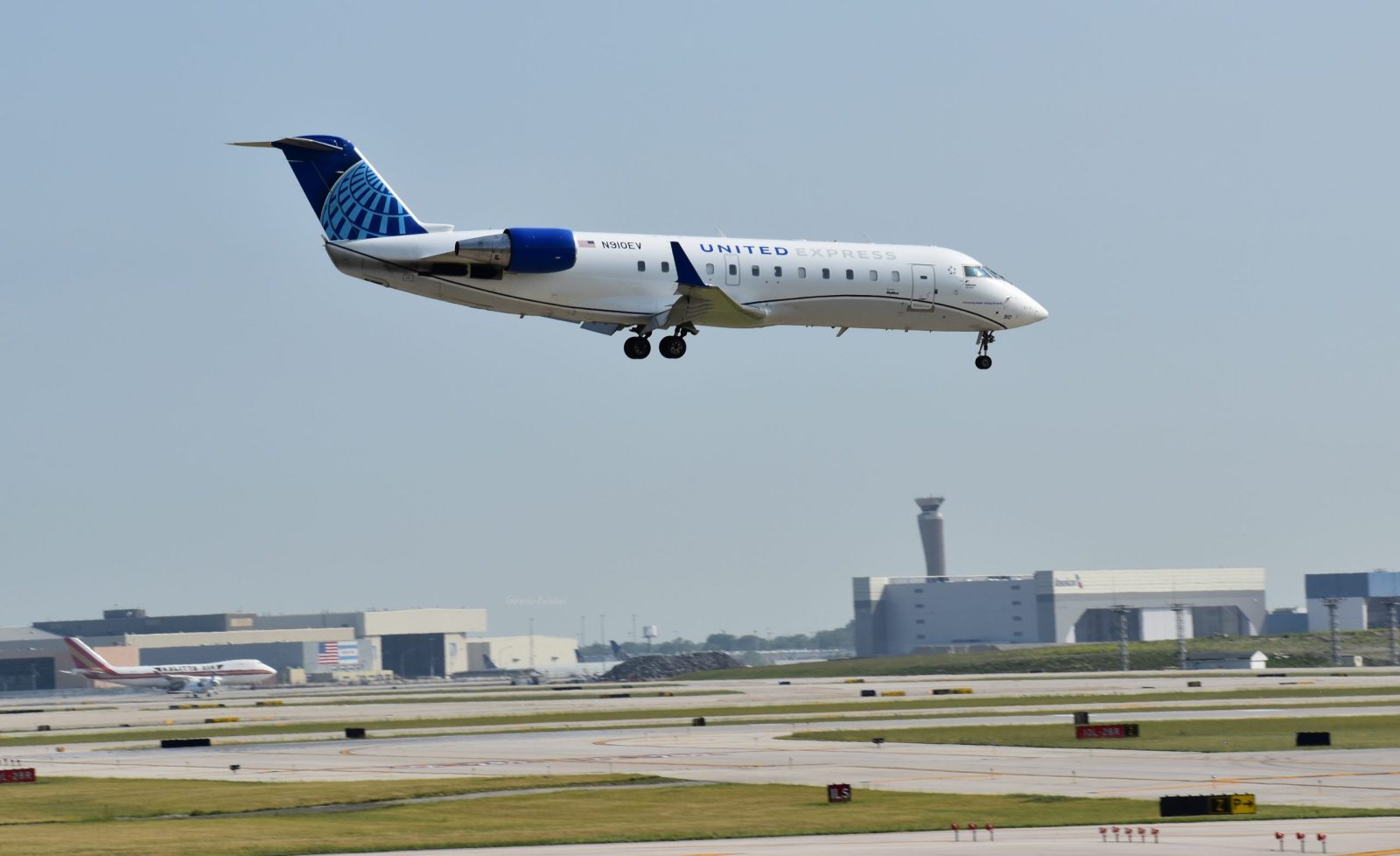
A United Express CRJ-200 arriving into Chicago O'Hare. (Photo: AirlineGeeks | Joey Gerardi)

Essential Air Service (EAS) is truly a hot issue with EAS routes changing more in the past year than they have in the past five, with airlines requesting to terminate service left and right. The top EAS carriers have also shifted, with Contour and Southern Airways Express slowly growing in the contracts that they hold.

But, with the carriers constantly changing, it is sometimes hard to keep track of what airlines fly to where, and which hubs are the biggest and smallest in terms of the number of EAS communities that they serve.

The Biggest EAS Hubs

There are many hubs that have only one or two EAS routes out of them, and will never be large in the EAS hub game as they don’t really serve as a hub for much anything else and are simply “medium or large” class airports that small airlines use to base operations. These include examples like Cape Air and its Billings Montana hub or Advanced Air and its Albuquerque hub just to name a few in the countless that contain just a few EAS routes.

But, there are countless other hubs that have dropped significantly in ranking over the years, like St. Louis and Salt Lake City which both used to have a much larger presence in the government-subsidized EAS program, but with airlines like Great Lakes Airlines collapsing and Cape Air downsizing, are both down to three EAS routes each.

While there are hubs that grow and shrink, some manage to stay relatively the same over the years. This includes airports like Detroit, which has managed to keep the same five EAS communities connected to it for a long time, with SkyWest under the Delta Connection brand.

Third Largest: Minneapolis/St. Paul

Minneapolis has dropped in and out of the top three ranking of EAS hubs but has always managed to stay relatively close with the number of EAS communities it possesses, although the airlines serving the cities has changed a little bit. This hub flies to 12 unique EAS communities with three different airlines, the largest being SkyWest under the Delta Connection brand with nine routes, followed by Denver Air Connection with two, and finally Sun Country with a single EAS route from MSP.

Delta Connection currently serves all of their EAS cities from MSP with 50-seat CRJ-200s. But, SkyWest has posted documents stating it will switch to the CRJ-700 or CRJ-900 in October of 2023 due to a directive from Delta on the need to serve every Delta-branded city with dual-class aircraft regardless of whether it’s an EAS community or not.

EAS communities it serves from Minneapolis/St. Paul includes Aberdeen, S.D.; Rhinelander, Wis.; Bemidji, Brainerd, International Falls, and Hibbing in Minnesota; and Iron Mountain, Escanaba, and Sault Ste. Marie in Michigan.

One of Delta’s CRJ-200s at Minneapolis St. Paul (Photo: AirlineGeeks | Joey Gerardi)

Denver Air Connection is the second-largest EAS carrier in Minneapolis with two routes; Thief River Falls, Minn., and Ironwood, Mich. All of its EAS flights from this ‘hub’ are scheduled to operate on their unique 30-seat Dornier328Jet, although the airline does occasionally swap in the 50-seat Embraer E145.

Sun Country, is the smallest EAS carrier in Minneapolis, and perhaps one of the most unique EAS communities out there. The route is served by the airlines 186-seat Boeing 737-800, and it operates only three times a week; Monday Thursday, and Friday. There was a huge argument when this contract was awarded as the airline technically does not satisfy the EAS requirements as it operates less than daily flights to a major connecting hub.

Taxiing out of Eau Claire back to Minneapolis (Photo: AirlineGeeks | Joey Gerardi)

Second Largest: Chicago O’Hare

Chicago has continually grown in the number of EAS markets, as airlines switch away from smaller medium-sized ‘hub’ airports in the midwest like St. Louis. This hub serves 18 unique EAS communities with six different carriers; with the largest being SkyWest under the United Express brand having eight routes, Southern Airways Express and Contour Air both have three each, Denver Air Connection has two, and Cape Air and American Airlines both operate just a single EAS route from Chicago.

SkyWest under the United Express brand operates all of its EAS communities with 50-seat CRJ-200s from the Chicago hub. The EAS communities it serves from O’Hare include; Houghton, Mich.; Johnstown, Penn.; Decatur, Ill.; Joplin Miss.; Salina, Kan.; and Sioux City, Mason City, and Fort Dodge all of which are in Iowa. SkyWest is still trying to downsize the number of CRJ-200s that it operates due to the ongoing pilot shortage, and this number has dramatically shrunk for them, especially in the past two years, and will continue to drop.

Southern Airways Express, operates three EAS routes from O’Hare, all of which are operated on the airline’s 8-seat Cessna 208. The carrier is also the second newest EAS carrier at the airport as they started service to O’Hare less than a year ago, on Oct. 1, 2023. Its EAS communities from O’Hare include Muskegon, Mich.; Quincy, Ill.; and Burlington, Iowa.

A Southern Airways Express Cessna 208 (Photo: AirlineGeeks | Joey Gerardi)

Contour is the newest EAS carrier in O’Hare and the fastest-growing EAS airline in the country, adding 14 new EAS cities in the past year and a half, with three of them being in Chicago and all of them starting less than a month ago and all on the same day, on Aug. 1, 2023.

All of these flights are scheduled to operate on the airline’s 30-seat Embraer E135 or E145s, although the carrier has recently been swapping in VIP 16-seat CRJ-200s recently, which are already use on Contour Air’s charter division, making those flights still operated by Contour, just a lot fancier than the E135/E145. It operates EAS flights from Chicago to Owensboro, Kentucky; Marion, Ill.; and Kirksville, Miss.

Denver Air Connection operates two EAS communities from Chicago, both of which are flown on the airline’s 50-seat Embraer E145s. From Chicago, the airline flies to Ironwood, Mich. and Watertown, S.D.

American Airlines has stayed pretty consistent and has had the same four EAS communities for many years, one of which operates from its already sizeable Chicago O’Hare hub and goes to Waterloo, Iowa. The only thing that has changed with the route over the years is that it has moved from operating on an Embraer E145s to a CRJ-200, both have 50-seats, but the operator of the flight keeps changing, starting out as Envoy, then Piedmont, and currently Air Wisconsin.

The operator of the flights could keep changing as American Airlines itself hold the contract, they can choose any of its regional operators to make the flight.

An American CRJ-200 in Charlotte (Photo: AirlineGeeks | William Derrickson)

Cape Air has drastically shrunk over the past couple of years, with mass termination requests due to pilot shortages has resulted in Southern Airways Express and Contour Air taking most of the EAS cities in the Midwest. The airline now remain with a single EAS route to Manistee, Mich, which it operates using their 8/9-seat Tecnam P2012 although their Cessna 402 does occasionally swap in when it is needed.

Largest EAS Hub: Denver

Denver is by far the largest Essential Air Service hub and has always been a big player in the EAS game, although the predominant EAS carrier has shifted over the years from Great Lakes Airlines to Boutique Air, to SkyWest, with it now slowly shifting away from SkyWest as it tries to terminate more EAS communities.

Denver holds 26 unique EAS routes over three airlines with the United Express brand being the largest holding 16 contracts, with SkyWest holding 14 of them and United Airlines themselves holding two of them. Denver Air Connection holds eight contracts from Denver and Southern Airways Express holds two.

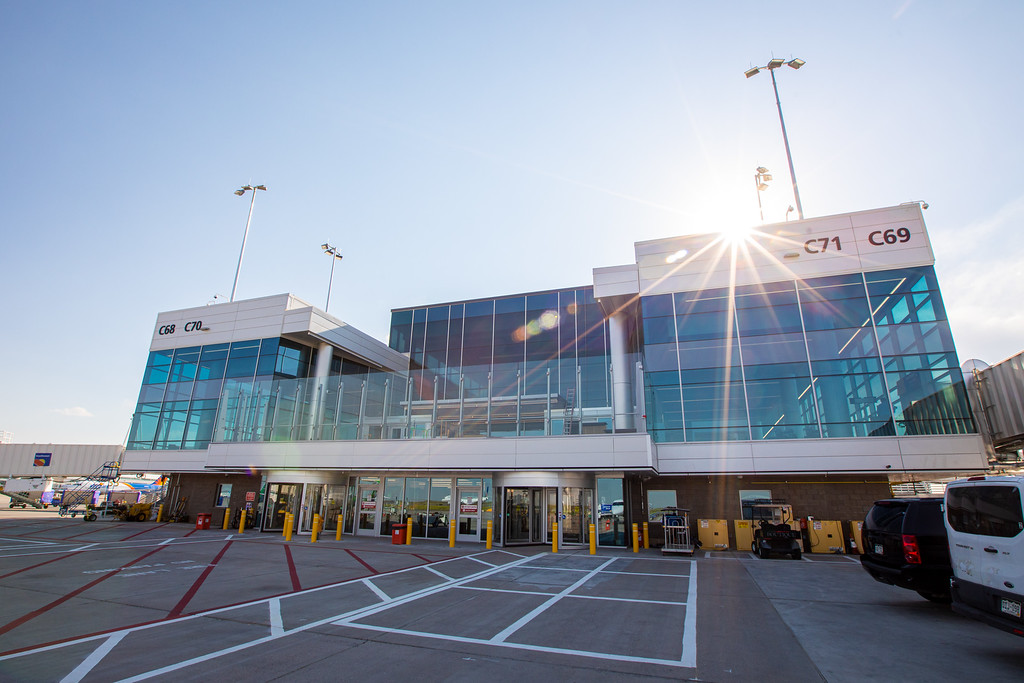
The new home of Denver’s EAS airlines (Photo: Denver International Airport)

The United Express brand; United themselves holds the contracts in the communities of Dickinson, N.D., and Cody, Wyo. so it can choose whichever regional partner to operate these flights, and currently it is Commutair with the Embraer E145s. But as for the other 16, they are all held directly by SkyWest and operate on 50-seat CRJ-200s, although they are trying to switch flights to 30-seat CRJ which has yet to be given an official name, under the ‘SkyWest Charters’ brand, which is currently being fought over between the DOT, FAA, and SkyWest.

But until then the CRJ-200 will operate the routes to the following communities; Vernal, Utah; Prescott, Ariz.; Laramie, Wyo.; Sioux City, Iowa; Joplin, Miss.; Devils Lake and Jamestown, N.D.; Dodge City, Liberal, and Hays in Kansas; North Platte and Scottsbluff, Nebraska. Moab, Utah, and West Yellowstone, Mont. are summer seasonal EAS cities for the United Express brand under SkyWest.

A United Express CRJ-200 (Photo: AirlineGeeks | Joey Gerardi)

The second largest EAS carrier in Denver is very appropriately named, Denver Air Connection, with eight EAS routes out of Denver. It serves Pierre and Watertown, S.D. using the 50-seat Embraer E145; Alliance and McCook, Nebraska as well as Cortez, Colo. with their 9-seat Fairchild Swearingin Metroliner. Clovis, N.M., and Alamosa, Colo. see a mix of 30-seat Dornier 328Jet and 50-seat Embraer E145, and it all depends on what day of the week and circumstances, as to what aircraft will be operating flights in these two communities.

DAC has been slowly growing over the past couple of years with most of its routes coming from Boutique Air, which has since stopped servicing Denver, and SkyWest which has slowly been dropping communities as part of their pilot shortage.

A lineup of Denver Air Connection planes in Denver (Photo: AirlineGeeks | Joey Gerardi)

Southern Airways Express, the smallest EAS carrier in Denver serves two communities; Chadron, Nebraska, and Pueblo, Colorado. Technically under contract, both Chadron and Pueblo are supposed to receive the 8-seat King Air 200, but due to some aircraft shortages the airline uses a mix of King Air 200a and Pilatus PC12a to serve both cities, and the aircraft frequently switches between the types depending on the day and what is available.

Conclusion

Some of these cities are mentioned multiple times even just in the top three EAS hubs, which is due to the fact that some of the communities do connect with multiple hubs creating a unique experience for some passengers that decide to connect in these small communities when traveling between hubs. While connecting in an EAS community definitely adds more time and is not the most convenient, it can add a splash or excitement to your day when you land in a city you’ve never heard of before.

While the EAS contracts do last for years, usually in two or four-year blocks, there are a lot of EAS communities around the country so there are always at least two or three that are in the midst of the EAS process, so it is hard to pinpoint a time of the year when everything is stable and a community isn’t in the process of a hub or airline change. Not only do the airlines change the EAS program a lot, but the routes are even more flexible, especially in Alternate Essential Air Service (AEAS) communities, which don’t even need DOT approval to switch routes or frequencies.

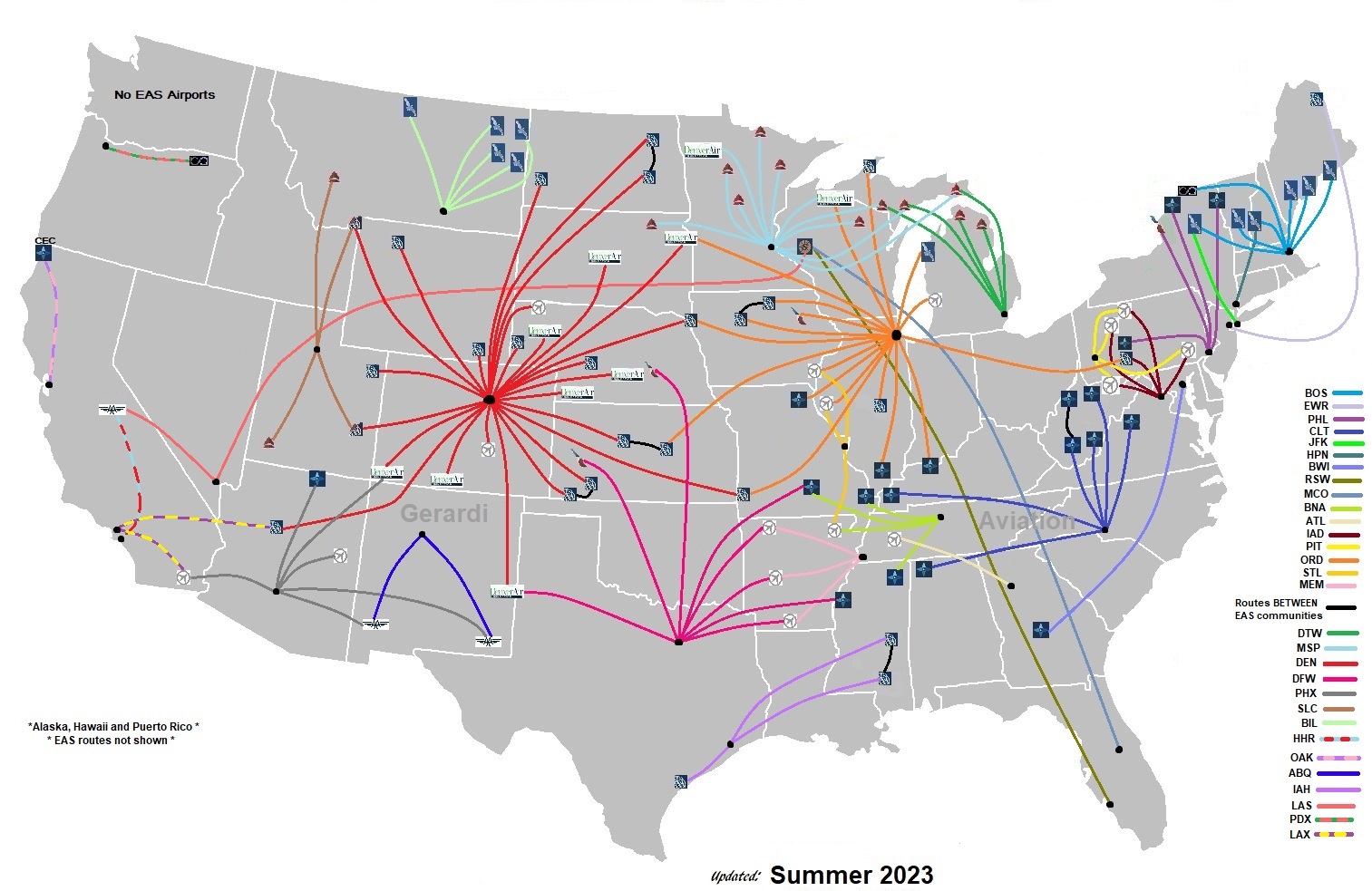
As it stands, this article goes over the ranking and routes from the top three EAS hubs in the United States. The map below depicts all of the EAS routes in the lower 48, which is accurate as of the time this article was posted.

Routes from every EAS Airport in the lower 48 states, as of August 21, 2023 (Photo: Joey Gerardi | AirlineGeeks)

Joey Gerardi

Joey has always been interested in planes for as long as he can remember. He grew up in Central New York during the early 2000s when US Airways Express turboprops ruled the skies. Being from a non-aviation family made it harder for him to be around planes and would only spend about three hours a month at the airport. He was so excited when he could drive by himself, the first thing he did with his driver's license was get ice cream and go plane spotting for the entire day. He graduated from Western Michigan University in 2022 with a B.S. in Aviation Management & Operations and a Minor in Business, and currently works for a major airline in his hometown.

Opinion: Spend-Based Loyalty Programs Bring an End to the Mileage Run

Spend-based loyalty programs are taking over.

An Air Canada Airbus A321 painted in the Star Alliance livery in Los Angeles. (Photo: AirlineGeeks | William Derrickson)

This week, Finnair announced that it would be moving the company’s loyalty brand to a spend-based model. This adds to the list of Airlines that have moved to the spend-based loyalty model. This announcement further demonstrates that the days of doing pure mileage runs are all but in the past.

Mileage runs are a weird quirk of the airline industry used by point hackers and business people that value the top-tier status that they use to get premium benefits that the world’s airlines offer to the very top of the elite spectrum. Typically a mileage run takes place in the later months of the year when a traveler may not be eligible for their current level of status for the following year. My personal longest mileage run began in Los Angeles saw me fly to New York then on to Houston followed by Rio De Janeiro then back to Houston and finally San Francisco. This trip allowed me to maintain top-tier status with my chosen airline and, while mildly excessive, was similar to what hundreds if not thousands of frequent fliers do every year.

Are Mileage Runs a Relic of the Past?

Spend-based frequent flier programs are becoming all too frequent and may very well end people’s desire to mileage runs. Having to spend $10,000 dollars is definitely a lot harder for most people than just spending a weekend on an airplane in economy racking up miles. These were the weekends that I got to fly with my dad to maintain his status and I just thought we were going to have a cool weekend of flying.

These days I’m sure you’re wondering why anyone would care about racking up status but as a trip reporter that spends 80 to 90 days a year on airplanes and in airports the luxuries that having top tier status with an airline in an alliance is incredibly helpful. From lounge access to upgrades, it helps like nothing else can. It allows one to get a bit more rest and should the worst happen and your flight gets canceled, you have a dedicated telephone number to call and get things figured out.

Spend-based loyalty programs are inevitable and eventually most airlines will adopt the program. With that, I’m sure the number of status holders will drop quickly. Airlines need to make money but status was a way for airlines and frequent fliers to acknowledge each other but if a single roundtrip ticket from Los Angeles to London can get you Platinum or very near to Platinum status with United, is it really about loyalty?

Boom Supersonic Hires Ex-Boeing Exec as Global Propulsion Leader and SVP of Symphony

Boom-Overture
Rendering of Boom's Overture Aircraft. (Photo rendering: Boom)

Boom Supersonic announced that Scott Powell has joined as Senior VP of Symphony, the propulsion system for Overture. Powell will lead the development, industrialization, certification, and integration of Symphony, bringing four decades of propulsion leadership experience.

Powell spent 38 years at Boeing before joining Boom. He led the Engineering Propulsion team for the Dreamliner, overseeing design, development, test, build, and business management. He also managed propulsion-integrated product teams for airframes such as KC-46 Tanker and Joint Strike Fighter. Recently, he led the Propulsion Integrated Product Team for the B-52J Commercial Engine Replacement Program.

During the announcement, Blake Scholl, Boom’s founder, and CEO, shared that they have achieved significant progress on Symphony. He also expressed his excitement over including Scott, who brings valuable leadership and experience overseeing certifications for various civil and military propulsion systems. This addition further strengthens their path forward with Symphony, and they are looking forward to the positive impact he will bring to the team.

In December 2022, Boom announced the development of the Symphony propulsion system designed for its Overture supersonic airliner. The engine is designed to provide 25% more time on the wing and a 10% reduction in operating costs. Boom has partnered with Florida Turbine Technologies (FTT), GE Additive, and StandardAero to develop Symphony.

In a recent statement, Scott Powell, the new Senior Vice President of Symphony at Boom, expressed his excitement for the future of sustainable supersonic travel. Powell highlighted the importance of developing an engine customized specifically for Overture, acknowledging the enormous potential it holds for the industry. He also expressed his eagerness to work alongside the team responsible for developing the propulsion system to power this revolutionary form of travel.

Boom shared several milestones for its Symphony program at the June 2023 Paris Air Show. Boom unveiled the 3D printed 1/3 scale model of the Symphony, whose technical specifications include:

  • Two-coil turbofan engine, medium bypass, no afterburner
  • 35,000 lb thrust
  • Optimized for 100% Sustainable Aviation Fuel (SAF)
  • FAA Part 33 and EASA CS 33 compliant
  • ICAO Chapter 14 noise certification

Boom continues to make strides as it expands its global supplier network, which already includes Safran Landing Systems, Eaton, Collins Aerospace, Flight Safety International, GE Additive, and StandardAero, consolidates the configuration of the Overture systems and moves toward production. Additionally, Boom announced an expanded partnership with FTT to assemble initial production units for ground and flight tests and certification at its facility in Jupiter, Florida.

Last month the Centennial, Colorado-based company announced structural supply agreements with three major aerospace companies for its Overture supersonic aircraft at the Paris Air Show 2023. Boom has signed agreements with Aernnova for Overture’s wings, Leonardo for the fuselage and wing box, and Aciturri for the tail.

Vincenzo Claudio Piscopo

Vincenzo graduated in 2019 in Mechanical Engineering with an aeronautical curriculum, focusing his thesis on Human Factors in aircraft maintenance. In 2022 he pursued his master's degree in Aerospace Engineering at the University of Palermo, Italy. He combines his journalistic activities with his work as a Reliability Engineer at Zetalab.

Canadian Airlines Add Capacity to Evacuate City Under Wildfire Threat

An Air Canada Boeing 737 MAX 8. (Photo: Air Canada)

Canadian airlines and the Royal Canadian Air Force are assisting in the evacuation of residents from multiple towns in the Northwest Territories and the province’s capital city Yellowknife. Following the declaration of a state of emergency on 15 August due to uncontrollable wildfires, a number of carriers that operate in the region such as Air Canada, WestJet and Canadian North amended schedules ahead of a noon Friday 18 August evacuation deadline. The Northwest Territories government stated that ‘only residents who do not have the option to leave the area by road are asked to register for evacuation flights.’

“Flights will be running 24/7”

CBC News reported that in addition to scheduled services, 1,500 residents were airlifted on Thursday on 10 evacuation flights. A further 22 evacuation flights were scheduled for Friday offering an additional 1,800 seats. The city of Yellowknife has an estimated population of 20,000 and government officials estimated a further 5,000 residents were looking to evacuate by air. Jennifer Young, emergency management organization information officer told CBC News “We will be running flights 24/7 until we have the population that is wanting to get out on flights are able to evacuate via those flights.”

Consideration was being given on flights for ‘more than 200 residents needing extra health care and attention, such as chemotherapy patients, people in late-term pregnancies, seniors, people with disabilities and vulnerable residents.’ Prisoners and corrections officers from correctional facilities would also be evacuated on specific flights.

Air Canada issued a statement advising: “For Thursday, August 17, we added two extra flights, doubling the normal frequencies to four. We have also substituted a larger 169-seat Boeing 737 for one of those flights to provide extra seat availability. For Friday, August 18, Air Canada has also added an extra B737 flight in addition to the usual two flights, and we will continue evaluating opportunities for adjustments.  At this time, there will be no flights to or from Yellowknife on Saturday, August 19 due to the government evacuation order. We plan to operate as the situation permits.”

CTV News reported that WestJet ‘added an extra recovery flight scheduled for Thursday between Yellowknife and Calgary, and added larger aircraft to operate previously scheduled flights between the cities.’ The airline was implementing flexible guidelines for changes and cancellations and amending its policy on pets on board to assist residents.

Commercial airlines were accused of taking advantage of the situation by escalating fare prices from Yellowknife. Canadian Prime Minister Justin Trudeau said: “(there) would be no tolerance for opportunistic price escalation, including airfare and essential goods for those impacted by the wildfires” after images of exorbitant fares were shared on social media.

Air Canada denies allegations of price gouging

Air Canada addressed criticisms and alleviated concerns regarding alleged price gouging by categorically stating that the allegations were incorrect. In a statement, the carrier said: “The examples on social media are aggregated fares by websites which are not in line with what we are offering on our non-stop flights from Yellowknife. For example, some involve several stops and other carriers, with some trips lasting as much as 21 hours, when a normal non-stop Yellowknife-Calgary flight is two hours.  We endeavor to get these aggregated fares corrected where possible – however, customers should always ensure they are purchasing the non-stop fares directly from the aircanada.com website or from a travel agent to avoid the multi-leg routings.”

The airline further continued: “We also monitor the pricing on aircanada.com to ensure that the capped fares continue to display as intended. Sometimes it requires taking steps to correct fares manually when they may not display as they should due to certain technical factors. Rest assured, we get these corrected as soon as possible, and we refund passengers who inadvertently purchase a fare before it gets corrected by our team.”

John Flett

John has always had a passion for aviation and through a career with Air New Zealand has gained a strong understanding of aviation operations and the strategic nature of the industry. During his career with the airline, John held multiple leadership roles and was involved in projects such as the introduction of both the 777-200 and -300 type aircraft and the development of the IFE for the 777-300. He was also part of a small team who created and published the internal communications magazines for Air New Zealand’s pilots, cabin crew and ground staff balancing a mix of corporate and social content. John is educated to postgraduate level achieving a masters degree with Distinction in Airline and Airport Management. John has held the positions of course director of an undergraduate commercial pilot training programme at a leading London university. In addition he is contracted as an external instructor for IATA (International Air Transport Association) and has been a member of the Heathrow Community Fund’s ‘Communities for Tomorrow’ panel.

Analysis: LATAM’s Long-Haul Network

A LATAM Boeing 777 on approach to Amsterdam. (Photo: AirlineGeeks | Fabian Behr)
LATAM Airlines, the largest South American carrier, has announced new long-haul routes this year, including flights to Johannesburg and London.
LATAM Airlines Group has revealed a new long-haul flight route between Lima, Peru’s International Airport and London’s Heathrow Airport in the UK, set to begin on Dec. 2. As the largest South American carrier, LATAM operates 22 non-stop routes exceeding 3,000 miles, and plans to introduce two more in the coming months. LATAM currently operates ten routes between South America and Europe, with its main long-haul hub in Sao Paulo Guarulhos. Its longest non-stop flight is from Santiago, Chile to Madrid, Spain.
With the announcement of the new long-haul route between Lima and London Heathrow, it’s time to explore LATAM’s extensive long-haul route map, destinations, and aircraft.

New Route To London

LATAM Airlines revealed its plan to bolster its international offerings with the launch of the new London to Lima route. This route will operate five times a week on Mondays, Tuesdays, Wednesdays, Thursdays and Saturdays. LATAM’s second non-stop route to London Heathrow, the new flight will originate from Sao Paulo’s Guarulhos International Airport in Brazil. The route will be serviced by a Boeing 787-9 Dreamliner, whereas the service between São Paulo and London uses LATAM Brasil’s Boeing 777-300. This route represents a significant milestone for LATAM Airlines, as it is the only direct connection between Peru and the U.K.
The airline operates a fleet of over 300 aircraft and has passenger subsidiaries in Chile, Brazil, Peru, Colombia and Ecuador. According to data from Cirium, LATAM runs 22 non-stop routes over 3,000 miles (2,606 nautical miles or 4,828 kilometers). A flight is generally considered long-haul if it covers at least 3,000 miles.
LATAM plans to launch two long-haul routes of over 3,000 miles in the coming months. The first, set to begin next month, will connect Guarulhos to Johannesburg’s Tambo International Airport in South Africa and covers 4,630 miles. The second is the new service between Lima and London, spanning 6,301 miles.

Long-Haul Routes To Europe

LATAM Airlines currently operates ten routes between South America and Europe, with distances ranging from 5,400 to 6,700 miles. The airline serves six European countries – Spain, Portugal, the U.K., France, Italy, and Germany. LATAM’s longest non-stop flight is the Santiago de Chile-Madrid route, covering 6,647 miles with eight weekly frequencies as of August 2023. Sao Paulo Guarulhos is LATAM’s main long-haul hub, offering flights to several European cities such as Frankfurt, Milan, London, Rome, Paris, Barcelona, Madrid, and Lisbon. LATAM also operates a European route from Lima, flying daily to Madrid (5,915 miles long).
Besides Europe, the recently launched Sao Paulo to Los Angeles service is established under the LATAM and Delta Air Lines Joint Venture Agreement. From Sao Paulo, LATAM offers long-haul flights to Boston, New York, Mexico City, Orlando and Miami. LATAM also operates long-haul routes from Lima, Fortaleza, and Santiago de Chile, flying to destinations such as Los Angeles, New York, Miami, Auckland, Mexico City, Cancun, and Punta Cana.

Parth Jain

Parth Jain is a dedicated aviation enthusiast with a rich background in general and commercial aviation. Over the years, Parth has consistently demonstrated a deep fascination with the aviation industry, his interests spanning from the workings of small general aviation aircraft to the complexities of large commercial jets. Parth's interest in aviation sparked at a young age when he first set foot in an airplane. Since then, he has dedicated much of his time to gaining first hand experience, achieving his private pilot license and currently working towards his instrument rating. Parth's education and experience are a testament to his dedication and commitment to this field. As a private pilot, he has navigated complex airspace, developed an understanding of the intricate details of aircraft operations, and consistently demonstrated safe and proficient flying skills.

Sustainable Aviation Fuels Continue Upward Trajectory

These types of fuels continue to grow in popularity.

United 787 Dreamliner is field with Sustainable Aviation Biofuel at San Francisco International Airport (Photo: San Francisco International Airport)

Sustainable aviation fuels have been getting a lot of attention recently as the world starts focusing more on aviation-related carbon emissions. Alternative propulsion systems like electric motors are still far in the future. In the meantime, the world is turning to sustainable aviation fuels as a necessary measure to reduce emissions while other more environmentally friendly technologies are developed.

Earlier this year in April, the European Union introduced new environmentally friendly measures to tackle aviation emissions. Their goal was to have two percent of aviation fuel supplied at European Union airports to be comprised of sustainable aviation fuels by 2025, growing to seventy percent by 2050.

KLM in May flew flights from Amsterdam to Los Angeles to test new initiatives in aviation sustainability by using things such as sustainable aviation fuel. United Airlines announced its participation in a fund to help increase the availability of these sustainable fuels in the industry.

In the United States, the Inflation Reduction Act signed into law in August of 2022 aims to spur the growth of lower-carbon aviation fuel by providing hefty tax credits to those developing sustainable aviation fuels.

More airlines are catching on to the trend of sustainable aviation fuels but it’s not going to be a cheap trend. Sustainable aviation fuels are currently not widely available and often more expensive than conventional fuel. It’s expected that as the fuel gains in popularity, costs will eventually come down. However, this is going to require significant investment.

Shell Aviation and American Express

This is why American Express Global Business Travel and Shell Aviation teamed up to help finance the growth of these fuels. Major companies such as Bank of America, and JetBlue have all joined on to take part in the effort. Most recently, Google has joined on as well seeking to use sustainable aviation fuel supplied by Shell as a way to help cut emissions from its corporate flying, according to GreenBiz.

The goal of this partnership is to bring more businesses into the program to leverage scale to increase the production of these new fuels.

Shell is working on a massive sustainable aviation fuel facility in Rotterdam that is expected to deliver 820,000 tons of biofuels a year using a technology that refines vegetable oils, waste oils, and fats using hydrogen. The goal of the company is to leverage corporate partnerships to have at least ten percent of its global aviation fuel sales be sustainable fuels by 2030.

Blockchain plays a part in all of this as well by acting as a ledger that can track sustainable fuels delivered across the aviation fueling network allowing businesses to report verifiable data on the amount of emissions reduced.

While we wait for electric and hydrogen-powered commercial aircraft to become reality, sustainable aviation fuels are the only realistic way to reliably reduce carbon emissions in the aviation industry beyond measures such as more fuel-efficient engines and flight paths.

Hemal Gosai

Hemal took his first flight at four years old and has been an avgeek since then. When he isn't working as an analyst he's frequently found outside watching planes fly overhead or flying in them. His favorite plane is the 747-8i which Lufthansa thankfully flies to EWR allowing for some great spotting. He firmly believes that the best way to fly between JFK and BOS is via DFW and is always willing to go for that extra elite qualifying mile. Hemal's opinions are his own and do not reflect those of his employer.

FLYING Media Group Acquires AirlineGeeks

FLYING Media Group has acquired AirlineGeeks. Delivering the latest airline and aviation news around the globe in real-time, AirlineGeeks offers a unique vantage point for the “AvGeek.” With more than 25 contributors, AirlineGeeks is trafficked by aviation enthusiasts, as well as airline industry executives and analysts.

AirlineGeeks is the 20th aviation-related brand that FLYING Media Group has purchased in the past two years, in a strategy to expand the world’s leading aviation content platform and serve an audience that spans from light sport to space and vintage to frontier.

“As a young boy, I fell in love with aviation while watching airliners take off and land near my house in Tennessee. I would make my parents drive me to Atlanta’s Hartsfield Airport (ICAO: KATL) to watch the commercial aircraft and stood in awe as they seemed to defy the laws of gravity. I am an AvGeek myself, and can’t wait to build on the AirlineGeeks brand,” stated Craig Fuller, CEO of FLYING Media Group.

FLYING Media Group has been very active in acquiring brands that service the general aviation (GA) industry. While commercial aviation and general aviation are often thought of as distinct and separate markets, in recent years they have become more interdependent.

Commercial pilots often start their careers as general aviation pilots, and many of them retain their love for flying in small GA aircraft their entire lives. GA is also a test-bed for new technologies and airframes that eventually make their way into commercial applications. With the emergence of air taxis and urban air mobility offerings that will blend commercial aviation with personal aviation, the two markets have never been more connected.

FLYING Media Group is not just focused on the enthusiast side of the market, but plans to use AirlineGeeks as a foundation to build a premier B2B data, news, and market intelligence platform for the commercial aviation industry.

The global market size for the airline industry is more than $840 billion and is expected to grow by a compound annual growth of nearly 4% over the next decade.

“As people around the world become wealthier, they wish to travel. Commercial flight is unmatched in its ability to link the world and offer experiences that are only possible because of the efficiency of the global airline industry. Additionally, as supply chains continue to build resilience into their operations, global air cargo will experience exponential growth over the next few decades. This is what’s driving fast growth on an unprecedented scale,” Fuller concluded.

About FLYING Media Group

FLYING Media Group is the largest aviation media provider in the world, with content spanning 20 aviation-related brands, including FLYING Magazine, Plane and Pilot, Kitplanes, AVweb.com, AirlineGeeks, and Aircraft for Sale

With an audience of nearly 3 million monthly visitors and subscribers, the broad reach of the FLYING platform is unmatched by any other aviation media source.

AirlineGeeks.com Staff

AirlineGeeks.com was founded in February 2013 as a one-person blog in Washington D.C. Since then, we’ve grown to have 25+ active team members scattered across the globe. We are all here for the same reason: we love deep-diving into the fascinating realm of the airline industry.

Gatwick Runway Closure Leads to Delays and Diversions

A runway closure created havoc for travelers at Gatwick Airport.

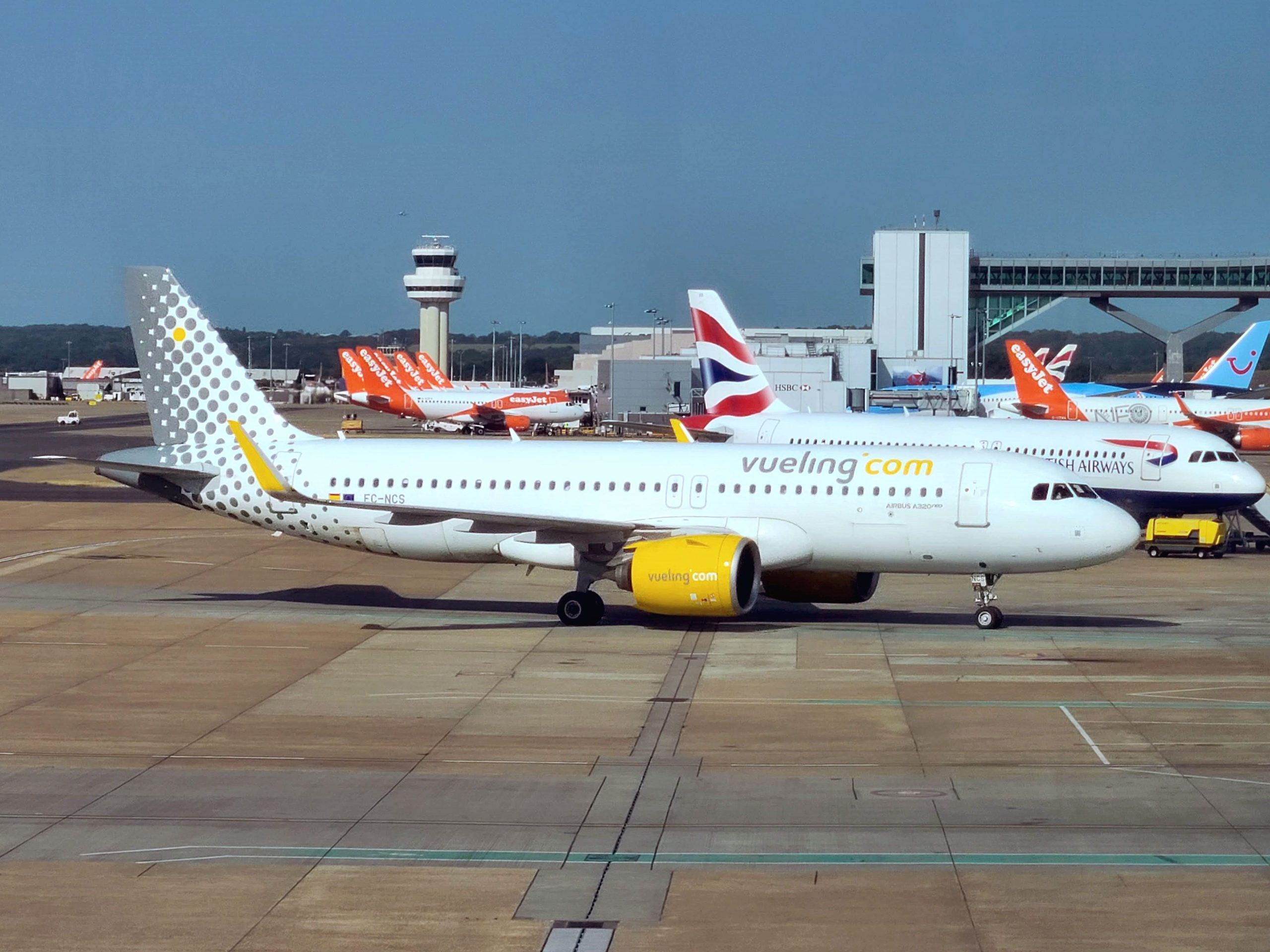
Aircraft at London Gatwick Airport (Photo: AirlineGeeks | Andrew Chen)

Runway movements at London Gatwick Airport were halted for nearly an hour on Wednesday afternoon after the main runway was temporarily closed for emergency repairs. The closure led to numerous flight diversions and delays throughout the afternoon and evening.

Closure Due to Reported Fuel Leak

Initial reports indicate that an aircraft experienced a fuel leak on Runway 08R/26L. Emergency equipment attended the scene and the runway was subsequently shut down for repairs. Reports of the closure began appearing on social media shortly before 4:00 p.m. Data from Flightradar24 shows that the last flight to use the runway before the closure was TUI Flight 321, which landed at the airport at 3:37 p.m. at the end of its flight from Kavala International Airport in Greece.

According to an airport spokesperson, “the main runway was closed for a short time today (16 August) due to emergency repairs. Four flights were diverted. The runway is now open and operating as normal. Safety is our top priority and we apologise for to passengers for any inconvenience.”

A screenshot from Flightradar24 at 3:45 p.m. on Wednesday, August 16, 2023 showing emergency and other airport vehicles on the main runway at London Gatwick Airport (Photo: Flightradar24)

Dozens of Delays and Diversions

Although the airport stated that only four flights were diverted, data from Flightradar24 and FlightAware appears to show that a total of ten inbound flights diverted to other airports in the area during the runway closure. These flights are listed below in the order of their scheduled arrival time at Gatwick:

  1. EasyJet Flight 8240 from Santorini (Thira) International Airport in Greece performed a go-around at Gatwick at 3:39 p.m. before diverting to Bournemouth Airport.
  2. EasyJet Flight 8326 from Rome Leonardo da Vinci–Fiumicino Airport turned for a final approach to Runway 08R at Gatwick at approximately 3:39 p.m. before turning away from the airport and diverting to London Southend Airport.
  3. TAP Air Portugal Flight 1336 from Humberto Delgado Airport in Lisbon, Portugal diverted to London Heathrow Airport, landing at 4:15 p.m.
  4. Aurigny Air Services Flight 606 from Guernsey Airport diverted to Southampton Airport, arriving at 4:20 p.m.
  5. EasyJet Flight 8198 from Kefalonia International Airport in Greece diverted to London Luton Airport, arriving at 4:25 p.m.
  6. British Airways EuroFlyer Flight 2813 from Corfu International Airport in Greece diverted to London Stansted Airport, arriving at 4:23 p.m.
  7. British Airways EuroFlyer from Flight 2833 from Dubrovnik Airport in Croatia diverted to London Stansted Airport, arriving at 4:36 p.m.
  8. EasyJet Flight 804 from George Best Belfast City Airport in Northern Ireland diverted to London Luton Airport, arriving at 4:23 p.m.
  9. EasyJet Flight 8216 from Heraklion International Airport in Greece diverted to London Luton Airport, arriving at 4:29 p.m.
  10. Turkish Airlines Flight 1997 from Istanbul Airport diverted to London Heathrow Airport, arriving at 4:34 p.m.

The first flight to use the runway after it reopened was Vueling Flight 6225 to Rome Leonardo da Vinci–Fiumicino Airport, taking off from Runway 08R at 4:20 p.m.

As of 9:00 p.m., data from FlightAware showed that a total of 410 flights have been delayed at London Gatwick on Wednesday, representing 42% of flights throughout the day.

Gatwick’s Runway Operations

Despite being the United Kingdom’s second busiest airport, Gatwick Airport uses a single-runway operation. The main runway – Runway 08R/26L – is in use most of the time, with the parallel northern Runway 08L/26R used only for emergencies or when the main runway is closed. The northern runway is shorter and is used as a taxiway during normal airport operations. It is unclear why the northern runway was not used during this latest runway closure.

Earlier this year, Gatwick Airport announced that it is planning to expand its northern runway to allow it to be used regularly. The airport is expected to submit its application for the expansion project soon, with an anticipated construction start date in 2025. As Gatwick reached capacity before the COVID-19 pandemic, the runway expansion would add much-needed capacity to the airport.

Andrew Chen

Andrew is a lifelong lover of aviation and travel. He has flown all over the world and is fascinated by the workings of the air travel industry. As a private pilot and glider pilot who has worked with airlines, airports and other industry stakeholders, he is always excited to share his passion for aviation with others. In addition to being a writer, he also hosts Flying Smarter, an educational travel podcast that explores the complex world of air travel to help listeners become better-informed and savvier travelers.

Asiana Airlines Makes Profit, Merger Remains Uncertain

Asiana will be sending its A350-900 XWB to New York starting Oct. 28, 2018. (Photo: AirlineGeeks | Ben Suskind)

As the airlines around the globe recorded a profit after the pandemic, South Korea’s Asiana Airlines wasn’t left behind and posted a net profit of 1.8 billion won ($1.36 million) in the second quarter of 2023.

The sales reached 1.57 trillion won in the second quarter, but operating profit still dropped 48.5% year-on-year due to rising cost and foreign exchange loss. After lifting the travel restrictions, the sales of the airline recorded a 112% increase year-on-year from passenger travel. The cash-strapped airline recorded a loss of 54.36 billion in the first quarter of the year.

It came days after Korean Air’s second quarter finance result. The flag carrier posted an operating profit of 468 billion won. Korean Air is optimistic about the third quarter of the year and enhances its services by increasing flight operations to meet the travel demand.

Merger With Korean Air

Korean Air and Korea Development Bank (KDB), the main creditor of Asiana, are working to acquire Asiana Airlines. However, Korean Air slowed its stride after submitting its request to the US and EU.

“We will do our best to win the final approvals after finishing negotiations with the antitrust authorities,” Korean Air said.

The acquisition is by no means a done deal. Earlier, Korean Air requested the EU extend the deadline to October, trying to offer more remedies to get the approval. The EU originally decided to deny the merger in early August and raised concerns over the competition. The merger has continued to undergo scrutiny by the bloc.

In addition, US is concerned that a merger with Korean Air could have a monopoly on cargo transportation services. The decision potentially could affect the stability of the supply chain, such as with semiconductors. The two Korean airlines currently have a combined market share of 95%.

In response to the concerns about the monopoly, KDB says it will consider offloading Asiana’s cargo section to boost the acquisition. The potential buyer could be T’way Air, a budget carrier in the country. The no-frills carrier currently operates without cargo services. Asiana Cargo owns a wide variety of aircraft, ranging from Airbus A320 to Boeing B747-400SF.

“There have been talks, but nothing has been decided,” T’way Air said after a meeting.

But KDB is reluctant to sell the cargo section and believes the valuation of Asiana will drop. Asiana could maximize synergy with the cargo section. Meanwhile, KDB denied the rumor of selling Asiana to a third party.

After nearly three years of announcing the merger, Korean Air got 11 green lights from competitors’ authorities, including the UK, Australia and Singapore. The acquisition needs three more approvals from the US, EU, and Japan to be done.

Sign-up for newsletters & special offers!

Get the latest stories & special offers delivered directly to your inbox

SUBSCRIBE

Uh-oh! It looks like you're using an ad blocker.

Our website relies on ads to provide free content and sustain our operations. By turning off your ad blocker, you help support us and ensure we can continue offering valuable content without any cost to you.

We truly appreciate your understanding and support. Thank you for considering disabling your ad blocker for this website