A Really Cool Airlines A350 mockup (Photo: Really Cool Airlines on Facebook)
Since the pandemic has come to an end, many new airlines around the globe are set to spread their wings. Really Cool Airlines, a new carrier in Thailand, is expected to launch its services in December with three leased Airbus A330s with a capacity of more than 300 in the early phase.
The startup will operate a number of regional routes, such as from Thailand to Singapore, Tokyo, Hong Kong, and Taiwan. It plans to grow its route map to Europe by 2025, but the airline didn’t provide its strategy for expanding its network. However, the airline rules out operating domestic rules to avoid competing with other carriers providing well-established domestic networks.
Patee Sarasin, the chief executive of the airline, said an operating license was granted earlier this year. Really Cool will be launched after being granted an air operator certificate from the Civil Aviation Authority of Thailand (CAAT) in December. The airline has invested over one billion baht ($28 million), with the aim of attracting inbound passengers who account for 70% of Thailand’s air travelers.
Sarasin, the former CEO of Nok Air, a low-cost carrier in Thailand, said the airline could meet the challenge of the invasion of Ukraine and the collapse of some commercial banks. In addition, the aviation industry is facing a slow recovery.
Growing Market For Russian Travel
Thailand has been recovering after the pandemic. Thai Airways, the flag carrier of the country, recorded an operating profit of 13,034 million baht in the first quarter of 2022, significantly improved from the first quarter in 2022, which reported an operating loss of 3,167 million baht.
In the light of reducing the cost and enhancing its safety and comfort, Really Cool will operate with new technology and innovative ideas. Earlier, the airline said that it will be considered a full-service “lifestyle carrier” and provide a unique experience to customers between luxury and budget carriers. Sarasin said the new carrier will exceed the previous standard and enhance safety and service.
Thailand is one of the popular holiday destinations, welcoming tourists around the world and it ticks all the boxes. The country recorded over 15 million tourists in the first seven months of 2023, an increase of 384% compared to the same time in 2022. Thailand expects 25 million visitors this year.
Surprisingly, Thailand is seeing an increase in popularity from Russia since the invasion of Ukraine, Russians largely used to travel to Europe during summer. Thailand is looking forward to ramping up flight operations to Russia and targets two million visitors from Russia in 2024.
A B-17 of the Yankee Air Museum preparing for an experience flight around Long Island. (Photo: AirlineGeeks | Tom Pallini)
The U.S. Government has been known to explore any and all ideas that would give them a tactical advantage during wartime. Some of these ideas are very outside the box, to say the least.
One such idea was Project Pigeon. This was an initiative to develop a pigeon-controlled guided bomb, and it started in the 1940s by Burrhus Federic Skinner, an American experimental psychologist.
The rationale behind this was to develop next generation bombing technology that would replace the ‘stupid’ bombs that were currently being used at the time during World War II. These ‘stupid’ bombs were considered stupid because there was no way of controlling these bombs once dropped. A heavy wind could alter the path of the bomb, or the pilot could’ve just had bad aim.
One initial idea was to develop a glider that would carry a thousand-pound warhead and a television camera to broadcast images to someone on the ground to who would steer the bomb. However, this was unsuccessful given significant limitations in tv broadcast capabilities at the time.
Training Pigeons
This is where Skinner came in. He had the ingenious idea to put pigeons inside these warhead-carrying gliders to steer.
Skinner got hold of your regular garden-variety pigeons and trained them to peck at an image of a ship placed in front of them. Every time the pigeons pecked at the ship correctly they were given a reward. Through continuous training, Skinner was able to train pigeons to peck 10,000 times in 45 minutes without stopping.
Pigeons had an electrode attached to their beaks and were placed in a compartment within the glider that had a conductive screen and lens which would project an image of the ground on the screen.
When launched, the screens would display the target below and the pigeons would begin madly pecking at the target projected onto the conductive screen. These were then converted into signals that were relayed to a guidance system on the glider which would result in course adjustments based on where the pigeons were pecking.
It was reported that the system worked perfectly when using live pigeons and actual combat footage projected onto the screen.
Too Ingenious to be Accepted
This system was never put into use during World War II. The military and National Bureau of Standards were for some reason hesitant about handing over the reigns to guide thousand-pound bombs in combat zones to pigeons.
Many feel the project was cut short due to many in government and military leadership being unwilling to accept such an outside-the-box approach. To try to lessen concerns of officials, Skinner reportedly added two pigeon co-pilots bring the pigeon pilot staffing count to three. Three pigeons would steer the bomb with at least two pigeons needing to peck at the same image to steer the bomb.
Multiple pigeon pilots did little to persuade military officials, and the project remained cancelled. The military ultimately did develop other technological guidance systems.
However, the work put into Project Pigeon is not entirely lost. The conductive touchscreen that the pigeons pecked at is a very early precursor to capacitive touchscreen technology that is near ubiquitous in cell phones and other touchscreens today.
Hemal took his first flight at four years old and has been an avgeek since then. When he isn't working as an analyst he's frequently found outside watching planes fly overhead or flying in them. His favorite plane is the 747-8i which Lufthansa thankfully flies to EWR allowing for some great spotting. He firmly believes that the best way to fly between JFK and BOS is via DFW and is always willing to go for that extra elite qualifying mile. Hemal's opinions are his own and do not reflect those of his employer.
Niger Airspace Closure’s Impact on Regional Air Travel
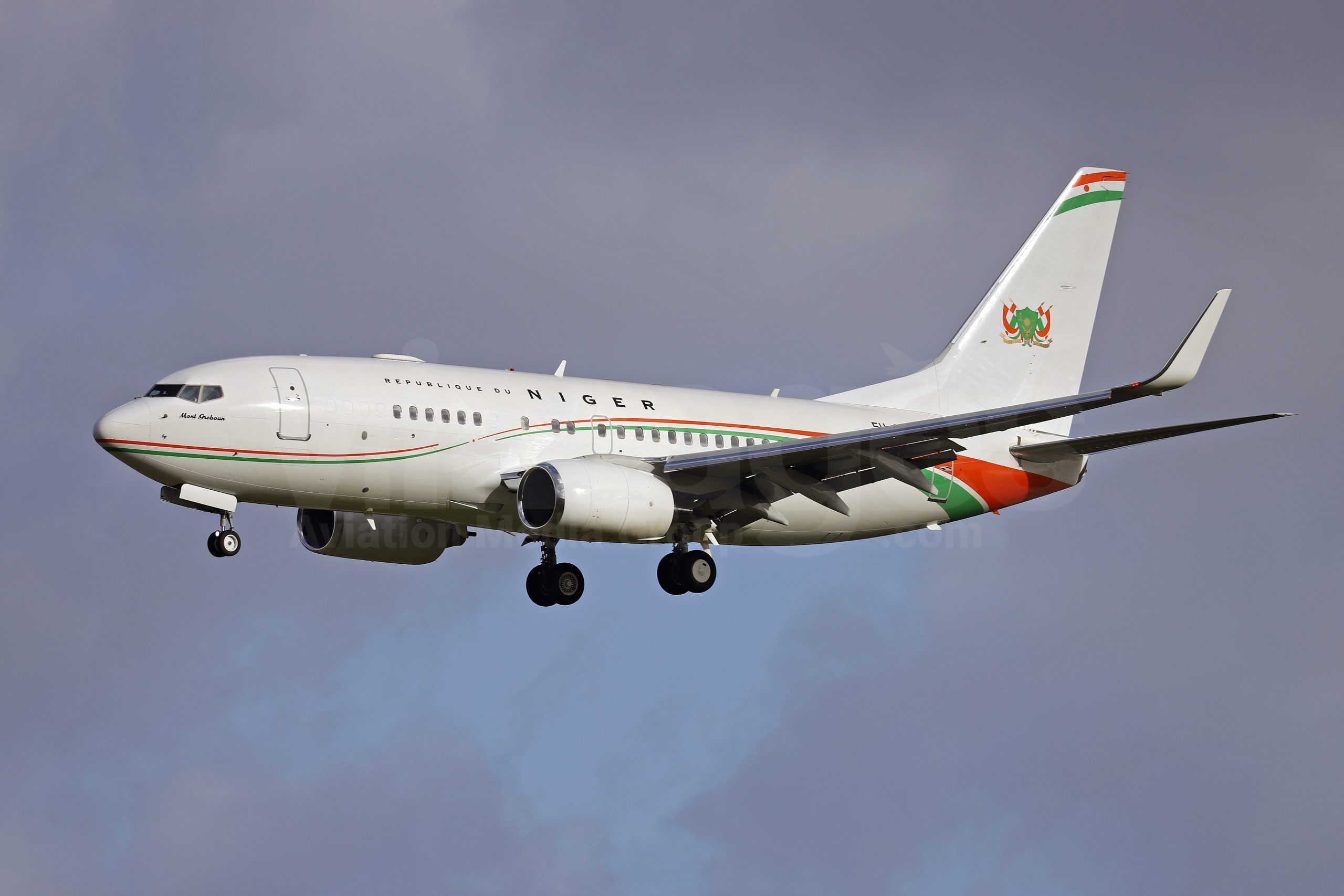
A Boeing 737 operated for the Republic of Niger.
(Photo: V1Images)
Niger, a landlocked country at the heart of Africa, finds itself embroiled in a political crisis that has led to the closure of its airspace. The country’s military rulers have declared the closure of the country’s airspace, signaling an escalation of tensions with neighboring countries and the international community. With neighboring nations allegedly preparing for intervention and the expiration of the ECOWAS ultimatum for a return to democratic governance, the situation in Niger remains highly volatile.
In a stern statement issued on Sunday, Niger’s military rulers announced the immediate closure of the country’s airspace, warning that any attempt to violate the closure would be met with a “energetic and immediate response.”
“Faced with the threat of intervention, which is becoming clearer through the preparation of neighboring countries, Niger’s airspace is closed from this day on Sunday…for all aircraft until further notice,” the country’s new rulers said in a statement.
The move came as the deadline imposed by Economic Community of West African States (ECOWAS) for the military rulers to return power to the democratically elected President, Mohamed Bazoum, expired. The closure, effective immediately, remains in force until further notice, adding a new dimension of complexity to the already precarious political situation.
Impact on Airlines and Air Travel
The closure of Niger’s airspace has dealt a blow to airlines operating in the region, disrupting their flight operations and routing. Forced to revise their flight plans, Air France, a major carrier serving the area, was swift to respond, announcing the suspension of its air links to Niger, Mali, and Burkina Faso. Flights to Niamey, the capital of Niger, have been suspended indefinitely, while flights to Bamako (Mali) and Ouagadougou (Burkina Faso) will be interrupted until August 11. Flights from Lagos (Nigeria), Yaoundé (Cameroon), and Abidjan (Côte d’Ivoire) to Paris were canceled as well.
Moreover, flights from Johannesburg (South Africa) and Nairobi (Kenya) were rerouted to Abidjan, while a flight from Libreville (Gabon) had to return to its point of origin. These changes have led to longer flight times and potential operational disruptions, affecting airlines and passengers alike.
The announcement of the airspace closure coincides with the expiration of the ultimatum set by the ECOWAS. Last Sunday, ECOWAS demanded that Niger’s military rulers step down and restore power to the democratically elected President, Mohamed Bazoum, within a week or face the possibility of military intervention. With the deadline now passed, the international community awaits the next steps taken by ECOWAS and potential responses from the military regime in Niger.
The political crisis in Niger took a dramatic turn on July 26 when President Mohamed Bazoum was overthrown by members of his own guard, leading to a change in government control. Since then, the military rulers have been at the center of regional and international attention, with ECOWAS playing a prominent role in calling for a return to democratic governance.
Victor Shalton's love for aviation can be traced to when he was 11-years-old. As a seasoned aviation writer, he takes pride in providing the best aviation coverage around the globe and is passionate about advancing his skills in the aviation space. In addition, he loves travelling, writing, arts and while his speaking engagements have taken him around the world, he is proud to call Nairobi home.
A Lufthansa A319 coming in to land in London.
(Photo: AirlineGeeks | William Derrickson)
Over the last couple of weeks, I’ve detailed trips I took on two different Lufthansa Regional carriers. The Lufthansa CityLine brand is best integrated into the Lufthansa group, wearing Lufthansa’s colors and sharing a nearly-identical name. Air Dolomiti, while still a wholly-owned member of the Lufthansa Group, doesn’t match the group’s branding as closely.
After taking domestic flights within Germany on mainline Lufthansa, Lufthansa CityLine, and Air Dolomiti, a major split became clear. While CityLine’s branding and product is closely in line with Lufthansa’s, Air Dolomiti’s is more divergent. Air Dolomiti does not put Lufthansa’s name on their aircraft, does not have the same aircraft cabins, and does not offer the same onboard service that Lufthansa does; there was not even acknowledgment at the airport that Air Dolomiti was operating on Lufthansa’s behalf, instead using its own name and branding.
Neither Lufthansa CityLine nor Air Dolomiti began their lives as part of the Lufthansa Group; both were purchased by the airline years after launching due to increasingly-close partnerships. Why would it be important, then, for Lufthansa to keep Air Dolomiti’s branding so distinct and risk confusing passengers who may not be aware of the two carriers’ relationship?
Why Is Air Dolomiti Important to Lufthansa?
One possibility is that Lufthansa wants to use Air Dolomiti to connect passengers from Italy to Lufthansa’s route network. As Lufthansa and Air Dolomiti operate interline and codeshare agreements, Italian passengers can fly to a Lufthansa hub in Germany on a brand they’re already familiar with and board a Lufthansa journey onward to a far-flung destination. Thus, perhaps this relationship is nothing more than a way for Lufthansa to gain extra passengers without needing to spend as much money on advertising.
Said brand familiarity is critical to this plan as well. Air Dolomiti is a regional airline, meaning it doesn’t focus on the major destinations that ITA Airways, or its predecessor Alitalia, do. Instead of serving high-demand routes bringing passengers into major Italian airports from around the world for business or exotic destinations, Air Dolomiti serves a niche clientele in smaller locations to get them across Italy in a seamless fashion.
Investing in flights to small destinations is often complicated and expensive for national flag carriers. It would require an airline to do market research, invest in new aircraft, and conduct advertising to win over passengers. This can be a tricky task if there is already an established airline in said market that passengers trust and highly prefer. Lufthansa may have decided it was a safer bet for them to buy out Air Dolomiti and gain access to its aircraft, route network, and loyal customers than to try to enter the Italian market with CityLine.
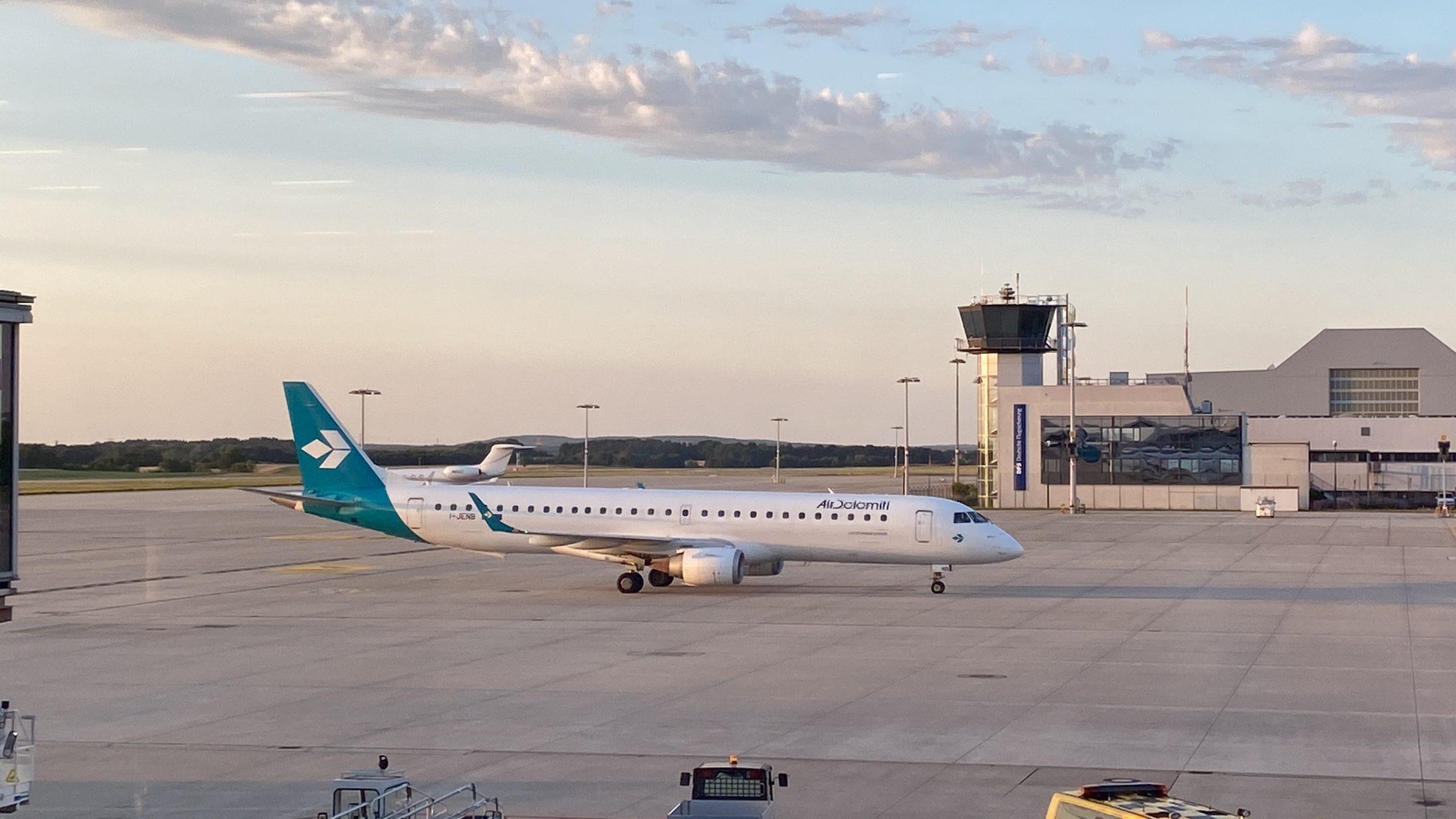
Our Air Dolomiti Embraer E190 after arriving in Dresden. (Photo: AirlineGeeks | John McDermott)
Lufthansa has shown interest in investing in ITA Airways, but the fact remains that ITA and Air Dolomiti serve largely different networks under different business strategies. They have different customer bases, different loyalties, and different route structures that serve Lufthansa differently. It’s equally, if arguably not more, important for Lufthansa to have more seamless regional connectivity into and out of its main hubs, thereby feeding more traffic towards Lufthansa itself than to try to compete in Italian markets that make more sense for a mainline carrier flying bigger aircraft.
Since ITA Airways is a relatively new company, and since Italy’s nationally-owned airlines don’t historically perform well, some passengers may continue to be more drawn to private airlines such as Air Dolomiti, offering Lufthansa an added boost of passengers’ comfort with the brand and product.
Why, then, doesn’t Air Dolomiti keep its legacy branding within Italy and conform to Lufthansa branding and products in Germany? Some of this may come down to the logistics of a uniform fleet and products. Without needing to worry about two sets of aircraft, training crews to fly in two different markets, and catering an aircraft two different ways based on where it is, Lufthansa can save costs by keeping the fleet more uniform, allowing it to continue to give passengers the same experience no matter where they area.
With these two different airlines, passengers also get to decide which experience they want when flying Lufthansa. Customers who are already familiar with Lufthansa and like its service can choose to fly with CityLine and have the product they know and love; passengers who prefer Air Dolomiti’s style can easily book flights on the carrier straight through an established, trusted brand.
All Airlines Are Not Created Equal
Lufthansa CityLine and Air Dolomiti are not, however, at a perfect 1:1 relationship in terms of aircraft flown or destinations served. CityLine is a much larger airline, with more than twice the aircraft and many more destinations. The Lufthansa brand, then, should be taken to be Lufthansa’s primary focus. Having a unified, professional image should be considered important to Lufthansa; the airline still needs to be recognizable, after all, and there is only so much complexity it can work into its system before becoming messy and risk losing its identity.
Air Dolomiti seems to serve a niche role within Lufthansa’s network. It serves to fill a gap that Lufthansa sees as critical to its operation. Lufthansa must think that it is better off with Air Dolomiti operating so independently, quite possibly just to provide Italian passengers with a familiar way to lead them onto other Lufthansa airlines.
We deplaned via air stairs, just as we had boarded in Munich. (Photo: AirlineGeeks | John McDermott)
I doubt that the Air Dolomiti brand is going anywhere. After all, we’re approaching the 20-year anniversary of Air Dolomiti’s full integration into the Lufthansa Group. But it’s still a little odd to have a regional airline so (relatively) out of place next to its wholly-owned parent company.
That said, a 40-minute flight doesn’t give either CityLine or Air Dolomiti much chance to prove themselves. Perhaps my next report from Germany will involve longer flights on Lufthansa mainline, Lufthansa CityLine, and Air Dolomiti around Europe to see how each carrier does on a flight a couple of hours long.
In the meantime, I’m looking forward to my next trip and sharing it with all of you. Leave comments on our YouTube channel if you agree or disagree with our conclusions.
John McDermott is a commercial pilot pursuing a career in professional flight. His passion for aviation began in an Ann Arbor bookstore with a tale of enemy pilots during World War 2, and he hasn't looked back. Besides flying and writing for AirlineGeeks, John volunteers with Professional Pilots of Tomorrow and travels whenever he gets the chance.
An American 787-9 landing in Dallas/Fort Worth (Photo: AirlineGeeks | William Derrickson)
Dallas-based American Airlines has decided to alter one of its long-haul international routes, but instead of changing a schedule or aircraft, it is changing the hub it will operate from. Starting Oct. 29, 2023, they will be moving its JFK-Doha route to its Philadelphia hub.
The route will continue to operate daily and on board the carrier’s Boeing 777-300ER. This does make sense for the carrier from a connection standpoint, as Philadelphia does offer more connections in the United States on American, as well as the fact that Philadelphia is already the airline’s main transatlantic hub, which this Qatar route will strengthen.
American will be competing with its partner Qatar, as that airline already offers a daily nonstop flight between these two cities. But, given that they are already partners, they now offer a second daily flight, one on each airline, that can seamlessly connect passengers to each other’s networks; American’s in Philadelphia and Qatar’s in Doha.
The move of American’s Doha route away from JFK could be due to the airline terminating its alliance between them and JetBlue. As American did start the Doha route about six months before the American-JetBlue partnership began in early 2021, and JFK is one of JetBlues main hubs.
Joey has always been interested in planes for as long as he can remember. He grew up in Central New York during the early 2000s when US Airways Express turboprops ruled the skies. Being from a non-aviation family made it harder for him to be around planes and would only spend about three hours a month at the airport. He was so excited when he could drive by himself, the first thing he did with his driver's license was get ice cream and go plane spotting for the entire day. He graduated from Western Michigan University in 2022 with a B.S. in Aviation Management & Operations and a Minor in Business, and currently works for a major airline in his hometown.
Italy Records 29% Increase in Passengers in First Half of 2023
An Emraer E195 belonging to Italy-based Air Dolomiti.
(Photo: AirlineGeeks | John McDermott)
Italy’s air traffic industry has remarkably recovered after months of turbulence and disruption caused by the COVID-19 pandemic. The Italian National Civil Aviation Authority (Ente Nazionale Aviazione Civile – ENAC) recently released data for the first half of 2023, which exceeded even the most optimistic expectations.
The pandemic severely affected the Italian aviation industry with flight cancellations, travel restrictions, and suspension of airport operations. Nevertheless, the sector has demonstrated remarkable resilience by quickly recovering and adapting to its challenges.
During the first semester of 2023, air traffic has remarkably recovered. The number of passengers has surpassed 89 million, a significant increase of 29% compared to the previous year, 2022. This exceptional outcome has helped to bridge the gap created during the pre-Covid period, allowing air traffic to return to 2019 levels.
According to the ENAC website, the traffic data for the first half 2023 is quite promising. There were 741,247 movements, a significant increase of 11% compared to the previous year.
An ITA Airways Airbus A330-200 at Rome Fiumicino Airport. (Photo: ITA Airways)
Last year, Italian airports saw an impressive number of passengers passing through for both domestic and international routes, totaling 89,303,818. Of this number, 31.9 million were domestic passengers, while 57.4 million were international travelers. The increase in domestic flights was remarkable, at 12%, and international flights saw an incredible rise of 41.5%, compared to the previous year.
Italy has a total of 41 airports that offer scheduled flights. The largest airport in the country is Rome Fiumicino / Leonardo Da Vinci International Airport (FCO) , which provides flights to 229 destinations across 74 countries.
Recently, a new international historic flight was re-established after ten years by ITA Airways, the state-owned flag carrier of Italy, which successfully operated the first commercial flight between Rome and Libya on July 24, 2023.
It’s worth mentioning that there has also been an improvement in the average number of passengers per flight. In the first half of 2022, there were 103 passengers per flight, but in 2023, this number increased to 114, an improvement of about 11%.
Despite a slight decrease of 6%, the cargo sector saw a total of 508,992 tons transported compared to the previous year. This dip is consistent with what is happening in other global trade sectors, which are impacted by ongoing geopolitical uncertainty. Despite the challenges, the airline industry remains optimistic about the future and is confident in its ability to recover and grow.
The significant passenger increase in the first half of 2023 highlights Italy’s enduring charm and emphasizes the need for innovation and adaptability in changing travel trends. Italy must prioritize its travelers’ safety and well-being while remaining committed to sustainable and responsible tourism practices. By doing so, Italy can maintain the positive trend in visitor numbers and cultivate a satisfied, growing, and loyal international tourist base.
Vincenzo graduated in 2019 in Mechanical Engineering with an aeronautical curriculum, focusing his thesis on Human Factors in aircraft maintenance. In 2022 he pursued his master's degree in Aerospace Engineering at the University of Palermo, Italy. He combines his journalistic activities with his work as a Reliability Engineer at Zetalab.
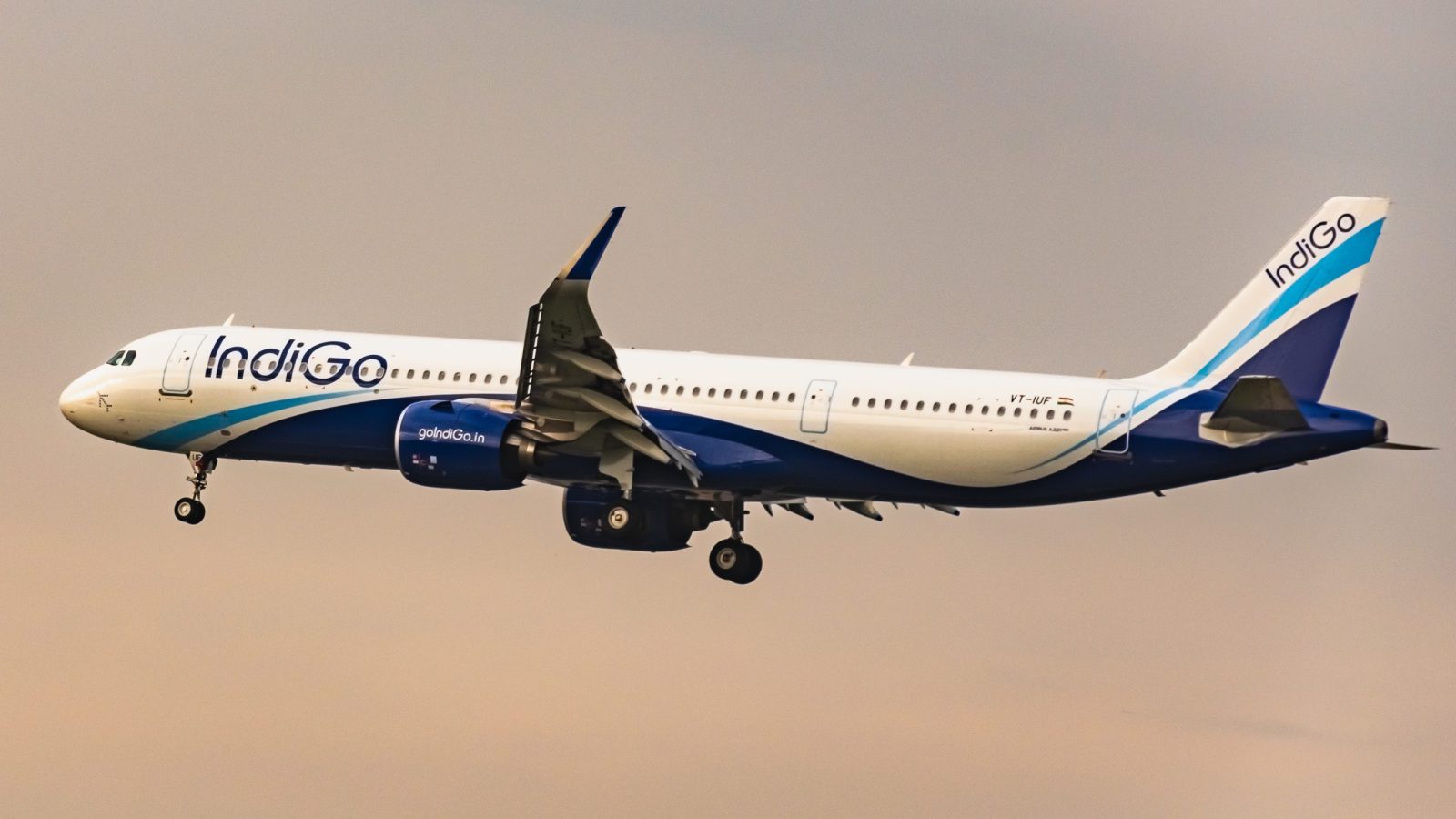
An IndiGo Airbus A321neo at Delhi Airport. (Photo: AirlineGeeks | Vihaan Kushwaha)
IndiGo made the headlines during the 2023 edition of Paris Air Show, as they placed the largest order in the history of aviation. An order of 125 Airbus A320neo and 375 Airbus A321neo totaling up to 50 billion dollars and taking the delivery backlog to almost 1,000 aircraft. At the 46th Paris Air Show in 2005, yet again, IndiGo also made it to the headlines by placing a firm order of 100 Airbus A320 aircraft.
Soon after receiving the first aircraft, IndiGo started operations on August 4, 2006, with their first flight from New Delhi to Imphal, India via Guwahati, India. Since then, there has been no looking back for the airline as it has soared successfully into the clouds to dominate the Indian skies.
IndiGo at Present
Today, IndiGo is not only the largest airline in India, but in Asia. It operates the largest fleet of Airbus’ flagship short-haul aircraft, the Airbus A320neo. Along with Airbus A321neo, Airbus A321 Freighter and ATR 72, the total fleet of IndiGo currently stands at 319 aircraft. This ever-growing fleet is key to the growth of aviation in India and to cater to millions of passengers every year.
In India, you are always bound to see an IndiGo aircraft at any airport, signifying the massive presence of the airline throughout the country. IndiGo’s passenger share amounts to a huge 60% in the Indian aviation market. It serves 78 destinations within the country with more than 1,800 flights daily.
If you think IndiGo operates a fleet of only short-haul aircraft, you might be in for a surprise! The airline recently inducted two Boeing 777-300ERs on a damp lease from Turkish Airlines to expand its international footprint. These 777s are used on flights from Delhi and Mumbai to Istanbul, increasing capacity on these routes to a significant number and enabling IndiGo’s stride into the European market. The partnership of IndiGo with Turkish Airlines has deepened in the past few months with the introduction of a number of codeshare routes throughout major destinations across Europe and across the Atlantic to Boston, Chicago, New York City and Washington, D.C..
IndiGo also received the ‘Best Low-Cost Airline in India and South Asia’ award by Skytrax at the World Airline Awards 2023.
Current Financial Results
IndiGo posted a profit of 372 million dollars in the June quarter, a jump of almost 30% compared to the previous quarter. This profit was the airline’s highest ever quarterly profit and a hike in salaries for cabin crew and pilots was announced shortly after. IndiGo CEO Pieter Elbers stated that the airline produced strong operational performance and welcomed the highest number of quarterly passengers, which enabled IndiGo to generate the highest-ever revenue and net profit for the quarter that ended June 2023.
Compared to the same period in 2022, this year, IndiGo reported an 18.8% capacity increase to 32.7 billion available seat-kilometer and the passengers’ numbers increased to 26.2 million, up by 30%.
What does the future hold for IndiGo?
Being the fastest-growing airline in the most populous nation in the world, IndiGo is now facing mighty competition from the now Tata Group-backed, Air India. But with almost 1,000 aircraft on order and spiraling demand for seats per sector, IndiGo has a bright future ahead.
The airline announced international expansion plans from India to new destinations in Africa and Central Asia. IndiGo has planned to start flights to Nairobi, Kenya and Jakarta, Indonesia from Mumbai and to Tbilisi, Georgia, Baku, Azerbaijan, Tashkent, Uzbekistan and Almaty, Kazakhstan from Delhi in the upcoming months. There are several new direct flights being added from India to the Middle East.
IndiGo has pioneered the LCC world in India and strives to be the largest airline in the country and Asia for years to come. It would be interesting to see how the airline enters unexplored markets and what holds for the temporary wide-body fleet in the future. A great future lies ahead for Indian aviation with the massive expansion of IndiGo and the rise of the new Air India.
It all started at the age of five when Vihaan got a Qantas 747 model from Sydney Airport. Since then, he has been an AvGeek, collecting aircraft models, safety cards, and even magazines! He has flown over 120 flights to more than 25 countries worldwide.
Vihaan shares his passion for photography and aviation by spotting at New Delhi's Indira Gandhi International Airport and wherever flights take him. Apart from being an AvGeek, Vihaan is currently an undergraduate business management student and aims to pursue a career in aviation consulting and analysis. You can check out some of his spotting work at @aviation.del on Instagram.
Ryanair and Others May Need To Cancel Flights Out of Dublin Airport
A Ryanair 737 at Paine Field.
(Photo: AirlineGeeks | Katie Bailey)
Ultra Low Cost Carrier Ryanair has been put on notice by the Dublin Airport Authority regarding flights operated during overnight hours. Ryanair CEO Michael O’Leary said “We will have to start cancelling flights in four weeks’ time. That first wave of departures in the morning… we will have to have mass cancellations of a lot of those flights.”
DAA was given notice by a local council that they would have to reduce flights between the hours of 11 p.m. and 7 a.m. following multiple noise complaints from local residents. The planning commission proceeded with an investigation that led to the removal of overnight slots at the airport. The investigation was part of the approval for Dublin’s new runway to the North of the airport. The approval was granted with the understanding that only 65 flights would operate during the overnight hours.
Michael O’Leary went as far as to call the enforcement of the rules “idiotic” and “stupid” claiming that a “tiny number of neighbors” shouldn’t be allowed to stop the flow of traffic at Ireland’s biggest airport. Ultimately all operators in and out of Dublin will be impacted by this move but Ryanair seems to have been the most vocal on the topic, and quite understandably so, since Dublin is a major cornerstone in Ryanair’s network. Aer Lingus is the other large player at Dublin Airport that will have to reduce or cancel the number of flights it operates overnight.
Although it hasn’t happened yet, a disruption of this magnitude at a major airport can have far-reaching effects. Ryanair exists because they are able to turn planes around in the shortest amount of time possible and having to keep planes in place on a stand or at a remote gate is bad for their business.
Fortunately, for all the airlines involved this reduction in operations comes just after the busy summer season comes to an end. However, if a resolution is not found, tens of thousands of passengers could end up stranded or left looking elsewhere for their travel needs during the holiday season this winter.
At this point I would like to hear from our readers: is this something that will make you rethink potential travel plans or are you willing to potentially risk having delays or cancellations?
As far as I am concerned, I am always willing to wait out a delay regardless of what the reason is. I love the experience of traveling, the good, the bad and the horribly delayed. That being said I have yet to fly with Ryanair and this coming winter was meant to be my first time out of Dublin Airport. Time will tell whether my travels will go ahead as planned or I will change my mind. Stay tuned to Airlinegeeks for that trip report soon.
India’s largest domestic airline IndiGo has posted a record net profit for the first quarter of the airline’s 2023-24 financial year, 01 Apr – 30 Jun Pieter Elbers, the airline’s chief executive officer, said: “That very positive momentum from the last two quarters has also continued in this quarter as we started the new year on a strong note and reported the highest-ever quarterly revenue of 171.6 billion rupees ($2.07 billion) and the highest ever quarterly net profit of 30.9 billion rupees ($373 million).”
Earlier Mr. Elbers referenced the carrier’s performance in the previous financial year as ‘a distinct period of two halves’ whereby the airline turned around a loss in the first half to declare a profit in the second. IndiGo carried a record 26.2 million passengers in a reporting period that had a significant number of strategic announcements for the carrier.
The reporting quarter also saw the airline layout further strategic fleet plans for the future in June. At the Paris Air Show, the largest single aircraft order with Airbus was announced with IndiGo placing a 500-aircraft order of A320 family aircraft. “This order speaks to the growth and the future of Indian aviation where we are proud to play a pivotal role,” said Mr Elbers.
“We already had previous orders totaling around 480 aircraft which are yet to be delivered between today and the end of this decade. With this additional order of 500 aircraft, our outstanding order book has now almost 1,000 aircraft,” Elbers added. “These 1,000 aircraft will help IndiGo to move forward, to make sure that we live up to our promise and continue to build our unparalleled network both domestic and international.”
IndiGo’s network continued to grow during the quarter with the airline’s 79th domestic destination added. The carrier also took steps to increase its international reach with a codeshare partnership with Turkish Airlines to the United States. The codeshare flights operating through Turkish Airlines’ Istanbul hub give IndiGo the ability to offer connectivity to major cities such as New York, Boston, Chicago and Washington D.C.
Vinay Malhotra, IndiGo’s Head of Global Sales, stated: “We are thrilled to expand our codeshare partnership with Turkish Airlines, for the first time across the Atlantic to the United States of America. By offering seamless travel experiences at affordable fares, we aim to create more opportunities for Indian travelers to discover and connect with these exceptional destinations. These connections will not only support the burgeoning trade and commerce between the countries but also offer increased options to students and tourists alike. This expansion reinforces our vision to strengthen international reach while offering on-time performance, and hassle-free service across our unparalleled network.”
Elbers added: “We are also leveraging on the massive opportunity in the five to six-hour flying radius from India and we have recently announced six new destinations across Asia and Africa. In the coming few days, we are starting operations to Nairobi, Jakarta, Tbilisi and Baku. Further, in the coming few weeks, we will start operations to Tashkent and Almaty.”
John has always had a passion for aviation and through a career with Air New Zealand has gained a strong understanding of aviation operations and the strategic nature of the industry. During his career with the airline, John held multiple leadership roles and was involved in projects such as the introduction of both the 777-200 and -300 type aircraft and the development of the IFE for the 777-300. He was also part of a small team who created and published the internal communications magazines for Air New Zealand’s pilots, cabin crew and ground staff balancing a mix of corporate and social content.
John is educated to postgraduate level achieving a masters degree with Distinction in Airline and Airport Management. John has held the positions of course director of an undergraduate commercial pilot training programme at a leading London university. In addition he is contracted as an external instructor for IATA (International Air Transport Association) and has been a member of the Heathrow Community Fund’s ‘Communities for Tomorrow’ panel.
An Alaska Airlines 737 MAX 9. (Photo: AirlineGeeks | Katie Zera)
Alaska Airlines recently announced a partnership benefiting wintertime outdoor enthusiasts. The Seattle-based carrier has come together with Mountain Collective to offer a point incentive for customers and members of their elite program who purchase a season pass.
A season pass with Mountain Collective allows pass holders to ski and snowboard at 24 ski resorts across five continents for two days each with the option to purchase additional days. Alaska Mileage Plan members will receive 5,000 bonus miles and an additional third day at one of the resorts. According to a press release produced by the Oneworld alliance carrier, elite members will earn an additional 5,000 points on top of the 5,000 initial points.
Alaska’s Vice President of Loyalty, Brett Catlin, believes the partnership will immensely benefit the carrier’s consumer base stating “So many of our Mileage Plan members are avid skiers and snowboarders. Our new partnership with The Mountain Collective is an excellent way to experience amazing resorts this winter and save money.”
The carrier currently flies to seven of the 24 resorts that are a part of the Mountain Collective. Additional resorts across the globe can be accessed by flying Alaska’s Oneworld partners such as JAL to Japan’s Niseko United or Qantas to Australia’s Mt. Buller.
Additional Perks
In addition to the new partnership with Mountain Collective, the Seattle-based carrier also partners with eight ski resorts at destinations it serves. This partnership allows passengers to ski or snowboard for free on the day of their arrival, departure or other day, depending on the resort, when they produce their boarding pass and ID at the resort ticket office. Offering a free day of skiing or riding provides significant savings for those who are traveling for that purpose.
Alaska currently charges for baggage, including snow sports equipment. However, the airline does not charge an oversized bag fee for the checked gear. Southwest Airlines, on the other hand, allows winter sports equipment to be checked for free following its bags fly-free policy. However, as of the time of writing, Southwest does not have a partnership with Mountain Collective or specific mountains for free skiing on the day of arrival.
The Seattle-based carrier also hinted at additional perks throughout the season at different resorts stating in the press release,“Stay tuned for on-mountain events planned throughout ski season exclusively for Mileage Plan members.” Flying to destinations across the Western United States and Canada boasting some of the best terrain and conditions around, Alaska Airlines is taking the opportunity to give customers more to enjoy while skiing and riding this winter.
Zach’s love for aviation began when he was in elementary school with a flight sim and model planes. This passion for being in the air only intensified throughout high school when he earned his Private Pilot Certificate. He then attended Embry-Riddle Aeronautical University, earning his certificates and ratings to later flight instruct and share his passion for aviation with others. He now resides in the North East living out his dream as an airline pilot.
Sign-up for newsletters & special offers!
Get the latest stories & special offers delivered directly to your inbox