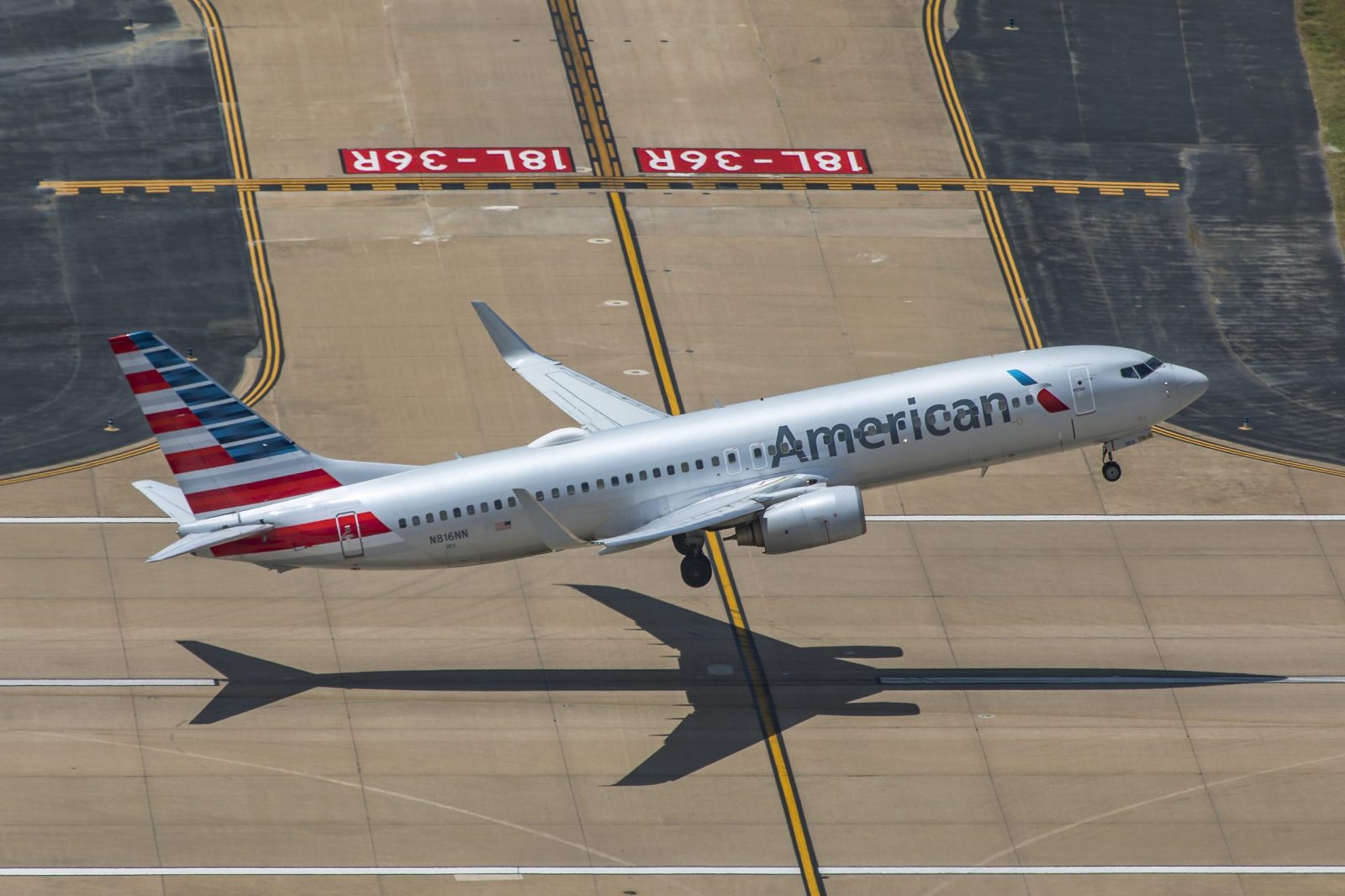
An American 737 departs from Dallas/Forth Worth.
(Photo: AirlineGeeks | William Derrickson)
American Airlines is adding additional flight frequencies on one of its most popular routes, which connects Austin, Texas with the airline’s hub at Dallas-Fort Worth International Airport, according to Ishrion Aviation on Twitter.
In the month of September, American is flying between Austin and Dallas 16 times daily. American’s regional partners will operate 3 Embraer E175s on the route per day, while mainline American Airlines will fly 1 Airbus A319, 2 Airbus A320s, and 10 Boeing 737-800s on the route, per Ishrion Aviation.
American will test these schedules for a month, though there are possibilities that the frequencies could be expanded further. Additionally, Dallas and Austin will be connected 17 times on September 8 and 10.
Based on 2022 statistics, American is the second-biggest airline in Austin, representing about 20% of traffic at the airport; Envoy Air, one of American’s wholly-owned regional subsidiaries, holds an additional 5%. American has a long way to go to catch up with Southwest, which carried nearly 40% of Austin’s passengers in 2022, but it still has a healthy lead over third-place Delta Airlines, which holds just over 10% of Austin’s traffic.
This is a significant step up for American, who held a 16% market share in 2019, to Southwest’s 33% and Delta’s 14%.
Dallas is the second-most-popular destination in Austin after Los Angeles. Besides these two, American also flies from Austin to Denver, Las Vegas, Chicago, Phoenix, Orlando, New York, and Charlotte as well as multiple international destinations.
American Airlines has been a leader in Austin, competing with airlines such as Southwest to control the market share at the airport. Dallas is an especially important connector into Austin; serving as American’s major midwestern connector and American’s single largest hub, Dallas brings in passengers from across the country to bring them to Austin.
Austin is undergoing a $4 billion upgrade to accommodate this spike in traffic. Airport officials estimate that the facility might process 30 million passengers by 2027. Nevertheless, the airport has been plagued with issues in recent years, most recently a near-collision in early 2023 when a Southwest aircraft was cleared for takeoff directly below a FedEx cargo jet executing a missed approach.
Whether Austin’s continued growth will cause further issues has yet to be seen, but American is placing a significant bet on Austin’s future and is vying for a significant role at the airport. Just which airline will win the bidding war to secure the largest role in Austin will be seen in the coming months and years.
John McDermott is a commercial pilot pursuing a career in professional flight. His passion for aviation began in an Ann Arbor bookstore with a tale of enemy pilots during World War 2, and he hasn't looked back. Besides flying and writing for AirlineGeeks, John volunteers with Professional Pilots of Tomorrow and travels whenever he gets the chance.
My aircraft for the flight pulling into the gate (Photo: AirlineGeeks | Joey Gerardi)
Reykjavík, Iceland-based Icelandair was founded over 85 years ago in 1937, originally under the name Flugfélag Akureyrar. It has flown to many destinations over the years out of its International hub located at Reykjavík/Keflavík Airport, and a smaller hub at Reykjavík Domestic for flights within Iceland. The carrier is most known for its Icelandic stopover program, which allows passengers to stop in Iceland for up to seven days on flights between North America and Europe (or vise-versa) at no extra flight cost.
Detroit was Icelandair’s 13th destination in the United States and its 15th in North America, not only can passengers fly to Iceland but also onward to over 25 destinations in Europe as well as Greenland and domestically in Iceland. The new flight from Detroit to Reykjavík/Keflavík began on May 18, 2023, and will operate four times a week on board the carrier’s 160-seat Boeing 737 MAX 8.
All times discussed in this trip report are expressed in local time at that specific location unless stated otherwise.
Day of the Flight
The flight to Iceland left Detroit in the evening, so I flew in from another smaller airport within the state of Michigan a couple of hours before the flight got me into Detroit around 5:30 p.m. and with a departure time of three hours later I decided to head right to check-in. Icelandair operates out of the Evans terminal in Detroit.
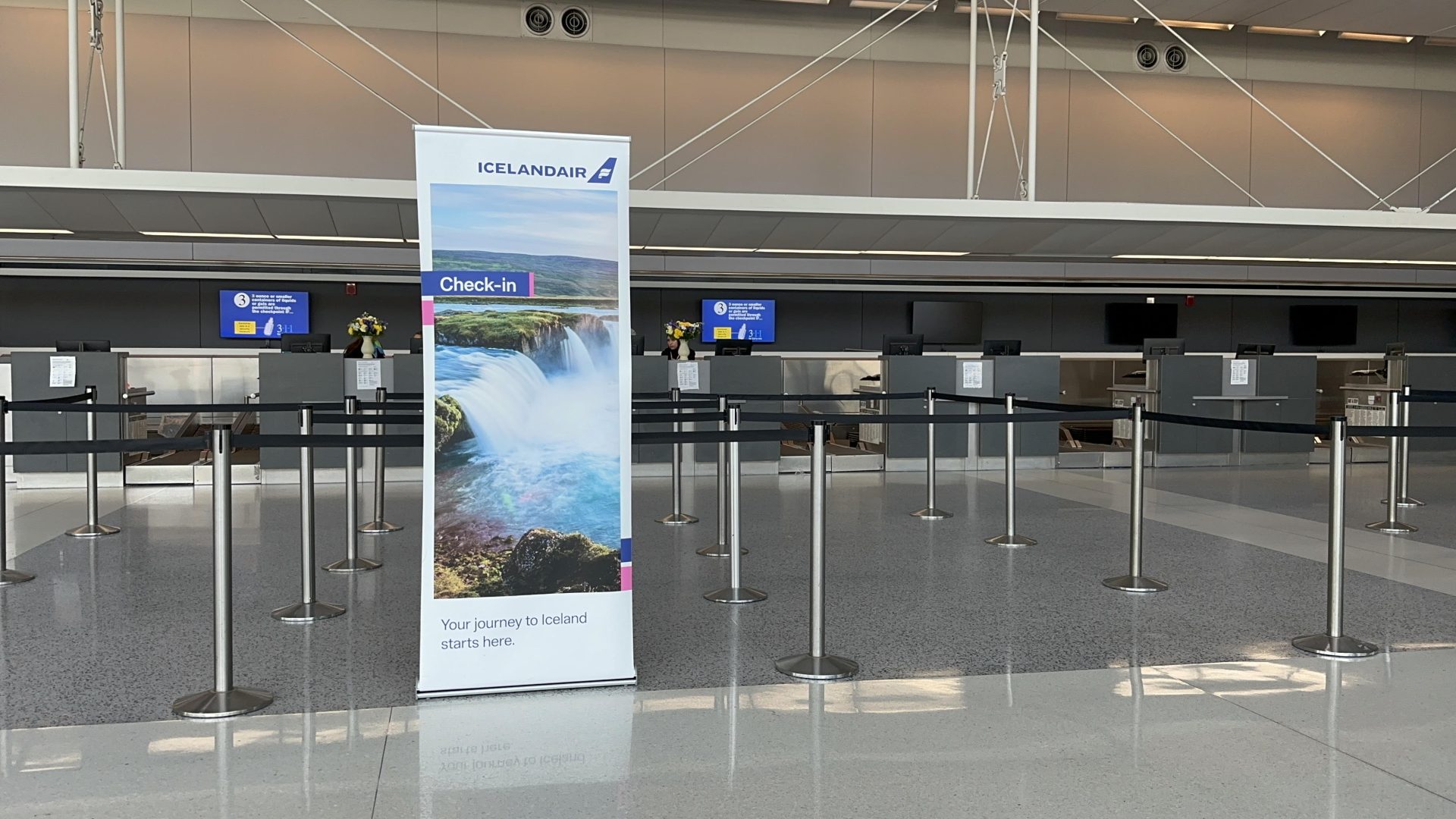
The Icelandair check-in desks in Detroit (Photo: AirlineGeeks | Joey Gerardi)
A nice perk of Icelandair is that it does participate in the TSA PreCheck program, which means you hopefully will have a much easier time going through security especially when it is busy. Check-in was a breeze and they printed my boarding pass, and it took me only five minutes to get through the PreCheck lane at security.
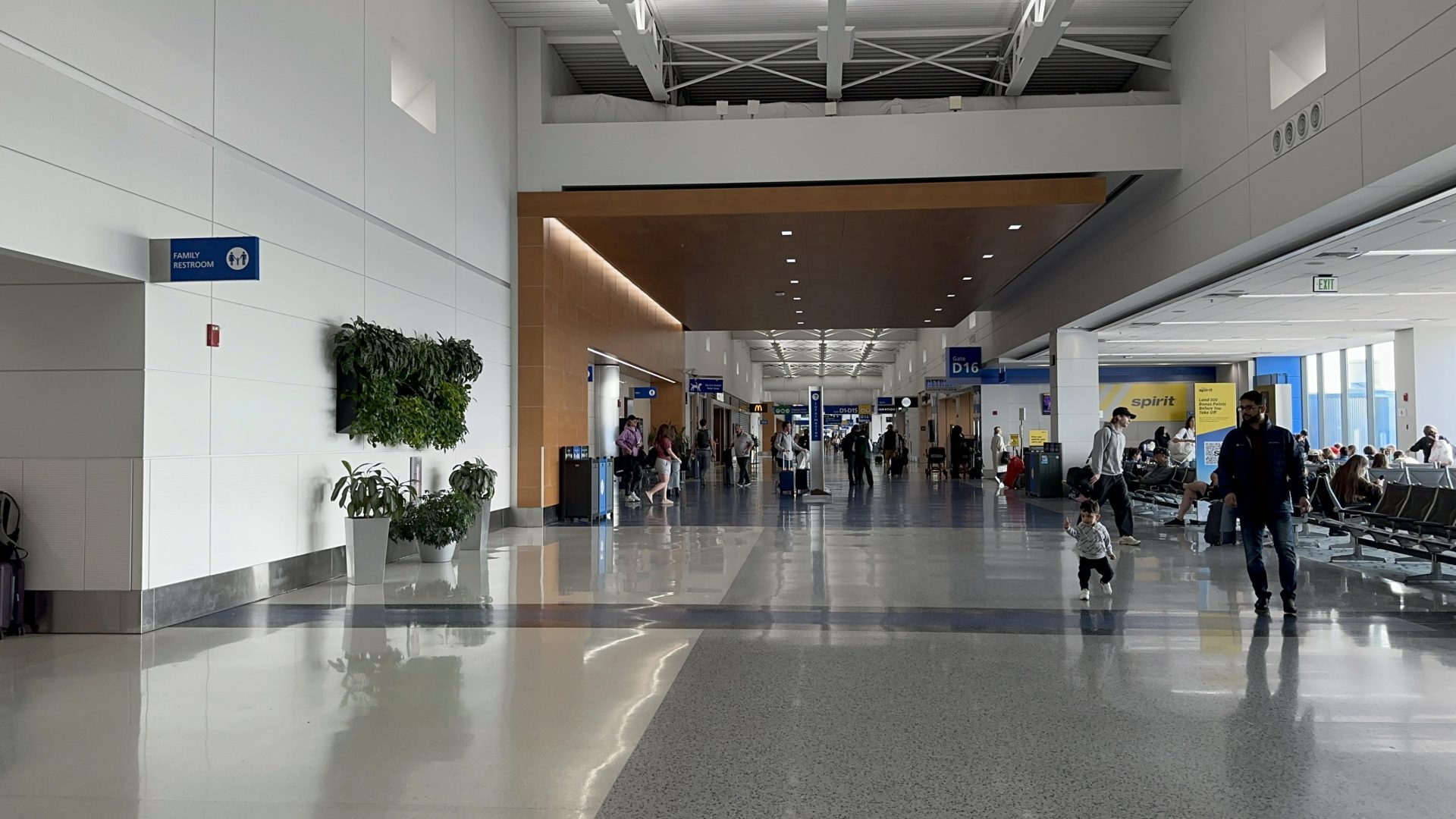
I made my way through the terminal down to the end where the flight would be departing out of, gate D5.
Walking towards my gate in Detroit, near the end of the terminal (Photo: AirlineGeeks | Joey Gerardi)
When I arrived at the gate party setup was underway with a cake and goodies already out for passengers that were on the flight. The cake was beautifully decorticated like the outdoors with northern lights on top, trees, mountains on the bottom, and a waterfall going down the side.
The cake at the Icelandair Inaugural party in Detroit (Photo: AirlineGeeks | Joey Gerardi)
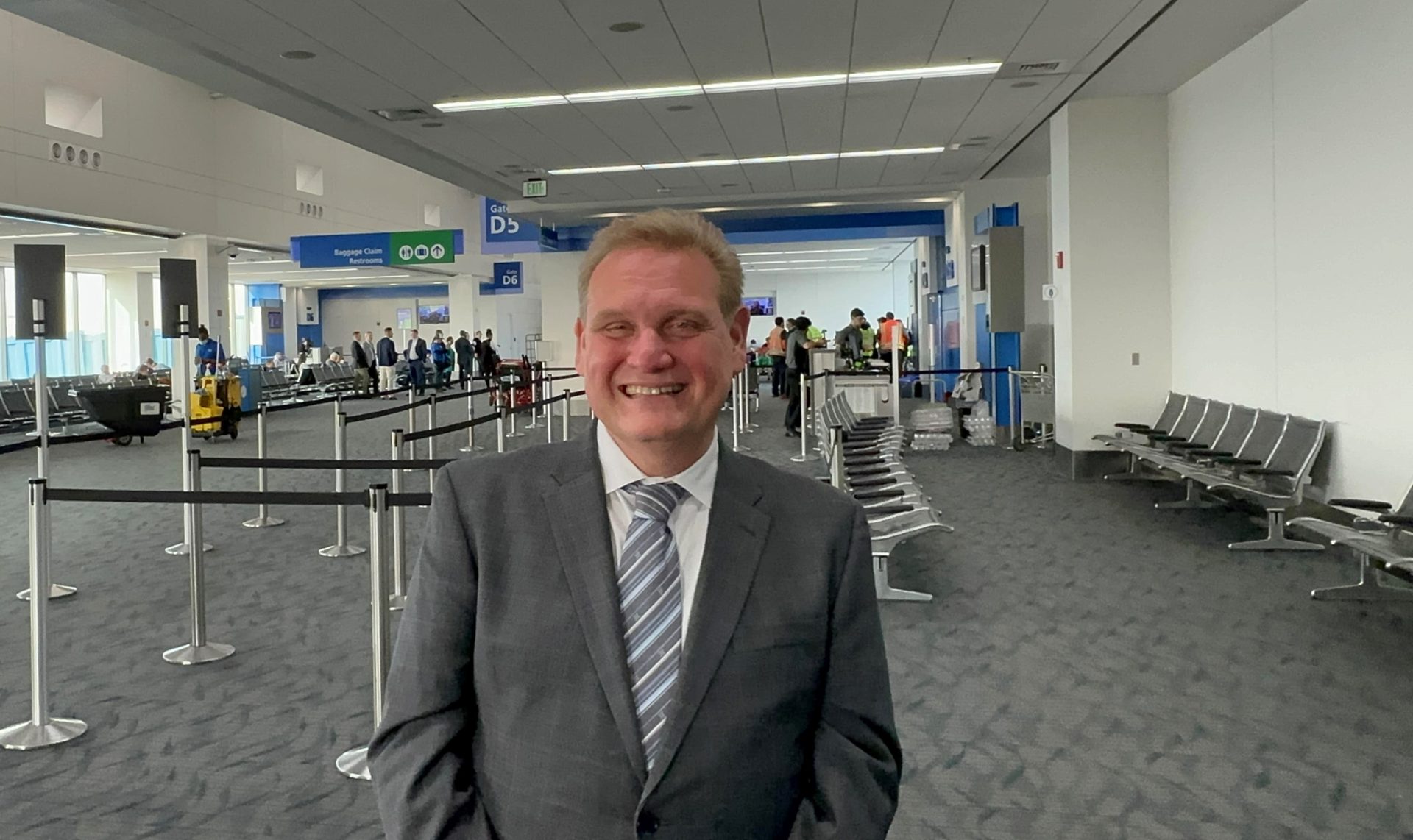
I spent the next hour or so talking to other AvGeeks at the gate as well as Icelandair executives including an interview with Michael Raucheisen, who is the Communications Manager for the airline in North America, a video interview of this interview will be posted at a later date.
Interviewing Michael Raucheisen during the inaugural party in Detroit (Photo: AirlineGeeks | Joey Gerardi)
It wasn’t long before the star of the show arrived, TF-ICN, a Boeing 737 MAX 8 that was delivered to the Icelandic carrier back in 2019. This also happened to be my first flight onboard a 737 MAX of any variant, which was another exciting aspect of this trip for me. My aircraft was named ” Mývatnm,” which is a volcanic lake located in northern Iceland.
By this time the crew had shown up there was a photo opportunity with them too. Not long after the CEO of the airline Bogi Nils Bogason made an appearance for a speech.
The CEO of Icelandair Bogi Nils Bogason, in the middle (Photo: AirlineGeeks | Joey Gerardi)
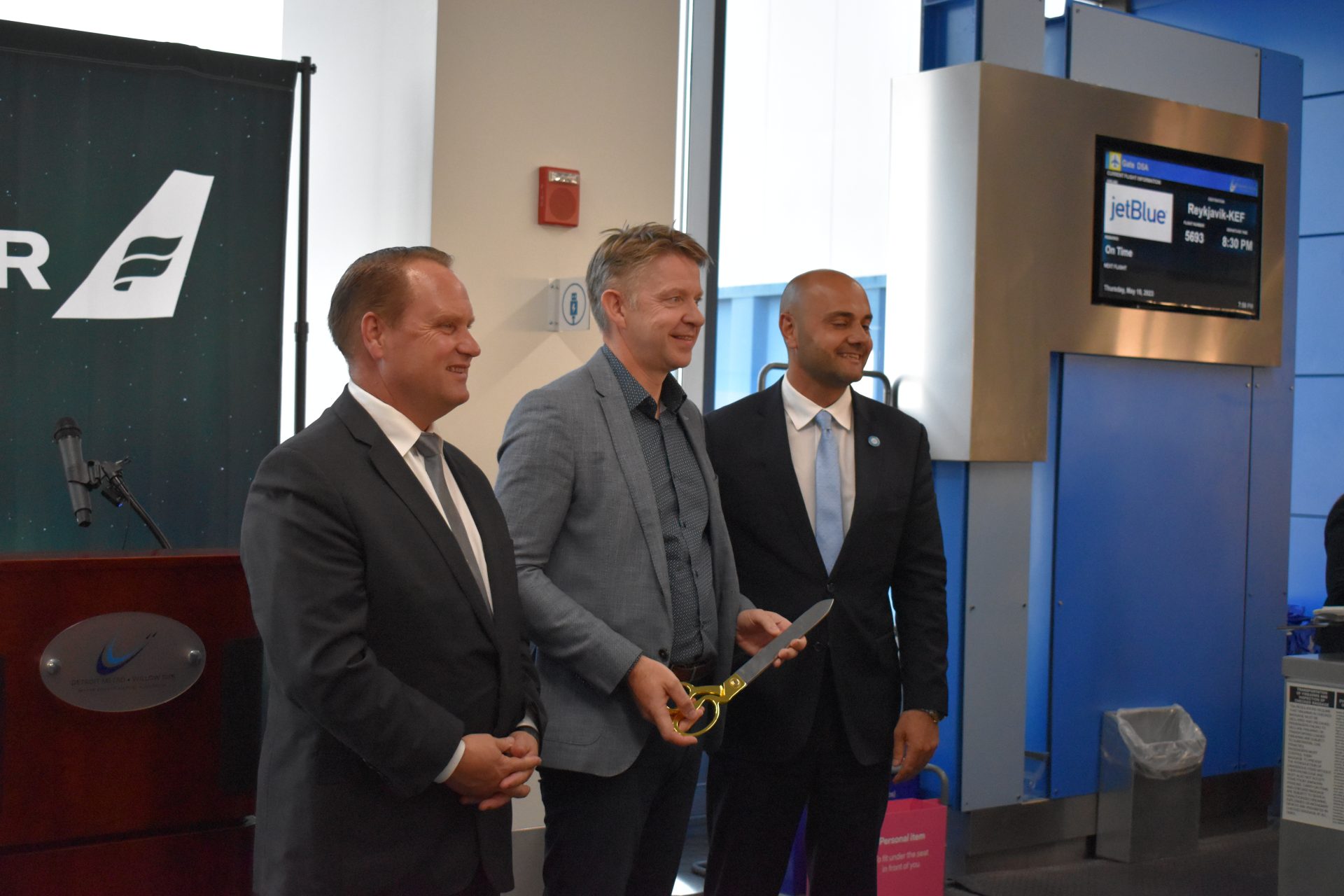
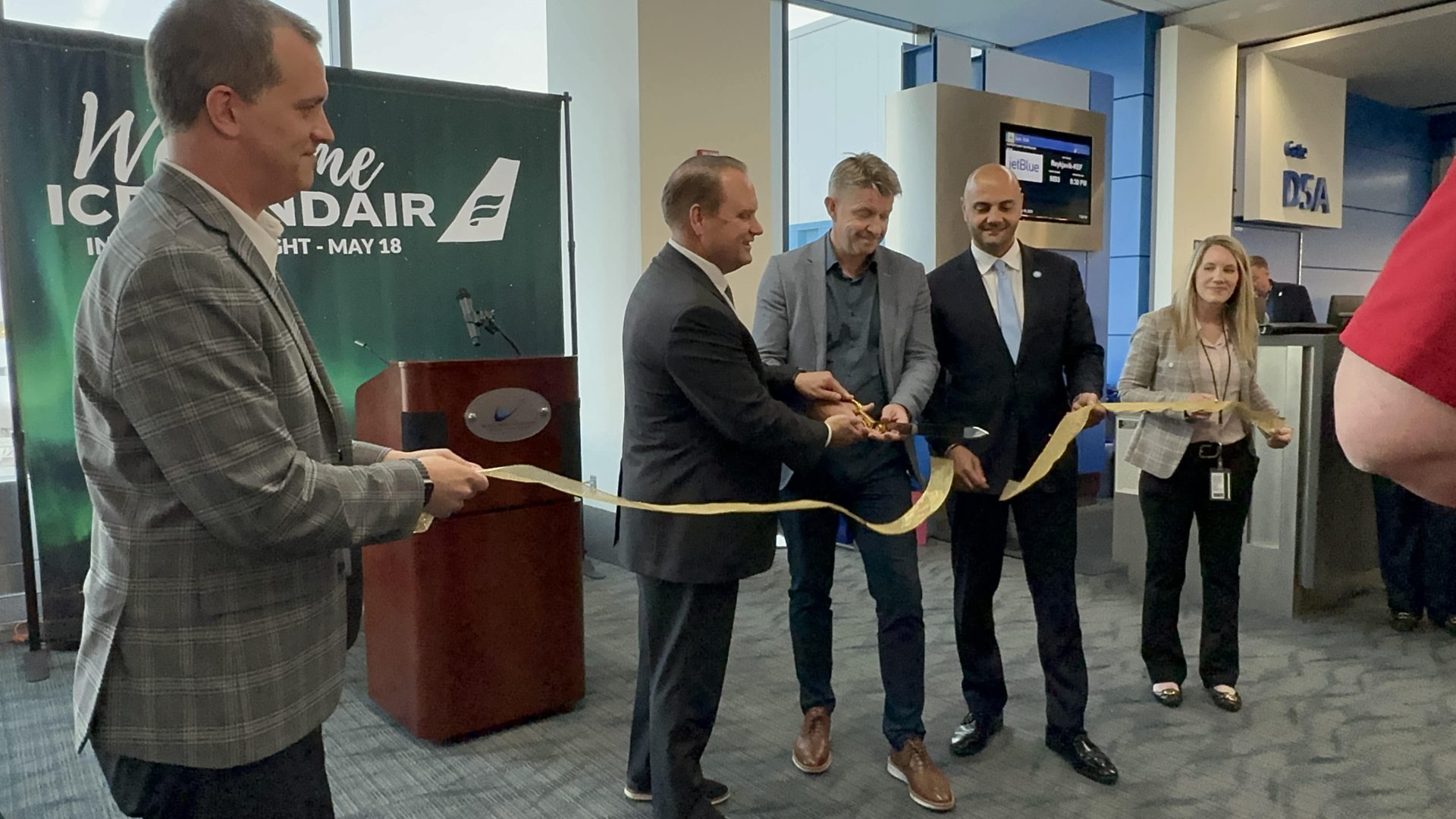
A couple of other executives from the airport authority as well as the county made speeches, which can be found in the video at the end of this article. Following the speeches there was a ribbon cutting before the boarding of the aircraft started.
Ribbon cutting for the inaugural Icelandair flight from Detroit (Photo: AirlineGeeks | Joey Gerardi)
When getting onto the aircraft, the crew was giving out Detroit Metro Airport branded bags with pens, hand sanitizer, and a 66° North winter hat which ended up coming in handy on the trip.
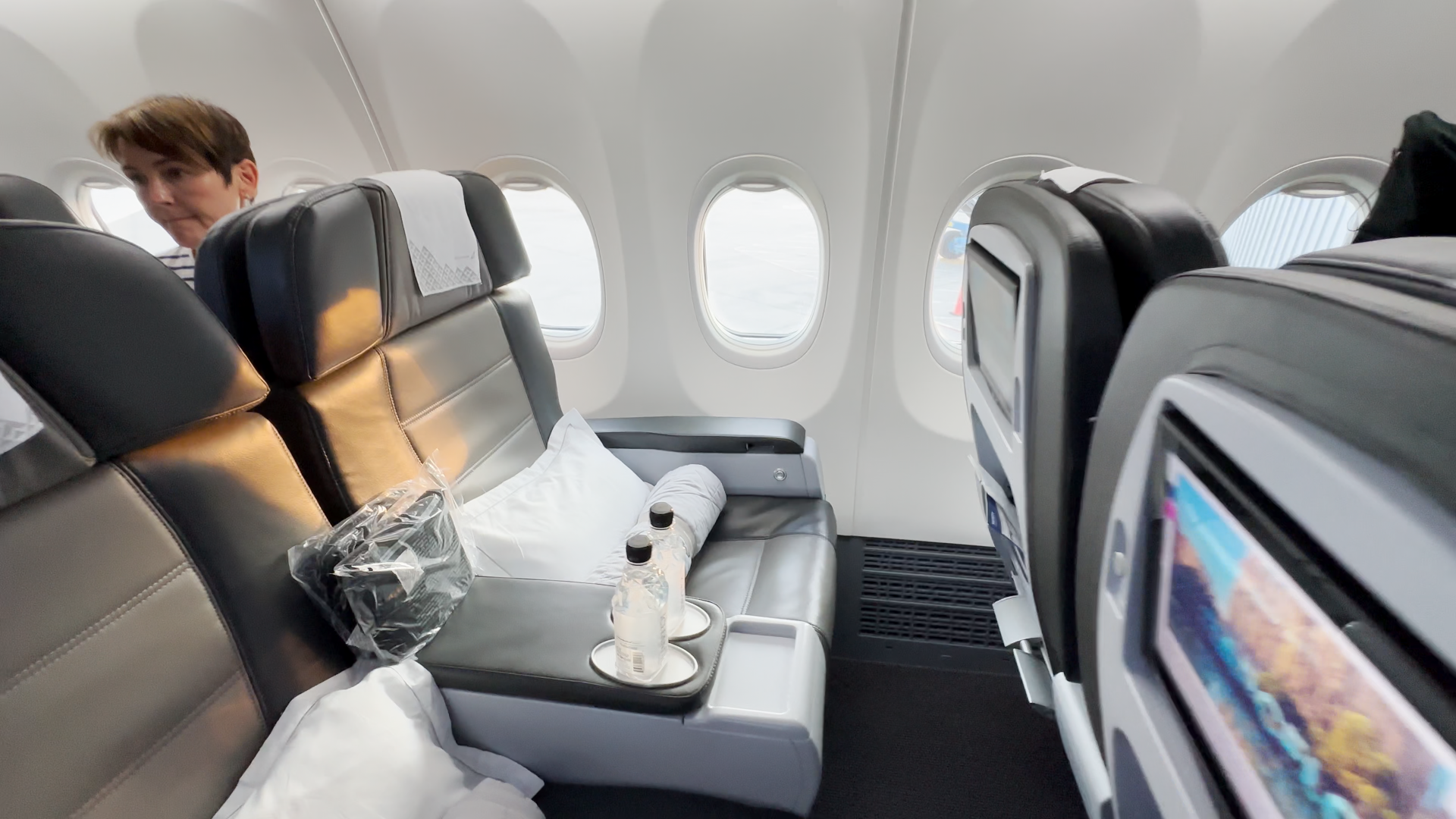
For this flight across the Atlantic, I was seated in 3A, which is located in the carrier’s Saga Premium class which is the first four rows on their 737 MAX 8.
My seat 3A for the flight over to Iceland (Photo: AirlineGeeks | Joey Gerardi)
Also waiting at the seat for us was a bottle of Icelandic Glacial water, a pillow, and an Icelandair-branded blanket for the overnight trip.
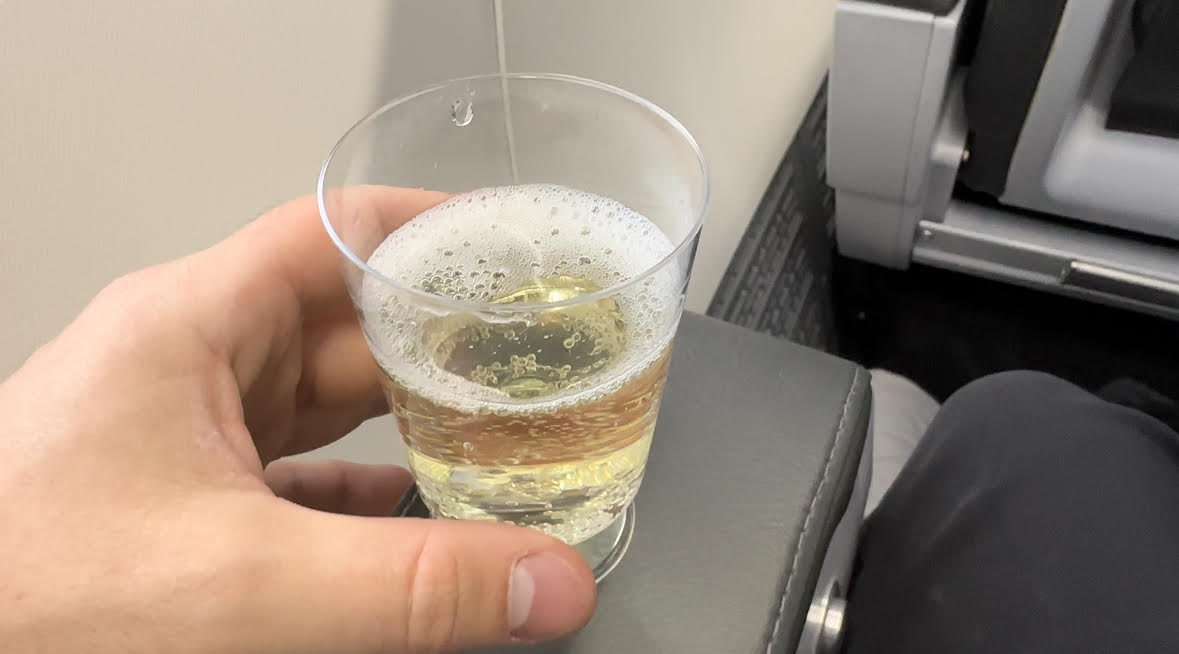
At each seat was a large IFE screen which had a USB port on it as well as a headphone jack. Shortly after boarding, the crew came around and offered everyone a glass of sparkling wine
Sparkling wine was given to passengers before departure (Photo: AirlineGeeks | Joey Gerardi)
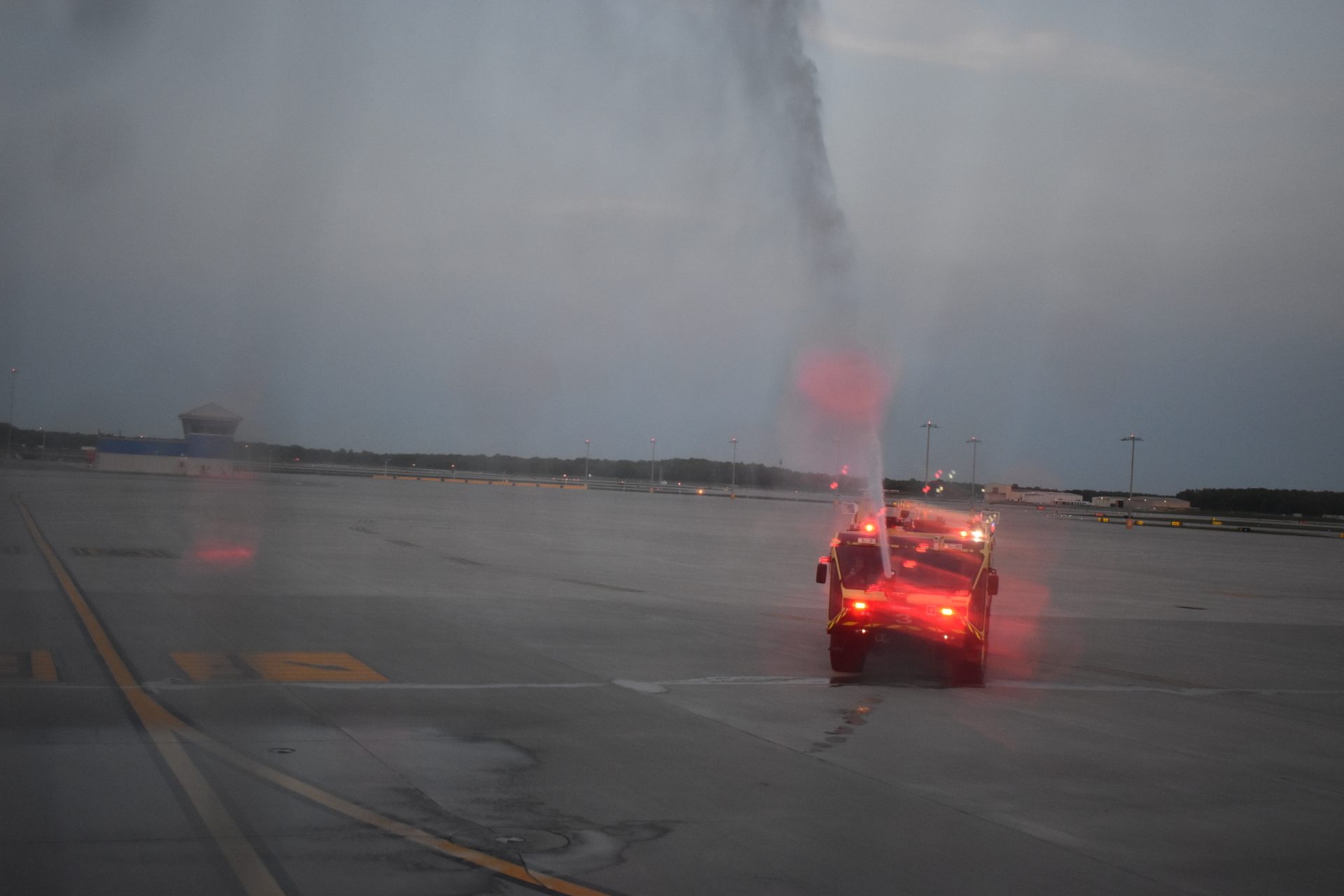
During the taxi out to the runway, we were given a traditional water cannon salute, believe it or not, this is the first time I have ever been inside the plane for a salute.
The traditional water cannon salute from inside the aircraft (Photo: AirlineGeeks | Joey Gerardi)
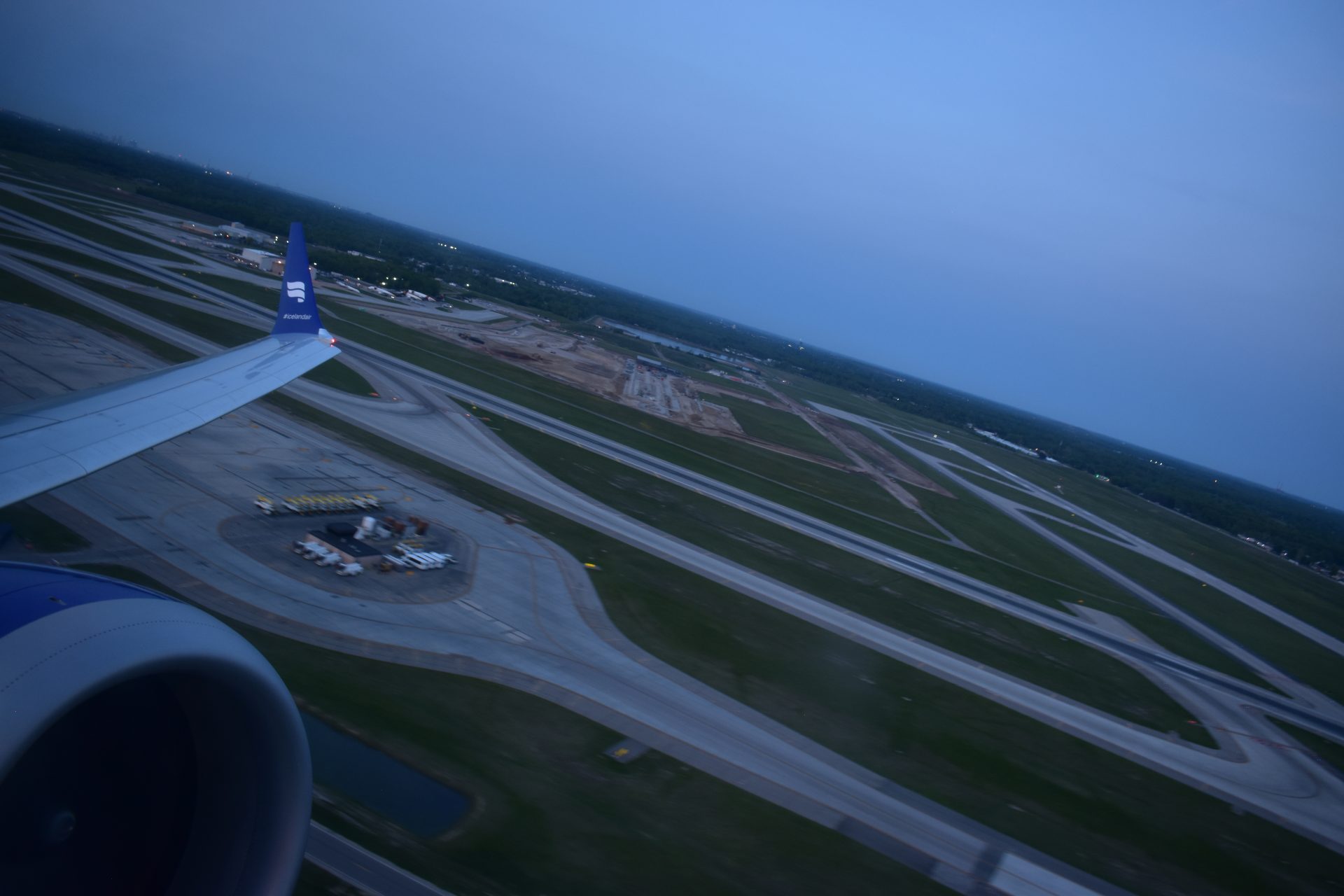
We then proceeded to head to the runway and gracefully lift off towards Iceland. I did notice how quiet it was on board compared to the other earlier versions of the Boeing 737.
Taking off from Detroit-Metro bound for Iceland (Photo: AirlineGeeks | Joey Gerardi)
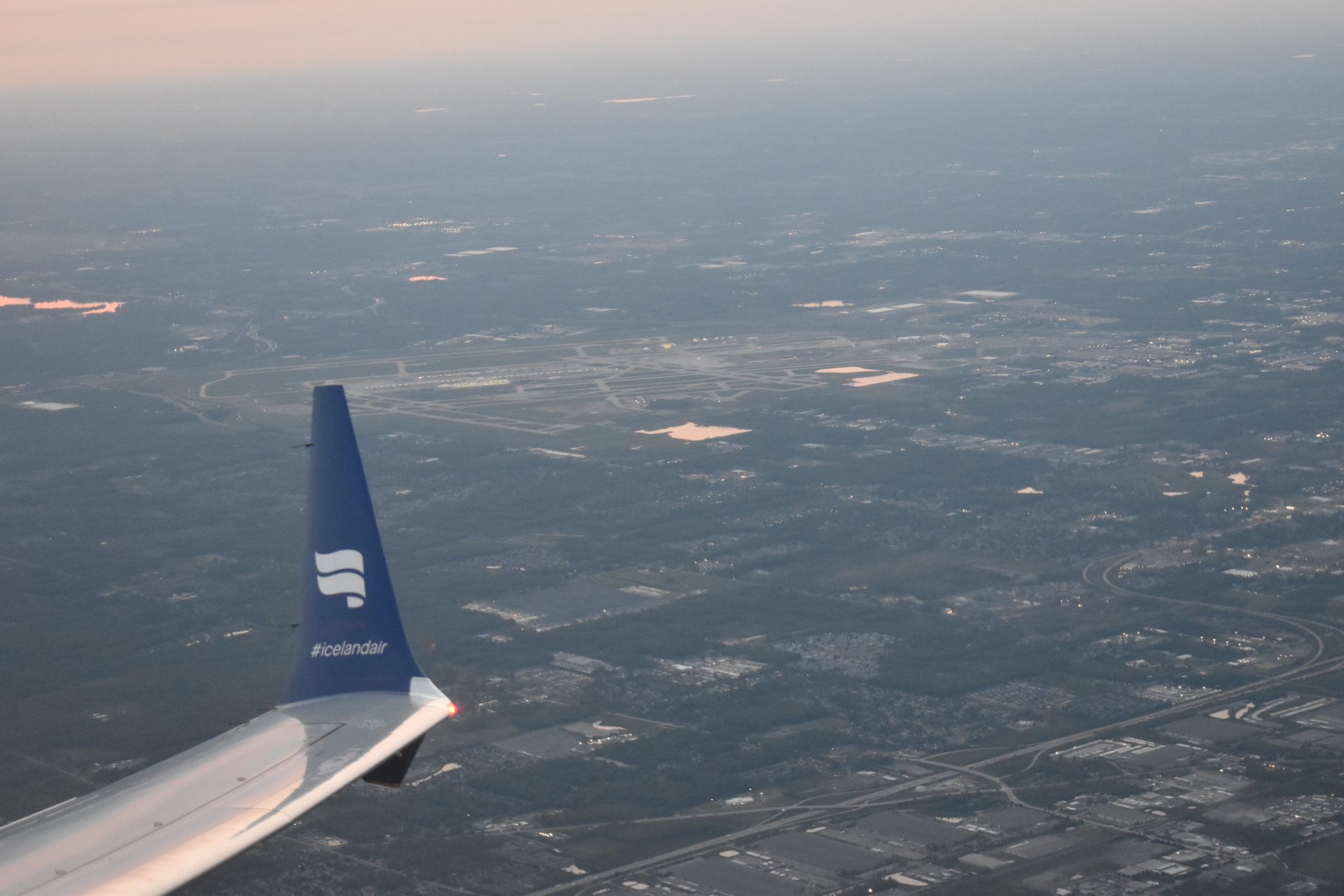
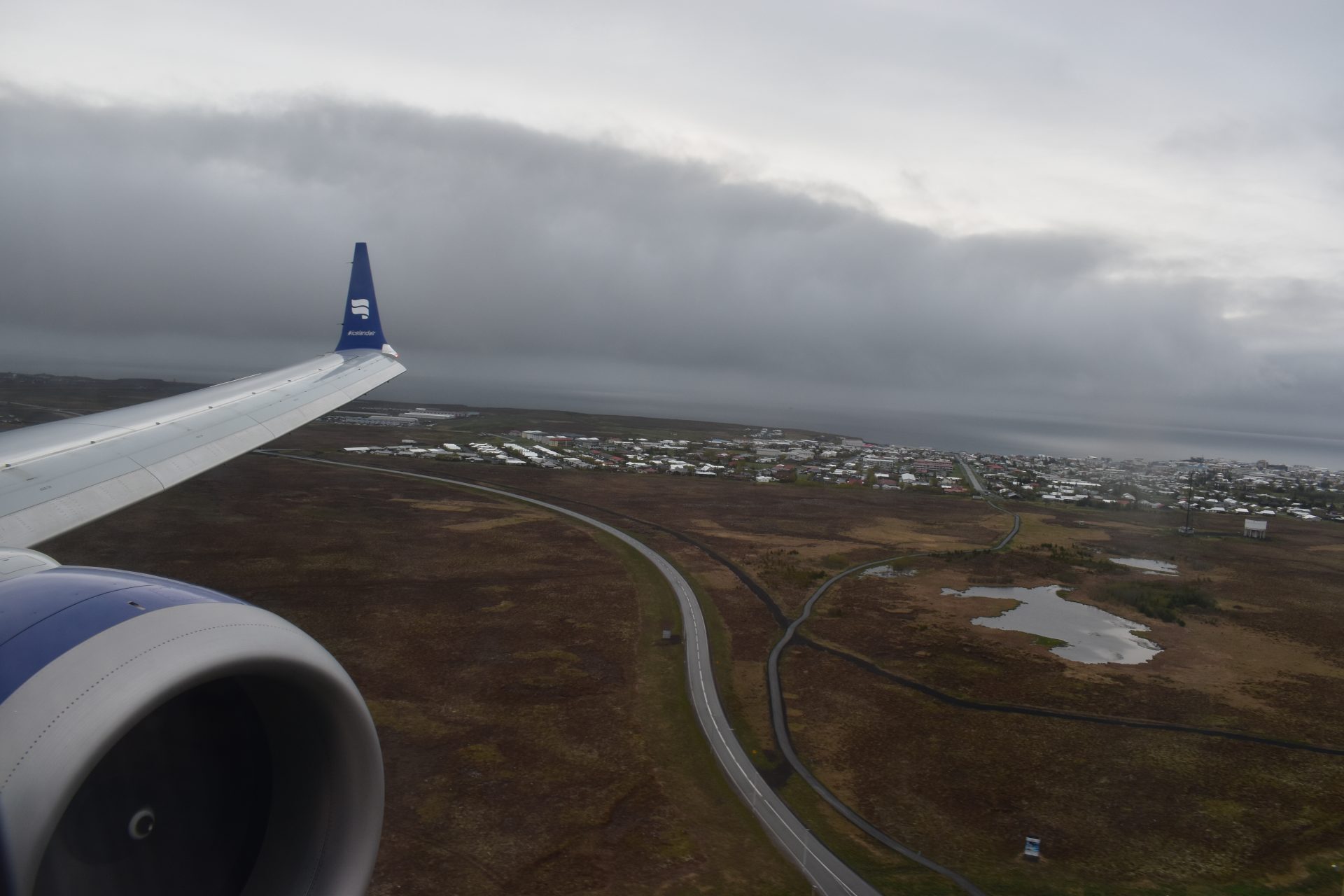
Passengers on the left side of the plane could see the Detroit Metro Airport slowly disappearing into the distance just (under/over) the unique 737 MAX scimitar winglet.
Detroit Metro Airport in the distance as we turn north towards Iceland (Photo: AirlineGeeks | Joey Gerardi)
Onboard Dining
Roughly 30 minutes after takeoff the flight attendants came around with a small bowl of cheese bread and asked us what our drink order would be. I choose Orange juice as I didn’t want to drink alcohol right before bedtime.
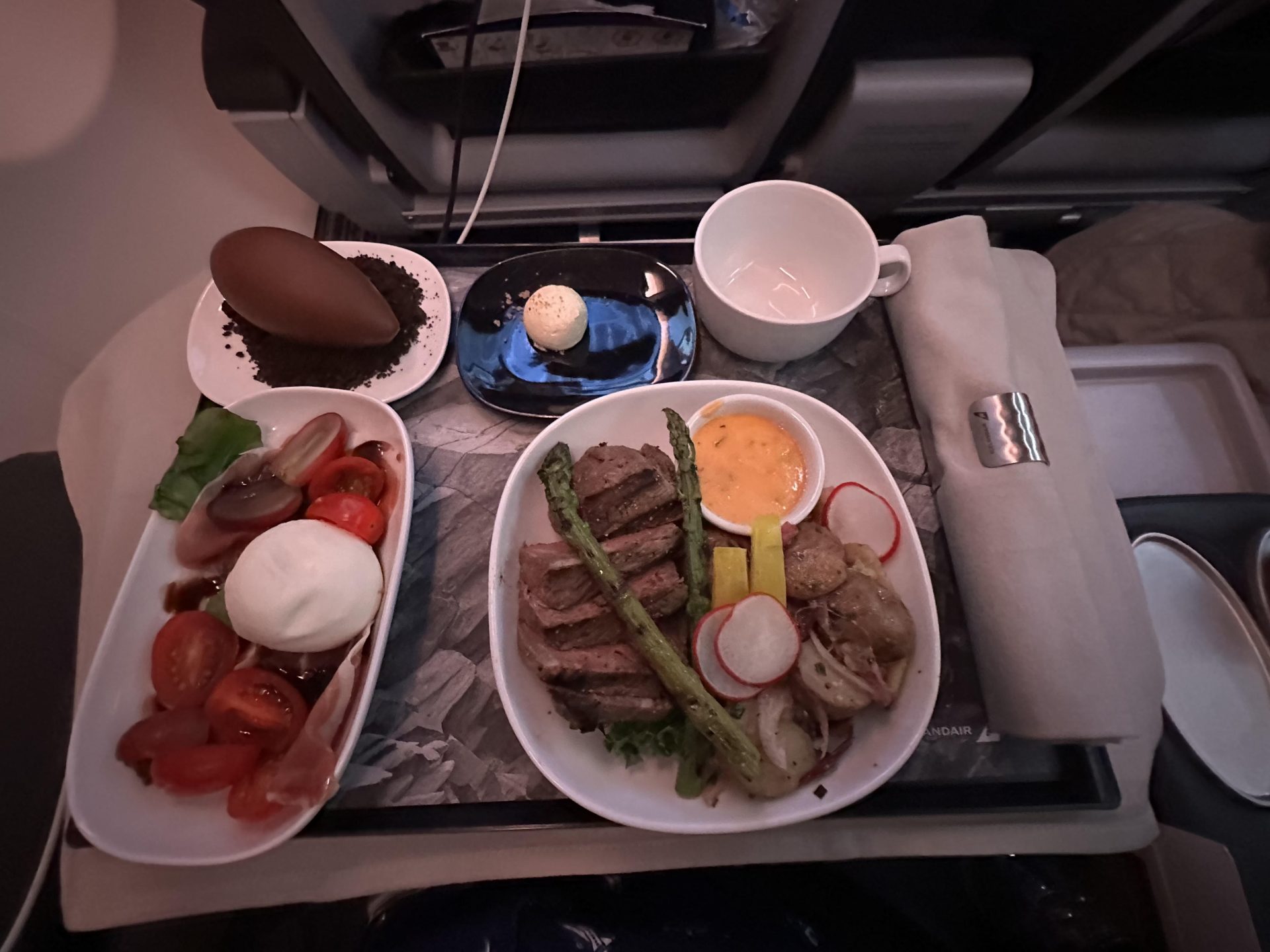
Shortly after that, the crew came around with the dinner menu, for those without dietary restrictions or pre-specified meals. The menu was the following; warm bread with whipped butter and Icelandic sea salt, Burrata cheese with Parma ham, and cherry tomatoes would be the starter.
For the main course, the airline had a warm option or a cold option from which passengers could choose. The warm option was Feta-pesto chicken with sundried tomatoes rice, and lemon butter sauce. The cold option was beef steak with potato salad, grilled asparagus, and a chili bearnaise sauce. For this flight, I choose the cold option as I felt it would pair well with the starter.
The desert was a chocolate mousse quenelle with Oreo crumble around it. Everything came out at once on the same tray which was beautifully presented on a tablecloth that the flight attendants laid down before bringing food out.
The dinner on the inaugural Detroit flight (Photo: AirlineGeeks | Joey Gerardi)
By the time all the food orders were completed and the food was in front of us, it was roughly an hour after takeoff.
At the time dinner was pretty much cleaned up, it was as dark as it was going to get. Due to the fact that we were headed north during some of the longer months of the year, the light never completely disappeared from the sky. There was still a slight sliver of light on the horizon and it began to slowly come up as we went further north.
I opened the blanket up, put the pillow behind my head, and got as much sleep as possible as redeye flights are never easy to sleep on, no matter how comfortable or quiet the environment is.
Also in the amenity kit was a cool section of stickers that you could put on your chest so the crew would know whether you wanted to be woken up for duty-free, food, or not at all. A neat little idea that could definitely serve a great purpose on longer flights and I think should be included on more airlines as I have been a culprit of sleeping through food in the past.
The sticker depicting what you want the crew to wake you up (Photo: AirlineGeeks | Joey Gerardi)
I woke up after two-and-a-half hours of what I thought was sleep although I am not completely sure. It was 5:20 Iceland time meaning it was just after 1 A.M. back in Detroit, these shorter redeyes are always difficult as it doesn’t give you much time to sleep, but it does get you to your destination really early giving you an entire extra day to enjoy Iceland. There were roughly 40 minutes left in the flight and they were making announcements about starting to descend soon.
In the early hours of the morning (Photo: AirlineGeeks | Joey Gerardi)
The skies were very cloudy so I couldn’t really see anything below, although there wasn’t much below us besides the ocean so I wasn’t disappointed. The flight attendants came around and collected garbage and cleaned the cabin for arrival. It wasn’t more than 20 minutes until we made our approach to Reykjavík/Keflavík Airport.
Just about to land in Iceland (Photo: AirlineGeeks | Joey Gerardi)
Landing
We landed in Iceland at 6:02 a.m. after a total flight time of five hours and 12 minutes. It was a great flight for me with a lot of firsts; my first 737 MAX flight, my first time in the cabin for the water cannon salute, my first time flying on Icelandair, and my first time being in Iceland.
Most flights arrive in the early morning from North American cities that flew overnight, and then they all leave for Europe roughly 2-3 hours later. then the process repeats in reverse in the early afternoon as flights go from Europe to Iceland, and then onto North American destinations.
Reflecting back on the flight, it was very pleasant and featured multiple AvGeek aspects from the inaugural celebration and the deplaning in Reykjavík/Keflavík, to the amenity kits, headrests on the plane, and the present presentation of the meal. You can definitely tell the difference from a passenger perspective between the 737 MAX and the older models of the 737 as it did feel more roomy and it was noticeably quieter during takeoff.
A video account of this Detroit Inaugural flight can be found below:
Editor’s Note: Icelandair provided AirlineGeeks with the seat on this flight, but this trip report is an honest portrayal of the events and is in no way swayed by that aspect.
Joey has always been interested in planes for as long as he can remember. He grew up in Central New York during the early 2000s when US Airways Express turboprops ruled the skies. Being from a non-aviation family made it harder for him to be around planes and would only spend about three hours a month at the airport. He was so excited when he could drive by himself, the first thing he did with his driver's license was get ice cream and go plane spotting for the entire day. He graduated from Western Michigan University in 2022 with a B.S. in Aviation Management & Operations and a Minor in Business, and currently works for a major airline in his hometown.
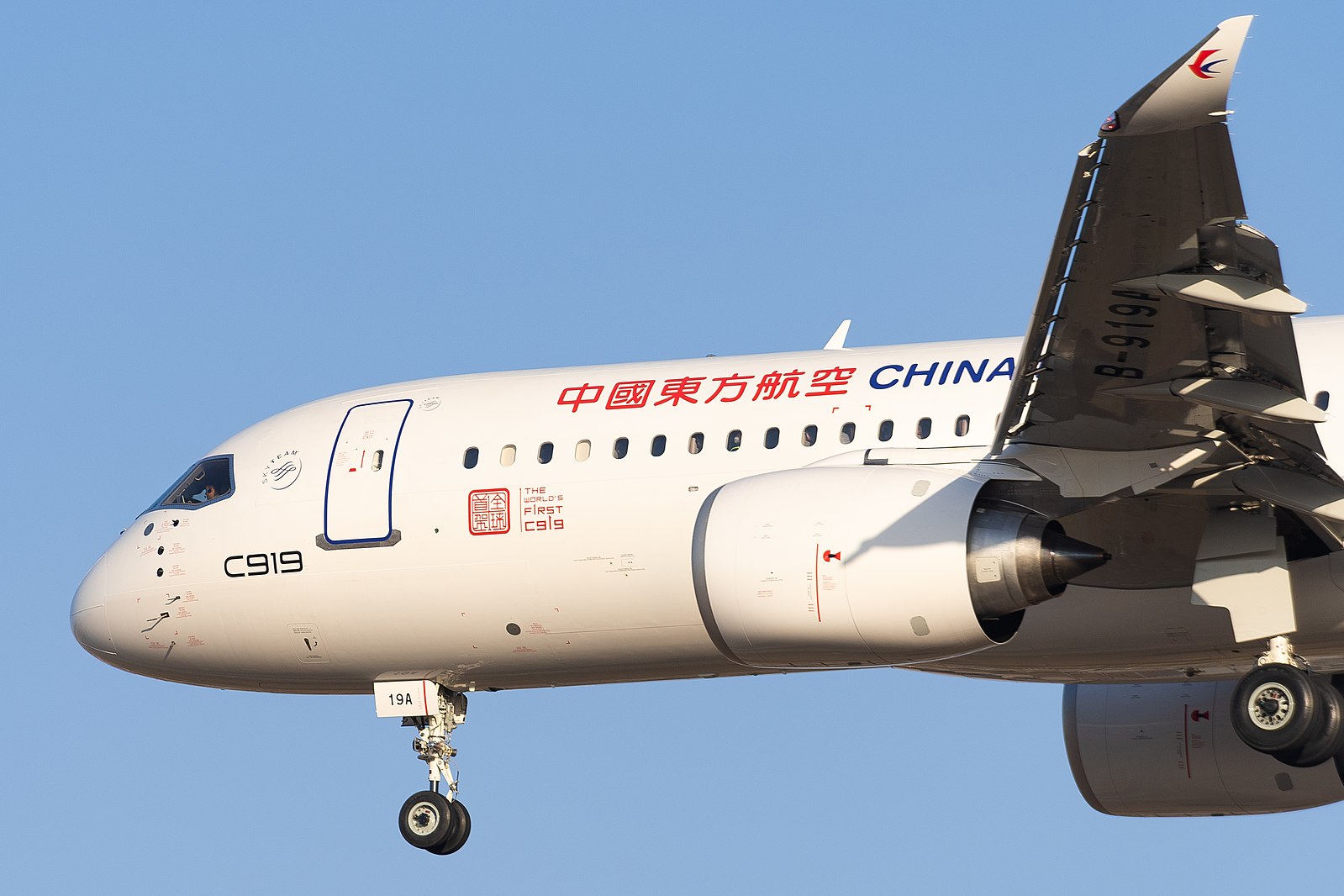
China Eastern's first C919 (Photo: N509FZ, CC BY-SA 4.0 , via Wikimedia Commons)
On the morning of May 28, COMAC’s C919 started its maiden flight from Shanghai’s Hongqiao International Airport to Beijing’s Capital International Airport. The China Eastern flight MU9191 took off at 10:32 a.m. local time, and landed at 12:31 p.m., after two hours of flight time. In the coming month, China Eastern scheduled its C919 on the route between Shanghai Hongqiao and Chengdu Tianfu with one round trip every day.
The first flight of COMAC C919 was highly anticipated by the public. While the flight MU9191 was in the air, it was the #1 tracked flight on Flightradar24. Local aviation enthusiasts were also grouped around airports to capture this historical flight as it takes off and lands.
Onboard the Flight
Passengers onboard the flight includes representatives from COMAC and China Eastern, government officials, local media, and a handful of aviation enthusiasts who were chosen from the pool of a lucky draw. Along with those passengers, there were the director of CAAC, the president of China Eastern, and the president of COMAC.
For this special flight, China Eastern specially designed a boarding pass reflecting the maiden flight of COMAC C919. Before the flight, passengers are invited to join a celebration at the China Eastern hanger at Shanghai’s Hongqiao International Airport. In the air, cakes were served to all passengers onboard, along with a special meal that was selected through an online vote, and even the water bottle was printed with “maiden flight of C919.”
The First C919 In Service
The first COMAC C919 in service, B-919A, was delivered to China Eastern on Dec. 9, 2022, shortly after the aircraft was fully certified by the Civil Aviation Administration of China (CAAC) in September 2022. A 100-hour flight testing began right after the delivery and was completed by February 2023. Afterward, the aircraft was sent back to the COMAC factory at Shanghai’s Pudong International Airport for further testing and modification and was pushed out of the factory in early May. After another 70-hour flight test was done during May, the aircraft was finally ready to begin commercial service by May 28.
The Comac C919 after receiving its type inspection authorization. (Photo: Comac)
As the first Chinese-designed, mid-sized single-aisle aircraft, the COMAC C919 was considered to be a long-term competitor with Boeing’s 737 MAX and Airbus’ A320neo. As of the moment, the second C919 was already rolled out of the production line, and it is planned to deliver to China Eastern in the latter half of this year. COMAC has not released any future delivery plans, however, the initial customers of C919 will likely be the “Big Three” Chinese airlines: China Eastern, China Southern, and Air China.
Based on the initial feedback of the first passengers onboard the COMAC C919, the experience on the flight was not quite different from what it is on a Boeing 737 or Airbus A320.
Editor’s Note: Stay tuned for additional coverage on the C919’s rollout into commercial service.
Lei is from Inner Mongolia, China, and now lives in Guangzhou. He grew up in an aviation family, where his passion began. During his time at Penn State University, he studied Industrial Engineering specializing in operations research, and he graduated with an honor’s thesis on airport gate assignment optimization. Now, he is a Purchasing Manager with Procter & Gamble. In his free time, he enjoys flying, reading, and wandering around the city.
Air Canada Increases Capacity to ‘Winter Sun’ Network Above Pre-Pandemic Levels
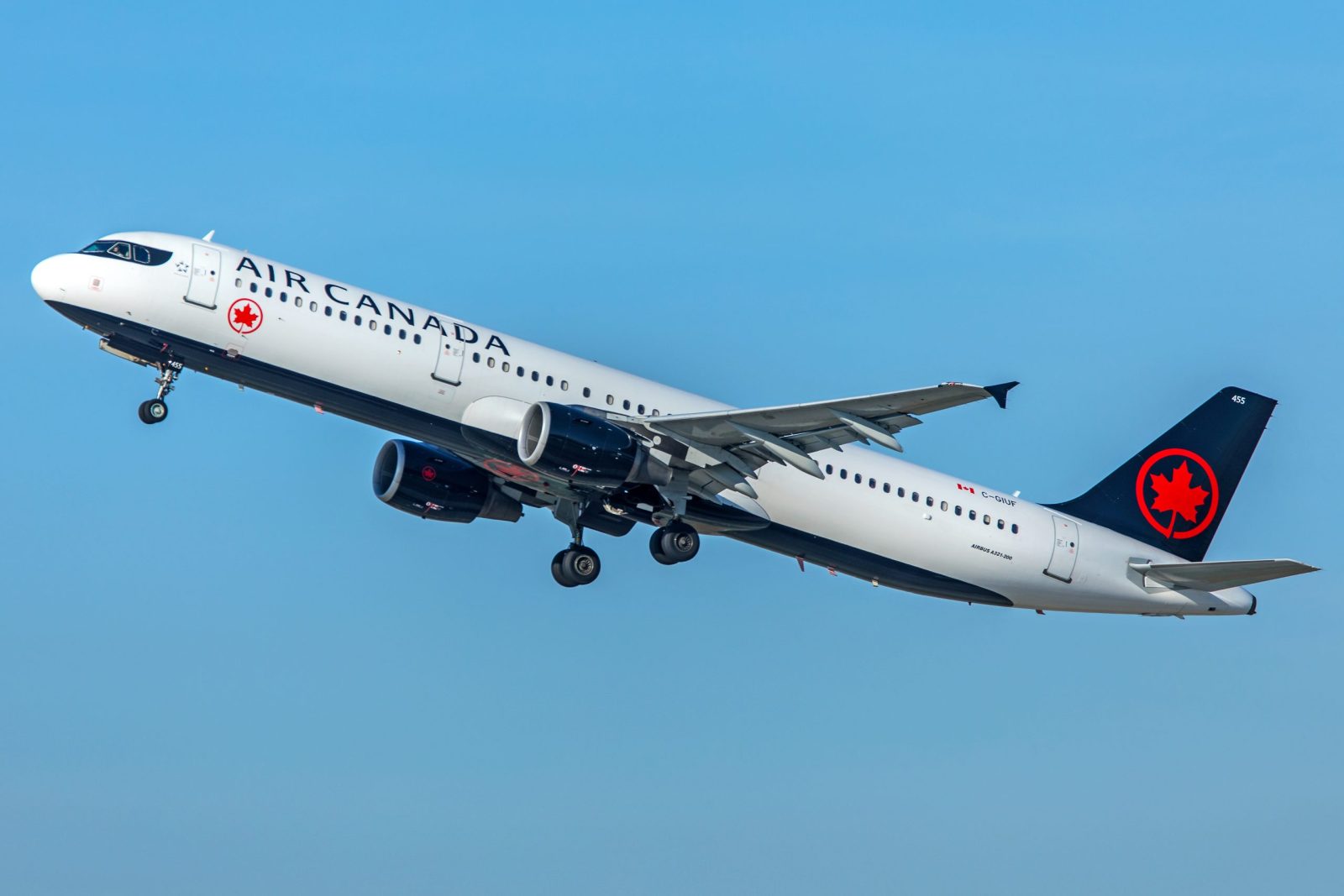
An Air Canada A321. (Photo: AirlineGeeks | William Derrickson)
Air Canada has followed up the expansion of several European routes to year-round services to Toulouse, Barcelona, Edinburgh, Lisbon, Rome, Madrid and Copenhagen with the announcement of the strategic expansion of its winter schedule. The airline announced it will increase capacity for the 2022-23 Northern Winter to more than 8 percent above its 2019-20 pre-pandemic schedule. The increased capacity is 11 percent above last winter and will include four new routes from Montreal’s Trudeau International (YUL) and Toronto’s Pearson International (YYZ).
From 29 October a four-times-weekly service from YYZ to Monterrey, Mexico will commence with a weekly YUL to Los Cabos, Mexico flight beginning on 01 December. Fort-de-France (FDF) and La Romana (LRM) in the Caribbean will be served from YYZ and YUL commencing 16 December (YYZ-FDF, weekly) and 17 December (YUL-LRM, weekly), respectively.
“We are seeing strong, ongoing interest for winter leisure travel, and as the leading carrier from Canada to popular sun destinations with up to 683 weekly flights planned this winter, we are thrilled to add exciting new services from Toronto and Montreal to the Caribbean and Mexico and significant increases from our Vancouver hub in response to pent up demand,” said Mark Galardo, Executive Vice President, Revenue and Network Planning at Air Canada.
“With the most flights to choose from coast to coast this winter to popular leisure sun destinations and convenient travel package options through Air Canada Vacations, customers can begin booking their vacation to their preferred destination now,” added Mr. Galardo.
Air Canada is seeking to leverage hub activity through YYZ from its extensive and expanded European destination network. Mr. Galardo noted that: “(Air Canada) have optimized our schedule to conveniently connect Europe to popular leisure destinations in Florida and Mexico, enabling customers from Spain, France, Italy, the U.K. and Denmark to enjoy one-stop travel to sought-after North American vacation destinations this winter.”
Highlights of the Vancouver (YVR) increases in capacity include the doubling of flights to Las Vegas and Phoenix to 14 per week. Puerto Vallarta and Cancun will have 7 flights per week up from 3 and 4, respectively) with Miami doubling to 6 weekly flights. A larger aircraft will service the YVR – San Diego route to achieve a 110 percent capacity increase. Los Cabos will be served by 2 extra flights over the winter raising the number of flights to 5 per week.
In addition to the increases in service from YVR to Cancun, the popular Mexican destination will see 21 weekly flights from Toronto (up from 11), 14 from Montreal (also up from 11) and 3 weekly flights each from Edmonton, Halifax and Ottawa (up from 2). Quebec City will also see an extra weekly flight to Cancun bringing the total number to four.
John has always had a passion for aviation and through a career with Air New Zealand has gained a strong understanding of aviation operations and the strategic nature of the industry. During his career with the airline, John held multiple leadership roles and was involved in projects such as the introduction of both the 777-200 and -300 type aircraft and the development of the IFE for the 777-300. He was also part of a small team who created and published the internal communications magazines for Air New Zealand’s pilots, cabin crew and ground staff balancing a mix of corporate and social content.
John is educated to postgraduate level achieving a masters degree with Distinction in Airline and Airport Management. John has held the positions of course director of an undergraduate commercial pilot training programme at a leading London university. In addition he is contracted as an external instructor for IATA (International Air Transport Association) and has been a member of the Heathrow Community Fund’s ‘Communities for Tomorrow’ panel.
Passenger Opens Door on Asiana Airlines Aircraft Mid-flight
Asiana Airbus jets in Seoul (Photo: AirlineGeeks | Ben Suskind)
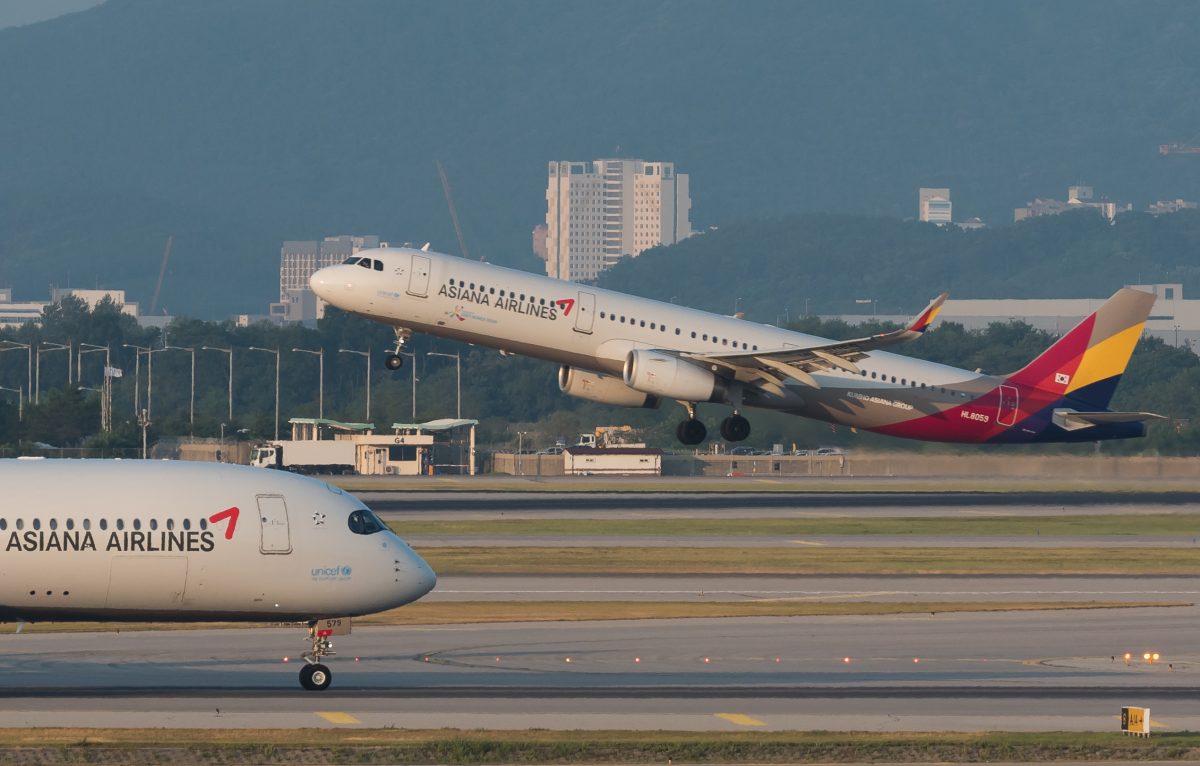
A passenger onboard an Asiana Airlines flight was arrested on Friday after opening an Airbus A321’s emergency door mid-flight. The man was taken into custody after landing at Daegu International Airport, and all passengers and crew onboard survived. Roughly a dozen passengers received medical treatment for minor injuries.
The aircraft was coming into land when the incident occurred. The aircraft was under 1000 feet from the ground, and cabin crew was slow to respond due to the imminent landing. Passengers recount that the man tried to jump from the plane after opening the door.
“It was chaos with people close to the door appearing to faint one by one and flight attendants calling out for doctors on board through broadcasting,” one 44-year-old passenger told Yonhap, adding they thought the plane would blow up.
Video of the incident has since circulated, showing high winds entering the cabin from the open door as the flight continued toward landing.
A statement from South Korea’s Ministry of Land, Infrastructure, and Transport said that, under the Aviation Security Act, any passenger who improperly operates doors, exits, or equipment inside an aircraft could be sentenced to up to 10 years in prison.
An Asiana A380 in Seoul (Photo: AirlineGeeks | Ben Suskind)
Geoffrey Thomas, an author at AirlineRatings, told CNN that it’s technically impossible to open airplane doors inflight due to the airstream flowing around a flying aircraft. The Airbus A321 lands at roughly 150 knots, so this plane was almost certainly flying at or above that speed when this incident occurred.
“The airplane is automatically set to adjust the pressure of the cabin according to the altitude of the aircraft,” Asiana Airlines said. “When the aircraft is high up in the air, it is impossible to open the door but when the altitude is low and close to landing, the door can be opened.”
Asiana Airlines A321 lands safely at Daegu Airport in South Korea after the emergency exit door was opened by a passenger on approach. 9 people taken to hospital with breathing difficulties. pic.twitter.com/Jzed4PMDvc
— Breaking Aviation News & Videos (@aviationbrk) May 26, 2023
Opening Aircraft Doors Inflight
Jet engines compress air and send it into the cabin to pressurize the passenger compartment. The pressure differential between inside and outside air, as well as the aforementioned slipstream, make it physically impossible to open an airplane’s door in flight. But as planes come in to land, the pressure differential of air inside and outside the aircraft is slim, eliminating that factor in the physics of opening plane doors.
At a normal cruising altitude, there are eight pounds of force against every square inch of a plane’s interior, per the Washington Post, which equates to about 1,100 feet of pressure against each square foot on an emergency door.
“Just by pure pressure alone, the force required to open the door would be astronomical,” said Bob Thomas, an Assistant Professor of Aeronautical Science at Embry-Riddle Aeronautical University.
The pressure on an aircraft drops closer to the ground when the pressurization inside the aircraft decreases to more closely match air pressure on the ground.
“This individual appears to have been able to open a door on approach,” said Nick Wilson, an Associate Professor of Aviation at the University of North Dakota. “At a lower elevation, there’s less differential pressure. That would be one of the important factors that allowed this door to be opened at all.”
Though very infrequent, there have been incidents where unruly passengers have tried to open aircraft doors in flight. Two such incidents occurred in the United States in 2022.
Even with a door open, aircraft are structurally sound and safe at low altitudes like this.
John McDermott is a commercial pilot pursuing a career in professional flight. His passion for aviation began in an Ann Arbor bookstore with a tale of enemy pilots during World War 2, and he hasn't looked back. Besides flying and writing for AirlineGeeks, John volunteers with Professional Pilots of Tomorrow and travels whenever he gets the chance.
Qantas to Wet Lease Two Finnair A330 Aircraft to Bolster Sotheast Asian Routes
A Finnair A330 in Seattle (Photo: AirlineGeeks | Katie Zera)
Recently, Qantas announced that it is boosting its international capacity for the coming season, partly with the help of oneworld alliance member Finnair. The press release stated that Qantas plans to wet lease two of Finnair’s A330 aircraft. The exciting news for Qantas passengers is that the aircraft that come equipped with Finnair’s revolutionary new seats they have called the “Air Lounge.” These new business class seats have received much praise from travelers despite the seats not being able to recline. Instead, passengers are invited to treat the seat like a couch and make themselves comfortable. The contour of the seat is entirely padded so that passengers can relax as they choose.
Finnair’s New Business Class Seat (Photo: Finnair)
What is a Wet Lease?
A wet lease is quite a common occurrence in the airline industry; it means that an airline is leasing an aircraft as well as its crew to service a particular route. When passengers board the select flights that will have a QF flight number and QF catering they will be met by Finnair cabin crew as well as the Finnair cabin. This is an exciting prospect for any Australians that may otherwise not have the desire to try out Finnair’s business class product all the way to Helsinki. Finnair has crews based in Singapore.
Qantas’ Plans Moving Forward
The wet leasing of these aircraft coincides with Qantas wanting to reactivate some of its aircraft. The statement from Qantas states “From late October 2023*, the national carrier will add around one million seats to its international network over 12 months compared to its current schedule, offering customers more choice to popular destinations across Asia, the United States and the Pacific.”
The Australian and International Pilot’s Association Response
In a statement to Australian Aviation AIPA’s Captain Tony Lucas had this to say:
“Qantas’ decision to wet lease two Finnair aircraft is shocking, bitterly disappointing and could have been avoided with more effective management decisions. It beggars’ belief that Qantas is outsourcing the Spirit of Australia while simultaneously converting two of our own A330 passenger aircraft into freighters.”
In conclusion, the wet leasing of Finnair’s A330 is a net positive for the passenger experience. That being said, the frustration of the AIPA and its pilots is understandable as routes are being taken away from them and given to a company that has no foothold in the Australian market, only time will tell if this was a proper decision from the Australian flag carrier.
A KLM 787-9 parked on the tarmac in Las Vegas. (Photo: AirlineGeeks | Terrill Murriel)
Sustainable aviation has slowly been gaining ground over the past few years. We’ve seen start ups across the world try to electrify flight or use hydrogen to power planes. In addition, the movement towards carbon neutral flight operations is prominent.
This technology is still in its infancy and has a long road to travel before it becomes commercially viable. What airlines are doing in the meantime is coming up with ways to reduce carbon emissions. This is through flying more fuel-efficient aircraft, utilizing fuel burn reduction techniques and utilizing sustainable aviation fuel.
It’s no surprise that the environmentally conscious folks in Europe are the ones leading the charge given their recent push towards more utilization of sustainable aviation fuel.
One such airline is KLM. The airline is aiming to reduce carbon emissions by 30% over the next 7 years compared to 2019 levels.
KLM is taking part in the Sustainable Flight Challenge, a challenge to come up with new ideas and feasible solutions for sustainable aviation. A group of KLM employees had come up with the idea after drawing inspiration from the London to Melbourne Race in 1934.
This race aimed to make the world more accessible and connect people with one another. The Sustainable Flight Challenge focuses on driving the world towards operating regular commercial scheduled service as sustainably as possible.
Sustainable Flight Challenge
KLM flew two rountrip flights from May 16 to May 18 from Amsterdam to Los Angeles to kick off the challenge. The route will be operated by a Boeing 787-10 Dreamliner and will test new initiatives in aviation sustainability.
The first of which is using sustainable aviation fuel. The goal is for the airline to operate the flights from both airports with a fuel blend that contains 50 percent sustainable aviation fuel, the maximum amount airlines are permitted to use.
The airline is also focusing on weight reduction across the cargo and passenger sections of the aircraft. Cardboard will be introduced across several components of the cargo operation. Instead of wood supports and wooden pallets, a type of cardboard, will be used that is comprised of 94 percent recycled paper.
Within the passenger cabin, lighter tableware and recycled trays. Most notably, the airline will not be serving any meat on flights to Los Angeles to further reduce environmental impact. Cabin crew will also have new uniforms and supplies made of organic and recycled materials. The number of paper boarding passes will also be reduced along with an elimination of printing at gates.
The expectation is that all of this will result in a signification reduction in carbon emissions. Last year’s attempt saw a reduction in emissions by 37 percent compared to regular commercial services. This year should see a greater reduction in emissions. Results will be released at the end of June.
Hemal took his first flight at four years old and has been an avgeek since then. When he isn't working as an analyst he's frequently found outside watching planes fly overhead or flying in them. His favorite plane is the 747-8i which Lufthansa thankfully flies to EWR allowing for some great spotting. He firmly believes that the best way to fly between JFK and BOS is via DFW and is always willing to go for that extra elite qualifying mile. Hemal's opinions are his own and do not reflect those of his employer.
A Sun Country 737 on the taxiway. (Photo: AirlineGeeks | William Derrickson)
Recently, Sun Country Airlines announced the resumption of flights between its main base and hub in Minneapolis to St. Maarten in a release to the press. The city pair was previously connected before the pandemic but was axed during Covid. The carrier also announced an expansion of its current service out of Milwaukee.
The flights to St. Maarten will be operated once weekly on Saturdays from Jan. 13 through April 6 next year. The route will be operated by one of the airline’s 53 Boeing 737-800s aircraft. At just under 2,500 nautical miles, the route will be one of the longest the carrier operates out of their Minneapolis-St. Paul hub, with the return westbound flight time estimated to be just over six hours.
Grant Whitney, Sun Country’s Senior Vice President and Chief Revenue Officer, is enthusiastic about the new offering for customers stating, “[W]ith this schedule extension, we are giving customers more flights and choices in existing markets. We are also very excited to welcome St. Maarten back to the Sun Country network.”
While a seasonal route to a Caribbean island that will last for four months seems like a short stint of time, seasonal flights actually make up the majority of Sun Country’s route structure. When looking at cities served on the carrier’s website, only 13 out of the 94 destinations served by the carrier are served on a year around basis at the time of writing. This means that a whopping 86% of the flying Sun Country does is done on a seasonal basis.
Expansion In Milwaukee
Milwaukee will also see an uptick in service from the Minneapolis-based carrier. Included in the press release, the carrier will boost its Milwaukee to Cancún, Mexico service offering daily flights this winter. Milwaukee customers will also see new flights to Fort Myers, Fla. and Orlando, Fla., along with Phoenix this winter.
The resumption of the seasonal routes fits right into Sun Country’s route structure, offering flights fitted for leisure travel customers. The low-cost carrier operates Boeing 737-800 aircraft for scheduled passenger service consisting of an all-economy class layout.
The airline offers an economy product labeled as “Best” with additional legroom, more recline and an alcoholic beverage included in the ticket price. All passengers have access to onboard entertainment, a perfect way to pass the time on the way to one of the carrier’s newly announced warm-weather, leisure destinations.
Zach’s love for aviation began when he was in elementary school with a flight sim and model planes. This passion for being in the air only intensified throughout high school when he earned his Private Pilot Certificate. He then attended Embry-Riddle Aeronautical University, earning his certificates and ratings to later flight instruct and share his passion for aviation with others. He now resides in the North East living out his dream as an airline pilot.
The Acquisition of Asiana Airlines Remains Uncertain
A Korean Air A380 (Photo: AirlineGeeks | William Derrickson)
Korean Air could fall short of acquiring Asiana Airlines after clearing 11 hurdles in the past two years. The U.S. is considering filing a lawsuit to block the acquisition. According to Politico, the Department of Justice has been investigating the deal for two years. It came after the potential blockage from the EU. The plan could fall through without agreeing from the pair.
The merger concerns the U.S. that it could make less competition on passenger and cargo services between the U.S. and South Korea. Korean Air and Asiana Airlines provide service to San Francisco, Los Angeles, Seattle, New York and Honolulu.
In addition, the administration is also concerned that the Korean carriers could have a monopoly on cargo transportation. The decision could affect the stability of the supply chain, such as microchips.
“At the last meeting with the DOJ on May 12, Korean Air learned that the authority has yet to take a position nor has a confirmed timeline.” Korean Air said in a statement.
The U.S. government has blocked a few aviation mergers in recent years. Earlier, the U.S. filed suit to stop JetBlue from buying Spirit Airlines in March, and succeeding in opposing a partnership between JetBlue and American Airlines in 2021. But the Asiana acquisition could be the first time it breaks up the acquisition of foreign airlines.
Waiting for a nod of approval
In the meantime, the EU remains skeptical about the merger, worrying the acquisition could result in increasing airfares and decreasing the quality of passenger and air transport services in the future. The bloc said the merger could restrict competition in the provision of passenger transport services on four routes between South Korea and France, Germany, Italy and Spain, and cargo air transport services between the European Economic Area (EEA) and South Korea.
In 2021, Air Canada canceled the acquisition of Transat after opposition by the EU.
Korean Air is expected to provide remedy to ease its monopoly, giving up some slots to Europe. However, the EU hasn’t accepted the packages from Korean Air thus far. Both Korean carriers monopolized flight operations from Seoul to Barcelona and 75% market share in Rome before 2019.
The EU is expected to announce the final decision in August.
“Korean Air has made, and continues to make, every effort to obtain all necessary approvals by emphasizing that the majority of the customers on the affected routes are Korean nationals and that the airline fully complies with a robust and comprehensive set of remedies ordered by Korea’s Fair Trade Commission,” Korean Air said.
The Korean flag carrier needs to clear 14 hurdles before making the deal. After two years, Korean Air got 11 approvals from the competitors’ authorities, including Australia, Singapore, and the U.K. Japan also hasn’t given the green light beside the U.S. and EU at the moment.
A Boeing 737 MAX in Renton, Wash. (Photo: AirlineGeeks | Ryan Krautkremer)
ASKY Airlines, the Pan-African carrier based in Togo, has announced its latest development in expanding its fleet through a lease partnership with AerCap, the world’s largest aircraft leasing company. ASKY Airlines, which provides intra-African connectivity, is set to lease two Boeing 737 MAX 8 aircraft from AerCap. These aircraft will be the first MAX models in ASKY’s fleet, which currently consists of Airbus and Bombardier aircraft.
The lease agreement marks a significant milestone for ASKY Airlines, as it continues to strengthen its presence in the African aviation industry. The two Boeing 737 MAX aircraft are scheduled for delivery between June and August 2023.
The CEO of ASKY Airlines, Esayas W. Hailu, expressed his excitement about introducing the aircraft to the ASKY fleet in a press statement. “I consider it an honor to introduce state-of-the-art B737-8 MAX aircraft into the ASKY fleet, which will support our wide regional network in our continuous endeavor to serve our esteemed customers,” remarked Esayas W. HAILU, the CEO of ASKY. “I am confident that the introduction of B737-8 MAX will further enhance ASKY’s brand image before the eyes of the traveling public. It feels great to be the region’s leading customer to AerCap, the world’s largest owners of commercial aircraft.”
Partnership with AerCap
AerCap, known for its extensive aircraft leasing operations worldwide, welcomed ASKY Airlines as a new customer and expressed its pleasure in placing the first MAX aircraft in Togo. Aengus Kelly, the CEO of AerCap, emphasized the company’s commitment to supporting the growth and development of African aviation.
“We are delighted to welcome ASKY as a new customer to AerCap and particularly pleased to place the first MAX in Togo,” said Aengus Kelly, the CEO of AerCap. “AerCap is the largest lessor in Africa with 14 airline customers on the continent, and we are pleased to continue to support the growth and development of African aviation. We wish the ASKY team every success and look forward to working with them as these aircraft deliver.”
With 14 airline customers on the continent, AerCap remains the largest lessor in Africa, contributing to the advancement of the aviation industry in the region. The lease agreement ceremony was attended by key figures from ASKY Airlines, AerCap, Ethiopian Airlines Group, and other distinguished guests.
Asky Partnership with Ethiopian Airlines
ASKY Airlines, established by a group of banking institutions including the ECOWAS Bank for Investment and Development (EBID), the West African Development Bank (BOAD), and the ECOBANK Group (ETI), aims to foster regional development, tourism, economic growth, and regional integration within Africa.
The collaboration between ASKY Airlines and Ethiopian Airlines extends beyond aircraft leasing, encompassing a strategic partnership that has further bolstered ASKY’s operations.
With a fleet of twelve aircraft, ASKY currently serves 26 destinations across 24 countries in Africa.
Victor Shalton's love for aviation can be traced to when he was 11-years-old. As a seasoned aviation writer, he takes pride in providing the best aviation coverage around the globe and is passionate about advancing his skills in the aviation space. In addition, he loves travelling, writing, arts and while his speaking engagements have taken him around the world, he is proud to call Nairobi home.