Stories

Spirit Competes with JetBlue in New Boston Expansion

A Spirit Airlines A320 landing in Las Vegas.
A Spirit Airlines A320 landing in Las Vegas. (Photo: AirlineGeeks | William Derrickson)

Spirit Airlines announced a significant expansion in the carrier’s Boston presence. With five new routes announced in a press release, the Miramar, Fla.-based carrier aims to increase competition with the big three and JetBlue.

The airline will launch routes that will go head to head with American, Delta, JetBlue and United. Beginning June 7, Spirit will begin operating between Charlotte and Dallas/Fort Worth, with Los Angeles beginning July 5 and Houston along with Phoenix inaugurating on August 9. 

While Boston is a hub for Delta and JetBlue, it is considered more of a focus city for American and has strong movements from United. The route to Los Angeles will have the strongest competition, with Spirit going head-to-head with the four carriers previously listed. Houston has the least competition, with only JetBlue and United currently operating to the Texas city. However, the other three routes will face direct competition from American, Delta, and JetBlue making Spirit the fourth airline to operate between Boston and the aforementioned cities. 

All five routes are currently advertised to be operated by the carrier’s Airbus A320 aircraft.

John Kirby, Spirit’s Vice President of Network Planning is enthusiastic about the new announcement stating “It’s exciting to grow our service in Boston and provide new nonstop options to a variety of popular destinations across the country. We trust Bostonians will appreciate the great value and convenience we provide our Guests at such affordable prices.”

Spirit-JetBlue Merger

This announcement comes as the carrier is currently working to resolve the lawsuit that the United States Department of Justice had imposed on blocking the merger with JetBlue and Spirit. Currently, the two carriers only go head-to-head on 38 routes throughout their respective networks. All five of the announced routes will have Spirit competing directly with JetBlue out of Boston, marking a 13% increase in competition from the current 38 routes to 43 this upcoming August. 

The carrier will also be welcoming a new aircraft to the fleet this summer. The first A321neo for Spirit will begin service between Fort Lauderdale and Chicago on June 7 according to Routesonline.

Zach Cooke

Zach’s love for aviation began when he was in elementary school with a flight sim and model planes. This passion for being in the air only intensified throughout high school when he earned his Private Pilot Certificate. He then attended Embry-Riddle Aeronautical University, earning his certificates and ratings to later flight instruct and share his passion for aviation with others. He now resides in the North East living out his dream as an airline pilot.

Airlink Launches Daily Nairobi Flights, Connecting South Africa and Kenya

An Airlink (South Africa) Jetstream J41, reg. ZS-OMS, seen at George Airport, Western Cape, South Africa (Photo: WikiMedia | Africaspotter)

Airlink, Southern Africa’s leading airline, has announced the launch of a new daily flight service from Johannesburg to Nairobi, connecting two of the major regional markets in Africa.

Airlink’s entry into the South Africa-Kenya market will offer more options and increased competition, benefitting travellers by potentially leading to more affordable fares and improved services. This move also signifies the efforts of both South Africa and Kenya to strengthen bilateral ties and promote tourism and trade between the two countries.

The new service is expected to provide greater choices for business and leisure travellers flying between the two major regional markets. Airlink’s connectivity through its Johannesburg hub will allow travellers to easily connect to various destinations within South Africa, Southern Africa, and around the world through its partner carriers.

Airlink CEO and Managing Director, Rodger Foster, said, “Our competitive and convenient flights will promote tourism in both markets by letting travellers take advantage of the visa-free requirements for Kenyans visiting South Africa and South Africans wanting to visit Kenya.”

Increasing Competition

With the addition of Kenya to Airlink’s comprehensive sub-Saharan route network, Kenya becomes the 15th country and the third in East Africa to be served by the airline, alongside Dar es Salaam and Entebbe. The flights on the Johannesburg-Nairobi route will operate daily, departing Johannesburg at 09.40 and arriving in Nairobi at 14.45 with flight number 4Z 070. The return flight, 4Z 071, will depart Nairobi at 15.45 and arrive in Johannesburg at 19.05. Airlink will operate 98-seat Embraer E190 jetliners on the new service.

In related news, TrueNoord has welcomed Airlink as a new lessee, with the novation of two YoM 2008 Embraer E190AR aircraft on long-term operating lease. These assets are part of TrueNoord’s recent portfolio acquisition of 10 aircraft from Nordic Aviation Capital (NAC), which brings new lessee airlines from the United States and Canada, as well as Airlink from South Africa, into the business. The aircraft are based in Cape Town and Johannesburg, flying domestic routes across South Africa and to international destinations within Southern Africa.

Maarten Grift, Sales Manager – Africa, Middle East and CIS at TrueNoord, comments, “Airlink has been connecting Africa for over 30 years. Operating the Continent’s largest fleet of Embraer aircraft, they continue to expand their route network to new destinations spanning regional capitals, smaller communities and major cities.”

Airlink’s CEO and Managing Director, Rodger Foster, said, “TrueNoord is a highly knowledgeable and experienced lessor with solid financial backing. We are very pleased to have them as a new business partner as we continue on our journey as South Africa’s leading regional airline. We are committed to optimising regional air transportation by providing exceptional quality service to all our customers and setting benchmarks in safety, on-time performance and reliability.”

Victor Shalton

Victor Shalton's love for aviation can be traced to when he was 11-years-old. As a seasoned aviation writer, he takes pride in providing the best aviation coverage around the globe and is passionate about advancing his skills in the aviation space. In addition, he loves travelling, writing, arts and while his speaking engagements have taken him around the world, he is proud to call Nairobi home.

Hong Kong’s Aviation Industry Gradually Rebounds

A Cathay Pacific 777 at the gate in Los Angeles. (Photo: AirlineGeeks | William Derrickson)

Hong Kong continues an upward trend after the lifting of travel restrictions. Cathay Pacific — the city’s flag carrier — has carried over 1.3 million passengers last month, with an increase of 19% compared with February. The load factor was over 90%.

Cathay Pacific and HK Express, its no-frills airline, has reached 50% pre-pandemic flight capacity, covering more than 70 destinations as of the end of March. Cathay Pacific has enhanced its services by adding flights to Shanghai’s Hongqiao Airport, the Chinese city of Haikou and Nagoya, Japan in March.

“Our Japan and South Korea flights benefited from good passenger traffic for the cherry blossom season and demand ahead of the Easter holiday. Demand between Hong Kong and Taiwan was similarly strong, including transit traffic from Taiwan to Europe and Indonesia via the Hong Kong hub,” Lavinia Lau, Chief Customer and Commercial Officer, said.

In the meantime, Hong Kong International Airport has welcomed 2.8 million passengers in March, with an increase over 30% to the previous month. The airport has handled approximately 100,000 passengers each day, reaching 50% of 2019 levels.

The aviation hub handled seven million passengers in the first three months of 2023. Compared to 2019, the airport served 18.8 million passengers in the first quarter. Earlier, Hong Kong International Airport was crowned the world’s busiest cargo airport in 2022.

In March, Hong Kong International Airport has welcomed the return of United Airlines. The airline has resumed the flight between San Francisco and Hong Kong. Meanwhile, British Airways has doubled its operations to Hong Kong as its A350-1000 touched down at the airport. Earlier, Virgin Atlantic — the rival of British Airways — announced the termination of the flights between London and Hong Kong.

Meanwhile, Hong Kong Airlines is operating 45% flight capacity of pre-pandemic levels. In March, the carrier has launched the flight operations to Beijing’s Daxing International Airport, becoming the only Hong Kong carrier to serve to Daxing and Beijing Capital Airport.

Affordable Price Tag

After three years of pandemic, Hong Kong has a long way to go before returning to normality. The shortage of staff is becoming all too familiar after the pandemic.

Hongkongers currently pay through the nose for the air tickets. The pent- up travel demand is outstripping supply and the customers need to book months earlier to secure their vacations. Some customers have  postponed their vacations and hoping for a cheaper fare.

In response to the staff issues, Qantas has delayed resuming flights between Melbourne, Australia and Hong Kong to June. Australia is one of Hongkonger’s favurite travel destinations. In addition, some Asian airlines haven’t returned to Hong Kong at the moment, such as Jin Air, Jetstar Japan, Mandarin Airlines, SpiceJet and Indigo.

FAA Reauthorization Bill Needed by the End of Fiscal Year

Inside an FAA Air Traffic Control Tower at Washington Dulles International Airport. The federal agency is celebrating 100 years of its Flight Service program. (Photo: AirlineGeeks | Ryan Ewing)

The American Federal Aviation Administration (FAA) is bracing for a reauthorization. Every five years, Congress passes a bill outlining new steps the agency can take to promote further growth and safety in the American aviation industry. These bills also provide the agency’s funding and dictate where the funding should go to further the American aviation industry.

Former President Donald Trump was the last leader to sign off on such a bill. In 2018, the FAA focused particularly on unmanned aircraft operations and making the skies a safer place for drones and manned aircraft to coexist. The FAA had also expanded powers and more funding for enforcement; the 2018 bill allocated to the FAA a total of $4.35 billion per year.

NOTAMs overhaul urgently needed

This time, the main focus of reauthorization talks is on modernizing the systems the FAA uses to run the national airspace system. An outage of the FAA’s Notices to Air Missions (NOTAMs) system in early January highlighted the need to systematically upgrade the technology the FAA uses to manage flights and send out critical safety information to pilots and aircraft operators alike.

Part of this reauthorization will be the approval for a new office within the FAA to test, approve, and integrate new technologies.

“I’m concerned that Federal Aviation Administration is falling short on its technological mission,” said Representative Jefferson Van Drew during a committee hearing. “This year’s FAA bill is the opportunity to develop [advanced technology] tools and set the agency up for real success.”

“Recent disruptions and groundings appear to be due in large part to reliance on outdated technology and systems, some of which are built on software that is decades old,” Rep. Brian Babin said. “It’s striking to see that the failure to use or partner with the right software or service providers could directly result in a disruptive impact on our passengers [and] the airlines themselves – shaking public confidence in our air operations.”

The reauthorization bill in 2018 allocated $3.35 billion for infrastructure investments, according to a CNN report. It has yet to be seen whether this amount will increase to allow the FAA to not only maintain but upgrade its infrastructure to enhance reliability.

One-pilot operations under consideration

Another hot topic has been at the forefront of this reauthorization. In December, it was revealed that an early draft of the bill included language that would allow the FAA to authorize airlines operating under Part 121 of the Code of Federal Regulations to fly with only one pilot aboard flights. This is a significant break from precedence, as Part 121 has required two pilots in the cockpit at any given time.

Airline lobbyists support such language, saying it will help them address a critical pilot shortage that has forced airlines to cut dozens of routes and hundreds of flights from their schedules. But pilot unions say that removing a pilot from a cockpit would be a critical safety blunder, adding that removing a pilot from the cockpit puts the flying public at risk.

“The risks associated with reduced-crew and single-pilot operations are well documented.

Most prominently, these risks stem from the increased workload for the remaining pilot, the elimination of a critical layer of monitoring and operating redundancy in the cockpit, and the inability of a single pilot to handle many emergency situations,” the Airline Pilots Association wrote in a document called ‘The Dangers of Single-Pilot Operations.’

Representatives on the U.S. House Transportation Committee emphasize why this reauthorization bill is so critical.

“Recently there have been incidents that reemphasize why getting an FAA reauthorization done on time is critical,” said House Transportation and Infrastructure Committee Chairman Sam Graves, referencing runway incursions and close calls across the first few months of 2023. “Even following the safest decade in our history, our aviation system is clearly in need of urgent attention. Complacency and stagnation are equal threats to a safety culture.”

“Our role, and the FAA’s role, is to manage risk and ensure safety while reaping the incredible benefits of flight. Our global leadership in aviation begins with global leadership in aviation safety. And the only way to maintain our gold standard is to continue to enhance it. I’m going to say it again – the goal is zero fatalities,” said Aviation Subcommittee Chairman Garret Graves.

The previous reauthorization bill expires at the end of Fiscal Year 2023, so lawmakers have until September 30 to agree on a new bill and send it to President Joe Biden. Ultimately, the consensus among lawmakers is that the FAA lags behind the pace it needs to keep up with the technology and problems of the modern day.

“First and foremost, we have the president’s budget, and we obviously need to be funded at that request level,” said Dave Boulter, the acting Associate Administrator for Aviation Safety at the FAA. “The pace of technology – as we all know – has increased, but the pace of our processes has not. My number one goal in the aviation safety organization is to get that speed without ever degrading safety.”


John McDermott

John McDermott is a commercial pilot pursuing a career in professional flight. His passion for aviation began in an Ann Arbor bookstore with a tale of enemy pilots during World War 2, and he hasn't looked back. Besides flying and writing for AirlineGeeks, John volunteers with Professional Pilots of Tomorrow and travels whenever he gets the chance.

Alaska Airlines Removing Check-in Kiosks

Alaska Airlines Boeing 737-900 (ER) and B737-800 aircraft at LAX. (Photo: AirlineGeeks | James Dinsdale)

Alaska Airlines is making bold changes to the airport experience in an effort to reduce the amount of time passengers have to spend in airport lobbies. The airline is investing $2.5 billion in improvements at its hub and focus city airports with the goal of getting travelers through to security in five minutes or less.

New Bag Tag Stations

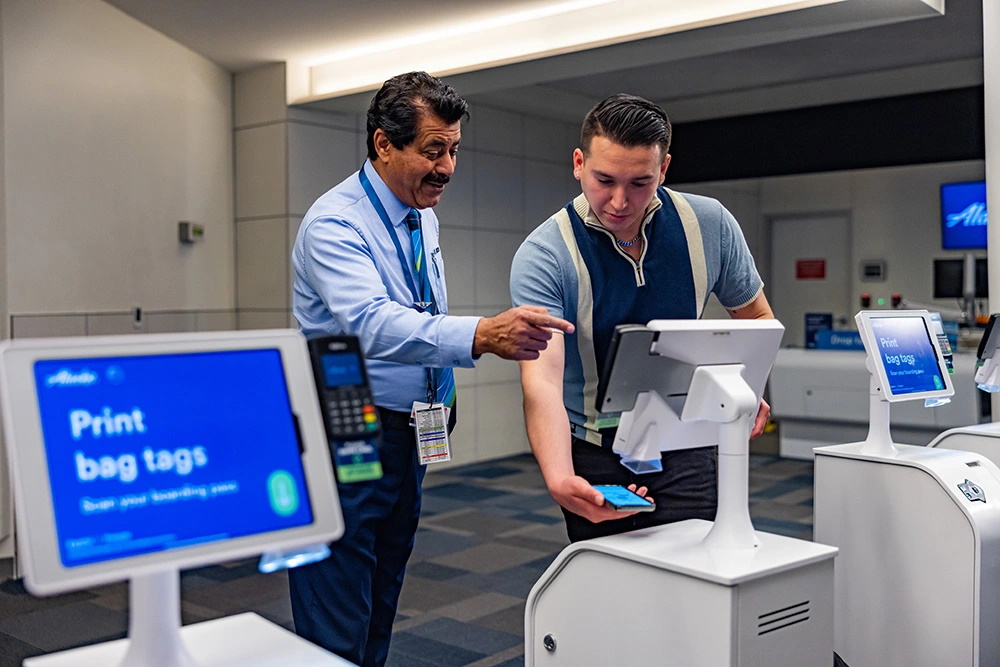
The Seattle-based carrier is eliminating a staple of the modern-day check-in lobby by replacing its existing check-in kiosks with new bag tag stations. The new stations are equipped with an iPad and a card payment terminal. Passengers who arrive at the airport with a printed or mobile boarding pass can scan their pass at the station, pay any bag fees if needed and receive a bag tag.

Alaska Airlines bag tag station (Photo: Alaska Airlines)

The airline has already started installing the new bag tag stations at Portland International Airport and Las Vegas’ Harry Reid International Airport and is planning on rolling out the new machines at its hub and focus cities. Other airports expected to get the new stations include Seattle–Tacoma International Airport, Los Angeles International Airport, San Francisco International Airport and Ted Stevens Anchorage International Airport. Alaska expects to complete the transition to the bag tag stations by the end of 2023.

Expanding Technology Use

Alaska is looking to build upon the trend of passengers increasingly using online and mobile check-in options. Approximately 75 percent of its passengers currently check-in before arriving at the airport and the airline is looking to raise that number to 90 percent.

Starting in the spring of 2024, the airline will also be introducing new bag drop technology. The machines will incorporate the use of biometrics and have the ability to scan faces, government-issued identification and bag tags. Airlines have been expanding the use of biometrics to improve the travel experience and Alaska’s move demonstrates its willingness to embrace this technology.

With the new system, the goal is to get passengers through the airport lobby seamlessly and efficiently. Travelers will check in beforehand and arrive at the airport with a boarding pass, before scanning their pass and receiving a bag tag. They will then take their bag to an automated bag drop station that will incorporate biometrics to allow passengers to use their faces as their identification and boarding pass. Customer service staff will be available to help travelers who require additional in-person assistance.

“As we thought about how to provide the most caring experience for our guests, it was clear the lobby was a pain point. We realized the majority of our guests were doing most of the kiosk actions on their own phones and we could reduce the congestion in our airports,” Alaska Senior Vice President of Innovation and Merchandising Charu Jain said in a press release. “Alaska was the first airline to introduce kiosks more than 20 years ago, and we’ll be the first airline to remove them. We’re looking forward to offering the new full guest experience next summer.”

Andrew Chen

Andrew is a lifelong lover of aviation and travel. He has flown all over the world and is fascinated by the workings of the air travel industry. As a private pilot and glider pilot who has worked with airlines, airports and other industry stakeholders, he is always excited to share his passion for aviation with others. In addition to being a writer, he also hosts Flying Smarter, an educational travel podcast that explores the complex world of air travel to help listeners become better-informed and savvier travelers.

ITA Airways Unveils New Interiors, Uniforms, Lounge and Special Livery

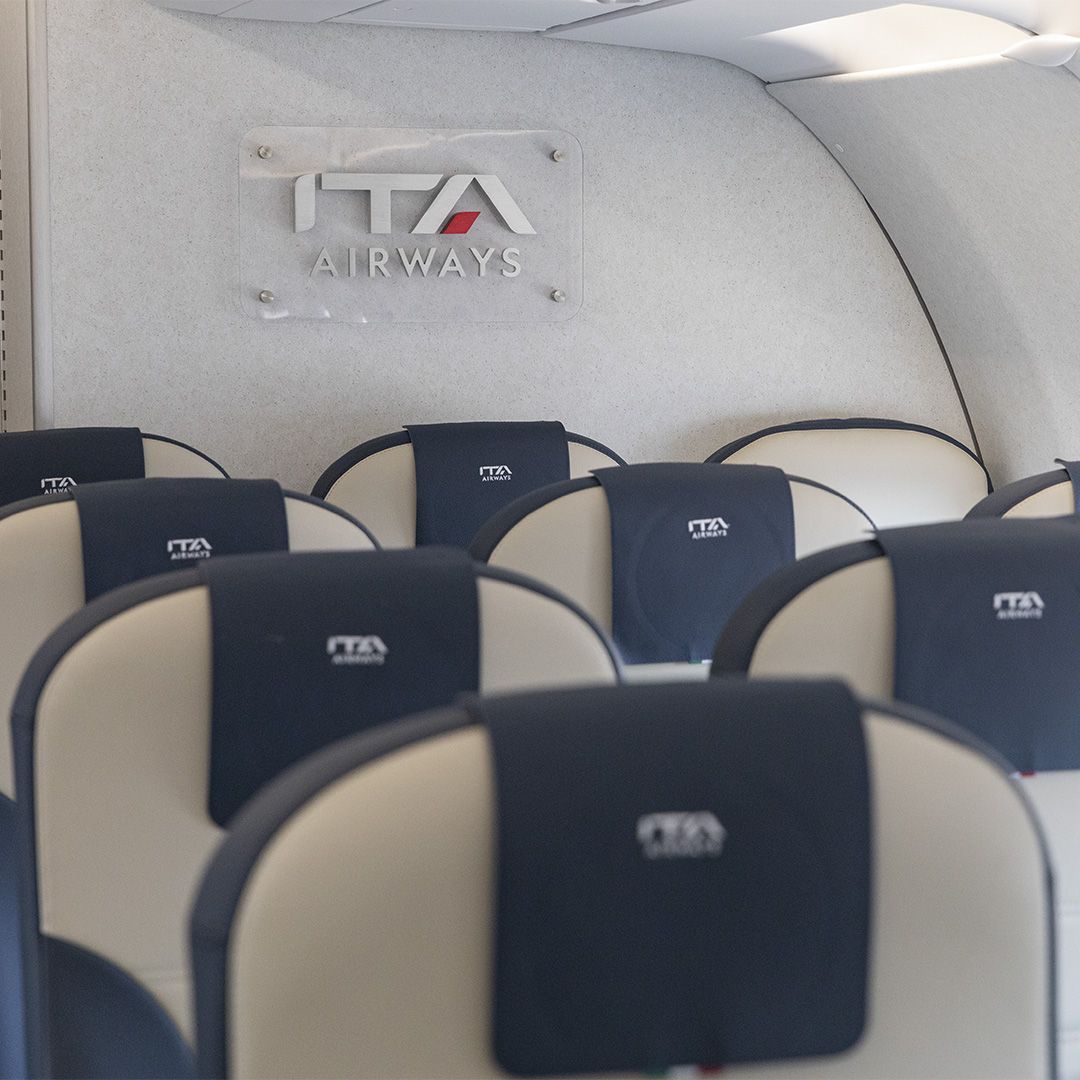
ITA Airways Airbus A320neo new interiors by Walter De Silva. (Photo | ITA Airways)

ITA Airways, Italy’s national airline, recently unveiled the Airbus A320neo (dedicated to Italian ice-skating champion Carolina Kostner) with new interiors designed by Walter De Silva, an Italian designer working in automotive design. This aircraft is the first in ITA Airways’ fully configured fleet.

For the first time, ITA Airways’ medium-haul fleet will offer a paid connectivity service and free IFE Wireless content, with 90 hours of video programming and 12 hours of audio programming updated every two months.

New uniforms signed by Brunello Cucinelli

The new uniforms that will be worn by all ITA Airways flight attendants have been unveiled, designed with the free stylistic advice of Brunello Cucinelli, founder of the eponymous company known worldwide for the production of fine cashmere knitwear. According to the airline, the production of the new uniforms did not involve any additional cost and 1448 uniforms were produced.

As part of ITA Airways’ circular economy program “l’arte indossa la sostenibilità”, which will be unveiled soon, the old uniforms will be given a second life thanks to independent artists from Italy’s leading fashion and design institutes, who will create works of art from the airline’s discontinued uniforms.

New lounge at the Leonardo da Vinci Airport in Rome Fiumicino

The new Hangar Lounge, designed by the branding agency Robilant Associati and created thanks to important synergies between ITA Airways and Italian brands such as Campari, Lavazza, Lema, Poltrona FRAU, B&B Italia and Bisazza, was inaugurated at Rome Fiumicino Airport.

The new 980-square-meter lounge, located after the Terminal 1 security gates in Boarding Area A, has a maximum capacity of 150 people and is dedicated to eligible passengers, Business Class and Premium Volare customers, Executive members and Elite Plus Skyteam members. It is also possible to purchase access to the lounge through the ITA Airways website or directly at the airport if you have a ticket with the Italian carrier. The lounge is open every day of the week from 06:00 to 23:00.

The new lounge features an exclusive Wi-Fi network, a work area with isolated stations equipped with USB charging points, and a VIP room where meetings can be held in complete privacy. The ITA Airways Hangar Lounge is the fourth lounge to be opened by the airline, following the Piazza di Spagna and Piazza Venezia lounges at Rome Fiumicino and the Piazza della Scala lounge at Milan Linate.

Special livery for Airbus A320 dedicated to Gustav Thoeni for EXPO2030

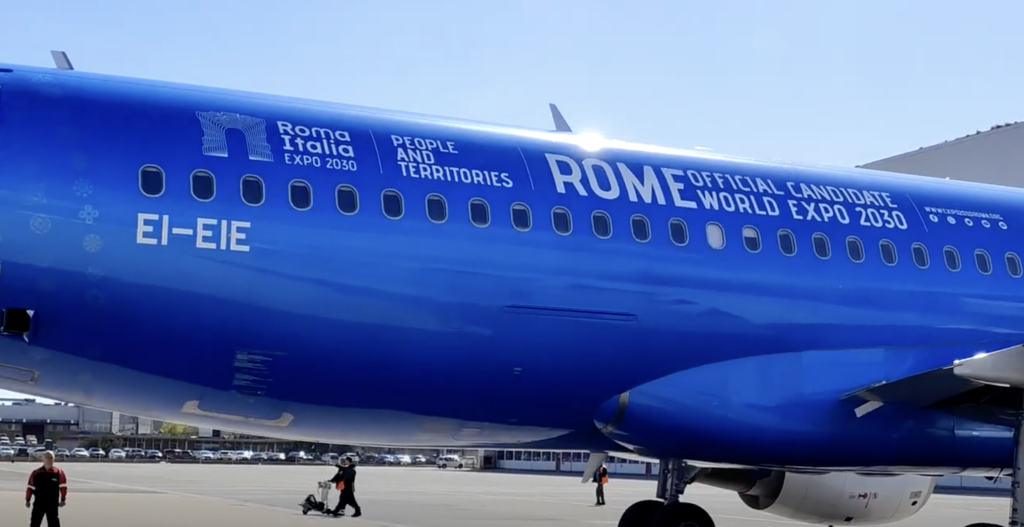
The Italian Committee for the Promotion of Rome’s Candidacy for EXPO 2030 and ITA Airways have decided to support Rome’s Candidacy for the World Expo 2030 by creating a special livery with the EXPO 2030 Rome logo, the theme of the event “People and Territories” and the inscription “Rome – Official Candidate World Expo 2030”.

ITA Airways, commits itself to accompany diplomatic delegations and staff of the Committee on missions to promote this Candidacy in selected countries of interest.

ITA Airways Rome EXPO2030 special livery. (Photo | ITA Airways)

Vincenzo Claudio Piscopo

Vincenzo graduated in 2019 in Mechanical Engineering with an aeronautical curriculum, focusing his thesis on Human Factors in aircraft maintenance. In 2022 he pursued his master's degree in Aerospace Engineering at the University of Palermo, Italy. He combines his journalistic activities with his work as a Reliability Engineer at Zetalab.

Airlines Promote Net-Zero Emissions for Earth Day 2023

Air Canada marks Earth Day by announcing the purchase of 9.5 million litres of Sustainable Aviation Fuel (SAF) (Photo | CNW Group/Air Canada)

The global aviation industry’s target to reach net-zero carbon emissions by 2050 includes a number of reduction measures agreed upon at an International Civil Aviation Organization (ICAO) conference last year. The World Economic Forum says these measures include ‘ramping up innovative aircraft technologies, “streamlining” flight operations and the increased production and use of sustainable aviation fuels (SAF).’

Pre-pandemic the aviation industry was reported to contribute 2.5 percent to global carbon dioxide emissions and to have a 3.5 percent non-carbon dioxide-related impact on climate. This compares to 8.5 percent of worldwide emissions attributable to agriculture and 10 percent to the fashion industry.  However, it is estimated that only 20 percent of the world’s population utilizes aviation services hence the industry’s actions to achieve a net-zero target by 2050.

With Earth Day 2023 on Saturday, April 22, a number of airlines are taking the opportunity to announce their latest initiatives to contribute toward the net-zero goal. Air India, Air Canada and Cathay Pacific are some of the airlines undertaking initiatives to commemorate the worldwide awareness campaign that marks the anniversary of the birth of the modern environmental movement in 1970.

Air India announced this week that the airline has ‘minimized single-use plastic usage by approximately 80 percent onboard all flights across its worldwide network.’ The carrier undertook a number of initiatives to achieve the target, including the 100 percent removal of 500ml plastic water bottles from all Economy Class seat pockets on widebody aircraft operating international flights, the replacement of plastic straws with paper straws, and the introduction of reusable linen bags on board.

Air Canada announced the purchase of 9.5 million liters of Sustainable Aviation Fuel (SAF) to ‘power flights from San Francisco airport.’ The airline’s partnership with SAF producer Neste and the use of SAF is a core pillar of the carrier’s Climate Action Plan. Michael Rousseau, President and CEO at Air Canada, stated: “At Air Canada, we have adopted a multifaceted approach to addressing climate change and sustainability. Environmental and social factors are incorporated into our strategic decisions, as are our fleet purchases and daily operations through our support of low-carbon alternatives.”

Rousseau added: “We have been purchasing Neste’s SAF since February 2022. Today’s announced purchase represents a five-fold increase in our SAF procurement year over year, and it is an important step towards our target of one percent fuel to be SAF by 2025, supporting our journey towards our 2050 net zero decarbonization goals.”

The Manila Times reports that Cathay Pacific staff, ‘trade agents and other partners will be gathering at various mangrove forests across Southeast Asia in April and May to kickstart the planting of mangrove trees in their respective countries.’ The planting of over 20,000 mangrove trees comes as the result of the airline’s ‘1 Ticket, 1 Tree’ campaign held in Thailand, Indonesia, Malaysia, Vietnam, Cambodia and Singapore in November 2022. The project started in Thailand the previous year and was expanded in 2022.

The airline chose the initiative as ‘many communities in Southeast Asia depend on mangroves for food, protection, and income. Conservation of mangrove forests can support the local communities and protect their livelihoods.’  Dominic Perret, regional general manager of Cathay Pacific Southeast Asia and Southwest Pacific, said: “We are excited to continue contributing to projects that make a difference to the communities we serve.”

John Flett

John has always had a passion for aviation and through a career with Air New Zealand has gained a strong understanding of aviation operations and the strategic nature of the industry. During his career with the airline, John held multiple leadership roles and was involved in projects such as the introduction of both the 777-200 and -300 type aircraft and the development of the IFE for the 777-300. He was also part of a small team who created and published the internal communications magazines for Air New Zealand’s pilots, cabin crew and ground staff balancing a mix of corporate and social content. John is educated to postgraduate level achieving a masters degree with Distinction in Airline and Airport Management. John has held the positions of course director of an undergraduate commercial pilot training programme at a leading London university. In addition he is contracted as an external instructor for IATA (International Air Transport Association) and has been a member of the Heathrow Community Fund’s ‘Communities for Tomorrow’ panel.

Avelo Announces Delaware Route Expansion

The Avelo aircraft is seen during the Avelo Air aircraft shoot at Hollywood Burbank Airport on April 07, 2021 in Burbank, California. (Photo: Joe Scarnici/Getty Images for Avelo Air)

On Thursday, Avelo Airlines announced yet another route expansion, growing its Wilmington, Del. base from five destinations served to 14. The Houston-based carrier continues its aggressive expansion strategy across the eastern seaboard and in the Delaware Valley, almost tripling service out of Wilmington just three months after beginning service out of the city. 

The carrier announced that new non-stop routes will span five states and complement services to warm weather destinations which began in February of this year. New cities will include: 

  • Charleston, S.C.
  • Daytona Beach, Fla. 
  • Greenville/Spartanburg, S.C.
  • Melbourne, Fla.
  • Myrtle Beach, S.C.
  • Nashville, Tenn. 
  • Savannah, Ga. / Hilton Head, S.C.
  • Wilmington, N.C. 

The carrier will operate all routes to the cities listed above, with the exception of flights to and from Myrtle Beach, twice weekly. Myrtle Beach will be operated three times weekly. All routes will begin towards the end of June. 

Operating flights two days a week instead of daily allows the carrier to operate to more destinations using fewer aircraft. Avelo will operate to all 14 destinations out of Wilmington using two Boeing 737-800 aircraft. The carrier currently has one deployed in the base, bringing in an additional type in June to aid in expansion. 

Different Cities, Same Name

Similar to Breeze’s Charleston to Charleston route, Avelo will operate a flight between two cities with the same name, Wilmington, Delaware to Wilmington, North Carolina.

The expansion also deepens Avelo’s impact with smaller cities that the carrier just announced service to, such as Daytona Beach and Melbourne, Florida. Avelo has yet to begin service to either city, yet is banking on strong demand, adding additional flights.

The Houston-based carrier has reported strong numbers operating out of Wilmington so far. Since the inaugural flight out of Wilmington on February 1st, the carrier has reported flying over 25,000 customers to and from the city according to their most recent press release. Situated between Philadelphia and Baltimore, alongside Southern New Jersey, the carrier has decided to use Wilmington’s New Castle Airport which is a smaller alternative to the bigger hubs in surrounding cities. Based on passenger numbers, this is working well for Avelo and fits into their business model. 

The carrier is also the only airline offering service to the state of Delaware. In its history, multiple airlines have operated in and out of New Castle airport, most recently Frontier Airlines in 2021 and 2022. This was a re-entrance into the market after the carrier had initially suspended service in 2016 sighting an inability to make a sustainable profit.

Frontier only made a brief stint in its return to the state, flying for a little over a year between Wilmington and Orlando, Florida before yet again suspending operations to the airport. Throughout drops in airline coverage, Delaware was the only state in the United States without airline service, most recently occurring from June 2022 to January 2023. 

Avelo, however, seems to have cracked the code thus far operating out of Delaware. Showing that the company will continue building upon its initial foundation in Wilmington, the carrier announced it will also be adding at least 35 new jobs in the hub, growing its New Castle operation to over 100 employees.

Zach Cooke

Zach’s love for aviation began when he was in elementary school with a flight sim and model planes. This passion for being in the air only intensified throughout high school when he earned his Private Pilot Certificate. He then attended Embry-Riddle Aeronautical University, earning his certificates and ratings to later flight instruct and share his passion for aviation with others. He now resides in the North East living out his dream as an airline pilot.

Expanded Canada-UAE Air Transportation Agreement Offers New Routes

An Air Canada 787-9 departing (Photo: Air Canada)

A recent expansion of the air transport agreement between Canada and the United Arab Emirates (UAE) has led to several route announcements from carriers from both countries. The announcements cover new routes as well as increased frequencies on existing routes.

Air Transport Agreement

Air transport agreements are formal treaties between governments that allow for commercial air service between two jurisdictions. The foundation for these agreements was set out in the 1944 Chicago Convention, which established the International Civil Aviation Organization (ICAO) and set out agreed rules around issues such as airspace, safety and aircraft registration.

These agreements generally include language governing various aspects of commercial aviation between the signatories. For example, they usually have language outlining procedures for cooperation on matters of security and provisions for mutual recognition of licenses and certificates.

Other parts of the agreements deal with matters such as taxation, tariffs and settlement of disputes. Typically, a route schedule is included in the annex of an air transport agreement.

Negotiations for the UAE-Canada air transport agreement were first concluded in 1999. That agreement permitted each country to allow its airlines to operate six flights per week in each direction as of June 1, 2003.  The agreement was expanded in 2018, increasing the cap to 14 weekly flights in each direction.

The 2018 expansion also included a capacity restriction but allowed each government to allocate 68 per cent more capacity among its carriers than before. On April 5, the governments of Canada and the UAE announced that the agreement had once been expanded. Each country’s airlines can now operate 21 flights in each direction, and the capacity limit has been removed.

Increased Frequencies and New Routes

Prior to the announcement of the expanded agreement, Canada had been using half of its allocated frequencies with Air Canada’s daily service between Toronto’s Pearson International Airport and Dubai, UAE’s International Airport. Since 2007, Emirates has also flown between Dubai’s International Airport and Toronto’s Pearson International Airport, with five weekly flights prior to the announcement.

Etihad Airways flies six times per week between Abu Dhabi International Airport and Toronto’s Pearson International Airport. While the UAE airlines were only using 11 of the country’s 14 weekly frequencies, they had effectively maxed out their capacity allocation due to the agreement’s capacity limit.

Three days after the announcement of the expanded agreement, Emirates announced that it would be increasing the frequency of its Dubai–Toronto service to one flight daily as of April 20, up from the previous five flights per week. Shortly afterwards, Etihad also announced that it would add an additional weekly flight on its Abu Dhabi–Toronto route to make it a daily service as well. Etihad’s frequency increase is scheduled to start on May 30.

On April 13, Air Canada announced a new route between Vancouver International Airport and Dubai International Airport. The new service is scheduled to be operated four times weekly by the carrier’s Boeing 787-9 aircraft starting on October 28.

Although a formal announcement has not been made yet, Milesopedia and MTLURB have reported that Emirates will be launching a new route between Dubai International Airport and Montréal’s Trudeau International Airport starting on July 5.

The service will reportedly be operated by Boeing 777s, and its launch would mean that the UAE would be using all its allocated frequencies under the air transport agreement.

Andrew Chen

Andrew is a lifelong lover of aviation and travel. He has flown all over the world and is fascinated by the workings of the air travel industry. As a private pilot and glider pilot who has worked with airlines, airports and other industry stakeholders, he is always excited to share his passion for aviation with others. In addition to being a writer, he also hosts Flying Smarter, an educational travel podcast that explores the complex world of air travel to help listeners become better-informed and savvier travelers.

Violent Clashes in Sudan Shut Down Khartoum Airport, Damage Aircraft

Saudia 777
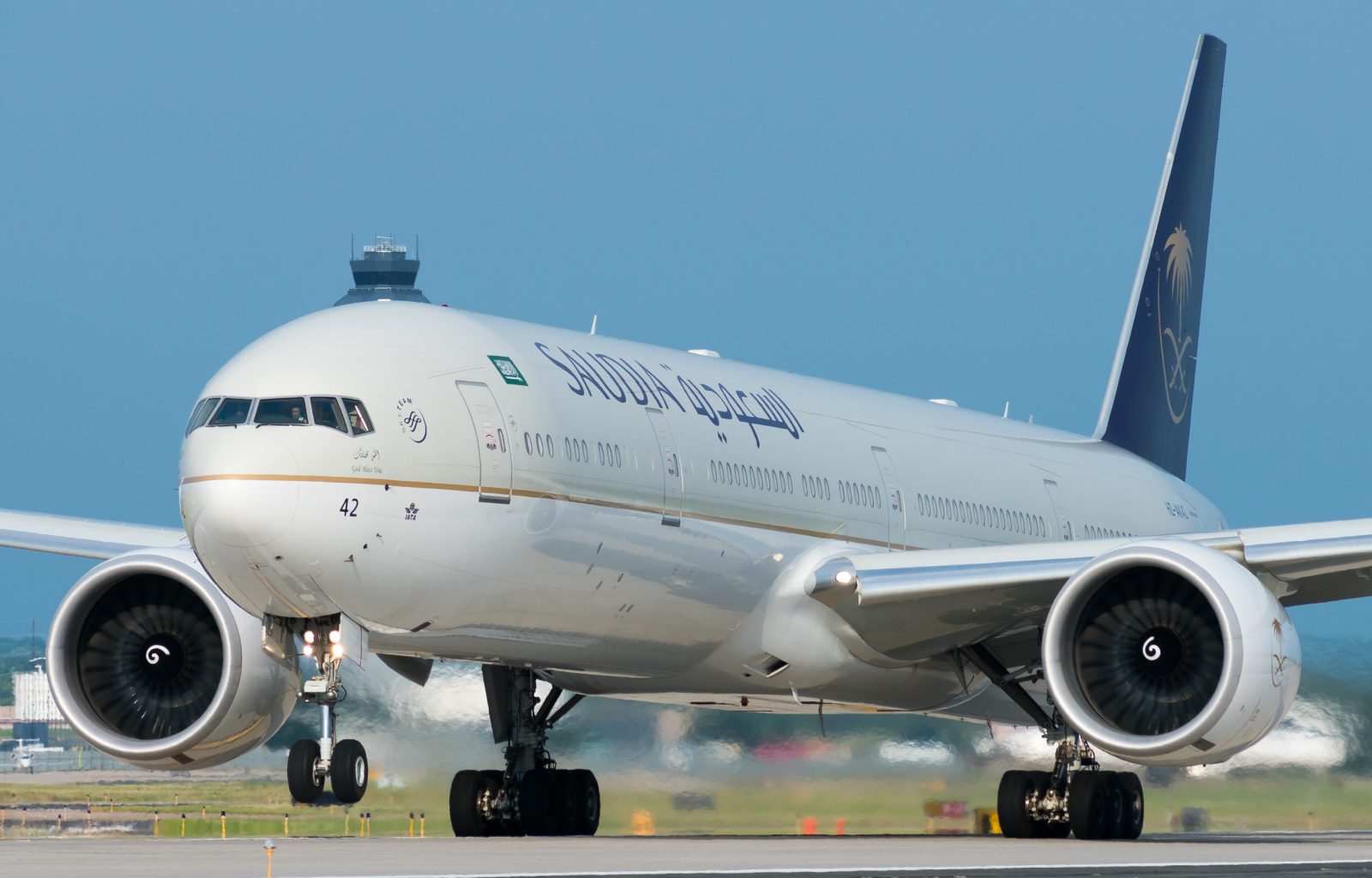
A Saudia 777-300ER at Washington Dulles. (Photo: AirlineGeeks | Ben Suskind)

Sudan has been in a state of unrest since the military takeover of the civilian government in October 2021. The situation took a turn for the worse on April 15 when violent clashes between the Sudanese military and the Rapid Support Forces (RSF) paramilitary group erupted in the capital city of Khartoum, leading to the closure of Khartoum International Airport (KRT) and the destruction of two parked aircraft.

Videos shared on social media showed burning aircraft on the apron, and travelers taking cover inside the airport’s departure hall. The RSF reportedly attempted to take over the airport, leading to an exchange of gunfire with the military. The conflict has raised concerns about the safety of air travel in Sudan.

Saudia’s Airbus A330-300, which was preparing for departure to Riyadh, was one of the aircraft that suffered damage during the clashes. The airline confirmed the attack in a statement, saying that it was working with the Saudi embassy and local authorities to find out what happened as crews and passengers were escorted to the Saudi Arabian embassy in Khartoum.

Another aircraft that suffered damage was a Boeing 737-800 operated by Ukraine’s SkyUp Airlines. SkyUp, which operates 12 Boeing 737s, was established as a charter and wet lease provider after being badly hit by the war in Ukraine. The incident in Sudan is a severe blow to the Ukrainian airline.

Impact of Closure of Sudan Airspace

Sudan airspace is an important highway for quite a few key global routes and its closure has had a significant impact on major airlines operating in Africa. Turkish Airlines, for instance, may have to reroute about 15 flights to 11 African countries due to the closure. Qatar Airways may have to reroute four flights to three African countries (Nigeria, Ghana, and Côte d’Ivoire) and four flights to three South American countries.

Dubai-based Emirates Airlines has also been affected, with the closure potentially requiring the rerouting of four flights to three African countries (Nigeria, Ghana, and Côte d’Ivoire) and three flights to two South American countries (Argentina and Brazil). Meanwhile, Etihad Airways may have to reroute one flight to Nigeria, while Saudi Airlines may have to reroute two flights to Nigeria.

Egyptian airline EgyptAir announced it suspended flights to and from Khartoum for 72 hours over security concerns. Egypt’s Ministry of Foreign Affairs said Cairo is following the situation in Sudan with great concern amid the ongoing clashes, urging maximum restraint to “protect the lives and capabilities of the brotherly Sudanese people, and uphold the supreme interests of the homeland.”

Of all the airlines potentially affected by the closure, Ethiopian Airlines has the most significant exposure due to its geographic position. The airline may have to reroute up to 38 routes in its network. However, the impact on its African network is minimal, with only a few flights being affected.

Tensions Between Army and RSF

The sustained fighting between the Sudanese army and paramilitary Rapid Support Forces (RSF) broke out in the Sudanese capital on April 15, including central Khartoum and the neighborhood of Bahr. The RSF said they were in control of several key sites following fighting with the regular army Saturday, including the presidential palace in the capital and Khartoum airport, reported AFP.

The General Command of the Armed Forces issued a press statement on Saturday, saying that rebel forces are conspiring against the state and national sovereignty and have been engaging in acts of aggression against Sudan. In response, the armed forces have been fighting for the “right and national dignity” of the country with soldiers shedding “precious blood” in the process.

Tensions between the army and the RSF have simmered since the military take-over of the civilian government in October 2021.

Victor Shalton

Victor Shalton's love for aviation can be traced to when he was 11-years-old. As a seasoned aviation writer, he takes pride in providing the best aviation coverage around the globe and is passionate about advancing his skills in the aviation space. In addition, he loves travelling, writing, arts and while his speaking engagements have taken him around the world, he is proud to call Nairobi home.
Sign-up for newsletters & special offers!

Get the latest stories & special offers delivered directly to your inbox

SUBSCRIBE

Uh-oh! It looks like you're using an ad blocker.

Our website relies on ads to provide free content and sustain our operations. By turning off your ad blocker, you help support us and ensure we can continue offering valuable content without any cost to you.

We truly appreciate your understanding and support. Thank you for considering disabling your ad blocker for this website