Stories

Trip Report: Porter Airlines’ Inaugural Vancouver Round Trip

An Embraer E195-E2 Registered as C-GKQJ Pulling into Toronto Pearson's Gate B39 (Photo: AirlineGeeks | Andrew Chen)

Porter Airlines marked the beginning of a new chapter with its inaugural flights between Toronto Pearson International Airport and Vancouver International Airport and I had a chance to experience the special occasion.

Since its inception in 2006, Porter has operated a fleet of De Havilland Canada Dash 8 Q400 turboprops from its base at Billy Bishop Toronto City Airport but the airline is in a midst of a bold expansion. In July 2021, Porter and Embraer announced an order for 30 Embraer E195-E2s, making Porter the North American launch customer for Embraer’s E2 jets.

Towards the end of 2022, the airline announced that its first jet routes would connect Toronto Pearson International Airport with Ottawa Macdonald–Cartier International Airport, Montréal–Trudeau International Airport and Vancouver International Airport. These new routes not only signal the start of jet operations for the carrier, but also mark the beginning of Porter’s operations at Toronto Pearson International Airport. The announcement of its Vancouver route was particularly significant as it is the carrier’s first transcontinental route after having flown short-haul flights throughout eastern Canada and the United States over the past 16 years.

Along with the introduction of the Embraer E195-E2 to its fleet, Porter is debuting a revamped onboard product. Porter has long attempted to distinguish itself from other airlines by offering an elevated economy class experience, with offerings such as leather seats and free beer and wine served in glassware. With its expansion into transcontinental flights, the airline unveiled what they call a new “all-inclusive economy experience,” called PorterReserve. Its existing economy class product is now known as PorterClassic.
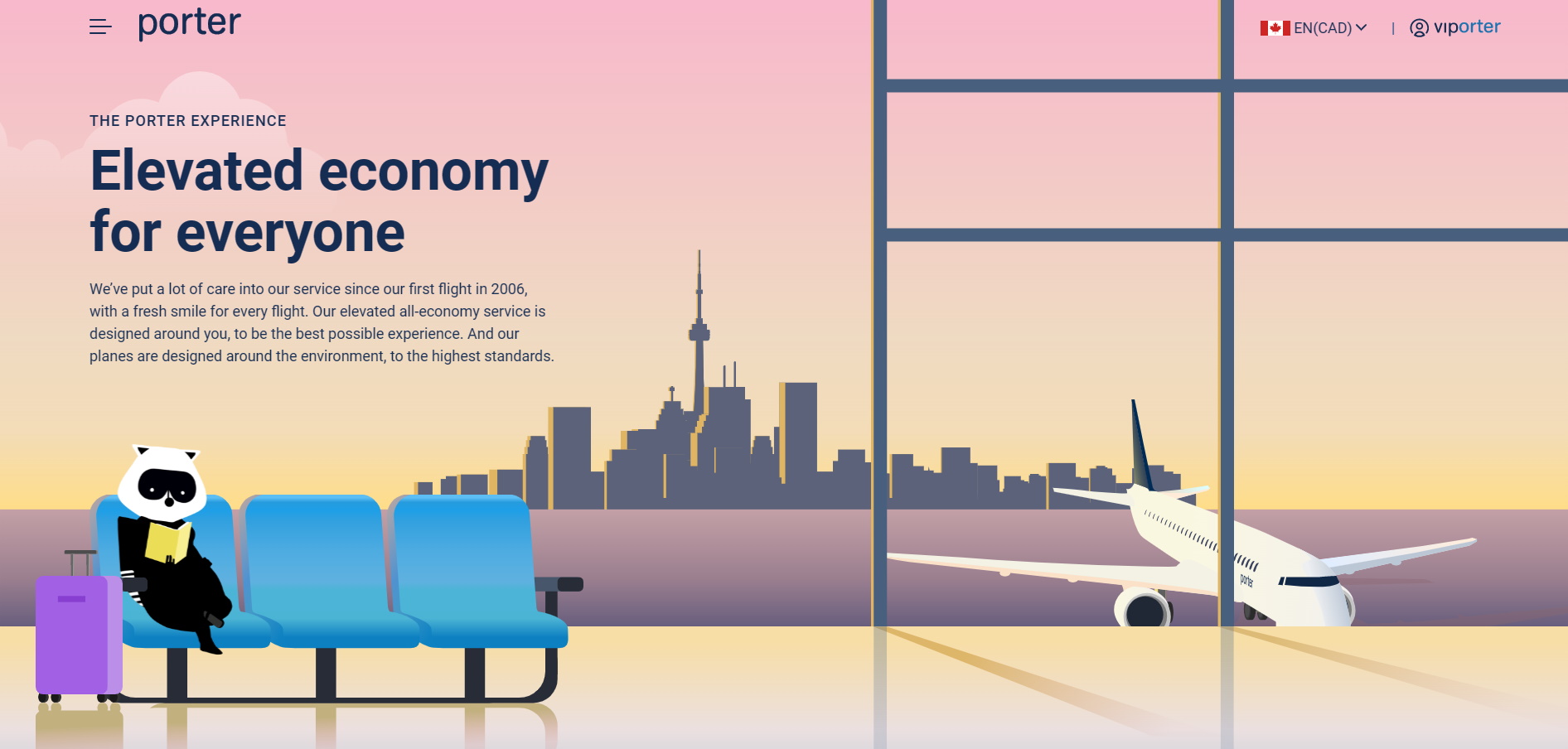
Porter has been promoting an elevated economy experience using the hashtag #ActuallyEnjoyEconomy (Photo: Porter Airlines)

The big day for Porter came on February 7, 2023 when the first flights to and from Vancouver were to take place. I was on board both flights to see what Porter had to offer in both PorterClassic and PorterReserve on its new transcontinental flights.

Toronto Pearson: Porter’s New Base

Porter Airlines began operations in 2006 with a small fleet of Dash 8 Q400s operating out of what was then known as Toronto City Centre Airport. The airport is located on an island off the shore of downtown Toronto. Porter currently operates 29 Dash 8 Q400s to destinations throughout central and eastern Canada as well as cities in the northeastern United States such as Chicago, New York and Boston. Jet aircraft are not allowed at the airport though, and Porter has started operating out of the much larger Toronto Pearson International Airport.

Porter operates out of Terminal 3, which is also served by WestJet, Air Transat and Sunwing, along with a number of Canadian low-cost carriers as well as some foreign carriers. Porter’s check-in area is located near the center of the high-ceilinged check-in hall, right beside the entrance to one of the security screening checkpoints. The check-in area has an area with self-service kiosks, a row of counters and a baggage drop area.

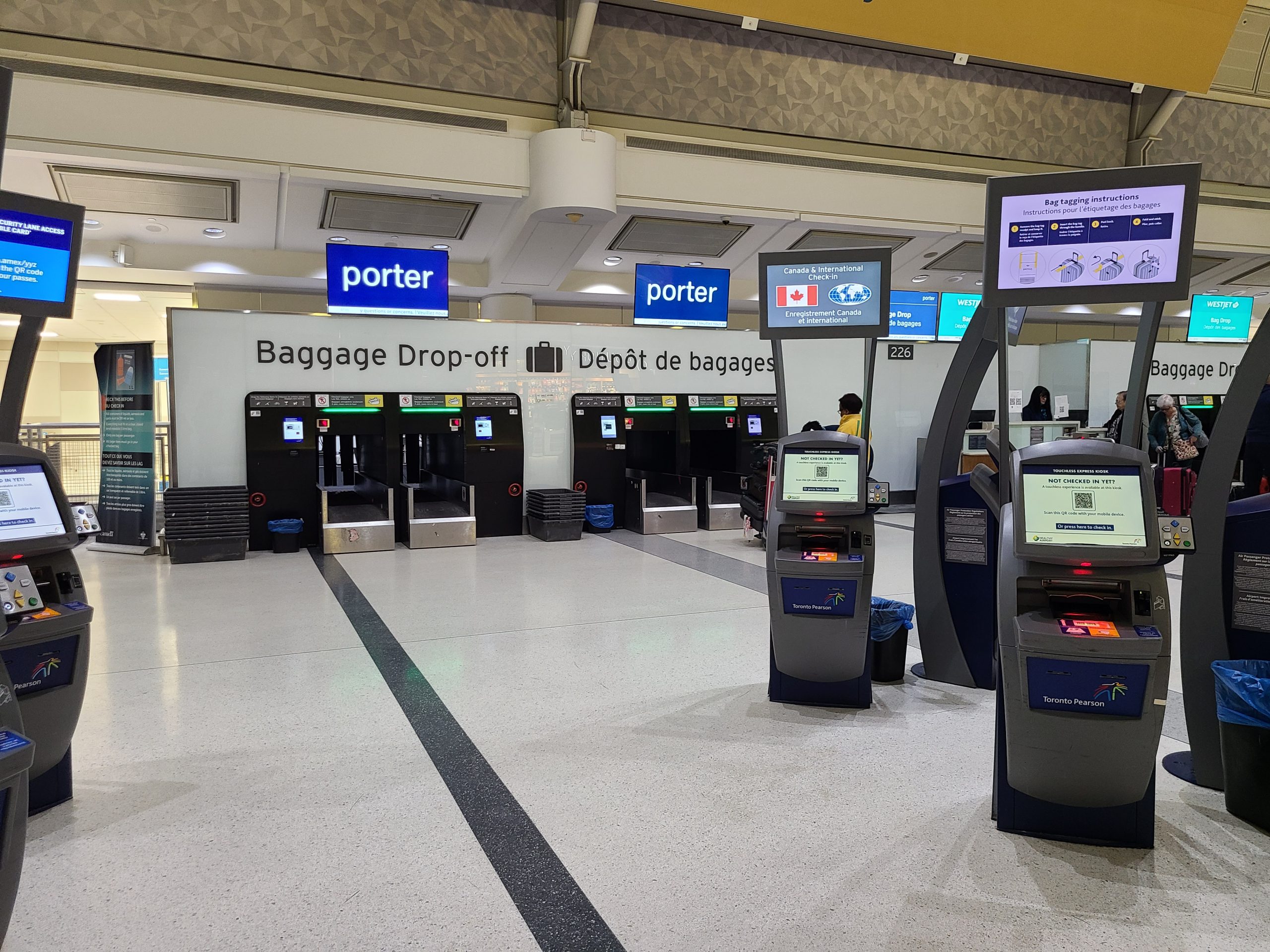
I had checked in online and had a boarding pass on my phone already. Porter doesn’t have a mobile app but I received my boarding pass via email. For the first flight to Vancouver, I was seated in PorterClassic. I would be seated in PorterReserve on the way back to Toronto.

I was quite early, having arrived at around 7:30 a.m. for a 10:15 a.m. flight. The Porter check-in and bag drop area was pretty quiet but I imagine that it will be busier as the airline adds more flights out of Toronto Pearson. I had no bags to check so I headed straight to security.

Toronto Gate Festivities

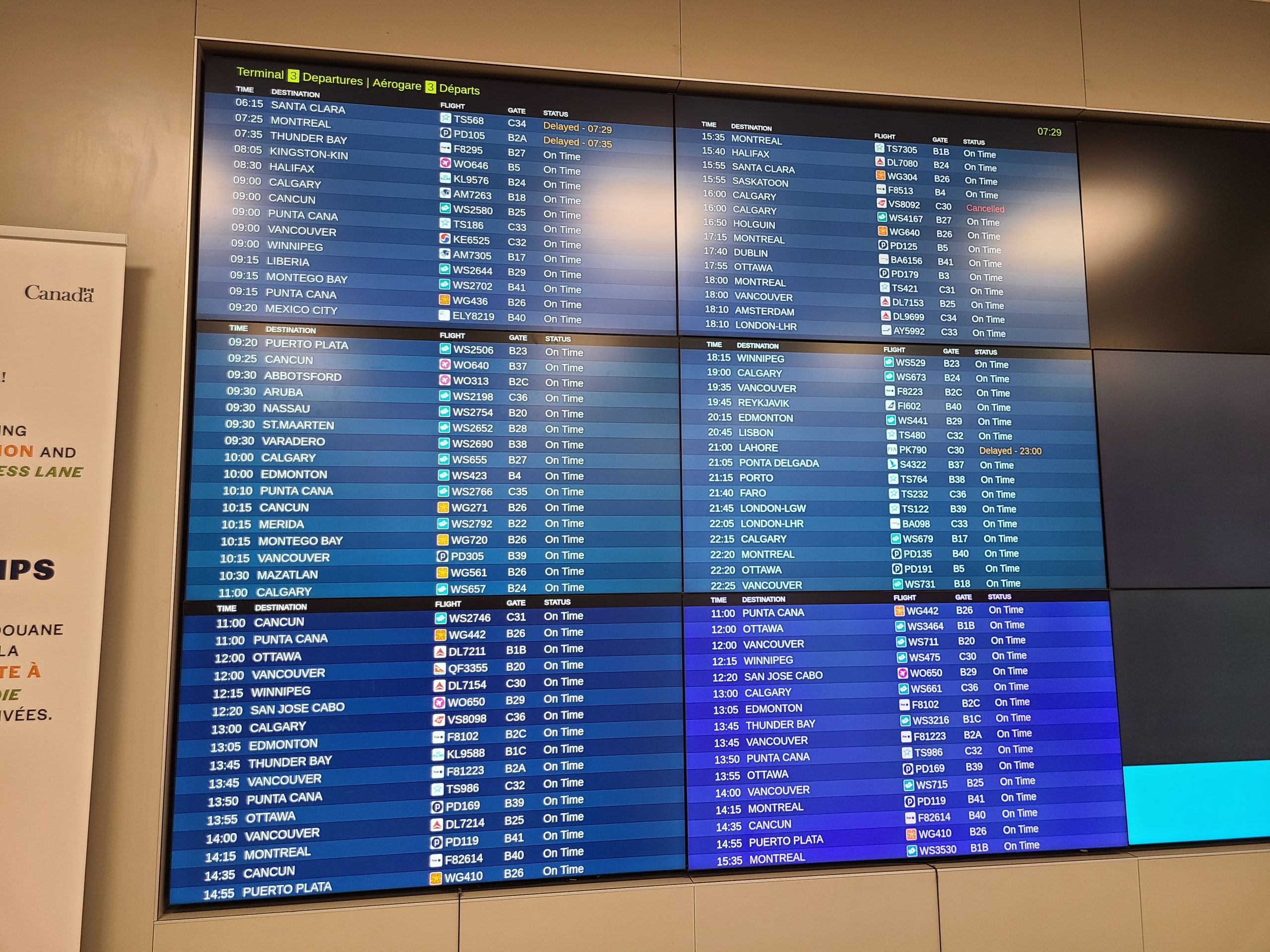
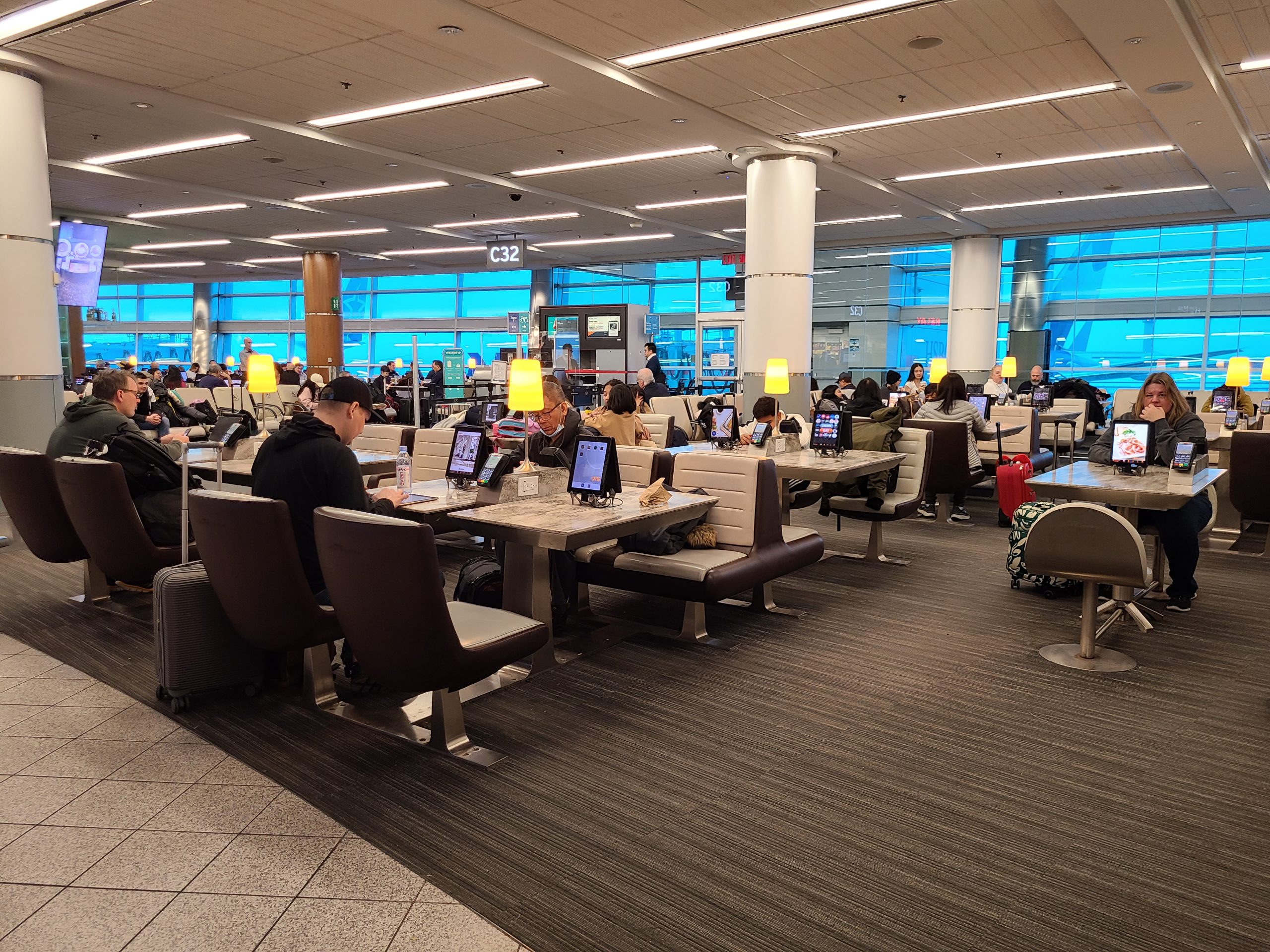
Porter’s inaugural flight to Vancouver was leaving from Gate B39. Since I had lots of time, I took a walk around the terminal. In addition to standard airport seating at each gate, Terminal 3 also has several lounge-style seating areas with power plugs and tablets for ordering food.
Around an hour and a half before departure, our aircraft was towed to the gate. The Embraer E195-E2 that would be taking us to Vancouver today was C-GKQJ, a brand new jet that was delivered to the airline in December and had entered service a week ago when Porter began its jet flights. The aircraft flew a few flights in January, presumably for flight crew training and ground crew familiarization.
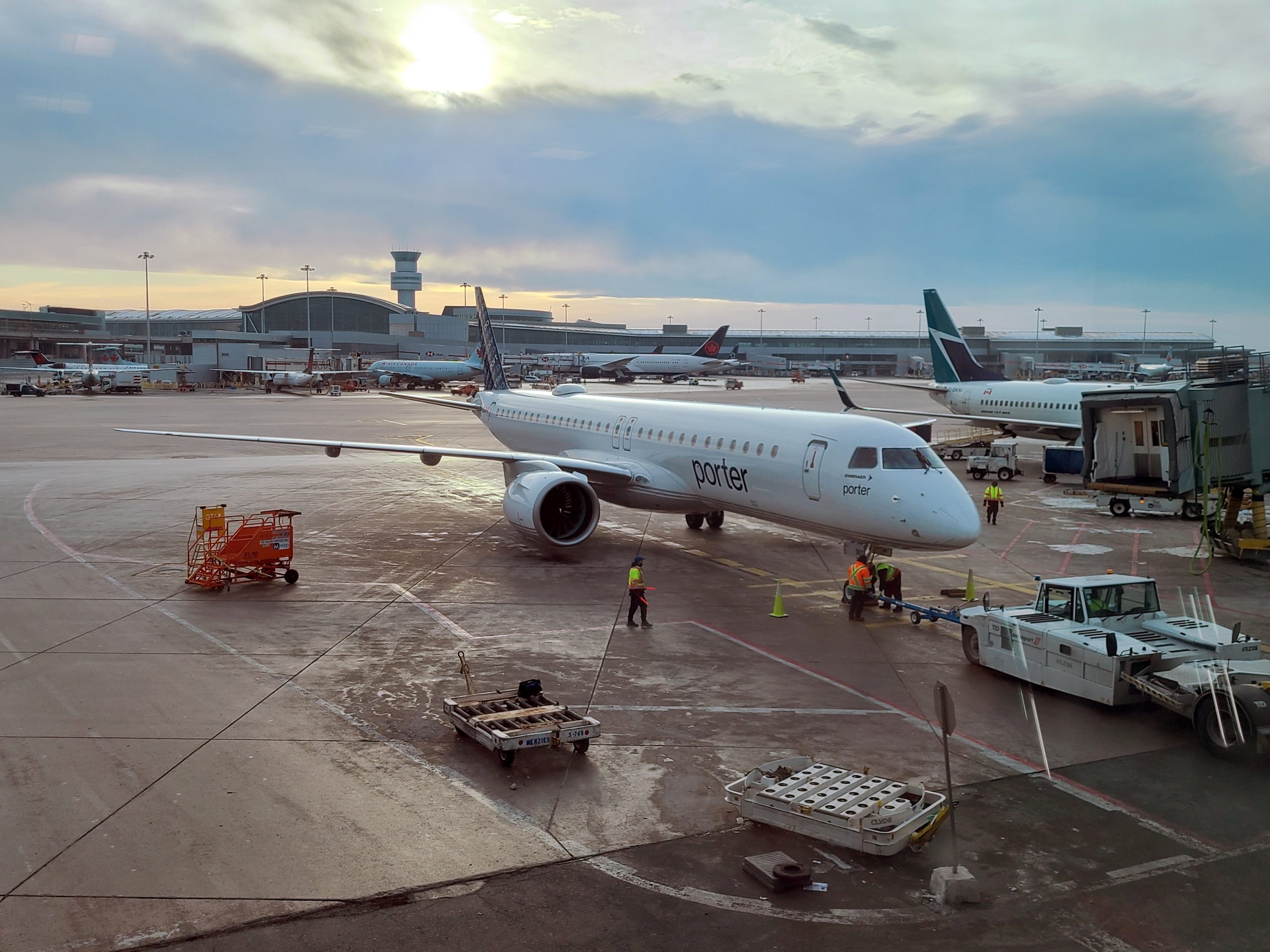
An Embraer E195-E2 registered as C-GKQJ pulling into Toronto Pearson’s Gate B39 (Photo: AirlineGeeks | Andrew Chen)

At around the same time, Porter staff began setting up the gate area for the inaugural flight. There was a table with coffee, tea and cookies.

Refreshments at the gate for Porter’s inaugural flight from Toronto to Vancouver (Photo: AirlineGeeks | Andrew Chen)

Beside the refreshments table, there was a small booth where there was a locked box and a rack of keys. Passengers could line up to pick a key and try to open the box. Porter staff continuously replenished the keys until a passenger opened the box and won a pair of roundtrip Porter tickets to any destination in their network.
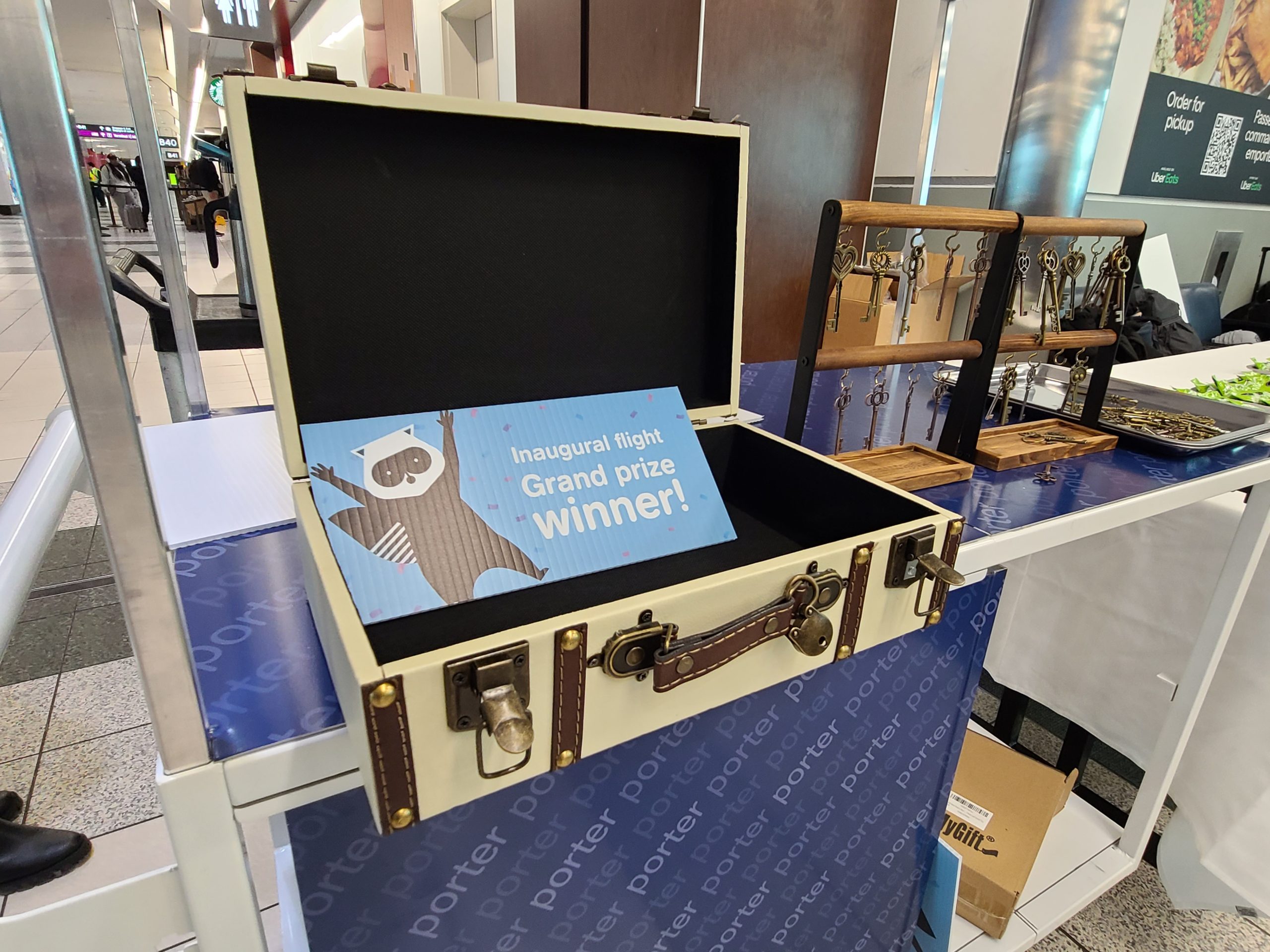
The box and keys after a passenger had won a pair of Porter tickets (Photo: Airline Geeks | Andrew Chen)

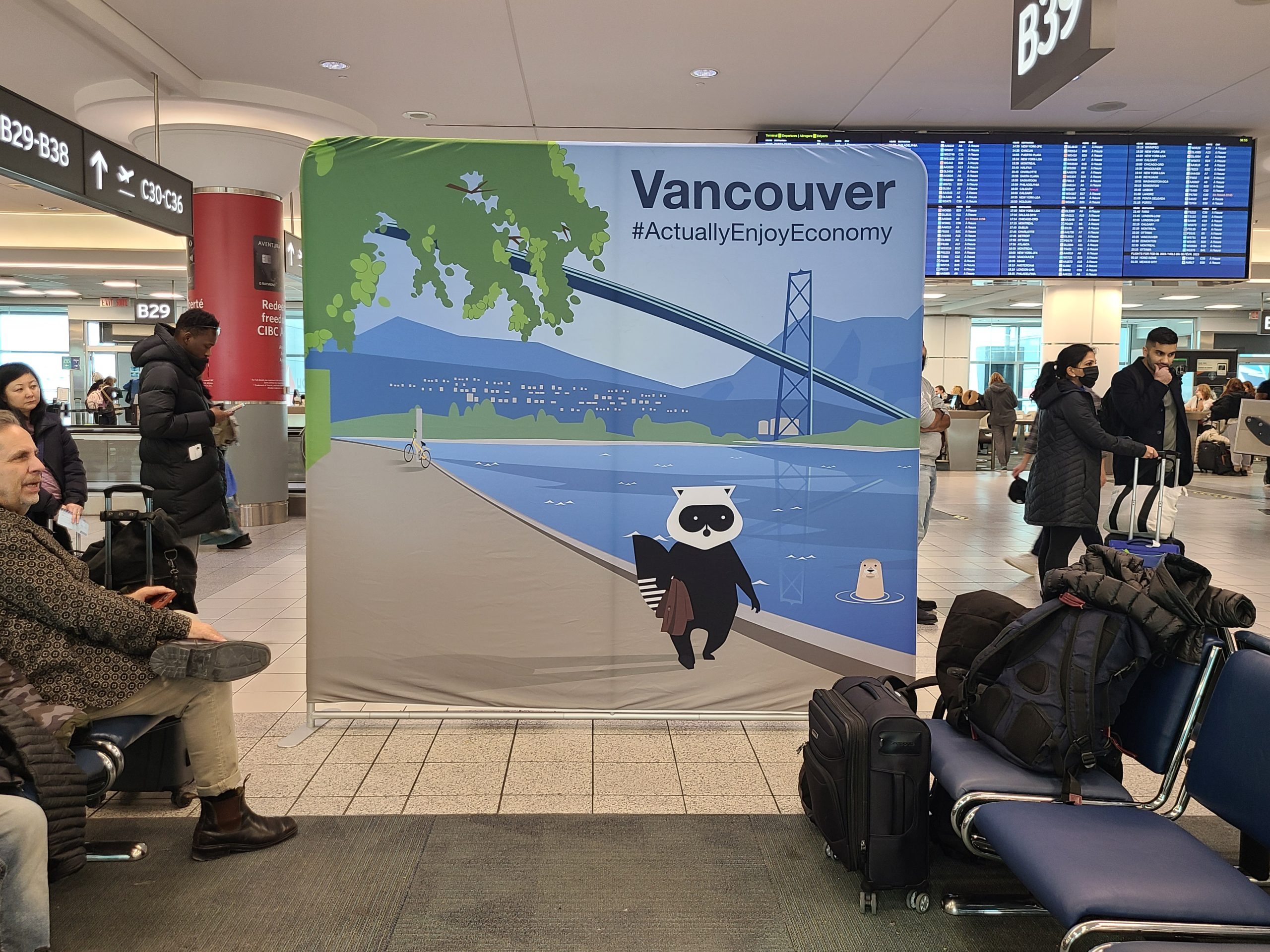
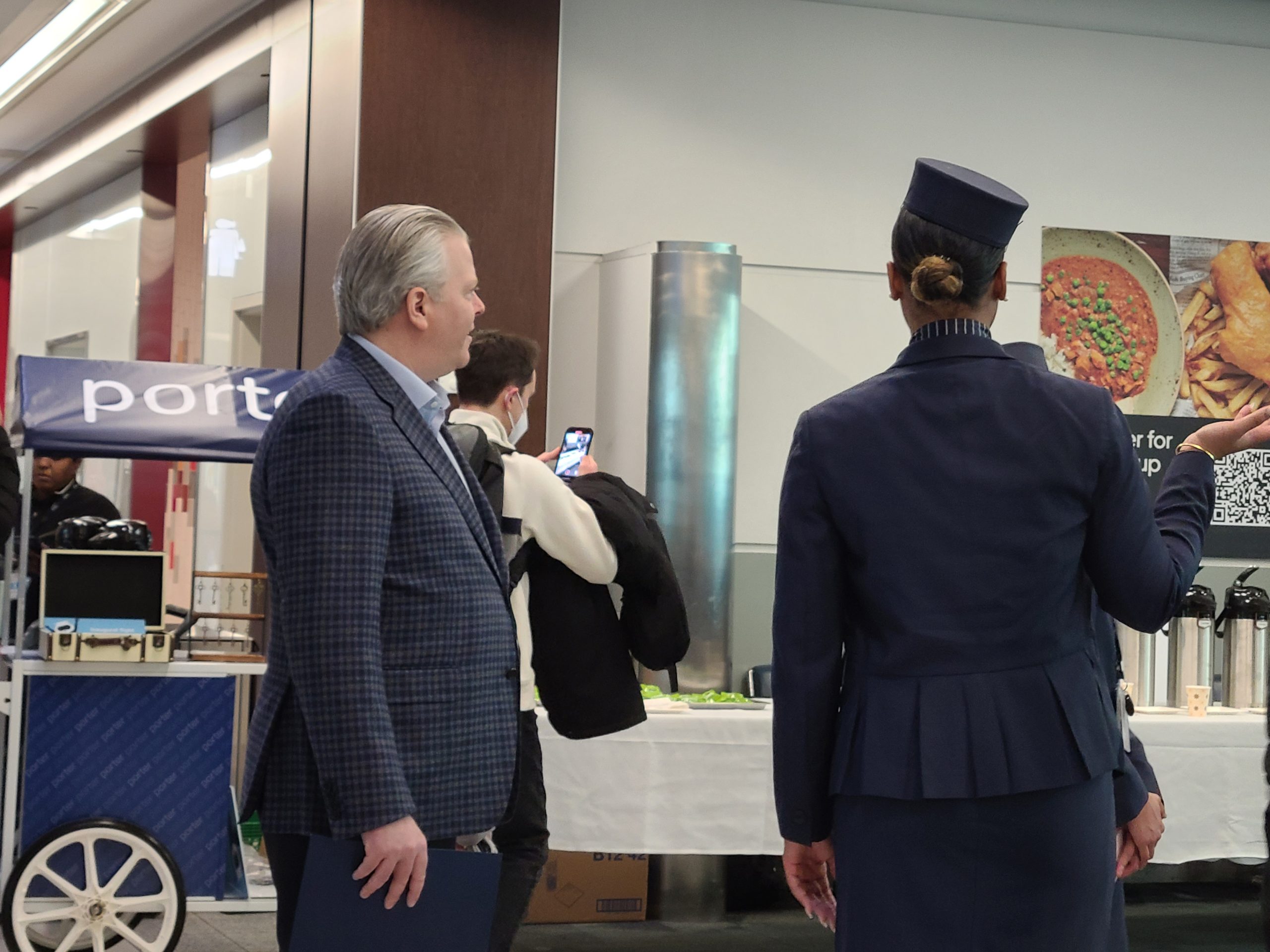
Porter had also set up a special Vancouver backdrop for photos. There were no speeches but Porter Airlines Chief Executive Officer (CEO) Michael Deluce was on hand to speak with employees and passengers and take some photos. I had the chance to chat with him briefly and he hinted that some more route announcements would be coming very soon. He was also on both inaugural flights.
Boarding started around five minutes early but ended up taking approximately 40 minutes, pushing our departure past the scheduled time of 10:15 a.m.

Cabin and Seats: Sleek and Modern

Porter’s Embraer jets are fitted with 132 economy class seats in a 2-2 configuration. The airline proudly states that it has no middle seats since both the E195-E2s and the Dash 8 Q400s have four across seating.
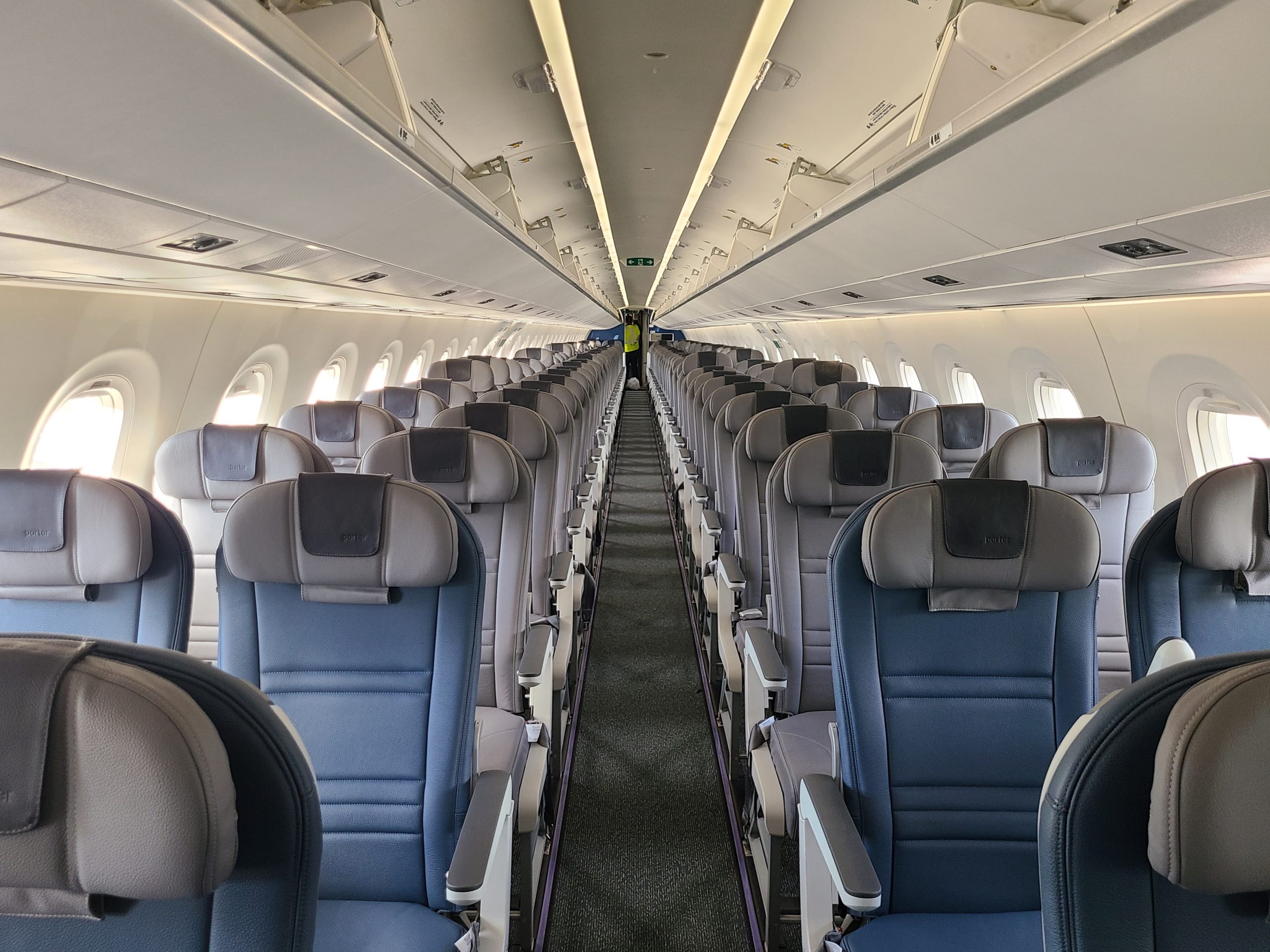
Porter Airlines Embraer E195-E2 cabin (Photo: AirlineGeeks | Andrew Chen)

On Porter’s E195-E2s, the first four rows are PorterReserve seats with 36 inches of pitch. All seats on the plane are 18.3 inches wide, a fairly decent width for economy class. The seats also feature an adjustable headrest.
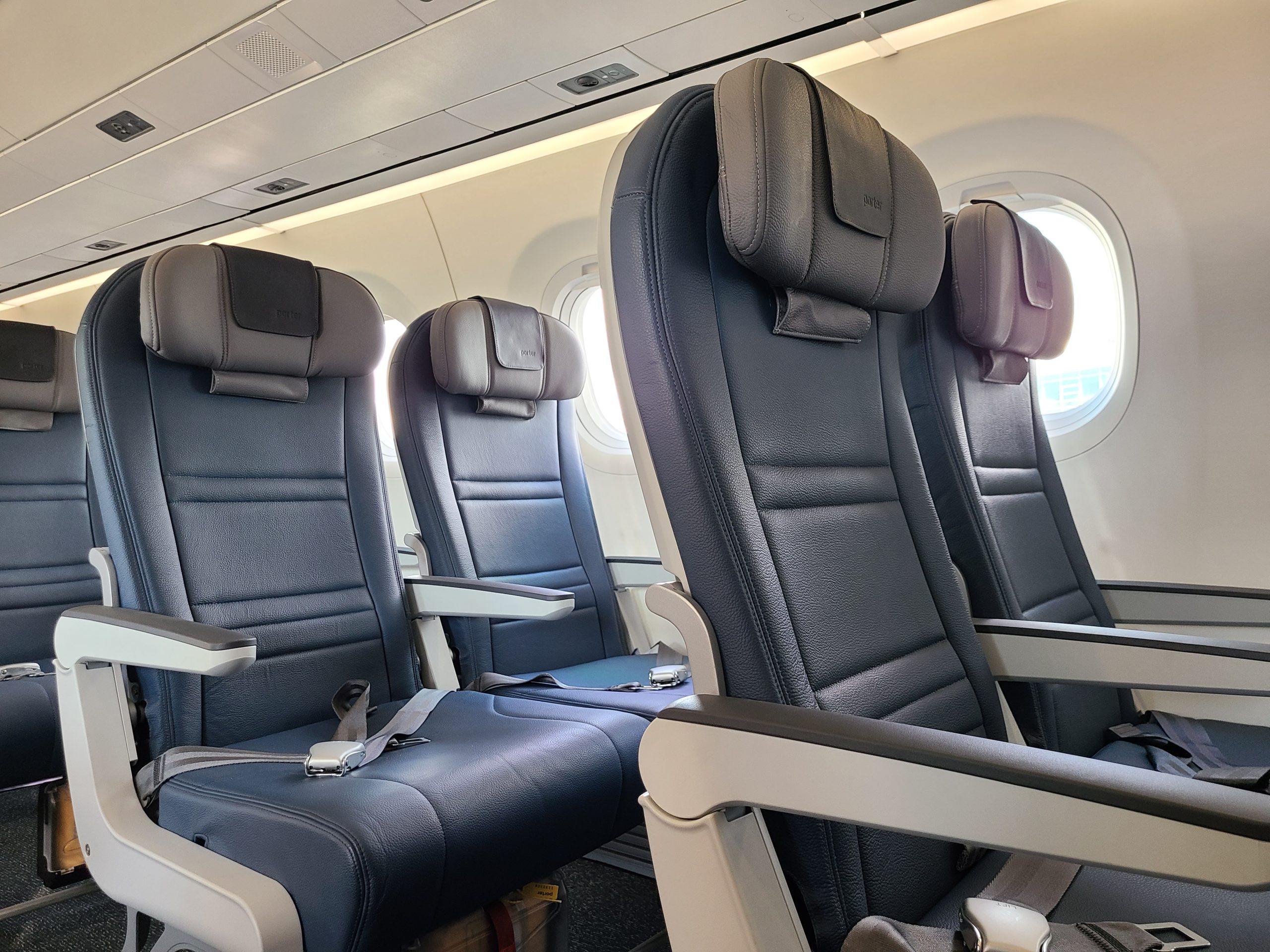
PorterReserve seats on Porter’s E195-E2 (Photo: AirlineGeeks | Andrew Chen)

PorterClassic seats are upholstered in grey and have 30 inches of pitch. Rows 5-7 and the two overwing exit rows have 34 inches of pitch and are called PorterClassic Stretch seats. There is an extra cost to select these extra legroom seats.
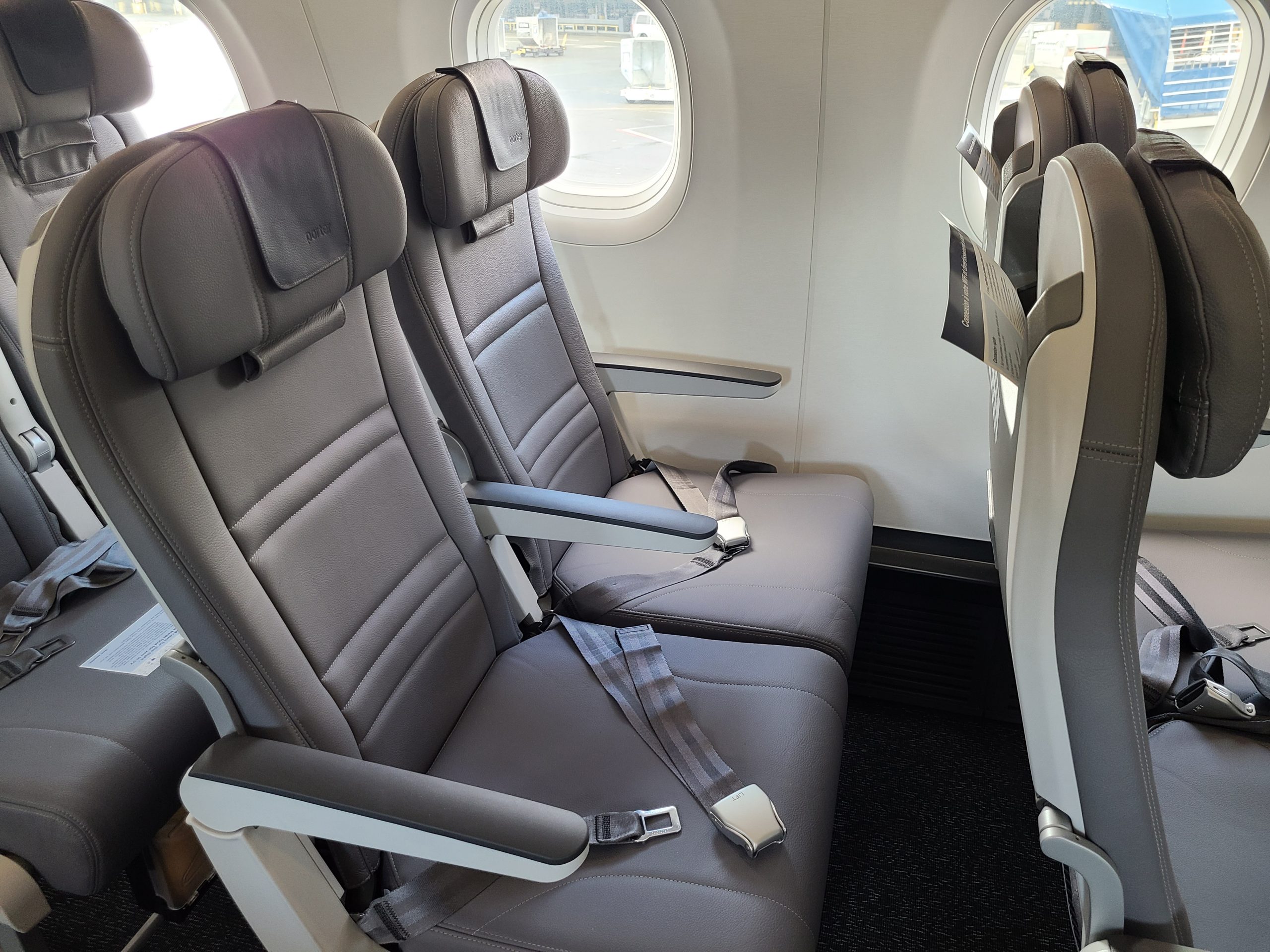
PorterClassic seats on Porter’s Embraer E195-E2 (Photo: AirlineGeeks | Andrew Chen)

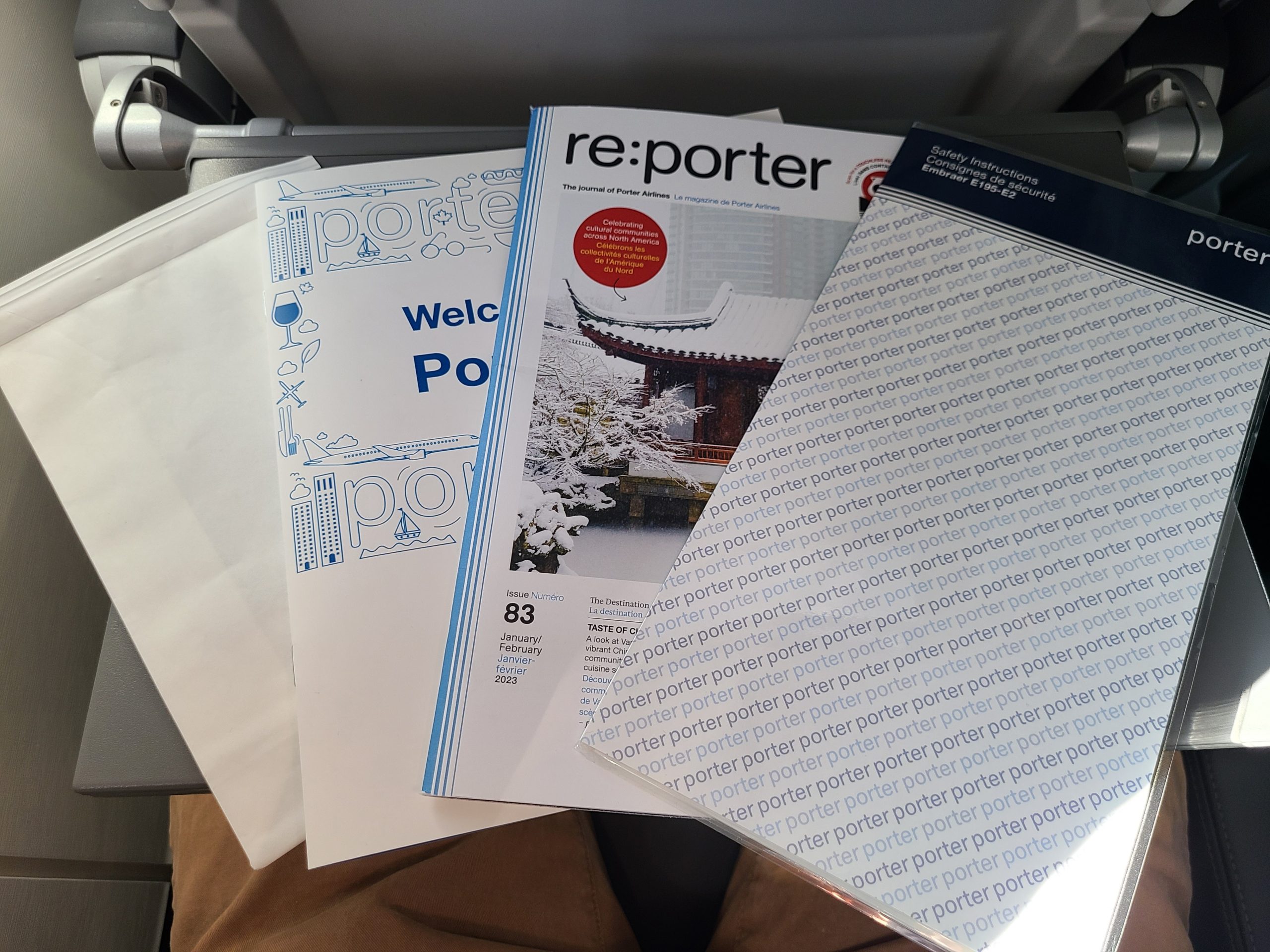
Each seat had a seatback pocket and a literature pocket that included the WiFi connection instructions. The seatback pocket had an air sickness bag, a copy of Porter’s inflight magazine, a safety card and a buy-on-board menu, which I will explore later.

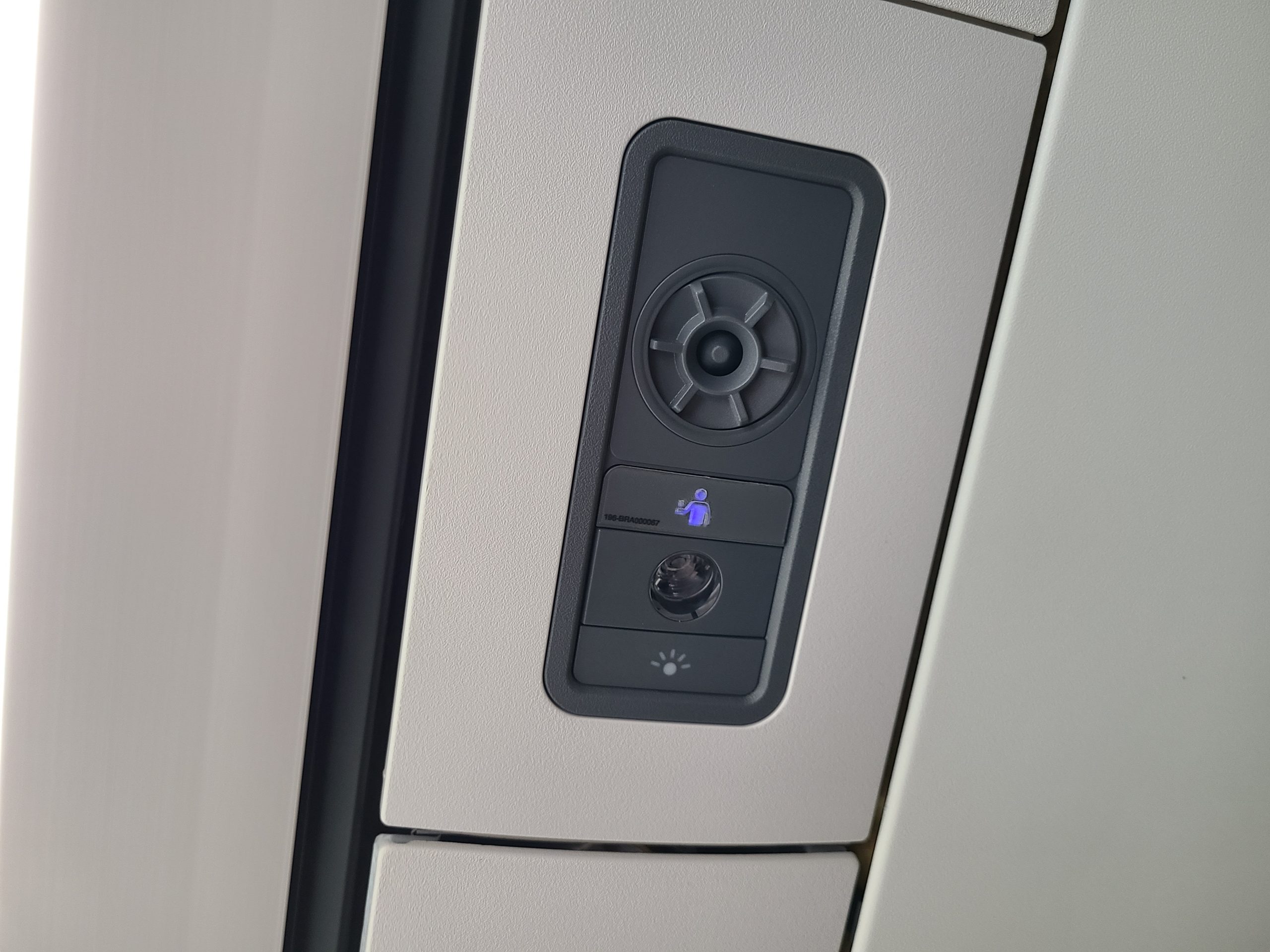
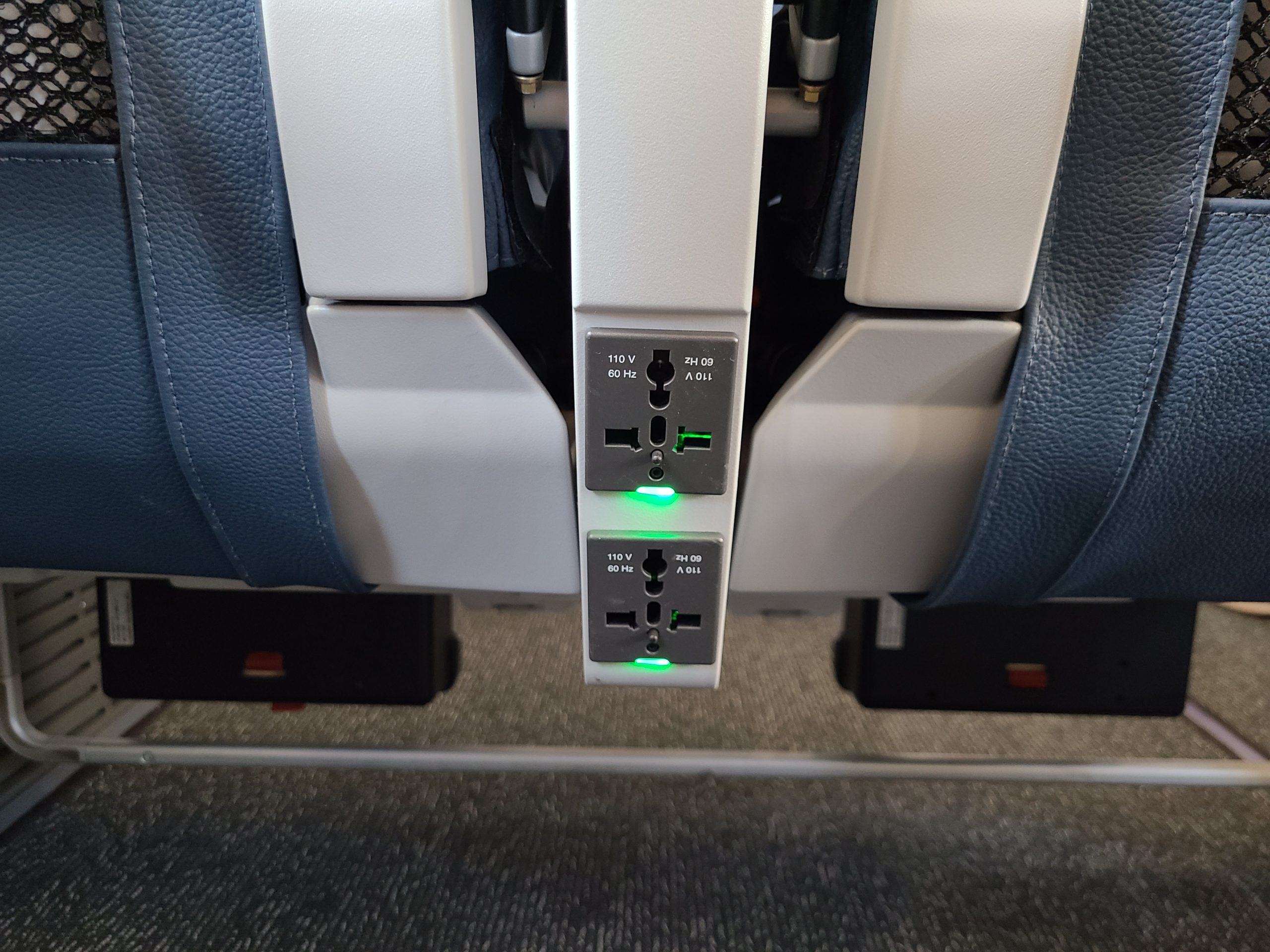
The overhead panel had a reading light, air vent and flight attendant call button. Each pair of seats also had two universal power plugs located between the two seats under the seatback pockets.
I noticed that many rows, including both rows that I sat in, had misaligned windows. On both flights, I had to either turn my head backwards or lean forward in my seat to look out the window. However, I realize that this isn’t really in Porter’s control but is rather an issue with how far apart the windows are on the E195-E2.
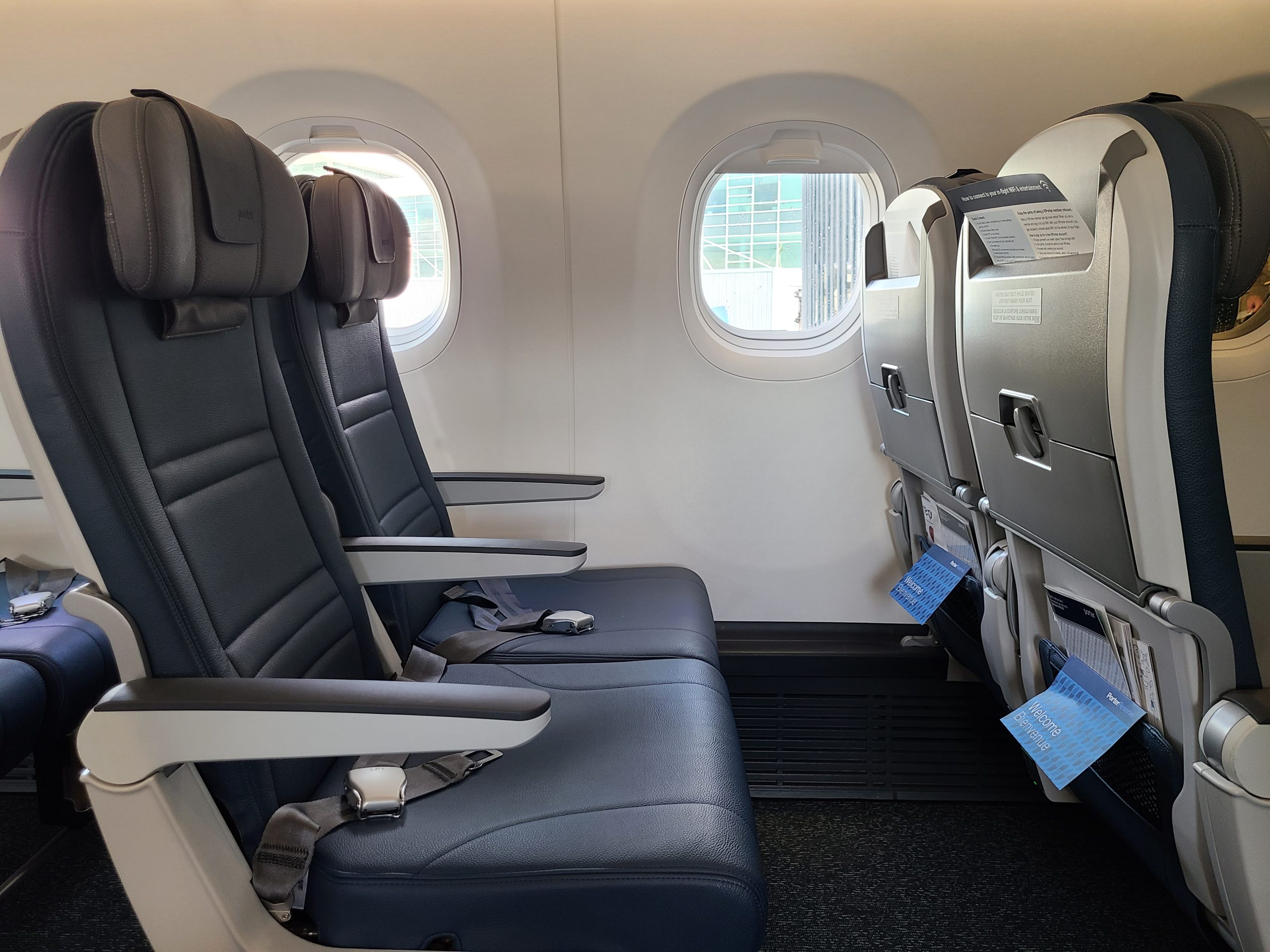
PorterReserve seating with a misaligned window on a Porter E195-E2 (Photo: AirlineGeeks | Andrew Chen)

Departure from Toronto

Our flight ended up departing around 15 minutes late due to the boarding delay and traffic at the airport. We took off from Runway 23, leaving wintry Toronto behind for warmer weather.
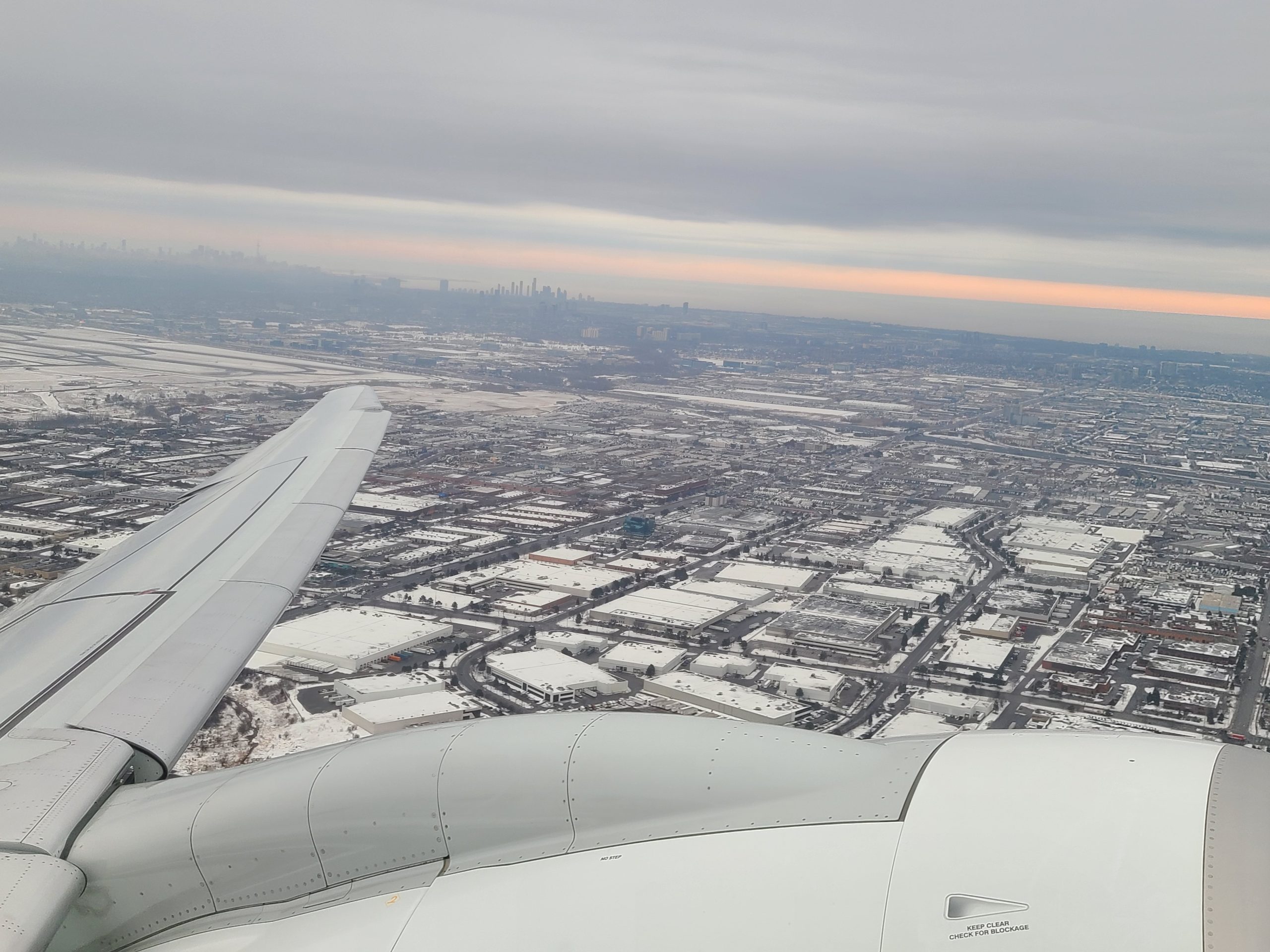
Departure from Toronto Pearson on Porter’s inaugural flight to Vancouver (Photo: AirlineGeeks | Andrew Chen)

WiFi and Entertainment

Porter’s E195-E2s offer free WiFi for all passengers. Members of the airline’s frequent flyer program, VIPorter, get free uninterrupted WiFi after watching a 30-second video advertisement. Those that don’t sign into a VIPorter account still get free WiFi but will need to watch an advertisement every 30 minutes to remain connected. Passengers can also sign up for the free VIPorter program while on board.
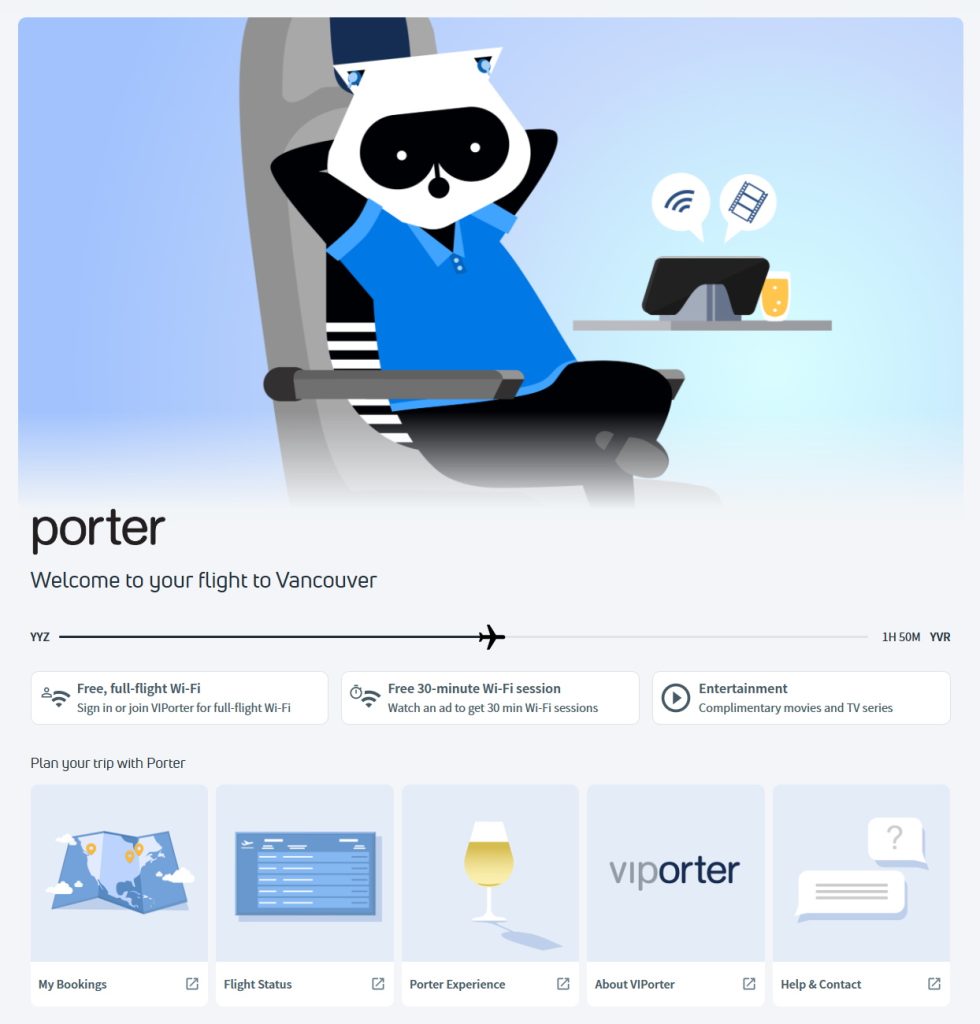
WiFi connection screen on Porter’s E195-E2 (Screenshot: Andrew Chen | AirlineGeeks)

I tested the connection speed three times over the course of the two flights and found download speeds ranging from 18.3 to 44.4 Mbps. I had no issues streaming videos, using email or browsing social media. On my first flight from Toronto to Vancouver, my tests showed upload speeds of 0.04 and 0.07 Mbps. I had some issues sending and uploading photos during that flight, with single photos taking up to an hour to post on social media. On the return flight though, I measured an upload speed of 0.32 Mbps and I was able to post photos within a minute.

WiFi speed tests on board Porter’s inaugural Vancouver flights (first two are from the YYZ-YVR flight and the third one is from the YVR-YYZ flight) (Screenshot: AirlineGeeks | Andrew Chen)

Porter also offers free streaming entertainment through its Wi-Fi connection. I counted approximately 80 movies and 60 television shows, with anywhere from 1 to 8 episodes per show. For some reason though, I was unable to get the streaming entertainment to work. I tried it on both flights and used my phone and laptop but the content player would not start the video. Porter also provides a copy of its in-flight magazine, re:Porter, at every seat.


Porter does not have seatback entertainment screens. However, there are significant cost and weight savings that result from the decision not to install screens and the free Wi-Fi and streaming entertainment should be more than enough to keep passengers occupied during their flight. Even without the streaming entertainment, the ability to browse the internet and stream videos on YouTube kept me entertained while on board.

PorterClassic Food & Beverage

Porter has long been known for offering a premium food and beverage experience. The airline provides free wine, beer and non-alcoholic beverages. On past Porter flights that I have taken, all drinks were served in glassware. On these flights though, it appeared that wine and beer were served in glassware and non-alcoholic beverages were served in paper cups. However, during one of the drink services I received ginger ale in a glass.

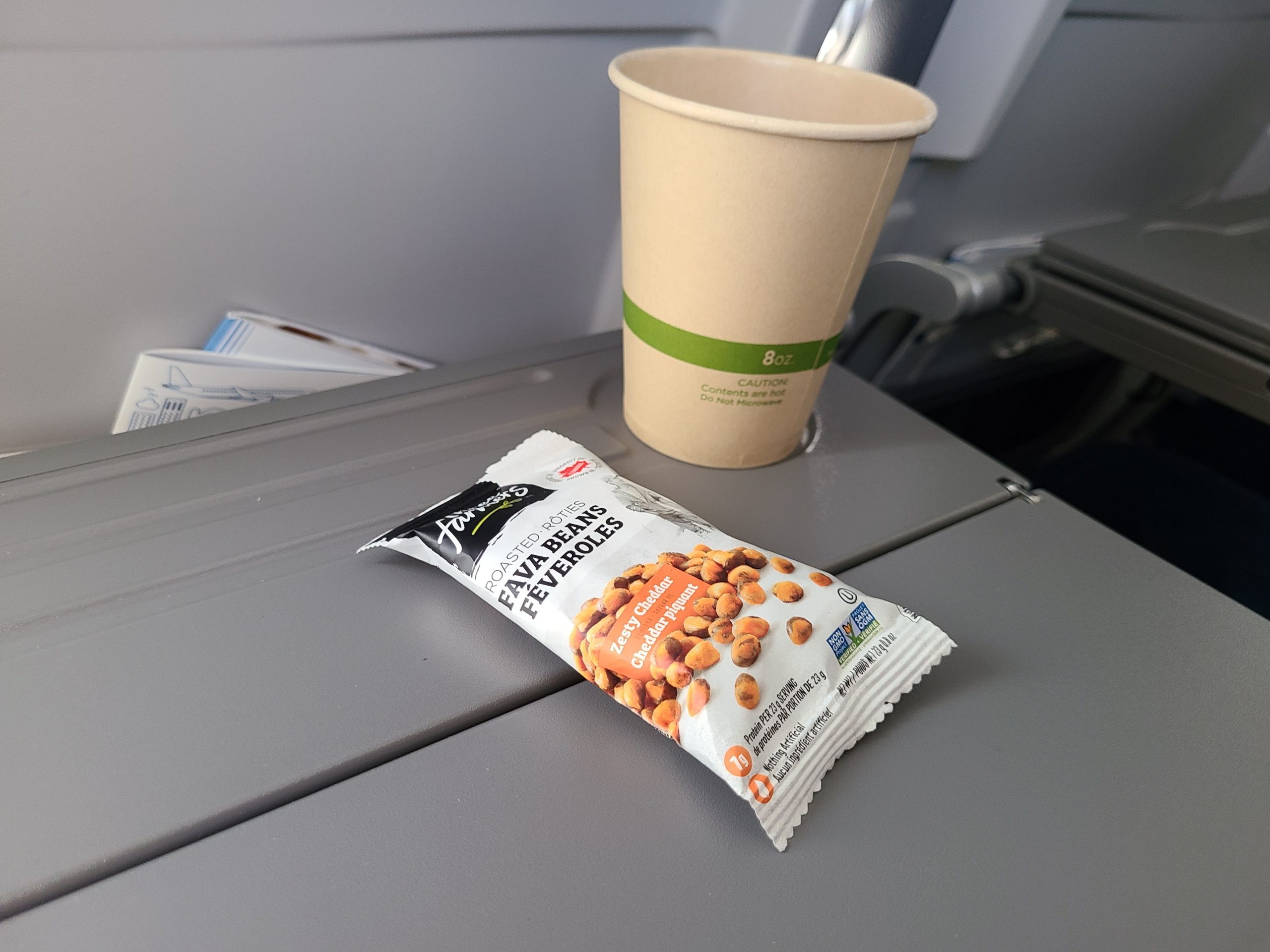
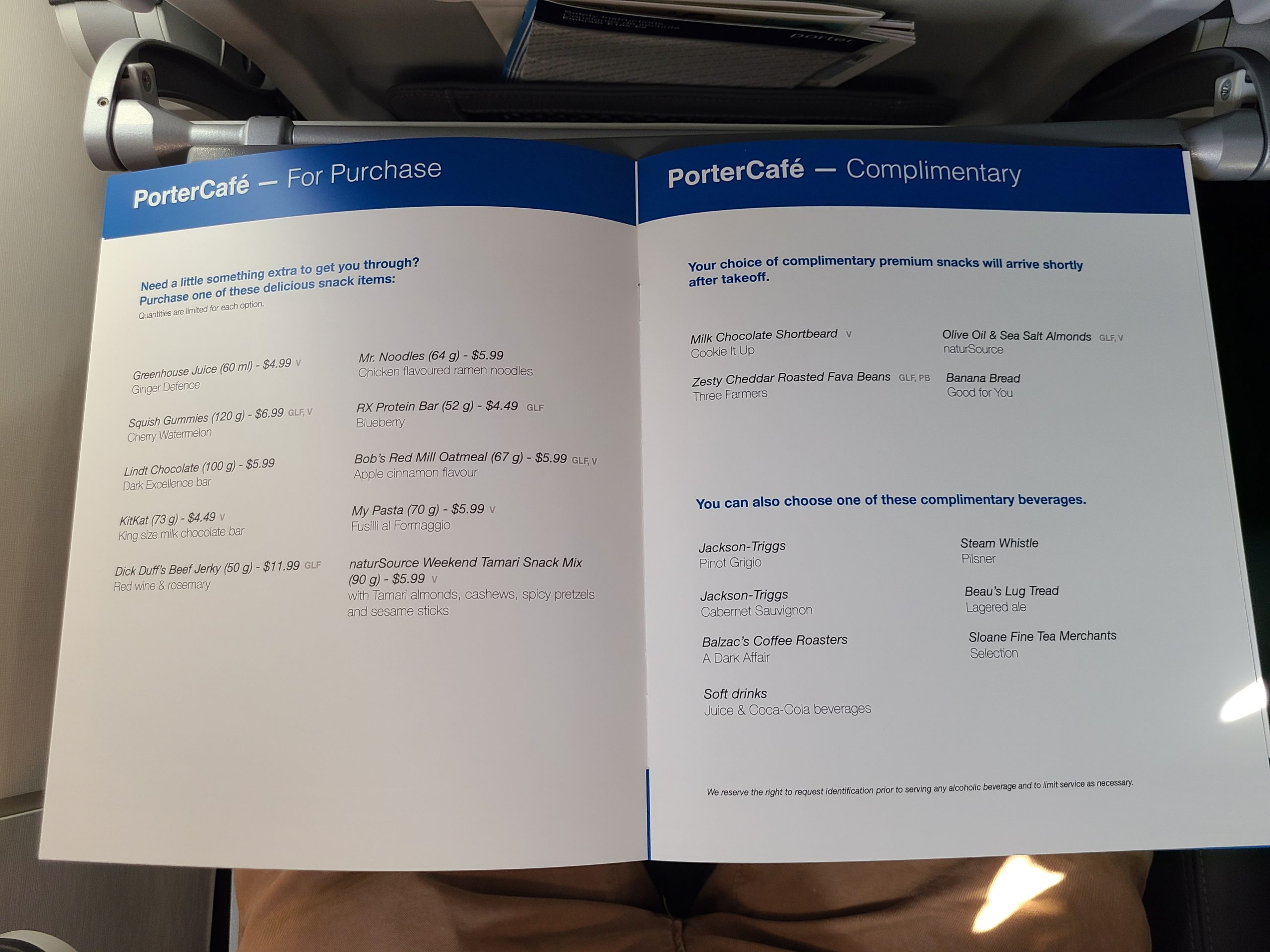
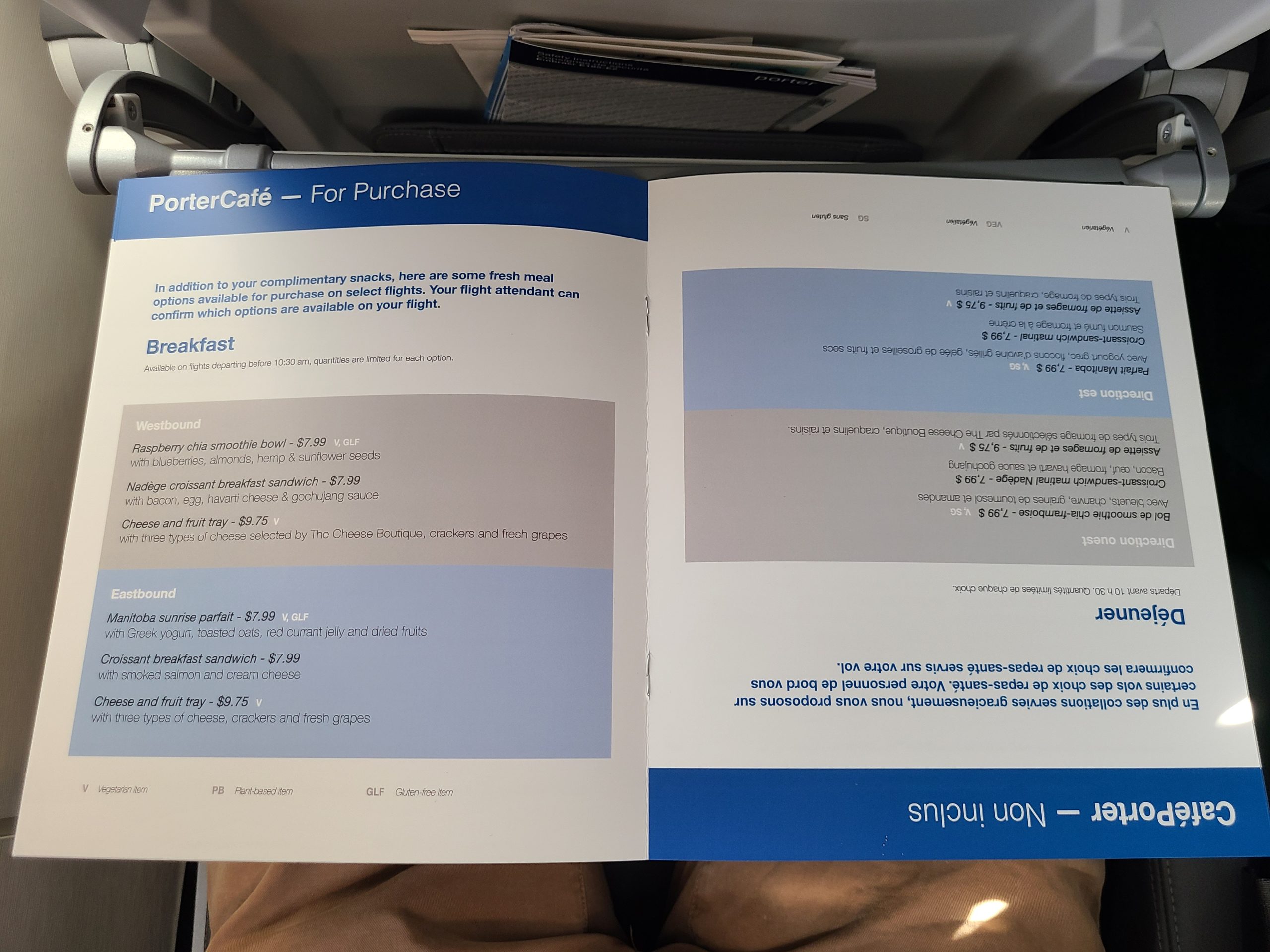
As part of its revamped economy class product, Porter has introduced snacks for purchase (in addition to their free snack selection). Passengers seated in PorterClassic can also purchase fresh meals. These meals are included for PorterReserve passengers, but I will cover that later in this report.
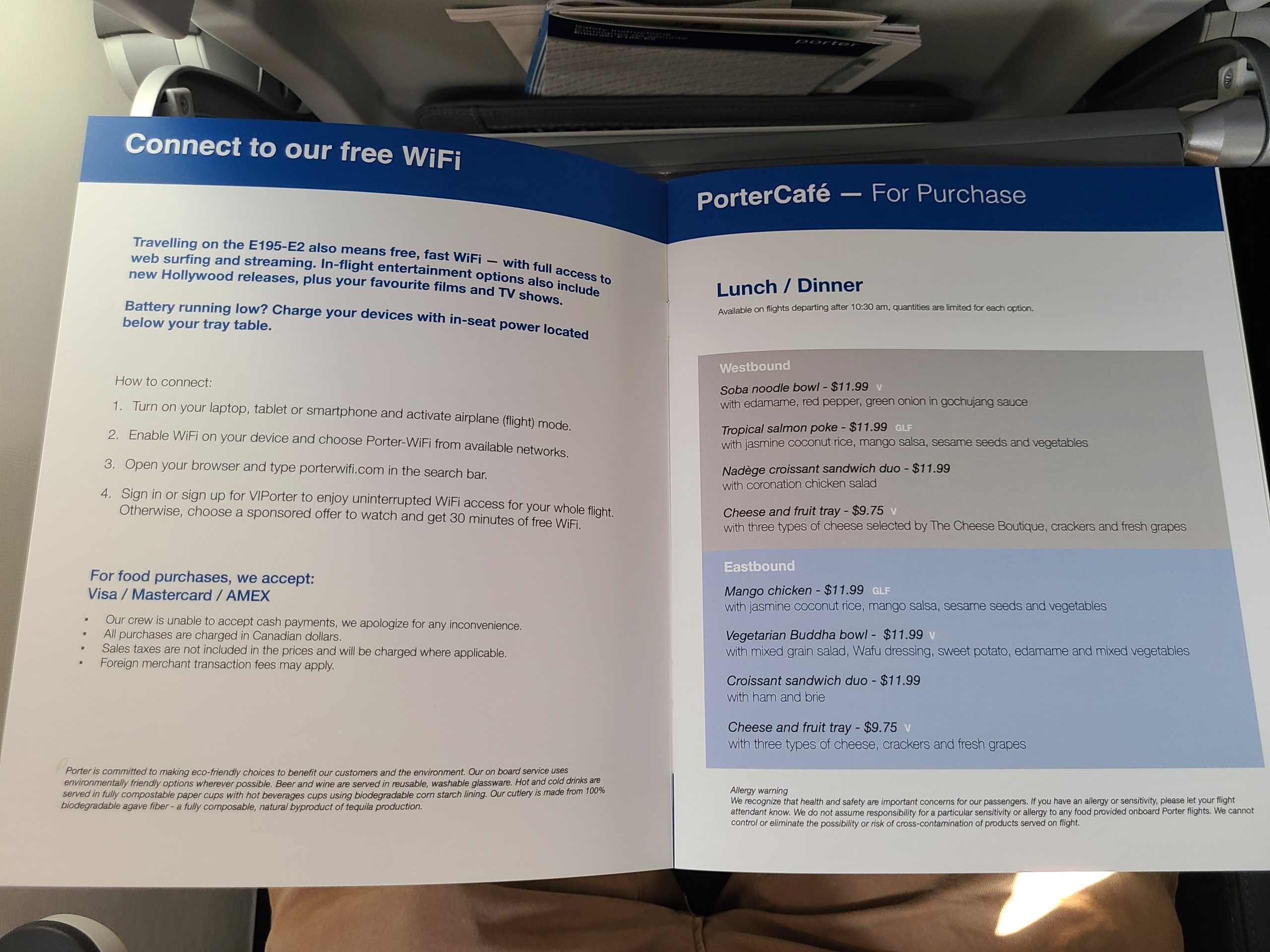
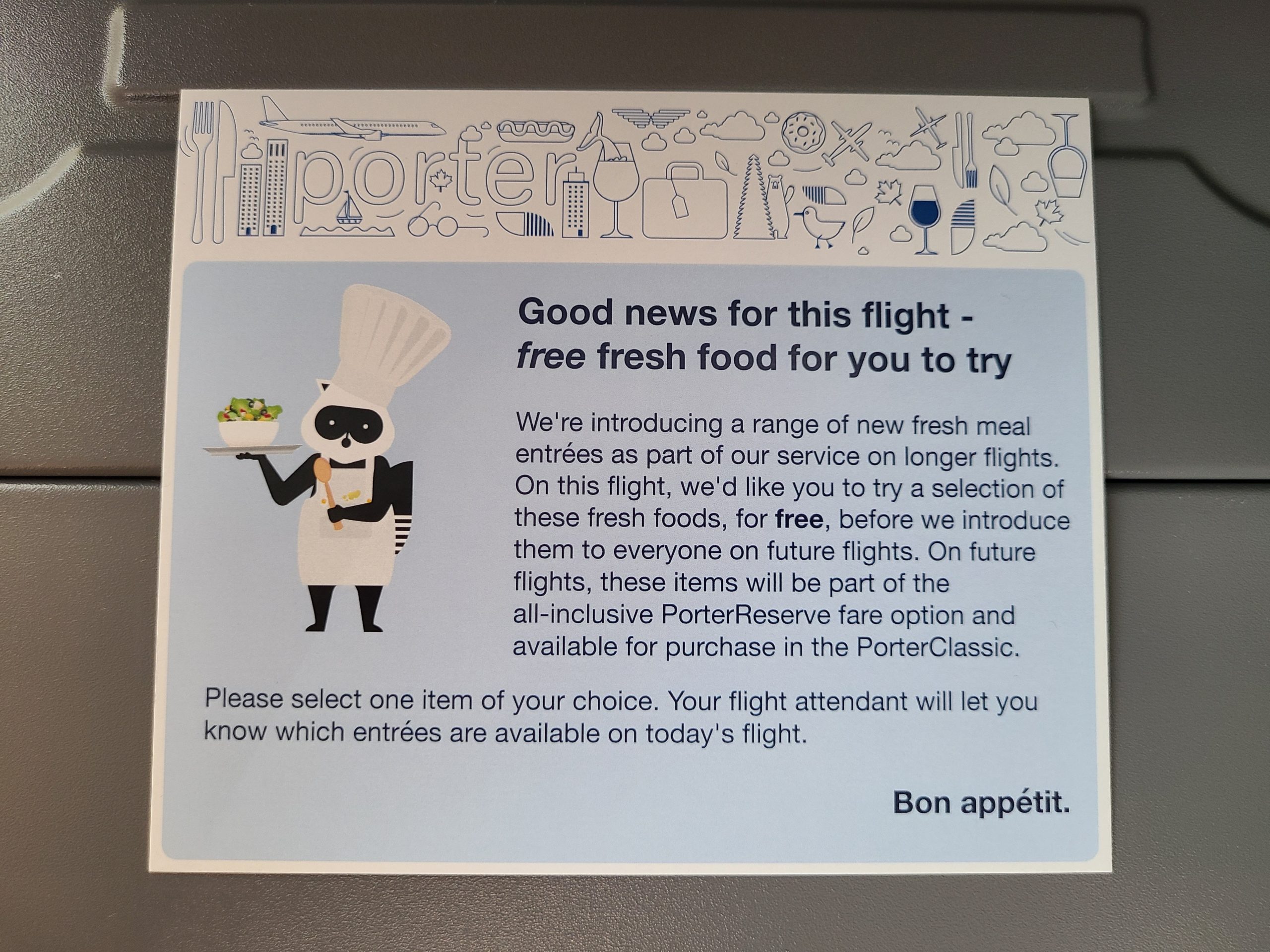
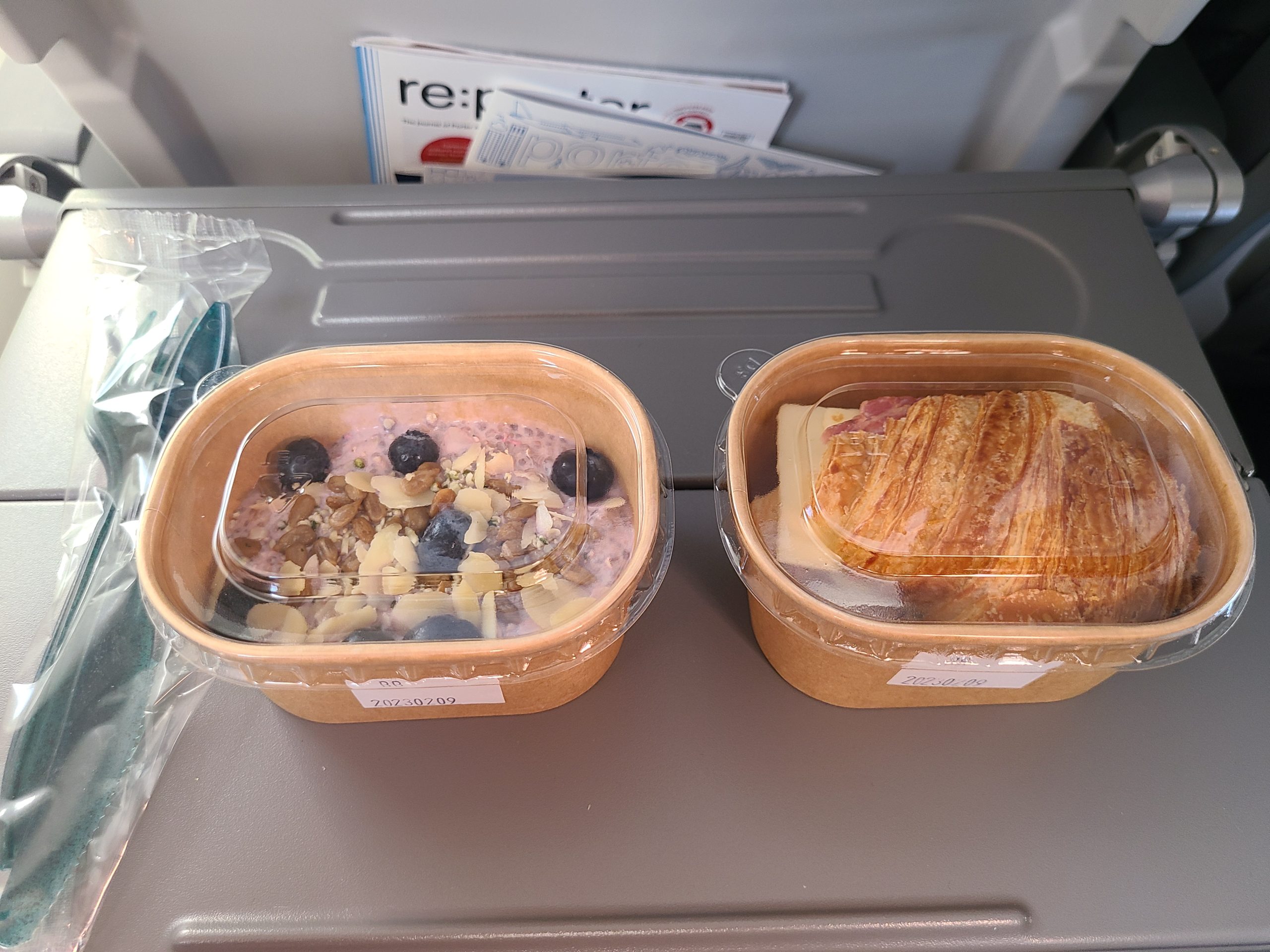
On our inaugural flights, PorterClassic passengers were offered a free meal entrée. On the flight to Vancouver, it was a breakfast meal service because the scheduled departure time was before 10:30 a.m. We were offered the choice of a raspberry chia smoothie bowl or a croissant breakfast sandwich. I chose the chia smoothie bowl and my seatmate lent me their breakfast sandwich for a photo. I found the smoothie bowl to be fresh and tasty. The portions were small but I’m not sure if they were small sample sized versions of the entrées or the actual ones that will be sold.
Inaugural Flight Goodies

During boarding, all passengers were handed an envelope that contained a welcome letter, a keychain and a 150 Canadian dollar flight voucher. Having taken both flights, I received two of these envelopes.
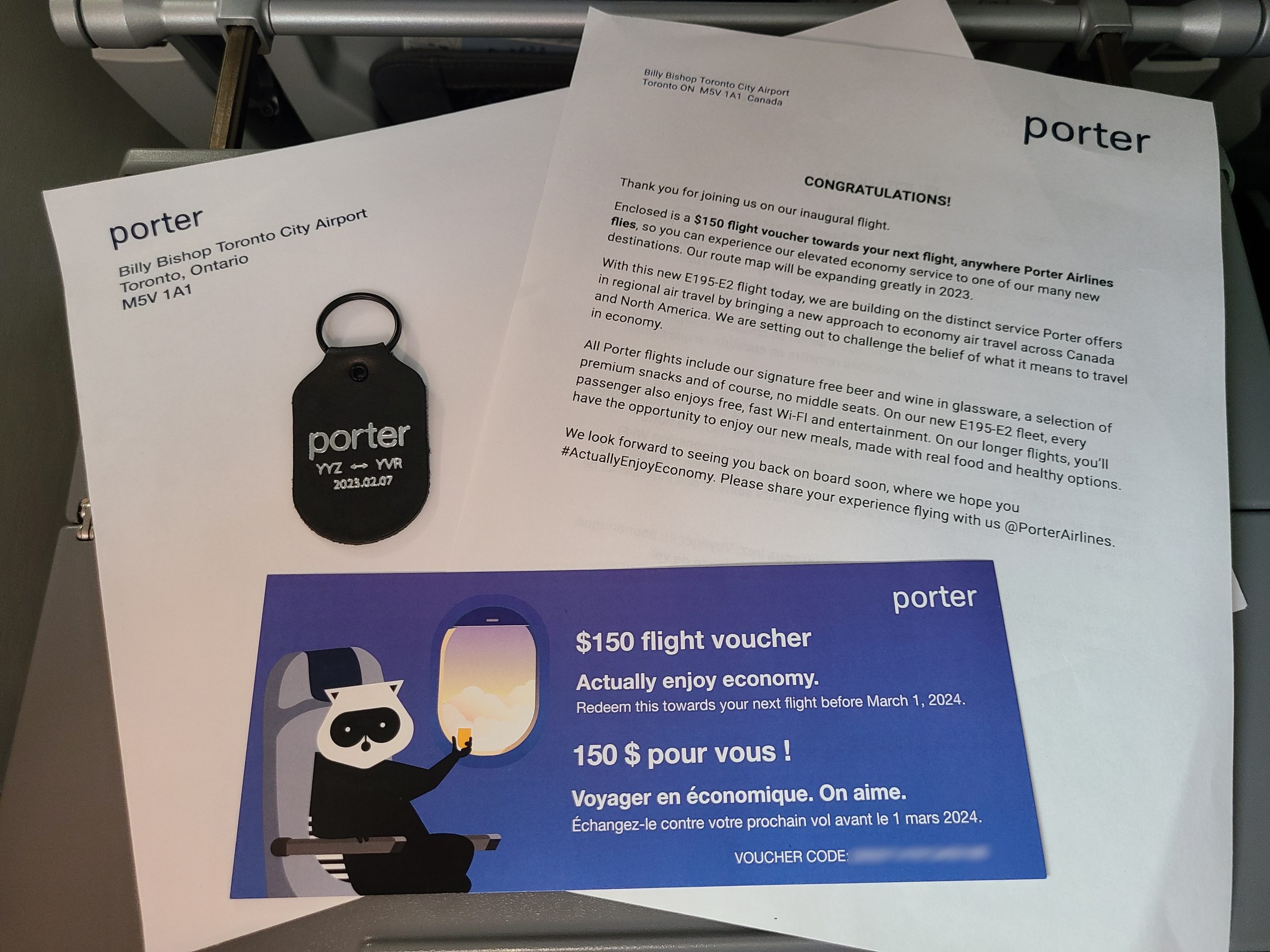
Porter Airlines inaugural Vancouver flight letter, keychain and voucher (Photo: AirlineGeeks | Andrew Chen)

Lavatories

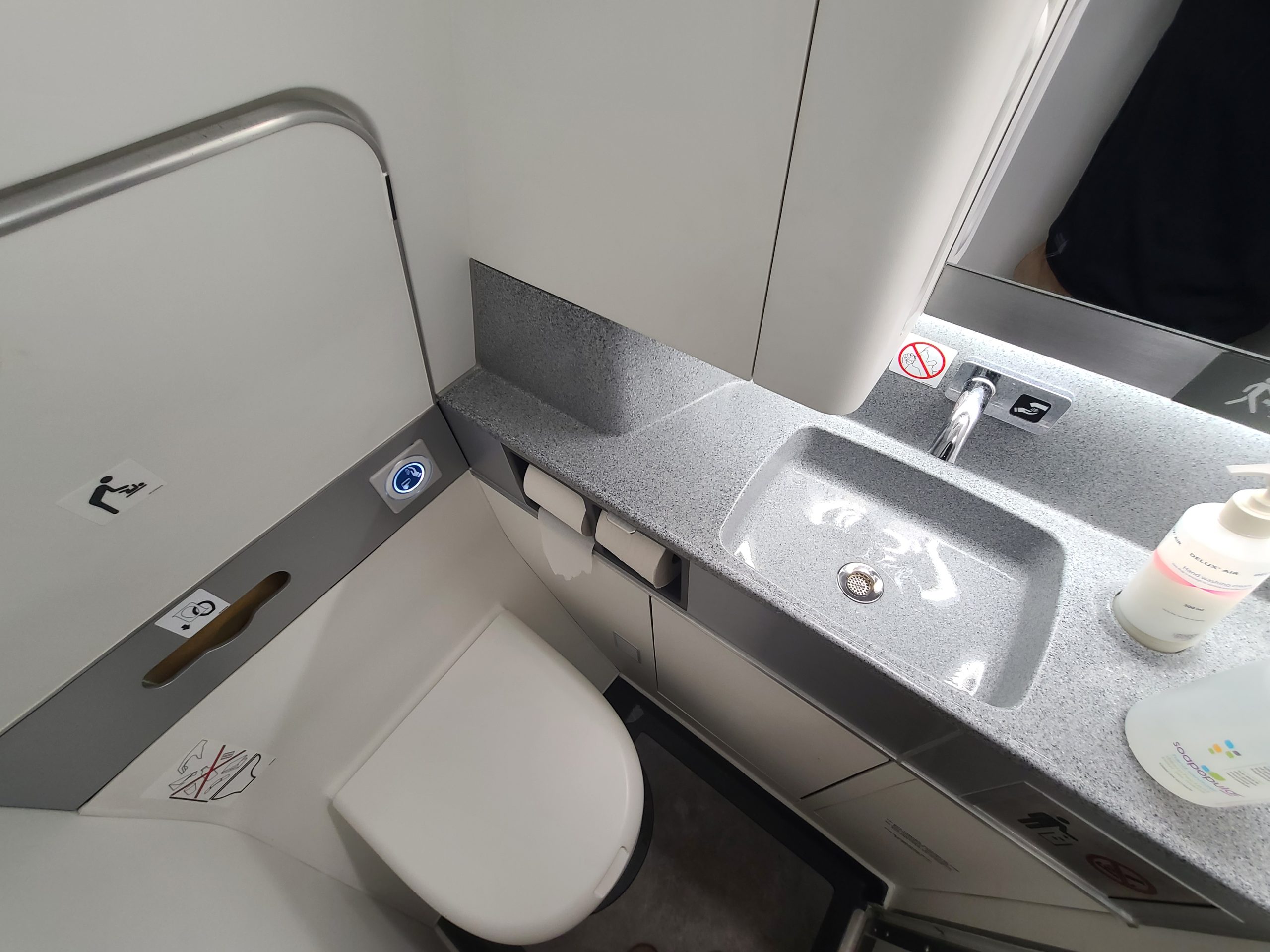
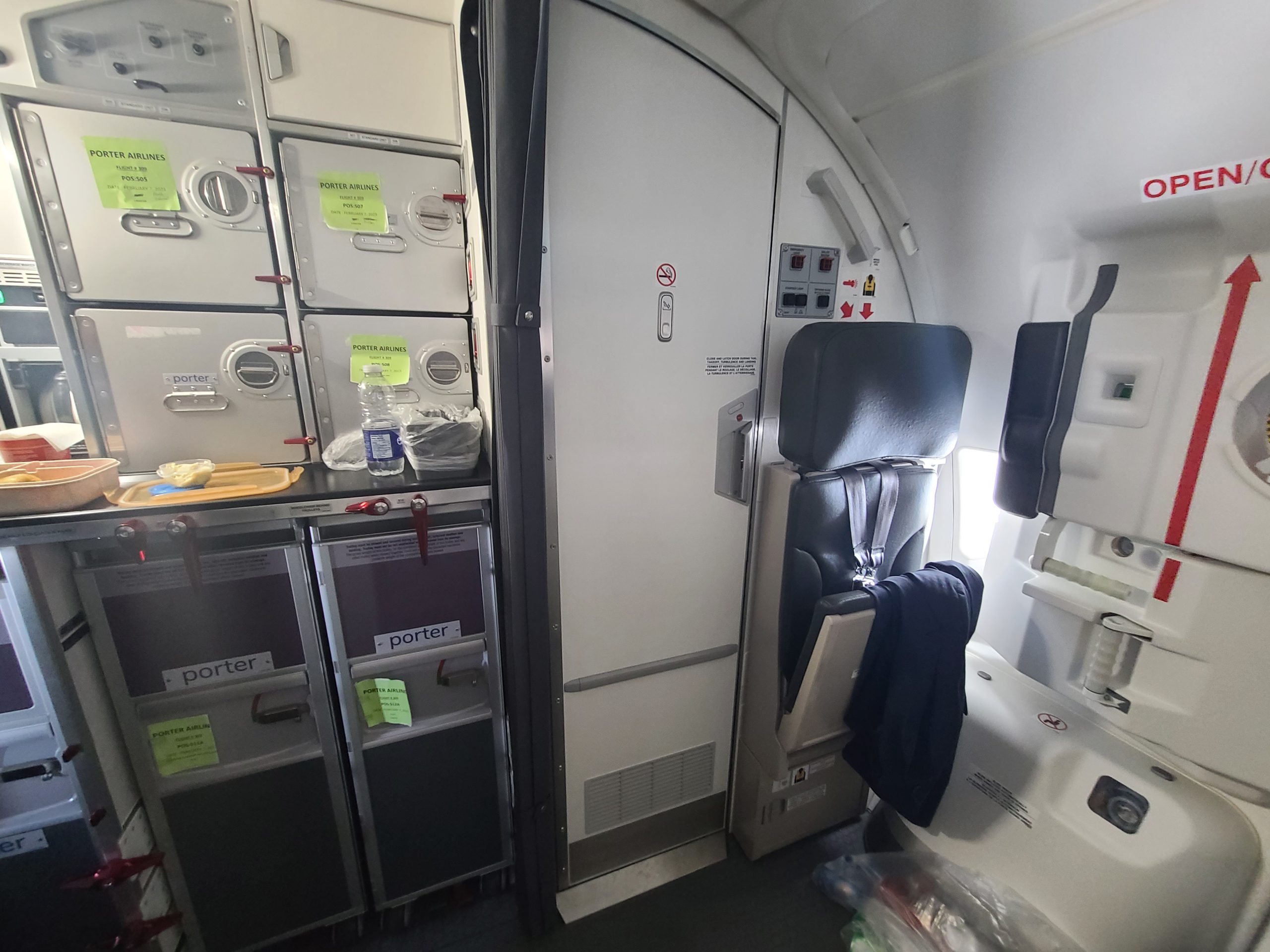
Porter’s E195-E2s have two lavatories: one at the front of the cabin and one at the back. Throughout the two flights, I used both. The lavatories were both fairly small and the one at the back of the aircraft is located within the rear galley space.
 

Arrival into Vancouver

It had rained heavily that morning in Vancouver but by the time we arrived, the skies had mostly cleared. There were lots of people on the ground at the gate, with many taking photos and videos. Most of them were on the right side of the aircraft so my photo doesn’t show the full crowd on the ground.
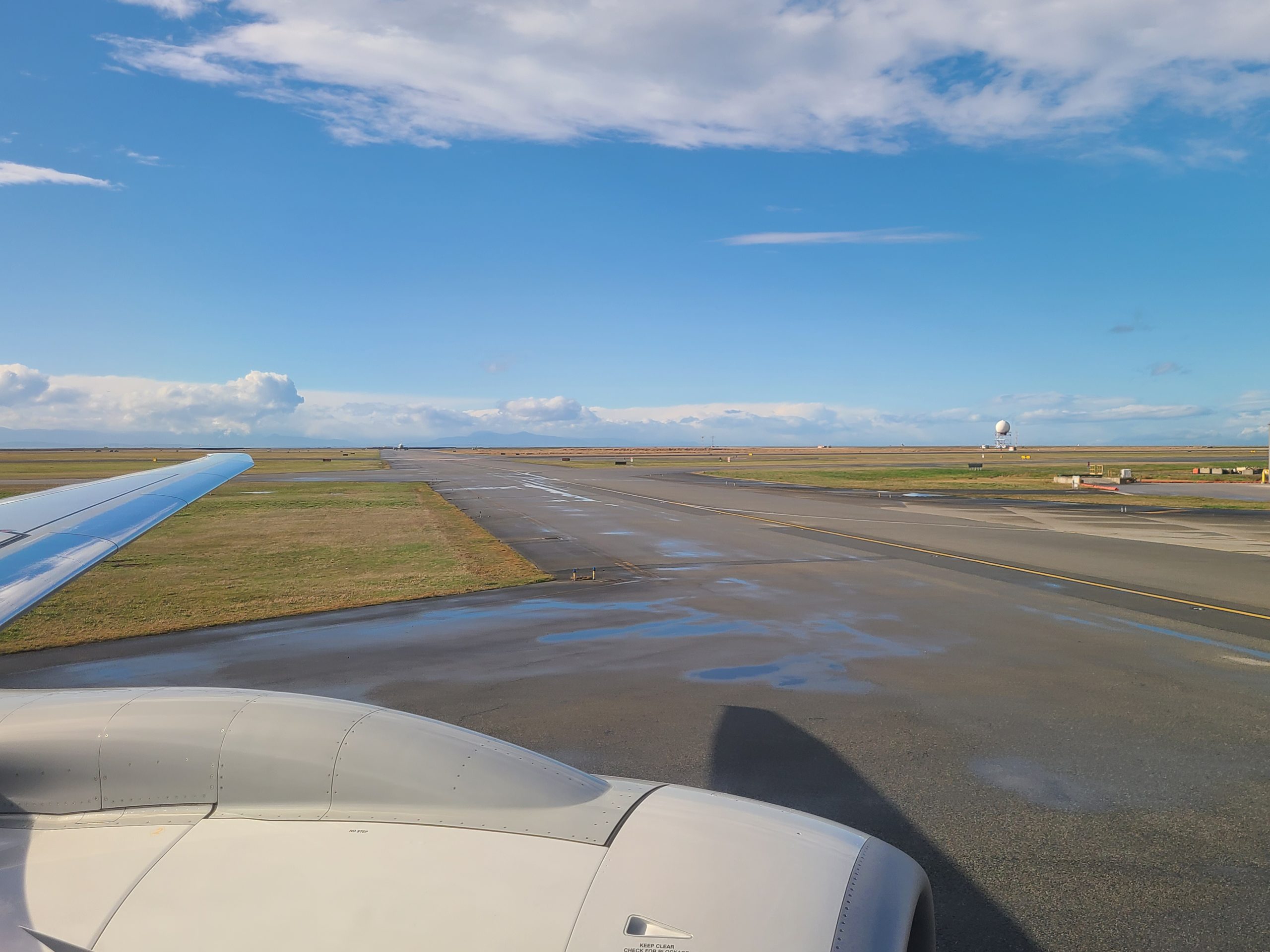
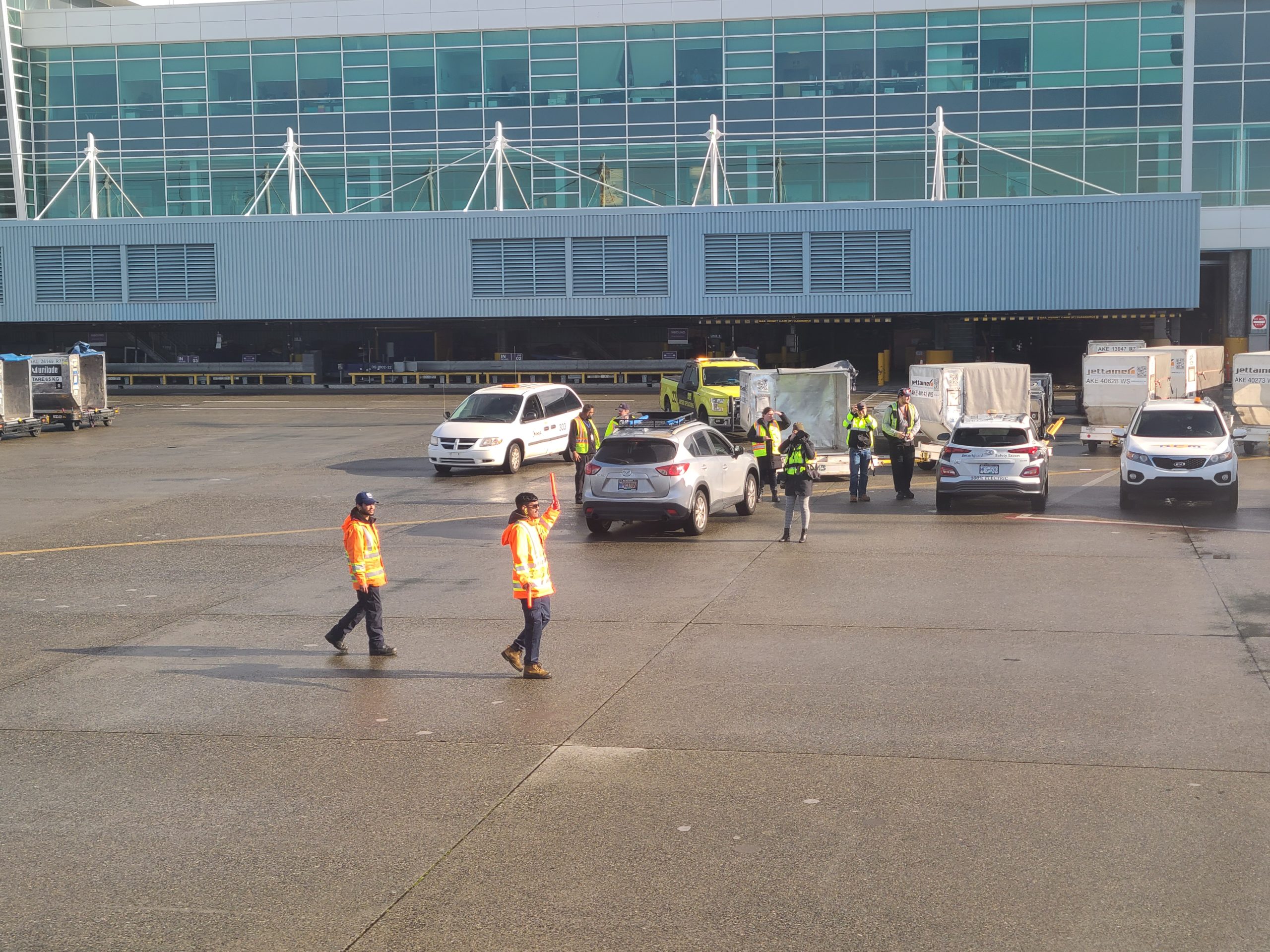
Our plane pulled into Gate B27 around 25 minutes behind schedule.
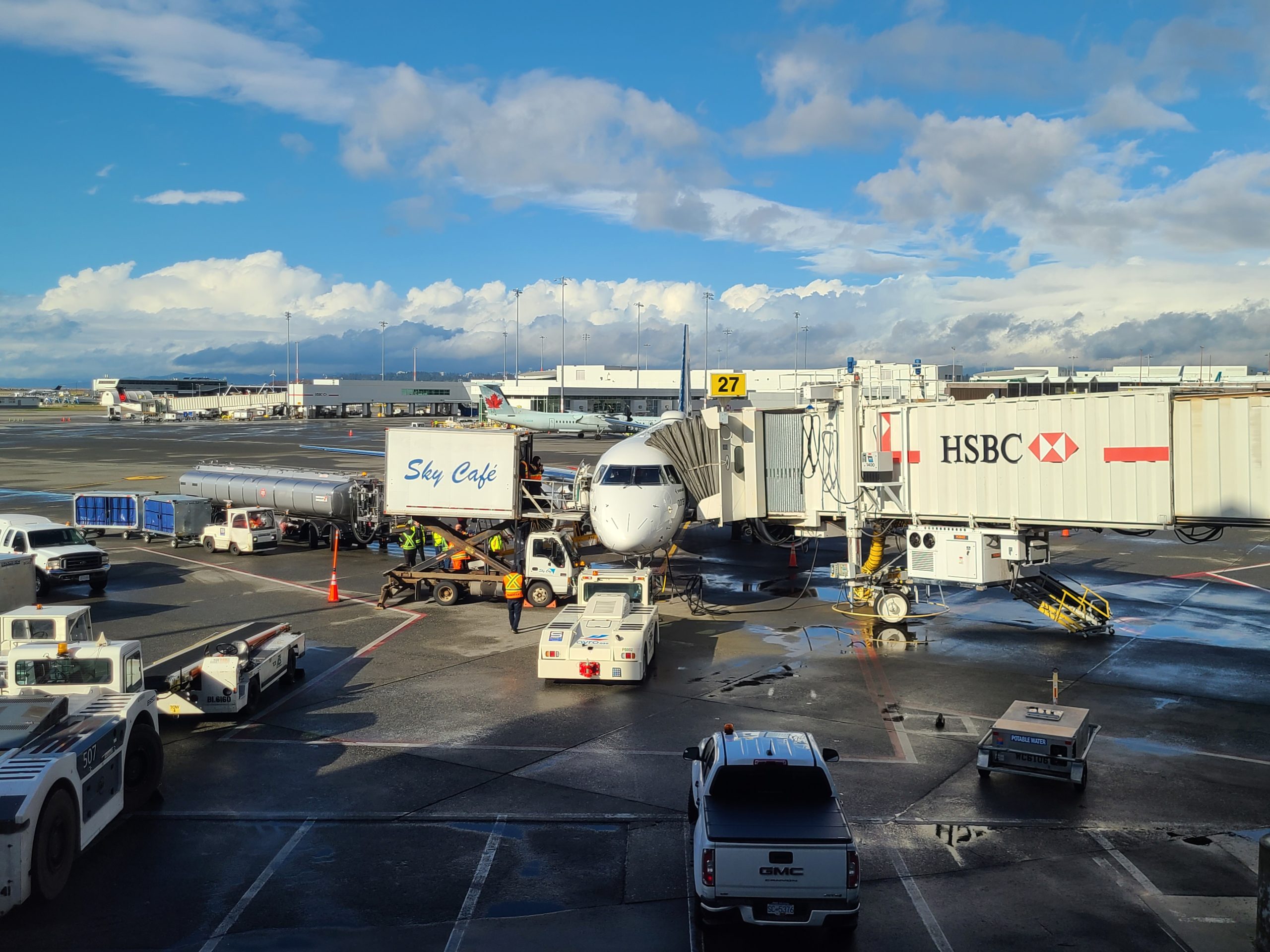
Porter’s inaugural flight to Vancouver International Airport parked at Gate B27 (Photo: AirlineGeeks | Andrew Chen)

Vancouver Gate Celebrations

The pre-departure function in Vancouver was a much grander affair than the festivities in Toronto. I got off the plane and saw a lineup of television cameras and lights facing a podium with a Toronto backdrop. Vancouver International Airport puts on a show for each of their inaugural flights and today’s flight was no exception, with music, Toronto-themed decorations, refreshments and even a special cake.

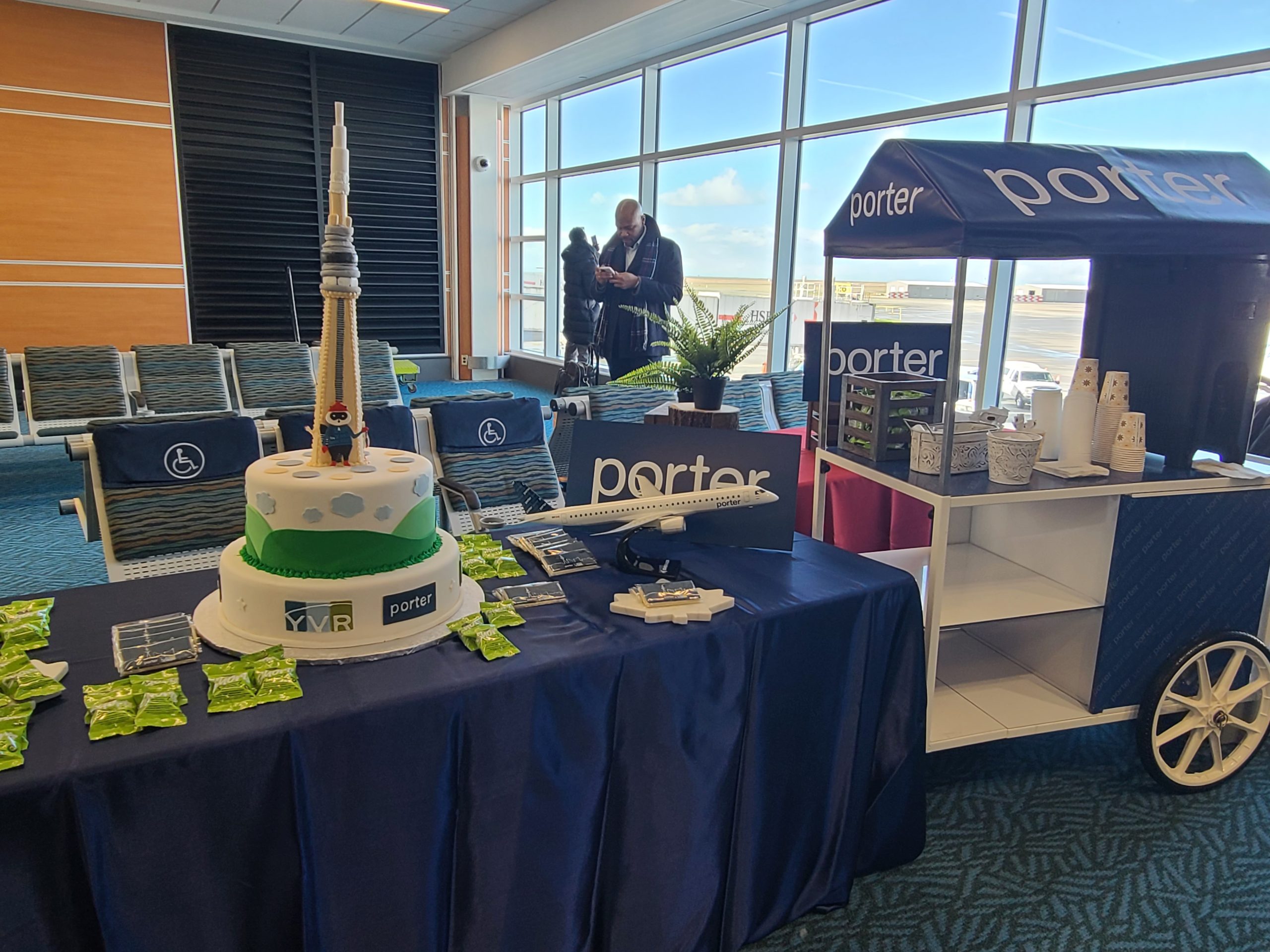
There were speeches from a councilor from the local Musqueam First Nations band; Porter CEO Michael Deluce; and Andy Margolis, Vice President, Airport Capacity & Systems Design at Vancouver International Airport. The speeches were followed by a photo op and a media availability.
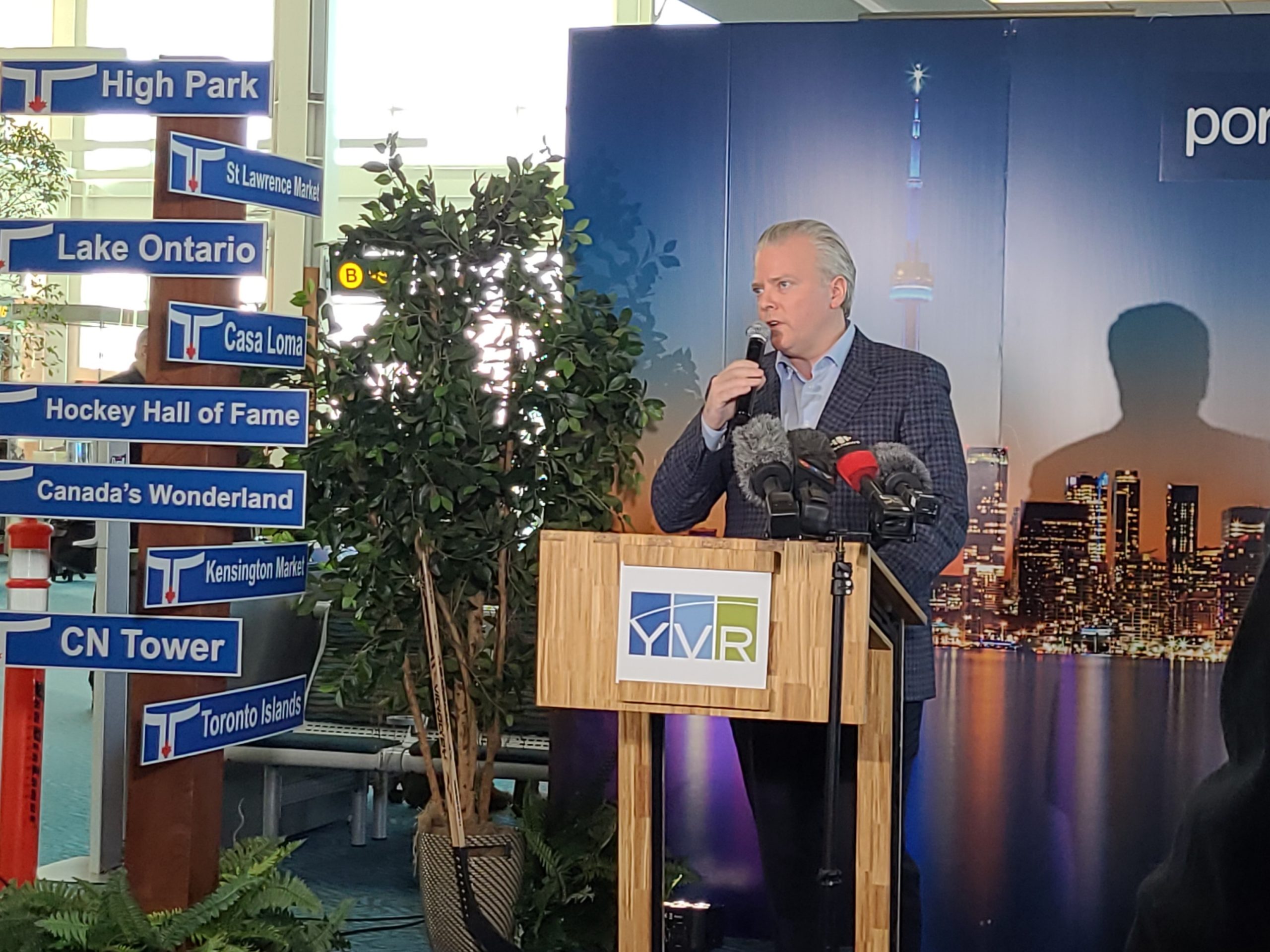

Boarding commenced soon after. Although the key and box activity was not replicated in Vancouver, the gate agents did announce that one passenger had been randomly selected to win a pair of roundtrip Porter tickets.
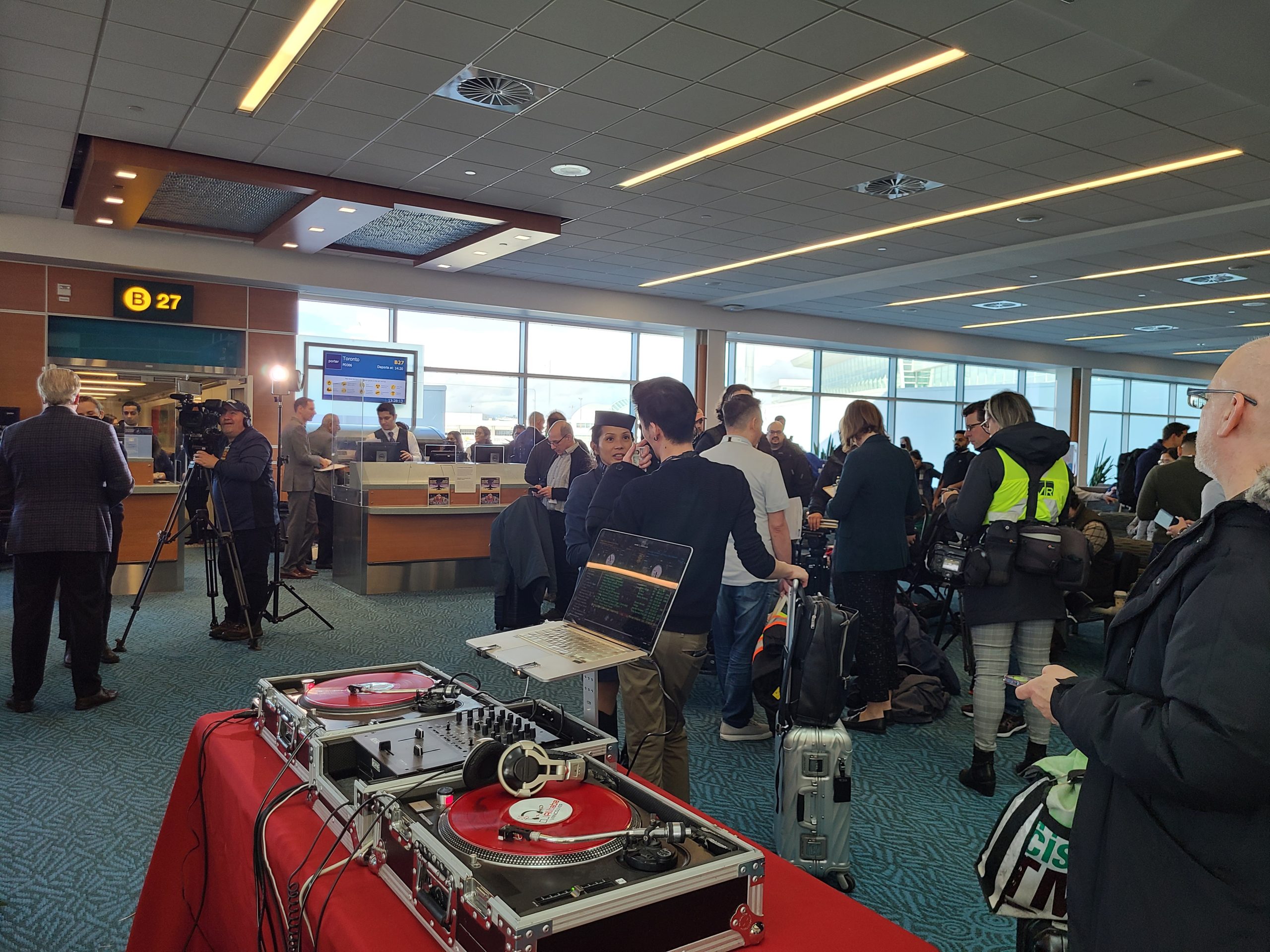
Boarding gate in Vancouver for Porter’s inaugural flight (Photo: AirlineGeeks | Andrew Chen)

PorterReserve Seating

PorterReserve seats are upholstered in blue and have 36 inches of pitch. Aside from the color, the seat itself is identical to PorterClassic seats so I won’t go into the seat features again.
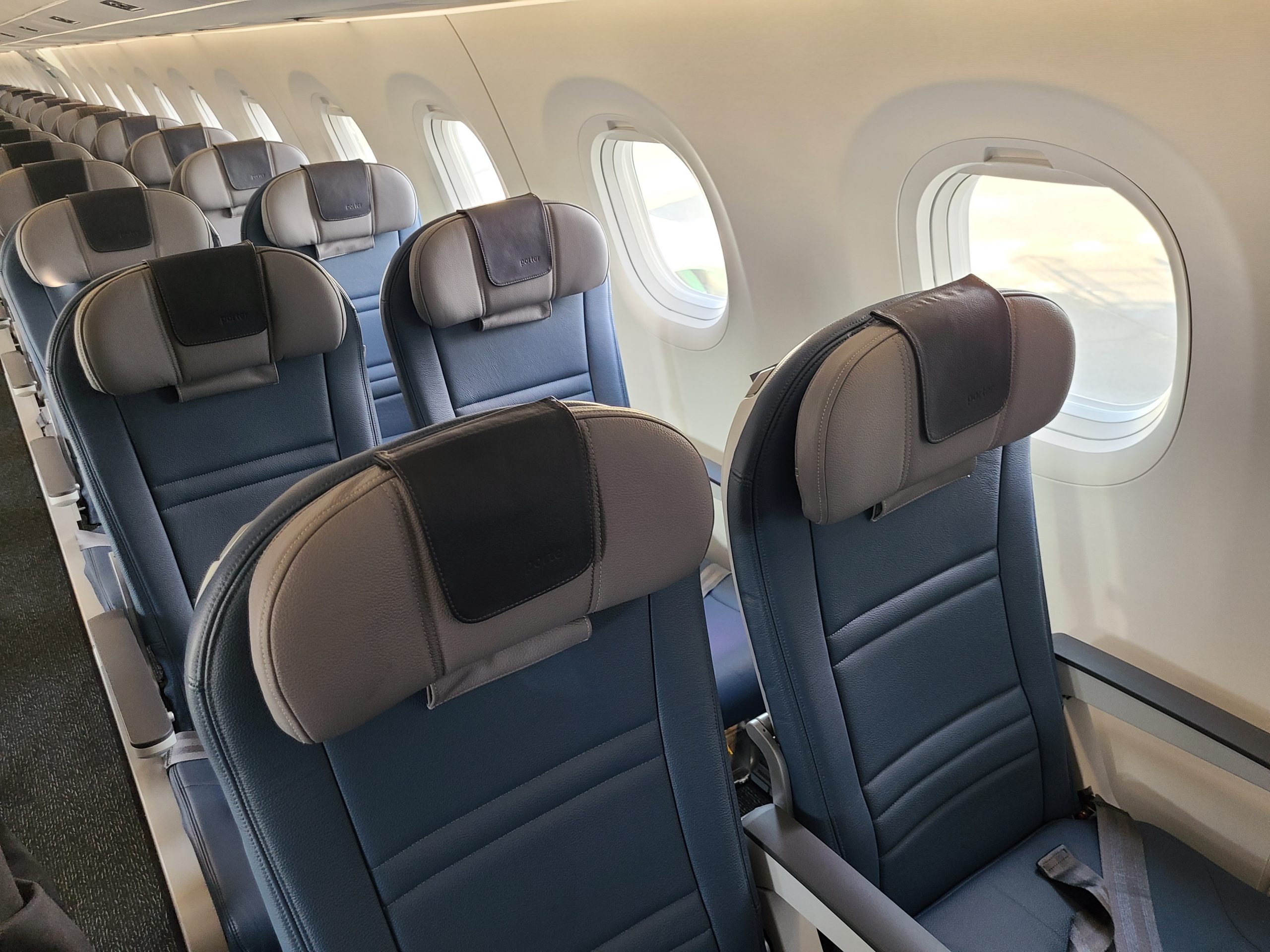
In addition to the premium onboard experience, PorterReserve passengers get perks such as priority check-in and boarding, two pieces of checked luggage and free seat selection.

Departure from Vancouver

We took off from Runway 26L slightly behind schedule. I love looking out the window when flying in and out of Vancouver. The views really show off the beauty of the Canadian west coast.

View of Vancouver International Airport and the surrounding area after departure on Porter’s inaugural flight out of Vancouver (Photo: AirlineGeeks | Andrew Chen)

PorterReserve Food & Beverage

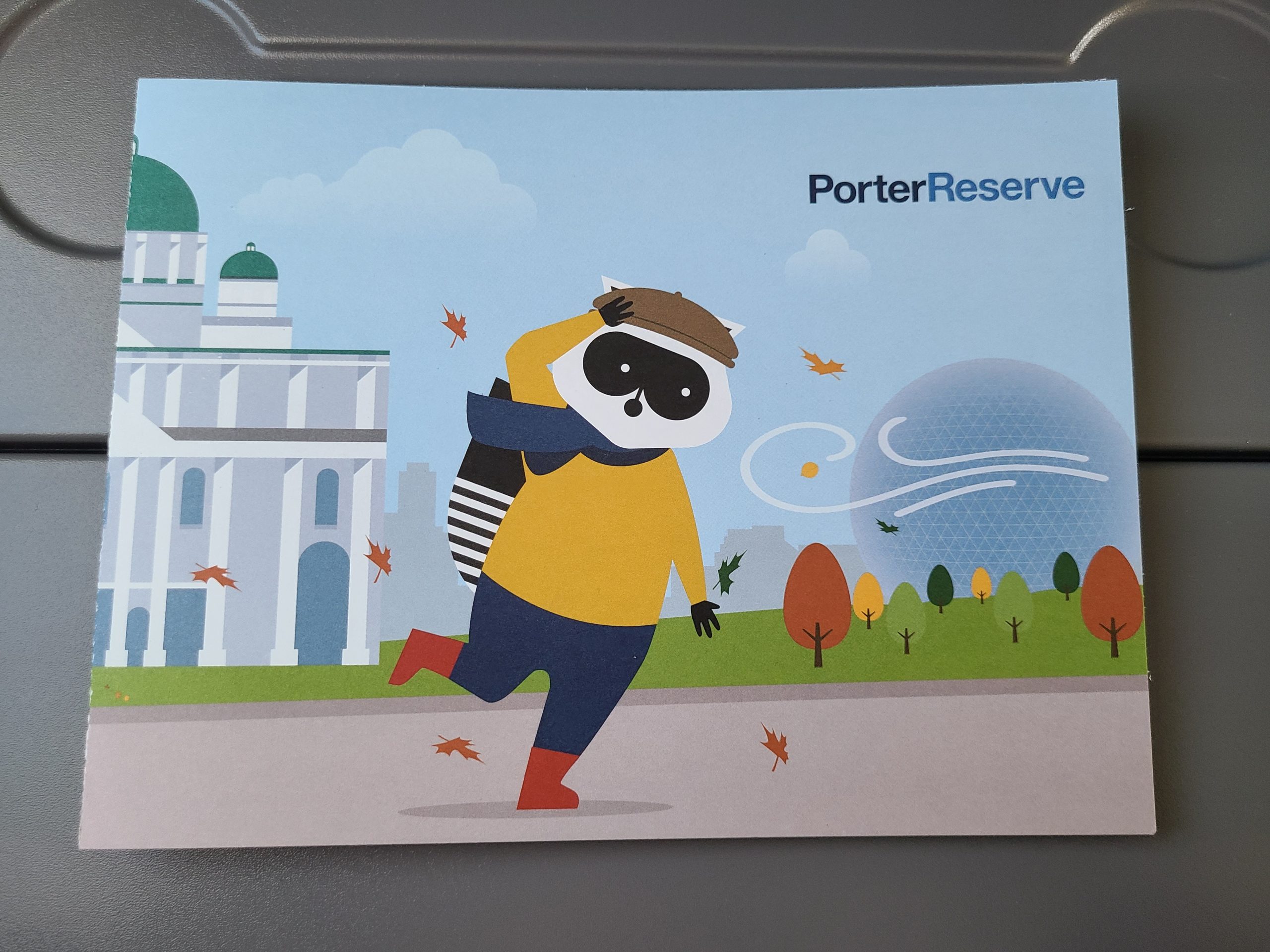
As I mentioned in the introduction, PorterReserve passengers have meals included in their fare. Service started around half an hour after takeoff with the snack basket. Immediately afterwards, the meal service began. The menu had been handed out during departure and was part of a card that also included a postcard.
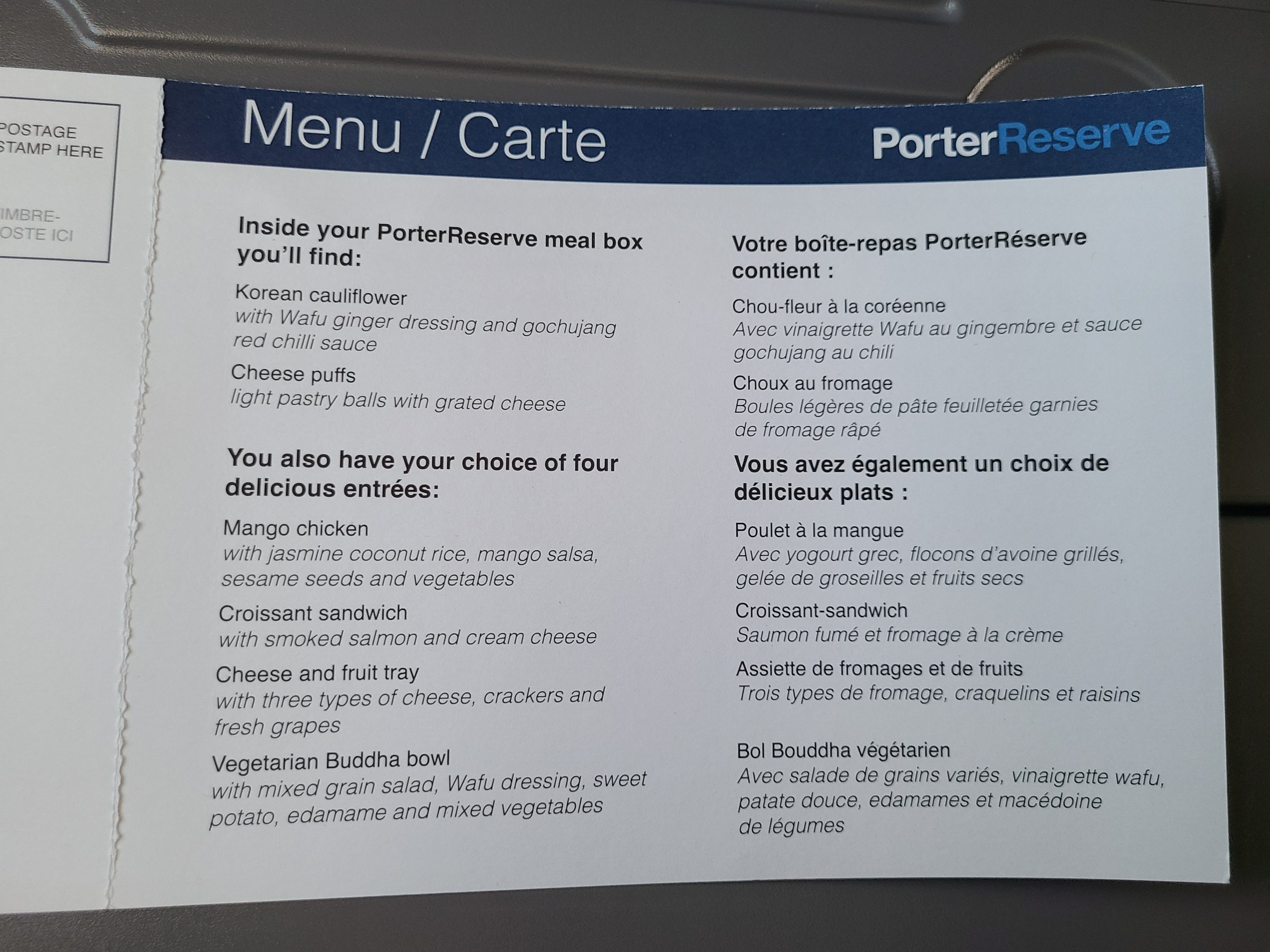
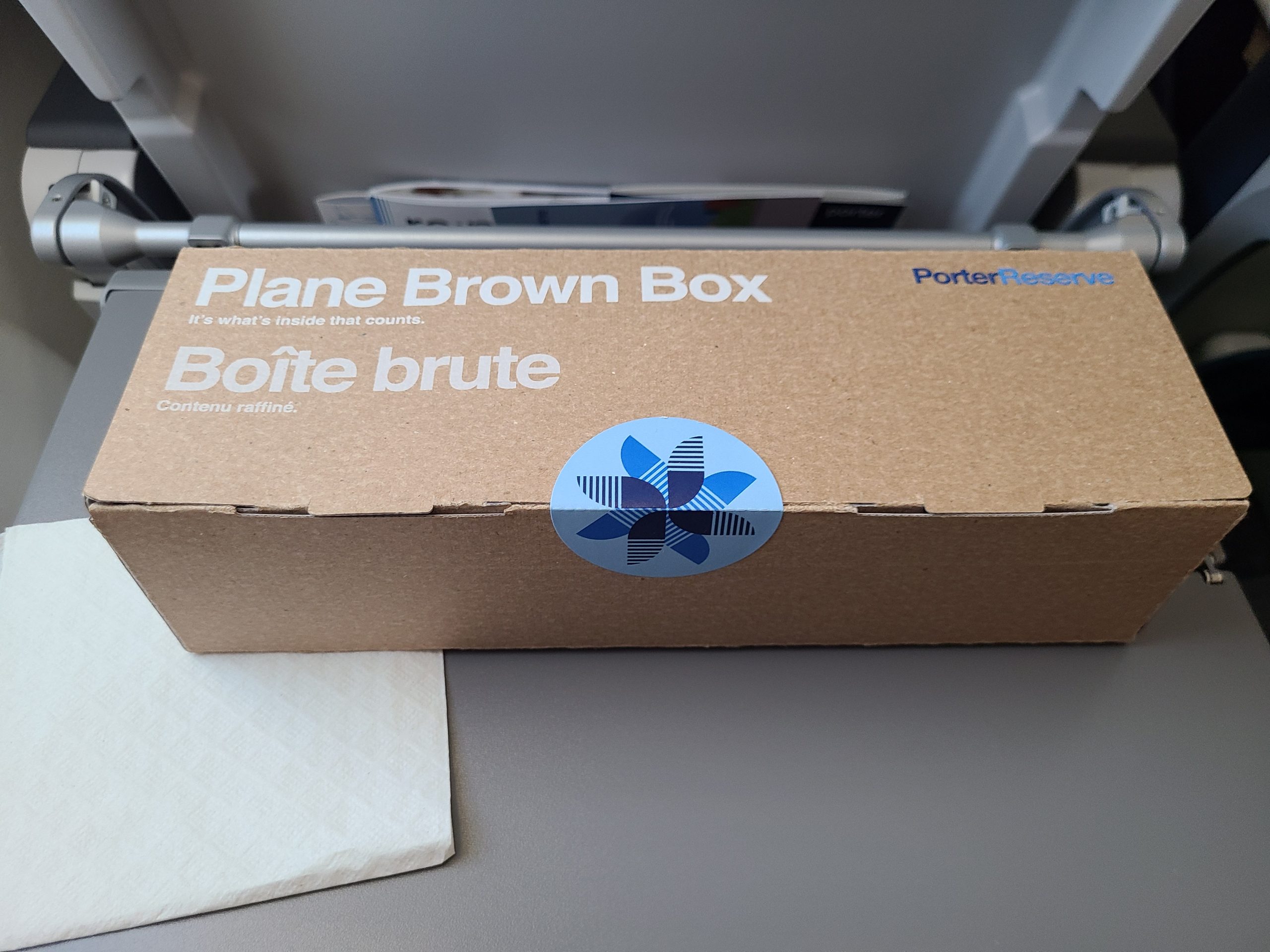
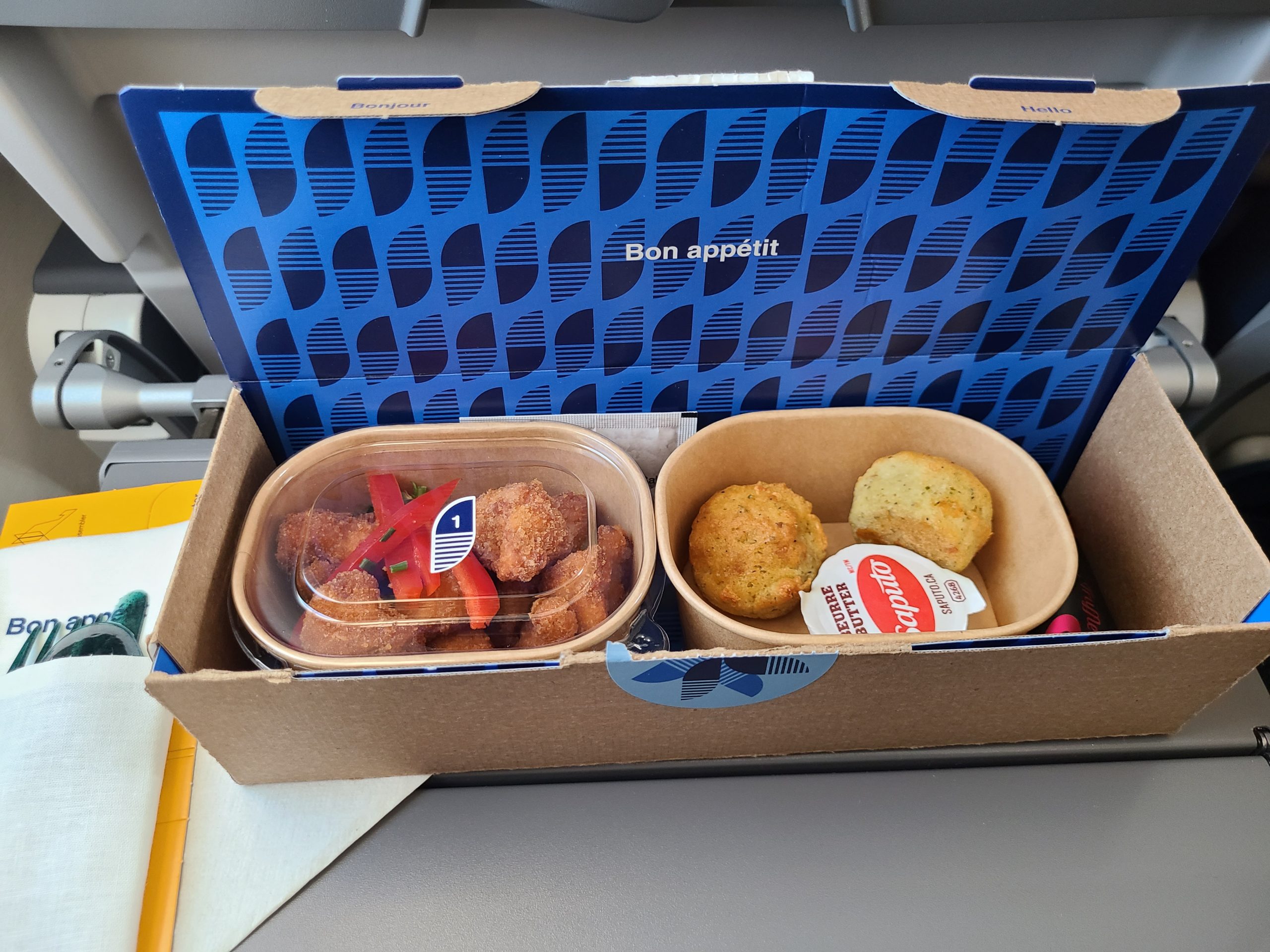
I first received a box, which opens to reveal the two appetizers and a chocolate truffle. There was also cutlery and a paper phone stand. I then had to fold open the front portion of the box to reveal spots for the entrée and a drink. The concept is creative and aesthetically pleasing but the flight attendant had to stop and explain the box opening sequence to each pair of passengers before serving them their main entrée.
For the entrée, I chose the mango chicken. The presentation of the food was excellent, with a sleek look and vivid colors. The entire meal and all entrée options were served cold. The food quality was also very good. It tasted very fresh, but I felt that the Korean cauliflower and mango chicken would have been better served warm. The Korean cauliflower and cheese puffs were both quite tasty. The chicken was well-seasoned but I found the rest of the entrée could have used more seasoning or salsa. Until I looked at the menu again to prepare this report, I didn’t realize that the rice was supposed to be coconut rice since it simply tasted like plain white rice. Overall though, I was quite impressed with Porter’s meal box.
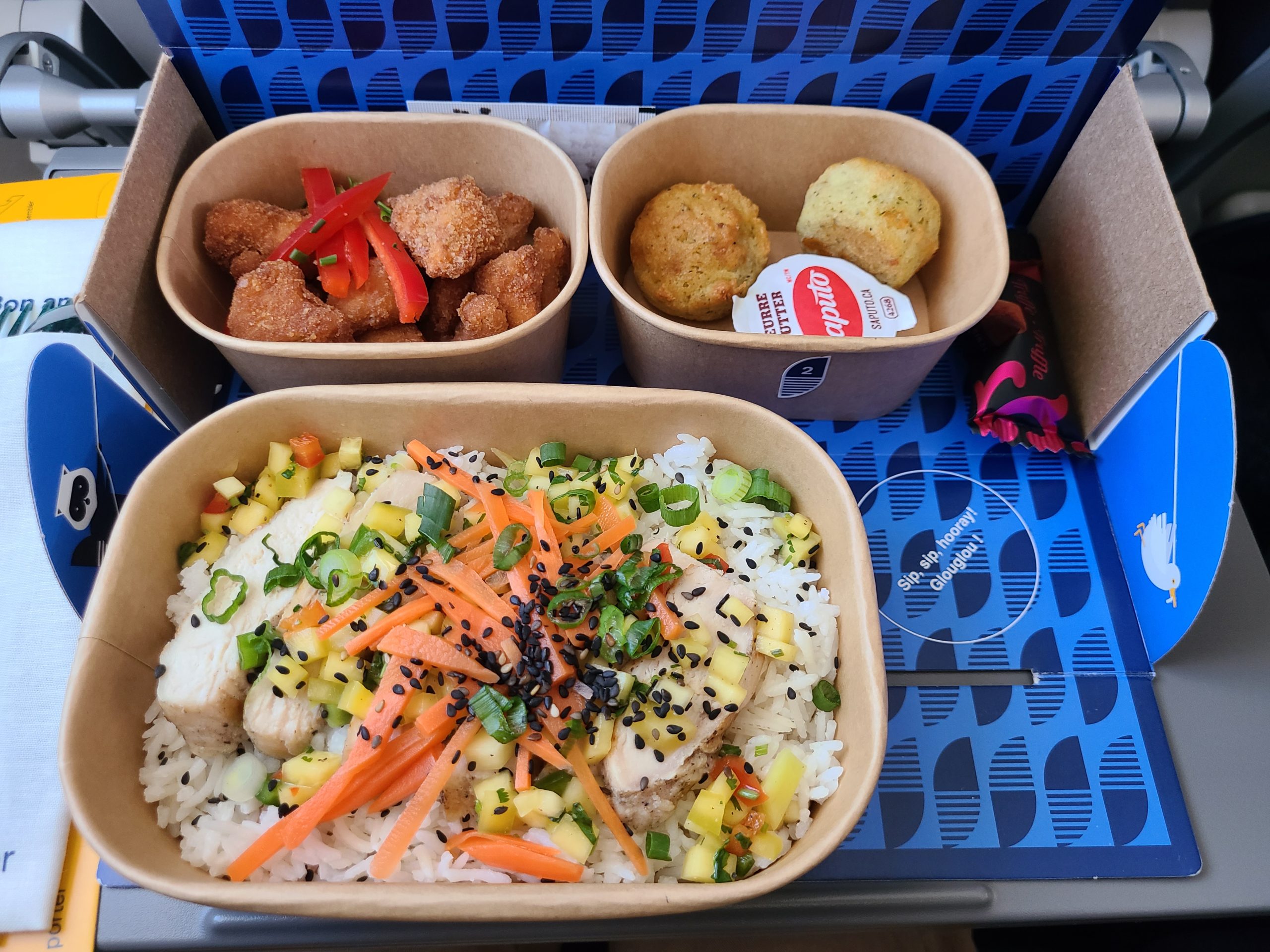
PorterReserve meal on Porter’s inaugural flight from Vancouver to Toronto Pearson (Photo: AirlineGeeks | Andrew Chen)

The food and beverage service flow was also a bit awkward. I had barely finished my snack before the meal boxes came around. Then after everyone received their meal, the accompanying drink service didn’t come around until people were finished or almost finished their food. I didn’t have anything to drink during most of my meal and my seatmate had finished his food before he got a drink. We then waited nearly an hour after eating before the meal boxes were collected. Service was also fairly slow on the outbound flight from Toronto to Vancouver.

Quite frankly though, I thought this was understandable and forgivable. The flight attendants were used to working short turboprop flights with a quick snack and drink service and were adjusting to the new onboard products and procedures. The flights that I took were the first two passenger flights that Porter has operated with a meal service, and I am confident that the service flow will improve greatly over time. As Porter continues to develop its E195-E2 product, I’m sure that the procedures will be refined over time and the airline will consider further improvements such as warm meals.

Service

Aside from the understandable challenges with the service flow, I found that the service was fantastic. The flight attendants were caring and attentive and fit well into Porter’s image of being a friendly airline. In addition to delivering the new meal service for the first time in the airline’s history, they had to serve an almost full flight on the first leg and around 100 passengers on the second leg. They had a challenging job working this inaugural roundtrip and they definitely rose to the occasion.

Arrival into Toronto

After the meal service was complete, the sun began to set outside and the crew dimmed the cabin lights.

Porter E195-E2 cabin with dimmed mood lighting (Photo: AirlineGeeks | Andrew Chen)

A second drink service was offered about an hour and forty-five minutes prior to landing and we soon found ourselves descending back into Toronto for a landing on Runway 24L.
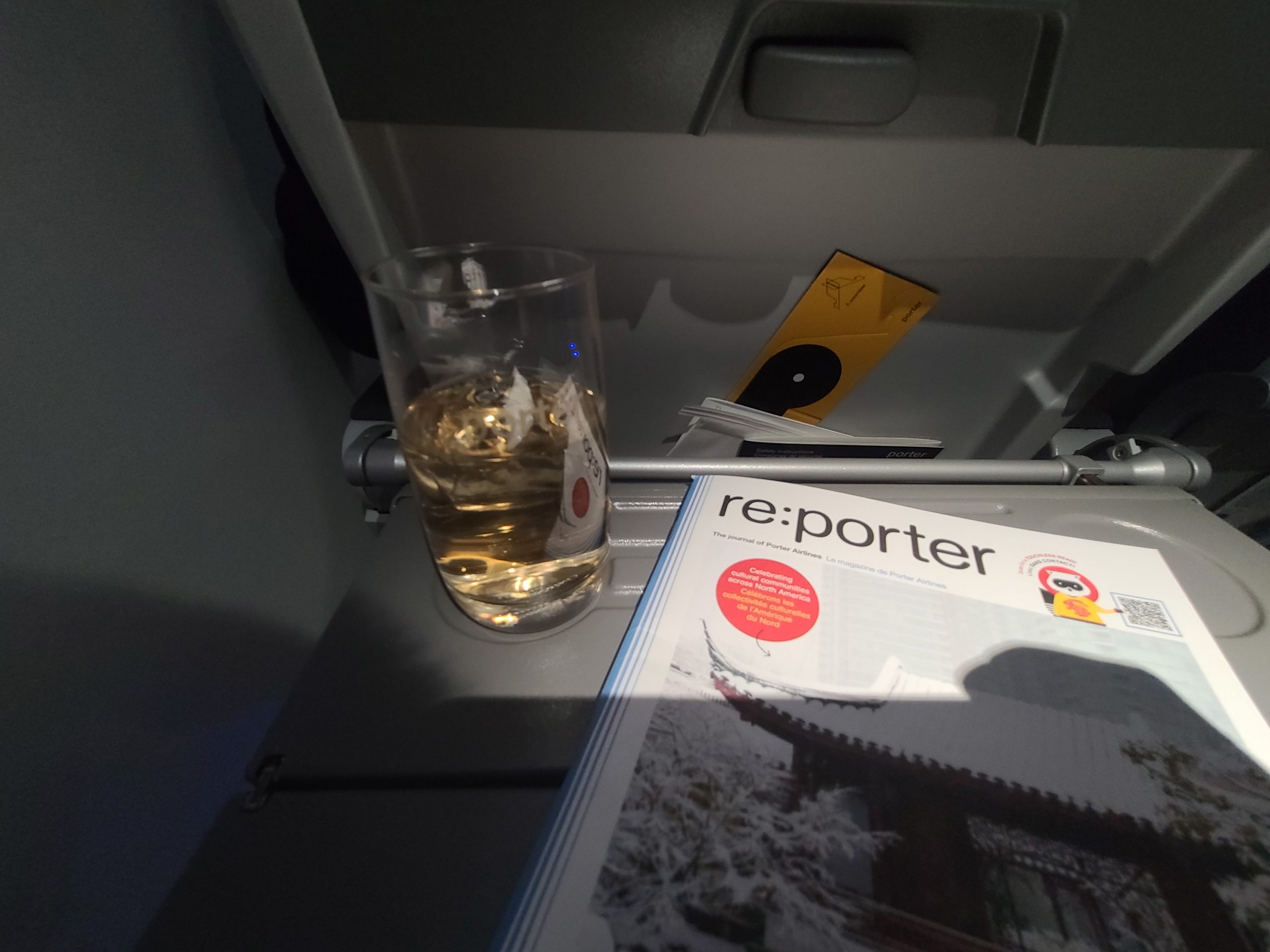
Porter drink service with glassware (Photo: AirlineGeeks | Andrew Chen)

We arrived around 20 minutes behind scheduled and taxied towards Gate B6. There was a slight delay before pulling into the gate as we waited for the ground crew to be ready. Gate B6 is located in a satellite building and required a walk through an underground tunnel to the main part of Terminal 3.
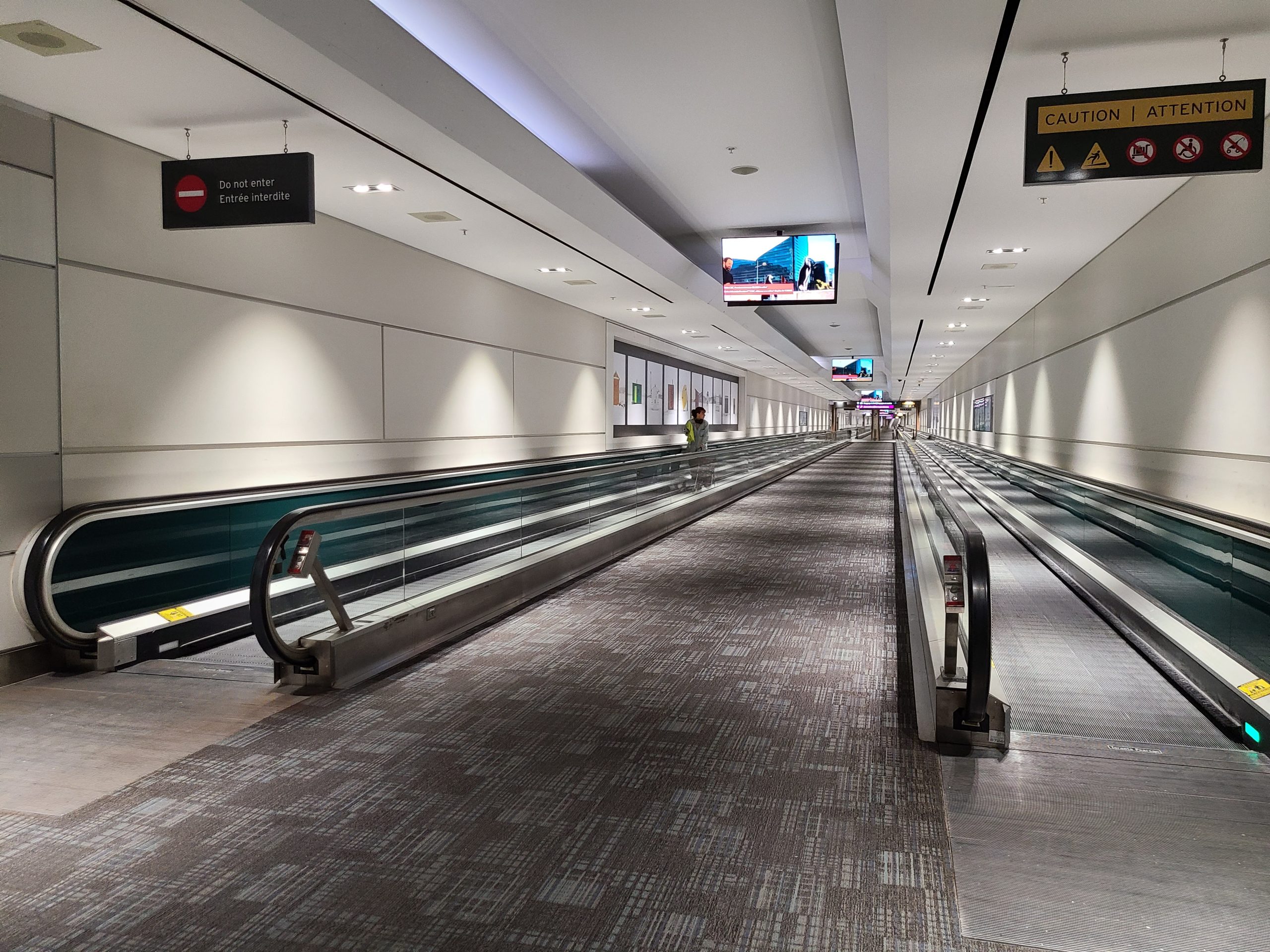
Terminal 3 tunnel at Toronto Pearson International Airport (Photo: Andrew Chen | AirlineGeeks)

Final Thoughts

Overall, I was very impressed with Porter’s new jets and service. Although there were some hiccups such as the service flow and streaming entertainment, Porter has clearly developed an excellent product. With no middle seats, free Wi-Fi for all passengers and revamped food and beverage offerings, Porter is well-positioned to deliver a competitive onboard experience.

With PorterReserve, the airline has created a unique product in the Canadian market. Priced between economy class and premium economy/North American business class offered by competitors, there isn’t really anything directly comparable. PorterReserve will therefore offer a creative new onboard option for Canadian travelers.

Porter has begun a new chapter in its history. The homegrown regional carrier operating turboprops out of the small downtown airport is now starting to fly jets from Canada’s largest airport to destinations throughout North America. Additional jet destinations that have been announced from Toronto Pearson include Calgary and Edmonton in Alberta and Halifax in Nova Scotia and the carrier is looking to expand to the United States and the Caribbean. It is an exciting time for Porter Airlines and I am looking forward to seeing what they have in store.

Andrew Chen

Andrew is a lifelong lover of aviation and travel. He has flown all over the world and is fascinated by the workings of the air travel industry. As a private pilot and glider pilot who has worked with airlines, airports and other industry stakeholders, he is always excited to share his passion for aviation with others. In addition to being a writer, he also hosts Flying Smarter, an educational travel podcast that explores the complex world of air travel to help listeners become better-informed and savvier travelers.

MHI Discontinues SpaceJet Regional Aircraft Program

Mitsubishi's SpaceJet (Photo: Mitsubishi)

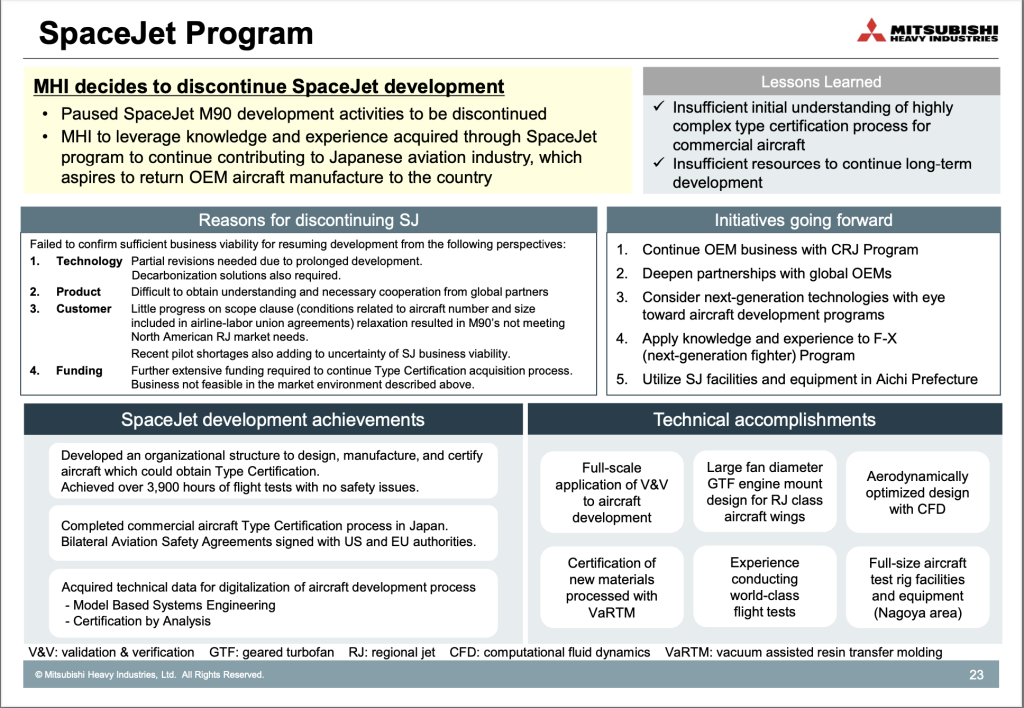
Mitsubishi Heavy Industries(MHI) announced the discontinuation of SpaceJet development activities, which Mitsubishi Aircraft Corporation, a consolidated MHI Group company, had pursued. The company previously announced freezing development of the regional aircraft in 2020. The company quietly scrapped the test articles at its base in Moses Lake, Wash.

In its financial results briefing, the company cited several reasons for canceling the program. 

Technology: Partial revisions are needed due to prolonged development. Decarbonization solutions are also required. 

Product: Difficult to obtain understanding and necessary cooperation from global partners 

Customer: Little progress on scope clause (conditions related to aircraft number and size included in airline-labor union agreements) relaxation resulted in M90’s not meeting North American RJ market needs. Recent pilot shortages also add to the uncertainty of SpaceJet’s business viability. 

Funding: Further extensive funding is required to continue the Type Certification acquisition process. Business is not feasible in the market environment described above.

While the group does not have another active aircraft developmental program, it is still committed to the aerospace industry. It plans to continue OEM business with the acquired CRJ program. In addition, it will also apply knowledge learned to the F-X next-generation fighter program. Meanwhile, the industry giant will look for next-generation technologies suited for new aircraft development programs. 

MHI officially cancels the SpaceJet Program. (Photo: Mitsubishi Heavy Industries)

The SpaceJet

The MRJ or SpaceJet program started in 2008, with an order for 25 aircraft from All Nippon Airways — targeting a 2013 introduction. The first test flight occurred on November 11, 2015, with a total of 7 MRJ90 test aircraft and 1 MRJ70 test aircraft, the program accumulated over 3,900 flight test hours.

The ill-fated jet had nearly 200 conditional orders from the U.S.’s Skywest Airlines and Republic Airways Holdings. However, the conditional order would never materialize, as the pilot union outright refused to adjust the scope clause.

The aircraft — renamed SpaceJet in 2019 — was supported by the Japanese government and domestic firms, including Toyota. It also attracted another headlining order from Mesa Airlines with the relaunch of M100, a 76-seat airplane that would have met the scope clause.

Sadly, with mounting cost overruns and the pandemic’s impact, the Japanese company slashed the program’s budget by 95%, effectively killing the program. Eventually, it started dismantling the test articles after shutting down its office in Seattle and Moses Lake, leading to the official cancellation this week.

MHI’s Ambition

The development of the Mitsubishi SpaceJet was Japan’s first domestic attempt to produce a commercial plane since the YS-11, a turboprop made by Nihon Aircraft Manufacturing that ended its production in 1974.

Mitsubishi Heavy has been a major aerospace component supplier. Due to the country’s close ties with the US, it has been heavily involved in Boeing’s supply chain, providing some of the most critical components, such as the wing box of the Boeing 787 Dreamliner. Despite its experience designing and manufacturing structural components for the aerospace industry, the company struggled to define requirements and create a complete aircraft.

In 2014, the company signed an agreement with the Seattle-based aerospace engineering firm AeroTEC seeking flight test assistance for the Mitsubishi regional jet. Unfortunately, the technical expertise was insufficient to bring new life to the program.

In the end, not only did the world lose a potential competitor for the Embraer E-jets, but Japan’s Aircraft OEM dream will also have to wait for another day.


Fangzhong Guo

Fangzhong grew up near an OEM airport in northeastern China, where he developed his enthusiasm for aviation. Taking upon his passion, he's now working as an aircraft interior design engineer. Besides working in the aerospace industry, Fangzhong enjoys trying out different types of airplanes and seeing how airplane interiors have evolved. So far, he's flown on over 80 types of aircraft. He also planespots in his spare time. His rarest catches included the 747 Shuttle Carrier Aircraft and AN-225.

IATA Figures Show Positive Growth in 2022 Passenger Demand

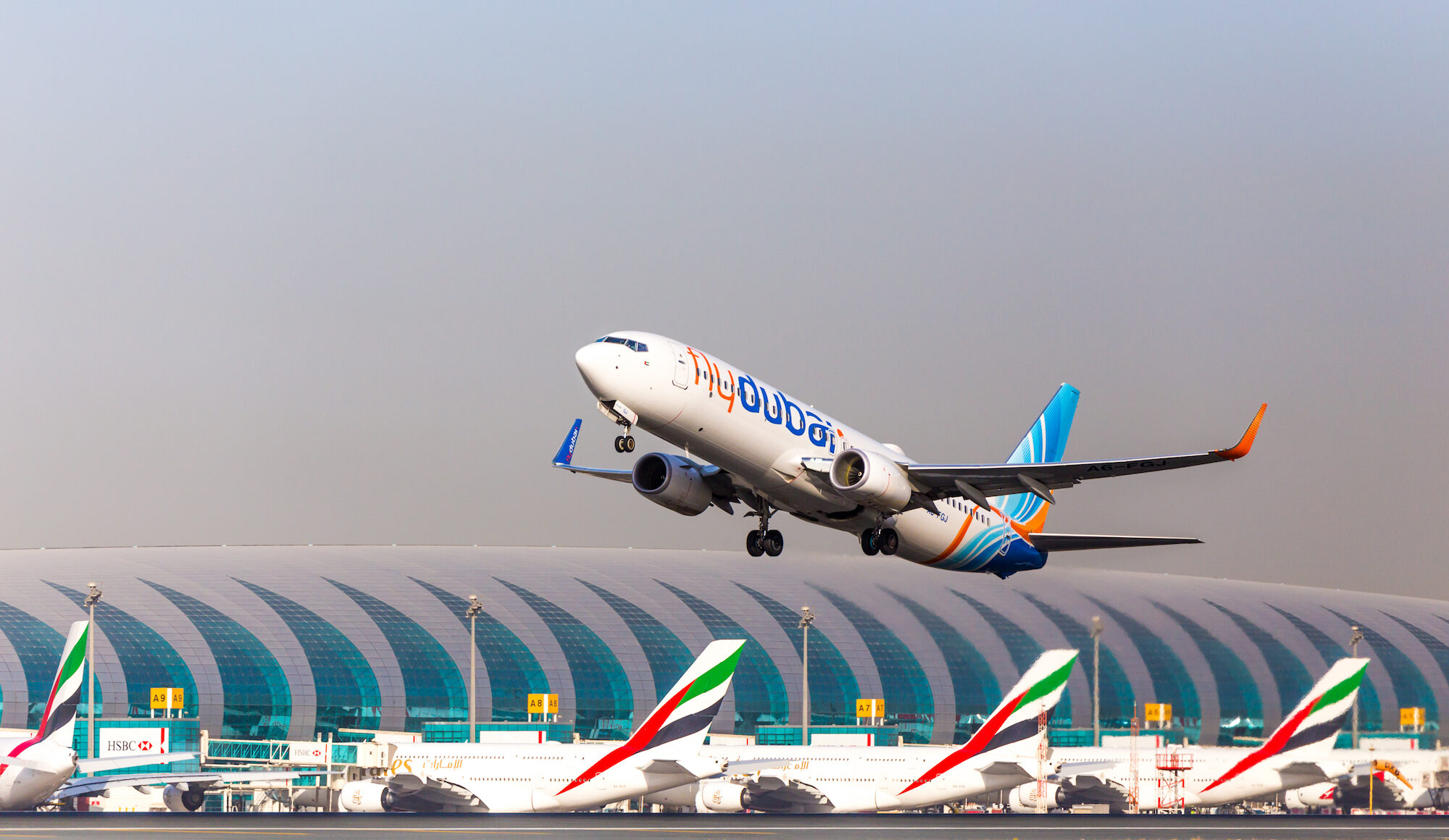
A flydubai Boeing 737 departs from Dubai International. (Photo: AirlineGeeks | Hisham Qadri)

This week, the International Air Transport Association (IATA) reported on the ongoing aviation industry recovery in 2022. The airline industry organization released statistics that show that total passenger traffic was up 64.4 percent in 2022 over 2021. This figure accounts for 68.5 percent of the 2019 pre-pandemic levels reflecting the fact that a number of countries still had travel restrictions for most of the year.

Willie Walsh, IATA’s Director General said, “The industry left 2022 in far stronger shape than it entered, as most governments lifted COVID-19 travel restrictions during the year and people took advantage of the restoration of their freedom to travel. This momentum is expected to continue in the New Year, despite some governments’ over-reactions to China’s re-opening.”

According to IATA, the figures show significant regional disparities in airline passenger capacity and demand. The North American region is closest to 2019 levels with available seat kilometers (ASK), a measure of capacity, 9.9 percent off pre-pandemic levels and the demand metric, revenue passenger kilometers (RPK), 11.3 percent behind. Asia Pacific still has some way to go with ASKs 55.6 percent and RPK 49.4 percent below 2019 figures.

Unsurprisingly given the ongoing restrictions for most of the year in major markets such as China and Japan international passenger traffic figures for Asia Pacific were way down in 2022.  Capacity was just 35 percent of 2019 and demand at just 32 percent. Domestic operations in the Asia Pacific region also showed a negative trend with both lower capacity and demand in 2022 over 2021.

The Middle East saw the largest percentage increase over 2021 in both total capacity (67 percent) and demand (144.4 percent). However, both of these metrics are still approximately 25 percent behind data from 2019. The Middle East’s domestic market operated close to 2019 levels with capacity and demand down just 4 percent and 10 percent, respectively.

Brazil was a positive story for the Latin American and Caribbean region with domestic traffic close to pre-pandemic levels in 2022 with RPKs totaling 94.6 percent of 2019 levels. Overall the Latin American and Caribbean region’s domestic capacity was 1.6 percent above 2019 with demand just 0.5 percent below pre-pandemic levels.

The European region was a positive story for the airline industry in 2022 at least in terms of capacity and demand. Despite staffing shortages and multiple disruptions over the peak summer travel season, the IATA statistics show domestic capacity (-6.7 percent) and demand (-3.1 percent) close to pre-pandemic levels. In further positive news, the passenger load factor (PLF) for European domestic flights exceeded 2019 levels by 3.2 percent, reaching 85.1 percent. Africa was the only region to record positive PLF figures over 2019 for both domestic and international passenger traffic.

Walsh summarized the year’s passenger traffic numbers, saying, “Let us hope that 2022 becomes known as the year in which governments locked away forever the regulatory shackles that kept their citizens earthbound for so long. It is vital that governments learn the lesson that travel restrictions and border closures have little positive impact in terms of slowing the spread of infectious diseases in our globally inter-connected world. However, they have an enormous negative impact on people’s lives and livelihoods, as well as on the global economy that depends on the unfettered movement of people and goods.”

John Flett

John has always had a passion for aviation and through a career with Air New Zealand has gained a strong understanding of aviation operations and the strategic nature of the industry. During his career with the airline, John held multiple leadership roles and was involved in projects such as the introduction of both the 777-200 and -300 type aircraft and the development of the IFE for the 777-300. He was also part of a small team who created and published the internal communications magazines for Air New Zealand’s pilots, cabin crew and ground staff balancing a mix of corporate and social content. John is educated to postgraduate level achieving a masters degree with Distinction in Airline and Airport Management. John has held the positions of course director of an undergraduate commercial pilot training programme at a leading London university. In addition he is contracted as an external instructor for IATA (International Air Transport Association) and has been a member of the Heathrow Community Fund’s ‘Communities for Tomorrow’ panel.

Japan Airlines Announces Flagship Airbus A350-1000

Japan Airlines Airbus A350-900 and Airbus A350-1000 Renderings (Photo: Airbus)

Japan Airlines has announced that the Airbus A350-1000 will be its new international flagship aircraft. The Tokyo-based carrier will be debuting its first flagship aircraft in two decades in the second part of 2023.

A New Flagship Aircraft

The Airbus A350-1000 will be replacing the Boeing 777-300ER, as Japan Airlines’ international flagship aircraft. The airline received its first Boeing 777-300ER in 2004, and it has served as the carrier’s premier international aircraft. Japan Airlines has 13 Airbus A350-1000s on order, which will be replacing the airline’s current fleet of 13 Boeing 777-300ERs.

In a recent press release, Japan Airlines stated that their A350-1000s will enter service in the Tokyo to New York market on flights between Tokyo’s Haneda Airport and New York’s John F. Kennedy Airport in winter 2023. Although no other further route announcements have been made, it is likely that the A350-1000 will be deployed to current 777-300ER destinations such as Paris, London, Chicago and Los Angeles.

Japan Airlines has not yet announced any details of the cabin configuration or products but there are some indications of what to expect. First Class seats are currently on sale on the Tokyo’s Haneda Airport to New York JFK route through next winter so it does not appear that the carrier is doing away with its First Class.

The carrier already has a set of respectable international premium products and the airline stated in a press release that with the A350-1000, it will be “developing new cabin specifications for international flights to provide a new unprecedented experience for each and every one of our customers.”

It appears that the A350-1000 will have a four-cabin configuration, just like the 777-300ERs that it is replacing.  While very few details of the new offerings have been released, the carrier is certainly aware that its main competitor, All Nippon Airways, introduced a stunningly spacious business class suite called The Room a few years ago.

The bar for premium international products in the Japanese market is high and Japan Airlines will be striving to deliver a competitive product.

Expanding the Fleet

Japan Airlines already has 16 Airbus A350-900s in its fleet, with another two on order. These aircraft are used on domestic routes and have high-density seating configurations.

The airline’s A350 fleet will therefore be split into two distinct parts, with the A350-1000s serving international routes while the A350-900 operates throughout the airline’s domestic network. Japan Airlines and All Nippon Airways have long had a need for large, high-density aircraft for the country’s busiest domestic routes. Japan Airlines’ A350-900s have the highest capacity of any aircraft type in the fleet, with some planes configured with nearly 400 seats.

Despite the carrier’s new commitment to its A350 fleet, Japan Airlines has traditionally been a Boeing operator. Even after the introduction of the A350-1000, the airline will have nearly 50 Boeing 787 aircraft. The A350 will be the carrier’s only Airbus aircraft, with the rest of the fleet consisting of Boeing 737s, Boeing 767s and Boeing  777s.

Even historically, the airline has largely operated aircraft from Boeing and McDonnell Douglas, both of which later merged into the Boeing that exists today. Notably, Japan Airlines has operated a large number of Boeing 747 aircraft, ranging from the Boeing 747-100 to the high-density Boeing 747-400D.

Andrew Chen

Andrew is a lifelong lover of aviation and travel. He has flown all over the world and is fascinated by the workings of the air travel industry. As a private pilot and glider pilot who has worked with airlines, airports and other industry stakeholders, he is always excited to share his passion for aviation with others. In addition to being a writer, he also hosts Flying Smarter, an educational travel podcast that explores the complex world of air travel to help listeners become better-informed and savvier travelers.

Las Vegas To Break Passenger Record, Nears Maximum Capacity

An Air Canada Rouge 767 in Las Vegas. (Photo: AirlineGeeks | William Derrickson)

In the next few days, Las Vegas’ Harry Reid International Airport is going to release the final passenger figures for 2022, and it is expected that the total number of travelers that passed through the main Nevada airport will be the highest in its history.

Passenger numbers had peaked in 2019 at 51,537,638 before seeing a sharp drop due to the COVID-19 pandemic and the restrictions to travel that eventually led to many casino resorts on the Strip to shut down for a few months. But after a 57% drop in 2020, the traffic rebounded and the figures for 2022 are expected to be close to 53 million, Clark County Department of Aviation Director Rosemary Vassiliadis told the Las Vegas Review-Journal.

“Las Vegas has rebounded faster than any other airport in the country, said Joel Van Over, Senior Director for consultancy company Ailevon Pacific, during a presentation to the Board of Directors. “During 2022 three extra airlines have started flights to the airport, adding 310,000 annual seats.”

There are 36 new markets that have seen the activation of a new non-stop connection to Las Vegas during the past year — 17 of which are domestic.

Capacity Limit To Be Reached by 2030

Long-term forecasts are notoriously tricky, especially in aviation, but if the current trend continues it is expected that the airport will hit its maximum theoretical capacity of between 63 and 65 million passengers per year around 2030.

“In having our consultants work on all of that, we know if everything goes perfectly, with our rate of sustainable growth, we feel that we’re going to start getting hit with delays on the airfield by the end of 2029 or maybe by 2030,” Vassiliadis told the Review-Journal. “Unfortunately, it means painful years for airlines and that we need a second commercial airport.”

“It is a problem that most airports will be envious of”, said Oliver Lamb, managing director at Ailevon Pacific. But problems are still problems and solutions will have to be found quickly.

The short-term solution needs to be found in making better use of the existing facilities: the airport needs to incentivize airlines to fly at off-peak times when the airport is less congested, but that is not always easy as airlines are striving to optimize their schedule and fly to their hubs to maximize connections.

Another strategy is to privilege airlines that serve Las Vegas as a destination instead of encouraging connections at Harry Reid International, but there are already carriers basing aircraft and crews in Las Vegas. The airport could also structure its charges to favor the usage of larger aircraft, like other constrained airports have done in the past, to optimize Nevada’s airspace and increase the number of passengers per movement. Already in February 2023, there will be 10% more seats available at the airport with an increase of only 1% in the number of flights, and this is thanks to the use of larger aircraft by operating carriers.

This strategy would also increase the likelihood that private aviation traffic will start using other facilities, like the Henderson Executive Airport, freeing up space at Harry Reid, although its executive terminal located just a few miles away from the heart of the Strip is too big an attraction for well-heeled customers wanting to live it up in Las Vegas.

Plans For New Airport

The long-term solution to this capacity problem is the construction of a new airport, the so-called Southern Nevada Supplementary Airport (SNSA). Due to be located between the villages of Jean, N.V. and Primm, N.V. in the Ivanpah Valley, this new airport is planned to be built approximately 30 miles south of the current airport, following a project that had already been approved in 2000, with its completion date initially projected for 2017.

However, the drop in traffic caused by the 2008-2009 recession convinced Clark County to put the project temporarily on hold. Currently, the project is going through a very long phase to asses its environmental impact, and the County does not expect it will be possible to have the new structure operational before 2037. This would leave a period of 6-7 years that will see Harry Reid operate at capacity or above, with crowded terminals, chronic delays, and unhappy airlines and passengers.

Vanni Gibertini

Vanni fell in love with commercial aviation during his undergraduate studies in Statistics at the University of Bologna, when he prepared his thesis on the effects of deregulation on the U.S. and European aviation markets. Then he pursued his passion further by obtaining a Master’s Degree in Air Transport Management at Cranfield University in the U.K. followed by holding several management positions at various start-up carriers in Europe (Jet2, SkyEurope, Silverjet). After moving to Canada, he was Business Development Manager for IATA for nine years before turning to his other passion: sports writing.

The Slow, Steady Upward Trend of Regional Airlines in India

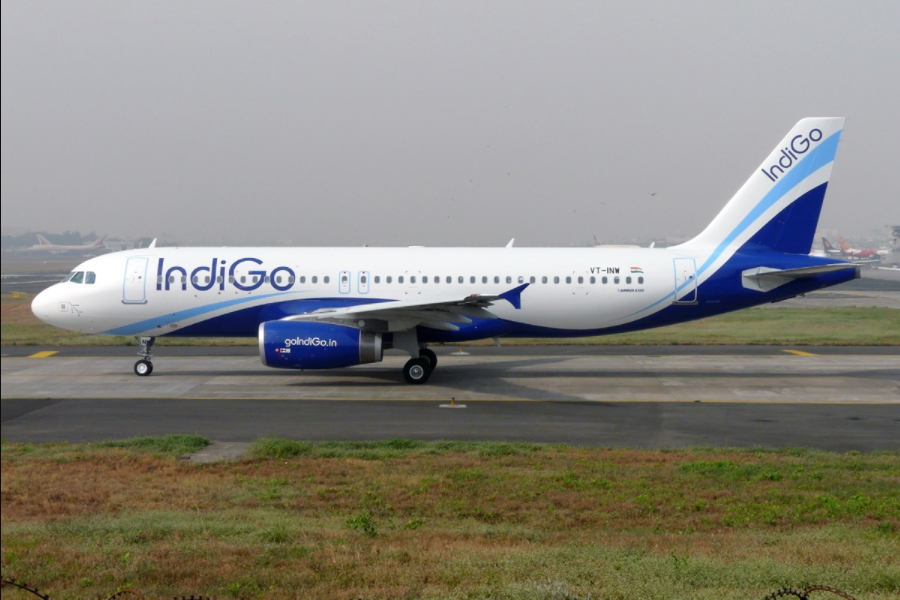
An IndiGo A320 in Mumbai.
An IndiGo A320 in Mumbai. (Photo: Sean D. Silva via Wikimedia Commons - https://commons.wikimedia.org/wiki/File:Airbus_A320-232,_IndiGo_Airlines_JP7457952.jpg)

IndiaOne Air has commenced operations from Kolkata, India to connect Jamshedpur and Bhubhaneshwar via two domestic routes. It is a regional airline based in the western Indian state of Gujarat. However, its operations are focused on the eastern part of the country.

The primary objective of the airline is to cater to Tier II and III cities of the country. Regular destinations are Bhubhaneshwar, Visakhapatnam, Jamshedpur, Jeypore and the metropolitan city of Kolkata.

What distinguishes the airline is that it is the first and only scheduled single-engine operator in India. The small airline has a fleet of 2 Cessna 208B Grand Caravan EX with another one on order. The seating capacity of each plane is nine.

The unique feature about this airline is the fact that there has been no shortage of regional airlines in the country, with most of them going belly up.

The extension of services of the airline is testament to the fact that there is justifiable demand to cater to such smaller cities as the standard of living and the disposable income has increased. Additionally, there is an ongoing trend of businesspeople and professionals having to travel to state capitals.

Additionally, there have been significant enthusiasm and steps taken by the national government in order to bolster regional air connectivity and to stimulate economic growth. To a certain, such policies were successful as the government were providing subsidies to airlines to operate on several low demand routes in order at least kickstart some demand. It did work somewhat at certain select locations and routes only.

LCCs like SpiceJet and IndiGo were also involved in this initiative by the Government of India. Even if their aircraft flew partly empty, airlines still continued to operate as long as they continued to receive subsidies.

Other regional airlines in the country at the moment include Alliance Air, FlyBig and Star Air.

Alliance Air is an airline owned by the Government. Operating a fleet of ATR 42-600, ATR 72-600 and a singular Dornier 228. It has 75 destinations across the country.

FlyBig is a fairly new airline, which commenced flights in December 2020 with an aim to provide connectivity to Tier II cities. It has an active fleet of three ATR 72-500/600s with 10 DHC Twin Otters on order.

Star Air is the second most established regional airline in the country after Alliance Air, serving 17 domestic destinations with a fleet of three active Embraer ERJ 145LR with 4 Embraer 175 on order. The airline has had a steady and consistent growth since its first flight in January 2019.

India has a strong presence of domestic and international airlines, its regional connectivity is also developing, slowly but surely. At this pace, India will continue seeing the boom and growth in its aviation sector, and not just from domestic and international flights, but also from regional activities.

Etihad Cargo, Astral Aviation Strengthen Ties, Expand African Network

Photo provided by Alec Mollenhauer

Etihad Cargo, the cargo and logistics arm of Etihad Aviation Group, has signed a memorandum of understanding (MoU) with Astral Aviation to expand the partnership between the two parties and enhance cooperation between Abu Dhabi and Nairobi.

The agreement demonstrates Etihad Cargo’s commitment to expanding its global network and providing increased cargo capacity to its customers in the African market.

As part of the agreement, Etihad Cargo and Astral Aviation will share up to 50% of all available capacity on additional flights between Nairobi and Abu Dhabi. This expansion of the partnership will further enhance Etihad Cargo’s capabilities in the African market and offer its customers additional cargo capacity out of Nairobi via the introduction of new services from Nairobi to Etihad Cargo’s hub in Abu Dhabi starting April 1, 2023.

Etihad Cargo and Astral Aviation first joined forces in 2021, when the carrier signed a Service Level Agreement (SLA) with Astral Aviation to provide reliable and cost-effective air freight solutions for the transportation of pharmaceuticals across Africa. This latest MoU builds on that agreement and further strengthens the relationship between the two companies.

Etihad Cargo’s Senior Vice President of Global Sales and Cargo, Martin Drew, said the MoU demonstrates both companies’ commitment to joint network development and providing a comprehensive solution to international cargo transportation between Nairobi and Abu Dhabi. He added that the partnership will enable Etihad Cargo to expand its African network and offer increased cargo capacity both into and out of Nairobi, strengthening the connection between the two cities and further developing this critical African gateway.

Astral Aviation CEO, Sanjeev Gadhia, agrees ad he expressed his company’s honor at entering into the MoU with Etihad Cargo, saying it was a part of their strategy to expand their network globally and enhance accessibility and connectivity via Etihad’s Abu Dhabi hub. He added that the cooperation would create new opportunities for both companies’ clients and would be a win-win partnership.

Through the MoU, Astral Aviation will operate more flights to Abu Dhabi, supported by Etihad Cargo, and the two companies will share available capacity on the new Nairobi-Abu Dhabi-Nairobi flights, increasing the capacity offered to air cargo and air mail customers. Etihad Cargo will utilize its expansive road feeder service network to transport cargo from Nairobi to destinations throughout the UAE and other offline stations.

The partnership between Etihad Cargo and Astral Aviation is a significant step in expanding the presence of both companies in the African market and providing more comprehensive solutions for international cargo transportation. The agreement will offer increased cargo capacity, enhanced connectivity, and new opportunities for both companies and their clients.

Victor Shalton

Victor Shalton's love for aviation can be traced to when he was 11-years-old. As a seasoned aviation writer, he takes pride in providing the best aviation coverage around the globe and is passionate about advancing his skills in the aviation space. In addition, he loves travelling, writing, arts and while his speaking engagements have taken him around the world, he is proud to call Nairobi home.

Norwegian Set to Lease Additional Aircraft After Promising January Performance

A Norwegian 737-800 arriving in the snow (Photo: Norwegian)

Norwegian Air Shuttle ASA, known simply as ‘Norwegian,’ a Norwegian low-cost airline that operates both domestically and internationally, began 2023 with a strong sales campaign, carrying around 1.1 million (1,131,474) passengers and also recording an increase in load factor. January is generally the month of the year when people travel the least, but compared to January 2022 there was a 78% increase in load factor. People typically use this time of year to book their next trips during the school holiday period and long weekends, but this month saw almost a full load of flights to the ‘hottest’ destinations by the Norwegian airline.

Capacity (ASK) was 1.870 million seat kilometers, while actual passenger traffic (RPK) was 1.453 million seat kilometers. In January, Norwegian operated an average of 62 aircraft and 99.5% of scheduled flights were completed. Punctuality, as measured by the number of flights departing within 15 minutes of the scheduled time, was 85.0% in January.

The low-cost airline also observed a positive booking trend after the January period. This year’s summer program includes 300 routes to 114 destinations, including some new ones. With an expanded route network and new aircraft, Norwegian continues to recruit new colleagues.

Last week the Norwegian aviation sector was marked by the bankruptcy of Flyr, a low-cost airline based at Oslo-Gardermoen Airport, like Norwegian itself.

Norwegian’s CEO, Geir Karlsen, said he was very supportive of the employees, customers and others affected by Flyr’s bankruptcy, inviting employees to apply for jobs at Norwegian.

Norwegian, as a result of the very positive result in January, decided to lease six Boeing 737 MAX 8 aircraft. On Monday, it signed a Letter of Intent (LOI) with Air Lease Corporation (ALC) for the lease of six Boeing 737 MAX 8 aircraft, which are in addition to the three 737 MAX 8s that Norwegian had previously agreed to lease from ALC and one of which has already been delivered to Norwegian.

The Boeing 737 MAX 8 is approximately 14% more fuel efficient than the previous generation aircraft, contributing to Norwegian’s ambitious goal of reducing its carbon footprint by 45% by 2030. The aircraft will be delivered to Norwegian in short order, ahead of the 2023 summer season.

Norwegian had already reached an agreement on May 30, 2022 to commit to the purchase of 50 Boeing 737 MAX aircraft. The agreement also included options for a further 30 aircraft.

Norwegian Air Shuttle ASA reached an agreement in principle with Boeing for a new commitment to purchase 50 Boeing 737 MAX 8 aircraft. The 50 aircraft were to be delivered between 2025 and 2028.

Vincenzo Claudio Piscopo

Vincenzo graduated in 2019 in Mechanical Engineering with an aeronautical curriculum, focusing his thesis on Human Factors in aircraft maintenance. In 2022 he pursued his master's degree in Aerospace Engineering at the University of Palermo, Italy. He combines his journalistic activities with his work as a Reliability Engineer at Zetalab.

Bristol Airport Expansion Remains Uncertain

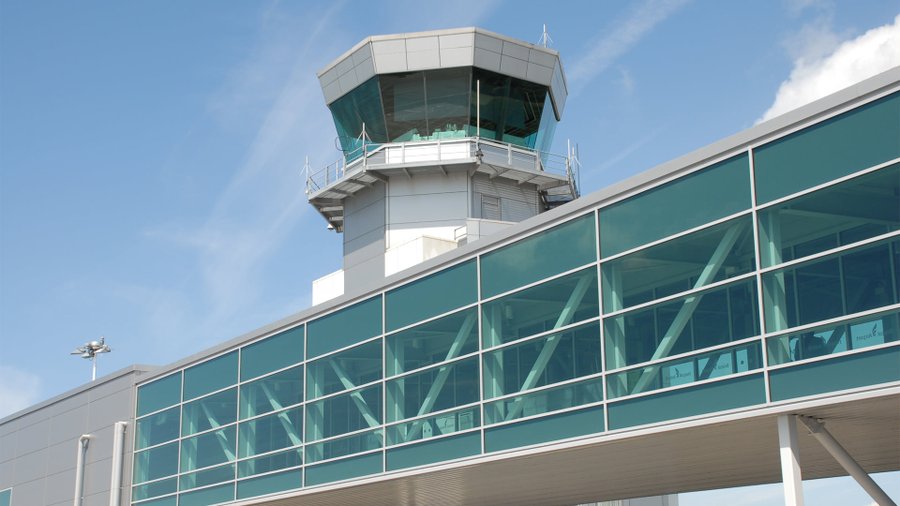
Bristol Airport

United Kingdom’s Bristol Airport is facing a challenge again after the High Court gave a green light to an expansion. The original project was banned in 2020 by North Somerset Council which could increase annual passenger capacity to 12 million from 10 million and handle up to 10,420 extra flights. Bristol could attract more international destinations as a result. However, Bristol Airport Action Network (BAAN) vowed to appeal the High Court’s decision.

Bristol Airport said the expansion would meet the travel demand for South West England in the future. The project includes to expand the terminal, build a multi-story car park and improve the public transport. Earlier, Bristol has started its redevelopment of its departure lounge.

The airport said 800 new jobs will be hired at the airport and up to a further 5,000 jobs will be created across the region, with a focus on the most deprived areas. The expansion could bring an estimated 430 million pounds to the economy of the South West of England and South Wales. In addition, the customers living in the region could avoid going to London airports for traveling abroad.

Bristol Airport handled nearly nine million passengers in 2019 and the airport has seen a speedy recovery after the pandemic. According to Civil Aviation Authority, from Dec 2021 to Nov 2022, it handled 7.7 million passengers. The airport mainly provides the flights to Europe and domestic service.

BANN said the expansion could fall short of protecting the environment and believes “this shows a total disregard for the climate emergency we are in.” However, the airport mentioned that it will meet the target of net zero carbon operation by 2030.

Swiss Touches Down at Bristol

Bristol Airport is determined to develop and expand its route map. Last Saturday, Bristol has welcomed Swiss International Air Lines’ maiden flight from Zurich.

Bristol is Swiss’s the eighth destination in the U.K. and the carrier will operate a weekly flight in the first phase. The airline will increase its frequencies and as of June it will operate three weekly flights.

“This is an incredibly exciting day for Bristol Airport and the region. Swiss is a major global airline and this decision shows confidence in the region. The regular service between Bristol and Switzerland opens up a wide range of European and worldwide connections to our customers.” Shaun Browne, Head of Airline Relation of the airline said.

“Our new Bristol services offers convenient schedules between Bristol and Switzerland’s financial centre and as easy access to our global network of over 110 destinations.” Heinrich Lange, Senior Director Sales Northern Europe Lufthansa Group Airlines said.

The airline will operate with Airbus A220 and the Embraer E190 aircraft of wet-lease partner Helvetic Airways.

Endeavor Air Winds Down Detroit CRJ-200 Operations

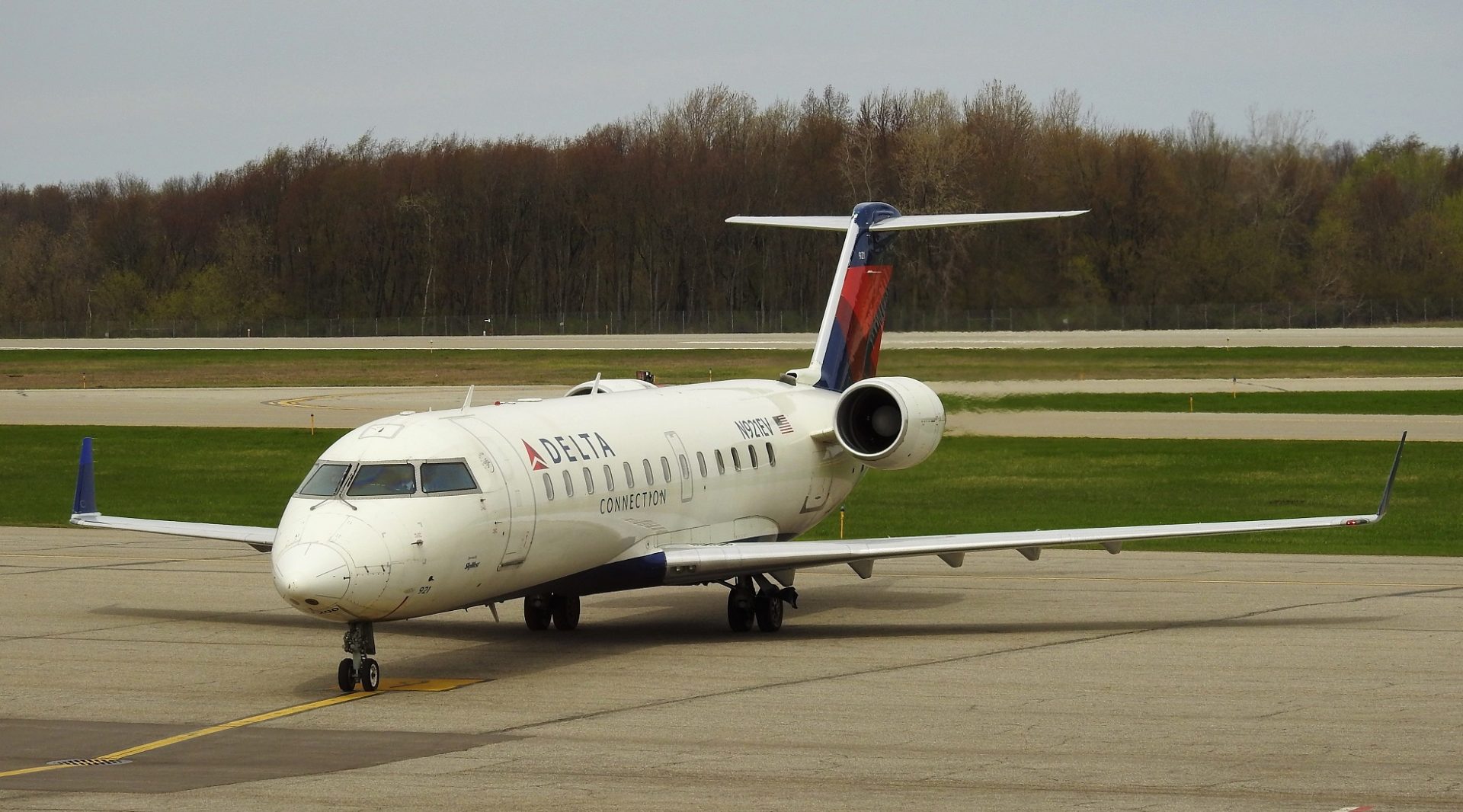
A Delta Connection CRJ-200 in Minneapolis/St. Paul (Photo: AirlineGeeks | Joey Gerardi)

Airlines around the world change their schedules constantly, and that’s nothing new. But over the last couple of months, Delta has had a considerable amount of shift in its schedule, most of which includes moving away from its smaller 50-seat CRJ-200 in favor of larger and much more reliable CRJ-700s and CRJ-900s. Endeavor Air, Delta’s wholly owned subsidiary, is slowly winding down its operations with the current smallest plane in Delta’s fleet, the almost unanimously hated CRJ-200.

Back in November of 2022, AirlineGeeks reported that Delta was shifting focus away from its Detroit hub in favor of other hubs, by ending nine routes to small cities more than half of which were not so coincidently operating on the ill-fated CRJ-200. As of the time this article was written, Endeavor Air only has 17 active CRJ-200s in service, a number which continues to go down every week as they fly more of them to Kingman, Ariz. for retirement in the desert.

A Delta Connection CRJ-200 (Photo: AirlineGeeks | Joey Gerardi)

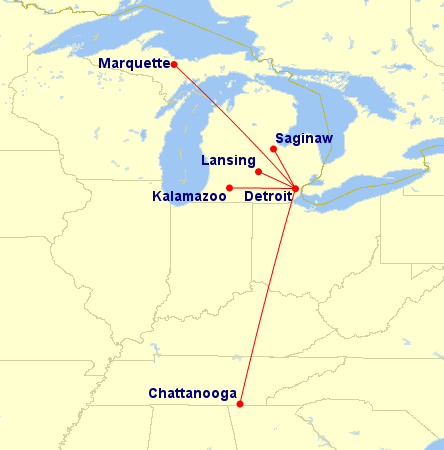
Endeavor has already ended all CRJ-200 flying from its Minneapolis/St. Paul hub and only five destinations still see the Endeavor Air-operated CRJ-200s out of Detroit-Metro. The cities that still see Endeavor Air CRJ-200s on routes out of Detroit include, Saginaw, Lansing, Kalamazoo, and Marquette all of which are located in Michigan, as well as Chattanooga in Tennessee. All of these cities are scheduled to see their last scheduled Delta CRJ-200 flights on March 8, 2023, according to Delta’s website.

Endeavor Air operated CRJ-200 flights out of Detroit (Photo: GreatCircleMapper)

This will also signal the closing of the Endeavor CRJ-200 base in Detroit, and Atlanta will become the only hub that will still have Endeavor CRJ-200s regularly scheduled from it. Come March 9, all the Endeavor CRJ-200 routes out of Detroit will be upgraded to either CRJ-700s or CRJ-900s and will continue to see the flights all operated by Endeavor. This will be a big capacity boost for these small cities as Saginaw and Lansing will go from 100 daily seats up to 152, Marquette will go from 50 to 76 as they only see one flight a day, and Kalamazoo will go from 100 to 138 daily seats, and Chattanooga will have their Detroit seat number go from 50 up to 76.

Chattanooga also sees 6-8 daily flights to Atlanta on a mix of Boeing 717s, A319s, and CRJ-900s, unlike the other cities mentioned in this article which only see flights from Detroit. Flights from Detroit to Lansing, Saginaw, Marquette, and Chattanooga will all be operated on the CRJ-900, but the flights to Kalamazoo will be operated on the CRJ-700 due to an aircraft noise restriction in the city.

A Delta Connection CRJ-200 in Lansing (Photo: AirlineGeeks | Joey Gerardi)

Endeavor Air will continue to operate the CRJ-200 to a number of small cities out of Atlanta for the time being. In addition, SkyWest still operates flights on board CRJ-200s out of Detroit, Minneapolis, and Salt Lake City to a hand full of Essential Air Service communities where SkyWest holds contracts. While it isn’t a massive deal for those that don’t fly to these small communities, it does signal the beginning of the end for one of the most almost unanimously hated commercial aircraft in the skies today.

If you still have a burning desire to fly on this aircraft type, a large number of them operate still operate under the United Express brand and American is even un-retiring the CRJ-200 this spring. All flight and schedule data was pulled directly from Delta’s website and could be changed without notice.

Joey Gerardi

Joey has always been interested in planes for as long as he can remember. He grew up in Central New York during the early 2000s when US Airways Express turboprops ruled the skies. Being from a non-aviation family made it harder for him to be around planes and would only spend about three hours a month at the airport. He was so excited when he could drive by himself, the first thing he did with his driver's license was get ice cream and go plane spotting for the entire day. He graduated from Western Michigan University in 2022 with a B.S. in Aviation Management & Operations and a Minor in Business, and currently works for a major airline in his hometown.
Sign-up for newsletters & special offers!

Get the latest stories & special offers delivered directly to your inbox

SUBSCRIBE

Uh-oh! It looks like you're using an ad blocker.

Our website relies on ads to provide free content and sustain our operations. By turning off your ad blocker, you help support us and ensure we can continue offering valuable content without any cost to you.

We truly appreciate your understanding and support. Thank you for considering disabling your ad blocker for this website