A Fiji Airways Airbus A350-941 with registration DQ-FAI (Photo: William Derrickson)
On November 25 Fiji Airways inaugurated its non-stop flights between Nadi (NAN) and Vancouver (YVR), services will be available throughout the year. The airline is the only carrier to connect Fiji to Canada. Flight FJ 880, operated on an Airbus A330 registered DQ-FJT, took off from Nadi International Airport (NAN) and landed at Vancouver International Airport (YVR) after 10 hours and 37 minutes.
According to data obtained through Cirium, Fiji Airways will offer 7,728 weekly seats between Fiji and the United States and Canada in December, a 28.8 percent increase when compared to pre-pandemic levels.
With the start of non-stop operations to Nadi (NAN), it becomes the fourth South Pacific destination served from Vancouver (YVR), the Canadian airport serves Sydney (SYD) and Brisbane (BNE) in Australia and Auckland (AKL) in New Zealand (AKL).
“We are delighted to welcome Fiji Airways to YVR and are proud that Vancouver will be the airline’s first Canadian destination in its growing network,” said Mike McNaney, Vice President and Head of External Affairs for the Vancouver Airport Authority.
Flight Itinerary
Vancouver – Nadi Flight FJ 880 NAN 22:15 – YVR 13:20 Monday and Friday.
Nadi – Vancouver Flight FJ 881 YVR 21:40 – NAN 05:30+2 Monday and Friday.
The route will be operated on Airbus A330-200 aircraft with a capacity of 273 seats in two classes (24 Business Class/249 Economy). This service will also provide additional cargo capacity to increase trade between Fiji and Canada, as well as with other Pacific Island nations seeking new business opportunities.
Fiji Airways’ new operation in Canada will produce approximately $7.5 million in combined Gross Domestic Product (GDP) with $12.2 million in tourism and the creation of 86 jobs in Vancouver and British Columbia’s hotels, restaurants and tourist attractions.
“With Canada well into winter and travelers eager for a warm tropical paradise, the timing of our new route couldn’t be better. There is no choice but Fiji. You don’t have to take my word for it, you’ll be convinced as soon as you step on board,” said Andre Viljoen, Fiji Airways’ managing director and CEO.
Fiji Airways schedule between Nadi (NAN) and the United States – Canada
(Source: Cirium, subject to change)
Honolulu (HNL): one weekly flight on Boeing 737 MAX 8.
Los Angeles (LAX): daily flights on Airbus A350-900.
San Francisco (SFO): three weekly flights on Airbus A330-200.
Vancouver (YVR): two weekly flights on Airbus A330-200.
The AirlineGeeks banner placed perfectly next to the last flying Super Constellation. ( Photo: AirlineGeeks | Mike Mangano )
The chance to visit any air show is, of course, a delight. The opportunity to attend an air show based at an aviation museum, however, is extraordinary. That’s what makes Wings Over Illawarra so distinctly unique. With pristine blue skies and open hangars packed full of aircraft, we found ourselves detached from reality in the netherworld of aviation.
While it is a tremendous sight to behold the array of warbirds from all eras take to the sky, Wings Over Illawarra always promises to highlight the equally historical and elegant – historical airliners. It’s this unique – and often forgotten – genre toward which AirlineGeeks gravitated, specifically two Australian icons.
One Shining Constellation
“Set your course by the stars, not by the lights of every passing ship.” – so said the legendary Omar Bradley. It is a profound statement and one that this writer understood in its most literal sense. And so, in true AvGeek fashion, we set our sights on a Constellation – the Lockheed C-121C Super Constellation.
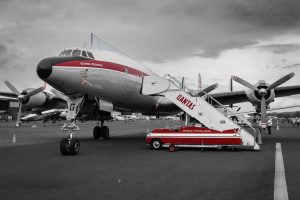
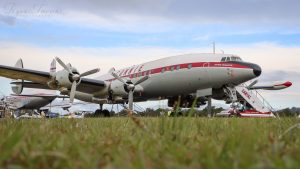
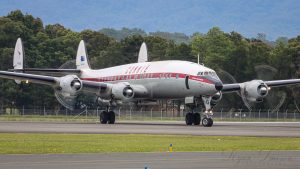
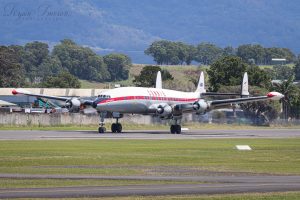
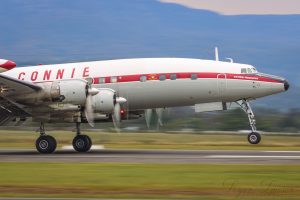
The Historical Aircraft Restoration Society’s Super Constellation, or ‘Connie’ as she is better known, is the last flying example anywhere in the world. Representing a bygone era of air travel, its vintage Qantas livery immediately transports the observer to a time of well-groomed travelers and, for Qantas, better times (the reader knows this to be true).
HARS’ Lockheed Super Constellation. Photo: Ryan ImesonHARS’ Lockheed Super Constellation. Photo: Ryan ImesonHARS’ Lockheed Super Constellation. Photo: Ryan ImesonHARS’ Lockheed Super Constellation. Photo: Ryan ImesonHARS’ Lockheed Super Constellation. Photo: Ryan Imeson
Despite its reputation as the best three-engine airliner, the dolphin-shaped Connie graces the skies with smooth elegance untapped by most modern airliners. Staff and engineers at HARS told a tale of this beauty’s oceanic crossings concerning its engine reliability. It seems that at one point in every flight, one engine decided to call it quits. Using this formula, the Super Constellation could expect an overhaul of all engines every four stops.
The fuselage itself represents another remarkable design from Lockheed. Imagine if the fuselage could assist with the generation of lift. The shape does just that, generating a degree of lift that puts the Constellation up in that starry sky. When props ruled the sky, the Super Constellation was king.
Another Constellation
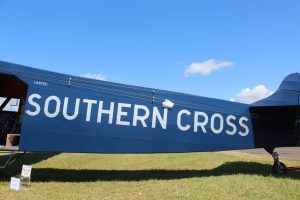
As if the theme centered around the starry, starry night, it is another group of celestial bodies we turn our eyes to – the Southern Cross. Having been awarded the status of immortality in this affectionately named Fokker F.VIIB, Australian aviator Charles Kingsford Smith and his crew made the first ever trans-Pacific flight from mainland USA to Australia in 1928.
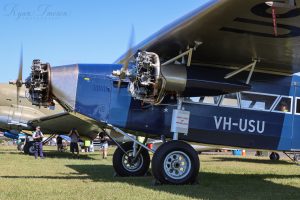
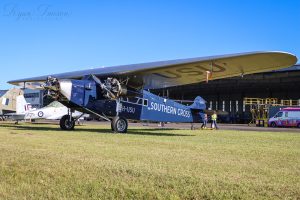
While the original is no longer airworthy, a dedicated crew painstakingly built a replica which we were privileged to board. Originally built between 1980 and 1987, the machine suffered a mishap in 2002 when the main wheel fell during take-off, finally nearing airworthiness today.
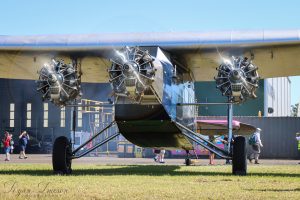
This new Southern Cross is a faithful replica of the old, manufactured with steel tubes and timber, a doped Irish Linen fuselage, and a spruce and plywood wing. It was about three meters of this wing that broke off during the failed take-off of 2002.
Of course, the eagle-eyed observer or historian will note some significant differences between the original and the replica, most notably the cabin. In 1928, the three 220 horsepower engines (joked to this writer that these “ran on oil, and cooled with fuel”) were supplied fuel from tanks in both the wing and cabin, with Smith having crammed as much fuel as possible for his historic flight. Today, those engines have been replaced with 300 horsepower models, with the cabin refitted with seats and a timber interior trim.
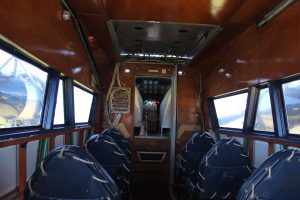
Boarding the plane, the cabin and cockpit feel true to the era – cramped but cozy. While the windows are larger than the original (which was converted to an airliner in its later years), the interior is still unmistakably a trip back in time, and one could be assured that in flight, it would certainly sound just as heritage.
One major question was, for this writer, how true is the cockpit? The answer is this: as true as possible. Given the fact that this aircraft does fly in the modern era, it is a given that the instrumentation installed must meet modern standards. Yet, despite the modern edge, the controls definitely hit the mark. Wire pulley systems are clearly visible on the beautiful timber wheel (yes, not a yoke or stick-wheel), and the rudder pedals are a close fit for the age (although they are Piper pedals). At the time of viewing, the radio was not installed, and this was a key reason for its inability to fly.
HARS’ Fokker F.VIIB Replica. Photo: Ryan ImesonHARS’ Fokker F.VIIB Replica. Photo: Ryan ImesonHARS’ Fokker F.VIIB Replica. Photo: Ryan ImesonInside HARS’ Fokker F.VIIB Replica. Photo: Mike ManganoInside HARS’ Fokker F.VIIB Replica. Photo: Mike Mangano
As we viewed this extraordinary and pioneering aircraft, it just so happened that another Australian aviation pioneer came by. As the first aviator to fly a helicopter solo around the world, Dick Smith – a huge supporter of the volunteer HARS – popped by to visit the Southern Cross. To shake hands with this iconic aviator beneath the wing of an iconic aircraft was, well, iconic.
A Fine Tribute to Aviation
This year’s Wings Over Illawarra was a fine tribute to aviation and its history. The collection of both static and flying aircraft from the Historical Aircraft Restoration Society, as well as others around Australia, was extensive. In fact, two days really doesn’t seem enough to thoroughly examine this extraordinary collection.
While this writer merely – and briefly – covers just two of the many machines, it is highly recommended that any AvGeek in the Sydney region visit Shellharbour Airport and the attached museum. AirlineGeeks would like to thank fellow AvGeek Ryan Imeson for the incredible photography. Enjoy the photos!
Mike’s love affair with flight and mechanical objects in the sky began at an early age, fascinated by space documentaries and the vintage Flight Simulator ’95. He currently works as an instructor for UAVs and is training to receive his Private Pilot Licence with the goal of working in manned flight instruction. An avid reader of all things aviation and manned space flight, Mike stays close to developments in aerospace while reminiscing and sharing the rich history of flight with others. He loves writing, engineering and science.
Massena Airport in Northern New York State (Photo: AirlineGeeks | Joey Gerardi)
If you have read my articles in the past, then you know I love out-of-the-way airports, airlines, and aircraft and would do almost anything to adventure to a new city or fly on a unique, rare aircraft type. So in continuation of this series, which I call my “Unique Connection Series”, I will go over a unique flight between two cities using a small, unusual airport as a stopover. The uniqueness of the connection might be referring to the small size of an airport, a unique aircraft type, or both.
Overview
For this Unique Connection Series, I will be starting at Baltimore-Washington International Airport or more commonly referred to as ‘BWI’ and traveling to Boston Logan. The route between the two isn’t underserved in the slightest and has at least 15 nonstop flights a day in each direction on the 369-mile sector which is served by four different airlines; American, Delta, JetBlue, and Southwest. Those traveling between the cities that do connect will most often than not go through the New York City area only adding a couple of miles extra overall to the trip.
But I decided to take the road a lot less traveled going almost double the distance, 670 miles total, and connecting in the small Essential Air Service community of Massena located in northern New York State along the St. Lawrence River and the US-Canada border. I will be taking this flight with San Francisco-based Boutique Air, on board one of their 8-seat Pilatus PC-12s.
Boutique Air recently submitted a request to terminate their EAS contract in Massena, but with plans to re-bid for it at a higher price due to the increased cost of fuel since they last won the contract. This isn’t the first time this has happened as Boutique did the same thing with three other communities, and they aren’t the only carrier to do this either. Cape Air has requested to terminate a few of its contracts due to a pilot shortage and has no plans to rebid for them.
Day of the flight
Boutique Air operates three daily flights out of, and into, Massena, with the plane starting the day early out of Massena. One plane takes the route; Massena-Boston-Massena-Baltimore-Massena-Boston-Massena, meaning that it is possible to connect in the opposite direction leaving Boston in the morning, but since I had to fly in the morning of the flight, times didn’t work out correctly so I opted for the reverse with an afternoon departure from Baltimore.
I was coming to the BWI Airport from the Amtrak/MARC train station which offers a free shuttle to the airport. My flight out of BWI wasn’t scheduled to leave until 2:15 P.M., but knowing the train system in our country I arrived a lot earlier than I needed to account for any unexpected delays.
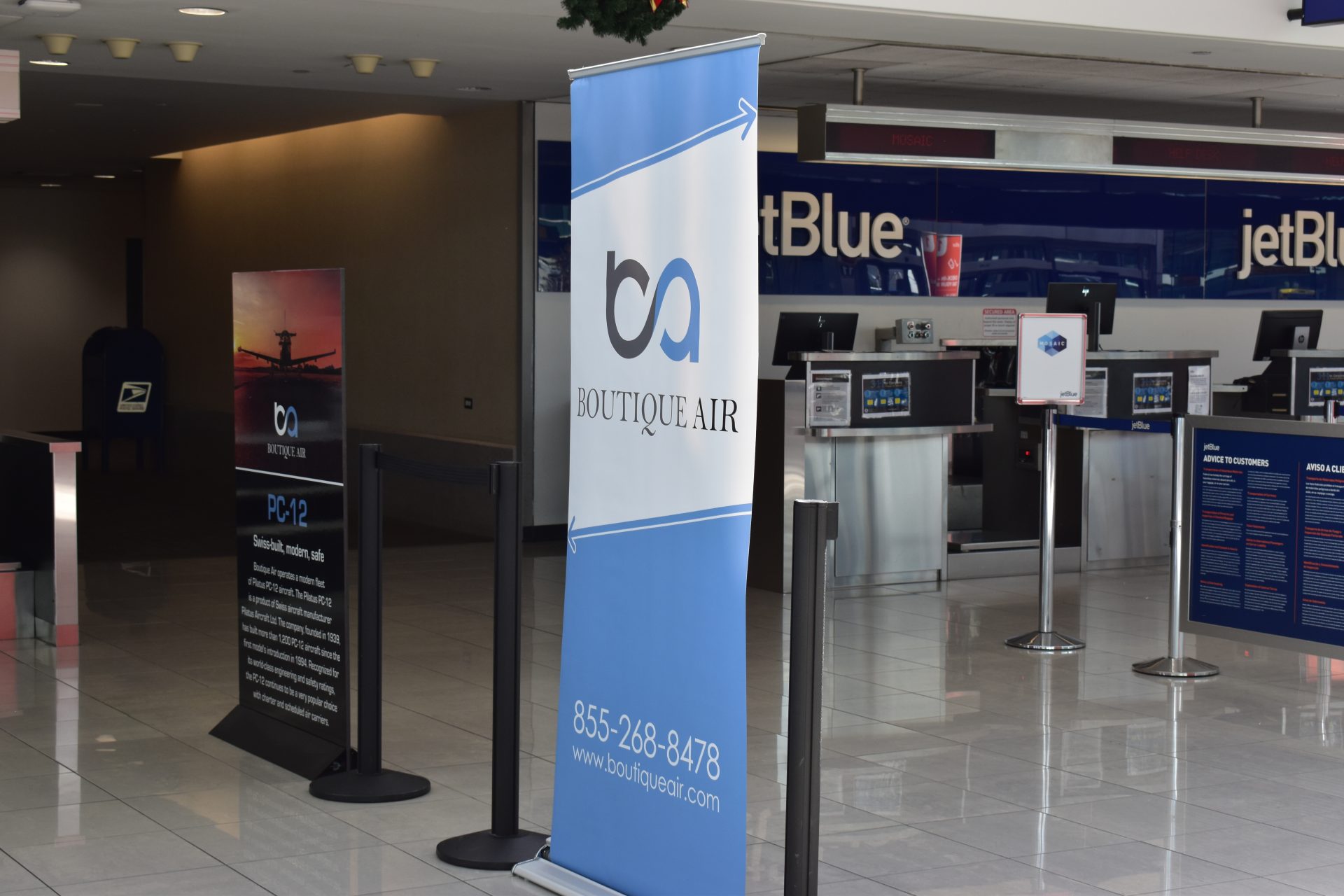
Boutique Air at Baltimore-Washington Airport (Photo: AirlineGeeks | Joey Gerardi)
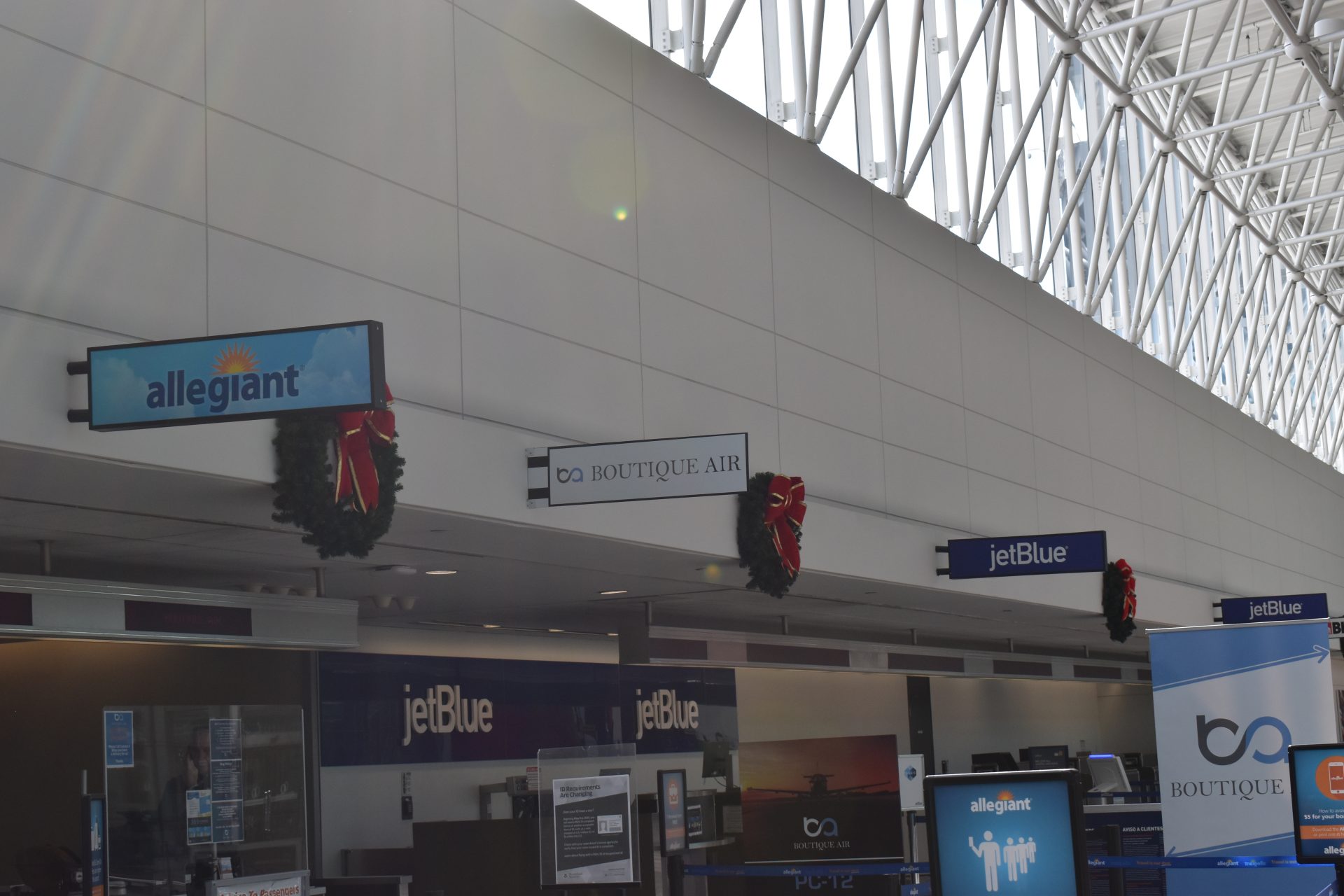
Boutique Air’s counter is located in the D concourse between Allegiant and JetBlue, they did have a sign on the counter saying they wouldn’t arrive until 12:30 P.M. but they actually had someone there much earlier, at around 11:15, so I got checked in and head through security earlier rather than normal so I could get a bite to eat before the flight.
Boutique Air does participate in the TSA PreCheck program, and while it isn’t super helpful at the smaller airports they serve it definitely helps at places like Baltimore and Boston. It took a little extra time to get my number added as the computer didn’t want to cooperate at first, but we managed to get PreCheck to show on my boarding pass.
Before leaving the check-in counter they asked for my approximate body weight and weighed my backpack, normal for flights on planes as small as the Pilatus PC-12 or similar size. The TSA PreCheck line didn’t even have three people in it making the process super easy, and I’m glad I spent the extra time getting it put on as the regular line was rather long.
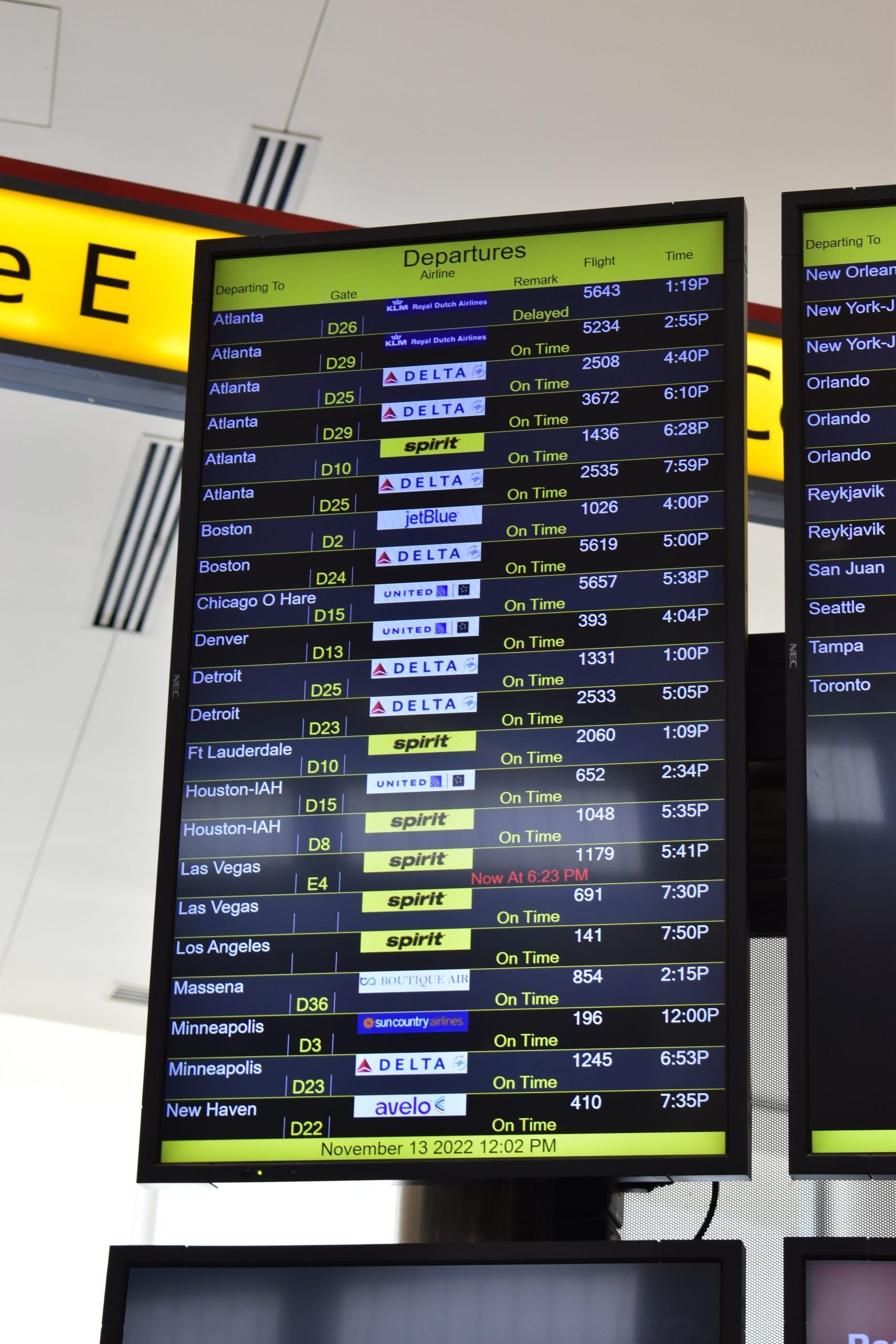
Once through security, I went up to the departure board and found Boutique towards the bottom of the list, the terminal houses many airlines so the Boutique symbol doesn’t stand as an oddity with airlines like Avelo, Sun Country, and Air Senegal showing on the board.
The departure board at BWI (Photo: AirlineGeeks | Joey Gerardi)
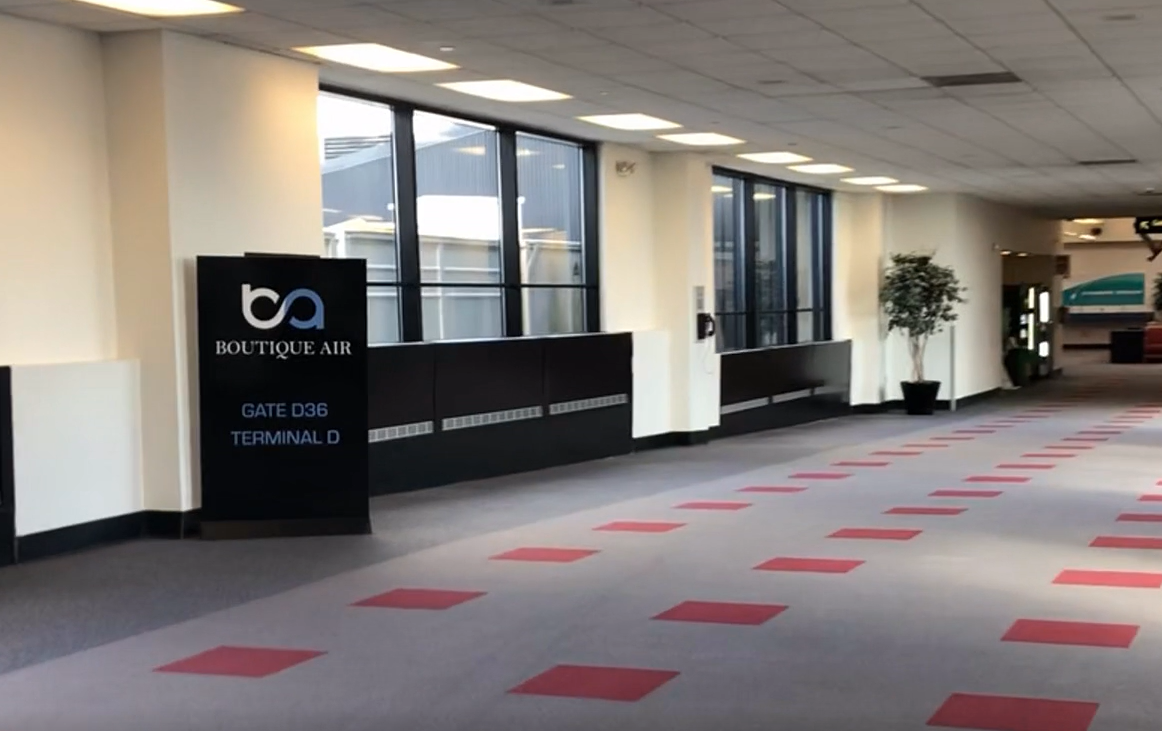
The trek down to D36 is a longer one, located at the very end of the concourse it sometimes felt like you were going too far. But, the airline does have little reminders in the terminal as they have placed several signs along the walk to the gate.
Boutique Air signs placed throughout the terminal (Photo: AirlineGeeks | Joey Gerardi)
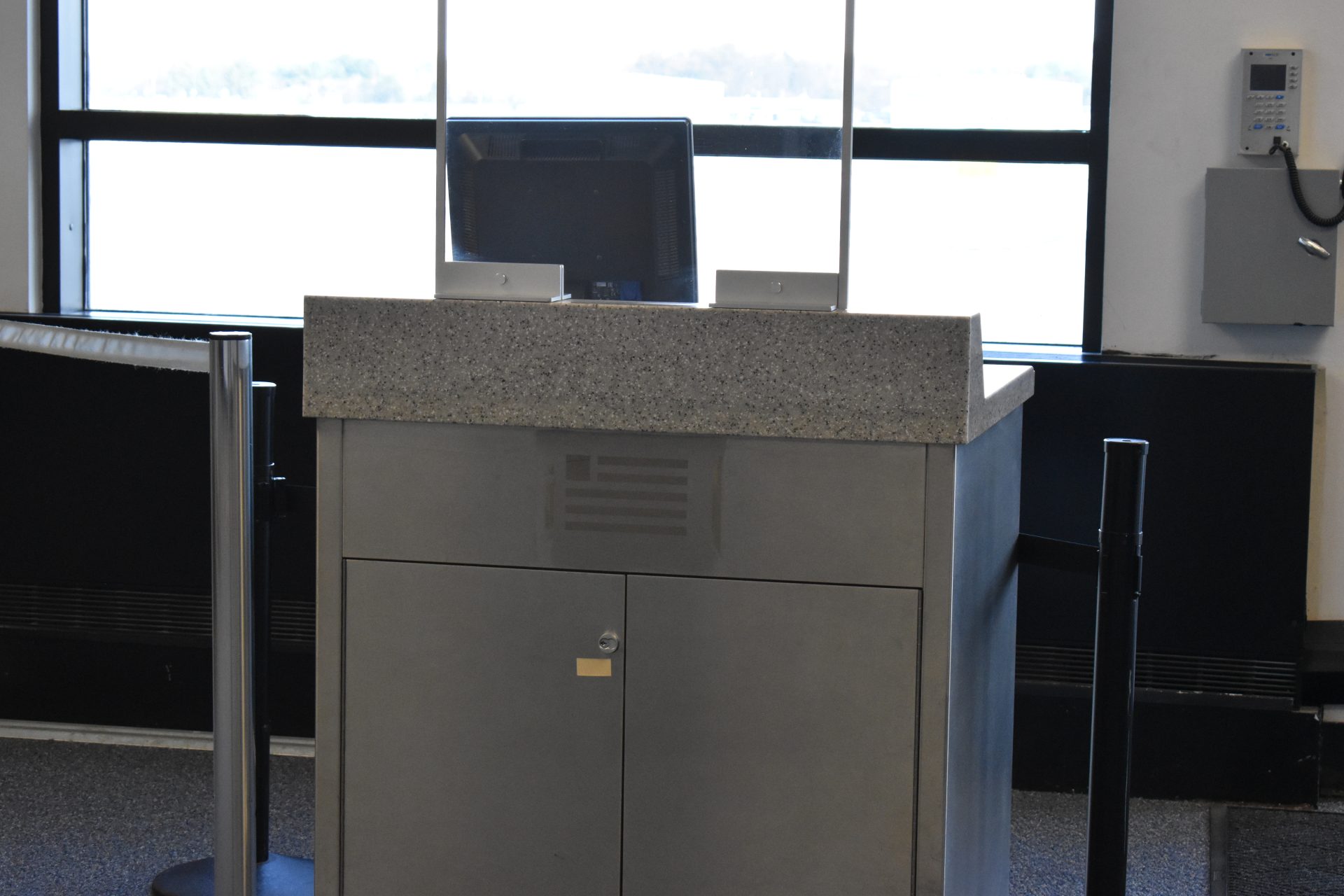
The Boutique Air gate is located in the ground board section of the terminal, where U.S. Airways Express used to be located when they served the airport. It was a nice treat that some of the gate podiums in this area still had the U.S. Airways logo on them too.
An old U.S. Airways Express gate podium (Photo: AirlineGeeks | Joey Gerardi)
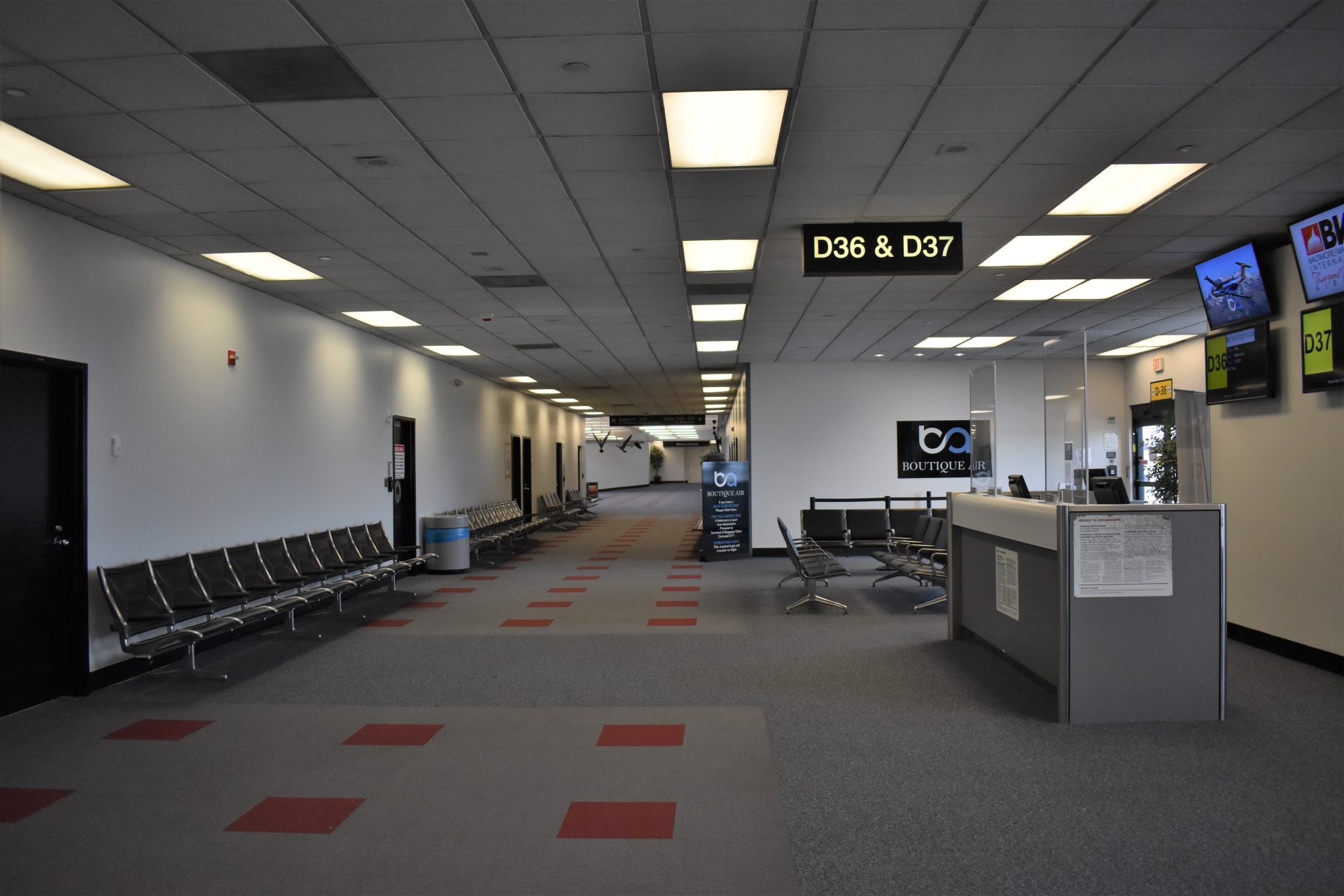
With no other airlines located in this section anymore except Boutique, there is plenty of seating even when they have a full plane of passengers.
The gate area near D36 & D37 (Photo: AirlineGeeks | Joey Gerardi)
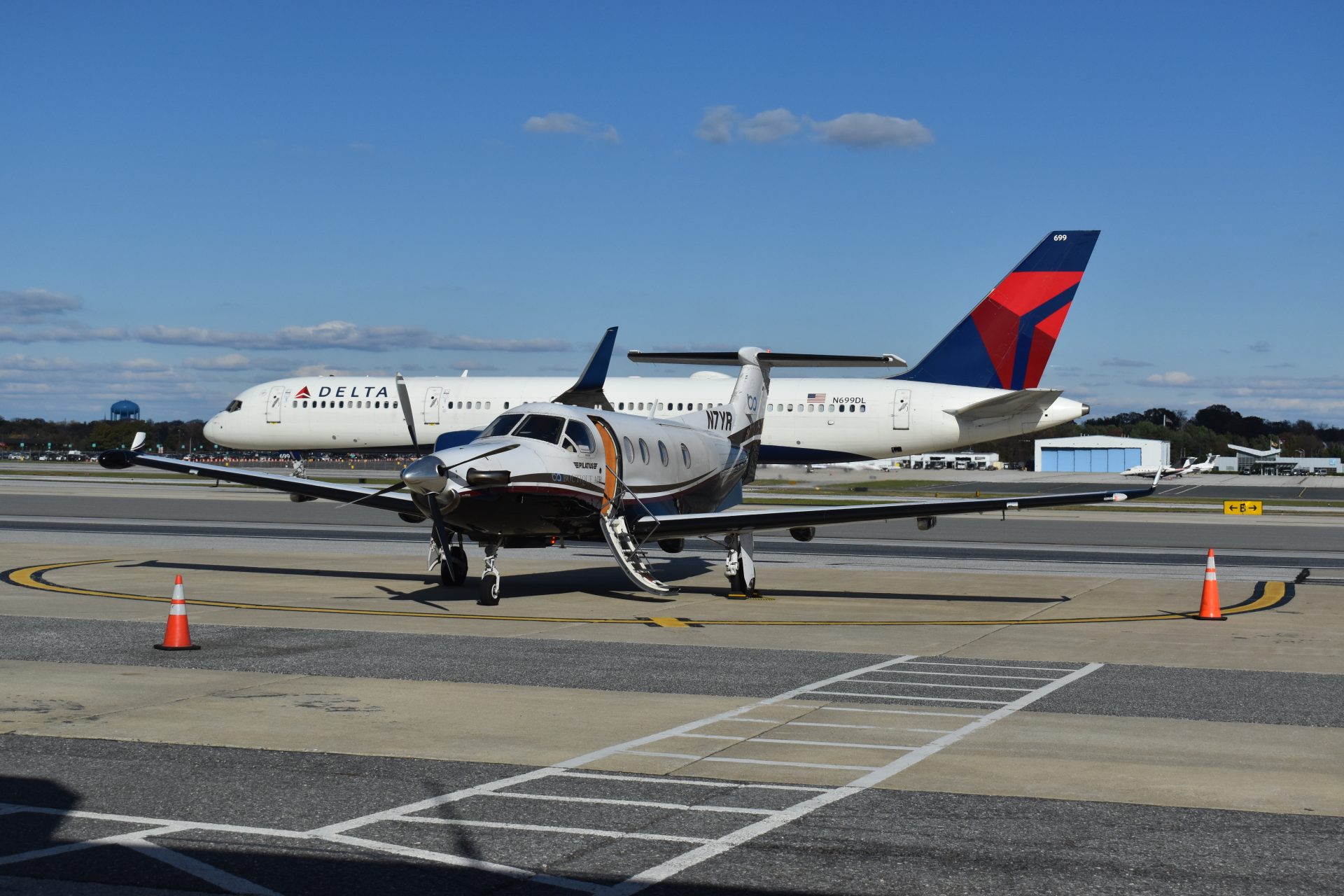
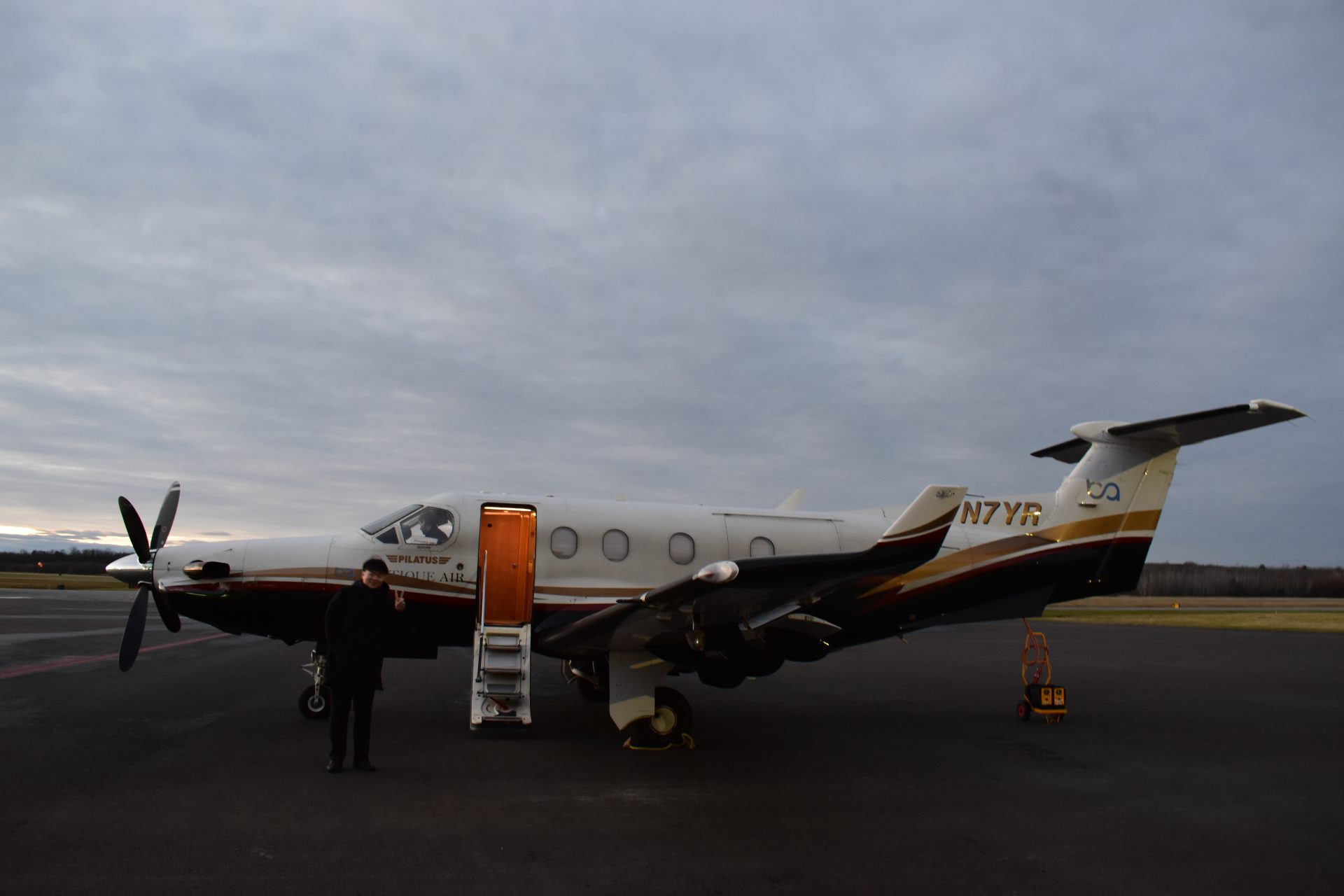
Slowly one by one, the other passengers showed up at the gate area for the flight with six of us total heading up to Massena on the flight this afternoon. Eventually, the star of the show rolled in, a 2003-built Pilatus PC-12/45 that Boutique took possession of in 2018, and carried the registration N7YR.
My aircraft N7YR at the gate in Baltimore (Photo: AirlineGeeks | Joey Gerardi)
It wasn’t long before we boarded began, on flights with smaller planes they sometimes will have you sit in a specific place due to weight and balance. But for this flight, we could choose where to sit, and I choose the right side facing backward. When flying north from Baltimore to Massena, the right side is best as you won’t be facing directly into the setting sun in the west.
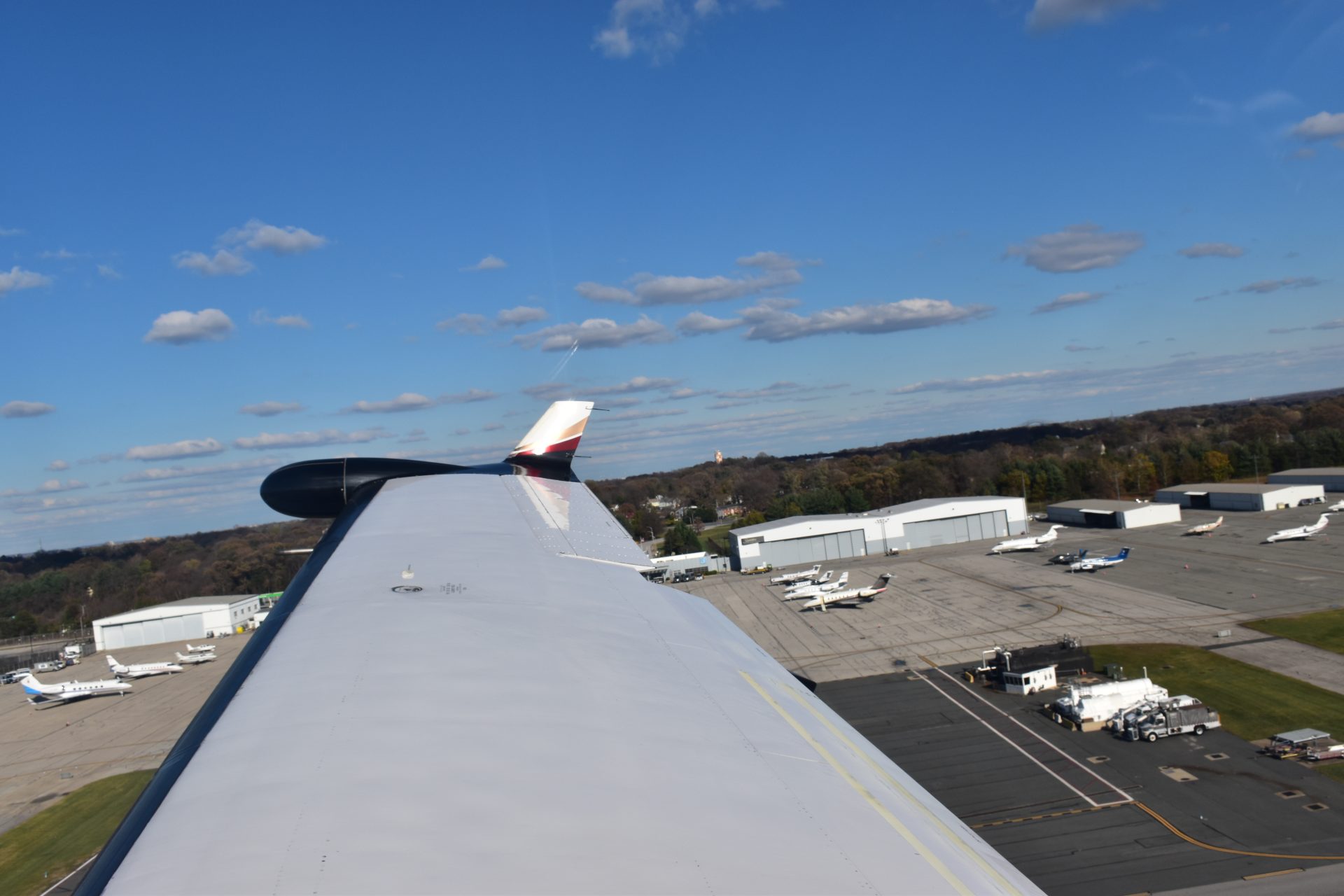
Pre-flight briefing and engine startup were quick. With us at the end of a concourse, it was one of the shorter taxi times at the airport and we took off exactly at 2:15 P.M., which was our scheduled departure time.
Just after taking off from Baltimore (Photo: AirlineGeeks | Joey Gerardi)
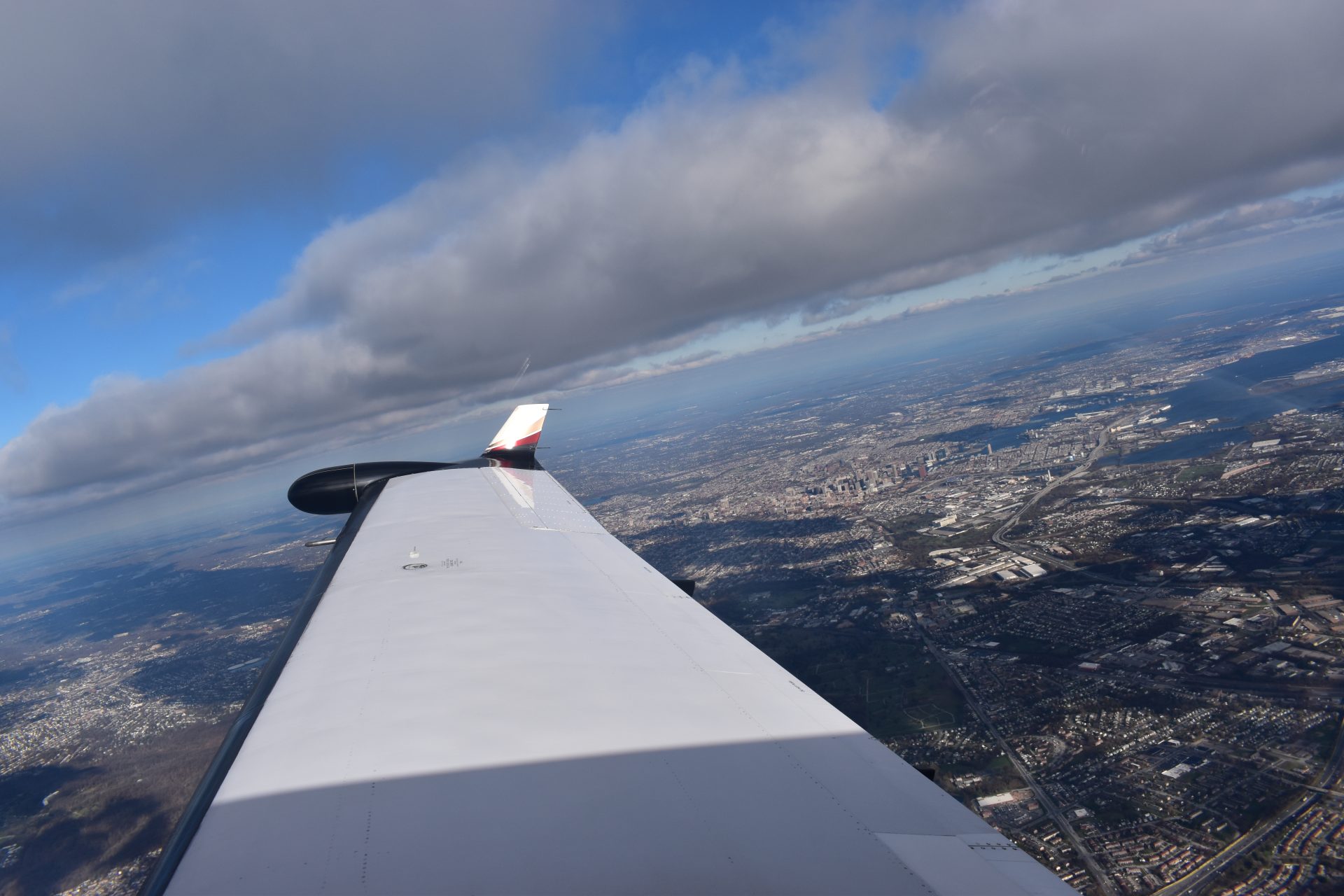
Not more than five minutes after taking off those on the right side of the plane could see downtown Baltimore and the Chesapeake Bay.
Downtown Baltimore and the Chesapeake Bay in the distance (Photo: AirlineGeeks | Joey Gerardi)
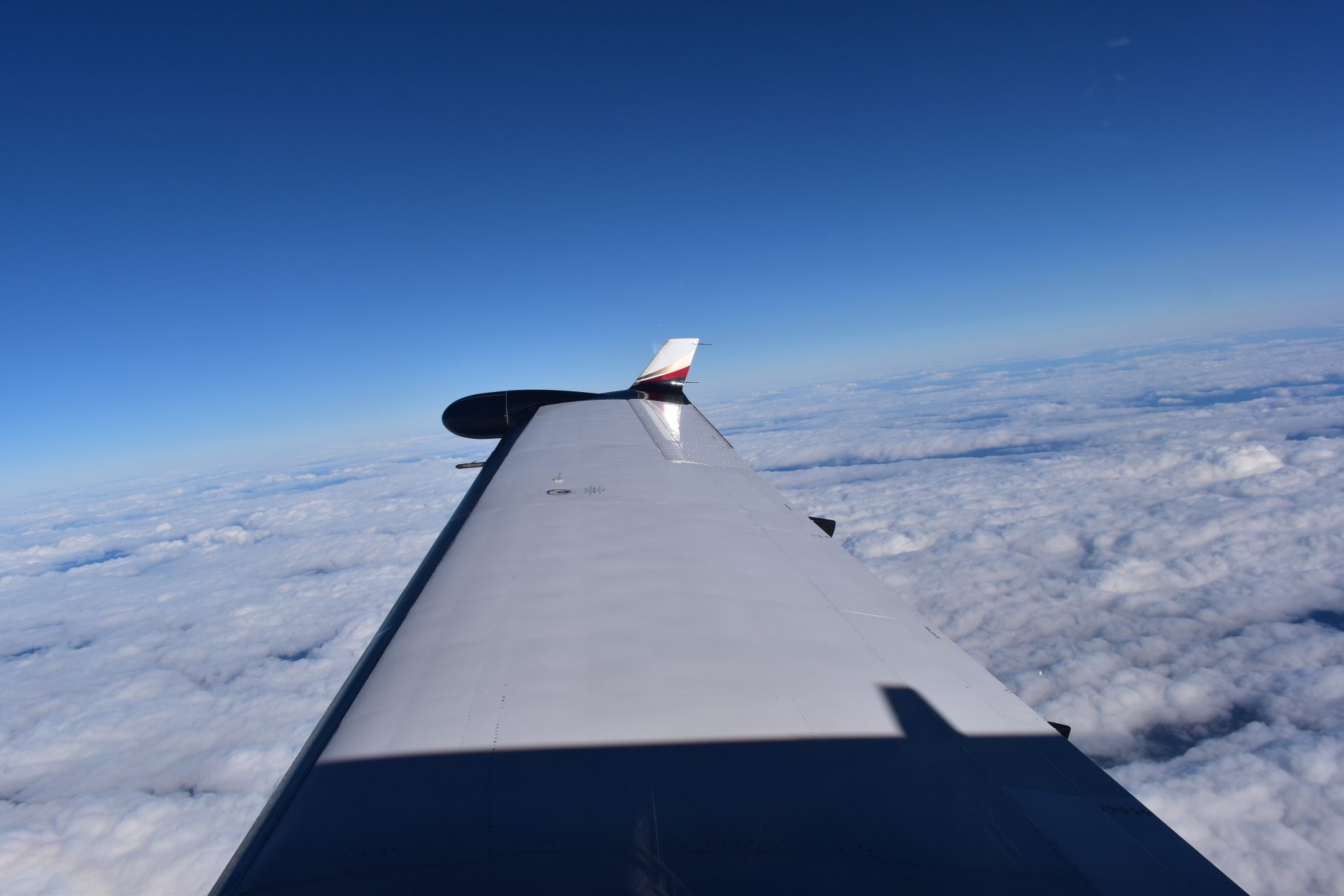
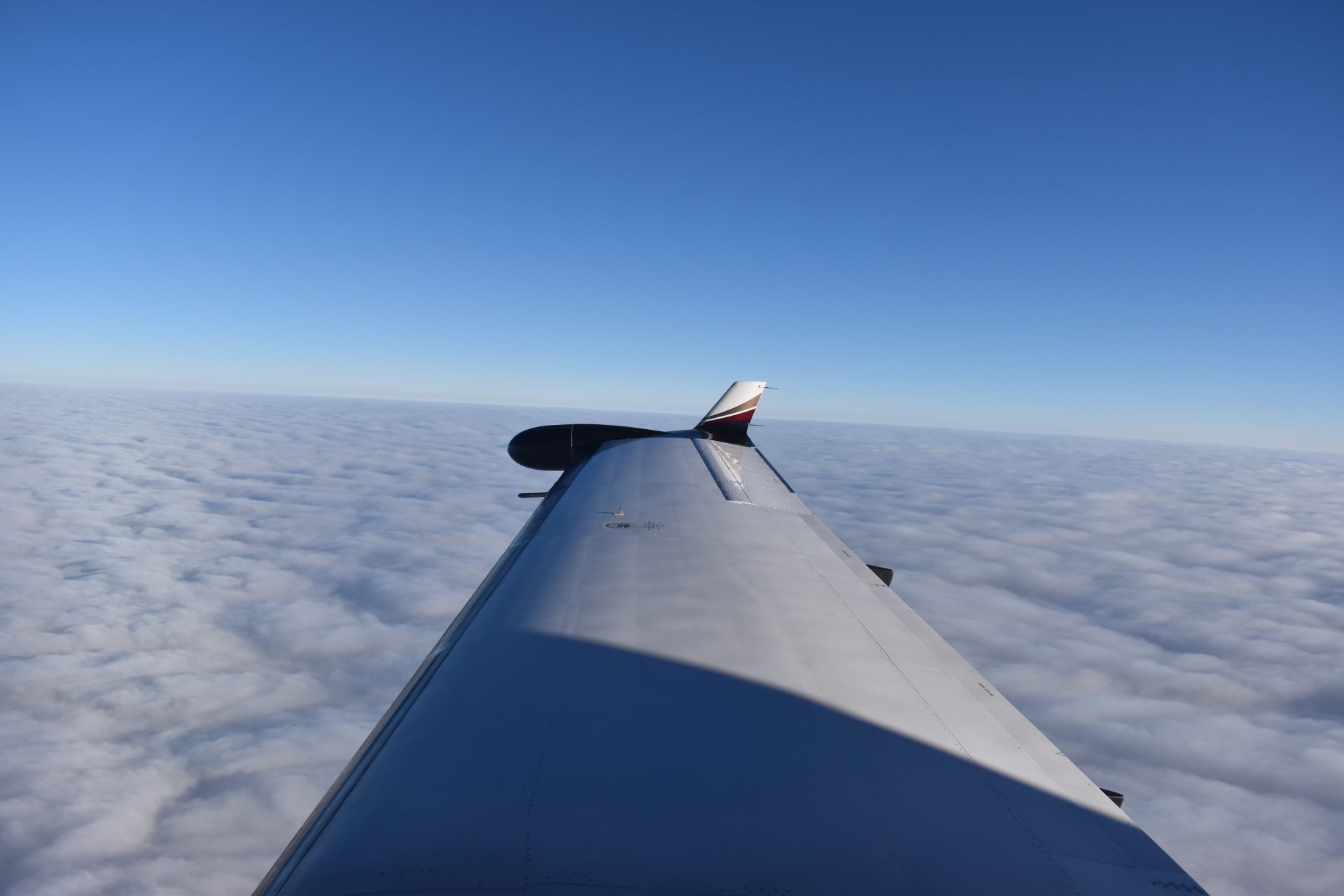
we quickly climbed above the clouds and the scenery below disappeared. Despite the PC-12 being a small plane, it’s pressurized, meaning it can fly higher than most single-engine aircraft and get above the weather making it perfect for this route as northern New York sees their fair share of harsh winter weather for many months of the year.
Climbing to cruise (Photo: AirlineGeeks | Joey Gerardi)
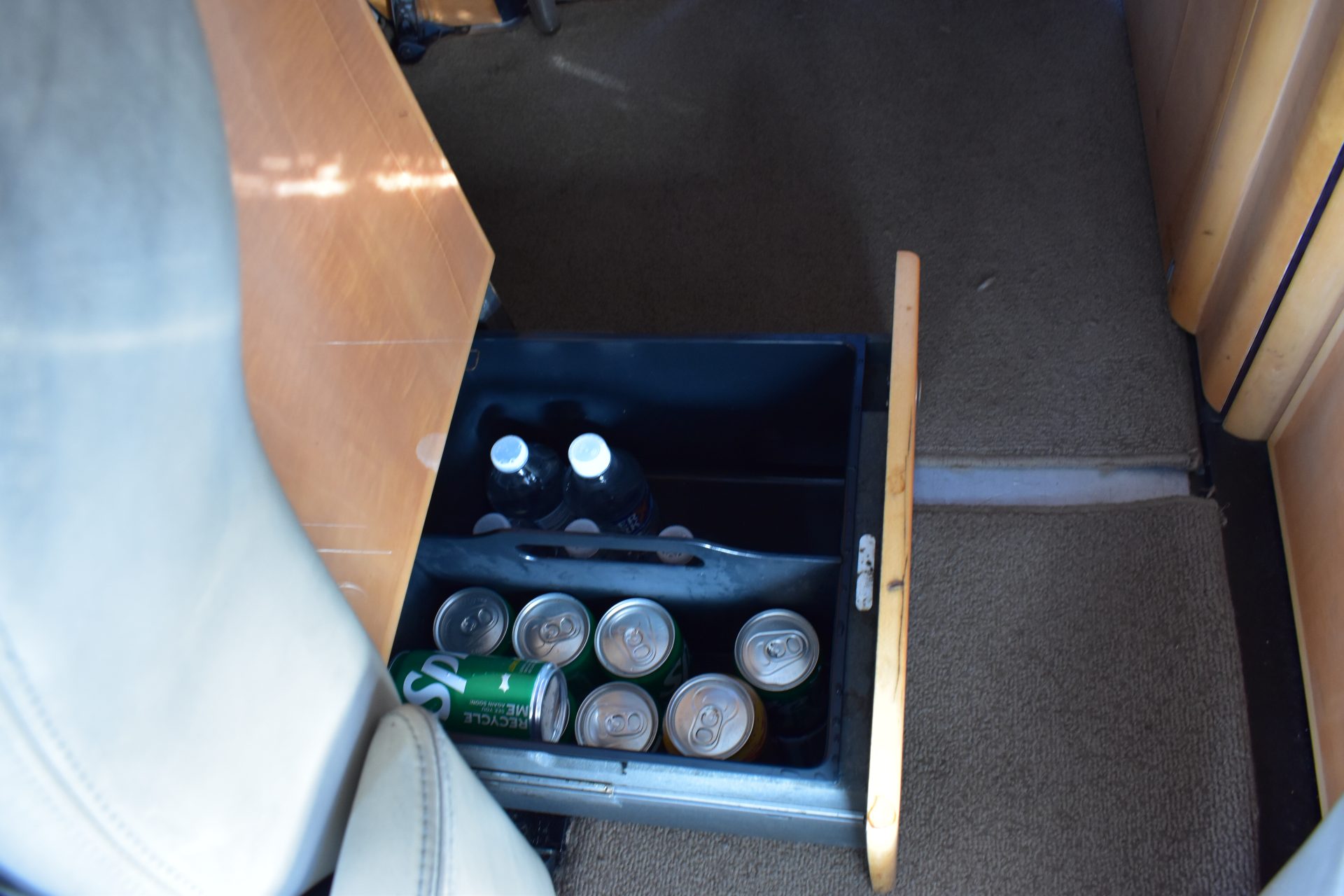
It wasn’t long before we reached our cruising altitude of 25,000 Feet, and the seat belt sign was turned off. Now keep in mind, there isn’t really anywhere to go with the sign being off, there is a bathroom but it is not recommended you use it as it’s just a bucket with a toilet seat and the cabin isn’t tall enough to stand up in. There is however a self-serve snack drawer at the front of the cabin, along with another drawer for drinks.
Self-serve drink drawer on the plane (Photo: AirlineGeeks | Joey Gerardi)
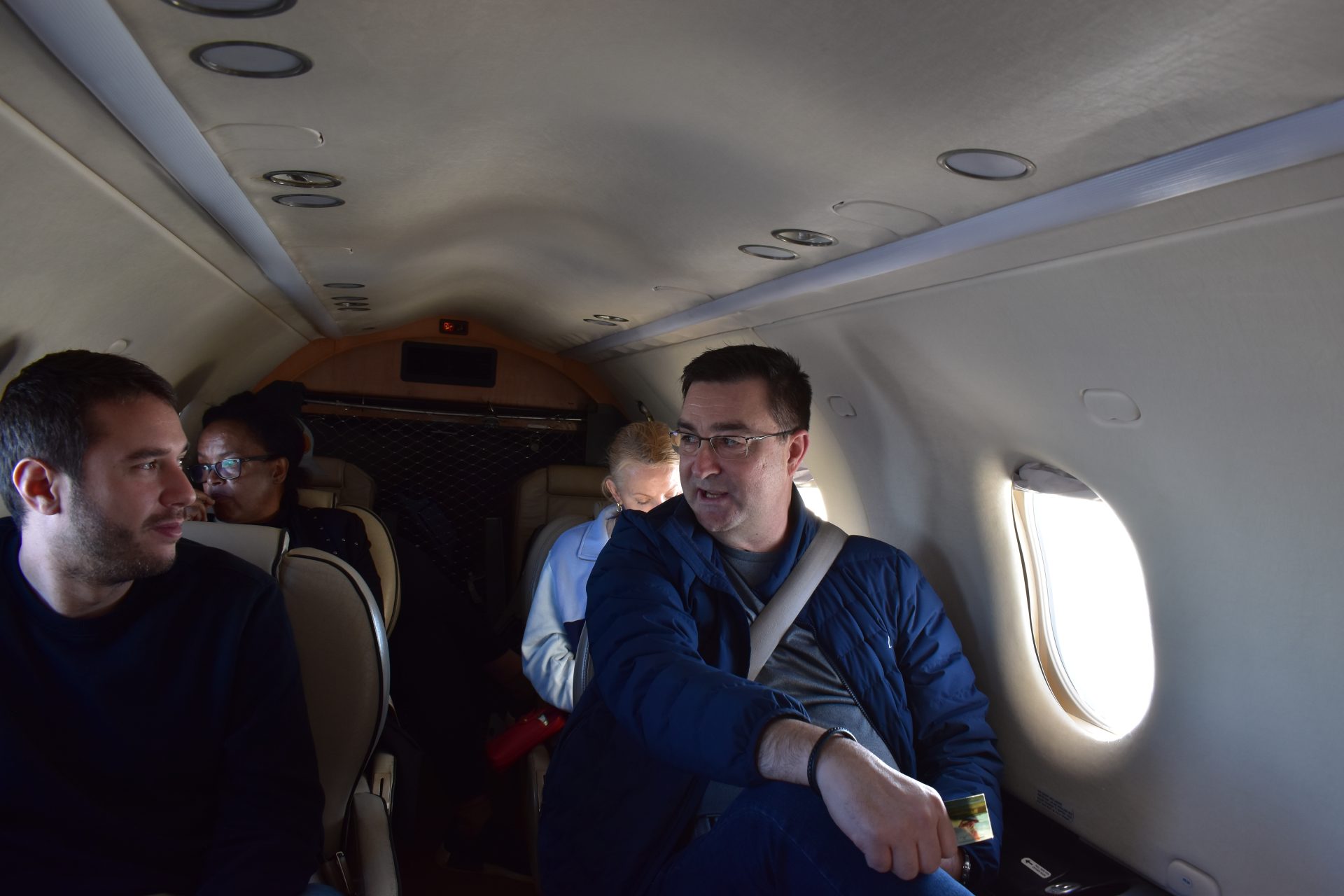
The snacks included Cheez-its and Chex-mix while drinks were sprites and water bottles. With planes this small, even without knowing each other beforehand, you tend to strike up conversations with each other, giving off a very friendly environment while flying. The backward-facing seats also help strike up a conversation as it’s very rare to find seats like these on any commercial aircraft where you are directly facing the other passengers.
Talking with the other passengers on board is easy with this set up (Photo: AirlineGeeks | Joey Gerardi)
This is one of the reasons I like these smaller planes, they promote and invite conversation with people you have never met before and you sometimes get to hear some really interesting stories of their travels.
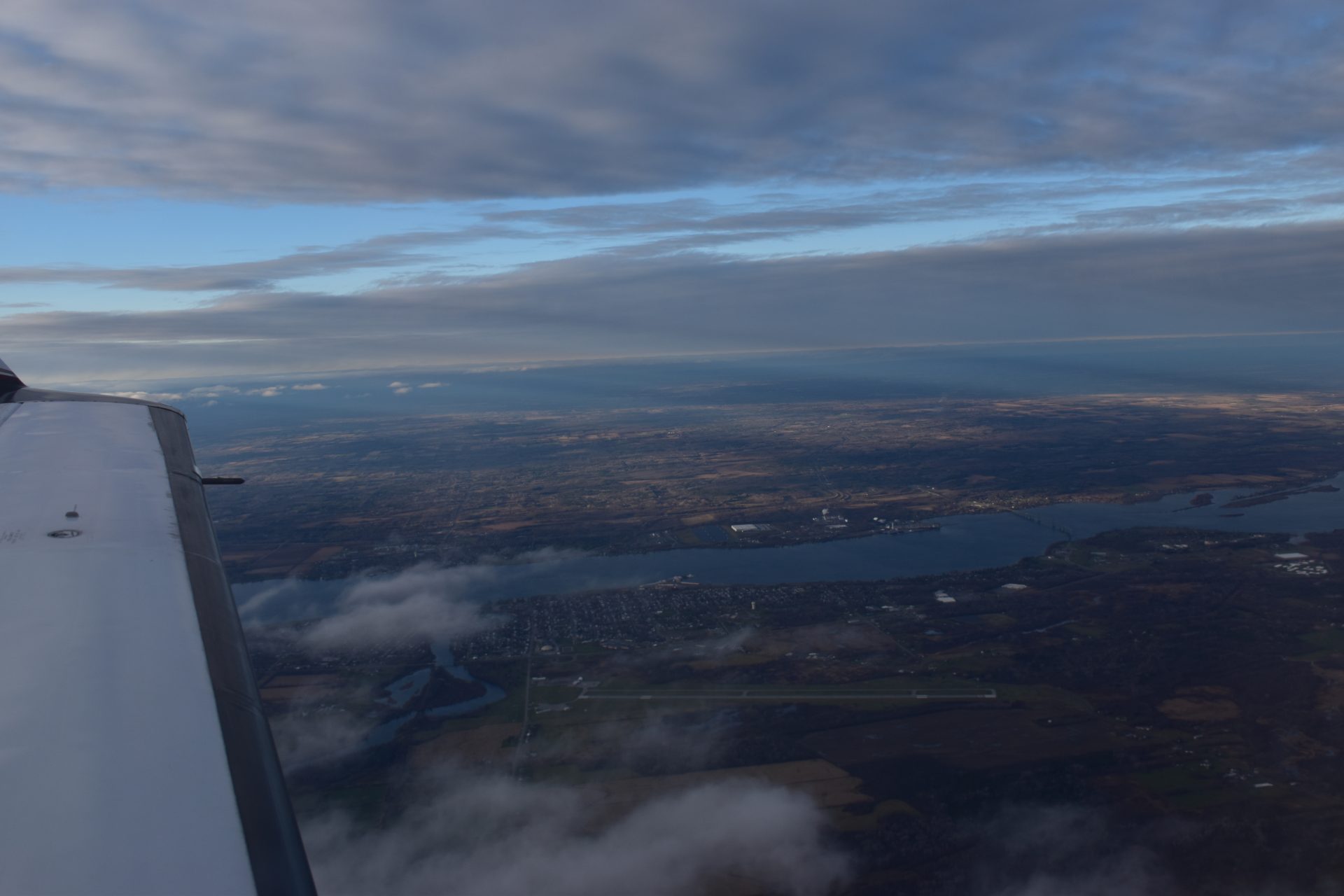
enroute to Massena at 25,000 feet (Photo: AirlineGeeks | Joey Gerardi)
With all of the talking the flight went by quickly and it wasn’t long before we began our slow descent into Massena. As we approached the airport I hopped to a seat on the other side of the cabin as we flew along the St. Lawrence River which represented the US-Canada border in northern New York State.
Looking towards the St. Lawrence River, which is the US-Canada border (Photo: AirlineGeeks | Joey Gerardi)
Along the way, we passed over Ogdensburg Intl., another EAS Airport that I have flown to in the past.
Flying over Ogdensburg Intl. (Photo: AirlineGeeks | Joey Gerardi)
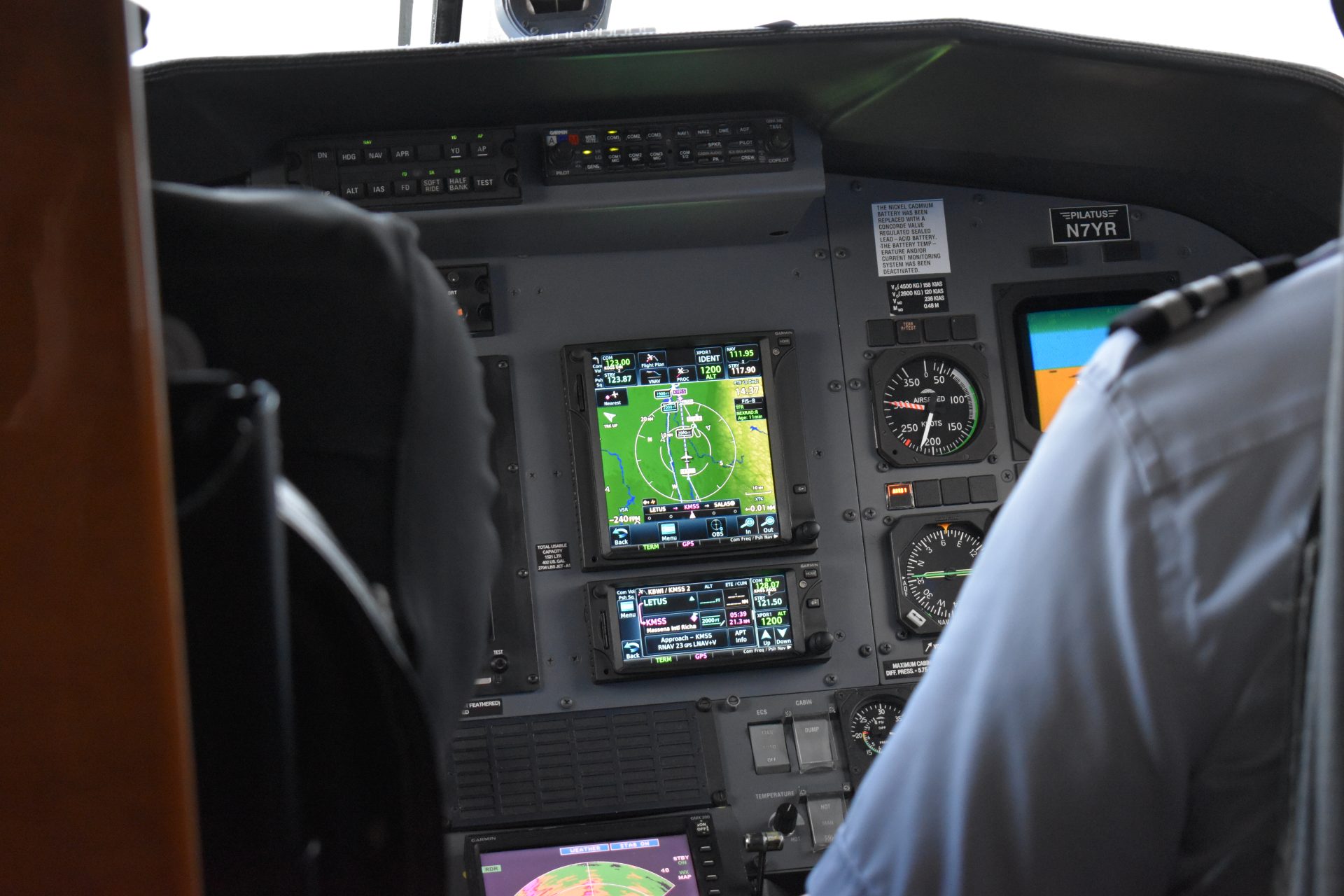
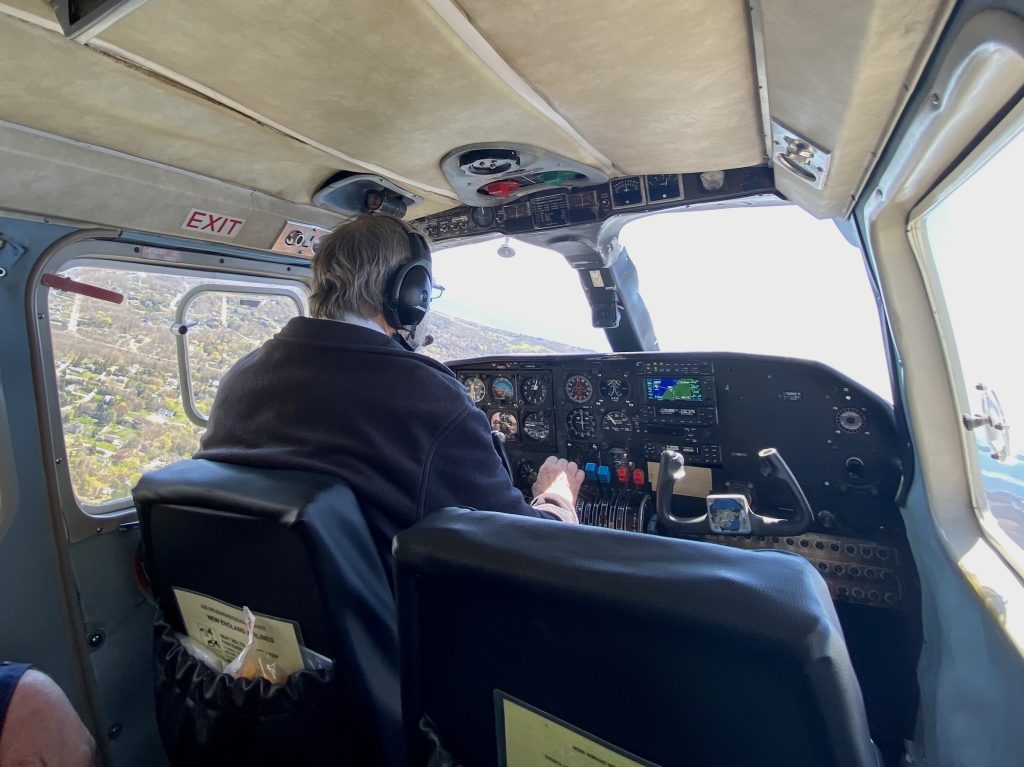
By this point in the flight, the pilots had opened the curtain that goes into the cockpit, giving all of the passengers a view out the front and of the controls.
Looking at the cockpit screens from the passenger cabin (Photo: AirlineGeeks | Joey Gerardi)
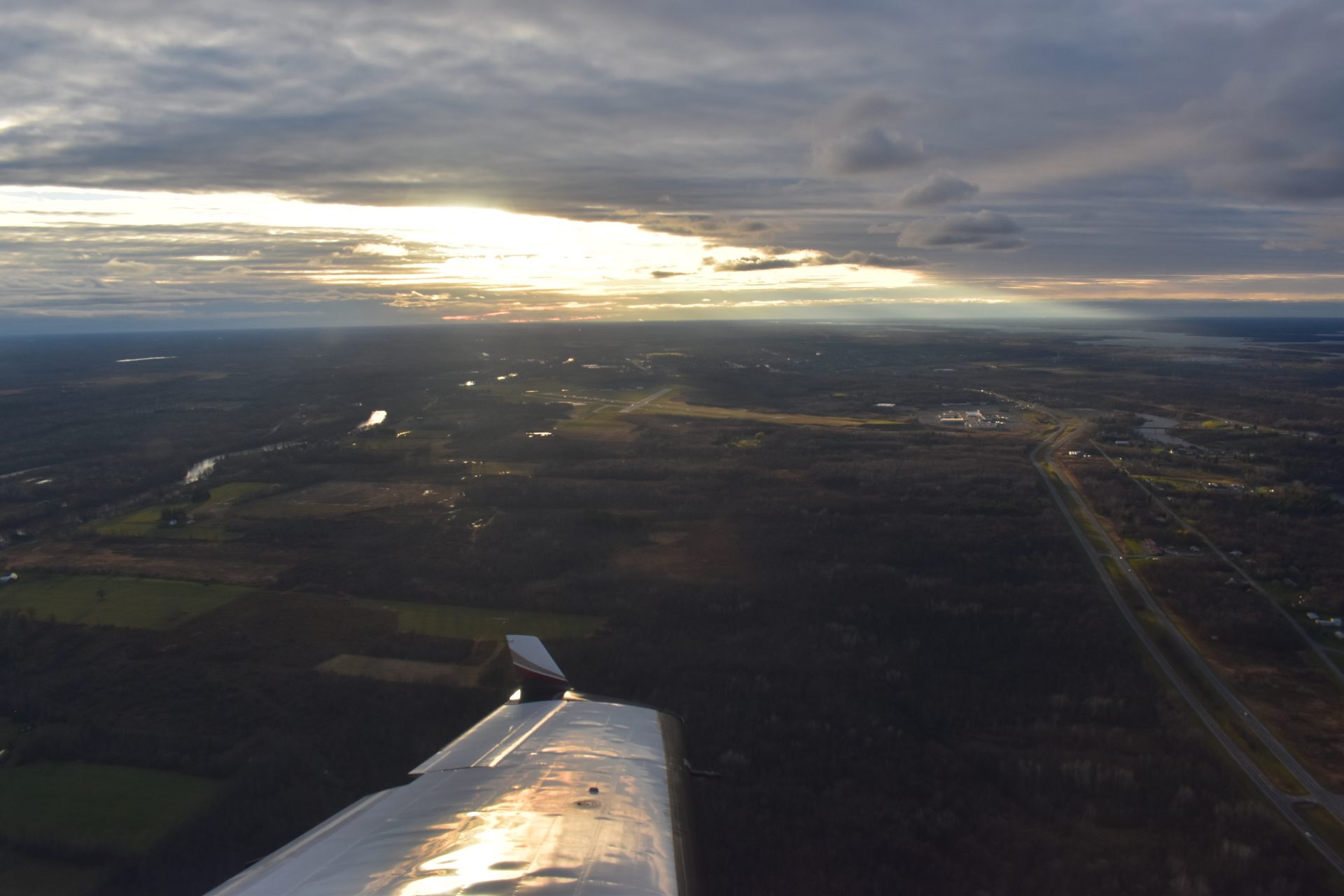
It wasn’t long before we touched down in Massena at 3:52 P.M. after a 1-hour and 37-minute flight up from Baltimore. The approach was really windy but the landing was one of the smoothest I’ve ever had.
Turning onto final going into Massena (Photo: AirlineGeeks | Joey Gerardi)
Massena is the 45th Essential Air Service airport I have been to, which was a huge accomplishment for me personally as these smaller airports are a big part of what I love about the industry; the small airports and airlines that bring us all together.
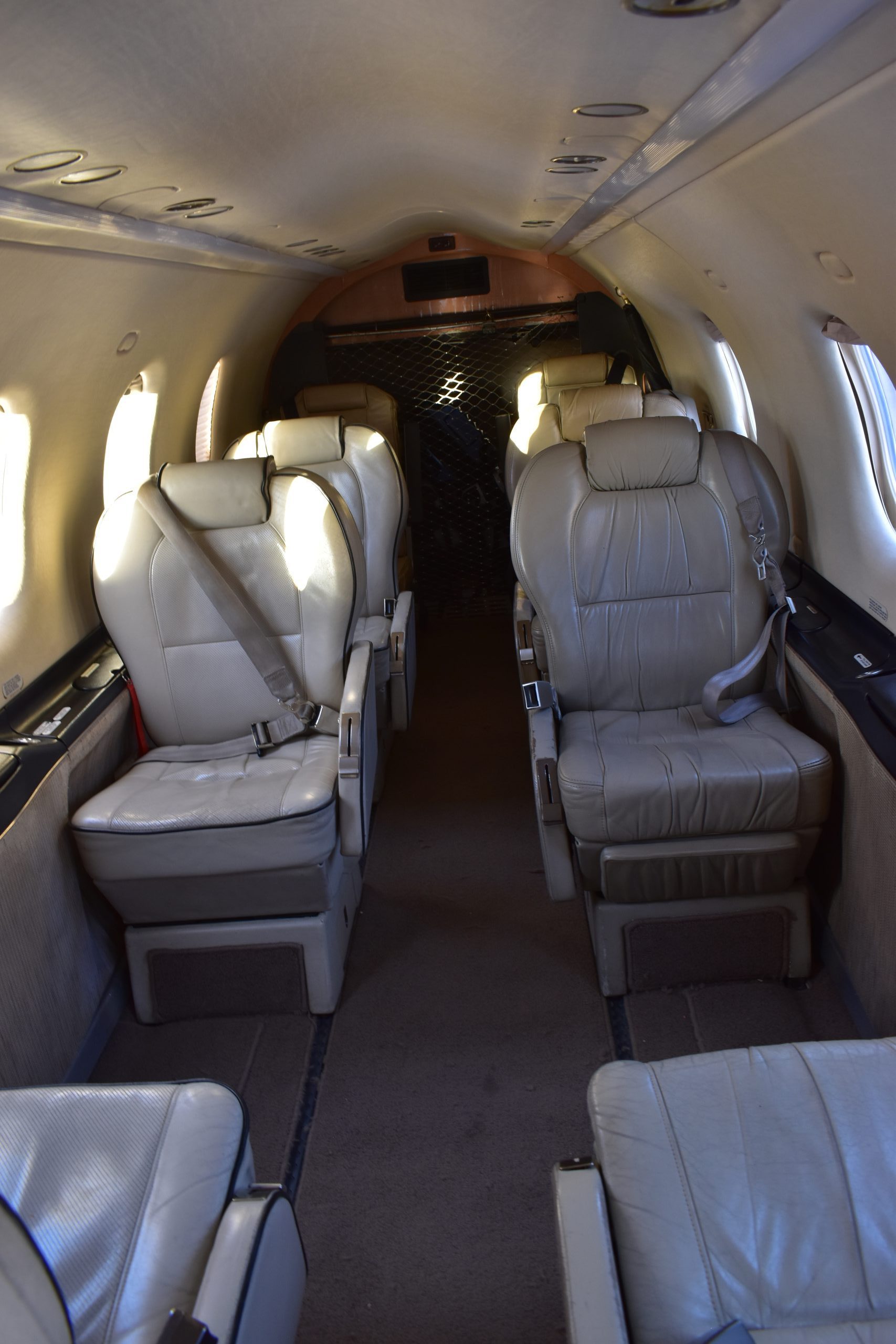
Once the engine shut off in Massena everyone deplaned, but I did stay on for a quick extra second to get a picture of the empty passenger cabin, something I didn’t get to do when I got on in Baltimore as I was one of the last ones on.
The passenger cabin of Boutique Air’s PC-12 (Photo: AirlineGeeks | Joey Gerardi)
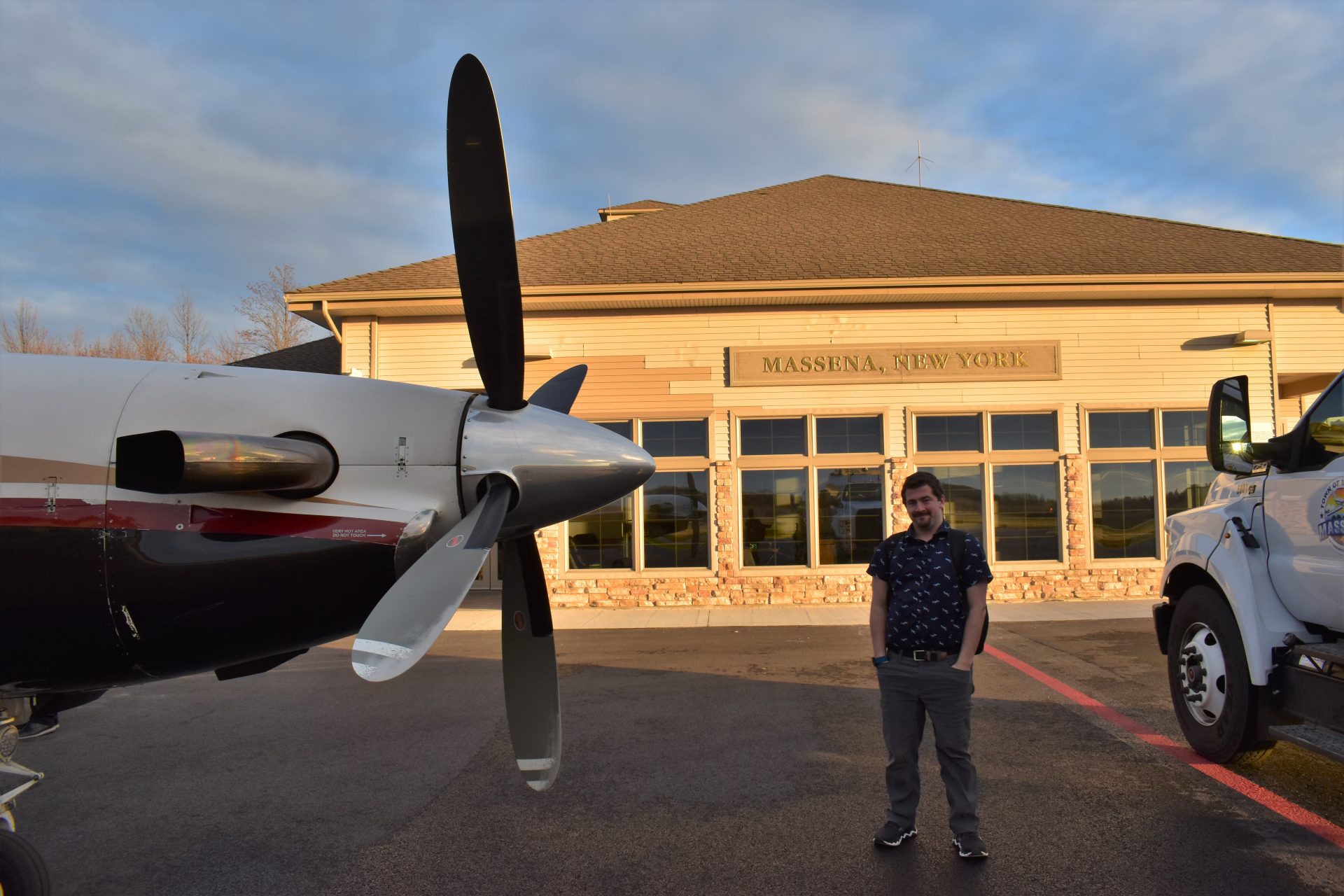
Of course, I had to get the obligatory AvGeek photo in front of the terminal and the plane which one of my fellow passengers was happy to take for me.
Me in front of the plane and terminal in Massena (Photo: AirlineGeeks | Joey Gerardi)
Once you go inside the terminal there are two options, leaving the secure area and staying in the gate area. For those continuing onto Boston, you need to stay in the gate area and not leave security. If you are continuing onto Boston but you leave the secure area then you might be stuck in Massena for the night.
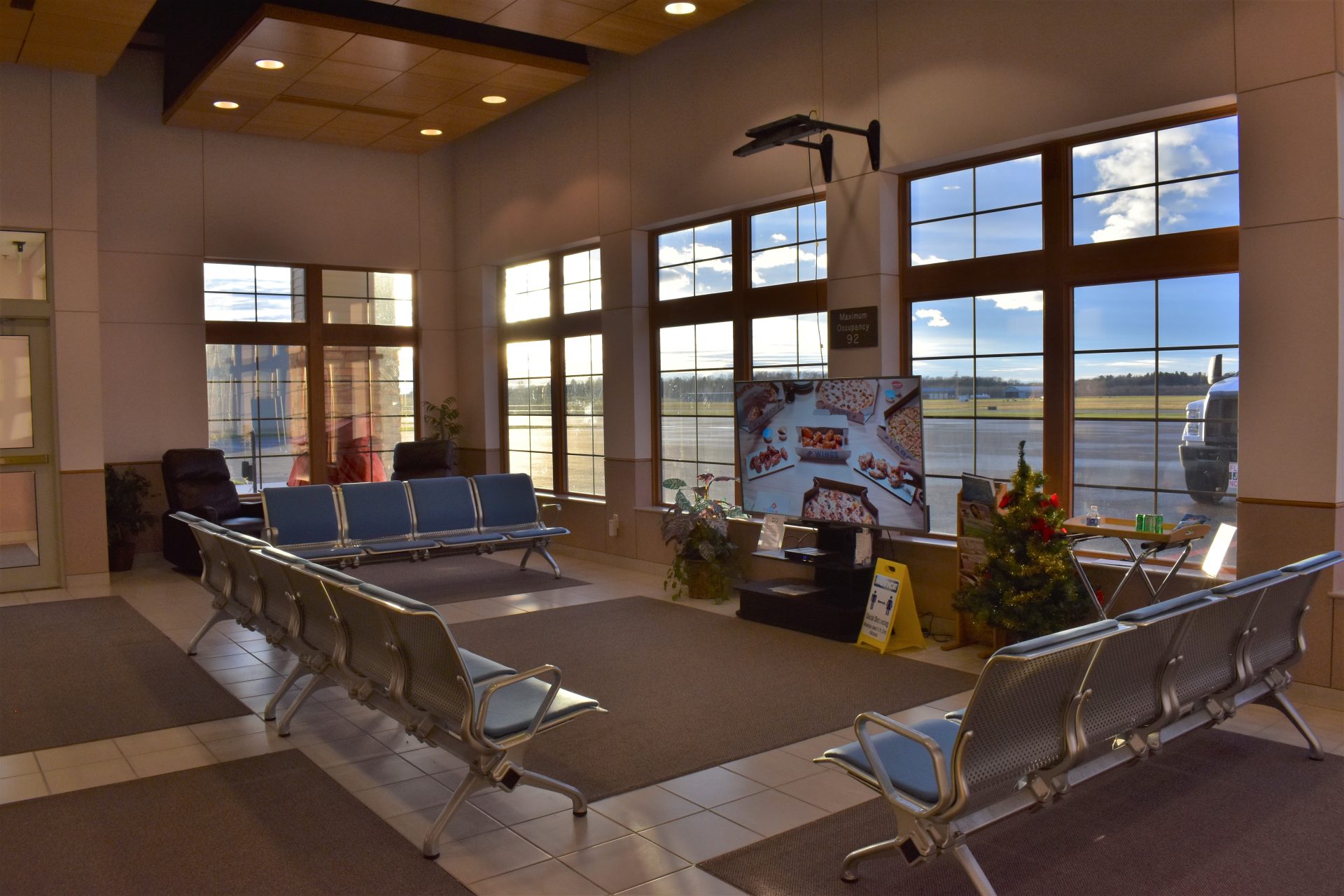
The gate area was nicely laid out, with around 10-15 seats and four recliners on each end of the room with a large flat screen in the middle. There is also a bathroom which is useful considering you don’t want to be using the one on the plane.
The gate area in Massena (Photo: AirlineGeeks | Joey Gerardi)
The flight onto Boston isn’t that much later with the scheduled departure time being 4:35 P.M., but, there was a delay due to gate space in Boston. Boutique Air shares a gate in Boston with Air Canada, who was delayed that evening, meaning until they left we weren’t allowed to take off from Massena.
The employees apologized for the delay and put out some snacks and drinks for us on a little tray located next to the tv.
Snack and drink tray they put out during a delay (Photo: AirlineGeeks | Joey Gerardi)
When it was finally time to board it didn’t take long with only five of us total going to Boston, none of which started with me in Baltimore and were all new passengers coming from Massena only.
Getting on the plane in Massena to Boston (Photo: AirlineGeeks | Joey Gerardi)
Same as the first flight, we could choose our own seats as it wasn’t weight restricted. On this flight, I chose a forward-facing seat in the second-row right side. taxi out was simple and we took to the skies 24 minutes behind schedule, which of course was the fault of Air Canada and not Boutique’s, meaning those making connections in Boston would have a tough time if they booked a short layover.
Taking off out of Massena (Photo: AirlineGeeks | Joey Gerardi)
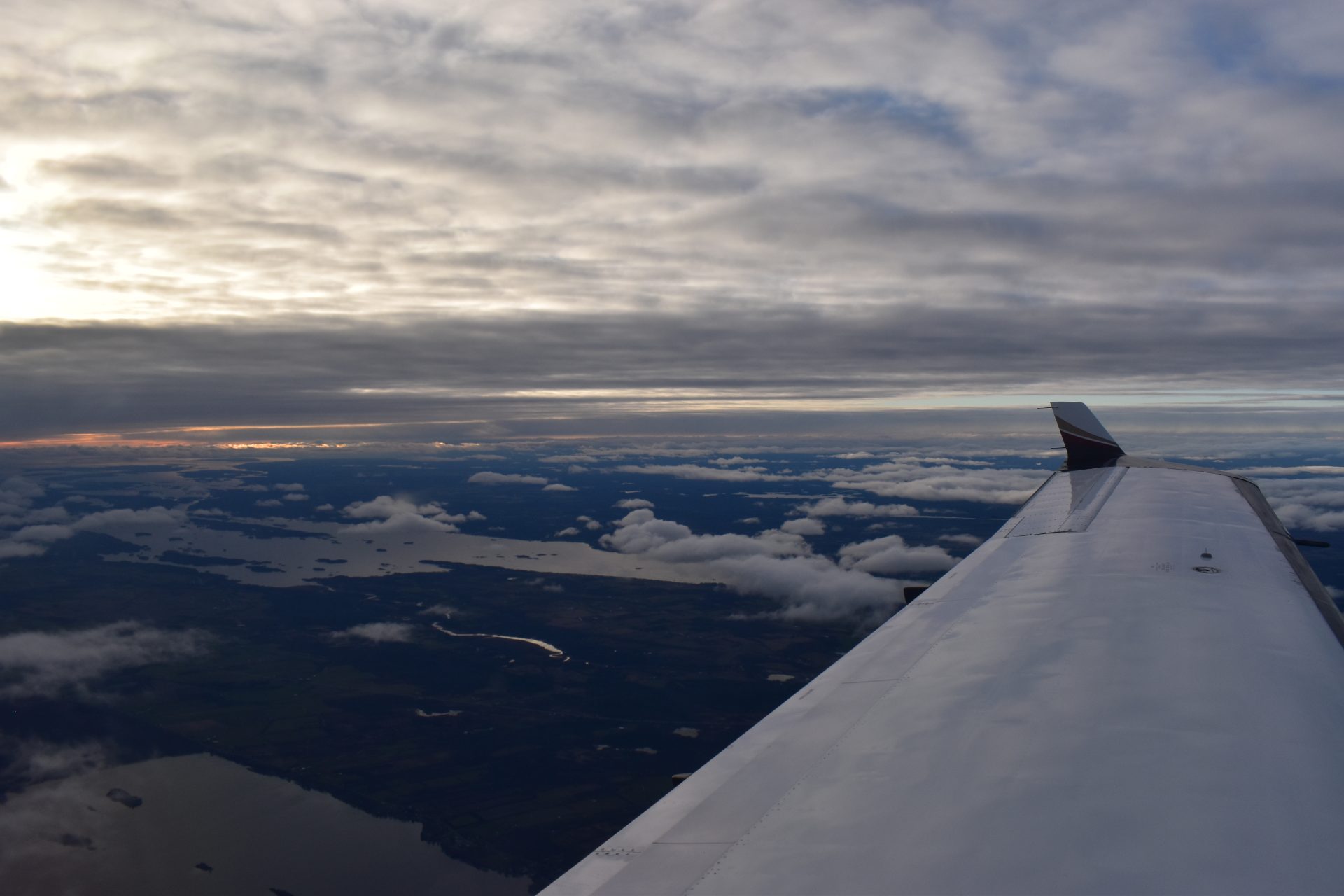
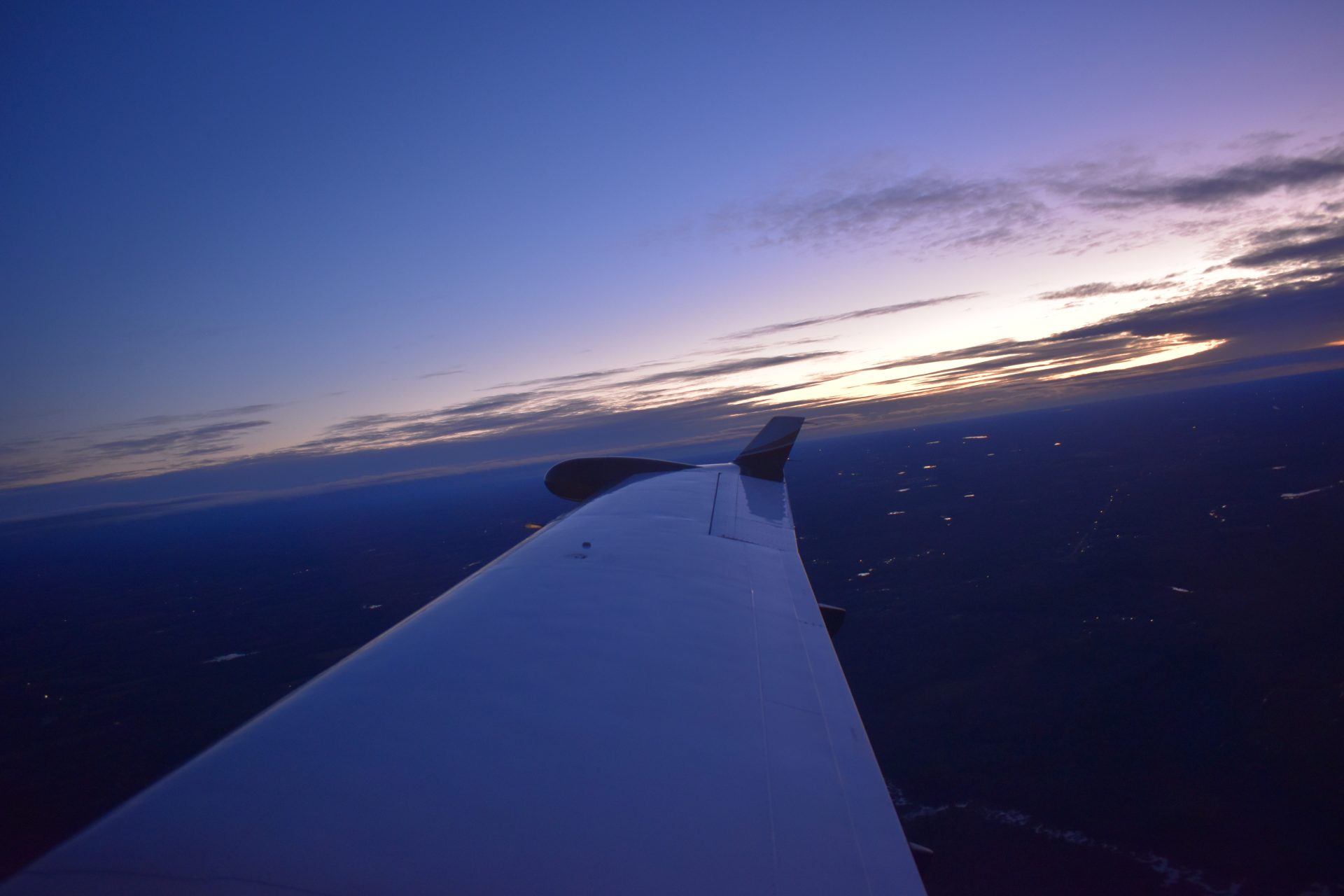
As we approach the winter months when the days are shorter and the sun sets earlier, those on this flight won’t see much as it will happen mostly during the dark from November until mid-February, but the sunset in the early part of this flight is nice to see.
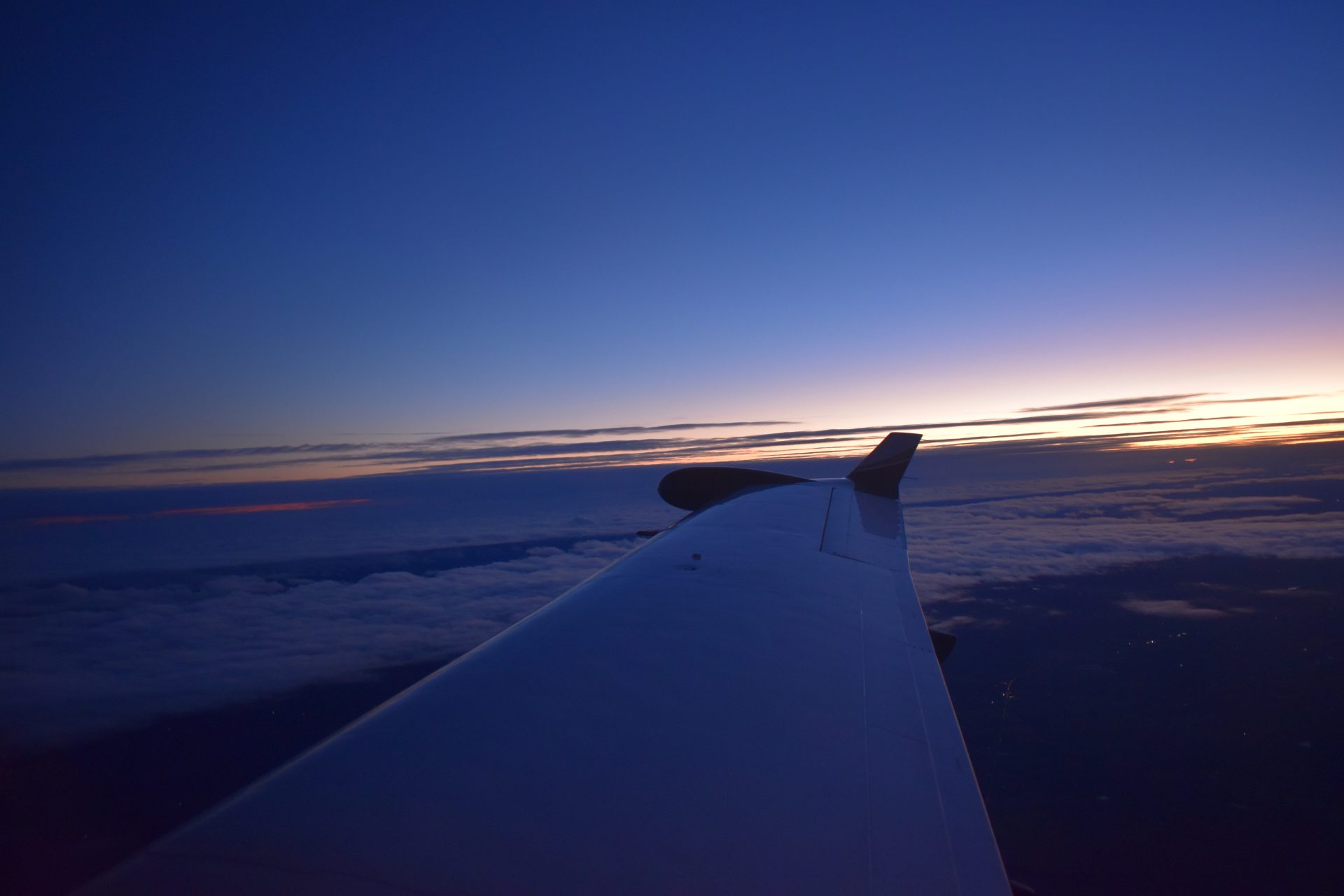
Looking towards the sunset as we climb to cruise (Photo: AirlineGeeks | Joey Gerardi)
For this flight, the cruising altitude was much lower than the first flight at 15,000 feet but still higher than most single-engine propeller flights getting you above any weather that might’ve been along the route.
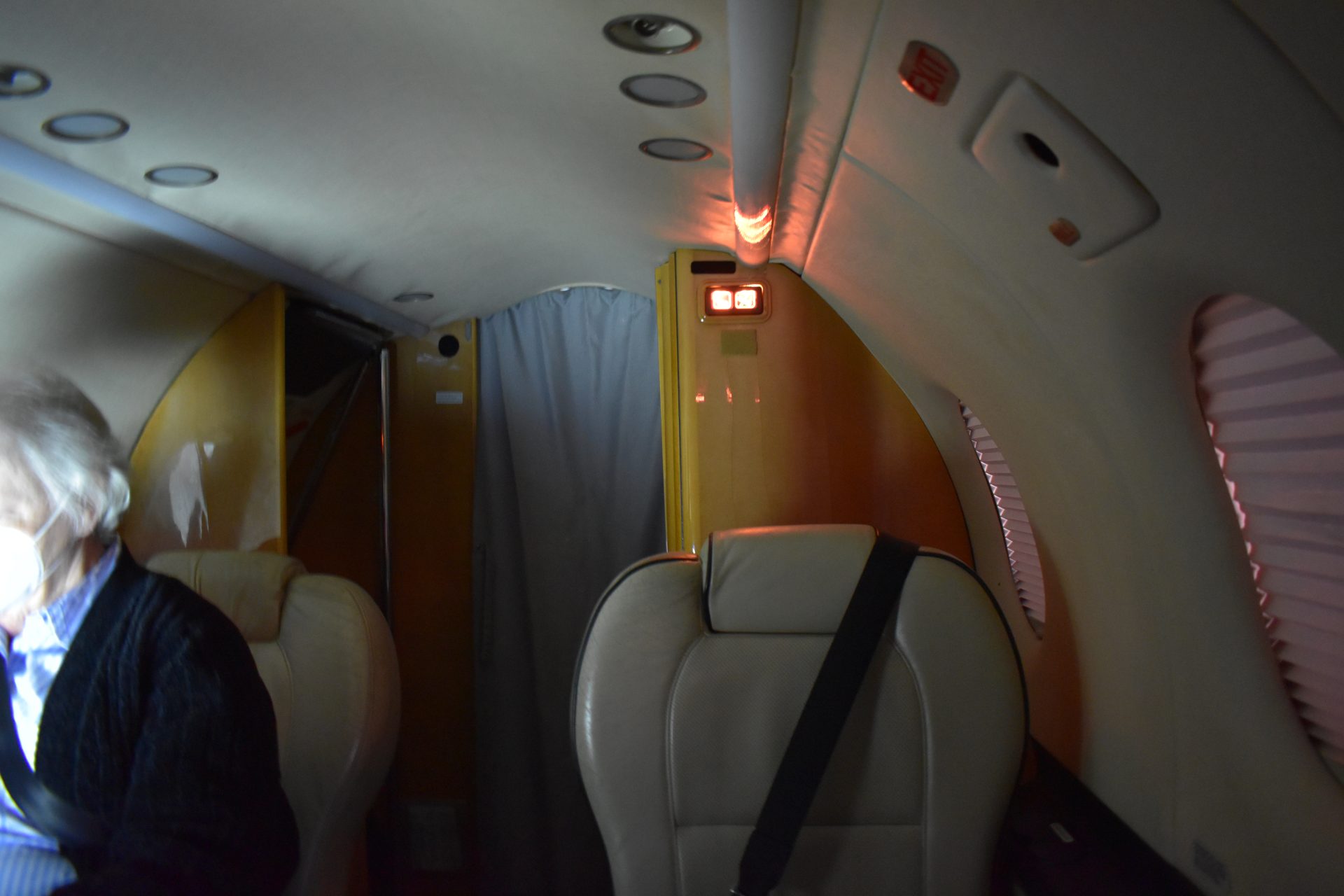
One of the other passengers took out her full-sized laptop and began to work on it, lighting up the cabin and showing just how easy it is to get work done on the full-sized tables that pull out of the walls near four of the seats.
Inside the cabin, lit up by a laptop (Photo: AirlineGeeks | Joey Gerardi)
The sunlight was now almost completely out of sight and the sky was a nice orange-red by this point of the flight.
The sunlight went from the skies (Photo: AirlineGeeks | Joey Gerardi)
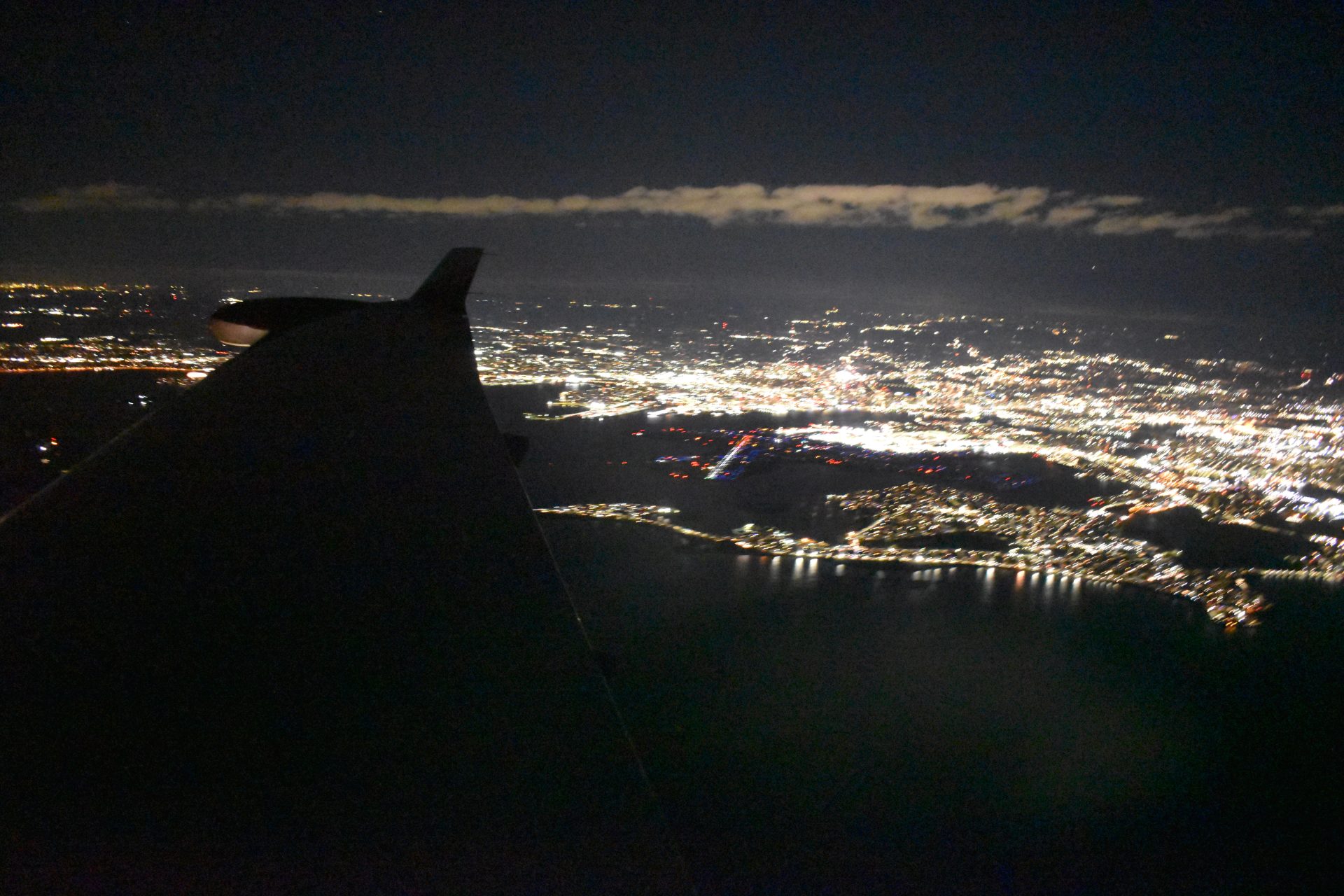
At some point shortly after I took that picture, I fell asleep for most of the remainder of the flight to Boston. When I woke up I could see the lights of Boston and the airport below us.
The lights of Boston below us (Photo: AirlineGeeks | Joey Gerardi)
We landed on one of the airport’s smaller runways, 32, avoiding the wake turbulence of much larger Boeing 777’s that were landing almost parallel to us on runway 33L.
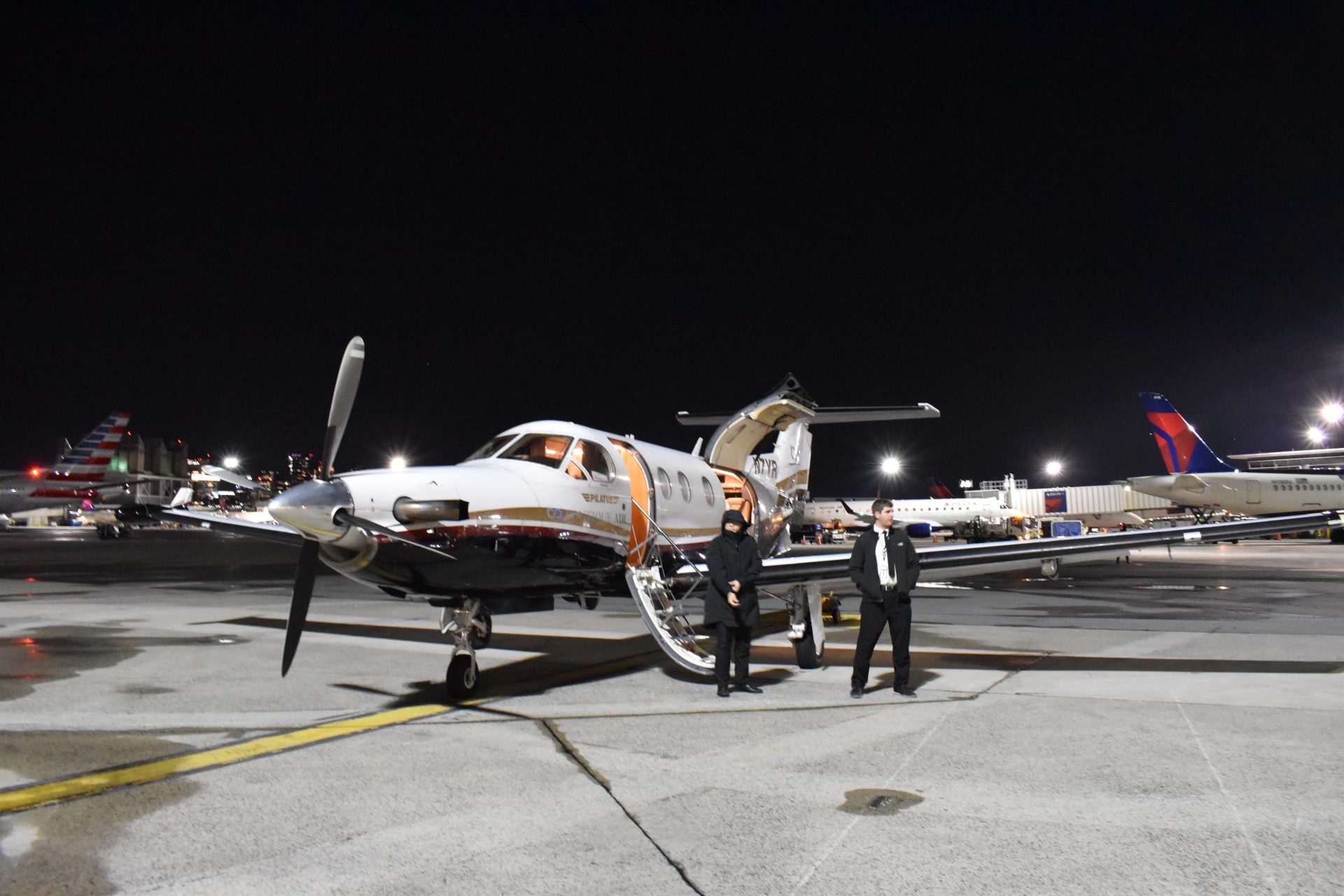
We landed at 6:02 P.M., a little over 15 minutes behind schedule due to the gate delay out of Massena. And when we pulled into the gate we became surrounded by Air Canada aircraft with our gate being the only one in the nearby gate area not being occupied by an Air Canada plane.
Our aircraft at Boston Logan Intl. (Photo: AirlineGeeks | Joey Gerardi)
From the time we took off from Baltimore until we landed in Boston, it was just under four hours, so it’s definitely not the fastest way between the two cities, but it for sure is the most unique way of flying between them. Plus with us entering winter, the New York City area might not be the easiest place to connect when the weather rolls in, so having them put you on Boutique might just save your trip if your connecting or nonstop flight was canceled.
With Boutique Air having five routes left in the entire country, this might be the only way to try this unique carrier and fly on the PC-12 without trekking all the way out to New Mexico, Texas, or Oregon. Community comments for this EAS proposal are due really soon, on Nov. 29, 2022 to regulations.gov, and we hope that all airlines have the funds and subsidies required to operate properly and cost-effectively, especially with fuel prices continuing to rise.
So, the next time you travel try connecting somewhere new and unique, you may just like where you end up.
Joey has always been interested in planes for as long as he can remember. He grew up in Central New York during the early 2000s when US Airways Express turboprops ruled the skies. Being from a non-aviation family made it harder for him to be around planes and would only spend about three hours a month at the airport. He was so excited when he could drive by himself, the first thing he did with his driver's license was get ice cream and go plane spotting for the entire day. He graduated from Western Michigan University in 2022 with a B.S. in Aviation Management & Operations and a Minor in Business, and currently works for a major airline in his hometown.
RwandAir Inducts First Dedicated Freighter to Fleet
Rwanda’s flag carrier RwandAir on November 24, inducted its first freighter aircraft in a bid to start a dedicated cargo service. The airline has inducted a Boeing 737-800SF freighter aircraft, which has been converted from a passenger jet to a full freighter configuration and is painted in RwandAir’s first cargo livery.
The airframe – 9XR-WW – is a former TUI passenger aircraft that is being leased to RwandAir through Merc Aviation, according to Cirium Fleets.
The cargo aircraft will be used for key missions in Africa and the Middle East, including Johannesburg, Nairobi, and UAE, the airline announced.
RwandAir’s Boeing 737-800SF, the first dedicated freighter aircraft (Photo: RwandAir)
Yvonne Makolo, CEO of RwandAir said: “The delivery of our dedicated cargo aircraft is a huge milestone in RwandAir’s fleet expansion plans. Cargo is of ever-increasing importance for the aviation industry, and as a landlocked country, we recognize the importance and value of good cargo connections. We want to ensure that Africa is seamlessly connected to the world, driving economic growth and valuable trade deals.
RwandAir currently owns a fleet of 13 aircraft, comprised of seven Boeing 737s, two Bombardier CRJ-900s, two Bombardier Q-400s and two Airbus A330s. Its fleet operates to destinations across East, Central, West, and Southern Africa, the Middle East, Europe, and Asia.
Africa’s growing cargo market
RwandAir’s latest addition comes as African airlines are augmenting their cargo capacity as the segment has emerged as a crucial and promising revenue stream during the last two years of covid pandemic.
These cargo aircraft numbers is set to rise even further as airlines are looking to add dedicated aircraft for cargo operations, which have fared better than passenger traffic amid the covid pandemic.
Nairobi-based Astral Aviation is adding three Boeing B757-200Fs and two Airbus A320 P2Fs to its 14-freighter fleet, while Kenya Airways Cargo has received a number of fleet extension proposals, which are now being examined and assessed by the leadership board.
Ethiopian Cargo & Logistics Services recently announced the launch of a new domestic cargo route to Dire Dawa and Jigjiga, which would operate three times per week beginning August 30.
With a rise in cargo volumes and airline operators in Africa on the verge of development, collaboration, and expanding business, it is apparent that the continent has the capacity to thrive; all it needs is prospective government backing. As per the IATA June 2022 report, African airlines saw cargo volumes grow 5.7 percent in June 2022 compared to June 2021, but worldwide demand was 6.4 percent lower.
Victor Shalton's love for aviation can be traced to when he was 11-years-old. As a seasoned aviation writer, he takes pride in providing the best aviation coverage around the globe and is passionate about advancing his skills in the aviation space. In addition, he loves travelling, writing, arts and while his speaking engagements have taken him around the world, he is proud to call Nairobi home.
Reliable Robotics' Cessna 208 test aircraft. (Photo: Reliable Robotics)
Over 40 countries, including Germany, the UK and New Zealand, have asked the United Nations body that sets aviation standards to help make single-pilot flights a safe reality. The European Union Aviation Safety Agency has also been working with aircraft manufacturers to determine how solo flights would operate and preparing rules to oversee them. EASA said such services could start in 2027.
The working paper aims to push the regulator to enable extended Minimum Crew Operation (eMCO) and eventually evolve the industry into Single Pilot Operation (SiPO). The former still employs two pilots at the controls during takeoff and landing, but one pilot can rest during the cruise phase. The measure would reduce costs and relief the pilot shortage situation.
As a passenger, I would avoid flying on a plane piloted by a single captain.
Single Pilot Operation Primer
Many commuter flights are operated by a single pilot. (Photo: AirlineGeeks | Fangzhong Guo)
Single pilot operation is not new or infeasible from a technology standpoint. Even in the commercial realm, most commuter flights that carry nine passengers or less in the United States only require a single pilot. However, the most recent plane mainly focuses on large airplanes. Most likely including airplanes from Boeing 737, Airbus A320 and larger widebody aircraft.
Civilian and military users are exploring the possibilities of operating longer flights with a single pilot. For instance, FedEx and Sikorsky tested single-pilot operations on an ATR 42. More recently, The US Air Force also flew an extended single-pilot mission with KC46, a tanker based on Boeing 767. However, both technologies are still in the trial phase without a clear timeline for mass application.
Single Point Failure
While the technology is mature for flying and even landing the aircraft in nominal conditions, pilots and passengers worry single pilot will reduce the safety margin in emergencies.
Crew Resource Management
Technology advancement such as Engine Indication and Crew Alerting System(EICAS) has proven helpful for reducing workload during malfunctions for the crew. However, even a well-trained professional can feel overwhelmed and make a mistake when many alarms are sounding. It has been challenging to avoid when two pilots are in the cockpit, and it’ll be even more inevitable when there’s only one in control.
The Second Hand
The proposed eMCO would still have two pilots onboard, so the second pilot could jump in and help in an emergency. However, it will not be as efficient as having two active pilots in the cockpit.
Even though incidents rarely occur during the cruise, disasters like AF447 could still happen. FAA study has shown that if a pilot is woken up after only one or two hours of rest, sleep inertia can cause a noticeable change in pilot response time. It’s hard to justify a second pilot could react effectively in that situation.
Companies are also developing technologies to pilot planes remotely, which could come to the rescue in this situation. However, I can hardly imagine the remote pilots having the complete information to apply situational awareness. The informational disparity could also render help from remote control less helpful.
Mental Health
Unfortunately, tragedies such as Germanwings flight 9525 exist. Hundreds of people have passed in deliberate crashes caused by mental health issues. It also prompted the European regulator to impose a minimum two-person rule in the cockpit for a brief period. As a passenger, I don’t think I’ll ever feel safe knowing a single-point failure could take many lives away in a moment.
Autonomous Flying Technology
Although I don’t support eMCO or SiPO in passenger airplanes, I believe they will be more practical for cargo applications. In the meantime, I think autonomous flying technologies will eventually replace the need for pilots in the cockpit. Systems such as Garmin AUTONOMÍ™ already exist that can land airplanes in case of emergency. With the proper ground equipment, larger planes can land themselves under challenging conditions, such as low visibility. Technology will slowly mature to cover all phases of operation and scenarios.
There are several concepts for operating un-piloted flights. For instance, Wisk and Boeing are working on an operational concept for a ground-based operator to simultaneously monitor several self-flying air taxis. On the other hand, Reliable Robotics is working on an unmanned demonstrator that involves more remote piloting. In either case, operators at command will make decisions based on the same information. In the case of a bad actor, there may be a better chance of taking them down before disaster strikes. Therefore, I would fly on a plane without a pilot before on one with a single pilot.
Final Thoughts
Moving toward less human involvement in commercial transport is the right direction. It’ll reduce operating costs and carbon emissions, and eventually, it’ll provide the same level of safety, if not better.
However, the technology appears to be a little far from ready. Aviation still needs reliable coverage over the vast area above the ocean. Data links still require a significant increase in bandwidth to support reliable uncrewed operations. Lastly, the ever-evolving cyber-security risk means most airplane systems are still individual players disconnected from the brain.
We won’t be stepping on an uncrewed flight soon, but I’m hopeful that day is not too far away.
Fangzhong grew up near an OEM airport in northeastern China, where he developed his enthusiasm for aviation. Taking upon his passion, he's now working as an aircraft interior design engineer. Besides working in the aerospace industry, Fangzhong enjoys trying out different types of airplanes and seeing how airplane interiors have evolved. So far, he's flown on over 80 types of aircraft. He also planespots in his spare time. His rarest catches included the 747 Shuttle Carrier Aircraft and AN-225.
An Icelandair 737 MAX 9 at Paine Field (Photo: AirlineGeeks | Katie Bailey)
Icelandair is further expanding its North American destination network with the addition of Detroit’s Metropolitan Wayne County Airport. The carrier will begin the seasonal summer operation on 18 May 2023 with a four-times-weekly schedule with a 160-seat Boeing 737 MAX. The service will operate to and from DTW and Icelandair’s base in Reyjavik, Iceland’s Keflavík International Airport on Mondays, Tuesdays, Thursdays and Fridays until October 30, 2023.
Iceland’s geographic location mid-Atlantic gives passengers the opportunity to fly direct and remain in the country or connect with flights to more than ‘25 destinations in Iceland, Greenland, the United Kingdom, Scandinavia and Continental Europe’. In addition, the airline allows transit customers to stop over in the country for no additional airfare for up to 7 nights.
Detroit serves over 125 destinations and Chad Newton, chief executive officer of the Wayne County Airport Authority welcomed the addition of Keflavik to the airport’s list.
“Thanks to Icelandair, the beauty of Iceland is now a short flight away from Detroit,” Mr. Newton said. “At Detroit Metropolitan Airport, we know our customers have a choice when they fly. We believe nonstop flights to Iceland and the opportunity to connect to exciting cities throughout Europe are two more reasons travelers will choose DTW.”
Bogi Nils Bogason, president and chief executive officer of Icelandair Group said, “Icelandair is pleased to offer Detroit a refreshing new choice when traveling to Iceland and beyond. Icelandair’s Detroit service will allow passengers to travel to and from Europe in new, fuel-efficient planes with modern amenities, including gate-to-gate Wi-Fi and inflight entertainment available for all passengers. These new flights will not only help meet the demands of a growing Detroit but also offer more options for Midwestern business and leisure travelers connecting from the Midwest region. We look forward to welcoming Detroit aboard.”
Two European destinations that passengers from the Midwest and the rest of North America can consider for summer 2023 are Barcelona, Spain and Prague. Icelandair recently announced that flights to Barcelona, Spain would recommence with a twice-weekly service from April through October, increasing to three times weekly between the peak months of June, July and August. Prague is a new destination for the carrier and the airline’s confidence in the destination is warranting four flights per week from June 1 through the end of October.
Prague Airport Aviation Business Director Jaroslav Filip cited the value that the seasonal service will provide.
“The opportunity to welcome a new carrier at Prague Airport is always clear proof of the Czech market appeal,” Filip said. “Icelandair’s new direct connection will support not only outbound tourism to Iceland but also provide another transfer opportunity to Icelandair’s wide network of connections in North America. Thanks to this new connection, we expect to see further strengthening of tourism between the Czech Republic and the United States or Canada.”
John has always had a passion for aviation and through a career with Air New Zealand has gained a strong understanding of aviation operations and the strategic nature of the industry. During his career with the airline, John held multiple leadership roles and was involved in projects such as the introduction of both the 777-200 and -300 type aircraft and the development of the IFE for the 777-300. He was also part of a small team who created and published the internal communications magazines for Air New Zealand’s pilots, cabin crew and ground staff balancing a mix of corporate and social content.
John is educated to postgraduate level achieving a masters degree with Distinction in Airline and Airport Management. John has held the positions of course director of an undergraduate commercial pilot training programme at a leading London university. In addition he is contracted as an external instructor for IATA (International Air Transport Association) and has been a member of the Heathrow Community Fund’s ‘Communities for Tomorrow’ panel.
Virgin Atlantic Withdraws Support to London Heathrow’s Third Runway
A Virgin Atlantic 787-9 departing London Heathrow. (Photo: AirlineGeeks | William Derrickson)
The plans of London Heathrow Airport — the British capital’s main international airport — to pursue planning permission for a third runway suffered a big setback earlier this week, as Virgin Atlantic, one of the two carriers based at the airport, withdrew its unconditional support to the project, as a reaction to the airport’s proposed intention to raise landing charges by 120%.
Sahi Weiss, Virgin Atlantic’s Chief Executive, speaking at the Airlines 2022 conference in London has called upon the U.K. Civil Aviation Authority (CAA) to “reform a broken system” and “pay close attention to the abuse of power by a de facto monopolistic airport.”
“Until that happens, it is difficult to see how expansion at Heathrow can be supported,” he added, The Guardian reports.
The U.K. CAA authorized Heathrow airport to raise its passenger charges by 56% at the beginning of 2022, to account for the uncertainties over how traffic will recover after the drop in demand caused by the COVID-19 pandemic. These charges have skyrocketed from £19.60 to £30.19 per passenger (from $23.30 to $35.89), but the U.K. regulator has also established Heathrow Airport will have to reduce those charges annually for the next four years until 2026.
The Long Saga of A Much-Needed Runway
Until 2019, London’s Heathrow Airport was operating essentially at full capacity and could not attract more traffic despite very strong demand from airlines. It was the first airport that was allowed by E.U. Authorities to allow slot trading on a monetary basis, with a pair of slots at peak times being sold for up to $75 million, and Virgin Atlantic issued a bond tied to the value of its slots at Heathrow raising £220 million.
The South-East of England has lacked runway capacity for decades, and an extra runway at Heathrow was selected more than once as the most favored solution to solve this infrastructure issue. However, this came not without controversy: Heathrow is located in a heavily-populated area West of London, and the last proposed plan for an extra runway did involve the destruction and relocation of an entire village, displacing 761 homes, as reported by the BBC.
In February 2020, the plan to build a third runway at Heathrow was considered illegal by a U.K. Court in a swiping victory by environmentalist groups. The plan was considered not compatible with the Paris Climate Agreement signed by the United Kingdom and with the related limit to greenhouse gas emissions linked to the agreement. The ruling was overturned in December 2020, but at this moment there is no timeline as to when the project will get the go-ahead.
Battle Between Airport and Airlines
After a chaotic summer during which airlines operating at Heathrow were asked to cancel flights due to the airport’s inability to deal with projected passenger flows and the unprecedented decision by the airport company to cap the number of passengers at 100,000 a day throughout the busiest travel period of the year, tension is high between Heathrow and the airlines operating at the airport, including Virgin Atlantic.
“This is not just about the next price control period in four years’ time,” Weiss said, as reported by The Guardian. “Everyone in this room will recognize the damage to consumer confidence that summer disruption caused. A repeat of this in summer 2023 is completely avoidable if honest and accurate passenger forecasts are used now for resource planning and building resilience.”
Heathrow’s medium to long-term plans also includes the construction of new satellite terminals that will lead to the demolition of Terminal 3, where Virgin Atlantic is currently located, together with most of the smaller operators at the airport as well as those not aligned with a major alliance. Of course, the carrier is trying to use all the leverage it can muster to obtain a better solution for itself in terms of terminal facilities.
John Holland-Kaye, the Heathrow chief executive, told the Guardian he expected to continue to “have a constructive relationship and conversations” with Virgin Atlantic, and that redevelopment of Terminal 3 or a move to the new Terminal 2 was in the airport’s medium-term plans.
After his speech, Weiss confirmed to the same British outlet that the company would still support Heathrow’s development, including its third runway, if some conditions were met, “including lower charges so that it remains competitive and consumers are protected, as well as massive renovation of Heathrow’s Terminal 3 where Virgin is based.”
Vanni fell in love with commercial aviation during his undergraduate studies in Statistics at the University of Bologna, when he prepared his thesis on the effects of deregulation on the U.S. and European aviation markets. Then he pursued his passion further by obtaining a Master’s Degree in Air Transport Management at Cranfield University in the U.K. followed by holding several management positions at various start-up carriers in Europe (Jet2, SkyEurope, Silverjet). After moving to Canada, he was Business Development Manager for IATA for nine years before turning to his other passion: sports writing.
New Airline Startup Fly Atlantic Makes Push for Low-Cost Transatlantic Flying
Ultra-low-cost, transatlantic, narrowbody air travel is a concept we’ve seen this one before, haven’t we? There were the days of Norwegian, WOW Air and the short-lived and tumultuous Primera Air — who after just about a year of operating ultra-low-cost flights connecting the United States to Europe at previously unseen prices — ceased operations.
Now, we are in the era of Norse and PLAY, which are two carriers that up until now have proved many pundits wrong. However, in 2024, Fly Atlantic thinks Norse and PLAY won’t be the only ones in this ever-changing transatlantic market.
The airline plans to be based in Belfast, Northern Ireland in the summer of 2024. Operating flights to both the United States and Canada, Fly Atlantic will look to change the narrative on ultra-low-cost transatlantic travel.
Andrew Pyne, the airline’s CEO, does have previous experience in the industry with stints at VietJet Air, Cobalt and WOW Air — all low-cost carriers. According to the airline, it will likely operate either the Boeing 737-MAX aircraft or the Airbus A321NEO and is currently in talks with both manufacturers.
Pyne seems confident in his ability to deliver on an airline starting in 2024 telling the Irish News, “Our vision is of Belfast as a strong aviation hub linking Europe and North America. The lack of direct transatlantic air services has clearly been an impediment to Northern Ireland’s economic and tourism development, which we now intend to remove.”
Additionally, Pyne’s confidence in Belfast as a hub to link the continents is undoubtedly interesting given that most ultra-low-cost carriers have gone via Iceland or in the case of Norse, essentially no true hub offering flights from a range of European cities.
“The project can be a game changer. We will be offering affordable fares with brand-new aircraft. We already have offices at the airport and will now be building out the infrastructure to support the airline’s launch. We start recruiting for the team early in 2023,” Pyne added.
It is safe to say that many view the Fly Atlantic concept as a “great if it ever happens” airline, more than having the expectation that comes 2024 Fly Atlantic aircraft will dot the sky. It is no secret that airline startups like WOW Air or Primera Air have vanished in a fair short period of time, due to the fact that the big carriers have an immense amount of resilience financially, whereas with a startup when investor money runs dry, it is likely the end.
Regardless of the past history of such airlines, Fly Atlantic presents an exciting new opportunity to link Northern Ireland and Europe to Canada and the United States. The airline said it hopes to serve roughly 35 cities across the two continents at its peak operation.
Ezra Gollan is a student, photographer and aviation enthusiast based in New York, New York. He has spent over half a decade around New York City’s airports as a photographer.
Air Serbia Receives a Second Airbus A330-200 and Mulls Flying to Chicago in 2023
An Air Serbia A330-200. Photo: Adam Moreira (AEMoreira042281), CC BY-SA 4.0 , via Wikimedia Commons
Air Serbia expands its offer in the United States with a new service between Belgrade (BEG) and Chicago O’ Hare (ORD) as of May 17, 2023. The carrier resumes operations to the windy city after 30 years.
This new service is possible thanks to the addition of a second Airbus A330-200 to the company’s intercontinental fleet: this new aircraft is registered YU-ARC and christened “Mihajlo Pupin”, a Serbian physicist, physical chemist and philanthropist, and includes his image on its tail as a part of the livery. This aircraft has a configuration of 21 seats in Business Class and 236 seats in Economy, was previously owned by South African Airways and has been introduced to active service in 2011.
According to Cirium, Air Serbia will have an offer of 4,883 weekly seats between Belgrade (BEG) and the United States for the 2023 summer season, a 60 percent increase in capacity over 2019 levels. The airline will offer non-stop services to New York (JFK) and Chicago (ORD).
Flight Itinerary
Belgrade – Chicago O’ Hare Flight JU 506 BEG 06:50 – ORD 10:50 Wednesdays and Saturdays.
Chicago O’ Hare – Belgrade Flight JU 507 ORD 12:40 – BEG 05:30+1 Wednesday and Saturday.
Service details
As of June 12, the route increases from 2 to 3 weekly flights, with an additional operation on Mondays.
This service will provide convenient connections through Air Serbia’s main hub in Belgrade (BEG) including Vienna (VIE), Athens (ATH), Berlin (BER), Bologna (BLQ), Dubrovnik (DBV), Istanbul (IST), Prague (PRG), Venice (VCE), Zagreb (ZAG), Rome – Fiumicino (FCO), among others.
On the other side of the Atlantic, passengers will also be able to connect to multiple U.S. destinations via New York (JFK) and Chicago O’Hare (ORD) through interline partnerships with American Airlines and JetBlue Airways.
A United 787-9 in Los Angeles (Photo: AirlineGeeks | William Derrickson)
On November 17 United inaugurated its non-stop services between Washington (IAD) and Cape Town (CPT). This new operation becomes the carrier’s third route between the United States and South Africa.
Flight UA 2222, operated by a Boeing 787 Dreamliner registered as N24979, took off from Washington Dulles International Airport (IAD) at 19:19 local time and landed at Cape Town Airport (CPT) at 15:31 the following day, after 13 hours and 32 minutes.
United is the only carrier to offer non-stop flights between the U.S. capital and South Africa. Passengers originating from Cape Town will have the option to connect through more than 60 of the carrier’s Americas destinations via its second major transatlantic hub at Washington – Dulles (IAD).
“As a country, we thank our United Airlines partners for their continued support and welcome this direct flight. We invite U.S. travelers to visit Cape Town and then explore other parts of South Africa, as we have so much to offer in our nine provinces,” said Nomasonto Ndlovu, chief operating officer of South African Tourism.
United’s new transatlantic service in South Africa will complement its operations from Newark (EWR) to Johannesburg (EWR) and Cape Town (CPT), the latter of which was upgraded from a seasonal service to year-round operation. According to Cirium, the Chicago-based carrier will have 6,682 weekly seats on offer between the U.S. and South Africa in December. United will be the largest operator in this segment in terms of seats per seat kilometers offered (ASK) with a market share of 52%.
Flight Itinerary
Washington – Cape Town Flight UA 2222 IAD 18:40 – CPT 16:10+1 Monday, Thursday and Saturday.
Cape Town – Washington Flight UA 2223 CPT 20:50 – IAD 05:50+1 Monday, Thursday and Saturday.
The route will be operated on Boeing 787-9 aircraft with a capacity of 257 passengers in four classes (48 United Polaris/21 Premium Plus/39 Economy Plus/149 Economy), plus service will be available year-round.
“The United States is a key source market for tourism, trade and investment for the province. We look forward to an excellent summer season ahead and would like to thank United Airlines for their continued commitment to our destination,” said Wrenelle Stander, Wesgro’s executive director and official spokesperson for Cape Town Air Access.
Cape Town (CPT) will complement United’s operations to Accra (ACC) and Lagos (LOS) from the U.S. capital. According to Cirium data, the carrier will offer 6,402 seats between Washington – Dulles (IAD) and Africa.