








Stories

Smooth Thanksgiving Holiday Travel After Chaotic Summer

Security lines at Denver International Airport. (Photo: AirlineGeeks | Fangzhong Guo)

Despite having a chaotic summer of air travel, US airlines performed well during Thanksgiving week. According to the flight tracking website FlightAware, US airlines canceled a total of 441 flights across the week. Calm weather across the continental US kept the airlines moving. The only exception was a major storm on Sunday, delaying more than 7,000 flights while accounting for 179 canceled flights. 

In the meantime, most travelers also reported clearing security in a reasonable time. There have not been any large-scale reports of extra-long security lines from social media.

The contrast comes after airlines scaled back ambitious flight schedules to a more sustainable compared to the summer. Increased hiring across the industry also kept the transportation system moving. 

Travel Compared to 2019 

According to TSA, nearly 27 million passengers passed security checkpoints between November 17 and 28. Sunday saw more than 2.5 million passengers through security checkpoints, the highest since the pandemic. The throughput represents a 6.8% increase from 2021 but is still 5.7% below the 2019 level. The trend is consistent with data from October, where the total number of passengers passing TSA checkpoints was 5.5% below the 2019 level.

While most of the world has reopened, high inflation and high fare prices have deferred some travelers from taking planes. AAA reported road travel has recovered at a higher pace to 98% of pre-pandemic levels.

Change in Consumer Habits

TSA throughput data matches airlines’ claims that flexible working arrangements stretch the holiday traveling period. Normalized numbers based on data from November 17 to Thanksgiving day show more people departed on Saturday, Sunday and Monday, while a lower percentage of people left on Tuesday, Wednesday and Thanksgiving day. More passengers are staying home through at least Monday despite more people traveling on Friday after Thanksgiving.

The more distributed travel demand also eased airlines’ pressure to provide reliable transport during the break. Although more companies require employees to work hybrid weekly, many still allow employees to work fully remotely for a few weeks in a year. While this reduces the chance of extremely expensive fares during peak travel times, flights further away from the holidays will also become more expensive.

A Good Omen for Christmas Travel?

Thanksgiving travel provides a preview for the upcoming Christmas travel season. Many can expect a similar trend where more people will start their trip early or return home later than usual. This past week clearly shows that the airlines have the right resources to handle their day-to-day operations. If all goes according to plan, the airlines should be able to get people to their destinations.

While the smooth sailing largely relied on fair weather, airlines have had to weather through several weather systems since Sunday. Sunday, Monday and Tuesday saw more than 7,000, 5,000, and 4,000 delays, respectively. Despite the many delays, the airlines managed to keep cancellations to mere hundreds, boosting consumer confidence in traveling this holiday season.

Although the performance is in no way a guarantee of smooth operation in the busiest time of the year, it is a good sign that the airlines can keep people moving again. In the meantime, we’ll keep our fingers crossed for good weather through the holiday season. 

Fangzhong Guo

Fangzhong grew up near an OEM airport in northeastern China, where he developed his enthusiasm for aviation. Taking upon his passion, he's now working as an aircraft interior design engineer. Besides working in the aerospace industry, Fangzhong enjoys trying out different types of airplanes and seeing how airplane interiors have evolved. So far, he's flown on over 80 types of aircraft. He also planespots in his spare time. His rarest catches included the 747 Shuttle Carrier Aircraft and AN-225.

Severe Pilot Shortage Cited For Dramatic Loss of U.S. Regional Flights

United CRJ-200
A United Express CRJ-200 exiting the runway in Ogdensburg, N.Y. (Photo: AirlineGeeks | Joey Gerardi)

A recent report from the Regional Airline Association (RAA) noted that 76 percent of U.S. airports lost air services when comparing figures from October 2022 with the same month in 2019. Of those 324 airports, the average loss equated to 31 percent of flights that were operated three years prior. The RAA cites a ‘severe pilot shortage’ for the trend of reduced services to small and medium-sized communities which its report concludes is accelerating given the future demand for pilots.

Faye Malarkey Black the chief executive officer of the RAA said, “We now have more than 500 regional aircraft parked without pilots to fly them and an associated air service retraction at 324 communities. Fourteen airports have lost all scheduled commercial air service – a number that is still rising.”

In the RAA report findings, fifteen U.S. states rely on regional airlines for 75 percent of air services. Mississippi (94 percent), West Virginia (93 percent) and Vermont (92 percent) take the top three positions for those states most reliant on regional airlines. A further 15 states including Michigan (60 percent), Ohio (56 percent) and Illinois (54 percent) rely on regional air services for 50 percent or more of air services.

Only this week, Burlington, VT’s International Airport lost its winter seasonal service to Orlando and summer service to Denver operated by Frontier Airlines. Vermont news website VTDigger noted that the airport – which recently opened a new $18 million new terminal wing – was one of 161 airports in the U.S. that had services reduced by over 25 percent in October compared to October 2019.  The airport does still have links with Florida and Colorado with an American Airlines service to Miami and United Airlines to Denver.

Scheduled network carrier regional aircraft utilization as measured in Block Hours (BH) has dropped for the second half of this year. The RAA report identifies 50-seat RJ aircraft BH reducing by 44 percent at American Airlines and 29 percent at Delta Air Lines. The same aircraft BH is down 13 percent at United Airlines with the Dual Class RJ BH down 30 percent at the carrier. Though the decrease in BH for these aircraft may not be solely attributable to pilot shortage or retraction of services, but actually the scheduled retirement from an airline’s fleet as reported in Airline Geeks last month.

RAA CEO Black warned, “We are on the precipice of a wholesale collapse of small community air service. It has already begun, with 60 U.S. airports losing more than half their air service since 2019. Every policymaker in the Administration and Congress must set aside politics and address this crisis today.”

According to the RAA website, the association ‘provides a unified voice of advocacy for North American regional airlines aimed at promoting a safe, reliable and strong regional airline industry and serves as an important support network connecting regional airlines and industry business partners, enabling them to share best practices.’

John Flett

John has always had a passion for aviation and through a career with Air New Zealand has gained a strong understanding of aviation operations and the strategic nature of the industry. During his career with the airline, John held multiple leadership roles and was involved in projects such as the introduction of both the 777-200 and -300 type aircraft and the development of the IFE for the 777-300. He was also part of a small team who created and published the internal communications magazines for Air New Zealand’s pilots, cabin crew and ground staff balancing a mix of corporate and social content. John is educated to postgraduate level achieving a masters degree with Distinction in Airline and Airport Management. John has held the positions of course director of an undergraduate commercial pilot training programme at a leading London university. In addition he is contracted as an external instructor for IATA (International Air Transport Association) and has been a member of the Heathrow Community Fund’s ‘Communities for Tomorrow’ panel.

34th Anniversary of Air Europa’s First Transatlantic Flight

Air Europa Boeing B757 ETOPS
Air Europa's EC-ELA, the Boeing 757 that completed the first ETOPS flight of a Spanish airline in history (Archive)

On November 30, 1988, Air Europa performed its first transatlantic service in a twin-engine aircraft. It is 34 years since this operation marked an important milestone in being the first Spanish airline to perform an ETOPS flight.

The ETOPS (Extended-range Twin-engine Operations Performance Standards) regulation was issued in 1985 and gathered the necessary requirements that had to be met at that time to be suitable for the operation of twin-engine aircraft in transoceanic flights and/or remote areas (poles, jungles, deserts).

Three years after the issuance of this standard, Air Europa worked hard with the Directorate General of Civil Aviation (DGAC) in Spain and the Federal Aviation Administration (FAA) to obtain the ETOPS certificate to make its first transatlantic flight on a service between Madrid (MAD) and New York (JFK) in a Boeing 757-200 aircraft.

In addition, Air Europa became one of the first airlines in the world to operate flights between the Old Continent and North America in twin-engine narrow-body aircraft and demonstrated not only the 757’s long-haul capabilities, but also the company’s work to obtain the certificate and ensure operational safety.

Air Europa continues to operate between Madrid (MAD) and New York (JFK) with five weekly flights on Boeing 787 Dreamliner and for the 2023 summer season, United Airlines will offer several transatlantic services from Newark (EWR) to Malaga (AGP) and Tenerife – South (TFS) on Boeing 757-200s, demonstrating the vital role of this aircraft in the market between the United States and Europe.

This article was originally published by Rainer Nieves Dolande on Aviacionline in syndication with AirlineGeeks

Flights to Cuba: Neos connects Cayo Largo del Sur and Italy

A Neos' Boeing 787

On November 19, Italian carrier Neos resumed its flights between Milan (MXP) and Cayo Largo del Sur (CYO) with a stopover in Havana (HAV) after almost three years. With this new operation, the leisure airline will offer up to four destinations in Cuba.

Flight NO 601 landed at Vilo Acuña Airport (CYO) with ninety-two passengers coming from José Martí International Airport (HAV), then took off from Cayo Largo del Sur (CYO) at 20:30 local time and landed at Milan-Malpensa Airport (MXP) at 11:00 the following day, after eight hours and 30 minutes.

Flight itinerary

Between November 19 and December 10, services to Cayo Largo del Sur (CYO) will have a stopover in Havana (HAV).

Milan/Malpensa – Havana Flight NO 601 MXP 10:00 – HAV 15:00 Saturday.
Havana – Cayo Largo del Sur Flight NO 601 HAV 17:00 – CYO 17:40 Saturday.
Cayo Largo del Sur – Milan/Malpensa Flight NO 601 CYO 19:10 – MXP 10:45+1 Saturday.

From December 24 flights will have stopover in Varadero (VRA).

Milan/Malpensa – Varadero Flight NO 601 MXP 12:00 – VRA 17:00 Saturday.
Varadero – Cayo Largo del Sur Flight NO 601 VRA 18:55 – CYO 19:35 Saturday.
Cayo Largo del Sur – Milan/Malpensa Flight NO 601 CYO 21:05 – MXP 12:40+1 Saturday.

The flights will be operated on Boeing 787-9 Dreamliner aircraft with a capacity of 359 seats in two classes (28 Premium Economy/331 Economy) and the service will be available throughout the year. The Italian leisure airline’s last operation at Vilo Acuña Airport (CYO) was on March 22, 2022.

Neos is the European airline offering the widest range of destinations in Cuba by serving Havana (HAV), Holguin (HOG), Varadero (VRA) and Cayo Largo del Sur (CYO) and the only airline operator offering scheduled flights to Vilo Acuña Airport (CYO). With the beginning of the peak tourist season, about forty-five foreign airlines are already operating in Cuba with both scheduled and charter services, offering more than 450 weekly flights.

Neos Schedule in Cuba

(Obtained through Cirium, subject to change).

From November 19 to December 10

Rome/Fiumicino (FCO) – Havana (HAV): one weekly flight with stopover in Cancun, Mexico (CUN).
Milan/Malpensa (MXP) – Havana (HAV): two weekly flights.
Milan/Malpensa (MXP) – Holguin (HOG): one flight a week.
Milan/Malpensa (MXP) – Cayo Largo del Sur (CYO): one weekly flight with stopover in Havana (HAV).

As of January 15, 2023

Rome/Fiumicino (FCO) – Havana (HAV): one weekly flight with stopover in Cancun, Mexico (CUN).
Milan/Malpensa (MXP) – Varadero (VRA): one flight weekly.
Milan/Malpensa (MXP) – Havana (HAV): one flight weekly.
Milan/Malpensa (MXP) – Holguin (HOG): one flight per week with stopover in Havana (HAV).
Milan/Malpensa (MXP) – Cayo Largo del Sur (CYO): one weekly flight with stopover in Varadero (VRA).


This article was originally published by Rainer Nieves Dolande on Aviacionline in syndication with AirlineGeeks

Airbus A220 – Corporate Business Jet Competition

A Delta A220-100 landing in Dallas/Fort Worth. (Photo: AirlineGeeks | Ben Suskind)

In October 2020, Airbus announced they would offer the A220-100 as an Airbus Corporate Jet (ACJ), known as the ACJ TwoTwenty. The Toulouse, France-based manufacturer had limited success marketing the A319 as an ACJ with only around 70 currently operating as a corporate jet. So what makes them think they can be successful with the A220? After all, both aircraft are similar in size.

The A220 was originally manufactured by Bombardier, known as the C Series. It was launched in 2008 with the first flight in 2013. Designed for the 100-135 seat market, the first delivery was not until July 2016 when HB-JBA was delivered to Swiss International Air Lines.

In 2016 Airbus saw the potential for the advanced technological C Series and purchased a majority 50.01% share. They increased this to 75% in 2020 as Bombardier exited the program completely. Ironically it is now with Bombardier that they are competing within the corporate jet market. The C series was rebranded as the A220 in 2018 and Airbus proved to be significantly better at marketing the plane. Sales jumped by 50%. Over 230 have now been delivered with over 550 on order. Airbus also saw the potential for the aircraft to be used as a corporate jet, with the first aircraft nearing completion. C/N 50062, registered as 9H-FIVE is currently at Comlux in Indianapolis, which has the contract for VIP cabin outfitting. 

So what has made the aircraft so popular? Well, Airbus claims the A220 can achieve an overall 25% lower seat-mile cost and 25% lower fuel burn and CO2 emissions advantage over similar aircraft. A significant saving and understandably airlines have jumped at the chance to order them. But why would such a large aircraft be in demand as a corporate jet?

At the Airspace Customer Showroom in Toulouse, Airbus has developed the ACJ TwoTwenty creative studio to demonstrate to potential clients exactly why they should purchase it. They largely compare it to its nearest competitor, Bombardier’s Global 7500. So, let’s look at the facts. Although the A220 appears deceptively larger, at 35 meters, it is only 1.2 meters longer than the Global 7500.

This means it only uses a similar amount of ramp space. But offers an additional 7 meters of cabin length. This is due to the engine placement. The Global 7500 engines are mounted on the rear of the fuselage utilizing a large proportion of the length. With the A220s engines mounted on the wings, all this additional space can be used for the interior.

Also with an additional 0.84 meters in width and 0.25 meters in height, the A220 provides about 50% more cabin space, for only a slightly larger aircraft. The additional height, which stands at 2.13 meters, also means everyone is capable of standing fully upright and there is potential for such features as a shower, and the additional width allows for a full-size bed.

The one feature that the A220 does lose, is the range. Although its additional fuel tanks extend it to 5650 nm it doesn’t compare to the Global 7500s 7700 nm. But Airbus can defend against this as well. They took a survey of corporate flights and came to the conclusion that a range of 5650 nm was good enough for about 97% of them, with most customers preferring a stopover for longer flights.

Aircraft Price

So what about the price, surely it costs significantly more? Well, Airbus is marketing it for around $80 million. With Bombardier’s Global 7500, Gulfstream’s G700, and Dassault’s Falcon 10X all costing approximately $75 Million, it’s not a significant increase. Combined with its similar size, significant cost savings and a significant increase in cabin space, the aircraft could soon be attracting significantly more orders.

Airbus has also gone above and beyond to market the aircraft in the creative studio. Recognizing that clients have very different needs when it comes to cabin interiors they have already created a hundred possible layouts. Ranging from clients like heads of state, who may wish to have their own bedroom and bathroom, to large corporations who may require workstations for several employees.

Clients are able to visually see the cabin size with a small cabin mockup along with floor illuminations to see the actual floor space. Airbus is also quick to demonstrate the significant size increase over the other corporate jets, allowing clients to see exactly how much more space they will get.

Next to this, Airbus offers a wide range of different textiles and colors that can be used to outfit the cabin. Clients are able to choose exactly how they want the cabin to look and what materials they want, on the spot at the time of purchase. They are able to use an interactive TV to interchange materials and colors and see exactly how different materials will look next to each other. They have even developed a virtual reality program allowing the client to design the cabin and then walk through it in 3D.

If the client wants to see an actual A220 up close, Airbus also has the original prototype in the building. C/N 50001 C-FBCS is now used to market the aircraft to airlines and is fitted out in a normal seating configuration that airlines may use.

Mark Evans

Mark has been interested in aviation since the age of eight when he first went plane spotting at Manchester Airport, England. Trips around various European airports in the following years and then to the USA as a teenager furthered his desire. This led to Mark wanting to work in the industry and at the age of twenty one was accepted to train as an Air Traffic Controller. After training and working for several years in England, Mark moved to Bahrain in the Middle East where he worked for six years. He then moved to Sydney, Australia where he resides today after twenty years in the profession. Mark's pursuit to see planes has seen him visit over 140 countries and territories, including places, like North Korea, Sudan and Iran. He has flown over 1,100 times, visited over 700 airports and can always be found researching his next trip.

Merger with Vistara Ushers Promising Future for Air India

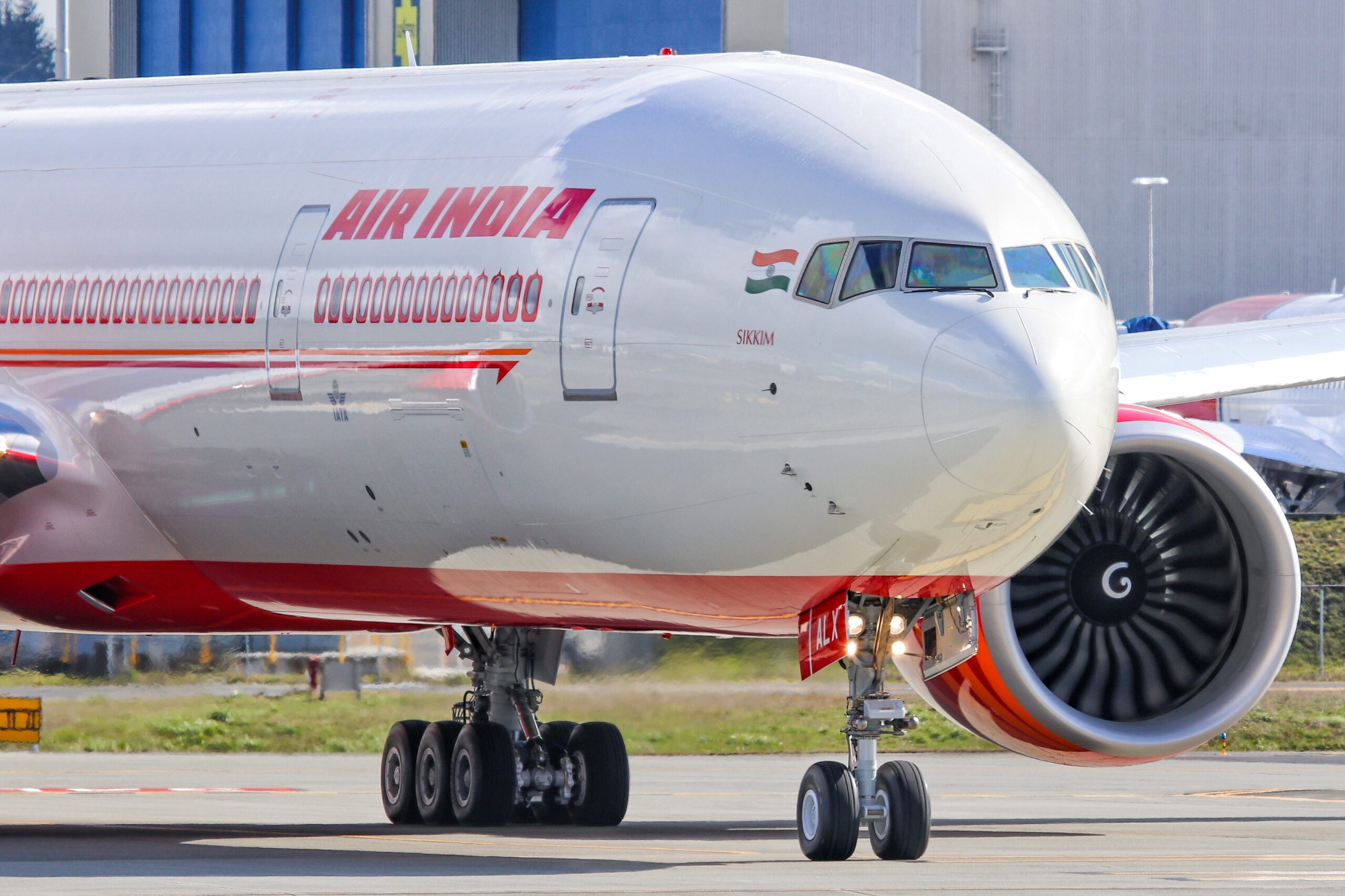
An Air India 777-300ER (Photo: AirlineGeeks | Katie Bailey)

Indian conglomerate TATA Group has announced it is merging Indian flag carrier Air India with the Singapore Airlines joint-venture airline, Vistara. The move looks to bolster Air India’s presence in Asia and provide a facelift to an Air India that in the last few years has been hanging on by a thread both in terms of finances and its public perception. 

The chairman of Tata Sons, Mr. Natarajan Chandrasekaran said in a press release, “The merger of Vistara and Air India is an important milestone in our journey to make Air India a truly world-class airline. We are transforming Air India, with the aim of providing a great customer experience, every time, for every customer. As part of the transformation, Air India is focusing on growing both its network and fleet, revamping its customer proposition, and enhancing safety, reliability, and on-time performance.

As a result, the merger will make the airline India’s second-largest domestic carrier and largest international carrier with a combined fleet size of 218 aircraft. Vistara — since its founding in 2013 — has risen to become one of India’s leading airlines and serves much of the domestic Indian market along with routes to Singapore and London among other shorter, international routes. It is clear that Tata Sons — the TATA subsidiary responsible for Vistara and Air India — sees the move as a pathway to giving Air India new life. 

“We are excited about the opportunity of creating a strong Air India which would offer both full-service and low-cost service across domestic and international routes. We would like to thank Singapore Airlines for their continued partnership.” The merger which will be completed in 2024 excites Singapore Airlines too with the carrier looking to strengthen its holdings in India and Southeast Asia,” Chandrasekaran added.

Singapore Sees Potential

Singapore Airlines Chief Executive Officer Mr. Goh Choon Phong said, “Tata Sons is one of the most established and respected names in India. Our collaboration to set up Vistara in 2013 resulted in a market-leading full-service carrier, which has won many global accolades in a short time. With this merger, we have an opportunity to deepen our relationship with Tata and participate directly in an exciting new growth phase in India’s aviation market. We will work together to support Air India’s transformation program, unlock its significant potential, and restore it to its position as a leading airline on the global stage.”

Singapore Airlines seeing potential in Air India means it sees potential in the Indian aviation market, given that India now holds one of the globe’s fastest-growing populations and economies and as a result, a tremendous rise in the number of people who can afford to travel and want to travel. Whether or not the merger will rescue Air India’s image is another issue, but things have to be looking for a carrier that just a year ago, was saved with its sale to the TATA Group for close to $3 billion after years of financial struggles and continuous government bailouts.

Ezra Gollan

Ezra Gollan is a student, photographer and aviation enthusiast based in New York, New York. He has spent over half a decade around New York City’s airports as a photographer.

Korean Air Enters Volare, ITA Airways’ Loyalty Program

Korean Air 787-10
A Korean Air 787-9 being delivered at Boeing's North Charleston, S.C. facility (Photo: AirlineGeeks | Hisham Qadri)

TA Airways and Korean Air strengthen their partnership beyond the Skyteam alliance with the signing of a frequent flyer agreement as part of Volare, the Italian flag carrier’s loyalty program.

Korean Air, a founding member of Skyteam, is the leading South Korean airline in Italy and the first airline partner of the Volare frequent flyer program. The Seoul-based operator, attentive to market demand, operates daily flights to one hundred destinations worldwide through its main hub at Incheon International Airport (ICN). This partnership with ITA Airways will guarantee Volare members extensive domestic and international connectivity between the two capitals.

When flying with Korean Air, as an alliance carrier, Skyteam Elite Plus members will be able to take advantage of SkyPriority services including priority check-in and boarding, additional baggage drop-off and drop-off, preferential access at transit counters and security checkpoint.

ITA Airways customers can also earn miles on Korean Air operated flights. Members need only register their Volare frequent flyer number at the time of booking to earn points in the Italian airline’s loyalty program.

“We are delighted to announce our partnership with Korean Air. For us, this agreement represents a further step in our growth strategy within SkyTeam,” said Emiliana Limosani, CCO of ITA Airways and CEO of Volare.

“Since ITA Airways officially joined SkyTeam, we have been working continuously with all partner airlines to ensure that frequent flyers enjoy the benefits and advantages of the Alliance,” added Limosani.

ITA Airways is set to welcome more airlines and business partners to its Volare program in the coming months, offering its customers greater choice and personalization.

Korean Air flight schedule in Italy

Seoul/Incheon (ICN) – Rome/Fiumicino (FCO)
KE 931 ICN 14:05 – FCO 19:35 Tuesday, Thursday and Saturday.
KE 932 FCO 22:00 – ICN 17:00+1 Tuesday, Thursday and Saturday.

Seoul/Incheon (ICN) – Milan/Malpensa (MXP)
KE 927 ICN 12:20 – MXP 18:05 Wednesday, Friday and Sunday.
KE 928 MXP 20:05 – ICN 15:25+1 Wednesday, Friday and Sunday.

This article was originally published by Rainer Nieves Dolande on Aviacionline in syndication with AirlineGeeks

Jet2 Expands Operations at London – Stansted for the 2023 Summer Season

G-CELH, a Jet2 Boeing B737-300 seen taxiing to the stand after vacating Runway 23R at Manchester Airport. (Photo: AirlineGeeks | James Field)

Jet2 will expand at London – Stansted (STN) for the 2023 summer season, thanks to the securing of additional slots to increase its operations and the addition of an aircraft at the base.

The addition of the 15th aircraft at STN allows the British tour operator to increase the supply of seats and flights to popular destinations in Croatia, Turkey, Greece and the Balearic Islands. This expansion means Jet2.com and Jet2Holidays will operate more than 225 flights to 42 destinations from Stansted Airport by summer 2023.

With more than 2.1 million seats available for sale from London (STN) by next summer, this represents a 10% increase compared to 2022 levels. To meet passenger demand during the peak season, the company will reinforce the base with another aircraft increasing the base to 16 units.

Destinations with increased Jet2.com capacity at London – Stansted (STN)

Balearic Islands: Ibiza, Palma de Mallorca.
Greece: Corfu, Crete (Chania), Crete (Heraklion), Kos, Kefalonia and Rhodes.
Croatia: Dubrovnik, Split.
Turkey: Dalaman.

In addition to unveiling its expanded schedule for the northern summer 2023 from London – Stansted (STN), the tour operator will offer new Mediterranean destinations to Athens and Rome – Fiumicino.

“This expansion is the latest demonstration of our continued commitment to invest in our operations at London Stansted. Earlier this year we celebrated five years since launching flights and vacations from London Stansted, and from day one the feedback from customers and independent travel agents has been incredible” said Steve Heapy, CEO of Jet2.com and Jet2holidays.

Jet2’s London – Stansted schedule for summer 2023

The tour operator will offer up to more than 225 weekly operations on 42 destinations.

Turkey: 30 weekly flights.
Spain: 83 weekly flights.
Portugal: 13 weekly flights.
Italy: 9 weekly flights.
Greece: 49 weekly flights.
Croatia: 9 weekly flights.
Cyprus: 11 weekly flights.
Malta: 2 weekly flights.
United Kingdom: one weekly flight.

This article was originally published by Rainer Nieves Dolande on Aviacionline in syndication with AirlineGeeks.

Opinion: Why the Comac C919 Cannot Currently Be Considered A Rival to the Airbus A320neo and the Boeing 737 MAX

The C919 roll out marked a milestone for Comac. (Photo: Zhang Anchao/Comac)

The Comac C919 is a twin-engine narrow-body low-wing airliner made by the Chinese company Comac — short for Commercial Aircraft Corporation of China. It began the design and construction stages in 2009 with the aim of entering the short- and medium-haul market, and since its announcement has aroused much interest in the aviation world as it was regarded as the “new” competitor in the struggle between Boeing 737 MAX and Airbus A320neo, and hailed as China’s answer to the Western monopoly of the commercial aviation market.

Comac applied to the Civil Aviation Administration of China (CAAC) for a Type Certificate for the aircraft on Oct. 28, 2010, and it was supposed to enter commercial service in 2016. However, the first flight took place on May 5, 2017, from Pudong Airport, presenting itself as an aircraft with the capacity to accommodate between 160 and 170 passengers with a range of 4,075 to 5,555 kilometers.

Finally, five years later on Sept. 29, the Comac C919 was certified, obtaining the Type Certificate (TC) issued by the Chinese authorities, and it was certainly a historic moment for global air transport, marking (according to some) the moment when a third player took in the slice of the market hitherto monopolized by giants Airbus and Boeing. However, the reality is different for 3 reasons.

A Small Number of Orders

With a total of 815 orders (many of them purchase intentions) from 28 customers, most of them Chinese, these numbers are much lower than those of Airbus and Boeing, which respectively have 8,500 orders for the Airbus A320neo and about 3,500 orders for the Boeing 737 MAX under their belt. It is to be noted that the orders list for the Chinese plane also included aircraft leasing giant GE Capital Aviation Services (GECAS), for ten aircraft with further options for ten more.

However, the Chinese aviation market is still mostly operated by Boeing and Airbus aircraft. Just consider that Air China out of nearly 500 active aircraft in its fleet, more than 450 are Airbus or Boeing and only 11 are Comac ARJ21 low-wing regional airliner bioreactor made in the 2000s.

Production Delays and Slowdowns

Despite being repeatedly announced as close to entering service, the COMAC C919, has not yet carried passengers on a commercial flight. Although the Chinese plane has been certified as airworthy, it has yet to obtain certification in order to start mass production. Without this certification, Comac could deliver only a dozen or so aircraft in 2023, unable to increase industrial production rates. Making a comparison with Airbus, the European aviation company will increase its production rate to 75 Airbus A320s per month in 2025.

China Eastern Airlines, recently stated that it will receive only one C919 by the end of 2022 (instead of the previously planned three jets) and four in 2023. It was announced in Chinese media that the first Comac C919 aircraft in China Eastern livery painted a few weeks ago was seen. The aircraft will be registered as B-919A instead of the provisional registration COMAC.

Such low numbers however are no surprise since thirteen years have passed since the program was launched, in 2009 and almost six years behind the original schedule due to technical difficulties and supply problems. The Chinese aircraft is not expected to enter service until the first half of 2023.

Lack of Certification by European, American Authorities

The recent certification by CAAC, is but a drop in the bucket. As long as the C919 is not certified by the European (EASA) and American (FAA) aviation authorities, it will greatly block the worldwide deployment of this aircraft. The Comac C919, therefore, will only be able to operate in the Chinese market.

Despite these 3 impediments, airlines in both Europe and Africa continue to show interest in the Chinese aircraft. The CEO of Ryanair, Michael O’Leary, has always placed much interest in the Chinese aircraft, entering into a Memorandum of Understanding (MoU) in 2011. However, this could be just another tactic from O’Leary to force Boeing to lower its price for the Boeing 737 of which Ryanair has more than 500 in service and more than 100 yet to be delivered.

Nigeria Air, the new flag carrier of Nigeria, will also consider purchasing some Comac C919s. The Nigerian aviation minister confirmed that the air carrier said it was willing to consider the Chinese aircraft for inclusion in its fleet, taking advantage of the excellent relationship between the nations. However, the Nigerian airline will start its operations with three Boeing 737-800s by the end of 2022, with plans also to purchase Airbus aircraft.

Vincenzo Claudio Piscopo

Vincenzo graduated in 2019 in Mechanical Engineering with an aeronautical curriculum, focusing his thesis on Human Factors in aircraft maintenance. In 2022 he pursued his master's degree in Aerospace Engineering at the University of Palermo, Italy. He combines his journalistic activities with his work as a Reliability Engineer at Zetalab.

Fiji Airways Opens a Year-Round, Non-Stop Route Between Nadi and Vancouver

A Fiji Airways Airbus A350-941 with registration DQ-FAI (Photo: William Derrickson)

On November 25 Fiji Airways inaugurated its non-stop flights between Nadi (NAN) and Vancouver (YVR), services will be available throughout the year. The airline is the only carrier to connect Fiji to Canada. Flight FJ 880, operated on an Airbus A330 registered DQ-FJT, took off from Nadi International Airport (NAN) and landed at Vancouver International Airport (YVR) after 10 hours and 37 minutes.

According to data obtained through Cirium, Fiji Airways will offer 7,728 weekly seats between Fiji and the United States and Canada in December, a 28.8 percent increase when compared to pre-pandemic levels.

With the start of non-stop operations to Nadi (NAN), it becomes the fourth South Pacific destination served from Vancouver (YVR), the Canadian airport serves Sydney (SYD) and Brisbane (BNE) in Australia and Auckland (AKL) in New Zealand (AKL).

“We are delighted to welcome Fiji Airways to YVR and are proud that Vancouver will be the airline’s first Canadian destination in its growing network,” said Mike McNaney, Vice President and Head of External Affairs for the Vancouver Airport Authority.

Flight Itinerary

Vancouver – Nadi Flight FJ 880 NAN 22:15 – YVR 13:20 Monday and Friday.
Nadi – Vancouver Flight FJ 881 YVR 21:40 – NAN 05:30+2 Monday and Friday.

The route will be operated on Airbus A330-200 aircraft with a capacity of 273 seats in two classes (24 Business Class/249 Economy). This service will also provide additional cargo capacity to increase trade between Fiji and Canada, as well as with other Pacific Island nations seeking new business opportunities.

Fiji Airways’ new operation in Canada will produce approximately $7.5 million in combined Gross Domestic Product (GDP) with $12.2 million in tourism and the creation of 86 jobs in Vancouver and British Columbia’s hotels, restaurants and tourist attractions.

“With Canada well into winter and travelers eager for a warm tropical paradise, the timing of our new route couldn’t be better. There is no choice but Fiji. You don’t have to take my word for it, you’ll be convinced as soon as you step on board,” said Andre Viljoen, Fiji Airways’ managing director and CEO.

Fiji Airways schedule between Nadi (NAN) and the United States – Canada

(Source: Cirium, subject to change)

Honolulu (HNL): one weekly flight on Boeing 737 MAX 8.
Los Angeles (LAX): daily flights on Airbus A350-900.
San Francisco (SFO): three weekly flights on Airbus A330-200.
Vancouver (YVR): two weekly flights on Airbus A330-200.


This article was originally published by Rainer Nieves Dolande on Aviacionline in syndication with AirlineGeeks.

Sign-up for newsletters & special offers!

Get the latest stories & special offers delivered directly to your inbox

SUBSCRIBE

Uh-oh! It looks like you're using an ad blocker.

Our website relies on ads to provide free content and sustain our operations. By turning off your ad blocker, you help support us and ensure we can continue offering valuable content without any cost to you.

We truly appreciate your understanding and support. Thank you for considering disabling your ad blocker for this website