









Stories

American Airlines To Settle Baggage Fees Class Action Lawsuit

American Airlines in Charlotte
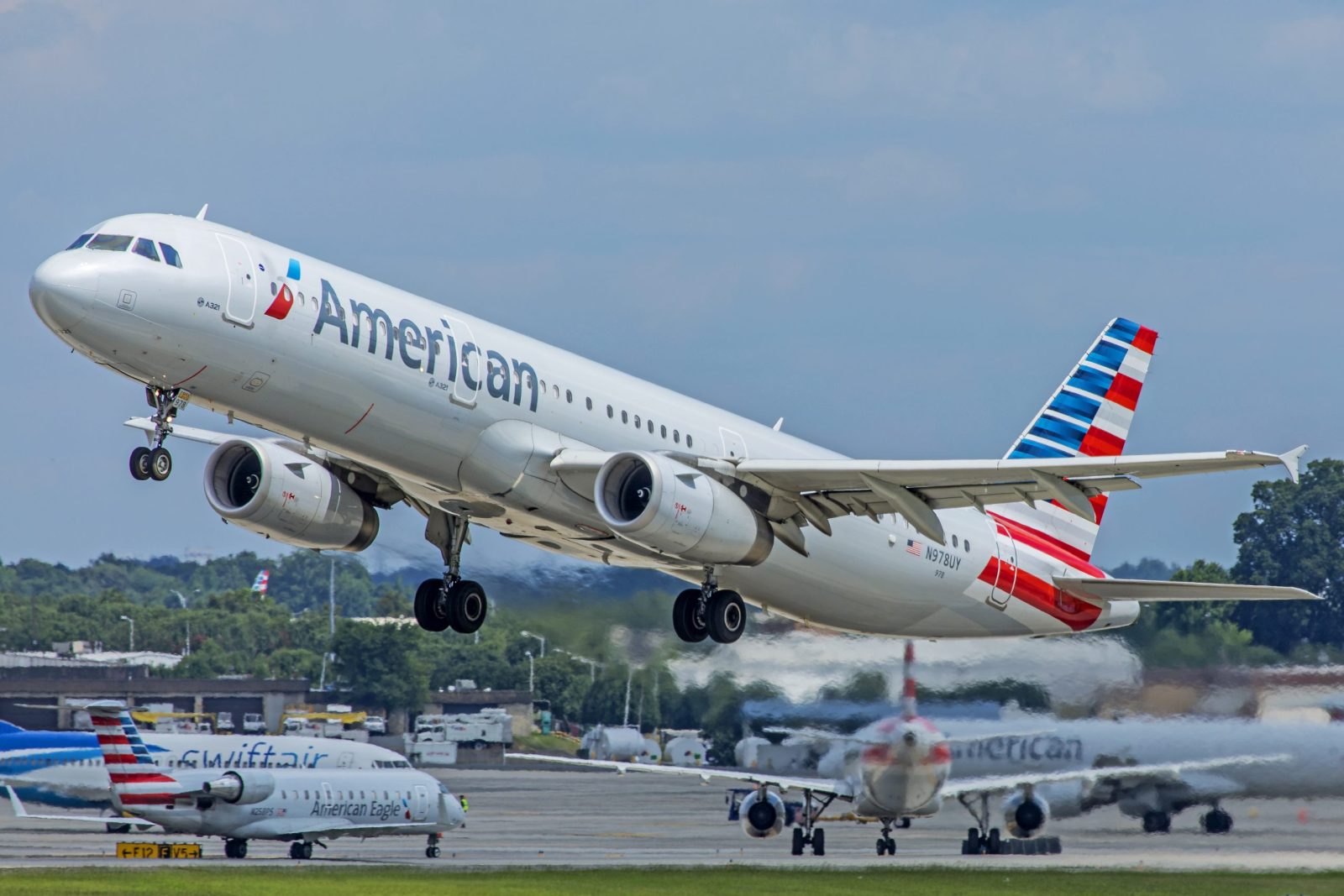
An American A321 in Charlotte. (Photo: AirlineGeeks | William Derrickson)

American Airlines has reached an out-of-court settlement in order to put to rest a class action lawsuit that was brought against them by up to 2.8 million passengers that claim they were “improperly charged” baggage fees between 2013 and 2021.

The lawsuit originated from the action of five passengers who claimed the airline broke its promise to allow them free baggage check-in on some of their luggage due to their frequent flier status, premium credit card or first-class ticket.

“The settlement applies to two sets of affected passengers: those who received email confirmation that promised one or more of their checked bags would be free but still had to pay; and those who held branded credit cards that entitled them to no-charge luggage checking but who were still charged on domestic trips. Travel had to take place on or after Feb. 24, 2017, and tickets needed to be bought no later than April 8, 2020,” the Washington Post reported.

American Airlines has agreed to pay at least $7.5 million to settle this lawsuit that has been filed in a Federal Court in Texas in February 2021 but has admitted no wrongdoing as the plaintiffs claimed the airline has “breached its [own] contract” by not allowing certain passengers to check-in some of their baggage for free.

“Rather than risk trial and appeal, which could lead to class members getting zero or less than-full compensation at an uncertain time later, the settlement gives every settlement class member a guaranteed opportunity now to get 100% compensation,” says the motion by American Airlines as reported by Business Insider.

The carrier also agreed to pay administration costs for the settlement as well as attorney fees and has put no limit or cap on the amount it will pay above that number. “That amount represents a strong result given the potential recovery and the risks and delay of ongoing litigation in this case. The fairness, reasonableness and adequacy of the proposed settlement is even clearer in light of the risks, expense, and delay that would accompany ongoing litigation,” continues the motion.

According to the lawsuit American Airlines failed to program the correct exemption into the software that automatically calculates baggage fees when passengers check in at the airport.

Baggage Fees Generated Over $2 Billion for U.S. Carriers in 2021

According to Statista.com, in the U.S. passengers have paid $2.18 billion in baggage fees, and almost a quarter of this amount has ended up in American Airlines’ accounts. In fact, the Texas-based carrier has collected $520.9 million in baggage fees, and it is firmly at the top of this list, leading second-ranked Delta Air Lines by an ample margin. Delta’s revenues in this area are just shy of $360 million for 2021, just above the $341 million reported by United Airlines.
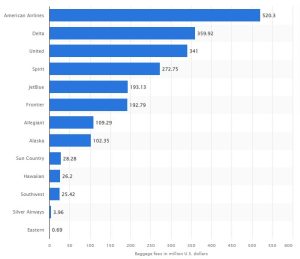
Airlines Baggage Fees 2021 (Source: Statista.com)

The three biggest carriers in the U.S. account for over 56% of the total amount corrected by all carriers. In fourth place, there is ultra-low-cost carrier Spirit Airlines whose business model heavily relies on ancillary revenues that account for almost 50% of the carrier’s revenue, according to CAPA.

Notably absent from the top positions of this list is Southwest Airlines, which is still refusing to charge baggage fees for the first two pieces of luggage, maintaining the policy that was common practice in the U.S. until the mid-2000s. In fact, the progenitor of all low-cost carriers, despite carrying 17.4% of domestic passengers in the U.S., only collects 1.2% of the total amount of baggage fees.

Vanni Gibertini

Vanni fell in love with commercial aviation during his undergraduate studies in Statistics at the University of Bologna, when he prepared his thesis on the effects of deregulation on the U.S. and European aviation markets. Then he pursued his passion further by obtaining a Master’s Degree in Air Transport Management at Cranfield University in the U.K. followed by holding several management positions at various start-up carriers in Europe (Jet2, SkyEurope, Silverjet). After moving to Canada, he was Business Development Manager for IATA for nine years before turning to his other passion: sports writing.

Cathay Pacific Increases Flight Frequencies Amid Surging Demand

A Cathay Pacific 777 lifts off from Dusseldorf, Germany. (Photo: AirlineGeeks | Fabian Behr)

Hongkongers have started dusting off their passports and returning to the skies again following the lifting of travel restrictions in September. In response to that surging demand, Cathay Pacific has increased flight frequencies across a wide variety of routes.

Earlier, the Hong Kong government scrapped hotel quarantine policies and implemented a so-called “0+3” model. Travelers coming from overseas need to take three days for self-monitoring for Covid-19 symptoms. During the self-monitoring period, travelers will be banned from entering restaurants and some other locations with crowds.

Taiwan is also carrying out a similar policy with travelers from North America and European countries, but the visitors need to take seven days of self-monitoring, a so-called “0+7” model.

Business travelers are not forecasted to come back to Hong Kong immediately, but Hongkongers have begun planning their long-awaited vacations. In Japan, one of the most popular destinations among travelers from Hong Kong, Cathay Pacific has increased frequencies to Tokyo’s Narita International Airport to 86 weekly and Osaka to 106 weekly in October.

The carrier is going further in adding almost 140,000 seats in November and December for those traveling to Japan. Flights between Hong Kong and Tokyo’s Haneda Airport will be resuming in November and Hong Kong to Sapporo will resume in December. Japan reopened its border and started welcoming international travelers on Oct. 11.

Meanwhile, the airline will add 31,500 seats in the coming two months to London. It is expected first class service will be resumed on CX251 and CX252 on Dec. 5 and Dec. 6. British Airways has also announced that it will resume London to Hong Kong services on Dec. 5. However, Virgin Atlantic has shocked the city and revealed that it will pull out of Hong Kong services as a result of the invasion of Ukraine.

Cathay Pacific also announced that passenger flights to Madrid; Milan; Dubai, United Arab Emirates; Kathmandu, Nepal and Bengaluru, India will be resumed. In the wake of surging demand, the airline is planning to hire 4,000 more employees.

In addition, Cathay Pacific revealed the travel figure for September, carrying 265,845 passengers, a slight increase compared to last month.

“Looking ahead, we remain focused on adding as many passengers flight as we can, and have already added more than 400 flights sectors in October to and from regional and long-haul destinations since the September announcements by the Government.” Ronald Lam, Chief Customer and Commercial Officer said.

Attracting Foreign Travelers

Despite the fact that the border of Hong Kong hasn’t fully opened, the Hong Kong government is trying to lure foreign travelers back by giving away 500,000 air tickets. Earlier, the IATA criticized Hong Kong’s travel restrictions will cost the city as an international aviation hub.

However, Hong Kong Express, Cathay Pacific’s subsidiary low-cost carrier, is facing a challenge after lifting the travel restrictions. The no-frills airline has canceled some scheduled flights after Jan. 15, a week ahead of the Lunar New Year holidays. According to local media, the airline has been facing staffing issues. The airline said it has reviewed its flight schedule in 2023 to provide passengers with a more transparent outlook.

“Customers are also eligible for full refunds if there are no other suitable options available,” Hong Kong Express’s spokeswoman said in a statement.

How South Africa’s CemAir is Preparing for Rapid Expansion

A CemAir CRJ-200 parked on the ramp. (Photo: CemAir)

CemAir — a South African privately-owned airline —  is looking to expand its operations by expanding its domestic capacity.

The airline is best known for its flights to smaller towns like the popular tourist spot of Plettenberg Bay and the iron ore mining hub of Sishen. However, the carrier is also looking beyond South Africa’s borders for new routes.

The International Air Services Council (IASC) — a council that was only recently reconvened after being vacant for a year and is now dealing with a massive backlog of applications by airlines — has granted CemAir seven weekly frequencies on the Johannesburg-Livingstone, Zambia route and four frequencies on the Johannesburg-Lilongwe, Malawi route.

In addition, CemAir has received additional three frequencies a week between Johannesburg and Accra, Ghana; Nairobi, Kenya; Pointe Noire and Brazzaville in Congo; Libreville, Gabon and Entebbe, Uganda.

Moreover, IASC also granted CemAir two frequencies a week on the Johannesburg-Kinshasa, Democratic Republic of the Congo and Johannesburg-Lubumbashi, Democratic Republic of the Congo routes, while one will be between Johannesburg and Freetown, Sierra Leone.

CemAir CEO, Miles van der Molen, while speaking to Travel News, said the outcome for a few of the routes applied for was still pending which include Johannesburg to Dar es Salaam, Tanzania; Johannesburg to Victoria Falls, and Harare, Zimbabwe.

Airline’s Fleet Expansion

According to Van der Molen, the airline would acquire more aircraft to cope with the need for increased capacity. CemAir had already committed to six 90-seat Bombardier CRJ-900 regional jets, which could be increased to 10 aircraft by the end of next year.

He also noted that, in addition to the regional routes, CemAir would add to its domestic operations. It will increase its Johannesburg-Cape Town, South Africa frequency and will soon start flights from Johannesburg to London.

The carrier had in late last month hinted that it was expecting a post-lockdown upset in South African aviation and had already begun to acquire more aircraft to plug the gap, which would ultimately be left by Comair’s demise.

“That’s where we see a lot of our capacity going moving forward,”  Van der Molen, told Business Insider SA of the airline’s expansion into the rest of Africa.

“We’re continually adding capacity [and] we’re growing quite quickly. Some of that capacity is deployed domestically, but we see that the domestic market, in time, when it fully recovers, will mostly need larger equipment [aircraft] for efficiencies and economies of scale… but the regional routes tend to be thin by nature, and the smaller aircraft we operate are practically the correct gauge for those routes,” Van de Molen added.

Headquartered at Johannesburg’s OR Tambo International Airport, CemAir increased its fleet size by more than 20% in the first half of the year. CemAir’s expansion plans were revealed in a government gazette published on Sept. 23.

CemAir’s operations outside of South Africa are currently limited to Luanda, Angola and Lusaka, Zambia. The airline also services Gaborone, Botswana and Maputo, Mozambique through codeshare agreements with other carriers.

It is unclear when these new routes will become operational, with the IASC hearing and deliberation just one step of many in the process of getting passengers in the sky. The longest of these processes is the diplomatic one, whereby governments of the countries where the airline plans to fly, need to approve the route.

Victor Shalton

Victor Shalton's love for aviation can be traced to when he was 11-years-old. As a seasoned aviation writer, he takes pride in providing the best aviation coverage around the globe and is passionate about advancing his skills in the aviation space. In addition, he loves travelling, writing, arts and while his speaking engagements have taken him around the world, he is proud to call Nairobi home.

Russian Aircraft Relics of Germany

IL62
DDR-SEG Preserved at Rhinow Stolln. (Photo: AirlineGeeks | Mark Evans)

Up until 1990 Germany was split into two nations. The capitalist west and the communist east. Sanctions placed upon the Soviet Union and satellite nations by the West, prevented East Germany from purchasing western aircraft. This meant that Russian aircraft were predominantly operated during the communist reign. 

Interflug was the national airline of East Germany, officially known as the German Democratic Republic. It was founded in 1955 as Deutsche Lufthansa and soon started flights to most European socialist capitals. In 1963 Deutsche Lufthansa was absorbed into Interflug and by the end was operating a large airliner fleet consisting of Ilyushin 18s, Ilyushin 62s, and Tupolev 134s. They also operated various other aircraft for agricultural, industrial and survey work as well as a flying school.

The East German airline had to endure significant problems during the 1970s and 80s. An energy crisis and rising fuel prices caused the airline to cease its domestic network, with the last domestic route flown in 1980. Its ageing fleet of Russian aircraft became expensive to operate. They used a lot more fuel than western jets and their engines didn’t meet new noise regulations in the west. This saw them paying increased landing fees or being banned from certain airports.

Once commercial airliners were made exempt from the trade embargo in 1988, Interflug quickly ordered three Airbus 310s with the first delivered in 1989. The western jets offered increased range over the IL62s allowing for direct flights to Cuba.

Unfortunately, the Berlin-based carrier didn’t have a chance to replace the other Russian aircraft. The German Democratic Republic was dissolved in October 1990 and became part of the Federal Republic of Germany. An agency was established to reprivatize East German enterprises. No investors could be found and the liquidation of Interflug was announced in February 1991, with the last flight in April.

Five of the IL18s were granted a second lease of life after a group of former Inteflug employees formed a Cargo airline called Berline. It was based out of Interflug’s former hub at Schonefeld Airport in Berlin but ceased operations in 1994.

The Airbus 310s were transferred to the German Air Force operating VIP flights for high-ranking German officials.


Several of the aircraft were preserved and remain at various airports and museums throughout the country.


IL18
DM-STA Preserved at Leipzig. (Photo: AirlineGeeks | Mark Evans)

DM-STA IL18  Deutsche Lufthansa colours – Preserved at Leipzig Airport.

DDR-STB IL18  Interflug colours – Preserved in Leipzig City Centre. Located on top of a building along Karl-Heine Strasse.

DDR-STE IL18  Interflug colours – Preserved at Borkheide Hans Grade Museum.

DDR-STG IL18  Interflug colours – Preserved at Erfurt Airport.

DDR-STH IL18  Interflug colours – Preserved Flugausstellung L & P 

T134
DDR-SCH Preserved at Finowfurt. (Photo: AirlineGeeks | Mark Evans)

Junior Museum, Hermeskiel.

DM-SEC   IL62  Interflug colours – Preserved at Luftfahrt Und Technik Museumspark,Merseburg Airport. Unfortunately, the museum has closed and the aircraft are for sale, so this aircraft is unlikely to stay there for long. Tupolev 134 DDR-SCZ was also there but appears to have been sold already. Currently unknown if it has a new location.

DDR-SEF  IL62  Interflug colors – Preserved at Leipzig City Centre as Restaurant Regenbogen.

DDR-SEG  IL62  Interflug colors – Preserved at Stolln / Rhinow airport.

DDR-SCB T134  Interflug colors – Preserved at Magdeburg Airport.

T134
DDR-SCL Preserved at Biberach. (Photo: AirlineGeeks | Mark Evans)

DDR-SCH T134  Interflug colors – Preserved at Finowfurt Aviation Museum.

DDR-SCK T134  Interflug colours – Preserved at Flugausstellung L & P Junior Museum, Hermeskiel.

DDR-SCL T134  Hydro Systems colors – Preserved at Hydro Systems, Biberach.


Germany has a rich heritage of preserving the history of aviation and many more aircraft can be found at various museums around the country. Several more Russian aircraft have been conserved at the following locations.


Auto Und Technik Museum, Sinsheim.

T144
CCCP-77112 Preserved at Sinsheim. (Photo: AirlineGeeks | Mark Evans)

A fantastic museum with many Aircraft Exhibits as well as other transports. They have spectacularly preserved a Tupolev 144 on top of their roof alongside a Concorde.

Russian Aircraft include:

CCCP-77112  Tupolev 144  Aeroflot colors.

HA-LBH  Tupolev 134  MALEV colors.

IL18
OK-PAI Preserved at Sinsheim. (Photo: AirlineGeeks | Mark Evans)

OK-PAI  Ilyushin 18  CSA colors.

0833  Ilyushin 14  Bulgarian Air Transport titles, but operated for the Polish Air Force.


Technikmuseum, Speyer.

Another large Museum with many Aircraft exhibits. Their main exhibit is the former Lufthansa B747-200 D-ABYM. Russian Aircraft include:

UR-64460  AN22  Antonov Design Bureau.

52+04  AN26  German Air Force.

Flugausstellung L & P Junior Museum, Hermeskiel.

In addition to the two Interflug aircraft mentioned above the museum has many other exhibits. Russian aircraft include:

HA-ANA  AN2  Hungarian Air Force.

52+08  AN26  German Air Force – Preserved Flugausstellung L & P Junior Museum, Hermeskiel.

3076  IL14  Polish Air Force.

The museum also has many interesting western types. Particularly a Vickers VC-10, G-ARVF painted in full United Arab Emirates Government colors.


Other Locations:

CCCP-65745 T134 basic Aeroflot colors, missing its tail – Preserved at Flugplatz Museum Cottbus.

RA-65117  T134  www.kunz.aero titles – Operated as an aircraft recovery systems testbed at Hahn Am See.

HA-LCB  T154  Flughafen Stuttgart titles – Preserved at Stuttgart airport and used as a fire trainer.


Mark Evans

Mark has been interested in aviation since the age of eight when he first went plane spotting at Manchester Airport, England. Trips around various European airports in the following years and then to the USA as a teenager furthered his desire. This led to Mark wanting to work in the industry and at the age of twenty one was accepted to train as an Air Traffic Controller. After training and working for several years in England, Mark moved to Bahrain in the Middle East where he worked for six years. He then moved to Sydney, Australia where he resides today after twenty years in the profession. Mark's pursuit to see planes has seen him visit over 140 countries and territories, including places, like North Korea, Sudan and Iran. He has flown over 1,100 times, visited over 700 airports and can always be found researching his next trip.

ITA Airways, One Year of Flight Operations

ITA A330
An ITA Airways Airbus A330-200 at Rome Fiumicino Airport. (Photo: ITA Airways)

ITA Airways, Italy’s national airline, was founded on June 29, 2020, by the government of President Giuseppe Conte, 100% public society (property of the Italian Ministry of Economy and Finance) with Francesco Caio as chairman and Fabio Lazzerini (former Alitalia manager) as CEO. 

October 14, 2021, marked the end of Alitalia’s (former Italy’s national airline) history after 74 years. The next day, on Oct. 15, 2021, the new Italian airline, ITA Airways, began flight operations when the first flight, (AZ 1637) from Milan Linate to Bari Palese landed at 7:35 a.m., with 60 passengers on board and the crew still in Alitalia uniforms.

From this flight started the story of the new Italian national airline, which, despite trying hard to proceed smoothly and break away from the “bad legacy” left by Alitalia, always seemed to be in trouble and is still struggling to “take off”. 

Alitalia brand was bought for 90 million from ITA Airways but never to be used and officially “to remove it from the market.” The new airline, however, had half of Alitalia’s old fleet, 52 planes, which will be gradually repainted blue, and less than half of its staff, 2,800 people.

ITA Airways officially joined the SkyTeam alliance (like Alitalia before) on October 29, 2021, and for the time being until December 31, 2022, it will belong to it.

Right from the start, the European Union’s Antitrust Authority imposed on ITA Airways the necessity of no continuity between Alitalia and the new Italian airline. This meant ITA Airways couldn’t buy from Alitalia the loyalty program “MilleMiglia” with more than 5 million members and the maintenance and handling branches. The Italian government tried to finance the new airline with €3 billion euros, but since the Antitrust Authority limited public financing, there was just a 1.35 billion euros financing for three years, €700 million in 2021, €400 million in 2022 and €250 million in 2023.

Due to the change of government in Italy from Giuseppe Conte to Mario Draghi, Alfredo Altavilla took over Francesco Caio as chairman of the airline. From the beginning, he did not get along very well with CEO Fabio Lazzerini and the first tensions began, which will never be resolved. 

In 2022, the first offers to privatize the airline arrived from different buyers. The first was from MSC and Lufthansa, and the Italian government had the option to remain a minority shareholder. Although everything seemed ready for sale, the American fund Certares and the airline Delta and Air France-KLM took over, making another offer and the first negotiation fell apart, proceeding to the latter. Meanwhile, more than half of ITA Airways’ board members resigned over disagreements with Chairman Altavilla.

Not Just Bad News

Early June 2022 saw the arrival of the first Airbus A350-900 for intercontinental routes to America, and ITA Airways was the first Italian airline to use this aircraft. As of October 14, 2022, there are 69 aircraft in the fleet, including the six new Airbus A350s, eight A330-200s, 31 A320ceos, and 18 A319ceos. New Airbus A220s will also be introduced in October. The first two, with the “Born To Be Sustainable” livery, made their first commercial flight on Sunday, October 16.

ITA Airways plans by 2026, a fleet of 80% new generation aircraft that will lead to an estimated 1.3 mln tons of CO2 emissions reduction over four years, from 2022 to 2026. Great news also from the new loyalty program, “Volare,” which has over 700,000 members and continues to grow.

It has been a year of great difficulty for ITA Airways, which, amid internal disagreements and external impositions, has had problems from the outset in operating and overcoming each new obstacle, also posed by restrictions due to the pandemic. Since the first day of flight operations, Italy’s flag carrier today has carried 9 million passengers, with an average of 95 travelers per flight. However, from October 2021 to June 2022, it recorded a daily loss of €1.6 million.

The privatization negotiations are very important and it is clear that time is now running out. The new government in Italy will finally give a future strategy for the Italian national airline that maybe seems destined to follow in the footsteps of Alitalia.

Vincenzo Claudio Piscopo

Vincenzo graduated in 2019 in Mechanical Engineering with an aeronautical curriculum, focusing his thesis on Human Factors in aircraft maintenance. In 2022 he pursued his master's degree in Aerospace Engineering at the University of Palermo, Italy. He combines his journalistic activities with his work as a Reliability Engineer at Zetalab.

Join Us at Wings Over Illawarra

Across the globe, AirlineGeeks and you – our community – are joined by one love: the love of flight. That love takes many forms, from airlines to aerobatics. For this reason, we are thrilled to announce we are sponsoring one of Australia’s largest air shows – the annual Wings Over Illawarra.

Why the hype? We want you to join us for this incredible event. As our second ever Australian sponsorship, we want to celebrate Australian aviation and this AirlineGeeks milestone with you.

For two days, Nov. 12 and 13, AirlineGeeks will be centered in the middle of the most diverse collection of vintage and modern aircraft in Australia, all within a one-and-a-half-hour drive south of Sydney. Located at Shellharbour Airport, we expect an incredible display of historical airliners, such as one of only two airworthy Super Constellations in the world, as well as many other flying and static displays from Australia’s Historical Aircraft Restoration Society.

Additionally, we anticipate intense aerobatics, historical formation flights, and fast flyovers from Australia’s newest F-35 Lightning II. For the AvGeek in need of their own flight, helicopter joy flights will also be available to take in the incredible coastline views and equally dramatic mountain ranges surrounding the airport.

Each day will include an action-packed program of aerial action, with a lineup of both civilian and military aircraft. The flying displays will include the RAAF’s Roulettes, an impeccably restored Lockheed C-121C Super Constellation (aka “Connie”), a classic Boeing Stearman biplane, as well as some of the most iconic warbirds of the Second World War, such as the Vought F4U Corsair, Supermarine Spitfire, and German Focke Wulf 190 – to name just a few.

A Supermarine Spitfire – one of many historical aircraft flying at this year’s Wings Over Illawarra. Photo: Justin McCoy

To complement this array of aircraft, we are excited to see the former record-setting English Electric Canberra – setting an altitude record of nearly 66,000 feet in 1955 – joined along with many more exhibits sure to satisfy the inner historian.

While there will be a certain focus on these incredible displays above, the static exhibits on the ground are also sure to excite. These displays are expected to comprise of HARS’ Boeing 747-400, Douglas DC-3 and DC-4, a General Dynamics F-111, and a true gem – a Consolidated PBY Catalina – as well as many others yet to be confirmed. For a small donation to the museum, guided tours of some of these aircraft are available.

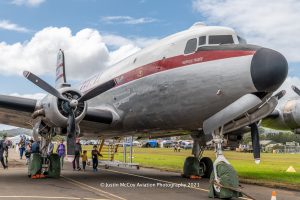
A Douglas DC-4 at Wings Over Illawarra. Photo: Justin McCoy

The exhibits and stalls extend beyond these aircraft, with different exhibitors through the differing precincts. For the reader eager to explore the prospect of becoming a pilot, advantage can be taken of the different flying schools in attendance, as well as gliding clubs and other aviation specialists. We also anticipate drone exhibits and stalls, each demonstrating the potential of unmanned aviation in the 21st century.

AirlineGeeks will be sharing photos, interviews and reviews with our audience, so be sure to tag us in your photos and get a ‘selfie’ with our banner!

With such an array of action and exhibits, we are excited for a fantastic weekend of planes, noise, and that intoxicating smell of jet fuel. If you can make it (we extend this invitation to those beyond Australia), we’d love your company as we lift our eyes ever upward and share in our true love – our love of flight.

Mike Mangano

Mike’s love affair with flight and mechanical objects in the sky began at an early age, fascinated by space documentaries and the vintage Flight Simulator ’95. He currently works as an instructor for UAVs and is training to receive his Private Pilot Licence with the goal of working in manned flight instruction. An avid reader of all things aviation and manned space flight, Mike stays close to developments in aerospace while reminiscing and sharing the rich history of flight with others. He loves writing, engineering and science.

FAA to Extend Flight Attendant Rest Period

Frontier Airlines cabin crew (photo Twitter @flyfrontier)

The Biden Administration is implementing 10-hour rest periods for U.S.-based cabin crew, in line with legislation passed by congress four years ago. This raises the rest period from 8 hours and brings flight attendant rest in line with that of flight deck crew.

Federal Aviation Administration Acting Administrator Billy Nolen said on Tuesday “I can tell you first-hand that well-rested crew members are important to safety… Flight attendants are the foundation of aviation’s safety culture starting with cabin safety.”

The pandemic has not been easy on the world’s cabin crews with rates of onboard disturbances spiking over the last few years, but the lifting of mask mandates seems to have lowered the number of instances it is still an omnipresent concern.

“As aviation’s first responders and last line of defense, it is critical that we are well-rested and ready to perform our duties,” Nelson said. “Covid has only exacerbated the safety gap with long duty days, short nights, and combative conditions on planes.”

The American airline industry is already incredibly short-staffed and there is no way to tell if this new legislation will have a greater effect on airlines timetables. With many flights being delayed on a daily basis this writer can only hope that the 10-hour rest period can entice more people to pursue a career as cabin crew and further strengthen the aviation industry. In any case this is an excellent step forward for the health and safety of air crew and, as an extension, the passengers.

The Federal Aviation Administration finalized the plan to require a 10-hour irreducible rest period. This law was passed in 2018 under the Trump Administration but was never enacted.

“Credit first and foremost goes to Flight Attendants on the frontlines who fought so hard for this moment and need this rest more than ever in the most difficult time” Sara Nelson, president of the Association of Flight Attendants-CWA said in a statement.

It is unclear how the additional 2 hours of rest will affect the already struggling airline industry in regards to scheduling but the health and safety of all crew, both in the cabin and on the flight deck, should never be downplayed as they are responsible for the safety of all passengers.

“Proper rest is critical for Flight Attendants to do our work as aviation’s first responders. Today was a long time coming, but it is here. We won’t forget how we achieved this major regulatory change for minimum rest. Flight Attendants need this rest to do our jobs. But ‘rest assured,’ we won’t ever rest in our work to ensure the continued safest transportation system in the world for all of the people within it.” Nelson concluded.

Federal Aviation Administration Restores Malaysia’s Category 1 Air Safety Rating

Malaysia Airlines' first A350-900XWB in Toulouse (Photo: Jujug Spotting)

After three years the Federal Aviation Administration (FAA) has restored Malaysia’s Category 1 Air Safety rating. This comes after in 2019 the FAA had dropped Malaysia’s rating to a Category 2 . The decision allows any Malaysian airline to restart service to the United States.

Prior to the pandemic, AirAsia was regularly flying to Hawaii and American Airlines and Malaysian Airlines had a codeshare agreement, both of which had to be discontinued after the rating was dropped.

Malaysian Transport Minister Datuk Seri Wee Ka Siong said “By mid-July this year the FAA returned for a reassessment and the [Civil Aviation Authority of Malaysia] had already completed all responses for the 29 findings and all corrective action plans were closed.” The restoration of the Category 1 rating means CAAM now falls in line with all International Civil Aviation Organization safety requirements.

Transport Minister Wee Ka Siong continued “With the return to Category 1, our airlines can now mount new flights to the U.S. and have code sharing with American carriers. There is no more barrier now, this is good news after the COVID-19 pandemic.”

Additionally, Riad Asmat, CEO of AirAsia Malaysia said that the restored rating was a “very good start.” and he hopes to expand further into the United States.

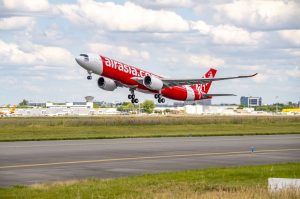
The first A330neo for AirAsia X (Photo: Airbus)

The Meaning of FAA Air Safety Ratings

What are the FAA’s Air Safety ratings and what do they mean? While all countries manage their own internal aviation programs the Federal Aviation Administration maintains an International Aviation Safety Assessment Program that assesses any country’s civil aviation authority if they wish to or already fly into the United States.

This program decides if the country is complying with International as well as U.S. standards. If a foreign CAA passes the assessment the FAA awards a Category 1 rating and that nation’s airlines may start or expand service within the United States.

If the Foreign CAA does not meet the criteria of the IASA inspection, then the country is awarded a Category 2 rating. Air carriers from category 2 countries are restricted from beginning or expanding service in the U.S. and they are not allowed to participate in code-sharing agreements with U.S.-based carriers.

Currently, there are eighty-three countries that have gone through the assessment program and only six countries failed (Bangladesh, Mexico, Pakistan, Russia, Thailand and Venezuela as of July 15, 2022).

Overall Malaysia made impressive changes to its Civil Aviation sector over the last three years and should be applauded for the efforts they have made towards creating a safe travel experience for all passengers and it did during a global shutdown.

A statement from Malaysia Aviation Group (MAG) offered support for CAAM and its efforts. “MAG is pleased to be able to support CAAM by being part of a Task Force that was formed to identify root causes, corrective action plans, and corrective measures in response to the downgrade in 2019.”MAG is confident that CAAM under the leadership of Captain Chester Voon and the rest of the management team, will be able to make significant contributions to the development of civil aviation’s safety and security in Malaysia.”

South African Airways Adds Fleet Capacity As Demand Rises

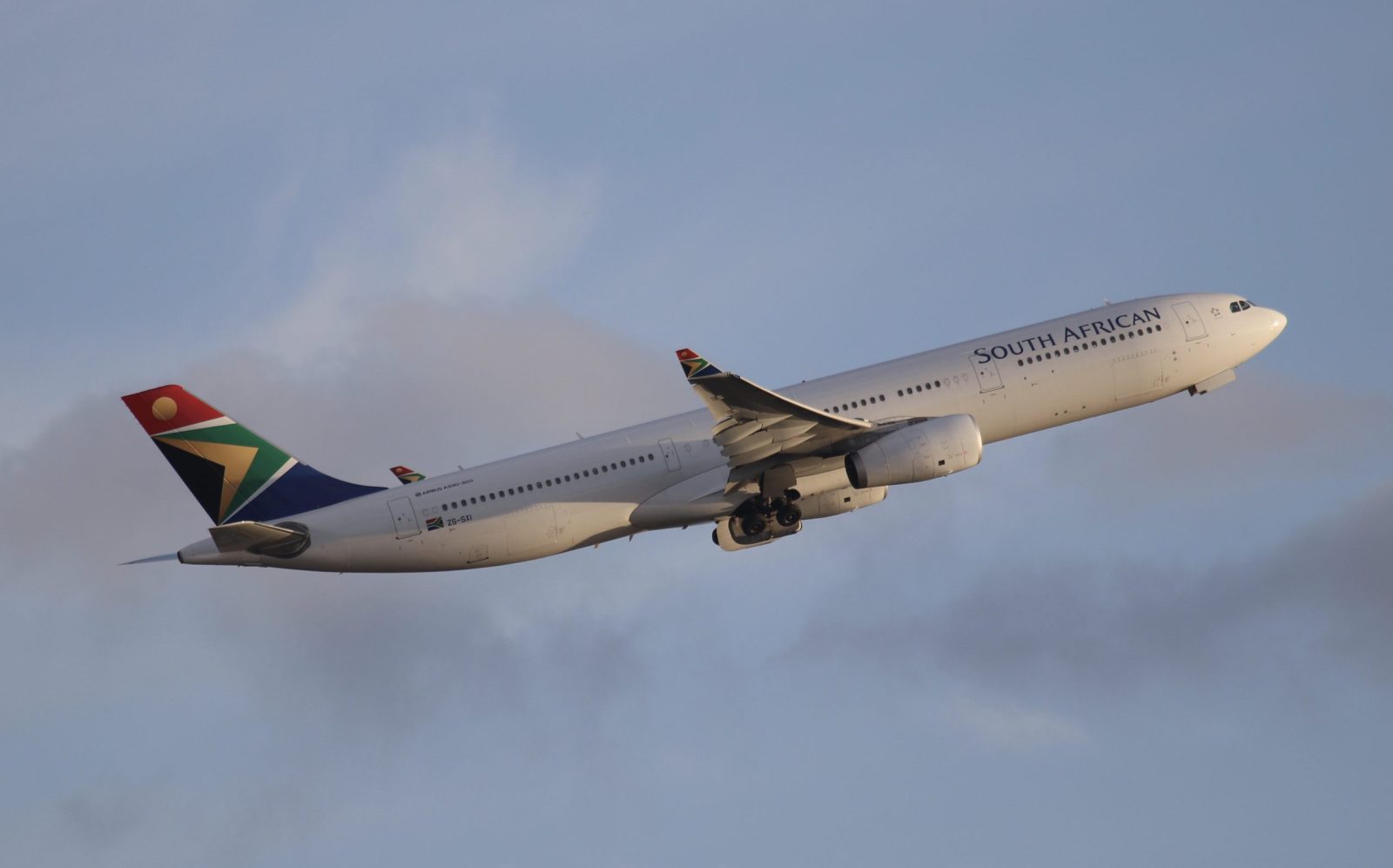
A South African A330 taking off. (Photo: AirlineGeeks | James Dinsdale)

South African Airways is to add a further three Airbus A320 aircraft to its fleet as operations continue to ramp up after the pandemic. The carrier restarted a significantly restricted schedule in September 2021 after the airline was grounded for 18 months from March 2020. Three Airbus A320 aircraft will all be in operation by the end of the calendar year in time for the South African summer holiday season.

The airline has been operating six regional and three domestic routes with two Airbus A320s, three Airbus A319s, an Airbus A330-300 and an Airbus A340-300. Demand has grown for its domestic services from Johannesburg to Harare, Zimbabwe and Cape Town, South Africa. The airline now operates the A330 on three of its weekly frequencies between Johannesburg and Harare, Zimbabwe.

SAA Chief Commercial Officer Tebogo Tsimane also noted, “SAA is replacing its A340-300 with a similar capacity aircraft and will exit the A319 fleet in 2023. As we increase fleet size to match the needs of the growing network schedule, we are encouraged that our strategy to cautiously re-enter markets abandoned due to the Covid pandemic has served us very well during the past twelve months, and we will continue to follow that cautious risk-adjusted trajectory.”

SAA has been the subject of intense scrutiny in recent years with significant losses prior to Covid-19 and a government-supported sale of a share of the airline. The Takatso Consortium was named as the ‘strategic equity partner’ (SEP) for SAA with a 51 percent controlling share and this transition is expected to be concluded by the end of March 2023.

The airline recently issued a statement reassuring customers that it would not be losing route rights after receipt of a letter in August from the Air Services Licensing Council (ASLC).  The letter from the ASLC cited a few possible breaches of the Air Services Licensing Act No 115 of 1990 and directed SAA to provide certain information to afford the Council an opportunity to ascertain SAA’s compliance and/or non-compliance with the Act.

In reassuring customers, the airline divulged that the matters raised in the letter from the ASLC were ‘of an administrative nature relating to the SEP transaction that is currently being negotiated by the Government, as the shareholder as well as issues relating to SAA’s interaction with the ASLC, the submission of financial statements and internal staff movement.’

In acknowledging the one-year anniversary of the restart of SAA operations the Chairman of the Interim Board and CEO Professor John Lamola stated, “It has been a challenging but stimulating 12 months. We have been inspired by the fact that SAA has successfully been flying the national flag for 88 years surviving formidable historical turbulences, both economic and political.  Thus we are firmly focused on rebuilding this airline and making South Africans proud.”

John Flett

John has always had a passion for aviation and through a career with Air New Zealand has gained a strong understanding of aviation operations and the strategic nature of the industry. During his career with the airline, John held multiple leadership roles and was involved in projects such as the introduction of both the 777-200 and -300 type aircraft and the development of the IFE for the 777-300. He was also part of a small team who created and published the internal communications magazines for Air New Zealand’s pilots, cabin crew and ground staff balancing a mix of corporate and social content. John is educated to postgraduate level achieving a masters degree with Distinction in Airline and Airport Management. John has held the positions of course director of an undergraduate commercial pilot training programme at a leading London university. In addition he is contracted as an external instructor for IATA (International Air Transport Association) and has been a member of the Heathrow Community Fund’s ‘Communities for Tomorrow’ panel.

Nigeria’s Newest Low-cost Carrier Launches Operations

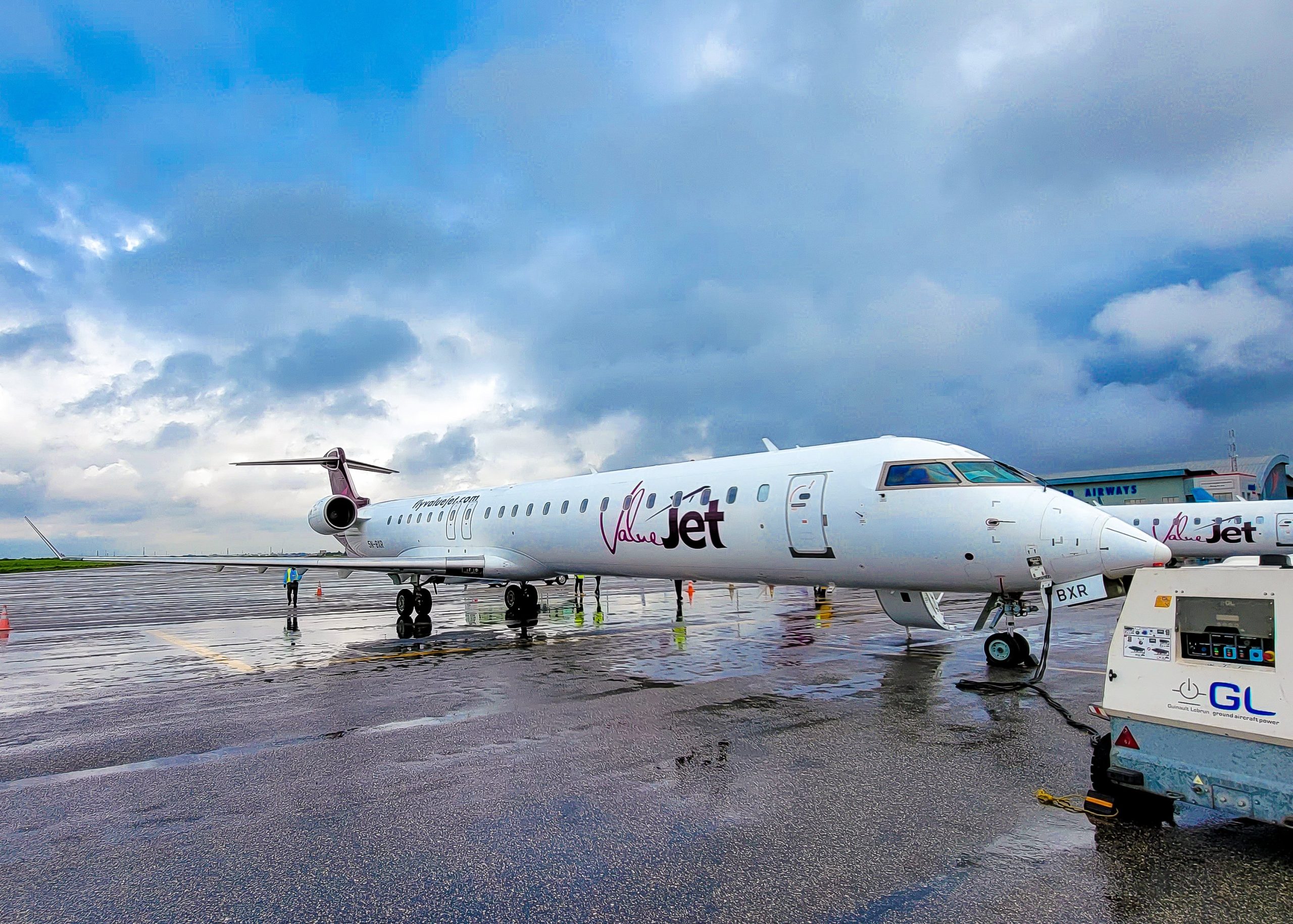
ValueJet's third CRJ900 registered 5N-BXR from Lufthansa sits on ramp following the conclusion of its demo flights (Photo: ValueJet)
Earlier this week, Nigerian startup ValueJet operated its first flight, marking the start of its commercial operations after receiving its Air Operator Certificate (AOC) from the Nigerian Civil Aviation Authority (NCAA) a little less than one month ago. The inaugural flight took off from Lagos, Nigeria’s Murtala Muhammed International Airport, en route to cities across Nigeria including Abuja, Port Harcourt, Jos and Asaba.
ValueJet was founded in 2018 with the vision of connecting people and places using modern-day air travel. Although founded during a difficult time in the aviation industry, ValueJet looks to hit the ground running with twice-daily flights between Lagos and Abuja, daily flights to Port Harcourt, and three-times weekly flights to Asaba and Jos. Flights will be all around an hour to an hour and thirty minutes. Eventually, the carrier will operate flights from Lagos to Benin, Togo; Yola, Nigeria and Kano, Nigeria.

ValueJet’s Initial Schedule

Flight Origin Destination Departure Arrival
VK200 Lagos Abuja 06:45 08:00
VK201 Abuja Lagos 08:45 09:55
VK214 Lagos Abuja 15:20 16:35
VK215 Abuja Lagos 17:15 18:30
VK222 Lagos Port Harcourt 10:35 11:45
VK223 Port Harcourt Lagos 12:25 1:35
VK230 Lagos Asaba 08:00 09:00
VK231 Asaba Lagos 09:30 10:40
The Nigerian carrier will utilize its fleet of three Bombardier CRJ-900 (5N-BXS, 5N-BXT and 5N-BXR) aircraft with an average fleet age of 15.8 years. Two of the aircraft were previously owned by Air Nostrum, a regional carrier headquartered in Valencia, Spain with one coming from Lufthansa.
Each aircraft is configured to seat 90 passengers. Labeling itself as a hybrid carrier, guests will have the option to choose between three packages; ValueLite, ValueXtra and ValuePremium.
ValueLite is the cheapest option of the three allows guests up to one carry-on item weighing under 15 lbs, with no checked bag included. ValueXtra gives customers more flexibility when booking a flight. Customers can personalize their package, with options that include a flexible ticket, airport lounge access and a larger checked bag allowance.
Value Premium customers are granted the full package, a true legacy experience. Guests having purchased this option will have priority boarding, deplaning, and check-in. They will be given a flexible ticket, premium inflight services, exclusive seating, 15 lbs hand luggage and airport lounge access. None of the packages include a checked bag without an additional cost.
The carrier’s primary goal is to make air travel affordable to the people of Nigeria.
“ValueJet’s vision is ambitious. We see a world where everybody can fly. Our aim is to add value from the very first flight once we are set for business operations,” stated Temitope Ajijola, ValueJet’s Head of Business. “Currently, only about 5% of Nigeria’s population can afford a flight ticket, according to available statistics, and ValueJet is looking to increase this number significantly through creative fare pricing.”
ValueJet has a respectable business model with a fairly common goal — to make travel cheaper. It will be interesting to see if the carrier has found a niche that brings about success. The carrier’s closest competitors include Max Air, Peace Air and Arik Air.

Chase Hagl

Chase Hagl grew up in Twin Falls, Idaho. His love and passion for Aviation landed him in Orem, Utah where he obtained a B.S. in Aviation Management with a minor in Business Management from Utah Valley University. Chase currently works as a flight attendant in Charleston, SC and is also the primary Inflight ASAP ERC representative for startup airline, Breeze Airways. His experience in the aviation industry spans back four years, working in areas including agriculture application, customer service, maintenance, and flight ops. In his free time, Chase enjoys road biking, astronomy, and flying.
Sign-up for newsletters & special offers!

Get the latest stories & special offers delivered directly to your inbox

SUBSCRIBE

Uh-oh! It looks like you're using an ad blocker.

Our website relies on ads to provide free content and sustain our operations. By turning off your ad blocker, you help support us and ensure we can continue offering valuable content without any cost to you.

We truly appreciate your understanding and support. Thank you for considering disabling your ad blocker for this website