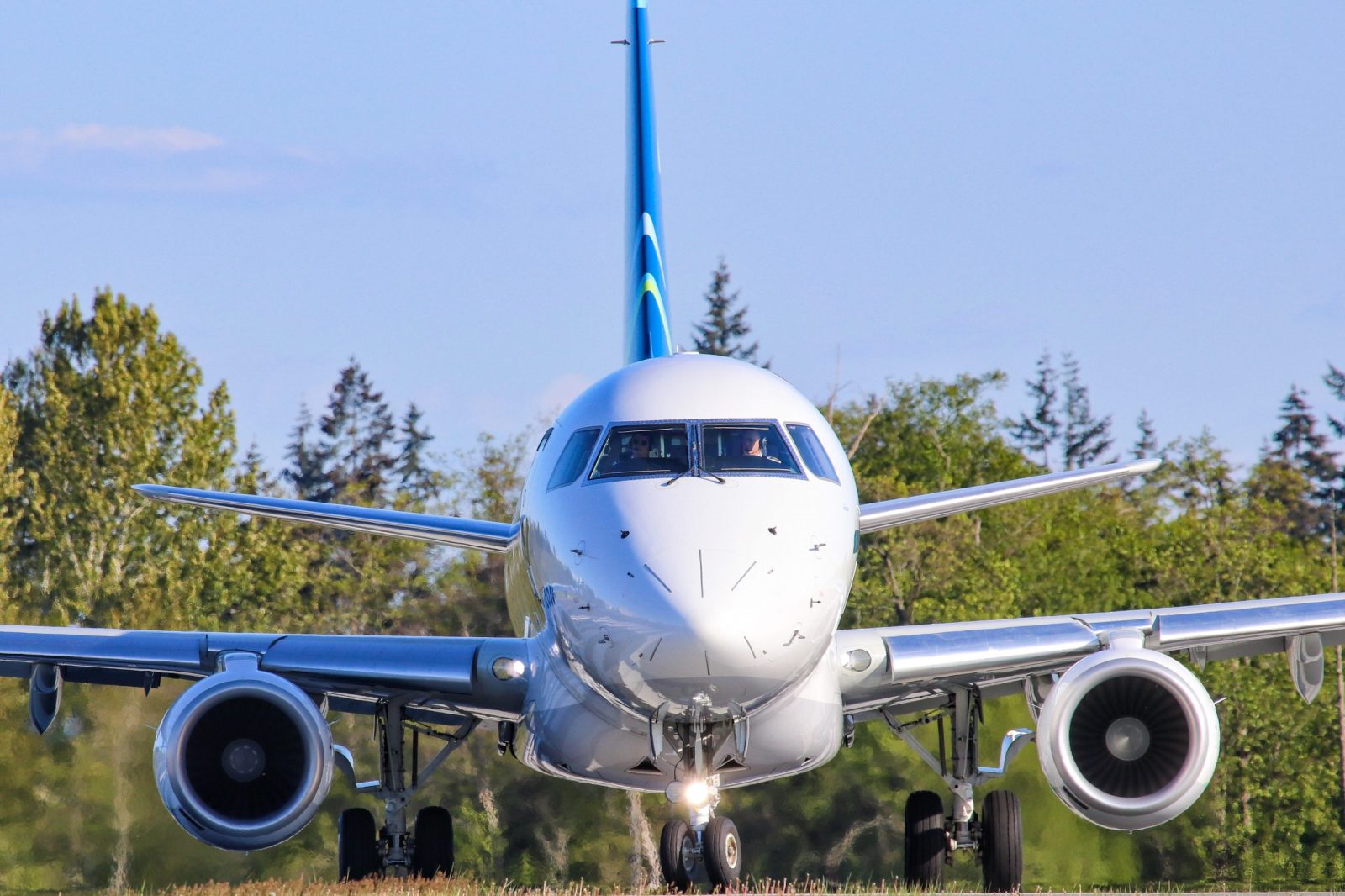
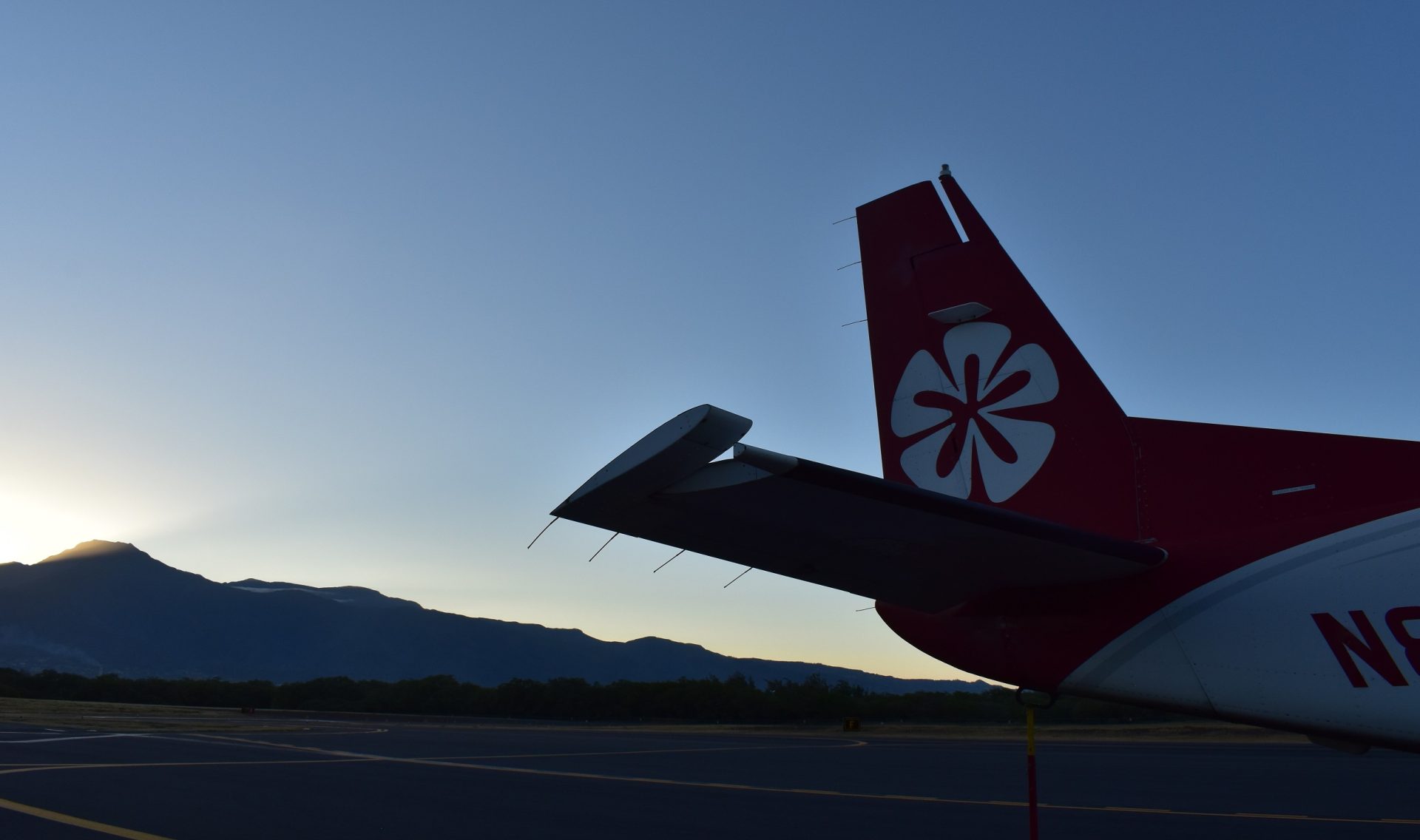
An Air China 737 MAX 8 (Photo: AirlineGeeks | Katie Bailey)
On October 12, Singapore Airlines announced that the carrier will resume another service to China, in the city of Xiamen, flight number SQ868/SQ869. After the resumption of this flight, Singapore Airlines Group, which includes Singapore Airlines, Silk Air, and Scoot Air, will provide as many as 14 weekly flights between Singapore and China. Chinese authorities are releasing the controls on international flights, and such action has attracted dozens of carriers to resume and open new routes in and out of China.
In May, China reduced the mandatory quarantine period from 14+ days to 7 days. Since Aug, the Chinese authority changed the fusing mechanism for international flights, from the original absolute confirmed Covid-19 cases to a percentage of all passengers on a flight. The change significantly reduced the likelihood of a flight reaching the limit of triggering the fusing. Authorities also canceled the limitations of the “one country one flight” policy, welcoming more carriers and more international flights coming back to China. Although the total number of flights between China and another country is still controlled, the limitation has been significantly lifted compared to previous practices.
In September, a number of international flights from China to Asia and Europe resumed operations. Emirates started its third and fourth operations between Dubai and Guangzhou; Japan Airlines and ANA announced multiple flights connecting Japan and Beijing, Shenyang, and Dalian, China. Moreover, Chinese carriers resumed flights to Central Asia, Europe, and more destinations as well.
Such rapid recovery quickly drove down the prices of flights in and out of China. Originally well over $5,000 one way ticket from Europe to China is now sometimes less than $1,000. The expanded passenger volume also drove the Covid-19 test price down. In October, the Helsinki Airport Covid-19 testing agency announced that it will reduce the price from 500EURO per test to 280EURO per test for transit passengers. Lowered prices are certainly an upside for passengers, however, the cost to quarantine after arriving in China is still largely the same.
As Hong Kong is releasing travel restrictions for international travelers, passengers are routing through Hong Kong to travel to China’s Mainland. Flights from Hong Kong to the Mainland has increased from a dozen flight a week to now well over 100 flights a week. However, traveling from Hong Kong to Mainland China will add a 3-day self-health monitor in Hong Kong before boarding a flight to the Mainland.
The future opportunities for China to further release travel restriction is still unclear at this moment. The Chinese government is not hinting at any further actions or timetable for entirely removing all Covid-19 travel restrictions, and the authorities are still fixated on the failing Zero-Covid policy. Multiple foreign missions and international corporations have urged Chinese authorities to cancel the international flight fusing mechanisms, as well as the mandatory quarantine.
As the Chinese economy is sliding towards a recession with each day the Zero-Covid policy is in place, the authority may slightly release the restrictions to stimulate business activities.
Lei is from Inner Mongolia, China, and now lives in Guangzhou. He grew up in an aviation family, where his passion began. During his time at Penn State University, he studied Industrial Engineering specializing in operations research, and he graduated with an honor’s thesis on airport gate assignment optimization. Now, he is a Purchasing Manager with Procter & Gamble. In his free time, he enjoys flying, reading, and wandering around the city.
This Week in Sustainable Flying: Delta and American Make Moves
It has been a busy week in the world of sustainable aviation. Delta Air Lines made its first investment in the air taxi sector, while American Airlines added hydrogen to its portfolio.
Delta, Joby Aviation Partner
Delta announced an equity investment in Joby of $60 million, with a total investment of up to $200 million possible as the startup achieves further milestones. The partnership also includes the eVTOL company operating air taxi services from Los Angeles and New York on behalf of the Atlanta-based airline after certification.
The deal is a first-of-its-kind arrangement. Instead of buying and taking ownership of new airplanes, Delta will take on Joby as a partner. The Santa Cruz, Calif.-based company will operate flights on Delta’s behalf while the airline integrates the service into its network. The startup secured its part 135 operating certificate earlier this year and planned to use a Cirrus aircraft to refine systems and procedures before launching the eVTOL service.
Initially, the eVTOL company targeted a 2024 launch date. However, during the latest interview, the CEO refused to commit to a new launch date. The lack of commitment is not surprising, given the public consensus of technology immaturity and the company’s crash in February 2022. Although it suffered a total loss of its test aircraft, the company is still one of the most mature programs, with more than 1,000 test flights completed.
The attitude is refreshing compared to the rest of the industry, where every company tries to commit to aggressive schedules. In addition, its test program also displayed great caution since it has been operating the airplane remotely. While the eventual goal is to fly autonomously, the company plans to have piloted flights at launch.
This partnership also leaves Wisk Aero the only company without a major airline partner. Despite securing funding from Boeing, Wisk has yet to disclose airplane orders or investments from airlines. It is also the only eVTOL company pursuing autonomous flying right off the bat, which could have played a factor.
Delta is the last of the U.S. 3 to invest in this segment. In comparison, American placed an order for 250 Vertical VX4 in July 2021, while United holds two orders from Archer Aviation and EVE Air Mobility dating back to February 2021. The Atlanta-based didn’t jump on the supersonic hype train either, which made this partnership more of a vote of confidence in the air taxi business model.
American Airlines Makes Investment in Universal Hydrogen
On October 10, 2022, American Airlines announced its strategic equity investment in Universal Hydrogen. This investment makes American the first U.S. airline to make two direct investments focused on developing hydrogen-electric propulsion technology and the future of hydrogen distribution logistics.
Universal Hydrogen’s fuel distribution network uses modular hydrogen capsules like cargo, eliminating the need for new fueling infrastructure at airports and speeding up fuel-loading operations. Although the clean-energy company is working on its own hydrogen conversion kit, the American deal mainly focuses on its fuel distribution network. The Dallas-based airline holds an order of 100 hydrogen engines from ZeroAvia.
Fangzhong grew up near an OEM airport in northeastern China, where he developed his enthusiasm for aviation. Taking upon his passion, he's now working as an aircraft interior design engineer. Besides working in the aerospace industry, Fangzhong enjoys trying out different types of airplanes and seeing how airplane interiors have evolved. So far, he's flown on over 80 types of aircraft. He also planespots in his spare time. His rarest catches included the 747 Shuttle Carrier Aircraft and AN-225.
LATAM Airlines Secures Financing and Expects to Exit Chapter 11 by Early November
LATAM Airlines Group informed through an Essential Fact filed with the Chilean Financial Market Commission (CMF) that, together with Professional Airline Services Inc. (a wholly owned subsidiary of LATAM), it priced an offering of US$450 million aggregate principal amount of senior secured notes due 2027 and US$700,000,000 aggregate principal amount of senior secured notes due 2029.
In addition, the Company priced a US$1.1 billion Term Financing with an interest rate at LATAM’s choice of ABR + 8.50% or Adjusted Term SOFR + 9.50% (after Chapter 11 exit – and prior to the effective date, ABR + 8.75% or Adjusted Term SOFR + 9.75%).
This represents an important milestone for the Company, and one of the latest in its Chapter 11 process. With these new funds, LATAM will have obtained the necessary financing to repay its existing debtor-in-possession financing currently contemplated to emerge from Chapter 11 of the U.S. Bankruptcy Code (“Chapter 11”) during the first week of November.
The Company has also obtained a new revolving credit facility (“RCF”) in the amount of approximately US$500 million.
“In a very challenging and dynamic context, we are on track to close the entire financing required under the Company’s Plan of Reorganization. In the coming weeks we expect to emerge from the Chapter 11 process with US$2.2 billion of liquidity and a debt reduction of approximately 35% versus what we had before entering this process,” said LATAM CEO Roberto Alvo.
Last June, the Company informed the CMF of the Chapter 11 exit financing structure, which contemplated the incurrence of new debt of up to US$2.25 billion, including the Bonds and a Term Financing, in addition to a new US$500 million revolving credit facility (the “DTE Financing”). The Notes were originally structured as Bridge Loans for an aggregate amount of US$1.5 billion committed by various banks.
On September, LATAM presented an updated business plan, which reported an improvement in its cost structure. The group updated its cost savings estimate from US$900 million to more than US$1 billion annually. At the same time, the group implemented structural transformations: among others, it is renegotiating its fleet, improving its relative costs, strengthening its network, and reducing its debt by approximately 36% compared to pre-pandemic levels.
Also, the plan foresees that by the end of 2022 demand in the subsidiaries’ domestic markets will have recovered to 2019 levels. In relation to international traffic, LATAM estimates that the recovery will be slower, reaching 2019 levels by mid-2023. The airline notes that its international operations accounted for approximately 45% of 2019 revenues. Finally, regarding income, the plan aims for the group to surpass 2019 levels only in 2024, when it estimates profits close to US$11.5 billion.
Boeing shows off first 737 MAX 7 at Renton facility (Photo: AirlineGeeks | Chuyi Chuang)
In late September Boeing disclosed that the company’s intention was to get an extension to the December 31, 2022 deadline, when a new law would prevent it from certifying the -7 and -10 variants of the 737 MAX without the incorporation of an integrated warning system that would have enormous consequences for operators and potential customers of the variants.
On January 1, 2023, the Aircraft Certification, Safety and Accountability Act (ACSAA), which tightened aircraft certification conditions following the controversy that opened regarding the FAA’s lax controls over the review and approval process for obtaining the type certificate, will go into effect.
The ACSAA states that any aircraft certified on or after Jan. 1, 2023, must comply with the current regulation on crew warning systems. Boeing created and installed a system called EICAS: Engine Indicating and Crew Alerting System. Airbus has its own, called ECAM (Electronic Centralized Aircraft Monitor).
Both systems are central to the operation, since they provide real-time information on the aircraft’s status and trigger alerts that can lead to the automatic execution of checklists and suggest actions to be taken, thus relieving the crew’s burden. Incorporating such systems implies additional training, something that destroys the 737 MAX’s main sales argument: the seamless -and therefore economical- transition from the Next Generation to the new models.
As reported by David Shepardson for Reuters, the manufacturer’s pressure is not bearing fruit: the latest version of the defense budget bill contains no amendments to address the ACSAA deadline extension.
While, says Shepardson, there are other instances in which such an amendment could be added, the chances are reduced, and the timeline is shortening. With no technical possibility of certifying the planes before the middle of next year, Boeing is depending on either an extension of the deadline to submit the planes as-is or to start incorporating the EICAS system and break the transparent transition chain by incorporating specific training on this new flight system.
Southwest, one of Boeing’s major customers and one of the most tenacious in calling for such a transition without additional training, had said last week that it supported the manufacturer’s idea of not incorporating EICAS because it would create a “difference in the cockpit experience” that would be detrimental to crews. Two different sets of rules for the variants could increase confusion during critical phases of flight.
With approximately 1,000 orders pending for the -7 and -10 variants, Boeing is playing an especially important card in getting the certification deadline extended under current conditions. It is probably one of those times when the future of an aerospace company is not played out at a design table, but at a desk far away from the factory.
Vietnamese carrier Bamboo Airways has received an Airbus A321neo ACF, with the next-generation aircraft becoming the 30th to join Bamboo’s fleet.
The A321neo is the longest-fuselage member of Airbus’s single-aisle A320 family. Bamboo has reduced its seating configuration density from 240 to 223, consisting of eight business class and 215 economy class seats, giving passengers more legroom. The aircraft has a maximum capacity of 244 seats and a standard seat width of 18 inches.
Bamboo Airways was found in 2017 and currently operates the domestic network to 21 out of 22 airports in the country. The A321NEO has played a key role in the airline, operating domestic and international routes, especially mid-range international routes.
Bamboo Airways officially operates the maximum fleet approved by the government, with three wide-body airplanes from Boeing 787-9 Dreamliner, 22 narrow-body aircraft from Airbus A321neo, Airbus A320neo, Airbus A319 and five regional jets from Embraer E190. Bamboo is the first carrier to operate the E190.
“Expanding the fleet scale is among our priority targets to serve a vigorously expanding international flight network to countries in Europe, Australia, Northeast Asia and the U.S.” Nguyen Ngoc Trong, Chairman of Bamboo Airways’ Board of Director said.
Bamboo is determined to improve its service and meet the travel demand, aiming to own a fleet of 42 aircraft by 2023. The airline believes the aviation industry is strongly recovering from the pandemic. In the long term, the airline pursues a goal of owning 100 aircraft by 2030 if conditions allow. Bamboo aims at operating 40 international routes and 80 domestic in 2022.
Expanding Its Route Map
In response to the increasing travel demand after the pandemic, the airline has been focusing on developing long-haul and Asian routes. Earlier, the airline has announced the route between Ho Chi Minh City, Vietnam to U.K’s London’s Gatwick Airport will be launched on Dec. 7. The new weekly service will be operated by Boeing 787-9 Dreamliner with three classes, including business class, premium economy and economy.
“With this new route operating ahead of Christmas and New Year 2023, Bamboo Airways hopes to meet the high travel demands of Vietnamese communities in the U.K. wishing to come back home for a holiday.” Thach Pierre Hoang, Acting Chief Commercial Officer of the airline said.
“It is fantastic news that Bamboo Airways is already expanding its operation from Gatwick, ahead of its inaugural flight.” Stephanie Wear, VP of Aviation Development of Gatwick Airport said.
Bamboo is set to launch the route between Hanoi, Vietnam and Gatwick on Oct. 30. The Ho Chi Minh City –London Gatwick is expected to complement the upcoming route Hanoi – London Gatwick. In addition, the carrier has started U.K. services earlier this year, the flight between Hanoi and London’s Heathrow Airport was launched in March.
A Horizon Air Embraer E175 at Paine Field. [AirlineGeeks - Katie Zera]
Embraer announced on October 10 that the Brazilian Development Bank (BNDES) approved financing for the export of six Embraer E175 commercial jets to the north American regional carrier SkyWest Airlines, Inc. (SkyWest). With the new financing facility, the number of aircraft acquired or to be acquired by SkyWest with BNDES financing totals 200 units
The financing, in the order of R$670 million -US 128,450 million-, will be through BNDES Exim Post-shipment, with disbursements made in Brazil’s local currency in favor of Embraer. SkyWest (importer) will assume the commitment to pay in dollars to BNDES, generating foreign currency for Brazil.
Brazilian BNDES is a key instrument for Embraer: it has helped finance sales globally, securing orders for continental and transcontinental customers such as Argentina’s Austral Lineas Aéreas, which acquired 24 E190 in April 2010.
The Embraer E175 is a well-known workhorse of the US regional market: limited by the Scope Clause, the E175’s maximum take-off weight and seating configuration makes it the perfect aircraft to serve as a feeder for larger carriers, surpassing the original E170 design. As the latest Scope Clause negotiations have not changed limits, the Brazilian manufacturer suspended the development of its natural successor, the E175-E2. Although is considered a three-year pause, it is unlikely that the variant will ever get to production, as the new generation aircraft will soon take over the construction lines.
A customer of BNDES since 1998, and of Embraer since 1986, SkyWest operates the world’s largest fleet of the E175 jet consisting of 232 E175 aircraft. BNDES, since 1998, has provided ten different financing facilities to SkyWest covering up to two hundred aircraft, comprised of eighteen delivered EMB120 aircraft, 175 delivered E175 and 7 to be delivered E175 aircraft.
This is the second financing tranche with BNDES for the sale of Embraer aircraft exports to SkyWest Airlines using the innovative Aircraft Financing Insurance Consortium (AFIC) offering from Marsh, the world’s leading insurance broker and risk advisor. The first financing was executed in December 2020 in amount of R$ 400 million, or US 77 million.
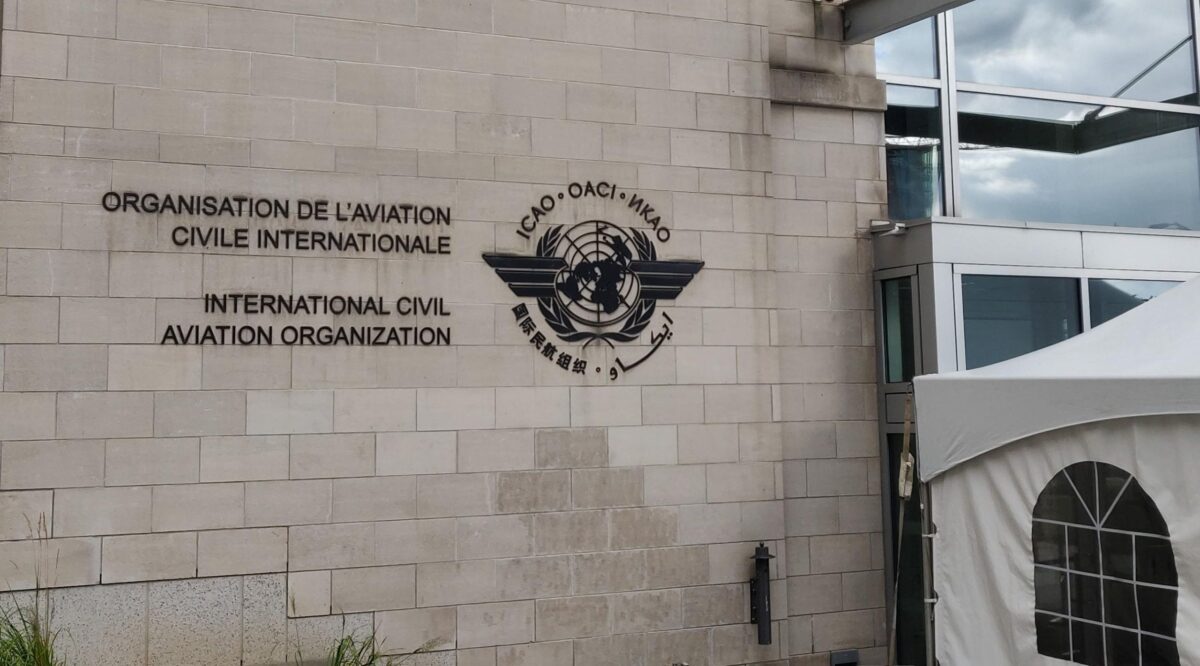
ICAO Headquarters in Montreal (Photo: Vanni Gibertini)
At its global headquarters in Montreal, Canada, the International Civil Aviation Organization (ICAO) has just concluded its 41st Assembly, a global event that every three years gathers all Member States to decide the way forward for all global items involving commercial aviation.
For two weeks approximately 2,500 delegates and observers from 184 countries have participated in assembly meetings and working groups to set the path for the next three years as civil aviation embarks on its most important challenge so far. After years of talks and despite the skepticism of some countries such as Russia and China, the ICAO Assembly has adopted a new Long Term Aspirational Goal (LTAG) to reach net-zero carbon emissions by 2050.
The same target had been agreed upon by the airlines of the International Air Transport Association during the 2021 Annual General Meeting in Boston, with some major players in the market committing to even more ambitious targets in the meantime.
“The significance of the LTAG agreement cannot be underestimated. The aviation industry’s commitment to achieve net zero CO2 emissions by 2050 requires supportive government policies. Now that governments and industry are both focused on net zero by 2050, we expect much stronger policy initiatives in key areas of decarbonization such as incentivizing the production capacity of Sustainable Aviation Fuels (SAF). And the global determination to decarbonize aviation that underpins this agreement must follow the delegates home and lead to practical policy actions enabling all states to support the industry in the rapid progress that it is determined to make,” said Willie Walsh, IATA’s Director General in a press release.
This goal is intended to combine the effect of carbon dioxide emission reduction, and the increased production and deployment of Sustainable Aviation Fuels (SAF). Those fuels are supposed to progressively replace fossil fuels and since most of them are plant-based and are cultivated on non-arable lands unsuitable for the production of food for human consumption, they produce a CO2 credit through photosynthesis during the first part of their lifecycle that goes to offset the emissions they produce when they are used as fuel for jet engines.
It is estimated that 65% of the mitigation needed to achieve the LTAG of net-zero emission by 2050 will come from Sustainable Aviation Fuels.
“States’ adoption of this new long-term goal for decarbonized air transport, following the similar commitments from industry groups, will contribute importantly to the green innovation and implementation momentum which must be accelerated over the coming decades to ultimately achieve emissions-free powered flight,” stressed the President of the ICAO Council Mr. Salvatore Sciacchitano.
“Countries have achieved some tremendous and very important diplomatic progress at this event, and on topics of crucial importance to the future sustainability of our planet and the air transport system which serves and connects its populations,” commented ICAO Secretary General Juan Carlos Salazar.
New Baseline Agreed for CORSIA
Another important environmental development achieved by the 41st ICAO Assembly has been the reaffirmation of CORSIA (Carbon Offsetting and Reduction Scheme for International Aviation) as the only benchmark to evaluate carbon emissions on behalf of the States and, most importantly for airlines, “the only economic measure to manage the footprint of international aviation”, said IATA Director General Willie Walsh.
As some countries have decided to independently introduce environmental taxes and financial penalties for more polluting airlines, the aviation community has been trying to fight against a scenario where a patchwork of local, narrow-focused initiatives would create a complex and expensive reality that would hamper the success of a fundamental global initiative like “net-zero 2050”.
A new target has been established at 85% of 2019 levels of CO2 emissions: this is supposed to be the new sustainable threshold that the aviation industry will have to reach and maintain in order to do its part in the fight against global warming.
Russia Ousted from the ICAO Council
During the first sessions of the Assembly, for the first time in the 75-year-long history of the ICAO a country was excluded by the ICAO Council, the internal organism in charge of running the organization, through a vote by the other State Members. Russia was voted out on Oct. 1, and after an initial refusal by the Russian delegation to accept the result, the decision was confirmed and ratified by all the present countries.
The attitude towards Russia was very tense from the very beginning: during the opening session of the Assembly, Canadian Minister of Foreign Affairs Melanie Joly was very critical of the behavior of Russia after its invasion of Ukraine, especially with regard to the unlawful nationalization of hundreds of jets leased by Western companies to Russian airlines after economic sanctions issued by the E.U. and the U.S.A. The move that is costing billions of dollars to the leasing companies involved is a flagrant violation of the Chicago Convention that ICAO is bound to protect and enforce, and therefore the measure taken against Russia can be seen as a consequence of these violations.
Vanni fell in love with commercial aviation during his undergraduate studies in Statistics at the University of Bologna, when he prepared his thesis on the effects of deregulation on the U.S. and European aviation markets. Then he pursued his passion further by obtaining a Master’s Degree in Air Transport Management at Cranfield University in the U.K. followed by holding several management positions at various start-up carriers in Europe (Jet2, SkyEurope, Silverjet). After moving to Canada, he was Business Development Manager for IATA for nine years before turning to his other passion: sports writing.
KLM Talks of Fleet Renewal as Alternative to Schiphol Airport Contraction Plan
A KLM 787-9 parked on the tarmac in Las Vegas. (Photo: AirlineGeeks | Terrill Murriel)
KLM Royal Dutch Airlines has put forward the renewal of its fleet with more economical latest generation aircraft as alternatives to the Dutch government’s green policy plans to cap capacity at Amsterdam Schiphol, arguing that fleet renewal would be a better option for reducing noise and carbon emissions.
Based at Amsterdam-Schiphol airport, the Dutch national airline last week reiterated its position on the government’s decision to continue to cap the number of departing passengers, a cap that could potentially cut the number of flight movements at the airport from 500,000 to 440,000 annually by the end of 2023 for five years while developing a new system of environmental standards. The lawmakers also proposed switching flights from Schiphol to Lelystad to safeguard route networks.
In a press release dated Oct. 6, the carrier argued that reduced airport capacity would benefit neither travelers nor the broader route network nor the Netherlands in general.
“Moreover, it restricts the earning capacity of airlines wanting to invest in sustainability. Fleet renewal offers a better alternative than capacity reduction. It will ensure a greater reduction in noise and emissions and allow travelers to keep flying. This will enable us to strike a better balance in the interests of Schiphol, the environment, the surrounding community, and travelers. We would like to discuss this alternative with the Dutch government,” the airline said.
“I share the cabinet’s aim of striking a balance between the interests of a good airport, the surrounding community, and the environment,” elaborated KLM CEO Marjan Rintel.
“To this, I want to add the interests of travelers. The cabinet’s current solution is to strike a better balance by reducing operational capacity at Schiphol. Calculations show that fleet renewal is a better alternative for reducing noise and CO2 emissions. This implies that it is a better solution for all. This is the issue I would like to address with the government.”
KLM could potentially drop up to 30 destinations from its network if the Dutch government proceeds with its plans to impose the “green cap” limiting movements at Amsterdam Schiphol (AMS) to minimize noise pollution and CO2 emissions.
The NL Times, for example, cites a possible scenario of 25 European destinations removed by the SkyTeam alliance member, in addition to five on the long haul These capacity limitations could affect “travelers going to cities such as Kyiv, Porto, Belgrade, Montreal, Boston, Taipei or Osaka”.
According to the airline, the cap does not reflect KLM’s fleet-renewal plans, which include the incorporation of less noisy and more efficient aircraft. If these are taken into account, Schiphol could operate 500,000 movements annually with less noise pollution than the government’s 440,000-movement cap. KLM urged the lawmakers to re-run their calculations regarding Schiphol noise based on this data, rather than fleet details from 2018.
Speaking at the Aviation Festival in Amsterdam, KLM CEO Marjan Rintel acknowledged that a proposal has been submitted to the government regarding the cap. She gave few details but said that KLM hopes to retain the current 500,000-movement cap and meet the government’s sustainability objectives through fleet renewal, rather than traffic limits.
Victor Shalton's love for aviation can be traced to when he was 11-years-old. As a seasoned aviation writer, he takes pride in providing the best aviation coverage around the globe and is passionate about advancing his skills in the aviation space. In addition, he loves travelling, writing, arts and while his speaking engagements have taken him around the world, he is proud to call Nairobi home.
My aircraft in Hana, Hawaii (Photo: AirlineGeeks | Joey Gerardi)
If you have read my articles in the past, then you know I love out-of-the-way airports, airlines, and aircraft. I would do almost anything to explore a new city or fly on a unique, rare aircraft type. So in the second article in my series, which I call “EAS Adventures”, I will start the trip at a larger airline hub, fly out to an Essential Air Service community and return to the same airport I started at, usually on the same aircraft that brought me there. What is the point of this you ask, if you have some time to kill at a hub during a long layover or if your flight gets delayed excessively, try venturing out to an EAS airport and seeing somewhere new during the downtime.
All locations in this article are located in the state of Hawaii.
Overview
For this EAS Adventure, I will be starting at Hawaii’s second busiest airport, Kahului International on the island of Maui, and flying to the EAS community of Hana which is also located on Maui. Hana is the smallest of three commercial airports located on the island of Maui, with Kahului Intl. being the largest, and Kapalua on the west end being the second biggest. I will be flying this adventure on Mokulele Airlines, whose flights are now operated by Southern Airways Express, on an 8-seat Cessna 208B Grand Caravan.
I started my day in Honolulu in the early morning flying a Unique Connection Series trip report through the EAS community of Kalaupapa on the island of Moloka’i, the trip report of which can be found HERE. Then I took a flight from Moloka’i to Kahului, followed by my flights out to Waimea and back which were the fourth and fifth flights of the day, the article of which can be found HERE. My flights out to Hana and back will be my sixth and seventh flights of the day, the most flights I had ever taken on commercial aircraft in a single calendar day, that record of which I have broken since that trip. Hana will also be the third EAS airport I will have been to in a single calendar day, another record that I have broken since that trip took place.
The ‘Road to Hana’ is a popular tourist attraction, and is a winding switchback road between Kahului and Hana, GoogleMaps says the drive is only two hours long, but locals have told me it usually takes five-to-six hours depending on how fast someone is driving. The flight to Hana only takes 10-minutes, so while you don’t get to drive along the switchbacks, you can spend your time enjoying Hana to the fullest and make a day trip. Or, if you are an AvGeek like me, just fly there and back in less than an hour for fun.
Just like most EAS communities, they receive two round-trip flights a day under the government-funded EAS program with Southern Airways Express, but they operate the Hawaii flights under the Mokulele Airlines banner and brand.
Day of the flight
As mentioned previously, these flights to Hana are my sixth and seventh of the day and I had already been to the counter at Kahului previously so they knew I was coming. For people who aren’t coming off other Mokulele flights, it is recommended you arrive at least an hour prior to your departure time. Even though I did come off another Mokulele flight, they did ask about my body weight again so they could seat me properly and safely in the correct row as they use smaller aircraft that are more affected by weight.
The Mokulele Airlines counter at Kahului Intl. (Photo: AirlineGeeks | Joey Gerardi)
After getting off my flight from Waimea my connection time was roughly three hours, which I spent plane spotting on a small hill adjacent to the commuter terminal.
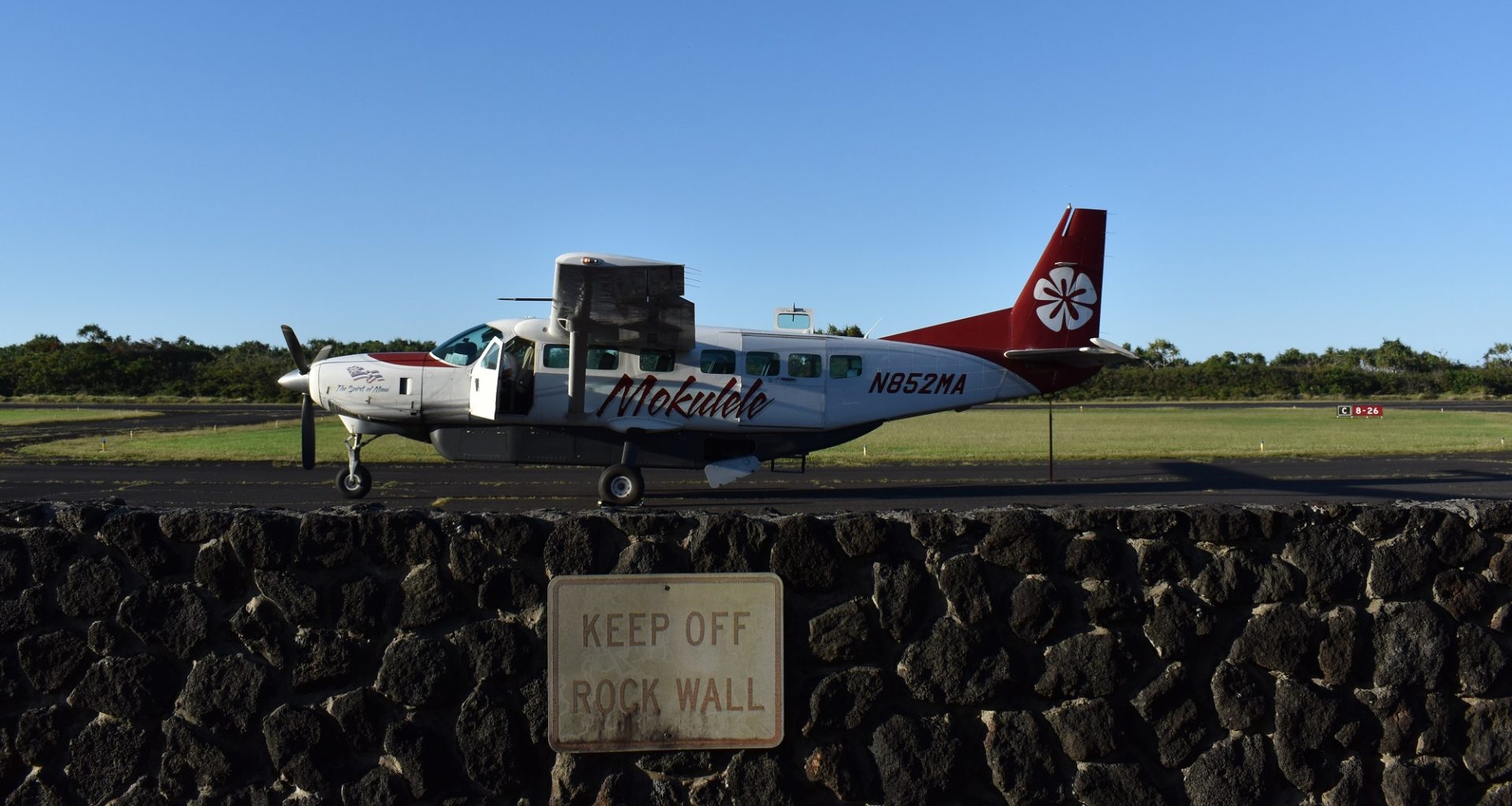
The aircraft that would take me to Hana and back is an 8-seat Cessna 208B Grand Caravan that carries the registration of N852MA, the same tail number that carried me on my first two flights of the day through Kalaupapa, and is only fitting that the same tail number finishes out my day with the airline.
Going to Hana you’ll want to pick a seat on the right side of the aircraft as you will be flying along the north side of the island and is best for the views. With only three of us going to Hana, everyone chose a seat on the right, as when they assigned seats they only told us what row you need to sit in and you can choose which side.
Startup and taxi out to the runway and takeoff were simple as the Mokulele flights use the smaller runway which is located adjacent to the commuter terminal. Not even a minute after takeoff and we had already reached our cruising altitude of 500 feet, a nice cruising altitude to see the sights on this short flight to Hana.
Just after taking off from Kahului Intl. (Photo: AirlineGeeks | Joey Gerardi)
Not much to explain as it was such a short flight, they had a magazine and route map but I spent my time looking outside at the views.
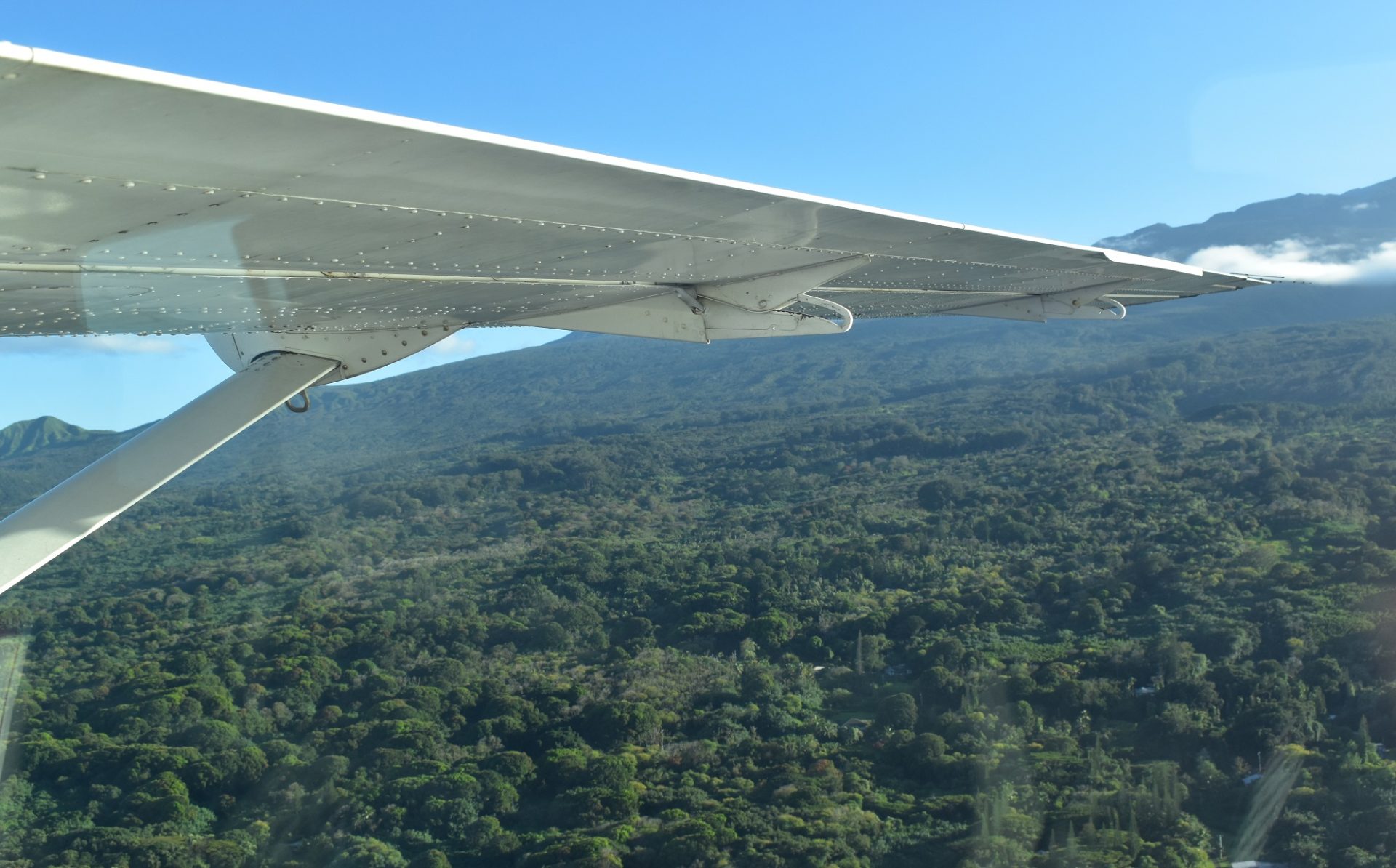
En-route to Hana (Photo: AirlineGeeks | Joey Gerardi)
As it was getting to be evening the sun was a bit of an obstacle in terms of pictures, but despite that, even a bad picture is a good picture considering how close we were to the ground.
Looking towards the west out of the aircraft window (Photo: AirlineGeeks | Joey Gerardi)
The larger windows of the Cessna 208 make this plane perfect for sightseeing no matter where you are in the cabin.
Flying towards Hana (Photo: AirlineGeeks | Joey Gerardi)
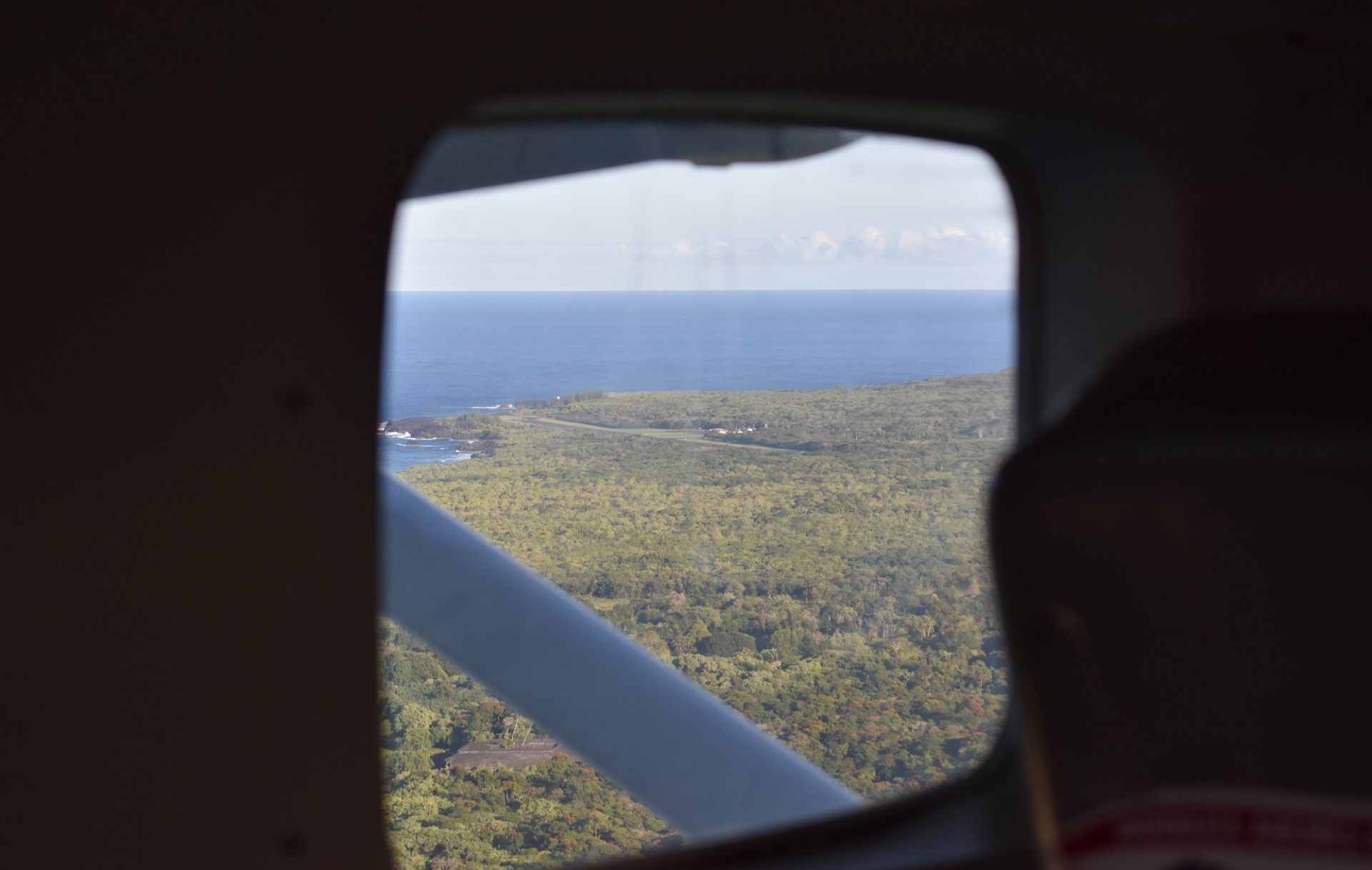
it wasn’t long before I could see the small airport out of the left side of the aircraft, and we had begun our quick descent into Hana.
Hana Airport, out of the left side of the plane (Photo: AirlineGeeks | Joey Gerardi)
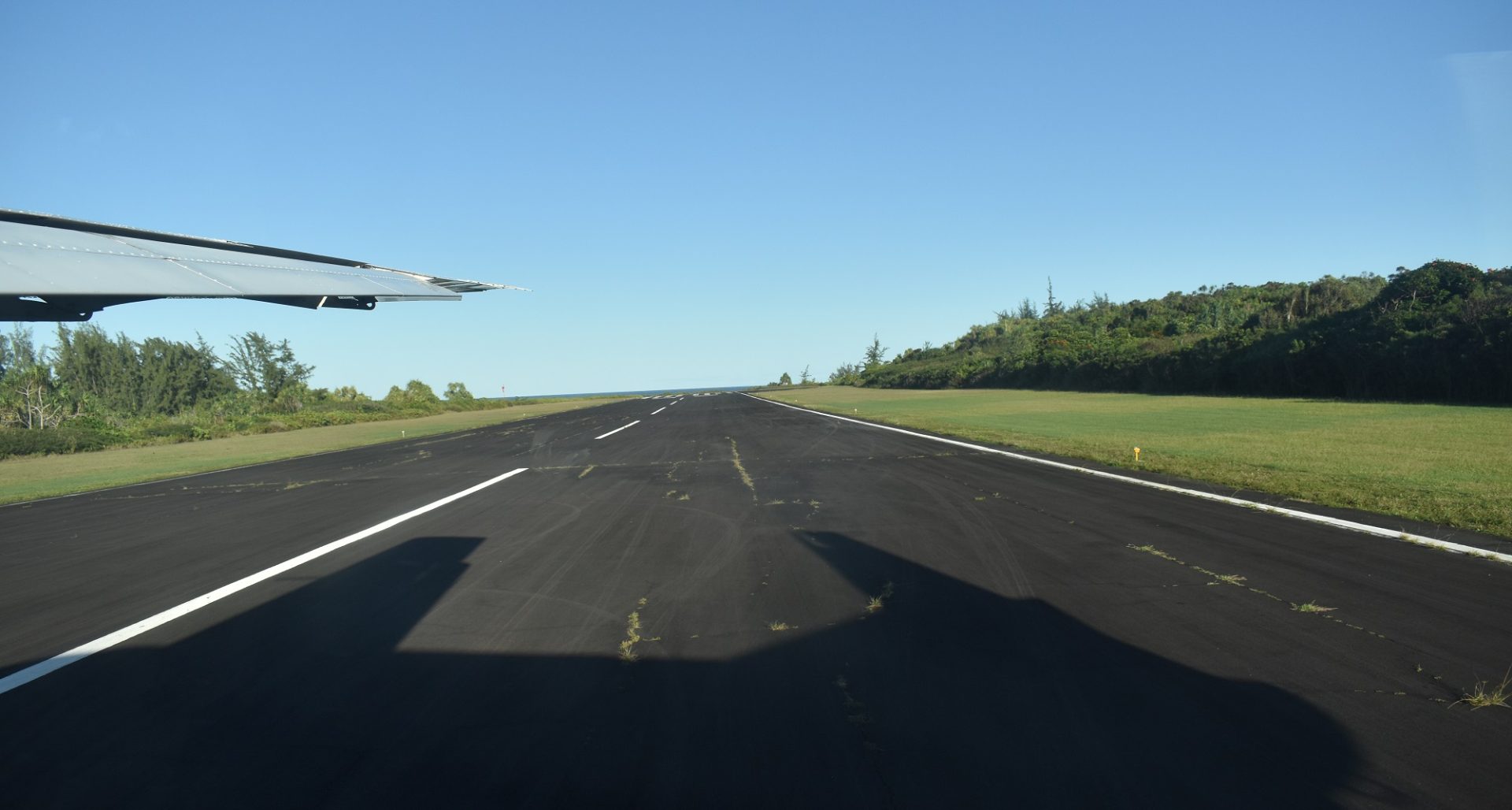
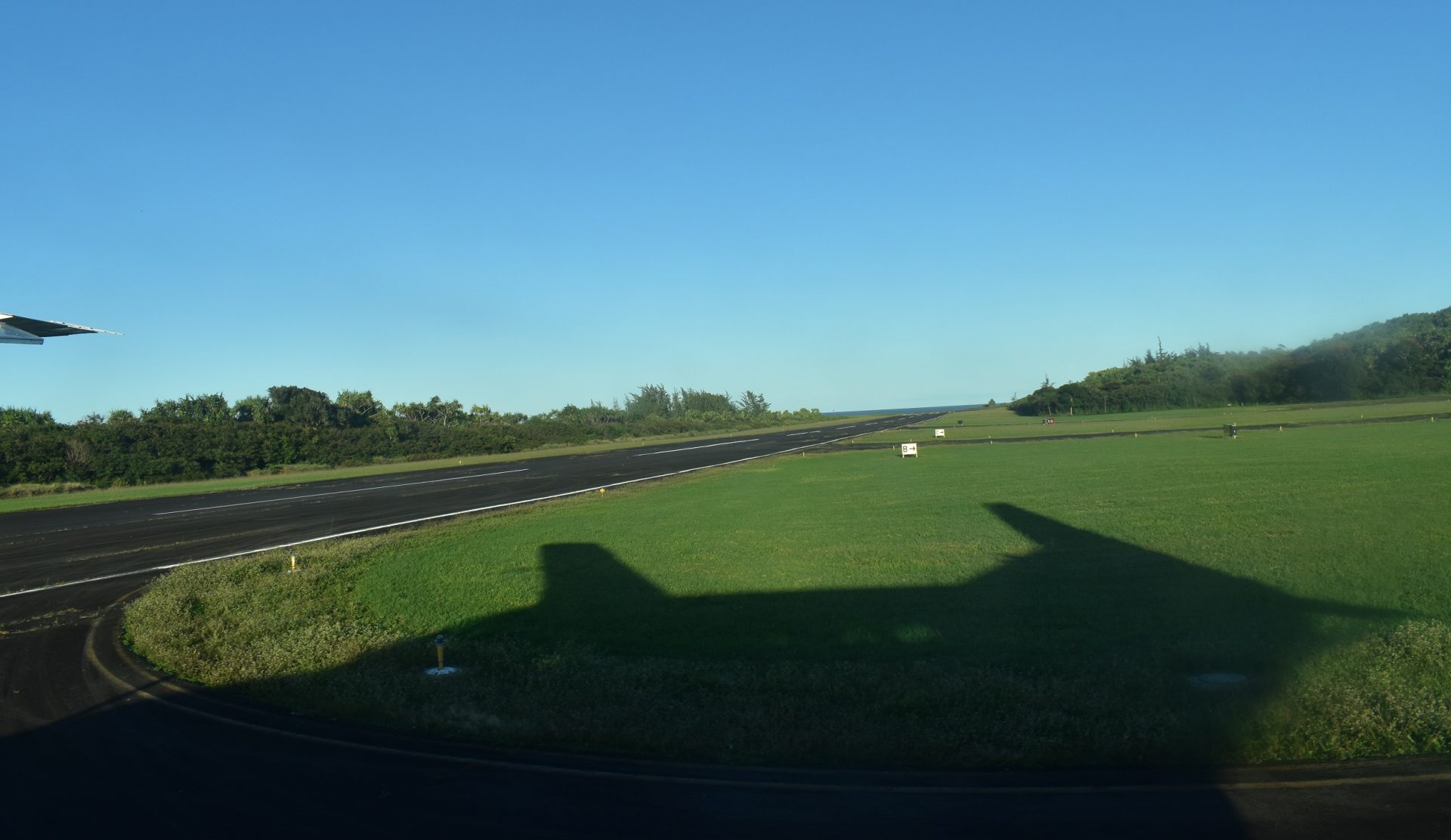
We touched down in Hana at 5:26 P.M. local time, after a short 11-minute flight, we then turned around and backtracked on the runway to the small terminal.
Turning around on the runway to backtrack (Photo: AirlineGeeks | Joey Gerardi)
As there is no TSA, the next group of passengers was waiting along the wall that was next to the small terminal building. Similar to Kalaupapa, the pilots act as customer service agents here in Hana.
This was the 39th EAS Airport I have visited, and the 3rd in the state of Hawaii with me now having visited all of them in this state. Just like every EAS airport I have seen, the terminal has its own unique flare, and here in Hana, it fits perfectly into the lush background scenery.
The small terminal building in Hana (Photo: AirlineGeeks | Joey Gerardi)
The wall next to the terminal is made from Lava Rocks from right in the Hawaiian Islands, another feature adding to the unique aspect of this airport. Within the building contains bathrooms, a water fountain, and a small check-in desk, but the pilots couldn’t find the key for it on their giant key ring so it was never opened.
Looking towards the plane and the Lava Rocks (Photo: AirlineGeeks | Joey Gerardi)
This is an important part, when flying on Mokulele or any small airline for that matter, make sure to talk to the pilots about which route the flight will be taking to your destination so you can select the side for prime viewing opportunities. Almost every single time the flight back to Kahului from Hana will take the north route, but today was a VERY rare treat, as we flew the longer way back to Kahului, flying around the south side. I talked with the other four passengers on the flight, most of them have taken the flight many many times before, and they told me they have never flown around the south end of the island and I was very lucky to be getting this chance.
Taxiing back out to the runway (Photo: AirlineGeeks | Joey Gerardi)
99.9% of the time when they take the north route back to Kahului the left seat is best for the flight. But due to the very rare route we were taking, I sat on the right side for this flight. Most of the other passengers rushed on and choose left seats as they thought we’d be taking the normal route back, so it is always best to ask about the route before assuming.
Just after taking off from Hana (Photo: AirlineGeeks | Joey Gerardi)
The cruising altitude for the flight back was 950 feet, higher than the first flight but still low enough to see the detail of the land below us. We also flew along the shoreline, but slightly over the water so the shore was visible for the entire flight back.
Flying along the shoreline south of Hana (Photo: AirlineGeeks | Joey Gerardi)
This is another great example of how Mokulele Airlines’ flights are not only meant to get you places, but they are great for sightseeing as well. The Haleakalā Observatory was visible to passengers facing the island for almost the entire way around, including on the flight there and back. It was such a fun aspect, seeing the white observatory peak from almost every aspect of the flight since I left Kahului.
The Haleakalā Observatory (Photo: AirlineGeeks | Joey Gerardi)
As we got closer to Kahului the land did change to a brownish-black color as we flew over the lava runoff area, a nice thing to see up close but even more fascinating seeing the expanse of the runoff from above.
Lava Runoff area (Photo: AirlineGeeks | Joey Gerardi)
Before we knew it, the land changed back to lush green and we slowly began to make our descent into Kahului
The landscape changes back to green (Photo: AirlineGeeks | Joey Gerardi)
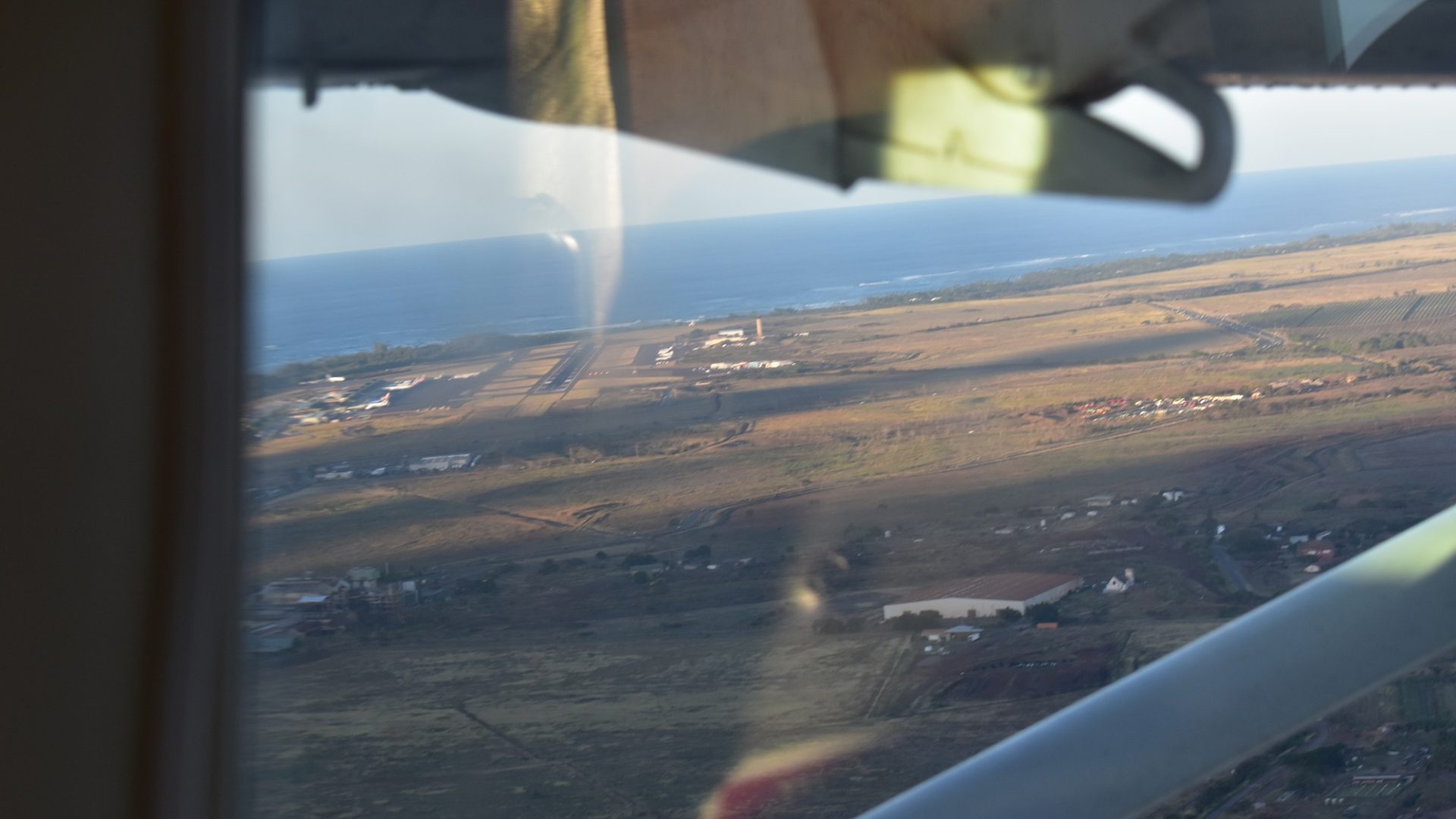
We could see the runway out of the right side as we turned onto final, and we touched down on the runway at 6:05 P.M. local time.
Kahului Intl. out of the right side, just before landing (Photo: AirlineGeeks | Joey Gerardi)
The flight back to Kahului took 20-minutes, almost double the flight there, but it was completely worth the extra time getting to fly around the entire east end of Maui.
Getting off the plane back at Kahului Intl. (Photo: AirlineGeeks | Joey Gerardi)
We took off from Kahului at 5:15 and got back to the same place at 6:05, meaning from the time we left Kahului, until the time we got back it was only roughly 50-minutes. It is just another EAS Adventure that is definitely worth your time if you have a rather long layover at Kahului Intl. or need an AvGeeky activity to do. Plus, we took the long way back to Kahului, meaning most flights out to Hana and back will take less time. The pictures just don’t do the beauty of the flight justice and are truly a sight to behold flying so low along the shores of Hawaii.
It was a fun little adventure, and despite the fact I didn’t leave the airport grounds in Hana I still got to see some amazing sights along the way especially with the south route returning. EAS flights, and especially those in smaller unpressurized aircraft like these, offer some amazing sightseeing opportunities along the way to your destination. So next time you have extra time at the airport or if your flight gets delayed by a couple of hours at a hub, look for an EAS adventure, you may just like what you see.
A video account of my trip to Hana can be found below
Joey has always been interested in planes for as long as he can remember. He grew up in Central New York during the early 2000s when US Airways Express turboprops ruled the skies. Being from a non-aviation family made it harder for him to be around planes and would only spend about three hours a month at the airport. He was so excited when he could drive by himself, the first thing he did with his driver's license was get ice cream and go plane spotting for the entire day. He graduated from Western Michigan University in 2022 with a B.S. in Aviation Management & Operations and a Minor in Business, and currently works for a major airline in his hometown.
Airbus Forecasts Commercial Aircraft Services Market Double in Value by 2041
JetBlue's Airspace by Airbus main cabin interior on its Airbus A321LR aircraft, featuring wider seats, more legroom and features tailored to the traveler (Photo: Business Wire)
Airbus believes the market for civil aviation-related services will return to pre-pandemic levels in 2023, before doubling in value over the next 20 years.
Airbus is the world’s leading civil aircraft manufacturer as of 2019 by the number of aircraft deliveries, recently concluded summer 2022 season, with 479 aircraft orders so far. The largest number of orders came from the Chinese market, with nearly 300 orders from the country’s three largest carriers; Air China, China Southern, and China Eastern. The manufacturer managed to deliver 145 aircraft in the summer period.
According to the latest Global Services Forecast (GSF) dated Oct. 6, 2022, Airbus expects to grow from the current $95 billion to more than $230 billion in 2041. As a result, the number of people working in aviation services, which keep the world’s fleets in the air, will have to increase by another two million to compensate for the increase in demand. As Airbus itself states, “It takes millions of people to keep you flying.”
In 2022 alone, more than 11 million skilled people worked to keep more than 23,500 planes flying (passenger planes with more than 100 seats and cargo planes with a payload of more than 10 tons).
The GSF report states that passengers have shown in 2022, after two years of restrictions due to the pandemic, that they really want to fly again and return to pre-COVID levels. There was and there is an urgent need for services related to civil aviation, to meet the demand of the 3.3 billion passengers expected until the end of 2022, an increase of 43 percent over the number of travelers in 2021.
According to the report, there were 22,880 aircraft in service at the beginning of 2020, of which 33% will remain in service (including 2020 and 2021 deliveries), while 67% will be replaced.
Nearly 40,000 new deliveries are planned for the period 2022-2041. In 2041, it is expected that more than 95% of passenger aircraft will be a new generation (such as the Airbus A220, A320neo and the A350), with lower carbon emissions and less noise. In addition, fleet renewal enables the introduction of alternative fuels (SAFs), and further engage in decarbonization innovation. Asia-Pacific (with India) will become the largest market for services by 2041
An annual growth rate of 3.7 percent will lead to a doubling of the value of the service market over the next two decades, with a demand for highly skilled labor of about 600,000 new pilots, 640,000 new technicians, and nearly 900,000 new cabin crews.
Aircraft operators are focusing more on their core business, and services to improve aircraft availability and efficiency. As such, these services will be increasingly outsourced, increasing the market for suppliers. These services will be driven by the goals of sustainability and digitization, connectivity and innovation.
Vincenzo graduated in 2019 in Mechanical Engineering with an aeronautical curriculum, focusing his thesis on Human Factors in aircraft maintenance. In 2022 he pursued his master's degree in Aerospace Engineering at the University of Palermo, Italy. He combines his journalistic activities with his work as a Reliability Engineer at Zetalab.