A KLM Boeing 777 on approach into Amsterdam.
(Photo: AirlineGeeks | Fabian Behr)
KLM is proposing a fleet renewal program as the main solution to reducing noise pollution and CO2 emissions at Amsterdam’s Schiphol airport. The announcement comes after the Netherlands parliament proposed cutting the number of annual flight movements at the airline’s hub from 500,000 to 440,000 by the end of 2023. The NL Times reports that the imposed measures would inflict ‘significant damage’ on the airline’s network and may result in the cutting of 30 routes with European destinations the hardest hit.
The Times cites a possible scenario of 25 European destinations being removed from the airline’s schedule with several long-haul routes also being cut. Transit travel through the Netherlands hub may affect travelers heading to cities such as Kyiv, Porto, Belgrade, Montreal, Boston, Taipei and Osaka.
KLM chief executive officer Marjan Rintel said, “I share the cabinet’s aim of striking a balance between the interests of a good airport, the surrounding community and the environment. To this, I want to add the interests of (air) travelers. The cabinet’s current solution is to strike a better balance by reducing operational capacity at Schiphol. Calculations show that fleet renewal is a better alternative for reducing noise and CO2 emissions. This implies that it is the better solution for all. This is the issue I would like to address with the government. Purely on the basis of facts and figures.”
The methodology applied by the Netherlands parliament to reach the flight movement targets has been criticized by a number of parties calling the plans ‘arbitrary,’ ‘one-sided,’ and ‘poorly substantiated.’ A report on the Dutch current affairs television program EénVandaag cited by the NL Times said that external experts from Erasmus University, SEO, and CE Delft consulted by the government after the decision had been made had all been critical of the decision.
According to the EénVandaag story the 440,000 capacity figure ‘is the minimum number required to guarantee Schiphol remains well connected to the world.’ The NL Times reported: “The Ministry looked at the 178 most important cities for business travelers Schiphol was connected to in 2019. Those require 296,000 flights per year. It also looked at Schiphol being connected to 385 cities, which would require 426,000 flights per year. The Ministry took an average of the two scenarios and added 2,000 flights to five special destinations – Suriname and the Caribbean Netherlands – plus 15 percent for holiday flights and another 5 percent as an uncertainty margin. The Cabinet rounded up and went for 440,000 flight movements per year.”
Floris de Haan from Erasmus University says that the Ministry of Infrastructure and Water Management’s method “gives a simplified representation of reality. Whatever model you choose, it will always have shortcomings. At the moment, the analysis results are one-sided.” CNN quotes Dick Benschop, outgoing president and CEO of Royal Schiphol Group as calling the Ministry proposal a “very risky approach.”
John has always had a passion for aviation and through a career with Air New Zealand has gained a strong understanding of aviation operations and the strategic nature of the industry. During his career with the airline, John held multiple leadership roles and was involved in projects such as the introduction of both the 777-200 and -300 type aircraft and the development of the IFE for the 777-300. He was also part of a small team who created and published the internal communications magazines for Air New Zealand’s pilots, cabin crew and ground staff balancing a mix of corporate and social content.
John is educated to postgraduate level achieving a masters degree with Distinction in Airline and Airport Management. John has held the positions of course director of an undergraduate commercial pilot training programme at a leading London university. In addition he is contracted as an external instructor for IATA (International Air Transport Association) and has been a member of the Heathrow Community Fund’s ‘Communities for Tomorrow’ panel.
An Air Premia aircraft takes off for its delivery flight from Everett, Wash. to Seoul's Incheon International Airport. (Photo: AirlineGeeks | Katie Bailey)
Air Premia — a South Korean startup carrier — is set to begin service to the United States for the first time beginning on Oct. 29. The budget carrier has had its eyes set on American soil for some time, registering with the United States Department of Transportation (DOT) in July 2021, but holding off due to the negative effects on demand caused by the pandemic.
Air Premia is South Korea’s first hybrid carrier — offering full service at the cost of a low-cost airline.
With the launch of commercial service on August 11, 2021, the airline was berthed during the COVID-19 health crisis and struggled to find its feet as its primary purpose is to provide service to medium and long-haul routes within the United States, Europe and Oceania. The carrier was forced to postpone any international flying and shifted its focus to domestic flying within South Korea to stay afloat.
With a bounce-back in demand, the airline will begin flying to Los Angeles International Airport from its Seoul, South Korea’s Incheon International Airport hub five times weekly.
With a scheduled block time of 10 hours and 50 minutes, Flight YP101, originating from Seoul, will take off at 13:20 and land in Los Angeles at 08:20. Customers will have the choice to fly on every Monday, Wednesday, Friday, Saturday and Sunday.
Heading back west to Seoul from Los Angeles, Flight YP102 will depart at 10:50 and arrive the following day at 16:20, for a total block time of 13 hours and 30 minutes.
Flight
Origin
Destination
Departure
Arrival
Block
YP101
Seoul
Los Angeles
13:20
08:20
10:50
YP102
Los Angeles
Seoul
10:50
16:20+1
13:30
Air Premia will utilize its Boeing 787-9 Dreamliners on the new route. Passengers will have their choice between a Premium Economy Class seat and a Regular Economy Class seat.
Upon check-in Premium Economy Class guests will have a dedicated check-in counter as well as priority baggage handling, allowing for a quicker check-in process. Once onboard the aircraft, guests will be seated in a seat that utilizes 42 inches of pitch for additional comfort as well as a 13-inch touch screen with access to inflight entertainment.
Economy Class consists of seats consisting of 31-35 inches of pitch with a 12-inch touch screen.
The carrier currently operates a fleet of only two Boeing 787-9 Dreamliners leased through Air Lease Corporation. However, the carrier has plans to quickly expand its fleet.
At a recent press conference CEO Yoo Myung-sub said, “By 2025, we plan to secure a total of 10 Dreamliners and aggressively increase long-distance routes. It will become an airline that travelers are satisfied with and come back to again.”
The hybrid concept of offering full-service at the cost of a budget carrier has proven to be difficult, however, the airline believes it found a gap in the market through the use of the Boeing 787 Dreamliner. They believe the low-cost due to lower fuel burn of the Dreamliner will be a key to the airline’s success.
The low-cost carrier will provide direct competition to South Korea’s largest flag carrier, Korean Air, as well as Asiana Airlines and Philippine Airlines, which provides 2X-weekly outbound flights from Seoul, South Korea to Los Angeles, originating in Manila, Philippines.
In addition to its new US route, Air Premia currently provides service to Singapore and Ho Chi Minh City, Vietnam.
Chase Hagl grew up in Twin Falls, Idaho. His love and passion for Aviation landed him in Orem, Utah where he obtained a B.S. in Aviation Management with a minor in Business Management from Utah Valley University. Chase currently works as a flight attendant in Charleston, SC and is also the primary Inflight ASAP ERC representative for startup airline, Breeze Airways. His experience in the aviation industry spans back four years, working in areas including agriculture application, customer service, maintenance, and flight ops. In his free time, Chase enjoys road biking, astronomy, and flying.
Mexicana Comeback? Mexican President Considers Creation of a State-Owned Airline
Photo provided by Richard Silagi (Own work) [CC BY-SA 4.0 (http://creativecommons.org/licenses/by-sa/4.0)], via Wikimedia Commons
Mexican President Andrés Manuel López Obrador said his government is considering the possibility of creating a publicly run airline to serve destinations that currently do not have good air connectivity.
As part of his daily morning press conference, the president said on Tuesday that the Ministry of National Defense (SEDENA) could run an airline that would initially have ten aircraft, including the controversial presidential airplane, to offer regular commercial services.
The presidential aircraft is the same Boeing 787-8 acquired during Felipe Calderón’s administration, with registration number XC-MEX, which aroused controversy from the moment of its acquisition. Before taking office, the current president spoke out against its purchase because it represents “a bad deal” for Mexico. After becoming the country’s leader, he put the plane up for sale but never found a buyer.
“The economic viability analysis is being carried out”, said López Obrador. According to the president, his administration is currently analyzing types of aircraft for the new airline’s fleet. However, he clarified that no decision has been made yet, but that “it is very likely that this new airline will be in place by next year”.
In addition, he said the move would represent the return to Mexico of “a symbol and an emblem”. He also remarked that the investigation into the probable future nature of the airline should be expanded. In that sense, he commented that “Mexicana” or another name that “relates to Mexico” would be the best option, although they should analyze the legal viability of that name.
If formed, the carrier would join a list of state-owned companies that look to provide connectivity rather than obtain profits: Colombian SATENA and Argentinian LADE, both operated by the country’s Air Force, are two examples of this particular business model.
The memory of Mexicana de Aviación
The name Mexicana attracted particular attention because of its coincidence with Mexicana de Aviación, a national airline founded in 1921 that ceased operations permanently in 2010. During its last decades of activity, the company remained a majority state-owned enterprise.
On Wednesday, López Obrador reiterated that “it would be very good for the name Mexicana de Aviación to be used in this company that will possibly be formed”. On the other hand, he pledged to consult with the former workers of the defunct company and talk to them about the situation of the lawsuits for unjustified dismissals.
However, he clarified that the Mexican government would not be able to support a full rescue of the company. “We are going to rescue the Mexican people. We must invest where there are benefits for the nation”.
This article was written by Agustin Miguens for Aviacionline.
Embraer's E2 featuring the "Profit Hunter" livery. (Photo: AirlineGeeks
Royal Jordanian Airlines and Embraer have signed a memorandum of understanding (MOU) for the introduction of two variants of the E-Jet E2 aircraft family, produced by the Brazilian manufacturer, into the Jordanian flag carrier’s fleet.
The agreement was sealed at the Istanbul Air Show by Royal Jordanian Vice President and CEO Samer Majali and Embraer CEO, Arjan Meijer. The document details that the operator plans to add ten aircraft over the next few years. Deliveries would include the E190-E2 and E195-E2 variants.
According to Royal Jordanian, the E190-E2s will have a 12-seat configuration in Crown Class (the airline’s Business Class service) and 80 seats in Economy for a 92-seat configuration. The larger E195-E2s will have the same number of seats available in Crown Class and 108 seats in Economy. The seat configuration will be 2-2, with two seats on either side of the centre aisle. The aircraft will have the traditional interior features of both variants, including larger luggage bins, adjustable ambient lighting, and high-speed wireless connectivity.
Samer Majali said the choice for the Embraer’s medium-range twin-engine family is related to the lower fuel consumption these aircraft offer. The move is part of the fleet expansion and modernization program that the company will undertake over the next few years.
Royal Jordanian has been an Embraer customer for fifteen years. It currently operates two E175s and two E195s. As such, the chosen alternative will reduce investment in crew training programs and reduce spare parts procurement costs. The new aircraft would provide up to 25% fuel savings per flight and per seat compared to those currently in the fleet.
“Embraer is honored to be selected by Royal Jordanian to provide the next generation of regional aircraft to their fleet”, said Arjan Meijer. ” The E2 family of advanced-generation E-Jets offers the quietest, lowest polluting, and most fuel-efficient aircraft in the under 150-seat market”, he added.
Royal Jordanian is not only moving forward with regional fleet renovation: the carrier has recently signed an agreement with Airbus to introduce up to twenty A320neo (New Engine Option) family aircraft to replace the thirteen A320ceo (Current Engine Option) that the Jordanian flag carrier currently operates. The company assured that they developed «exhaustive feasibility studies» to choose the best option to replace its A319ceo, A320ceo and A321ceo. Also, Samer Majali confirmed that discussions are underway with Boeing to add four 787-8s in the coming years.
Currently, Royal Jordanian has seven aircraft of this kind in its fleet. In addition, the company’s top executive commented that they are evaluating the possibility of acquiring airplanes of the larger capacity 787-9 and 787-10 variants.
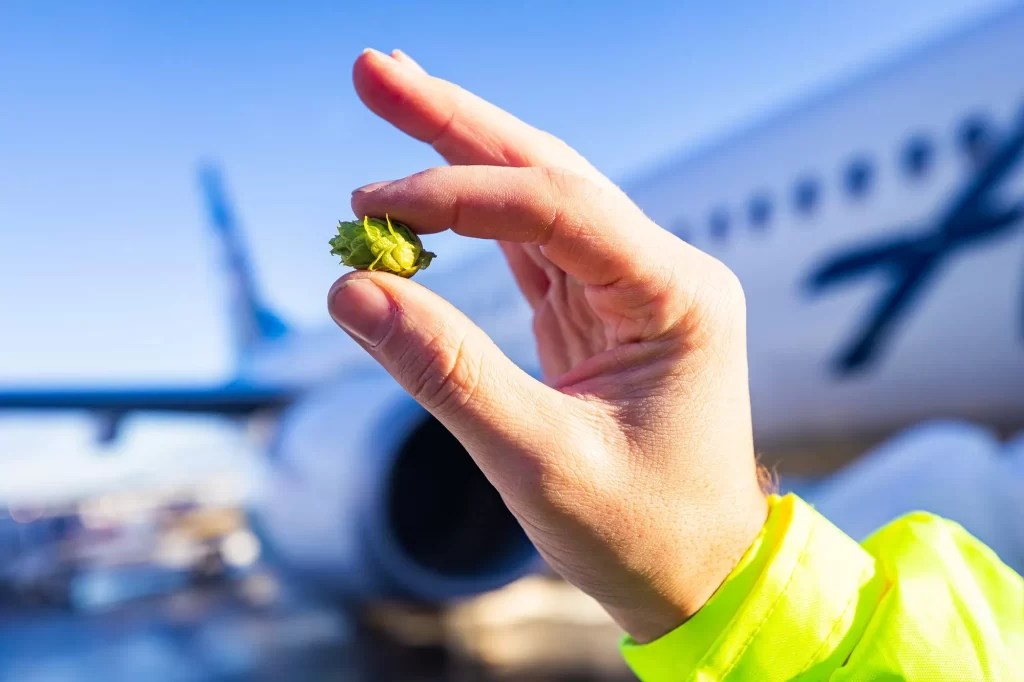
More than 1,200 pounds of fresh hops were shipped via Alaska Air Cargo to Maui and Anchorage within 24 hours of harvest in Central Washington. (Photos: Alaska Air Cargo | Ingrid Barrentine)
Alaska Airlines, Yakima Chief Hops and Bale Breaker Brewing Company are teaming up to deliver fresh hop harvests to Hawaii and Alaska. The farm-to-kettle operation will bring three collaboration beers on tap at select Alaska Lounges.
Traditionally, breweries can only use dried hop pellets to add flavor to beers because hops are extremely perishable. However, breweries in the Pacific Northwest have the opportunity to brew with fresh hops and add different floral notes to their beers each harvesting season since the region accounts for three-quarters of the US’s hop production. Hops needed to reach the brewing kettle within 24 hours of harvesting. Therefore fresh hop beers have largely been a regional delicacy until now.
The “Fresh Hops Fly” Idea
The fresh hop, in front of an Alaska Airlines plane. (Photo: Alaska Air Cargo)
According to Alaska Air Cargo, Jake Spotts, the airline’s postal affairs manager and a beer enthusiast, wanted to leverage the company’s expertise in shipping perishable products like fresh Alaskan seafood to ship fresh hops to breweries outside the Northwest. It is something that no other US airline has done on a commercial scale.
The team has a lot of experience in shipping fresh produce on time. The cargo company provides seamless transits and cold-chain support on dedicated cargo planes and passenger plane belly cargoes for Alaskan seafood such as halibut and geoduck. Most notably, the Seattle-based airline even holds annual cooking competitions upon first delivery of the season’s salmon crop.
Once the team determined it had the expertise, Spotts and Drouhard, the managing director of Alaska Air Cargo, reached out to one of Spotts’s favorite breweries, Bale Breaker Brewing Company. The parties hit it off and started working on the logistics.
Farm-to-Kettle Logistics
The fresh hops were shipped the same day they were harvested. (Photo: Alaska Air Cargo)
Bale Breaker reached out to Maui Brewing Co. in Hawaii and 49th State Brewing in Alaska. The brewers worked on beer recipes to highlight the hops’ fresh flavor and coordinated logistics with the Alaska Air Cargo team and Yakima Chief Hops, one of the largest hop distributors.
The harvest was timed so the hops could be bagged onsite at the farm immediately after picking to keep the hops as fresh as possible throughout the shipment. They were loaded into refrigerated trucks and driven to the Alaska Air Cargo offices at Sea-Tac International Airport just in time to load onto the aircraft.
The team shipped more than 1,200 lbs of fresh hops non-stop to the brewers. “Scalability of shipping fresh hops has really been the challenge to overcome because you only have about 24 hours from harvest before the hops start to degrade,” said Bryan Pierce, Chief Sales and Marketing Officer for YCH.
The co-owner of Bale Breaker has also been racking up some frequent traveler miles for this collaboration. He’s been personally traveling to the breweries in Hawaii and Alaska to assist in brewing their first-ever fresh hop beers.
The Beers
In addition to the brewer’s taproom and distribution channels, travelers can look for these seasonal delights in Alaska Lounges at select airports.
You can also have a taste of the Alaska Lounge at the comfort of your home. (Photo: AirlineGeeks | Fangzhong Guo)
Bale Breaker will have two beers on draft at Alaska Lounges in Sea-Tac International Airport at the Alaska Lounge in Portland International Airport. The Homegrown fresh hop IPA will feature citrusy, blueberry, pine resin, and fresh-cut grass flavors, while the Citra Slicker Wet Hop IPA will focus on citrusy and floral tasting notes.
Freshial Delivery Hazy Fresh Hop IPA features plane-themed packaging. (Photo: 49th State Brewing)
Freshial Delivery Hazy Fresh Hop IPA from 49th State Brewing will be available at the Alaska Lounge in Anchorage International Airport. While the brewer did not list official tasting notes on the website, one can expect floral and tropical fruit flavors for the type.
Maui Brewing Co named their beer Hop Cargo Fresh Hop IPA, which will only be available on draft at the Alaska Lounge in Sea-Tac, North Satellite. The style is similar to that of the Homegrown IPA. All beers are on tap now, remember to enjoy the hoppiest time of the year by grabbing a pint of fresh hop beer the next time you swing by Alaska Lounge.
Fangzhong grew up near an OEM airport in northeastern China, where he developed his enthusiasm for aviation. Taking upon his passion, he's now working as an aircraft interior design engineer. Besides working in the aerospace industry, Fangzhong enjoys trying out different types of airplanes and seeing how airplane interiors have evolved. So far, he's flown on over 80 types of aircraft. He also planespots in his spare time. His rarest catches included the 747 Shuttle Carrier Aircraft and AN-225.
MALEV T134 at Aeropark, Budapest (Photo: AirlineGeeks | Mark Evans)
Hungary was under communist rule until 1989, along with several other Eastern Bloc countries in the area. It had been this way since 1945 when it became a satellite state of the Soviet Union, following the defeat of Nazi Germany. Sanctions placed on the country by the West meant that Russian aircraft were operated throughout the country.
MALEV Air Cargo IL18 at Aeropark, Budapest (Photo: AirlineGeeks | Mark Evans)
During communist rule, MALEV was the flag carrier of the country. At the end it was operating a wholly Russian fleet which included Ilyushin 18, Tupolev 134, Tupolev 154 and Yak40 aircraft.
It was only once the Iron Curtain fell and communist rule ended in 1989 that Hungary and other Eastern Bloc countries would begin to replace their fleets with western jets. Commercial airliners were actually made exempt from the trade embargo in 1988 when the Soviet Union started to reform the political system.
MALEV was quick to act, introducing Boeing 737s at the end of the year, and would eventually operate a western fleet. Boeing 737s became the mainstay for European routes, alongside Boeing 767s for long-haul routes, and Fokker 70s, DHC8s, and Canadair Regional Jets for regional routes.
Unfortunately, MALEV ceased operations in 2012 and a new flag carrier was never established. Low fares airline Wizzair is now the main carrier for the country. Its headquarters are in Budapest, although its first flight was from Katowice, Poland in 2004. It quickly established bases throughout the eastern bloc nations and has now expanded with subsidiaries in the UK and Abu Dhabi. The airline’s CEO is Josef Varadi, former CEO of MALEV Hungarian Airlines.
MALEV continued to operate some of the Russian aircraft for several years with the last Tupolev 154 not being retired until 2001. Fortunately several of the Russian aircraft have been preserved in two museums within the country.
Aeropark
Located next to Budapest Liszt Ferenc International Airport and is dedicated to the history of Hungarian civil aviation. It was formed in 1988 when the Soviet Army donated an Ilyushin 14 for exhibition.
HA-MALIL14MALEV – Originally operated for the Soviet Air Force from 1957 as 04 RED until it was donated for exhibition. Painted in MALEV cls with fake registration.
HA-MOAIL18Hungarian Air transport titles – Arrived in 1960, its first flight was to Moscow. It remained in service until 1987 with the last ten years as a cargo aircraft for MALEV.
HA-MOGIL18MALEV Air Cargo – Operated from 1964 to 1988. It was written off after an engine fire just two months before it was planned to be retired. Initially used by MALEV for training it was due to be dismantled in 2006. But a petition was started and the aircraft was moved to the museum with the exterior being restored in 2014.
HA-LBET134MALEV – Its first flight was to prague in 1969 and was retired in 1987. It became one of the first three aircraft in the museum.
HA-LCGT154MALEV – Operated for MALEV from 1975 to 1994.
Linair Yak 40 at Aeropark, Budapest (Photo: AirlineGeeks | Mark Evans)
HA-LRA YAK40 Linair – Started life with CSA in 1974. It was sold to Hungary in 1990 operating for Aviaexpress and Linair, which were partners with MALEV.
Hungarian Flight Inspection Yak 40 at Aeropark, Budapest (Photo: AirlineGeeks | Mark Evans)
HA-YLRYAK40Hungarian Flight Inspection – Arrived in 1975 and used to test and authenticate navigation equipment.
HA-LAFLET410Hungarian Flight Inspection – Purchased new in 1990 and flew for Aviaexpress.
HA-LIQLisunov2MALEV – The LI-2 was the first passenger aircraft to be operated in Hungary. This particular one started life with the Hungarian Air Force in 1954.
HA-MHIAN2No Title – Used as an Agricultural aircraft since 1967.
HA-YHFAN2MALEV Aero Club – Delivered in 1979 and used for agricultural services. Painted in the same colors as another AN2 that operated for MALEV Aero Club.
AN2 painted in MALEV Aero Club colours at Aeropark, Budapest (Photo: AirlineGeeks | Mark Evans)
Szolnok Hungarian Air Base is just over an hour’s drive from Aeropark. There is a small museum in the northwest corner of this Air Base.
HA-LBFT134Operated for MALEV from 1970.
HA-MOEIL18MALEV Air Cargo – Operated from 1963 and like the other Il18s ended life as a cargo aircraft.
907AN24Operated for Hungarian Air Force from 1968.
202AN26Operated for Hungarian Air Force from 1974.
Another MALEV T134, HA-LBH, can also be found in Germany at the Auto Und Technik Museum, Sinsheim.
MALEV Air Cargo IL18 at Szolnok (Photo: AirlineGeeks | Mark Evans)
Mark has been interested in aviation since the age of eight when he first went plane spotting at Manchester Airport, England. Trips around various European airports in the following years and then to the USA as a teenager furthered his desire.
This led to Mark wanting to work in the industry and at the age of twenty one was accepted to train as an Air Traffic Controller. After training and working for several years in England, Mark moved to Bahrain in the Middle East where he worked for six years. He then moved to Sydney, Australia where he resides today after twenty years in the profession.
Mark's pursuit to see planes has seen him visit over 140 countries and territories, including places, like North Korea, Sudan and Iran. He has flown over 1,100 times, visited over 700 airports and can always be found researching his next trip.
Ethiopian Airlines, IAI Complete Conversion of Africa’s First 767 Boeing Converted Freighter
Ethiopian Airlines will soon put into service its first 767-300BDSF (BEDEK Special Freighter) and the first freighter to be converted with Israel Aerospace Industries (IAI) at the Ethiopian Airlines’ maintenance, repair and overhaul (MRO) facility in Addis Ababa.
According to Cargo Facts, the 18-year-old aircraft with serial number 33768, which was previously in passenger service with the airline and had been at ADD since September 2021, has now completed the conversion process. The aircraft conducted a test flight on Sept. 19. It will be followed by two other jets of the same model, with serial numbers 33767 and 33769 and an average age of 17 years. The aircraft will be used by the Ethiopian carrier to expand its cargo capacity.
The 767-300BDSF is the third freighter type to join Ethiopian’s fleet. However, the airline has signed a memorandum of understanding for five of Boeing’s 777-8Fs, becoming the second known customer of the type.
IAI is the world’s leader in passenger to cargo conversions of the Boeing 767, 737 and 747 aircraft, with lines in Israel and Mexico, while its Abu Dhabi site is expected to open in partnership with Etihad Engineering.
The 767-300BDSF is the advanced converted freighter type of the B767 family, offered by IAI as a follow-up to the successful Boeing 767-200BDSF. The company has delivered more than 100 converted 767-300 aircraft. Israel Aerospace Industries says that it transforms about 25 planes a year, up from 18 annually before the Covid-19 pandemic. The process takes about three months.
The state-owned Israeli company is also preparing to begin work on Boeing 777 conversions, for which it has partnered with AerCap, the world’s largest owner of commercial aircraft, requiring it to increase overall global capacity. IAI has also obtained certification for Airbus A330-300 conversion programs.
In addition to the 767-300BDSFs, Ethiopian Airlines recently took delivery of its first 737-800BCF, ordered five more 777Fs in addition to making headlines at the Farnborough International Airshow as one of the launch customers for De Havilland’s Dash 8-400 freighter conversion program.
The airline is committed to increasing its current 777F fleet to as many as 14 frames, becoming one of the largest customers of that type.
Last month, Titan Aircraft Investments, the joint venture between Titan Aviation Holdings, Inc. and Bain Capital Credit, announced the placement of three 767-300ER converted freighters on long-term dry leases with Ethiopian Airlines.
Victor Shalton's love for aviation can be traced to when he was 11-years-old. As a seasoned aviation writer, he takes pride in providing the best aviation coverage around the globe and is passionate about advancing his skills in the aviation space. In addition, he loves travelling, writing, arts and while his speaking engagements have taken him around the world, he is proud to call Nairobi home.
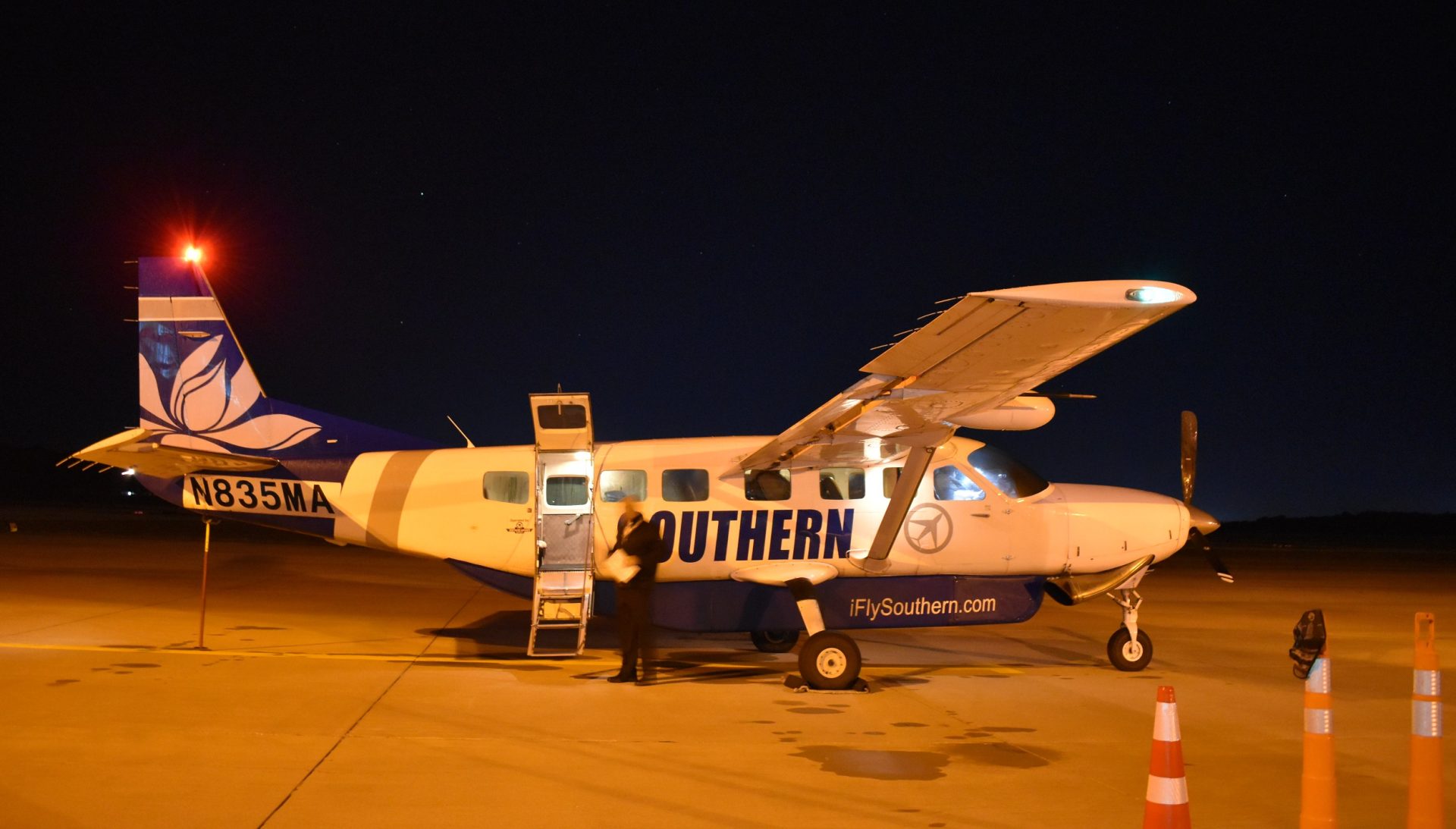
My aircraft for today, N835MA, a Cessna 208 Grand Caravan (Photo: AirlineGeeks | Joey Gerardi)
This will probably sound like a broken record for avid AirlineGeeks readers, but in the Spring of 2022 SkyWest under the United Express brand requested to terminate 31 Essential Air Service communities. Now at least six months later, some of them have said that SkyWest isn’t allowed to leave, some have chosen a new carrier and have already started service with that new carrier and some, like the community in this trip report, have selected a carrier with service scheduled to start this fall.
Muskegon County Airport in Michigan, located on the western shore of the state along Lake Michigan and roughly 45 minute away from much larger Grand Rapids Airport, is in a weird position. One of the main rules of EAS is that they have to be located more than 70 miles from a medium or large hub city, Grand Rapids is closer than that, but it hasn’t hit the medium-sized threshold yet.
Just before the Covid-19 struck the United States in March of 2020 the airport was nearing that benchmark, and with travel rebounding, they are nearing it again. Another rule about EAS contracts is that airports have a clause saying they must have multi-engine aircraft service, but the airport can waive that right. out of the 31 airports, SkyWest has requested to leave, Muskegon is the only airport of the group to waive their right to dual engine operations, which also means they automatically waived their rights for it in future EAS contracts.
However, with Grand Rapids nearing the medium hub-sized classification, this could very well be the last EAS contract the community will be awarded if Grand Rapids is large enough the next time Muskegon’s EAS contract is up for rebidding four years from now in 2026. So that single engine waiver may mean nothing in four years
Once they lose eligibility it will be up to the current airline there whether or not it would like to stay without the EAS subsidies. The community leaders in Muskegon are being very smart and open-minded about this, get an airline to establish a connection with the community and build up passenger numbers so that not if, but when they lose subsidies, maybe they’ll stay. Half of the 31 EAS cities that have decided to go with other airlines aren’t at risk of losing eligibility, so they have stood firm with not waiving their dual-engine rights.
But, for now, Southern Airways Express will serve Muskegon from Chicago’s O’Hare International Airport with 36 round-trip flights per week according to the EAS contract it were awarded. All flights are scheduled to be on one of the airline’s many eight to nine seat Cessna 208s.
Fall and more specifically Oct.1 is one of the more common dates that EAS contracts start on. Exactly two years ago on Oct. 1, 2020, I participated in Cape Air’s inaugural flight out of Manistee, Mich. which is located less than two hours north of Muskegon. Manistee is also an EAS community.
The day before the flight, around 7 p.m. I got a phone call from one of the airline employees reminding me I had a flight booked with them. This is not uncommon for smaller commuter airlines to get a personal text or call reminding them of the flight. I got a call the night before my Cape Air flight out of Manistee, and someone from Southern Airways Express sent me a text message the morning of my flight from LAX to Imperial, Calif.
For the sake of not typing the entire airlines name every time, I will refer to ‘Southern Airways Express’ simply as ‘SAE’ in the remainder of this article.
Day of the Flight
The inaugural departure from Muskegon was scheduled for 5:45 a.m. and with a departure in the early morning the doors were sure to be locked overnight, but I wanted to make sure I was first to check in, so I arrived earlier than I probably should of at 3:40 a.m. The first airline employee didn’t arrive and unlock the terminal doors until around 4:20 a.m., and the few passengers for the flight started to trickle in, six to be exact for this first flight. Even in the dark, you could see that the airport was a striking green color, and looked like something that belongs in the Wizard of Oz.
The Muskegon County Airport (Photo: AirlineGeeks | Joey Gerardi)
With commuter airlines like this, especially ones that have interline relationships, it is always interesting hearing the stories from the passengers on what airline they think they are flying on before, they realize they will be on an eight or nine seat propeller plane. Me and one other person were just going to Chicago, three of the passengers booked it on American’s website and had onward connections, and the last passenger booked it with United and had an onward connection as well.
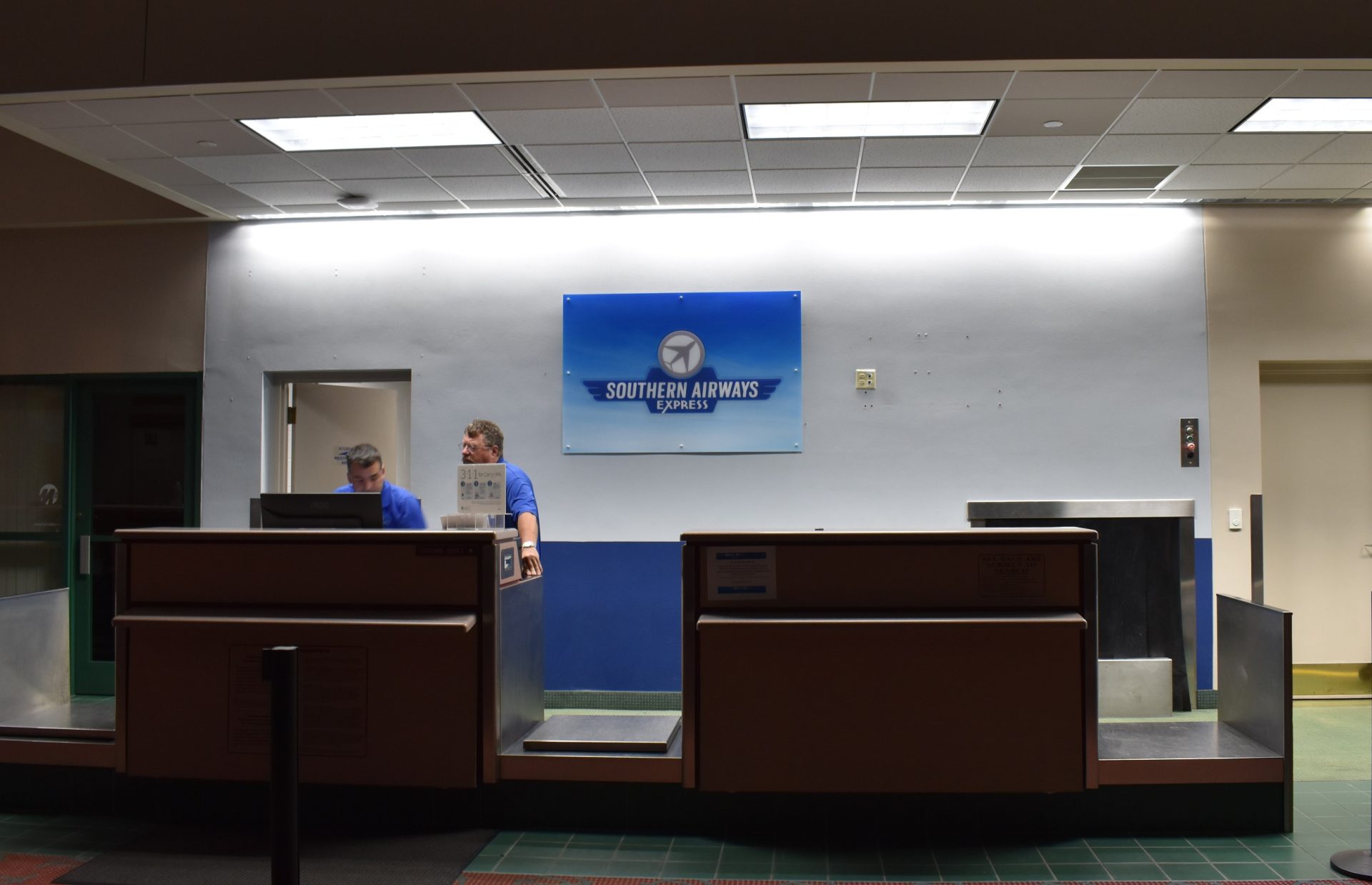
Despite United/SkyWest only leaving the day before, they had already stripped away all of the logos and anything that showed they were ever here and the SAE name and logo is what remained the morning of the first flight. As with all airlines that fly smaller planes like these, they asked everyone their body weight and weighed all bags and items that were going on the plane. This is so the pilots can seat us where they need to in the cabin for weight and balance purposes.
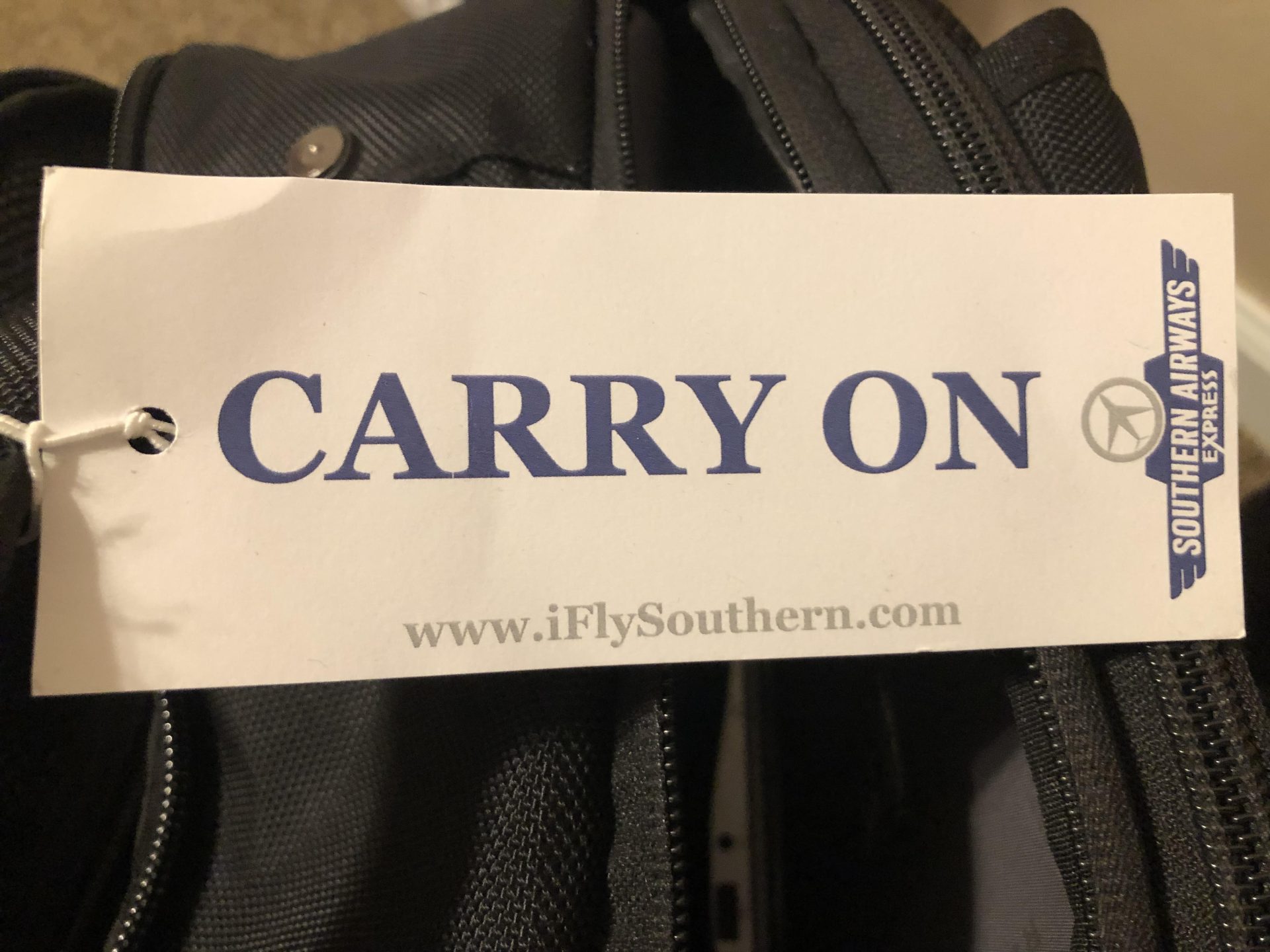
There are three types of bags on this flight: checked, carry-on and valet. Checked bags are given to the airline when you check-in and you get them back at baggage claim at your final destination, carry-on bags for this plane are smaller items like purses or small backpacks that can sit at your feet, anything bigger than that will be valet as this plane has no under-seat storage or overhead bins to speak of.
The tag they put on my backpack (Photo: AirlineGeeks | Joey Gerardi)
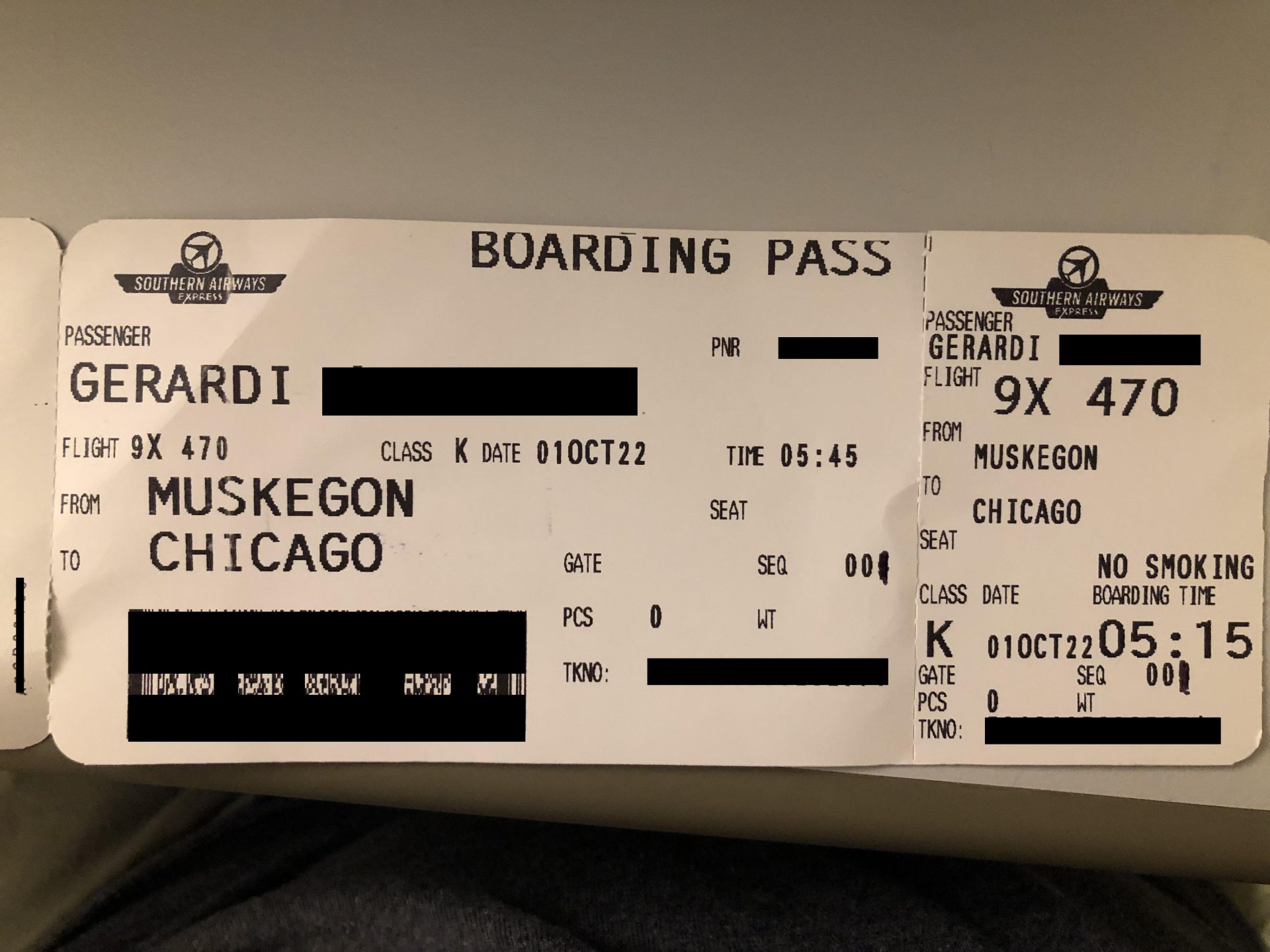
As with any airline’s first day in a new city, the employees were still learning the systems and getting used to all the ins and outs of a new software. I tried to get my TSA PreCheck number added to my boarding pass, but they couldn’t figure it out, since it was a smaller airport it didn’t matter because there was no long line, but it would’ve been nice to not remove my laptop, camera gear and other such items from my bag. I would like to note than I was the first person to ever check-in for a SAE flight in Muskegon, seen on my boarding pass as “SEQ 001,” a unique distinction that I also got on Cape Air’s flight out of Manistee two years prior.
My boarding pass for the inaugural flight (Photo: AirlineGeeks | Joey Gerardi)
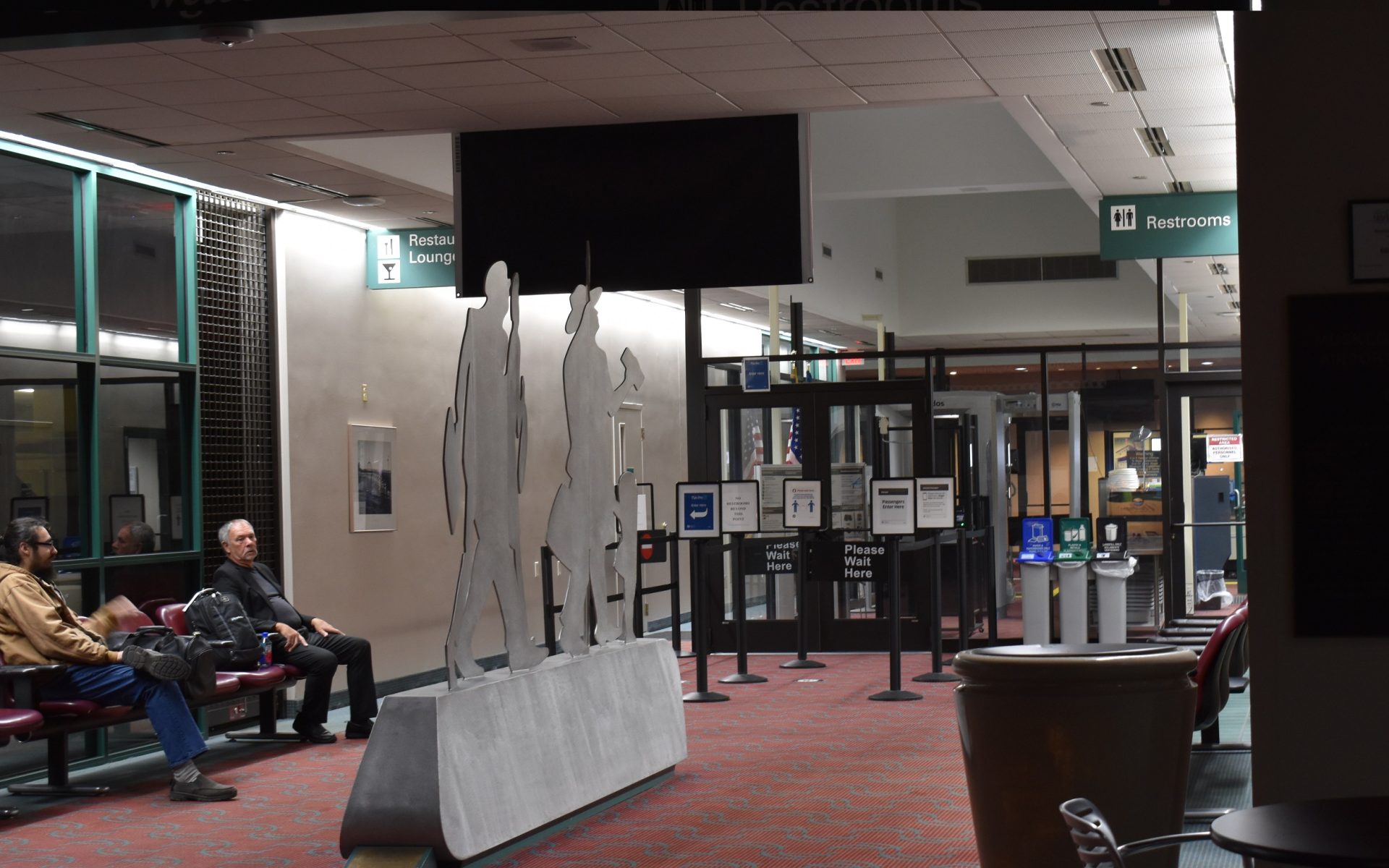
As it was a small plane they didn’t need to board 30 minutes prior like the boarding passes read, and the TSA checkpoint didn’t even open until 30 minutes prior anyways. An interesting note to add about this airport is they don’t have a restroom in the gate area past security, and with the plane also not having a restroom, that means the lobby of the airport was the last chance to use it until we got to Chicago an hour and a half later.
The area just before the TSA Checkpoint (Photo: AirlineGeeks | Joey Gerardi)
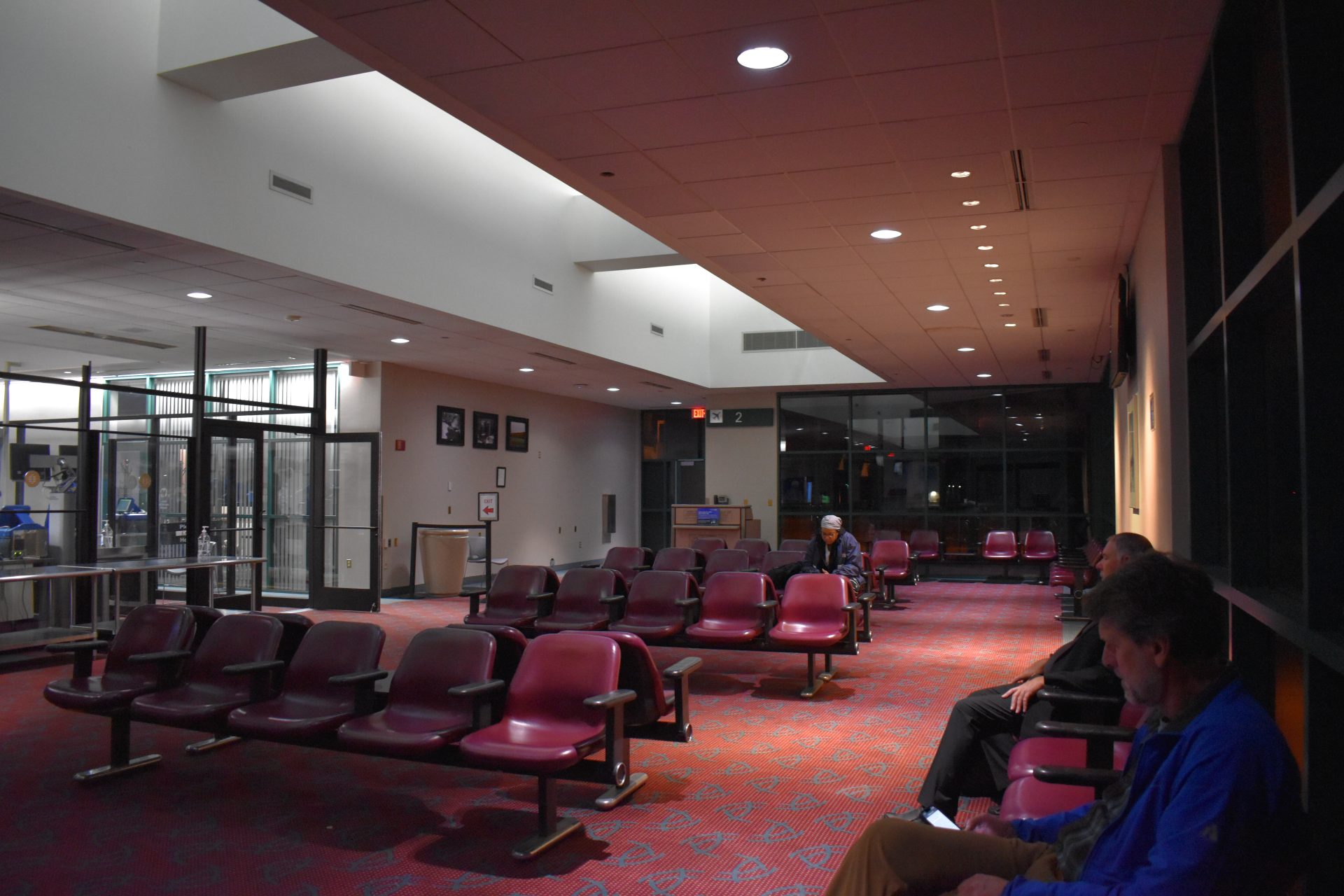
The gate area wasn’t big and has roughly 50 or 50 seats, perfect for the CRJ-200’s that used to operate here but overkill for the Cessna 208’s that now operate to the airport. The gate area also has two gates each of which are equipped with a jetway, which now probably won’t be used for a long time. I would like to note that they do receive casino/gambling charters on Sun Country Boeing 737’s every eight months or so, but those haven’t been seen since before the pandemic began.
The gate area at MKG (Photo: AirlineGeeks | Joey Gerardi)
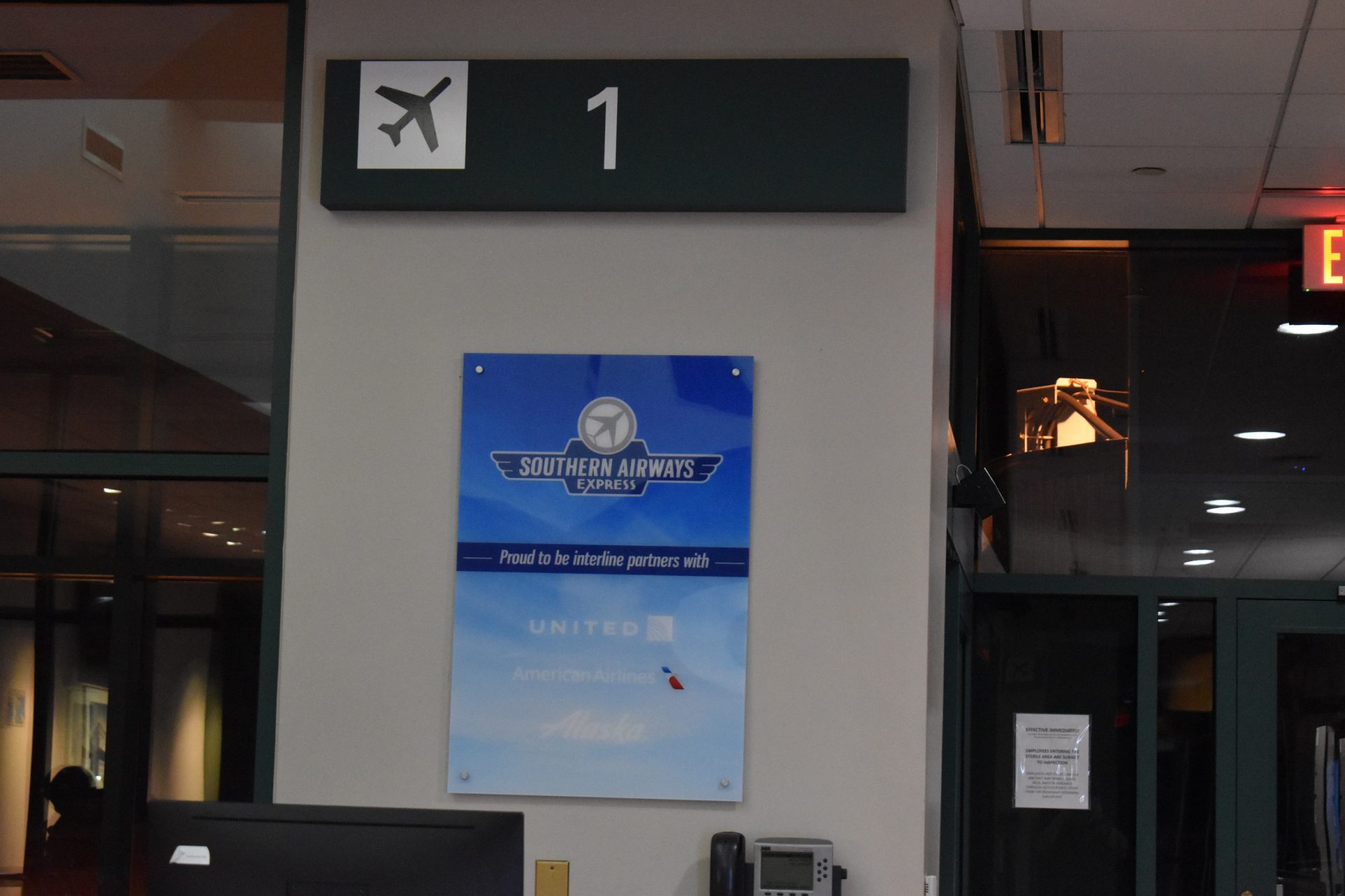
Under the Gate 1 sign, it had the Southern Airways Express logo along with the three airlines they had interline agreements with: American, Alaska and United. Passengers could check their bags to either three of the airlines going to or from Muskegon.
It is also interesting that neither the airline nor the airport had set up any type of fanfare or celebration, given this is the airlines first time operating out of Muskegon, and the state of Michigan as a whole I did expect at least a little something even at five in the morning. However I did hear employees say, “This is it, first one!” a couple of times, but other than that there was nothing different from this flight and every other flight they’ll take out of here for the next four years. A little disappointing, as I have attended a bunch of inaugurals in the past, this is the first without a celebration of any sort.
About 10 minutes before departure time we were ushered outside and got on board our aircraft for the inaugural flight. My aircraft is a nine-seat Cessna 208 Grand Caravan that carries the registration of N835MA, and there is actually a bit of a fun fact about this tail number, I have encountered it before.
My aircraft for today, N835MA, a Cessna 208 Grand Caravan (Photo: AirlineGeeks | Joey Gerardi)
Over two years ago I flew to the EAS community of Imperial, Calif., a town located along the U.S.-Mexico border and although I didn’t fly on it, this plane was sitting on the tarmac. The one large difference is that the last time I saw the plane, it was still wearing the Mokulele Airlines livery of which SAE merged with just months before that flight.
The seat numbers were labeled with pieces of paper taped just above the windows, I was given seat 7, a seat on the left side of the plane. Safety briefing and engine startup, when we taxied out to the runway he didn’t talk to ATC, but instead himself. In Muskegon and other similarly sized airports around the country, the ATC is closed from 11 p.m. to 6 a.m. local time, so outside of that time pilots and aircraft just say what they are doing over frequency and go, then contact the center once in the air. The audio of this can be heard in the video of I made of this trip, located at the end of this article.
taxiing out to the runway in Muskegon (Photo: AirlineGeeks | Joey Gerardi)
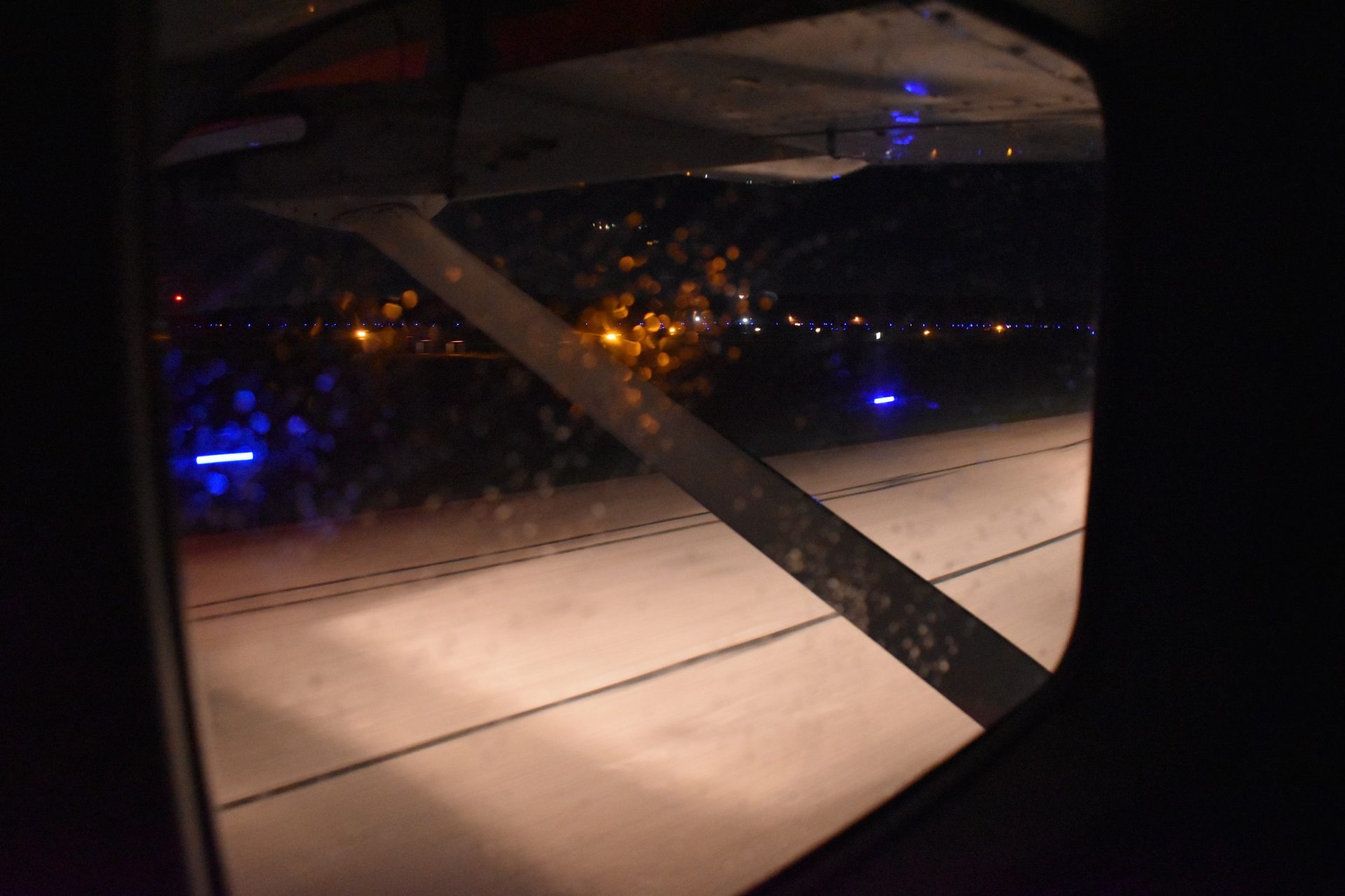
Taxi was normal and we took off into the dark early morning sky towards Chicago. Another interesting aspect that makes it different from the airline previously here is the route they take to get to Chicago. When SkyWest/United was here with the CRJ-200 they flew directly over the lake, but not SAE. Due to the size of Lake Michigan, and that we were using a single engine unpressurized plane, we had to fly relatively close to the shore of Lake Michigan for the entirety of the flight. This also meant the flight time would be at least double what it took on the CRJ-200 with United.
On takeoff roll leaving Muskegon (Photo: AirlineGeeks | Joey Gerardi)
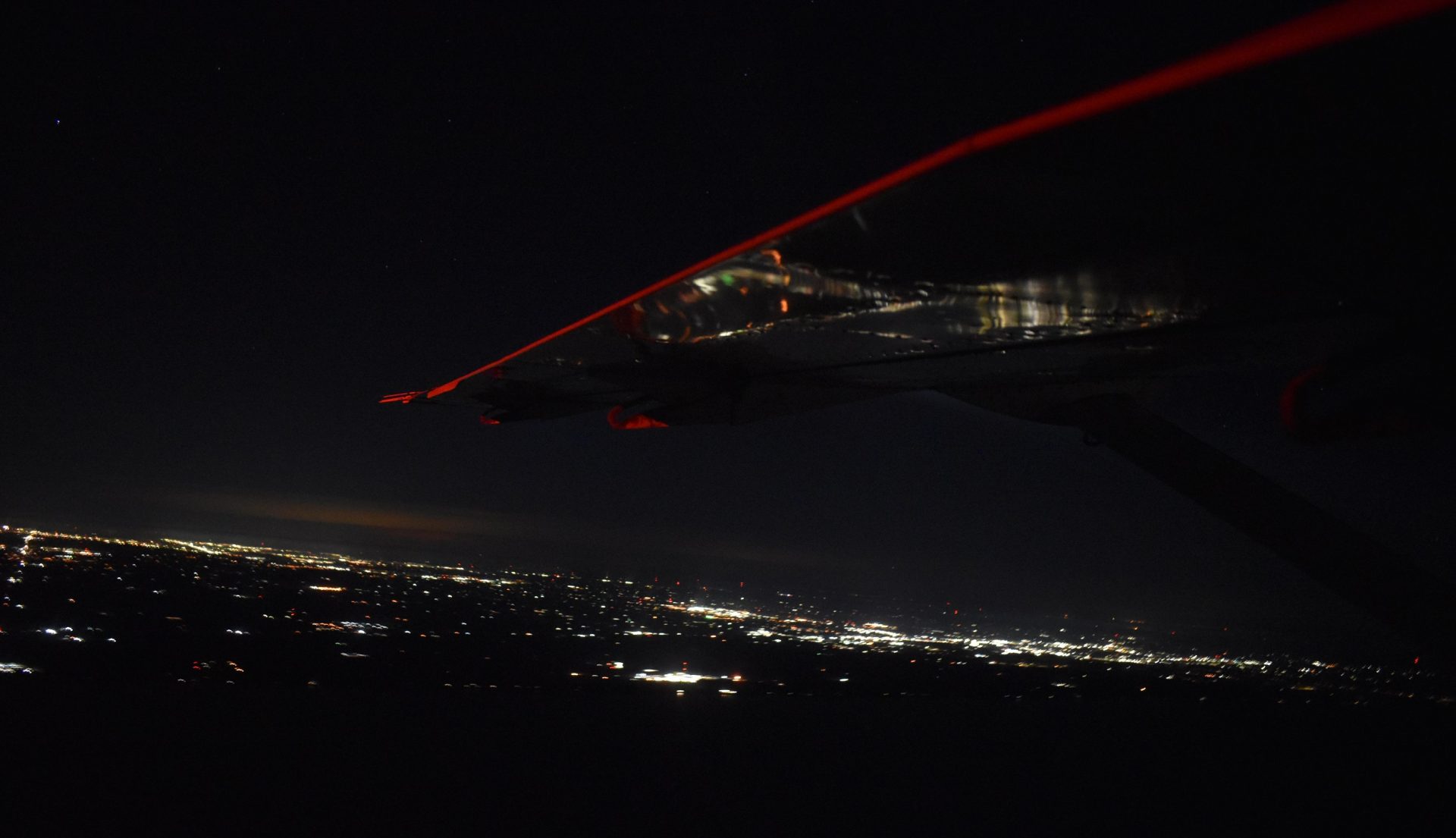
The windows on the Cessna 208 are relatively large — definitely larger than the windows on the CRJ-200, which was great for people on the left side of the aircraft especially during hours when it’s dark. The lights of the cities and communities we passed illuminated our way, although not literally since GPS exists, but it was still nice seeing the lights along the route.
Just after taking off from Muskegon (Photo: AirlineGeeks | Joey Gerardi)
Even though sunrise was still more than an hour away, once we got up into the sky people on the left could start to see the glimpse of a bring spot in the sky which glowed a very dull orange color. Along the way we passed South Haven, and Benton Harbor along with other smaller cities that shined so dull we could hardly see them. It is so beautiful seeing all of the communities, and with the complete darkness you can clearly see the edge of the lake with the light shining around it.
Roughly halfway through the trip, those on the right side of the plane could start to see the other end of the lake shining brightly even though it was still a good distance away.
The west side of the Lake Michigan shoreline (Photo: AirlineGeeks | Joey Gerardi)
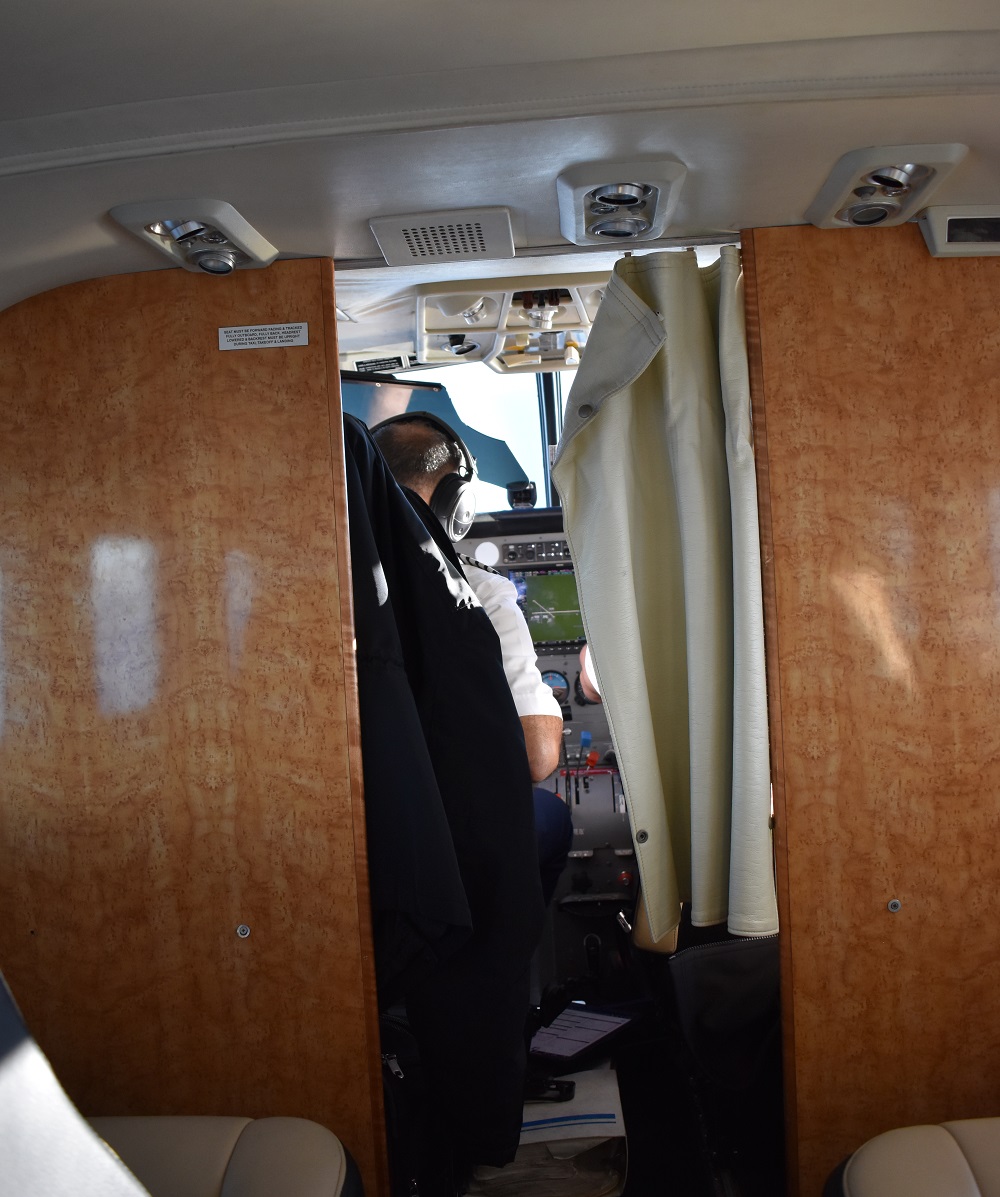
With the open cockpit, except for some dividers just behind the seats, you could stare directly into the cockpit and see the GPS and tracking equipment which shined a bright light back into the cabin.
Looking into the cockpit from the passenger cabin (Photo: AirlineGeeks | Joey Gerardi)
We then passed over Michigan City, Ind., which was the brightest and biggest city we have seen since we left Muskegon.
Flying over Michigan City, Indiana (Photo: AirlineGeeks | Joey Gerardi)
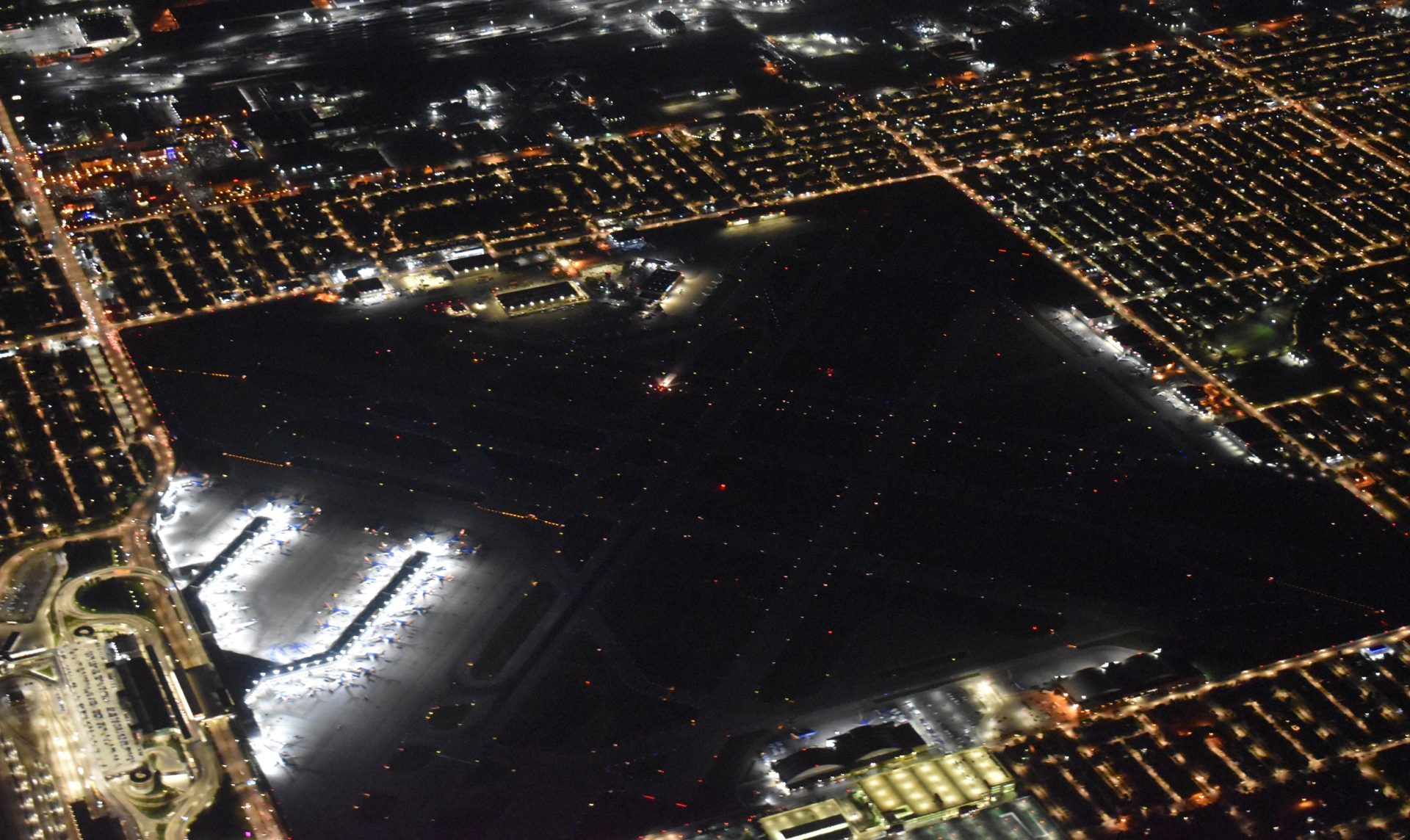
It wasn’t long before we were flying over the Chicago suburbs. Both sides of the aircraft had a spectacular view — the left side could see Midway Airway and the right side could see downtown Chicago.
Chicago Midway from above (Photo: AirlineGeeks | Joey Gerardi)
Luckily someone on the right side was nice enough to learn back a good bit so I could get a shot of the Downtown Chicago skyline, one of the most beautiful sights you’ll see. This is a premium example of why a slower and lower flying plane like this Cessna 208 is the most fun option of flying into and out of bigger cities.
The Downtown Chicago Skyline in the dark (Photo: AirlineGeeks | Joey Gerardi)
You could also see O’Hare out of the right side of the aircraft. Another interesting aspect of flying a smaller plane into a large airport like O’Hare is how small compared to everything else you are, we didn’t start descending from out cruising altitude of 8,000-feet until we were over the suburbs. And we were still flying at our cruise speed of between 160-180 knots until we were on final to O’Hare. Because all of the other planes are moving so much faster, we need to keep our speed up until we got really close to the airport.
As we turned back to the east to land, you could see the sun coming up further out of the cockpit windows as well as the runway we were to land on.
On approach to Chicago O’Hare (Photo: AirlineGeeks | Joey Gerardi)
We touched down on runway 10C at 5:56 a.m. and completed the flight in 1 hour and 7 minutes. The flight is scheduled as 1 hour and 50 minutes, meaning we arrived pretty early into Chicago. It was also a double inaugural flight for the airline and me. As this is SAE’s first route into O’Hare it makes it the first scheduled flight of theirs to touch down at the airport.
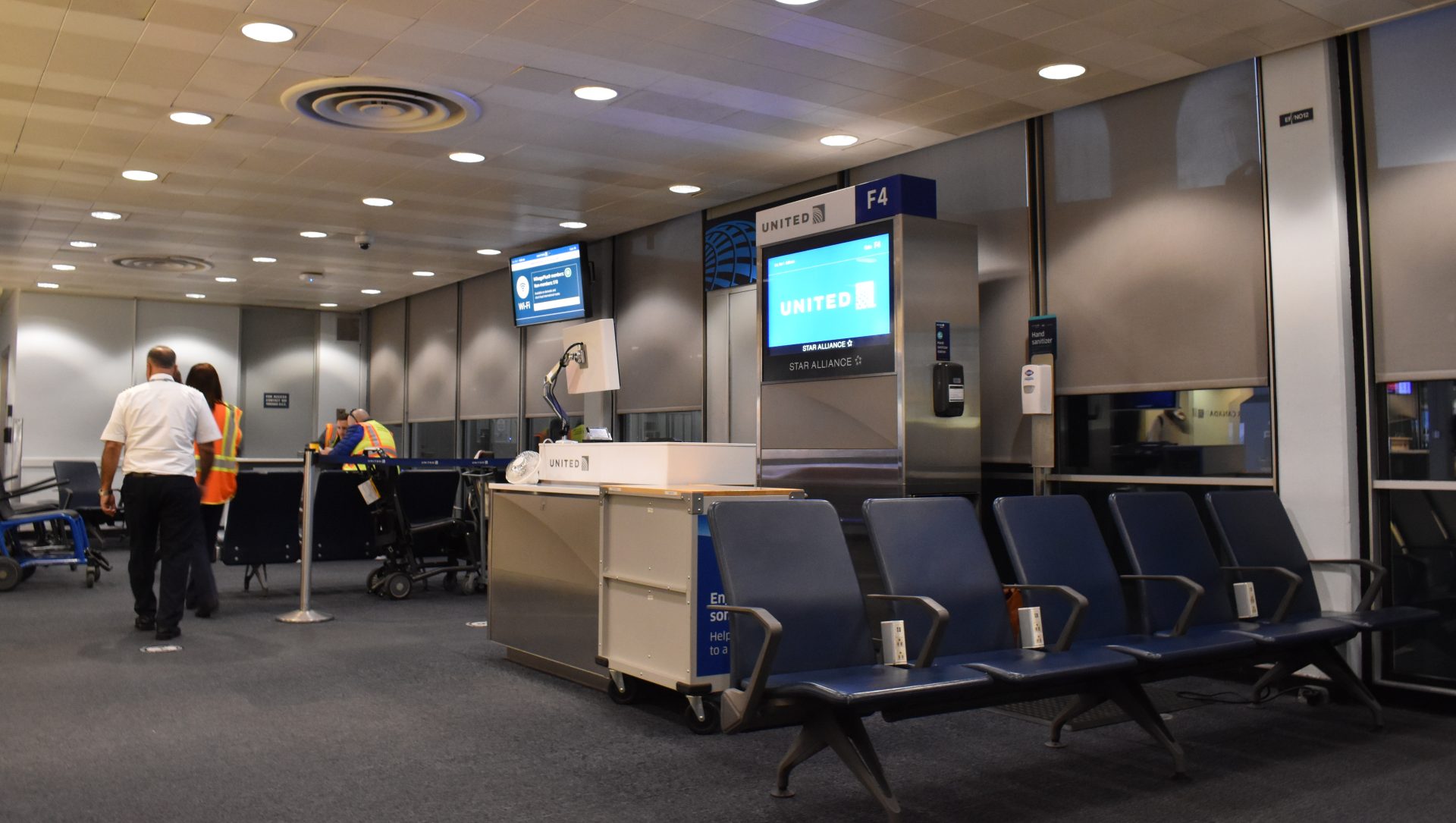
We then taxied into gate F4, which was a shock to me as I thought all of the commuter airlines used the ground boarding gate L11A in American’s terminal. Gate F4 is among United regional jet gates, meaning we were among flights to other EAS communities. It is a perfect spot as it is right on the edge between the United and American gates, with Alaska’s gate not far from them either, making it perfect for those connecting to any of the three airlines they interline with.
They brought us into a door on the ramp and we took an elevator ride up into the terminal and it dumped us out in the middle of a bank of United Express gates, and conveniently right next to a United flight departure board.
For those traveling on with American, Alaska or any other airline except for United and Air Canada, they had to use the airlines app of ask a SAE staff member to point them in the right direction for their next flight. This is due to it being a United gate area and no flights showing up on the board except theirs and close Star Alliance partners like Air Canada.
As this was SAE’s very first day in Chicago, they didn’t show up on any departure board at the airport at all. An airline staff member said they were working with the airport to get that changed and get them added. Once fixed their flight will appear on every board at the airport, from American and United’s to the smaller board in the L gates for the commuter airlines and Spirit. That way all connecting passengers will be able to find them, even if they aren’t coming from an interline partner airline. One passenger had that problem the morning of the flight as he was coming from Spirit Airlines, and most non-Southern employees at the airport have never heard of the airline before.
There is also no SAE logo or any signs showing Muskegon anywhere at gate F4, again since it is their first day they don’t have everything set up yet and they are working on it. I was then given my boarding pass for the return flight and they checked my ID, they got my body and bag weight from the agents in Muskegon.
The gate Southern will be using at Chicago O’Hare (Photo: AirlineGeeks | Joey Gerardi)
Flashforward to roughly 7 a.m., the flight back to Muskegon is scheduled to leave at 7:10 a.m. but we were informed the flight would be delayed by 30-minutes. This is due to their fuel supplier, Swissport, showing up with the wrong connector to fuel the small Cessna 208 and having to go back and get a different one so they could fuel.
After the 30-minute fuel delay, I and the three other passengers boarded the plane back to Muskegon which would this time be during the daylight. Same as last time, most of the other passengers didn’t know what they were getting onto, and because there was a jetway blocking the window, they didn’t see it until we got outside. This lead to some pretty funny reactions on the ramp, especially considering one of them has flown United into Muskegon before and didn’t expect anything different.
Heading back out to the same plane that brought me here (Photo: AirlineGeeks | Joey Gerardi)
Same as before, safety briefing and engine startup, we then began to taxi out to our departure runway of 10L with me this time sitting in seat 6 on the right side. It is amazing how small we were even compared to a 50-seat jet, but the size really does show once you get behind a Boeing 737 or a plane even bigger.
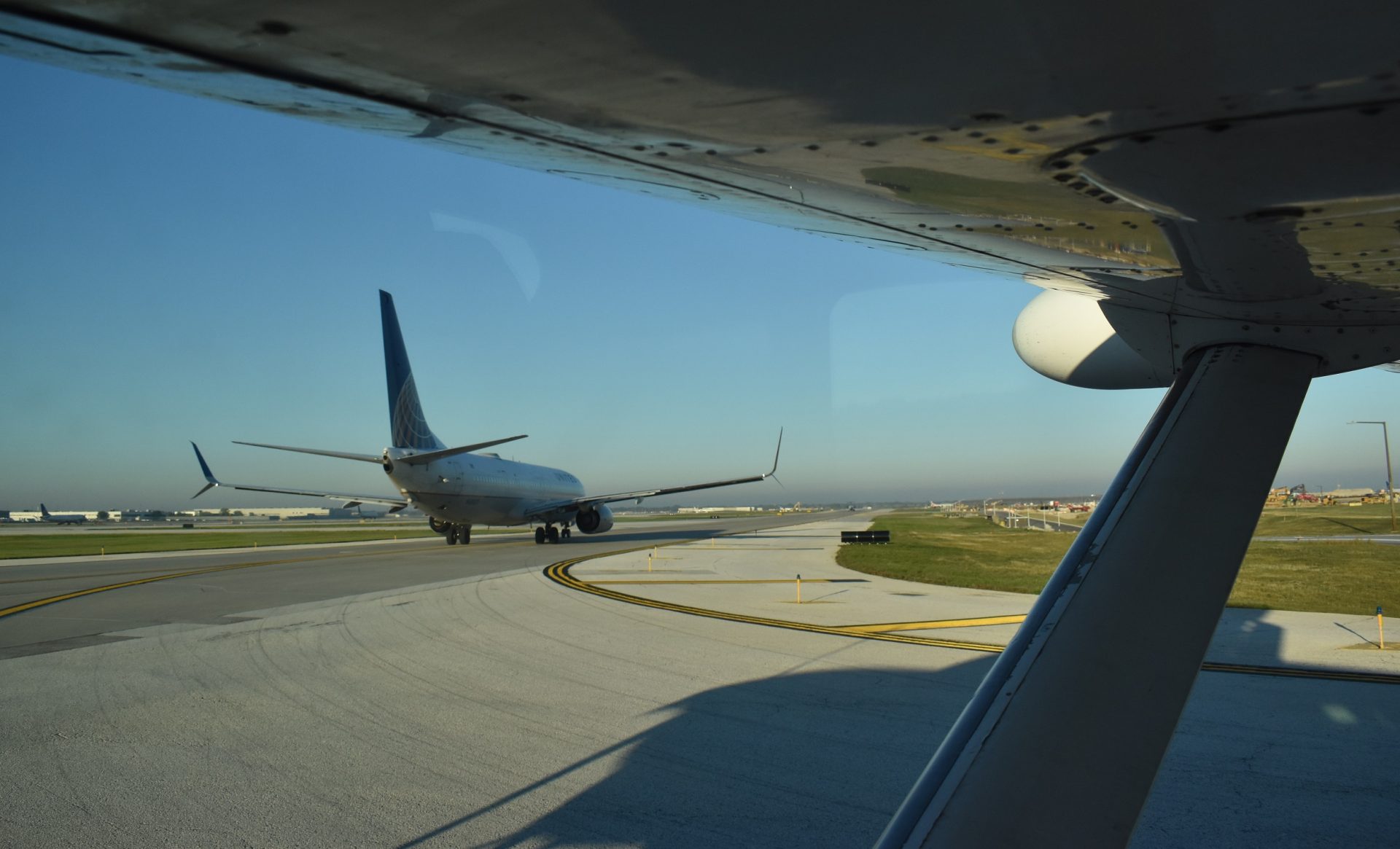
Taxiing behind a United 737 (Photo: AirlineGeeks | Joey Gerardi)
We then took off from 10L with planes taxiing on the sides of us. For those of us like myself that can’t afford those pricey helicopter spotting sessions over large airports, the slower nature of this plane makes it perfect to get those shots of planes taxiing below us, this is another benefit of having a high-wing aircraft like this.
Taking off from Chicago O’Hare (Photo: AirlineGeeks | Joey Gerardi)
For the reverse flight those on the right side can see Chicago Midway, and those on the left can see downtown Chicago. A couple of minutes after takeoff those on the right will also be able to see Chicago-Gary Airport below. While looking down at Gary, I noticed something I somehow forgotten until now, the fixed landing gear.
Flying over Chicago-Gary Airport (Photo: AirlineGeeks | Joey Gerardi)
The fixed landing gear on the Cessna 208 is just another unique aspect of this plane, it’s not often passengers get to look directly at the landing gear from the inside of the cabin while landing, without seeing them from a camera like on the Airbus A350.
The daylight also gave me a chance to look around the cabin and at the airlines magazine, which contains a depiction of the fleet types SAE operates and a route map. You can also see the cockpit a little better, although I didn’t notice how much the barriers obstructed it until the sun came up, but you can still see the GPS from the back so that’s good.
Looking forward from the passenger cabin (Photo: AirlineGeeks | Joey Gerardi)
At some point shortly after flying past Michigan City, I fell asleep and didn’t even realize it until I woke up and we were flying over land with the airport in the near distance. These small planes tend to rock people to sleep, and it shows because at one point all four of the passengers were asleep, but I was the only one that woke up before we landed.
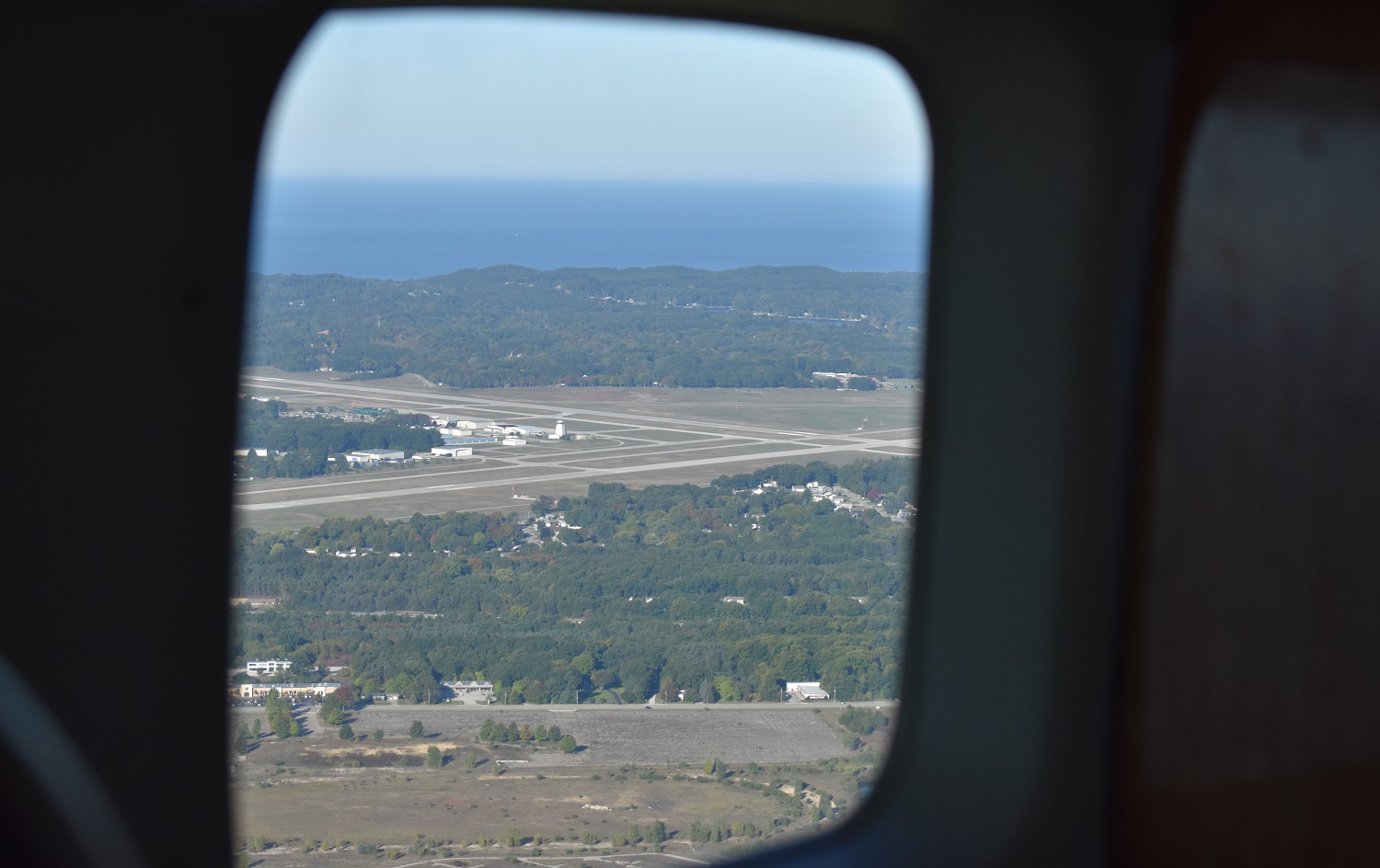
Muskegon County Airport out of the left side of the plane just before landing (Photo: AirlineGeeks | Joey Gerardi)
We touched down at 9:46 a.m. after a 1-hour, 4-minute flight, only one minute behind schedule which is good considering our delay leaving Chicago. Once we touched down the other passengers woke up, also surprised that they fell asleep.
Despite the lack of celebration and fanfare for an inaugural, it was a great flight with the only real problem being the fault of the fueling company in Chicago.
SkyWest vs. SAE
Time to compare SkyWest and SAE, as they definitely both have ups and downs. First, the ease of booking. I know about Southern, so I went directly through their website, but most people don’t know they exist especially with them being new to the area. Most will book the flight through a larger carriers website like American, Alaska or United.
For ease of connections, the interlines are a big plus with the new carrier, with American, Alaska, and United having baggage agreements with SAE. It will be even easier than before and passengers will now have more options for connections with two of their three interline partners having a hub at O’Hare. And they won’t be loosing any connections as you can still connect to flights on the previous carrier that served here, United.
United MileagePlus members can’t earn miles for the Muskegon segment of the trip and neither will members of the other two airlines they interline with, which isn’t a huge deal as it is such a short route and will only be an inconvenience at most. However the high rollers from United will see that as a bigger letdown and will probably drive to nearby Grand Rapids, but that number will probably be relatively low.
The CRJ-200 is definitely faster than a Cessna 208, and the trip now takes at least twice the time as before with United averaging around 30-35mins for the flights to Chicago before they left, and just my two flights with Southern both being over one-hour. The smaller planes obviously hold less, and with only eight to nine seats per plane four to six times per day, they can only take a maximum number of passengers around 50-54 per day to Chicago, but with United’s average load during the summers being close to 50% there shouldn’t be much in the way of people not having seats available. If it does happen, Grand Rapids is not that far away and the United operation there can more than support a couple passengers leaking over from Muskegon.
SAE’s flight schedule is much better, with four to six flights a day. The earliest departure is around 5:45 a.m. and the last arrival comes in close to midnight, offering much better options in terms of connectivity in Chicago and timing of flights. Prior to pulling out, United’s first flight of the day from Muskegon left around 1 p.m. and their last arrival every day left Chicago at around 1 p.m. getting into Muskegon at 3 p.m. which wasn’t great for anyone making an early/late flights or those wanting to do a day trip.
The winter will be interesting to watch, historically when airlines need to lower the number of landing slots the shorter flights making less money tend to go first, like Muskegon, saving the slots for larger planes that seat hundreds of people. But with SAE having an independent operation hopefully their weather cancellations will be at a minimum, although that is a prediction and only time will tell for that.
United does have it’s upsides and Southern has it’s downsides, but overall it seems like Southern Airways Express is the better fit for Muskegon. Especially with them at risk of losing EAS funding as Grand Rapids grows, they need a carrier that is possibly willing to stay once the government EAS money ends.
Joey has always been interested in planes for as long as he can remember. He grew up in Central New York during the early 2000s when US Airways Express turboprops ruled the skies. Being from a non-aviation family made it harder for him to be around planes and would only spend about three hours a month at the airport. He was so excited when he could drive by himself, the first thing he did with his driver's license was get ice cream and go plane spotting for the entire day. He graduated from Western Michigan University in 2022 with a B.S. in Aviation Management & Operations and a Minor in Business, and currently works for a major airline in his hometown.
G-UZHA parked at the Delivery Centre, Toulouse. (photo: Airbus)
According to a survey published by the British low-cost airline, EasyJet, out of 2,000 British vacationers, more than 75 percent believe that airlines urgently need to define ways to achieve net zero CO2 emissions.
EasyJet is the second-largest low-cost airline in Europe after Ryanair and has 318 aircraft in its fleet, all Airbus, including 24 of the New Engine Option family, 20 Airbus A320neo and 4 Airbus A321neo. The Airbus A320neo family — that have larger and more efficient engines — uses 15 percent less fuel, with 8 percent lower operating costs, less noise and 10 percent less NOx than the previous “standard” A320 family.
EasyJet has ordered 168 more A320neos from Airbus, and the manufacturer will also retrofit the existing fleet with technology to optimize flight descent and fuel burn. EasyJet plans to curb CO2 emissions by 35% per passenger kilometers by 2035 as part of its new roadmap
The airline has announced a detailed plan to reduce its carbon emissions to zero within the next 30 years, with the ultimate ambition of flying hydrogen-powered aircraft with zero carbon emissions. According to the same survey, 6 in 10 Britons are excited about the prospect of zero-carbon planes, and 4 in 10 are confident of zero-carbon planes in the next 15 years. 82 percent of respondents believe that flying with zero carbon emissions is the best approach to achieving net zero in aviation.
EasyJet is already working with industry partners, including Airbus and Rolls-Royce, on several dedicated projects to accelerate the development of zero-carbon aircraft technology, as well as the use of Sustainable Aviation Fuel (SAF) as an interim measure, and the work the airline is already doing to make its daily operations increasingly fuel efficient and to support airspace modernization by reducing fuel use by flying more “direct” routes.
By the way, the most significant imminent reduction, of about 15 percent of current emissions, would come through fleet replacement of conventional kerosene-fuelled planes.
The study conducted by easyJet revealed that 78 percent will choose an airline based on its sustainability credentials when traveling in the future, and 70 percent would commit to a “zero carbon” vacation if it were available.
76 percent of travelers today actively seek to reduce the impact of their travel plans on the environment. These plans include choosing a European vacation over a long-haul flight in 33% of cases, choosing an airline that does more to fly sustainably (such as operating efficiently, with a high load factor and a young fleet) in 30% of cases, or choosing a green hotel in 30% of cases.
According to EasyJet CEO Johan Lundgren, implementing the roadmap step by step in the years ahead will ensure a sustainable future of aviation for the benefit of the next generation and the planet.
Vincenzo graduated in 2019 in Mechanical Engineering with an aeronautical curriculum, focusing his thesis on Human Factors in aircraft maintenance. In 2022 he pursued his master's degree in Aerospace Engineering at the University of Palermo, Italy. He combines his journalistic activities with his work as a Reliability Engineer at Zetalab.
An Air India Boeing 787-8. (Photo: AirlineGeeks | William Derrickson)
Air India — after being acquired by the Tata Group — is determined to reclaim its position as a leader of international airlines. After weeks of announcing the fleet expansion in Mid-September, the airline has revealed its plan of adding 5,000 seats and 20 weekly flights to the U.S. and U.K. starting in October. The new moves are paving the way for the recovery.
The flag carrier has introduced the services from Mumbai to San Francisco and reinstated Bangalore, India to San Francisco, bringing the total number of flights to the U.S. to 40 a week. Also, nine additional flights to London and five flights to Birmingham, U.K., will be added. After the enhancement, seven Indian cities will provide non-stop services to London’s Heathrow Airport, and 48 flights will be operated between India and U.K. every week. The moves come after 10 months of the acquisition by the Tata Group.
“As Air India reinvents itself under the Vihaan.AI transformation program, adding frequency and improving connectivity from major Indian cities to more international destinations is a significant focus.” Campbell Wilson, the Chief Executive Officer and Managing Director of the airline said.
Earlier, the airline introduced its transformation plan named Vihaan. AI. The plan is in Sanskrit which means the dawn of a new era.
Air India said there are five pillars of Vihaan.AI, including unmatched customer experience and convenience, robust operations, attracting the best industry talent, industry leadership and commercial efficiency and profitability.
The airline said the transformation will be comprehensive and outlined the expansion of the fleet will involve a combination of both narrow and wide-bodied aircraft to cater to different network needs. Also, the airline will improve flight schedules to enhance its on-time performance (OTP). Air India said the transformation is already underway, starting from refurbishing cabins with serviceable seats and improving its in-flight entertainment.
“The excitement and shared commitment to drive Vihann.AI are palpable across the organization and stakeholders will recognize the changes as the new face of Air India emerges,” Wilson said.
Airline’s Market Share
In the meantime, Air India aimed to increase its market share to at least 30 percent in the domestic market by expanding its international routes.
According to India’s Directorate General of Civil Aviation (DGCA)’s latest traffic figures, Air India was left behind and shared only 8.4 percent of the domestic market in August, the load factor was 73.6 percent. Indigo, the country’s largest no-frills airline ranked first, shared 57.7 percent of the market. All airlines carried a total of 77 million passengers from January to August, recording an increase of 67 percent, compared to the same time last year.
Meanwhile, Bloomberg said the Tata Group is considering raising at least one billion dollars, letting the airline could value the carrier at around five billion dollars. It comes after the increase in frequencies in U.S. and U.K. However, Air India has denied commenting.