An Ethiopian Cargo Boeing 777 lifts off in Limburg, Netherlands.
(Photo: AirlineGeeks | Fabian Behr)
Ethiopian Airlines Group has signed a long-term dry lease agreement with Titan Aircraft Investments,the joint venture between Titan Aviation Holdings and Bain Capital Credit, for three Boeing 767-300ER converted freighters.
Ethiopian Airlines is expected to take delivery of the first aircraft later this month with the second delivery planned for later this year and the third aircraft planned for 2023, according to an announcement by Atlas Air.
“We are delighted to welcome Ethiopian Airlines as a strategic customer and support its growing freighter fleet,” said Michael Steen, President and Chief Executive Office of Titan Aviation Holdings. “We are honored that Ethiopian Airlines recognizes our industry and technical expertise and has placed its trust in Titan.”
For his part, Ethiopian Airlines Group CEO Mesfin Tasew said, “This dry lease agreement will be fundamental to our fast-growing cargo operation as Ethiopian is a key global player in the air cargo business. We are glad about the partnership with Titan Aircraft Investments to enhance our capacity with three more B767 converted aircraft in addition to the existing nine widebody freighters and four B737 converted aircraft.”
Titan Aviation Holdings, a subsidiary of Atlas Air Worldwide and a freighter-centric leasing company, is now the third largest freighter lessor globally by fleet value, managing 33 aircraft worldwide with a book value of over $1.5 billion.
Ethiopian currently operates nine Boeing 777 freighters and four Boeing 737-800 freighters. It will add five more brand new 777 freighters in the next three years besides its plans to buy five new generation Boeing freighters, the Boeing 777-8, to be added into its fleet by the end of this decade.
A League of Its Own
The airline is by many efficiency and operational metrics a standout as Africa’s top airline. Its cargo division, Ethiopian Cargo & Logistics Services, is the largest cargo network operator in the continent and one of the major global cargo carriers with a modern warehouse at its hub in Addis Ababa. In the 2020-2021 fiscal Ethiopia carried more than 750,000 tonnes of cargo.
It provides freight services to its global customers in over 66 global destinations in Africa, the Gulf, the Middle East, Asia, Europe, and the Americas. It operates 12 dedicated freighters that include nine Boeing 777s and four Boeing 737-800 freighters.
In the strategic road map of Ethiopian — Vision 2035 — Ethiopian Cargo & Logistics Services plans to be a full-fledged profit center with annual revenue touching $2.87 billion, have a fleet of 24 freighters serving 70 cargo destinations, and carry close to a million metric tons of cargo.
This comes as the International Air Transport Association released data for global air cargo markets in July 2022, showing a continued track of traffic close to pre-Covid-19 pandemic levels .
Global demand, measured in freight ton-kilometres, was sitting in July 2022 within 3.5% of the July 2019 level but 9.7% below July 2021 against a backdrop of falling orders, according to IATA.
Capacity was 3.6% higher than July 2021 — 6.8% higher for international operations — but still 7.8% lower than July 2019 levels. Air cargo has thrived during the health crisis thanks to the reduction capacity and the explosion in demand, which caused prices to soar.
Victor Shalton's love for aviation can be traced to when he was 11-years-old. As a seasoned aviation writer, he takes pride in providing the best aviation coverage around the globe and is passionate about advancing his skills in the aviation space. In addition, he loves travelling, writing, arts and while his speaking engagements have taken him around the world, he is proud to call Nairobi home.
An Air India Boeing 787-8. (Photo: AirlineGeeks | William Derrickson)
Recently, Air India announced an enhancement of its flight capacity by leasing 30 new aircraft. The airline signed leases and letters of Intent for 30 aircraft, including 21 Airbus A320neos, four Airbus A321neos and five Boeing B777-200LRs. The new aircraft are expected to be delivered as soon as December.
“After a long time without significant growth Air India is delighted to resume expanding its fleet and global footprint,” Campbell Wilson, the airline’s CEO and Managing Director said.
The airline’s latest move is the first significant fleet expansion after being acquired by the Tata group this year, the number of aircraft will increase by 25 percent, not counting 16 aircraft that returned to the skies recently. Air India currently owns 128 aircraft. However, the airline didn’t provide the price tag of the new aircraft.
The new flight could improve its services to North America. Earlier, the airline increased its flight frequencies from New Delhi to Vancouver, Canada.
According to Air India, the new Boeing B777 will be operated the route from Mumbai to North American cities, including San Francisco, New York’s John F. Kennedy International Airport and Newark, N.J. Also, Air India is set to operate a three-times-weekly service from Bangalore, India to San Francisco with the new Boeing B777. In addition, the airline will introduce Premium Economy class on long-haul flights for the first time — allowing the passengers can taste a better service without breaking the bank. According to local media, Vistara is the only carrier currently offering Premium Economy in the country.
Meanwhile, four Airbus A321neos are expected to be delivered by the first quarter of 2023, while 21 Airbus A320neos will join the fleet in the second half of 2023. The new 25 aircraft will be operated on domestic services and short-haul international routes. It is believed that Air India can bolster its capacity to compete with other carriers, such as Indigo and Vistara.
“These new aircraft, together with existing aircraft being returned to service, address an immediate need for more capacity and connectivity, and mark a strong step forward,” Wilson added.
Airline’s Staffing Expansion
In addition, Air India will hire trainee pilots and cabin crew for the Airbus A320 and Boeing 777 to expand its workforce. This expansion comes after the travel demand surge in the country.
Since Tata took over Air India, the airline has decided to extend its retirement age for pilots from 58 to 65 and improve the airline’s on-time performance (OTP). Earlier, the report showed its OTP was left behind — compared to other Indian carriers.
Meanwhile, the flag carrier has announced that it will increase flight operations to Qatar — the host country of the FIFA World Cup — which take place in November. The new scheduled flight will enter service from Oct. 30 to Dec. 27.
Delta Air Lines is planning to introduce a new route from the United States to South Africa that would put another destination in high demand on its map. On Dec. 2, the Atlanta-based carrier will launch a new triangular route linking its main base at Atlanta’s Hartsfield International Airport to Johannesburg and Cape Town.
The route to Cape Town has been on Delta’s wish list for a very long time, but the market turmoil caused by the COVID-19 pandemic as well as the restrictions imposed by the South African Government on international travel put the plans on hold for almost two years. The non-stop flight to Johannesburg that was in place before the pandemic was operated with a Boeing 777 aircraft, but Delta is not operating this aircraft type any longer so it will be the new Airbus A350 aircraft to fly the route.
This required some creativity on behalf of the flight planning department at Delta since the aircraft does not have the capability to fly non-stop from Johannesburg to Atlanta at full capacity. In fact, the largest city in South Africa’s O.R. Tambo Airport is located at an altitude of 5,558 feet or 1,694 meters above sea level, slightly higher than Denver, and this heavily affects aircraft performance at take-off considerably reducing the aircraft range. Therefore, Delta has planned to fly a short sector to Cape Town, which is at sea level, where the A350 aircraft would be refueled before its return flight to Atlanta.
Since the bilateral agreement between the U.S. and South Africa does not allow for cabotage, i.e. does not allow foreign carriers to operate domestic flights within another country, Delta Air Lines will not sell the domestic sector within South Africa, but nonetheless, this solution will allow the U.S. carrier to include the beautiful Cape Town in the list of its destinations.
Extra Frequencies Needed
The plan encountered the opposition of United Airlines — who sought approval from the U.S. Department of Transportation (DOT) — to operate three times a week from Washington, DC’s Dulles Airport to Cape Town, South Africa, in addition to their daily service from Newark, N.J. However, the bilateral agreement regulating services from the U.S to South Africa would only allow 21 flights per week, and there were only four frequencies per week available to be assigned, and these new services was requiring an extra six frequencies per week.
In fact, Delta’s plan is to operate the triangular flight from Atlanta to Cape Town, South Africa through Johannesburg four times a week. The carrier will supplement the operation with three extra non-stop frequencies from Atlanta to Cape Town so that the coastal town in South Africa could get a daily service. However, this would require authorization for the three extra flights a week to Cape Town, South Africa.
The DOT was able to negotiate with its South African counterpart to increase the number of allowed frequencies to 23 so that both United and Delta could go ahead with their plans. United will start its new service from Dulles Airport to Cape Town on Nov. 18.
“As demand for travel increases, we’ll be offering our largest-ever schedule between South Africa and the U.S. this summer. Thanks to this added connectivity, customers will have access to more than 160 cities in North and South America, giving people even more opportunities to reconnect or expand business ties between our two countries, which U.S. Government data estimated to be worth $17.8 billion in 2019,” Jimmy Eichelgruen, Delta’s Director of Sales for Africa, the Middle East and India, said, to Simple Flying.
Vanni fell in love with commercial aviation during his undergraduate studies in Statistics at the University of Bologna, when he prepared his thesis on the effects of deregulation on the U.S. and European aviation markets. Then he pursued his passion further by obtaining a Master’s Degree in Air Transport Management at Cranfield University in the U.K. followed by holding several management positions at various start-up carriers in Europe (Jet2, SkyEurope, Silverjet). After moving to Canada, he was Business Development Manager for IATA for nine years before turning to his other passion: sports writing.
United Invests Another $15 Million in Electric Flying Taxi
United signs purchase agreement for up to 400 eVTOL aircraft from Eve aiming to revolutionize commuter experience in cities around the world.(Photo: United Airlines)
United, on September 8, announced a $15 million investment in EVE Air Mobility. In addition, it made a conditional purchase agreement for 200 four-seat electric aircraft plus 200 options. The airline is expecting the first deliveries as early as 2026.
EVE Air Mobility is an Embraer-backed startup that spun off from Uber Elevate after Joby Aviation took control of the program. The Melbourne, Fla-based company is designing a four-seat electric Vertical Take-off and Landing(eVTOL) aircraft capable of flying up to 60 miles. While the company showed a cabin mockup at the Farnborough Airshow, its plane has yet to take its maiden flight.
EVE to Simulate Operations in Chicago
EVE Chicago XP poster. (Photo: EVE Air Mobility)
Even though EVE does not have a flying aircraft, it plans to conduct an eVTOL dry run from September 14 to September 30 in United’s home city, Chicago. The dry run would gather data about operations to optimize its Urban Air Traffic Management(UATM) offering. The company aims to complement its eVTOL platform with UATM when it’s ready to scale up.
Since the company does not have a certified aircraft yet, it’s leveraging its relationship with Blade Air Mobility for the operation. The consortium will offer $150 flights to and from Chicago Vertiport to two suburbs outside the city in a helicopter. Testing out of Chicago may appear to cater to United’s appetite, but the real reason is probably more mundane due to Blade’s existing involvement at the vertiport.
Route map of EVE Air Mobility’s dry run in Chicago. (Photo: EVE Air Mobility)
Blade Air Mobility currently offers helicopter and seaplane rides in New York and Los Angeles. One of its key markets is shuttling passengers between Manhattan and the New York airports. Therefore an air taxi fits perfectly in its business model. The New York-based company has an agreement with Eve for up to 60,000 hours of flight time per year from 2026, equating to about 60 aircraft on Blade’s platform.
The idea of a dry run is not new to the eVTOL industry. Joby Aviation also planned on gathering operation data with a Cirrus aircraft since its plane won’t be ready until 2024.
Putting Eggs in Different Baskets
United Airlines has 200 Archer Aviation Midnight’s on order. (Photo: Archer Aviation)
The investment from United comes only a month after the company placed a $10 million deposit for Archer Aviation’s similarly sized air taxi. This move also makes United the first airline to publicly invest in multiple air taxi startups.
The Chicago-based airline has a similar purchase agreement for 200 four-seat Archer Midnight plus 100 options. Although the two aircraft have nearly identical ranges and capacities, the architectures are vastly different. Archer’s midnight features six tilt and six VTOL-only rotors. At the same time, EVE’s latest concept utilizes eight VTOL-only motors and two propeller motors.
The diversified investments will give the Chicago-based airline a higher chance of bringing Urban Air Mobility(UAM) into reality. It also aligns with the company’s strategy in the fuel sector, as it has a diverse investing profile in hydrogen-electric, battery-electric, and sustainable aviation fuel.
Will Chicago be the Next eVTOL Breeding Ground?
An EVE Air Mobility aircraft in Republic Airways Livery with Chicago in the backdrop. (Photo: EVE Air Mobility)
Most of the US-based eVTOL programs have their bases in California and Florida. It makes sense since both places have less concentrated skyrises and large city footprints. However, UAM needs to work in other traffic-congested cities to provide more value for humanity.
Chicago could be the pilot in this category since its airspace is not as restricted as other high-density markets such as New York or DC. When Republic Airways announced its non-binding agreement to purchase 100 EVE aircraft, it received its rendering with Chicago in the backdrop. The latest interest from United and Blade’s alliance with Chicago Vertiport might be the catalyst to bring more UAM efforts to Windy City.
Fangzhong grew up near an OEM airport in northeastern China, where he developed his enthusiasm for aviation. Taking upon his passion, he's now working as an aircraft interior design engineer. Besides working in the aerospace industry, Fangzhong enjoys trying out different types of airplanes and seeing how airplane interiors have evolved. So far, he's flown on over 80 types of aircraft. He also planespots in his spare time. His rarest catches included the 747 Shuttle Carrier Aircraft and AN-225.
ITA Airways’ Airbus A350 Draws Crowd During Italian Grand Prix Flyover
ITA Airways Airbus A350 and Frecce Tricolori fly over the Monza Autodrome. (Photo: Mattia Cosmai | thecosmaspotter)
An Airbus A350-900 from Italy’s national airline, ITA Airways, flew over the skies of Monza on Sunday for its first flight. After dedicating its first Airbus A350s to Valentino Rossi, Marcello Lippi, Roberto Baggio and Enzo Bearzot, the latest arrival was dedicated to Enzo Ferrari, founder of the Scuderia Ferrari Grand Prix motor racing team, and subsequently of the Ferrari automobile marque.
The new Airbus A350 with ITA Airways’ classic light blue livery made its first flight at Monza at the Italian Grand Prix, accompanied by nine Aermacchi MB.339 A/PAN MLU of the Frecce Tricolori at the start of the race, flying over the starting grid while the Italian national anthem was being sung by Italian opera singer Andrea Bocelli.
This is a historic event, as it is the first time the Italian national airline has been present at the Italian Grand Prix, and the first during which the Frecce Tricolori have performed together with an airliner.
The event was made possible by Enzo Ferrari’s son, Eng. Piero Ferrari (Ferrari’s vice president) to Eng. John Elkann (Ferrari’s president) and the management team of the Italian car company founded in Maranello in the province of Modena.
The name Enzo Ferrari, was written on a red background on the blue livery of the ITA Airways aircraft, an exclusive detail among all the aircraft in the fleet, which instead have the name of the personage to whom the aircraft is dedicated on a blue background.
This is the fourth aircraft in ITA Airways’ fleet that, on the occasion of the Italian Grand Prix, has a new blue livery with the Logo of the 100th Anniversary Celebrations of the Monza Autodrome (1922-2022), founded on Sept. 3, 1922. This Airbus A350 joins three other aircraft that the Italian flag carrier has dedicated to individuals who have written the history of Italian motor racing, namely the A330 named after Tazio Nuvolari, and two Airbus A319s named after Alberto Ascari and Michele Alboreto.
In the past few days, an Airbus A350 in the white livery of ITA Airways, which arrived from the airline’s hub airport Rome Fiumicino, had carried out tests ahead of the overflight at the Monza GP together with two aircraft of the Frecce Tricolori at Milan Linate airport.
The Italian airline had chosen in recent months to lease six Airbus A350 long-haul aircraft to complete the modernization of its fleet and thus pursue the green goal of reducing fuel consumption and CO2 emissions by 25 percent. These aircraft have become the symbol of ITA Airways’ fleet and are used for intercontinental routes, mainly to North America.
Vincenzo graduated in 2019 in Mechanical Engineering with an aeronautical curriculum, focusing his thesis on Human Factors in aircraft maintenance. In 2022 he pursued his master's degree in Aerospace Engineering at the University of Palermo, Italy. He combines his journalistic activities with his work as a Reliability Engineer at Zetalab.
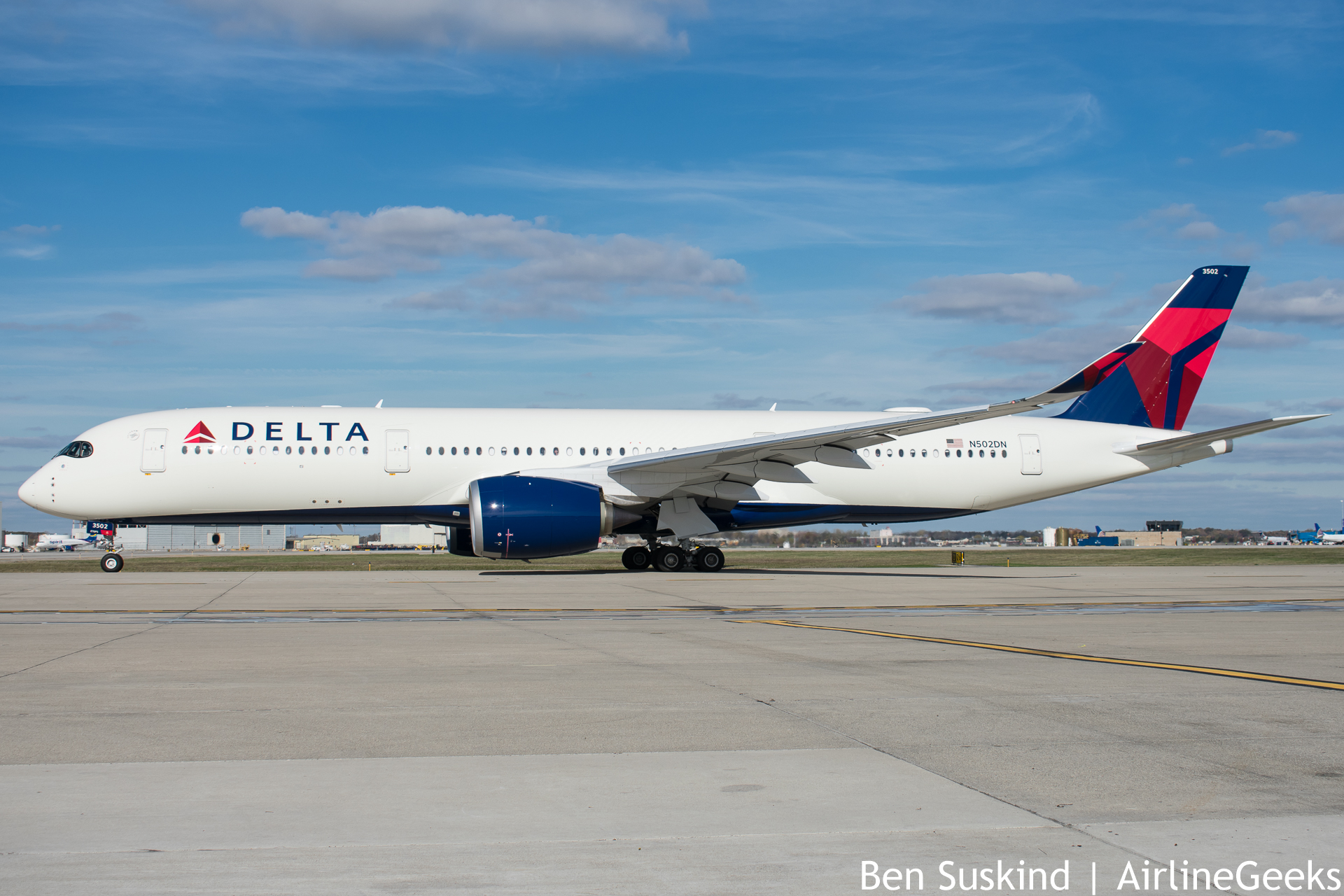
A Delta Connection CRJ-200 (Photo: AirlineGeeks | Joey Gerardi)
Atlanta-based Delta Air Lines has made it through the pandemic without starting a single tag route. Other airlines such as United, American, Alaska, and others combined destinations into a single flight to save costs during the pandemic due to severely light passenger loads. SkyWest under the United Express banner combined many smaller EAS communities into a single flight routing this past spring when the airline began to struggle with the pilot shortage. A tag flight is when an aircraft makes a stop in the first city and continues to the next.
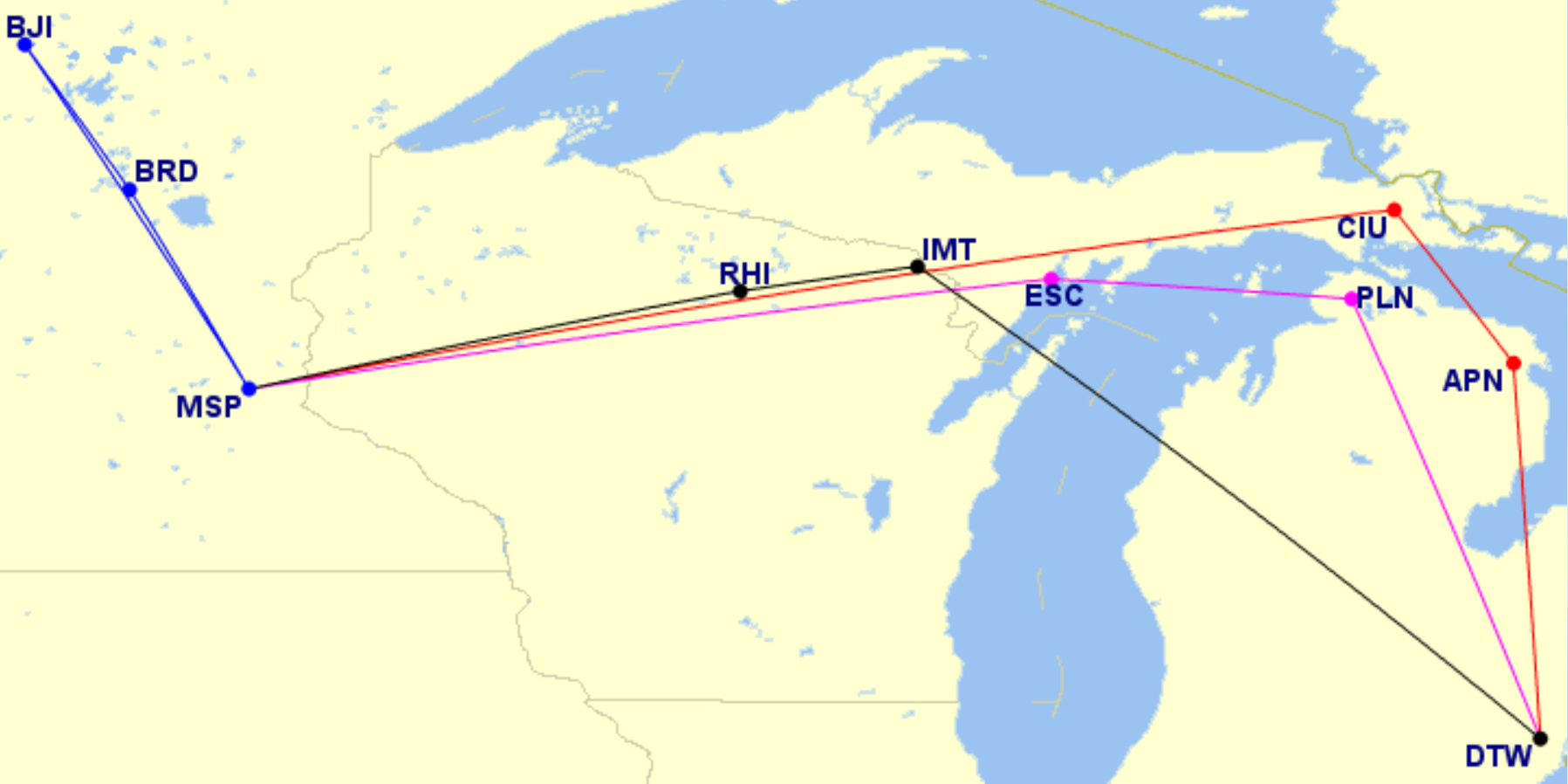
This all changes this coming Monday, Sept. 12, 2022, when SkyWest under the Delta Connection brand will begin its tag routes which will affect eight Essential Air Service communities; Pellston (PLN), Alpena (APN), Sault Ste. Marie (CIU), Iron Mountain (IMT), and Escanaba (ESC) all of which are in Michigan; Brainerd (BRD) and Bemidji (BJI) located in Minnesota, and Rhinelander (RHI) in Wisconsin.
All of the changes talked about in the previous article which can be viewed HERE are still in effect starting Sept. 12, 2022, but with one major change to the schedule, they will now only last for less than a month. Previously, the tag flights were planned to continue until at least January 2023 due to pilot shortages. The reason for this quick and drastic flight change is the communities, more specifically the people living there.
Escanaba, Mich., and Rhinelander, Wis. Airport managers, and town leaders in many of the communities wrote letters to the DOT and others saying how this change would greatly affect their communities and wouldn’t stand for it. The Rhinelander Airport Manager even went as far as saying, if SkyWest didn’t reinstate the original service pattern they would contact their senator and house representative to get the flights back.
The upsetting nature of the flight schedule can be seen from the airport’s point of view. Currently, each community is receiving two flights a day on 50-seat jets, but with the tag flights, they’d have to share the seat with other communities. This would give each community affected half the seats they normally do as they would be stopping en-route to pick up other passengers in other affected EAS communities.
SkyWest hear the complaints and did end up reinstating the original schedule for all of the communities and their not-so-tag flights. However, the communities will have to bite their tongues for roughly a month and learn to deal with the situation. The reinstatement of the original schedule doesn’t restart until Oct. 6, 2022. So, the communities mentioned above will have their very unique tag routing for just shy of a month, making it even rarer for those that do end up flying on any of the routes during this short period of time.
The service changes come Sept. 12, 2022 (Screenshot: GreatCircleMapper)
While complaining and threatening to call a senator does work apparently, the schedule doesn’t go back to 100% normality in October. Pellston, Alpena, Sault Ste. Marie and Iron Mountain will go back to their original nonstop flights in October, other than some timing differences. Escanaba will also go back to two nonstops a day, but instead of one flight a day to each Minneapolis and Detroit, they will be losing their Minneapolis flight and instead have twice daily to Detroit on most days. In addition, Escanaba will be losing their early morning departure and late night arrival flights, with the first departure now around 1 p.m. and the last arrival for the day around 6 p.m.
Brainerd and Bemidji in Minnesota will not be reverting to their nonstop flights in October. Bemidji’s early morning departure will still stop in Brainerd on the way to Minneapolis from October until at least December of 2022. Brainerd will still not be affected at all continuing to have two flights a day to Minneapolis.
The flight schedules do change again towards the end of the year, but given the ever-changing nature of the flight schedule, it is not mentioning them this far in advance.
All information in this article was obtained from Delta’s website or documents on Regulations.gov.
Joey has always been interested in planes for as long as he can remember. He grew up in Central New York during the early 2000s when US Airways Express turboprops ruled the skies. Being from a non-aviation family made it harder for him to be around planes and would only spend about three hours a month at the airport. He was so excited when he could drive by himself, the first thing he did with his driver's license was get ice cream and go plane spotting for the entire day. He graduated from Western Michigan University in 2022 with a B.S. in Aviation Management & Operations and a Minor in Business, and currently works for a major airline in his hometown.
An AtlasAir 747 at Kaneohe Bay. Photo: AirlineGeeks | Mike Mangano
Echoing off the Jurassic mountains of Hawaii’s Kaneohe Bay, the sound of jet engines filled the skies at last month’s ‘Blues on the Bay’ air show. Dormant since the pandemic, the Kaneohe Bay Air Show erupted back to life, offering aviation lovers of all backgrounds a chance to get up close and personal to a variety of private, commercial, and military aircraft. Extended hospitality from the Marine Corp Base Hawaii, AirlineGeeks was given the opportunity to witness the precision displays of the Blue Angels, incredible capabilities of the F22 Raptor, as well as some hidden gems from Hawaiian Airlines.
The event, held on the weekend of August 13 and 14, was a true eye-opener for this writer. While any air show will capture the eyes of those in attendance, the ‘Kay Bay’ air show – as many a local will call it – offered experiences that are unmatched in Australia (the home of this intrepid Airline Geek), attracting even an IMAX team. While most events down under will be highlighted by a single Hornet or Lightning, Kay Bay’s program was truly a non-stop exhibition of the most incredible and, more importantly, loud jet performances yet seen by this writer.
Getting to Kay Bay
Being the first time the Blue Angels have appeared at Kaneohe since 2015, anticipation was high among all in attendance, and the traffic certainly reflected this excitement. Having left the North Shore early, AirlineGeeks expected about a one-hour drive and a straightforward entry. As it turned out, it wasn’t quite that simple. It seemed that despite efforts to meet at the media tent at 8:30 a.m., we only managed to get a car park at 9:40 a.m.
As it was expected, large crowds had made the roads outside and inside the Marine Corps Base Hawaii a parking lot, moving slowly through the gates and to the car parking areas provided. In a style true of an international tourist, reliance on Google Maps led this writer straight in, and then straight out – was it really a right turn instead of a left? Evidently, no – it was a left indeed.
Eventually, and with the assistance of some friendly locals, the parking lot was eventually located. Before long, we were in line for entry. While we were unable to enter immediately, the very sight of the Blue Angels from the line was a thrill; this was a bucket list item that was about to get a huge tick. But from that point on, the day continued to improve.
Marine Hospitality
While waiting for entry to such an event can be tiresome, it seemed the excitement ahead meant that patience of many was missing in the ‘lost and yet to be found’ pile. Yet, it was the professionality of the Marines that captured this writer’s attention; a friendly demeanor somehow accompanied those who dared tame the more snappy of the crowd. With firm humor, the men and women guiding this mass contained their swells, focused on the single goal of delivering a safe and spectacular event.
We, for our part, were delighted to see aid approach in the form of a white light, edging closer and parting the sea of attendees waiting to gain entry. The light neared, and slowly defined itself: a white golf cart, dispatched for us by officer and gentleman First Lieutenant Mark McDonough. Having played an incredible part in organizing the air show, he and the COMMSTRAT team showed themselves cool and calm and collected this media team with true hospitality and personal care.
As we entered the gates, the crowds soon followed behind, but in the brief silence in between, we were tantalized by the closeup views of the many aircraft. The static displays were impressive: an entry garnished by Osprey, a Raptor and Falcon, a near-replica Magnum PI helicopter (not quite an MD500D, but looks pretty close), with a look ahead displaying an Atlas Air 747. We were warmly received at the media tent, greeted with professionalism and hospitality from the COMMSTRAT team – truly some of the most pleasant and polite people one could meet.
Reviewing the Program
Kaneohe Bay Air Show was well organized, and although there were some changes made to the program, the planning was so well executed that it would have been impossible to realize those changes unless one was privy to the details. Until the action in the air began around 11 am, AirlineGeeks – and all in attendance – could view and walk through some incredible machines.
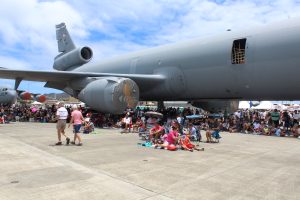
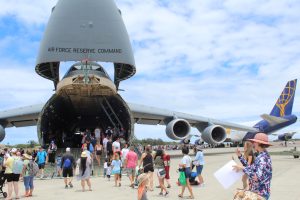
The intense heat demonstrated a new capability of this KC-10 Extender – a shady spot to sit. Photo: AirlineGeeks | Mike ManganoIt’s hard to comprehend the payload capacity of this C5 Galaxy. Photo: AirlineGeeks | Mike Mangano
This writer’s first time up close with most of the static displays, the sheer scale and size of the transport aircraft was hard to fathom. A walkthrough of a C-17 Globemaster reveals a true definition of logistical capability. Standing on the inside, it’s difficult to comprehend how an aircraft of its size and volume can deliver the performance it later demonstrated in its high angle of attack take-offs.
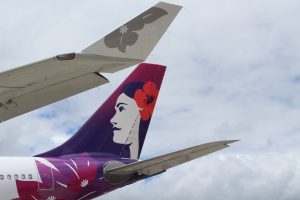
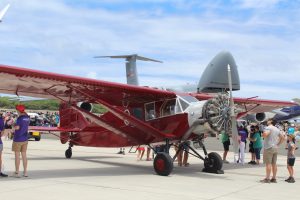
The next stop, of all the displays, was to a favorite of many an Airline Geek – the Hawaiian Airlines aircraft. Although it’s the immediate A330 that captures attention, there was a small, red gen hiding in its shadow: a 1929 Bellanca – Hawaiian’s first aircraft. A trusted source and Hawaiian Airlines pilot, Charlie Morris – who also flew an F-22 Raptor at the event – told AirlineGeeks the tale of its resurrection. The aircraft, once thought lost for all time, was miraculously found in someone’s front yard in the middle of nowhere. Now, with restored trims and polished timber on the inside, she sat parked next to the newest of Hawaiian’s fleet. It was an incredible opportunity – a trip through time – that few airlines could exhibit.
It wouldn’t be an Hawaiian air show without Hawaiian Airlines. Photo: AirlineGeeks | Mike ManganoA heavily restored 1929 Bellanca, Hawaiian Airlines (formerly Inter Island Airways Hawaii) first aircraft. Photo: AirlineGeeks | Mike Mangano
As the crowd’s heads pitched upward to the wings above, we were awarded an incredible display of technological wonder and precision piloting. The maneuverability of the Falcon is an impressive sight – evidence of a highly advanced design that hasn’t aged. But of greater awe by far was the Raptor, flown (for the single-ship demonstration) by Cabo Gunderson, the official F22 Demonstration Team pilot.
Most importantly for the viewer, it’s loud. Very loud. Its performance capabilities are even more incredible. While the Blue Angels in their Hornets are a sight to behold, the agility of a Raptor is second to none. With its thrust vectoring capability, one stands in awe as it defies the laws most airplanes are governed by. The Raptor demonstrated its ability to pitch at angles and rates that would leave the Wright brothers lost for words. Rotating in the air while apparently still, its mighty engines were close to shattering ear drums, with the acoustics reflecting off the nearby mountains to amplify the sound. Don’t be misled – the Raptor is a serious aircraft with serious performance, capable of reaching Mach 2.0 without afterburners being engaged. The highlight of this show was, for this writer, the head-spinning wonder of the Raptor.
An F-22 Raptor, flown by the F-22 Raptor Demo Team, but borrowed from elsewhere. Photo: AirlineGeeks | Mike Mangano
Having previously mentioned the C-17 Demonstration Team, which proved that there is far more to an exciting air show than speed alone, the Ospreys helped define versatility as they flew into view like a plane, and then landed like a helicopter.
About 2 p.m., a shift in uniform color became visible on the apron as the Blue Angels made their much-anticipated appearance. For this writer, having never yet witnessed the US Navy’s display team, the iconic diamond flight lives up to all the expectations. The incredible teamwork, professionalism, and precision are not lost on the spectator; each pilot maintains extremely tight formation despite high-speed and high-G turns without any sort of G-suit.
US Navy Blue Angels F/A-18 Hornets at Kaneohe Bay. Photo: AirlineGeeks | Mike ManganoUS Navy Blue Angels F/A-18 Hornets at Kaneohe Bay. Photo: AirlineGeeks | Mike ManganoUS Navy Blue Angels F/A-18 Hornets at Kaneohe Bay. Photo: AirlineGeeks | Mike Mangano
Although it would be a lie to say the near hour-long display did not impress, one is left with an appreciation of what teamwork and personal commitment can result in, and that really is the purpose. The aviator is only the arrowhead, the most visible part of a team committed to nothing short of perfection, unafraid to learn from mistakes and support each other. The crew on the ground are uniform in both action and thought, and to witness their work is to have seen the definition of synchronize. It truly is inspiring, and leave little wonder as to why an IMAX attended the air show themselves (did we mention they are producing an IMAX Blue Angels film?).
Closing Time
The saddest time was, of course, the closure of the gates. In a bid to avoid the heavy traffic, we decided to linger around, taking advantage of the opportunity to grab a hotdog and chat with those who decided to do the same. It was during this time we met some incredible aviators, such as the aforementioned Charlie Morris, and networked with an international community of AvGeeks. As Test Pilot Mark Jones Jr. once told me, “AvGeek is a language we all speak.” This writer (and surely the reader) knows this to be true.
Waiting in the traffic afforded another unexpected surprise – the chance to chat with the Marines based in Hawaii. As the conversations ensued, this writer clearly felt the deep sense of commitment of these men and women, as well as the volunteers assisting the crowds, and it’s only at this point that one comprehends the magnitude of what makes the Kay Bay Air Show so successful.
The August Air Show at Kaneohe Bay was an event unique. With a backdrop of magnificent mountains, the smell of avgas, and a touch of Hawaiian sun, Kaneohe Bay Air Show is more than an air show – it is a demonstration of commitment, of impeccably engineered flying machines, an industrious spirit of a committed team, and the integration of so many aviation and defense sectors that delivered seamlessly. Kay Bay is nothing less than the essence of high performance.
Mike’s love affair with flight and mechanical objects in the sky began at an early age, fascinated by space documentaries and the vintage Flight Simulator ’95. He currently works as an instructor for UAVs and is training to receive his Private Pilot Licence with the goal of working in manned flight instruction. An avid reader of all things aviation and manned space flight, Mike stays close to developments in aerospace while reminiscing and sharing the rich history of flight with others. He loves writing, engineering and science.
Earlier this week, Virgin Atlantic revealed images on Twitter of its freshly painted Airbus A330neo. The highly anticipated aircraft is just one of the carrier’s 16 Airbus A330-900s firm orders that were placed during the 2019 Paris Airshow. The new aircraft in Virgin Atlantic’s fleet is expected to enter service on Oct. 12 at Boston’s Logan International Airport.
By the end of this year, Virgin Atlantic will take delivery of three widebody aircraft — with the remaining aircraft being delivered through 2026.
The aircraft rolled out of Airbus’s paint shop in Toulouse, France and sported the signature red and white Virgin color palette. The company named this particular plane Billie Holiday, an ode to the late American jazz and swing music singer.
The A330neo looks to replace the carrier’s older A330-300 aircraft. The aircraft will be an important player in the carrier’s initiative for net-zero emissions by 2050. The Neo will reduce carbon emissions by 11 percent as well as reduce noise emissions by 50 percent through the utilization of its Rolls Royce Trent 7000 engines.
“The A330neo plays a significant role in our multi-billion dollar fleet transformation, demonstrating our commitment to the planet,” Virgin’s Chief Customer and Operating Officer, Corneel Koster, said. “We know the most impactful thing we can do as an airline is to fly the cleanest, greenest, youngest fleet possible and the A330neo is integral to achieving this goal. It’s truly a plane for the future.”
Virgin Atlantic’s A330neo utilizes a 262-passenger, three-class cabin configuration. This includes Economy, Premium, and Upper Class.
Starting in the back of the aircraft, Virgin’s Economy class consists of 184 seats in a 2-4-2 configuration. Passengers can enjoy a 17.9-inch seat width with 31-34 inches of seat pitch. Installed in each seat-back is a 13.3-inch entertainment screen, which the company prides itself in for being the largest screen ever seen in an economy cabin.
The Premium Class section is located in front of the airline’s Economy class. The layout includes 46 seats in a 2-3-2 configuration. Premium seats have 18.5 inches of seat width and up to 38 inches of pitch allowing customers a little more legroom. Passengers also have access to an in-seat wireless charging pad.
Another popular feature is the entertainment screen’s ability to connect to passengers’ headphones via Bluetooth. The pinnacle of Virgin Atlantic’s new aircraft is its Upper Class or business class cabin. Here you can find 32 seats that each utilize private doors — creating a much more private experience for the guest.
The Upper Class cabin includes two executive “Retreat” suites. According to the airline, it is their “most spacious” suite, which contains a 6 ft 7-inch seat that doubles as a fully lie-flat bed. The suite contains a 27-inch touchscreen.
Another selling point of the new aircraft is The Loft, a space for passengers to socialize within the Upper Class. The Loft provides enough space for eight people to stand or sit comfortably. The Loft contains four lounge-style seats and allows guests to sit and chat or enjoy refreshments from a self-service fridge and drinks dispenser. The airline’s strong attention to detail is what helps the U.K. carrier stand apart from its competitors.
“We care about every detail of the cabin design and every step of our customer’s journey,” Koster added. “We’re proud to unveil our state-of-the-art A330neo and show the evolution of our customer experience, with each of our customers receiving a premium experience regardless of the cabin they travel in.”
Chase Hagl grew up in Twin Falls, Idaho. His love and passion for Aviation landed him in Orem, Utah where he obtained a B.S. in Aviation Management with a minor in Business Management from Utah Valley University. Chase currently works as a flight attendant in Charleston, SC and is also the primary Inflight ASAP ERC representative for startup airline, Breeze Airways. His experience in the aviation industry spans back four years, working in areas including agriculture application, customer service, maintenance, and flight ops. In his free time, Chase enjoys road biking, astronomy, and flying.
Hit By Russian Airspace Closure, Finnair Unveils New Profitability Strategy
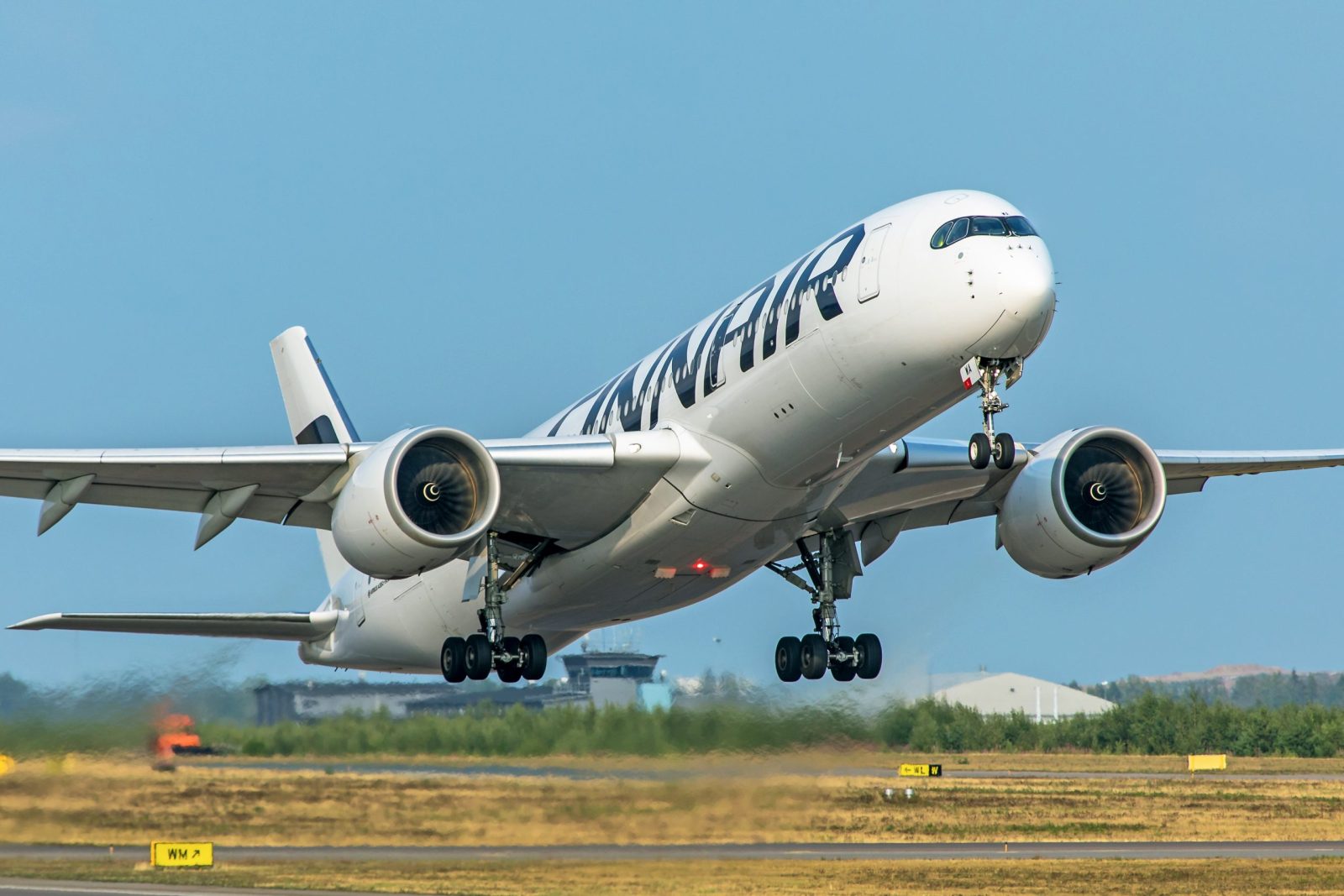
A Finnair A350 takes off.
(Photo: AirlineGeeks | William Derrickson)
Finnair will introduce a new corporate strategy aimed at restoring profitability, the Finnish airline said in a statement today. According to the text, “the weight of the different markets in the business is changing,” requiring a major structural overhaul to maintain competitiveness.
“Our operating environment has changed dramatically this year in the wake of the war in Ukraine and the subsequent closure of Russian airspace,” the company has stated earlier in the previous weeks. For years, Finnair’s strategy has relied heavily on connecting Europe and Asia via northern routes, which reduce travel times considerably.
However, the current impossibility to fly over the airspace affects almost all European airlines. As a result, many operators have had to choose to re-route or cancel services. Finnair’s routes between Helsinki (located further north than most European terminals with direct services to Asia and close to the Finnish-Russian border) and the Far East were modified.
Flights now follow more southerly routes. For that reason, and depending on the final destination, they will take around two or more hours longer than the usual route further north, which involves flying over Siberia. The longer operations have an impact on fuel costs and thus result in lower profitability.
Topi Manner, the company’s CEO, said, “The changes in our operating environment require a new strategy and significant renewal of Finnair, especially related to costs.” As a result, the airline will seek to achieve mid-term operating profit levels comparable to those recorded in 2019 based on measures to optimise its operations.
The New Corporate Strategy
• A more geographically balanced network connecting Europe with North America, Asia, India and the Middle East through the airline’s hub at Helsinki-Vantaa Airport (HEL), in addition to a strengthened domestic and regional offering.
• Reducing and optimising the fleet.
• Strengthening unit revenues through improved digital offerings and more competitive products.
• Leveraging the company’s partnerships with other operators, and especially its membership of the Oneworld alliance, to strengthen the network offering and diversify the products available to customers.
• The reduction of unit costs by approximately 15% compared to 2019 levels, excluding fuel costs. The sharp increase in fuel prices this year affected the aviation industry as a whole.
Review of Staff Conditions and Operating Procedures
According to Finnair, «the support of all key stakeholder groups is needed» in order to achieve the planned results. In that sense, they assured that the implementation of the new corporate strategy will include the reduction of costs associated with its staff.
According to the statement, the company will initiate discussions with employees on possible adjustments to working conditions and evaluate additional measures. These include the possible outsourcing of cabin service on specific routes and of certain operational activities, as well as actions to improve the efficiency of shared functions.
On the other hand, savings in other aspects of the operation will be sought through new contract negotiations with suppliers, structural changes in operations and optimisation of in-house facilities, according to the company.
However, the Finnair has not yet provided further details on the measures to be implemented in each area.
Editor’s Note: This article was written by Agustín Miguens for Aviacionline.
Parker joined AirlineGeeks as a writer and photographer in 2016, combining his longtime love for aviation with a newfound passion for journalism. Since then, he’s worked as a Senior Writer before becoming Editor-in-Chief of the site in 2020. Originally from Dallas and an American frequent flyer, he left behind the city’s rich aviation history to attend college in North Carolina, where he’s studying economics.
Hit By Western Sanctions, Aeroflot Signs Letter of Intent for 339 Aircraft with UAC
An Aeroflot Sukhoi Superjet 100 at Dresden Airport in Germany. (Photo: AirlineGeeks | Fangzhong Guo)
Confirming what had been announced a couple of weeks ago, Aeroflot and United Aircraft Corporation (UAC) signed a letter of intent on Wednesday for the delivery of 339 Russian-made aircraft by 2030.
This was done at the Easter Economic Forum in Vladivostok and reported by the official TASS news agency.
The order comprises 210 Irkut MC-21s, 89 Sukhoi Superjet SSJ100s and 40 Tu-214 aircraft, with deliveries starting from 2023 with two SSJs, to be followed by six MC-21s and seven Tu-214s in 2024.
According to Russian Industry and Trade Minister Denis Manturov, the total value of the contract would be more than one trillion rubles, around $16 billion, an unprecedented figure in Russian history.
In practice, Aeroflot has two ways to finance this plan: seek new funds from its main shareholder, the Russian government, or go to the market, the former being the best option in the face of huge uncertainty about the company’s cash flow after Western sanctions hit Russian aviation hard.
Another challenge will be to get manufacturers to increase their production rate, as currently only a few units a year are produced.
A Move to Russia
Aeroflot’s turn to Russian companies for new aircraft is likely as much out of necessity as a desire to support other Russian companies. As a result of sanctions brought against Russia and local corporations by dozens of countries around the world, major aircraft manufacturers like Boeing and Airbus are forbidden from selling new aircraft, parts and other services to the company.
In addition, potential lessors aren’t able to provide aircraft to carriers either. (Some have even put substantial effort into repossessing aircraft that were being leased to airlines in Russia before it invaded Ukraine.)
As the nation’s flag carrier, Aeroflot’s nod to Irkut, Sukhoi and Tupolev may be as much of a signal — showing how Russia plans to get by without a dependence on other countries’ exports — as it is filling one of the airline’s needs.
The specific timeline for these orders is still unclear.
Editor’s Note: A portion of this article was written by Edgardo Gimenez Mazó for Aviacionline.
Parker joined AirlineGeeks as a writer and photographer in 2016, combining his longtime love for aviation with a newfound passion for journalism. Since then, he’s worked as a Senior Writer before becoming Editor-in-Chief of the site in 2020. Originally from Dallas and an American frequent flyer, he left behind the city’s rich aviation history to attend college in North Carolina, where he’s studying economics.
Sign-up for newsletters & special offers!
Get the latest stories & special offers delivered directly to your inbox